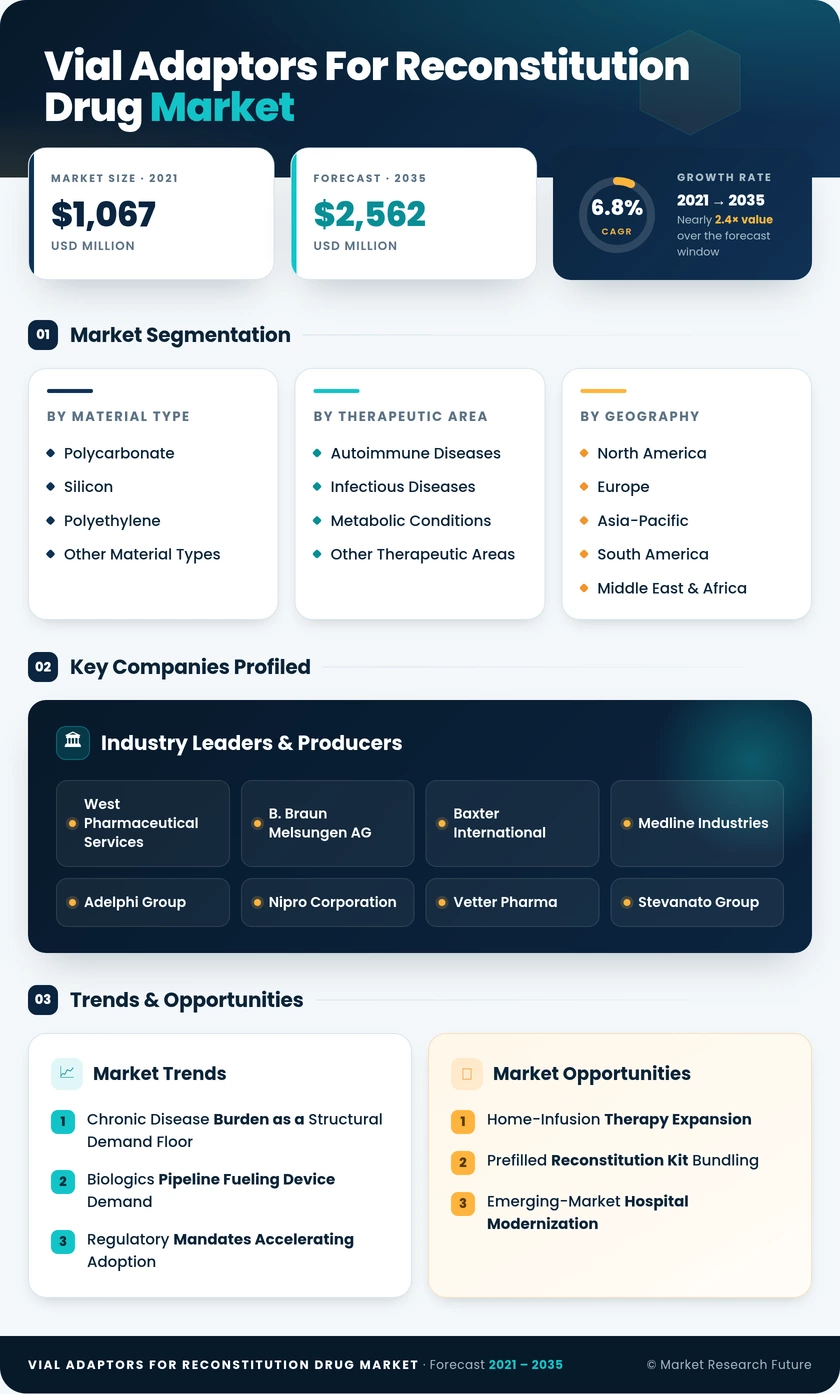
Vial Adaptors for Reconstitution Drug Market

ID: MRFR/Pharma/38185-HCR
100 Pages
Rahul Gotadki
Last Updated: June 24, 2026
Vial Adaptors for Reconstitution Drug Market Research Report By Application (Oncology, Autoimmune Diseases, Infectious Diseases, Genetic Disorders, Hormonal Replacement), By Material Type (Plastic, Glass, Rubber, Silicone, Metal), By Product Type (Single-Use Vial Adaptors, Multi-Use Vial Adaptors, Customized Vial Adaptors), By End Use (Pharmaceutical Companies, Contract Manufacturing Organizations, Research Institutions, Hospitals, Retail Pharmacies) and By Regional (North America, Europe, South America, Asia-Pacific, Middle East and Africa) - Growth & Industry Forecast 2025 To 2035
Download PDF ×

We do not share your information with anyone. However, we may send you emails based on your report interest from time to time. You may contact us at any time to opt-out.

Vial Adaptors for Reconstitution Drug Market

Market Size

Forecast Period2026-2035
CAGR (2026-2035)6.8%
2025 Market SizeUSD 1,327.0 Million
2035 Market SizeUSD 2,562.0 Million

Key Players

West Pharmaceutical Services
B. Braun Melsungen AG
Baxter International
Medline Industries
Adelphi Group
Nipro Corporation
Opportunities
  • Home-Infusion Therapy Expansion
  • Prefilled Reconstitution Kit Bundling
  • Emerging-Market Hospital Modernization
  1. 1 Market Overview |
    1. 1.1 Study Assumptions & Market Definition |
    2. 1.2 Scope of the Study |
    3. 1.3 Research Methodology
  2. 2 Market Summary & Key Takeaways
  3. 3 Market Dynamics |
    1. 3.1 Market Drivers Analysis | |
      1. 3.1.1 Rising Chronic Disease Prevalence | |
      2. 3.1.2 Biologics and Biosimilar Pipeline Expansion | |
      3. 3.1.3 Regulatory Enforcement of Hazardous Drug Handling | |
      4. 3.1.4 Aging Global Population | |
      5. 3.1.5 Oncology Incidence Escalation | |
      6. 3.1.6 Hospital Infection-Control Investment | |
      7. 3.1.7 Home-Infusion Therapy Adoption |
    2. 3.2 Market Restraints Analysis | |
      1. 3.2.1 High Per-Unit Cost vs. Conventional Syringes | |
      2. 3.2.2 Limited Clinician Training on Closed Systems | |
      3. 3.2.3 Reimbursement Gaps for Device-Aided Reconstitution | |
      4. 3.2.4 Regulatory Fragmentation Across Jurisdictions | |
      5. 3.2.5 Raw-Material Supply-Chain Disruptions |
    3. 3.3 Market Opportunity Analysis | |
      1. 3.3.1 Home-Infusion Therapy Expansion | |
      2. 3.3.2 Prefilled Reconstitution Kit Bundling | |
      3. 3.3.3 Emerging-Market Hospital Modernization | |
      4. 3.3.4 Digital Integration and Smart Adaptor Platforms | |
      5. 3.3.5 Sustainability-Driven Material Innovation |
    4. 3.4 Industry Value Chain Analysis |
    5. 3.5 Porter's Five Forces Analysis
  4. 4 Global Vial Adaptors for Reconstitution Drug Market Size & Forecast (2021–2035) |
    1. 4.1 Historical Market Size (2021–2025) |
    2. 4.2 Current & Forecast Market Size (2026–2035) |
    3. 4.3 Market Size by Revenue (USD Million) |
    4. 4.4 Year-over-Year Growth Analysis
  5. 5 Segmentation Analysis |
    1. 5.1 By Material Type | |
      1. 5.1.1 Polycarbonate | |
      2. 5.1.2 Silicon | |
      3. 5.1.3 Polyethylene | |
      4. 5.1.4 Other Material Types |
    2. 5.2 By Therapeutic Area | |
      1. 5.2.1 Autoimmune Diseases | |
      2. 5.2.2 Infectious Diseases | |
      3. 5.2.3 Metabolic Conditions | |
      4. 5.2.4 Other Therapeutic Areas
  6. 6 Regional Analysis |
    1. 6.1 North America | |
      1. 6.1.1 United States | |
      2. 6.1.2 Canada | |
      3. 6.1.3 Mexico |
    2. 6.2 Europe | |
      1. 6.2.1 Germany | |
      2. 6.2.2 United Kingdom | |
      3. 6.2.3 France | |
      4. 6.2.4 Italy | |
      5. 6.2.5 Spain | |
      6. 6.2.6 Nordic Countries | |
      7. 6.2.7 Russia | |
      8. 6.2.8 Rest of Europe |
    3. 6.3 Asia-Pacific | |
      1. 6.3.1 China | |
      2. 6.3.2 India | |
      3. 6.3.3 Japan | |
      4. 6.3.4 South Korea | |
      5. 6.3.5 ASEAN | |
      6. 6.3.6 Rest of Asia-Pacific |
    4. 6.4 South America | |
      1. 6.4.1 Brazil | |
      2. 6.4.2 Argentina | |
      3. 6.4.3 Rest of South America |
    5. 6.5 Middle East & Africa | |
      1. 6.5.1 Saudi Arabia | |
      2. 6.5.2 UAE | |
      3. 6.5.3 South Africa | |
      4. 6.5.4 Egypt | |
      5. 6.5.5 Rest of MEA
  7. 7 Competitive Landscape |
    1. 7.1 Market Share Analysis (2025) |
    2. 7.2 Competitive Benchmarking Matrix |
    3. 7.3 Company Profiles | |
      1. 7.3.1 Becton, Dickinson and Company | |
      2. 7.3.2 West Pharmaceutical Services | |
      3. 7.3.3 B. Braun Melsungen AG | |
      4. 7.3.4 Baxter International | |
      5. 7.3.5 Medline Industries | |
      6. 7.3.6 Adelphi Group | |
      7. 7.3.7 Nipro Corporation | |
      8. 7.3.8 Vetter Pharma | |
      9. 7.3.9 Stevanato Group | |
      10. 7.3.10 Gerresheimer AG
  8. 8 Future Outlook & Strategic Recommendations (2026–2035) |
    1. 8.1 AI-Enabled Reconstitution Workflow Automation |
    2. 8.2 Personalized Medicine and Dose-Specific Reconstitution |
    3. 8.3 Cell and Gene Therapy Preparation Requirements |
    4. 8.4 Sustainability and Circular-Economy Pressures
  9. 9 Recent Developments & News
  10. 10 Frequently Asked Questions (FAQs)
  11. 11 Report Scope & Methodology |
    1. 11.1 Study Period & Base Year |
    2. 11.2 Data Sources & Citations |
    3. 11.3 Abbreviations
  12. 12 LIST OF TABLES |
  13. TABLE 1 Global Vial Adaptors for Reconstitution Drug Market Size & Forecast, by Revenue (USD Million), 2021–2035 |
  14. TABLE 2 Global Market — Year-over-Year Growth Analysis, 2021–2035 |
  15. TABLE 3 Driver Impact Analysis, 2026–2035 |
  16. TABLE 4 Restraints Impact Analysis, 2026–2035 |
  17. TABLE 5 Regional Market Summary, 2025 |
  18. TABLE 6 North America Market Size, by Country, 2021–2035 (USD Million) |
  19. TABLE 7 Europe Market Size, by Country, 2021–2035 (USD Million) |
  20. TABLE 8 Asia-Pacific Market Size, by Country, 2021–2035 (USD Million) |
  21. TABLE 9 South America Market Size, by Country, 2021–2035 (USD Million) |
  22. TABLE 10 Middle East & Africa Market Size, by Country, 2021–2035 (USD Million) |
  23. TABLE 11 Market Size, by Material Type, 2021–2035 (USD Million) |
  24. TABLE 12 Market Size, by Therapeutic Area, 2021–2035 (USD Million) |
  25. TABLE 13 Competitive Benchmarking Matrix — Global Market, 2025 |
  26. TABLE 14 Company Profiles — Key Players |
  27. TABLE 15 Recent Developments & Strategic Announcements, 2023–2025 |
  28. TABLE 16 Report Scope & Methodology Summary |
  29. TABLE 17 Detailed Sources and Citations
  30. 13 LIST OF FIGURES |
  31. FIGURE 1 Market Dynamics — Drivers, Restraints, and Opportunities |
  32. FIGURE 2 Value Chain Analysis — Vial Adaptors for Reconstitution Drug Market |
  33. FIGURE 3 Porter's Five Forces Analysis |
  34. FIGURE 4 Global Market Size Trend (USD Million), 2021–2035 |
  35. FIGURE 5 Market Share by Material Type (%), 2025 |
  36. FIGURE 6 Market Share by Therapeutic Area (%), 2025 |
  37. FIGURE 7 Regional Market Share (%), 2025 |
  38. FIGURE 8 North America Country-Level Share (%), 2025 |
  39. FIGURE 9 Europe Country-Level Share (%), 2025 |
  40. FIGURE 10 Asia-Pacific Country-Level Share (%), 2025 |
  41. FIGURE 11 South America Country-Level Share (%), 2025 |
  42. FIGURE 12 Middle East & Africa Country-Level Share (%), 2025 |
  43. FIGURE 13 Competitive Landscape — Market Concentration Chart

Segmentation Quick Reference

DimensionSub-SegmentsDominant SegmentFastest Growing Segment
Material TypePolycarbonate, Silicon, Polyethylene, Other Material TypesPolycarbonate (~42% share)Polyethylene (7.9% CAGR)
Therapeutic AreaAutoimmune Diseases, Infectious Diseases, Metabolic Conditions, Other Therapeutic AreasAutoimmune Diseases (~34% share)Infectious Diseases (7.3% CAGR)
GeographyNorth America, Europe, Asia-Pacific, South America, Middle East & AfricaNorth America (38% share)Asia-Pacific (8.4% CAGR)


Market Segmentation Overview

By Material Type

Sub-SegmentKey Trend
PolycarbonateSustained demand from hazardous drug handling compliance mandates in hospital pharmacies
SiliconPreferred for elastomeric seal integrity in high-potency API reconstitution
PolyethyleneCost-driven adoption accelerating across emerging-market hospital networks
Other Material TypesNiche applications including glass-filled polymers and bio-based composites


Polycarbonate adaptors remain the material of choice for cytotoxic drug reconstitution across developed markets, while polyethylene variants are gaining rapid traction in price-sensitive healthcare systems. Material innovation — particularly bio-polycarbonate and recycled-content polymers — is expected to reshape competitive positioning through 2035 as healthcare sustainability mandates intensify.

By Therapeutic Area

Sub-SegmentKey Trend
Autoimmune DiseasesBiologic prescribing growth for RA, MS, and IBD sustaining high adaptor volumes
Infectious DiseasesAntimicrobial stewardship programs mandating standardized reconstitution protocols
Metabolic ConditionsInsulin and GLP-1 agonist preparation driving steady utilization
Other Therapeutic AreasRare disease biologics and transplant immunosuppressants expanding niche demand


The autoimmune disease segment generates the highest absolute revenue, driven by the global proliferation of biologic disease-modifying therapies. Infectious disease applications are growing fastest as WHO-endorsed antimicrobial stewardship programs push hospitals to adopt standardized, device-aided reconstitution for IV antibiotics and antifungals across critical-care settings.