
Request Free Sample ×

Kindly complete the form below to receive a free sample of this Report

* Please use a valid business email

Leading companies partner with us for data-driven Insights

clients tt-cursor
Hero Background
English
Chinese
French
Japanese
Korean
German
Spanish

Vegetable Oil Market Size

ID: MRFR/FnB/5501-HCR
128 Pages
Snehal Singh
April 2026

Vegetable Oil Market Size, Share, Industry Trend & Analysis Research Report By Type (Palm Oil, Soybean Oil, Sunflower Oil, Canola Oil, Groundnut Oil), By Application (Food Industry, Biofuels, Cosmetics, Pharmaceuticals), By Source (Edible Oils, Non-Edible Oils), By Processing Method (Refined, Unrefined, Cold-Pressed, Expeller-Pressed) and By Regional (North America, Europe, South America, Asia Pacific, Middle East and Africa) - Forecast to 2035

Share:
Download PDF ×

We do not share your information with anyone. However, we may send you emails based on your report interest from time to time. You may contact us at any time to opt-out.

Vegetable Oil Market Infographic
Purchase Options

Vegetable Oil Size

Vegetable Oil Market Growth Projections and Opportunities

Numerous variables interact to form the dynamics of the vegetable oil market, which in turn reacts to customer preferences, economic situations, and worldwide trends. The agricultural landscape and oilseed cultivation are two important factors. The availability of crops like canola, soybeans, palm, sunflower, and rice has a direct effect on how much vegetable oil is produced. The market as a whole is impacted by weather patterns, pest management strategies, and agricultural technological developments that are critical to maintaining a steady and adequate supply of raw materials. The dietary trends and consumer tastes have a major role in the market variables of the vegetable oil sector. Demand for oils thought to be more heart-healthy—like olive oil—has increased as people prioritize leading healthier lives. Furthermore, there is a growing market for oils with less saturated fat as a result of the move away from trans fats. Vegetable oils are essential components of many processed foods and are thus widely used in cooking and food preparation, making them a mainstay in contemporary diets. Key variables of the vegetable oil market include economic factors at the regional and global levels. Vegetable oil prices are affected by fluctuations in commodity prices, which are impacted by trade regulations, currency rates, and geopolitical events. These fluctuations also have an effect on production costs. Consumer expenditure on edible oils is also influenced by economic stability, income levels, and purchasing power; during economic downturns, consumer behavior may shift in favor of less expensive products. The industrial structure and competitive environment play a crucial role in determining the vegetable oil market. The sector is characterized by the coexistence of regional and global firms. Companies spend in R&D for product innovation due to intense competition, concentrating on aspects like flavor, nutritional content, and packaging. Leaders in the industry frequently get into strategic alliances and acquisitions to bolster their market positions and diversify their product lines.

Vegetable Oil Market Size Graph
Author
Author Profile
Snehal Singh
Manager - Research

High acumen in analyzing complex macro & micro markets with more than 6 years of work experience in the field of market research. By implementing her analytical skills in forecasting and estimation into market research reports, she has expertise in Packaging, Construction, and Equipment domains. She handles a team size of 20-25 resources and ensures smooth running of the projects, associated marketing activities, and client servicing.

Leave a Comment

FAQs

What is the current valuation of the Vegetable Oil Market in 2025?

<p>The Vegetable Oil Market is valued at approximately 187.67 USD Billion in 2024.</p>

What is the projected market size for the Vegetable Oil Market by 2035?

<p>The market is expected to reach a valuation of 251.3 USD Billion by 2035.</p>

What is the expected CAGR for the Vegetable Oil Market during the forecast period 2025 - 2035?

<p>The expected CAGR for the Vegetable Oil Market during the forecast period 2025 - 2035 is 2.69%.</p>

Which segment of the Vegetable Oil Market has the highest valuation in 2024?

<p>In 2024, the Edible Oils segment holds the highest valuation at approximately 120.0 USD Billion.</p>

What are the projected valuations for Palm Oil and Soybean Oil by 2035?

<p>By 2035, Palm Oil is projected to reach 95.0 USD Billion, while Soybean Oil is expected to reach 55.0 USD Billion.</p>

Which companies are considered key players in the Vegetable Oil Market?

<p>Key players in the Vegetable Oil Market include Cargill, Archer Daniels Midland, Bunge, and Wilmar International.</p>

What is the valuation range for the Biofuels application segment in 2024?

<p>The Biofuels application segment is valued between 30.0 and 40.0 USD Billion in 2024.</p>

How does the valuation of Non-Edible Oils compare to Edible Oils in 2024?

<p>In 2024, Non-Edible Oils are valued at approximately 67.67 USD Billion, compared to Edible Oils at 120.0 USD Billion.</p>

What is the projected valuation for the Refined processing method by 2035?

<p>The Refined processing method is projected to reach a valuation of 135.0 USD Billion by 2035.</p>

What is the expected growth trend for the Vegetable Oil Market in the coming years?

<p>The Vegetable Oil Market is likely to experience steady growth, with a projected CAGR of 2.69% from 2025 to 2035.</p>

Market Summary

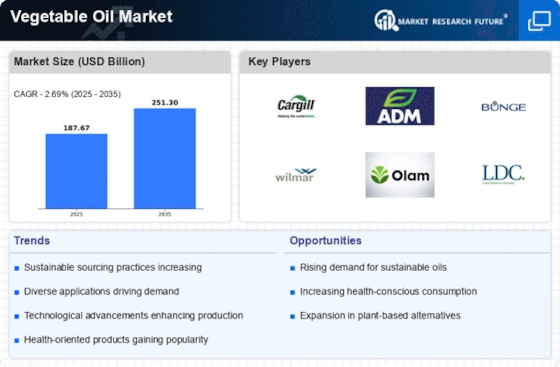
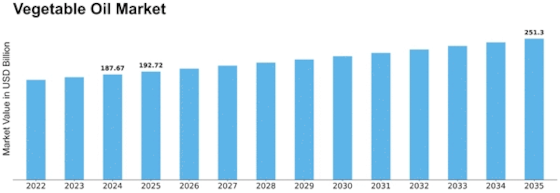
As per Market Research Future analysis, the Vegetable Oil Market Size was estimated at 187.67 USD Billion in 2024. The Vegetable Oil industry is projected to grow from 192.71 USD Billion in 2025 to 251.3 USD Billion by 2035, exhibiting a compound annual growth rate (CAGR) of 2.69% during the forecast period 2025 - 2035

Key Market Trends & Highlights

The Vegetable Oil Market is experiencing a dynamic shift towards health-conscious and sustainable practices.

  • Health-conscious consumers are increasingly favoring vegetable oils due to their perceived health benefits. Sustainability and ethical sourcing are becoming pivotal in shaping consumer preferences, particularly in North America. Palm oil remains the largest segment, while soybean oil is witnessing rapid growth, especially in the Asia-Pacific region. The growing demand for biofuels and culinary trends favoring plant-based diets are driving market expansion.

Market Size & Forecast

2024 Market Size 187.67 (USD Billion)
2035 Market Size 251.3 (USD Billion)
CAGR (2025 - 2035) 2.69%
Largest Regional Market Share in 2024 Asia Pacific

Major Players

Cargill (US), Archer Daniels Midland (US), Bunge (US), Wilmar International (SG), Olam International (SG), Louis Dreyfus Company (NL), Sime Darby Plantation (MY), Musim Mas (ID), IOI Corporation (MY)<br>These companies account for a substantial vegetable oil market share across global regions.

Market Trends

The vegetable oil market is currently experiencing a dynamic phase characterized by evolving consumer preferences and increasing demand for healthier cooking alternatives. As awareness regarding health and nutrition rises, consumers are gravitating towards oils that are perceived as beneficial, such as olive and avocado oils. This shift is prompting manufacturers to innovate and diversify their product offerings, thereby enhancing competition within the vegetable oils market. Furthermore, sustainability concerns are becoming more pronounced, with consumers favoring products that are sourced responsibly and produced with minimal environmental impact.

In addition to health consciousness, the vegetable oil market is also witnessing a surge in demand for plant-based oils driven by the growing popularity of vegan and vegetarian diets. This trend is reshaping culinary practices and expanding opportunities within the dairy free vegetable oils market. Overall, the vegetable oil market is poised for continued evolution, reflecting broader societal shifts towards health, sustainability, and dietary inclusivity.

Health-Conscious Choices

Consumers are increasingly prioritizing health in their dietary selections, leading to a rise in demand within the vegetable oil market for oils rich in omega fatty acids and antioxidants. This trend is prompting manufacturers to focus on producing oils that offer health benefits, such as those rich in omega fatty acids and antioxidants.

Sustainability and Ethical Sourcing

There is a growing emphasis on sustainability within the vegetable oil market, influencing sourcing strategies and production methods across the vegetable oils market. This shift is influencing production practices and encouraging companies to adopt more sustainable methods.

Rise of Plant-Based Oils

The popularity of plant-based diets is driving demand across the vegetable oil market, particularly supporting growth in the dairy free vegetable oils market as consumers shift away from animal-based fats. This trend is reshaping product offerings, with companies exploring innovative blends and formulations to meet the needs of health-conscious individuals. The global vegetable oil market growth is being driven by increasing health consciousness, a shift toward plant‑based diets, and expanding applications in food processing and renewable energy sectors. Consumption trends reveal that vegetable oils remain essential in culinary and industrial uses, with producers responding to demand for healthier, sustainably sourced oils and diverse product profiles across regions.

Vegetable Oil Market Market Drivers

Growing Demand for Biofuels

The rising demand for biofuels is emerging as a significant driver in the Vegetable Oil Market. As countries strive to reduce their carbon footprints and transition to renewable energy sources, vegetable oils are increasingly being utilized as feedstock for biodiesel production. Data suggests that the biodiesel market is expected to grow substantially, with vegetable oils playing a pivotal role in this expansion. This trend not only supports the agricultural sector but also creates new opportunities for vegetable oil producers. The integration of vegetable oils into the biofuel sector may lead to increased prices and demand for certain oil types, thereby influencing the overall dynamics of the Vegetable Oil Market.

Health Benefits of Vegetable Oils

The increasing awareness of health benefits associated with vegetable oils appears to be a primary driver in the Vegetable Oil Market. Consumers are increasingly opting for oils rich in unsaturated fats, such as olive and canola oil, which are known to support heart health. According to recent data, the demand for healthier cooking oils has surged, with the market for olive oil alone projected to reach approximately 3 billion USD by 2026. This trend indicates a shift towards oils that not only enhance flavor but also contribute positively to overall well-being. As consumers become more health-conscious, the Vegetable Oil Market is likely to see sustained growth, driven by the preference for oils that align with healthier dietary choices.

Sustainability and Ethical Sourcing

Sustainability has emerged as a crucial factor influencing the Vegetable Oil Market. Consumers are increasingly concerned about the environmental impact of their purchases, leading to a growing demand for sustainably sourced oils. This trend is particularly evident in the palm oil sector, where certifications such as RSPO (Roundtable on Sustainable Palm Oil) are gaining traction. Reports indicate that the market for sustainably sourced palm oil is expected to grow significantly, reflecting a broader shift towards ethical consumption. Companies that prioritize sustainable practices may find themselves at a competitive advantage, as consumers are willing to pay a premium for products that align with their values. Thus, sustainability is not merely a trend but a fundamental driver shaping the future of the Vegetable Oil Market.

Culinary Trends Favoring Plant-Based Diets

Culinary trends that favor plant-based diets are significantly impacting the Vegetable Oil Market. As more consumers adopt vegetarian and vegan lifestyles, the demand for plant-based oils is on the rise. This shift is reflected in the increasing popularity of oils such as avocado and coconut oil, which are often highlighted in plant-based recipes. Market analysis indicates that the plant-based oil segment is projected to grow at a robust rate, driven by the culinary industry's adaptation to these dietary preferences. As chefs and home cooks alike embrace these oils for their unique flavors and health benefits, the Vegetable Oil Market is likely to experience a transformation, catering to the evolving tastes and preferences of consumers.

Technological Advancements in Oil Extraction

Technological advancements in oil extraction processes are transforming the Vegetable Oil Market. Innovations such as cold-press extraction and supercritical fluid extraction are enhancing oil quality and yield, thereby attracting more producers to adopt these methods. These technologies not only improve the efficiency of oil extraction but also preserve the nutritional properties of the oils. As a result, the market is witnessing an influx of high-quality oils that cater to discerning consumers. Furthermore, the adoption of these advanced technologies is likely to reduce production costs over time, making vegetable oils more accessible to a broader audience. This evolution in extraction technology could potentially reshape the competitive landscape of the Vegetable Oil Market.

Market Segment Insights

By Type: Palm Oil (Largest) vs. Soybean Oil (Fastest-Growing)

The vegetable oil market is characterized by diverse oil types, with Palm Oil holding the largest share due to its cost efficiency and versatility. Soybean Oil continues to gain traction, contributing to shifts in vegetable oil market share across food and industrial applications. Other notable oils in the segment include Sunflower Oil, <a href="https://www.marketresearchfuture.com/reports/canola-oil-market-2752" target="_blank" title="canola oil">Canola Oil</a>, and Groundnut Oil, each contributing to the overall dynamics with varying market shares. The demand for vegetable oil food industry applications remains robust, as these oils serve as foundational ingredients in cooking, <a href="https://www.marketresearchfuture.com/reports/food-processing-market-8588" target="_blank" title="food processing">food processing</a>, bakery, snacks, and ready‑to‑eat meals. Consumer emphasis on healthier cooking options and clean‑label products—such as cold‑pressed and non‑GMO oils—is further supporting adoption across mainstream and specialty food segments.

Palm Oil (Dominant) vs. Soybean Oil (Emerging)

Palm Oil is recognized as the dominant player in the Vegetable Oil Market, known for its high yield and efficiency in production. This oil is primarily used in food applications, cosmetics, and biofuels, showcasing its broad range of utility. In contrast, Soybean Oil, classified as an emerging segment, is witnessing a surge due to its perceived health benefits, including higher omega-3 fatty acid content. While Palm Oil remains the staple for many industries, Soybean Oil is compelling consumers seeking healthier alternatives, driving significant growth and adaptation in food formulations and product developments.<br> <br>Vegetable oil production trends show a sustained focus on expanding output of key oil types—such as palm, soybean, and sunflower—throughout major producing regions. Producers are adopting advanced crushing, refining, and packaging technologies to improve efficiency and meet rising global demand, while sustainable sourcing and traceability initiatives are shaping long‑term production practices. 

By Application: Food Industry (Largest) vs. Biofuels (Fastest-Growing)

The Food Industry dominates the vegetable oil market, while biofuels represent a high-growth segment. Increased interest in renewable fuels is also driving demand for advanced alternatives within the hydrotreated vegetable oil market and hydrotreated vegetable oil hvo market.. This segment significantly contributes to the overall demand for vegetable oils, as consumers increasingly prefer healthy and sustainable options. Following the food sector, Biofuels is emerging as a notable player, with growing interest in biofuel production driving demand for vegetable oils as renewable energy sources. The major vegetable oil producers market share is dominated by integrated agribusiness and commodity firms that control significant portions of supply chains from seed procurement through processing and distribution. Top global players leverage scale and diversification to manage price volatility, support broad geographic reach, and meet demand in both food and non‑food applications, with leadership particularly evident in palm and soybean oil segments.

Food Industry: Cooking Oils (Dominant) vs. Biofuels (Emerging)

The Food Industry, comprising primarily of cooking oils, is a dominant segment in the vegetable oil market, characterized by a robust demand from both consumers and food manufacturers. Cooking oils derived from vegetable sources are increasingly favored for their health benefits, driving innovation and diversification in product offerings. Conversely, Biofuels represent an emerging segment fueled by environmental concerns and the quest for renewable energy solutions. The demand for biofuels is gaining momentum as industries seek eco-friendly alternatives, leading to significant investments and advancements in technology for producing biofuel from vegetable oils.

By Source: Edible Oils (Largest) vs. Non-Edible Oils (Fastest-Growing)

In the Vegetable Oil Market, the segment of Edible Oils dominates, capturing a significant market share due to its extensive use in cooking and food processing. This category includes oils such as olive oil, sunflower oil, and soybean oil, all of which have established consumer bases driven by increasing health consciousness and culinary trends. Meanwhile, Non-Edible Oils, which are used primarily in industries like cosmetics, soaps, and biofuels, are gradually gaining traction, reflecting a growing acceptance of these products in various applications beyond food.

Edible Oils: Dominant vs. Non-Edible Oils: Emerging

Edible Oils maintain a dominant position in the Vegetable Oil Market, mainly due to their widespread utility in daily cooking and the increasing popularity of healthy oil options like olive and avocado oil. Their strong consumer appeal is bolstered by rising awareness of health benefits associated with certain oils and an expanding range of products catering to diverse culinary preferences. Conversely, Non-Edible Oils, viewed as an emerging segment, are experiencing rapid growth fueled by advancements in industrial applications and a push towards sustainable alternatives, especially in biofuels and eco-friendly products. As industries innovate, Non-Edible Oils are carving a niche that supports the transition to green technologies.

By Processing Method: Refined (Largest) vs. Cold-Pressed (Fastest-Growing)

In the Vegetable Oil Market, the processing methods have distinct market share distributions, with refined oils holding the largest share due to their widespread use in cooking and food production. Refined oils are preferred for their neutral flavor, longer shelf life, and ability to withstand high cooking temperatures. In contrast, cold-pressed oils are gaining traction among health-conscious consumers seeking natural and less processed options, positioning them as an emerging favorite in the market.

Refined (Dominant) vs. Cold-Pressed (Emerging)

Refined oils dominate the Vegetable Oil Market, characterized by their high purity, minimal flavor, and versatile cooking applications. They undergo refining processes that remove impurities and enhance stability, making them suitable for various culinary uses, including frying and baking. On the other hand, cold-pressed oils are recognized for their superior nutritional profiles and rich flavors, appealing to the health-conscious demographic. This method preserves the natural antioxidants and vitamins, which is driving its rapid growth. As consumers become more aware of the benefits of unrefined products, cold-pressed oils are positioned as a significant emerging category in the market.

Get more detailed insights about Vegetable Oil Market Research Report - Forecast till 2035

Regional Insights

The Vegetable Oil Market is diversified across various regions, reflecting distinct opportunities and dynamics. In 2024, North America is valued at 30.0 USD Billion, while Europe follows with a substantial share of 45.0 USD Billion, indicating its significance in the market landscape. Asia Pacific emerges as a major contributor, dominating with a valuation of 70.0 USD Billion, showcasing its vast consumption trends and agricultural capacity.

South America, valued at 20.0 USD Billion, presents growth potential due to rising dietary preferences and economic development.Middle East and Africa, valued at 22.21 USD Billion, reflect a growing market driven by increasing urbanization and dietary changes. These regional values underscore the varying levels of demand and consumption, ultimately influencing the Vegetable Oil Market statistics and industry trends. The preference for vegetable oils in food processing and cooking continues to drive market growth, while challenges such as sustainability and competition with alternative oils persist.

Understanding this segmentation is essential for stakeholders seeking to navigate the complexities of the market landscape and leverage opportunities in different regions.

Key Players and Competitive Insights

The Vegetable Oil Market is characterized by a complex landscape of competition driven by diverse consumer preferences, regulatory factors, and fluctuations in agricultural yields. The industry comprises various players ranging from large multinational corporations to regional producers, each strategizing to enhance their market share. As global demand for vegetable oils continues to rise, manufacturers are focusing on developing innovative products, advancing sustainable practices, and expanding their footprint in emerging markets. The competitive environment is also influenced by pricing dynamics, supply chain efficiencies, and brand loyalty, allowing key players to carve out significant portions of the market. Understanding the competitive insights within this sector is crucial for stakeholders looking to navigate the challenges and opportunities presented by this evolving marketplace.Wilmar International stands as a formidable player in the Vegetable Oil Market, where it has established a strong presence through substantial investments in production, refining, and distribution. Renowned for its large-scale operations, the company boasts a diversified portfolio, offering various types of vegetable oils tailored to both consumer and industrial sectors. Wilmar International leverages its state-of-the-art facilities and extensive distribution networks to maintain a competitive edge, effectively meeting the demands of global customers while emphasizing quality and sustainability. The company’s strengths lie in its integrated supply chain management, which facilitates efficiency and cost-effectiveness, allowing it to respond rapidly to market trends and consumer needs.Marico has emerged as a prominent entity in the Vegetable Oil Market, distinguished by its focus on quality and innovation in product offerings. The company provides a range of key products, including cooking oils, which cater to diverse culinary needs across various regions. With a well-established market presence, Marico capitalizes on strong brand recognition and consumer trust to drive sales. The company's strengths include its adept marketing strategies, commitment to sustainability, and ongoing investment in research and development to enhance product offerings. In addition to organic growth, Marico explores strategic alliances and acquisitions that bolster its position in the global landscape, expanding its reach and capability within the market while continuously adapting to changing consumer preferences. The edible oils market size forecast points to a continued upward trajectory, with projections showing expanding market value and volume over the coming decade. Key drivers include broadening consumer interest in vegetable oil varieties with improved nutritional profiles, integration into global food supply chains, and rising use within emerging markets. 

Key Companies in the Vegetable Oil Market include

Industry Developments

Recent developments across the vegetable oil market include pricing strategies, sustainability initiatives, and expansion into biofuel-related segments such as the hydrogenated vegetable oil market and hydrotreated vegetable oil market.

In April 2025, the Malaysian Palm Oil Council anticipates that the competitive pricing of palm oil will result in a rise in demand from China and India, prompting the countries to replenish their inventories.Chosen Foods introduced Avocado Oil Shortening in June 2025, a high-smoke-point, clean-label alternative that is appropriate for frying and baking.In March 2025, CME Group introduced cash-settled European rapeseed oil futures, which will enable monthly contracts starting in May 2025.

This move is intended to enhance price discovery.In May 2024, Cargill provided premiums to Indonesian smallholder independent producers and supported RSPO certification, thereby improving the traceability and sustainability of palm oil supply chains.


Future Outlook

Vegetable Oil Market Future Outlook

The Vegetable Oil Market is projected to grow at a 2.69% CAGR from 2025 to 2035, driven by rising health consciousness, demand for biofuels, and sustainable sourcing practices.

New opportunities lie in:

  • <p>Expansion into plant-based oil blends for health-conscious consumers. Development of eco-friendly packaging solutions to enhance sustainability. Investment in precision agriculture technologies to optimize yield and reduce costs.</p>

By 2035, the Vegetable Oil Market is expected to achieve robust growth, driven by innovation and sustainability.

Market Segmentation

Vegetable Oil Market Type Outlook

  • Palm Oil
  • Soybean Oil
  • Sunflower Oil
  • Canola Oil
  • Groundnut Oil

Vegetable Oil Market Source Outlook

  • Edible Oils
  • Non-Edible Oils

Vegetable Oil Market Application Outlook

  • Food Industry
  • Biofuels
  • Cosmetics
  • Pharmaceuticals

Vegetable Oil Market Processing Method Outlook

  • Refined
  • Unrefined
  • Cold-Pressed
  • Expeller-Pressed

Report Scope

MARKET SIZE 2024 187.67(USD Billion)
MARKET SIZE 2025 192.71(USD Billion)
MARKET SIZE 2035 251.3(USD Billion)
COMPOUND ANNUAL GROWTH RATE (CAGR) 2.69% (2025 - 2035)
REPORT COVERAGE Revenue Forecast, Competitive Landscape, Growth Factors, and Trends
BASE YEAR 2024
Market Forecast Period 2025 - 2035
Historical Data 2019 - 2024
Market Forecast Units USD Billion
Key Companies Profiled Cargill (US), Archer Daniels Midland (US), Bunge (US), Wilmar International (SG), Olam International (SG), Louis Dreyfus Company (NL), Sime Darby Plantation (MY), Musim Mas (ID), IOI Corporation (MY)
Segments Covered Type, Application, Source, Processing Method, Regional
Key Market Opportunities Growing demand for sustainable and health-conscious vegetable oil alternatives presents significant market opportunities.
Key Market Dynamics Rising consumer preference for sustainable sourcing drives innovation and competition in the vegetable oil market.
Countries Covered North America, Europe, APAC, South America, MEA

FAQs

What is the current valuation of the Vegetable Oil Market in 2025?

<p>The Vegetable Oil Market is valued at approximately 187.67 USD Billion in 2024.</p>

What is the projected market size for the Vegetable Oil Market by 2035?

<p>The market is expected to reach a valuation of 251.3 USD Billion by 2035.</p>

What is the expected CAGR for the Vegetable Oil Market during the forecast period 2025 - 2035?

<p>The expected CAGR for the Vegetable Oil Market during the forecast period 2025 - 2035 is 2.69%.</p>

Which segment of the Vegetable Oil Market has the highest valuation in 2024?

<p>In 2024, the Edible Oils segment holds the highest valuation at approximately 120.0 USD Billion.</p>

What are the projected valuations for Palm Oil and Soybean Oil by 2035?

<p>By 2035, Palm Oil is projected to reach 95.0 USD Billion, while Soybean Oil is expected to reach 55.0 USD Billion.</p>

Which companies are considered key players in the Vegetable Oil Market?

<p>Key players in the Vegetable Oil Market include Cargill, Archer Daniels Midland, Bunge, and Wilmar International.</p>

What is the valuation range for the Biofuels application segment in 2024?

<p>The Biofuels application segment is valued between 30.0 and 40.0 USD Billion in 2024.</p>

How does the valuation of Non-Edible Oils compare to Edible Oils in 2024?

<p>In 2024, Non-Edible Oils are valued at approximately 67.67 USD Billion, compared to Edible Oils at 120.0 USD Billion.</p>

What is the projected valuation for the Refined processing method by 2035?

<p>The Refined processing method is projected to reach a valuation of 135.0 USD Billion by 2035.</p>

What is the expected growth trend for the Vegetable Oil Market in the coming years?

<p>The Vegetable Oil Market is likely to experience steady growth, with a projected CAGR of 2.69% from 2025 to 2035.</p>

  1. SECTION I: EXECUTIVE SUMMARY AND KEY HIGHLIGHTS
    1. | 1.1 EXECUTIVE SUMMARY
    2. | | 1.1.1 Market Overview
    3. | | 1.1.2 Key Findings
    4. | | 1.1.3 Market Segmentation
    5. | | 1.1.4 Competitive Landscape
    6. | | 1.1.5 Challenges and Opportunities
    7. | | 1.1.6 Future Outlook
  2. SECTION II: SCOPING, METHODOLOGY AND MARKET STRUCTURE
    1. | 2.1 MARKET INTRODUCTION
    2. | | 2.1.1 Definition
    3. | | 2.1.2 Scope of the study
    4. | | | 2.1.2.1 Research Objective
    5. | | | 2.1.2.2 Assumption
    6. | | | 2.1.2.3 Limitations
    7. | 2.2 RESEARCH METHODOLOGY
    8. | | 2.2.1 Overview
    9. | | 2.2.2 Data Mining
    10. | | 2.2.3 Secondary Research
    11. | | 2.2.4 Primary Research
    12. | | | 2.2.4.1 Primary Interviews and Information Gathering Process
    13. | | | 2.2.4.2 Breakdown of Primary Respondents
    14. | | 2.2.5 Forecasting Model
    15. | | 2.2.6 Market Size Estimation
    16. | | | 2.2.6.1 Bottom-Up Approach
    17. | | | 2.2.6.2 Top-Down Approach
    18. | | 2.2.7 Data Triangulation
    19. | | 2.2.8 Validation
  3. SECTION III: QUALITATIVE ANALYSIS
    1. | 3.1 MARKET DYNAMICS
    2. | | 3.1.1 Overview
    3. | | 3.1.2 Drivers
    4. | | 3.1.3 Restraints
    5. | | 3.1.4 Opportunities
    6. | 3.2 MARKET FACTOR ANALYSIS
    7. | | 3.2.1 Value chain Analysis
    8. | | 3.2.2 Porter's Five Forces Analysis
    9. | | | 3.2.2.1 Bargaining Power of Suppliers
    10. | | | 3.2.2.2 Bargaining Power of Buyers
    11. | | | 3.2.2.3 Threat of New Entrants
    12. | | | 3.2.2.4 Threat of Substitutes
    13. | | | 3.2.2.5 Intensity of Rivalry
    14. | | 3.2.3 COVID-19 Impact Analysis
    15. | | | 3.2.3.1 Market Impact Analysis
    16. | | | 3.2.3.2 Regional Impact
    17. | | | 3.2.3.3 Opportunity and Threat Analysis
  4. SECTION IV: QUANTITATIVE ANALYSIS
    1. | 4.1 Food, Beverages & Nutrition, BY Type (USD Billion)
    2. | | 4.1.1 Palm Oil
    3. | | 4.1.2 Soybean Oil
    4. | | 4.1.3 Sunflower Oil
    5. | | 4.1.4 Canola Oil
    6. | | 4.1.5 Groundnut Oil
    7. | 4.2 Food, Beverages & Nutrition, BY Application (USD Billion)
    8. | | 4.2.1 Food Industry
    9. | | 4.2.2 Biofuels
    10. | | 4.2.3 Cosmetics
    11. | | 4.2.4 Pharmaceuticals
    12. | 4.3 Food, Beverages & Nutrition, BY Source (USD Billion)
    13. | | 4.3.1 Edible Oils
    14. | | 4.3.2 Non-Edible Oils
    15. | 4.4 Food, Beverages & Nutrition, BY Processing Method (USD Billion)
    16. | | 4.4.1 Refined
    17. | | 4.4.2 Unrefined
    18. | | 4.4.3 Cold-Pressed
    19. | | 4.4.4 Expeller-Pressed
    20. | 4.5 Food, Beverages & Nutrition, BY Region (USD Billion)
    21. | | 4.5.1 North America
    22. | | | 4.5.1.1 US
    23. | | | 4.5.1.2 Canada
    24. | | 4.5.2 Europe
    25. | | | 4.5.2.1 Germany
    26. | | | 4.5.2.2 UK
    27. | | | 4.5.2.3 France
    28. | | | 4.5.2.4 Russia
    29. | | | 4.5.2.5 Italy
    30. | | | 4.5.2.6 Spain
    31. | | | 4.5.2.7 Rest of Europe
    32. | | 4.5.3 APAC
    33. | | | 4.5.3.1 China
    34. | | | 4.5.3.2 India
    35. | | | 4.5.3.3 Japan
    36. | | | 4.5.3.4 South Korea
    37. | | | 4.5.3.5 Malaysia
    38. | | | 4.5.3.6 Thailand
    39. | | | 4.5.3.7 Indonesia
    40. | | | 4.5.3.8 Rest of APAC
    41. | | 4.5.4 South America
    42. | | | 4.5.4.1 Brazil
    43. | | | 4.5.4.2 Mexico
    44. | | | 4.5.4.3 Argentina
    45. | | | 4.5.4.4 Rest of South America
    46. | | 4.5.5 MEA
    47. | | | 4.5.5.1 GCC Countries
    48. | | | 4.5.5.2 South Africa
    49. | | | 4.5.5.3 Rest of MEA
  5. SECTION V: COMPETITIVE ANALYSIS
    1. | 5.1 Competitive Landscape
    2. | | 5.1.1 Overview
    3. | | 5.1.2 Competitive Analysis
    4. | | 5.1.3 Market share Analysis
    5. | | 5.1.4 Major Growth Strategy in the Food, Beverages & Nutrition
    6. | | 5.1.5 Competitive Benchmarking
    7. | | 5.1.6 Leading Players in Terms of Number of Developments in the Food, Beverages & Nutrition
    8. | | 5.1.7 Key developments and growth strategies
    9. | | | 5.1.7.1 New Product Launch/Service Deployment
    10. | | | 5.1.7.2 Merger & Acquisitions
    11. | | | 5.1.7.3 Joint Ventures
    12. | | 5.1.8 Major Players Financial Matrix
    13. | | | 5.1.8.1 Sales and Operating Income
    14. | | | 5.1.8.2 Major Players R&D Expenditure. 2023
    15. | 5.2 Company Profiles
    16. | | 5.2.1 Cargill (US)
    17. | | | 5.2.1.1 Financial Overview
    18. | | | 5.2.1.2 Products Offered
    19. | | | 5.2.1.3 Key Developments
    20. | | | 5.2.1.4 SWOT Analysis
    21. | | | 5.2.1.5 Key Strategies
    22. | | 5.2.2 Archer Daniels Midland (US)
    23. | | | 5.2.2.1 Financial Overview
    24. | | | 5.2.2.2 Products Offered
    25. | | | 5.2.2.3 Key Developments
    26. | | | 5.2.2.4 SWOT Analysis
    27. | | | 5.2.2.5 Key Strategies
    28. | | 5.2.3 Bunge (US)
    29. | | | 5.2.3.1 Financial Overview
    30. | | | 5.2.3.2 Products Offered
    31. | | | 5.2.3.3 Key Developments
    32. | | | 5.2.3.4 SWOT Analysis
    33. | | | 5.2.3.5 Key Strategies
    34. | | 5.2.4 Wilmar International (SG)
    35. | | | 5.2.4.1 Financial Overview
    36. | | | 5.2.4.2 Products Offered
    37. | | | 5.2.4.3 Key Developments
    38. | | | 5.2.4.4 SWOT Analysis
    39. | | | 5.2.4.5 Key Strategies
    40. | | 5.2.5 Olam International (SG)
    41. | | | 5.2.5.1 Financial Overview
    42. | | | 5.2.5.2 Products Offered
    43. | | | 5.2.5.3 Key Developments
    44. | | | 5.2.5.4 SWOT Analysis
    45. | | | 5.2.5.5 Key Strategies
    46. | | 5.2.6 Louis Dreyfus Company (NL)
    47. | | | 5.2.6.1 Financial Overview
    48. | | | 5.2.6.2 Products Offered
    49. | | | 5.2.6.3 Key Developments
    50. | | | 5.2.6.4 SWOT Analysis
    51. | | | 5.2.6.5 Key Strategies
    52. | | 5.2.7 Sime Darby Plantation (MY)
    53. | | | 5.2.7.1 Financial Overview
    54. | | | 5.2.7.2 Products Offered
    55. | | | 5.2.7.3 Key Developments
    56. | | | 5.2.7.4 SWOT Analysis
    57. | | | 5.2.7.5 Key Strategies
    58. | | 5.2.8 Musim Mas (ID)
    59. | | | 5.2.8.1 Financial Overview
    60. | | | 5.2.8.2 Products Offered
    61. | | | 5.2.8.3 Key Developments
    62. | | | 5.2.8.4 SWOT Analysis
    63. | | | 5.2.8.5 Key Strategies
    64. | | 5.2.9 IOI Corporation (MY)
    65. | | | 5.2.9.1 Financial Overview
    66. | | | 5.2.9.2 Products Offered
    67. | | | 5.2.9.3 Key Developments
    68. | | | 5.2.9.4 SWOT Analysis
    69. | | | 5.2.9.5 Key Strategies
    70. | 5.3 Appendix
    71. | | 5.3.1 References
    72. | | 5.3.2 Related Reports
  6. LIST OF FIGURES
    1. | 6.1 MARKET SYNOPSIS
    2. | 6.2 NORTH AMERICA MARKET ANALYSIS
    3. | 6.3 US MARKET ANALYSIS BY TYPE
    4. | 6.4 US MARKET ANALYSIS BY APPLICATION
    5. | 6.5 US MARKET ANALYSIS BY SOURCE
    6. | 6.6 US MARKET ANALYSIS BY PROCESSING METHOD
    7. | 6.7 CANADA MARKET ANALYSIS BY TYPE
    8. | 6.8 CANADA MARKET ANALYSIS BY APPLICATION
    9. | 6.9 CANADA MARKET ANALYSIS BY SOURCE
    10. | 6.10 CANADA MARKET ANALYSIS BY PROCESSING METHOD
    11. | 6.11 EUROPE MARKET ANALYSIS
    12. | 6.12 GERMANY MARKET ANALYSIS BY TYPE
    13. | 6.13 GERMANY MARKET ANALYSIS BY APPLICATION
    14. | 6.14 GERMANY MARKET ANALYSIS BY SOURCE
    15. | 6.15 GERMANY MARKET ANALYSIS BY PROCESSING METHOD
    16. | 6.16 UK MARKET ANALYSIS BY TYPE
    17. | 6.17 UK MARKET ANALYSIS BY APPLICATION
    18. | 6.18 UK MARKET ANALYSIS BY SOURCE
    19. | 6.19 UK MARKET ANALYSIS BY PROCESSING METHOD
    20. | 6.20 FRANCE MARKET ANALYSIS BY TYPE
    21. | 6.21 FRANCE MARKET ANALYSIS BY APPLICATION
    22. | 6.22 FRANCE MARKET ANALYSIS BY SOURCE
    23. | 6.23 FRANCE MARKET ANALYSIS BY PROCESSING METHOD
    24. | 6.24 RUSSIA MARKET ANALYSIS BY TYPE
    25. | 6.25 RUSSIA MARKET ANALYSIS BY APPLICATION
    26. | 6.26 RUSSIA MARKET ANALYSIS BY SOURCE
    27. | 6.27 RUSSIA MARKET ANALYSIS BY PROCESSING METHOD
    28. | 6.28 ITALY MARKET ANALYSIS BY TYPE
    29. | 6.29 ITALY MARKET ANALYSIS BY APPLICATION
    30. | 6.30 ITALY MARKET ANALYSIS BY SOURCE
    31. | 6.31 ITALY MARKET ANALYSIS BY PROCESSING METHOD
    32. | 6.32 SPAIN MARKET ANALYSIS BY TYPE
    33. | 6.33 SPAIN MARKET ANALYSIS BY APPLICATION
    34. | 6.34 SPAIN MARKET ANALYSIS BY SOURCE
    35. | 6.35 SPAIN MARKET ANALYSIS BY PROCESSING METHOD
    36. | 6.36 REST OF EUROPE MARKET ANALYSIS BY TYPE
    37. | 6.37 REST OF EUROPE MARKET ANALYSIS BY APPLICATION
    38. | 6.38 REST OF EUROPE MARKET ANALYSIS BY SOURCE
    39. | 6.39 REST OF EUROPE MARKET ANALYSIS BY PROCESSING METHOD
    40. | 6.40 APAC MARKET ANALYSIS
    41. | 6.41 CHINA MARKET ANALYSIS BY TYPE
    42. | 6.42 CHINA MARKET ANALYSIS BY APPLICATION
    43. | 6.43 CHINA MARKET ANALYSIS BY SOURCE
    44. | 6.44 CHINA MARKET ANALYSIS BY PROCESSING METHOD
    45. | 6.45 INDIA MARKET ANALYSIS BY TYPE
    46. | 6.46 INDIA MARKET ANALYSIS BY APPLICATION
    47. | 6.47 INDIA MARKET ANALYSIS BY SOURCE
    48. | 6.48 INDIA MARKET ANALYSIS BY PROCESSING METHOD
    49. | 6.49 JAPAN MARKET ANALYSIS BY TYPE
    50. | 6.50 JAPAN MARKET ANALYSIS BY APPLICATION
    51. | 6.51 JAPAN MARKET ANALYSIS BY SOURCE
    52. | 6.52 JAPAN MARKET ANALYSIS BY PROCESSING METHOD
    53. | 6.53 SOUTH KOREA MARKET ANALYSIS BY TYPE
    54. | 6.54 SOUTH KOREA MARKET ANALYSIS BY APPLICATION
    55. | 6.55 SOUTH KOREA MARKET ANALYSIS BY SOURCE
    56. | 6.56 SOUTH KOREA MARKET ANALYSIS BY PROCESSING METHOD
    57. | 6.57 MALAYSIA MARKET ANALYSIS BY TYPE
    58. | 6.58 MALAYSIA MARKET ANALYSIS BY APPLICATION
    59. | 6.59 MALAYSIA MARKET ANALYSIS BY SOURCE
    60. | 6.60 MALAYSIA MARKET ANALYSIS BY PROCESSING METHOD
    61. | 6.61 THAILAND MARKET ANALYSIS BY TYPE
    62. | 6.62 THAILAND MARKET ANALYSIS BY APPLICATION
    63. | 6.63 THAILAND MARKET ANALYSIS BY SOURCE
    64. | 6.64 THAILAND MARKET ANALYSIS BY PROCESSING METHOD
    65. | 6.65 INDONESIA MARKET ANALYSIS BY TYPE
    66. | 6.66 INDONESIA MARKET ANALYSIS BY APPLICATION
    67. | 6.67 INDONESIA MARKET ANALYSIS BY SOURCE
    68. | 6.68 INDONESIA MARKET ANALYSIS BY PROCESSING METHOD
    69. | 6.69 REST OF APAC MARKET ANALYSIS BY TYPE
    70. | 6.70 REST OF APAC MARKET ANALYSIS BY APPLICATION
    71. | 6.71 REST OF APAC MARKET ANALYSIS BY SOURCE
    72. | 6.72 REST OF APAC MARKET ANALYSIS BY PROCESSING METHOD
    73. | 6.73 SOUTH AMERICA MARKET ANALYSIS
    74. | 6.74 BRAZIL MARKET ANALYSIS BY TYPE
    75. | 6.75 BRAZIL MARKET ANALYSIS BY APPLICATION
    76. | 6.76 BRAZIL MARKET ANALYSIS BY SOURCE
    77. | 6.77 BRAZIL MARKET ANALYSIS BY PROCESSING METHOD
    78. | 6.78 MEXICO MARKET ANALYSIS BY TYPE
    79. | 6.79 MEXICO MARKET ANALYSIS BY APPLICATION
    80. | 6.80 MEXICO MARKET ANALYSIS BY SOURCE
    81. | 6.81 MEXICO MARKET ANALYSIS BY PROCESSING METHOD
    82. | 6.82 ARGENTINA MARKET ANALYSIS BY TYPE
    83. | 6.83 ARGENTINA MARKET ANALYSIS BY APPLICATION
    84. | 6.84 ARGENTINA MARKET ANALYSIS BY SOURCE
    85. | 6.85 ARGENTINA MARKET ANALYSIS BY PROCESSING METHOD
    86. | 6.86 REST OF SOUTH AMERICA MARKET ANALYSIS BY TYPE
    87. | 6.87 REST OF SOUTH AMERICA MARKET ANALYSIS BY APPLICATION
    88. | 6.88 REST OF SOUTH AMERICA MARKET ANALYSIS BY SOURCE
    89. | 6.89 REST OF SOUTH AMERICA MARKET ANALYSIS BY PROCESSING METHOD
    90. | 6.90 MEA MARKET ANALYSIS
    91. | 6.91 GCC COUNTRIES MARKET ANALYSIS BY TYPE
    92. | 6.92 GCC COUNTRIES MARKET ANALYSIS BY APPLICATION
    93. | 6.93 GCC COUNTRIES MARKET ANALYSIS BY SOURCE
    94. | 6.94 GCC COUNTRIES MARKET ANALYSIS BY PROCESSING METHOD
    95. | 6.95 SOUTH AFRICA MARKET ANALYSIS BY TYPE
    96. | 6.96 SOUTH AFRICA MARKET ANALYSIS BY APPLICATION
    97. | 6.97 SOUTH AFRICA MARKET ANALYSIS BY SOURCE
    98. | 6.98 SOUTH AFRICA MARKET ANALYSIS BY PROCESSING METHOD
    99. | 6.99 REST OF MEA MARKET ANALYSIS BY TYPE
    100. | 6.100 REST OF MEA MARKET ANALYSIS BY APPLICATION
    101. | 6.101 REST OF MEA MARKET ANALYSIS BY SOURCE
    102. | 6.102 REST OF MEA MARKET ANALYSIS BY PROCESSING METHOD
    103. | 6.103 KEY BUYING CRITERIA OF FOOD, BEVERAGES & NUTRITION
    104. | 6.104 RESEARCH PROCESS OF MRFR
    105. | 6.105 DRO ANALYSIS OF FOOD, BEVERAGES & NUTRITION
    106. | 6.106 DRIVERS IMPACT ANALYSIS: FOOD, BEVERAGES & NUTRITION
    107. | 6.107 RESTRAINTS IMPACT ANALYSIS: FOOD, BEVERAGES & NUTRITION
    108. | 6.108 SUPPLY / VALUE CHAIN: FOOD, BEVERAGES & NUTRITION
    109. | 6.109 FOOD, BEVERAGES & NUTRITION, BY TYPE, 2024 (% SHARE)
    110. | 6.110 FOOD, BEVERAGES & NUTRITION, BY TYPE, 2024 TO 2035 (USD Billion)
    111. | 6.111 FOOD, BEVERAGES & NUTRITION, BY APPLICATION, 2024 (% SHARE)
    112. | 6.112 FOOD, BEVERAGES & NUTRITION, BY APPLICATION, 2024 TO 2035 (USD Billion)
    113. | 6.113 FOOD, BEVERAGES & NUTRITION, BY SOURCE, 2024 (% SHARE)
    114. | 6.114 FOOD, BEVERAGES & NUTRITION, BY SOURCE, 2024 TO 2035 (USD Billion)
    115. | 6.115 FOOD, BEVERAGES & NUTRITION, BY PROCESSING METHOD, 2024 (% SHARE)
    116. | 6.116 FOOD, BEVERAGES & NUTRITION, BY PROCESSING METHOD, 2024 TO 2035 (USD Billion)
    117. | 6.117 BENCHMARKING OF MAJOR COMPETITORS
  7. LIST OF TABLES
    1. | 7.1 LIST OF ASSUMPTIONS
    2. | | 7.1.1
    3. | 7.2 North America MARKET SIZE ESTIMATES; FORECAST
    4. | | 7.2.1 BY TYPE, 2025-2035 (USD Billion)
    5. | | 7.2.2 BY APPLICATION, 2025-2035 (USD Billion)
    6. | | 7.2.3 BY SOURCE, 2025-2035 (USD Billion)
    7. | | 7.2.4 BY PROCESSING METHOD, 2025-2035 (USD Billion)
    8. | 7.3 US MARKET SIZE ESTIMATES; FORECAST
    9. | | 7.3.1 BY TYPE, 2025-2035 (USD Billion)
    10. | | 7.3.2 BY APPLICATION, 2025-2035 (USD Billion)
    11. | | 7.3.3 BY SOURCE, 2025-2035 (USD Billion)
    12. | | 7.3.4 BY PROCESSING METHOD, 2025-2035 (USD Billion)
    13. | 7.4 Canada MARKET SIZE ESTIMATES; FORECAST
    14. | | 7.4.1 BY TYPE, 2025-2035 (USD Billion)
    15. | | 7.4.2 BY APPLICATION, 2025-2035 (USD Billion)
    16. | | 7.4.3 BY SOURCE, 2025-2035 (USD Billion)
    17. | | 7.4.4 BY PROCESSING METHOD, 2025-2035 (USD Billion)
    18. | 7.5 Europe MARKET SIZE ESTIMATES; FORECAST
    19. | | 7.5.1 BY TYPE, 2025-2035 (USD Billion)
    20. | | 7.5.2 BY APPLICATION, 2025-2035 (USD Billion)
    21. | | 7.5.3 BY SOURCE, 2025-2035 (USD Billion)
    22. | | 7.5.4 BY PROCESSING METHOD, 2025-2035 (USD Billion)
    23. | 7.6 Germany MARKET SIZE ESTIMATES; FORECAST
    24. | | 7.6.1 BY TYPE, 2025-2035 (USD Billion)
    25. | | 7.6.2 BY APPLICATION, 2025-2035 (USD Billion)
    26. | | 7.6.3 BY SOURCE, 2025-2035 (USD Billion)
    27. | | 7.6.4 BY PROCESSING METHOD, 2025-2035 (USD Billion)
    28. | 7.7 UK MARKET SIZE ESTIMATES; FORECAST
    29. | | 7.7.1 BY TYPE, 2025-2035 (USD Billion)
    30. | | 7.7.2 BY APPLICATION, 2025-2035 (USD Billion)
    31. | | 7.7.3 BY SOURCE, 2025-2035 (USD Billion)
    32. | | 7.7.4 BY PROCESSING METHOD, 2025-2035 (USD Billion)
    33. | 7.8 France MARKET SIZE ESTIMATES; FORECAST
    34. | | 7.8.1 BY TYPE, 2025-2035 (USD Billion)
    35. | | 7.8.2 BY APPLICATION, 2025-2035 (USD Billion)
    36. | | 7.8.3 BY SOURCE, 2025-2035 (USD Billion)
    37. | | 7.8.4 BY PROCESSING METHOD, 2025-2035 (USD Billion)
    38. | 7.9 Russia MARKET SIZE ESTIMATES; FORECAST
    39. | | 7.9.1 BY TYPE, 2025-2035 (USD Billion)
    40. | | 7.9.2 BY APPLICATION, 2025-2035 (USD Billion)
    41. | | 7.9.3 BY SOURCE, 2025-2035 (USD Billion)
    42. | | 7.9.4 BY PROCESSING METHOD, 2025-2035 (USD Billion)
    43. | 7.10 Italy MARKET SIZE ESTIMATES; FORECAST
    44. | | 7.10.1 BY TYPE, 2025-2035 (USD Billion)
    45. | | 7.10.2 BY APPLICATION, 2025-2035 (USD Billion)
    46. | | 7.10.3 BY SOURCE, 2025-2035 (USD Billion)
    47. | | 7.10.4 BY PROCESSING METHOD, 2025-2035 (USD Billion)
    48. | 7.11 Spain MARKET SIZE ESTIMATES; FORECAST
    49. | | 7.11.1 BY TYPE, 2025-2035 (USD Billion)
    50. | | 7.11.2 BY APPLICATION, 2025-2035 (USD Billion)
    51. | | 7.11.3 BY SOURCE, 2025-2035 (USD Billion)
    52. | | 7.11.4 BY PROCESSING METHOD, 2025-2035 (USD Billion)
    53. | 7.12 Rest of Europe MARKET SIZE ESTIMATES; FORECAST
    54. | | 7.12.1 BY TYPE, 2025-2035 (USD Billion)
    55. | | 7.12.2 BY APPLICATION, 2025-2035 (USD Billion)
    56. | | 7.12.3 BY SOURCE, 2025-2035 (USD Billion)
    57. | | 7.12.4 BY PROCESSING METHOD, 2025-2035 (USD Billion)
    58. | 7.13 APAC MARKET SIZE ESTIMATES; FORECAST
    59. | | 7.13.1 BY TYPE, 2025-2035 (USD Billion)
    60. | | 7.13.2 BY APPLICATION, 2025-2035 (USD Billion)
    61. | | 7.13.3 BY SOURCE, 2025-2035 (USD Billion)
    62. | | 7.13.4 BY PROCESSING METHOD, 2025-2035 (USD Billion)
    63. | 7.14 China MARKET SIZE ESTIMATES; FORECAST
    64. | | 7.14.1 BY TYPE, 2025-2035 (USD Billion)
    65. | | 7.14.2 BY APPLICATION, 2025-2035 (USD Billion)
    66. | | 7.14.3 BY SOURCE, 2025-2035 (USD Billion)
    67. | | 7.14.4 BY PROCESSING METHOD, 2025-2035 (USD Billion)
    68. | 7.15 India MARKET SIZE ESTIMATES; FORECAST
    69. | | 7.15.1 BY TYPE, 2025-2035 (USD Billion)
    70. | | 7.15.2 BY APPLICATION, 2025-2035 (USD Billion)
    71. | | 7.15.3 BY SOURCE, 2025-2035 (USD Billion)
    72. | | 7.15.4 BY PROCESSING METHOD, 2025-2035 (USD Billion)
    73. | 7.16 Japan MARKET SIZE ESTIMATES; FORECAST
    74. | | 7.16.1 BY TYPE, 2025-2035 (USD Billion)
    75. | | 7.16.2 BY APPLICATION, 2025-2035 (USD Billion)
    76. | | 7.16.3 BY SOURCE, 2025-2035 (USD Billion)
    77. | | 7.16.4 BY PROCESSING METHOD, 2025-2035 (USD Billion)
    78. | 7.17 South Korea MARKET SIZE ESTIMATES; FORECAST
    79. | | 7.17.1 BY TYPE, 2025-2035 (USD Billion)
    80. | | 7.17.2 BY APPLICATION, 2025-2035 (USD Billion)
    81. | | 7.17.3 BY SOURCE, 2025-2035 (USD Billion)
    82. | | 7.17.4 BY PROCESSING METHOD, 2025-2035 (USD Billion)
    83. | 7.18 Malaysia MARKET SIZE ESTIMATES; FORECAST
    84. | | 7.18.1 BY TYPE, 2025-2035 (USD Billion)
    85. | | 7.18.2 BY APPLICATION, 2025-2035 (USD Billion)
    86. | | 7.18.3 BY SOURCE, 2025-2035 (USD Billion)
    87. | | 7.18.4 BY PROCESSING METHOD, 2025-2035 (USD Billion)
    88. | 7.19 Thailand MARKET SIZE ESTIMATES; FORECAST
    89. | | 7.19.1 BY TYPE, 2025-2035 (USD Billion)
    90. | | 7.19.2 BY APPLICATION, 2025-2035 (USD Billion)
    91. | | 7.19.3 BY SOURCE, 2025-2035 (USD Billion)
    92. | | 7.19.4 BY PROCESSING METHOD, 2025-2035 (USD Billion)
    93. | 7.20 Indonesia MARKET SIZE ESTIMATES; FORECAST
    94. | | 7.20.1 BY TYPE, 2025-2035 (USD Billion)
    95. | | 7.20.2 BY APPLICATION, 2025-2035 (USD Billion)
    96. | | 7.20.3 BY SOURCE, 2025-2035 (USD Billion)
    97. | | 7.20.4 BY PROCESSING METHOD, 2025-2035 (USD Billion)
    98. | 7.21 Rest of APAC MARKET SIZE ESTIMATES; FORECAST
    99. | | 7.21.1 BY TYPE, 2025-2035 (USD Billion)
    100. | | 7.21.2 BY APPLICATION, 2025-2035 (USD Billion)
    101. | | 7.21.3 BY SOURCE, 2025-2035 (USD Billion)
    102. | | 7.21.4 BY PROCESSING METHOD, 2025-2035 (USD Billion)
    103. | 7.22 South America MARKET SIZE ESTIMATES; FORECAST
    104. | | 7.22.1 BY TYPE, 2025-2035 (USD Billion)
    105. | | 7.22.2 BY APPLICATION, 2025-2035 (USD Billion)
    106. | | 7.22.3 BY SOURCE, 2025-2035 (USD Billion)
    107. | | 7.22.4 BY PROCESSING METHOD, 2025-2035 (USD Billion)
    108. | 7.23 Brazil MARKET SIZE ESTIMATES; FORECAST
    109. | | 7.23.1 BY TYPE, 2025-2035 (USD Billion)
    110. | | 7.23.2 BY APPLICATION, 2025-2035 (USD Billion)
    111. | | 7.23.3 BY SOURCE, 2025-2035 (USD Billion)
    112. | | 7.23.4 BY PROCESSING METHOD, 2025-2035 (USD Billion)
    113. | 7.24 Mexico MARKET SIZE ESTIMATES; FORECAST
    114. | | 7.24.1 BY TYPE, 2025-2035 (USD Billion)
    115. | | 7.24.2 BY APPLICATION, 2025-2035 (USD Billion)
    116. | | 7.24.3 BY SOURCE, 2025-2035 (USD Billion)
    117. | | 7.24.4 BY PROCESSING METHOD, 2025-2035 (USD Billion)
    118. | 7.25 Argentina MARKET SIZE ESTIMATES; FORECAST
    119. | | 7.25.1 BY TYPE, 2025-2035 (USD Billion)
    120. | | 7.25.2 BY APPLICATION, 2025-2035 (USD Billion)
    121. | | 7.25.3 BY SOURCE, 2025-2035 (USD Billion)
    122. | | 7.25.4 BY PROCESSING METHOD, 2025-2035 (USD Billion)
    123. | 7.26 Rest of South America MARKET SIZE ESTIMATES; FORECAST
    124. | | 7.26.1 BY TYPE, 2025-2035 (USD Billion)
    125. | | 7.26.2 BY APPLICATION, 2025-2035 (USD Billion)
    126. | | 7.26.3 BY SOURCE, 2025-2035 (USD Billion)
    127. | | 7.26.4 BY PROCESSING METHOD, 2025-2035 (USD Billion)
    128. | 7.27 MEA MARKET SIZE ESTIMATES; FORECAST
    129. | | 7.27.1 BY TYPE, 2025-2035 (USD Billion)
    130. | | 7.27.2 BY APPLICATION, 2025-2035 (USD Billion)
    131. | | 7.27.3 BY SOURCE, 2025-2035 (USD Billion)
    132. | | 7.27.4 BY PROCESSING METHOD, 2025-2035 (USD Billion)
    133. | 7.28 GCC Countries MARKET SIZE ESTIMATES; FORECAST
    134. | | 7.28.1 BY TYPE, 2025-2035 (USD Billion)
    135. | | 7.28.2 BY APPLICATION, 2025-2035 (USD Billion)
    136. | | 7.28.3 BY SOURCE, 2025-2035 (USD Billion)
    137. | | 7.28.4 BY PROCESSING METHOD, 2025-2035 (USD Billion)
    138. | 7.29 South Africa MARKET SIZE ESTIMATES; FORECAST
    139. | | 7.29.1 BY TYPE, 2025-2035 (USD Billion)
    140. | | 7.29.2 BY APPLICATION, 2025-2035 (USD Billion)
    141. | | 7.29.3 BY SOURCE, 2025-2035 (USD Billion)
    142. | | 7.29.4 BY PROCESSING METHOD, 2025-2035 (USD Billion)
    143. | 7.30 Rest of MEA MARKET SIZE ESTIMATES; FORECAST
    144. | | 7.30.1 BY TYPE, 2025-2035 (USD Billion)
    145. | | 7.30.2 BY APPLICATION, 2025-2035 (USD Billion)
    146. | | 7.30.3 BY SOURCE, 2025-2035 (USD Billion)
    147. | | 7.30.4 BY PROCESSING METHOD, 2025-2035 (USD Billion)
    148. | 7.31 PRODUCT LAUNCH/PRODUCT DEVELOPMENT/APPROVAL
    149. | | 7.31.1
    150. | 7.32 ACQUISITION/PARTNERSHIP
    151. | | 7.32.1

Food, Beverages & Nutrition Market Segmentation

Food, Beverages & Nutrition By Type (USD Billion, 2025-2035)

  • Palm Oil
  • Soybean Oil
  • Sunflower Oil
  • Canola Oil
  • Groundnut Oil

Food, Beverages & Nutrition By Application (USD Billion, 2025-2035)

  • Food Industry
  • Biofuels
  • Cosmetics
  • Pharmaceuticals

Food, Beverages & Nutrition By Source (USD Billion, 2025-2035)

  • Edible Oils
  • Non-Edible Oils

Food, Beverages & Nutrition By Processing Method (USD Billion, 2025-2035)

  • Refined
  • Unrefined
  • Cold-Pressed
  • Expeller-Pressed
Infographic

Free Sample Request

Kindly complete the form below to receive a free sample of this Report

Get Free Sample

Customer Strories

Compare Licence

×
Features License Type
Single User Multiuser License Enterprise User
Price $4,950 $5,950 $7,250
Maximum User Access Limit 1 User Upto 10 Users Unrestricted Access Throughout the Organization
Free Customization
Direct Access to Analyst
Deliverable Format
Platform Access
Discount on Next Purchase 10% 15% 15%
Printable Versions
%>