Request Free Sample ×

Kindly complete the form below to receive a free sample of this Report

* Please use a valid business email

Leading companies partner with us for data-driven Insights

clients tt-cursor
Hero Background
English
Chinese
French
Japanese
Korean
German
Spanish

Varicocele treatment Market Trends

ID: MRFR/HC/2613-HCR
200 Pages
Satyendra Maurya
March 2026

Varicocele Treatment Market Research Report By Treatment Type (Surgical Treatment, Non-Surgical Treatment, Laparoscopic Treatment), By Procedure Type (Varicocelectomy, Embolization, Sclerotherapy), By End User (Hospitals, Clinics, Research Institutions), By Patient Demographics (Adolescents, Adults, Geriatrics), By Severity of Condition (Mild, Moderate, Severe) and By Regional (North America, Europe, South America, Asia Pacific, Middle East and Africa) -Forecast to 2035

Share:
Download PDF ×

We do not share your information with anyone. However, we may send you emails based on your report interest from time to time. You may contact us at any time to opt-out.

Varicocele treatment Market Infographic
Purchase Options

Market Trends

Key Emerging Trends in the Varicocele treatment Market

One outstanding pattern is the rising inclination for minimally invasive techniques over conventional careful mediations. Methods, for example, laparoscopic varicocelectomy and percutaneous embolization have acquired prevalence because of their decreased intrusiveness, more limited recuperation times, and lower entanglement rates contrasted with open medical procedures. Patients and medical services suppliers the same are embracing these less obtrusive choices as they offer effective treatment while limiting the impact on patients' regular routines. Besides, progressions in imaging innovations play had a crucial impact in the finding and treatment arranging of varicocele. Ultrasound and Doppler imaging have become fundamental devices in precisely surveying the significance of varicoceles and directing interventional strategies. The reconciliation of these imaging modalities improves symptomatic accuracy as well as adds to the developing pattern of customized medication in varicocele treatment. Fitting mediations considering individual patient characteristics and the idea of the varicocele is turning out to be progressively normal, prompting more effective results. Another significant pattern is the extending job of helped reproductive advancements in conjunction with varicocele treatment. Varicoceles are known to be related with male infertility, and tending to this condition has turned into a necessary piece of fertility treatment. Subsequently, the varicocele treatment market has seen an equal growth with the rising interest for Craftsmanship methodology, like in vitro preparation (IVF) and intracytoplasmic sperm injection (ICSI). The cooperative energy between varicocele treatment and helped reproductive innovations features the interdisciplinary idea of current medical care, where urologists and reproductive experts team up to address complex infertility issues thoroughly. Besides, there is a developing spotlight on tolerant training and awareness in the varicocele treatment scene. Expanded awareness crusades and instructive drives mean to illuminate both medical services experts and patients about the significance of early determination and intercession. This proactive methodology cultivates opportune treatment as well as adds to decreasing the disgrace related with male reproductive medical problems. As cultural mentalities develop, people are bound to look for clinical exhortation and investigate accessible treatment choices, cultivating a positive impact on the general market elements.

Author
Author Profile
Satyendra Maurya
Research Analyst

An accomplished research analyst with high proficiency in market forecasting, data visualization, competitive benchmarking, and others. He holds a pronounced track record in research and consulting projects for sectors such as life sciences, medical devices, and healthcare IT. His capabilities in qualitative and quantitative analysis have resulted in positive client outcomes. Working on niche market trends, opportunities, sales, and forecasted value is part of his skill set.

Leave a Comment

FAQs

What is the projected market valuation of the Varicocele Treatment Market by 2035?

<p>The Varicocele Treatment Market is projected to reach a valuation of 466.1 USD Million by 2035.</p>

What was the market valuation of the Varicocele Treatment Market in 2024?

<p>In 2024, the Varicocele Treatment Market was valued at 311.22 USD Million.</p>

What is the expected CAGR for the Varicocele Treatment Market during the forecast period 2025 - 2035?

<p>The expected CAGR for the Varicocele Treatment Market during the forecast period 2025 - 2035 is 3.74%.</p>

Which treatment type had the highest valuation in 2024?

<p>In 2024, Non-Surgical Treatment had the highest valuation at 120.0 USD Million.</p>

What are the key players in the Varicocele Treatment Market?

<p>Key players in the Varicocele Treatment Market include Boston Scientific, Medtronic, Stryker, and Johnson & Johnson.</p>

What is the projected valuation for Surgical Treatment by 2035?

<p>Surgical Treatment is projected to reach a valuation of 150.0 USD Million by 2035.</p>

Which demographic segment is expected to contribute the most to the market by 2035?

<p>Adults are expected to contribute the most, with a projected valuation of 232.83 USD Million by 2035.</p>

What was the valuation of Varicocelectomy in 2024?

<p>In 2024, Varicocelectomy was valued at 150.0 USD Million.</p>

How does the valuation of Clinics compare to Hospitals in 2024?

<p>In 2024, Clinics were valued at 93.0 USD Million, whereas Hospitals had a higher valuation of 124.0 USD Million.</p>

What is the projected market performance for Severe conditions by 2035?

<p>The market performance for Severe conditions is projected to reach 186.84 USD Million by 2035.</p>

Market Summary

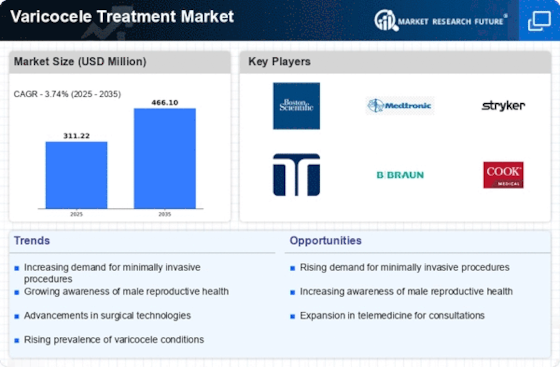
As per Market Research Future analysis, the Varicocele Treatment Market Size was estimated at 311.22 USD Million in 2024. The Varicocele Treatment industry is projected to grow from 322.86 USD Million in 2025 to 466.1 USD Million by 2035, exhibiting a compound annual growth rate (CAGR) of 3.74% during the forecast period 2025 - 2035

Key Market Trends & Highlights

The Varicocele Treatment Market is experiencing a shift towards innovative and patient-centric approaches.

  • Minimally invasive techniques are gaining traction, reflecting a broader trend towards less invasive surgical options. Personalized treatment approaches are becoming increasingly prevalent, catering to the unique needs of patients. The integration of digital health solutions is enhancing patient engagement and treatment monitoring. The rising incidence of varicocele and growing awareness of male infertility are driving market growth, particularly in North America and the Asia-Pacific region.

Market Size & Forecast

2024 Market Size 311.22 (USD Million)
2035 Market Size 466.1 (USD Million)
CAGR (2025 - 2035) 3.74%
Largest Regional Market Share in 2024 North America

Major Players

Boston Scientific (US), Medtronic (US), Stryker (US), Teleflex (US), B. Braun Melsungen AG (DE), Cook Medical (US), Johnson &amp; Johnson (US), Terumo Corporation (JP), <a title="AngioDynamics" href="https://www.angiodynamics.com/patients/varicose-vein-treatment/" target="_blank" rel="noopener">AngioDynamics</a> (US)

Market Trends

The Varicocele Treatment Market is currently experiencing a notable evolution, driven by advancements in medical technology and an increasing awareness of male reproductive health. As more individuals seek effective solutions for varicocele, a condition that can lead to infertility and discomfort, the demand for innovative treatment options is on the rise. Various therapeutic approaches, including surgical interventions and minimally invasive techniques, are gaining traction among healthcare providers and patients alike. This shift towards less invasive procedures appears to be reshaping the landscape of treatment modalities available in the market. Moreover, the growing emphasis on patient-centered care is influencing the Varicocele Treatment Market. Healthcare professionals are increasingly focusing on personalized treatment plans that cater to the unique needs of each patient. This trend is likely to enhance patient satisfaction and improve overall treatment outcomes. Additionally, the integration of telemedicine and digital health solutions is facilitating better access to care, allowing patients to consult specialists remotely. As these trends continue to unfold, the Varicocele Treatment Market is poised for further growth, reflecting a broader commitment to improving men's health and addressing the complexities associated with varicocele.

Minimally Invasive Techniques

The Varicocele Treatment Market is witnessing a shift towards minimally invasive techniques, which are preferred for their reduced recovery times and lower complication rates. These methods, such as laparoscopic surgery and percutaneous embolization, are becoming increasingly popular among both patients and healthcare providers.

Personalized Treatment Approaches

There is a growing trend towards personalized treatment approaches in the Varicocele Treatment Market. Healthcare professionals are focusing on tailoring interventions to meet the specific needs of individual patients, which may enhance treatment efficacy and patient satisfaction.

Integration of Digital Health Solutions

The integration of digital health solutions is transforming the Varicocele Treatment Market. Telemedicine and online consultations are improving access to care, enabling patients to receive timely advice and treatment options from specialists without geographical constraints.

Varicocele treatment Market Market Drivers

Rising Incidence of Varicocele

The increasing prevalence of varicocele among males is a primary driver for the Varicocele Treatment Market. Studies indicate that varicocele affects approximately 15 to 20% of the male population, particularly in the age group of 15 to 25 years. This rising incidence is likely to escalate the demand for effective treatment options, thereby propelling market growth. As awareness regarding male reproductive health improves, more individuals are seeking medical intervention for varicocele, which further stimulates the Varicocele Treatment Market. The growing recognition of varicocele as a significant factor in male infertility is also contributing to this trend, as men are increasingly motivated to pursue treatment to enhance their reproductive capabilities.

Increase in Healthcare Expenditure

The rise in healthcare expenditure across various regions is a crucial driver for the Varicocele Treatment Market. As individuals and governments allocate more resources to healthcare, access to advanced treatment options improves. This increase in spending is likely to facilitate the adoption of innovative therapies and technologies in the treatment of varicocele. Furthermore, higher healthcare budgets enable hospitals and clinics to invest in state-of-the-art medical equipment and training for healthcare professionals. As a result, the Varicocele Treatment Market is poised for growth, as patients gain access to better treatment options and improved healthcare services. This trend may also lead to enhanced patient outcomes and satisfaction, further stimulating market demand.

Advancements in Surgical Techniques

Innovations in surgical techniques are transforming the Varicocele Treatment Market. Minimally invasive procedures, such as laparoscopic surgery and percutaneous embolization, have gained traction due to their reduced recovery times and lower complication rates. These advancements not only enhance patient outcomes but also increase the overall efficiency of treatment. The market is witnessing a shift towards these modern techniques, which are becoming the preferred choice among healthcare providers. As a result, the demand for skilled professionals and advanced medical equipment is likely to rise, further driving the Varicocele Treatment Market. The integration of new technologies into surgical practices is expected to improve patient satisfaction and outcomes, thereby fostering market expansion.

Emergence of Telemedicine Solutions

The emergence of telemedicine solutions is reshaping the Varicocele Treatment Market. With the increasing adoption of digital health technologies, patients are now able to consult healthcare providers remotely, which enhances access to treatment. Telemedicine offers convenience and flexibility, allowing patients to receive consultations and follow-up care without the need for in-person visits. This trend is particularly beneficial for individuals in remote areas or those with mobility challenges. As telemedicine continues to gain traction, it is likely to expand the reach of varicocele treatment services, thereby driving market growth. The Varicocele Treatment Market may see a rise in patient engagement and adherence to treatment plans, as telemedicine facilitates ongoing communication between patients and healthcare providers.

Growing Awareness of Male Infertility

The heightened awareness surrounding male infertility is significantly influencing the Varicocele Treatment Market. As societal perceptions evolve, more men are recognizing the impact of varicocele on fertility. Educational campaigns and increased media coverage are contributing to this awareness, prompting men to seek medical advice and treatment. This trend is reflected in the rising number of consultations and treatments for varicocele, as men become more proactive about their reproductive health. The Varicocele Treatment Market is likely to benefit from this shift, as healthcare providers adapt their services to meet the growing demand for infertility-related treatments. Consequently, this awareness is expected to drive market growth in the coming years.

Market Segment Insights

By Treatment Type: Surgical Treatment (Largest) vs. Non-Surgical Treatment (Fastest-Growing)

<p>In the Varicocele Treatment Market, the Surgical Treatment segment commands the largest share, attributed to its established efficacy and long-standing acceptance among urologists. Surgical methods, including varicocelectomy, have been the traditional choice and remain the gold standard for severe cases. In contrast, the Non-Surgical Treatment segment, which includes percutaneous embolization, has been gaining traction, especially among younger patients and those seeking minimally invasive options.</p>

<p>Surgical Treatment (Dominant) vs. Non-Surgical Treatment (Emerging)</p>

<p>Surgical Treatment remains the dominant approach in the Varicocele Treatment Market, primarily due to its proven success rates and comprehensive results. It is often preferred for patients with significant symptoms or complications. On the other hand, Non-Surgical Treatment has emerged as a favorable alternative, appealing to those prioritizing less invasive options. Its popularity is driven by advancements in technology, which have improved patient outcomes and reduced recovery times. Growth in awareness and acceptance of these methods further accentuates this segment’s rise, making it a key focus for future developments in varicocele management.</p>

By Procedure Type: Varicocelectomy (Largest) vs. Embolization (Fastest-Growing)

<p>In the Varicocele Treatment Market, Varicocelectomy holds a significant portion of the market share, recognized as the most established and traditional surgical method for treating varicoceles. It involves the surgical removal of dilated veins and is widely preferred due to its effectiveness and long-term results. On the other hand, both Embolization and Sclerotherapy are gaining traction, although on different scales. Embolization is quickly becoming a favored alternative due to its minimally invasive nature and fewer complications, carving out a notable share of the market.</p>

<p>Embolization (Dominant) vs. Sclerotherapy (Emerging)</p>

<p>Embolization has emerged as a dominant procedure in the Varicocele Treatment Market due to its favorable patient outcomes and increasing acceptance among healthcare professionals. This minimally invasive technique allows for effective treatment through catheter-based access, resulting in reduced recovery time and hospital stays compared to traditional surgery. Meanwhile, Sclerotherapy is recognized as an emerging option, offering a non-surgical approach where a sclerosant is injected to collapse the veins. Though it is not as widely adopted as Embolization, its advantages such as lower morbidity and outpatient convenience are contributing to its gradual market penetration and appeal in selected patient populations.</p>

By End User: Hospitals (Largest) vs. Clinics (Fastest-Growing)

<p>In the Varicocele Treatment Market, the end user segment is primarily led by hospitals, which dominate in terms of market share due to their advanced facilities and comprehensive patient care. With a significant number of procedures being performed in hospitals, they account for the majority of the treatment market. Clinics, while smaller in overall share, are experiencing rapid growth as more patients seek convenient outpatient services. This shift towards less invasive procedures offered by clinics is contributing to their increasing market presence.</p>

<p>Hospitals (Dominant) vs. Clinics (Emerging)</p>

<p>Hospitals play a dominant role in the varicocele treatment segment due to their well-equipped facilities and access to specialized medical professionals. They provide a range of treatment options, including surgical and non-surgical methods, making them the first choice for patients requiring comprehensive care. In contrast, outpatient clinics are emerging as a valuable segment in the market, with a focus on non-invasive procedures and patient convenience. Their appeal lies in shorter wait times and lower costs, which attract a growing number of patients seeking accessible treatment options.</p>

By Patient Demographics: Adults (Largest) vs. Adolescents (Fastest-Growing)

<p>In the Varicocele Treatment Market, the patient demographics segment exhibits a diverse share distribution. Adults represent the largest portion of the market, reflecting their greater incidence of varicocele and seeking treatment options. In contrast, adolescents are emerging as a significant segment, which indicates an increasing awareness and diagnosis in younger populations. This growing recognition of varicocele incidences in adolescents is attributed to advancements in diagnostic techniques and increased educational outreach regarding male reproductive health issues. As we observe growth trends, the market for varicocele treatments is experiencing a notable shift. Adolescents are projected to be the fastest-growing demographic, with rising instances diagnosed through routine check-ups and heightened awareness of male fertility issues. The adult segment remains robust, driven by a combination of lifestyle factors and an aging population that is more susceptible to related complications, creating a broader demand for various treatment options.</p>

<p>Adults (Dominant) vs. Adolescents (Emerging)</p>

<p>The adult demographic stands as the dominant segment within the Varicocele Treatment Market due to a higher prevalence of the condition, often linked to lifestyle factors and the aging process. This group typically consists of males between 18 and 40 years who seek treatment primarily for pain relief or infertility concerns. Among them, treatment options include surgical interventions and minimally invasive procedures. Conversely, adolescents represent an emerging market segment, characterized by younger males, often diagnosed incidentally during evaluations for other health issues. Increased awareness and proactive health measures have led to a growing demand for educational initiatives and tailored treatment approaches for this age group, marking a trend towards earlier intervention and management.</p>

By Severity of Condition: Moderate (Largest) vs. Severe (Fastest-Growing)

<p>In the Varicocele Treatment Market, the distribution of cases by severity of condition shows that moderate varicoceles represent the largest segment. This is largely due to the heightened awareness and diagnosis rates among individuals experiencing moderate symptoms, leading to increased treatment seeking. Meanwhile, severe varicoceles, although currently smaller in terms of market share, are projected to grow rapidly as more patients become aware of treatment options and potential improvements in quality of life. Moreover, the growth trends in the severe segment are propelled by advancements in treatment modalities and heightened healthcare focus on severe conditions. Digital health technologies and telemedicine have made access easier for patients suffering from severe symptoms, enabling them to receive timely interventions. Increased clinical research is also fueling innovations in treatment, likely driving significant growth in this segment over the forecast period.</p>

<p>Moderate (Dominant) vs. Severe (Emerging)</p>

<p>In the Varicocele Treatment Market, moderate varicoceles are classified as the dominant segment, characterized by a substantial patient population that seeks treatment primarily for symptoms ranging from discomfort to fertility issues. These patients often present for evaluation due to increased awareness stemming from educational initiatives about male reproductive health. Treatment options for moderate cases are well-established, including lifestyle modifications and interventional therapies. Conversely, severe varicoceles are emerging as a significant segment due to their complex nature and the potential for substantial patient impact. The treatment landscape for severe cases is evolving, integrating advanced surgical techniques and minimally invasive options that appeal to patients seeking effective relief. As awareness grows, this segment is expected to gain prominence, influencing overall market dynamics.</p>

Get more detailed insights about Varicocele Treatment Market Research Report-Forecast to 2035

Regional Insights

North America : Leading Market for Innovation

North America is the largest market for varicocele treatments, accounting for approximately 45% of the global market share. The region's growth is driven by increasing awareness of male reproductive health, advancements in minimally invasive surgical techniques, and supportive healthcare policies. Regulatory bodies like the FDA have streamlined approval processes for new treatments, further boosting market growth. The United States is the primary contributor, with a robust presence of key players such as Boston Scientific, Medtronic, and Stryker. The competitive landscape is characterized by continuous innovation and strategic partnerships among leading companies. The focus on research and development, along with a growing number of healthcare facilities, enhances the availability of advanced treatment options for patients.

Europe : Emerging Market with Growth Potential

Europe is witnessing significant growth in the varicocele treatment market, holding approximately 30% of the global share. The region benefits from a well-established healthcare infrastructure, increasing prevalence of varicocele diagnoses, and rising patient awareness. Regulatory frameworks, such as the European Medicines Agency's guidelines, are facilitating the introduction of new therapies, thereby enhancing market dynamics. Leading countries include Germany, France, and the UK, where healthcare investments are on the rise. The competitive landscape features major players like B. Braun Melsungen AG and Cook Medical, who are focusing on innovative solutions and expanding their product portfolios. Collaborations between healthcare providers and manufacturers are also fostering advancements in treatment methodologies.

Asia-Pacific : Rapidly Growing Healthcare Sector

Asia-Pacific is emerging as a significant market for varicocele treatments, accounting for about 20% of the global market share. The growth is driven by increasing healthcare expenditure, rising awareness of male reproductive health issues, and a growing population. Countries like India and China are witnessing a surge in demand for advanced medical treatments, supported by government initiatives to improve healthcare access. The competitive landscape is evolving, with key players like Terumo Corporation and AngioDynamics expanding their presence in the region. The market is characterized by a mix of local and international companies, focusing on innovative treatment options. The increasing number of healthcare facilities and improved medical infrastructure are further propelling market growth in this region.

Middle East and Africa : Untapped Market Potential

The Middle East and Africa region is gradually emerging in the varicocele treatment market, holding approximately 5% of the global share. The growth is primarily driven by increasing healthcare investments, rising awareness of male reproductive health, and the expansion of healthcare facilities. Governments are implementing policies to enhance healthcare access, which is expected to boost market growth in the coming years. Leading countries in this region include South Africa and the UAE, where there is a growing demand for advanced medical treatments. The competitive landscape is still developing, with a mix of local and international players entering the market. Companies are focusing on establishing partnerships and collaborations to enhance their service offerings and reach a broader patient base.

Key Players and Competitive Insights

The Global Varicocele Treatment Market has been experiencing notable developments, driven by advancements in medical techniques, increasing awareness of male reproductive health, and a rise in the prevalence of varicocele among the male population. The market landscape consists of various treatment options, including surgical interventions, non-surgical procedures, and pharmacological therapies. Competitive insights reveal a dynamic environment where key players are focused on innovation, patient-centered approaches, and expanding their geographic reach to capture a larger market share. Companies are investing heavily in research and development to enhance treatment effectiveness and improve patient outcomes, thus fostering competitive advantages.
The ongoing collaborations, partnerships, and mergers among companies in this sector further intensify the competition, aiming to leverage complementary strengths and broaden service offerings in the Global Varicocele Treatment arena.NMC Health has established a significant presence within the Global Varicocele Treatment Market, characterized by its robust service delivery and specialized healthcare facilities. The company is known for its integrated healthcare approach, providing comprehensive varicocele treatment solutions that encompass diagnostic, therapeutic, and follow-up services. One of the key strengths of NMC Health lies in its extensive network of clinics and hospitals, allowing for better patient access and comprehensive care management.
Moreover, NMC Health's emphasis on collaboration with experienced urologists and vascular specialists has enhanced its reputation as a trusted provider in varicocele treatments. The company's ability to adapt to evolving medical technologies and its commitment to patient education further position it favorably in the competitive landscape of this market.Abbott Laboratories stands out in the Global Varicocele Treatment Market due to its commitment to innovation and high-quality healthcare products. The company offers a range of medical devices and treatments aimed at addressing varicocele conditions effectively.
Abbott Laboratories is recognized for its advanced technological solutions, including minimally invasive surgical techniques that significantly improve patient recovery times and outcomes. Its strengths include a strong global footprint, underpinned by a solid research and development framework that drives continuous product enhancements. Abbott Laboratories has also pursued strategic mergers and acquisitions to bolster its capabilities within the varicocele treatment segment. By combining resources and expertise through these strategic moves, Abbott aims to enhance its market offerings and deliver comprehensive, innovative solutions that address the needs of patients worldwide in the context of varicocele management.

Key Companies in the Varicocele treatment Market include

Industry Developments

Recent developments in the Global Varicocele Treatment Market have highlighted significant advancements and activities among key players. Notably, NMC Health and Abbott Laboratories have been at the forefront of introducing enhanced treatment options and minimally invasive techniques. Civco Medical Solutions and Cook Medical have also contributed to this trend by introducing innovative medical devices, which are expected to elevate the overall treatment landscape. The market has seen ongoing research efforts, particularly from LivaNova and Johnson and Johnson, aimed at optimizing patient outcomes and recovery times.

In terms of mergers and acquisitions, Medtronic announced its acquisition of a smaller medical technology firm in September 2023, which is focused on reproductive health technology, thereby expanding its presence in the varicocele treatment sector. Additionally, Boston Scientific has reported growth in its market valuation due to increasing demand for its advanced treatment devices, reflecting positively on the overall market dynamics. The Global Varicocele Treatment Market has experienced significant growth over the past few years, with a notable spike in interest and investment, particularly since early 2022, as healthcare providers emphasize non-invasive treatment methodologies.

Future Outlook

Varicocele treatment Market Future Outlook

The Varicocele Treatment Market is projected to grow at a 3.74% CAGR from 2025 to 2035, driven by increasing awareness, technological advancements, and rising healthcare expenditure.

New opportunities lie in:

  • Development of minimally invasive surgical techniques for outpatient procedures.
  • Expansion of telemedicine platforms for remote consultations and follow-ups.
  • Investment in targeted marketing strategies to reach underserved demographics.

By 2035, the Varicocele Treatment Market is expected to achieve substantial growth, reflecting evolving patient needs and innovative treatment options.

Market Segmentation

Varicocele treatment Market End User Outlook

  • Hospitals
  • Clinics
  • Research Institutions

Varicocele treatment Market Procedure Type Outlook

  • Varicocelectomy
  • Embolization
  • Sclerotherapy

Varicocele treatment Market Treatment Type Outlook

  • Surgical Treatment
  • Non-Surgical Treatment
  • Laparoscopic Treatment

Varicocele treatment Market Patient Demographics Outlook

  • Adolescents
  • Adults
  • Geriatrics

Varicocele treatment Market Severity of Condition Outlook

  • Mild
  • Moderate
  • Severe

Report Scope

MARKET SIZE 2024 311.22(USD Million)
MARKET SIZE 2025 322.86(USD Million)
MARKET SIZE 2035 466.1(USD Million)
COMPOUND ANNUAL GROWTH RATE (CAGR) 3.74% (2025 - 2035)
REPORT COVERAGE Revenue Forecast, Competitive Landscape, Growth Factors, and Trends
BASE YEAR 2024
Market Forecast Period 2025 - 2035
Historical Data 2019 - 2024
Market Forecast Units USD Million
Key Companies Profiled Boston Scientific (US), Medtronic (US), Stryker (US), Teleflex (US), B. Braun Melsungen AG (DE), Cook Medical (US), Johnson & Johnson (US), Terumo Corporation (JP), AngioDynamics (US)
Segments Covered Treatment Type, Procedure Type, End User, Patient Demographics, Severity of Condition, Regional
Key Market Opportunities Advancements in minimally invasive techniques enhance patient outcomes in the Varicocele Treatment Market.
Key Market Dynamics Rising demand for minimally invasive procedures drives innovation and competition in the Varicocele Treatment Market.
Countries Covered North America, Europe, APAC, South America, MEA

FAQs

What is the projected market valuation of the Varicocele Treatment Market by 2035?

<p>The Varicocele Treatment Market is projected to reach a valuation of 466.1 USD Million by 2035.</p>

What was the market valuation of the Varicocele Treatment Market in 2024?

<p>In 2024, the Varicocele Treatment Market was valued at 311.22 USD Million.</p>

What is the expected CAGR for the Varicocele Treatment Market during the forecast period 2025 - 2035?

<p>The expected CAGR for the Varicocele Treatment Market during the forecast period 2025 - 2035 is 3.74%.</p>

Which treatment type had the highest valuation in 2024?

<p>In 2024, Non-Surgical Treatment had the highest valuation at 120.0 USD Million.</p>

What are the key players in the Varicocele Treatment Market?

<p>Key players in the Varicocele Treatment Market include Boston Scientific, Medtronic, Stryker, and Johnson & Johnson.</p>

What is the projected valuation for Surgical Treatment by 2035?

<p>Surgical Treatment is projected to reach a valuation of 150.0 USD Million by 2035.</p>

Which demographic segment is expected to contribute the most to the market by 2035?

<p>Adults are expected to contribute the most, with a projected valuation of 232.83 USD Million by 2035.</p>

What was the valuation of Varicocelectomy in 2024?

<p>In 2024, Varicocelectomy was valued at 150.0 USD Million.</p>

How does the valuation of Clinics compare to Hospitals in 2024?

<p>In 2024, Clinics were valued at 93.0 USD Million, whereas Hospitals had a higher valuation of 124.0 USD Million.</p>

What is the projected market performance for Severe conditions by 2035?

<p>The market performance for Severe conditions is projected to reach 186.84 USD Million by 2035.</p>

  1. SECTION I: EXECUTIVE SUMMARY AND KEY HIGHLIGHTS
    1. | 1.1 EXECUTIVE SUMMARY
    2. | | 1.1.1 Market Overview
    3. | | 1.1.2 Key Findings
    4. | | 1.1.3 Market Segmentation
    5. | | 1.1.4 Competitive Landscape
    6. | | 1.1.5 Challenges and Opportunities
    7. | | 1.1.6 Future Outlook
  2. SECTION II: SCOPING, METHODOLOGY AND MARKET STRUCTURE
    1. | 2.1 MARKET INTRODUCTION
    2. | | 2.1.1 Definition
    3. | | 2.1.2 Scope of the study
    4. | | | 2.1.2.1 Research Objective
    5. | | | 2.1.2.2 Assumption
    6. | | | 2.1.2.3 Limitations
    7. | 2.2 RESEARCH METHODOLOGY
    8. | | 2.2.1 Overview
    9. | | 2.2.2 Data Mining
    10. | | 2.2.3 Secondary Research
    11. | | 2.2.4 Primary Research
    12. | | | 2.2.4.1 Primary Interviews and Information Gathering Process
    13. | | | 2.2.4.2 Breakdown of Primary Respondents
    14. | | 2.2.5 Forecasting Model
    15. | | 2.2.6 Market Size Estimation
    16. | | | 2.2.6.1 Bottom-Up Approach
    17. | | | 2.2.6.2 Top-Down Approach
    18. | | 2.2.7 Data Triangulation
    19. | | 2.2.8 Validation
  3. SECTION III: QUALITATIVE ANALYSIS
    1. | 3.1 MARKET DYNAMICS
    2. | | 3.1.1 Overview
    3. | | 3.1.2 Drivers
    4. | | 3.1.3 Restraints
    5. | | 3.1.4 Opportunities
    6. | 3.2 MARKET FACTOR ANALYSIS
    7. | | 3.2.1 Value chain Analysis
    8. | | 3.2.2 Porter's Five Forces Analysis
    9. | | | 3.2.2.1 Bargaining Power of Suppliers
    10. | | | 3.2.2.2 Bargaining Power of Buyers
    11. | | | 3.2.2.3 Threat of New Entrants
    12. | | | 3.2.2.4 Threat of Substitutes
    13. | | | 3.2.2.5 Intensity of Rivalry
    14. | | 3.2.3 COVID-19 Impact Analysis
    15. | | | 3.2.3.1 Market Impact Analysis
    16. | | | 3.2.3.2 Regional Impact
    17. | | | 3.2.3.3 Opportunity and Threat Analysis
  4. SECTION IV: QUANTITATIVE ANALYSIS
    1. | 4.1 Healthcare, BY Treatment Type (USD Million)
    2. | | 4.1.1 Surgical Treatment
    3. | | 4.1.2 Non-Surgical Treatment
    4. | | 4.1.3 Laparoscopic Treatment
    5. | 4.2 Healthcare, BY Procedure Type (USD Million)
    6. | | 4.2.1 Varicocelectomy
    7. | | 4.2.2 Embolization
    8. | | 4.2.3 Sclerotherapy
    9. | 4.3 Healthcare, BY End User (USD Million)
    10. | | 4.3.1 Hospitals
    11. | | 4.3.2 Clinics
    12. | | 4.3.3 Research Institutions
    13. | 4.4 Healthcare, BY Patient Demographics (USD Million)
    14. | | 4.4.1 Adolescents
    15. | | 4.4.2 Adults
    16. | | 4.4.3 Geriatrics
    17. | 4.5 Healthcare, BY Severity of Condition (USD Million)
    18. | | 4.5.1 Mild
    19. | | 4.5.2 Moderate
    20. | | 4.5.3 Severe
    21. | 4.6 Healthcare, BY Region (USD Million)
    22. | | 4.6.1 North America
    23. | | | 4.6.1.1 US
    24. | | | 4.6.1.2 Canada
    25. | | 4.6.2 Europe
    26. | | | 4.6.2.1 Germany
    27. | | | 4.6.2.2 UK
    28. | | | 4.6.2.3 France
    29. | | | 4.6.2.4 Russia
    30. | | | 4.6.2.5 Italy
    31. | | | 4.6.2.6 Spain
    32. | | | 4.6.2.7 Rest of Europe
    33. | | 4.6.3 APAC
    34. | | | 4.6.3.1 China
    35. | | | 4.6.3.2 India
    36. | | | 4.6.3.3 Japan
    37. | | | 4.6.3.4 South Korea
    38. | | | 4.6.3.5 Malaysia
    39. | | | 4.6.3.6 Thailand
    40. | | | 4.6.3.7 Indonesia
    41. | | | 4.6.3.8 Rest of APAC
    42. | | 4.6.4 South America
    43. | | | 4.6.4.1 Brazil
    44. | | | 4.6.4.2 Mexico
    45. | | | 4.6.4.3 Argentina
    46. | | | 4.6.4.4 Rest of South America
    47. | | 4.6.5 MEA
    48. | | | 4.6.5.1 GCC Countries
    49. | | | 4.6.5.2 South Africa
    50. | | | 4.6.5.3 Rest of MEA
  5. SECTION V: COMPETITIVE ANALYSIS
    1. | 5.1 Competitive Landscape
    2. | | 5.1.1 Overview
    3. | | 5.1.2 Competitive Analysis
    4. | | 5.1.3 Market share Analysis
    5. | | 5.1.4 Major Growth Strategy in the Healthcare
    6. | | 5.1.5 Competitive Benchmarking
    7. | | 5.1.6 Leading Players in Terms of Number of Developments in the Healthcare
    8. | | 5.1.7 Key developments and growth strategies
    9. | | | 5.1.7.1 New Product Launch/Service Deployment
    10. | | | 5.1.7.2 Merger & Acquisitions
    11. | | | 5.1.7.3 Joint Ventures
    12. | | 5.1.8 Major Players Financial Matrix
    13. | | | 5.1.8.1 Sales and Operating Income
    14. | | | 5.1.8.2 Major Players R&D Expenditure. 2023
    15. | 5.2 Company Profiles
    16. | | 5.2.1 Boston Scientific (US)
    17. | | | 5.2.1.1 Financial Overview
    18. | | | 5.2.1.2 Products Offered
    19. | | | 5.2.1.3 Key Developments
    20. | | | 5.2.1.4 SWOT Analysis
    21. | | | 5.2.1.5 Key Strategies
    22. | | 5.2.2 Medtronic (US)
    23. | | | 5.2.2.1 Financial Overview
    24. | | | 5.2.2.2 Products Offered
    25. | | | 5.2.2.3 Key Developments
    26. | | | 5.2.2.4 SWOT Analysis
    27. | | | 5.2.2.5 Key Strategies
    28. | | 5.2.3 Stryker (US)
    29. | | | 5.2.3.1 Financial Overview
    30. | | | 5.2.3.2 Products Offered
    31. | | | 5.2.3.3 Key Developments
    32. | | | 5.2.3.4 SWOT Analysis
    33. | | | 5.2.3.5 Key Strategies
    34. | | 5.2.4 Teleflex (US)
    35. | | | 5.2.4.1 Financial Overview
    36. | | | 5.2.4.2 Products Offered
    37. | | | 5.2.4.3 Key Developments
    38. | | | 5.2.4.4 SWOT Analysis
    39. | | | 5.2.4.5 Key Strategies
    40. | | 5.2.5 B. Braun Melsungen AG (DE)
    41. | | | 5.2.5.1 Financial Overview
    42. | | | 5.2.5.2 Products Offered
    43. | | | 5.2.5.3 Key Developments
    44. | | | 5.2.5.4 SWOT Analysis
    45. | | | 5.2.5.5 Key Strategies
    46. | | 5.2.6 Cook Medical (US)
    47. | | | 5.2.6.1 Financial Overview
    48. | | | 5.2.6.2 Products Offered
    49. | | | 5.2.6.3 Key Developments
    50. | | | 5.2.6.4 SWOT Analysis
    51. | | | 5.2.6.5 Key Strategies
    52. | | 5.2.7 Johnson & Johnson (US)
    53. | | | 5.2.7.1 Financial Overview
    54. | | | 5.2.7.2 Products Offered
    55. | | | 5.2.7.3 Key Developments
    56. | | | 5.2.7.4 SWOT Analysis
    57. | | | 5.2.7.5 Key Strategies
    58. | | 5.2.8 Terumo Corporation (JP)
    59. | | | 5.2.8.1 Financial Overview
    60. | | | 5.2.8.2 Products Offered
    61. | | | 5.2.8.3 Key Developments
    62. | | | 5.2.8.4 SWOT Analysis
    63. | | | 5.2.8.5 Key Strategies
    64. | | 5.2.9 AngioDynamics (US)
    65. | | | 5.2.9.1 Financial Overview
    66. | | | 5.2.9.2 Products Offered
    67. | | | 5.2.9.3 Key Developments
    68. | | | 5.2.9.4 SWOT Analysis
    69. | | | 5.2.9.5 Key Strategies
    70. | 5.3 Appendix
    71. | | 5.3.1 References
    72. | | 5.3.2 Related Reports
  6. LIST OF FIGURES
    1. | 6.1 MARKET SYNOPSIS
    2. | 6.2 NORTH AMERICA MARKET ANALYSIS
    3. | 6.3 US MARKET ANALYSIS BY TREATMENT TYPE
    4. | 6.4 US MARKET ANALYSIS BY PROCEDURE TYPE
    5. | 6.5 US MARKET ANALYSIS BY END USER
    6. | 6.6 US MARKET ANALYSIS BY PATIENT DEMOGRAPHICS
    7. | 6.7 US MARKET ANALYSIS BY SEVERITY OF CONDITION
    8. | 6.8 CANADA MARKET ANALYSIS BY TREATMENT TYPE
    9. | 6.9 CANADA MARKET ANALYSIS BY PROCEDURE TYPE
    10. | 6.10 CANADA MARKET ANALYSIS BY END USER
    11. | 6.11 CANADA MARKET ANALYSIS BY PATIENT DEMOGRAPHICS
    12. | 6.12 CANADA MARKET ANALYSIS BY SEVERITY OF CONDITION
    13. | 6.13 EUROPE MARKET ANALYSIS
    14. | 6.14 GERMANY MARKET ANALYSIS BY TREATMENT TYPE
    15. | 6.15 GERMANY MARKET ANALYSIS BY PROCEDURE TYPE
    16. | 6.16 GERMANY MARKET ANALYSIS BY END USER
    17. | 6.17 GERMANY MARKET ANALYSIS BY PATIENT DEMOGRAPHICS
    18. | 6.18 GERMANY MARKET ANALYSIS BY SEVERITY OF CONDITION
    19. | 6.19 UK MARKET ANALYSIS BY TREATMENT TYPE
    20. | 6.20 UK MARKET ANALYSIS BY PROCEDURE TYPE
    21. | 6.21 UK MARKET ANALYSIS BY END USER
    22. | 6.22 UK MARKET ANALYSIS BY PATIENT DEMOGRAPHICS
    23. | 6.23 UK MARKET ANALYSIS BY SEVERITY OF CONDITION
    24. | 6.24 FRANCE MARKET ANALYSIS BY TREATMENT TYPE
    25. | 6.25 FRANCE MARKET ANALYSIS BY PROCEDURE TYPE
    26. | 6.26 FRANCE MARKET ANALYSIS BY END USER
    27. | 6.27 FRANCE MARKET ANALYSIS BY PATIENT DEMOGRAPHICS
    28. | 6.28 FRANCE MARKET ANALYSIS BY SEVERITY OF CONDITION
    29. | 6.29 RUSSIA MARKET ANALYSIS BY TREATMENT TYPE
    30. | 6.30 RUSSIA MARKET ANALYSIS BY PROCEDURE TYPE
    31. | 6.31 RUSSIA MARKET ANALYSIS BY END USER
    32. | 6.32 RUSSIA MARKET ANALYSIS BY PATIENT DEMOGRAPHICS
    33. | 6.33 RUSSIA MARKET ANALYSIS BY SEVERITY OF CONDITION
    34. | 6.34 ITALY MARKET ANALYSIS BY TREATMENT TYPE
    35. | 6.35 ITALY MARKET ANALYSIS BY PROCEDURE TYPE
    36. | 6.36 ITALY MARKET ANALYSIS BY END USER
    37. | 6.37 ITALY MARKET ANALYSIS BY PATIENT DEMOGRAPHICS
    38. | 6.38 ITALY MARKET ANALYSIS BY SEVERITY OF CONDITION
    39. | 6.39 SPAIN MARKET ANALYSIS BY TREATMENT TYPE
    40. | 6.40 SPAIN MARKET ANALYSIS BY PROCEDURE TYPE
    41. | 6.41 SPAIN MARKET ANALYSIS BY END USER
    42. | 6.42 SPAIN MARKET ANALYSIS BY PATIENT DEMOGRAPHICS
    43. | 6.43 SPAIN MARKET ANALYSIS BY SEVERITY OF CONDITION
    44. | 6.44 REST OF EUROPE MARKET ANALYSIS BY TREATMENT TYPE
    45. | 6.45 REST OF EUROPE MARKET ANALYSIS BY PROCEDURE TYPE
    46. | 6.46 REST OF EUROPE MARKET ANALYSIS BY END USER
    47. | 6.47 REST OF EUROPE MARKET ANALYSIS BY PATIENT DEMOGRAPHICS
    48. | 6.48 REST OF EUROPE MARKET ANALYSIS BY SEVERITY OF CONDITION
    49. | 6.49 APAC MARKET ANALYSIS
    50. | 6.50 CHINA MARKET ANALYSIS BY TREATMENT TYPE
    51. | 6.51 CHINA MARKET ANALYSIS BY PROCEDURE TYPE
    52. | 6.52 CHINA MARKET ANALYSIS BY END USER
    53. | 6.53 CHINA MARKET ANALYSIS BY PATIENT DEMOGRAPHICS
    54. | 6.54 CHINA MARKET ANALYSIS BY SEVERITY OF CONDITION
    55. | 6.55 INDIA MARKET ANALYSIS BY TREATMENT TYPE
    56. | 6.56 INDIA MARKET ANALYSIS BY PROCEDURE TYPE
    57. | 6.57 INDIA MARKET ANALYSIS BY END USER
    58. | 6.58 INDIA MARKET ANALYSIS BY PATIENT DEMOGRAPHICS
    59. | 6.59 INDIA MARKET ANALYSIS BY SEVERITY OF CONDITION
    60. | 6.60 JAPAN MARKET ANALYSIS BY TREATMENT TYPE
    61. | 6.61 JAPAN MARKET ANALYSIS BY PROCEDURE TYPE
    62. | 6.62 JAPAN MARKET ANALYSIS BY END USER
    63. | 6.63 JAPAN MARKET ANALYSIS BY PATIENT DEMOGRAPHICS
    64. | 6.64 JAPAN MARKET ANALYSIS BY SEVERITY OF CONDITION
    65. | 6.65 SOUTH KOREA MARKET ANALYSIS BY TREATMENT TYPE
    66. | 6.66 SOUTH KOREA MARKET ANALYSIS BY PROCEDURE TYPE
    67. | 6.67 SOUTH KOREA MARKET ANALYSIS BY END USER
    68. | 6.68 SOUTH KOREA MARKET ANALYSIS BY PATIENT DEMOGRAPHICS
    69. | 6.69 SOUTH KOREA MARKET ANALYSIS BY SEVERITY OF CONDITION
    70. | 6.70 MALAYSIA MARKET ANALYSIS BY TREATMENT TYPE
    71. | 6.71 MALAYSIA MARKET ANALYSIS BY PROCEDURE TYPE
    72. | 6.72 MALAYSIA MARKET ANALYSIS BY END USER
    73. | 6.73 MALAYSIA MARKET ANALYSIS BY PATIENT DEMOGRAPHICS
    74. | 6.74 MALAYSIA MARKET ANALYSIS BY SEVERITY OF CONDITION
    75. | 6.75 THAILAND MARKET ANALYSIS BY TREATMENT TYPE
    76. | 6.76 THAILAND MARKET ANALYSIS BY PROCEDURE TYPE
    77. | 6.77 THAILAND MARKET ANALYSIS BY END USER
    78. | 6.78 THAILAND MARKET ANALYSIS BY PATIENT DEMOGRAPHICS
    79. | 6.79 THAILAND MARKET ANALYSIS BY SEVERITY OF CONDITION
    80. | 6.80 INDONESIA MARKET ANALYSIS BY TREATMENT TYPE
    81. | 6.81 INDONESIA MARKET ANALYSIS BY PROCEDURE TYPE
    82. | 6.82 INDONESIA MARKET ANALYSIS BY END USER
    83. | 6.83 INDONESIA MARKET ANALYSIS BY PATIENT DEMOGRAPHICS
    84. | 6.84 INDONESIA MARKET ANALYSIS BY SEVERITY OF CONDITION
    85. | 6.85 REST OF APAC MARKET ANALYSIS BY TREATMENT TYPE
    86. | 6.86 REST OF APAC MARKET ANALYSIS BY PROCEDURE TYPE
    87. | 6.87 REST OF APAC MARKET ANALYSIS BY END USER
    88. | 6.88 REST OF APAC MARKET ANALYSIS BY PATIENT DEMOGRAPHICS
    89. | 6.89 REST OF APAC MARKET ANALYSIS BY SEVERITY OF CONDITION
    90. | 6.90 SOUTH AMERICA MARKET ANALYSIS
    91. | 6.91 BRAZIL MARKET ANALYSIS BY TREATMENT TYPE
    92. | 6.92 BRAZIL MARKET ANALYSIS BY PROCEDURE TYPE
    93. | 6.93 BRAZIL MARKET ANALYSIS BY END USER
    94. | 6.94 BRAZIL MARKET ANALYSIS BY PATIENT DEMOGRAPHICS
    95. | 6.95 BRAZIL MARKET ANALYSIS BY SEVERITY OF CONDITION
    96. | 6.96 MEXICO MARKET ANALYSIS BY TREATMENT TYPE
    97. | 6.97 MEXICO MARKET ANALYSIS BY PROCEDURE TYPE
    98. | 6.98 MEXICO MARKET ANALYSIS BY END USER
    99. | 6.99 MEXICO MARKET ANALYSIS BY PATIENT DEMOGRAPHICS
    100. | 6.100 MEXICO MARKET ANALYSIS BY SEVERITY OF CONDITION
    101. | 6.101 ARGENTINA MARKET ANALYSIS BY TREATMENT TYPE
    102. | 6.102 ARGENTINA MARKET ANALYSIS BY PROCEDURE TYPE
    103. | 6.103 ARGENTINA MARKET ANALYSIS BY END USER
    104. | 6.104 ARGENTINA MARKET ANALYSIS BY PATIENT DEMOGRAPHICS
    105. | 6.105 ARGENTINA MARKET ANALYSIS BY SEVERITY OF CONDITION
    106. | 6.106 REST OF SOUTH AMERICA MARKET ANALYSIS BY TREATMENT TYPE
    107. | 6.107 REST OF SOUTH AMERICA MARKET ANALYSIS BY PROCEDURE TYPE
    108. | 6.108 REST OF SOUTH AMERICA MARKET ANALYSIS BY END USER
    109. | 6.109 REST OF SOUTH AMERICA MARKET ANALYSIS BY PATIENT DEMOGRAPHICS
    110. | 6.110 REST OF SOUTH AMERICA MARKET ANALYSIS BY SEVERITY OF CONDITION
    111. | 6.111 MEA MARKET ANALYSIS
    112. | 6.112 GCC COUNTRIES MARKET ANALYSIS BY TREATMENT TYPE
    113. | 6.113 GCC COUNTRIES MARKET ANALYSIS BY PROCEDURE TYPE
    114. | 6.114 GCC COUNTRIES MARKET ANALYSIS BY END USER
    115. | 6.115 GCC COUNTRIES MARKET ANALYSIS BY PATIENT DEMOGRAPHICS
    116. | 6.116 GCC COUNTRIES MARKET ANALYSIS BY SEVERITY OF CONDITION
    117. | 6.117 SOUTH AFRICA MARKET ANALYSIS BY TREATMENT TYPE
    118. | 6.118 SOUTH AFRICA MARKET ANALYSIS BY PROCEDURE TYPE
    119. | 6.119 SOUTH AFRICA MARKET ANALYSIS BY END USER
    120. | 6.120 SOUTH AFRICA MARKET ANALYSIS BY PATIENT DEMOGRAPHICS
    121. | 6.121 SOUTH AFRICA MARKET ANALYSIS BY SEVERITY OF CONDITION
    122. | 6.122 REST OF MEA MARKET ANALYSIS BY TREATMENT TYPE
    123. | 6.123 REST OF MEA MARKET ANALYSIS BY PROCEDURE TYPE
    124. | 6.124 REST OF MEA MARKET ANALYSIS BY END USER
    125. | 6.125 REST OF MEA MARKET ANALYSIS BY PATIENT DEMOGRAPHICS
    126. | 6.126 REST OF MEA MARKET ANALYSIS BY SEVERITY OF CONDITION
    127. | 6.127 KEY BUYING CRITERIA OF HEALTHCARE
    128. | 6.128 RESEARCH PROCESS OF MRFR
    129. | 6.129 DRO ANALYSIS OF HEALTHCARE
    130. | 6.130 DRIVERS IMPACT ANALYSIS: HEALTHCARE
    131. | 6.131 RESTRAINTS IMPACT ANALYSIS: HEALTHCARE
    132. | 6.132 SUPPLY / VALUE CHAIN: HEALTHCARE
    133. | 6.133 HEALTHCARE, BY TREATMENT TYPE, 2024 (% SHARE)
    134. | 6.134 HEALTHCARE, BY TREATMENT TYPE, 2024 TO 2035 (USD Million)
    135. | 6.135 HEALTHCARE, BY PROCEDURE TYPE, 2024 (% SHARE)
    136. | 6.136 HEALTHCARE, BY PROCEDURE TYPE, 2024 TO 2035 (USD Million)
    137. | 6.137 HEALTHCARE, BY END USER, 2024 (% SHARE)
    138. | 6.138 HEALTHCARE, BY END USER, 2024 TO 2035 (USD Million)
    139. | 6.139 HEALTHCARE, BY PATIENT DEMOGRAPHICS, 2024 (% SHARE)
    140. | 6.140 HEALTHCARE, BY PATIENT DEMOGRAPHICS, 2024 TO 2035 (USD Million)
    141. | 6.141 HEALTHCARE, BY SEVERITY OF CONDITION, 2024 (% SHARE)
    142. | 6.142 HEALTHCARE, BY SEVERITY OF CONDITION, 2024 TO 2035 (USD Million)
    143. | 6.143 BENCHMARKING OF MAJOR COMPETITORS
  7. LIST OF TABLES
    1. | 7.1 LIST OF ASSUMPTIONS
    2. | | 7.1.1
    3. | 7.2 North America MARKET SIZE ESTIMATES; FORECAST
    4. | | 7.2.1 BY TREATMENT TYPE, 2025-2035 (USD Million)
    5. | | 7.2.2 BY PROCEDURE TYPE, 2025-2035 (USD Million)
    6. | | 7.2.3 BY END USER, 2025-2035 (USD Million)
    7. | | 7.2.4 BY PATIENT DEMOGRAPHICS, 2025-2035 (USD Million)
    8. | | 7.2.5 BY SEVERITY OF CONDITION, 2025-2035 (USD Million)
    9. | 7.3 US MARKET SIZE ESTIMATES; FORECAST
    10. | | 7.3.1 BY TREATMENT TYPE, 2025-2035 (USD Million)
    11. | | 7.3.2 BY PROCEDURE TYPE, 2025-2035 (USD Million)
    12. | | 7.3.3 BY END USER, 2025-2035 (USD Million)
    13. | | 7.3.4 BY PATIENT DEMOGRAPHICS, 2025-2035 (USD Million)
    14. | | 7.3.5 BY SEVERITY OF CONDITION, 2025-2035 (USD Million)
    15. | 7.4 Canada MARKET SIZE ESTIMATES; FORECAST
    16. | | 7.4.1 BY TREATMENT TYPE, 2025-2035 (USD Million)
    17. | | 7.4.2 BY PROCEDURE TYPE, 2025-2035 (USD Million)
    18. | | 7.4.3 BY END USER, 2025-2035 (USD Million)
    19. | | 7.4.4 BY PATIENT DEMOGRAPHICS, 2025-2035 (USD Million)
    20. | | 7.4.5 BY SEVERITY OF CONDITION, 2025-2035 (USD Million)
    21. | 7.5 Europe MARKET SIZE ESTIMATES; FORECAST
    22. | | 7.5.1 BY TREATMENT TYPE, 2025-2035 (USD Million)
    23. | | 7.5.2 BY PROCEDURE TYPE, 2025-2035 (USD Million)
    24. | | 7.5.3 BY END USER, 2025-2035 (USD Million)
    25. | | 7.5.4 BY PATIENT DEMOGRAPHICS, 2025-2035 (USD Million)
    26. | | 7.5.5 BY SEVERITY OF CONDITION, 2025-2035 (USD Million)
    27. | 7.6 Germany MARKET SIZE ESTIMATES; FORECAST
    28. | | 7.6.1 BY TREATMENT TYPE, 2025-2035 (USD Million)
    29. | | 7.6.2 BY PROCEDURE TYPE, 2025-2035 (USD Million)
    30. | | 7.6.3 BY END USER, 2025-2035 (USD Million)
    31. | | 7.6.4 BY PATIENT DEMOGRAPHICS, 2025-2035 (USD Million)
    32. | | 7.6.5 BY SEVERITY OF CONDITION, 2025-2035 (USD Million)
    33. | 7.7 UK MARKET SIZE ESTIMATES; FORECAST
    34. | | 7.7.1 BY TREATMENT TYPE, 2025-2035 (USD Million)
    35. | | 7.7.2 BY PROCEDURE TYPE, 2025-2035 (USD Million)
    36. | | 7.7.3 BY END USER, 2025-2035 (USD Million)
    37. | | 7.7.4 BY PATIENT DEMOGRAPHICS, 2025-2035 (USD Million)
    38. | | 7.7.5 BY SEVERITY OF CONDITION, 2025-2035 (USD Million)
    39. | 7.8 France MARKET SIZE ESTIMATES; FORECAST
    40. | | 7.8.1 BY TREATMENT TYPE, 2025-2035 (USD Million)
    41. | | 7.8.2 BY PROCEDURE TYPE, 2025-2035 (USD Million)
    42. | | 7.8.3 BY END USER, 2025-2035 (USD Million)
    43. | | 7.8.4 BY PATIENT DEMOGRAPHICS, 2025-2035 (USD Million)
    44. | | 7.8.5 BY SEVERITY OF CONDITION, 2025-2035 (USD Million)
    45. | 7.9 Russia MARKET SIZE ESTIMATES; FORECAST
    46. | | 7.9.1 BY TREATMENT TYPE, 2025-2035 (USD Million)
    47. | | 7.9.2 BY PROCEDURE TYPE, 2025-2035 (USD Million)
    48. | | 7.9.3 BY END USER, 2025-2035 (USD Million)
    49. | | 7.9.4 BY PATIENT DEMOGRAPHICS, 2025-2035 (USD Million)
    50. | | 7.9.5 BY SEVERITY OF CONDITION, 2025-2035 (USD Million)
    51. | 7.10 Italy MARKET SIZE ESTIMATES; FORECAST
    52. | | 7.10.1 BY TREATMENT TYPE, 2025-2035 (USD Million)
    53. | | 7.10.2 BY PROCEDURE TYPE, 2025-2035 (USD Million)
    54. | | 7.10.3 BY END USER, 2025-2035 (USD Million)
    55. | | 7.10.4 BY PATIENT DEMOGRAPHICS, 2025-2035 (USD Million)
    56. | | 7.10.5 BY SEVERITY OF CONDITION, 2025-2035 (USD Million)
    57. | 7.11 Spain MARKET SIZE ESTIMATES; FORECAST
    58. | | 7.11.1 BY TREATMENT TYPE, 2025-2035 (USD Million)
    59. | | 7.11.2 BY PROCEDURE TYPE, 2025-2035 (USD Million)
    60. | | 7.11.3 BY END USER, 2025-2035 (USD Million)
    61. | | 7.11.4 BY PATIENT DEMOGRAPHICS, 2025-2035 (USD Million)
    62. | | 7.11.5 BY SEVERITY OF CONDITION, 2025-2035 (USD Million)
    63. | 7.12 Rest of Europe MARKET SIZE ESTIMATES; FORECAST
    64. | | 7.12.1 BY TREATMENT TYPE, 2025-2035 (USD Million)
    65. | | 7.12.2 BY PROCEDURE TYPE, 2025-2035 (USD Million)
    66. | | 7.12.3 BY END USER, 2025-2035 (USD Million)
    67. | | 7.12.4 BY PATIENT DEMOGRAPHICS, 2025-2035 (USD Million)
    68. | | 7.12.5 BY SEVERITY OF CONDITION, 2025-2035 (USD Million)
    69. | 7.13 APAC MARKET SIZE ESTIMATES; FORECAST
    70. | | 7.13.1 BY TREATMENT TYPE, 2025-2035 (USD Million)
    71. | | 7.13.2 BY PROCEDURE TYPE, 2025-2035 (USD Million)
    72. | | 7.13.3 BY END USER, 2025-2035 (USD Million)
    73. | | 7.13.4 BY PATIENT DEMOGRAPHICS, 2025-2035 (USD Million)
    74. | | 7.13.5 BY SEVERITY OF CONDITION, 2025-2035 (USD Million)
    75. | 7.14 China MARKET SIZE ESTIMATES; FORECAST
    76. | | 7.14.1 BY TREATMENT TYPE, 2025-2035 (USD Million)
    77. | | 7.14.2 BY PROCEDURE TYPE, 2025-2035 (USD Million)
    78. | | 7.14.3 BY END USER, 2025-2035 (USD Million)
    79. | | 7.14.4 BY PATIENT DEMOGRAPHICS, 2025-2035 (USD Million)
    80. | | 7.14.5 BY SEVERITY OF CONDITION, 2025-2035 (USD Million)
    81. | 7.15 India MARKET SIZE ESTIMATES; FORECAST
    82. | | 7.15.1 BY TREATMENT TYPE, 2025-2035 (USD Million)
    83. | | 7.15.2 BY PROCEDURE TYPE, 2025-2035 (USD Million)
    84. | | 7.15.3 BY END USER, 2025-2035 (USD Million)
    85. | | 7.15.4 BY PATIENT DEMOGRAPHICS, 2025-2035 (USD Million)
    86. | | 7.15.5 BY SEVERITY OF CONDITION, 2025-2035 (USD Million)
    87. | 7.16 Japan MARKET SIZE ESTIMATES; FORECAST
    88. | | 7.16.1 BY TREATMENT TYPE, 2025-2035 (USD Million)
    89. | | 7.16.2 BY PROCEDURE TYPE, 2025-2035 (USD Million)
    90. | | 7.16.3 BY END USER, 2025-2035 (USD Million)
    91. | | 7.16.4 BY PATIENT DEMOGRAPHICS, 2025-2035 (USD Million)
    92. | | 7.16.5 BY SEVERITY OF CONDITION, 2025-2035 (USD Million)
    93. | 7.17 South Korea MARKET SIZE ESTIMATES; FORECAST
    94. | | 7.17.1 BY TREATMENT TYPE, 2025-2035 (USD Million)
    95. | | 7.17.2 BY PROCEDURE TYPE, 2025-2035 (USD Million)
    96. | | 7.17.3 BY END USER, 2025-2035 (USD Million)
    97. | | 7.17.4 BY PATIENT DEMOGRAPHICS, 2025-2035 (USD Million)
    98. | | 7.17.5 BY SEVERITY OF CONDITION, 2025-2035 (USD Million)
    99. | 7.18 Malaysia MARKET SIZE ESTIMATES; FORECAST
    100. | | 7.18.1 BY TREATMENT TYPE, 2025-2035 (USD Million)
    101. | | 7.18.2 BY PROCEDURE TYPE, 2025-2035 (USD Million)
    102. | | 7.18.3 BY END USER, 2025-2035 (USD Million)
    103. | | 7.18.4 BY PATIENT DEMOGRAPHICS, 2025-2035 (USD Million)
    104. | | 7.18.5 BY SEVERITY OF CONDITION, 2025-2035 (USD Million)
    105. | 7.19 Thailand MARKET SIZE ESTIMATES; FORECAST
    106. | | 7.19.1 BY TREATMENT TYPE, 2025-2035 (USD Million)
    107. | | 7.19.2 BY PROCEDURE TYPE, 2025-2035 (USD Million)
    108. | | 7.19.3 BY END USER, 2025-2035 (USD Million)
    109. | | 7.19.4 BY PATIENT DEMOGRAPHICS, 2025-2035 (USD Million)
    110. | | 7.19.5 BY SEVERITY OF CONDITION, 2025-2035 (USD Million)
    111. | 7.20 Indonesia MARKET SIZE ESTIMATES; FORECAST
    112. | | 7.20.1 BY TREATMENT TYPE, 2025-2035 (USD Million)
    113. | | 7.20.2 BY PROCEDURE TYPE, 2025-2035 (USD Million)
    114. | | 7.20.3 BY END USER, 2025-2035 (USD Million)
    115. | | 7.20.4 BY PATIENT DEMOGRAPHICS, 2025-2035 (USD Million)
    116. | | 7.20.5 BY SEVERITY OF CONDITION, 2025-2035 (USD Million)
    117. | 7.21 Rest of APAC MARKET SIZE ESTIMATES; FORECAST
    118. | | 7.21.1 BY TREATMENT TYPE, 2025-2035 (USD Million)
    119. | | 7.21.2 BY PROCEDURE TYPE, 2025-2035 (USD Million)
    120. | | 7.21.3 BY END USER, 2025-2035 (USD Million)
    121. | | 7.21.4 BY PATIENT DEMOGRAPHICS, 2025-2035 (USD Million)
    122. | | 7.21.5 BY SEVERITY OF CONDITION, 2025-2035 (USD Million)
    123. | 7.22 South America MARKET SIZE ESTIMATES; FORECAST
    124. | | 7.22.1 BY TREATMENT TYPE, 2025-2035 (USD Million)
    125. | | 7.22.2 BY PROCEDURE TYPE, 2025-2035 (USD Million)
    126. | | 7.22.3 BY END USER, 2025-2035 (USD Million)
    127. | | 7.22.4 BY PATIENT DEMOGRAPHICS, 2025-2035 (USD Million)
    128. | | 7.22.5 BY SEVERITY OF CONDITION, 2025-2035 (USD Million)
    129. | 7.23 Brazil MARKET SIZE ESTIMATES; FORECAST
    130. | | 7.23.1 BY TREATMENT TYPE, 2025-2035 (USD Million)
    131. | | 7.23.2 BY PROCEDURE TYPE, 2025-2035 (USD Million)
    132. | | 7.23.3 BY END USER, 2025-2035 (USD Million)
    133. | | 7.23.4 BY PATIENT DEMOGRAPHICS, 2025-2035 (USD Million)
    134. | | 7.23.5 BY SEVERITY OF CONDITION, 2025-2035 (USD Million)
    135. | 7.24 Mexico MARKET SIZE ESTIMATES; FORECAST
    136. | | 7.24.1 BY TREATMENT TYPE, 2025-2035 (USD Million)
    137. | | 7.24.2 BY PROCEDURE TYPE, 2025-2035 (USD Million)
    138. | | 7.24.3 BY END USER, 2025-2035 (USD Million)
    139. | | 7.24.4 BY PATIENT DEMOGRAPHICS, 2025-2035 (USD Million)
    140. | | 7.24.5 BY SEVERITY OF CONDITION, 2025-2035 (USD Million)
    141. | 7.25 Argentina MARKET SIZE ESTIMATES; FORECAST
    142. | | 7.25.1 BY TREATMENT TYPE, 2025-2035 (USD Million)
    143. | | 7.25.2 BY PROCEDURE TYPE, 2025-2035 (USD Million)
    144. | | 7.25.3 BY END USER, 2025-2035 (USD Million)
    145. | | 7.25.4 BY PATIENT DEMOGRAPHICS, 2025-2035 (USD Million)
    146. | | 7.25.5 BY SEVERITY OF CONDITION, 2025-2035 (USD Million)
    147. | 7.26 Rest of South America MARKET SIZE ESTIMATES; FORECAST
    148. | | 7.26.1 BY TREATMENT TYPE, 2025-2035 (USD Million)
    149. | | 7.26.2 BY PROCEDURE TYPE, 2025-2035 (USD Million)
    150. | | 7.26.3 BY END USER, 2025-2035 (USD Million)
    151. | | 7.26.4 BY PATIENT DEMOGRAPHICS, 2025-2035 (USD Million)
    152. | | 7.26.5 BY SEVERITY OF CONDITION, 2025-2035 (USD Million)
    153. | 7.27 MEA MARKET SIZE ESTIMATES; FORECAST
    154. | | 7.27.1 BY TREATMENT TYPE, 2025-2035 (USD Million)
    155. | | 7.27.2 BY PROCEDURE TYPE, 2025-2035 (USD Million)
    156. | | 7.27.3 BY END USER, 2025-2035 (USD Million)
    157. | | 7.27.4 BY PATIENT DEMOGRAPHICS, 2025-2035 (USD Million)
    158. | | 7.27.5 BY SEVERITY OF CONDITION, 2025-2035 (USD Million)
    159. | 7.28 GCC Countries MARKET SIZE ESTIMATES; FORECAST
    160. | | 7.28.1 BY TREATMENT TYPE, 2025-2035 (USD Million)
    161. | | 7.28.2 BY PROCEDURE TYPE, 2025-2035 (USD Million)
    162. | | 7.28.3 BY END USER, 2025-2035 (USD Million)
    163. | | 7.28.4 BY PATIENT DEMOGRAPHICS, 2025-2035 (USD Million)
    164. | | 7.28.5 BY SEVERITY OF CONDITION, 2025-2035 (USD Million)
    165. | 7.29 South Africa MARKET SIZE ESTIMATES; FORECAST
    166. | | 7.29.1 BY TREATMENT TYPE, 2025-2035 (USD Million)
    167. | | 7.29.2 BY PROCEDURE TYPE, 2025-2035 (USD Million)
    168. | | 7.29.3 BY END USER, 2025-2035 (USD Million)
    169. | | 7.29.4 BY PATIENT DEMOGRAPHICS, 2025-2035 (USD Million)
    170. | | 7.29.5 BY SEVERITY OF CONDITION, 2025-2035 (USD Million)
    171. | 7.30 Rest of MEA MARKET SIZE ESTIMATES; FORECAST
    172. | | 7.30.1 BY TREATMENT TYPE, 2025-2035 (USD Million)
    173. | | 7.30.2 BY PROCEDURE TYPE, 2025-2035 (USD Million)
    174. | | 7.30.3 BY END USER, 2025-2035 (USD Million)
    175. | | 7.30.4 BY PATIENT DEMOGRAPHICS, 2025-2035 (USD Million)
    176. | | 7.30.5 BY SEVERITY OF CONDITION, 2025-2035 (USD Million)
    177. | 7.31 PRODUCT LAUNCH/PRODUCT DEVELOPMENT/APPROVAL
    178. | | 7.31.1
    179. | 7.32 ACQUISITION/PARTNERSHIP
    180. | | 7.32.1

Healthcare Market Segmentation

Healthcare By Treatment Type (USD Million, 2025-2035)

  • Surgical Treatment
  • Non-Surgical Treatment
  • Laparoscopic Treatment

Healthcare By Procedure Type (USD Million, 2025-2035)

  • Varicocelectomy
  • Embolization
  • Sclerotherapy

Healthcare By End User (USD Million, 2025-2035)

  • Hospitals
  • Clinics
  • Research Institutions

Healthcare By Patient Demographics (USD Million, 2025-2035)

  • Adolescents
  • Adults
  • Geriatrics

Healthcare By Severity of Condition (USD Million, 2025-2035)

  • Mild
  • Moderate
  • Severe
Infographic

Free Sample Request

Kindly complete the form below to receive a free sample of this Report

Get Free Sample

Customer Strories

Compare Licence

×
Features License Type
Single User Multiuser License Enterprise User
Price $4,950 $5,950 $7,250
Maximum User Access Limit 1 User Upto 10 Users Unrestricted Access Throughout the Organization
Free Customization
Direct Access to Analyst
Deliverable Format
Platform Access
Discount on Next Purchase 10% 15% 15%
Printable Versions