
Request Free Sample ×

Kindly complete the form below to receive a free sample of this Report

* Please use a valid business email

Leading companies partner with us for data-driven Insights

clients tt-cursor
Hero Background
English
Chinese
French
Japanese
Korean
German
Spanish

Vacuum Valve Market Analysis

ID: MRFR/Equip/15653-HCR
128 Pages
Shubham Munde
April 2026

Vacuum Valve Market Research Report Information By Type (Pressure Control Valves, Isolation Valves, Transfer Valves, Air Admittance Valves, and Check Valves), By Pressure Range (Low-To-Medium, High Vacuum, and Very High Vacuum), By Industry (Analytical Instruments, Chemicals, Flat-Panel Display Manufacturing, Food & Beverages, Paper & Pulp, pharmaceuticals, Semiconductor, Thin-Film Coating and Others) And By Region (North America, Europe, Asia-Pacific, And Rest Of The World) –Market Forecast Till 2035

Share:
Download PDF ×

We do not share your information with anyone. However, we may send you emails based on your report interest from time to time. You may contact us at any time to opt-out.

Vacuum Valve Market Infographic
Purchase Options

Market Analysis

In-depth Analysis of Vacuum Valve Market Industry Landscape

The Vacuum Valve Market is characterized by a complex interplay of market dynamics that shape its overall trajectory. One of the prominent dynamics is the continual technological advancements in manufacturing processes. As industries across the spectrum adopt more sophisticated technologies, the demand for vacuum valves with enhanced capabilities rises. Manufacturers are compelled to innovate, developing valves that offer improved performance, reliability, and efficiency to meet the evolving needs of diverse applications.

Global economic conditions exert a significant influence on the market dynamics of the vacuum valve industry. Economic stability and growth are closely tied to increased industrial activities, impacting the demand for vacuum valves. During periods of economic expansion, industries invest in new projects and technologies, thereby boosting the market. Conversely, economic downturns can lead to a slowdown in industrial production and capital spending, affecting the demand for vacuum valves.

Environmental considerations are increasingly shaping the market dynamics of the vacuum valve industry. With a growing emphasis on sustainability, industries are seeking environmentally friendly solutions. Vacuum valves that reduce energy consumption and minimize environmental impact are gaining traction. Furthermore, stringent regulations regarding emissions and safety standards are influencing the market, driving the adoption of valves that comply with these requirements. As a result, manufacturers are compelled to develop eco-friendly and compliant products to stay relevant in the evolving market landscape.

The competitive landscape plays a crucial role in determining the market dynamics of the vacuum valve industry. The presence of numerous players, ranging from established companies to emerging entrants, fosters competition and innovation. Intense competition often leads to price wars, prompting manufacturers to offer cost-effective solutions without compromising quality. Strategic alliances, mergers, and acquisitions also contribute to the dynamics by influencing market concentration and reshaping the competitive landscape.

Customer preferences and industry trends significantly influence the market dynamics of the vacuum valve industry. As end-users become more discerning, they seek valves that not only meet their technical requirements but also align with industry trends. For instance, the growing emphasis on miniaturization and the demand for compact components are influencing the design and specifications of vacuum valves. Manufacturers need to stay attuned to these evolving preferences to remain competitive and meet the dynamic needs of their customers.

Supply chain disruptions and geopolitical factors introduce an element of uncertainty into the market dynamics of the vacuum valve industry. Events such as trade tensions, geopolitical conflicts, or natural disasters can impact the supply chain, leading to disruptions in production and distribution. These uncertainties can affect the pricing, availability, and lead times of vacuum valves, influencing market dynamics and creating challenges for both manufacturers and end-users.

Regulatory changes also contribute to the dynamic nature of the vacuum valve market. Shifts in regulations related to safety standards, quality certifications, and environmental compliance can have a profound impact on market dynamics. Manufacturers must stay abreast of regulatory developments and adapt their products and processes to meet evolving requirements, ensuring continued market relevance and compliance.


Author
Author Profile
Shubham Munde
Team Lead - Research

Shubham brings over 7 years of expertise in Market Intelligence and Strategic Consulting, with a strong focus on the Automotive, Aerospace, and Defense sectors. Backed by a solid foundation in semiconductors, electronics, and software, he has successfully delivered high-impact syndicated and custom research on a global scale. His core strengths include market sizing, forecasting, competitive intelligence, consumer insights, and supply chain mapping. Widely recognized for developing scalable growth strategies, Shubham empowers clients to navigate complex markets and achieve a lasting competitive edge. Trusted by start-ups and Fortune 500 companies alike, he consistently converts challenges into strategic opportunities that drive sustainable growth.

Leave a Comment

FAQs

What is the current valuation of the Vacuum Valve Market as of 2024?

<p>The Vacuum Valve Market was valued at 1.808 USD Billion in 2024.</p>

What is the projected market size for the Vacuum Valve Market in 2035?

<p>The market is projected to reach 4.62 USD Billion by 2035.</p>

What is the expected CAGR for the Vacuum Valve Market during the forecast period 2025 - 2035?

<p>The expected CAGR for the Vacuum Valve Market during 2025 - 2035 is 8.9%.</p>

Which companies are considered key players in the Vacuum Valve Market?

<p>Key players include Parker Hannifin, Edwards Vacuum, VAT Group, and MKS Instruments.</p>

What are the main types of vacuum valves and their market valuations?

<p>Pressure Control Valves and Isolation Valves are notable types, with valuations of 0.362 and 0.454 USD Billion respectively in 2024.</p>

How does the market for High Vacuum valves compare to Very High Vacuum valves?

<p>In 2024, the High Vacuum segment was valued at 0.542 USD Billion, while the Very High Vacuum segment was valued at 0.542 USD Billion.</p>

What industries are driving demand for vacuum valves?

Industries such as Pharmaceuticals and Semiconductors are driving demand, with valuations of 0.4 and 0.3 USD Billion respectively in 2024.

What is the market valuation for Isolation Valves in 2024?

Isolation Valves were valued at 0.454 USD Billion in 2024.

What is the projected growth for the Low-To-Medium pressure range segment?

The Low-To-Medium pressure range segment is projected to grow from 0.724 USD Billion in 2024 to 1.81 USD Billion by 2035.

What is the market valuation for Check Valves in 2024?

Check Valves were valued at 0.268 USD Billion in 2024.

Market Summary

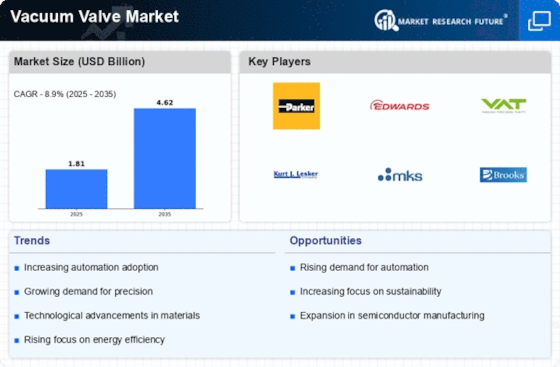
As per Market Research Future analysis, the Vacuum Valve Market was estimated at 1.808 USD Billion in 2024. The Vacuum Valve industry is projected to grow from 1.969 USD Billion in 2025 to 4.62 USD Billion by 2035, exhibiting a compound annual growth rate (CAGR) of 8.9% during the forecast period 2025 - 2035

Key Market Trends & Highlights

The Vacuum Valve Market is experiencing robust growth driven by technological advancements and increasing demand across various sectors.

  • Technological advancements are enhancing the efficiency and performance of vacuum valves, particularly in North America. The Asia-Pacific region is emerging as the fastest-growing market, fueled by rising industrialization and innovation. Isolation valves dominate the market due to their critical role in various applications, while pressure control valves are witnessing rapid growth. Key market drivers include the rising demand in semiconductor manufacturing and the growth in pharmaceutical and biotechnology sectors.

Market Size & Forecast

2024 Market Size 1.808 (USD Billion)
2035 Market Size 4.62 (USD Billion)
CAGR (2025 - 2035) 8.9%
Largest Regional Market Share in 2024 North America

Major Players

<a href="https://ph.parker.com/in/en/category/valves">Parker Hannifin</a> (US), Edwards Vacuum (GB), VAT Group (CH), Kurt J. Lesker Company (US), MKS Instruments (US), Brooks Automation (US), Aalborg Instruments (US), <a href="https://catalog.hoke.com/category/valves">Hoke </a>Inc. (US)

Market Trends

The Vacuum Valve Market is currently experiencing a dynamic evolution, driven by advancements in technology and increasing demand across various sectors. Industries such as semiconductor manufacturing, pharmaceuticals, and food processing are increasingly relying on vacuum valves for their operations. This reliance is likely due to the valves' ability to maintain precise control over pressure and flow, which is essential for ensuring product quality and operational efficiency. Furthermore, the growing emphasis on automation and smart manufacturing solutions appears to be propelling the adoption of advanced vacuum valve systems, which integrate seamlessly with modern production lines. In addition, environmental considerations are becoming more prominent within the Vacuum Valve Market. Companies are increasingly seeking solutions that not only enhance performance but also minimize energy consumption and waste. This trend suggests a shift towards more sustainable practices, as manufacturers strive to meet regulatory requirements and consumer expectations. As the market continues to evolve, it seems poised for further growth, with innovations in materials and design likely to play a crucial role in shaping its future.

Technological Advancements

The Vacuum Valve Market is witnessing a surge in technological innovations, particularly in the development of smart valves. These advanced systems offer enhanced monitoring and control capabilities, allowing for real-time data analysis and improved operational efficiency. As industries increasingly adopt automation, the demand for such sophisticated solutions is expected to rise.

Sustainability Focus

There is a growing emphasis on sustainability within the Vacuum Valve Market, as companies seek to reduce their environmental impact. This trend is reflected in the development of energy-efficient safety valves and materials that minimize waste. Manufacturers are likely to prioritize eco-friendly practices to align with regulatory standards and consumer preferences.

Diverse Applications

The applications of vacuum valves are expanding across various sectors, including pharmaceuticals, food processing, and electronics. This diversification indicates a broader acceptance of vacuum technology in different industries, suggesting that the market may continue to grow as new applications are discovered and developed.

Vacuum Valve Market Market Drivers

Increased Focus on Energy Efficiency

The Vacuum Valve Market is witnessing a shift towards energy-efficient solutions as industries strive to reduce operational costs and environmental impact. Vacuum systems are integral to various processes, and optimizing their energy consumption is becoming a priority. The implementation of energy-efficient vacuum valves can lead to significant savings in energy costs, which is particularly appealing in sectors such as food processing and chemical manufacturing. As energy prices fluctuate, the demand for vacuum valves that offer enhanced efficiency is likely to rise. This trend indicates a growing awareness among manufacturers about the importance of sustainability and cost-effectiveness, thereby propelling the Vacuum Valve Market forward.

Expansion of Renewable Energy Projects

The Vacuum Valve Market is positively impacted by the expansion of renewable energy projects, particularly in the wind and solar sectors. These projects often require vacuum systems for various applications, including the production of photovoltaic cells and the maintenance of turbine systems. As the world shifts towards sustainable energy sources, the demand for vacuum valves that support these technologies is expected to grow. The renewable energy market is projected to reach over 2 trillion USD by 2025, indicating a substantial opportunity for the Vacuum Valve Market. This growth suggests that manufacturers who align their products with the needs of the renewable sector may find lucrative prospects in the coming years.

Technological Innovations in Valve Design

The Vacuum Valve Market is characterized by continuous technological innovations that enhance valve performance and reliability. Recent advancements in materials and design have led to the development of valves that can withstand extreme conditions while maintaining optimal functionality. Innovations such as smart valves equipped with IoT capabilities are gaining traction, allowing for real-time monitoring and control. This evolution is particularly relevant in industries like aerospace and automotive, where precision and reliability are paramount. As manufacturers adopt these cutting-edge technologies, the Vacuum Valve Market is likely to experience a transformation, with increased demand for high-performance valves that meet the rigorous standards of modern applications.

Rising Demand in Semiconductor Manufacturing

The Vacuum Valve Market experiences a notable surge in demand driven by the semiconductor manufacturing sector. As the industry continues to expand, the need for high-precision vacuum valves becomes increasingly critical. These valves are essential for maintaining the vacuum environment necessary for various processes, including etching and deposition. In 2025, the semiconductor market is projected to reach a valuation of approximately 600 billion USD, indicating a robust growth trajectory. This growth directly correlates with the rising demand for vacuum valves, as manufacturers seek to enhance production efficiency and product quality. Consequently, the Vacuum Valve Market is likely to benefit from this trend, as companies invest in advanced technologies to meet the evolving needs of semiconductor fabrication.

Growth in Pharmaceutical and Biotechnology Sectors

The Vacuum Valve Market is significantly influenced by the expansion of the pharmaceutical and biotechnology sectors. These industries require stringent control over environmental conditions during the production and packaging of drugs and biologics. Vacuum valves play a crucial role in ensuring the integrity and sterility of products, which is paramount in these fields. The pharmaceutical market is expected to reach around 1.5 trillion USD by 2025, reflecting a strong demand for reliable vacuum systems. As companies prioritize quality assurance and regulatory compliance, the need for advanced vacuum valves is likely to increase, thereby driving growth in the Vacuum Valve Market. This trend suggests a promising outlook for manufacturers catering to these critical sectors.

Market Segment Insights

By Type: Isolation Valves (Largest) vs. Pressure Control Valves (Fastest-Growing)

<p>In the Vacuum Valve Market, the segment values reveal a clear hierarchy regarding market share. Isolation Valves take the lead, dominating sales due to their critical role in maintaining system integrity by preventing backflow and leaks. Following closely, Pressure Control Valves have gained significant traction, attributed to increased automation and precision control in industrial applications. Other valves such as Transfer Valves, Air Admittance Valves, and Check Valves, while important, exhibit comparatively smaller market shares.</p>

<p>Isolation Valves (Dominant) vs. Pressure Control Valves (Emerging)</p>

<p>Isolation Valves are recognized for their paramount importance in the Vacuum Valve Market, providing critical functions in various applications, particularly in the pharmaceutical and semiconductor industries. Their robustness and reliability contribute to their dominant position, as they prevent contamination and protect sensitive equipment. Conversely, Pressure Control Valves are emerging as a vital component, gaining rapid popularity due to the increasing demand for precise pressure management in vacuum systems. This growth is fueled by advancements in technology, improved manufacturing processes, and an expanding range of applications where high-performance valves are essential.</p>

By Pressure Range: High Vacuum (Largest) vs. Very High Vacuum (Fastest-Growing)

<p>In the Vacuum Valve Market, the pressure range segment is primarily dominated by high vacuum valves, which hold the largest market share due to their extensive applications in the semiconductor, electronic, and pharmaceutical industries. Low-to-medium vacuum valves cater to a broader range of industrial applications but represent a smaller portion of the total market, while very high vacuum valves are gaining traction due to innovations in technology and increasing demand for advanced applications.</p>

<p>Pressure Range: High Vacuum (Dominant) vs. Very High Vacuum (Emerging)</p>

<p>High vacuum valves are essential for industries requiring precise control and maintenance of low pressure environments; they are characterized by their ability to operate efficiently at pressures ranging from 10^-3 to 10^-7 torr. Conversely, very high vacuum valves are positioned as an emerging segment, catering to cutting-edge sectors such as aerospace and materials science. These valves, operating below 10^-7 torr, are being adopted rapidly due to advancements in nanotechnology and experimentation. Both segments are critical, yet high vacuum remains the dominant player, while very high vacuum is swiftly adapting to meet evolving technological demands.</p>

By Industry: Pharmaceuticals (Largest) vs. Semiconductors (Fastest-Growing)

<p>In the Vacuum Valve Market, the industry segment shows a diverse distribution of market share across various sectors. Pharmaceuticals holds the largest share, driven by the consistent need for vacuum systems in drug manufacturing and research labs. This sector is critical because vacuum valves are essential for ensuring sterile and controlled environments in pharmaceutical processes. Other significant industries include Chemicals and Food & Beverages, which also utilize vacuum valves extensively for product preservation and production efficiency. The Paper & Pulp and Analytical Instruments sectors follow closely, but with smaller shares that reflect their specific niche applications and market demands. Looking ahead, the growth trends in the Vacuum Valve Market are heavily influenced by technological advancements and increasing demand in emerging industries. The Semiconductor sector, noted for being the fastest-growing, is witnessing rapid expansion due to the rising need for efficient manufacturing processes in electronics. Innovations in vacuum valve designs are propelling growth across industries, as they enhance performance and energy efficiency. The overall demand for vacuum solutions is also expanding as industries focus on automation and process optimization, which are critical in maintaining competitive advantages.</p>

<p>Pharmaceuticals (Dominant) vs. Semiconductors (Emerging)</p>

<p>The Pharmaceuticals segment in the Vacuum Valve Market is characterized by an established demand for highly reliable and precise valves used in sterile manufacturing processes. These valves ensure that the vacuum conditions are maintained, crucial for the production of high-quality pharmaceuticals. Due to stringent regulatory requirements, this segment demands high-quality valves that can operate under specific conditions to prevent contamination. On the other hand, the Semiconductors sector is an emerging segment notable for its rapid growth. The surge in electronics manufacturing has led to an increased need for vacuum systems in chip production. This sector prioritizes advanced technology and high-performance vacuum valves, differentiating itself with a focus on innovation and sustainability, responding to the global trend toward smart and energy-efficient solutions.</p>

Get more detailed insights about Vacuum Valve Market Research Report — Global Forecast till 2035

Regional Insights

North America : Innovation and Demand Surge

North America is witnessing robust growth in the vacuum valve market, driven by advancements in semiconductor manufacturing and increased demand in the pharmaceutical sector. The region holds approximately 40% of the global market share, making it the largest market. Regulatory support for cleanroom environments and stringent quality standards further catalyze this growth. The U.S. is the primary contributor, followed by Canada, which is rapidly expanding its manufacturing capabilities. The competitive landscape is dominated by key players such as Parker Hannifin, MKS Instruments, and Brooks Automation. These companies are investing in R&D to enhance product efficiency and reliability. The presence of established manufacturers and a strong supply chain network bolster the market. Additionally, collaborations and partnerships among industry leaders are expected to drive innovation and market penetration, ensuring sustained growth in the coming years.

Europe : Regulatory Framework and Innovation

Europe is emerging as a significant player in the vacuum valve market, driven by stringent environmental regulations and a focus on energy efficiency. The region accounts for approximately 30% of the global market share, making it the second-largest market. Countries like Germany and the UK are leading the charge, with increasing investments in clean technologies and automation. The European Union's commitment to sustainability and innovation is a key driver for market growth, fostering advancements in vacuum technology. Leading countries in this region include Germany, the UK, and France, with a competitive landscape featuring companies like VAT Group and Edwards Vacuum. The presence of these key players, along with a strong emphasis on research and development, is propelling the market forward. Collaborative efforts between industry and academia are also enhancing innovation, ensuring that Europe remains at the forefront of vacuum valve technology. The regulatory environment supports these advancements, creating a conducive atmosphere for growth.

Asia-Pacific : Rapid Industrialization and Growth

Asia-Pacific is rapidly becoming a powerhouse in the vacuum valve market, driven by industrialization and increasing demand from the electronics and automotive sectors. The region holds approximately 25% of the global market share, with China and Japan being the largest contributors. The growing focus on automation and smart manufacturing is further propelling market growth, supported by favorable government policies and investments in infrastructure development. China leads the market, followed by Japan and South Korea, with a competitive landscape featuring both local and international players. Companies like Kurt J. Lesker and Aalborg Instruments are expanding their presence in the region. The market is characterized by a mix of established manufacturers and emerging startups, fostering innovation and competition. As the region continues to invest in advanced manufacturing technologies, the vacuum valve market is expected to see significant growth in the coming years.

Middle East and Africa : Emerging Markets and Opportunities

The Middle East and Africa region is witnessing gradual growth in the vacuum valve market, driven by increasing industrial activities and investments in infrastructure. The region holds approximately 5% of the global market share, with countries like South Africa and the UAE leading the way. The demand for vacuum valves is being fueled by sectors such as oil and gas, pharmaceuticals, and food processing, supported by government initiatives to diversify economies and enhance industrial capabilities. South Africa is the largest market in the region, followed by the UAE, with a competitive landscape that includes both local manufacturers and international players. Companies are focusing on expanding their product offerings and improving service capabilities to meet the growing demand. As the region continues to develop its industrial base, the vacuum valve market is poised for growth, presenting opportunities for both established and new entrants in the market.

Key Players and Competitive Insights

Leading market players are investing heavily in the research and development in order to expand their product lines, which will help the Vacuum Valve Market grow even more. Market players are also undertaking a variety of strategic activities to spread their global footprint, with important market developments including mergers and acquisitions, new product launches, contractual agreements, higher investments, and collaboration with other organizations. To spread and survive in a more competitive and rising market climate, the Vacuum Valve industry must offer cost-effective items.
Manufacturing locally to minimize the operational costs is one of the key business tactics used by the manufacturers in the global Vacuum Valve industry to benefit the clients and increase the market sector. In recent years, the Vacuum Valve industry has offered some of the most significant advantages to several industries. Major players in the Vacuum Valve Market, including VAT Group AG, Pfeiffer Vacuum Technology AG, Busch Vacuum Pumps, MKS Instruments, CDK Corporation, ULVAC, INC, SMC Corporation, Agilent Technologies, HVA LLC, V-TEX Corporation, and others, are trying to increase market demand by investing in research and development operations.
VAT Group AG is a leading global provider of high-performance vacuum valves and related solutions, with its headquarters in Haag, Switzerland. VAT is renowned for its innovative and precision-engineered vacuum valve products, which play a critical role in creating and maintaining vacuum conditions essential for various industrial processes. The company's commitment to technological excellence, product quality, and the customer satisfaction has solidified its position as a trusted partner in the advancement of vacuum technology globally.
VAT Group AG's comprehensive portfolio of vacuum valves and related services continues to meet the evolving needs of industries that rely on vacuum processes for their manufacturing and research endeavors.
In October VAT Holding AG, the global market leader in high-end vacuum valves, was acquired by Capvis, the leading Swiss mid-market private equity fund, and Partners Group, the global private markets manager, in a joint lead transaction. The acquisition is valued at CHF 1.4 billion (approximately USD 1.5 billion).
 Pfeiffer Vacuum Technology AG is a globally recognized company that specializes in vacuum solutions and technology. Headquartered in Asslar, Germany, the company has established itself as a leading provider of vacuum pumps, systems, and instruments for a wider range of applications. The company's product portfolio includes turbopumps, backing pumps, leak detectors, vacuum gauges, and related services catering to the diverse requirement of its global customer base. Pfeiffer Vacuum is renowned for its commitment to innovation, quality, and customer satisfaction, contributing significantly to advancements in vacuum technology and its widespread adoption across various industrial sectors worldwide.
In September 2023, Pfeiffer Vacuum Technology AG, a German manufacturer of vacuum technology, acquired CVC Holdings Inc., a US-based manufacturer of vacuum valves, for an undisclosed amount. The acquisition is expected to expand Pfeiffer Vacuum Technology's product portfolio and market reach.

Key Companies in the Vacuum Valve Market include

Industry Developments

August 2023: Busch Vacuum Pumps and Systems, a German manufacturer of vacuum pumps and systems, acquired Leybold GmbH, a German manufacturer of vacuum valves, for an undisclosed amount. The acquisition is expected to create a leading provider of vacuum technology solutions.

August 2023: Edwards Vacuum and Entegris, a US manufacturer of materials for the semiconductor industry, signed a partnership agreement to develop and commercialize vacuum valves for the semiconductor industry. The two companies will compile their expertise to develop new and improved vacuum valves for semiconductor manufacturing applications.

June 2023: ULVAC, Inc. acquired Veeco Instruments, Inc., a leading manufacturer of vacuum deposition equipment, for $2.4 billion. The acquisition is expected to expand ULVAC's presence in the semiconductor equipment market.

Future Outlook

Vacuum Valve Market Future Outlook

The Vacuum Valve Market is projected to grow at an 8.9% CAGR from 2025 to 2035, driven by advancements in automation, increasing demand in semiconductor manufacturing, and rising environmental regulations.<br>The future of the Vacuum Valves Market is defined by the rapid expansion of the semiconductor industry, specifically for 2nm node production and AI-driven chip architecture. Innovation is shifting toward IoT-integrated smart valves that offer real-time health analytics and predictive maintenance, significantly reducing fab downtime. Additionally, the push for ultra-high vacuum (UHV) systems in renewable energy and pharmaceutical manufacturing will drive sustained demand for advanced, contamination-free isolation technologies through 2035.

New opportunities lie in:

  • <p>Development of smart vacuum valves with IoT integration for real-time monitoring. Expansion into emerging markets with tailored vacuum solutions for local industries. Partnerships with renewable energy firms to supply vacuum valves for solar and wind applications.</p>

By 2035, the Vacuum Valve Market is expected to achieve substantial growth, driven by innovation and strategic partnerships.

Market Segmentation

Vacuum Valve Market Type Outlook

  • Pressure Control Valves
  • Isolation Valves
  • Transfer Valves
  • Air Admittance Valves
  • Check Valves

Vacuum Valve Market Industry Outlook

  • Analytical Instruments
  • Chemicals
  • Flat-Panel Display Manufacturing
  • Food & Beverages
  • Paper & Pulp
  • Pharmaceuticals
  • Semiconductors
  • Thin-Film Coating
  • Others

Vacuum Valve Market Pressure Range Outlook

  • Low-To-Medium
  • High Vacuum
  • Very High Vacuum

Report Scope

MARKET SIZE 2024 1.808(USD Billion)
MARKET SIZE 2025 1.969(USD Billion)
MARKET SIZE 2035 4.62(USD Billion)
COMPOUND ANNUAL GROWTH RATE (CAGR) 8.9% (2025 - 2035)
REPORT COVERAGE Revenue Forecast, Competitive Landscape, Growth Factors, and Trends
BASE YEAR 2024
Market Forecast Period 2025 - 2035
Historical Data 2019 - 2024
Market Forecast Units USD Billion
Key Companies Profiled Parker Hannifin (US), Edwards Vacuum (GB), VAT Group (CH), Kurt J. Lesker Company (US), MKS Instruments (US), Brooks Automation (US), Aalborg Instruments (US), Hoke Inc. (US)
Segments Covered Type, Pressure Range, Industry, Region
Key Market Opportunities Integration of smart technologies enhances efficiency in the Vacuum Valve Market.
Key Market Dynamics Technological advancements and regulatory changes drive innovation and competition in the vacuum valve market.
Countries Covered North America, Europe, APAC, South America, MEA

FAQs

What is the current valuation of the Vacuum Valve Market as of 2024?

<p>The Vacuum Valve Market was valued at 1.808 USD Billion in 2024.</p>

What is the projected market size for the Vacuum Valve Market in 2035?

<p>The market is projected to reach 4.62 USD Billion by 2035.</p>

What is the expected CAGR for the Vacuum Valve Market during the forecast period 2025 - 2035?

<p>The expected CAGR for the Vacuum Valve Market during 2025 - 2035 is 8.9%.</p>

Which companies are considered key players in the Vacuum Valve Market?

<p>Key players include Parker Hannifin, Edwards Vacuum, VAT Group, and MKS Instruments.</p>

What are the main types of vacuum valves and their market valuations?

<p>Pressure Control Valves and Isolation Valves are notable types, with valuations of 0.362 and 0.454 USD Billion respectively in 2024.</p>

How does the market for High Vacuum valves compare to Very High Vacuum valves?

<p>In 2024, the High Vacuum segment was valued at 0.542 USD Billion, while the Very High Vacuum segment was valued at 0.542 USD Billion.</p>

What industries are driving demand for vacuum valves?

Industries such as Pharmaceuticals and Semiconductors are driving demand, with valuations of 0.4 and 0.3 USD Billion respectively in 2024.

What is the market valuation for Isolation Valves in 2024?

Isolation Valves were valued at 0.454 USD Billion in 2024.

What is the projected growth for the Low-To-Medium pressure range segment?

The Low-To-Medium pressure range segment is projected to grow from 0.724 USD Billion in 2024 to 1.81 USD Billion by 2035.

What is the market valuation for Check Valves in 2024?

Check Valves were valued at 0.268 USD Billion in 2024.

  1. SECTION I: EXECUTIVE SUMMARY AND KEY HIGHLIGHTS
    1. | 1.1 EXECUTIVE SUMMARY
    2. | | 1.1.1 Market Overview
    3. | | 1.1.2 Key Findings
    4. | | 1.1.3 Market Segmentation
    5. | | 1.1.4 Competitive Landscape
    6. | | 1.1.5 Challenges and Opportunities
    7. | | 1.1.6 Future Outlook
  2. SECTION II: SCOPING, METHODOLOGY AND MARKET STRUCTURE
    1. | 2.1 MARKET INTRODUCTION
    2. | | 2.1.1 Definition
    3. | | 2.1.2 Scope of the study
    4. | | | 2.1.2.1 Research Objective
    5. | | | 2.1.2.2 Assumption
    6. | | | 2.1.2.3 Limitations
    7. | 2.2 RESEARCH METHODOLOGY
    8. | | 2.2.1 Overview
    9. | | 2.2.2 Data Mining
    10. | | 2.2.3 Secondary Research
    11. | | 2.2.4 Primary Research
    12. | | | 2.2.4.1 Primary Interviews and Information Gathering Process
    13. | | | 2.2.4.2 Breakdown of Primary Respondents
    14. | | 2.2.5 Forecasting Model
    15. | | 2.2.6 Market Size Estimation
    16. | | | 2.2.6.1 Bottom-Up Approach
    17. | | | 2.2.6.2 Top-Down Approach
    18. | | 2.2.7 Data Triangulation
    19. | | 2.2.8 Validation
  3. SECTION III: QUALITATIVE ANALYSIS
    1. | 3.1 MARKET DYNAMICS
    2. | | 3.1.1 Overview
    3. | | 3.1.2 Drivers
    4. | | 3.1.3 Restraints
    5. | | 3.1.4 Opportunities
    6. | 3.2 MARKET FACTOR ANALYSIS
    7. | | 3.2.1 Value chain Analysis
    8. | | 3.2.2 Porter's Five Forces Analysis
    9. | | | 3.2.2.1 Bargaining Power of Suppliers
    10. | | | 3.2.2.2 Bargaining Power of Buyers
    11. | | | 3.2.2.3 Threat of New Entrants
    12. | | | 3.2.2.4 Threat of Substitutes
    13. | | | 3.2.2.5 Intensity of Rivalry
    14. | | 3.2.3 COVID-19 Impact Analysis
    15. | | | 3.2.3.1 Market Impact Analysis
    16. | | | 3.2.3.2 Regional Impact
    17. | | | 3.2.3.3 Opportunity and Threat Analysis
  4. SECTION IV: QUANTITATIVE ANALYSIS
    1. | 4.1 Semiconductor & Electronics, BY Type (USD Billion)
    2. | | 4.1.1 Pressure Control Valves
    3. | | 4.1.2 Isolation Valves
    4. | | 4.1.3 Transfer Valves
    5. | | 4.1.4 Air Admittance Valves
    6. | | 4.1.5 Check Valves
    7. | 4.2 Semiconductor & Electronics, BY Pressure Range (USD Billion)
    8. | | 4.2.1 Low-To-Medium
    9. | | 4.2.2 High Vacuum
    10. | | 4.2.3 Very High Vacuum
    11. | 4.3 Semiconductor & Electronics, BY Industry (USD Billion)
    12. | | 4.3.1 Analytical Instruments
    13. | | 4.3.2 Chemicals
    14. | | 4.3.3 Flat-Panel Display Manufacturing
    15. | | 4.3.4 Food & Beverages
    16. | | 4.3.5 Paper & Pulp
    17. | | 4.3.6 Pharmaceuticals
    18. | | 4.3.7 Semiconductors
    19. | | 4.3.8 Thin-Film Coating
    20. | | 4.3.9 Others
    21. | 4.4 Semiconductor & Electronics, BY Region (USD Billion)
    22. | | 4.4.1 North America
    23. | | | 4.4.1.1 US
    24. | | | 4.4.1.2 Canada
    25. | | 4.4.2 Europe
    26. | | | 4.4.2.1 Germany
    27. | | | 4.4.2.2 UK
    28. | | | 4.4.2.3 France
    29. | | | 4.4.2.4 Russia
    30. | | | 4.4.2.5 Italy
    31. | | | 4.4.2.6 Spain
    32. | | | 4.4.2.7 Rest of Europe
    33. | | 4.4.3 APAC
    34. | | | 4.4.3.1 China
    35. | | | 4.4.3.2 India
    36. | | | 4.4.3.3 Japan
    37. | | | 4.4.3.4 South Korea
    38. | | | 4.4.3.5 Malaysia
    39. | | | 4.4.3.6 Thailand
    40. | | | 4.4.3.7 Indonesia
    41. | | | 4.4.3.8 Rest of APAC
    42. | | 4.4.4 South America
    43. | | | 4.4.4.1 Brazil
    44. | | | 4.4.4.2 Mexico
    45. | | | 4.4.4.3 Argentina
    46. | | | 4.4.4.4 Rest of South America
    47. | | 4.4.5 MEA
    48. | | | 4.4.5.1 GCC Countries
    49. | | | 4.4.5.2 South Africa
    50. | | | 4.4.5.3 Rest of MEA
  5. SECTION V: COMPETITIVE ANALYSIS
    1. | 5.1 Competitive Landscape
    2. | | 5.1.1 Overview
    3. | | 5.1.2 Competitive Analysis
    4. | | 5.1.3 Market share Analysis
    5. | | 5.1.4 Major Growth Strategy in the Semiconductor & Electronics
    6. | | 5.1.5 Competitive Benchmarking
    7. | | 5.1.6 Leading Players in Terms of Number of Developments in the Semiconductor & Electronics
    8. | | 5.1.7 Key developments and growth strategies
    9. | | | 5.1.7.1 New Product Launch/Service Deployment
    10. | | | 5.1.7.2 Merger & Acquisitions
    11. | | | 5.1.7.3 Joint Ventures
    12. | | 5.1.8 Major Players Financial Matrix
    13. | | | 5.1.8.1 Sales and Operating Income
    14. | | | 5.1.8.2 Major Players R&D Expenditure. 2023
    15. | 5.2 Company Profiles
    16. | | 5.2.1 Parker Hannifin (US)
    17. | | | 5.2.1.1 Financial Overview
    18. | | | 5.2.1.2 Products Offered
    19. | | | 5.2.1.3 Key Developments
    20. | | | 5.2.1.4 SWOT Analysis
    21. | | | 5.2.1.5 Key Strategies
    22. | | 5.2.2 Edwards Vacuum (GB)
    23. | | | 5.2.2.1 Financial Overview
    24. | | | 5.2.2.2 Products Offered
    25. | | | 5.2.2.3 Key Developments
    26. | | | 5.2.2.4 SWOT Analysis
    27. | | | 5.2.2.5 Key Strategies
    28. | | 5.2.3 VAT Group (CH)
    29. | | | 5.2.3.1 Financial Overview
    30. | | | 5.2.3.2 Products Offered
    31. | | | 5.2.3.3 Key Developments
    32. | | | 5.2.3.4 SWOT Analysis
    33. | | | 5.2.3.5 Key Strategies
    34. | | 5.2.4 Kurt J. Lesker Company (US)
    35. | | | 5.2.4.1 Financial Overview
    36. | | | 5.2.4.2 Products Offered
    37. | | | 5.2.4.3 Key Developments
    38. | | | 5.2.4.4 SWOT Analysis
    39. | | | 5.2.4.5 Key Strategies
    40. | | 5.2.5 MKS Instruments (US)
    41. | | | 5.2.5.1 Financial Overview
    42. | | | 5.2.5.2 Products Offered
    43. | | | 5.2.5.3 Key Developments
    44. | | | 5.2.5.4 SWOT Analysis
    45. | | | 5.2.5.5 Key Strategies
    46. | | 5.2.6 Brooks Automation (US)
    47. | | | 5.2.6.1 Financial Overview
    48. | | | 5.2.6.2 Products Offered
    49. | | | 5.2.6.3 Key Developments
    50. | | | 5.2.6.4 SWOT Analysis
    51. | | | 5.2.6.5 Key Strategies
    52. | | 5.2.7 Aalborg Instruments (US)
    53. | | | 5.2.7.1 Financial Overview
    54. | | | 5.2.7.2 Products Offered
    55. | | | 5.2.7.3 Key Developments
    56. | | | 5.2.7.4 SWOT Analysis
    57. | | | 5.2.7.5 Key Strategies
    58. | | 5.2.8 Hoke Inc. (US)
    59. | | | 5.2.8.1 Financial Overview
    60. | | | 5.2.8.2 Products Offered
    61. | | | 5.2.8.3 Key Developments
    62. | | | 5.2.8.4 SWOT Analysis
    63. | | | 5.2.8.5 Key Strategies
    64. | 5.3 Appendix
    65. | | 5.3.1 References
    66. | | 5.3.2 Related Reports
  6. LIST OF FIGURES
    1. | 6.1 MARKET SYNOPSIS
    2. | 6.2 NORTH AMERICA MARKET ANALYSIS
    3. | 6.3 US MARKET ANALYSIS BY TYPE
    4. | 6.4 US MARKET ANALYSIS BY PRESSURE RANGE
    5. | 6.5 US MARKET ANALYSIS BY INDUSTRY
    6. | 6.6 CANADA MARKET ANALYSIS BY TYPE
    7. | 6.7 CANADA MARKET ANALYSIS BY PRESSURE RANGE
    8. | 6.8 CANADA MARKET ANALYSIS BY INDUSTRY
    9. | 6.9 EUROPE MARKET ANALYSIS
    10. | 6.10 GERMANY MARKET ANALYSIS BY TYPE
    11. | 6.11 GERMANY MARKET ANALYSIS BY PRESSURE RANGE
    12. | 6.12 GERMANY MARKET ANALYSIS BY INDUSTRY
    13. | 6.13 UK MARKET ANALYSIS BY TYPE
    14. | 6.14 UK MARKET ANALYSIS BY PRESSURE RANGE
    15. | 6.15 UK MARKET ANALYSIS BY INDUSTRY
    16. | 6.16 FRANCE MARKET ANALYSIS BY TYPE
    17. | 6.17 FRANCE MARKET ANALYSIS BY PRESSURE RANGE
    18. | 6.18 FRANCE MARKET ANALYSIS BY INDUSTRY
    19. | 6.19 RUSSIA MARKET ANALYSIS BY TYPE
    20. | 6.20 RUSSIA MARKET ANALYSIS BY PRESSURE RANGE
    21. | 6.21 RUSSIA MARKET ANALYSIS BY INDUSTRY
    22. | 6.22 ITALY MARKET ANALYSIS BY TYPE
    23. | 6.23 ITALY MARKET ANALYSIS BY PRESSURE RANGE
    24. | 6.24 ITALY MARKET ANALYSIS BY INDUSTRY
    25. | 6.25 SPAIN MARKET ANALYSIS BY TYPE
    26. | 6.26 SPAIN MARKET ANALYSIS BY PRESSURE RANGE
    27. | 6.27 SPAIN MARKET ANALYSIS BY INDUSTRY
    28. | 6.28 REST OF EUROPE MARKET ANALYSIS BY TYPE
    29. | 6.29 REST OF EUROPE MARKET ANALYSIS BY PRESSURE RANGE
    30. | 6.30 REST OF EUROPE MARKET ANALYSIS BY INDUSTRY
    31. | 6.31 APAC MARKET ANALYSIS
    32. | 6.32 CHINA MARKET ANALYSIS BY TYPE
    33. | 6.33 CHINA MARKET ANALYSIS BY PRESSURE RANGE
    34. | 6.34 CHINA MARKET ANALYSIS BY INDUSTRY
    35. | 6.35 INDIA MARKET ANALYSIS BY TYPE
    36. | 6.36 INDIA MARKET ANALYSIS BY PRESSURE RANGE
    37. | 6.37 INDIA MARKET ANALYSIS BY INDUSTRY
    38. | 6.38 JAPAN MARKET ANALYSIS BY TYPE
    39. | 6.39 JAPAN MARKET ANALYSIS BY PRESSURE RANGE
    40. | 6.40 JAPAN MARKET ANALYSIS BY INDUSTRY
    41. | 6.41 SOUTH KOREA MARKET ANALYSIS BY TYPE
    42. | 6.42 SOUTH KOREA MARKET ANALYSIS BY PRESSURE RANGE
    43. | 6.43 SOUTH KOREA MARKET ANALYSIS BY INDUSTRY
    44. | 6.44 MALAYSIA MARKET ANALYSIS BY TYPE
    45. | 6.45 MALAYSIA MARKET ANALYSIS BY PRESSURE RANGE
    46. | 6.46 MALAYSIA MARKET ANALYSIS BY INDUSTRY
    47. | 6.47 THAILAND MARKET ANALYSIS BY TYPE
    48. | 6.48 THAILAND MARKET ANALYSIS BY PRESSURE RANGE
    49. | 6.49 THAILAND MARKET ANALYSIS BY INDUSTRY
    50. | 6.50 INDONESIA MARKET ANALYSIS BY TYPE
    51. | 6.51 INDONESIA MARKET ANALYSIS BY PRESSURE RANGE
    52. | 6.52 INDONESIA MARKET ANALYSIS BY INDUSTRY
    53. | 6.53 REST OF APAC MARKET ANALYSIS BY TYPE
    54. | 6.54 REST OF APAC MARKET ANALYSIS BY PRESSURE RANGE
    55. | 6.55 REST OF APAC MARKET ANALYSIS BY INDUSTRY
    56. | 6.56 SOUTH AMERICA MARKET ANALYSIS
    57. | 6.57 BRAZIL MARKET ANALYSIS BY TYPE
    58. | 6.58 BRAZIL MARKET ANALYSIS BY PRESSURE RANGE
    59. | 6.59 BRAZIL MARKET ANALYSIS BY INDUSTRY
    60. | 6.60 MEXICO MARKET ANALYSIS BY TYPE
    61. | 6.61 MEXICO MARKET ANALYSIS BY PRESSURE RANGE
    62. | 6.62 MEXICO MARKET ANALYSIS BY INDUSTRY
    63. | 6.63 ARGENTINA MARKET ANALYSIS BY TYPE
    64. | 6.64 ARGENTINA MARKET ANALYSIS BY PRESSURE RANGE
    65. | 6.65 ARGENTINA MARKET ANALYSIS BY INDUSTRY
    66. | 6.66 REST OF SOUTH AMERICA MARKET ANALYSIS BY TYPE
    67. | 6.67 REST OF SOUTH AMERICA MARKET ANALYSIS BY PRESSURE RANGE
    68. | 6.68 REST OF SOUTH AMERICA MARKET ANALYSIS BY INDUSTRY
    69. | 6.69 MEA MARKET ANALYSIS
    70. | 6.70 GCC COUNTRIES MARKET ANALYSIS BY TYPE
    71. | 6.71 GCC COUNTRIES MARKET ANALYSIS BY PRESSURE RANGE
    72. | 6.72 GCC COUNTRIES MARKET ANALYSIS BY INDUSTRY
    73. | 6.73 SOUTH AFRICA MARKET ANALYSIS BY TYPE
    74. | 6.74 SOUTH AFRICA MARKET ANALYSIS BY PRESSURE RANGE
    75. | 6.75 SOUTH AFRICA MARKET ANALYSIS BY INDUSTRY
    76. | 6.76 REST OF MEA MARKET ANALYSIS BY TYPE
    77. | 6.77 REST OF MEA MARKET ANALYSIS BY PRESSURE RANGE
    78. | 6.78 REST OF MEA MARKET ANALYSIS BY INDUSTRY
    79. | 6.79 KEY BUYING CRITERIA OF SEMICONDUCTOR & ELECTRONICS
    80. | 6.80 RESEARCH PROCESS OF MRFR
    81. | 6.81 DRO ANALYSIS OF SEMICONDUCTOR & ELECTRONICS
    82. | 6.82 DRIVERS IMPACT ANALYSIS: SEMICONDUCTOR & ELECTRONICS
    83. | 6.83 RESTRAINTS IMPACT ANALYSIS: SEMICONDUCTOR & ELECTRONICS
    84. | 6.84 SUPPLY / VALUE CHAIN: SEMICONDUCTOR & ELECTRONICS
    85. | 6.85 SEMICONDUCTOR & ELECTRONICS, BY TYPE, 2024 (% SHARE)
    86. | 6.86 SEMICONDUCTOR & ELECTRONICS, BY TYPE, 2024 TO 2035 (USD Billion)
    87. | 6.87 SEMICONDUCTOR & ELECTRONICS, BY PRESSURE RANGE, 2024 (% SHARE)
    88. | 6.88 SEMICONDUCTOR & ELECTRONICS, BY PRESSURE RANGE, 2024 TO 2035 (USD Billion)
    89. | 6.89 SEMICONDUCTOR & ELECTRONICS, BY INDUSTRY, 2024 (% SHARE)
    90. | 6.90 SEMICONDUCTOR & ELECTRONICS, BY INDUSTRY, 2024 TO 2035 (USD Billion)
    91. | 6.91 BENCHMARKING OF MAJOR COMPETITORS
  7. LIST OF TABLES
    1. | 7.1 LIST OF ASSUMPTIONS
    2. | | 7.1.1
    3. | 7.2 North America MARKET SIZE ESTIMATES; FORECAST
    4. | | 7.2.1 BY TYPE, 2025-2035 (USD Billion)
    5. | | 7.2.2 BY PRESSURE RANGE, 2025-2035 (USD Billion)
    6. | | 7.2.3 BY INDUSTRY, 2025-2035 (USD Billion)
    7. | 7.3 US MARKET SIZE ESTIMATES; FORECAST
    8. | | 7.3.1 BY TYPE, 2025-2035 (USD Billion)
    9. | | 7.3.2 BY PRESSURE RANGE, 2025-2035 (USD Billion)
    10. | | 7.3.3 BY INDUSTRY, 2025-2035 (USD Billion)
    11. | 7.4 Canada MARKET SIZE ESTIMATES; FORECAST
    12. | | 7.4.1 BY TYPE, 2025-2035 (USD Billion)
    13. | | 7.4.2 BY PRESSURE RANGE, 2025-2035 (USD Billion)
    14. | | 7.4.3 BY INDUSTRY, 2025-2035 (USD Billion)
    15. | 7.5 Europe MARKET SIZE ESTIMATES; FORECAST
    16. | | 7.5.1 BY TYPE, 2025-2035 (USD Billion)
    17. | | 7.5.2 BY PRESSURE RANGE, 2025-2035 (USD Billion)
    18. | | 7.5.3 BY INDUSTRY, 2025-2035 (USD Billion)
    19. | 7.6 Germany MARKET SIZE ESTIMATES; FORECAST
    20. | | 7.6.1 BY TYPE, 2025-2035 (USD Billion)
    21. | | 7.6.2 BY PRESSURE RANGE, 2025-2035 (USD Billion)
    22. | | 7.6.3 BY INDUSTRY, 2025-2035 (USD Billion)
    23. | 7.7 UK MARKET SIZE ESTIMATES; FORECAST
    24. | | 7.7.1 BY TYPE, 2025-2035 (USD Billion)
    25. | | 7.7.2 BY PRESSURE RANGE, 2025-2035 (USD Billion)
    26. | | 7.7.3 BY INDUSTRY, 2025-2035 (USD Billion)
    27. | 7.8 France MARKET SIZE ESTIMATES; FORECAST
    28. | | 7.8.1 BY TYPE, 2025-2035 (USD Billion)
    29. | | 7.8.2 BY PRESSURE RANGE, 2025-2035 (USD Billion)
    30. | | 7.8.3 BY INDUSTRY, 2025-2035 (USD Billion)
    31. | 7.9 Russia MARKET SIZE ESTIMATES; FORECAST
    32. | | 7.9.1 BY TYPE, 2025-2035 (USD Billion)
    33. | | 7.9.2 BY PRESSURE RANGE, 2025-2035 (USD Billion)
    34. | | 7.9.3 BY INDUSTRY, 2025-2035 (USD Billion)
    35. | 7.10 Italy MARKET SIZE ESTIMATES; FORECAST
    36. | | 7.10.1 BY TYPE, 2025-2035 (USD Billion)
    37. | | 7.10.2 BY PRESSURE RANGE, 2025-2035 (USD Billion)
    38. | | 7.10.3 BY INDUSTRY, 2025-2035 (USD Billion)
    39. | 7.11 Spain MARKET SIZE ESTIMATES; FORECAST
    40. | | 7.11.1 BY TYPE, 2025-2035 (USD Billion)
    41. | | 7.11.2 BY PRESSURE RANGE, 2025-2035 (USD Billion)
    42. | | 7.11.3 BY INDUSTRY, 2025-2035 (USD Billion)
    43. | 7.12 Rest of Europe MARKET SIZE ESTIMATES; FORECAST
    44. | | 7.12.1 BY TYPE, 2025-2035 (USD Billion)
    45. | | 7.12.2 BY PRESSURE RANGE, 2025-2035 (USD Billion)
    46. | | 7.12.3 BY INDUSTRY, 2025-2035 (USD Billion)
    47. | 7.13 APAC MARKET SIZE ESTIMATES; FORECAST
    48. | | 7.13.1 BY TYPE, 2025-2035 (USD Billion)
    49. | | 7.13.2 BY PRESSURE RANGE, 2025-2035 (USD Billion)
    50. | | 7.13.3 BY INDUSTRY, 2025-2035 (USD Billion)
    51. | 7.14 China MARKET SIZE ESTIMATES; FORECAST
    52. | | 7.14.1 BY TYPE, 2025-2035 (USD Billion)
    53. | | 7.14.2 BY PRESSURE RANGE, 2025-2035 (USD Billion)
    54. | | 7.14.3 BY INDUSTRY, 2025-2035 (USD Billion)
    55. | 7.15 India MARKET SIZE ESTIMATES; FORECAST
    56. | | 7.15.1 BY TYPE, 2025-2035 (USD Billion)
    57. | | 7.15.2 BY PRESSURE RANGE, 2025-2035 (USD Billion)
    58. | | 7.15.3 BY INDUSTRY, 2025-2035 (USD Billion)
    59. | 7.16 Japan MARKET SIZE ESTIMATES; FORECAST
    60. | | 7.16.1 BY TYPE, 2025-2035 (USD Billion)
    61. | | 7.16.2 BY PRESSURE RANGE, 2025-2035 (USD Billion)
    62. | | 7.16.3 BY INDUSTRY, 2025-2035 (USD Billion)
    63. | 7.17 South Korea MARKET SIZE ESTIMATES; FORECAST
    64. | | 7.17.1 BY TYPE, 2025-2035 (USD Billion)
    65. | | 7.17.2 BY PRESSURE RANGE, 2025-2035 (USD Billion)
    66. | | 7.17.3 BY INDUSTRY, 2025-2035 (USD Billion)
    67. | 7.18 Malaysia MARKET SIZE ESTIMATES; FORECAST
    68. | | 7.18.1 BY TYPE, 2025-2035 (USD Billion)
    69. | | 7.18.2 BY PRESSURE RANGE, 2025-2035 (USD Billion)
    70. | | 7.18.3 BY INDUSTRY, 2025-2035 (USD Billion)
    71. | 7.19 Thailand MARKET SIZE ESTIMATES; FORECAST
    72. | | 7.19.1 BY TYPE, 2025-2035 (USD Billion)
    73. | | 7.19.2 BY PRESSURE RANGE, 2025-2035 (USD Billion)
    74. | | 7.19.3 BY INDUSTRY, 2025-2035 (USD Billion)
    75. | 7.20 Indonesia MARKET SIZE ESTIMATES; FORECAST
    76. | | 7.20.1 BY TYPE, 2025-2035 (USD Billion)
    77. | | 7.20.2 BY PRESSURE RANGE, 2025-2035 (USD Billion)
    78. | | 7.20.3 BY INDUSTRY, 2025-2035 (USD Billion)
    79. | 7.21 Rest of APAC MARKET SIZE ESTIMATES; FORECAST
    80. | | 7.21.1 BY TYPE, 2025-2035 (USD Billion)
    81. | | 7.21.2 BY PRESSURE RANGE, 2025-2035 (USD Billion)
    82. | | 7.21.3 BY INDUSTRY, 2025-2035 (USD Billion)
    83. | 7.22 South America MARKET SIZE ESTIMATES; FORECAST
    84. | | 7.22.1 BY TYPE, 2025-2035 (USD Billion)
    85. | | 7.22.2 BY PRESSURE RANGE, 2025-2035 (USD Billion)
    86. | | 7.22.3 BY INDUSTRY, 2025-2035 (USD Billion)
    87. | 7.23 Brazil MARKET SIZE ESTIMATES; FORECAST
    88. | | 7.23.1 BY TYPE, 2025-2035 (USD Billion)
    89. | | 7.23.2 BY PRESSURE RANGE, 2025-2035 (USD Billion)
    90. | | 7.23.3 BY INDUSTRY, 2025-2035 (USD Billion)
    91. | 7.24 Mexico MARKET SIZE ESTIMATES; FORECAST
    92. | | 7.24.1 BY TYPE, 2025-2035 (USD Billion)
    93. | | 7.24.2 BY PRESSURE RANGE, 2025-2035 (USD Billion)
    94. | | 7.24.3 BY INDUSTRY, 2025-2035 (USD Billion)
    95. | 7.25 Argentina MARKET SIZE ESTIMATES; FORECAST
    96. | | 7.25.1 BY TYPE, 2025-2035 (USD Billion)
    97. | | 7.25.2 BY PRESSURE RANGE, 2025-2035 (USD Billion)
    98. | | 7.25.3 BY INDUSTRY, 2025-2035 (USD Billion)
    99. | 7.26 Rest of South America MARKET SIZE ESTIMATES; FORECAST
    100. | | 7.26.1 BY TYPE, 2025-2035 (USD Billion)
    101. | | 7.26.2 BY PRESSURE RANGE, 2025-2035 (USD Billion)
    102. | | 7.26.3 BY INDUSTRY, 2025-2035 (USD Billion)
    103. | 7.27 MEA MARKET SIZE ESTIMATES; FORECAST
    104. | | 7.27.1 BY TYPE, 2025-2035 (USD Billion)
    105. | | 7.27.2 BY PRESSURE RANGE, 2025-2035 (USD Billion)
    106. | | 7.27.3 BY INDUSTRY, 2025-2035 (USD Billion)
    107. | 7.28 GCC Countries MARKET SIZE ESTIMATES; FORECAST
    108. | | 7.28.1 BY TYPE, 2025-2035 (USD Billion)
    109. | | 7.28.2 BY PRESSURE RANGE, 2025-2035 (USD Billion)
    110. | | 7.28.3 BY INDUSTRY, 2025-2035 (USD Billion)
    111. | 7.29 South Africa MARKET SIZE ESTIMATES; FORECAST
    112. | | 7.29.1 BY TYPE, 2025-2035 (USD Billion)
    113. | | 7.29.2 BY PRESSURE RANGE, 2025-2035 (USD Billion)
    114. | | 7.29.3 BY INDUSTRY, 2025-2035 (USD Billion)
    115. | 7.30 Rest of MEA MARKET SIZE ESTIMATES; FORECAST
    116. | | 7.30.1 BY TYPE, 2025-2035 (USD Billion)
    117. | | 7.30.2 BY PRESSURE RANGE, 2025-2035 (USD Billion)
    118. | | 7.30.3 BY INDUSTRY, 2025-2035 (USD Billion)
    119. | 7.31 PRODUCT LAUNCH/PRODUCT DEVELOPMENT/APPROVAL
    120. | | 7.31.1
    121. | 7.32 ACQUISITION/PARTNERSHIP
    122. | | 7.32.1

Semiconductor & Electronics Market Segmentation

Semiconductor & Electronics By Type (USD Billion, 2025-2035)

  • Pressure Control Valves
  • Isolation Valves
  • Transfer Valves
  • Air Admittance Valves
  • Check Valves

Semiconductor & Electronics By Pressure Range (USD Billion, 2025-2035)

  • Low-To-Medium
  • High Vacuum
  • Very High Vacuum

Semiconductor & Electronics By Industry (USD Billion, 2025-2035)

  • Analytical Instruments
  • Chemicals
  • Flat-Panel Display Manufacturing
  • Food & Beverages
  • Paper & Pulp
  • Pharmaceuticals
  • Semiconductors
  • Thin-Film Coating
  • Others
Infographic

Free Sample Request

Kindly complete the form below to receive a free sample of this Report

Get Free Sample

Customer Strories

Compare Licence

×
Features License Type
Single User Multiuser License Enterprise User
Price $4,950 $5,950 $7,250
Maximum User Access Limit 1 User Upto 10 Users Unrestricted Access Throughout the Organization
Free Customization
Direct Access to Analyst
Deliverable Format
Platform Access
Discount on Next Purchase 10% 15% 15%
Printable Versions
%>