Request Free Sample ×

Kindly complete the form below to receive a free sample of this Report

* Please use a valid business email

Leading companies partner with us for data-driven Insights

clients tt-cursor
Hero Background
English
Chinese
French
Japanese
Korean
German
Spanish

Utility Vehicles Market Size

ID: MRFR/AT/10346-HCR
128 Pages
Shubham Munde
April 2026

Utility Vehicles Market Research Report Information by Vehicle Type (Sport Utility Vehicle (SUV), Multi Utility Vehicle (MUV), Utility Terrain Vehicle (UTV), Others), by Application (Passenger Commute, Industrial, Agricultural, Sports, Others), by Propulsion (IC Engine Powered, Electric Powered, Others) and By Region (North America, Europe, Asia-Pacific, and Rest of the World) –Market Forecast Till 2035

Share:
Download PDF ×

We do not share your information with anyone. However, we may send you emails based on your report interest from time to time. You may contact us at any time to opt-out.

Utility Vehicles Market Infographic
Purchase Options

Utility Vehicles Size

Utility Vehicles Market Growth Projections and Opportunities

A multitude of interconnected influencing factors determine the market's course for utility vehicles. Consumer demand, which is driven by a wide range of requirements ranging from leisure activities to business implementations, is a crucial determinant. The rising predominance of urbanization and changing ways of life have prompted a significant flood in the interest for flexible utility vehicles, including hybrids and SUVs. Furthermore, mileage and reasonableness are huge elements, as customers habitually search for vehicles that accomplish an amicable blend of execution and monetary reasonability.

Moreover, government arrangements and guidelines are essential market factors. The worldwide execution of outflow guidelines, security guidelines, and eco-friendliness orders impacts the conceptualization, assembling, and advancement of utility vehicles. To meet these prerequisites, producers should distribute assets towards innovative work, which brings about mechanical developments that significantly affect the market climate.

Critical effect is applied by monetary circumstances available for utility vehicles. Purchasers for the most part have more noteworthy dispensable incomes during times of monetary development, which invigorates the interest in utility vehicles. Going against the norm, monetary constrictions could provoke a progress towards vehicles that are more prudent and harmless to the ecosystem regarding gas utilization. Also, supporting choices and loan costs impact the buying choices of purchasers, with ideal funding terms regularly invigorating business sector development.

Mechanical development arises as an outlook changing specialist inside the market for utility vehicles. The conspicuousness of electric and mixture innovation headways has expanded because of the overall development towards maintainability and ecological mindfulness. Utility vehicles gain an upper hand by integrating shrewd innovations, including network includes and high level driver help frameworks (ADAS), which oblige to the changing inclinations of mechanically slanted customers.

The business of auto is altogether impacted by serious powers that shape the utility vehicle market. Rivalry among makers, incorporating both deep rooted firms and newbies, invigorates the headway of items and developments. Besides, market elements are affected by essential coalitions, consolidations, and acquisitions, which thusly influence market focus and the cutthroat climate. The limit of makers to change in light of advancing customer inclinations and emanant patterns is basic to their proceeded with success.

International and foreign relations acquaint a component of unconventionality with the utility vehicle market. Inventory network disturbances brought about in terms of professional career questions, taxes, and international pressures can possibly affect creation costs and, therefore, vehicle costs. Manufacturing costs are significantly impacted by price fluctuations in primary materials, particularly aluminum and steel, which in turn affects pricing strategies employed by industry players.

Inclinations and view of customers essentially impact the development of the market. The increased attention given to electric and hybrid utility vehicles as a result of an increased focus on sustainability is indicative of a more general shift toward environmentally conscious modes of transportation. Customer choices are furthermore affected by wellbeing ascribes, visual appeal, and brand picture, which forces makers to give priority to these elements during the method involved with fostering their items.

The market for utility vehicles is a multifaceted biological system that is influenced by a broad number of interrelated components. The market elements are formed by an intersection of variables including shopper interest, unofficial laws, monetary circumstances, innovative progressions, serious powers, worldwide occasions, and customer inclinations. By staying aware of these factors, adapting their strategies to match emerging trends, and meeting the ever-changing needs of customers in a dynamic automotive industry, skilled manufacturers are able to successfully navigate this complicated terrain.

Utility Vehicles Market Size Graph
Author
Author Profile
Shubham Munde
Team Lead - Research

Shubham brings over 7 years of expertise in Market Intelligence and Strategic Consulting, with a strong focus on the Automotive, Aerospace, and Defense sectors. Backed by a solid foundation in semiconductors, electronics, and software, he has successfully delivered high-impact syndicated and custom research on a global scale. His core strengths include market sizing, forecasting, competitive intelligence, consumer insights, and supply chain mapping. Widely recognized for developing scalable growth strategies, Shubham empowers clients to navigate complex markets and achieve a lasting competitive edge. Trusted by start-ups and Fortune 500 companies alike, he consistently converts challenges into strategic opportunities that drive sustainable growth.

Leave a Comment

FAQs

What is the current valuation of the Utility Vehicles Market?

<p>The Utility Vehicles Market was valued at 31.76 USD Billion in 2024.</p>

What is the projected market valuation for the Utility Vehicles Market in 2035?

<p>The market is projected to reach 89.74 USD Billion by 2035.</p>

What is the expected CAGR for the Utility Vehicles Market from 2025 to 2035?

<p>The expected CAGR for the Utility Vehicles Market during the forecast period 2025 - 2035 is 9.9%.</p>

Which segments are included in the Utility Vehicles Market?

<p>The market includes segments such as Sport Utility Vehicles (SUV), Multi Utility Vehicles (MUV), and Utility Terrain Vehicles (UTV), among others.</p>

What was the valuation of the Sport Utility Vehicle segment in 2024?

<p>The Sport Utility Vehicle segment was valued at 12.7 USD Billion in 2024.</p>

How much is the Electric Powered propulsion segment projected to grow by 2035?

<p>The Electric Powered propulsion segment is projected to grow from 8.0 USD Billion in 2024 to 30.0 USD Billion by 2035.</p>

What applications are driving the Utility Vehicles Market?

Key applications driving the market include Passenger Commute, Industrial, and Agricultural uses.

Which company is a key player in the Utility Vehicles Market?

Toyota, Ford, and General Motors are among the key players in the Utility Vehicles Market.

What was the valuation of the Industrial application segment in 2024?

The Industrial application segment was valued at 8.0 USD Billion in 2024.

What is the projected valuation for the Utility Terrain Vehicle segment by 2035?

The Utility Terrain Vehicle segment is projected to grow from 5.0 USD Billion in 2024 to 15.0 USD Billion by 2035.

Market Summary

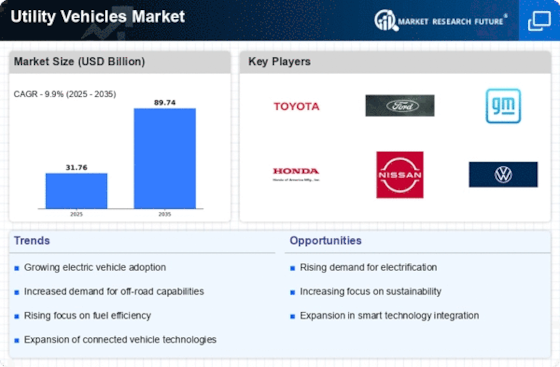
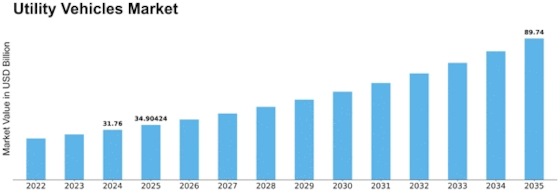
As per Market Research Future analysis, the Utility Vehicles Market was estimated at 31.76 USD Billion in 2024. The Utility Vehicles industry is projected to grow from 34.91 USD Billion in 2025 to 89.74 USD Billion by 2035, exhibiting a compound annual growth rate (CAGR) of 9.9% during the forecast period 2025 - 2035

Key Market Trends & Highlights

The Utility Vehicles Market is experiencing a dynamic shift towards sustainability and technological integration.

  • North America remains the largest market for utility vehicles, driven by a robust demand for versatile models. The Asia-Pacific region is emerging as the fastest-growing market, fueled by increasing urbanization and economic development. Sport Utility Vehicles Market dominate the market, while Multi Utility Vehicles Market are witnessing rapid growth due to their adaptability. Key drivers include rising demand for fuel-efficient vehicles and government incentives promoting utility vehicle adoption.

Market Size & Forecast

2024 Market Size 31.76 (USD Billion)
2035 Market Size 89.74 (USD Billion)
CAGR (2025 - 2035) 9.9%
Largest Regional Market Share in 2024 North America

Major Players

<a href="https://www.toyota.com/off-road-vehicles/">Toyota</a> (JP), Ford (US), General Motors (US), Honda (JP), Nissan (JP), Volkswagen (DE), <a href="https://www.hyundai.com/worldwide/en/vehicles.suv">Hyundai</a> (KR), Kia (KR), Subaru (JP)

Market Trends

The Utility Vehicles Market is currently experiencing a dynamic evolution, driven by various factors that shape consumer preferences and technological advancements. The increasing demand for versatile vehicles that can serve multiple purposes, such as transportation, recreation, and utility tasks, appears to be a primary catalyst for growth. Additionally, the rising awareness of environmental sustainability is prompting manufacturers to innovate and develop more eco-friendly options, which may include electric and hybrid models. This shift not only aligns with global sustainability goals but also caters to a growing segment of environmentally conscious consumers. Moreover, the Utility Vehicles Market is witnessing a notable trend towards enhanced connectivity and smart technology integration. Vehicles equipped with advanced features such as GPS navigation, real-time traffic updates, and driver assistance systems are becoming increasingly popular. This technological evolution seems to enhance user experience and safety, thereby attracting a broader audience. As manufacturers continue to invest in research and development, the market is likely to see a proliferation of models that combine functionality with cutting-edge technology, ultimately reshaping the landscape of utility vehicles in the coming years.

Sustainability Initiatives

The Utility Vehicles Market is increasingly influenced by sustainability initiatives, as manufacturers strive to reduce their environmental impact. This trend encompasses the development of electric and hybrid vehicles, which are designed to minimize emissions and enhance fuel efficiency. As consumers become more environmentally aware, the demand for sustainable options is likely to grow, prompting further innovation in this area.

Technological Advancements

Technological advancements are playing a crucial role in transforming the Utility Vehicles Market. The integration of smart technologies, such as advanced driver assistance systems and connectivity features, is enhancing vehicle functionality and user experience. This trend suggests that consumers are seeking vehicles that not only serve practical purposes but also offer modern conveniences and safety enhancements.

Diverse Applications

The Utility Vehicles Market is characterized by a growing diversity in applications, catering to various consumer needs. From recreational use to commercial applications, the versatility of utility vehicles is becoming increasingly apparent. This trend indicates that manufacturers are focusing on creating models that can adapt to different environments and purposes, thereby expanding their market reach.

Utility Vehicles Market Market Drivers

Increased Focus on Fuel Efficiency

In the Utility Vehicles Market, there is a growing emphasis on fuel efficiency as consumers become more environmentally conscious. Manufacturers are responding by developing vehicles that not only meet regulatory standards but also appeal to eco-friendly consumers. The introduction of hybrid and electric utility vehicles is indicative of this trend. Market data suggests that the share of electric utility vehicles is expected to rise significantly, potentially reaching 20% of total utility vehicle sales by 2030. This shift towards fuel-efficient options is likely to reshape the competitive landscape of the industry, as companies innovate to meet changing consumer demands.

Rising Demand for Versatile Utility Vehicles

The Utility Vehicles Market experiences a notable increase in demand for versatile vehicles that can serve multiple purposes. This trend is driven by consumers seeking vehicles that can transition seamlessly between personal and commercial use. For instance, utility vehicles are increasingly utilized in agriculture, construction, and recreational activities. The market data indicates that the utility vehicle segment is projected to grow at a compound annual growth rate of approximately 5.2% over the next five years. This growth reflects a shift in consumer preferences towards multifunctional vehicles that offer both utility and comfort, thereby expanding the market's potential.

Expansion of E-commerce and Delivery Services

The Utility Vehicles Market is significantly influenced by the expansion of e-commerce and delivery services. As online shopping continues to grow, the demand for utility vehicles capable of efficient last-mile delivery is on the rise. Companies are increasingly investing in utility vehicles that can navigate urban environments while providing ample cargo space. Market data reveals that the logistics sector is expected to account for a substantial portion of utility vehicle sales, with projections indicating a growth rate of around 6% annually. This trend underscores the importance of utility vehicles in supporting the evolving landscape of retail and delivery.

Technological Integration in Utility Vehicles

The Utility Vehicles Market is witnessing a surge in technological integration, enhancing vehicle performance and user experience. Features such as advanced navigation systems, connectivity options, and safety enhancements are becoming standard in new models. The incorporation of smart technologies not only improves functionality but also attracts tech-savvy consumers. Market analysis indicates that the adoption of these technologies could lead to a 15% increase in sales for vehicles equipped with advanced features. As manufacturers continue to innovate, the industry is likely to see a shift towards more sophisticated utility vehicles that cater to modern consumer expectations.

Government Incentives for Utility Vehicle Adoption

In the Utility Vehicles Market, government incentives play a crucial role in promoting the adoption of utility vehicles. Various governments are implementing policies that encourage consumers to purchase utility vehicles, particularly those that are environmentally friendly. Incentives such as tax rebates, grants, and subsidies for electric and hybrid models are becoming more common. Market data suggests that these initiatives could lead to a 10% increase in utility vehicle sales over the next few years. As governments continue to prioritize sustainability, the impact of these incentives on consumer behavior and market dynamics is likely to be profound.

Market Segment Insights

By Type: Sport Utility Vehicle (Largest) vs. Multi Utility Vehicle (Fastest-Growing)

<p>In the Utility Vehicles Market, the Sport Utility Vehicle (SUV) segment holds the largest share, establishing a strong market presence due to its popularity among consumers seeking a versatile and spacious vehicle. Multi Utility Vehicles (MUVs) are closing the gap, appealing to families and larger groups with their flexible seating and ample cargo space. Other segments like Utility Terrain Vehicles (UTVs) cater to niche markets, primarily for recreational and off-road use, seeing moderate interest but lacking the broader appeal of SUVs and MUVs. As consumer preferences shift towards adventure and versatility, the MUV segment is experiencing significant growth. Factors driving this trend include the increasing demand for multi-purpose vehicles that offer better utility and comfort. Additionally, the rise in outdoor recreational activities is boosting the adoption of UTVs, as they provide an ideal solution for off-road enthusiasts. Together, these segments are reshaping the dynamics of the Utility Vehicles Market by catering to diverse consumer needs and lifestyles.</p>

<p>Sport Utility Vehicle (Dominant) vs. Multi Utility Vehicle (Emerging)</p>

<p>The Sport Utility Vehicle (SUV) segment remains the dominant force in the Utility Vehicles Market, characterized by its robust design, advanced safety features, and a wide array of configurations. SUVs are favored for their versatility, capable of serving as family transport, off-road adventurers, or stylish urban vehicles. Meanwhile, the Multi Utility Vehicle (MUV) segment is emerging as a competitive alternative, especially in markets with growing demand for spacious, family-oriented vehicles that offer both comfort and utility. MUVs are designed with flexible interiors that can accommodate various passenger and cargo requirements, making them ideal for families or commercial use. As the market evolves, these two segments highlight the ongoing shift in consumer preferences toward vehicles that blend functionality with modern design.</p>

By Application: Passenger Commute (Largest) vs. Agricultural (Fastest-Growing)

<p>In the Utility Vehicles Market, the application segmentation reveals diverse needs and usage patterns, with Passenger Commute taking the lead as the largest segment. This segment caters to personal transportation and public transit requirements, constituting a significant portion of market share due to urbanization and increased demand for efficient transit solutions. Following closely are Industrial and Agricultural applications that leverage utility vehicles for tasks, showcasing a competitive landscape that is influenced by sector-specific needs. In terms of growth, the Agricultural application segment is emerging as the fastest-growing due to heightened focus on improving farming efficiency and productivity. Enhanced agricultural techniques, rising demand for mechanization in farming, and increased government support for agricultural initiatives are propelling the growth of utility vehicles in this sector. The Industrial segment also holds considerable potential, driven by the rise of logistics and warehousing needs as industries adapt to new market dynamics.</p>

<p>Passenger Commute (Dominant) vs. Agricultural (Emerging)</p>

<p>The Passenger Commute segment remains dominant within the Utility Vehicles Market, serving as a backbone for both personal and public transportation systems. Its prevalence stems from the growing urban population and the need for reliable commuting solutions. The segment's vehicles are designed for comfort, efficiency, and user convenience, often incorporating advanced technology to enhance the commuting experience. In contrast, the Agricultural segment is emerging as a critical player, driven by technological advancements in farming and increasing demand for agricultural production efficiency. Utility vehicles in this segment are tailored for diverse farming tasks, from planting to harvesting, emphasizing durability and versatility. The rapid integration of automation and smart technologies in agricultural machinery is expected to further boost this emerging segment.</p>

By Propulsion: IC Engine Powered (Largest) vs. Electric Powered (Fastest-Growing)

<p>The Utility Vehicles Market showcases significant diversity in propulsion technologies, with IC Engine Powered vehicles dominating the market share. This segment is favored for its established infrastructure and reliability, catering to various applications across industries. Meanwhile, Electric Powered vehicles are carving out an essential niche, reflecting a growing preference for eco-friendly solutions and enhanced energy efficiency. The presence of Others segment encompasses alternative propulsion systems, contributing modestly to overall dynamics.</p>

<p>IC Engine Powered (Dominant) vs. Electric Powered (Emerging)</p>

<p>IC Engine Powered utility vehicles remain dominant due to their longstanding presence and proven performance in various operational environments. This segment is recognized for its robustness and ability to deliver high power output, making it suitable for heavy-duty applications. Conversely, Electric Powered vehicles are emerging rapidly, driven by technological advancements and shifts in regulatory standards promoting sustainability. These vehicles offer reduced operating costs and lower emissions, making them attractive for businesses seeking efficiency and compliance with evolving environmental norms. As charging infrastructure expands and battery technology improves, the Electric Powered segment is poised for substantial growth in the coming years.</p>

Get more detailed insights about Utility Vehicles Market Research Report—Global Forecast till 2035

Regional Insights

North America : Market Leader in Utility Vehicles Market

North America is the largest market for utility vehicles, accounting for approximately 45% of the global market share. The region's growth is driven by increasing consumer demand for versatile vehicles, advancements in technology, and supportive government regulations promoting eco-friendly options. The U.S. and Canada are the primary contributors, with a strong focus on electric utility vehicles as part of sustainability initiatives. The competitive landscape is robust, featuring key players such as Ford, General Motors, and Toyota, which dominate the market with innovative models. The presence of established manufacturers and a growing trend towards hybrid and electric utility vehicles are shaping the market dynamics. Additionally, consumer preferences for larger vehicles for both personal and commercial use continue to drive sales in this region.

Europe : Emerging Market with Regulations

Europe is witnessing significant growth in the utility vehicles market, holding approximately 30% of the global share. The region's expansion is fueled by stringent environmental regulations and a shift towards sustainable transportation solutions. Countries like Germany and France are leading this transformation, with policies that encourage the adoption of electric and hybrid utility vehicles, thus enhancing market demand. Germany stands out as a key player, with major manufacturers like Volkswagen and Hyundai investing heavily in electric utility vehicle technology. The competitive landscape is characterized by innovation and collaboration among automakers to meet regulatory standards. The European market is also seeing an increase in consumer interest in utility vehicles that offer both functionality and eco-friendliness, further driving growth.

Asia-Pacific : Rapid Growth and Urbanization

Asia-Pacific is rapidly emerging as a significant player in the utility vehicles market, accounting for about 20% of the global share. The region's growth is driven by urbanization, rising disposable incomes, and increasing demand for versatile vehicles. Countries like China and India are at the forefront, with government initiatives supporting the development of electric utility vehicles to combat pollution and enhance mobility. China is the largest market in the region, with major manufacturers like Nissan and Honda leading the charge in electric utility vehicle production. The competitive landscape is evolving, with both domestic and international players vying for market share. The increasing focus on sustainability and innovation in vehicle technology is expected to further boost the utility vehicles market in this region.

Middle East and Africa : Resource-Rich with Growth Potential

The Middle East and Africa region is gradually developing its utility vehicles market, currently holding about 5% of the global share. The growth is primarily driven by increasing infrastructure projects and a rising demand for utility vehicles in both urban and rural areas. Countries like South Africa and the UAE are leading the market, with investments in transportation infrastructure and a growing interest in utility vehicles for commercial use. The competitive landscape is characterized by a mix of local and international players, with brands like Toyota and Ford being prominent. The region's unique needs for utility vehicles, such as durability and off-road capabilities, are shaping product offerings. As economic conditions improve, the demand for utility vehicles is expected to rise, presenting significant opportunities for manufacturers.

Key Players and Competitive Insights

Leading market players are investing heavily in research and development in order to expand their product lines, which will help the Utility Vehicles Market, grow even more. Market participants are also undertaking a variety of strategic activities to expand their global footprint, with important market developments including new product launches, contractual agreements, mergers and acquisitions, higher investments, and collaboration with other organizations. To expand and survive in a more competitive and rising market climate, Utility Vehicles industry must offer cost-effective items. Manufacturing locally to minimize operational costs is one of the key business tactics used by manufacturers in the global Utility Vehicles industry to benefit clients and increase the market sector. In recent years, the Utility Vehicles industry has offered some of the most significant advantages to medicine. Major players in the Utility Vehicles Market, including BRP Inc., CFMOTO, Deere & Company, Honda Motor Co., Ltd., Kawasaki Heavy Industries, Ltd., KUBOTA Corporation, Mahindra & Mahindra Limited, Polaris Inc., Textron Inc., Yamaha Motor Co., Ltd., and others, are attempting to increase market demand by investing in research and development operations. Honda Motor Co., Ltd., also known simply as Honda, is a Japanese multinational company specialising in the production of cars, motorbikes, and power tools. One of the biggest automakers in the world, Honda was established in 1948 by Soichiro Honda and Takeo Fujisawa. In order to bring cutting-edge technology and enhance sustainability, Honda has continually placed a strong emphasis on research and development. Through the development of vehicles like the Honda Insight and Honda Clarity, the business has been a pioneer in the field of hybrid and electric vehicles. Mahindra & Mahindra Limited the corporate headquarters of the Indian multinational company also known as Mahindra, are located in Mumbai. Mahindra, an Indian multinational corporation that was founded in 1945, operates in a variety of industries, including the automotive, aircraft, agribusiness, construction equipment, defense, energy, finance, hospitality, and more. Mahindra is well known as an automaker for creating a variety of vehicles, such as SUVs, pickup trucks, commercial vehicles, and electric vehicles.  The company is well-known in the Indian automobile industry and has grown its business internationally, opening subsidiaries and production facilities in other nations. Popular vehicles including the Mahindra Scorpio, Mahindra XUV500, Mahindra Bolero, and Mahindra Thar are available from Mahindra's automotive sector. As a result of the company's emphasis on toughness, dependability, and off-road skills, its vehicles are ideal for a variety of terrains and demanding situations.

Key Companies in the Utility Vehicles Market include

Industry Developments

In March 2024, the new luxury utility vehicles were launched by Upfit UTV, a subsidiary of Fox Factory Holding Corp., while promising unparalleled quality and reliability. Moreover, Powerland, a start-up from Goa, introduced an electric all-terrain vehicle in India’s market called ‘Powerland Tachyon 4x4’ in March 2024. The first ever Volcon Inc., an all-electric power sports company, initiated its Volcom Stag electric-powered utility vehicle (UTV) delivery to the US Army Corps of Engineers in February 2024.

Also, in February 2024, Hero MotoCorp exhibited the Vida brand electric dirt bike at the first Bharat Mobility Expo 2024. LIVAQ released LIVAQ EQUAD as pure EVs are looking to disrupt this ICE-dominated sector in December 2023. Similarly to this, in November 2023, Kawasaki introduced two motorbikes, namely for off-road: the KX 85, which will be sold for $4699 and the KLX 300R ($5499).

For instance, £89 Million was invested into funding twenty net zero tech projects such as a lithium scale-up plant, hydrogen offroad vehicles, innovative new EV battery systems etc, making the UK known as a global leader in zero-emission vehicle technology, among others, in October 2023. Kubota Corporation announced that it had recently unveiled its latest utility terrain vehicle in October 2023 thus its status as a significant player in the utility terrain vehicle market RTV-X900, which comes with three different diesel engines.

In May 2023, Polaris India launched another new utility task vehicle. The Polaris RZR Pro R4 Ultimate’s petrol engine produces a torque of up to two liters.Besides this line of thought, Polaris Inc. introduced its specialized UTV RZR Pro R factory-built specifically for race purposes in March 2023. Built just for desert racing conditions where high performance is expected, this vehicle is a racing machine with no equal. E-mobility start-up Powerland in Goa’s Verna Industrial Estate began building electric ATVs for sectors like agriculture, defense and adventure sports in October 2022.

Future Outlook

Utility Vehicles Market Future Outlook

The Utility Vehicles Market is projected to grow at a 9.9% CAGR from 2025 to 2035, driven by technological advancements, increasing demand for efficient transport solutions, and sustainability initiatives.

New opportunities lie in:

  • <p>Development of electric utility vehicle models for urban logistics. Integration of telematics for fleet management optimization. Expansion into emerging markets with tailored utility vehicle solutions.</p>

By 2035, the Utility Vehicles Market is expected to achieve substantial growth, reflecting evolving consumer needs and technological innovations.

Market Segmentation

Utility Vehicles Market Type Outlook

  • Sport Utility Vehicle (SUV)
  • Multi Utility Vehicle (MUV)
  • Utility Terrain Vehicle (UTV)
  • Others

Utility Vehicles Market Propulsion Outlook

  • IC Engine Powered
  • Electric Powered
  • Others

Utility Vehicles Market Application Outlook

  • Passenger Commute
  • Industrial
  • Agricultural
  • Sports
  • Others

Report Scope

MARKET SIZE 2024 31.76(USD Billion)
MARKET SIZE 2025 34.91(USD Billion)
MARKET SIZE 2035 89.74(USD Billion)
COMPOUND ANNUAL GROWTH RATE (CAGR) 9.9% (2025 - 2035)
REPORT COVERAGE Revenue Forecast, Competitive Landscape, Growth Factors, and Trends
BASE YEAR 2024
Market Forecast Period 2025 - 2035
Historical Data 2019 - 2024
Market Forecast Units USD Billion
Key Companies Profiled Toyota (JP), Ford (US), General Motors (US), Honda (JP), Nissan (JP), Volkswagen (DE), Hyundai (KR), Kia (KR), Subaru (JP)
Segments Covered Vehicle Type, Application, Propulsion, Region
Key Market Opportunities Integration of electric powertrains in Utility Vehicles Market enhances sustainability and meets evolving consumer preferences.
Key Market Dynamics Rising demand for electric utility vehicles driven by sustainability initiatives and evolving consumer preferences.
Countries Covered North America, Europe, APAC, South America, MEA

FAQs

What is the current valuation of the Utility Vehicles Market?

<p>The Utility Vehicles Market was valued at 31.76 USD Billion in 2024.</p>

What is the projected market valuation for the Utility Vehicles Market in 2035?

<p>The market is projected to reach 89.74 USD Billion by 2035.</p>

What is the expected CAGR for the Utility Vehicles Market from 2025 to 2035?

<p>The expected CAGR for the Utility Vehicles Market during the forecast period 2025 - 2035 is 9.9%.</p>

Which segments are included in the Utility Vehicles Market?

<p>The market includes segments such as Sport Utility Vehicles (SUV), Multi Utility Vehicles (MUV), and Utility Terrain Vehicles (UTV), among others.</p>

What was the valuation of the Sport Utility Vehicle segment in 2024?

<p>The Sport Utility Vehicle segment was valued at 12.7 USD Billion in 2024.</p>

How much is the Electric Powered propulsion segment projected to grow by 2035?

<p>The Electric Powered propulsion segment is projected to grow from 8.0 USD Billion in 2024 to 30.0 USD Billion by 2035.</p>

What applications are driving the Utility Vehicles Market?

Key applications driving the market include Passenger Commute, Industrial, and Agricultural uses.

Which company is a key player in the Utility Vehicles Market?

Toyota, Ford, and General Motors are among the key players in the Utility Vehicles Market.

What was the valuation of the Industrial application segment in 2024?

The Industrial application segment was valued at 8.0 USD Billion in 2024.

What is the projected valuation for the Utility Terrain Vehicle segment by 2035?

The Utility Terrain Vehicle segment is projected to grow from 5.0 USD Billion in 2024 to 15.0 USD Billion by 2035.

  1. SECTION I: EXECUTIVE SUMMARY AND KEY HIGHLIGHTS
    1. | 1.1 EXECUTIVE SUMMARY
    2. | | 1.1.1 Market Overview
    3. | | 1.1.2 Key Findings
    4. | | 1.1.3 Market Segmentation
    5. | | 1.1.4 Competitive Landscape
    6. | | 1.1.5 Challenges and Opportunities
    7. | | 1.1.6 Future Outlook
  2. SECTION II: SCOPING, METHODOLOGY AND MARKET STRUCTURE
    1. | 2.1 MARKET INTRODUCTION
    2. | | 2.1.1 Definition
    3. | | 2.1.2 Scope of the study
    4. | | | 2.1.2.1 Research Objective
    5. | | | 2.1.2.2 Assumption
    6. | | | 2.1.2.3 Limitations
    7. | 2.2 RESEARCH METHODOLOGY
    8. | | 2.2.1 Overview
    9. | | 2.2.2 Data Mining
    10. | | 2.2.3 Secondary Research
    11. | | 2.2.4 Primary Research
    12. | | | 2.2.4.1 Primary Interviews and Information Gathering Process
    13. | | | 2.2.4.2 Breakdown of Primary Respondents
    14. | | 2.2.5 Forecasting Model
    15. | | 2.2.6 Market Size Estimation
    16. | | | 2.2.6.1 Bottom-Up Approach
    17. | | | 2.2.6.2 Top-Down Approach
    18. | | 2.2.7 Data Triangulation
    19. | | 2.2.8 Validation
  3. SECTION III: QUALITATIVE ANALYSIS
    1. | 3.1 MARKET DYNAMICS
    2. | | 3.1.1 Overview
    3. | | 3.1.2 Drivers
    4. | | 3.1.3 Restraints
    5. | | 3.1.4 Opportunities
    6. | 3.2 MARKET FACTOR ANALYSIS
    7. | | 3.2.1 Value chain Analysis
    8. | | 3.2.2 Porter's Five Forces Analysis
    9. | | | 3.2.2.1 Bargaining Power of Suppliers
    10. | | | 3.2.2.2 Bargaining Power of Buyers
    11. | | | 3.2.2.3 Threat of New Entrants
    12. | | | 3.2.2.4 Threat of Substitutes
    13. | | | 3.2.2.5 Intensity of Rivalry
    14. | | 3.2.3 COVID-19 Impact Analysis
    15. | | | 3.2.3.1 Market Impact Analysis
    16. | | | 3.2.3.2 Regional Impact
    17. | | | 3.2.3.3 Opportunity and Threat Analysis
  4. SECTION IV: QUANTITATIVE ANALYSIS
    1. | 4.1 Automobile, BY Type (USD Billion)
    2. | | 4.1.1 Sport Utility Vehicle (SUV)
    3. | | 4.1.2 Multi Utility Vehicle (MUV)
    4. | | 4.1.3 Utility Terrain Vehicle (UTV)
    5. | | 4.1.4 Others
    6. | 4.2 Automobile, BY Application (USD Billion)
    7. | | 4.2.1 Passenger Commute
    8. | | 4.2.2 Industrial
    9. | | 4.2.3 Agricultural
    10. | | 4.2.4 Sports
    11. | | 4.2.5 Others
    12. | 4.3 Automobile, BY Propulsion (USD Billion)
    13. | | 4.3.1 IC Engine Powered
    14. | | 4.3.2 Electric Powered
    15. | | 4.3.3 Others
    16. | 4.4 Automobile, BY Region (USD Billion)
    17. | | 4.4.1 North America
    18. | | | 4.4.1.1 US
    19. | | | 4.4.1.2 Canada
    20. | | 4.4.2 Europe
    21. | | | 4.4.2.1 Germany
    22. | | | 4.4.2.2 UK
    23. | | | 4.4.2.3 France
    24. | | | 4.4.2.4 Russia
    25. | | | 4.4.2.5 Italy
    26. | | | 4.4.2.6 Spain
    27. | | | 4.4.2.7 Rest of Europe
    28. | | 4.4.3 APAC
    29. | | | 4.4.3.1 China
    30. | | | 4.4.3.2 India
    31. | | | 4.4.3.3 Japan
    32. | | | 4.4.3.4 South Korea
    33. | | | 4.4.3.5 Malaysia
    34. | | | 4.4.3.6 Thailand
    35. | | | 4.4.3.7 Indonesia
    36. | | | 4.4.3.8 Rest of APAC
    37. | | 4.4.4 South America
    38. | | | 4.4.4.1 Brazil
    39. | | | 4.4.4.2 Mexico
    40. | | | 4.4.4.3 Argentina
    41. | | | 4.4.4.4 Rest of South America
    42. | | 4.4.5 MEA
    43. | | | 4.4.5.1 GCC Countries
    44. | | | 4.4.5.2 South Africa
    45. | | | 4.4.5.3 Rest of MEA
  5. SECTION V: COMPETITIVE ANALYSIS
    1. | 5.1 Competitive Landscape
    2. | | 5.1.1 Overview
    3. | | 5.1.2 Competitive Analysis
    4. | | 5.1.3 Market share Analysis
    5. | | 5.1.4 Major Growth Strategy in the Automobile
    6. | | 5.1.5 Competitive Benchmarking
    7. | | 5.1.6 Leading Players in Terms of Number of Developments in the Automobile
    8. | | 5.1.7 Key developments and growth strategies
    9. | | | 5.1.7.1 New Product Launch/Service Deployment
    10. | | | 5.1.7.2 Merger & Acquisitions
    11. | | | 5.1.7.3 Joint Ventures
    12. | | 5.1.8 Major Players Financial Matrix
    13. | | | 5.1.8.1 Sales and Operating Income
    14. | | | 5.1.8.2 Major Players R&D Expenditure. 2023
    15. | 5.2 Company Profiles
    16. | | 5.2.1 Toyota (JP)
    17. | | | 5.2.1.1 Financial Overview
    18. | | | 5.2.1.2 Products Offered
    19. | | | 5.2.1.3 Key Developments
    20. | | | 5.2.1.4 SWOT Analysis
    21. | | | 5.2.1.5 Key Strategies
    22. | | 5.2.2 Ford (US)
    23. | | | 5.2.2.1 Financial Overview
    24. | | | 5.2.2.2 Products Offered
    25. | | | 5.2.2.3 Key Developments
    26. | | | 5.2.2.4 SWOT Analysis
    27. | | | 5.2.2.5 Key Strategies
    28. | | 5.2.3 General Motors (US)
    29. | | | 5.2.3.1 Financial Overview
    30. | | | 5.2.3.2 Products Offered
    31. | | | 5.2.3.3 Key Developments
    32. | | | 5.2.3.4 SWOT Analysis
    33. | | | 5.2.3.5 Key Strategies
    34. | | 5.2.4 Honda (JP)
    35. | | | 5.2.4.1 Financial Overview
    36. | | | 5.2.4.2 Products Offered
    37. | | | 5.2.4.3 Key Developments
    38. | | | 5.2.4.4 SWOT Analysis
    39. | | | 5.2.4.5 Key Strategies
    40. | | 5.2.5 Nissan (JP)
    41. | | | 5.2.5.1 Financial Overview
    42. | | | 5.2.5.2 Products Offered
    43. | | | 5.2.5.3 Key Developments
    44. | | | 5.2.5.4 SWOT Analysis
    45. | | | 5.2.5.5 Key Strategies
    46. | | 5.2.6 Volkswagen (DE)
    47. | | | 5.2.6.1 Financial Overview
    48. | | | 5.2.6.2 Products Offered
    49. | | | 5.2.6.3 Key Developments
    50. | | | 5.2.6.4 SWOT Analysis
    51. | | | 5.2.6.5 Key Strategies
    52. | | 5.2.7 Hyundai (KR)
    53. | | | 5.2.7.1 Financial Overview
    54. | | | 5.2.7.2 Products Offered
    55. | | | 5.2.7.3 Key Developments
    56. | | | 5.2.7.4 SWOT Analysis
    57. | | | 5.2.7.5 Key Strategies
    58. | | 5.2.8 Kia (KR)
    59. | | | 5.2.8.1 Financial Overview
    60. | | | 5.2.8.2 Products Offered
    61. | | | 5.2.8.3 Key Developments
    62. | | | 5.2.8.4 SWOT Analysis
    63. | | | 5.2.8.5 Key Strategies
    64. | | 5.2.9 Subaru (JP)
    65. | | | 5.2.9.1 Financial Overview
    66. | | | 5.2.9.2 Products Offered
    67. | | | 5.2.9.3 Key Developments
    68. | | | 5.2.9.4 SWOT Analysis
    69. | | | 5.2.9.5 Key Strategies
    70. | 5.3 Appendix
    71. | | 5.3.1 References
    72. | | 5.3.2 Related Reports
  6. LIST OF FIGURES
    1. | 6.1 MARKET SYNOPSIS
    2. | 6.2 NORTH AMERICA MARKET ANALYSIS
    3. | 6.3 US MARKET ANALYSIS BY TYPE
    4. | 6.4 US MARKET ANALYSIS BY APPLICATION
    5. | 6.5 US MARKET ANALYSIS BY PROPULSION
    6. | 6.6 CANADA MARKET ANALYSIS BY TYPE
    7. | 6.7 CANADA MARKET ANALYSIS BY APPLICATION
    8. | 6.8 CANADA MARKET ANALYSIS BY PROPULSION
    9. | 6.9 EUROPE MARKET ANALYSIS
    10. | 6.10 GERMANY MARKET ANALYSIS BY TYPE
    11. | 6.11 GERMANY MARKET ANALYSIS BY APPLICATION
    12. | 6.12 GERMANY MARKET ANALYSIS BY PROPULSION
    13. | 6.13 UK MARKET ANALYSIS BY TYPE
    14. | 6.14 UK MARKET ANALYSIS BY APPLICATION
    15. | 6.15 UK MARKET ANALYSIS BY PROPULSION
    16. | 6.16 FRANCE MARKET ANALYSIS BY TYPE
    17. | 6.17 FRANCE MARKET ANALYSIS BY APPLICATION
    18. | 6.18 FRANCE MARKET ANALYSIS BY PROPULSION
    19. | 6.19 RUSSIA MARKET ANALYSIS BY TYPE
    20. | 6.20 RUSSIA MARKET ANALYSIS BY APPLICATION
    21. | 6.21 RUSSIA MARKET ANALYSIS BY PROPULSION
    22. | 6.22 ITALY MARKET ANALYSIS BY TYPE
    23. | 6.23 ITALY MARKET ANALYSIS BY APPLICATION
    24. | 6.24 ITALY MARKET ANALYSIS BY PROPULSION
    25. | 6.25 SPAIN MARKET ANALYSIS BY TYPE
    26. | 6.26 SPAIN MARKET ANALYSIS BY APPLICATION
    27. | 6.27 SPAIN MARKET ANALYSIS BY PROPULSION
    28. | 6.28 REST OF EUROPE MARKET ANALYSIS BY TYPE
    29. | 6.29 REST OF EUROPE MARKET ANALYSIS BY APPLICATION
    30. | 6.30 REST OF EUROPE MARKET ANALYSIS BY PROPULSION
    31. | 6.31 APAC MARKET ANALYSIS
    32. | 6.32 CHINA MARKET ANALYSIS BY TYPE
    33. | 6.33 CHINA MARKET ANALYSIS BY APPLICATION
    34. | 6.34 CHINA MARKET ANALYSIS BY PROPULSION
    35. | 6.35 INDIA MARKET ANALYSIS BY TYPE
    36. | 6.36 INDIA MARKET ANALYSIS BY APPLICATION
    37. | 6.37 INDIA MARKET ANALYSIS BY PROPULSION
    38. | 6.38 JAPAN MARKET ANALYSIS BY TYPE
    39. | 6.39 JAPAN MARKET ANALYSIS BY APPLICATION
    40. | 6.40 JAPAN MARKET ANALYSIS BY PROPULSION
    41. | 6.41 SOUTH KOREA MARKET ANALYSIS BY TYPE
    42. | 6.42 SOUTH KOREA MARKET ANALYSIS BY APPLICATION
    43. | 6.43 SOUTH KOREA MARKET ANALYSIS BY PROPULSION
    44. | 6.44 MALAYSIA MARKET ANALYSIS BY TYPE
    45. | 6.45 MALAYSIA MARKET ANALYSIS BY APPLICATION
    46. | 6.46 MALAYSIA MARKET ANALYSIS BY PROPULSION
    47. | 6.47 THAILAND MARKET ANALYSIS BY TYPE
    48. | 6.48 THAILAND MARKET ANALYSIS BY APPLICATION
    49. | 6.49 THAILAND MARKET ANALYSIS BY PROPULSION
    50. | 6.50 INDONESIA MARKET ANALYSIS BY TYPE
    51. | 6.51 INDONESIA MARKET ANALYSIS BY APPLICATION
    52. | 6.52 INDONESIA MARKET ANALYSIS BY PROPULSION
    53. | 6.53 REST OF APAC MARKET ANALYSIS BY TYPE
    54. | 6.54 REST OF APAC MARKET ANALYSIS BY APPLICATION
    55. | 6.55 REST OF APAC MARKET ANALYSIS BY PROPULSION
    56. | 6.56 SOUTH AMERICA MARKET ANALYSIS
    57. | 6.57 BRAZIL MARKET ANALYSIS BY TYPE
    58. | 6.58 BRAZIL MARKET ANALYSIS BY APPLICATION
    59. | 6.59 BRAZIL MARKET ANALYSIS BY PROPULSION
    60. | 6.60 MEXICO MARKET ANALYSIS BY TYPE
    61. | 6.61 MEXICO MARKET ANALYSIS BY APPLICATION
    62. | 6.62 MEXICO MARKET ANALYSIS BY PROPULSION
    63. | 6.63 ARGENTINA MARKET ANALYSIS BY TYPE
    64. | 6.64 ARGENTINA MARKET ANALYSIS BY APPLICATION
    65. | 6.65 ARGENTINA MARKET ANALYSIS BY PROPULSION
    66. | 6.66 REST OF SOUTH AMERICA MARKET ANALYSIS BY TYPE
    67. | 6.67 REST OF SOUTH AMERICA MARKET ANALYSIS BY APPLICATION
    68. | 6.68 REST OF SOUTH AMERICA MARKET ANALYSIS BY PROPULSION
    69. | 6.69 MEA MARKET ANALYSIS
    70. | 6.70 GCC COUNTRIES MARKET ANALYSIS BY TYPE
    71. | 6.71 GCC COUNTRIES MARKET ANALYSIS BY APPLICATION
    72. | 6.72 GCC COUNTRIES MARKET ANALYSIS BY PROPULSION
    73. | 6.73 SOUTH AFRICA MARKET ANALYSIS BY TYPE
    74. | 6.74 SOUTH AFRICA MARKET ANALYSIS BY APPLICATION
    75. | 6.75 SOUTH AFRICA MARKET ANALYSIS BY PROPULSION
    76. | 6.76 REST OF MEA MARKET ANALYSIS BY TYPE
    77. | 6.77 REST OF MEA MARKET ANALYSIS BY APPLICATION
    78. | 6.78 REST OF MEA MARKET ANALYSIS BY PROPULSION
    79. | 6.79 KEY BUYING CRITERIA OF AUTOMOBILE
    80. | 6.80 RESEARCH PROCESS OF MRFR
    81. | 6.81 DRO ANALYSIS OF AUTOMOBILE
    82. | 6.82 DRIVERS IMPACT ANALYSIS: AUTOMOBILE
    83. | 6.83 RESTRAINTS IMPACT ANALYSIS: AUTOMOBILE
    84. | 6.84 SUPPLY / VALUE CHAIN: AUTOMOBILE
    85. | 6.85 AUTOMOBILE, BY TYPE, 2024 (% SHARE)
    86. | 6.86 AUTOMOBILE, BY TYPE, 2024 TO 2035 (USD Billion)
    87. | 6.87 AUTOMOBILE, BY APPLICATION, 2024 (% SHARE)
    88. | 6.88 AUTOMOBILE, BY APPLICATION, 2024 TO 2035 (USD Billion)
    89. | 6.89 AUTOMOBILE, BY PROPULSION, 2024 (% SHARE)
    90. | 6.90 AUTOMOBILE, BY PROPULSION, 2024 TO 2035 (USD Billion)
    91. | 6.91 BENCHMARKING OF MAJOR COMPETITORS
  7. LIST OF TABLES
    1. | 7.1 LIST OF ASSUMPTIONS
    2. | | 7.1.1
    3. | 7.2 North America MARKET SIZE ESTIMATES; FORECAST
    4. | | 7.2.1 BY TYPE, 2025-2035 (USD Billion)
    5. | | 7.2.2 BY APPLICATION, 2025-2035 (USD Billion)
    6. | | 7.2.3 BY PROPULSION, 2025-2035 (USD Billion)
    7. | 7.3 US MARKET SIZE ESTIMATES; FORECAST
    8. | | 7.3.1 BY TYPE, 2025-2035 (USD Billion)
    9. | | 7.3.2 BY APPLICATION, 2025-2035 (USD Billion)
    10. | | 7.3.3 BY PROPULSION, 2025-2035 (USD Billion)
    11. | 7.4 Canada MARKET SIZE ESTIMATES; FORECAST
    12. | | 7.4.1 BY TYPE, 2025-2035 (USD Billion)
    13. | | 7.4.2 BY APPLICATION, 2025-2035 (USD Billion)
    14. | | 7.4.3 BY PROPULSION, 2025-2035 (USD Billion)
    15. | 7.5 Europe MARKET SIZE ESTIMATES; FORECAST
    16. | | 7.5.1 BY TYPE, 2025-2035 (USD Billion)
    17. | | 7.5.2 BY APPLICATION, 2025-2035 (USD Billion)
    18. | | 7.5.3 BY PROPULSION, 2025-2035 (USD Billion)
    19. | 7.6 Germany MARKET SIZE ESTIMATES; FORECAST
    20. | | 7.6.1 BY TYPE, 2025-2035 (USD Billion)
    21. | | 7.6.2 BY APPLICATION, 2025-2035 (USD Billion)
    22. | | 7.6.3 BY PROPULSION, 2025-2035 (USD Billion)
    23. | 7.7 UK MARKET SIZE ESTIMATES; FORECAST
    24. | | 7.7.1 BY TYPE, 2025-2035 (USD Billion)
    25. | | 7.7.2 BY APPLICATION, 2025-2035 (USD Billion)
    26. | | 7.7.3 BY PROPULSION, 2025-2035 (USD Billion)
    27. | 7.8 France MARKET SIZE ESTIMATES; FORECAST
    28. | | 7.8.1 BY TYPE, 2025-2035 (USD Billion)
    29. | | 7.8.2 BY APPLICATION, 2025-2035 (USD Billion)
    30. | | 7.8.3 BY PROPULSION, 2025-2035 (USD Billion)
    31. | 7.9 Russia MARKET SIZE ESTIMATES; FORECAST
    32. | | 7.9.1 BY TYPE, 2025-2035 (USD Billion)
    33. | | 7.9.2 BY APPLICATION, 2025-2035 (USD Billion)
    34. | | 7.9.3 BY PROPULSION, 2025-2035 (USD Billion)
    35. | 7.10 Italy MARKET SIZE ESTIMATES; FORECAST
    36. | | 7.10.1 BY TYPE, 2025-2035 (USD Billion)
    37. | | 7.10.2 BY APPLICATION, 2025-2035 (USD Billion)
    38. | | 7.10.3 BY PROPULSION, 2025-2035 (USD Billion)
    39. | 7.11 Spain MARKET SIZE ESTIMATES; FORECAST
    40. | | 7.11.1 BY TYPE, 2025-2035 (USD Billion)
    41. | | 7.11.2 BY APPLICATION, 2025-2035 (USD Billion)
    42. | | 7.11.3 BY PROPULSION, 2025-2035 (USD Billion)
    43. | 7.12 Rest of Europe MARKET SIZE ESTIMATES; FORECAST
    44. | | 7.12.1 BY TYPE, 2025-2035 (USD Billion)
    45. | | 7.12.2 BY APPLICATION, 2025-2035 (USD Billion)
    46. | | 7.12.3 BY PROPULSION, 2025-2035 (USD Billion)
    47. | 7.13 APAC MARKET SIZE ESTIMATES; FORECAST
    48. | | 7.13.1 BY TYPE, 2025-2035 (USD Billion)
    49. | | 7.13.2 BY APPLICATION, 2025-2035 (USD Billion)
    50. | | 7.13.3 BY PROPULSION, 2025-2035 (USD Billion)
    51. | 7.14 China MARKET SIZE ESTIMATES; FORECAST
    52. | | 7.14.1 BY TYPE, 2025-2035 (USD Billion)
    53. | | 7.14.2 BY APPLICATION, 2025-2035 (USD Billion)
    54. | | 7.14.3 BY PROPULSION, 2025-2035 (USD Billion)
    55. | 7.15 India MARKET SIZE ESTIMATES; FORECAST
    56. | | 7.15.1 BY TYPE, 2025-2035 (USD Billion)
    57. | | 7.15.2 BY APPLICATION, 2025-2035 (USD Billion)
    58. | | 7.15.3 BY PROPULSION, 2025-2035 (USD Billion)
    59. | 7.16 Japan MARKET SIZE ESTIMATES; FORECAST
    60. | | 7.16.1 BY TYPE, 2025-2035 (USD Billion)
    61. | | 7.16.2 BY APPLICATION, 2025-2035 (USD Billion)
    62. | | 7.16.3 BY PROPULSION, 2025-2035 (USD Billion)
    63. | 7.17 South Korea MARKET SIZE ESTIMATES; FORECAST
    64. | | 7.17.1 BY TYPE, 2025-2035 (USD Billion)
    65. | | 7.17.2 BY APPLICATION, 2025-2035 (USD Billion)
    66. | | 7.17.3 BY PROPULSION, 2025-2035 (USD Billion)
    67. | 7.18 Malaysia MARKET SIZE ESTIMATES; FORECAST
    68. | | 7.18.1 BY TYPE, 2025-2035 (USD Billion)
    69. | | 7.18.2 BY APPLICATION, 2025-2035 (USD Billion)
    70. | | 7.18.3 BY PROPULSION, 2025-2035 (USD Billion)
    71. | 7.19 Thailand MARKET SIZE ESTIMATES; FORECAST
    72. | | 7.19.1 BY TYPE, 2025-2035 (USD Billion)
    73. | | 7.19.2 BY APPLICATION, 2025-2035 (USD Billion)
    74. | | 7.19.3 BY PROPULSION, 2025-2035 (USD Billion)
    75. | 7.20 Indonesia MARKET SIZE ESTIMATES; FORECAST
    76. | | 7.20.1 BY TYPE, 2025-2035 (USD Billion)
    77. | | 7.20.2 BY APPLICATION, 2025-2035 (USD Billion)
    78. | | 7.20.3 BY PROPULSION, 2025-2035 (USD Billion)
    79. | 7.21 Rest of APAC MARKET SIZE ESTIMATES; FORECAST
    80. | | 7.21.1 BY TYPE, 2025-2035 (USD Billion)
    81. | | 7.21.2 BY APPLICATION, 2025-2035 (USD Billion)
    82. | | 7.21.3 BY PROPULSION, 2025-2035 (USD Billion)
    83. | 7.22 South America MARKET SIZE ESTIMATES; FORECAST
    84. | | 7.22.1 BY TYPE, 2025-2035 (USD Billion)
    85. | | 7.22.2 BY APPLICATION, 2025-2035 (USD Billion)
    86. | | 7.22.3 BY PROPULSION, 2025-2035 (USD Billion)
    87. | 7.23 Brazil MARKET SIZE ESTIMATES; FORECAST
    88. | | 7.23.1 BY TYPE, 2025-2035 (USD Billion)
    89. | | 7.23.2 BY APPLICATION, 2025-2035 (USD Billion)
    90. | | 7.23.3 BY PROPULSION, 2025-2035 (USD Billion)
    91. | 7.24 Mexico MARKET SIZE ESTIMATES; FORECAST
    92. | | 7.24.1 BY TYPE, 2025-2035 (USD Billion)
    93. | | 7.24.2 BY APPLICATION, 2025-2035 (USD Billion)
    94. | | 7.24.3 BY PROPULSION, 2025-2035 (USD Billion)
    95. | 7.25 Argentina MARKET SIZE ESTIMATES; FORECAST
    96. | | 7.25.1 BY TYPE, 2025-2035 (USD Billion)
    97. | | 7.25.2 BY APPLICATION, 2025-2035 (USD Billion)
    98. | | 7.25.3 BY PROPULSION, 2025-2035 (USD Billion)
    99. | 7.26 Rest of South America MARKET SIZE ESTIMATES; FORECAST
    100. | | 7.26.1 BY TYPE, 2025-2035 (USD Billion)
    101. | | 7.26.2 BY APPLICATION, 2025-2035 (USD Billion)
    102. | | 7.26.3 BY PROPULSION, 2025-2035 (USD Billion)
    103. | 7.27 MEA MARKET SIZE ESTIMATES; FORECAST
    104. | | 7.27.1 BY TYPE, 2025-2035 (USD Billion)
    105. | | 7.27.2 BY APPLICATION, 2025-2035 (USD Billion)
    106. | | 7.27.3 BY PROPULSION, 2025-2035 (USD Billion)
    107. | 7.28 GCC Countries MARKET SIZE ESTIMATES; FORECAST
    108. | | 7.28.1 BY TYPE, 2025-2035 (USD Billion)
    109. | | 7.28.2 BY APPLICATION, 2025-2035 (USD Billion)
    110. | | 7.28.3 BY PROPULSION, 2025-2035 (USD Billion)
    111. | 7.29 South Africa MARKET SIZE ESTIMATES; FORECAST
    112. | | 7.29.1 BY TYPE, 2025-2035 (USD Billion)
    113. | | 7.29.2 BY APPLICATION, 2025-2035 (USD Billion)
    114. | | 7.29.3 BY PROPULSION, 2025-2035 (USD Billion)
    115. | 7.30 Rest of MEA MARKET SIZE ESTIMATES; FORECAST
    116. | | 7.30.1 BY TYPE, 2025-2035 (USD Billion)
    117. | | 7.30.2 BY APPLICATION, 2025-2035 (USD Billion)
    118. | | 7.30.3 BY PROPULSION, 2025-2035 (USD Billion)
    119. | 7.31 PRODUCT LAUNCH/PRODUCT DEVELOPMENT/APPROVAL
    120. | | 7.31.1
    121. | 7.32 ACQUISITION/PARTNERSHIP
    122. | | 7.32.1

Automobile Market Segmentation

Automobile By Type (USD Billion, 2025-2035)

  • Sport Utility Vehicle (SUV)
  • Multi Utility Vehicle (MUV)
  • Utility Terrain Vehicle (UTV)
  • Others

Automobile By Application (USD Billion, 2025-2035)

  • Passenger Commute
  • Industrial
  • Agricultural
  • Sports
  • Others

Automobile By Propulsion (USD Billion, 2025-2035)

  • IC Engine Powered
  • Electric Powered
  • Others
Infographic

Free Sample Request

Kindly complete the form below to receive a free sample of this Report

Get Free Sample

Customer Strories

Compare Licence

×
Features License Type
Single User Multiuser License Enterprise User
Price $4,950 $5,950 $7,250
Maximum User Access Limit 1 User Upto 10 Users Unrestricted Access Throughout the Organization
Free Customization
Direct Access to Analyst
Deliverable Format
Platform Access
Discount on Next Purchase 10% 15% 15%
Printable Versions