Request Free Sample ×

Kindly complete the form below to receive a free sample of this Report

* Please use a valid business email

Leading companies partner with us for data-driven Insights

clients tt-cursor
Hero Background
English
Chinese
French
Japanese
Korean
German
Spanish

USB Devices Market Trends

ID: MRFR/SEM/7199-CR
111 Pages
Ankit Gupta
Last Updated: April 17, 2026

USB Devices Market Size, Share and Research Report By Product (Webcam, USB flash drives, memory card readers, digital audio players, computer peripherals, scanners & printers and others), By Type (USB 1.0, USB 2.0, USB 3.0 and Others), By Connector Type (Type A, Type B, Type C and Lightning Connector), By Application (Consumer electronics, IT & telecommunication, Automotive, Healthcare & medical devices and Others), And By Region (North America, Europe, Asia-Pacific, And Rest Of The World) –Industry Forecast Till 2035

Share:
Download PDF ×

We do not share your information with anyone. However, we may send you emails based on your report interest from time to time. You may contact us at any time to opt-out.

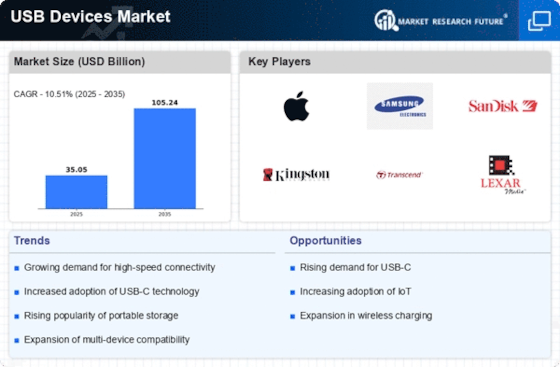
USB Devices Market Infographic
Purchase Options

Market Trends

Key Emerging Trends in the USB Devices Market

The market trends for USB devices provide information on how consumers' tastes and needs are changing as well as the creative approaches that manufacturers are employing. The growing use of USB Type-C ports is one such trend. Because of its increased power output, more user-friendly design, and quicker data transmission speeds, this adaptable and reversible connection has become more and more popular. The industry is seeing a transition towards a standardized and simplified connecting experience as more devices—including laptops, smartphones, and peripherals—adopt USB Type-C. The emergence of wireless technologies and how they affect the use of USB devices is another noteworthy topic. Even though Bluetooth and Wi-Fi are now more common wireless communication choices, USB devices are still in high demand since they provide dependable. When appropriate, the market is adjusting to this trend by adding wireless capabilities to USB products. One example of how the industry has responded to the increased desire for cable-free experiences is the inclusion of wireless charging capabilities in USB-powered gadgets.

In the market for USB devices, the need for high-capacity storage options is still a prominent trend. With customers creating and storing more data than ever before, USB flash drives and external hard drives with higher storage capacity are becoming more and more popular. The demand for portable storage options that can handle the increasing amounts of digital material, such as enormous files, high-resolution photographs, and movies, is what's driving this trend. In response, producers are creating USB devices with terabyte-level capacity to fulfill consumers' growing demands. Trends in USB devices have made security measures increasingly important. Companies and consumers alike are placing a higher priority on the security of their digital assets due to growing worries about data breaches and illegal access. The industry is seeing an increase in the number of USB devices with built-in encryption, password protection, and other security features. This development indicates that people are becoming more conscious of how important it is to protect sensitive data, particularly because USB devices are frequently used to transport and store important data.

Author
Author Profile
Ankit Gupta
Team Lead - Research

Ankit Gupta is a seasoned market intelligence and strategic research professional with over six plus years of experience in the ICT and Semiconductor industries. With academic roots in Telecom, Marketing, and Electronics, he blends technical insight with business strategy. Ankit has led 200+ projects, including work for Fortune 500 clients like Microsoft and Rio Tinto, covering market sizing, tech forecasting, and go-to-market strategies. Known for bridging engineering and enterprise decision-making, his insights support growth, innovation, and investment planning across diverse technology markets.

Leave a Comment

FAQs

What is the current valuation of the USB Devices Market as of 2024?

<p>The USB Devices Market was valued at 35.05 USD Billion in 2024.</p>

What is the projected market valuation for the USB Devices Market in 2035?

<p>The USB Devices Market is projected to reach 105.24 USD Billion by 2035.</p>

What is the expected CAGR for the USB Devices Market during the forecast period 2025 - 2035?

<p>The expected CAGR for the USB Devices Market during the forecast period 2025 - 2035 is 10.51%.</p>

Which companies are considered key players in the USB Devices Market?

<p>Key players in the USB Devices Market include Apple Inc, Samsung Electronics, SanDisk Corporation, and Kingston Technology Company.</p>

What product segments are included in the USB Devices Market?

<p>Product segments in the USB Devices Market include USB flash drives, webcams, memory card readers, and computer peripherals.</p>

How do USB connector types impact the market valuation?

<p>The market valuation for USB connector types indicates Type C is projected to reach 36.0 USD Billion by 2035.</p>

What applications are driving growth in the USB Devices Market?

Applications driving growth include consumer electronics, IT &amp; telecommunication, and healthcare &amp; medical devices.

What was the market size for USB flash drives in 2024?

The market size for USB flash drives was 8.0 USD Billion in 2024 and is expected to grow to 25.0 USD Billion by 2035.

How does the performance of USB 3.0 compare to other USB types?

USB 3.0 is projected to grow from 15.0 USD Billion in 2024 to 45.0 USD Billion by 2035, indicating strong performance.

What trends are emerging in the USB Devices Market regarding consumer electronics?

The consumer electronics segment is expected to grow from 10.0 USD Billion in 2024 to 30.0 USD Billion by 2035, reflecting increasing demand.

Market Summary

As per Market Research Future analysis, the USB Devices Market Size was estimated at 35.05 USD Billion in 2024. The USB Devices industry is projected to grow from 38.73 USD Billion in 2025 to 105.24 USD Billion by 2035, exhibiting a compound annual growth rate (CAGR) of 10.51% during the forecast period 2025 - 2035

Key Market Trends & Highlights

The USB Devices Market is experiencing robust growth driven by technological advancements and increasing consumer demand.

  • North America remains the largest market for USB devices, driven by high consumer electronics adoption. Asia-Pacific is the fastest-growing region, reflecting a surge in e-commerce and portable device usage. Webcams represent the largest segment, while USB flash drives are witnessing the fastest growth due to rising data storage needs. Key market drivers include the increasing adoption of portable devices and technological advancements in USB standards.

Market Size & Forecast

2024 Market Size 35.05 (USD Billion)
2035 Market Size 105.24 (USD Billion)
CAGR (2025 - 2035) 10.51%
Largest Regional Market Share in 2024 North America

Major Players

<a title="Apple Inc" href="https://www.apple.com/us/search/USB-C-Digital-AV-Multiport-Adapter?rdt=redirectionFromProductPage&amp;tab=accessories" target="_blank" rel="noopener">Apple Inc</a> (US), <a title="Samsung Electronics" href="https://www.samsung.com/us/common/notfound.html" target="_blank" rel="noopener">Samsung Electronics</a> (KR), SanDisk Corporation (US), Kingston Technology Company (US), Transcend Information Inc (TW), Lexar Media Inc (US), PNY Technologies Inc (US), ADATA Technology Co Ltd (TW), <a title="Toshiba Corporation" href="https://www.toshiba-storage.com/products/toshiba-usb-flash-drives/" target="_blank" rel="noopener">Toshiba Corporation</a> (JP)

Market Trends

The USB Devices Market is currently experiencing a dynamic evolution, driven by the increasing demand for connectivity and data transfer solutions across various sectors. As technology advances, the proliferation of devices requiring USB interfaces continues to rise, suggesting a robust growth trajectory. This market encompasses a wide array of products, including flash drives, external hard drives, and various peripherals, all of which play a crucial role in enhancing user experience and productivity. Furthermore, the integration of USB technology into emerging applications, such as IoT devices and smart home systems, indicates a shift towards more versatile and multifunctional solutions. In addition, the growing emphasis on data security and efficient power management is shaping product development within the USB Devices Market. Manufacturers are increasingly focusing on creating devices that not only meet performance standards but also adhere to safety regulations. This trend reflects a broader awareness of the importance of sustainability and user safety in technology. As the market continues to evolve, it appears poised for further innovation, with potential advancements in speed, capacity, and compatibility, which may redefine user expectations and industry standards.

Rising Demand for High-Speed Data Transfer

The USB Devices Market is witnessing a notable shift towards high-speed data transfer solutions. As users increasingly require faster and more efficient methods for transferring large files, manufacturers are responding by developing advanced USB standards that facilitate quicker data exchange. This trend is particularly evident in sectors such as media production and gaming, where performance is paramount.

Integration with Smart Technologies

There is a growing trend of integrating USB devices with smart technologies, reflecting the increasing interconnectedness of devices in everyday life. This integration enhances functionality, allowing users to control and manage multiple devices seamlessly. As smart home systems gain traction, the demand for USB devices that can interface with these technologies is likely to rise.

Focus on Energy Efficiency and Sustainability

The USB Devices Market is also seeing a heightened focus on energy efficiency and sustainability. Manufacturers are prioritizing the development of eco-friendly products that consume less power and utilize recyclable materials. This trend aligns with global efforts to reduce environmental impact and promote sustainable practices within the technology sector.

USB Devices Market Market Drivers

Growth of the Internet of Things (IoT)

The growth of the Internet of Things (IoT) is significantly impacting the USB Devices Market. As more devices become interconnected, the need for reliable and efficient data transfer solutions is paramount. USB devices play a crucial role in facilitating connectivity among IoT devices, which are projected to reach over 30 billion by 2025. This surge in IoT adoption is likely to drive demand for USB hubs, adapters, and other related accessories. The integration of USB technology in IoT applications suggests a promising future for the USB Devices Market, as manufacturers innovate to create products that cater to the unique requirements of IoT ecosystems. This trend indicates a shift towards a more interconnected world, where USB devices serve as essential components.

Increasing Adoption of Portable Devices

The proliferation of portable devices such as smartphones, tablets, and laptops has catalyzed the USB Devices Market. As consumers increasingly rely on these devices for both personal and professional use, the demand for USB devices has surged. In 2025, it is estimated that the number of portable device users will exceed 3 billion, driving the need for compatible USB accessories. This trend indicates a robust growth trajectory for the USB Devices Market, as manufacturers strive to meet the evolving needs of consumers. Furthermore, the integration of USB-C technology in many new devices enhances compatibility and convenience, further propelling market expansion. The shift towards portability and convenience appears to be a key driver in shaping the future landscape of the USB Devices Market.

Expansion of E-commerce and Online Retail

The rapid expansion of e-commerce and online retail platforms has significantly influenced the USB Devices Market. As consumers increasingly turn to online shopping for electronics and accessories, the accessibility of USB devices has improved. In 2025, online sales of USB devices are projected to account for over 40% of total sales, reflecting a shift in consumer purchasing behavior. This trend not only enhances market reach for manufacturers but also fosters competition among retailers, leading to better pricing and product variety. The convenience of online shopping, coupled with the growing trend of home office setups, suggests that the USB Devices Market will continue to thrive as consumers seek reliable and efficient connectivity solutions.

Rising Demand for Data Security Solutions

As data breaches and cyber threats become increasingly prevalent, the demand for data security solutions within the USB Devices Market is on the rise. Consumers and businesses alike are seeking USB devices that offer enhanced security features, such as encryption and secure access controls. In 2025, the market for secure USB devices is expected to grow by over 25%, reflecting a heightened awareness of data protection. This trend indicates that manufacturers must prioritize security in their product offerings to remain competitive. The increasing reliance on USB devices for sensitive data transfer suggests that the USB Devices Market will continue to evolve, focusing on integrating advanced security measures to meet consumer expectations.

Technological Advancements in USB Standards

Technological advancements in USB standards, particularly the introduction of USB 4.0, are poised to reshape the USB Devices Market. This new standard offers enhanced data transfer speeds, improved power delivery, and greater versatility in device connectivity. As more devices adopt USB 4.0, the demand for compatible accessories is likely to increase. In 2025, it is anticipated that USB 4.0-enabled devices will constitute a significant portion of the market, driving innovation among manufacturers. The evolution of USB technology not only enhances user experience but also encourages the development of new applications and functionalities, thereby expanding the USB Devices Market. This ongoing technological evolution appears to be a critical factor in sustaining market growth.

Market Segment Insights

By Product: Webcam (Largest) vs. USB Flash Drives (Fastest-Growing)

The USB Devices Market reveals a diverse product segment distribution with webcams emerging as the largest category. This dominance is attributed to the rising need for video communication tools, particularly in remote work and education. <a title="USB flash drives" href="https://www.marketresearchfuture.com/reports/usb-flash-drives-market-38381USB%20flash%20drives" target="_blank" rel="noopener">USB flash drives</a> follow closely, signifying substantial market presence as portable data storage solutions, resonating well with the mobile workforce and tech-savvy consumers. Other segments, including memory card readers and digital audio players, capture notable shares, reflective of specific consumer needs in photography and music playback. As the market evolves, several growth trends are evident. The increasing adoption of high-definition webcams in various sectors from corporate to educational hints at robust demand. Conversely, USB flash drives are witnessing a surge fueled by growing data generation and storage needs in businesses and personal use. Enhanced features, affordability, and versatility further drive these segments, positioning them strongly in the USB Devices Market.

Webcam (Dominant) vs. USB Flash Drives (Emerging)

Webcams lead the USB Devices Market, driven by increasing remote communication needs and video conferencing demand. Their integration into various platforms highlights their utility in both professional and personal settings. Additionally, webcams have adopted advanced features, enhancing image quality and user experience, thus bolstering their market appeal. In contrast, USB flash drives are positioned as the emerging force within the market. Their compactness and ease of use cater to the growing needs of consumers for portable data solutions. With advancements in storage capacities and performance, USB flash drives are quickly becoming essential for both everyday users and professionals. This dynamic interplay between webcams and USB flash drives illustrates the diverse demands and trends shaping the USB Devices Market.

By Type: USB 3.0 (Largest) vs. USB 2.0 (Fastest-Growing)

In the USB Devices Market, the segmentation by type showcases a clear hierarchy in market share. USB 3.0 emerges as the largest segment, dominating the market due to its superior speed and performance, catering to the increasing demands of modern data transfer needs. Meanwhile, USB 2.0, while not as fast, maintains a significant share as it serves various lower-bandwidth applications, making it still relevant in many consumer and industrial contexts. Growth trends indicate a robust expansion within the USB 2.0 segment, primarily driven by its cost-effectiveness and widespread compatibility with various legacy devices. The demand for affordable and reliable connections in lower-end electronics fosters its emergence as the fastest-growing type. Simultaneously, USB 3.0's established presence continues to attract high-performance applications, ensuring it remains a dominant force in the market.

USB 3.0 (Dominant) vs. USB 2.0 (Emerging)

USB 3.0 solidifies its status as the dominant type within the USB Devices Market, offering transfer speeds significantly higher than its predecessors. This technology caters to sectors demanding high data throughput, including video editing, gaming, and cloud computing. It is designed for enhanced power efficiency, allowing devices to charge faster and connect over longer distances without compromising performance. In contrast, USB 2.0, labeled as emerging, is seeing renewed interest as more consumers and businesses look for affordable alternatives for basic connectivity needs. Although it lacks the speed advantages of newer standards, its compatibility with a broad range of devices ensures its sustained relevance in various applications, enabling easy integration into legacy setups.

By Connector Type: Type C (Largest) vs. Lightning Connector (Fastest-Growing)

The USB Devices Market features a diverse array of connector types, with Type C dominating the landscape due to its versatility and widespread adoption across various devices. Type C connectors are favored for their reversible design and high data transfer rates. In contrast, Type A and Type B connectors maintain significant market shares, especially in legacy devices, but Type C continues to capture an increasing portion of the market. Meanwhile, the Lightning Connector is gaining traction, particularly within Apple's ecosystem, appealing to mobile device users looking for reliable and efficient connectivity solutions.

Connector Technologies: Type C (Dominant) vs. Lightning Connector (Emerging)

Type C connectors are known for their versatility and efficiency, making them the dominant choice in the USB Devices Market. Their reversible design allows for convenient insertion, while supporting high-speed data transfer and charging capabilities. This has made them the preferred option for a range of devices, including smartphones, laptops, and other electronics. Meanwhile, the Lightning Connector, primarily associated with Apple products, is emerging as a significant player in this market segment. Its compact design and seamless integration with Apple devices provide a user-friendly experience, appealing particularly to a loyal customer base. As technology advances and consumer preferences shift, both connector types are positioned to capture attention in the evolving USB landscape.

By Application: Consumer Electronics (Largest) vs. IT & Telecommunication (Fastest-Growing)

In the USB Devices Market, the<a title=" consumer electronics " href="https://www.marketresearchfuture.com/reports/consumer-electronics-market-66318" target="_blank" rel="noopener"> consumer electronics</a> segment commands the largest share, driven by the widespread adoption of USB-enabled devices like smartphones, tablets, and laptops. This segment remains essential as consumer preferences shift towards high-capacity storage and faster data transfer rates, solidifying its position as a market leader. On the other hand, the IT &amp; telecommunication sector is emerging as the fastest-growing segment. It benefits from increased demand for connectivity solutions and the integration of USB devices in various telecommunications equipment, responding to the evolving needs of remote working and digital communications.

Consumer Electronics: Dominant vs. IT &amp; Telecommunication: Emerging

Consumer electronics segment thrives on innovation and user demand. The proliferation of USB-enabled gadgets and ongoing technological advancements in storage solutions make it a formidable player in the market. Meanwhile, the IT &amp; telecommunication segment is emerging, fueled by the rapid digital transformation across industries. The increasing reliance on data transfer and connectivity solutions accentuates the growth of USB devices in this realm. High-speed connectivity, ease of use, and compatibility with various systems position the IT segment as a key area for future expansion.

Get more detailed insights about USB Devices Market Research Report—Global Forecast till 2035

Regional Insights

North America : Tech Innovation Leader

North America is the largest market for USB devices, holding approximately 40% of the global share. The region's growth is driven by high consumer demand for advanced technology, increasing adoption of cloud storage solutions, and a robust e-commerce sector. Regulatory support for technology innovation further catalyzes market expansion, with initiatives aimed at enhancing digital infrastructure and cybersecurity. The United States leads the market, with major players like Apple Inc., SanDisk Corporation, and Kingston Technology Company headquartered here. The competitive landscape is characterized by continuous innovation and product diversification, with companies focusing on high-capacity and high-speed USB devices to meet consumer needs. Canada also contributes significantly, driven by its growing tech sector and increasing digitalization.

Europe : Emerging USB Market Hub

Europe is witnessing a significant rise in the USB devices market, accounting for approximately 30% of the global share. The region's growth is fueled by increasing demand for portable storage solutions, regulatory initiatives promoting digital transformation, and a strong emphasis on data security. Countries like Germany and the UK are at the forefront, with supportive policies aimed at enhancing technological infrastructure and innovation. Germany is the largest market in Europe, followed closely by the UK and France. The competitive landscape features key players such as Samsung Electronics and Transcend Information, which are investing heavily in R&D to develop cutting-edge USB technology. The presence of a well-established manufacturing base and a growing consumer electronics market further bolster the region's position in The USB Devices Market.

Asia-Pacific : Rapid Growth and Adoption

Asia-Pacific is rapidly emerging as a powerhouse in the USB devices market, holding approximately 25% of the global share. The region's growth is driven by increasing smartphone penetration, rising disposable incomes, and a burgeoning e-commerce sector. Countries like China and India are leading the charge, supported by government initiatives aimed at boosting digital literacy and technology adoption. China is the largest market in the region, with significant contributions from local manufacturers such as ADATA Technology and Toshiba Corporation. The competitive landscape is marked by a mix of established players and new entrants, all vying for market share through innovative product offerings. The region's focus on enhancing manufacturing capabilities and technological advancements positions it well for future growth in the USB devices market.

Middle East and Africa : Emerging Market Potential

The Middle East and Africa region is gradually emerging in the USB devices market, accounting for about 5% of the global share. The growth is primarily driven by increasing digitalization, rising internet penetration, and a growing demand for portable storage solutions. Countries like South Africa and the UAE are leading the market, supported by government initiatives aimed at enhancing technological infrastructure and promoting innovation. South Africa is the largest market in the region, with a competitive landscape that includes both local and international players. The presence of key manufacturers and distributors is growing, as they seek to capitalize on the increasing demand for USB devices. The region's focus on improving digital access and technology adoption is expected to drive further growth in the USB devices market.

Key Players and Competitive Insights

Leading market players are investing heavily in research and development in order to expand their product lines, which will help the USB devices market, grow even more. Market participants are also undertaking a variety of strategic activities to expand their global footprint, with important market developments including new product launches, contractual agreements, mergers and acquisitions, higher investments, and collaboration with other organizations. To expand and survive in a more competitive and rising market climate, USB devices industry must offer cost-effective items. Manufacturing locally to minimize operational costs is one of the key business tactics used by manufacturers in the global USB devices industry to benefit clients and increase the market sector. In recent years, the USB devices industry has offered some of the most significant advantages to market. Major players in the USB devices market attempting to increase market demand by investing in research and development operations include Corsair Memory Inc. (US), Adata Technology Co. Ltd. (Taiwan), Sandisk Corporation (US), Kingston Technology Corporation (US), Toshiba Corporation (Japan), Samsung Electronics Co. Ltd. (South Korea), Micron Consumer Products Group Inc. (US), Verbatim Americas LLC (US), Transcend Information Inc. (Taiwan), Intel Corporation (US), HP Inc. (US), Imation Corporation (Ojin Corporation) (US), Koninklijke Philips N.V. (Netherlands), Netac Technology Co Ltd. (China) and Teclast Electronics Co. Ltd. (China). SanDisk is a Western Digital brand for flash memory goods, such as memory cards and readers, USB flash drives, solid-state drives, and digital music players. In 2016, Western Digital bought the original business, SanDisk Corporation. SanDisk LLC creates, develops, and produces data storage products. SanDisk serves customers in the US. Intel Corp creates technological components and products. Microprocessors, chipsets, embedded processors, microcontrollers, flash memory, graphic, network, and conferencing solutions are all included in the company's product line. Additionally, it provides motherboards, SSDs, servers, wireless connection equipment, software, and applications. Original equipment manufacturers, producers of industrial and communication equipment, and producers of original designs are the customers of Intel.

Key Companies in the USB Devices Market include

Industry Developments

January 2023: The US-based secure data storage company Kanguru recently announced the addition of a cutting-edge and commercially successful USB to Cloud portable software tool by ClevX 2 its Defender product line of hardware-encrypted USB drives, which is the industry standard.

December 2022: India joined the EU in requiring USB-C ports for smartphones, yet Americans are still forced to use three distinct ports and cables.

August 2021: Kingston Digital provided new DataTraveler Max USB drive launch information. According to the manufacturer, the USB-C 3.2 flash drive is expected to achieve record-breaking data transmission speeds of up to 1,000 MB/s read and 900 MB/s write, making it one of the best USB drives models on the market. The high-speed Data Traveler Max uses USB 3.2 Gen 2 to provide speeds that are roughly twice as fast as Gen 1.

Future Outlook

USB Devices Market Future Outlook

The USB Devices Market is projected to grow at a 10.51% CAGR from 2025 to 2035, driven by technological advancements, increased data transfer needs, and the proliferation of smart devices.

New opportunities lie in:

  • <p>Development of high-capacity USB storage solutions for enterprise data management. Integration of USB technology in emerging IoT devices for seamless connectivity. Expansion of USB-C adoption in consumer electronics to enhance compatibility and performance.</p>

By 2035, the USB Devices Market is expected to be robust, reflecting substantial growth and innovation.

Market Segmentation

USB Devices Market Type Outlook

  • USB 1.0
  • USB 2.0
  • USB 3.0
  • others

USB Devices Market Product Outlook

  • webcam
  • USB flash drives
  • memory card readers
  • digital audio players
  • computer peripherals
  • scanners & printers
  • others

USB Devices Market Application Outlook

  • consumer electronics
  • IT & telecommunication
  • automotive
  • healthcare & medical devices
  • others

USB Devices Market Connector Type Outlook

  • Type A
  • Type B
  • Type C
  • Lightning Connector

Report Scope

MARKET SIZE 2024 35.05(USD Billion)
MARKET SIZE 2025 38.73(USD Billion)
MARKET SIZE 2035 105.24(USD Billion)
COMPOUND ANNUAL GROWTH RATE (CAGR) 10.51% (2025 - 2035)
REPORT COVERAGE Revenue Forecast, Competitive Landscape, Growth Factors, and Trends
BASE YEAR 2024
Market Forecast Period 2025 - 2035
Historical Data 2019 - 2024
Market Forecast Units USD Billion
Key Companies Profiled Apple Inc (US), Samsung Electronics (KR), SanDisk Corporation (US), Kingston Technology Company (US), Transcend Information Inc (TW), Lexar Media Inc (US), PNY Technologies Inc (US), ADATA Technology Co Ltd (TW), Toshiba Corporation (JP)
Segments Covered Product, Type, Connector Type, Application, Region
Key Market Opportunities Integration of advanced security features in USB Devices Market to address rising data protection concerns.
Key Market Dynamics Rising demand for high-speed data transfer drives innovation and competition in the USB devices market.
Countries Covered North America, Europe, APAC, South America, MEA

FAQs

What is the current valuation of the USB Devices Market as of 2024?

<p>The USB Devices Market was valued at 35.05 USD Billion in 2024.</p>

What is the projected market valuation for the USB Devices Market in 2035?

<p>The USB Devices Market is projected to reach 105.24 USD Billion by 2035.</p>

What is the expected CAGR for the USB Devices Market during the forecast period 2025 - 2035?

<p>The expected CAGR for the USB Devices Market during the forecast period 2025 - 2035 is 10.51%.</p>

Which companies are considered key players in the USB Devices Market?

<p>Key players in the USB Devices Market include Apple Inc, Samsung Electronics, SanDisk Corporation, and Kingston Technology Company.</p>

What product segments are included in the USB Devices Market?

<p>Product segments in the USB Devices Market include USB flash drives, webcams, memory card readers, and computer peripherals.</p>

How do USB connector types impact the market valuation?

<p>The market valuation for USB connector types indicates Type C is projected to reach 36.0 USD Billion by 2035.</p>

What applications are driving growth in the USB Devices Market?

Applications driving growth include consumer electronics, IT &amp; telecommunication, and healthcare &amp; medical devices.

What was the market size for USB flash drives in 2024?

The market size for USB flash drives was 8.0 USD Billion in 2024 and is expected to grow to 25.0 USD Billion by 2035.

How does the performance of USB 3.0 compare to other USB types?

USB 3.0 is projected to grow from 15.0 USD Billion in 2024 to 45.0 USD Billion by 2035, indicating strong performance.

What trends are emerging in the USB Devices Market regarding consumer electronics?

The consumer electronics segment is expected to grow from 10.0 USD Billion in 2024 to 30.0 USD Billion by 2035, reflecting increasing demand.

  1. SECTION I: EXECUTIVE SUMMARY AND KEY HIGHLIGHTS |
    1. EXECUTIVE SUMMARY | |
      1. Market Overview | |
      2. Key Findings | |
      3. Market Segmentation | |
      4. Competitive Landscape | |
      5. Challenges and Opportunities | |
      6. Future Outlook 2
  2. SECTION II: SCOPING, METHODOLOGY AND MARKET STRUCTURE |
    1. MARKET INTRODUCTION | |
      1. Definition | |
      2. Scope of the study | | |
    2. RESEARCH METHODOLOGY | |
      1. Overview | |
      2. Data Mining | |
      3. Secondary Research | |
      4. Primary Research | | |
      5. Forecasting Model | |
      6. Market Size Estimation | | |
      7. Data Triangulation | |
      8. Validation 3
  3. SECTION III: QUALITATIVE ANALYSIS |
    1. MARKET DYNAMICS | |
      1. Overview | |
      2. Drivers | |
      3. Restraints | |
      4. Opportunities |
    2. MARKET FACTOR ANALYSIS | |
      1. Value chain Analysis | |
      2. Porter's Five Forces Analysis | | |
      3. COVID-19 Impact Analysis | | |
  4. SECTION IV: QUANTITATIVE ANALYSIS |
    1. Semiconductor & Electronics, BY Product (USD Billion) | |
      1. webcam | |
      2. USB flash drives | |
      3. memory card readers | |
      4. digital audio players | |
      5. computer peripherals | |
      6. scanners & printers | |
      7. others |
    2. Semiconductor & Electronics, BY Type (USD Billion) | |
      1. USB
    3. | |
      1. USB
    4. | |
      1. USB
    5. | |
      1. others |
    6. Semiconductor & Electronics, BY Connector Type (USD Billion) | |
      1. Type A | |
      2. Type B | |
      3. Type C | |
      4. Lightning Connector |
    7. Semiconductor & Electronics, BY Application (USD Billion) | |
      1. consumer electronics | |
      2. IT & telecommunication | |
      3. automotive | |
      4. healthcare & medical devices | |
      5. others |
    8. Semiconductor & Electronics, BY Region (USD Billion) | |
      1. North America | | |
      2. Europe | | |
      3. APAC | | |
      4. South America | | |
      5. MEA | | |
  5. SECTION V: COMPETITIVE ANALYSIS |
    1. Competitive Landscape | |
      1. Overview | |
      2. Competitive Analysis | |
      3. Market share Analysis | |
      4. Major Growth Strategy in the Semiconductor & Electronics | |
      5. Competitive Benchmarking | |
      6. Leading Players in Terms of Number of Developments in the Semiconductor & Electronics | |
      7. Key developments and growth strategies | | |
      8. Major Players Financial Matrix | | |
    2. Company Profiles | |
      1. Apple Inc (US) | | |
      2. Samsung Electronics (KR) | | |
      3. SanDisk Corporation (US) | | |
      4. Kingston Technology Company (US) | | |
      5. Transcend Information Inc (TW) | | |
      6. Lexar Media Inc (US) | | |
      7. PNY Technologies Inc (US) | | |
      8. ADATA Technology Co Ltd (TW) | | |
      9. Toshiba Corporation (JP) | | |
    3. Appendix | |
      1. References | |
      2. Related Reports 6 LIST OF FIGURES |
    4. MARKET SYNOPSIS |
    5. NORTH AMERICA MARKET ANALYSIS |
    6. US MARKET ANALYSIS BY PRODUCT |
    7. US MARKET ANALYSIS BY TYPE |
    8. US MARKET ANALYSIS BY CONNECTOR TYPE |
    9. US MARKET ANALYSIS BY APPLICATION |
    10. CANADA MARKET ANALYSIS BY PRODUCT |
    11. CANADA MARKET ANALYSIS BY TYPE |
    12. CANADA MARKET ANALYSIS BY CONNECTOR TYPE |
    13. CANADA MARKET ANALYSIS BY APPLICATION |
    14. EUROPE MARKET ANALYSIS |
    15. GERMANY MARKET ANALYSIS BY PRODUCT |
    16. GERMANY MARKET ANALYSIS BY TYPE |
    17. GERMANY MARKET ANALYSIS BY CONNECTOR TYPE |
    18. GERMANY MARKET ANALYSIS BY APPLICATION |
    19. UK MARKET ANALYSIS BY PRODUCT |
    20. UK MARKET ANALYSIS BY TYPE |
    21. UK MARKET ANALYSIS BY CONNECTOR TYPE |
    22. UK MARKET ANALYSIS BY APPLICATION |
    23. FRANCE MARKET ANALYSIS BY PRODUCT |
    24. FRANCE MARKET ANALYSIS BY TYPE |
    25. FRANCE MARKET ANALYSIS BY CONNECTOR TYPE |
    26. FRANCE MARKET ANALYSIS BY APPLICATION |
    27. RUSSIA MARKET ANALYSIS BY PRODUCT |
    28. RUSSIA MARKET ANALYSIS BY TYPE |
    29. RUSSIA MARKET ANALYSIS BY CONNECTOR TYPE |
    30. RUSSIA MARKET ANALYSIS BY APPLICATION |
    31. ITALY MARKET ANALYSIS BY PRODUCT |
    32. ITALY MARKET ANALYSIS BY TYPE |
    33. ITALY MARKET ANALYSIS BY CONNECTOR TYPE |
    34. ITALY MARKET ANALYSIS BY APPLICATION |
    35. SPAIN MARKET ANALYSIS BY PRODUCT |
    36. SPAIN MARKET ANALYSIS BY TYPE |
    37. SPAIN MARKET ANALYSIS BY CONNECTOR TYPE |
    38. SPAIN MARKET ANALYSIS BY APPLICATION |
    39. REST OF EUROPE MARKET ANALYSIS BY PRODUCT |
    40. REST OF EUROPE MARKET ANALYSIS BY TYPE |
    41. REST OF EUROPE MARKET ANALYSIS BY CONNECTOR TYPE |
    42. REST OF EUROPE MARKET ANALYSIS BY APPLICATION |
    43. APAC MARKET ANALYSIS |
    44. CHINA MARKET ANALYSIS BY PRODUCT |
    45. CHINA MARKET ANALYSIS BY TYPE |
    46. CHINA MARKET ANALYSIS BY CONNECTOR TYPE |
    47. CHINA MARKET ANALYSIS BY APPLICATION |
    48. INDIA MARKET ANALYSIS BY PRODUCT |
    49. INDIA MARKET ANALYSIS BY TYPE |
    50. INDIA MARKET ANALYSIS BY CONNECTOR TYPE |
    51. INDIA MARKET ANALYSIS BY APPLICATION |
    52. JAPAN MARKET ANALYSIS BY PRODUCT |
    53. JAPAN MARKET ANALYSIS BY TYPE |
    54. JAPAN MARKET ANALYSIS BY CONNECTOR TYPE |
    55. JAPAN MARKET ANALYSIS BY APPLICATION |
    56. SOUTH KOREA MARKET ANALYSIS BY PRODUCT |
    57. SOUTH KOREA MARKET ANALYSIS BY TYPE |
    58. SOUTH KOREA MARKET ANALYSIS BY CONNECTOR TYPE |
    59. SOUTH KOREA MARKET ANALYSIS BY APPLICATION |
    60. MALAYSIA MARKET ANALYSIS BY PRODUCT |
    61. MALAYSIA MARKET ANALYSIS BY TYPE |
    62. MALAYSIA MARKET ANALYSIS BY CONNECTOR TYPE |
    63. MALAYSIA MARKET ANALYSIS BY APPLICATION |
    64. THAILAND MARKET ANALYSIS BY PRODUCT |
    65. THAILAND MARKET ANALYSIS BY TYPE |
    66. THAILAND MARKET ANALYSIS BY CONNECTOR TYPE |
    67. THAILAND MARKET ANALYSIS BY APPLICATION |
    68. INDONESIA MARKET ANALYSIS BY PRODUCT |
    69. INDONESIA MARKET ANALYSIS BY TYPE |
    70. INDONESIA MARKET ANALYSIS BY CONNECTOR TYPE |
    71. INDONESIA MARKET ANALYSIS BY APPLICATION |
    72. REST OF APAC MARKET ANALYSIS BY PRODUCT |
    73. REST OF APAC MARKET ANALYSIS BY TYPE |
    74. REST OF APAC MARKET ANALYSIS BY CONNECTOR TYPE |
    75. REST OF APAC MARKET ANALYSIS BY APPLICATION |
    76. SOUTH AMERICA MARKET ANALYSIS |
    77. BRAZIL MARKET ANALYSIS BY PRODUCT |
    78. BRAZIL MARKET ANALYSIS BY TYPE |
    79. BRAZIL MARKET ANALYSIS BY CONNECTOR TYPE |
    80. BRAZIL MARKET ANALYSIS BY APPLICATION |
    81. MEXICO MARKET ANALYSIS BY PRODUCT |
    82. MEXICO MARKET ANALYSIS BY TYPE |
    83. MEXICO MARKET ANALYSIS BY CONNECTOR TYPE |
    84. MEXICO MARKET ANALYSIS BY APPLICATION |
    85. ARGENTINA MARKET ANALYSIS BY PRODUCT |
    86. ARGENTINA MARKET ANALYSIS BY TYPE |
    87. ARGENTINA MARKET ANALYSIS BY CONNECTOR TYPE |
    88. ARGENTINA MARKET ANALYSIS BY APPLICATION |
    89. REST OF SOUTH AMERICA MARKET ANALYSIS BY PRODUCT |
    90. REST OF SOUTH AMERICA MARKET ANALYSIS BY TYPE |
    91. REST OF SOUTH AMERICA MARKET ANALYSIS BY CONNECTOR TYPE |
    92. REST OF SOUTH AMERICA MARKET ANALYSIS BY APPLICATION |
    93. MEA MARKET ANALYSIS |
    94. GCC COUNTRIES MARKET ANALYSIS BY PRODUCT |
    95. GCC COUNTRIES MARKET ANALYSIS BY TYPE |
    96. GCC COUNTRIES MARKET ANALYSIS BY CONNECTOR TYPE |
    97. GCC COUNTRIES MARKET ANALYSIS BY APPLICATION |
    98. SOUTH AFRICA MARKET ANALYSIS BY PRODUCT |
    99. SOUTH AFRICA MARKET ANALYSIS BY TYPE |
    100. SOUTH AFRICA MARKET ANALYSIS BY CONNECTOR TYPE |
    101. SOUTH AFRICA MARKET ANALYSIS BY APPLICATION |
    102. REST OF MEA MARKET ANALYSIS BY PRODUCT |
    103. REST OF MEA MARKET ANALYSIS BY TYPE |
    104. REST OF MEA MARKET ANALYSIS BY CONNECTOR TYPE |
    105. REST OF MEA MARKET ANALYSIS BY APPLICATION |
    106. KEY BUYING CRITERIA OF SEMICONDUCTOR & ELECTRONICS |
    107. RESEARCH PROCESS OF MRFR |
    108. DRO ANALYSIS OF SEMICONDUCTOR & ELECTRONICS |
    109. DRIVERS IMPACT ANALYSIS: SEMICONDUCTOR & ELECTRONICS |
    110. RESTRAINTS IMPACT ANALYSIS: SEMICONDUCTOR & ELECTRONICS |
    111. SUPPLY / VALUE CHAIN: SEMICONDUCTOR & ELECTRONICS |
    112. SEMICONDUCTOR & ELECTRONICS, BY PRODUCT, 2024 (% SHARE) |
    113. SEMICONDUCTOR & ELECTRONICS, BY PRODUCT, 2024 TO 2035 (USD Billion) |
    114. SEMICONDUCTOR & ELECTRONICS, BY TYPE, 2024 (% SHARE) |
    115. SEMICONDUCTOR & ELECTRONICS, BY TYPE, 2024 TO 2035 (USD Billion) |
    116. SEMICONDUCTOR & ELECTRONICS, BY CONNECTOR TYPE, 2024 (% SHARE) |
    117. SEMICONDUCTOR & ELECTRONICS, BY CONNECTOR TYPE, 2024 TO 2035 (USD Billion) |
    118. SEMICONDUCTOR & ELECTRONICS, BY APPLICATION, 2024 (% SHARE) |
    119. SEMICONDUCTOR & ELECTRONICS, BY APPLICATION, 2024 TO 2035 (USD Billion) |
    120. BENCHMARKING OF MAJOR COMPETITORS 7 LIST OF TABLES |
    121. LIST OF ASSUMPTIONS | |
      1. |
    122. North America MARKET SIZE ESTIMATES; FORECAST | |
      1. BY PRODUCT, 2025-2035 (USD Billion) | |
      2. BY TYPE, 2025-2035 (USD Billion) | |
      3. BY CONNECTOR TYPE, 2025-2035 (USD Billion) | |
      4. BY APPLICATION, 2025-2035 (USD Billion) |
    123. US MARKET SIZE ESTIMATES; FORECAST | |
      1. BY PRODUCT, 2025-2035 (USD Billion) | |
      2. BY TYPE, 2025-2035 (USD Billion) | |
      3. BY CONNECTOR TYPE, 2025-2035 (USD Billion) | |
      4. BY APPLICATION, 2025-2035 (USD Billion) |
    124. Canada MARKET SIZE ESTIMATES; FORECAST | |
      1. BY PRODUCT, 2025-2035 (USD Billion) | |
      2. BY TYPE, 2025-2035 (USD Billion) | |
      3. BY CONNECTOR TYPE, 2025-2035 (USD Billion) | |
      4. BY APPLICATION, 2025-2035 (USD Billion) |
    125. Europe MARKET SIZE ESTIMATES; FORECAST | |
      1. BY PRODUCT, 2025-2035 (USD Billion) | |
      2. BY TYPE, 2025-2035 (USD Billion) | |
      3. BY CONNECTOR TYPE, 2025-2035 (USD Billion) | |
      4. BY APPLICATION, 2025-2035 (USD Billion) |
    126. Germany MARKET SIZE ESTIMATES; FORECAST | |
      1. BY PRODUCT, 2025-2035 (USD Billion) | |
      2. BY TYPE, 2025-2035 (USD Billion) | |
      3. BY CONNECTOR TYPE, 2025-2035 (USD Billion) | |
      4. BY APPLICATION, 2025-2035 (USD Billion) |
    127. UK MARKET SIZE ESTIMATES; FORECAST | |
      1. BY PRODUCT, 2025-2035 (USD Billion) | |
      2. BY TYPE, 2025-2035 (USD Billion) | |
      3. BY CONNECTOR TYPE, 2025-2035 (USD Billion) | |
      4. BY APPLICATION, 2025-2035 (USD Billion) |
    128. France MARKET SIZE ESTIMATES; FORECAST | |
      1. BY PRODUCT, 2025-2035 (USD Billion) | |
      2. BY TYPE, 2025-2035 (USD Billion) | |
      3. BY CONNECTOR TYPE, 2025-2035 (USD Billion) | |
      4. BY APPLICATION, 2025-2035 (USD Billion) |
    129. Russia MARKET SIZE ESTIMATES; FORECAST | |
      1. BY PRODUCT, 2025-2035 (USD Billion) | |
      2. BY TYPE, 2025-2035 (USD Billion) | |
      3. BY CONNECTOR TYPE, 2025-2035 (USD Billion) | |
      4. BY APPLICATION, 2025-2035 (USD Billion) |
    130. Italy MARKET SIZE ESTIMATES; FORECAST | |
      1. BY PRODUCT, 2025-2035 (USD Billion) | |
      2. BY TYPE, 2025-2035 (USD Billion) | |
      3. BY CONNECTOR TYPE, 2025-2035 (USD Billion) | |
      4. BY APPLICATION, 2025-2035 (USD Billion) |
    131. Spain MARKET SIZE ESTIMATES; FORECAST | |
      1. BY PRODUCT, 2025-2035 (USD Billion) | |
      2. BY TYPE, 2025-2035 (USD Billion) | |
      3. BY CONNECTOR TYPE, 2025-2035 (USD Billion) | |
      4. BY APPLICATION, 2025-2035 (USD Billion) |
    132. Rest of Europe MARKET SIZE ESTIMATES; FORECAST | |
      1. BY PRODUCT, 2025-2035 (USD Billion) | |
      2. BY TYPE, 2025-2035 (USD Billion) | |
      3. BY CONNECTOR TYPE, 2025-2035 (USD Billion) | |
      4. BY APPLICATION, 2025-2035 (USD Billion) |
    133. APAC MARKET SIZE ESTIMATES; FORECAST | |
      1. BY PRODUCT, 2025-2035 (USD Billion) | |
      2. BY TYPE, 2025-2035 (USD Billion) | |
      3. BY CONNECTOR TYPE, 2025-2035 (USD Billion) | |
      4. BY APPLICATION, 2025-2035 (USD Billion) |
    134. China MARKET SIZE ESTIMATES; FORECAST | |
      1. BY PRODUCT, 2025-2035 (USD Billion) | |
      2. BY TYPE, 2025-2035 (USD Billion) | |
      3. BY CONNECTOR TYPE, 2025-2035 (USD Billion) | |
      4. BY APPLICATION, 2025-2035 (USD Billion) |
    135. India MARKET SIZE ESTIMATES; FORECAST | |
      1. BY PRODUCT, 2025-2035 (USD Billion) | |
      2. BY TYPE, 2025-2035 (USD Billion) | |
      3. BY CONNECTOR TYPE, 2025-2035 (USD Billion) | |
      4. BY APPLICATION, 2025-2035 (USD Billion) |
    136. Japan MARKET SIZE ESTIMATES; FORECAST | |
      1. BY PRODUCT, 2025-2035 (USD Billion) | |
      2. BY TYPE, 2025-2035 (USD Billion) | |
      3. BY CONNECTOR TYPE, 2025-2035 (USD Billion) | |
      4. BY APPLICATION, 2025-2035 (USD Billion) |
    137. South Korea MARKET SIZE ESTIMATES; FORECAST | |
      1. BY PRODUCT, 2025-2035 (USD Billion) | |
      2. BY TYPE, 2025-2035 (USD Billion) | |
      3. BY CONNECTOR TYPE, 2025-2035 (USD Billion) | |
      4. BY APPLICATION, 2025-2035 (USD Billion) |
    138. Malaysia MARKET SIZE ESTIMATES; FORECAST | |
      1. BY PRODUCT, 2025-2035 (USD Billion) | |
      2. BY TYPE, 2025-2035 (USD Billion) | |
      3. BY CONNECTOR TYPE, 2025-2035 (USD Billion) | |
      4. BY APPLICATION, 2025-2035 (USD Billion) |
    139. Thailand MARKET SIZE ESTIMATES; FORECAST | |
      1. BY PRODUCT, 2025-2035 (USD Billion) | |
      2. BY TYPE, 2025-2035 (USD Billion) | |
      3. BY CONNECTOR TYPE, 2025-2035 (USD Billion) | |
      4. BY APPLICATION, 2025-2035 (USD Billion) |
    140. Indonesia MARKET SIZE ESTIMATES; FORECAST | |
      1. BY PRODUCT, 2025-2035 (USD Billion) | |
      2. BY TYPE, 2025-2035 (USD Billion) | |
      3. BY CONNECTOR TYPE, 2025-2035 (USD Billion) | |
      4. BY APPLICATION, 2025-2035 (USD Billion) |
    141. Rest of APAC MARKET SIZE ESTIMATES; FORECAST | |
      1. BY PRODUCT, 2025-2035 (USD Billion) | |
      2. BY TYPE, 2025-2035 (USD Billion) | |
      3. BY CONNECTOR TYPE, 2025-2035 (USD Billion) | |
      4. BY APPLICATION, 2025-2035 (USD Billion) |
    142. South America MARKET SIZE ESTIMATES; FORECAST | |
      1. BY PRODUCT, 2025-2035 (USD Billion) | |
      2. BY TYPE, 2025-2035 (USD Billion) | |
      3. BY CONNECTOR TYPE, 2025-2035 (USD Billion) | |
      4. BY APPLICATION, 2025-2035 (USD Billion) |
    143. Brazil MARKET SIZE ESTIMATES; FORECAST | |
      1. BY PRODUCT, 2025-2035 (USD Billion) | |
      2. BY TYPE, 2025-2035 (USD Billion) | |
      3. BY CONNECTOR TYPE, 2025-2035 (USD Billion) | |
      4. BY APPLICATION, 2025-2035 (USD Billion) |
    144. Mexico MARKET SIZE ESTIMATES; FORECAST | |
      1. BY PRODUCT, 2025-2035 (USD Billion) | |
      2. BY TYPE, 2025-2035 (USD Billion) | |
      3. BY CONNECTOR TYPE, 2025-2035 (USD Billion) | |
      4. BY APPLICATION, 2025-2035 (USD Billion) |
    145. Argentina MARKET SIZE ESTIMATES; FORECAST | |
      1. BY PRODUCT, 2025-2035 (USD Billion) | |
      2. BY TYPE, 2025-2035 (USD Billion) | |
      3. BY CONNECTOR TYPE, 2025-2035 (USD Billion) | |
      4. BY APPLICATION, 2025-2035 (USD Billion) |
    146. Rest of South America MARKET SIZE ESTIMATES; FORECAST | |
      1. BY PRODUCT, 2025-2035 (USD Billion) | |
      2. BY TYPE, 2025-2035 (USD Billion) | |
      3. BY CONNECTOR TYPE, 2025-2035 (USD Billion) | |
      4. BY APPLICATION, 2025-2035 (USD Billion) |
    147. MEA MARKET SIZE ESTIMATES; FORECAST | |
      1. BY PRODUCT, 2025-2035 (USD Billion) | |
      2. BY TYPE, 2025-2035 (USD Billion) | |
      3. BY CONNECTOR TYPE, 2025-2035 (USD Billion) | |
      4. BY APPLICATION, 2025-2035 (USD Billion) |
    148. GCC Countries MARKET SIZE ESTIMATES; FORECAST | |
      1. BY PRODUCT, 2025-2035 (USD Billion) | |
      2. BY TYPE, 2025-2035 (USD Billion) | |
      3. BY CONNECTOR TYPE, 2025-2035 (USD Billion) | |
      4. BY APPLICATION, 2025-2035 (USD Billion) |
    149. South Africa MARKET SIZE ESTIMATES; FORECAST | |
      1. BY PRODUCT, 2025-2035 (USD Billion) | |
      2. BY TYPE, 2025-2035 (USD Billion) | |
      3. BY CONNECTOR TYPE, 2025-2035 (USD Billion) | |
      4. BY APPLICATION, 2025-2035 (USD Billion) |
    150. Rest of MEA MARKET SIZE ESTIMATES; FORECAST | |
      1. BY PRODUCT, 2025-2035 (USD Billion) | |
      2. BY TYPE, 2025-2035 (USD Billion) | |
      3. BY CONNECTOR TYPE, 2025-2035 (USD Billion) | |
      4. BY APPLICATION, 2025-2035 (USD Billion) |
    151. PRODUCT LAUNCH/PRODUCT DEVELOPMENT/APPROVAL | |
      1. |
    152. ACQUISITION/PARTNERSHIP | |

Semiconductor & Electronics Market Segmentation

Semiconductor & Electronics By Product (USD Billion, 2025-2035)

  • webcam
  • USB flash drives
  • memory card readers
  • digital audio players
  • computer peripherals
  • scanners & printers
  • others

Semiconductor & Electronics By Type (USD Billion, 2025-2035)

  • USB 1.0
  • USB 2.0
  • USB 3.0
  • others

Semiconductor & Electronics By Connector Type (USD Billion, 2025-2035)

  • Type A
  • Type B
  • Type C
  • Lightning Connector

Semiconductor & Electronics By Application (USD Billion, 2025-2035)

  • consumer electronics
  • IT & telecommunication
  • automotive
  • healthcare & medical devices
  • others
Infographic

Free Sample Request

Kindly complete the form below to receive a free sample of this Report

Get Free Sample

Customer Strories

Compare Licence

×
Features License Type
Single User Multiuser License Enterprise User
Price $4,950 $5,950 $7,250
Maximum User Access Limit 1 User Upto 10 Users Unrestricted Access Throughout the Organization
Free Customization
Direct Access to Analyst
Deliverable Format
Platform Access
Discount on Next Purchase 10% 15% 15%
Printable Versions