×
Hero Background
English
Chinese
French
Japanese
Korean
German
Spanish

US Specialty Gas Market Size

ID: MRFR/CnM/12404-HCR
128 Pages
Anshula Mandaokar
October 2025

US Specialty Gas Market Research Report Information By Type (High Purity Gases, Noble Gases, Carbon Gases, Halogen Gases, and Others), By Ingredients (Argon, Bromine, Nitrogen, Helium, Carbon Monoxide, Xenon, Methane, Krypton Oxygen, Neon, Hydrogen, and Others), By Application (Manufacturing, Electronics, Healthcare, Academics, Analytical & Calibration, Refrigeration, and Others), - Market Forecast Till 2035.

Share:
Download PDF ×

We do not share your information with anyone. However, we may send you emails based on your report interest from time to time. You may contact us at any time to opt-out.

US Specialty Gas Market Infographic
Purchase Options

Us Specialty Gas Size

US Specialty Gas Market Growth Projections and Opportunities

The US Specialty Gas Market is shaped by a range of market factors that contribute to its growth and dynamics. One of the primary drivers is the expanding industrial applications of specialty gases. These gases, known for their high purity and precise composition, find extensive use in industries such as healthcare, electronics, manufacturing, and analytical laboratories. As these sectors continue to advance and demand stringent quality control measures, the need for specialty gases has surged, propelling the growth of the US specialty gas market.

Furthermore, technological advancements and innovations in various industries play a pivotal role in influencing the market. The rapid pace of technological change has led to the development of new applications for specialty gases, particularly in emerging fields such as nanotechnology and biotechnology. The continuous demand for cutting-edge technologies and processes has driven the requirement for specialized gases, creating a favorable environment for the growth of the specialty gas market in the United States.

Government regulations and standards are also significant factors shaping the US Specialty Gas Market. Given the critical applications of specialty gases in industries like healthcare and environmental monitoring, stringent regulations govern their production, storage, and transportation. Compliance with these regulations is imperative, leading manufacturers to invest in advanced technologies and quality control measures to ensure the safety and reliability of specialty gases. Regulatory standards act as a driving force for market participants to maintain high-quality standards in their products.

Sustainability considerations are gaining prominence in the specialty gas market, reflecting broader environmental concerns. As industries increasingly focus on reducing their environmental impact, there is a growing demand for eco-friendly and sustainable practices, including the use of environmentally friendly gases. Specialty gas manufacturers are responding to this demand by exploring greener alternatives and implementing practices that minimize their carbon footprint. This sustainability-driven approach is influencing market dynamics and shaping the choices made by both suppliers and consumers in the US specialty gas industry.

US Specialty Gas Market Size was valued at USD 1.8 Billion in 2022. The specialty gas industry is projected to grow from USD 1.9 Billion in 2023 to USD 3.9 Billion by 2032, exhibiting a compound annual growth rate (CAGR) of 8.90%

The competitive landscape and industry consolidation are additional factors impacting the US Specialty Gas Market. The market is characterized by the presence of both global and regional players, leading to intense competition. Mergers, acquisitions, and strategic partnerships are common as companies seek to enhance their product portfolios, expand their market reach, and capitalize on synergies. This competitive environment encourages continuous innovation, technological advancements, and the development of customized solutions to meet the specific needs of diverse industries.

The energy sector, particularly the growing emphasis on alternative energy sources, is a significant driver for the specialty gas market in the United States. Specialty gases play a vital role in various renewable energy technologies, including solar energy, wind energy, and fuel cells. As the US continues to invest in renewable energy initiatives, the demand for specialty gases used in these applications is expected to rise, contributing to the overall growth of the specialty gas market.
US Specialty Gas Market Size Graph
Author
Anshula Mandaokar
Team Lead - Research

Anshula Mandaokar holds an academic degree in Chemical Engineering and has been contributing to the field for more than 5 years. She has expertise in Market Research and Business Consulting and serves as a Team Lead for a reputed Market Research firm under the Chemicals and Materials domain spectrum. She has worked on multiple projects, generating explicit results in a quick turnaround time. Her understanding of data interpretation justifies her role as a leader.

Leave a Comment

FAQs

What is the current valuation of the US Specialty Gas Market as of 2024?

The US Specialty Gas Market was valued at 2.069 USD Billion in 2024.

What is the projected market valuation for the US Specialty Gas Market in 2035?

The market is projected to reach 5.287 USD Billion by 2035.

What is the expected CAGR for the US Specialty Gas Market during the forecast period 2025 - 2035?

The expected CAGR for the market during the forecast period is 8.9%.

Which companies are considered key players in the US Specialty Gas Market?

Key players include Air Products and Chemicals Inc, Linde plc, Praxair Inc, and Airgas Inc.

What are the main segments of the US Specialty Gas Market?

The main segments include High Purity Gases, Noble Gases, Carbon Gases, and Halogen Gases.

Market Summary

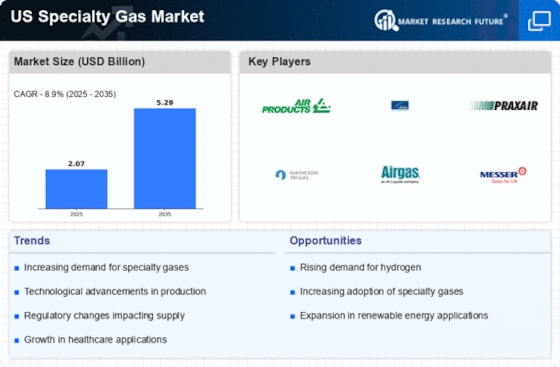
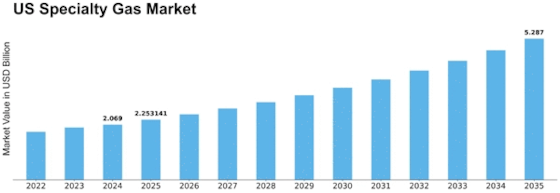
As per MRFR analysis, the US Specialty Gas Market Size was estimated at 2.069 USD Billion in 2024. The US Specialty Gas industry is projected to grow from 2.253 USD Billion in 2025 to 5.287 USD Billion by 2035, exhibiting a compound annual growth rate (CAGR) of 8.9 during the forecast period 2025 - 2035.

Key Market Trends & Highlights

The US Specialty Gas Market is poised for growth driven by technological advancements and sustainability initiatives.

  • Technological advancements are enhancing the efficiency and purity of specialty gases, particularly in North America.
  • Sustainability initiatives are increasingly influencing market dynamics, with a focus on reducing environmental impact in gas production.
  • The high purity gases segment remains the largest, while helium is emerging as the fastest-growing segment due to its diverse applications.
  • Rising demand in the healthcare sector and the expansion of semiconductor manufacturing are key drivers propelling market growth.

Market Size & Forecast

2024 Market Size 2.069 (USD Billion)
2035 Market Size 5.287 (USD Billion)
CAGR (2025 - 2035) 8.9%
Largest Regional Market Share in 2024 North America

Major Players

<p>Air Products and Chemicals Inc (US), Linde plc (IE), Praxair Inc (US), Matheson Tri-Gas Inc (US), Airgas Inc (US), Messer Group GmbH (DE), Noble Gas Solutions Inc (US), Taiyo Nippon Sanso Corporation (JP)</p>

Market Trends

The US Specialty Gas Market is currently experiencing a dynamic evolution, driven by various factors including technological advancements and increasing demand across multiple sectors. Industries such as healthcare, electronics, and manufacturing are increasingly relying on specialty gases for their unique properties and applications. This reliance suggests a growing recognition of the importance of these gases in enhancing product performance and operational efficiency. Furthermore, the market appears to be influenced by environmental regulations, which may encourage the adoption of cleaner and more sustainable gas solutions. As companies strive to meet these regulations, innovation in gas production and distribution is likely to become a focal point. In addition, the competitive landscape of the US Specialty Gas Market is shifting, with both established players and new entrants vying for market share. This competition may lead to strategic partnerships and collaborations aimed at expanding product offerings and improving service delivery. The ongoing research and development efforts in specialty gas applications indicate a potential for new market segments to emerge, further diversifying the landscape. Overall, the US Specialty Gas Market seems poised for growth, driven by technological innovation, regulatory pressures, and evolving customer needs.

Technological Advancements

The US Specialty Gas Market is witnessing rapid technological progress, which enhances production efficiency and application versatility. Innovations in gas separation and purification techniques are likely to improve the quality and availability of specialty gases, catering to diverse industrial needs.

Sustainability Initiatives

There is a noticeable shift towards sustainable practices within the US Specialty Gas Market. Companies are increasingly focusing on eco-friendly gas solutions, driven by regulatory pressures and consumer demand for greener alternatives. This trend may lead to the development of low-emission gases.

Growing Industrial Applications

The demand for specialty gases is expanding across various industries, including healthcare, electronics, and manufacturing. This growth suggests that specialty gases are becoming integral to modern production processes, enhancing product quality and operational efficiency.

US Specialty Gas Market Market Drivers

Rising Demand in Healthcare Sector

The US Specialty Gas Market experiences a notable surge in demand from the healthcare sector. Specialty gases such as nitrous oxide and medical-grade oxygen are essential for various medical applications, including anesthesia and respiratory therapies. The increasing prevalence of chronic diseases and the aging population contribute to this demand. According to recent data, the healthcare sector accounts for a significant portion of the specialty gas consumption, with projections indicating a growth rate of approximately 5% annually. This trend underscores the critical role of specialty gases in enhancing patient care and treatment outcomes, thereby driving the overall market growth.

Innovations in Energy Storage Solutions

Innovations in energy storage solutions are emerging as a pivotal driver for the US Specialty Gas Market. Gases such as hydrogen are gaining traction in energy storage applications, particularly in fuel cells and battery technologies. The transition towards renewable energy sources necessitates efficient storage solutions, and specialty gases play a vital role in this context. The energy storage market is projected to grow significantly, with estimates suggesting a compound annual growth rate of over 20% in the coming years. This shift towards sustainable energy solutions is likely to enhance the demand for specialty gases, thereby impacting the US Specialty Gas Market positively.

Expansion of Semiconductor Manufacturing

The US Specialty Gas Market is significantly influenced by the expansion of semiconductor manufacturing. Specialty gases like nitrogen trifluoride and silane are crucial in the production of semiconductors, which are integral to various electronic devices. The semiconductor industry has witnessed robust growth, with a market size exceeding 200 billion dollars in recent years. This growth is driven by the increasing demand for electronics, including smartphones and computers. As manufacturers seek to enhance production efficiency and yield, the reliance on specialty gases is expected to rise, thereby propelling the US Specialty Gas Market forward.

Increased Focus on Environmental Regulations

The US Specialty Gas Market is also shaped by an increased focus on environmental regulations. Stricter regulations regarding emissions and environmental impact are prompting industries to adopt cleaner technologies, which often require specialty gases. For instance, the use of low-global warming potential gases is becoming more prevalent in various applications, including refrigeration and air conditioning. The regulatory landscape is evolving, with agencies implementing guidelines that encourage the use of environmentally friendly gases. This shift not only aligns with sustainability goals but also drives innovation within the US Specialty Gas Market, as companies seek compliant solutions.

Growth in Research and Development Activities

The US Specialty Gas Market is witnessing growth in research and development activities across various sectors. Industries such as aerospace, automotive, and pharmaceuticals are increasingly investing in R&D to explore new applications for specialty gases. This trend is fueled by the need for advanced materials and processes that enhance performance and efficiency. The R&D expenditure in these sectors has seen a steady increase, with estimates suggesting a growth rate of around 4% annually. As companies strive to innovate and improve their offerings, the demand for specialty gases is likely to rise, further propelling the US Specialty Gas Market.

Market Segment Insights

Specialty Gas Type Insights

The US Specialty Gas Market segmentation, based on type includes High Purity Gases, Noble Gases, Carbon Gases, Halogen Gases, and Others. The carbon gases segment dominated the market mostly. Medical equipment, including that utilized in ophthalmology, magnetic resonance imaging, nuclear magnetic resonance imaging, and other fields, frequently uses carbon gases. Industries including chemicals, electronics, manufacturing, and healthcare have a strong demand for carbon gases. The need for carbon gases is rising due to their expanding range of applications in instrument calibration.

Figure 1: US Specialty Gas Market, by Type, 2022 & 2032 (USD Billion)Source: Secondary Research, Primary Research, Market Research Future Database and Analyst Review

Specialty Gas Ingredients Insights

The US Specialty Gas Market segmentation, based on ingredients, includes Argon, Bromine, Nitrogen, Helium, Carbon Monoxide, Xenon, Methane, Krypton Oxygen, Neon, Hydrogen, and Others. The carbon monoxide category generated the most income. In terms of market share, carbon monoxide (CO) is the most common and well-known gas. Owing to its special qualities and uses, this colorless, odorless gas—produced when fuels containing carbon burn incompletely—is extensively employed in a variety of sectors.

The market is expanding in part because of the growing demand for carbon monoxide in the chemical sector, where it is used as an intermediate and raw material in the synthesis of various chemicals, including formaldehyde, methanol, and acetic acid.

Specialty Gas Application Insights

The US Specialty Gas Market segmentation, based on application, includes Manufacturing, Electronics, Healthcare, Academics, Analytical & Calibration, Refrigeration, and Others. The healthcare category generated the most income. Various specialty gases, including oxygen, medical air, medical nitrous oxide, and medical helium, are used in the healthcare industry. The primary drivers of the market are anticipated to be the rising use of advanced medical technology and the increased spending on healthcare by governments worldwide.

Specialty Gas Country Insights

The US is a major global user of industrial gas, and during the past five years, there has been a notable surge in the country's need for specialty gases. These include high purity gases, carbon gases, and noble gases. They are used in a variety of industries, including the food and beverage, electronics, hydrocarbon processing, and life sciences sectors. Additionally, the US is propelled by the existence of several major businesses in a wide range of industries, including healthcare, electronics, automotive, and manufacturing.

The nation is also growing as a result of a number of technical developments, the developing semiconductor sector, healthcare services, and a growing emphasis on renewable energy technologies. In addition, growing medical technology and an aging population are major factors driving the need for medical gases, which is largely driven by the healthcare sector. For uses such as anesthetic and diagnostic testing, specialty gases are indispensable. It is anticipated that this trend will accelerate market expansion as healthcare quality becomes increasingly important.

Get more detailed insights about US Specialty Gas Market Research Report - Forecast by 2035

Regional Insights

North America : Market Leader in Specialty Gases

The North American specialty gas market is primarily driven by the increasing demand from industries such as healthcare, electronics, and manufacturing. The region holds approximately 60% of the global market share, with the United States being the largest contributor, followed by Canada at around 15%. Regulatory support for clean energy initiatives and technological advancements in gas production are significant growth catalysts. The competitive landscape is characterized by major players like Air Products and Chemicals Inc, Praxair Inc, and Matheson Tri-Gas Inc, which dominate the market. These companies are investing in innovative technologies and expanding their production capacities to meet the rising demand. The presence of a robust distribution network further enhances market accessibility, ensuring that specialty gases are readily available across various sectors.

Europe : Emerging Market with Growth Potential

Europe is witnessing a growing demand for specialty gases, driven by advancements in technology and increasing applications in sectors such as pharmaceuticals and food processing. The region accounts for approximately 25% of The US Specialty Gas Market, with Germany and the UK being the largest markets, holding around 10% and 7% respectively. Regulatory frameworks promoting sustainability and environmental safety are also propelling market growth. Leading countries in Europe are focusing on innovation and sustainability, with key players like Linde plc and Messer Group GmbH leading the charge. The competitive landscape is evolving, with companies investing in R&D to develop eco-friendly gas solutions. The presence of stringent regulations ensures that companies adhere to safety and environmental standards, further enhancing market credibility.

Asia-Pacific : Rapid Growth in Emerging Economies

The Asia-Pacific region is experiencing rapid growth in the specialty gas market, driven by industrialization and urbanization in countries like China and India. This region holds approximately 15% of the global market share, with China being the largest market, accounting for nearly 10%. The increasing demand for specialty gases in electronics and healthcare sectors is a significant growth driver, supported by favorable government policies and investments in infrastructure. Competitive dynamics in Asia-Pacific are characterized by the presence of both local and international players, including Taiyo Nippon Sanso Corporation and Noble Gas Solutions Inc. These companies are focusing on expanding their production capabilities and enhancing distribution networks to meet the growing demand. The region's diverse industrial base provides ample opportunities for specialty gas applications, further fueling market growth.

Middle East and Africa : Emerging Market with Unique Challenges

The Middle East and Africa region is gradually emerging in the specialty gas market, driven by increasing industrial activities and investments in infrastructure. This region holds about 5% of the global market share, with countries like South Africa and the UAE leading the way. The growth is supported by government initiatives aimed at diversifying economies and reducing reliance on oil, which is creating new opportunities for specialty gas applications. The competitive landscape is still developing, with a mix of local and international players. Companies are focusing on establishing partnerships and collaborations to enhance their market presence. The unique challenges in this region include regulatory hurdles and varying levels of market maturity, which require tailored strategies for successful market penetration.

Key Players and Competitive Insights

Leading market players are investing heavily in research and development in order to expand their product lines, which will help the specialty gas market, grow even more. Market participants are also undertaking a variety of strategic activities to expand their footprint, with important market developments including new product launches, contractual agreements, mergers and acquisitions, higher investments, and collaboration with other organizations. To expand and survive in a more competitive and rising market climate, specialty gas industry must offer cost-effective items.

Major players in the specialty gas market are attempting to increase market demand by investing in research and development operations includes The Linde Group (Germany), Air Liquide (France), Air Products and Chemicals Inc. (U.S.), Praxair Technology, Inc. (U.S.), Showa Denko K.K. (Japan), Southern Industrial Gas Sdn Bhd (Malaysia), Messer Group Gmbh (Germany), Mitsui Chemicals Inc. (Japan), and TAIYO NIPPON SANSO CORPORATION (Japan).

Key Companies in the US Specialty Gas Market market include

Industry Developments

February 2023: One of the top American manufacturers, H2 Merck KGaA, intends to build a new production facility in Taiwan as part of its expansion plans. The corporation will be able to increase its market share abroad thanks to this production facility's ability to produce these gasses and semiconductor materials.

December 2022: In order to distribute and supply Solvay's product, Solvaclean, the Electronic Fluorocarbons (EFC) Company, a significant specialized gas provider to the semiconductor sector, teamed with Solvay. This product is a mixture of fluorine gases that are useful for cleaning semiconductor equipment. Through this collaboration, Solvay will be able to join the American market, and EFC will gain from having more items in its line.

Future Outlook

US Specialty Gas Market Future Outlook

<p>The US Specialty Gas Market is projected to grow at an 8.9% CAGR from 2024 to 2035, driven by technological advancements, increasing industrial applications, and environmental regulations.</p>

New opportunities lie in:

  • <p>Expansion of specialty gas applications in pharmaceuticals and healthcare sectors.</p>
  • <p>Development of advanced gas delivery systems for industrial use.</p>
  • <p>Investment in sustainable gas production technologies to meet regulatory demands.</p>

<p>By 2035, the US Specialty Gas Market is expected to achieve robust growth and innovation.</p>

Market Segmentation

US Specialty Gas Market Type Outlook

  • High Purity Gases
  • Noble Gases
  • Carbon Gases
  • Halogen Gases
  • Others

US Specialty Gas Market Application Outlook

  • Manufacturing
  • Electronics
  • Healthcare
  • Academics
  • Analytical & Calibration
  • Refrigeration
  • Others

US Specialty Gas Market Ingredients Outlook

  • Argon
  • Bromine
  • Nitrogen
  • Helium
  • Carbon Monoxide
  • Xenon
  • Methane
  • Krypton
  • Oxygen
  • Neon
  • Hydrogen
  • Others

Report Scope

MARKET SIZE 20242.069(USD Billion)
MARKET SIZE 20252.253(USD Billion)
MARKET SIZE 20355.287(USD Billion)
COMPOUND ANNUAL GROWTH RATE (CAGR)8.9% (2024 - 2035)
REPORT COVERAGERevenue Forecast, Competitive Landscape, Growth Factors, and Trends
BASE YEAR2024
Market Forecast Period2025 - 2035
Historical Data2019 - 2024
Market Forecast UnitsUSD Billion
Key Companies ProfiledMarket analysis in progress
Segments CoveredMarket segmentation analysis in progress
Key Market OpportunitiesGrowing demand for high-purity gases in semiconductor manufacturing and healthcare sectors.
Key Market DynamicsRising demand for high-purity gases drives innovation and competition in the US Specialty Gas Market.
Countries CoveredNorth America, Europe, APAC, South America, MEA

FAQs

What is the current valuation of the US Specialty Gas Market as of 2024?

The US Specialty Gas Market was valued at 2.069 USD Billion in 2024.

What is the projected market valuation for the US Specialty Gas Market in 2035?

The market is projected to reach 5.287 USD Billion by 2035.

What is the expected CAGR for the US Specialty Gas Market during the forecast period 2025 - 2035?

The expected CAGR for the market during the forecast period is 8.9%.

Which companies are considered key players in the US Specialty Gas Market?

Key players include Air Products and Chemicals Inc, Linde plc, Praxair Inc, and Airgas Inc.

What are the main segments of the US Specialty Gas Market?

The main segments include High Purity Gases, Noble Gases, Carbon Gases, and Halogen Gases.

  1. SECTION I: EXECUTIVE SUMMARY AND KEY HIGHLIGHTS
    1. EXECUTIVE SUMMARY
      1. Market Overview
      2. Key Findings
      3. Market Segmentation
      4. Competitive Landscape
      5. Challenges and Opportunities
      6. Future Outlook
  2. SECTION II: SCOPING, METHODOLOGY AND MARKET STRUCTURE
    1. MARKET INTRODUCTION
      1. Definition
      2. Scope of the study
    2. RESEARCH METHODOLOGY
      1. Overview
      2. Data Mining
      3. Secondary Research
      4. Primary Research
      5. Forecasting Model
      6. Market Size Estimation
      7. Data Triangulation
      8. Validation
  3. SECTION III: QUALITATIVE ANALYSIS
    1. MARKET DYNAMICS
      1. Overview
      2. Drivers
      3. Restraints
      4. Opportunities
    2. MARKET FACTOR ANALYSIS
      1. Value chain Analysis
      2. Porter's Five Forces Analysis
      3. COVID-19 Impact Analysis
  4. SECTION IV: QUANTITATIVE ANALYSIS
    1. Chemicals and Materials, BY Type (USD Billion)
      1. High Purity Gases
      2. Noble Gases
      3. Carbon Gases
      4. Halogen Gases
      5. Others
    2. Chemicals and Materials, BY Ingredients (USD Billion)
      1. Argon
      2. Bromine
      3. Nitrogen
      4. Helium
      5. Carbon Monoxide
      6. Xenon
      7. Methane
      8. Krypton
      9. Oxygen
      10. Neon
      11. Hydrogen
      12. Others
    3. Chemicals and Materials, BY Application (USD Billion)
      1. Manufacturing
      2. Electronics
      3. Healthcare
      4. Academics
      5. Analytical & Calibration
      6. Refrigeration
      7. Others
    4. Chemicals and Materials, BY Region (USD Billion)
      1. North America
      2. Europe
      3. APAC
      4. South America
      5. MEA
  5. SECTION V: COMPETITIVE ANALYSIS
    1. Competitive Landscape
      1. Overview
      2. Competitive Analysis
      3. Market share Analysis
      4. Major Growth Strategy in the Chemicals and Materials
      5. Competitive Benchmarking
      6. Leading Players in Terms of Number of Developments in the Chemicals and Materials
      7. Key developments and growth strategies
      8. Major Players Financial Matrix
    2. Company Profiles
      1. Air Products and Chemicals Inc (US)
      2. Linde plc (IE)
      3. Praxair Inc (US)
      4. Matheson Tri-Gas Inc (US)
      5. Airgas Inc (US)
      6. Messer Group GmbH (DE)
      7. Noble Gas Solutions Inc (US)
      8. Taiyo Nippon Sanso Corporation (JP)
    3. Appendix
      1. References
      2. Related Reports
  6. LIST OF FIGURES
    1. MARKET SYNOPSIS
    2. NORTH AMERICA MARKET ANALYSIS
    3. US MARKET ANALYSIS BY TYPE
    4. US MARKET ANALYSIS BY INGREDIENTS
    5. US MARKET ANALYSIS BY APPLICATION
    6. CANADA MARKET ANALYSIS BY TYPE
    7. CANADA MARKET ANALYSIS BY INGREDIENTS
    8. CANADA MARKET ANALYSIS BY APPLICATION
    9. EUROPE MARKET ANALYSIS
    10. GERMANY MARKET ANALYSIS BY TYPE
    11. GERMANY MARKET ANALYSIS BY INGREDIENTS
    12. GERMANY MARKET ANALYSIS BY APPLICATION
    13. UK MARKET ANALYSIS BY TYPE
    14. UK MARKET ANALYSIS BY INGREDIENTS
    15. UK MARKET ANALYSIS BY APPLICATION
    16. FRANCE MARKET ANALYSIS BY TYPE
    17. FRANCE MARKET ANALYSIS BY INGREDIENTS
    18. FRANCE MARKET ANALYSIS BY APPLICATION
    19. RUSSIA MARKET ANALYSIS BY TYPE
    20. RUSSIA MARKET ANALYSIS BY INGREDIENTS
    21. RUSSIA MARKET ANALYSIS BY APPLICATION
    22. ITALY MARKET ANALYSIS BY TYPE
    23. ITALY MARKET ANALYSIS BY INGREDIENTS
    24. ITALY MARKET ANALYSIS BY APPLICATION
    25. SPAIN MARKET ANALYSIS BY TYPE
    26. SPAIN MARKET ANALYSIS BY INGREDIENTS
    27. SPAIN MARKET ANALYSIS BY APPLICATION
    28. REST OF EUROPE MARKET ANALYSIS BY TYPE
    29. REST OF EUROPE MARKET ANALYSIS BY INGREDIENTS
    30. REST OF EUROPE MARKET ANALYSIS BY APPLICATION
    31. APAC MARKET ANALYSIS
    32. CHINA MARKET ANALYSIS BY TYPE
    33. CHINA MARKET ANALYSIS BY INGREDIENTS
    34. CHINA MARKET ANALYSIS BY APPLICATION
    35. INDIA MARKET ANALYSIS BY TYPE
    36. INDIA MARKET ANALYSIS BY INGREDIENTS
    37. INDIA MARKET ANALYSIS BY APPLICATION
    38. JAPAN MARKET ANALYSIS BY TYPE
    39. JAPAN MARKET ANALYSIS BY INGREDIENTS
    40. JAPAN MARKET ANALYSIS BY APPLICATION
    41. SOUTH KOREA MARKET ANALYSIS BY TYPE
    42. SOUTH KOREA MARKET ANALYSIS BY INGREDIENTS
    43. SOUTH KOREA MARKET ANALYSIS BY APPLICATION
    44. MALAYSIA MARKET ANALYSIS BY TYPE
    45. MALAYSIA MARKET ANALYSIS BY INGREDIENTS
    46. MALAYSIA MARKET ANALYSIS BY APPLICATION
    47. THAILAND MARKET ANALYSIS BY TYPE
    48. THAILAND MARKET ANALYSIS BY INGREDIENTS
    49. THAILAND MARKET ANALYSIS BY APPLICATION
    50. INDONESIA MARKET ANALYSIS BY TYPE
    51. INDONESIA MARKET ANALYSIS BY INGREDIENTS
    52. INDONESIA MARKET ANALYSIS BY APPLICATION
    53. REST OF APAC MARKET ANALYSIS BY TYPE
    54. REST OF APAC MARKET ANALYSIS BY INGREDIENTS
    55. REST OF APAC MARKET ANALYSIS BY APPLICATION
    56. SOUTH AMERICA MARKET ANALYSIS
    57. BRAZIL MARKET ANALYSIS BY TYPE
    58. BRAZIL MARKET ANALYSIS BY INGREDIENTS
    59. BRAZIL MARKET ANALYSIS BY APPLICATION
    60. MEXICO MARKET ANALYSIS BY TYPE
    61. MEXICO MARKET ANALYSIS BY INGREDIENTS
    62. MEXICO MARKET ANALYSIS BY APPLICATION
    63. ARGENTINA MARKET ANALYSIS BY TYPE
    64. ARGENTINA MARKET ANALYSIS BY INGREDIENTS
    65. ARGENTINA MARKET ANALYSIS BY APPLICATION
    66. REST OF SOUTH AMERICA MARKET ANALYSIS BY TYPE
    67. REST OF SOUTH AMERICA MARKET ANALYSIS BY INGREDIENTS
    68. REST OF SOUTH AMERICA MARKET ANALYSIS BY APPLICATION
    69. MEA MARKET ANALYSIS
    70. GCC COUNTRIES MARKET ANALYSIS BY TYPE
    71. GCC COUNTRIES MARKET ANALYSIS BY INGREDIENTS
    72. GCC COUNTRIES MARKET ANALYSIS BY APPLICATION
    73. SOUTH AFRICA MARKET ANALYSIS BY TYPE
    74. SOUTH AFRICA MARKET ANALYSIS BY INGREDIENTS
    75. SOUTH AFRICA MARKET ANALYSIS BY APPLICATION
    76. REST OF MEA MARKET ANALYSIS BY TYPE
    77. REST OF MEA MARKET ANALYSIS BY INGREDIENTS
    78. REST OF MEA MARKET ANALYSIS BY APPLICATION
    79. KEY BUYING CRITERIA OF CHEMICALS AND MATERIALS
    80. RESEARCH PROCESS OF MRFR
    81. DRO ANALYSIS OF CHEMICALS AND MATERIALS
    82. DRIVERS IMPACT ANALYSIS: CHEMICALS AND MATERIALS
    83. RESTRAINTS IMPACT ANALYSIS: CHEMICALS AND MATERIALS
    84. SUPPLY / VALUE CHAIN: CHEMICALS AND MATERIALS
    85. CHEMICALS AND MATERIALS, BY TYPE, 2024 (% SHARE)
    86. CHEMICALS AND MATERIALS, BY TYPE, 2024 TO 2035 (USD Billion)
    87. CHEMICALS AND MATERIALS, BY INGREDIENTS, 2024 (% SHARE)
    88. CHEMICALS AND MATERIALS, BY INGREDIENTS, 2024 TO 2035 (USD Billion)
    89. CHEMICALS AND MATERIALS, BY APPLICATION, 2024 (% SHARE)
    90. CHEMICALS AND MATERIALS, BY APPLICATION, 2024 TO 2035 (USD Billion)
    91. BENCHMARKING OF MAJOR COMPETITORS
  7. LIST OF TABLES
    1. LIST OF ASSUMPTIONS
    2. North America MARKET SIZE ESTIMATES; FORECAST
      1. BY TYPE, 2025-2035 (USD Billion)
      2. BY INGREDIENTS, 2025-2035 (USD Billion)
      3. BY APPLICATION, 2025-2035 (USD Billion)
    3. US MARKET SIZE ESTIMATES; FORECAST
      1. BY TYPE, 2025-2035 (USD Billion)
      2. BY INGREDIENTS, 2025-2035 (USD Billion)
      3. BY APPLICATION, 2025-2035 (USD Billion)
    4. Canada MARKET SIZE ESTIMATES; FORECAST
      1. BY TYPE, 2025-2035 (USD Billion)
      2. BY INGREDIENTS, 2025-2035 (USD Billion)
      3. BY APPLICATION, 2025-2035 (USD Billion)
    5. Europe MARKET SIZE ESTIMATES; FORECAST
      1. BY TYPE, 2025-2035 (USD Billion)
      2. BY INGREDIENTS, 2025-2035 (USD Billion)
      3. BY APPLICATION, 2025-2035 (USD Billion)
    6. Germany MARKET SIZE ESTIMATES; FORECAST
      1. BY TYPE, 2025-2035 (USD Billion)
      2. BY INGREDIENTS, 2025-2035 (USD Billion)
      3. BY APPLICATION, 2025-2035 (USD Billion)
    7. UK MARKET SIZE ESTIMATES; FORECAST
      1. BY TYPE, 2025-2035 (USD Billion)
      2. BY INGREDIENTS, 2025-2035 (USD Billion)
      3. BY APPLICATION, 2025-2035 (USD Billion)
    8. France MARKET SIZE ESTIMATES; FORECAST
      1. BY TYPE, 2025-2035 (USD Billion)
      2. BY INGREDIENTS, 2025-2035 (USD Billion)
      3. BY APPLICATION, 2025-2035 (USD Billion)
    9. Russia MARKET SIZE ESTIMATES; FORECAST
      1. BY TYPE, 2025-2035 (USD Billion)
      2. BY INGREDIENTS, 2025-2035 (USD Billion)
      3. BY APPLICATION, 2025-2035 (USD Billion)
    10. Italy MARKET SIZE ESTIMATES; FORECAST
      1. BY TYPE, 2025-2035 (USD Billion)
      2. BY INGREDIENTS, 2025-2035 (USD Billion)
      3. BY APPLICATION, 2025-2035 (USD Billion)
    11. Spain MARKET SIZE ESTIMATES; FORECAST
      1. BY TYPE, 2025-2035 (USD Billion)
      2. BY INGREDIENTS, 2025-2035 (USD Billion)
      3. BY APPLICATION, 2025-2035 (USD Billion)
    12. Rest of Europe MARKET SIZE ESTIMATES; FORECAST
      1. BY TYPE, 2025-2035 (USD Billion)
      2. BY INGREDIENTS, 2025-2035 (USD Billion)
      3. BY APPLICATION, 2025-2035 (USD Billion)
    13. APAC MARKET SIZE ESTIMATES; FORECAST
      1. BY TYPE, 2025-2035 (USD Billion)
      2. BY INGREDIENTS, 2025-2035 (USD Billion)
      3. BY APPLICATION, 2025-2035 (USD Billion)
    14. China MARKET SIZE ESTIMATES; FORECAST
      1. BY TYPE, 2025-2035 (USD Billion)
      2. BY INGREDIENTS, 2025-2035 (USD Billion)
      3. BY APPLICATION, 2025-2035 (USD Billion)
    15. India MARKET SIZE ESTIMATES; FORECAST
      1. BY TYPE, 2025-2035 (USD Billion)
      2. BY INGREDIENTS, 2025-2035 (USD Billion)
      3. BY APPLICATION, 2025-2035 (USD Billion)
    16. Japan MARKET SIZE ESTIMATES; FORECAST
      1. BY TYPE, 2025-2035 (USD Billion)
      2. BY INGREDIENTS, 2025-2035 (USD Billion)
      3. BY APPLICATION, 2025-2035 (USD Billion)
    17. South Korea MARKET SIZE ESTIMATES; FORECAST
      1. BY TYPE, 2025-2035 (USD Billion)
      2. BY INGREDIENTS, 2025-2035 (USD Billion)
      3. BY APPLICATION, 2025-2035 (USD Billion)
    18. Malaysia MARKET SIZE ESTIMATES; FORECAST
      1. BY TYPE, 2025-2035 (USD Billion)
      2. BY INGREDIENTS, 2025-2035 (USD Billion)
      3. BY APPLICATION, 2025-2035 (USD Billion)
    19. Thailand MARKET SIZE ESTIMATES; FORECAST
      1. BY TYPE, 2025-2035 (USD Billion)
      2. BY INGREDIENTS, 2025-2035 (USD Billion)
      3. BY APPLICATION, 2025-2035 (USD Billion)
    20. Indonesia MARKET SIZE ESTIMATES; FORECAST
      1. BY TYPE, 2025-2035 (USD Billion)
      2. BY INGREDIENTS, 2025-2035 (USD Billion)
      3. BY APPLICATION, 2025-2035 (USD Billion)
    21. Rest of APAC MARKET SIZE ESTIMATES; FORECAST
      1. BY TYPE, 2025-2035 (USD Billion)
      2. BY INGREDIENTS, 2025-2035 (USD Billion)
      3. BY APPLICATION, 2025-2035 (USD Billion)
    22. South America MARKET SIZE ESTIMATES; FORECAST
      1. BY TYPE, 2025-2035 (USD Billion)
      2. BY INGREDIENTS, 2025-2035 (USD Billion)
      3. BY APPLICATION, 2025-2035 (USD Billion)
    23. Brazil MARKET SIZE ESTIMATES; FORECAST
      1. BY TYPE, 2025-2035 (USD Billion)
      2. BY INGREDIENTS, 2025-2035 (USD Billion)
      3. BY APPLICATION, 2025-2035 (USD Billion)
    24. Mexico MARKET SIZE ESTIMATES; FORECAST
      1. BY TYPE, 2025-2035 (USD Billion)
      2. BY INGREDIENTS, 2025-2035 (USD Billion)
      3. BY APPLICATION, 2025-2035 (USD Billion)
    25. Argentina MARKET SIZE ESTIMATES; FORECAST
      1. BY TYPE, 2025-2035 (USD Billion)
      2. BY INGREDIENTS, 2025-2035 (USD Billion)
      3. BY APPLICATION, 2025-2035 (USD Billion)
    26. Rest of South America MARKET SIZE ESTIMATES; FORECAST
      1. BY TYPE, 2025-2035 (USD Billion)
      2. BY INGREDIENTS, 2025-2035 (USD Billion)
      3. BY APPLICATION, 2025-2035 (USD Billion)
    27. MEA MARKET SIZE ESTIMATES; FORECAST
      1. BY TYPE, 2025-2035 (USD Billion)
      2. BY INGREDIENTS, 2025-2035 (USD Billion)
      3. BY APPLICATION, 2025-2035 (USD Billion)
    28. GCC Countries MARKET SIZE ESTIMATES; FORECAST
      1. BY TYPE, 2025-2035 (USD Billion)
      2. BY INGREDIENTS, 2025-2035 (USD Billion)
      3. BY APPLICATION, 2025-2035 (USD Billion)
    29. South Africa MARKET SIZE ESTIMATES; FORECAST
      1. BY TYPE, 2025-2035 (USD Billion)
      2. BY INGREDIENTS, 2025-2035 (USD Billion)
      3. BY APPLICATION, 2025-2035 (USD Billion)
    30. Rest of MEA MARKET SIZE ESTIMATES; FORECAST
      1. BY TYPE, 2025-2035 (USD Billion)
      2. BY INGREDIENTS, 2025-2035 (USD Billion)
      3. BY APPLICATION, 2025-2035 (USD Billion)
    31. PRODUCT LAUNCH/PRODUCT DEVELOPMENT/APPROVAL
    32. ACQUISITION/PARTNERSHIP

US Specialty Gas Market Segmentation

Market Segmentation Overview

  • Detailed segmentation data will be available in the full report
  • Comprehensive analysis by multiple parameters
  • Regional and country-level breakdowns
  • Market size forecasts by segment
Infographic

Free Sample Request

Kindly complete the form below to receive a free sample of this Report

Get Free Sample

Customer Strories

Compare Licence

×
Features License Type
Single User Multiuser License Enterprise User
Price $4,950 $5,950 $7,250
Maximum User Access Limit 1 User Upto 10 Users Unrestricted Access Throughout the Organization
Free Customization
Direct Access to Analyst
Deliverable Format
Platform Access
Discount on Next Purchase 10% 15% 15%
Printable Versions