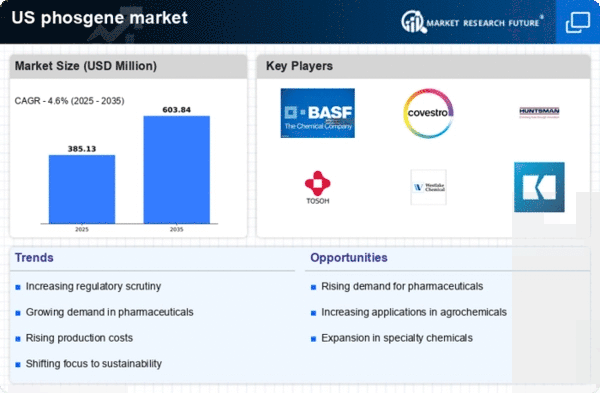
The phosgene market exhibits a competitive landscape characterized by a blend of established players and emerging innovators, driven by increasing demand for high-performance chemicals across various industries. Key growth drivers include the rising need for specialty chemicals in pharmaceuticals, agrochemicals, and polymers. Major companies such as BASF SE (Germany), Huntsman Corporation (US), and Westlake Chemical Corporation (US) are strategically positioned to leverage their extensive R&D capabilities and global supply chains. Their operational focus on innovation and sustainability initiatives appears to be shaping the competitive environment, fostering a landscape where technological advancements and eco-friendly practices are paramount.In terms of business tactics, companies are increasingly localizing manufacturing to enhance supply chain resilience and reduce lead times. The market structure is moderately fragmented, with a mix of large multinational corporations and smaller niche players. This fragmentation allows for diverse competitive strategies, as key players like Covestro AG (Germany) and Koch Industries, Inc. (US) optimize their operations to capture market share through strategic partnerships and localized production.
In October BASF SE (Germany) announced a significant investment in a new phosgene production facility in Texas, aimed at increasing capacity to meet the growing demand for specialty chemicals. This strategic move not only enhances BASF's production capabilities but also aligns with its commitment to sustainability by incorporating advanced technologies that reduce emissions. Such investments are likely to solidify BASF's market position and enhance its competitive edge.
In September Huntsman Corporation (US) launched a new line of phosgene-based products designed for the automotive sector, emphasizing performance and environmental compliance. This initiative reflects Huntsman's strategy to diversify its product offerings while addressing the increasing regulatory pressures for sustainable solutions. The introduction of these products may strengthen Huntsman's foothold in the automotive market, showcasing its adaptability to evolving industry demands.
In August Westlake Chemical Corporation (US) entered into a strategic partnership with a leading technology firm to develop AI-driven solutions for optimizing phosgene production processes. This collaboration indicates Westlake's commitment to digital transformation and operational efficiency, potentially leading to significant cost reductions and enhanced product quality. Such technological advancements are likely to redefine competitive dynamics within the market.
As of November current trends in the phosgene market are increasingly defined by digitalization, sustainability, and the integration of AI technologies. Strategic alliances among key players are shaping the landscape, fostering innovation and enhancing supply chain reliability. The competitive differentiation is expected to evolve from traditional price-based competition towards a focus on technological innovation and sustainable practices, indicating a shift in how companies will compete in the future.