US Neonatal Thermoregulation Market

ID: MRFR/MED/15178-HCR 100 Pages Satyendra Maurya Last Updated: November 16, 2026
US Neonatal Thermoregulation Market Research Report: Size, Share, Trend Analysis By Product Type (warmer, neonatal incubators, neonatal cooling systems), By Modality (Open, Closed) and By End Users (Hospitals, pediatric and neonatal intensive care units, others) - Growth Outlook & Industry Forecast 2025 To 2035
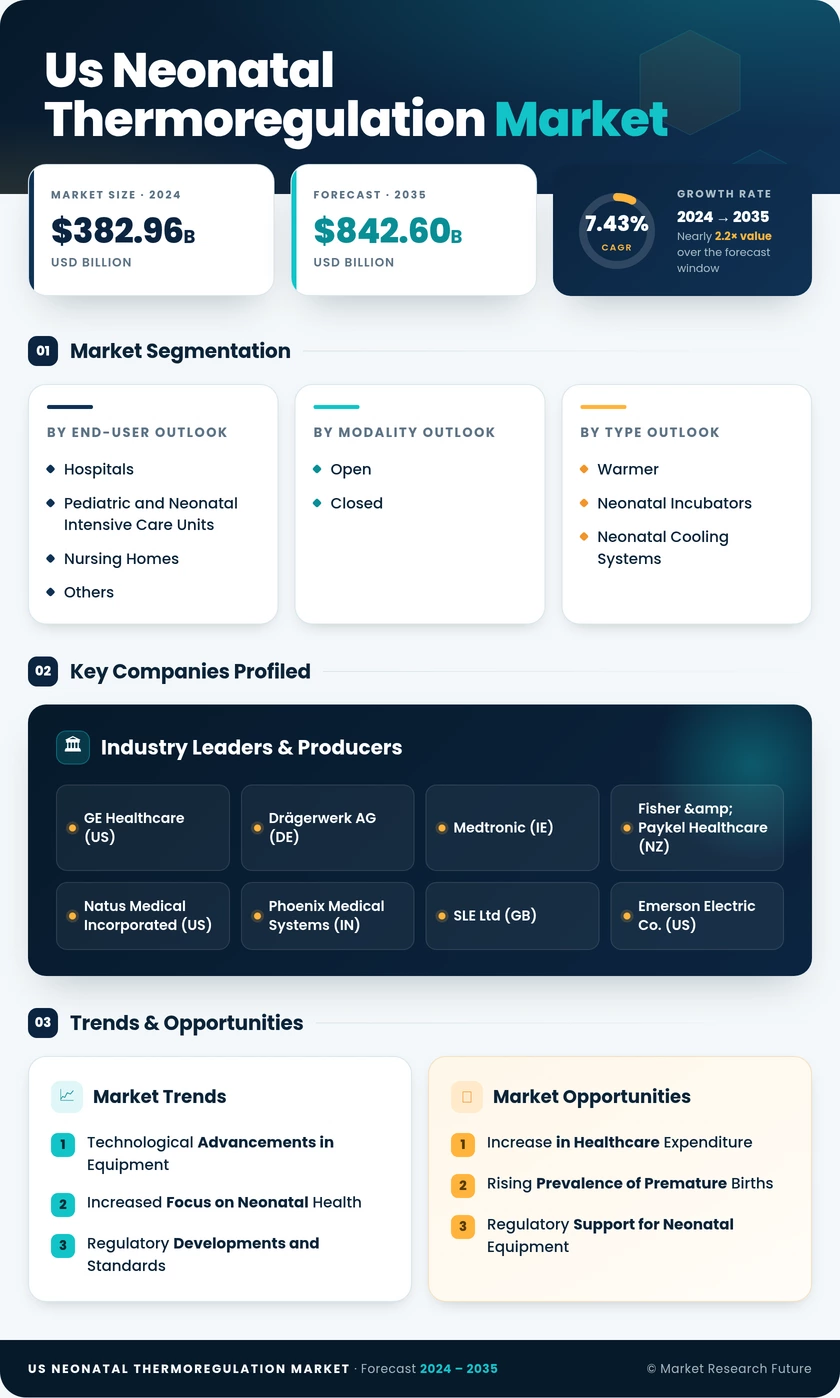
US Neonatal Thermoregulation Market
Market Size
Forecast Period2025 - 2035
CAGR (2025 - 2035)7.43%
2024 Market Size$ 382.96 Million
2025 Market Size$ 411.42 Million
2035 Market Size$ 842.6 Million
Key Players
GE Healthcare
Drägerwerk AG
Medtronic
Fisher & Paykel Healthcare
Natus Medical Incorporated
Phoenix Medical Systems
Opportunities
  • Increase in Healthcare Expenditure
  • Rising Prevalence of Premature Births
  • Regulatory Support for Neonatal Equipment
  1. 1 SECTION I: EXECUTIVE SUMMARY AND KEY HIGHLIGHTS
    1. 1.1 EXECUTIVE SUMMARY
      1. 1.1.1 Market Overview
      2. 1.1.2 Key Findings
      3. 1.1.3 Market Segmentation
      4. 1.1.4 Competitive Landscape
      5. 1.1.5 Challenges and Opportunities
      6. 1.1.6 Future Outlook
  2. 2 SECTION II: SCOPING, METHODOLOGY AND MARKET STRUCTURE
    1. 2.1 MARKET INTRODUCTION
      1. 2.1.1 Definition
      2. 2.1.2 Scope of the study
        1. 2.1.2.1 Research Objective
        2. 2.1.2.2 Assumption
        3. 2.1.2.3 Limitations
    2. 2.2 RESEARCH METHODOLOGY
      1. 2.2.1 Overview
      2. 2.2.2 Data Mining
      3. 2.2.3 Secondary Research
      4. 2.2.4 Primary Research
        1. 2.2.4.1 Primary Interviews and Information Gathering Process
        2. 2.2.4.2 Breakdown of Primary Respondents
      5. 2.2.5 Forecasting Model
      6. 2.2.6 Market Size Estimation
        1. 2.2.6.1 Bottom-Up Approach
        2. 2.2.6.2 Top-Down Approach
      7. 2.2.7 Data Triangulation
      8. 2.2.8 Validation
  3. 3 SECTION III: QUALITATIVE ANALYSIS
    1. 3.1 MARKET DYNAMICS
      1. 3.1.1 Overview
      2. 3.1.2 Drivers
      3. 3.1.3 Restraints
      4. 3.1.4 Opportunities
    2. 3.2 MARKET FACTOR ANALYSIS
      1. 3.2.1 Value chain Analysis
      2. 3.2.2 Porter's Five Forces Analysis
        1. 3.2.2.1 Bargaining Power of Suppliers
        2. 3.2.2.2 Bargaining Power of Buyers
        3. 3.2.2.3 Threat of New Entrants
        4. 3.2.2.4 Threat of Substitutes
        5. 3.2.2.5 Intensity of Rivalry
      3. 3.2.3 COVID-19 Impact Analysis
        1. 3.2.3.1 Market Impact Analysis
        2. 3.2.3.2 Regional Impact
        3. 3.2.3.3 Opportunity and Threat Analysis
  4. 4 SECTION IV: QUANTITATIVE ANALYSIS
    1. 4.1 Security, Access Control and Robotics, BY Product Type (USD Million)
      1. 4.1.1 Warmer
      2. 4.1.2 Neonatal Incubators
      3. 4.1.3 Neonatal Cooling Systems
    2. 4.2 Security, Access Control and Robotics, BY Modality (USD Million)
      1. 4.2.1 Open
      2. 4.2.2 Closed
    3. 4.3 Security, Access Control and Robotics, BY End-user (USD Million)
      1. 4.3.1 Hospitals
      2. 4.3.2 Pediatric and Neonatal Intensive Care Units
      3. 4.3.3 Nursing Homes
      4. 4.3.4 Others
  5. 5 SECTION V: COMPETITIVE ANALYSIS
    1. 5.1 Competitive Landscape
      1. 5.1.1 Overview
      2. 5.1.2 Competitive Analysis
      3. 5.1.3 Market share Analysis
      4. 5.1.4 Major Growth Strategy in the Security, Access Control and Robotics
      5. 5.1.5 Competitive Benchmarking
      6. 5.1.6 Leading Players in Terms of Number of Developments in the Security, Access Control and Robotics
      7. 5.1.7 Key developments and growth strategies
        1. 5.1.7.1 New Product Launch/Service Deployment
        2. 5.1.7.2 Merger & Acquisitions
        3. 5.1.7.3 Joint Ventures
      8. 5.1.8 Major Players Financial Matrix
        1. 5.1.8.1 Sales and Operating Income
        2. 5.1.8.2 Major Players R&D Expenditure. 2023
    2. 5.2 Company Profiles
      1. 5.2.1 GE Healthcare (US)
        1. 5.2.1.1 Financial Overview
        2. 5.2.1.2 Products Offered
        3. 5.2.1.3 Key Developments
        4. 5.2.1.4 SWOT Analysis
        5. 5.2.1.5 Key Strategies
      2. 5.2.2 Drägerwerk AG (DE)
        1. 5.2.2.1 Financial Overview
        2. 5.2.2.2 Products Offered
        3. 5.2.2.3 Key Developments
        4. 5.2.2.4 SWOT Analysis
        5. 5.2.2.5 Key Strategies
      3. 5.2.3 Medtronic (IE)
        1. 5.2.3.1 Financial Overview
        2. 5.2.3.2 Products Offered
        3. 5.2.3.3 Key Developments
        4. 5.2.3.4 SWOT Analysis
        5. 5.2.3.5 Key Strategies
      4. 5.2.4 Fisher & Paykel Healthcare (NZ)
        1. 5.2.4.1 Financial Overview
        2. 5.2.4.2 Products Offered
        3. 5.2.4.3 Key Developments
        4. 5.2.4.4 SWOT Analysis
        5. 5.2.4.5 Key Strategies
      5. 5.2.5 Natus Medical Incorporated (US)
        1. 5.2.5.1 Financial Overview
        2. 5.2.5.2 Products Offered
        3. 5.2.5.3 Key Developments
        4. 5.2.5.4 SWOT Analysis
        5. 5.2.5.5 Key Strategies
      6. 5.2.6 Phoenix Medical Systems (IN)
        1. 5.2.6.1 Financial Overview
        2. 5.2.6.2 Products Offered
        3. 5.2.6.3 Key Developments
        4. 5.2.6.4 SWOT Analysis
        5. 5.2.6.5 Key Strategies
      7. 5.2.7 SLE Ltd (GB)
        1. 5.2.7.1 Financial Overview
        2. 5.2.7.2 Products Offered
        3. 5.2.7.3 Key Developments
        4. 5.2.7.4 SWOT Analysis
        5. 5.2.7.5 Key Strategies
      8. 5.2.8 Emerson Electric Co. (US)
        1. 5.2.8.1 Financial Overview
        2. 5.2.8.2 Products Offered
        3. 5.2.8.3 Key Developments
        4. 5.2.8.4 SWOT Analysis
        5. 5.2.8.5 Key Strategies
    3. 5.3 Appendix
      1. 5.3.1 References
      2. 5.3.2 Related Reports
  6. 6 LIST OF FIGURES
    1. 6.1 MARKET SYNOPSIS
    2. 6.2 US MARKET ANALYSIS BY PRODUCT TYPE
    3. 6.3 US MARKET ANALYSIS BY MODALITY
    4. 6.4 US MARKET ANALYSIS BY END-USER
    5. 6.5 KEY BUYING CRITERIA OF SECURITY, ACCESS CONTROL AND ROBOTICS
    6. 6.6 RESEARCH PROCESS OF MRFR
    7. 6.7 DRO ANALYSIS OF SECURITY, ACCESS CONTROL AND ROBOTICS
    8. 6.8 DRIVERS IMPACT ANALYSIS: SECURITY, ACCESS CONTROL AND ROBOTICS
    9. 6.9 RESTRAINTS IMPACT ANALYSIS: SECURITY, ACCESS CONTROL AND ROBOTICS
    10. 6.10 SUPPLY / VALUE CHAIN: SECURITY, ACCESS CONTROL AND ROBOTICS
    11. 6.11 SECURITY, ACCESS CONTROL AND ROBOTICS, BY PRODUCT TYPE, 2024 (% SHARE)
    12. 6.12 SECURITY, ACCESS CONTROL AND ROBOTICS, BY PRODUCT TYPE, 2024 TO 2035 (USD Million)
    13. 6.13 SECURITY, ACCESS CONTROL AND ROBOTICS, BY MODALITY, 2024 (% SHARE)
    14. 6.14 SECURITY, ACCESS CONTROL AND ROBOTICS, BY MODALITY, 2024 TO 2035 (USD Million)
    15. 6.15 SECURITY, ACCESS CONTROL AND ROBOTICS, BY END-USER, 2024 (% SHARE)
    16. 6.16 SECURITY, ACCESS CONTROL AND ROBOTICS, BY END-USER, 2024 TO 2035 (USD Million)
    17. 6.17 BENCHMARKING OF MAJOR COMPETITORS
  7. 7 LIST OF TABLES
    1. 7.1 LIST OF ASSUMPTIONS
  8. 7.1.1
    1. 7.2 US MARKET SIZE ESTIMATES; FORECAST
      1. 7.2.1 BY PRODUCT TYPE, 2025-2035 (USD Million)
      2. 7.2.2 BY MODALITY, 2025-2035 (USD Million)
      3. 7.2.3 BY END-USER, 2025-2035 (USD Million)
    2. 7.3 PRODUCT LAUNCH/PRODUCT DEVELOPMENT/APPROVAL
  9. 7.3.1
    1. 7.4 ACQUISITION/PARTNERSHIP
  10. 7.4.1

US Neonatal Thermoregulation Market Segmentation

US Neonatal Thermoregulation Market By Product Type (USD Million, 2025-2035)

  • Warmer
  • Neonatal Incubators
  • Neonatal Cooling Systems

US Neonatal Thermoregulation Market By Modality (USD Million, 2025-2035)

  • Open
  • Closed

US Neonatal Thermoregulation Market By End-user (USD Million, 2025-2035)

  • Hospitals
  • Pediatric and Neonatal Intensive Care Units
  • Nursing Homes
  • Others
Download PDF ×

We do not share your information with anyone. However, we may send you emails based on your report interest from time to time. You may contact us at any time to opt-out.