Request Free Sample ×

Kindly complete the form below to receive a free sample of this Report

* Please use a valid business email

Leading companies partner with us for data-driven Insights

clients tt-cursor
Hero Background
English
Chinese
French
Japanese
Korean
German
Spanish

US Inorganic Salt Market Analysis

ID: MRFR/CnM/0290-HCR
214 Pages
Chitranshi Jaiswal
March 2026

Global & US Inorganic Salt Market by Application (Food & Beverages, Agriculture, Pharmaceutical, others (Construction & Chemical) and by Types (Potassium salt, Calcium salt, Sodium salt, Ammonium salt and others) Forecast 2024 to 2032

Share:
Download PDF ×

We do not share your information with anyone. However, we may send you emails based on your report interest from time to time. You may contact us at any time to opt-out.

US Inorganic Salt Market Infographic
Purchase Options

Market Analysis

In-depth Analysis of US Inorganic Salt Market Industry Landscape

A lot of different industries use inorganic salt, such as crops, fertilizers, and agrochemicals. The world's market for artificial salt has grown over the past few years. This is because the population keeps going up and agricultural chemicals and agricultural companies are growing.

Some of the most important parts of fake salt are magnesium oxide and rubber. Because of the growth of the rubber industry and the rising need for magnesium oxide, the world market for artificial salt has grown. Calcium salts, nitrates, ammonium phosphate, zinc salts, and other elements are used by many to improve the nutrients in soil, which is why the global inorganic salts market is rising. As a softener, solid salt is very important to the drugstore business.

Inorganic salt is used in cement in the building industry as Epsom salt, which is also useful in gardens, homes, farms, and many other places. The expected rise of the global inorganic salt market is due in part to these reasons. But it's important to keep in mind that artificial salt can sometimes be poisonous, which could be bad for your health and slow the growth of its global market.

With the arrival of new biotechnology tools like High-Pressure Liquid Chromatography (HPLC), the global inorganic salt market is starting to see new opportunities. This opens up new ways for the market to grow and shows that technology is getting better.

The variety of methods that artificial salt is used in different fields shows how important it is to many different areas. Even though the market has grown a lot, worries about possible health risks make it even more important to use it responsibly and make more progress in the business. The use of new technologies, such as HPLC, makes it possible for the global artificial salt market to grow in exciting new ways.

Author
Author Profile
Chitranshi Jaiswal
Team Lead - Research

Chitranshi is a Team Leader in the Chemicals & Materials (CnM) and Energy & Power (EnP) domains, with 6+ years of experience in market research. She leads and mentors teams to deliver cross-domain projects that equip clients with actionable insights and growth strategies. She is skilled in market estimation, forecasting, competitive benchmarking, and both primary & secondary research, enabling her to turn complex data into decision-ready insights. An engineer and MBA professional, she combines technical expertise with strategic acumen to solve dynamic market challenges. Chitranshi has successfully managed projects that support market entry, investment planning, and competitive positioning, while building strong client relationships. Certified in Advanced Excel & Power BI she leverages data-driven approaches to ensure accuracy, clarity, and impactful outcomes.

Leave a Comment

FAQs

What is the current valuation of the US inorganic salt market?

<p>The US inorganic salt market was valued at 21.7 USD Billion in 2024.</p>

What is the projected market size for the US inorganic salt market by 2035?

<p>The market is projected to reach 35.04 USD Billion by 2035.</p>

What is the expected CAGR for the US inorganic salt market during the forecast period 2025 - 2035?

<p>The expected CAGR for the US inorganic salt market during 2025 - 2035 is 4.45%.</p>

Which companies are considered key players in the US inorganic salt market?

<p>Key players in the market include Compass Minerals, Cargill, American Vanguard Corporation, K+S Aktiengesellschaft, Nutrien Ltd., Olin Corporation, Tata Chemicals, and FMC Corporation.</p>

What are the main applications of inorganic salts in the US market?

<p>The main applications include agriculture, food processing, chemical manufacturing, pharmaceuticals, and water treatment.</p>

How much is the agriculture segment of the US inorganic salt market expected to grow?

<p>The agriculture segment is expected to grow from 3.5 USD Billion to 5.5 USD Billion by 2035.</p>

What is the valuation of the food processing segment in the US inorganic salt market?

<p>The food processing segment was valued at 4.0 USD Billion in 2024 and is projected to reach 6.0 USD Billion by 2035.</p>

Which type of inorganic salts holds the largest market share?

<p>Sodium salts hold the largest market share, with a valuation expected to grow from 8.0 USD Billion to 12.5 USD Billion by 2035.</p>

What forms of inorganic salts are prevalent in the US market?

<p>Prevalent forms include powder, granular, liquid, crystalline, and tablet, with crystalline salts projected to grow from 6.0 USD Billion to 10.0 USD Billion by 2035.</p>

What purity levels are available for inorganic salts in the US market?

<p>Purity levels include technical grade, food grade, pharmaceutical grade, industrial grade, and reagent grade, with industrial grade expected to grow from 7.0 USD Billion to 11.0 USD Billion by 2035.</p>

What factors could challenge the growth of the US Inorganic Salt Market?

Challenges may arise from regulatory constraints and fluctuations in raw material prices.

How will the Calcium Salts segment perform by 2035?

The Calcium Salts segment is expected to grow significantly, reaching a value of 7.5 billion USD by 2035.

What will be the expected market value of Potassium Salts in 2024?

The Potassium Salts segment is valued at 3.0 billion USD in 2024.

Market Summary

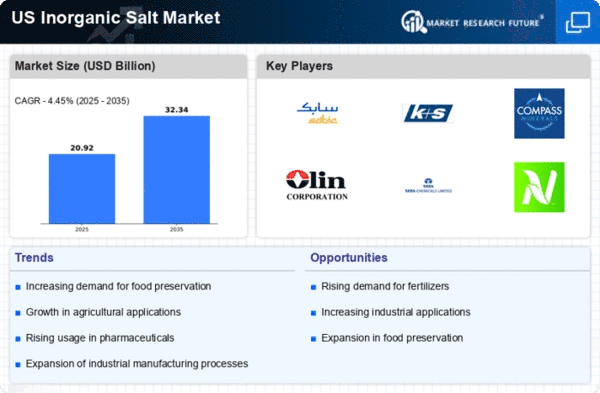
As per Market Research Future analysis, the US inorganic salt market Size was estimated at 20.03 USD Billion in 2024. The US inorganic salt market is projected to grow from 20.92 USD Billion in 2025 to 32.34 USD Billion by 2035, exhibiting a compound annual growth rate (CAGR) of 4.4% during the forecast period 2025 - 2035

Key Market Trends & Highlights

The US The US inorganic salt market is experiencing robust growth. This growth is driven by sustainability and technological advancements.

  • Sustainability initiatives are increasingly shaping the production and consumption patterns within the inorganic salt market. Technological advancements are enhancing the efficiency of inorganic salt applications across various industries. The agricultural segment remains the largest, while the food processing segment is identified as the fastest-growing in the market. Rising demand in agriculture and industrial applications expansion are key drivers propelling market growth.

Market Size & Forecast

2024 Market Size 20.03 (USD Billion)
2035 Market Size 32.34 (USD Billion)
CAGR (2025 - 2035) 4.45%

Major Players

SABIC (SA), K+S AG (DE), Compass Minerals (US), Olin Corporation (US), Tata Chemicals (IN), Nutrien Ltd. (CA), Yara International (NO), Solvay S.A. (BE), FMC Corporation (US)

Market Trends

The inorganic salt market is currently experiencing a dynamic phase. This phase is characterized by evolving demand patterns and regulatory influences. Various sectors, including agriculture, pharmaceuticals, and food processing, are driving the need for diverse inorganic salts. The agricultural sector, in particular, relies heavily on these compounds for fertilizers and soil amendments, which are essential for enhancing crop yields. Additionally, the pharmaceutical industry utilizes inorganic salts in drug formulations, indicating a growing intersection between health and chemical industries. As environmental regulations become more stringent, manufacturers are adapting their processes to comply with sustainability standards, which may reshape production methods and product offerings. Moreover, the increasing focus on food safety and quality is prompting food manufacturers to seek high-purity inorganic salts for preservation and flavor enhancement. This trend suggests a potential shift towards more specialized products that meet stringent safety criteria. The ongoing advancements in technology are also likely to influence the production and application of inorganic salts, leading to innovations that could enhance efficiency and reduce environmental impact. Overall, the inorganic salt market appears poised for growth, driven by diverse applications and a commitment to sustainability, which may redefine its landscape in the coming years.

Sustainability Initiatives

There is a noticeable shift towards sustainable practices within the inorganic salt market. Manufacturers are increasingly adopting eco-friendly production methods to minimize environmental impact. This trend is driven by regulatory pressures and consumer demand for greener products, leading to innovations in sourcing and processing.

Technological Advancements

Technological innovations are playing a crucial role in shaping the inorganic salt market. Enhanced production techniques and improved purification processes are enabling manufacturers to produce higher-quality products. These advancements may lead to increased efficiency and reduced costs, benefiting various end-use industries.

Regulatory Compliance

The inorganic salt market is significantly influenced by evolving regulatory frameworks. Stricter guidelines regarding safety and environmental impact are prompting companies to adapt their practices. Compliance with these regulations is becoming essential for market players, potentially affecting product formulations and market dynamics.

US Inorganic Salt Market Market Drivers

Water Treatment Needs

The rising demand for water treatment solutions is driving the inorganic salt market. Inorganic salts, such as sodium sulfate and calcium chloride, play a vital role in water purification and softening processes. As water quality regulations become more stringent, industries are increasingly adopting these salts to ensure compliance. The market for inorganic salts in water treatment is projected to grow at a CAGR of 6% through 2027, highlighting the critical role these substances play in maintaining water quality. This trend underscores the importance of inorganic salts in the broader context of environmental sustainability and public health.

Emerging Health Trends

Emerging health trends emphasize the importance of mineral intake, influencing the inorganic salt market. Inorganic salts, such as magnesium sulfate and potassium chloride, are recognized for their health benefits and are increasingly incorporated into dietary supplements. The market for dietary supplements is projected to grow at a CAGR of 7% through 2028, which may positively impact the inorganic salt market. This trend suggests a growing awareness among consumers regarding the role of minerals in health, thereby creating new opportunities for the inorganic salt market.

Growth in Food Processing

The inorganic salt market is benefiting from the growth of the food processing industry. In this industry, these salts are utilized as preservatives, flavor enhancers, and stabilizers. Sodium chloride, for instance, is widely used in food preservation, while potassium salts are employed to reduce sodium content in processed foods. The food processing sector is anticipated to contribute significantly to the inorganic salt market, with an expected valuation of $2.5 billion by 2026. This growth reflects the increasing consumer demand for processed foods and the need for effective preservation methods, thereby driving the inorganic salt market forward.

Rising Demand in Agriculture

The inorganic salt market is experiencing a notable surge in demand from the agricultural sector. Inorganic salts, such as potassium chloride and ammonium sulfate, are essential for fertilizers, which are crucial for enhancing crop yield and quality. The increasing need for food security, driven by a growing population, is propelling the use of these salts in agriculture. In 2025, the agricultural segment is projected to account for approximately 40% of the total market share. This trend indicates a robust growth trajectory for the inorganic salt market, as farmers seek to optimize their production through effective fertilization strategies.

Industrial Applications Expansion

The inorganic salt market is witnessing significant growth due to its expanding applications across various industries. In particular, the chemical manufacturing sector utilizes inorganic salts for producing a wide range of products, including dyes, pigments, and pharmaceuticals. The market for inorganic salts in industrial applications is expected to reach $3 billion by 2026, reflecting a compound annual growth rate (CAGR) of 5% from 2025. This expansion is indicative of the increasing reliance on inorganic salts in diverse industrial processes, thereby bolstering the overall inorganic salt market.

Market Segment Insights

By Application: Water Treatment (Largest) vs. Agriculture (Fastest-Growing)

<p>In the US inorganic salt market, the application segments are classified into Agriculture, Food Processing, Chemical Manufacturing, Pharmaceuticals, and Water Treatment. Among these, Water Treatment stands out as the largest segment, driven by the increasing demand for clean and safe water. It significantly contributes to the market share due to its widespread application in municipal and industrial water treatment processes. Meanwhile, Agriculture is emerging as the fastest-growing segment due to the rising need for fertilizers and soil amendments, reflecting the growing trend towards enhanced agricultural productivity.</p>

<p>Water Treatment (Dominant) vs. Agriculture (Emerging)</p>

<p>Water Treatment remains the dominant segment in the US inorganic salt market, primarily due to its critical role in purifying and supplying drinking water, as well as treating wastewater. The increasing regulations on water quality and environmental sustainability are propelling the consistent demand for various inorganic salts in this segment. Conversely, Agriculture is identified as an emerging segment, primarily fueled by the heightened focus on sustainable farming practices and the need for effective fertilizers. As farmers increasingly adopt precision agriculture techniques, the demand for specific inorganic salts to enhance soil health and crop yield is on the rise, fostering innovation and expansion within this market segment.</p>

By End Use: Fertilizers (Largest) vs. Industrial Chemicals (Fastest-Growing)

<p>The U.S. inorganic salt market is characterized by a diverse range of end-use applications, with fertilizers holding the largest share. This sector is primarily driven by agricultural demand, where inorganic salts play a significant role in enhancing crop yield and soil fertility. Industrial chemicals follow as a prominent segment, reflecting the growing use of inorganic salts in various manufacturing processes across industries such as textiles, detergents, and batteries. In terms of growth trends, industrial chemicals represent the fastest-growing segment within the market. This is attributed to increasing industrialization and the demand for high-performance chemicals in production processes. Moreover, the rising need for sustainable practices is further driving investments in new and innovative inorganic salt products tailored for industrial applications.</p>

<p>Fertilizers: Dominant vs. Industrial Chemicals: Emerging</p>

<p>Fertilizers are the dominant end-use segment in the U.S. inorganic salt market, largely owing to their vital role in sustainable agriculture. These inorganic salts, including ammonium nitrate and potassium chloride, are essential for improving soil health and increasing agricultural productivity. This segment benefits from the constant need to enhance food production to meet the growing population demands. On the other hand, industrial chemicals as an emerging segment reflect a noteworthy trend propelled by innovations in manufacturing and production. Inorganic salts are increasingly utilized in creating high-quality materials and products, such as catalysts and processing agents, demonstrating their versatility and essential role in various industrial settings.</p>

By Type: Sodium Salts (Largest) vs. Calcium Salts (Fastest-Growing)

<p>In the US inorganic salt market, the distribution among segment values reveals that sodium salts hold a significant portion of the market share, representing the largest category due to their widespread applications in various industries such as food, healthcare, and chemical manufacturing. Following sodium salts, calcium salts are emerging strongly, as they are increasingly being utilized in pharmaceuticals and as dietary supplements, making them a notable contender in terms of market presence. The growth trends in this segment are driven by a surge in demand for sodium salts across multiple applications, particularly in de-icing and industrial processes. Calcium salts, on the other hand, are witnessing rapid growth attributed to their health benefits and increased usage in food fortification. The regulatory shifts favoring the health-conscious trend further propel their adoption, ensuring a promising growth trajectory for this category of inorganic salts.</p>

<p>Sodium Salts (Dominant) vs. Magnesium Salts (Emerging)</p>

<p>Sodium salts are recognized as the dominant player in the US inorganic salt market, utilized extensively in food preservation, chemical reactions, and as a key component in various industrial processes. Their high stability, cost-effectiveness, and versatility enhance their appeal across a wide range of applications. Conversely, magnesium salts are seen as an emerging segment, gaining traction due to their use in agriculture as fertilizers and soil conditioners, alongside their growing applications in pharmaceuticals. While sodium salts maintain a strong market position, magnesium salts continue to carve out a significant niche, driven by the increasing need for efficient agricultural solutions and health-related products.</p>

By Form: Powder (Largest) vs. Granular (Fastest-Growing)

<p>In the US inorganic salt market, the 'By Form' segment showcases a varied distribution, with powder forms holding the largest market share due to their versatility and widespread applications in various industries, including agriculture and food processing. Granular forms are quickly gaining traction, appealing to sectors that require more controlled dissolution and usage, making them an attractive option for manufacturers and consumers alike.</p>

<p>Powder (Dominant) vs. Granular (Emerging)</p>

<p>The powder form of inorganic salts remains the dominant player in the market, characterized by its ease of use, cost-effectiveness, and adaptability across multiple applications such as fertilizers, de-icing agents, and pharmaceuticals. In contrast, granular forms are emerging rapidly, driven by their precise solubility and convenience in handling. Granular inorganic salts cater specifically to industries that prioritize controlled usage scenarios, allowing for better efficiency and consistency in applications like water treatment and specialty chemicals, marking a significant shift towards tailored solutions in the market.</p>

By Purity Level: Food Grade (Largest) vs. Pharmaceutical Grade (Fastest-Growing)

<p>The US inorganic salt market is characterized by a diverse range of purity levels that cater to different industry needs. Among these, Food Grade salts hold the largest market share, driven by the growing demand in the food and beverage industry for safe and high-quality ingredients. Meanwhile, Pharmaceutical Grade salts are emerging rapidly, gaining interest from the healthcare sector as they offer high purity, essential for drug manufacturing and formulations. As consumer preferences evolve, the growth in the Pharmaceutical Grade segment is underpinned by increased investments in pharmaceutical research and development. This segment's expansion is driven not only by innovation in drug delivery systems but also by stringent regulatory frameworks requiring higher purity standards. Additionally, the rise in chronic disease prevalence propels the need for high-quality pharmaceutical products, further stimulating growth in this segment.</p>

<p>Food Grade: (Dominant) vs. Pharmaceutical Grade (Emerging)</p>

<p>Food Grade inorganic salts are a dominant force in the US market, primarily because they meet stringent safety standards and are widely accepted in food production processes. These salts provide essential minerals and serve various functions, including flavor enhancement, preservation, and nutritional supplementation. Their consistent demand in the food industry establishes their strong market presence. On the other hand, Pharmaceutical Grade salts are rapidly emerging due to their high purity requirements necessary for drug formulations. This segment is characterized by rigorous testing and compliance with stringent regulatory standards, which ensures that these salts are safe for human consumption. Their role in the formulation of advanced therapies and biologics is becoming increasingly vital, solidifying their importance in the healthcare sector.</p>

Get more detailed insights about Global & US Inorganic Salt Market Consumption Forecast 2022 to 2035

Regional Insights

Key Players and Competitive Insights

The inorganic salt market is characterized by a competitive landscape that is increasingly shaped by innovation, sustainability, and strategic partnerships. Key players such as Compass Minerals (US), Olin Corporation (US), and Nutrien Ltd. (CA) are actively pursuing growth strategies that emphasize operational efficiency and market expansion. Compass Minerals (US) has focused on enhancing its product portfolio through sustainable practices, while Olin Corporation (US) is leveraging its strong manufacturing capabilities to optimize supply chains. Nutrien Ltd. (CA) appears to be concentrating on digital transformation initiatives to improve customer engagement and operational transparency, collectively influencing the competitive dynamics of the market.The market structure is moderately fragmented, with several players vying for market share through localized manufacturing and supply chain optimization. This fragmentation allows for a diverse range of products and services, catering to various industrial applications. The collective influence of these key players fosters a competitive environment where innovation and efficiency are paramount, driving the market towards more sustainable practices and advanced technologies.
In October Compass Minerals (US) announced a significant investment in a new production facility aimed at increasing its capacity for specialty fertilizers, which are derived from inorganic salts. This strategic move is expected to enhance the company's market position by meeting the growing demand for sustainable agricultural solutions. The investment not only reflects Compass Minerals' commitment to sustainability but also positions the company to capitalize on the increasing trend towards environmentally friendly agricultural practices.
In September Olin Corporation (US) launched a new line of eco-friendly inorganic salts designed for industrial applications. This initiative underscores Olin's strategy to align its product offerings with the rising demand for sustainable solutions across various sectors. By introducing these innovative products, Olin Corporation aims to differentiate itself in a competitive market, potentially attracting environmentally conscious customers and enhancing its brand reputation.
In August Nutrien Ltd. (CA) entered into a strategic partnership with a technology firm to develop AI-driven solutions for optimizing the production and distribution of inorganic salts. This collaboration is indicative of Nutrien's forward-thinking approach, as it seeks to integrate advanced technologies into its operations. The partnership is likely to enhance operational efficiency and reduce costs, positioning Nutrien as a leader in the digital transformation of the inorganic salt market.
As of November the competitive trends in the inorganic salt market are increasingly defined by digitalization, sustainability, and technological integration. Strategic alliances are becoming more prevalent, enabling companies to leverage complementary strengths and enhance their market offerings. The shift from price-based competition to a focus on innovation, technology, and supply chain reliability is evident, suggesting that future competitive differentiation will hinge on the ability to adapt to these evolving trends.

Key Companies in the US Inorganic Salt Market include

Industry Developments

Future Outlook

US Inorganic Salt Market Future Outlook

The inorganic salt market is projected to grow at a 4.45% CAGR from 2025 to 2035, driven by industrial demand, agricultural applications, and advancements in chemical processes.

New opportunities lie in:

  • <p>Development of eco-friendly inorganic salt formulations Expansion into emerging agricultural markets Investment in automated production technologies for efficiency</p>

By 2035, the inorganic salt market is expected to achieve robust growth and enhanced market positioning.

Market Segmentation

US Inorganic Salt Market Type Outlook

  • Sodium Salts
  • Magnesium Salts
  • Calcium Salts
  • Potassium Salts
  • Ammonium Salts
  • Others

US Inorganic Salt Market Application Outlook

  • Agriculture
  • Pharmaceuticals
  • Cement
  • Rubber processing
  • Food
  • Others

Report Scope

MARKET SIZE 2024 20.03(USD Billion)
MARKET SIZE 2025 20.92(USD Billion)
MARKET SIZE 2035 32.34(USD Billion)
COMPOUND ANNUAL GROWTH RATE (CAGR) 4.45% (2025 - 2035)
REPORT COVERAGE Revenue Forecast, Competitive Landscape, Growth Factors, and Trends
BASE YEAR 2024
Market Forecast Period 2025 - 2035
Historical Data 2019 - 2024
Market Forecast Units USD Billion
Key Companies Profiled SABIC (SA), K+S AG (DE), Compass Minerals (US), Olin Corporation (US), Tata Chemicals (IN), Nutrien Ltd. (CA), Yara International (NO), Solvay S.A. (BE), FMC Corporation (US)
Segments Covered Type, Application
Key Market Opportunities Growing demand for specialty inorganic salts in agriculture and water treatment applications presents a market opportunity.
Key Market Dynamics Rising demand for specialty inorganic salts driven by advancements in agriculture and water treatment technologies.
Countries Covered US

FAQs

What is the current valuation of the US inorganic salt market?

<p>The US inorganic salt market was valued at 21.7 USD Billion in 2024.</p>

What is the projected market size for the US inorganic salt market by 2035?

<p>The market is projected to reach 35.04 USD Billion by 2035.</p>

What is the expected CAGR for the US inorganic salt market during the forecast period 2025 - 2035?

<p>The expected CAGR for the US inorganic salt market during 2025 - 2035 is 4.45%.</p>

Which companies are considered key players in the US inorganic salt market?

<p>Key players in the market include Compass Minerals, Cargill, American Vanguard Corporation, K+S Aktiengesellschaft, Nutrien Ltd., Olin Corporation, Tata Chemicals, and FMC Corporation.</p>

What are the main applications of inorganic salts in the US market?

<p>The main applications include agriculture, food processing, chemical manufacturing, pharmaceuticals, and water treatment.</p>

How much is the agriculture segment of the US inorganic salt market expected to grow?

<p>The agriculture segment is expected to grow from 3.5 USD Billion to 5.5 USD Billion by 2035.</p>

What is the valuation of the food processing segment in the US inorganic salt market?

<p>The food processing segment was valued at 4.0 USD Billion in 2024 and is projected to reach 6.0 USD Billion by 2035.</p>

Which type of inorganic salts holds the largest market share?

<p>Sodium salts hold the largest market share, with a valuation expected to grow from 8.0 USD Billion to 12.5 USD Billion by 2035.</p>

What forms of inorganic salts are prevalent in the US market?

<p>Prevalent forms include powder, granular, liquid, crystalline, and tablet, with crystalline salts projected to grow from 6.0 USD Billion to 10.0 USD Billion by 2035.</p>

What purity levels are available for inorganic salts in the US market?

<p>Purity levels include technical grade, food grade, pharmaceutical grade, industrial grade, and reagent grade, with industrial grade expected to grow from 7.0 USD Billion to 11.0 USD Billion by 2035.</p>

What factors could challenge the growth of the US Inorganic Salt Market?

Challenges may arise from regulatory constraints and fluctuations in raw material prices.

How will the Calcium Salts segment perform by 2035?

The Calcium Salts segment is expected to grow significantly, reaching a value of 7.5 billion USD by 2035.

What will be the expected market value of Potassium Salts in 2024?

The Potassium Salts segment is valued at 3.0 billion USD in 2024.

  1. SECTION I: EXECUTIVE SUMMARY AND KEY HIGHLIGHTS
    1. | 1.1 EXECUTIVE SUMMARY
    2. | | 1.1.1 Market Overview
    3. | | 1.1.2 Key Findings
    4. | | 1.1.3 Market Segmentation
    5. | | 1.1.4 Competitive Landscape
    6. | | 1.1.5 Challenges and Opportunities
    7. | | 1.1.6 Future Outlook
  2. SECTION II: SCOPING, METHODOLOGY AND MARKET STRUCTURE
    1. | 2.1 MARKET INTRODUCTION
    2. | | 2.1.1 Definition
    3. | | 2.1.2 Scope of the study
    4. | | | 2.1.2.1 Research Objective
    5. | | | 2.1.2.2 Assumption
    6. | | | 2.1.2.3 Limitations
    7. | 2.2 RESEARCH METHODOLOGY
    8. | | 2.2.1 Overview
    9. | | 2.2.2 Data Mining
    10. | | 2.2.3 Secondary Research
    11. | | 2.2.4 Primary Research
    12. | | | 2.2.4.1 Primary Interviews and Information Gathering Process
    13. | | | 2.2.4.2 Breakdown of Primary Respondents
    14. | | 2.2.5 Forecasting Model
    15. | | 2.2.6 Market Size Estimation
    16. | | | 2.2.6.1 Bottom-Up Approach
    17. | | | 2.2.6.2 Top-Down Approach
    18. | | 2.2.7 Data Triangulation
    19. | | 2.2.8 Validation
  3. SECTION III: QUALITATIVE ANALYSIS
    1. | 3.1 MARKET DYNAMICS
    2. | | 3.1.1 Overview
    3. | | 3.1.2 Drivers
    4. | | 3.1.3 Restraints
    5. | | 3.1.4 Opportunities
    6. | 3.2 MARKET FACTOR ANALYSIS
    7. | | 3.2.1 Value chain Analysis
    8. | | 3.2.2 Porter's Five Forces Analysis
    9. | | | 3.2.2.1 Bargaining Power of Suppliers
    10. | | | 3.2.2.2 Bargaining Power of Buyers
    11. | | | 3.2.2.3 Threat of New Entrants
    12. | | | 3.2.2.4 Threat of Substitutes
    13. | | | 3.2.2.5 Intensity of Rivalry
    14. | | 3.2.3 COVID-19 Impact Analysis
    15. | | | 3.2.3.1 Market Impact Analysis
    16. | | | 3.2.3.2 Regional Impact
    17. | | | 3.2.3.3 Opportunity and Threat Analysis
  4. SECTION IV: QUANTITATIVE ANALYSIS
    1. | 4.1 Chemicals and Materials, BY Application (USD Billion)
    2. | | 4.1.1 Agriculture
    3. | | 4.1.2 Food Processing
    4. | | 4.1.3 Chemical Manufacturing
    5. | | 4.1.4 Pharmaceuticals
    6. | | 4.1.5 Water Treatment
    7. | 4.2 Chemicals and Materials, BY End Use (USD Billion)
    8. | | 4.2.1 Fertilizers
    9. | | 4.2.2 Industrial Chemicals
    10. | | 4.2.3 Food Additives
    11. | | 4.2.4 Pharmaceutical Ingredients
    12. | | 4.2.5 Water Purification
    13. | 4.3 Chemicals and Materials, BY Type (USD Billion)
    14. | | 4.3.1 Sodium Salts
    15. | | 4.3.2 Calcium Salts
    16. | | 4.3.3 Potassium Salts
    17. | | 4.3.4 Magnesium Salts
    18. | | 4.3.5 Ammonium Salts
    19. | 4.4 Chemicals and Materials, BY Form (USD Billion)
    20. | | 4.4.1 Powder
    21. | | 4.4.2 Granular
    22. | | 4.4.3 Liquid
    23. | | 4.4.4 Crystalline
    24. | | 4.4.5 Tablet
    25. | 4.5 Chemicals and Materials, BY Purity Level (USD Billion)
    26. | | 4.5.1 Technical Grade
    27. | | 4.5.2 Food Grade
    28. | | 4.5.3 Pharmaceutical Grade
    29. | | 4.5.4 Industrial Grade
    30. | | 4.5.5 Reagent Grade
  5. SECTION V: COMPETITIVE ANALYSIS
    1. | 5.1 Competitive Landscape
    2. | | 5.1.1 Overview
    3. | | 5.1.2 Competitive Analysis
    4. | | 5.1.3 Market share Analysis
    5. | | 5.1.4 Major Growth Strategy in the Chemicals and Materials
    6. | | 5.1.5 Competitive Benchmarking
    7. | | 5.1.6 Leading Players in Terms of Number of Developments in the Chemicals and Materials
    8. | | 5.1.7 Key developments and growth strategies
    9. | | | 5.1.7.1 New Product Launch/Service Deployment
    10. | | | 5.1.7.2 Merger & Acquisitions
    11. | | | 5.1.7.3 Joint Ventures
    12. | | 5.1.8 Major Players Financial Matrix
    13. | | | 5.1.8.1 Sales and Operating Income
    14. | | | 5.1.8.2 Major Players R&D Expenditure. 2023
    15. | 5.2 Company Profiles
    16. | | 5.2.1 Compass Minerals (US)
    17. | | | 5.2.1.1 Financial Overview
    18. | | | 5.2.1.2 Products Offered
    19. | | | 5.2.1.3 Key Developments
    20. | | | 5.2.1.4 SWOT Analysis
    21. | | | 5.2.1.5 Key Strategies
    22. | | 5.2.2 Cargill (US)
    23. | | | 5.2.2.1 Financial Overview
    24. | | | 5.2.2.2 Products Offered
    25. | | | 5.2.2.3 Key Developments
    26. | | | 5.2.2.4 SWOT Analysis
    27. | | | 5.2.2.5 Key Strategies
    28. | | 5.2.3 American Vanguard Corporation (US)
    29. | | | 5.2.3.1 Financial Overview
    30. | | | 5.2.3.2 Products Offered
    31. | | | 5.2.3.3 Key Developments
    32. | | | 5.2.3.4 SWOT Analysis
    33. | | | 5.2.3.5 Key Strategies
    34. | | 5.2.4 K+S Aktiengesellschaft (US)
    35. | | | 5.2.4.1 Financial Overview
    36. | | | 5.2.4.2 Products Offered
    37. | | | 5.2.4.3 Key Developments
    38. | | | 5.2.4.4 SWOT Analysis
    39. | | | 5.2.4.5 Key Strategies
    40. | | 5.2.5 Nutrien Ltd. (US)
    41. | | | 5.2.5.1 Financial Overview
    42. | | | 5.2.5.2 Products Offered
    43. | | | 5.2.5.3 Key Developments
    44. | | | 5.2.5.4 SWOT Analysis
    45. | | | 5.2.5.5 Key Strategies
    46. | | 5.2.6 Olin Corporation (US)
    47. | | | 5.2.6.1 Financial Overview
    48. | | | 5.2.6.2 Products Offered
    49. | | | 5.2.6.3 Key Developments
    50. | | | 5.2.6.4 SWOT Analysis
    51. | | | 5.2.6.5 Key Strategies
    52. | | 5.2.7 Tata Chemicals (US)
    53. | | | 5.2.7.1 Financial Overview
    54. | | | 5.2.7.2 Products Offered
    55. | | | 5.2.7.3 Key Developments
    56. | | | 5.2.7.4 SWOT Analysis
    57. | | | 5.2.7.5 Key Strategies
    58. | | 5.2.8 FMC Corporation (US)
    59. | | | 5.2.8.1 Financial Overview
    60. | | | 5.2.8.2 Products Offered
    61. | | | 5.2.8.3 Key Developments
    62. | | | 5.2.8.4 SWOT Analysis
    63. | | | 5.2.8.5 Key Strategies
    64. | 5.3 Appendix
    65. | | 5.3.1 References
    66. | | 5.3.2 Related Reports
  6. LIST OF FIGURES
    1. | 6.1 MARKET SYNOPSIS
    2. | 6.2 US MARKET ANALYSIS BY APPLICATION
    3. | 6.3 US MARKET ANALYSIS BY END USE
    4. | 6.4 US MARKET ANALYSIS BY TYPE
    5. | 6.5 US MARKET ANALYSIS BY FORM
    6. | 6.6 US MARKET ANALYSIS BY PURITY LEVEL
    7. | 6.7 KEY BUYING CRITERIA OF CHEMICALS AND MATERIALS
    8. | 6.8 RESEARCH PROCESS OF MRFR
    9. | 6.9 DRO ANALYSIS OF CHEMICALS AND MATERIALS
    10. | 6.10 DRIVERS IMPACT ANALYSIS: CHEMICALS AND MATERIALS
    11. | 6.11 RESTRAINTS IMPACT ANALYSIS: CHEMICALS AND MATERIALS
    12. | 6.12 SUPPLY / VALUE CHAIN: CHEMICALS AND MATERIALS
    13. | 6.13 CHEMICALS AND MATERIALS, BY APPLICATION, 2024 (% SHARE)
    14. | 6.14 CHEMICALS AND MATERIALS, BY APPLICATION, 2024 TO 2035 (USD Billion)
    15. | 6.15 CHEMICALS AND MATERIALS, BY END USE, 2024 (% SHARE)
    16. | 6.16 CHEMICALS AND MATERIALS, BY END USE, 2024 TO 2035 (USD Billion)
    17. | 6.17 CHEMICALS AND MATERIALS, BY TYPE, 2024 (% SHARE)
    18. | 6.18 CHEMICALS AND MATERIALS, BY TYPE, 2024 TO 2035 (USD Billion)
    19. | 6.19 CHEMICALS AND MATERIALS, BY FORM, 2024 (% SHARE)
    20. | 6.20 CHEMICALS AND MATERIALS, BY FORM, 2024 TO 2035 (USD Billion)
    21. | 6.21 CHEMICALS AND MATERIALS, BY PURITY LEVEL, 2024 (% SHARE)
    22. | 6.22 CHEMICALS AND MATERIALS, BY PURITY LEVEL, 2024 TO 2035 (USD Billion)
    23. | 6.23 BENCHMARKING OF MAJOR COMPETITORS
  7. LIST OF TABLES
    1. | 7.1 LIST OF ASSUMPTIONS
    2. | | 7.1.1
    3. | 7.2 US MARKET SIZE ESTIMATES; FORECAST
    4. | | 7.2.1 BY APPLICATION, 2025-2035 (USD Billion)
    5. | | 7.2.2 BY END USE, 2025-2035 (USD Billion)
    6. | | 7.2.3 BY TYPE, 2025-2035 (USD Billion)
    7. | | 7.2.4 BY FORM, 2025-2035 (USD Billion)
    8. | | 7.2.5 BY PURITY LEVEL, 2025-2035 (USD Billion)
    9. | 7.3 PRODUCT LAUNCH/PRODUCT DEVELOPMENT/APPROVAL
    10. | | 7.3.1
    11. | 7.4 ACQUISITION/PARTNERSHIP
    12. | | 7.4.1

US Chemicals and Materials Market Segmentation

Chemicals and Materials By Application (USD Billion, 2025-2035)

  • Agriculture
  • Food Processing
  • Chemical Manufacturing
  • Pharmaceuticals
  • Water Treatment

Chemicals and Materials By End Use (USD Billion, 2025-2035)

  • Fertilizers
  • Industrial Chemicals
  • Food Additives
  • Pharmaceutical Ingredients
  • Water Purification

Chemicals and Materials By Type (USD Billion, 2025-2035)

  • Sodium Salts
  • Calcium Salts
  • Potassium Salts
  • Magnesium Salts
  • Ammonium Salts

Chemicals and Materials By Form (USD Billion, 2025-2035)

  • Powder
  • Granular
  • Liquid
  • Crystalline
  • Tablet

Chemicals and Materials By Purity Level (USD Billion, 2025-2035)

  • Technical Grade
  • Food Grade
  • Pharmaceutical Grade
  • Industrial Grade
  • Reagent Grade
Infographic

Free Sample Request

Kindly complete the form below to receive a free sample of this Report

Get Free Sample

Customer Strories

Compare Licence

×
Features License Type
Single User Multiuser License Enterprise User
Price $4,950 $5,950 $7,250
Maximum User Access Limit 1 User Upto 10 Users Unrestricted Access Throughout the Organization
Free Customization
Direct Access to Analyst
Deliverable Format
Platform Access
Discount on Next Purchase 10% 15% 15%
Printable Versions