Request Free Sample ×

Kindly complete the form below to receive a free sample of this Report

* Please use a valid business email

Leading companies partner with us for data-driven Insights

clients tt-cursor
Hero Background
English
Chinese
French
Japanese
Korean
German
Spanish

US Graphene Market Analysis

ID: MRFR/CnM/12413-HCR
111 Pages
Chitranshi Jaiswal
December 2024

US Graphene Market Research Report: By Type (Graphene Oxide (GO), Graphene Nanoplatelets (GNP), Few Layer Graphene (FLG), Mono-Layer & Bi-Layer Graphene, Others) and By End User (Automotive, Aerospace, Pharmaceutical, Energy, Coatings, Electronics, Chemical, Others) - Forecast to 2035

Share:
Download PDF ×

We do not share your information with anyone. However, we may send you emails based on your report interest from time to time. You may contact us at any time to opt-out.

US Graphene Market Infographic
Purchase Options

Market Analysis

In-depth Analysis of US Graphene Market Industry Landscape

The US graphene market is undergoing dynamic changes, driven by a combination of factors that influence both supply and demand in this innovative industry. Graphene, a single layer of carbon atoms arranged in a hexagonal lattice, holds remarkable properties such as high conductivity, strength, and flexibility, making it a sought-after material for a wide range of applications. The market dynamics are shaped by technological advancements, research breakthroughs, regulatory considerations, and the diverse applications of graphene.

Technological advancements contribute significantly to the dynamic nature of the US graphene market. As researchers and scientists explore new methods for producing graphene and enhancing its properties, the material becomes more accessible for various applications. Advances in scalable production techniques, such as chemical vapor deposition and liquid-phase exfoliation, contribute to reducing the cost and improving the commercial viability of graphene, impacting its market dynamics.

Research breakthroughs and discoveries play a pivotal role in shaping the market dynamics of graphene in the US. Ongoing research efforts focus on unlocking the full potential of graphene in fields ranging from electronics and energy storage to healthcare and materials science. As new applications are identified, the demand for graphene evolves, influencing both its supply chain and market pricing. Breakthroughs in areas like composite materials and flexible electronics drive the market forward, creating opportunities for innovative applications.

Regulatory considerations are an important factor influencing the market dynamics of graphene. The regulatory landscape around the use of graphene in various industries, particularly in areas like healthcare and electronics, requires adherence to safety standards and environmental regulations. As the graphene market expands, regulatory frameworks will likely evolve to address potential challenges related to health, safety, and environmental impact, impacting how graphene is produced, used, and integrated into commercial products.

The competitive landscape fosters innovation and efficiency in the graphene market. Companies are continually striving to differentiate themselves by offering high-quality graphene products, exploring novel applications, and improving production processes. Collaboration between academic institutions, research organizations, and industry players contributes to the overall growth and competitiveness of the graphene market as a whole.

The diverse applications of graphene contribute to the dynamic landscape of the market. From conductive inks and coatings to advanced materials for aerospace and healthcare, graphene finds use in a wide range of industries. The development of graphene-based batteries, sensors, and composites opens up new avenues for growth. The versatility of graphene ensures that its market dynamics are influenced by trends in multiple sectors, making it a material with vast potential for various applications.

Socio-economic factors, including economic trends and industry investments, contribute to the market dynamics of graphene in the US. Economic growth often correlates with increased investment in research and development, spurring innovation in graphene-related technologies. The willingness of industries to invest in graphene-based solutions for improved performance and efficiency further shapes the demand for graphene in the market.


Author
Author Profile
Chitranshi Jaiswal
Team Lead - Research

Chitranshi is a Team Leader in the Chemicals & Materials (CnM) and Energy & Power (EnP) domains, with 6+ years of experience in market research. She leads and mentors teams to deliver cross-domain projects that equip clients with actionable insights and growth strategies. She is skilled in market estimation, forecasting, competitive benchmarking, and both primary & secondary research, enabling her to turn complex data into decision-ready insights. An engineer and MBA professional, she combines technical expertise with strategic acumen to solve dynamic market challenges. Chitranshi has successfully managed projects that support market entry, investment planning, and competitive positioning, while building strong client relationships. Certified in Advanced Excel & Power BI she leverages data-driven approaches to ensure accuracy, clarity, and impactful outcomes.

Leave a Comment

FAQs

What is the current valuation of the US graphene market as of 2024?

<p>The US graphene market was valued at 36.0 USD Million in 2024.</p>

What is the projected market valuation for the US graphene market in 2035?

<p>The projected valuation for the US graphene market in 2035 is 450.04 USD Million.</p>

What is the expected CAGR for the US graphene market during the forecast period 2025 - 2035?

<p>The expected CAGR for the US graphene market during the forecast period 2025 - 2035 is 25.81%.</p>

Which companies are considered key players in the US graphene market?

<p>Key players in the US graphene market include Graphenea, XG Sciences, Applied Graphene Materials, Haydale Graphene Industries, First Graphene, NanoXplore, Graphene 3D Lab, and Directa Plus.</p>

What are the main application segments of the US graphene market?

<p>The main application segments of the US graphene market include Electronics, Energy Storage, Composites, Coatings, and Biomedical.</p>

How does the valuation of the Energy Storage segment compare to others in 2024?

<p>In 2024, the Energy Storage segment was valued at 8.0 USD Million, with a projected increase to 100.0 USD Million by 2035.</p>

What is the valuation of the Consumer Electronics segment in 2024?

<p>The Consumer Electronics segment was valued at 10.0 USD Million in 2024, with expectations of growth to 120.0 USD Million by 2035.</p>

What are the projected valuations for the different forms of graphene by 2035?

<p>By 2035, the projected valuations for different forms of graphene include Graphene Oxide at 60.0 USD Million, Reduced Graphene Oxide at 120.0 USD Million, and Graphene Nanoplatelets at 90.0 USD Million.</p>

What distribution channels are utilized in the US graphene market?

<p>Distribution channels in the US graphene market include Direct Sales, Distributors, Online Sales, Retail, and Wholesale.</p>

How does the valuation of the Wholesale distribution channel compare to others in 2024?

<p>In 2024, the Wholesale distribution channel was valued at 7.0 USD Million, with a projected increase to 110.0 USD Million by 2035.</p>

Market Summary

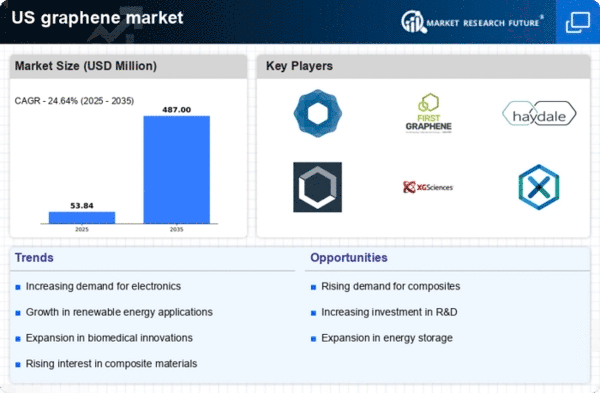
As per Market Research Future analysis, the US graphene market Size was estimated at 43.2 USD Million in 2024. The US graphene market is projected to grow from 53.84 USD Million in 2025 to 487.0 USD Million by 2035, exhibiting a compound annual growth rate (CAGR) of 24.6% during the forecast period 2025 - 2035

Key Market Trends & Highlights

The US graphene market is poised for substantial growth driven by technological advancements and increasing applications across various sectors.

  • Investment in R&D for graphene technologies is witnessing a notable increase, indicating a robust market trajectory. The electronics segment remains the largest, while the healthcare segment is emerging as the fastest-growing application area for graphene. Sustainability and environmental considerations are becoming central to the development and application of graphene materials. Technological advancements in production and growing demand in energy storage are key drivers propelling the market forward.

Market Size & Forecast

2024 Market Size 43.2 (USD Million)
2035 Market Size 487.0 (USD Million)
CAGR (2025 - 2035) 24.64%

Major Players

Graphenea (ES), First Graphene (AU), Haydale Graphene Industries (GB), Applied Graphene Materials (GB), XG Sciences (US), NanoXplore (CA), Directa Plus (IT), Graphene Flagship (EU)

Market Trends

The graphene market in the United States is currently experiencing notable growth, driven by advancements in technology and increasing applications across various sectors. Industries such as electronics, energy storage, and composites are particularly keen on integrating graphene due to its exceptional properties, including high electrical conductivity and mechanical strength. This trend suggests a shift towards more innovative materials, as manufacturers seek to enhance product performance and sustainability. Furthermore, government initiatives aimed at promoting research and development in nanotechnology are likely to bolster the market's expansion, creating a favorable environment for investment and innovation.

In addition, the rising demand for lightweight and high-strength materials in automotive and aerospace industries is propelling the adoption of graphene within the US graphene market. . As companies strive to meet stringent regulations regarding emissions and energy efficiency, graphene's potential to improve material properties is becoming increasingly attractive. Ongoing collaboration between academic institutions and industry players is expected to yield new applications and drive further growth in the US graphene market. . Overall, the landscape appears promising, with various factors converging to support the continued evolution of this dynamic sector.

Increased Investment in R&D

There is a noticeable uptick in investment directed towards research and development within the graphene market. This trend is largely fueled by both public and private sectors recognizing the potential of graphene in various applications. Enhanced funding is likely to accelerate innovation and facilitate the commercialization of new technologies.

Expansion in Electronics Applications

The electronics sector is increasingly adopting graphene for its unique properties, which may lead to the development of advanced devices. This trend indicates a growing interest in utilizing graphene in components such as transistors, sensors, and flexible displays, potentially revolutionizing the industry.

Sustainability and Environmental Focus

A heightened emphasis on sustainability is influencing the graphene market. Companies are exploring graphene's potential to create eco-friendly products, which could reduce environmental impact. This trend suggests a shift towards greener technologies, aligning with broader societal goals for sustainability.

US Graphene Market Market Drivers

Emerging Trends in Electronics

The US Graphene Market is poised for growth due to emerging trends in electronics, where graphene is being explored for its potential to revolutionize various electronic components. Its remarkable electrical properties enable the development of faster and more efficient transistors, sensors, and flexible displays. The market for graphene-based electronic devices is expected to expand rapidly, with projections indicating a potential market size of over $1 billion by 2030. As consumer electronics continue to evolve, manufacturers are increasingly looking to graphene to enhance performance and reduce energy consumption. This trend suggests that the US Graphene Market will play a pivotal role in shaping the future of electronics, as companies strive to innovate and meet the demands of a tech-savvy consumer base.

Government Support and Funding

The US Graphene Market benefits from substantial government support and funding aimed at fostering research and development in graphene technologies. Various federal and state initiatives are in place to promote innovation in materials science, with graphene being a focal point due to its potential applications across multiple sectors. Funding programs and grants are being allocated to universities and research institutions to explore new uses for graphene, which could lead to breakthroughs in electronics, energy, and environmental applications. This governmental backing not only stimulates research but also encourages private sector investment, creating a conducive environment for the growth of the US Graphene Market. As a result, the landscape for graphene research and commercialization is likely to expand, attracting more stakeholders.

Rising Applications in Healthcare

The US Graphene Market is witnessing a surge in applications within the healthcare sector. Graphene's unique properties, such as its biocompatibility and electrical conductivity, make it an attractive material for medical devices, drug delivery systems, and biosensors. The market for graphene-based biomedical applications is projected to grow significantly, with estimates suggesting a compound annual growth rate (CAGR) of over 30% in the coming years. This growth is driven by the increasing need for advanced medical technologies and the demand for more efficient diagnostic tools. As healthcare providers seek innovative solutions to improve patient outcomes, the integration of graphene into medical applications appears to be a promising avenue for development, thereby bolstering the overall US Graphene Market.

Innovations in Composite Materials

The US Graphene Market is experiencing a notable transformation due to innovations in composite materials. Graphene's exceptional strength-to-weight ratio and thermal conductivity are being harnessed to enhance the performance of various composites used in industries such as aerospace, automotive, and construction. The incorporation of graphene into these materials can lead to lighter, stronger, and more durable products, which is particularly appealing in sectors where performance and efficiency are paramount. Recent studies indicate that graphene-enhanced composites can improve mechanical properties by up to 50%, making them highly desirable. As manufacturers increasingly adopt these advanced materials, the demand for graphene is likely to escalate, further propelling the growth of the US Graphene Market.

Growing Interest in Energy Applications

The US Graphene Market is increasingly influenced by the growing interest in energy applications, particularly in the fields of batteries and supercapacitors. Graphene's high electrical conductivity and large surface area make it an ideal candidate for enhancing energy storage devices. Recent advancements indicate that graphene-based batteries can potentially offer higher energy densities and faster charging times compared to traditional lithium-ion batteries. The market for energy storage solutions is projected to reach several billion dollars in the next few years, with graphene playing a crucial role in this evolution. As the demand for efficient and sustainable energy solutions rises, the integration of graphene into energy applications is likely to drive significant growth within the US Graphene Market.

Market Segment Insights

By Application: Electronics (Largest) vs. Energy Storage (Fastest-Growing)

<p>In the US graphene market, the application segment demonstrates a diverse distribution among key categories. Electronics lead the market with substantial share, driven by its integration in advanced technologies such as flexible displays and high-performance transistors. Following closely, energy storage has emerged as a crucial area due to the increasing demand for efficient battery technologies and renewable energy solutions, capturing a significant portion of market interest. Growth trends highlight that while electronics maintain dominance, energy storage is rapidly evolving as the fastest-growing segment. This surge is largely attributed to the rising need for electric vehicles and renewable energy storage solutions, prompting many manufacturers to innovate and incorporate graphene for enhanced performance and longevity in energy devices. Coatings, composites, and biomedicine also contribute to the market, but with comparatively slower growth rates and lower share.</p>

<p>Electronics (Dominant) vs. Energy Storage (Emerging)</p>

<p>Electronics serves as the dominant segment in the US graphene market, characterized by its application in high-tech devices and components. This segment benefits from advancements in wearable technologies and the increasing need for lightweight, flexible materials in consumer electronics. Conversely, energy storage represents an emerging segment that is gaining traction due to the global shift towards sustainable energy solutions. The integration of graphene into batteries enhances efficiency, charge rates, and lifespan, appealing to manufacturers aiming to meet growing consumer and regulatory demand for greener technologies. As developments continue, both segments are positioned to impact the market significantly, with electronics maintaining a robust presence while energy storage expands rapidly.</p>

By End Use: Aerospace (Largest) vs. Automotive (Fastest-Growing)

<p>In the US graphene market, the distribution of market share among the end use segments reveals that aerospace is currently the largest segment, leveraging graphene's exceptional strength-to-weight ratio and conductivity. Automotive is gaining traction rapidly, with the increasing adoption of lightweight materials to improve fuel efficiency and reduce emissions driving its growth. Consumer electronics, healthcare, and construction follow, each with distinct opportunities fueled by graphene's unique properties. The growth trends in these segments highlight the increasing demand for advanced materials across various industries. Aerospace remains robust, with ongoing innovations in composite materials. Automotive is poised for significant growth, driven by stringent regulations on emissions and a shift towards electric vehicles. Consumer electronics benefit from continuous technological advancements, while healthcare sees potential applications in drug delivery and diagnostics, and construction explores graphene-enhanced materials for improved durability.</p>

<p>Aerospace: Dominant vs. Automotive: Emerging</p>

<p>Aerospace stands as the dominant segment in the US graphene market due to its stringent performance requirements and the material's unmatched attributes, such as high strength, low weight, and excellent thermal conductivity. Aircraft manufacturers are incorporating graphene to enhance fuel efficiency and reduce overall weight, which leads to lower operational costs. On the other hand, the automotive sector is emerging rapidly, capitalizing on these same properties to innovate lightweight vehicle designs. With advancements in electric and autonomous vehicles, the demand for graphene-based materials is set to surge, making this segment a focal point of future growth. Both segments highlight how graphene can redefine traditional industry standards, emphasizing the material's versatility across high-performance applications.</p>

By Form: Graphene Oxide (Largest) vs. Graphene Nanoplatelets (Fastest-Growing)

<p>In the US graphene market, 'Graphene Oxide' stands as the largest segment, primarily due to its extensive applicability in various industries, including electronics, energy storage, and composites. Close behind, 'Reduced Graphene Oxide' captures a significant market share, recognized for its enhanced electrical conductivity and versatility. 'Graphene Films' and 'Graphene Powder', while smaller in comparison, contribute to niche applications where thin-layer structures and bulk properties are crucial, respectively, establishing an integral segment of the overall market.</p>

<p>Graphene Oxide (Dominant) vs. Graphene Nanoplatelets (Emerging)</p>

<p>Graphene Oxide, known for its high wettability and unique electrical properties, plays a crucial role in enhancing materials used in batteries and fuel cells, solidifying its dominance in the US graphene market. Meanwhile, Graphene Nanoplatelets are emerging rapidly, favored for their lightweight yet strong characteristics, making them ideal for reinforced materials in automotive and aerospace applications. These materials offer an attractive synergy of strength, flexibility, and conductivity. Thus, while Graphene Oxide serves established markets, Graphene Nanoplatelets are poised for growth driven by innovations in material science and increasing demand for high-performance composites.</p>

By Distribution Channel: Direct Sales (Largest) vs. Online Sales (Fastest-Growing)

<p>In the US graphene market, the distribution of sales channels reveals that direct sales dominate the landscape, accounting for the largest share among consumers and businesses. Distributors follow closely, serving as critical intermediaries that enhance market penetration, while retail and wholesale channels also play significant roles, albeit with lesser shares. Online sales have emerged as a vital component of the distribution strategy, catering to a tech-savvy customer base that prefers convenience and accessibility when procuring graphene products. Growth trends indicate a shift towards online sales, driven by changing consumer behaviors and increased digital engagement. As more industries recognize the benefits of graphene, online platforms are becoming the quickest avenue for reaching customers. Additionally, the rise of e-commerce and digital marketplaces supports the growth of online sales, as these channels provide wider reach and the necessary infrastructure for scaling operations efficiently.</p>

<p>Direct Sales: Dominant vs. Online Sales: Emerging</p>

<p>Direct sales in the US graphene market exhibit a strong presence, largely due to long-standing relationships between manufacturers and clients that foster trust and reliability. This channel allows businesses to maintain control over pricing and customer interactions, leading to enhanced customer satisfaction. On the other hand, online sales are rapidly emerging, driven by the increasing preference for convenience among consumers. This segment leverages digital marketing strategies and e-commerce platforms to facilitate procurement, reaching a broader audience. Online sales are characterized by user-friendly interfaces, detailed product descriptions, and responsive customer service, enabling quick transactions. The combination of both segments illustrates a complementary relationship where direct sales continue to thrive while online sales capture the attention of the newer, more digital-focused clientele.</p>

Get more detailed insights about US Graphene Market Research Report - Forecast by 2035

Regional Insights

North America : Innovation and Leadership Hub

The North American graphene market is primarily driven by technological advancements and increasing demand across various sectors, including electronics and materials science. The U.S. holds the largest market share at approximately 60%, followed by Canada with around 20%. Regulatory support and funding for research initiatives further catalyze growth, making this region a leader in graphene innovation. The competitive landscape is characterized by key players such as Graphenea, XG Sciences, and Haydale Graphene Industries, which are at the forefront of graphene production and application development. The presence of these companies, along with robust research institutions, fosters a dynamic environment for innovation. The U.S. government’s focus on advanced materials also enhances the market's growth potential.

Europe : Emerging Market with Potential

Europe is witnessing a significant rise in the graphene market, driven by increasing investments in research and development, particularly in the UK and Germany. The region holds a market share of approximately 25%, with the UK being the largest contributor at around 15%. Regulatory frameworks promoting sustainable materials and innovation are key growth catalysts, enhancing the region's competitiveness in the global market. Leading countries in Europe include the UK, Germany, and France, where companies like Applied Graphene Materials and First Graphene are making strides in commercializing graphene applications. The competitive landscape is evolving, with numerous startups emerging alongside established firms, creating a vibrant ecosystem for graphene technology. The European Commission emphasizes the importance of graphene in its strategic initiatives, stating that "Graphene is a key material for the future of advanced technologies."

Asia-Pacific : Rapid Growth and Adoption

The Asia-Pacific region is rapidly emerging as a significant player in the graphene market, driven by increasing industrial applications and government support for nanotechnology. Countries like China and Japan are leading the charge, with China holding a market share of approximately 30%. The region benefits from a growing demand for advanced materials in electronics and energy storage, supported by favorable regulations and investments in research. China, Japan, and South Korea are the leading countries in this market, with companies like NanoXplore and Graphene 3D Lab making notable contributions. The competitive landscape is marked by a mix of established firms and innovative startups, fostering a collaborative environment for research and development. The region's focus on sustainable technologies further enhances its growth prospects, positioning it as a key player in The US Graphene Market.

Middle East and Africa : Emerging Market with Challenges

The Middle East and Africa region is still in the nascent stages of developing its graphene market, with significant potential for growth driven by increasing interest in advanced materials. The market share is currently low, estimated at around 5%, but there is a growing recognition of graphene's applications in various sectors, including construction and electronics. Regulatory frameworks are gradually evolving to support innovation and investment in this area. Countries like South Africa and the UAE are beginning to explore graphene applications, with local universities and research institutions leading initial studies. The competitive landscape is still developing, with few key players, but the region's focus on diversifying its economy and investing in technology could pave the way for future growth. The potential for graphene in enhancing material properties is gaining attention among policymakers and researchers alike.

Key Players and Competitive Insights

The graphene market exhibits a dynamic competitive landscape characterized by rapid innovation and strategic collaborations. Key growth drivers include increasing demand for advanced materials across various sectors, such as electronics, energy storage, and composites. Notably, companies like XG Sciences (US), Graphenea (ES), and First Graphene (AU) are at the forefront of this market. XG Sciences (US) focuses on enhancing its production capabilities and expanding its product portfolio, while Graphenea (ES) emphasizes research and development to innovate graphene applications. First Graphene (AU) is strategically positioning itself through partnerships aimed at commercializing graphene-based products, thereby shaping a competitive environment that prioritizes technological advancement and market responsiveness.In terms of business tactics, companies are increasingly localizing manufacturing to reduce supply chain vulnerabilities and optimize operational efficiency. The market structure appears moderately fragmented, with several players vying for market share. However, the collective influence of major companies is significant, as they drive technological advancements and set industry standards. This competitive structure fosters an environment where innovation is paramount, compelling companies to continuously adapt and refine their strategies.
In October XG Sciences (US) announced a partnership with a leading battery manufacturer to develop graphene-enhanced energy storage solutions. This strategic move is likely to bolster XG Sciences' position in the energy sector, tapping into the growing demand for efficient and sustainable energy storage technologies. The collaboration not only enhances their product offerings but also aligns with broader industry trends towards sustainability and performance optimization.
In September Graphenea (ES) launched a new line of graphene-based coatings aimed at the automotive industry. This initiative reflects Graphenea's commitment to diversifying its application areas and catering to the increasing demand for lightweight and durable materials in automotive manufacturing. The introduction of these coatings could potentially disrupt traditional materials, offering enhanced performance characteristics that appeal to manufacturers seeking competitive advantages.
In August First Graphene (AU) secured a significant investment to expand its production facilities in Australia. This expansion is expected to increase their output capacity and meet the rising global demand for graphene products. The investment underscores First Graphene's strategic focus on scaling operations to capitalize on market opportunities, positioning the company as a key player in the supply chain of graphene materials.
As of November current competitive trends indicate a strong emphasis on digitalization, sustainability, and the integration of AI technologies within the graphene market. Strategic alliances are increasingly shaping the landscape, enabling companies to leverage complementary strengths and accelerate innovation. Looking ahead, competitive differentiation is likely to evolve from traditional price-based competition towards a focus on technological innovation, supply chain reliability, and sustainable practices. This shift suggests that companies that prioritize R&D and strategic partnerships will be better positioned to thrive in an increasingly competitive environment.

Key Companies in the US Graphene Market include

Industry Developments

Recent developments in the US Graphene Market indicate a growing interest and investment in this innovative material. G6 Materials Corp and CVD Equipment Corporation have been focused on expanding their production capabilities, demonstrating substantial growth in market valuation, fueled by governmental support for advanced materials. Noteworthy, a merger involving Haydale Graphene Industries and a US-based company has recently been concluded, emphasizing the trend of consolidation in the sector as companies seek to enhance their technological capabilities and market presence.

In July 2023, Tesla announced its plans to incorporate graphene in its battery technology, further showcasing the material's potential in the electric vehicle industry. XG Sciences and NanoXplore have also reported upward momentum, benefiting from rising demands in various applications such as electronics and composites. Additionally, First Graphene is actively exploring joint ventures to leverage graphene's unique properties, indicating a collaborative spirit in the industry. Over the past two years, the market has witnessed significant advancements, especially in research and development focused on commercial applications, with renewed investments and partnerships highlighted by industry unions and trade organizations.

Future Outlook

US Graphene Market Future Outlook

The graphene market is projected to grow at a 24.64% CAGR from 2025 to 2035, driven by advancements in electronics, energy storage, and composite materials.

New opportunities lie in:

  • <p>Development of graphene-enhanced batteries for electric vehicles Integration of graphene in advanced coatings for corrosion resistance Establishment of graphene-based sensors for environmental monitoring</p>

By 2035, the graphene market is expected to achieve substantial growth and innovation.

Market Segmentation

US Graphene Market Form Outlook

  • Powder
  • Suspension
  • Film
  • Dispersions

US Graphene Market Type Outlook

  • Graphene Oxide
  • Reduced Graphene Oxide
  • Graphene Nanoplatelets
  • Monolayer Graphene

US Graphene Market Application Outlook

  • Electronics
  • Energy Storage
  • Composites
  • Coatings
  • Biomedicine

US Graphene Market End Use Industry Outlook

  • Consumer Electronics
  • Automotive
  • Aerospace
  • Healthcare
  • Construction

Report Scope

MARKET SIZE 2024 43.2(USD Million)
MARKET SIZE 2025 53.84(USD Million)
MARKET SIZE 2035 487.0(USD Million)
COMPOUND ANNUAL GROWTH RATE (CAGR) 24.64% (2025 - 2035)
REPORT COVERAGE Revenue Forecast, Competitive Landscape, Growth Factors, and Trends
BASE YEAR 2024
Market Forecast Period 2025 - 2035
Historical Data 2019 - 2024
Market Forecast Units USD Million
Key Companies Profiled Graphenea (ES), First Graphene (AU), Haydale Graphene Industries (GB), Applied Graphene Materials (GB), XG Sciences (US), NanoXplore (CA), Directa Plus (IT), Graphene Flagship (EU)
Segments Covered Application, Type, End Use Industry, Form
Key Market Opportunities Advancements in energy storage technologies drive demand for graphene applications in batteries and supercapacitors.
Key Market Dynamics Technological advancements drive innovation in graphene applications, enhancing competitive dynamics within the US market.
Countries Covered US

FAQs

What is the current valuation of the US graphene market as of 2024?

<p>The US graphene market was valued at 36.0 USD Million in 2024.</p>

What is the projected market valuation for the US graphene market in 2035?

<p>The projected valuation for the US graphene market in 2035 is 450.04 USD Million.</p>

What is the expected CAGR for the US graphene market during the forecast period 2025 - 2035?

<p>The expected CAGR for the US graphene market during the forecast period 2025 - 2035 is 25.81%.</p>

Which companies are considered key players in the US graphene market?

<p>Key players in the US graphene market include Graphenea, XG Sciences, Applied Graphene Materials, Haydale Graphene Industries, First Graphene, NanoXplore, Graphene 3D Lab, and Directa Plus.</p>

What are the main application segments of the US graphene market?

<p>The main application segments of the US graphene market include Electronics, Energy Storage, Composites, Coatings, and Biomedical.</p>

How does the valuation of the Energy Storage segment compare to others in 2024?

<p>In 2024, the Energy Storage segment was valued at 8.0 USD Million, with a projected increase to 100.0 USD Million by 2035.</p>

What is the valuation of the Consumer Electronics segment in 2024?

<p>The Consumer Electronics segment was valued at 10.0 USD Million in 2024, with expectations of growth to 120.0 USD Million by 2035.</p>

What are the projected valuations for the different forms of graphene by 2035?

<p>By 2035, the projected valuations for different forms of graphene include Graphene Oxide at 60.0 USD Million, Reduced Graphene Oxide at 120.0 USD Million, and Graphene Nanoplatelets at 90.0 USD Million.</p>

What distribution channels are utilized in the US graphene market?

<p>Distribution channels in the US graphene market include Direct Sales, Distributors, Online Sales, Retail, and Wholesale.</p>

How does the valuation of the Wholesale distribution channel compare to others in 2024?

<p>In 2024, the Wholesale distribution channel was valued at 7.0 USD Million, with a projected increase to 110.0 USD Million by 2035.</p>

  1. SECTION I: EXECUTIVE SUMMARY AND KEY HIGHLIGHTS
    1. | 1.1 EXECUTIVE SUMMARY
    2. | | 1.1.1 Market Overview
    3. | | 1.1.2 Key Findings
    4. | | 1.1.3 Market Segmentation
    5. | | 1.1.4 Competitive Landscape
    6. | | 1.1.5 Challenges and Opportunities
    7. | | 1.1.6 Future Outlook
  2. SECTION II: SCOPING, METHODOLOGY AND MARKET STRUCTURE
    1. | 2.1 MARKET INTRODUCTION
    2. | | 2.1.1 Definition
    3. | | 2.1.2 Scope of the study
    4. | | | 2.1.2.1 Research Objective
    5. | | | 2.1.2.2 Assumption
    6. | | | 2.1.2.3 Limitations
    7. | 2.2 RESEARCH METHODOLOGY
    8. | | 2.2.1 Overview
    9. | | 2.2.2 Data Mining
    10. | | 2.2.3 Secondary Research
    11. | | 2.2.4 Primary Research
    12. | | | 2.2.4.1 Primary Interviews and Information Gathering Process
    13. | | | 2.2.4.2 Breakdown of Primary Respondents
    14. | | 2.2.5 Forecasting Model
    15. | | 2.2.6 Market Size Estimation
    16. | | | 2.2.6.1 Bottom-Up Approach
    17. | | | 2.2.6.2 Top-Down Approach
    18. | | 2.2.7 Data Triangulation
    19. | | 2.2.8 Validation
  3. SECTION III: QUALITATIVE ANALYSIS
    1. | 3.1 MARKET DYNAMICS
    2. | | 3.1.1 Overview
    3. | | 3.1.2 Drivers
    4. | | 3.1.3 Restraints
    5. | | 3.1.4 Opportunities
    6. | 3.2 MARKET FACTOR ANALYSIS
    7. | | 3.2.1 Value chain Analysis
    8. | | 3.2.2 Porter's Five Forces Analysis
    9. | | | 3.2.2.1 Bargaining Power of Suppliers
    10. | | | 3.2.2.2 Bargaining Power of Buyers
    11. | | | 3.2.2.3 Threat of New Entrants
    12. | | | 3.2.2.4 Threat of Substitutes
    13. | | | 3.2.2.5 Intensity of Rivalry
    14. | | 3.2.3 COVID-19 Impact Analysis
    15. | | | 3.2.3.1 Market Impact Analysis
    16. | | | 3.2.3.2 Regional Impact
    17. | | | 3.2.3.3 Opportunity and Threat Analysis
  4. SECTION IV: QUANTITATIVE ANALYSIS
    1. | 4.1 Chemicals and Materials, BY Application (USD Million)
    2. | | 4.1.1 Electronics
    3. | | 4.1.2 Energy Storage
    4. | | 4.1.3 Composites
    5. | | 4.1.4 Coatings
    6. | | 4.1.5 Biomedical
    7. | 4.2 Chemicals and Materials, BY End Use (USD Million)
    8. | | 4.2.1 Aerospace
    9. | | 4.2.2 Automotive
    10. | | 4.2.3 Consumer Electronics
    11. | | 4.2.4 Healthcare
    12. | | 4.2.5 Construction
    13. | 4.3 Chemicals and Materials, BY Form (USD Million)
    14. | | 4.3.1 Graphene Oxide
    15. | | 4.3.2 Reduced Graphene Oxide
    16. | | 4.3.3 Graphene Nanoplatelets
    17. | | 4.3.4 Graphene Films
    18. | | 4.3.5 Graphene Powder
    19. | 4.4 Chemicals and Materials, BY Distribution Channel (USD Million)
    20. | | 4.4.1 Direct Sales
    21. | | 4.4.2 Distributors
    22. | | 4.4.3 Online Sales
    23. | | 4.4.4 Retail
    24. | | 4.4.5 Wholesale
  5. SECTION V: COMPETITIVE ANALYSIS
    1. | 5.1 Competitive Landscape
    2. | | 5.1.1 Overview
    3. | | 5.1.2 Competitive Analysis
    4. | | 5.1.3 Market share Analysis
    5. | | 5.1.4 Major Growth Strategy in the Chemicals and Materials
    6. | | 5.1.5 Competitive Benchmarking
    7. | | 5.1.6 Leading Players in Terms of Number of Developments in the Chemicals and Materials
    8. | | 5.1.7 Key developments and growth strategies
    9. | | | 5.1.7.1 New Product Launch/Service Deployment
    10. | | | 5.1.7.2 Merger & Acquisitions
    11. | | | 5.1.7.3 Joint Ventures
    12. | | 5.1.8 Major Players Financial Matrix
    13. | | | 5.1.8.1 Sales and Operating Income
    14. | | | 5.1.8.2 Major Players R&D Expenditure. 2023
    15. | 5.2 Company Profiles
    16. | | 5.2.1 Graphenea (US)
    17. | | | 5.2.1.1 Financial Overview
    18. | | | 5.2.1.2 Products Offered
    19. | | | 5.2.1.3 Key Developments
    20. | | | 5.2.1.4 SWOT Analysis
    21. | | | 5.2.1.5 Key Strategies
    22. | | 5.2.2 XG Sciences (US)
    23. | | | 5.2.2.1 Financial Overview
    24. | | | 5.2.2.2 Products Offered
    25. | | | 5.2.2.3 Key Developments
    26. | | | 5.2.2.4 SWOT Analysis
    27. | | | 5.2.2.5 Key Strategies
    28. | | 5.2.3 Applied Graphene Materials (US)
    29. | | | 5.2.3.1 Financial Overview
    30. | | | 5.2.3.2 Products Offered
    31. | | | 5.2.3.3 Key Developments
    32. | | | 5.2.3.4 SWOT Analysis
    33. | | | 5.2.3.5 Key Strategies
    34. | | 5.2.4 Haydale Graphene Industries (US)
    35. | | | 5.2.4.1 Financial Overview
    36. | | | 5.2.4.2 Products Offered
    37. | | | 5.2.4.3 Key Developments
    38. | | | 5.2.4.4 SWOT Analysis
    39. | | | 5.2.4.5 Key Strategies
    40. | | 5.2.5 First Graphene (US)
    41. | | | 5.2.5.1 Financial Overview
    42. | | | 5.2.5.2 Products Offered
    43. | | | 5.2.5.3 Key Developments
    44. | | | 5.2.5.4 SWOT Analysis
    45. | | | 5.2.5.5 Key Strategies
    46. | | 5.2.6 NanoXplore (US)
    47. | | | 5.2.6.1 Financial Overview
    48. | | | 5.2.6.2 Products Offered
    49. | | | 5.2.6.3 Key Developments
    50. | | | 5.2.6.4 SWOT Analysis
    51. | | | 5.2.6.5 Key Strategies
    52. | | 5.2.7 Graphene 3D Lab (US)
    53. | | | 5.2.7.1 Financial Overview
    54. | | | 5.2.7.2 Products Offered
    55. | | | 5.2.7.3 Key Developments
    56. | | | 5.2.7.4 SWOT Analysis
    57. | | | 5.2.7.5 Key Strategies
    58. | | 5.2.8 Directa Plus (US)
    59. | | | 5.2.8.1 Financial Overview
    60. | | | 5.2.8.2 Products Offered
    61. | | | 5.2.8.3 Key Developments
    62. | | | 5.2.8.4 SWOT Analysis
    63. | | | 5.2.8.5 Key Strategies
    64. | 5.3 Appendix
    65. | | 5.3.1 References
    66. | | 5.3.2 Related Reports
  6. LIST OF FIGURES
    1. | 6.1 MARKET SYNOPSIS
    2. | 6.2 US MARKET ANALYSIS BY APPLICATION
    3. | 6.3 US MARKET ANALYSIS BY END USE
    4. | 6.4 US MARKET ANALYSIS BY FORM
    5. | 6.5 US MARKET ANALYSIS BY DISTRIBUTION CHANNEL
    6. | 6.6 KEY BUYING CRITERIA OF CHEMICALS AND MATERIALS
    7. | 6.7 RESEARCH PROCESS OF MRFR
    8. | 6.8 DRO ANALYSIS OF CHEMICALS AND MATERIALS
    9. | 6.9 DRIVERS IMPACT ANALYSIS: CHEMICALS AND MATERIALS
    10. | 6.10 RESTRAINTS IMPACT ANALYSIS: CHEMICALS AND MATERIALS
    11. | 6.11 SUPPLY / VALUE CHAIN: CHEMICALS AND MATERIALS
    12. | 6.12 CHEMICALS AND MATERIALS, BY APPLICATION, 2024 (% SHARE)
    13. | 6.13 CHEMICALS AND MATERIALS, BY APPLICATION, 2024 TO 2035 (USD Million)
    14. | 6.14 CHEMICALS AND MATERIALS, BY END USE, 2024 (% SHARE)
    15. | 6.15 CHEMICALS AND MATERIALS, BY END USE, 2024 TO 2035 (USD Million)
    16. | 6.16 CHEMICALS AND MATERIALS, BY FORM, 2024 (% SHARE)
    17. | 6.17 CHEMICALS AND MATERIALS, BY FORM, 2024 TO 2035 (USD Million)
    18. | 6.18 CHEMICALS AND MATERIALS, BY DISTRIBUTION CHANNEL, 2024 (% SHARE)
    19. | 6.19 CHEMICALS AND MATERIALS, BY DISTRIBUTION CHANNEL, 2024 TO 2035 (USD Million)
    20. | 6.20 BENCHMARKING OF MAJOR COMPETITORS
  7. LIST OF TABLES
    1. | 7.1 LIST OF ASSUMPTIONS
    2. | | 7.1.1
    3. | 7.2 US MARKET SIZE ESTIMATES; FORECAST
    4. | | 7.2.1 BY APPLICATION, 2025-2035 (USD Million)
    5. | | 7.2.2 BY END USE, 2025-2035 (USD Million)
    6. | | 7.2.3 BY FORM, 2025-2035 (USD Million)
    7. | | 7.2.4 BY DISTRIBUTION CHANNEL, 2025-2035 (USD Million)
    8. | 7.3 PRODUCT LAUNCH/PRODUCT DEVELOPMENT/APPROVAL
    9. | | 7.3.1
    10. | 7.4 ACQUISITION/PARTNERSHIP
    11. | | 7.4.1

US Chemicals and Materials Market Segmentation

Chemicals and Materials By Application (USD Million, 2025-2035)

  • Electronics
  • Energy Storage
  • Composites
  • Coatings
  • Biomedical

Chemicals and Materials By End Use (USD Million, 2025-2035)

  • Aerospace
  • Automotive
  • Consumer Electronics
  • Healthcare
  • Construction

Chemicals and Materials By Form (USD Million, 2025-2035)

  • Graphene Oxide
  • Reduced Graphene Oxide
  • Graphene Nanoplatelets
  • Graphene Films
  • Graphene Powder

Chemicals and Materials By Distribution Channel (USD Million, 2025-2035)

  • Direct Sales
  • Distributors
  • Online Sales
  • Retail
  • Wholesale
Infographic

Free Sample Request

Kindly complete the form below to receive a free sample of this Report

Get Free Sample

Customer Strories

Compare Licence

×
Features License Type
Single User Multiuser License Enterprise User
Price $4,950 $5,950 $7,250
Maximum User Access Limit 1 User Upto 10 Users Unrestricted Access Throughout the Organization
Free Customization
Direct Access to Analyst
Deliverable Format
Platform Access
Discount on Next Purchase 10% 15% 15%
Printable Versions