Request Free Sample ×

Kindly complete the form below to receive a free sample of this Report

* Please use a valid business email

Leading companies partner with us for data-driven Insights

clients tt-cursor
Hero Background

US Gitelman Syndrome Market

ID: MRFR/LS/17826-HCR
100 Pages
Vikita Thakur
Last Updated: April 06, 2026

US Gitelman Syndrome Market Research Report By Disease Type (Classic Gitelman Syndrome, Atypical Gitelman Syndrome, Gitelman-like Syndrome), By Diagnostic Method (Genetic Testing, Blood Tests, Urine Tests), By Treatment Type (Potassium Supplements, Magnesium Supplements, Non-Steroidal Anti-Inflammatory Drugs) and By End User (Hospitals, Clinics, Homecare Settings) - Growth & Industry Forecast 2025 To 2035

Share:
Download PDF ×

We do not share your information with anyone. However, we may send you emails based on your report interest from time to time. You may contact us at any time to opt-out.

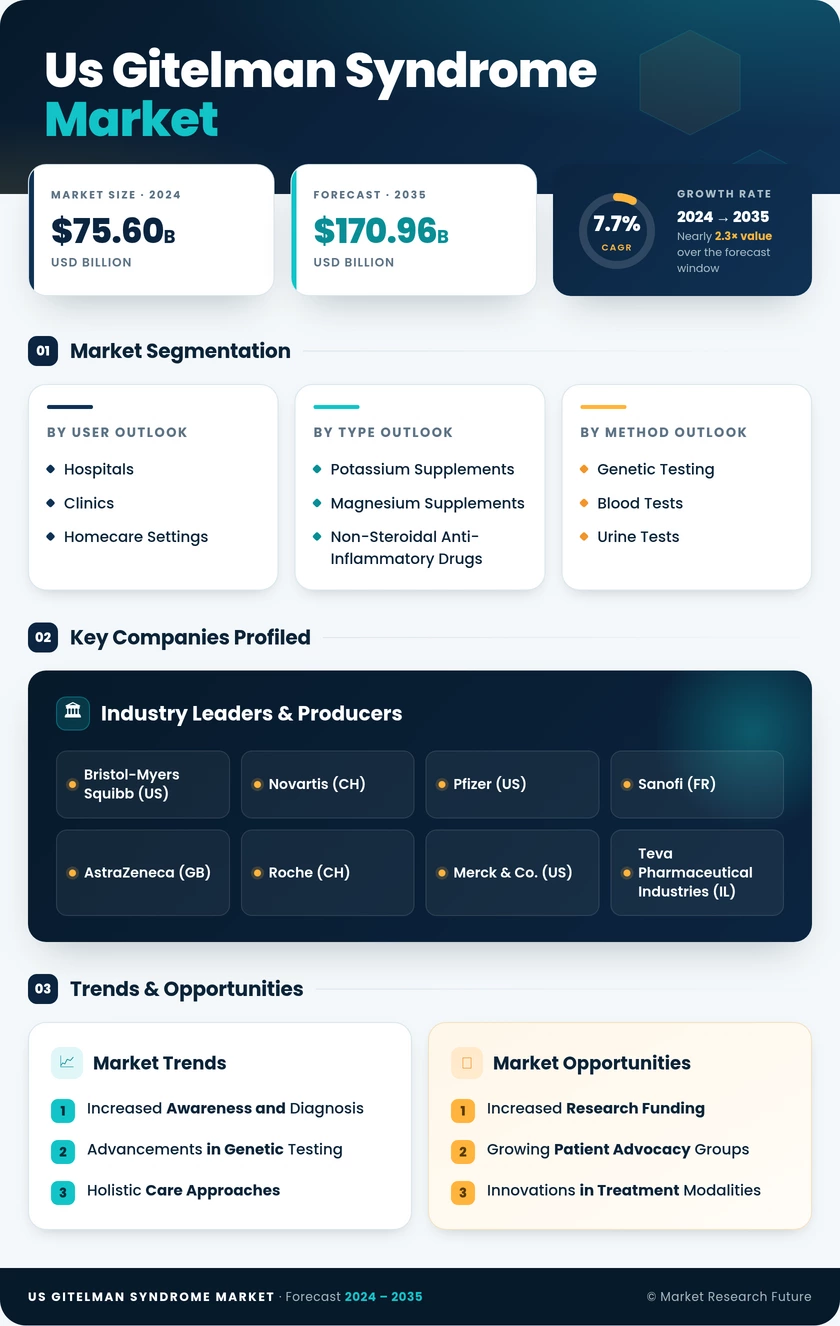
US Gitelman Syndrome Market Infographic
Purchase Options
  1. 1 SECTION I: EXECUTIVE SUMMARY AND KEY HIGHLIGHTS
  2.   1.1 EXECUTIVE SUMMARY
  3.     1.1.1 Market Overview
  4.     1.1.2 Key Findings
  5.     1.1.3 Market Segmentation
  6.     1.1.4 Competitive Landscape
  7.     1.1.5 Challenges and Opportunities
  8.     1.1.6 Future Outlook
  9. 2 SECTION II: SCOPING, METHODOLOGY AND MARKET STRUCTURE
  10.   2.1 MARKET INTRODUCTION
  11.     2.1.1 Definition
  12.     2.1.2 Scope of the study
  13.       2.1.2.1 Research Objective
  14.       2.1.2.2 Assumption
  15.       2.1.2.3 Limitations
  16.   2.2 RESEARCH METHODOLOGY
  17.     2.2.1 Overview
  18.     2.2.2 Data Mining
  19.     2.2.3 Secondary Research
  20.     2.2.4 Primary Research
  21.       2.2.4.1 Primary Interviews and Information Gathering Process
  22.       2.2.4.2 Breakdown of Primary Respondents
  23.     2.2.5 Forecasting Model
  24.     2.2.6 Market Size Estimation
  25.       2.2.6.1 Bottom-Up Approach
  26.       2.2.6.2 Top-Down Approach
  27.     2.2.7 Data Triangulation
  28.     2.2.8 Validation
  29. 3 SECTION III: QUALITATIVE ANALYSIS
  30.   3.1 MARKET DYNAMICS
  31.     3.1.1 Overview
  32.     3.1.2 Drivers
  33.     3.1.3 Restraints
  34.     3.1.4 Opportunities
  35.   3.2 MARKET FACTOR ANALYSIS
  36.     3.2.1 Value chain Analysis
  37.     3.2.2 Porter's Five Forces Analysis
  38.       3.2.2.1 Bargaining Power of Suppliers
  39.       3.2.2.2 Bargaining Power of Buyers
  40.       3.2.2.3 Threat of New Entrants
  41.       3.2.2.4 Threat of Substitutes
  42.       3.2.2.5 Intensity of Rivalry
  43.     3.2.3 COVID-19 Impact Analysis
  44.       3.2.3.1 Market Impact Analysis
  45.       3.2.3.2 Regional Impact
  46.       3.2.3.3 Opportunity and Threat Analysis
  47. 4 SECTION IV: QUANTITATIVE ANALYSIS
  48.   4.1 Chemicals and Materials, BY Disease Type (USD Million)
  49.     4.1.1 Classic Gitelman Syndrome
  50.     4.1.2 Atypical Gitelman Syndrome
  51.     4.1.3 Gitelman-like Syndrome
  52.   4.2 Chemicals and Materials, BY Diagnostic Method (USD Million)
  53.     4.2.1 Genetic Testing
  54.     4.2.2 Blood Tests
  55.     4.2.3 Urine Tests
  56.   4.3 Chemicals and Materials, BY Treatment Type (USD Million)
  57.     4.3.1 Potassium Supplements
  58.     4.3.2 Magnesium Supplements
  59.     4.3.3 Non-Steroidal Anti-Inflammatory Drugs
  60.   4.4 Chemicals and Materials, BY End User (USD Million)
  61.     4.4.1 Hospitals
  62.     4.4.2 Clinics
  63.     4.4.3 Homecare Settings
  64. 5 SECTION V: COMPETITIVE ANALYSIS
  65.   5.1 Competitive Landscape
  66.     5.1.1 Overview
  67.     5.1.2 Competitive Analysis
  68.     5.1.3 Market share Analysis
  69.     5.1.4 Major Growth Strategy in the Chemicals and Materials
  70.     5.1.5 Competitive Benchmarking
  71.     5.1.6 Leading Players in Terms of Number of Developments in the Chemicals and Materials
  72.     5.1.7 Key developments and growth strategies
  73.       5.1.7.1 New Product Launch/Service Deployment
  74.       5.1.7.2 Merger & Acquisitions
  75.       5.1.7.3 Joint Ventures
  76.     5.1.8 Major Players Financial Matrix
  77.       5.1.8.1 Sales and Operating Income
  78.       5.1.8.2 Major Players R&D Expenditure. 2023
  79.   5.2 Company Profiles
  80.     5.2.1 Bristol-Myers Squibb (US)
  81.       5.2.1.1 Financial Overview
  82.       5.2.1.2 Products Offered
  83.       5.2.1.3 Key Developments
  84.       5.2.1.4 SWOT Analysis
  85.       5.2.1.5 Key Strategies
  86.     5.2.2 Novartis (CH)
  87.       5.2.2.1 Financial Overview
  88.       5.2.2.2 Products Offered
  89.       5.2.2.3 Key Developments
  90.       5.2.2.4 SWOT Analysis
  91.       5.2.2.5 Key Strategies
  92.     5.2.3 Pfizer (US)
  93.       5.2.3.1 Financial Overview
  94.       5.2.3.2 Products Offered
  95.       5.2.3.3 Key Developments
  96.       5.2.3.4 SWOT Analysis
  97.       5.2.3.5 Key Strategies
  98.     5.2.4 Sanofi (FR)
  99.       5.2.4.1 Financial Overview
  100.       5.2.4.2 Products Offered
  101.       5.2.4.3 Key Developments
  102.       5.2.4.4 SWOT Analysis
  103.       5.2.4.5 Key Strategies
  104.     5.2.5 AstraZeneca (GB)
  105.       5.2.5.1 Financial Overview
  106.       5.2.5.2 Products Offered
  107.       5.2.5.3 Key Developments
  108.       5.2.5.4 SWOT Analysis
  109.       5.2.5.5 Key Strategies
  110.     5.2.6 Roche (CH)
  111.       5.2.6.1 Financial Overview
  112.       5.2.6.2 Products Offered
  113.       5.2.6.3 Key Developments
  114.       5.2.6.4 SWOT Analysis
  115.       5.2.6.5 Key Strategies
  116.     5.2.7 Merck & Co. (US)
  117.       5.2.7.1 Financial Overview
  118.       5.2.7.2 Products Offered
  119.       5.2.7.3 Key Developments
  120.       5.2.7.4 SWOT Analysis
  121.       5.2.7.5 Key Strategies
  122.     5.2.8 Teva Pharmaceutical Industries (IL)
  123.       5.2.8.1 Financial Overview
  124.       5.2.8.2 Products Offered
  125.       5.2.8.3 Key Developments
  126.       5.2.8.4 SWOT Analysis
  127.       5.2.8.5 Key Strategies
  128.   5.3 Appendix
  129.     5.3.1 References
  130.     5.3.2 Related Reports
  131. 6 LIST OF FIGURES
  132.   6.1 MARKET SYNOPSIS
  133.   6.2 US MARKET ANALYSIS BY DISEASE TYPE
  134.   6.3 US MARKET ANALYSIS BY DIAGNOSTIC METHOD
  135.   6.4 US MARKET ANALYSIS BY TREATMENT TYPE
  136.   6.5 US MARKET ANALYSIS BY END USER
  137.   6.6 KEY BUYING CRITERIA OF CHEMICALS AND MATERIALS
  138.   6.7 RESEARCH PROCESS OF MRFR
  139.   6.8 DRO ANALYSIS OF CHEMICALS AND MATERIALS
  140.   6.9 DRIVERS IMPACT ANALYSIS: CHEMICALS AND MATERIALS
  141.   6.10 RESTRAINTS IMPACT ANALYSIS: CHEMICALS AND MATERIALS
  142.   6.11 SUPPLY / VALUE CHAIN: CHEMICALS AND MATERIALS
  143.   6.12 CHEMICALS AND MATERIALS, BY DISEASE TYPE, 2024 (% SHARE)
  144.   6.13 CHEMICALS AND MATERIALS, BY DISEASE TYPE, 2024 TO 2035 (USD Million)
  145.   6.14 CHEMICALS AND MATERIALS, BY DIAGNOSTIC METHOD, 2024 (% SHARE)
  146.   6.15 CHEMICALS AND MATERIALS, BY DIAGNOSTIC METHOD, 2024 TO 2035 (USD Million)
  147.   6.16 CHEMICALS AND MATERIALS, BY TREATMENT TYPE, 2024 (% SHARE)
  148.   6.17 CHEMICALS AND MATERIALS, BY TREATMENT TYPE, 2024 TO 2035 (USD Million)
  149.   6.18 CHEMICALS AND MATERIALS, BY END USER, 2024 (% SHARE)
  150.   6.19 CHEMICALS AND MATERIALS, BY END USER, 2024 TO 2035 (USD Million)
  151.   6.20 BENCHMARKING OF MAJOR COMPETITORS
  152. 7 LIST OF TABLES
  153.   7.1 LIST OF ASSUMPTIONS
  154.     7.1.1
  155.   7.2 US MARKET SIZE ESTIMATES; FORECAST
  156.     7.2.1 BY DISEASE TYPE, 2025-2035 (USD Million)
  157.     7.2.2 BY DIAGNOSTIC METHOD, 2025-2035 (USD Million)
  158.     7.2.3 BY TREATMENT TYPE, 2025-2035 (USD Million)
  159.     7.2.4 BY END USER, 2025-2035 (USD Million)
  160.   7.3 PRODUCT LAUNCH/PRODUCT DEVELOPMENT/APPROVAL
  161.     7.3.1
  162.   7.4 ACQUISITION/PARTNERSHIP
  163.     7.4.1

US Chemicals and Materials Market Segmentation

Chemicals and Materials By Disease Type (USD Million, 2025-2035)

  • Classic Gitelman Syndrome
  • Atypical Gitelman Syndrome
  • Gitelman-like Syndrome

Chemicals and Materials By Diagnostic Method (USD Million, 2025-2035)

  • Genetic Testing
  • Blood Tests
  • Urine Tests

Chemicals and Materials By Treatment Type (USD Million, 2025-2035)

  • Potassium Supplements
  • Magnesium Supplements
  • Non-Steroidal Anti-Inflammatory Drugs

Chemicals and Materials By End User (USD Million, 2025-2035)

  • Hospitals
  • Clinics
  • Homecare Settings

Compare Licence

×
Features License Type
Single User Multiuser License Enterprise User
Price $4,950 $5,950 $7,250
Maximum User Access Limit 1 User Upto 10 Users Unrestricted Access Throughout the Organization
Free Customization
Direct Access to Analyst
Deliverable Format
Platform Access
Discount on Next Purchase 10% 15% 15%
Printable Versions