Request Free Sample ×

Kindly complete the form below to receive a free sample of this Report

* Please use a valid business email

Leading companies partner with us for data-driven Insights

clients tt-cursor
Hero Background
English
Chinese
French
Japanese
Korean
German
Spanish

US Geotextiles Market Trends

ID: MRFR/CnM/12409-HCR
128 Pages
Chitranshi Jaiswal
April 2026

US Geotextiles Market Research Report Information By Material (Synthetic and Natural), By Product (Non-Woven, Woven, and Knitted), and By Application (Road Construction, Erosion Control, Pavement Repair, Drainage, Railroad, Agriculture, and Others)–Market Forecast Till 2035

Share:
Download PDF ×

We do not share your information with anyone. However, we may send you emails based on your report interest from time to time. You may contact us at any time to opt-out.

US Geotextiles Market Infographic
Purchase Options

Market Trends

Key Emerging Trends in the US Geotextiles Market

The US Geotextiles Market is currently undergoing significant shifts, marked by various trends that reflect the evolving dynamics within the construction, environmental, and infrastructure sectors. One notable trend is the increasing emphasis on sustainable and eco-friendly geotextile solutions. With a growing awareness of environmental concerns, there is a rising demand for geotextiles that contribute to erosion control, soil stabilization, and environmental protection. This trend aligns with the broader movement toward sustainable construction practices, influencing the development and adoption of geotextiles with minimal environmental impact.

Additionally, the construction industry's robust growth is a major driver shaping the US Geotextiles Market. As infrastructure projects and civil engineering activities expand, there is a parallel increase in the demand for geotextiles for applications such as road construction, embankment reinforcement, and drainage systems. Geotextiles provide cost-effective solutions by enhancing the durability and performance of construction projects, thus becoming an integral component in modern civil engineering practices. The market trends indicate a positive correlation between the growth of the construction sector and the demand for geotextiles.

Technological advancements in geotextile materials and manufacturing processes are influencing market trends in the US. The development of high-performance geotextiles with enhanced strength, durability, and permeability characteristics is expanding the application scope. Innovations in material engineering, including the use of synthetic polymers and advanced weaving techniques, are contributing to the evolution of geotextiles that meet specific project requirements. This trend is driven by the industry's pursuit of improved geotechnical solutions that address the challenges posed by diverse environmental and construction conditions.

Furthermore, the increasing focus on infrastructure resilience and disaster mitigation is driving the adoption of geotextiles in geoenvironmental applications. Geotextiles play a crucial role in mitigating the impact of natural disasters, such as floods and landslides, by providing effective erosion control and reinforcement solutions. With climate change concerns on the rise, there is a growing recognition of the role geotextiles can play in building resilient infrastructure that can withstand environmental challenges.

E-commerce and digitalization are influencing the distribution and marketing strategies in the US Geotextiles Market. Online platforms have become important channels for geotextile manufacturers and distributors to reach a wider audience, providing detailed product information and facilitating easy procurement. The accessibility of geotextile products through online channels contributes to increased market awareness and ease of transactions, reflecting the changing landscape of business-to-business interactions in the industry.

Regulatory considerations and standards are also shaping the market trends in the US Geotextiles Market. Compliance with industry regulations and specifications, such as those set by organizations like the American Society for Testing and Materials (ASTM) and the International Organization for Standardization (ISO), is crucial for ensuring the quality and performance of geotextile products. Market players are investing in research and development to meet these standards while also addressing the specific needs of different applications within the geotextile sector.


Author
Author Profile
Chitranshi Jaiswal
Team Lead - Research

Chitranshi is a Team Leader in the Chemicals & Materials (CnM) and Energy & Power (EnP) domains, with 6+ years of experience in market research. She leads and mentors teams to deliver cross-domain projects that equip clients with actionable insights and growth strategies. She is skilled in market estimation, forecasting, competitive benchmarking, and both primary & secondary research, enabling her to turn complex data into decision-ready insights. An engineer and MBA professional, she combines technical expertise with strategic acumen to solve dynamic market challenges. Chitranshi has successfully managed projects that support market entry, investment planning, and competitive positioning, while building strong client relationships. Certified in Advanced Excel & Power BI she leverages data-driven approaches to ensure accuracy, clarity, and impactful outcomes.

Leave a Comment

FAQs

What is the current valuation of the US geotextiles market as of 2024?

<p>The US geotextiles market was valued at 1.18 USD Billion in 2024.</p>

What is the projected market size for the US geotextiles market by 2035?

<p>The market is projected to reach 2.45 USD Billion by 2035.</p>

What is the expected CAGR for the US geotextiles market during the forecast period 2025 - 2035?

<p>The expected CAGR for the US geotextiles market during 2025 - 2035 is 6.85%.</p>

Which application segments are driving the US geotextiles market?

<p>Key application segments include Erosion Control, Drainage, Separation, Reinforcement, and Filtration, with valuations ranging from 0.18 to 0.65 USD Billion.</p>

What are the leading material types in the US geotextiles market?

<p>Leading material types include Polypropylene, Polyester, Natural Fiber, Polyethylene, and Geosynthetic Clay, with valuations from 0.03 to 0.95 USD Billion.</p>

Which end-use sectors are contributing to the growth of the US geotextiles market?

<p>End-use sectors such as Road Construction, Landfill, Agriculture, Environmental Protection, and Coastal Engineering are contributing, with valuations from 0.03 to 0.95 USD Billion.</p>

What product types are prevalent in the US geotextiles market?

<p>Prevalent product types include Non-Woven Geotextiles, Woven Geotextiles, Knitted Geotextiles, Geocomposites, and Geogrids, with valuations from 0.03 to 0.95 USD Billion.</p>

Who are the key players in the US geotextiles market?

<p>Key players include Tensar International Corporation, Geosynthetics, Inc., GSE Environmental, Inc., Propex Global, and others.</p>

How does the US geotextiles market compare to other regions?

<p>While specific regional comparisons are not provided, the US market shows robust growth potential with a projected increase to 2.45 USD Billion by 2035.</p>

What factors are likely to influence the growth of the US geotextiles market?

<p>Factors such as increasing infrastructure development, environmental protection initiatives, and advancements in geotextile technology may influence market growth.</p>

What is the projected valuation for natural fibers in the US Geotextiles Market by 2035?

The natural fibers segment is expected to reach 0.85 billion USD by 2035.

Who are the key players in the US Geotextiles Market?

Major players include Berry Global, Armtec, Polyfelt, Nilex, and Geosynthetic Solutions among others.

What are the key applications driving growth in the US Geotextiles Market?

Key applications include erosion control, drainage, and road construction, which are vital for market expansion.

What challenges does the US Geotextiles Market currently face?

The market faces challenges such as fluctuating raw material prices and increasing competition.

How does the current global scenario impact the US Geotextiles Market?

The global scenario influences supply chains and pricing, potentially impacting market trends and consumer demand.

Market Summary

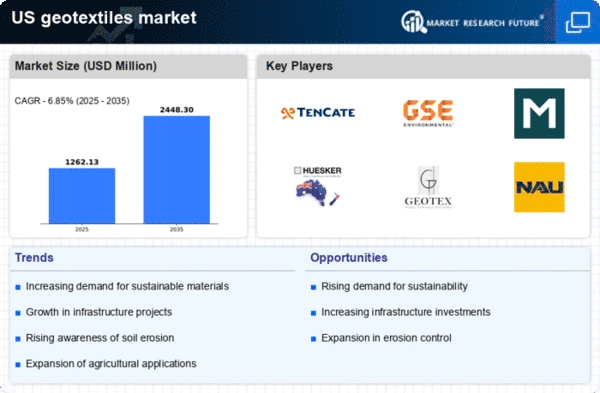
As per Market Research Future analysis, the US geotextiles market Size was estimated at 1181.22 USD Million in 2024. The US geotextiles market is projected to grow from 1262.13 USD Million in 2025 to 2448.3 USD Million by 2035, exhibiting a compound annual growth rate (CAGR) of 6.8% during the forecast period 2025 - 2035

Key Market Trends & Highlights

The US geotextiles market is poised for growth driven by sustainability and technological advancements.

  • Sustainable practices are increasingly driving demand for geotextiles across various sectors.
  • Technological advancements in material science are enhancing the performance and applications of geotextiles.
  • The agricultural segment is the largest, while the infrastructure segment is the fastest-growing in the US geotextiles market.
  • Infrastructure development initiatives and environmental concerns are key drivers propelling market expansion.

Market Size & Forecast

2024 Market Size 1181.22 (USD Million)
2035 Market Size 2448.3 (USD Million)
CAGR (2025 - 2035) 6.85%

Major Players

TenCate Geosynthetics (NL), GSE Environmental (US), Maccaferri (IT), Huesker (DE), Geotex (FR), NAUE (DE), Terrafix (CA), Propex (US), Fibertex (DK)

Market Trends

The geotextiles market is currently experiencing notable growth, driven by increasing demand across various sectors such as construction, agriculture, and environmental protection. The rising focus on sustainable practices and infrastructure development has led to a surge in the adoption of geotextiles, which are utilized for soil stabilization, erosion control, and drainage solutions. Furthermore, advancements in material technology are enhancing the performance and durability of geotextiles, making them more appealing to end-users. As a result, the market landscape is evolving, with manufacturers exploring innovative products to meet the diverse needs of their clientele. In addition, regulatory frameworks and government initiatives aimed at promoting sustainable construction practices are likely to bolster the geotextiles market. The emphasis on reducing environmental impact and improving resource efficiency aligns with the benefits offered by geotextiles, such as reduced soil erosion and improved water management. This alignment suggests a promising future for the market, as stakeholders increasingly recognize the value of integrating geotextiles into their projects. Overall, the geotextiles market appears poised for continued expansion, driven by technological advancements and a growing commitment to sustainability.

Sustainable Practices Drive Demand

The increasing emphasis on sustainability within construction and civil engineering sectors is propelling the geotextiles market. Stakeholders are increasingly recognizing the environmental benefits of using geotextiles, such as soil stabilization and erosion control, which contribute to more sustainable project outcomes.

Technological Advancements

Innovations in material science are enhancing the performance characteristics of geotextiles. New formulations and manufacturing techniques are leading to products that offer improved durability, strength, and functionality, thereby expanding their applications across various industries.

Regulatory Support

Government policies and regulations promoting environmentally friendly construction practices are likely to support the growth of the geotextiles market. Initiatives aimed at reducing environmental impact and improving resource management align well with the advantages provided by geotextiles.

US Geotextiles Market Market Drivers

Rising Demand for Infrastructure Development

The US Geotextiles Market is experiencing a notable surge in demand driven by extensive infrastructure development projects across the nation. With the government prioritizing the enhancement of transportation networks, water management systems, and urban development, the need for geotextiles has become increasingly pronounced. According to recent data, the US infrastructure investment is projected to reach approximately 1.5 trillion dollars over the next decade, which is likely to bolster the geotextiles sector significantly. Geotextiles play a crucial role in soil stabilization, erosion control, and drainage, making them indispensable in various construction applications. As urbanization continues to escalate, the US Geotextiles Market is poised to benefit from this upward trend, as stakeholders seek innovative solutions to meet the challenges posed by rapid development.

Increased Investment in Renewable Energy Projects

The US Geotextiles Market is poised for growth due to increased investment in renewable energy projects, particularly in wind and solar energy sectors. As the nation transitions towards sustainable energy sources, the demand for geotextiles in the construction of renewable energy infrastructure is likely to rise. Geotextiles are utilized in various applications within these projects, including site preparation, erosion control, and stabilization of soil in wind farm installations and solar fields. Recent projections suggest that investments in renewable energy infrastructure could exceed 500 billion dollars over the next decade, creating substantial opportunities for the US Geotextiles Market. This trend indicates a promising future for geotextiles as they become integral components in the development of sustainable energy solutions.

Technological Innovations in Geotextile Manufacturing

Technological advancements are playing a pivotal role in shaping the US Geotextiles Market. Innovations in manufacturing processes, such as the development of advanced polymer materials and improved production techniques, are enhancing the performance and durability of geotextiles. These innovations not only improve the functionality of geotextiles in applications like filtration, separation, and reinforcement but also contribute to cost-effectiveness. The integration of smart technologies, such as sensors and geospatial data analytics, is further revolutionizing the industry by enabling real-time monitoring and assessment of geotextile performance. As a result, the US Geotextiles Market is likely to witness increased adoption of high-performance geotextiles, driven by the need for efficient and sustainable solutions in construction and civil engineering projects.

Environmental Regulations and Sustainability Initiatives

The US Geotextiles Market is significantly influenced by stringent environmental regulations and a growing emphasis on sustainability. As federal and state governments implement policies aimed at reducing environmental impact, the demand for eco-friendly materials, including geotextiles, is likely to increase. The market is witnessing a shift towards biodegradable and recyclable geotextile products, which align with sustainability goals. Recent statistics indicate that the market for sustainable construction materials is expected to grow at a compound annual growth rate of over 10% in the coming years. This trend suggests that the US Geotextiles Market will continue to evolve, adapting to regulatory frameworks that favor environmentally responsible practices. Consequently, manufacturers are investing in research and development to create innovative geotextile solutions that meet these regulatory demands while also appealing to environmentally conscious consumers.

Growing Awareness of Soil Erosion and Environmental Protection

The US Geotextiles Market is benefiting from a heightened awareness of soil erosion and the need for environmental protection. As climate change and extreme weather events become more prevalent, the importance of effective erosion control measures is increasingly recognized. Geotextiles serve as a vital tool in mitigating soil erosion, enhancing water quality, and promoting sustainable land use practices. Recent studies indicate that the economic impact of soil erosion in the United States amounts to billions of dollars annually, underscoring the necessity for effective solutions. This awareness is driving demand for geotextiles in various applications, including road construction, landscaping, and agricultural practices. Consequently, the US Geotextiles Market is likely to expand as stakeholders seek to implement effective erosion control strategies that align with environmental conservation efforts.

Market Segment Insights

By Application: Erosion Control (Largest) vs. Drainage (Fastest-Growing)

<p>In the US <a href="https://www.marketresearchfuture.com/reports/geotextiles-market-8344" target="_blank" title="geotextiles">geotextiles</a> market, the application segment is characterized by a diverse range of uses, namely erosion control, drainage, separation, reinforcement, and filtration. Among these, erosion control stands out as the largest segment, accounting for a significant share of the overall market. Meanwhile, drainage is noted as the fastest-growing segment, reflecting increasing investments in infrastructure and stormwater management practices that utilize geotextiles for efficient water management solutions.</p>

<p>Erosion Control: Dominant vs. Drainage: Emerging</p>

<p>Erosion control geotextiles play a critical role in preventing soil loss and degradation, especially in areas susceptible to heavy rainfall and construction activities. This segment is highly established, backed by extensive applications in agriculture, landscaping, and civil engineering projects. Conversely, the drainage segment is emerging rapidly due to heightened awareness of sustainable water management solutions. The growing infrastructure development and urbanization have led to a heightened demand for drainage geotextiles, which effectively manage subsurface water, ensuring the longevity of structures and pavement. Together, these segments highlight a dynamic interplay between established practices and innovative approaches within the US geotextiles market.</p>

By Material Type: Polypropylene (Largest) vs. Polyester (Fastest-Growing)

<p>In the US geotextiles market, the material type segment exhibits a competitive landscape characterized by various materials, with polypropylene leading in market share due to its high durability and versatility. Polyester follows as a strong contender, known for its resistance to environmental factors, while <a href="https://www.marketresearchfuture.com/reports/natural-fiber-market-28972" target="_blank" title="natural fiber">natural fibers</a>, polyethylene, and geosynthetic clay are carving niches within specific applications. This distribution reflects the diverse preferences in the industry, driven by project requirements and environmental considerations. Looking towards growth trends, the adoption of geotextiles made from polypropylene is bolstered by rising infrastructure development and erosion control projects across the US. Polyester is gaining traction as the fastest-growing segment, propelled by innovations that enhance its environmental compatibility and performance in civil engineering. Meanwhile, natural fiber geotextiles are emerging, driven by a surge in demand for sustainable materials, presenting opportunities for growth in eco-conscious sectors of the market.</p>

<p>Polypropylene (Dominant) vs. Natural Fiber (Emerging)</p>

<p>Polypropylene geotextiles dominate the US market due to their exceptional strength, chemical resistance, and versatility in applications ranging from construction to environmental protection. Their cost-effectiveness makes them a preferred choice for many contractors and engineers. On the other hand, natural fiber geotextiles, while still emerging in the market, offer sustainability advantages that appeal to environmentally conscious consumers and industries. Comprising materials such as jute and coir, they provide biodegradable options for erosion control and landscaping projects, aligning with the growing trend towards green building practices. This shift towards sustainability positions natural fibers as a significant emerging segment, especially in applications where environmental impact is a primary concern.</p>

By End Use: Road Construction (Largest) vs. Agriculture (Fastest-Growing)

<p>In the US geotextiles market, the distribution of market share among various end-use applications is significant. Road construction stands as the largest sector, largely attributed to the increasing investments in infrastructure development. Moreover, agriculture, though smaller in share, shows a robust growth trajectory as the demand for sustainable farming practices rises, driving the use of geotextiles in erosion control and soil stabilization.</p>

<p>Agriculture: Road Construction (Dominant) vs. Agriculture (Emerging)</p>

<p>Road construction and agriculture represent two pivotal applications in the US geotextiles market. Road construction dominates due to crucial infrastructure projects, emphasizing durability and performance capabilities of geotextiles to withstand various environmental conditions. In contrast, agriculture is emerging as a significant segment, driven by the rising focus on sustainable agricultural practices. This sector employs geotextiles for enhancing soil quality and crop yields, tapping into the growing trend of environmentally friendly farming. Both segments reflect a distinct approach towards utilizing geotextiles, with road construction focusing on long-term durability while agriculture emphasizes sustainability and restorative practices.</p>

By Product Type: Non-Woven Geotextiles (Largest) vs. Woven Geotextiles (Fastest-Growing)

<p>In the US geotextiles market, the product type segment is characterized by a diverse range of materials catering to various applications. Currently, non-woven geotextiles hold a significant market share due to their versatility in drainage and filtration applications. Woven geotextiles, while smaller in market size, are rapidly gaining traction, thanks to their strength and durability in construction-related projects. As the demand for effective soil stabilization solutions rises, the distribution of market shares continues to evolve, showcasing the potential of various product types in meeting specific industry needs.</p>

<p>Non-Woven Geotextiles (Dominant) vs. Woven Geotextiles (Emerging)</p>

<p>Non-woven geotextiles have established themselves as the dominant segment within the US geotextiles market, primarily due to their extensive application across different sectors such as landscaping, highways, and erosion control. Their unique manufacturing process allows for high permeability and excellent drainage properties, making them ideal for civil engineering applications. In contrast, woven geotextiles are emerging as a strong competitor, particularly in areas requiring high tensile strength. They are increasingly utilized in road and slope construction projects, showcasing their capabilities in load-bearing applications, thus attracting attention due to their performance in heavy-duty conditions.</p>

Get more detailed insights about US Geotextiles Market Research Report - Forecast by 2035

Regional Insights

North America : Leading Geotextiles Market

The North American geotextiles market is driven by increasing infrastructure projects, environmental regulations, and a growing emphasis on sustainable construction practices. The U.S. holds the largest market share at approximately 70%, followed by Canada at around 15%. Regulatory catalysts, such as the Clean Water Act, promote the use of geotextiles in erosion control and stormwater management, further boosting demand. The competitive landscape is characterized by key players like Tensar International Corporation, GSE Environmental, and Propex Global, which dominate the market. These companies are focusing on innovation and sustainability to meet the rising demand. The presence of established manufacturers and a robust distribution network enhances market accessibility, ensuring a steady supply of geotextiles across various applications.

Europe : Emerging Geotextiles Hub

Europe's geotextiles market is experiencing significant growth due to stringent environmental regulations and a shift towards sustainable construction practices. The region is characterized by a strong focus on recycling and waste management, with Germany and France being the largest markets, holding approximately 30% and 25% market shares, respectively. The European Union's Green Deal aims to promote eco-friendly materials, further driving demand for geotextiles. Leading countries in this region include Germany, France, and the UK, with a competitive landscape featuring companies like Huesker and TenCate Geosynthetics. These firms are investing in R&D to develop innovative products that meet regulatory standards. The presence of a well-established supply chain and increasing public-private partnerships in infrastructure projects are also contributing to market growth.

Asia-Pacific : Rapidly Growing Market

The Asia-Pacific geotextiles market is witnessing rapid growth, driven by extensive infrastructure development and urbanization. Countries like China and India are leading the market, accounting for approximately 40% and 20% of the regional share, respectively. Government initiatives aimed at improving transportation and water management systems are significant demand drivers, alongside increasing awareness of environmental sustainability. The competitive landscape features key players such as Solmax International and Maccaferri, which are expanding their operations in the region. The presence of a large number of local manufacturers also intensifies competition. As infrastructure projects continue to rise, the demand for geotextiles is expected to grow, supported by favorable government policies and investments in construction.

Middle East and Africa : Emerging Market Potential

The Middle East and Africa geotextiles market is emerging, driven by increasing investments in infrastructure and construction projects. Countries like the UAE and South Africa are leading the market, holding approximately 30% and 20% shares, respectively. The region's focus on sustainable development and environmental protection is catalyzing the adoption of geotextiles in various applications, including road construction and erosion control. The competitive landscape is characterized by a mix of local and international players, with companies like Terrafix Geosynthetics and GSE Environmental making significant inroads. The presence of government initiatives aimed at enhancing infrastructure and environmental sustainability is expected to further boost market growth. As the region continues to develop, the demand for geotextiles is anticipated to rise significantly.

Key Players and Competitive Insights

The geotextiles market exhibits a dynamic competitive landscape characterized by a blend of innovation, strategic partnerships, and regional expansion. Key players such as TenCate Geosynthetics (NL), GSE Environmental (US), and Maccaferri (IT) are actively shaping the market through their distinct operational focuses. TenCate Geosynthetics (NL) emphasizes innovation in product development, particularly in sustainable materials, which aligns with the growing demand for eco-friendly solutions. GSE Environmental (US) has adopted a strategy centered on regional expansion, enhancing its presence in North America to capitalize on infrastructure projects. Maccaferri (IT) focuses on strategic partnerships, collaborating with local firms to enhance its market reach and operational efficiency. Collectively, these strategies contribute to a competitive environment that is increasingly driven by sustainability and technological advancement.In terms of business tactics, companies are localizing manufacturing to reduce lead times and optimize supply chains. The market structure appears moderately fragmented, with several players vying for market share while also collaborating on projects. This fragmentation allows for a diverse range of products and solutions, catering to various applications in civil engineering, environmental protection, and construction.

In October GSE Environmental (US) announced a significant investment in a new manufacturing facility in Texas, aimed at increasing production capacity for geotextiles. This move is strategically important as it not only enhances GSE's ability to meet rising demand but also positions the company closer to key markets in the southern US, potentially reducing transportation costs and improving service delivery.

In September Maccaferri (IT) launched a new line of biodegradable geotextiles, reflecting a commitment to sustainability. This product innovation is likely to attract environmentally conscious clients and aligns with global trends towards sustainable construction practices. By diversifying its product offerings, Maccaferri strengthens its competitive position in a market increasingly focused on eco-friendly solutions.

In August TenCate Geosynthetics (NL) entered into a strategic partnership with a leading technology firm to integrate AI into its manufacturing processes. This collaboration aims to enhance operational efficiency and product quality, indicating a shift towards digital transformation in the industry. The integration of AI could potentially streamline production and reduce costs, providing TenCate with a competitive edge in a rapidly evolving market.

As of November current trends in the geotextiles market are heavily influenced by digitalization, sustainability, and the integration of advanced technologies. Strategic alliances are becoming increasingly vital, enabling companies to leverage shared resources and expertise. Looking ahead, competitive differentiation is likely to evolve from traditional price-based competition to a focus on innovation, technology integration, and supply chain reliability. This shift suggests that companies prioritizing sustainable practices and technological advancements will be better positioned to thrive in the future.

Key Companies in the US Geotextiles Market include

Industry Developments

March 2022: BontexGeo Group acquired Geotexan S.A. The acquired company specializes in the production and sale of geosynthetics and fibers. This acquisition helped the company secure a strong position in the market.

Future Outlook

US Geotextiles Market Future Outlook

The geotextiles market is projected to grow at a 6.85% CAGR from 2025 to 2035, driven by infrastructure development, environmental regulations, and technological advancements.

New opportunities lie in:

  • Development of biodegradable geotextiles for eco-friendly projects.
  • Expansion into emerging markets with tailored product offerings.
  • Investment in R&D for innovative geotextile applications in construction.

By 2035, the geotextiles market is expected to achieve robust growth and increased market penetration.

Market Segmentation

US Geotextiles Market End-Use Outlook

  • Transportation
  • Environment
  • Energy & Water Resources
  • Building Site Infrastructure
  • Agriculture
  • Others

US Geotextiles Market Material Outlook

  • Synthetic Fibers
  • Natural Fibers

US Geotextiles Market Product Type Outlook

  • Non-Woven
  • Woven
  • Knitted
  • Others

Report Scope

MARKET SIZE 2024 1181.22(USD Million)
MARKET SIZE 2025 1262.13(USD Million)
MARKET SIZE 2035 2448.3(USD Million)
COMPOUND ANNUAL GROWTH RATE (CAGR) 6.85% (2025 - 2035)
REPORT COVERAGE Revenue Forecast, Competitive Landscape, Growth Factors, and Trends
BASE YEAR 2024
Market Forecast Period 2025 - 2035
Historical Data 2019 - 2024
Market Forecast Units USD Million
Key Companies Profiled TenCate Geosynthetics (NL), GSE Environmental (US), Maccaferri (IT), Huesker (DE), Geotex (FR), NAUE (DE), Terrafix (CA), Propex (US), Fibertex (DK)
Segments Covered Material, Product Type, End-Use
Key Market Opportunities Growing demand for sustainable construction materials drives innovation in the geotextiles market.
Key Market Dynamics Rising demand for sustainable construction materials drives innovation and competition in the geotextiles market.
Countries Covered US

FAQs

What is the current valuation of the US geotextiles market as of 2024?

<p>The US geotextiles market was valued at 1.18 USD Billion in 2024.</p>

What is the projected market size for the US geotextiles market by 2035?

<p>The market is projected to reach 2.45 USD Billion by 2035.</p>

What is the expected CAGR for the US geotextiles market during the forecast period 2025 - 2035?

<p>The expected CAGR for the US geotextiles market during 2025 - 2035 is 6.85%.</p>

Which application segments are driving the US geotextiles market?

<p>Key application segments include Erosion Control, Drainage, Separation, Reinforcement, and Filtration, with valuations ranging from 0.18 to 0.65 USD Billion.</p>

What are the leading material types in the US geotextiles market?

<p>Leading material types include Polypropylene, Polyester, Natural Fiber, Polyethylene, and Geosynthetic Clay, with valuations from 0.03 to 0.95 USD Billion.</p>

Which end-use sectors are contributing to the growth of the US geotextiles market?

<p>End-use sectors such as Road Construction, Landfill, Agriculture, Environmental Protection, and Coastal Engineering are contributing, with valuations from 0.03 to 0.95 USD Billion.</p>

What product types are prevalent in the US geotextiles market?

<p>Prevalent product types include Non-Woven Geotextiles, Woven Geotextiles, Knitted Geotextiles, Geocomposites, and Geogrids, with valuations from 0.03 to 0.95 USD Billion.</p>

Who are the key players in the US geotextiles market?

<p>Key players include Tensar International Corporation, Geosynthetics, Inc., GSE Environmental, Inc., Propex Global, and others.</p>

How does the US geotextiles market compare to other regions?

<p>While specific regional comparisons are not provided, the US market shows robust growth potential with a projected increase to 2.45 USD Billion by 2035.</p>

What factors are likely to influence the growth of the US geotextiles market?

<p>Factors such as increasing infrastructure development, environmental protection initiatives, and advancements in geotextile technology may influence market growth.</p>

What is the projected valuation for natural fibers in the US Geotextiles Market by 2035?

The natural fibers segment is expected to reach 0.85 billion USD by 2035.

Who are the key players in the US Geotextiles Market?

Major players include Berry Global, Armtec, Polyfelt, Nilex, and Geosynthetic Solutions among others.

What are the key applications driving growth in the US Geotextiles Market?

Key applications include erosion control, drainage, and road construction, which are vital for market expansion.

What challenges does the US Geotextiles Market currently face?

The market faces challenges such as fluctuating raw material prices and increasing competition.

How does the current global scenario impact the US Geotextiles Market?

The global scenario influences supply chains and pricing, potentially impacting market trends and consumer demand.

  1. SECTION I: EXECUTIVE SUMMARY AND KEY HIGHLIGHTS
    1. | 1.1 EXECUTIVE SUMMARY
    2. | | 1.1.1 Market Overview
    3. | | 1.1.2 Key Findings
    4. | | 1.1.3 Market Segmentation
    5. | | 1.1.4 Competitive Landscape
    6. | | 1.1.5 Challenges and Opportunities
    7. | | 1.1.6 Future Outlook
  2. SECTION II: SCOPING, METHODOLOGY AND MARKET STRUCTURE
    1. | 2.1 MARKET INTRODUCTION
    2. | | 2.1.1 Definition
    3. | | 2.1.2 Scope of the study
    4. | | | 2.1.2.1 Research Objective
    5. | | | 2.1.2.2 Assumption
    6. | | | 2.1.2.3 Limitations
    7. | 2.2 RESEARCH METHODOLOGY
    8. | | 2.2.1 Overview
    9. | | 2.2.2 Data Mining
    10. | | 2.2.3 Secondary Research
    11. | | 2.2.4 Primary Research
    12. | | | 2.2.4.1 Primary Interviews and Information Gathering Process
    13. | | | 2.2.4.2 Breakdown of Primary Respondents
    14. | | 2.2.5 Forecasting Model
    15. | | 2.2.6 Market Size Estimation
    16. | | | 2.2.6.1 Bottom-Up Approach
    17. | | | 2.2.6.2 Top-Down Approach
    18. | | 2.2.7 Data Triangulation
    19. | | 2.2.8 Validation
  3. SECTION III: QUALITATIVE ANALYSIS
    1. | 3.1 MARKET DYNAMICS
    2. | | 3.1.1 Overview
    3. | | 3.1.2 Drivers
    4. | | 3.1.3 Restraints
    5. | | 3.1.4 Opportunities
    6. | 3.2 MARKET FACTOR ANALYSIS
    7. | | 3.2.1 Value chain Analysis
    8. | | 3.2.2 Porter's Five Forces Analysis
    9. | | | 3.2.2.1 Bargaining Power of Suppliers
    10. | | | 3.2.2.2 Bargaining Power of Buyers
    11. | | | 3.2.2.3 Threat of New Entrants
    12. | | | 3.2.2.4 Threat of Substitutes
    13. | | | 3.2.2.5 Intensity of Rivalry
    14. | | 3.2.3 COVID-19 Impact Analysis
    15. | | | 3.2.3.1 Market Impact Analysis
    16. | | | 3.2.3.2 Regional Impact
    17. | | | 3.2.3.3 Opportunity and Threat Analysis
  4. SECTION IV: QUANTITATIVE ANALYSIS
    1. | 4.1 Chemicals and Materials, BY Application (USD Billion)
    2. | | 4.1.1 Erosion Control
    3. | | 4.1.2 Drainage
    4. | | 4.1.3 Separation
    5. | | 4.1.4 Reinforcement
    6. | | 4.1.5 Filtration
    7. | 4.2 Chemicals and Materials, BY Material Type (USD Billion)
    8. | | 4.2.1 Polypropylene
    9. | | 4.2.2 Polyester
    10. | | 4.2.3 Natural Fiber
    11. | | 4.2.4 Polyethylene
    12. | | 4.2.5 Geosynthetic Clay
    13. | 4.3 Chemicals and Materials, BY End Use (USD Billion)
    14. | | 4.3.1 Road Construction
    15. | | 4.3.2 Landfill
    16. | | 4.3.3 Agriculture
    17. | | 4.3.4 Environmental Protection
    18. | | 4.3.5 Coastal Engineering
    19. | 4.4 Chemicals and Materials, BY Product Type (USD Billion)
    20. | | 4.4.1 Non-Woven Geotextiles
    21. | | 4.4.2 Woven Geotextiles
    22. | | 4.4.3 Knitted Geotextiles
    23. | | 4.4.4 Geocomposites
    24. | | 4.4.5 Geogrids
  5. SECTION V: COMPETITIVE ANALYSIS
    1. | 5.1 Competitive Landscape
    2. | | 5.1.1 Overview
    3. | | 5.1.2 Competitive Analysis
    4. | | 5.1.3 Market share Analysis
    5. | | 5.1.4 Major Growth Strategy in the Chemicals and Materials
    6. | | 5.1.5 Competitive Benchmarking
    7. | | 5.1.6 Leading Players in Terms of Number of Developments in the Chemicals and Materials
    8. | | 5.1.7 Key developments and growth strategies
    9. | | | 5.1.7.1 New Product Launch/Service Deployment
    10. | | | 5.1.7.2 Merger & Acquisitions
    11. | | | 5.1.7.3 Joint Ventures
    12. | | 5.1.8 Major Players Financial Matrix
    13. | | | 5.1.8.1 Sales and Operating Income
    14. | | | 5.1.8.2 Major Players R&D Expenditure. 2023
    15. | 5.2 Company Profiles
    16. | | 5.2.1 Tensar International Corporation (US)
    17. | | | 5.2.1.1 Financial Overview
    18. | | | 5.2.1.2 Products Offered
    19. | | | 5.2.1.3 Key Developments
    20. | | | 5.2.1.4 SWOT Analysis
    21. | | | 5.2.1.5 Key Strategies
    22. | | 5.2.2 Geosynthetics, Inc. (US)
    23. | | | 5.2.2.1 Financial Overview
    24. | | | 5.2.2.2 Products Offered
    25. | | | 5.2.2.3 Key Developments
    26. | | | 5.2.2.4 SWOT Analysis
    27. | | | 5.2.2.5 Key Strategies
    28. | | 5.2.3 GSE Environmental, Inc. (US)
    29. | | | 5.2.3.1 Financial Overview
    30. | | | 5.2.3.2 Products Offered
    31. | | | 5.2.3.3 Key Developments
    32. | | | 5.2.3.4 SWOT Analysis
    33. | | | 5.2.3.5 Key Strategies
    34. | | 5.2.4 Propex Global (US)
    35. | | | 5.2.4.1 Financial Overview
    36. | | | 5.2.4.2 Products Offered
    37. | | | 5.2.4.3 Key Developments
    38. | | | 5.2.4.4 SWOT Analysis
    39. | | | 5.2.4.5 Key Strategies
    40. | | 5.2.5 Huesker Inc. (US)
    41. | | | 5.2.5.1 Financial Overview
    42. | | | 5.2.5.2 Products Offered
    43. | | | 5.2.5.3 Key Developments
    44. | | | 5.2.5.4 SWOT Analysis
    45. | | | 5.2.5.5 Key Strategies
    46. | | 5.2.6 Maccaferri, Inc. (US)
    47. | | | 5.2.6.1 Financial Overview
    48. | | | 5.2.6.2 Products Offered
    49. | | | 5.2.6.3 Key Developments
    50. | | | 5.2.6.4 SWOT Analysis
    51. | | | 5.2.6.5 Key Strategies
    52. | | 5.2.7 Terrafix Geosynthetics Inc. (US)
    53. | | | 5.2.7.1 Financial Overview
    54. | | | 5.2.7.2 Products Offered
    55. | | | 5.2.7.3 Key Developments
    56. | | | 5.2.7.4 SWOT Analysis
    57. | | | 5.2.7.5 Key Strategies
    58. | | 5.2.8 Solmax International Inc. (US)
    59. | | | 5.2.8.1 Financial Overview
    60. | | | 5.2.8.2 Products Offered
    61. | | | 5.2.8.3 Key Developments
    62. | | | 5.2.8.4 SWOT Analysis
    63. | | | 5.2.8.5 Key Strategies
    64. | | 5.2.9 Layfield Group (US)
    65. | | | 5.2.9.1 Financial Overview
    66. | | | 5.2.9.2 Products Offered
    67. | | | 5.2.9.3 Key Developments
    68. | | | 5.2.9.4 SWOT Analysis
    69. | | | 5.2.9.5 Key Strategies
    70. | 5.3 Appendix
    71. | | 5.3.1 References
    72. | | 5.3.2 Related Reports
  6. LIST OF FIGURES
    1. | 6.1 MARKET SYNOPSIS
    2. | 6.2 US MARKET ANALYSIS BY APPLICATION
    3. | 6.3 US MARKET ANALYSIS BY MATERIAL TYPE
    4. | 6.4 US MARKET ANALYSIS BY END USE
    5. | 6.5 US MARKET ANALYSIS BY PRODUCT TYPE
    6. | 6.6 KEY BUYING CRITERIA OF CHEMICALS AND MATERIALS
    7. | 6.7 RESEARCH PROCESS OF MRFR
    8. | 6.8 DRO ANALYSIS OF CHEMICALS AND MATERIALS
    9. | 6.9 DRIVERS IMPACT ANALYSIS: CHEMICALS AND MATERIALS
    10. | 6.10 RESTRAINTS IMPACT ANALYSIS: CHEMICALS AND MATERIALS
    11. | 6.11 SUPPLY / VALUE CHAIN: CHEMICALS AND MATERIALS
    12. | 6.12 CHEMICALS AND MATERIALS, BY APPLICATION, 2024 (% SHARE)
    13. | 6.13 CHEMICALS AND MATERIALS, BY APPLICATION, 2024 TO 2035 (USD Billion)
    14. | 6.14 CHEMICALS AND MATERIALS, BY MATERIAL TYPE, 2024 (% SHARE)
    15. | 6.15 CHEMICALS AND MATERIALS, BY MATERIAL TYPE, 2024 TO 2035 (USD Billion)
    16. | 6.16 CHEMICALS AND MATERIALS, BY END USE, 2024 (% SHARE)
    17. | 6.17 CHEMICALS AND MATERIALS, BY END USE, 2024 TO 2035 (USD Billion)
    18. | 6.18 CHEMICALS AND MATERIALS, BY PRODUCT TYPE, 2024 (% SHARE)
    19. | 6.19 CHEMICALS AND MATERIALS, BY PRODUCT TYPE, 2024 TO 2035 (USD Billion)
    20. | 6.20 BENCHMARKING OF MAJOR COMPETITORS
  7. LIST OF TABLES
    1. | 7.1 LIST OF ASSUMPTIONS
    2. | | 7.1.1
    3. | 7.2 US MARKET SIZE ESTIMATES; FORECAST
    4. | | 7.2.1 BY APPLICATION, 2025-2035 (USD Billion)
    5. | | 7.2.2 BY MATERIAL TYPE, 2025-2035 (USD Billion)
    6. | | 7.2.3 BY END USE, 2025-2035 (USD Billion)
    7. | | 7.2.4 BY PRODUCT TYPE, 2025-2035 (USD Billion)
    8. | 7.3 PRODUCT LAUNCH/PRODUCT DEVELOPMENT/APPROVAL
    9. | | 7.3.1
    10. | 7.4 ACQUISITION/PARTNERSHIP
    11. | | 7.4.1

US Chemicals and Materials Market Segmentation

Chemicals and Materials By Application (USD Billion, 2025-2035)

  • Erosion Control
  • Drainage
  • Separation
  • Reinforcement
  • Filtration

Chemicals and Materials By Material Type (USD Billion, 2025-2035)

  • Polypropylene
  • Polyester
  • Natural Fiber
  • Polyethylene
  • Geosynthetic Clay

Chemicals and Materials By End Use (USD Billion, 2025-2035)

  • Road Construction
  • Landfill
  • Agriculture
  • Environmental Protection
  • Coastal Engineering

Chemicals and Materials By Product Type (USD Billion, 2025-2035)

  • Non-Woven Geotextiles
  • Woven Geotextiles
  • Knitted Geotextiles
  • Geocomposites
  • Geogrids
Infographic

Free Sample Request

Kindly complete the form below to receive a free sample of this Report

Get Free Sample

Customer Strories

Compare Licence

×
Features License Type
Single User Multiuser License Enterprise User
Price $4,950 $5,950 $7,250
Maximum User Access Limit 1 User Upto 10 Users Unrestricted Access Throughout the Organization
Free Customization
Direct Access to Analyst
Deliverable Format
Platform Access
Discount on Next Purchase 10% 15% 15%
Printable Versions