×
Request Free Sample ×

Kindly complete the form below to receive a free sample of this Report

* Please use a valid business email

Leading companies partner with us for data-driven Insights

clients tt-cursor
Hero Background

US Automotive Occupant Sensing System Market

ID: MRFR/AT/12123-HCR
100 Pages
Sejal Akre
February 2026

US Automotive Occupant Sensing System Market Research Report By Vehicle Type (Passenger Vehicle, Light Commercial Vehicle, Heavy Commercial Vehicle) and By Channel (Original Equipment Manufacturer, After Market) - Forecast to 2035

Share:
Download PDF ×

We do not share your information with anyone. However, we may send you emails based on your report interest from time to time. You may contact us at any time to opt-out.

US Automotive Occupant Sensing System Market Infographic
Purchase Options

US Automotive Occupant Sensing System Market Summary

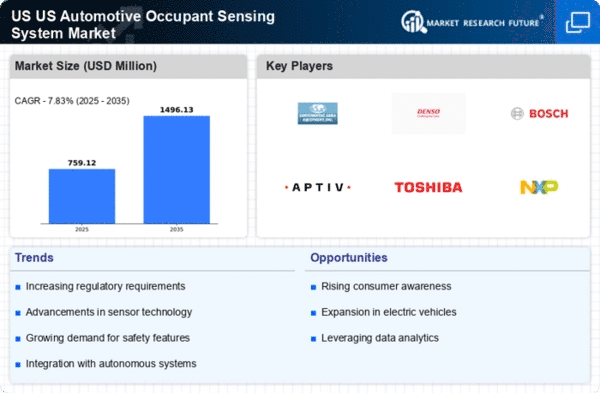
As per analysis, the US Automotive Occupant Sensing System Market is projected to grow from USD 704.0 Million in 2024 to USD 1496.13 Million by 2035, exhibiting a compound annual growth rate (CAGR) of 7.09% during the forecast period (2025 - 2035).

Key Market Trends & Highlights

The US Automotive Occupant Sensing System Market is poised for growth driven by technological advancements and increasing safety demands.

  • Technological advancements in sensing systems are reshaping the landscape of the automotive occupant sensing market.
  • Passenger vehicles represent the largest segment, while commercial vehicles are emerging as the fastest-growing segment.
  • Ultrasonic sensors dominate the market, whereas capacitive sensors are gaining traction rapidly.
  • Key market drivers include the integration of advanced driver assistance systems and rising awareness of child safety in vehicles.

Market Size & Forecast

2024 Market Size 704.0 (USD Million)
2035 Market Size 1496.13 (USD Million)
CAGR (2025 - 2035) 7.09%

Major Players

TRW Automotive (US), Continental AG (DE), Denso Corporation (JP), Aptiv PLC (IE), Bosch (DE), Toshiba Corporation (JP), NXP Semiconductors (NL), Sensata Technologies (US), Valeo (FR)

Our Impact
Enabled $4.3B Revenue Impact for Fortune 500 and Leading Multinationals
Partnering with 2000+ Global Organizations Each Year
30K+ Citations by Top-Tier Firms in the Industry

US Automotive Occupant Sensing System Market Trends

The US Automotive Occupant Sensing System Market is currently experiencing a notable evolution, driven by advancements in technology and increasing safety regulations. These systems, which are designed to detect the presence and position of occupants in vehicles, play a crucial role in enhancing airbag deployment strategies and overall vehicle safety. As manufacturers strive to meet stringent safety standards set forth by regulatory bodies, the integration of sophisticated sensors and algorithms becomes paramount. This trend not only improves passenger safety but also aligns with the growing consumer demand for enhanced vehicle features that prioritize protection and comfort. Moreover, the market appears to be influenced by the rising awareness of the importance of occupant safety among consumers. As more individuals recognize the potential risks associated with inadequate sensing systems, there is a shift towards vehicles equipped with advanced occupant detection technologies. This shift is further supported by ongoing research and development efforts aimed at refining these systems, ensuring they are capable of accurately identifying various occupant conditions. Consequently, the US Automotive Occupant Sensing System Market is poised for continued growth, as both manufacturers and consumers increasingly prioritize safety and innovation in automotive design.

Technological Advancements in Sensing Systems

The US Automotive Occupant Sensing System Market is witnessing rapid technological advancements, particularly in sensor technology. Innovations such as pressure sensors, infrared sensors, and weight sensors are being integrated into vehicles to enhance occupant detection accuracy. These advancements not only improve safety but also contribute to the development of more sophisticated airbag deployment strategies.

Regulatory Compliance and Safety Standards

The market is significantly influenced by stringent regulatory compliance and safety standards established by US authorities. These regulations mandate the inclusion of advanced occupant sensing systems in new vehicles, compelling manufacturers to invest in research and development. This trend ensures that vehicles meet safety benchmarks, thereby enhancing consumer trust and market growth.

Consumer Demand for Enhanced Safety Features

There is a growing consumer demand for vehicles equipped with advanced safety features, including occupant sensing systems. As awareness of vehicle safety increases, consumers are more inclined to choose models that offer superior occupant protection. This trend is driving manufacturers to prioritize the integration of advanced sensing technologies in their vehicle designs.

US Automotive Occupant Sensing System Market Drivers

Regulatory Compliance and Safety Standards

The US Automotive Occupant Sensing System Market is significantly influenced by stringent regulatory compliance and safety standards set forth by government agencies. The National Highway Traffic Safety Administration (NHTSA) has established regulations that mandate the inclusion of advanced occupant sensing systems in new vehicles to enhance passenger safety. These regulations are designed to minimize the risk of injury during accidents, particularly for children and smaller adults. As a result, automotive manufacturers are compelled to invest in advanced occupant sensing technologies to meet these requirements. The market is expected to see a steady increase in demand as compliance with these regulations becomes a priority for manufacturers, thereby driving growth in the US Automotive Occupant Sensing System Market.

Consumer Demand for Enhanced Safety Features

The US Automotive Occupant Sensing System Market is witnessing a notable increase in consumer demand for enhanced safety features in vehicles. As awareness of vehicle safety continues to rise, consumers are increasingly seeking vehicles equipped with advanced occupant sensing systems that provide better protection for all passengers. This trend is reflected in market data indicating that nearly 70% of consumers prioritize safety features when purchasing a vehicle. Consequently, automotive manufacturers are responding by integrating sophisticated occupant sensing technologies into their models. This shift not only caters to consumer preferences but also aligns with the industry's broader goal of reducing accident-related injuries and fatalities, thus propelling the growth of the US Automotive Occupant Sensing System Market.

Rising Awareness of Child Safety in Vehicles

Rising awareness of child safety in vehicles is a crucial driver for the US Automotive Occupant Sensing System Market. Parents and guardians are increasingly concerned about the safety of child passengers, leading to a heightened demand for vehicles equipped with advanced occupant sensing systems that can accurately detect the presence of children. This trend is supported by data indicating that a significant percentage of parents prioritize child safety features when selecting a vehicle. As a result, automotive manufacturers are focusing on developing and implementing advanced sensing technologies that cater specifically to the needs of child passengers. This growing emphasis on child safety is expected to drive innovation and investment in the US Automotive Occupant Sensing System Market, ultimately enhancing the overall safety of vehicles.

Technological Advancements in Sensing Systems

The US Automotive Occupant Sensing System Market is experiencing a surge in technological advancements that enhance the functionality and reliability of occupant sensing systems. Innovations such as improved sensor technologies, including pressure sensors and infrared sensors, are being integrated into vehicles to provide more accurate detection of occupants. These advancements not only improve safety but also contribute to the overall efficiency of airbag deployment systems. According to recent data, the market for advanced sensing technologies is projected to grow at a compound annual growth rate (CAGR) of approximately 8% over the next five years. This growth is driven by the increasing demand for smart vehicles equipped with sophisticated safety features, thereby propelling the US Automotive Occupant Sensing System Market forward.

Integration of Advanced Driver Assistance Systems (ADAS)

The integration of Advanced Driver Assistance Systems (ADAS) is a pivotal driver for the US Automotive Occupant Sensing System Market. As vehicles become increasingly equipped with ADAS technologies, the need for reliable occupant sensing systems becomes paramount. These systems work in conjunction with ADAS to enhance overall vehicle safety by ensuring that airbag deployment is optimized based on the presence and position of occupants. The market for ADAS is projected to grow significantly, with estimates suggesting a CAGR of around 10% over the next five years. This growth is likely to stimulate demand for advanced occupant sensing systems, as manufacturers strive to create vehicles that not only meet safety standards but also provide a seamless integration of safety technologies, thereby benefiting the US Automotive Occupant Sensing System Market.


Market Segment Insights

By Application: Passenger Vehicle (Largest) vs. Commercial Vehicle (Fastest-Growing)

In the US Automotive Occupant Sensing System Market, the passenger vehicle segment holds the largest market share, owing to the high production rates and consumer demand for personal mobility solutions. The increasing focus on safety regulations, combined with the rise in the number of vehicles on the road, has fortuitously positioned this segment as the dominant force within the market landscape. Furthermore, the integration of advanced technologies in these vehicles is enhancing occupant safety and comfort, further justifying the market leadership role of passenger vehicles. On the other hand, the commercial vehicle segment is witnessing rapid growth, driven by increased freight transportation demands and the growing adoption of advanced safety features. The rising emphasis on driver and cargo safety, along with the regulatory push for enhanced safety standards, has lead to an uptick in the implementation of occupant sensing systems in these vehicles. This segment is characterized by innovations designed to improve safety ratings, making it the fastest-growing area in the market.

Passenger Vehicle (Dominant) vs. Commercial Vehicle (Emerging)

The passenger vehicle segment represents the dominant market force within the US Automotive Occupant Sensing System Market, characterized by a strong demand for features enhancing safety and comfort for occupants. These vehicles are increasingly equipped with sophisticated sensing technologies that adapt to varied passenger needs, demonstrating a commitment to consumer safety and comfort. In contrast, the commercial vehicle segment, while emerging, reflects a growing shift towards integrating advanced safety systems to meet regulatory standards and improve operational safety. The competitive landscape for commercial vehicles is evolving, as manufacturers introduce innovations designed to protect drivers and cargo, thus establishing this segment as crucial for the market's future.

By Technology: Ultrasonic Sensor (Largest) vs. Capacitive Sensor (Fastest-Growing)

In the US Automotive Occupant Sensing System Market, the segment distribution reveals that the Ultrasonic Sensor holds the largest market share. This established technology is favored for its robustness and reliability in detecting the presence and position of vehicle occupants. Following closely, Pressure Sensors and Infrared Sensors are also significant players, offering varied capabilities that meet specifications in occupant detection. However, Capacitive Sensors have emerged as a compelling alternative, gaining traction due to their ability to provide nuanced touch-free detection, making them an attractive option for modern vehicles. The growth trends within this segment are driven primarily by advancements in vehicle safety technologies and an increase in consumer demand for features that enhance occupant safety. As automakers seek to implement more sophisticated occupant sensing systems that can adapt to a variety of conditions, the pressure on sensor technology to evolve is at an all-time high. Capacitive Sensors, in particular, are rapidly rising as they incorporate innovative approaches towards occupant detection, aligning with the broader trend of electrification and automation in the automotive sector.

Technology: Ultrasonic Sensor (Dominant) vs. Capacitive Sensor (Emerging)

The Ultrasonic Sensor has established itself as the dominant technology within the US Automotive Occupant Sensing System Market. Its reliability, cost-effectiveness, and capability to function in diverse conditions have made it a preferred choice among manufacturers. The technology harnesses sound waves to detect the presence and position of occupants, hence providing vital data that enhances the vehicle's safety systems. In contrast, Capacitive Sensors represent an emerging technology that is quickly gaining ground. Utilizing changes in capacitance to detect the presence of occupants, these sensors offer a touch-free approach that is particularly desirable in an era focused on user convenience and enhanced interaction. Their capacity to improve the aesthetics of vehicle interiors while ensuring safety compliance factors significantly into their rapid adoption by automakers.
By End Use: Original Equipment Manufacturer (Largest) vs. Aftermarket (Fastest-Growing)

In the US Automotive Occupant Sensing System Market, the Original Equipment Manufacturer (OEM) segment holds the most significant market share, driven by the high demand for advanced safety features in new vehicles. As automakers increasingly prioritize occupant safety, OEM systems are becoming standard in many car models, resulting in a steady revenue stream for manufacturers. In contrast, the aftermarket segment is rapidly gaining traction, catering to consumers looking to retrofit older vehicles with modern safety technologies.

End Use: OEM (Dominant) vs. Aftermarket (Emerging)

The OEM segment is characterized by its strong partnerships with automotive manufacturers, ensuring that occupant sensing systems are seamlessly integrated into new vehicle designs. This segment benefits from advancements in technology, regulatory requirements, and consumer safety expectations which lead to OEM products being more prevalent in the market. Meanwhile, the aftermarket segment presents an emerging opportunity as vehicle owners recognize the importance of upgrading older models with advanced sensing technologies. This segment is favored by consumers seeking customization, enhanced safety, and compliance with evolving safety standards, leading to a robust growth trajectory.

By Vehicle Type: SUV (Largest) vs. Truck (Fastest-Growing)

In the US Automotive Occupant Sensing System Market, the market share is predominantly held by SUVs, which have become the preferred choice for many American families and individuals. The increased focus on safety features, alongside rising consumer preferences for larger vehicles, has driven a favorable distribution for this segment. Truck sales have also gained traction, accounting for a significant share as they cater to both personal and commercial users who prioritize functionality and performance.

SUV (Dominant) vs. Truck (Emerging)

In the vehicle type segment, SUVs are considered the dominant player, largely due to their versatility, spacious interiors, and heightened safety features. Their popularity stems from a lifestyle trend favoring larger, multi-functional vehicles, contributing to their robust market position. Trucks, on the other hand, are emerging as a key segment, rapidly gaining market share due to increased demand from consumers looking for durability and cargo capacity. Trucks are now being adapted for everyday use beyond commercial applications, attracting a diverse audience and enhancing their market presence. Together, these segments illustrate a dynamic shift in consumer preferences and a competitive landscape.

By Functionality: Occupant Detection (Largest) vs. Weight Sensing (Fastest-Growing)

In the US Automotive Occupant Sensing System Market, the segment reveals a diverse distribution of functionalities. Occupant Detection stands as the largest segment, greatly contributing to the overall market share by ensuring the safety and comfort of vehicle occupants. Weight Sensing, on the other hand, holds a significant position as well, though it tends to follow closely behind in terms of market share. This segmentation allows manufacturers to innovate and provide tailored solutions aligned with safety regulations and consumer demands. As the automotive industry increasingly focuses on passenger safety, the growth trends for these functionalities are rising. Weight Sensing is recognized as the fastest-growing segment, fueled by advancements in technology and heightened regulatory requirements that mandate improved sensing capabilities. In contrast, Occupant Detection continues to maintain its dominance through steady innovations, emphasizing the need for enhanced safety features to cater to consumer expectations and secure compliance with evolving industry standards.

Occupant Detection (Dominant) vs. Position Sensing (Emerging)

Occupant Detection plays a crucial role in the US Automotive Occupant Sensing System Market, serving as the dominant segment through its robust integration into vehicle safety systems. This technology ensures that vehicles can accurately identify the presence of passengers, enabling optimal airbag deployment and minimizing the risk of injury during collisions. Its reliability and critical role in enhancing passenger safety have solidified its market position. On the other hand, Position Sensing is an emerging segment gaining traction, characterized by its ability to determine the precise location of occupants in the vehicle. This functionality enhances the effectiveness of safety systems and contributes to personalized experiences, making it an attractive choice for manufacturers aiming to innovate and improve overall vehicle safety.

Get more detailed insights about US Automotive Occupant Sensing System Market

Key Players and Competitive Insights

The Automotive Occupant Sensing System Market is characterized by a competitive landscape that is increasingly shaped by technological advancements and strategic collaborations. Key players such as TRW Automotive (US), Continental AG (Germany), and Denso Corporation (Japan) are at the forefront, focusing on innovation and partnerships to enhance their market positions. TRW Automotive (US) emphasizes the integration of advanced sensor technologies to improve safety features, while Continental AG (Germany) is investing in digital transformation initiatives to streamline operations and enhance product offerings. Denso Corporation (Japan) is also pursuing regional expansion strategies, particularly in North America, to capitalize on the growing demand for advanced occupant sensing systems. Collectively, these strategies indicate a trend towards a more interconnected and technologically advanced market environment.

In terms of business tactics, companies are increasingly localizing manufacturing to reduce lead times and optimize supply chains. This approach appears to be a response to the need for greater efficiency and responsiveness in a moderately fragmented market. The competitive structure is influenced by the presence of both established players and emerging startups, which collectively drive innovation and create a dynamic marketplace.

In November 2025, Denso Corporation (Japan) announced a partnership with a leading automotive manufacturer to develop next-generation occupant sensing technologies. This collaboration is expected to leverage Denso's expertise in sensor technology and the manufacturer's extensive market reach, potentially leading to enhanced safety features in future vehicle models. The strategic importance of this partnership lies in its potential to accelerate the development of innovative solutions that meet evolving consumer demands for safety and comfort.

In December 2025, Continental AG (Germany) unveiled a new line of occupant sensing systems that utilize artificial intelligence to improve accuracy in detecting passenger presence and weight. This launch is significant as it positions Continental at the cutting edge of technology, allowing for more precise safety measures and compliance with stringent regulatory standards. The integration of AI into their systems may also enhance the user experience, making vehicles safer and more intuitive.

In January 2026, TRW Automotive (US) revealed plans to invest $50 million in expanding its R&D facilities focused on occupant sensing technologies. This investment underscores TRW's commitment to innovation and its strategic intent to lead in the development of advanced safety systems. By enhancing its R&D capabilities, TRW aims to accelerate the introduction of new technologies that could redefine occupant safety standards in the automotive industry.

As of January 2026, current trends in the Automotive Occupant Sensing System Market are heavily influenced by digitalization, sustainability, and the integration of AI technologies. Strategic alliances among key players are fostering innovation and enhancing competitive differentiation. The market appears to be shifting from traditional price-based competition towards a focus on technological advancements and supply chain reliability. This evolution suggests that companies that prioritize innovation and strategic partnerships will likely emerge as leaders in the future landscape of the automotive industry.

Key Companies in the US Automotive Occupant Sensing System Market include

Industry Developments

The US Automotive Occupant Sensing System Market has recently seen significant developments and changes. Companies like BorgWarner, Infineon Technologies, and Delphi Technologies have continued to expand their product lines, focusing on improving passenger safety through advanced sensing technologies. The market's growth is propelled by increasing vehicle safety regulations, with the National Highway Traffic Safety Administration (NHTSA) mandating comprehensive occupant detection systems. Notably, in September 2023, Autoliv announced a strategic partnership with Denso to enhance occupant safety features, emphasizing innovation in airbag technology.

Additionally, in June 2023, Magna International completed the acquisition of a sensing technology firm, significantly bolstering its capabilities in the occupant sensing sector. This acquisition aligns with the broader trend within the market, where firms such as Aptiv and Sensata Technologies are investing heavily in Research and Development to stay competitive. The market valuation has grown notably, reflecting an increasing demand for enhanced safety features across various vehicle types and sustaining interest in smart technologies. Recent advancements over the past two years, including the rise of artificial intelligence-driven systems, are reshaping how manufacturers approach occupant safety.

Future Outlook

US Automotive Occupant Sensing System Market Future Outlook

The US Automotive Occupant Sensing System Market is projected to grow at a 7.09% CAGR from 2025 to 2035, driven by advancements in safety regulations, technology integration, and consumer demand for enhanced vehicle safety features.

New opportunities lie in:

  • Development of AI-driven occupant detection algorithms for improved safety accuracy.
  • Integration of occupant sensing systems with autonomous vehicle technologies.
  • Expansion into aftermarket solutions for retrofitting existing vehicles with advanced sensing capabilities.

By 2035, the market is expected to be robust, driven by innovation and regulatory compliance.

Market Segmentation

US Automotive Occupant Sensing System Market End Use Outlook

  • Original Equipment Manufacturer
  • Aftermarket

US Automotive Occupant Sensing System Market Technology Outlook

  • Ultrasonic Sensor
  • Pressure Sensor
  • Infrared Sensor
  • Capacitive Sensor

US Automotive Occupant Sensing System Market Application Outlook

  • Passenger Vehicle
  • Commercial Vehicle
  • Two-Wheeler
  • Heavy-Duty Vehicle

US Automotive Occupant Sensing System Market Vehicle Type Outlook

  • Sedan
  • SUV
  • Truck
  • Van

US Automotive Occupant Sensing System Market Functionality Outlook

  • Occupant Detection
  • Weight Sensing
  • Position Sensing
  • Airbag Deployment

Report Scope

MARKET SIZE 2024704.0(USD Million)
MARKET SIZE 2025768.0(USD Million)
MARKET SIZE 20351496.13(USD Million)
COMPOUND ANNUAL GROWTH RATE (CAGR)7.09% (2024 - 2035)
REPORT COVERAGERevenue Forecast, Competitive Landscape, Growth Factors, and Trends
BASE YEAR2024
Market Forecast Period2025 - 2035
Historical Data2019 - 2024
Market Forecast UnitsUSD Million
Key Companies ProfiledTRW Automotive (US), Continental AG (DE), Denso Corporation (JP), Aptiv PLC (IE), Bosch (DE), Toshiba Corporation (JP), NXP Semiconductors (NL), Sensata Technologies (US), Valeo (FR)
Segments CoveredApplication, Technology, End Use, Vehicle Type, Functionality
Key Market OpportunitiesIntegration of advanced artificial intelligence in occupant sensing systems enhances safety and personalization in vehicles.
Key Market DynamicsRising regulatory standards drive innovation and adoption of advanced Automotive Occupant Sensing Systems in the US market.
Countries CoveredUS
Leave a Comment

FAQs

What is the projected market valuation of the US Automotive Occupant Sensing System Market by 2035?

The market is projected to reach approximately 1496.13 USD Million by 2035.

What was the market valuation of the US Automotive Occupant Sensing System Market in 2024?

In 2024, the market valuation stood at 704.0 USD Million.

What is the expected CAGR for the US Automotive Occupant Sensing System Market during the forecast period 2025 - 2035?

The expected CAGR for the market during this period is 7.09%.

Which companies are considered key players in the US Automotive Occupant Sensing System Market?

Key players include TRW Automotive, Continental AG, Denso Corporation, Aptiv PLC, Bosch, Toshiba Corporation, NXP Semiconductors, Sensata Technologies, and Valeo.

What are the primary applications of occupant sensing systems in vehicles?

The primary applications include occupant detection, weight sensing, position sensing, and airbag deployment.

How does the market for passenger vehicles compare to commercial vehicles in terms of valuation?

The passenger vehicle segment was valued at 735.0 USD Million, while the commercial vehicle segment reached 367.0 USD Million.

What is the valuation of the ultrasonic sensor segment in the US Automotive Occupant Sensing System Market?

The ultrasonic sensor segment was valued at 210.0 USD Million.

What is the projected valuation for the aftermarket segment by 2035?

The aftermarket segment is projected to reach approximately 596.13 USD Million by 2035.

Which vehicle type is expected to have the highest market valuation in the US Automotive Occupant Sensing System Market?

The SUV segment is expected to have the highest valuation, projected at 600.0 USD Million by 2035.

What is the expected growth trend for weight sensing technology in the market?

The weight sensing technology segment is projected to grow to approximately 350.0 USD Million by 2035.

Download Free Sample

Kindly complete the form below to receive a free sample of this Report

Compare Licence

×
Features License Type
Single User Multiuser License Enterprise User
Price $4,950 $5,950 $7,250
Maximum User Access Limit 1 User Upto 10 Users Unrestricted Access Throughout the Organization
Free Customization
Direct Access to Analyst
Deliverable Format
Platform Access
Discount on Next Purchase 10% 15% 15%
Printable Versions