×
Hero Background
English
Chinese
French
Japanese
Korean
German
Spanish

US 3D Medical Printing Market Trends

ID: MRFR/HC/11131-HCR
128 Pages
Rahul Gotadki
October 2025

US 3D Medical Printing Market Research Report Information By Component (Equipment (3D Printers, 3D Bioprinters), Metals and Metal Alloys, Biomaterials, Ceramics, Materials (Plastics (Thermoplastics, Photopolymers), Paper, Wax, Other Materials) and Services & Software), By Application (Surgical Instruments (Surgical Fasteners, Scalpels, Retractors), By End User (Hospitals & Surgical Centers, Dental & Orthopedic Clinics, Pharma-Biotech & Medical Device Companies, Academic Institutions & Research Laboratories, and Clinical ... read more

Share:
Download PDF ×

We do not share your information with anyone. However, we may send you emails based on your report interest from time to time. You may contact us at any time to opt-out.

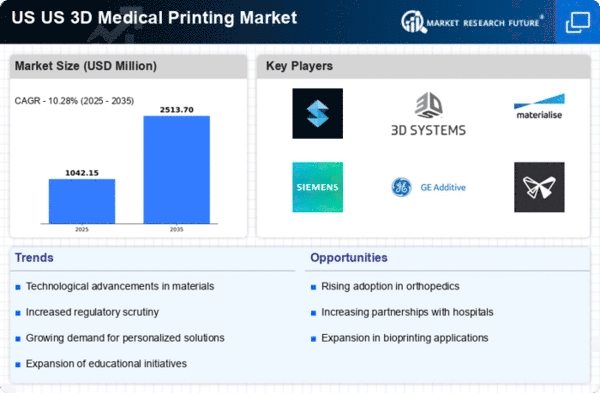
US 3D Medical Printing Market Infographic
Purchase Options

Market Trends

Key Emerging Trends in the US 3D Medical Printing Market

The 3D printing sector has historically emphasized hardware and materials, but a notable shift in focus has occurred towards the enhancement of software solutions integral to the process of printing medical devices. This evolution marks a significant trend in the industry, steering attention towards the software side of 3D printing technology.

An essential aspect of this trend is the increasing emphasis on the interoperability of software solutions, which has proven immensely advantageous for the 3D printing realm. This interoperability streamlines the entire process, notably reducing the complexity involved in designing models for printing. By minimizing the number of steps, tools, and efforts required for model creation, this development simplifies and expedites the printing process, fostering efficiency and innovation.

Technological advancements serve as the cornerstone for these strides in software solutions, driving the creation of novel 3D-printed products, particularly tailored for the burgeoning demand in the healthcare industry. The demand for 3D-printed medical devices continues to grow within healthcare, prompting the industry to continually innovate and refine its offerings.

Traditional manufacturing methods often prove time-consuming and limited in their capabilities, prompting major industry players to pivot towards the development of groundbreaking products. This shift reflects a concerted effort to overcome the constraints of conventional manufacturing processes. Embracing technological advancements, these market leaders are spearheading the creation of innovative products to meet the escalating demands within the healthcare sector.

This evolution in focus, from hardware and materials to software solutions in the 3D printing landscape, signifies a pivotal moment in the industry's trajectory. The emphasis on software's role in simplifying and enhancing the 3D printing process not only facilitates efficiency but also opens doors to a realm of new possibilities in medical device manufacturing. As these advancements continue to gain momentum, the industry is poised for further transformation, promising a future marked by unprecedented innovation and efficiency in 3D-printed medical devices.


Author
Rahul Gotadki
Assistant Manager

He holds an experience of about 7+ years in Market Research and Business Consulting, working under the spectrum of Life Sciences and Healthcare domains. Rahul conceptualizes and implements a scalable business strategy and provides strategic leadership to the clients. His expertise lies in market estimation, competitive intelligence, pipeline analysis, customer assessment, etc. In addition to the above, his other responsibility includes strategic tracking of high growth markets & advising clients on the potential areas of focus they could direct their business initiatives

Leave a Comment

FAQs

What is the current valuation of the US 3D Medical Printing Market?

As of 2024, the market valuation was approximately 9.557 USD Billion.

What is the projected market size for the US 3D Medical Printing Market by 2035?

The market is projected to reach approximately 51.72 USD Billion by 2035.

What is the expected CAGR for the US 3D Medical Printing Market during the forecast period?

The expected CAGR for the market from 2025 to 2035 is 16.59%.

Which companies are considered key players in the US 3D Medical Printing Market?

Key players include Stratasys, 3D Systems, Materialise, Siemens, GE Additive, Formlabs, HP Inc., EOS, and Medtronic.

What are the main components of the US 3D Medical Printing Market?

Main components include equipment, metals and metal alloys, biomaterials, ceramics, and services & software.

Market Summary

As per MRFR analysis, the US 3D Medical Printing Market Size was estimated at 9.557 USD Billion in 2024. The 3D medical printing industry is projected to grow from 11.14 USD Billion in 2025 to 51.72 USD Billion by 2035, exhibiting a compound annual growth rate (CAGR) of 16.59 during the forecast period 2025 - 2035.

Key Market Trends & Highlights

The US 3D Medical Printing Market is poised for substantial growth driven by customization and technological advancements.

  • Customization and personalization are increasingly shaping the landscape of the US 3D medical printing market.
  • North America remains the largest market, while the Asia-Pacific region is recognized as the fastest-growing area for 3D medical printing.
  • The equipment segment holds the largest market share, whereas services and software are experiencing rapid growth.
  • Technological advancements and rising demand for customized solutions are key drivers propelling market expansion.

Market Size & Forecast

2024 Market Size 9.557 (USD Billion)
2035 Market Size 51.72 (USD Billion)
CAGR (2025 - 2035) 16.59%
Largest Regional Market Share in 2024 North America

Major Players

<p>Stratasys (US), 3D Systems (US), Materialise (US), Siemens (US), GE Additive (US), Formlabs (US), HP Inc. (US), EOS (US), Medtronic (US)</p>

Market Trends

The US 3D Medical Printing Market is currently experiencing a transformative phase, characterized by rapid advancements in technology and increasing adoption across various healthcare sectors. This market encompasses a wide range of applications, including the production of customized implants, prosthetics, and anatomical models for surgical planning. The integration of 3D printing into medical practices appears to enhance patient outcomes by allowing for personalized treatment options and improved surgical precision. Furthermore, the ongoing collaboration between healthcare providers and technology firms suggests a promising future for innovation in this field. In addition to technological advancements, regulatory frameworks are evolving to accommodate the unique challenges posed by 3D printing in medicine. This evolution indicates a growing recognition of the potential benefits of additive manufacturing in healthcare. As the US 3D Medical Printing Market continues to expand, it may also face challenges related to standardization and quality control. Nevertheless, the overall trajectory seems positive, with increasing investments and research efforts aimed at unlocking new possibilities in patient care and treatment methodologies.

Customization and Personalization

The trend towards customization in the US 3D Medical Printing Market is gaining momentum. Healthcare providers are increasingly utilizing 3D printing to create tailored medical devices and implants that meet the specific needs of individual patients. This shift towards personalized solutions not only enhances patient satisfaction but also improves clinical outcomes, as treatments can be more accurately aligned with patient anatomy.

Integration of Advanced Materials

The incorporation of advanced materials into the US 3D Medical Printing Market is becoming more prevalent. Innovations in biocompatible materials and composites are enabling the production of more durable and effective medical devices. This trend suggests a potential for improved functionality and longevity of printed products, which could lead to better patient experiences and reduced healthcare costs.

Regulatory Developments

Regulatory developments are playing a crucial role in shaping the US 3D Medical Printing Market. As the technology evolves, regulatory bodies are adapting their frameworks to ensure safety and efficacy in 3D printed medical products. This trend indicates a growing commitment to maintaining high standards in healthcare, which may foster greater trust among practitioners and patients alike.

US 3D Medical Printing Market Market Drivers

Technological Advancements

The US 3D Medical Printing Market is experiencing rapid technological advancements that enhance the capabilities of 3D printing. Innovations in software and hardware are enabling more precise and efficient printing processes. For instance, the integration of artificial intelligence and machine learning is streamlining design processes, allowing for the creation of complex geometries that were previously unattainable. As of 2025, the market is projected to grow at a compound annual growth rate (CAGR) of approximately 20%, driven by these advancements. Furthermore, the development of bioprinting technologies is revolutionizing tissue engineering, which could lead to breakthroughs in regenerative medicine. This continuous evolution in technology not only improves the quality of medical products but also reduces production costs, making 3D printing a more viable option for healthcare providers.

Cost Efficiency and Waste Reduction

Cost efficiency and waste reduction are pivotal drivers in the US 3D Medical Printing Market. Traditional manufacturing methods often involve significant material waste and high production costs. In contrast, 3D printing utilizes additive manufacturing techniques, which build objects layer by layer, minimizing waste. This efficiency is particularly beneficial in the production of complex medical devices and implants, where precision is paramount. As of 2025, the market is projected to save healthcare providers millions in production costs, making 3D printing an attractive alternative. Additionally, the ability to produce on-demand reduces inventory costs and ensures that medical facilities can maintain a leaner operational model. This focus on cost-effectiveness is likely to encourage more healthcare organizations to adopt 3D printing technologies, further propelling the growth of the market.

Regulatory Support and Standardization

Regulatory support and standardization are crucial factors influencing the US 3D Medical Printing Market. As the technology matures, regulatory bodies are establishing frameworks to ensure the safety and efficacy of 3D printed medical products. The Food and Drug Administration (FDA) has begun to outline guidelines for the approval of 3D printed devices, which is fostering confidence among manufacturers and healthcare providers. As of 2025, the establishment of clear regulatory pathways is expected to facilitate market entry for new products, thereby accelerating innovation. Moreover, standardization of materials and processes is likely to enhance product reliability and interoperability, which are essential for widespread adoption. This supportive regulatory environment is anticipated to play a significant role in shaping the future of the US 3D Medical Printing Market, encouraging more stakeholders to engage with this transformative technology.

Rising Demand for Customized Solutions

The US 3D Medical Printing Market is witnessing a surge in demand for customized medical solutions. Patients increasingly seek personalized treatments, which 3D printing can effectively provide. This technology allows for the production of patient-specific implants, prosthetics, and surgical instruments tailored to individual anatomical requirements. As of 2025, the market is expected to reach a valuation of over $2 billion, largely fueled by this trend. Customization not only enhances patient outcomes but also improves the efficiency of surgical procedures. Moreover, the ability to rapidly prototype and iterate designs means that healthcare providers can respond more swiftly to patient needs, thereby increasing the overall effectiveness of medical interventions. This growing emphasis on personalization is likely to continue shaping the landscape of the US 3D Medical Printing Market.

Increased Investment in Healthcare Innovation

The US 3D Medical Printing Market is benefiting from increased investment in healthcare innovation. Government initiatives and private sector funding are driving research and development in 3D printing technologies. As of 2025, investments in this sector are expected to exceed $1 billion, reflecting a strong commitment to advancing medical technologies. This influx of capital is facilitating the exploration of new applications, such as bioprinting organs and tissues, which could revolutionize transplant medicine. Furthermore, partnerships between academic institutions and industry leaders are fostering innovation, leading to the development of cutting-edge solutions that address pressing healthcare challenges. This trend of heightened investment is likely to sustain the momentum of the US 3D Medical Printing Market, as stakeholders seek to capitalize on the potential of 3D printing to transform patient care.

Market Segment Insights

3D Medical Printing Component Insights

The US 3D Medical Printing Market segmentation, based on component includes Equipment (3D Printers, 3D Bioprinters), Metals and Metal Alloys, Biomaterials, Ceramics, Materials (Plastics (Thermoplastics, Photopolymers), Paper, Wax, Other Materials) and Services & Software. The equipment segment dominated the market mostly. Due to its portability and ability to be transported to remote locations, the sophisticated technology utilized in the healthcare industry has expanded the scope of services available. To ensure that the operation proceeds without a hitch and that the intended outcomes are obtained, it is imperative that the healthcare industry provides faultless services.

3D Medical Printing Application Insights

The US 3D Medical Printing Market segmentation, based on application includes Surgical Instruments (Surgical Fasteners, Scalpels, Retractors), Surgical Guides (Dental Guides, Craniomaxillofacial Guides, Orthopedic Guides, Spinal Guides), Standard Prosthetics & Implants, Custom Prosthetics & Implants (Orthopedic Implants, Craniomaxillofacial Implants, Dental Prosthetics & Implants,), Tissue-engineered Products (Bone & Cartilage Scaffolds, Ligament & Tendon Scaffolds), Hearing Aids, Wearable Medical Devices, and Other Applications. The wearable medical devices segment dominated the market mostly because of the abundance of patients, the relaxation of rules governing 3D printers, the rise in the use of this technology in hospitals and dentistry offices, and customizations.

During the course of the forecast period, these factors are anticipated to accelerate market growth.

3D Medical Printing Technology Insights

The US 3D Medical Printing Market segmentation, based on technology includes Laser Beam Melting (Direct Metal Laser Sintering, Selective Laser Sintering, Selective Laser Melting, LaserCUSING), Droplet Deposition/Extrusion-based Technologies (Fused Deposition Modeling, Multiphase Jet Solidification, Low-temperature Deposition Manufacturing, Microextrusion Bioprinting), Photopolymerization (Digital Light Processing, Stereolithography, Two-photon Polymerization, PolyJet 3D Printing), Electron Beam Melting, Three-dimensional Printing/Adhesion Bonding/Binder Jetting, and Other Technologies. The Droplet Deposition/Extrusion-based Technologies segment dominated the market mostly. The ability of 3D printing technology to withstand chemicals has become one of its main draws for prospective customers.

Due to their ability to tolerate extremely high temperatures, these materials are found in many highly durable items on the market. The market's size has increased significantly due to the growing demand for new technology among consumers, and this trend is anticipated to continue in the coming years.

3D Medical Printing End User Insights

The US 3D Medical Printing Market segmentation, based on end user, includes Hospitals & Surgical Centers, Dental & Orthopedic Clinics, Pharma-Biotech & Medical Device Companies, Academic Institutions & Research Laboratories, and Clinical Research Organizations. The hospitals & surgical centers category generated the most income. The market for 3D medical printing is expanding due to a number of factors, such as increased government and private sector investments in 3D printing technology and a rise in university-business partnerships. These elements have created opportunities for 3D printing's expansion in the healthcare industry.

Figure 1: US 3D Medical Printing Market, by End User, 2024 & 2032 (USD Billion)

Source: Secondary Research, Primary Research, Market Research Future Database and Analyst Review

Get more detailed insights about US 3D Medical Printing Market Research Report—Forecast till 2035

Regional Insights

North America : Innovation and Leadership Hub

The North American 3D medical printing market is the largest globally, accounting for approximately 45% of the total market share. Key growth drivers include advancements in technology, increasing demand for personalized medicine, and supportive regulatory frameworks. The region benefits from a robust healthcare infrastructure and significant investments in research and development, which are crucial for market expansion. The United States leads the market, with major players like Stratasys, 3D Systems, and GE Additive driving innovation. The competitive landscape is characterized by a focus on technological advancements and strategic partnerships. The presence of leading healthcare institutions further enhances the market's growth potential, making North America a pivotal region in the 3D medical printing landscape.

Europe : Emerging Market with Potential

Europe is the second-largest market for 3D medical printing, holding around 30% of the global market share. The region is witnessing significant growth due to increasing investments in healthcare technology, rising demand for customized medical solutions, and supportive government initiatives. Regulatory bodies are actively promoting the adoption of 3D printing technologies, which is expected to further boost market growth in the coming years. Leading countries in Europe include Germany, the UK, and France, where key players like Materialise and Siemens are making substantial contributions. The competitive landscape is evolving, with a focus on innovation and collaboration among industry stakeholders. The presence of advanced research institutions and a strong healthcare system positions Europe as a promising market for 3D medical printing.

Asia-Pacific : Rapidly Growing Market

The Asia-Pacific region is emerging as a significant player in the 3D medical printing market, accounting for approximately 20% of the global share. Key growth drivers include increasing healthcare expenditure, a growing population, and rising awareness of advanced medical technologies. Countries like China and Japan are leading the charge, supported by favorable government policies and investments in healthcare infrastructure. China is at the forefront, with numerous startups and established companies like HP Inc. and Formlabs entering the market. The competitive landscape is characterized by rapid technological advancements and collaborations between healthcare providers and technology firms. As the region continues to develop, the demand for 3D medical printing solutions is expected to rise significantly, enhancing patient care and treatment options.

Middle East and Africa : Emerging Opportunities Ahead

The Middle East and Africa region is gradually recognizing the potential of 3D medical printing, currently holding about 5% of the global market share. Growth is driven by increasing healthcare investments, a rising prevalence of chronic diseases, and a focus on improving healthcare delivery systems. Governments are beginning to support the adoption of innovative technologies, which is expected to catalyze market growth in the near future. Countries like South Africa and the UAE are leading the way, with initiatives aimed at enhancing healthcare capabilities through technology. The competitive landscape is still developing, with a mix of local and international players entering the market. As awareness of 3D printing benefits grows, the region is poised for significant advancements in medical applications, paving the way for improved patient outcomes.

Key Players and Competitive Insights

Leading market players are investing heavily in research and development in order to expand their product lines, which will help the 3D medical printing market, grow even more. Market participants are also undertaking a variety of strategic activities to expand their  footprint, with important market developments including new product launches, contractual agreements, mergers and acquisitions, higher investments, and collaboration with other organizations. To expand and survive in a more competitive and rising market climate, 3D medical printing industry must offer cost-effective items.

Key Companies in the US 3D Medical Printing Market market include

Industry Developments

Future Outlook

US 3D Medical Printing Market Future Outlook

<p>The US 3D Medical Printing Market is projected to grow at a 16.59% CAGR from 2024 to 2035, driven by technological advancements, increasing demand for personalized medicine, and cost-effective production methods.</p>

New opportunities lie in:

  • <p>Development of bioprinted organ models for preclinical testing.</p>
  • <p>Integration of AI for optimized design and production processes.</p>
  • <p>Expansion of on-demand printing services for surgical instruments.</p>

<p>By 2035, the market is expected to be robust, driven by innovation and increased adoption across healthcare sectors.</p>

Market Segmentation

US 3D Medical Printing Market End User Outlook

  • Hospitals & Surgical Centers
  • Dental & Orthopedic Clinics
  • Pharma-Biotech & Medical Device Companies
  • Academic Institutions & Research Laboratories
  • Clinical Research Organizations

US 3D Medical Printing Market Component Outlook

  • Equipment (3D Printers, 3D Bioprinters)
  • Metals and Metal Alloys
  • Biomaterials
  • Ceramics
  • Materials (Plastics, Paper, Wax, Other Materials)
  • Services & Software

US 3D Medical Printing Market Technology Outlook

  • Laser Beam Melting
  • Droplet Deposition/Extrusion-based Technologies
  • Photopolymerization
  • Electron Beam Melting
  • Three-dimensional Printing/Adhesion Bonding/Binder Jetting
  • Other Technologies

US 3D Medical Printing Market Application Outlook

  • Surgical Instruments
  • Surgical Guides
  • Standard Prosthetics & Implants
  • Custom Prosthetics & Implants
  • Tissue-engineered Products
  • Hearing Aids
  • Wearable Medical Devices
  • Other Applications

Report Scope

MARKET SIZE 20249.557(USD Billion)
MARKET SIZE 202511.14(USD Billion)
MARKET SIZE 203551.72(USD Billion)
COMPOUND ANNUAL GROWTH RATE (CAGR)16.59% (2024 - 2035)
REPORT COVERAGERevenue Forecast, Competitive Landscape, Growth Factors, and Trends
BASE YEAR2024
Market Forecast Period2025 - 2035
Historical Data2019 - 2024
Market Forecast UnitsUSD Billion
Key Companies ProfiledMarket analysis in progress
Segments CoveredMarket segmentation analysis in progress
Key Market OpportunitiesAdvancements in bioprinting technologies enhance personalized medicine in the US 3D Medical Printing Market.
Key Market DynamicsTechnological advancements and regulatory changes drive innovation and adoption in the US 3D Medical Printing Market.
Countries CoveredNorth America, Europe, APAC, South America, MEA

FAQs

What is the current valuation of the US 3D Medical Printing Market?

As of 2024, the market valuation was approximately 9.557 USD Billion.

What is the projected market size for the US 3D Medical Printing Market by 2035?

The market is projected to reach approximately 51.72 USD Billion by 2035.

What is the expected CAGR for the US 3D Medical Printing Market during the forecast period?

The expected CAGR for the market from 2025 to 2035 is 16.59%.

Which companies are considered key players in the US 3D Medical Printing Market?

Key players include Stratasys, 3D Systems, Materialise, Siemens, GE Additive, Formlabs, HP Inc., EOS, and Medtronic.

What are the main components of the US 3D Medical Printing Market?

Main components include equipment, metals and metal alloys, biomaterials, ceramics, and services & software.

  1. SECTION I: EXECUTIVE SUMMARY AND KEY HIGHLIGHTS
    1. EXECUTIVE SUMMARY
      1. Market Overview
      2. Key Findings
      3. Market Segmentation
      4. Competitive Landscape
      5. Challenges and Opportunities
      6. Future Outlook
  2. SECTION II: SCOPING, METHODOLOGY AND MARKET STRUCTURE
    1. MARKET INTRODUCTION
      1. Definition
      2. Scope of the study
    2. RESEARCH METHODOLOGY
      1. Overview
      2. Data Mining
      3. Secondary Research
      4. Primary Research
      5. Forecasting Model
      6. Market Size Estimation
      7. Data Triangulation
      8. Validation
  3. SECTION III: QUALITATIVE ANALYSIS
    1. MARKET DYNAMICS
      1. Overview
      2. Drivers
      3. Restraints
      4. Opportunities
    2. MARKET FACTOR ANALYSIS
      1. Value chain Analysis
      2. Porter's Five Forces Analysis
      3. COVID-19 Impact Analysis
  4. SECTION IV: QUANTITATIVE ANALYSIS
    1. Healthcare, BY Component (USD Billion)
      1. Equipment (3D Printers, 3D Bioprinters)
      2. Metals and Metal Alloys
      3. Biomaterials
      4. Ceramics
      5. Materials (Plastics, Paper, Wax, Other Materials)
      6. Services & Software
    2. Healthcare, BY Application (USD Billion)
      1. Surgical Instruments
      2. Surgical Guides
      3. Standard Prosthetics & Implants
      4. Custom Prosthetics & Implants
      5. Tissue-engineered Products
      6. Hearing Aids
      7. Wearable Medical Devices
      8. Other Applications
    3. Healthcare, BY Technology (USD Billion)
      1. Laser Beam Melting
      2. Droplet Deposition/Extrusion-based Technologies
      3. Photopolymerization
      4. Electron Beam Melting
      5. Three-dimensional Printing/Adhesion Bonding/Binder Jetting
      6. Other Technologies
    4. Healthcare, BY End User (USD Billion)
      1. Hospitals & Surgical Centers
      2. Dental & Orthopedic Clinics
      3. Pharma-Biotech & Medical Device Companies
      4. Academic Institutions & Research Laboratories
      5. Clinical Research Organizations
    5. Healthcare, BY Region (USD Billion)
      1. North America
      2. Europe
      3. APAC
      4. South America
      5. MEA
  5. SECTION V: COMPETITIVE ANALYSIS
    1. Competitive Landscape
      1. Overview
      2. Competitive Analysis
      3. Market share Analysis
      4. Major Growth Strategy in the Healthcare
      5. Competitive Benchmarking
      6. Leading Players in Terms of Number of Developments in the Healthcare
      7. Key developments and growth strategies
      8. Major Players Financial Matrix
    2. Company Profiles
      1. Stratasys (US)
      2. 3D Systems (US)
      3. Materialise (US)
      4. Siemens (US)
      5. GE Additive (US)
      6. Formlabs (US)
      7. HP Inc. (US)
      8. EOS (US)
      9. Medtronic (US)
    3. Appendix
      1. References
      2. Related Reports
  6. LIST OF FIGURES
    1. MARKET SYNOPSIS
    2. NORTH AMERICA MARKET ANALYSIS
    3. US MARKET ANALYSIS BY COMPONENT
    4. US MARKET ANALYSIS BY APPLICATION
    5. US MARKET ANALYSIS BY TECHNOLOGY
    6. US MARKET ANALYSIS BY END USER
    7. CANADA MARKET ANALYSIS BY COMPONENT
    8. CANADA MARKET ANALYSIS BY APPLICATION
    9. CANADA MARKET ANALYSIS BY TECHNOLOGY
    10. CANADA MARKET ANALYSIS BY END USER
    11. EUROPE MARKET ANALYSIS
    12. GERMANY MARKET ANALYSIS BY COMPONENT
    13. GERMANY MARKET ANALYSIS BY APPLICATION
    14. GERMANY MARKET ANALYSIS BY TECHNOLOGY
    15. GERMANY MARKET ANALYSIS BY END USER
    16. UK MARKET ANALYSIS BY COMPONENT
    17. UK MARKET ANALYSIS BY APPLICATION
    18. UK MARKET ANALYSIS BY TECHNOLOGY
    19. UK MARKET ANALYSIS BY END USER
    20. FRANCE MARKET ANALYSIS BY COMPONENT
    21. FRANCE MARKET ANALYSIS BY APPLICATION
    22. FRANCE MARKET ANALYSIS BY TECHNOLOGY
    23. FRANCE MARKET ANALYSIS BY END USER
    24. RUSSIA MARKET ANALYSIS BY COMPONENT
    25. RUSSIA MARKET ANALYSIS BY APPLICATION
    26. RUSSIA MARKET ANALYSIS BY TECHNOLOGY
    27. RUSSIA MARKET ANALYSIS BY END USER
    28. ITALY MARKET ANALYSIS BY COMPONENT
    29. ITALY MARKET ANALYSIS BY APPLICATION
    30. ITALY MARKET ANALYSIS BY TECHNOLOGY
    31. ITALY MARKET ANALYSIS BY END USER
    32. SPAIN MARKET ANALYSIS BY COMPONENT
    33. SPAIN MARKET ANALYSIS BY APPLICATION
    34. SPAIN MARKET ANALYSIS BY TECHNOLOGY
    35. SPAIN MARKET ANALYSIS BY END USER
    36. REST OF EUROPE MARKET ANALYSIS BY COMPONENT
    37. REST OF EUROPE MARKET ANALYSIS BY APPLICATION
    38. REST OF EUROPE MARKET ANALYSIS BY TECHNOLOGY
    39. REST OF EUROPE MARKET ANALYSIS BY END USER
    40. APAC MARKET ANALYSIS
    41. CHINA MARKET ANALYSIS BY COMPONENT
    42. CHINA MARKET ANALYSIS BY APPLICATION
    43. CHINA MARKET ANALYSIS BY TECHNOLOGY
    44. CHINA MARKET ANALYSIS BY END USER
    45. INDIA MARKET ANALYSIS BY COMPONENT
    46. INDIA MARKET ANALYSIS BY APPLICATION
    47. INDIA MARKET ANALYSIS BY TECHNOLOGY
    48. INDIA MARKET ANALYSIS BY END USER
    49. JAPAN MARKET ANALYSIS BY COMPONENT
    50. JAPAN MARKET ANALYSIS BY APPLICATION
    51. JAPAN MARKET ANALYSIS BY TECHNOLOGY
    52. JAPAN MARKET ANALYSIS BY END USER
    53. SOUTH KOREA MARKET ANALYSIS BY COMPONENT
    54. SOUTH KOREA MARKET ANALYSIS BY APPLICATION
    55. SOUTH KOREA MARKET ANALYSIS BY TECHNOLOGY
    56. SOUTH KOREA MARKET ANALYSIS BY END USER
    57. MALAYSIA MARKET ANALYSIS BY COMPONENT
    58. MALAYSIA MARKET ANALYSIS BY APPLICATION
    59. MALAYSIA MARKET ANALYSIS BY TECHNOLOGY
    60. MALAYSIA MARKET ANALYSIS BY END USER
    61. THAILAND MARKET ANALYSIS BY COMPONENT
    62. THAILAND MARKET ANALYSIS BY APPLICATION
    63. THAILAND MARKET ANALYSIS BY TECHNOLOGY
    64. THAILAND MARKET ANALYSIS BY END USER
    65. INDONESIA MARKET ANALYSIS BY COMPONENT
    66. INDONESIA MARKET ANALYSIS BY APPLICATION
    67. INDONESIA MARKET ANALYSIS BY TECHNOLOGY
    68. INDONESIA MARKET ANALYSIS BY END USER
    69. REST OF APAC MARKET ANALYSIS BY COMPONENT
    70. REST OF APAC MARKET ANALYSIS BY APPLICATION
    71. REST OF APAC MARKET ANALYSIS BY TECHNOLOGY
    72. REST OF APAC MARKET ANALYSIS BY END USER
    73. SOUTH AMERICA MARKET ANALYSIS
    74. BRAZIL MARKET ANALYSIS BY COMPONENT
    75. BRAZIL MARKET ANALYSIS BY APPLICATION
    76. BRAZIL MARKET ANALYSIS BY TECHNOLOGY
    77. BRAZIL MARKET ANALYSIS BY END USER
    78. MEXICO MARKET ANALYSIS BY COMPONENT
    79. MEXICO MARKET ANALYSIS BY APPLICATION
    80. MEXICO MARKET ANALYSIS BY TECHNOLOGY
    81. MEXICO MARKET ANALYSIS BY END USER
    82. ARGENTINA MARKET ANALYSIS BY COMPONENT
    83. ARGENTINA MARKET ANALYSIS BY APPLICATION
    84. ARGENTINA MARKET ANALYSIS BY TECHNOLOGY
    85. ARGENTINA MARKET ANALYSIS BY END USER
    86. REST OF SOUTH AMERICA MARKET ANALYSIS BY COMPONENT
    87. REST OF SOUTH AMERICA MARKET ANALYSIS BY APPLICATION
    88. REST OF SOUTH AMERICA MARKET ANALYSIS BY TECHNOLOGY
    89. REST OF SOUTH AMERICA MARKET ANALYSIS BY END USER
    90. MEA MARKET ANALYSIS
    91. GCC COUNTRIES MARKET ANALYSIS BY COMPONENT
    92. GCC COUNTRIES MARKET ANALYSIS BY APPLICATION
    93. GCC COUNTRIES MARKET ANALYSIS BY TECHNOLOGY
    94. GCC COUNTRIES MARKET ANALYSIS BY END USER
    95. SOUTH AFRICA MARKET ANALYSIS BY COMPONENT
    96. SOUTH AFRICA MARKET ANALYSIS BY APPLICATION
    97. SOUTH AFRICA MARKET ANALYSIS BY TECHNOLOGY
    98. SOUTH AFRICA MARKET ANALYSIS BY END USER
    99. REST OF MEA MARKET ANALYSIS BY COMPONENT
    100. REST OF MEA MARKET ANALYSIS BY APPLICATION
    101. REST OF MEA MARKET ANALYSIS BY TECHNOLOGY
    102. REST OF MEA MARKET ANALYSIS BY END USER
    103. KEY BUYING CRITERIA OF HEALTHCARE
    104. RESEARCH PROCESS OF MRFR
    105. DRO ANALYSIS OF HEALTHCARE
    106. DRIVERS IMPACT ANALYSIS: HEALTHCARE
    107. RESTRAINTS IMPACT ANALYSIS: HEALTHCARE
    108. SUPPLY / VALUE CHAIN: HEALTHCARE
    109. HEALTHCARE, BY COMPONENT, 2024 (% SHARE)
    110. HEALTHCARE, BY COMPONENT, 2024 TO 2035 (USD Billion)
    111. HEALTHCARE, BY APPLICATION, 2024 (% SHARE)
    112. HEALTHCARE, BY APPLICATION, 2024 TO 2035 (USD Billion)
    113. HEALTHCARE, BY TECHNOLOGY, 2024 (% SHARE)
    114. HEALTHCARE, BY TECHNOLOGY, 2024 TO 2035 (USD Billion)
    115. HEALTHCARE, BY END USER, 2024 (% SHARE)
    116. HEALTHCARE, BY END USER, 2024 TO 2035 (USD Billion)
    117. BENCHMARKING OF MAJOR COMPETITORS
  7. LIST OF TABLES
    1. LIST OF ASSUMPTIONS
    2. North America MARKET SIZE ESTIMATES; FORECAST
      1. BY COMPONENT, 2025-2035 (USD Billion)
      2. BY APPLICATION, 2025-2035 (USD Billion)
      3. BY TECHNOLOGY, 2025-2035 (USD Billion)
      4. BY END USER, 2025-2035 (USD Billion)
    3. US MARKET SIZE ESTIMATES; FORECAST
      1. BY COMPONENT, 2025-2035 (USD Billion)
      2. BY APPLICATION, 2025-2035 (USD Billion)
      3. BY TECHNOLOGY, 2025-2035 (USD Billion)
      4. BY END USER, 2025-2035 (USD Billion)
    4. Canada MARKET SIZE ESTIMATES; FORECAST
      1. BY COMPONENT, 2025-2035 (USD Billion)
      2. BY APPLICATION, 2025-2035 (USD Billion)
      3. BY TECHNOLOGY, 2025-2035 (USD Billion)
      4. BY END USER, 2025-2035 (USD Billion)
    5. Europe MARKET SIZE ESTIMATES; FORECAST
      1. BY COMPONENT, 2025-2035 (USD Billion)
      2. BY APPLICATION, 2025-2035 (USD Billion)
      3. BY TECHNOLOGY, 2025-2035 (USD Billion)
      4. BY END USER, 2025-2035 (USD Billion)
    6. Germany MARKET SIZE ESTIMATES; FORECAST
      1. BY COMPONENT, 2025-2035 (USD Billion)
      2. BY APPLICATION, 2025-2035 (USD Billion)
      3. BY TECHNOLOGY, 2025-2035 (USD Billion)
      4. BY END USER, 2025-2035 (USD Billion)
    7. UK MARKET SIZE ESTIMATES; FORECAST
      1. BY COMPONENT, 2025-2035 (USD Billion)
      2. BY APPLICATION, 2025-2035 (USD Billion)
      3. BY TECHNOLOGY, 2025-2035 (USD Billion)
      4. BY END USER, 2025-2035 (USD Billion)
    8. France MARKET SIZE ESTIMATES; FORECAST
      1. BY COMPONENT, 2025-2035 (USD Billion)
      2. BY APPLICATION, 2025-2035 (USD Billion)
      3. BY TECHNOLOGY, 2025-2035 (USD Billion)
      4. BY END USER, 2025-2035 (USD Billion)
    9. Russia MARKET SIZE ESTIMATES; FORECAST
      1. BY COMPONENT, 2025-2035 (USD Billion)
      2. BY APPLICATION, 2025-2035 (USD Billion)
      3. BY TECHNOLOGY, 2025-2035 (USD Billion)
      4. BY END USER, 2025-2035 (USD Billion)
    10. Italy MARKET SIZE ESTIMATES; FORECAST
      1. BY COMPONENT, 2025-2035 (USD Billion)
      2. BY APPLICATION, 2025-2035 (USD Billion)
      3. BY TECHNOLOGY, 2025-2035 (USD Billion)
      4. BY END USER, 2025-2035 (USD Billion)
    11. Spain MARKET SIZE ESTIMATES; FORECAST
      1. BY COMPONENT, 2025-2035 (USD Billion)
      2. BY APPLICATION, 2025-2035 (USD Billion)
      3. BY TECHNOLOGY, 2025-2035 (USD Billion)
      4. BY END USER, 2025-2035 (USD Billion)
    12. Rest of Europe MARKET SIZE ESTIMATES; FORECAST
      1. BY COMPONENT, 2025-2035 (USD Billion)
      2. BY APPLICATION, 2025-2035 (USD Billion)
      3. BY TECHNOLOGY, 2025-2035 (USD Billion)
      4. BY END USER, 2025-2035 (USD Billion)
    13. APAC MARKET SIZE ESTIMATES; FORECAST
      1. BY COMPONENT, 2025-2035 (USD Billion)
      2. BY APPLICATION, 2025-2035 (USD Billion)
      3. BY TECHNOLOGY, 2025-2035 (USD Billion)
      4. BY END USER, 2025-2035 (USD Billion)
    14. China MARKET SIZE ESTIMATES; FORECAST
      1. BY COMPONENT, 2025-2035 (USD Billion)
      2. BY APPLICATION, 2025-2035 (USD Billion)
      3. BY TECHNOLOGY, 2025-2035 (USD Billion)
      4. BY END USER, 2025-2035 (USD Billion)
    15. India MARKET SIZE ESTIMATES; FORECAST
      1. BY COMPONENT, 2025-2035 (USD Billion)
      2. BY APPLICATION, 2025-2035 (USD Billion)
      3. BY TECHNOLOGY, 2025-2035 (USD Billion)
      4. BY END USER, 2025-2035 (USD Billion)
    16. Japan MARKET SIZE ESTIMATES; FORECAST
      1. BY COMPONENT, 2025-2035 (USD Billion)
      2. BY APPLICATION, 2025-2035 (USD Billion)
      3. BY TECHNOLOGY, 2025-2035 (USD Billion)
      4. BY END USER, 2025-2035 (USD Billion)
    17. South Korea MARKET SIZE ESTIMATES; FORECAST
      1. BY COMPONENT, 2025-2035 (USD Billion)
      2. BY APPLICATION, 2025-2035 (USD Billion)
      3. BY TECHNOLOGY, 2025-2035 (USD Billion)
      4. BY END USER, 2025-2035 (USD Billion)
    18. Malaysia MARKET SIZE ESTIMATES; FORECAST
      1. BY COMPONENT, 2025-2035 (USD Billion)
      2. BY APPLICATION, 2025-2035 (USD Billion)
      3. BY TECHNOLOGY, 2025-2035 (USD Billion)
      4. BY END USER, 2025-2035 (USD Billion)
    19. Thailand MARKET SIZE ESTIMATES; FORECAST
      1. BY COMPONENT, 2025-2035 (USD Billion)
      2. BY APPLICATION, 2025-2035 (USD Billion)
      3. BY TECHNOLOGY, 2025-2035 (USD Billion)
      4. BY END USER, 2025-2035 (USD Billion)
    20. Indonesia MARKET SIZE ESTIMATES; FORECAST
      1. BY COMPONENT, 2025-2035 (USD Billion)
      2. BY APPLICATION, 2025-2035 (USD Billion)
      3. BY TECHNOLOGY, 2025-2035 (USD Billion)
      4. BY END USER, 2025-2035 (USD Billion)
    21. Rest of APAC MARKET SIZE ESTIMATES; FORECAST
      1. BY COMPONENT, 2025-2035 (USD Billion)
      2. BY APPLICATION, 2025-2035 (USD Billion)
      3. BY TECHNOLOGY, 2025-2035 (USD Billion)
      4. BY END USER, 2025-2035 (USD Billion)
    22. South America MARKET SIZE ESTIMATES; FORECAST
      1. BY COMPONENT, 2025-2035 (USD Billion)
      2. BY APPLICATION, 2025-2035 (USD Billion)
      3. BY TECHNOLOGY, 2025-2035 (USD Billion)
      4. BY END USER, 2025-2035 (USD Billion)
    23. Brazil MARKET SIZE ESTIMATES; FORECAST
      1. BY COMPONENT, 2025-2035 (USD Billion)
      2. BY APPLICATION, 2025-2035 (USD Billion)
      3. BY TECHNOLOGY, 2025-2035 (USD Billion)
      4. BY END USER, 2025-2035 (USD Billion)
    24. Mexico MARKET SIZE ESTIMATES; FORECAST
      1. BY COMPONENT, 2025-2035 (USD Billion)
      2. BY APPLICATION, 2025-2035 (USD Billion)
      3. BY TECHNOLOGY, 2025-2035 (USD Billion)
      4. BY END USER, 2025-2035 (USD Billion)
    25. Argentina MARKET SIZE ESTIMATES; FORECAST
      1. BY COMPONENT, 2025-2035 (USD Billion)
      2. BY APPLICATION, 2025-2035 (USD Billion)
      3. BY TECHNOLOGY, 2025-2035 (USD Billion)
      4. BY END USER, 2025-2035 (USD Billion)
    26. Rest of South America MARKET SIZE ESTIMATES; FORECAST
      1. BY COMPONENT, 2025-2035 (USD Billion)
      2. BY APPLICATION, 2025-2035 (USD Billion)
      3. BY TECHNOLOGY, 2025-2035 (USD Billion)
      4. BY END USER, 2025-2035 (USD Billion)
    27. MEA MARKET SIZE ESTIMATES; FORECAST
      1. BY COMPONENT, 2025-2035 (USD Billion)
      2. BY APPLICATION, 2025-2035 (USD Billion)
      3. BY TECHNOLOGY, 2025-2035 (USD Billion)
      4. BY END USER, 2025-2035 (USD Billion)
    28. GCC Countries MARKET SIZE ESTIMATES; FORECAST
      1. BY COMPONENT, 2025-2035 (USD Billion)
      2. BY APPLICATION, 2025-2035 (USD Billion)
      3. BY TECHNOLOGY, 2025-2035 (USD Billion)
      4. BY END USER, 2025-2035 (USD Billion)
    29. South Africa MARKET SIZE ESTIMATES; FORECAST
      1. BY COMPONENT, 2025-2035 (USD Billion)
      2. BY APPLICATION, 2025-2035 (USD Billion)
      3. BY TECHNOLOGY, 2025-2035 (USD Billion)
      4. BY END USER, 2025-2035 (USD Billion)
    30. Rest of MEA MARKET SIZE ESTIMATES; FORECAST
      1. BY COMPONENT, 2025-2035 (USD Billion)
      2. BY APPLICATION, 2025-2035 (USD Billion)
      3. BY TECHNOLOGY, 2025-2035 (USD Billion)
      4. BY END USER, 2025-2035 (USD Billion)
    31. PRODUCT LAUNCH/PRODUCT DEVELOPMENT/APPROVAL
    32. ACQUISITION/PARTNERSHIP

US 3D Medical Printing Market Segmentation

Market Segmentation Overview

  • Detailed segmentation data will be available in the full report
  • Comprehensive analysis by multiple parameters
  • Regional and country-level breakdowns
  • Market size forecasts by segment
Infographic

Free Sample Request

Kindly complete the form below to receive a free sample of this Report

Get Free Sample

Customer Strories

Compare Licence

×
Features License Type
Single User Multiuser License Enterprise User
Price $4,950 $5,950 $7,250
Maximum User Access Limit 1 User Upto 10 Users Unrestricted Access Throughout the Organization
Free Customization
Direct Access to Analyst
Deliverable Format
Platform Access
Discount on Next Purchase 10% 15% 15%
Printable Versions