
Request Free Sample ×

Kindly complete the form below to receive a free sample of this Report

* Please use a valid business email

Leading companies partner with us for data-driven Insights

clients tt-cursor
Hero Background
English
Chinese
French
Japanese
Korean
German
Spanish

Ultra-Low Temperature Freezer Market Size

ID: MRFR/HC/1281-CR
200 Pages
Nidhi Mandole
July 2025

Ultra Low Temperature Freezers Market Research Report By Application (Biobanking, Pharmaceuticals, Research Laboratories, Clinical Trials, Industrial Applications), By End-use (Healthcare, Academic Institutions, Pharmaceutical Companies, Biotechnology Companies), By Product Type (Upright Freezers, Chest Freezers, Combination Freezers, Portable Freezers), By Cooling Technology (Vapor Compression, Cascade Refrigeration, Cryogenic), and By Regional (North America, Europe, South America, Asia Pacific, Middle East and Africa) -Forecast to 2035

Share:
Download PDF ×

We do not share your information with anyone. However, we may send you emails based on your report interest from time to time. You may contact us at any time to opt-out.

Ultra-Low Temperature Freezer Market Infographic
Purchase Options

Ultra Low Temperature Freezer Size

Ultra-Low Temperature Freezer Market Growth Projections and Opportunities

Ultra-low temperature freezers (ULT freezers) are instrumental bio-coolers designed to maintain extremely low temperatures, typically ranging from -40°C, -86°C down to an astounding -150°C. This niche market segment plays a critical role in various research sectors, including biomedical and life sciences, and has witnessed significant growth driven by advancements in research and an increasing demand for specialized storage solutions, particularly in blood banks. The pivotal factor contributing to the expansion of the ultra-low temperature freezers market is the remarkable growth in the research sector, especially in fields such as biomedical and life sciences. As research endeavors in these domains continue to evolve, there is a parallel need for advanced storage systems that can preserve sensitive biological materials at ultra-low temperatures. ULT freezers have emerged as indispensable tools in laboratories and research facilities, providing the precise and ultra-low temperatures required for the preservation of various biological specimens. Blood banks, crucial components of the healthcare infrastructure, are significant contributors to the growing demand for ultra-low temperature freezers. The need for reliable and ultra-low temperature storage is paramount in blood bank operations to maintain the integrity and viability of blood and blood products. ULT freezers play a vital role in ensuring the long-term preservation of blood components, contributing to the overall efficiency and safety of blood bank operations. Pharmaceutical companies have also become major stakeholders in the ultra-low temperature freezers market, employing these bio-coolers for critical processes such as drug discovery and clinical testing. The pharmaceutical industry relies on precise temperature control to preserve the efficacy of drugs and biological samples. ULT freezers provide the ideal environment for the storage of drugs, chemicals, viruses, bacteria, enzymes, cell preparations, and tissue samples, ensuring their stability and integrity for research and testing purposes. The versatility of ultra-low temperature freezers is underscored by their applications in preserving a wide range of biological materials. These bio-coolers are indispensable in maintaining the viability and functionality of drugs and chemicals, safeguarding valuable research materials such as viruses, bacteria, enzymes, and cell preparations. Additionally, ultra-low temperature freezers play a crucial role in the storage of tissue samples, ensuring the availability of high-quality specimens for research and diagnostic purposes. An exciting prospect for the future of the ultra-low temperature freezers market is the development of energy-saving models. As sustainability and energy efficiency gain prominence across industries, the demand for eco-friendly and energy-efficient laboratory equipment is on the rise. The introduction of energy-saving ultra-low temperature freezers is anticipated to create new opportunities in the market, aligning with the growing emphasis on environmental responsibility in scientific and research communities. In conclusion, the ultra-low temperature freezers market is experiencing substantial growth propelled by advancements in research sectors, particularly biomedical and life sciences. The increasing demand for specialized storage solutions, driven by the growth of blood banks and the pharmaceutical industry, has positioned ULT freezers as indispensable tools in scientific endeavors. Their versatility in preserving a diverse range of biological materials underscores their significance in various applications. Looking ahead, the development of energy-saving ultra-low temperature freezers is poised to open new avenues, aligning the market with the broader trend of sustainability in scientific research and laboratory practices. As the ultra-low temperature freezers market continues to evolve, its impact on research and scientific advancements is expected to be both profound and enduring.

Ultra-Low Temperature Freezer Market Size Graph
Author
Author Profile
Nidhi Mandole
Senior Research Analyst

She is an extremely curious individual currently working in Healthcare and Medical Devices Domain. Nidhi is comfortably versed in data centric research backed by healthcare educational background. She leverages extensive data mining and analytics tools such as Primary and Secondary Research, Statistical Analysis, Machine Learning, Data Modelling. Her key role also involves Technical Sales Support, Client Interaction and Project management within the Healthcare team. Lastly, she showcases extensive affinity towards learning new skills and remain fascinated in implementing them.

Leave a Comment

FAQs

What is the projected market valuation of the Ultra Low Temperature Freezers Market by 2035?

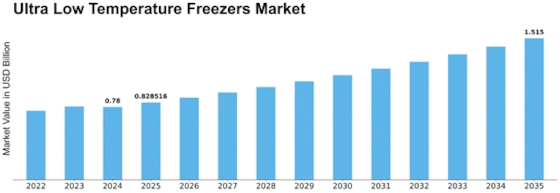
<p>The projected market valuation for the Ultra Low Temperature Freezers Market is 1.515 USD Billion by 2035.</p>

What was the market valuation of Ultra Low Temperature Freezers in 2024?

<p>The overall market valuation of Ultra Low Temperature Freezers was 0.78 USD Billion in 2024.</p>

What is the expected CAGR for the Ultra Low Temperature Freezers Market from 2025 to 2035?

<p>The expected CAGR for the Ultra Low Temperature Freezers Market during the forecast period 2025 - 2035 is 6.22%.</p>

Which application segment is projected to have the highest growth in the Ultra Low Temperature Freezers Market?

<p>The Pharmaceuticals application segment is projected to grow from 0.25 USD Billion to 0.5 USD Billion by 2035.</p>

What are the key players in the Ultra Low Temperature Freezers Market?

<p>Key players in the Ultra Low Temperature Freezers Market include Thermo Fisher Scientific, Eppendorf, Panasonic Healthcare, and Haier Biomedical.</p>

How does the market for Upright Freezers compare to other product types?

<p>The market for Upright Freezers is expected to grow from 0.25 USD Billion to 0.5 USD Billion by 2035, indicating strong demand.</p>

What is the projected growth for the Biobanking application segment?

<p>The Biobanking application segment is anticipated to increase from 0.15 USD Billion to 0.3 USD Billion by 2035.</p>

Which cooling technology segment shows the most potential for growth?

<p>The Vapor Compression cooling technology segment is projected to grow from 0.39 USD Billion to 0.78 USD Billion by 2035.</p>

What is the expected growth for the Healthcare end-use segment?

<p>The Healthcare end-use segment is expected to grow from 0.25 USD Billion to 0.5 USD Billion by 2035.</p>

How do the market valuations of Biotechnology Companies compare to Pharmaceutical Companies?

<p>Biotechnology Companies are projected to grow from 0.18 USD Billion to 0.3 USD Billion, while Pharmaceutical Companies are expected to grow from 0.25 USD Billion to 0.5 USD Billion by 2035.</p>

Market Summary

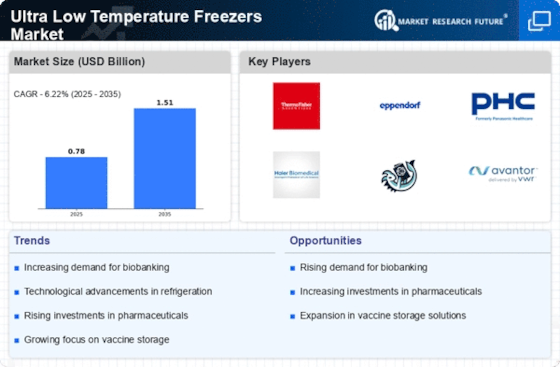
As per Market Research Future analysis, the Ultra Low Temperature Freezers Market Size was estimated at 0.78 USD Billion in 2024. The Ultra Low Temperature Freezers industry is projected to grow from USD 0.8285 Billion in 2025 to USD 1.515 Billion by 2035, exhibiting a compound annual growth rate (CAGR) of 6.2% during the forecast period 2025 - 2035

Key Market Trends & Highlights

The Ultra Low Temperature Freezers Market is poised for substantial growth driven by technological advancements and increasing demand across various sectors.

  • North America remains the largest market for ultra low temperature freezers, driven by robust biopharmaceutical research and healthcare needs. The Asia-Pacific region is emerging as the fastest-growing market, fueled by rising investments in healthcare infrastructure and biobanking initiatives. The biobanking segment holds the largest share, while the pharmaceutical companies segment is experiencing rapid growth due to heightened research activities. Technological advancements and the rising demand in biopharmaceuticals are key drivers propelling market expansion.

Market Size & Forecast

2024 Market Size 0.78 (USD Billion)
2035 Market Size 1.515 (USD Billion)
CAGR (2025 - 2035) 6.22%
Largest Regional Market Share in 2024 North America

Major Players

<a href="https://www.thermofisher.com/in/en/home/life-science/lab-equipment/cold-storage/ult-freezers.html">Thermo Fisher Scientific</a> (US), Eppendorf (DE), <a href="https://www.phchd.com/apac/biomedical/ult-freezers">Panasonic Healthcare</a> (JP), Haier Biomedical (CN), Binder (DE), VWR (US), Sanyo (JP), Revco (US), Froilabo (FR)

Market Trends

The Ultra Low Temperature Freezers Market is currently experiencing a notable evolution, driven by advancements in technology and increasing demand from various sectors. These freezers are essential for preserving sensitive materials, particularly in the fields of pharmaceuticals, biotechnology, and research laboratories. As the need for reliable storage solutions grows, manufacturers are focusing on enhancing energy efficiency and reducing operational costs. This trend aligns with global sustainability goals, as organizations seek to minimize their environmental impact while maintaining high standards of performance. Moreover, the market appears to be influenced by the rising emphasis on research and development activities across multiple industries. Institutions are investing in state-of-the-art equipment to ensure the integrity of their samples, which further propels the demand for ultra-low temperature storage solutions. Additionally, the increasing prevalence of biobanks and the need for long-term storage of biological specimens contribute to the market's expansion. As a result, the Ultra Low Temperature Freezers Market is poised for continued growth, with innovations likely to shape its future landscape.

Technological Advancements

The Ultra Low Temperature Freezers Market is witnessing a surge in technological innovations aimed at improving efficiency and reliability. Manufacturers are integrating advanced monitoring systems and automation features, which enhance user experience and ensure optimal performance. These developments not only streamline operations but also contribute to energy conservation, aligning with the growing focus on sustainability.

Rising Demand in Biopharmaceuticals

There is a marked increase in the demand for ultra-low temperature freezers within the biopharmaceutical sector. As companies expand their research capabilities and focus on developing new therapies, the need for secure storage of sensitive biological materials becomes paramount. This trend indicates a robust growth trajectory for the market, driven by the evolving landscape of drug development.

Focus on Energy Efficiency

A significant trend in the Ultra Low Temperature Freezers Market is the heightened emphasis on energy efficiency. Manufacturers are responding to environmental concerns by designing freezers that consume less power while maintaining optimal performance. This shift not only reduces operational costs for users but also supports broader sustainability initiatives across various industries.

Ultra-Low Temperature Freezer Market Market Drivers

Focus on Energy Efficiency

Energy efficiency is becoming a critical consideration within the Ultra Low Temperature Freezers Market. As environmental concerns grow, manufacturers are increasingly focusing on developing energy-efficient models that not only reduce carbon footprints but also lower operational costs for users. The introduction of energy-efficient technologies, such as variable speed compressors and advanced control systems, is expected to reshape the market landscape. According to recent estimates, energy-efficient ultra low temperature freezers can reduce energy consumption by up to 30%, making them an attractive option for laboratories and research facilities. This shift towards sustainability is likely to influence purchasing decisions, as organizations prioritize eco-friendly solutions while maintaining high performance standards.

Rising Demand in Biopharmaceuticals

The Ultra Low Temperature Freezers Market is significantly influenced by the rising demand in the biopharmaceutical sector. As the industry continues to expand, the need for effective storage solutions for vaccines, biologics, and other temperature-sensitive products becomes paramount. Ultra low temperature freezers are essential for maintaining the integrity of these products, which often require storage at temperatures below -70 degrees Celsius. The biopharmaceutical market is expected to reach a valuation of over 500 billion dollars by 2026, indicating a robust growth trajectory. This increasing demand for ultra low temperature storage solutions is likely to drive investments in ultra low temperature freezers, as companies seek to ensure compliance with stringent regulatory requirements and maintain product efficacy.

Growing Awareness of Sample Preservation

The Ultra Low Temperature Freezers Market is witnessing a growing awareness regarding the importance of sample preservation among various sectors, including healthcare, pharmaceuticals, and academic institutions. As the understanding of the impact of temperature fluctuations on sample integrity increases, organizations are investing in ultra low temperature freezers to ensure the long-term viability of their samples. This trend is particularly evident in biobanking and clinical research, where the preservation of biological samples is crucial for future studies. The market for biobanks is expected to grow significantly, potentially reaching 100 billion dollars by 2027, which will likely drive the demand for ultra low temperature freezers. This heightened awareness of sample preservation underscores the critical role that ultra low temperature freezers play in maintaining the quality and reliability of research materials.

Increasing Research and Development Activities

The Ultra Low Temperature Freezers Market is also being driven by increasing research and development activities across various sectors, including pharmaceuticals, biotechnology, and academic research. As organizations invest more in R&D, the need for reliable storage solutions for sensitive biological samples and compounds becomes critical. Ultra low temperature freezers play a vital role in preserving the integrity of these materials, ensuring that they remain viable for experimentation and analysis. The global R&D spending is projected to reach over 2 trillion dollars by 2025, indicating a strong demand for ultra low temperature storage solutions. This trend suggests that the market for ultra low temperature freezers will continue to expand as more entities recognize the importance of maintaining optimal storage conditions for their research materials.

Technological Advancements in Ultra Low Temperature Freezers

The Ultra Low Temperature Freezers Market is experiencing a surge in technological advancements that enhance the efficiency and reliability of these systems. Innovations such as advanced insulation materials and improved compressor technologies are being integrated into new models, allowing for lower energy consumption and better temperature stability. These advancements not only improve the performance of ultra low temperature freezers but also reduce operational costs for end-users. The market is projected to grow at a compound annual growth rate of approximately 5.2% over the next few years, driven by these technological improvements. As research institutions and laboratories increasingly require precise temperature control for sensitive samples, the demand for state-of-the-art ultra low temperature freezers is likely to rise, further propelling the market forward.

Market Segment Insights

By Application: Biobanking (Largest) vs. Pharmaceuticals (Fastest-Growing)

The Ultra Low Temperature Freezers Market is segmented by application, with biobanking and pharmaceuticals leading the market share. Biobanking is the largest segment, driven by the increasing need for long-term biological specimen preservation. Following closely, pharmaceuticals represent the fastest-growing segment due to the surge in drug development activities and personalized medicine initiatives, which demand advanced storage solutions. Other segments, such as research laboratories and clinical trials, contribute significantly but rank lower on the market share scale. Growth trends in the Ultra Low Temperature Freezers Market highlight the increasing demand for biological samples in biobanking and the technological advancements in freezing equipment. The pharmaceutical sector is witnessing rapid growth, as stringent regulations and innovative therapies require reliable storage solutions. Industrial applications are also on the rise, leveraging ultra-low temperature freezers for various manufacturing processes. Rising investment in research and development across these segments supports sustained growth, driven by the need for efficient sample preservation and storage technologies.

Biobanking (Dominant) vs. Clinical Trials (Emerging)

Biobanking serves as the dominant application in the Ultra Low Temperature Freezers Market, focusing on the preservation of biological specimens for research and therapeutic uses. This segment has gained prominence due to heightened awareness regarding the importance of genetic research, diagnostics, and vaccine development. Biobanks require sophisticated refrigeration solutions to maintain sample integrity over extended periods. On the other hand, clinical trials represent an emerging application, characterized by the need for secure storage of trial samples and investigational products. The increasing pace of clinical studies and patient-centric approaches drives demand for ultra-low temperature freezers in this segment. Both biobanking and <a href="https://www.marketresearchfuture.com/reports/clinical-trials-market-7787">clinical trials</a> emphasize technological innovation, particularly in data management and automation of storage solutions.

By End-use: Healthcare (Largest) vs. Pharmaceutical Companies (Fastest-Growing)

In the Ultra Low Temperature Freezers Market, the healthcare segment holds a significant share due to the increasing demand for biobanking and preservation of biological samples. Healthcare facilities, including hospitals and clinics, utilize ultra-low temperature freezers to store vaccines, blood plasma, and other critical medical products. Pharmaceutical companies also play a crucial role, especially in drug development processes, necessitating stringent temperature control to ensure product stability and efficacy. The growth trends in this segment are primarily driven by technological advancements in refrigeration solutions, alongside the rising emphasis on research and development in healthcare and pharmaceuticals. The COVID-19 pandemic underscored the importance of adequate storage solutions for vaccines, leading to a surge in demand from pharmaceutical companies, which are rapidly adopting ultra-low temperature freezers to support vaccine and bio-pharmaceutical storage needs.

Healthcare: Hospitals (Dominant) vs. Academic Institutions (Emerging)

In the healthcare sector, hospitals represent the dominant force in the Ultra Low Temperature Freezers Market, utilizing these advanced freezers for the effective conservation of critical medical supplies like vaccines and organ samples. Their robust infrastructure and investments in cutting-edge technology allow hospitals to maintain an efficient and reliable cold chain. In contrast, academic institutions are emerging as significant users of ultra-low temperature freezers, primarily for research purposes. As research in life sciences expands, the demand for precise storage solutions that can maintain essential biological materials at ultra-low temperatures is on the rise. This trend indicates a growing recognition among academic institutions of the necessity for reliable refrigeration technology to support innovative research initiatives.

By Product Type: Upright Freezers (Largest) vs. Chest Freezers (Fastest-Growing)

In the Ultra Low Temperature Freezers Market, the product type segmentation reveals that Upright Freezers hold the largest market share, primarily due to their efficient space utilization and user-friendly design, making them a preferred choice in laboratories and medical facilities. Meanwhile, Chest Freezers, although currently smaller in share, are witnessing rapid adoption driven by their exceptional energy efficiency and greater capacity, appealing to various sectors including research institutions and pharmaceutical companies. The growth trends within this market segment are significantly influenced by technological advancements and increasing demand for reliable cold storage solutions. The rise in biopharmaceutical research and the surge in vaccine production are key drivers, pushing brands to innovate. As regulations tighten concerning storage conditions for bio-materials, the appeal of both Upright and Chest Freezers is set to strengthen, ensuring they adapt to these changing demands.

Upright Freezers (Dominant) vs. Combination Freezers (Emerging)

Upright Freezers are recognized as the dominant players in the Ultra Low Temperature Freezers Market, offering significant advantages such as built-in adjustable shelving and a smaller footprint, which is critical for laboratories with space constraints. These freezers are well-suited for environments requiring frequent access to stored samples, thus increasing their operational efficiency. In contrast, Combination Freezers are emerging due to their hybrid design, which allows for both freezing and refrigerated storage in a single unit. This adaptability makes them ideal for institutions needing flexibility without sacrificing efficiency. As usage patterns evolve, Combination Freezers are gaining traction, especially in multi-functional laboratory settings.

By Cooling Technology: Vapor Compression (Largest) vs. Cascade Refrigeration (Fastest-Growing)

The Ultra Low Temperature Freezers Market showcases a diverse array of cooling technologies, with Vapor Compression leading the segment in market share. Its robust efficiency and reliability have solidified its position while catering to a wide range of applications including medical storage and laboratories. Cascade Refrigeration follows closely, representing a significant share as it becomes increasingly recognized for its ability to achieve even lower temperatures, appealing to specialized needs in the sector.

Cooling Technology: Vapor Compression (Dominant) vs. Cascade Refrigeration (Emerging)

Vapor Compression technology remains at the forefront of the Ultra Low Temperature Freezers Market, characterized by its proven efficiency and widespread acceptance across various industries. This technology employs a compressor to cycle refrigerant, reaching low temperatures ideal for sensitive materials. Meanwhile, Cascade Refrigeration is gaining traction as an emerging alternative due to its unique capability to attain ultra-low temperatures through a sequential condensation process. This method is especially beneficial in applications requiring extremely low thermal conditions. Together, these technologies represent the breadth of options available in the market, reflecting diverse operational needs and preferences among end-users.

Get more detailed insights about Ultra-Low Temperature Freezers Market Research Report—Forecast till 2035

Regional Insights

The Ultra Low Temperature Freezers Market showed substantial regional diversification, with North America holding the majority with a valuation of 1.08 USD Billion in 2024, which is projected to grow to 1.833 USD Billion by 2035. This growth was driven by the increasing demand for biobanking and Research and Development applications in the region.

Europe followed closely, valued at 0.848 USD Billion in 2024 and projected at 1.426 USD Billion in 2035, supported by stringent regulations in the pharmaceutical sector that required precise temperature control.

The Asia Pacific region was also noteworthy, expecting an increase from 0.617 USD Billion in 2024 to 1.019 USD Billion by 2035, given the rapid advancement in healthcare infrastructure and rising biopharmaceutical production.

Meanwhile, South America and the Middle East and Africa contributed valuations of 0.231 USD Billion and 0.594 USD Billion in 2024, respectively, with future projections of 0.407 USD Billion and 0.815 USD Billion by 2035. The growth in these regions indicated increasing opportunities but also highlighted certain challenges like regulatory compliance and technology adoption.

Overall, the Ultra Low Temperature Freezers Market displayed varied yet significant growth potential across all regions, driven by unique local industry requirements and advancements in temperature-sensitive storage solutions.

Key Players and Competitive Insights

The Ultra Low Temperature Freezers Market has seen significant developments, underscored by advancements in technology and an increasing demand for efficient temperature control solutions across various industries. This market is characterized by an intense competitive landscape, where several key players vie for market share by enhancing their product offerings and expanding their geographical reach.
Factors driving competition include the rise in biopharmaceutical research, growing necessity for vaccine storage, and increased focus on disaster recovery solutions. Additionally, market participants are leveraging mergers and acquisitions, partnerships, and innovative product development to gain a competitive edge.
As stakeholders adapt to the evolving market dynamics, a clear understanding of the competitive insights is crucial for strategizing and meeting consumer demands effectively in the ultra-low temperature freezers sector.
Haier Biomedical has established a strong presence in the Ultra Low Temperature Freezers Market through its commitment to innovation and quality. The company has developed a diverse range of ultra-low freezers that meet the strict requirements of industries such as pharmaceuticals, biotechnology, and healthcare.
With advanced technologies deployed in their products, Haier Biomedical emphasizes reliability, energy efficiency, and user-friendly features, which resonate well with end-users worldwide. Their strong focus on research and development has not only enhanced their product lineup, but also positioned them as a preferred choice for organizations looking to ensure the safe storage of sensitive biological materials.
Furthermore, Haier Biomedical's strategic initiatives and collaborations have expanded their distribution channels, reinforcing their competitive position within the global market.
Froilabo plays a significant role in the Ultra Low Temperature Freezers Market, providing high-quality cooling solutions tailored for various applications, including laboratory and medical uses. The company is renowned for its reliable ultra-low temperature freezers, which are characterized by robust construction, low energy consumption, and advanced monitoring systems.
Froilabo's presence in the market is supported by its portfolio of key products that cater to the growing needs of research institutions and medical facilities. Their consistent investment in innovation, coupled with strategic partnerships and mergers, has enabled Froilabo to enhance its operational capabilities and expand its footprint in the global arena.
By focusing on customer-centric solutions and maintaining high standards in product quality, Froilabo continues to strengthen its position as a competitive player within the ultra-low temperature freezers sector.

Key Companies in the Ultra-Low Temperature Freezer Market include

Industry Developments

In an effort to improve lab sustainability and operational efficiency, Thermo Fisher Scientific unveiled its TSX Universal Series ultra-low temperature freezers on April 8, 2024. These freezers have ENERGY STAR certification, tighter temperature control, faster recovery times, universal voltage capability, and up to 33% energy savings.

Thermo Fisher Scientific highlighted in April 09, 2024, that its TSX Universal Series is equipped with natural hydrocarbon refrigerants, wireless cloud-connected monitoring, frost-management systems, adaptive V-Drive technology, and exterior status lights. These features allow the series to meet My Green Lab ACT-label environmental standards while using up to 70% less energy than traditional models.

As part of its green portfolio, Thermo Fisher introduced the TDE Series 80°C chest freezers on October 4, 2022. These freezers use eco-friendly refrigerants and advanced insulation to reduce energy use by about 25%, provide quick one-minute recovery times, and guarantee compliance with EU F-gas and EPA SNAP regulations.

On March 8, 2025, many customers complained about Thermo Fisher TSX upright freezers that had performance problems. They described compressor failures that caused temperature drifts to -60°C or greater, with yearly failures forcing samples to be moved to backup freezers.

Other laboratories continued to receive recurring TSX dependability complaints over a number of years, even though users reported numerous problems (such as error code EO5).

Future Outlook

Ultra-Low Temperature Freezer Market Future Outlook

The Ultra Low Temperature Freezers Market is projected to grow at a 6.22% CAGR from 2025 to 2035, driven by advancements in biotechnology, pharmaceuticals, and increased demand for vaccine storage.

New opportunities lie in:

  • Expansion into emerging markets with tailored solutions
  • Development of energy-efficient models to reduce operational costs
  • Integration of IoT technology for <a href="https://www.marketresearchfuture.com/reports/real-time-health-monitoring-devices-market-3564">real-time health monitoring</a> and management

By 2035, the market is expected to achieve robust growth, driven by innovation and strategic investments.

Market Segmentation

Ultra-Low Temperature Freezer Market End-use Outlook

  • Healthcare
  • Academic Institutions
  • Pharmaceutical Companies
  • Biotechnology Companies

Ultra-Low Temperature Freezer Market Application Outlook

  • Biobanking
  • Pharmaceuticals
  • Research Laboratories
  • Clinical Trials
  • Industrial Applications

Ultra-Low Temperature Freezer Market Product Type Outlook

  • Upright Freezers
  • Chest Freezers
  • Combination Freezers
  • Portable Freezers

Ultra-Low Temperature Freezer Market Cooling Technology Outlook

  • Vapor Compression
  • Cascade Refrigeration
  • Cryogenic

Report Scope

MARKET SIZE 2024 0.78(USD Billion)
MARKET SIZE 2025 0.8285(USD Billion)
MARKET SIZE 2035 1.515(USD Billion)
COMPOUND ANNUAL GROWTH RATE (CAGR) 6.22% (2025 - 2035)
REPORT COVERAGE Revenue Forecast, Competitive Landscape, Growth Factors, and Trends
BASE YEAR 2024
Market Forecast Period 2025 - 2035
Historical Data 2019 - 2024
Market Forecast Units USD Billion
Key Companies Profiled Thermo Fisher Scientific (US), Eppendorf (DE), Panasonic Healthcare (JP), Haier Biomedical (CN), Binder (DE), VWR (US), Sanyo (JP), Revco (US), Froilabo (FR)
Segments Covered Application, End-use, Product Type, Cooling Technology, Regional
Key Market Opportunities Advancements in energy-efficient technologies enhance sustainability in the Ultra Low Temperature Freezers Market.
Key Market Dynamics Rising demand for biopharmaceuticals drives innovation and competition in the Ultra Low Temperature Freezers market.
Countries Covered North America, Europe, APAC, South America, MEA

FAQs

What is the projected market valuation of the Ultra Low Temperature Freezers Market by 2035?

<p>The projected market valuation for the Ultra Low Temperature Freezers Market is 1.515 USD Billion by 2035.</p>

What was the market valuation of Ultra Low Temperature Freezers in 2024?

<p>The overall market valuation of Ultra Low Temperature Freezers was 0.78 USD Billion in 2024.</p>

What is the expected CAGR for the Ultra Low Temperature Freezers Market from 2025 to 2035?

<p>The expected CAGR for the Ultra Low Temperature Freezers Market during the forecast period 2025 - 2035 is 6.22%.</p>

Which application segment is projected to have the highest growth in the Ultra Low Temperature Freezers Market?

<p>The Pharmaceuticals application segment is projected to grow from 0.25 USD Billion to 0.5 USD Billion by 2035.</p>

What are the key players in the Ultra Low Temperature Freezers Market?

<p>Key players in the Ultra Low Temperature Freezers Market include Thermo Fisher Scientific, Eppendorf, Panasonic Healthcare, and Haier Biomedical.</p>

How does the market for Upright Freezers compare to other product types?

<p>The market for Upright Freezers is expected to grow from 0.25 USD Billion to 0.5 USD Billion by 2035, indicating strong demand.</p>

What is the projected growth for the Biobanking application segment?

<p>The Biobanking application segment is anticipated to increase from 0.15 USD Billion to 0.3 USD Billion by 2035.</p>

Which cooling technology segment shows the most potential for growth?

<p>The Vapor Compression cooling technology segment is projected to grow from 0.39 USD Billion to 0.78 USD Billion by 2035.</p>

What is the expected growth for the Healthcare end-use segment?

<p>The Healthcare end-use segment is expected to grow from 0.25 USD Billion to 0.5 USD Billion by 2035.</p>

How do the market valuations of Biotechnology Companies compare to Pharmaceutical Companies?

<p>Biotechnology Companies are projected to grow from 0.18 USD Billion to 0.3 USD Billion, while Pharmaceutical Companies are expected to grow from 0.25 USD Billion to 0.5 USD Billion by 2035.</p>

  1. SECTION I: EXECUTIVE SUMMARY AND KEY HIGHLIGHTS
    1. | 1.1 EXECUTIVE SUMMARY
    2. | | 1.1.1 Market Overview
    3. | | 1.1.2 Key Findings
    4. | | 1.1.3 Market Segmentation
    5. | | 1.1.4 Competitive Landscape
    6. | | 1.1.5 Challenges and Opportunities
    7. | | 1.1.6 Future Outlook
  2. SECTION II: SCOPING, METHODOLOGY AND MARKET STRUCTURE
    1. | 2.1 MARKET INTRODUCTION
    2. | | 2.1.1 Definition
    3. | | 2.1.2 Scope of the study
    4. | | | 2.1.2.1 Research Objective
    5. | | | 2.1.2.2 Assumption
    6. | | | 2.1.2.3 Limitations
    7. | 2.2 RESEARCH METHODOLOGY
    8. | | 2.2.1 Overview
    9. | | 2.2.2 Data Mining
    10. | | 2.2.3 Secondary Research
    11. | | 2.2.4 Primary Research
    12. | | | 2.2.4.1 Primary Interviews and Information Gathering Process
    13. | | | 2.2.4.2 Breakdown of Primary Respondents
    14. | | 2.2.5 Forecasting Model
    15. | | 2.2.6 Market Size Estimation
    16. | | | 2.2.6.1 Bottom-Up Approach
    17. | | | 2.2.6.2 Top-Down Approach
    18. | | 2.2.7 Data Triangulation
    19. | | 2.2.8 Validation
  3. SECTION III: QUALITATIVE ANALYSIS
    1. | 3.1 MARKET DYNAMICS
    2. | | 3.1.1 Overview
    3. | | 3.1.2 Drivers
    4. | | 3.1.3 Restraints
    5. | | 3.1.4 Opportunities
    6. | 3.2 MARKET FACTOR ANALYSIS
    7. | | 3.2.1 Value chain Analysis
    8. | | 3.2.2 Porter's Five Forces Analysis
    9. | | | 3.2.2.1 Bargaining Power of Suppliers
    10. | | | 3.2.2.2 Bargaining Power of Buyers
    11. | | | 3.2.2.3 Threat of New Entrants
    12. | | | 3.2.2.4 Threat of Substitutes
    13. | | | 3.2.2.5 Intensity of Rivalry
    14. | | 3.2.3 COVID-19 Impact Analysis
    15. | | | 3.2.3.1 Market Impact Analysis
    16. | | | 3.2.3.2 Regional Impact
    17. | | | 3.2.3.3 Opportunity and Threat Analysis
  4. SECTION IV: QUANTITATIVE ANALYSIS
    1. | 4.1 Healthcare, BY Application (USD Billion)
    2. | | 4.1.1 Biobanking
    3. | | 4.1.2 Pharmaceuticals
    4. | | 4.1.3 Research Laboratories
    5. | | 4.1.4 Clinical Trials
    6. | | 4.1.5 Industrial Applications
    7. | 4.2 Healthcare, BY End-use (USD Billion)
    8. | | 4.2.1 Healthcare
    9. | | 4.2.2 Academic Institutions
    10. | | 4.2.3 Pharmaceutical Companies
    11. | | 4.2.4 Biotechnology Companies
    12. | 4.3 Healthcare, BY Product Type (USD Billion)
    13. | | 4.3.1 Upright Freezers
    14. | | 4.3.2 Chest Freezers
    15. | | 4.3.3 Combination Freezers
    16. | | 4.3.4 Portable Freezers
    17. | 4.4 Healthcare, BY Cooling Technology (USD Billion)
    18. | | 4.4.1 Vapor Compression
    19. | | 4.4.2 Cascade Refrigeration
    20. | | 4.4.3 Cryogenic
    21. | 4.5 Healthcare, BY Region (USD Billion)
    22. | | 4.5.1 North America
    23. | | | 4.5.1.1 US
    24. | | | 4.5.1.2 Canada
    25. | | 4.5.2 Europe
    26. | | | 4.5.2.1 Germany
    27. | | | 4.5.2.2 UK
    28. | | | 4.5.2.3 France
    29. | | | 4.5.2.4 Russia
    30. | | | 4.5.2.5 Italy
    31. | | | 4.5.2.6 Spain
    32. | | | 4.5.2.7 Rest of Europe
    33. | | 4.5.3 APAC
    34. | | | 4.5.3.1 China
    35. | | | 4.5.3.2 India
    36. | | | 4.5.3.3 Japan
    37. | | | 4.5.3.4 South Korea
    38. | | | 4.5.3.5 Malaysia
    39. | | | 4.5.3.6 Thailand
    40. | | | 4.5.3.7 Indonesia
    41. | | | 4.5.3.8 Rest of APAC
    42. | | 4.5.4 South America
    43. | | | 4.5.4.1 Brazil
    44. | | | 4.5.4.2 Mexico
    45. | | | 4.5.4.3 Argentina
    46. | | | 4.5.4.4 Rest of South America
    47. | | 4.5.5 MEA
    48. | | | 4.5.5.1 GCC Countries
    49. | | | 4.5.5.2 South Africa
    50. | | | 4.5.5.3 Rest of MEA
  5. SECTION V: COMPETITIVE ANALYSIS
    1. | 5.1 Competitive Landscape
    2. | | 5.1.1 Overview
    3. | | 5.1.2 Competitive Analysis
    4. | | 5.1.3 Market share Analysis
    5. | | 5.1.4 Major Growth Strategy in the Healthcare
    6. | | 5.1.5 Competitive Benchmarking
    7. | | 5.1.6 Leading Players in Terms of Number of Developments in the Healthcare
    8. | | 5.1.7 Key developments and growth strategies
    9. | | | 5.1.7.1 New Product Launch/Service Deployment
    10. | | | 5.1.7.2 Merger & Acquisitions
    11. | | | 5.1.7.3 Joint Ventures
    12. | | 5.1.8 Major Players Financial Matrix
    13. | | | 5.1.8.1 Sales and Operating Income
    14. | | | 5.1.8.2 Major Players R&D Expenditure. 2023
    15. | 5.2 Company Profiles
    16. | | 5.2.1 Thermo Fisher Scientific (US)
    17. | | | 5.2.1.1 Financial Overview
    18. | | | 5.2.1.2 Products Offered
    19. | | | 5.2.1.3 Key Developments
    20. | | | 5.2.1.4 SWOT Analysis
    21. | | | 5.2.1.5 Key Strategies
    22. | | 5.2.2 Eppendorf (DE)
    23. | | | 5.2.2.1 Financial Overview
    24. | | | 5.2.2.2 Products Offered
    25. | | | 5.2.2.3 Key Developments
    26. | | | 5.2.2.4 SWOT Analysis
    27. | | | 5.2.2.5 Key Strategies
    28. | | 5.2.3 Panasonic Healthcare (JP)
    29. | | | 5.2.3.1 Financial Overview
    30. | | | 5.2.3.2 Products Offered
    31. | | | 5.2.3.3 Key Developments
    32. | | | 5.2.3.4 SWOT Analysis
    33. | | | 5.2.3.5 Key Strategies
    34. | | 5.2.4 Haier Biomedical (CN)
    35. | | | 5.2.4.1 Financial Overview
    36. | | | 5.2.4.2 Products Offered
    37. | | | 5.2.4.3 Key Developments
    38. | | | 5.2.4.4 SWOT Analysis
    39. | | | 5.2.4.5 Key Strategies
    40. | | 5.2.5 Binder (DE)
    41. | | | 5.2.5.1 Financial Overview
    42. | | | 5.2.5.2 Products Offered
    43. | | | 5.2.5.3 Key Developments
    44. | | | 5.2.5.4 SWOT Analysis
    45. | | | 5.2.5.5 Key Strategies
    46. | | 5.2.6 VWR (US)
    47. | | | 5.2.6.1 Financial Overview
    48. | | | 5.2.6.2 Products Offered
    49. | | | 5.2.6.3 Key Developments
    50. | | | 5.2.6.4 SWOT Analysis
    51. | | | 5.2.6.5 Key Strategies
    52. | | 5.2.7 Sanyo (JP)
    53. | | | 5.2.7.1 Financial Overview
    54. | | | 5.2.7.2 Products Offered
    55. | | | 5.2.7.3 Key Developments
    56. | | | 5.2.7.4 SWOT Analysis
    57. | | | 5.2.7.5 Key Strategies
    58. | | 5.2.8 Revco (US)
    59. | | | 5.2.8.1 Financial Overview
    60. | | | 5.2.8.2 Products Offered
    61. | | | 5.2.8.3 Key Developments
    62. | | | 5.2.8.4 SWOT Analysis
    63. | | | 5.2.8.5 Key Strategies
    64. | | 5.2.9 Froilabo (FR)
    65. | | | 5.2.9.1 Financial Overview
    66. | | | 5.2.9.2 Products Offered
    67. | | | 5.2.9.3 Key Developments
    68. | | | 5.2.9.4 SWOT Analysis
    69. | | | 5.2.9.5 Key Strategies
    70. | 5.3 Appendix
    71. | | 5.3.1 References
    72. | | 5.3.2 Related Reports
  6. LIST OF FIGURES
    1. | 6.1 MARKET SYNOPSIS
    2. | 6.2 NORTH AMERICA MARKET ANALYSIS
    3. | 6.3 US MARKET ANALYSIS BY APPLICATION
    4. | 6.4 US MARKET ANALYSIS BY END-USE
    5. | 6.5 US MARKET ANALYSIS BY PRODUCT TYPE
    6. | 6.6 US MARKET ANALYSIS BY COOLING TECHNOLOGY
    7. | 6.7 CANADA MARKET ANALYSIS BY APPLICATION
    8. | 6.8 CANADA MARKET ANALYSIS BY END-USE
    9. | 6.9 CANADA MARKET ANALYSIS BY PRODUCT TYPE
    10. | 6.10 CANADA MARKET ANALYSIS BY COOLING TECHNOLOGY
    11. | 6.11 EUROPE MARKET ANALYSIS
    12. | 6.12 GERMANY MARKET ANALYSIS BY APPLICATION
    13. | 6.13 GERMANY MARKET ANALYSIS BY END-USE
    14. | 6.14 GERMANY MARKET ANALYSIS BY PRODUCT TYPE
    15. | 6.15 GERMANY MARKET ANALYSIS BY COOLING TECHNOLOGY
    16. | 6.16 UK MARKET ANALYSIS BY APPLICATION
    17. | 6.17 UK MARKET ANALYSIS BY END-USE
    18. | 6.18 UK MARKET ANALYSIS BY PRODUCT TYPE
    19. | 6.19 UK MARKET ANALYSIS BY COOLING TECHNOLOGY
    20. | 6.20 FRANCE MARKET ANALYSIS BY APPLICATION
    21. | 6.21 FRANCE MARKET ANALYSIS BY END-USE
    22. | 6.22 FRANCE MARKET ANALYSIS BY PRODUCT TYPE
    23. | 6.23 FRANCE MARKET ANALYSIS BY COOLING TECHNOLOGY
    24. | 6.24 RUSSIA MARKET ANALYSIS BY APPLICATION
    25. | 6.25 RUSSIA MARKET ANALYSIS BY END-USE
    26. | 6.26 RUSSIA MARKET ANALYSIS BY PRODUCT TYPE
    27. | 6.27 RUSSIA MARKET ANALYSIS BY COOLING TECHNOLOGY
    28. | 6.28 ITALY MARKET ANALYSIS BY APPLICATION
    29. | 6.29 ITALY MARKET ANALYSIS BY END-USE
    30. | 6.30 ITALY MARKET ANALYSIS BY PRODUCT TYPE
    31. | 6.31 ITALY MARKET ANALYSIS BY COOLING TECHNOLOGY
    32. | 6.32 SPAIN MARKET ANALYSIS BY APPLICATION
    33. | 6.33 SPAIN MARKET ANALYSIS BY END-USE
    34. | 6.34 SPAIN MARKET ANALYSIS BY PRODUCT TYPE
    35. | 6.35 SPAIN MARKET ANALYSIS BY COOLING TECHNOLOGY
    36. | 6.36 REST OF EUROPE MARKET ANALYSIS BY APPLICATION
    37. | 6.37 REST OF EUROPE MARKET ANALYSIS BY END-USE
    38. | 6.38 REST OF EUROPE MARKET ANALYSIS BY PRODUCT TYPE
    39. | 6.39 REST OF EUROPE MARKET ANALYSIS BY COOLING TECHNOLOGY
    40. | 6.40 APAC MARKET ANALYSIS
    41. | 6.41 CHINA MARKET ANALYSIS BY APPLICATION
    42. | 6.42 CHINA MARKET ANALYSIS BY END-USE
    43. | 6.43 CHINA MARKET ANALYSIS BY PRODUCT TYPE
    44. | 6.44 CHINA MARKET ANALYSIS BY COOLING TECHNOLOGY
    45. | 6.45 INDIA MARKET ANALYSIS BY APPLICATION
    46. | 6.46 INDIA MARKET ANALYSIS BY END-USE
    47. | 6.47 INDIA MARKET ANALYSIS BY PRODUCT TYPE
    48. | 6.48 INDIA MARKET ANALYSIS BY COOLING TECHNOLOGY
    49. | 6.49 JAPAN MARKET ANALYSIS BY APPLICATION
    50. | 6.50 JAPAN MARKET ANALYSIS BY END-USE
    51. | 6.51 JAPAN MARKET ANALYSIS BY PRODUCT TYPE
    52. | 6.52 JAPAN MARKET ANALYSIS BY COOLING TECHNOLOGY
    53. | 6.53 SOUTH KOREA MARKET ANALYSIS BY APPLICATION
    54. | 6.54 SOUTH KOREA MARKET ANALYSIS BY END-USE
    55. | 6.55 SOUTH KOREA MARKET ANALYSIS BY PRODUCT TYPE
    56. | 6.56 SOUTH KOREA MARKET ANALYSIS BY COOLING TECHNOLOGY
    57. | 6.57 MALAYSIA MARKET ANALYSIS BY APPLICATION
    58. | 6.58 MALAYSIA MARKET ANALYSIS BY END-USE
    59. | 6.59 MALAYSIA MARKET ANALYSIS BY PRODUCT TYPE
    60. | 6.60 MALAYSIA MARKET ANALYSIS BY COOLING TECHNOLOGY
    61. | 6.61 THAILAND MARKET ANALYSIS BY APPLICATION
    62. | 6.62 THAILAND MARKET ANALYSIS BY END-USE
    63. | 6.63 THAILAND MARKET ANALYSIS BY PRODUCT TYPE
    64. | 6.64 THAILAND MARKET ANALYSIS BY COOLING TECHNOLOGY
    65. | 6.65 INDONESIA MARKET ANALYSIS BY APPLICATION
    66. | 6.66 INDONESIA MARKET ANALYSIS BY END-USE
    67. | 6.67 INDONESIA MARKET ANALYSIS BY PRODUCT TYPE
    68. | 6.68 INDONESIA MARKET ANALYSIS BY COOLING TECHNOLOGY
    69. | 6.69 REST OF APAC MARKET ANALYSIS BY APPLICATION
    70. | 6.70 REST OF APAC MARKET ANALYSIS BY END-USE
    71. | 6.71 REST OF APAC MARKET ANALYSIS BY PRODUCT TYPE
    72. | 6.72 REST OF APAC MARKET ANALYSIS BY COOLING TECHNOLOGY
    73. | 6.73 SOUTH AMERICA MARKET ANALYSIS
    74. | 6.74 BRAZIL MARKET ANALYSIS BY APPLICATION
    75. | 6.75 BRAZIL MARKET ANALYSIS BY END-USE
    76. | 6.76 BRAZIL MARKET ANALYSIS BY PRODUCT TYPE
    77. | 6.77 BRAZIL MARKET ANALYSIS BY COOLING TECHNOLOGY
    78. | 6.78 MEXICO MARKET ANALYSIS BY APPLICATION
    79. | 6.79 MEXICO MARKET ANALYSIS BY END-USE
    80. | 6.80 MEXICO MARKET ANALYSIS BY PRODUCT TYPE
    81. | 6.81 MEXICO MARKET ANALYSIS BY COOLING TECHNOLOGY
    82. | 6.82 ARGENTINA MARKET ANALYSIS BY APPLICATION
    83. | 6.83 ARGENTINA MARKET ANALYSIS BY END-USE
    84. | 6.84 ARGENTINA MARKET ANALYSIS BY PRODUCT TYPE
    85. | 6.85 ARGENTINA MARKET ANALYSIS BY COOLING TECHNOLOGY
    86. | 6.86 REST OF SOUTH AMERICA MARKET ANALYSIS BY APPLICATION
    87. | 6.87 REST OF SOUTH AMERICA MARKET ANALYSIS BY END-USE
    88. | 6.88 REST OF SOUTH AMERICA MARKET ANALYSIS BY PRODUCT TYPE
    89. | 6.89 REST OF SOUTH AMERICA MARKET ANALYSIS BY COOLING TECHNOLOGY
    90. | 6.90 MEA MARKET ANALYSIS
    91. | 6.91 GCC COUNTRIES MARKET ANALYSIS BY APPLICATION
    92. | 6.92 GCC COUNTRIES MARKET ANALYSIS BY END-USE
    93. | 6.93 GCC COUNTRIES MARKET ANALYSIS BY PRODUCT TYPE
    94. | 6.94 GCC COUNTRIES MARKET ANALYSIS BY COOLING TECHNOLOGY
    95. | 6.95 SOUTH AFRICA MARKET ANALYSIS BY APPLICATION
    96. | 6.96 SOUTH AFRICA MARKET ANALYSIS BY END-USE
    97. | 6.97 SOUTH AFRICA MARKET ANALYSIS BY PRODUCT TYPE
    98. | 6.98 SOUTH AFRICA MARKET ANALYSIS BY COOLING TECHNOLOGY
    99. | 6.99 REST OF MEA MARKET ANALYSIS BY APPLICATION
    100. | 6.100 REST OF MEA MARKET ANALYSIS BY END-USE
    101. | 6.101 REST OF MEA MARKET ANALYSIS BY PRODUCT TYPE
    102. | 6.102 REST OF MEA MARKET ANALYSIS BY COOLING TECHNOLOGY
    103. | 6.103 KEY BUYING CRITERIA OF HEALTHCARE
    104. | 6.104 RESEARCH PROCESS OF MRFR
    105. | 6.105 DRO ANALYSIS OF HEALTHCARE
    106. | 6.106 DRIVERS IMPACT ANALYSIS: HEALTHCARE
    107. | 6.107 RESTRAINTS IMPACT ANALYSIS: HEALTHCARE
    108. | 6.108 SUPPLY / VALUE CHAIN: HEALTHCARE
    109. | 6.109 HEALTHCARE, BY APPLICATION, 2024 (% SHARE)
    110. | 6.110 HEALTHCARE, BY APPLICATION, 2024 TO 2035 (USD Billion)
    111. | 6.111 HEALTHCARE, BY END-USE, 2024 (% SHARE)
    112. | 6.112 HEALTHCARE, BY END-USE, 2024 TO 2035 (USD Billion)
    113. | 6.113 HEALTHCARE, BY PRODUCT TYPE, 2024 (% SHARE)
    114. | 6.114 HEALTHCARE, BY PRODUCT TYPE, 2024 TO 2035 (USD Billion)
    115. | 6.115 HEALTHCARE, BY COOLING TECHNOLOGY, 2024 (% SHARE)
    116. | 6.116 HEALTHCARE, BY COOLING TECHNOLOGY, 2024 TO 2035 (USD Billion)
    117. | 6.117 BENCHMARKING OF MAJOR COMPETITORS
  7. LIST OF TABLES
    1. | 7.1 LIST OF ASSUMPTIONS
    2. | | 7.1.1
    3. | 7.2 North America MARKET SIZE ESTIMATES; FORECAST
    4. | | 7.2.1 BY APPLICATION, 2025-2035 (USD Billion)
    5. | | 7.2.2 BY END-USE, 2025-2035 (USD Billion)
    6. | | 7.2.3 BY PRODUCT TYPE, 2025-2035 (USD Billion)
    7. | | 7.2.4 BY COOLING TECHNOLOGY, 2025-2035 (USD Billion)
    8. | 7.3 US MARKET SIZE ESTIMATES; FORECAST
    9. | | 7.3.1 BY APPLICATION, 2025-2035 (USD Billion)
    10. | | 7.3.2 BY END-USE, 2025-2035 (USD Billion)
    11. | | 7.3.3 BY PRODUCT TYPE, 2025-2035 (USD Billion)
    12. | | 7.3.4 BY COOLING TECHNOLOGY, 2025-2035 (USD Billion)
    13. | 7.4 Canada MARKET SIZE ESTIMATES; FORECAST
    14. | | 7.4.1 BY APPLICATION, 2025-2035 (USD Billion)
    15. | | 7.4.2 BY END-USE, 2025-2035 (USD Billion)
    16. | | 7.4.3 BY PRODUCT TYPE, 2025-2035 (USD Billion)
    17. | | 7.4.4 BY COOLING TECHNOLOGY, 2025-2035 (USD Billion)
    18. | 7.5 Europe MARKET SIZE ESTIMATES; FORECAST
    19. | | 7.5.1 BY APPLICATION, 2025-2035 (USD Billion)
    20. | | 7.5.2 BY END-USE, 2025-2035 (USD Billion)
    21. | | 7.5.3 BY PRODUCT TYPE, 2025-2035 (USD Billion)
    22. | | 7.5.4 BY COOLING TECHNOLOGY, 2025-2035 (USD Billion)
    23. | 7.6 Germany MARKET SIZE ESTIMATES; FORECAST
    24. | | 7.6.1 BY APPLICATION, 2025-2035 (USD Billion)
    25. | | 7.6.2 BY END-USE, 2025-2035 (USD Billion)
    26. | | 7.6.3 BY PRODUCT TYPE, 2025-2035 (USD Billion)
    27. | | 7.6.4 BY COOLING TECHNOLOGY, 2025-2035 (USD Billion)
    28. | 7.7 UK MARKET SIZE ESTIMATES; FORECAST
    29. | | 7.7.1 BY APPLICATION, 2025-2035 (USD Billion)
    30. | | 7.7.2 BY END-USE, 2025-2035 (USD Billion)
    31. | | 7.7.3 BY PRODUCT TYPE, 2025-2035 (USD Billion)
    32. | | 7.7.4 BY COOLING TECHNOLOGY, 2025-2035 (USD Billion)
    33. | 7.8 France MARKET SIZE ESTIMATES; FORECAST
    34. | | 7.8.1 BY APPLICATION, 2025-2035 (USD Billion)
    35. | | 7.8.2 BY END-USE, 2025-2035 (USD Billion)
    36. | | 7.8.3 BY PRODUCT TYPE, 2025-2035 (USD Billion)
    37. | | 7.8.4 BY COOLING TECHNOLOGY, 2025-2035 (USD Billion)
    38. | 7.9 Russia MARKET SIZE ESTIMATES; FORECAST
    39. | | 7.9.1 BY APPLICATION, 2025-2035 (USD Billion)
    40. | | 7.9.2 BY END-USE, 2025-2035 (USD Billion)
    41. | | 7.9.3 BY PRODUCT TYPE, 2025-2035 (USD Billion)
    42. | | 7.9.4 BY COOLING TECHNOLOGY, 2025-2035 (USD Billion)
    43. | 7.10 Italy MARKET SIZE ESTIMATES; FORECAST
    44. | | 7.10.1 BY APPLICATION, 2025-2035 (USD Billion)
    45. | | 7.10.2 BY END-USE, 2025-2035 (USD Billion)
    46. | | 7.10.3 BY PRODUCT TYPE, 2025-2035 (USD Billion)
    47. | | 7.10.4 BY COOLING TECHNOLOGY, 2025-2035 (USD Billion)
    48. | 7.11 Spain MARKET SIZE ESTIMATES; FORECAST
    49. | | 7.11.1 BY APPLICATION, 2025-2035 (USD Billion)
    50. | | 7.11.2 BY END-USE, 2025-2035 (USD Billion)
    51. | | 7.11.3 BY PRODUCT TYPE, 2025-2035 (USD Billion)
    52. | | 7.11.4 BY COOLING TECHNOLOGY, 2025-2035 (USD Billion)
    53. | 7.12 Rest of Europe MARKET SIZE ESTIMATES; FORECAST
    54. | | 7.12.1 BY APPLICATION, 2025-2035 (USD Billion)
    55. | | 7.12.2 BY END-USE, 2025-2035 (USD Billion)
    56. | | 7.12.3 BY PRODUCT TYPE, 2025-2035 (USD Billion)
    57. | | 7.12.4 BY COOLING TECHNOLOGY, 2025-2035 (USD Billion)
    58. | 7.13 APAC MARKET SIZE ESTIMATES; FORECAST
    59. | | 7.13.1 BY APPLICATION, 2025-2035 (USD Billion)
    60. | | 7.13.2 BY END-USE, 2025-2035 (USD Billion)
    61. | | 7.13.3 BY PRODUCT TYPE, 2025-2035 (USD Billion)
    62. | | 7.13.4 BY COOLING TECHNOLOGY, 2025-2035 (USD Billion)
    63. | 7.14 China MARKET SIZE ESTIMATES; FORECAST
    64. | | 7.14.1 BY APPLICATION, 2025-2035 (USD Billion)
    65. | | 7.14.2 BY END-USE, 2025-2035 (USD Billion)
    66. | | 7.14.3 BY PRODUCT TYPE, 2025-2035 (USD Billion)
    67. | | 7.14.4 BY COOLING TECHNOLOGY, 2025-2035 (USD Billion)
    68. | 7.15 India MARKET SIZE ESTIMATES; FORECAST
    69. | | 7.15.1 BY APPLICATION, 2025-2035 (USD Billion)
    70. | | 7.15.2 BY END-USE, 2025-2035 (USD Billion)
    71. | | 7.15.3 BY PRODUCT TYPE, 2025-2035 (USD Billion)
    72. | | 7.15.4 BY COOLING TECHNOLOGY, 2025-2035 (USD Billion)
    73. | 7.16 Japan MARKET SIZE ESTIMATES; FORECAST
    74. | | 7.16.1 BY APPLICATION, 2025-2035 (USD Billion)
    75. | | 7.16.2 BY END-USE, 2025-2035 (USD Billion)
    76. | | 7.16.3 BY PRODUCT TYPE, 2025-2035 (USD Billion)
    77. | | 7.16.4 BY COOLING TECHNOLOGY, 2025-2035 (USD Billion)
    78. | 7.17 South Korea MARKET SIZE ESTIMATES; FORECAST
    79. | | 7.17.1 BY APPLICATION, 2025-2035 (USD Billion)
    80. | | 7.17.2 BY END-USE, 2025-2035 (USD Billion)
    81. | | 7.17.3 BY PRODUCT TYPE, 2025-2035 (USD Billion)
    82. | | 7.17.4 BY COOLING TECHNOLOGY, 2025-2035 (USD Billion)
    83. | 7.18 Malaysia MARKET SIZE ESTIMATES; FORECAST
    84. | | 7.18.1 BY APPLICATION, 2025-2035 (USD Billion)
    85. | | 7.18.2 BY END-USE, 2025-2035 (USD Billion)
    86. | | 7.18.3 BY PRODUCT TYPE, 2025-2035 (USD Billion)
    87. | | 7.18.4 BY COOLING TECHNOLOGY, 2025-2035 (USD Billion)
    88. | 7.19 Thailand MARKET SIZE ESTIMATES; FORECAST
    89. | | 7.19.1 BY APPLICATION, 2025-2035 (USD Billion)
    90. | | 7.19.2 BY END-USE, 2025-2035 (USD Billion)
    91. | | 7.19.3 BY PRODUCT TYPE, 2025-2035 (USD Billion)
    92. | | 7.19.4 BY COOLING TECHNOLOGY, 2025-2035 (USD Billion)
    93. | 7.20 Indonesia MARKET SIZE ESTIMATES; FORECAST
    94. | | 7.20.1 BY APPLICATION, 2025-2035 (USD Billion)
    95. | | 7.20.2 BY END-USE, 2025-2035 (USD Billion)
    96. | | 7.20.3 BY PRODUCT TYPE, 2025-2035 (USD Billion)
    97. | | 7.20.4 BY COOLING TECHNOLOGY, 2025-2035 (USD Billion)
    98. | 7.21 Rest of APAC MARKET SIZE ESTIMATES; FORECAST
    99. | | 7.21.1 BY APPLICATION, 2025-2035 (USD Billion)
    100. | | 7.21.2 BY END-USE, 2025-2035 (USD Billion)
    101. | | 7.21.3 BY PRODUCT TYPE, 2025-2035 (USD Billion)
    102. | | 7.21.4 BY COOLING TECHNOLOGY, 2025-2035 (USD Billion)
    103. | 7.22 South America MARKET SIZE ESTIMATES; FORECAST
    104. | | 7.22.1 BY APPLICATION, 2025-2035 (USD Billion)
    105. | | 7.22.2 BY END-USE, 2025-2035 (USD Billion)
    106. | | 7.22.3 BY PRODUCT TYPE, 2025-2035 (USD Billion)
    107. | | 7.22.4 BY COOLING TECHNOLOGY, 2025-2035 (USD Billion)
    108. | 7.23 Brazil MARKET SIZE ESTIMATES; FORECAST
    109. | | 7.23.1 BY APPLICATION, 2025-2035 (USD Billion)
    110. | | 7.23.2 BY END-USE, 2025-2035 (USD Billion)
    111. | | 7.23.3 BY PRODUCT TYPE, 2025-2035 (USD Billion)
    112. | | 7.23.4 BY COOLING TECHNOLOGY, 2025-2035 (USD Billion)
    113. | 7.24 Mexico MARKET SIZE ESTIMATES; FORECAST
    114. | | 7.24.1 BY APPLICATION, 2025-2035 (USD Billion)
    115. | | 7.24.2 BY END-USE, 2025-2035 (USD Billion)
    116. | | 7.24.3 BY PRODUCT TYPE, 2025-2035 (USD Billion)
    117. | | 7.24.4 BY COOLING TECHNOLOGY, 2025-2035 (USD Billion)
    118. | 7.25 Argentina MARKET SIZE ESTIMATES; FORECAST
    119. | | 7.25.1 BY APPLICATION, 2025-2035 (USD Billion)
    120. | | 7.25.2 BY END-USE, 2025-2035 (USD Billion)
    121. | | 7.25.3 BY PRODUCT TYPE, 2025-2035 (USD Billion)
    122. | | 7.25.4 BY COOLING TECHNOLOGY, 2025-2035 (USD Billion)
    123. | 7.26 Rest of South America MARKET SIZE ESTIMATES; FORECAST
    124. | | 7.26.1 BY APPLICATION, 2025-2035 (USD Billion)
    125. | | 7.26.2 BY END-USE, 2025-2035 (USD Billion)
    126. | | 7.26.3 BY PRODUCT TYPE, 2025-2035 (USD Billion)
    127. | | 7.26.4 BY COOLING TECHNOLOGY, 2025-2035 (USD Billion)
    128. | 7.27 MEA MARKET SIZE ESTIMATES; FORECAST
    129. | | 7.27.1 BY APPLICATION, 2025-2035 (USD Billion)
    130. | | 7.27.2 BY END-USE, 2025-2035 (USD Billion)
    131. | | 7.27.3 BY PRODUCT TYPE, 2025-2035 (USD Billion)
    132. | | 7.27.4 BY COOLING TECHNOLOGY, 2025-2035 (USD Billion)
    133. | 7.28 GCC Countries MARKET SIZE ESTIMATES; FORECAST
    134. | | 7.28.1 BY APPLICATION, 2025-2035 (USD Billion)
    135. | | 7.28.2 BY END-USE, 2025-2035 (USD Billion)
    136. | | 7.28.3 BY PRODUCT TYPE, 2025-2035 (USD Billion)
    137. | | 7.28.4 BY COOLING TECHNOLOGY, 2025-2035 (USD Billion)
    138. | 7.29 South Africa MARKET SIZE ESTIMATES; FORECAST
    139. | | 7.29.1 BY APPLICATION, 2025-2035 (USD Billion)
    140. | | 7.29.2 BY END-USE, 2025-2035 (USD Billion)
    141. | | 7.29.3 BY PRODUCT TYPE, 2025-2035 (USD Billion)
    142. | | 7.29.4 BY COOLING TECHNOLOGY, 2025-2035 (USD Billion)
    143. | 7.30 Rest of MEA MARKET SIZE ESTIMATES; FORECAST
    144. | | 7.30.1 BY APPLICATION, 2025-2035 (USD Billion)
    145. | | 7.30.2 BY END-USE, 2025-2035 (USD Billion)
    146. | | 7.30.3 BY PRODUCT TYPE, 2025-2035 (USD Billion)
    147. | | 7.30.4 BY COOLING TECHNOLOGY, 2025-2035 (USD Billion)
    148. | 7.31 PRODUCT LAUNCH/PRODUCT DEVELOPMENT/APPROVAL
    149. | | 7.31.1
    150. | 7.32 ACQUISITION/PARTNERSHIP
    151. | | 7.32.1

Healthcare Market Segmentation

Healthcare By Application (USD Billion, 2025-2035)

  • Biobanking
  • Pharmaceuticals
  • Research Laboratories
  • Clinical Trials
  • Industrial Applications

Healthcare By End-use (USD Billion, 2025-2035)

  • Healthcare
  • Academic Institutions
  • Pharmaceutical Companies
  • Biotechnology Companies

Healthcare By Product Type (USD Billion, 2025-2035)

  • Upright Freezers
  • Chest Freezers
  • Combination Freezers
  • Portable Freezers

Healthcare By Cooling Technology (USD Billion, 2025-2035)

  • Vapor Compression
  • Cascade Refrigeration
  • Cryogenic
Infographic

Free Sample Request

Kindly complete the form below to receive a free sample of this Report

Get Free Sample

Customer Strories

Compare Licence

×
Features License Type
Single User Multiuser License Enterprise User
Price $4,950 $5,950 $7,250
Maximum User Access Limit 1 User Upto 10 Users Unrestricted Access Throughout the Organization
Free Customization
Direct Access to Analyst
Deliverable Format
Platform Access
Discount on Next Purchase 10% 15% 15%
Printable Versions
%>