
×
Request Free Sample ×

Kindly complete the form below to receive a free sample of this Report

* Please use a valid business email

Leading companies partner with us for data-driven Insights

clients tt-cursor
Hero Background
English
Chinese
French
Japanese
Korean
German
Spanish

UK Processed Eggs Market Trends

ID: MRFR/FnB/12426-HCR
128 Pages
Snehal Singh
October 2025

UK Processed Eggs Market Size, Share, Industry Trend & Analysis Research Report Information By Product Type (Dried Egg Products, Liquid Egg Products, and Frozen Egg Products), By Application (Bakery & Confectionery, Food Processing, Diary Production, Ready to Eat, Soups and Sauces, and Others), - Market Size, Share, Industry Trend & Analysis Forecast Till 2035

Share:
Download PDF ×

We do not share your information with anyone. However, we may send you emails based on your report interest from time to time. You may contact us at any time to opt-out.

UK Processed Eggs Market Infographic
×
UK Processed Eggs Market Infographic Full View
Purchase Options

Market Trends

Key Emerging Trends in the UK Processed Eggs Market

The UK processed eggs market has witnessed significant trends in recent years, reflecting changes in consumer preferences, dietary habits, and the evolving food industry landscape. One prominent trend is the increasing demand for convenient and ready-to-use egg products. As busy lifestyles become the norm, consumers are seeking time-saving options in the kitchen, leading to a surge in popularity for processed eggs in various forms such as liquid eggs, pre-cooked scrambled eggs, and egg whites. This trend aligns with the modern emphasis on convenience and the need for quick and hassle-free meal preparation.

The rise of health-conscious consumer behavior has also influenced the UK processed eggs market, with a growing demand for healthier and more transparent product options. Processed egg manufacturers are responding by offering products with reduced cholesterol, organic and free-range options, and labeling that emphasizes nutritional benefits. This trend reflects a broader movement towards mindful eating and a desire for clean-label, nutritious food choices, positioning processed eggs as a versatile and health-conscious protein source.

Sustainability considerations are playing an increasingly significant role in shaping the UK processed eggs market. Consumers are becoming more aware of the environmental impact of food production, leading to a preference for sustainably sourced and ethically produced egg products. This trend has prompted industry players to adopt environmentally friendly practices in their supply chains, including the use of cage-free eggs, eco-friendly packaging, and reduced carbon footprints. The emphasis on sustainability aligns with the growing importance of ethical and eco-conscious choices in consumer purchasing decisions.

In response to the evolving dietary landscape, there is a notable trend towards plant-based and alternative egg products in the UK processed eggs market. With the rise of veganism and flexitarian diets, manufacturers are developing innovative egg substitutes derived from plant sources such as soy, pea protein, and algae. These plant-based alternatives aim to cater to consumers looking for cruelty-free and sustainable options while providing a similar texture and taste to traditional eggs. This trend reflects the industry's adaptation to changing dietary preferences and the expanding market for plant-based protein alternatives.

The influence of technology is evident in the UK processed eggs market, with advancements in processing and packaging contributing to product innovation. Improved processing techniques such as pasteurization and aseptic packaging ensure the safety and extended shelf life of processed egg products, meeting consumer expectations for freshness and quality. Additionally, technological advancements play a role in enhancing the efficiency of production processes, contributing to the scalability and cost-effectiveness of the processed eggs industry.

The market dynamics include strategic collaborations and partnerships among key players in the UK processed eggs sector. Companies are forming alliances to enhance their market presence, share technological expertise, and address sustainability challenges collectively. This collaborative approach fosters innovation, supports industry growth, and contributes to the overall competitiveness of processed egg products in the market.

Author
Snehal Singh
Assistant Manager - Research

High acumen in analyzing complex macro & micro markets with more than 6 years of work experience in the field of market research. By implementing her analytical skills in forecasting and estimation into market research reports, she has expertise in Packaging, Construction, and Equipment domains. She handles a team size of 20-25 resources and ensures smooth running of the projects, associated marketing activities, and client servicing.

Leave a Comment

FAQs

What is the current valuation of the UK processed eggs market?

<p>The UK processed eggs market was valued at 1.19 USD Billion in 2024.</p>

What is the projected market valuation for the UK processed eggs market in 2035?

<p>The market is projected to reach 1.76 USD Billion by 2035.</p>

What is the expected CAGR for the UK processed eggs market from 2025 to 2035?

<p>The expected CAGR for the UK processed eggs market during the forecast period 2025 - 2035 is 3.6%.</p>

Which companies are the key players in the UK processed eggs market?

<p>Key players in the market include Noble Foods, Moy Park, Hicksons, Stonegate, Lakeside Foods, The Happy Egg Co., Cargill, Eggs 'R' Us, and Poultry Partners.</p>

What are the main applications of processed eggs in the UK market?

<p>The main applications include food service, retail, food processing, baking, and snacking.</p>

Market Summary

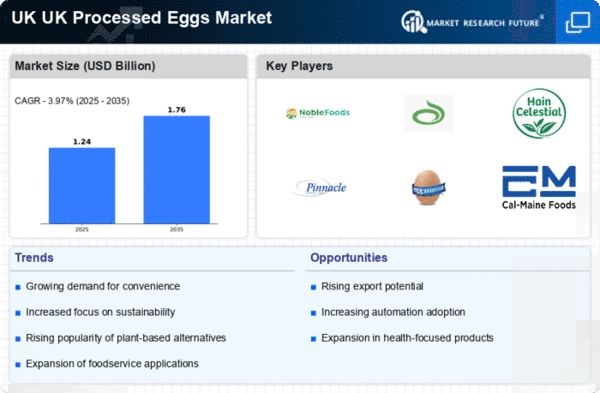
As per analysis, the UK Processed Eggs Market is projected to grow from USD 1.25 Billion in 2025 to USD 1.76 Billion by 2035, exhibiting a compound annual growth rate (CAGR) of 3.6% during the forecast period (2025 - 2035).

Key Market Trends & Highlights

The UK Processed Eggs Market is experiencing a notable shift towards convenience and health-oriented products.

  • The Food Service segment remains the largest contributor to the processed eggs market, driven by increasing demand for convenience foods.
  • The Retail segment is the fastest-growing area, reflecting a rising trend in health-conscious consumer preferences.
  • Liquid Eggs dominate the market, while Dried Eggs are emerging as the fastest-growing segment due to their versatility and shelf stability.
  • Key market drivers include the increasing demand for convenience foods and health-conscious consumer trends, which are shaping product innovation.

Market Size & Forecast

2024 Market Size 1.19 (USD Billion)
2035 Market Size 1.76 (USD Billion)
CAGR (2025 - 2035) 3.6%

Major Players

<p>Noble Foods (GB), Moy Park (GB), Hicksons (GB), Stonegate (GB), Lakeside Foods (GB), The Happy Egg Co. (GB), Cargill (GB), Eggs 'R' Us (GB), Poultry Partners (GB)</p>

Market Trends

The UK Processed Eggs Market is currently experiencing a notable transformation, driven by evolving consumer preferences and increasing demand for convenience. As lifestyles become busier, consumers are gravitating towards ready-to-use egg products, which offer both time savings and versatility in meal preparation. This shift is further supported by a growing awareness of the nutritional benefits associated with eggs, leading to a rise in their incorporation into various diets. Additionally, the market is witnessing innovations in processing techniques, enhancing product quality and safety, which are crucial for maintaining consumer trust and satisfaction. Moreover, sustainability has emerged as a pivotal theme within the UK Processed Eggs Market. Consumers are increasingly concerned about the environmental impact of their food choices, prompting manufacturers to adopt more sustainable practices. This includes sourcing eggs from free-range or organic farms and implementing eco-friendly packaging solutions. As a result, the market is likely to see a surge in demand for ethically produced egg products, reflecting a broader trend towards responsible consumption. Overall, the UK Processed Eggs Market appears poised for growth, driven by convenience, health consciousness, and sustainability initiatives.

Rise of Convenience Products

The UK Processed Eggs Market is witnessing a surge in demand for convenience-oriented products. Consumers are increasingly seeking ready-to-use egg solutions that simplify meal preparation, such as liquid eggs and pre-cooked egg dishes. This trend aligns with the fast-paced lifestyles of modern consumers, who prioritize efficiency without compromising on nutrition.

Focus on Health and Nutrition

Health consciousness among UK consumers is influencing their food choices, including egg products. The processed eggs segment is benefiting from this trend, as eggs are recognized for their high protein content and essential nutrients. Manufacturers are responding by promoting the health benefits of their offerings, appealing to a demographic that values nutritious options.

Sustainability and Ethical Sourcing

Sustainability is becoming increasingly important in the UK Processed Eggs Market. Consumers are showing a preference for products that are sourced ethically, such as free-range or organic eggs. This shift is prompting producers to adopt more sustainable practices, including eco-friendly packaging and responsible farming methods, to meet consumer expectations.

UK Processed Eggs Market Market Drivers

Innovation in Product Offerings

Innovation is a key driver in the UK Processed Eggs Market, as manufacturers continuously seek to develop new and improved products. The introduction of value-added processed egg products, such as organic and free-range options, caters to the growing consumer demand for quality and ethical sourcing. Furthermore, advancements in food technology have enabled the creation of products with extended shelf life and enhanced nutritional profiles. For instance, the launch of fortified processed egg products, enriched with vitamins and minerals, has gained traction among health-conscious consumers. This focus on innovation not only attracts new customers but also retains existing ones, thereby fostering growth within the UK Processed Eggs Market. As competition intensifies, the ability to innovate will likely remain a crucial factor for success in this sector.

Health Conscious Consumer Trends

The UK Processed Eggs Market is witnessing a shift towards health-conscious consumer behavior. With rising awareness of nutrition and dietary choices, consumers are increasingly seeking protein-rich foods that align with their health goals. Processed eggs, known for their high protein content and essential nutrients, are becoming a preferred choice among health-focused individuals. Recent surveys indicate that approximately 60% of UK consumers prioritize protein intake in their diets, which bodes well for the processed eggs segment. Additionally, the growing trend of fitness and wellness is likely to further drive demand for processed egg products, as they are often marketed as healthy alternatives to traditional egg offerings. This trend suggests a promising future for the UK Processed Eggs Market, as it adapts to meet the evolving preferences of health-conscious consumers.

Increasing Demand for Convenience Foods

The UK Processed Eggs Market is experiencing a notable surge in demand for convenience foods. As consumers lead increasingly busy lifestyles, the preference for ready-to-cook and easy-to-use products has intensified. Processed eggs, such as liquid eggs and pre-cooked egg products, offer significant time savings and versatility in meal preparation. According to recent data, the convenience food sector in the UK has grown by approximately 5% annually, with processed eggs playing a pivotal role in this trend. This shift is likely to continue, as more households seek quick meal solutions without compromising on quality. The UK Processed Eggs Market is thus positioned to benefit from this growing consumer inclination towards convenience, potentially leading to increased sales and product innovation.

Regulatory Support and Food Safety Standards

The UK Processed Eggs Market benefits from robust regulatory support and stringent food safety standards. The UK government has implemented comprehensive regulations to ensure the safety and quality of processed egg products. These regulations not only protect consumers but also enhance the credibility of the industry. Compliance with food safety standards, such as those set by the Food Standards Agency, is essential for manufacturers aiming to maintain market access and consumer trust. Additionally, government initiatives promoting local sourcing and production of eggs contribute to the sustainability of the UK Processed Eggs Market. This regulatory framework is likely to foster a stable environment for growth, encouraging investment and innovation within the sector.

Rising Popularity of Plant-Based Alternatives

The UK Processed Eggs Market is also influenced by the rising popularity of plant-based alternatives. As more consumers adopt vegetarian and vegan diets, there is a growing demand for egg substitutes that mimic the taste and texture of traditional eggs. This trend presents both challenges and opportunities for the processed eggs sector. While the market for plant-based egg alternatives is expanding, traditional processed egg products can adapt by highlighting their nutritional benefits and versatility. The UK Processed Eggs Market may need to innovate and diversify its offerings to remain competitive in this evolving landscape. This dynamic could lead to new product development and marketing strategies aimed at appealing to a broader consumer base.

Market Segment Insights

By Application: Food Service (Largest) vs. Retail (Fastest-Growing)

<p>In the UK processed eggs market, the application segment comprises various channels including food service, retail, food processing, baking, and snacking. The food service sector holds the largest market share, driven by the increasing demand from restaurants, cafes, and catering companies that utilize processed eggs for their menu offerings. Retail, while currently smaller in share compared to food service, is rapidly gaining momentum as more consumers opt for convenient meal solutions at home, thus driving the growth of processed egg products in supermarkets and grocery stores.</p>

<p>Food Service (Dominant) vs. Retail (Emerging)</p>

<p>The food service application is recognized as the dominant player in the UK processed eggs market, showcasing its extensive use in culinary applications across restaurants and hotel chains. This segment benefits from the ongoing trend of culinary innovation and demand for quality ingredients in food preparation. Conversely, the retail segment emerges as a significant player as it taps into the growing consumer preference for ready-to-use egg products, such as liquid eggs and hard-boiled eggs, which cater to the convenience-seeking consumer. This shift underscores changing lifestyles and the desire for quick meal solutions, indicating a promising trajectory for the retail segment in the upcoming years.</p>

By Product Type: Liquid Eggs (Largest) vs. Dried Eggs (Fastest-Growing)

<p>In the UK processed eggs market, liquid eggs currently hold the largest share among all product types, being favored for their versatility and convenience in various culinary applications. Following closely, dried eggs are gaining traction due to their long shelf life and stable properties, making them attractive for both consumers and food manufacturers. Frozen and powdered eggs also contribute to the market but remain lesser-known categories in comparison with liquid and dried segments.</p>

<p>Liquid Eggs (Dominant) vs. Dried Eggs (Emerging)</p>

<p>Liquid eggs dominate the UK processed eggs market, primarily due to their widespread usage in food processing, baking, and catering industries. Their convenience and ease of use make them a preferred choice for chefs and food businesses. On the other hand, dried eggs are emerging as a notable segment, particularly in the health-conscious demographic and among consumers looking for long-lasting products. Dried eggs offer advantages like lightweight packaging and extended storage without refrigeration, expanding their scope in culinary and industrial applications, thus making them a competitive product in the market.</p>

By End Use: Household (Largest) vs. Industrial (Fastest-Growing)

<p>In the UK Processed Eggs Market, the Household segment holds the largest share, driven by increased consumer preference for convenience and the rising trend of home cooking. The segment encompasses various products, including scrambled eggs, egg whites, and liquid eggs, appealing to a diverse demographic. In contrast, the Industrial segment is rapidly expanding to cater to the growing demand for processed eggs in food manufacturing and baked goods, positioning it as the fastest-growing segment in the market.</p>

<p>Household (Dominant) vs. Industrial (Emerging)</p>

<p>The Household segment is characterized by its strong market position, as consumers increasingly favor ready-to-use and convenient egg products for domestic preparation, making it the dominant force in the UK Processed Eggs Market. This segment enjoys a loyal customer base, with products widely used for breakfast solutions and in various recipes. Conversely, the Industrial segment, deemed emerging, is gaining momentum due to its utilization in large-scale food operations, such as bakeries and processed food manufacturers. This segment is tapping into the growing emphasis on high-quality protein sources and cost-effective solutions in food production, thus driving its rapid market growth.</p>

By Distribution Channel: Supermarkets (Largest) vs. Online (Fastest-Growing)

<p>In the UK processed eggs market, supermarkets hold a dominant share, serving as the primary point of purchase for consumers. Their extensive reach and established brand presence make them a go-to source for shoppers seeking reliable options for processed eggs. In contrast, online channels are experiencing rapid growth as consumers increasingly turn to e-commerce for convenience. Online sales are benefiting from changing shopping habits and the rise of home delivery services, making it a compelling option for consumers seeking processed eggs.</p>

<p>Supermarkets (Dominant) vs. Online (Emerging)</p>

<p>Supermarkets continue to exhibit dominance in the UK processed eggs market, leveraging their vast networks and the ability to offer various egg products under one roof. They are able to cater to a wide demographic, including families and bulk buyers, with promotions that drive purchases. Conversely, online distribution channels are emerging as a significant player due to shifting consumer behaviors. The convenience of ordering from home, coupled with efficient delivery options, attracts younger consumers and busy households. This trend is likely to continue as technological advancements improve the online shopping experience, thereby enhancing the attractiveness of processed eggs sold via online platforms.</p>

By Formulation: Organic (Largest) vs. Conventional (Fastest-Growing)

<p>In the UK processed eggs market, the formulation segment exhibits a diverse distribution among organic, conventional, and free-range products. Organic eggs have emerged as the largest segment, driven by an increasing consumer preference for natural and sustainable products. Conventional eggs, on the other hand, constitute a significant portion of the market, appealing to budget-conscious consumers while maintaining availability across various retail channels. Free-range eggs also play a notable role, benefiting from health-conscious trends. The growth trajectory for the formulation segment is primarily influenced by changing consumer lifestyles and expectations. There is a growing inclination towards organic products, which is associated with higher nutritional benefits and ethical farming practices. Meanwhile, conventional processed eggs are witnessing the fastest growth due to their affordability and widespread popularity. This segment is becoming increasingly competitive as manufacturers innovate to enhance product standards and appeal.</p>

<p>Organic (Dominant) vs. Conventional (Emerging)</p>

<p>Organic eggs are dominating the formulated segment in the UK processed eggs market, characterized by their appeal to health-conscious consumers and those interested in ethical farming. This segment's growth is fueled by increased awareness of the benefits of organic farming and the associated higher nutritional values of organic eggs. In contrast, conventional eggs are emerging as a growing choice due to their affordability and ease of access. They tend to attract a more price-sensitive demographic, making them a significant player in the processed eggs sector. As consumers seek a balance between quality and cost, the conventional segment is adapting through enhancements in production standards and increasing focus on food safety. This dynamic interplay positions both organic and conventional options uniquely in the evolving marketplace.</p>

Get more detailed insights about UK Processed Eggs Market Research Report— Forecast till 2035

Regional Insights

North America : Stable Market Dynamics

The North American processed eggs market is driven by increasing consumer demand for convenience foods and protein-rich diets. Regulatory support for food safety and quality standards has further catalyzed market growth. The U.S. holds the largest market share at approximately 70%, followed by Canada at 20%. This robust demand is supported by a growing trend towards health-conscious eating and the expansion of food service sectors. Leading players in this region include major companies like Noble Foods and Pinnacle Foods, which dominate the market with innovative product offerings. The competitive landscape is characterized by a mix of established brands and emerging players, all vying for market share. The presence of key players ensures a diverse range of processed egg products, catering to various consumer preferences and dietary needs.

Europe : Regulatory Framework Impact

The European processed eggs market is significantly influenced by stringent regulations aimed at ensuring food safety and sustainability. The UK, as a key player, holds about 30% of the market share, while Germany follows closely with 25%. The demand for processed eggs is driven by the growing trend of sustainable sourcing and consumer preference for high-quality, ethically produced food products. Regulatory frameworks are pushing for transparency and traceability in the supply chain. Countries like the UK and Germany lead the market, with a competitive landscape featuring established brands such as Hickmans and The Happy Egg Co. The presence of these key players fosters innovation in product development, particularly in organic and free-range processed eggs. The market is also witnessing an increase in collaborations and partnerships aimed at enhancing product offerings and expanding distribution channels.

Asia-Pacific : Emerging Market Potential

The Asia-Pacific processed eggs market is witnessing rapid growth, driven by increasing urbanization and changing dietary habits. Countries like China and India are leading this growth, with China holding approximately 40% of the market share, followed by India at 25%. The rising middle class and their demand for convenient, protein-rich food options are significant growth drivers. Additionally, favorable government policies supporting the poultry industry are enhancing market dynamics. The competitive landscape is evolving, with both local and international players entering the market. Key companies such as Lakeside Foods and Moy Park are expanding their presence in this region. The focus on product innovation, including ready-to-eat and value-added processed egg products, is becoming increasingly important to cater to diverse consumer preferences and dietary needs.

Middle East and Africa : Untapped Market Opportunities

The Middle East and Africa processed eggs market is characterized by untapped potential and increasing demand for protein-rich foods. The region is witnessing a gradual shift towards processed egg products, driven by urbanization and changing consumer lifestyles. Countries like South Africa and the UAE are leading the market, with South Africa holding about 30% of the market share, while the UAE accounts for 20%. The growing food service industry and rising health awareness are key factors propelling market growth. The competitive landscape is still developing, with local players and international brands vying for market share. Companies such as Eggs by Ella and Cotswold Eggs are making strides in this region. The focus on quality and sustainability is becoming increasingly important, as consumers seek products that align with their health and ethical values. This presents significant opportunities for growth and innovation in the processed eggs sector.

Key Players and Competitive Insights

The UK processed eggs market is currently characterized by a competitive landscape that is both dynamic and multifaceted. Key growth drivers include increasing consumer demand for convenience foods, a rising focus on health and nutrition, and the ongoing trend towards sustainable sourcing. Major players such as Noble Foods (GB), Moy Park (GB), and Cargill (GB) are strategically positioned to leverage these trends. Noble Foods (GB) emphasizes innovation in product development, particularly in the realm of free-range and organic offerings, while Moy Park (GB) focuses on regional expansion and enhancing its supply chain efficiencies. Cargill (GB) appears to be investing heavily in digital transformation initiatives, which may enhance operational efficiencies and customer engagement. Collectively, these strategies contribute to a competitive environment that is increasingly focused on quality, sustainability, and technological advancement.

In terms of business tactics, companies are localizing manufacturing to reduce transportation costs and enhance supply chain resilience. The market structure is moderately fragmented, with several key players holding substantial market shares. This fragmentation allows for a variety of product offerings, catering to diverse consumer preferences. However, the collective influence of these major players is significant, as they set trends and standards that smaller companies often follow.

In December 2025, Noble Foods (GB) announced a partnership with a leading food technology firm to develop a new line of high-protein processed egg products aimed at health-conscious consumers. This strategic move is likely to enhance Noble's product portfolio and cater to the growing demand for nutritious food options, thereby strengthening its market position. The collaboration may also facilitate innovation in product formulation, aligning with current consumer trends towards health and wellness.

In November 2025, Moy Park (GB) launched a new sustainability initiative aimed at reducing its carbon footprint by 30% over the next five years. This initiative underscores Moy Park's commitment to environmental stewardship and may resonate well with consumers increasingly concerned about sustainability. By prioritizing eco-friendly practices, Moy Park could enhance its brand reputation and attract a more environmentally conscious customer base.

In October 2025, Cargill (GB) unveiled a state-of-the-art processing facility designed to incorporate AI-driven technologies for quality control and efficiency. This investment not only signifies Cargill's commitment to innovation but also positions the company to respond more adeptly to market demands. The integration of AI may streamline operations and improve product consistency, which is crucial in maintaining competitive advantage in a crowded market.

As of January 2026, current competitive trends in the processed eggs market are increasingly defined by digitalization, sustainability, and the integration of advanced technologies such as AI. Strategic alliances are becoming more prevalent, as companies seek to enhance their capabilities and market reach. The competitive differentiation is likely to evolve from traditional price-based competition towards a focus on innovation, technology, and supply chain reliability. This shift suggests that companies that prioritize these areas may be better positioned to thrive in the future.

Key Companies in the UK Processed Eggs Market include

Industry Developments

July 2022: A strategic investment in Ovotrack Holding, a top provider of inventory management and traceability systems for egg processing facilities, grading centers, and hatcheries, has been agreed to by Sanovo Technology and Ovotrack.

July 2021: A brand of bottled egg whites was introduced by Cornish egg company St Ewe's in Morrisons stores around the nation. The Super Egg Whites are 100% pasteurized free-range egg whites, zero grams of fat, zero grams of protein per 100 milliliters, and devoid of gluten and cholesterol, according to the producer.

Future Outlook

UK Processed Eggs Market Future Outlook

The UK Processed Eggs Market is projected to grow at a 3.6% CAGR from 2024 to 2035, driven by increasing demand for convenience foods and health-conscious consumer trends.

New opportunities lie in:

  • Expansion of ready-to-eat meal kits featuring processed eggs
  • Development of high-protein, low-fat processed egg products
  • Investment in sustainable packaging solutions for processed egg products

By 2035, the UK Processed Eggs Market is expected to be robust, reflecting evolving consumer preferences and innovative product offerings.

Market Segmentation

UK Processed Eggs Market End Use Outlook

  • Household
  • Commercial
  • Industrial

UK Processed Eggs Market Application Outlook

  • Food Service
  • Retail
  • Food Processing
  • Baking
  • Snacking

UK Processed Eggs Market Formulation Outlook

  • Organic
  • Conventional
  • Free Range

UK Processed Eggs Market Product Type Outlook

  • Liquid Eggs
  • Dried Eggs
  • Frozen Eggs
  • Powdered Eggs

UK Processed Eggs Market Distribution Channel Outlook

  • Online
  • Supermarkets
  • Convenience Stores
  • Specialty Stores

Report Scope

MARKET SIZE 20241.19(USD Billion)
MARKET SIZE 20251.25(USD Billion)
MARKET SIZE 20351.76(USD Billion)
COMPOUND ANNUAL GROWTH RATE (CAGR)3.6% (2024 - 2035)
REPORT COVERAGERevenue Forecast, Competitive Landscape, Growth Factors, and Trends
BASE YEAR2024
Market Forecast Period2025 - 2035
Historical Data2019 - 2024
Market Forecast UnitsUSD Billion
Key Companies ProfiledNoble Foods (GB), Moy Park (GB), Hicksons (GB), Stonegate (GB), Lakeside Foods (GB), The Happy Egg Co. (GB), Cargill (GB), Eggs 'R' Us (GB), Poultry Partners (GB)
Segments CoveredApplication, Product Type, End Use, Distribution Channel, Formulation
Key Market OpportunitiesGrowing demand for convenient, ready-to-eat processed egg products among health-conscious consumers in the UK.
Key Market DynamicsRising consumer demand for convenience drives innovation in the UK processed eggs market.
Countries CoveredUK

FAQs

What is the current valuation of the UK processed eggs market?

<p>The UK processed eggs market was valued at 1.19 USD Billion in 2024.</p>

What is the projected market valuation for the UK processed eggs market in 2035?

<p>The market is projected to reach 1.76 USD Billion by 2035.</p>

What is the expected CAGR for the UK processed eggs market from 2025 to 2035?

<p>The expected CAGR for the UK processed eggs market during the forecast period 2025 - 2035 is 3.6%.</p>

Which companies are the key players in the UK processed eggs market?

<p>Key players in the market include Noble Foods, Moy Park, Hicksons, Stonegate, Lakeside Foods, The Happy Egg Co., Cargill, Eggs 'R' Us, and Poultry Partners.</p>

What are the main applications of processed eggs in the UK market?

<p>The main applications include food service, retail, food processing, baking, and snacking.</p>

  1. SECTION I: EXECUTIVE SUMMARY AND KEY HIGHLIGHTS
    1. EXECUTIVE SUMMARY
      1. Market Overview
      2. Key Findings
      3. Market Segmentation
      4. Competitive Landscape
      5. Challenges and Opportunities
      6. Future Outlook
  2. SECTION II: SCOPING, METHODOLOGY AND MARKET STRUCTURE
    1. MARKET INTRODUCTION
      1. Definition
      2. Scope of the study
    2. RESEARCH METHODOLOGY
      1. Overview
      2. Data Mining
      3. Secondary Research
      4. Primary Research
      5. Forecasting Model
      6. Market Size Estimation
      7. Data Triangulation
      8. Validation
  3. SECTION III: QUALITATIVE ANALYSIS
    1. MARKET DYNAMICS
      1. Overview
      2. Drivers
      3. Restraints
      4. Opportunities
    2. MARKET FACTOR ANALYSIS
      1. Value chain Analysis
      2. Porter's Five Forces Analysis
      3. COVID-19 Impact Analysis
  4. SECTION IV: QUANTITATIVE ANALYSIS
    1. Food, Beverages & Nutrition, BY Type (USD Billion)
      1. Dried Egg Products
      2. Liquid Egg Products
      3. Frozen Egg Products
    2. Food, Beverages & Nutrition, BY Application (USD Billion)
      1. Bakery & Confectionery
      2. Food Processing
      3. Diary Production
      4. Ready to Eat
      5. Soups and Sauces
      6. Others
    3. Food, Beverages & Nutrition, BY Region (USD Billion)
      1. North America
      2. Europe
      3. APAC
      4. South America
      5. MEA
  5. SECTION V: COMPETITIVE ANALYSIS
    1. Competitive Landscape
      1. Overview
      2. Competitive Analysis
      3. Market share Analysis
      4. Major Growth Strategy in the Food, Beverages & Nutrition
      5. Competitive Benchmarking
      6. Leading Players in Terms of Number of Developments in the Food, Beverages & Nutrition
      7. Key developments and growth strategies
      8. Major Players Financial Matrix
    2. Company Profiles
      1. Noble Foods (GB)
      2. Pinnacle Foods (GB)
      3. Hickmans (GB)
      4. Lakeside Foods (GB)
      5. The Happy Egg Co (GB)
      6. Eggs by Ella (GB)
      7. Cotswold Eggs (GB)
      8. Dale Farm (GB)
      9. Moy Park (GB)
    3. Appendix
      1. References
      2. Related Reports
  6. LIST OF FIGURES
    1. MARKET SYNOPSIS
    2. NORTH AMERICA MARKET ANALYSIS
    3. US MARKET ANALYSIS BY TYPE
    4. US MARKET ANALYSIS BY APPLICATION
    5. CANADA MARKET ANALYSIS BY TYPE
    6. CANADA MARKET ANALYSIS BY APPLICATION
    7. EUROPE MARKET ANALYSIS
    8. GERMANY MARKET ANALYSIS BY TYPE
    9. GERMANY MARKET ANALYSIS BY APPLICATION
    10. UK MARKET ANALYSIS BY TYPE
    11. UK MARKET ANALYSIS BY APPLICATION
    12. FRANCE MARKET ANALYSIS BY TYPE
    13. FRANCE MARKET ANALYSIS BY APPLICATION
    14. RUSSIA MARKET ANALYSIS BY TYPE
    15. RUSSIA MARKET ANALYSIS BY APPLICATION
    16. ITALY MARKET ANALYSIS BY TYPE
    17. ITALY MARKET ANALYSIS BY APPLICATION
    18. SPAIN MARKET ANALYSIS BY TYPE
    19. SPAIN MARKET ANALYSIS BY APPLICATION
    20. REST OF EUROPE MARKET ANALYSIS BY TYPE
    21. REST OF EUROPE MARKET ANALYSIS BY APPLICATION
    22. APAC MARKET ANALYSIS
    23. CHINA MARKET ANALYSIS BY TYPE
    24. CHINA MARKET ANALYSIS BY APPLICATION
    25. INDIA MARKET ANALYSIS BY TYPE
    26. INDIA MARKET ANALYSIS BY APPLICATION
    27. JAPAN MARKET ANALYSIS BY TYPE
    28. JAPAN MARKET ANALYSIS BY APPLICATION
    29. SOUTH KOREA MARKET ANALYSIS BY TYPE
    30. SOUTH KOREA MARKET ANALYSIS BY APPLICATION
    31. MALAYSIA MARKET ANALYSIS BY TYPE
    32. MALAYSIA MARKET ANALYSIS BY APPLICATION
    33. THAILAND MARKET ANALYSIS BY TYPE
    34. THAILAND MARKET ANALYSIS BY APPLICATION
    35. INDONESIA MARKET ANALYSIS BY TYPE
    36. INDONESIA MARKET ANALYSIS BY APPLICATION
    37. REST OF APAC MARKET ANALYSIS BY TYPE
    38. REST OF APAC MARKET ANALYSIS BY APPLICATION
    39. SOUTH AMERICA MARKET ANALYSIS
    40. BRAZIL MARKET ANALYSIS BY TYPE
    41. BRAZIL MARKET ANALYSIS BY APPLICATION
    42. MEXICO MARKET ANALYSIS BY TYPE
    43. MEXICO MARKET ANALYSIS BY APPLICATION
    44. ARGENTINA MARKET ANALYSIS BY TYPE
    45. ARGENTINA MARKET ANALYSIS BY APPLICATION
    46. REST OF SOUTH AMERICA MARKET ANALYSIS BY TYPE
    47. REST OF SOUTH AMERICA MARKET ANALYSIS BY APPLICATION
    48. MEA MARKET ANALYSIS
    49. GCC COUNTRIES MARKET ANALYSIS BY TYPE
    50. GCC COUNTRIES MARKET ANALYSIS BY APPLICATION
    51. SOUTH AFRICA MARKET ANALYSIS BY TYPE
    52. SOUTH AFRICA MARKET ANALYSIS BY APPLICATION
    53. REST OF MEA MARKET ANALYSIS BY TYPE
    54. REST OF MEA MARKET ANALYSIS BY APPLICATION
    55. KEY BUYING CRITERIA OF FOOD, BEVERAGES & NUTRITION
    56. RESEARCH PROCESS OF MRFR
    57. DRO ANALYSIS OF FOOD, BEVERAGES & NUTRITION
    58. DRIVERS IMPACT ANALYSIS: FOOD, BEVERAGES & NUTRITION
    59. RESTRAINTS IMPACT ANALYSIS: FOOD, BEVERAGES & NUTRITION
    60. SUPPLY / VALUE CHAIN: FOOD, BEVERAGES & NUTRITION
    61. FOOD, BEVERAGES & NUTRITION, BY TYPE, 2024 (% SHARE)
    62. FOOD, BEVERAGES & NUTRITION, BY TYPE, 2024 TO 2035 (USD Billion)
    63. FOOD, BEVERAGES & NUTRITION, BY APPLICATION, 2024 (% SHARE)
    64. FOOD, BEVERAGES & NUTRITION, BY APPLICATION, 2024 TO 2035 (USD Billion)
    65. BENCHMARKING OF MAJOR COMPETITORS
  7. LIST OF TABLES
    1. LIST OF ASSUMPTIONS
    2. North America MARKET SIZE ESTIMATES; FORECAST
      1. BY TYPE, 2025-2035 (USD Billion)
      2. BY APPLICATION, 2025-2035 (USD Billion)
    3. US MARKET SIZE ESTIMATES; FORECAST
      1. BY TYPE, 2025-2035 (USD Billion)
      2. BY APPLICATION, 2025-2035 (USD Billion)
    4. Canada MARKET SIZE ESTIMATES; FORECAST
      1. BY TYPE, 2025-2035 (USD Billion)
      2. BY APPLICATION, 2025-2035 (USD Billion)
    5. Europe MARKET SIZE ESTIMATES; FORECAST
      1. BY TYPE, 2025-2035 (USD Billion)
      2. BY APPLICATION, 2025-2035 (USD Billion)
    6. Germany MARKET SIZE ESTIMATES; FORECAST
      1. BY TYPE, 2025-2035 (USD Billion)
      2. BY APPLICATION, 2025-2035 (USD Billion)
    7. UK MARKET SIZE ESTIMATES; FORECAST
      1. BY TYPE, 2025-2035 (USD Billion)
      2. BY APPLICATION, 2025-2035 (USD Billion)
    8. France MARKET SIZE ESTIMATES; FORECAST
      1. BY TYPE, 2025-2035 (USD Billion)
      2. BY APPLICATION, 2025-2035 (USD Billion)
    9. Russia MARKET SIZE ESTIMATES; FORECAST
      1. BY TYPE, 2025-2035 (USD Billion)
      2. BY APPLICATION, 2025-2035 (USD Billion)
    10. Italy MARKET SIZE ESTIMATES; FORECAST
      1. BY TYPE, 2025-2035 (USD Billion)
      2. BY APPLICATION, 2025-2035 (USD Billion)
    11. Spain MARKET SIZE ESTIMATES; FORECAST
      1. BY TYPE, 2025-2035 (USD Billion)
      2. BY APPLICATION, 2025-2035 (USD Billion)
    12. Rest of Europe MARKET SIZE ESTIMATES; FORECAST
      1. BY TYPE, 2025-2035 (USD Billion)
      2. BY APPLICATION, 2025-2035 (USD Billion)
    13. APAC MARKET SIZE ESTIMATES; FORECAST
      1. BY TYPE, 2025-2035 (USD Billion)
      2. BY APPLICATION, 2025-2035 (USD Billion)
    14. China MARKET SIZE ESTIMATES; FORECAST
      1. BY TYPE, 2025-2035 (USD Billion)
      2. BY APPLICATION, 2025-2035 (USD Billion)
    15. India MARKET SIZE ESTIMATES; FORECAST
      1. BY TYPE, 2025-2035 (USD Billion)
      2. BY APPLICATION, 2025-2035 (USD Billion)
    16. Japan MARKET SIZE ESTIMATES; FORECAST
      1. BY TYPE, 2025-2035 (USD Billion)
      2. BY APPLICATION, 2025-2035 (USD Billion)
    17. South Korea MARKET SIZE ESTIMATES; FORECAST
      1. BY TYPE, 2025-2035 (USD Billion)
      2. BY APPLICATION, 2025-2035 (USD Billion)
    18. Malaysia MARKET SIZE ESTIMATES; FORECAST
      1. BY TYPE, 2025-2035 (USD Billion)
      2. BY APPLICATION, 2025-2035 (USD Billion)
    19. Thailand MARKET SIZE ESTIMATES; FORECAST
      1. BY TYPE, 2025-2035 (USD Billion)
      2. BY APPLICATION, 2025-2035 (USD Billion)
    20. Indonesia MARKET SIZE ESTIMATES; FORECAST
      1. BY TYPE, 2025-2035 (USD Billion)
      2. BY APPLICATION, 2025-2035 (USD Billion)
    21. Rest of APAC MARKET SIZE ESTIMATES; FORECAST
      1. BY TYPE, 2025-2035 (USD Billion)
      2. BY APPLICATION, 2025-2035 (USD Billion)
    22. South America MARKET SIZE ESTIMATES; FORECAST
      1. BY TYPE, 2025-2035 (USD Billion)
      2. BY APPLICATION, 2025-2035 (USD Billion)
    23. Brazil MARKET SIZE ESTIMATES; FORECAST
      1. BY TYPE, 2025-2035 (USD Billion)
      2. BY APPLICATION, 2025-2035 (USD Billion)
    24. Mexico MARKET SIZE ESTIMATES; FORECAST
      1. BY TYPE, 2025-2035 (USD Billion)
      2. BY APPLICATION, 2025-2035 (USD Billion)
    25. Argentina MARKET SIZE ESTIMATES; FORECAST
      1. BY TYPE, 2025-2035 (USD Billion)
      2. BY APPLICATION, 2025-2035 (USD Billion)
    26. Rest of South America MARKET SIZE ESTIMATES; FORECAST
      1. BY TYPE, 2025-2035 (USD Billion)
      2. BY APPLICATION, 2025-2035 (USD Billion)
    27. MEA MARKET SIZE ESTIMATES; FORECAST
      1. BY TYPE, 2025-2035 (USD Billion)
      2. BY APPLICATION, 2025-2035 (USD Billion)
    28. GCC Countries MARKET SIZE ESTIMATES; FORECAST
      1. BY TYPE, 2025-2035 (USD Billion)
      2. BY APPLICATION, 2025-2035 (USD Billion)
    29. South Africa MARKET SIZE ESTIMATES; FORECAST
      1. BY TYPE, 2025-2035 (USD Billion)
      2. BY APPLICATION, 2025-2035 (USD Billion)
    30. Rest of MEA MARKET SIZE ESTIMATES; FORECAST
      1. BY TYPE, 2025-2035 (USD Billion)
      2. BY APPLICATION, 2025-2035 (USD Billion)
    31. PRODUCT LAUNCH/PRODUCT DEVELOPMENT/APPROVAL
    32. ACQUISITION/PARTNERSHIP

UK Processed Eggs Market Segmentation

Market Segmentation Overview

  • Detailed segmentation data will be available in the full report
  • Comprehensive analysis by multiple parameters
  • Regional and country-level breakdowns
  • Market size forecasts by segment
Infographic

Free Sample Request

Kindly complete the form below to receive a free sample of this Report

Get Free Sample

Customer Strories

Compare Licence

×
Features License Type
Single User Multiuser License Enterprise User
Price $4,950 $5,950 $7,250
Maximum User Access Limit 1 User Upto 10 Users Unrestricted Access Throughout the Organization
Free Customization
Direct Access to Analyst
Deliverable Format
Platform Access
Discount on Next Purchase 10% 15% 15%
Printable Versions