Request Free Sample ×

Kindly complete the form below to receive a free sample of this Report

* Please use a valid business email

Leading companies partner with us for data-driven Insights

clients tt-cursor
Hero Background
English
Chinese
French
Japanese
Korean
German
Spanish

Two-piece Empty Hard Capsule Market Size

ID: MRFR/Pharma/4823-CR
72 Pages
Rahul Gotadki
Last Updated: March 27, 2026

Two-Piece Empty Hard Capsule Market Research Report By Raw Material (Gelatin Hydroxypropyl Methylcellulose (HPMC), Starch and Pullulan), By size (Size "00" capsules, Size "0" capsules, Size "1" capsules, Size "2" capsules, others), By End Users (Pharmaceutical Companies, Health & Nutrition, Others) And By Region (North America, Europe, Asia-Pacific, And Rest Of The World - Forecast Till 2035

Share:
Download PDF ×

We do not share your information with anyone. However, we may send you emails based on your report interest from time to time. You may contact us at any time to opt-out.

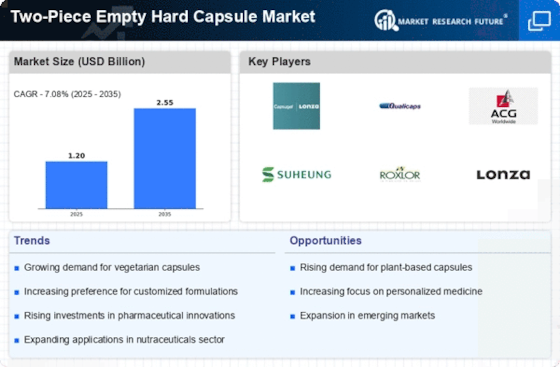
Two-piece Empty Hard Capsule Market Infographic
Purchase Options

Two Piece Empty Hard Capsule Size

Two-piece Empty Hard Capsule Market Growth Projections and Opportunities

The two-piece empty hard capsule is a widely used form of medicine that comes in two parts and is sealed together before reaching the people who use it. The global market for these capsules is influenced by several things, like big companies investing more in making these capsules and the capsules being used more in pharmaceutical and nutraceutical (related to nutrition) industries. For example, in February 2018, CapsCanada spent 28 million USD to make more K-CAPS capsules because people all over the world were wanting them. Also, there's a growing demand for capsules that have special certifications, like being kosher or halal, and this is expected to make the market even bigger.

However, there are things slowing down the growth of the market. One is that making vegetarian capsules can be expensive. Also, the prices of the materials used to make the capsules can go up and down, causing challenges for the market.

The global market for two-piece empty hard capsules is divided into different parts based on things like what materials are used, who uses them, and where they are used.

In simple terms, the two-piece empty hard capsule is like a puzzle with two parts, and companies are working hard to make more of them because many people around the world need and want these capsules. Big companies are spending a lot of money to make more of these capsules, especially when there's a high demand for them. The capsules are used in different industries, especially in making medicines and nutrition-related products.

Despite all the good things, there are also challenges. Making capsules without using animal products can cost a lot, and sometimes the prices of the things needed to make the capsules can change a lot, causing problems for the market.

To understand the market better, we can look at how these capsules are made, who uses them, and where they are used around the world. This helps companies plan better and make sure they are meeting the needs of the people who want these capsules.

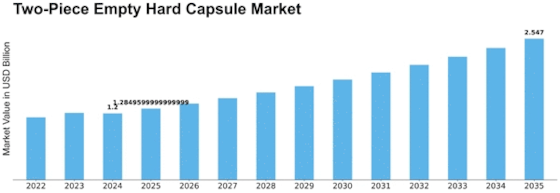
Two-piece Empty Hard Capsule Market Size Graph
Author
Author Profile
Rahul Gotadki
Research Manager

He holds an experience of about 9+ years in Market Research and Business Consulting, working under the spectrum of Life Sciences and Healthcare domains. Rahul conceptualizes and implements a scalable business strategy and provides strategic leadership to the clients. His expertise lies in market estimation, competitive intelligence, pipeline analysis, customer assessment, etc.

Leave a Comment

FAQs

What is the current market valuation of the Two-Piece Empty Hard Capsule Market?

<p>The market valuation was 1.2 USD Billion in 2024.</p>

What is the projected market size for the Two-Piece Empty Hard Capsule Market by 2035?

<p>The market is projected to reach 2.547 USD Billion by 2035.</p>

What is the expected CAGR for the Two-Piece Empty Hard Capsule Market during the forecast period?

<p>The expected CAGR for the market from 2025 to 2035 is 7.08%.</p>

Which companies are considered key players in the Two-Piece Empty Hard Capsule Market?

<p>Key players include Capsugel, Qualicaps, ACG Worldwide, Suheung Co Ltd, Roxlor, Lonza Group, Fangda Science and Technology, and Shandong Pharmaceutical.</p>

What are the primary raw materials used in the production of Two-Piece Empty Hard Capsules?

<p>The primary raw materials include Gelatin, Hydroxypropyl Methylcellulose (HPMC), and Starch and Pullulan.</p>

How does the market size for Gelatin capsules compare to HPMC capsules?

<p>The market size for Gelatin capsules was 0.72 to 1.5 USD Billion, while HPMC capsules ranged from 0.36 to 0.8 USD Billion.</p>

What is the market size for Size '00' capsules in the Two-Piece Empty Hard Capsule Market?

The market size for Size '00' capsules is projected to be between 0.3 and 0.7 USD Billion.

Which end-user segment holds the largest market share in the Two-Piece Empty Hard Capsule Market?

The Pharmaceutical Companies segment holds the largest market share, with a valuation between 0.72 and 1.5 USD Billion.

What is the market size for the 'Others' category in the Size segment?

The 'Others' category in the Size segment is projected to range from 0.2 to 0.5 USD Billion.

What trends are influencing the growth of the Two-Piece Empty Hard Capsule Market?

Trends such as increasing demand from pharmaceutical companies and health &amp; nutrition sectors are likely influencing market growth.

Market Summary

As per Market Research Future analysis, the Two-Piece Empty Hard Capsule Market Size was estimated at 1.2 USD Billion in 2024. The Two-Piece Empty Hard Capsule industry is projected to grow from USD 1.285 Billion in 2025 to USD 2.547 Billion by 2035, exhibiting a compound annual growth rate (CAGR) of 7.08% during the forecast period 2025 - 2035

Key Market Trends & Highlights

The Two-Piece Empty Hard Capsule Market is experiencing a dynamic shift towards innovative and health-conscious solutions.

  • The market is witnessing a notable shift towards vegetarian capsules, particularly in North America, driven by changing consumer preferences.
  • Technological advancements in manufacturing processes are enhancing the efficiency and quality of capsule production across the Asia-Pacific region.
  • The rise of personalized medicine is influencing the demand for tailored capsule solutions, especially in the pharmaceutical sector.
  • Increasing demand for dietary supplements and the expansion of pharmaceutical applications are key drivers propelling market growth.

Market Size & Forecast

2024 Market Size 1.2 (USD Billion)
2035 Market Size 2.547 (USD Billion)
CAGR (2025 - 2035) 7.08%
Largest Regional Market Share in 2024 North America

Major Players

Capsugel (US), Qualicaps (JP), ACG Worldwide (IN), Suheung Co Ltd (KR), Roxlor (US), Lonza Group (CH), Fangda Science and Technology (CN), Shandong Pharmaceutical (CN)

Market Trends

The Two-Piece Empty Hard Capsule Market is currently experiencing notable growth, driven by increasing demand for pharmaceutical products and dietary supplements. This market segment is characterized by a shift towards vegetarian and gelatin capsules, as consumers become more health-conscious and seek alternatives that align with their dietary preferences. The versatility of these capsules, which can encapsulate powders, granules, and pellets, further enhances their appeal across various applications. Additionally, advancements in capsule manufacturing technology are likely to improve production efficiency and product quality, thereby attracting more manufacturers to this sector. Moreover, the rising trend of personalized medicine is influencing the Two-Piece Empty Hard Capsule Market. As healthcare providers increasingly tailor treatments to individual patient needs, the demand for customized dosage forms is expected to rise. This trend may lead to innovations in capsule design and formulation, allowing for more effective delivery of active ingredients. Furthermore, the growing emphasis on sustainability within the pharmaceutical industry could drive the development of eco-friendly capsule options, potentially reshaping consumer preferences and market dynamics in the coming years.

Shift Towards Vegetarian Capsules

There is a noticeable trend towards the adoption of vegetarian capsules in the Two-Piece Empty Hard Capsule Market. This shift is largely influenced by consumer preferences for plant-based products, as individuals become more health-conscious and environmentally aware. Vegetarian capsules are perceived as a more natural alternative to traditional gelatin capsules, appealing to a broader audience, including those with dietary restrictions.

Technological Advancements in Manufacturing

Technological innovations in capsule manufacturing are transforming the Two-Piece Empty Hard Capsule Market. Enhanced production techniques are likely to improve efficiency and reduce costs, enabling manufacturers to meet the growing demand for high-quality capsules. These advancements may also facilitate the development of specialized capsules that cater to specific pharmaceutical needs, thereby expanding market opportunities.

Rise of Personalized Medicine

The increasing focus on personalized medicine is shaping the Two-Piece Empty Hard Capsule Market. As healthcare evolves towards tailored treatments, the demand for customized dosage forms is expected to grow. This trend may encourage the development of innovative capsule designs that allow for precise delivery of active ingredients, aligning with the needs of individual patients.

Two-piece Empty Hard Capsule Market Market Drivers

Growth of E-commerce in Health Products

The Two-Piece Empty Hard Capsule Market is experiencing a boost from the growth of e-commerce in health products. As online shopping becomes increasingly prevalent, consumers are turning to digital platforms for their health and wellness needs. This trend is particularly pronounced in the dietary supplement sector, where convenience and accessibility are paramount. Recent data indicates that e-commerce sales of health products are projected to grow at a CAGR of approximately 10% over the next few years. This shift towards online purchasing is likely to drive demand for Two-Piece Empty Hard Capsules, as manufacturers and retailers adapt to the changing landscape by offering a wider range of encapsulated products online. Consequently, the Two-Piece Empty Hard Capsule Market stands to benefit from this evolving retail environment.

Expansion of Pharmaceutical Applications

The Two-Piece Empty Hard Capsule Market is significantly benefiting from the expansion of pharmaceutical applications. As the pharmaceutical sector continues to innovate, there is an increasing need for effective drug delivery systems. Capsules are favored for their ability to mask unpleasant tastes and odors, which is particularly advantageous for certain medications. Recent statistics indicate that the pharmaceutical industry is expected to grow at a compound annual growth rate (CAGR) of around 5% over the next few years. This growth is likely to drive the demand for Two-Piece Empty Hard Capsules, as pharmaceutical companies seek reliable and efficient means to deliver their products. Additionally, the versatility of capsules in accommodating various formulations, including powders and liquids, further enhances their appeal within the pharmaceutical sector.

Increasing Demand for Dietary Supplements

The Two-Piece Empty Hard Capsule Market is experiencing a notable surge in demand for dietary supplements. This trend is largely driven by a growing awareness of health and wellness among consumers. As individuals increasingly seek preventive healthcare solutions, the consumption of vitamins, minerals, and herbal supplements has risen. According to recent data, the dietary supplement market is projected to reach a valuation of approximately 300 billion USD by 2025. This growth directly influences the Two-Piece Empty Hard Capsule Market, as manufacturers are compelled to produce more capsules to meet the rising demand for encapsulated supplements. Furthermore, the convenience and ease of consumption offered by capsules make them a preferred choice for consumers, thereby enhancing the market's growth potential.

Technological Innovations in Capsule Production

The Two-Piece Empty Hard Capsule Market is being transformed by technological innovations in capsule production. Advances in manufacturing processes, such as the use of automated systems and improved quality control measures, are enhancing production efficiency and product quality. These innovations allow for the creation of capsules that are not only more consistent in size and shape but also more effective in preserving the integrity of the contents. Recent developments indicate that the market for capsule manufacturing technology is expected to grow significantly, with projections suggesting a CAGR of around 6% in the coming years. This technological progress is likely to bolster the Two-Piece Empty Hard Capsule Market, as manufacturers strive to meet the increasing demands for high-quality encapsulated products.

Rising Popularity of Vegan and Vegetarian Products

The Two-Piece Empty Hard Capsule Market is witnessing a shift towards vegan and vegetarian products, reflecting broader consumer trends. As more individuals adopt plant-based diets, the demand for vegetarian capsules is on the rise. This shift is not merely a fad; it appears to be a long-term change in consumer preferences. Market Research Future suggests that the vegetarian capsule segment is expected to grow at a CAGR of approximately 8% over the next five years. This growth is indicative of a larger movement towards sustainable and ethical consumption. Consequently, manufacturers within the Two-Piece Empty Hard Capsule Market are increasingly investing in the development of plant-based capsules to cater to this evolving consumer base, thereby enhancing their market position.


Market Segment Insights

By Raw Material: Gelatin (Largest) vs. Hydroxypropyl Methylcellulose (HPMC) (Fastest-Growing)

<p>The Two-Piece Empty Hard Capsule Market is characterized by a diverse range of raw materials, with Gelatin holding the largest share due to its extensive application in the pharmaceutical industry. Gelatin capsules are well-known for their excellent bioavailability and stability, making them a preferred choice for various formulations. In contrast, Hydroxypropyl Methylcellulose (HPMC) is gaining traction among manufacturers, particularly for vegetarian and vegan segments, owing to its plant-derived nature. Starch and Pullulan are also present in the market but occupy a smaller share compared to the prominent roles of Gelatin and HPMC.</p>

<p>Gelatin (Dominant) vs. Hydroxypropyl Methylcellulose (HPMC) (Emerging)</p>

<p>Gelatin dominates the Two-Piece Empty Hard Capsule Market due to its widespread acceptance and performance attributes, such as rapid dissolution and compatibility with diverse formulations. It is primarily sourced from animal by-products, appealing to traditional pharmaceutical companies. Conversely, Hydroxypropyl Methylcellulose (HPMC) is emerging as a powerful alternative, especially with the increasing demand for vegetarian capsules. HPMC offers unique properties, including moisture resistance and a plant-based profile, resonating well with consumer trends towards natural products. Both Gelatin and HPMC cater to distinct market needs, indicative of a dynamically evolving industry where consumer preferences shape product offerings.</p>

By Size: Size '00' Capsules (Largest) vs. Size '0' Capsules (Fastest-Growing)

<p>In the Two-Piece Empty Hard Capsule Market, the 'Size 00' capsules dominate the segment, representing the largest share due to their versatility and widespread acceptance in pharmaceutical applications. Following closely are 'Size 0' capsules, which are rapidly gaining traction, particularly among companies focused on supplement manufacturing. Other sizes, such as 'Size 1' and 'Size 2', hold smaller market shares, often catering to niche segments within the industry. The growth trends in this segment are largely driven by an increasing demand for dietary supplements and personalized medicine, which favor larger capsule sizes for easier dosing. Additionally, the rise of vegetarian and vegan options has sparked interest in 'Size 0' capsules, which are perceived as more suitable for such formulations. This trend indicates a shift towards more consumer-friendly and accessible healthcare solutions.</p>

<p>Size '00' Capsules (Dominant) vs. Size '0' Capsules (Emerging)</p>

<p>Size '00' capsules are the cornerstone of the Two-Piece Empty Hard Capsule Market, recognized for their significant capacity which allows for higher fill volumes. They are favored by pharmaceutical manufacturers for drug formulations as well as in the nutraceutical sector for vitamins and supplements. In contrast, Size '0' capsules are emerging as a popular choice among new market entrants, particularly for health and wellness products due to their compatibility with a variety of fillers. Size '0' capsules strike a balance between volume and ease of swallowing, making them appealing to consumers. This dual positioning—size '00' as the dominant force and size '0' as the growing alternative—highlights the diverse preferences in dosage form and the evolving landscape of capsule utilization in the health sector.</p>

By End User: Pharmaceutical Companies (Largest) vs. Health & Nutrition (Fastest-Growing)

<p>In the Two-Piece Empty Hard Capsule Market, the distribution of market share among end users reveals a significant dominance of pharmaceutical companies, which hold the largest share due to the increasing demand for drug formulations requiring convenient and effective delivery systems. Health and nutrition segments are also seeing noteworthy contributions as these sectors recognize the importance of capsules in supplement delivery, showcasing a growing trend among consumers seeking convenient health solutions. The 'Others' category, comprising various applications, contributes positively to the market but remains dwarfed by the significant shares held by pharmaceutical and health & nutrition sectors.</p>

<p>Pharmaceutical Companies: Dominant vs. Health & Nutrition: Emerging</p>

<p>The pharmaceutical companies dominate the Two-Piece Empty Hard Capsule Market, leveraging their extensive research and development resources to innovate and introduce new drug formulations that require such delivery methods. Their robust infrastructure and established relationships with healthcare providers enable them to maintain a strong market position. Conversely, the health and nutrition sector is emerging rapidly, driven by a shift in consumer preferences towards <a href="https://www.marketresearchfuture.com/reports/health-supplements-market-1646" target="_blank" title="health supplements">health supplements</a> and nutraceutical products. This sector's growth is fueled by increasing health consciousness among consumers, leading to higher demand for easy-to-swallow capsule forms. Companies within this segment are adapting quickly, focusing on natural ingredients and innovative product offerings to cater to this growing market.</p>

Two-Piece Empty Hard Capsule Region Insights

By Region, the study segments the market into North America, Europe, Asia-Pacific, and Rest of the World. North America Two-Piece Empty Hard Capsule Market accounted for the largest market share of 36.60% in 2022 and is anticipated to reach approximately USD 0.71 billion by 2032 at a 5.70% CAGR during the forecast period. However, Asia-Pacific is projected to grow at the highest CAGR of 8.89% during the forecast period.

The outlook for the North America Two-Piece Empty Hard Capsule Market remains promising, with sustained growth anticipated. Investments in healthcare infrastructure and a growing awareness of advanced medical solutions are expected to drive market expansion further. Both established players and emerging entrants are poised to capitalize on these opportunities, leveraging technological advancements to meet the rising demand for improved surgical outcomes.

Further, the major countries will be study are US, Canada, Germany, France, UK, Italy, Spain, China, Japan, India, Australia, South Korea, and Brazil.

Source: Secondary Research, Primary Research, Market Research Future Database and Analyst Review

Get more detailed insights about Two-Piece Empty Hard Capsule Market Research Report - Global Forecast till 2035

Regional Insights

North America : Market Leader in Innovation

North America is the largest market for two-piece empty hard capsules, holding approximately 40% of the global market share. The region's growth is driven by increasing demand for pharmaceutical products, advancements in capsule technology, and stringent regulatory standards that ensure product quality. The presence of major pharmaceutical companies and a robust healthcare infrastructure further catalyze market expansion. The United States and Canada are the leading countries in this region, with the U.S. accounting for the majority of the market share. Key players such as Capsugel and Roxlor are headquartered here, contributing to a competitive landscape characterized by innovation and strategic partnerships. The focus on research and development in the pharmaceutical sector is expected to sustain growth in the coming years.

Europe : Regulatory Framework Drives Growth

Europe is the second-largest market for two-piece empty hard capsules, accounting for approximately 30% of the global market share. The region benefits from a strong regulatory framework that promotes high-quality manufacturing standards and safety protocols. Increasing health awareness and the rising prevalence of chronic diseases are driving demand for pharmaceutical products, thereby boosting the capsule market. Germany, France, and the UK are the leading countries in this region, with Germany being the largest market. The competitive landscape features key players like Qualicaps and Lonza Group, which are known for their innovative solutions. The presence of a well-established pharmaceutical industry and ongoing investments in research and development are expected to enhance market growth further.

Asia-Pacific : Emerging Market with High Potential

Asia-Pacific is an emerging powerhouse in the two-piece empty hard capsule market, holding approximately 25% of the global market share. The region's growth is fueled by increasing healthcare expenditure, a growing population, and rising demand for generic drugs. Regulatory support and initiatives to improve healthcare infrastructure are also significant growth drivers, making it a key area for market expansion. China and India are the leading countries in this region, with China being the largest market. The competitive landscape is marked by the presence of local players like Fangda Science and Technology and Shandong Pharmaceutical, alongside international companies. The region's focus on cost-effective manufacturing and innovation is expected to drive further growth in the capsule market.

Middle East and Africa : Untapped Market Opportunities

The Middle East and Africa represent a resource-rich frontier for the two-piece empty hard capsule market, holding approximately 5% of the global market share. The region is witnessing growth due to increasing healthcare investments, rising awareness of health issues, and a growing pharmaceutical sector. Regulatory bodies are also beginning to implement stricter guidelines, which will enhance product quality and safety in the market. South Africa and the UAE are the leading countries in this region, with South Africa showing significant growth potential. The competitive landscape is still developing, with opportunities for both local and international players to establish a presence. As healthcare infrastructure improves, the demand for high-quality pharmaceutical products is expected to rise, driving market growth.

Key Players and Competitive Insights

The Two-Piece Empty Hard Capsule Market is distinguished by the presence of numerous regional and local players catering to two-piece empty hard Capsule products that are evolving at a rapid pace. Furthermore, the increasing prevalence of non-communicable diseases, growing demand for nutraceuticals, and advancements in Capsule technology is further driving the growth of Two-Piece Empty Hard Capsule Market during the forecast period. The major players have adopted a strategy of obtaining regulatory approval from government agencies for their products, services and signing contracts and agreements to broaden their reach and reduce operational costs.
Qualicaps manufactures empty two-piece hard capsules for solid oral dosage forms and for use in dry powder inhalers, as well as a broad line of pharmaceuticals. The company manufactures pharmaceutical-grade capsules of high quality, available in various sizes, colors, and printing choices to help your product distinguish itself in the market.
in August 2021, Qualicaps Europe, S.A.U. expands its footprint throughout the region of South Asia. a result of this expansion, the company is well-equipped to maintain its high standards of performance, functionality, and quality in these integrated regions: flexibility to meet unique customer needs, cooperation in the scientific, technical, and service aspects of the Capsule delivery form, and high-quality products and services.

Key Companies in the Two-piece Empty Hard Capsule Market include

Industry Developments

August 2021:Qualicaps Europe, S.A.U. expands its footprint throughout the region of South Asia. a result of this expansion, the company is well-equipped to maintain its high standards of performance, functionality, and quality in these integrated regions: flexibility to meet unique customer needs, cooperation in the scientific, technical, and service aspects of the Capsule delivery form, and high-quality products and services.

Future Outlook

Two-piece Empty Hard Capsule Market Future Outlook

The Two-Piece Empty Hard Capsule Market is projected to grow at a 7.08% CAGR from 2025 to 2035, driven by increasing demand for pharmaceutical formulations and dietary supplements.

New opportunities lie in:

  • Expansion into emerging markets with tailored product offerings.
  • Development of plant-based capsule alternatives to meet consumer preferences.
  • Investment in advanced manufacturing technologies for enhanced production efficiency.

By 2035, the market is expected to solidify its position as a key player in the pharmaceutical industry.

Market Segmentation

Two-piece Empty Hard Capsule Market Size Outlook

  • Size '00' capsules
  • Size '0' capsules
  • Size '1' capsules
  • Size '2' capsules
  • Others

Two-piece Empty Hard Capsule Market End User Outlook

  • Pharmaceutical Companies
  • Health & Nutrition
  • Others

Two-piece Empty Hard Capsule Market Raw Material Outlook

  • Gelatin
  • Hydroxypropyl Methylcellulose (HPMC)
  • Starch and Pullulan

Report Scope

MARKET SIZE 2024 1.2(USD Billion)
MARKET SIZE 2025 1.285(USD Billion)
MARKET SIZE 2035 2.547(USD Billion)
COMPOUND ANNUAL GROWTH RATE (CAGR) 7.08% (2025 - 2035)
REPORT COVERAGE Revenue Forecast, Competitive Landscape, Growth Factors, and Trends
BASE YEAR 2024
Market Forecast Period 2025 - 2035
Historical Data 2019 - 2024
Market Forecast Units USD Billion
Key Companies Profiled Capsugel (US), Qualicaps (JP), ACG Worldwide (IN), Suheung Co Ltd (KR), Roxlor (US), Lonza Group (CH), Fangda Science and Technology (CN), Shandong Pharmaceutical (CN)
Segments Covered Raw Material, size, End Users, Region
Key Market Opportunities Growing demand for plant-based capsules driven by consumer preference for natural ingredients in the Two-Piece Empty Hard Capsule Market.
Key Market Dynamics Rising demand for plant-based capsules drives innovation and competition in the Two-Piece Empty Hard Capsule Market.
Countries Covered North America, Europe, APAC, South America, MEA

FAQs

What is the current market valuation of the Two-Piece Empty Hard Capsule Market?

<p>The market valuation was 1.2 USD Billion in 2024.</p>

What is the projected market size for the Two-Piece Empty Hard Capsule Market by 2035?

<p>The market is projected to reach 2.547 USD Billion by 2035.</p>

What is the expected CAGR for the Two-Piece Empty Hard Capsule Market during the forecast period?

<p>The expected CAGR for the market from 2025 to 2035 is 7.08%.</p>

Which companies are considered key players in the Two-Piece Empty Hard Capsule Market?

<p>Key players include Capsugel, Qualicaps, ACG Worldwide, Suheung Co Ltd, Roxlor, Lonza Group, Fangda Science and Technology, and Shandong Pharmaceutical.</p>

What are the primary raw materials used in the production of Two-Piece Empty Hard Capsules?

<p>The primary raw materials include Gelatin, Hydroxypropyl Methylcellulose (HPMC), and Starch and Pullulan.</p>

How does the market size for Gelatin capsules compare to HPMC capsules?

<p>The market size for Gelatin capsules was 0.72 to 1.5 USD Billion, while HPMC capsules ranged from 0.36 to 0.8 USD Billion.</p>

What is the market size for Size '00' capsules in the Two-Piece Empty Hard Capsule Market?

The market size for Size '00' capsules is projected to be between 0.3 and 0.7 USD Billion.

Which end-user segment holds the largest market share in the Two-Piece Empty Hard Capsule Market?

The Pharmaceutical Companies segment holds the largest market share, with a valuation between 0.72 and 1.5 USD Billion.

What is the market size for the 'Others' category in the Size segment?

The 'Others' category in the Size segment is projected to range from 0.2 to 0.5 USD Billion.

What trends are influencing the growth of the Two-Piece Empty Hard Capsule Market?

Trends such as increasing demand from pharmaceutical companies and health &amp; nutrition sectors are likely influencing market growth.

  1. SECTION I: EXECUTIVE SUMMARY AND KEY HIGHLIGHTS
    1. | 1.1 EXECUTIVE SUMMARY
    2. | | 1.1.1 Market Overview
    3. | | 1.1.2 Key Findings
    4. | | 1.1.3 Market Segmentation
    5. | | 1.1.4 Competitive Landscape
    6. | | 1.1.5 Challenges and Opportunities
    7. | | 1.1.6 Future Outlook
  2. SECTION II: SCOPING, METHODOLOGY AND MARKET STRUCTURE
    1. | 2.1 MARKET INTRODUCTION
    2. | | 2.1.1 Definition
    3. | | 2.1.2 Scope of the study
    4. | | | 2.1.2.1 Research Objective
    5. | | | 2.1.2.2 Assumption
    6. | | | 2.1.2.3 Limitations
    7. | 2.2 RESEARCH METHODOLOGY
    8. | | 2.2.1 Overview
    9. | | 2.2.2 Data Mining
    10. | | 2.2.3 Secondary Research
    11. | | 2.2.4 Primary Research
    12. | | | 2.2.4.1 Primary Interviews and Information Gathering Process
    13. | | | 2.2.4.2 Breakdown of Primary Respondents
    14. | | 2.2.5 Forecasting Model
    15. | | 2.2.6 Market Size Estimation
    16. | | | 2.2.6.1 Bottom-Up Approach
    17. | | | 2.2.6.2 Top-Down Approach
    18. | | 2.2.7 Data Triangulation
    19. | | 2.2.8 Validation
  3. SECTION III: QUALITATIVE ANALYSIS
    1. | 3.1 MARKET DYNAMICS
    2. | | 3.1.1 Overview
    3. | | 3.1.2 Drivers
    4. | | 3.1.3 Restraints
    5. | | 3.1.4 Opportunities
    6. | 3.2 MARKET FACTOR ANALYSIS
    7. | | 3.2.1 Value chain Analysis
    8. | | 3.2.2 Porter's Five Forces Analysis
    9. | | | 3.2.2.1 Bargaining Power of Suppliers
    10. | | | 3.2.2.2 Bargaining Power of Buyers
    11. | | | 3.2.2.3 Threat of New Entrants
    12. | | | 3.2.2.4 Threat of Substitutes
    13. | | | 3.2.2.5 Intensity of Rivalry
    14. | | 3.2.3 COVID-19 Impact Analysis
    15. | | | 3.2.3.1 Market Impact Analysis
    16. | | | 3.2.3.2 Regional Impact
    17. | | | 3.2.3.3 Opportunity and Threat Analysis
  4. SECTION IV: QUANTITATIVE ANALYSIS
    1. | 4.1 Healthcare, BY Raw Material (USD Billion)
    2. | | 4.1.1 Gelatin
    3. | | 4.1.2 Hydroxypropyl Methylcellulose (HPMC)
    4. | | 4.1.3 Starch and Pullulan
    5. | 4.2 Healthcare, BY Size (USD Billion)
    6. | | 4.2.1 Size '00' capsules
    7. | | 4.2.2 Size '0' capsules
    8. | | 4.2.3 Size '1' capsules
    9. | | 4.2.4 Size '2' capsules
    10. | | 4.2.5 Others
    11. | 4.3 Healthcare, BY End User (USD Billion)
    12. | | 4.3.1 Pharmaceutical Companies
    13. | | 4.3.2 Health & Nutrition
    14. | | 4.3.3 Others
    15. | 4.4 Healthcare, BY Region (USD Billion)
    16. | | 4.4.1 North America
    17. | | | 4.4.1.1 US
    18. | | | 4.4.1.2 Canada
    19. | | 4.4.2 Europe
    20. | | | 4.4.2.1 Germany
    21. | | | 4.4.2.2 UK
    22. | | | 4.4.2.3 France
    23. | | | 4.4.2.4 Russia
    24. | | | 4.4.2.5 Italy
    25. | | | 4.4.2.6 Spain
    26. | | | 4.4.2.7 Rest of Europe
    27. | | 4.4.3 APAC
    28. | | | 4.4.3.1 China
    29. | | | 4.4.3.2 India
    30. | | | 4.4.3.3 Japan
    31. | | | 4.4.3.4 South Korea
    32. | | | 4.4.3.5 Malaysia
    33. | | | 4.4.3.6 Thailand
    34. | | | 4.4.3.7 Indonesia
    35. | | | 4.4.3.8 Rest of APAC
    36. | | 4.4.4 South America
    37. | | | 4.4.4.1 Brazil
    38. | | | 4.4.4.2 Mexico
    39. | | | 4.4.4.3 Argentina
    40. | | | 4.4.4.4 Rest of South America
    41. | | 4.4.5 MEA
    42. | | | 4.4.5.1 GCC Countries
    43. | | | 4.4.5.2 South Africa
    44. | | | 4.4.5.3 Rest of MEA
  5. SECTION V: COMPETITIVE ANALYSIS
    1. | 5.1 Competitive Landscape
    2. | | 5.1.1 Overview
    3. | | 5.1.2 Competitive Analysis
    4. | | 5.1.3 Market share Analysis
    5. | | 5.1.4 Major Growth Strategy in the Healthcare
    6. | | 5.1.5 Competitive Benchmarking
    7. | | 5.1.6 Leading Players in Terms of Number of Developments in the Healthcare
    8. | | 5.1.7 Key developments and growth strategies
    9. | | | 5.1.7.1 New Product Launch/Service Deployment
    10. | | | 5.1.7.2 Merger & Acquisitions
    11. | | | 5.1.7.3 Joint Ventures
    12. | | 5.1.8 Major Players Financial Matrix
    13. | | | 5.1.8.1 Sales and Operating Income
    14. | | | 5.1.8.2 Major Players R&D Expenditure. 2023
    15. | 5.2 Company Profiles
    16. | | 5.2.1 Capsugel (US)
    17. | | | 5.2.1.1 Financial Overview
    18. | | | 5.2.1.2 Products Offered
    19. | | | 5.2.1.3 Key Developments
    20. | | | 5.2.1.4 SWOT Analysis
    21. | | | 5.2.1.5 Key Strategies
    22. | | 5.2.2 Qualicaps (JP)
    23. | | | 5.2.2.1 Financial Overview
    24. | | | 5.2.2.2 Products Offered
    25. | | | 5.2.2.3 Key Developments
    26. | | | 5.2.2.4 SWOT Analysis
    27. | | | 5.2.2.5 Key Strategies
    28. | | 5.2.3 ACG Worldwide (IN)
    29. | | | 5.2.3.1 Financial Overview
    30. | | | 5.2.3.2 Products Offered
    31. | | | 5.2.3.3 Key Developments
    32. | | | 5.2.3.4 SWOT Analysis
    33. | | | 5.2.3.5 Key Strategies
    34. | | 5.2.4 Suheung Co Ltd (KR)
    35. | | | 5.2.4.1 Financial Overview
    36. | | | 5.2.4.2 Products Offered
    37. | | | 5.2.4.3 Key Developments
    38. | | | 5.2.4.4 SWOT Analysis
    39. | | | 5.2.4.5 Key Strategies
    40. | | 5.2.5 Roxlor (US)
    41. | | | 5.2.5.1 Financial Overview
    42. | | | 5.2.5.2 Products Offered
    43. | | | 5.2.5.3 Key Developments
    44. | | | 5.2.5.4 SWOT Analysis
    45. | | | 5.2.5.5 Key Strategies
    46. | | 5.2.6 Lonza Group (CH)
    47. | | | 5.2.6.1 Financial Overview
    48. | | | 5.2.6.2 Products Offered
    49. | | | 5.2.6.3 Key Developments
    50. | | | 5.2.6.4 SWOT Analysis
    51. | | | 5.2.6.5 Key Strategies
    52. | | 5.2.7 Fangda Science and Technology (CN)
    53. | | | 5.2.7.1 Financial Overview
    54. | | | 5.2.7.2 Products Offered
    55. | | | 5.2.7.3 Key Developments
    56. | | | 5.2.7.4 SWOT Analysis
    57. | | | 5.2.7.5 Key Strategies
    58. | | 5.2.8 Shandong Pharmaceutical (CN)
    59. | | | 5.2.8.1 Financial Overview
    60. | | | 5.2.8.2 Products Offered
    61. | | | 5.2.8.3 Key Developments
    62. | | | 5.2.8.4 SWOT Analysis
    63. | | | 5.2.8.5 Key Strategies
    64. | 5.3 Appendix
    65. | | 5.3.1 References
    66. | | 5.3.2 Related Reports
  6. LIST OF FIGURES
    1. | 6.1 MARKET SYNOPSIS
    2. | 6.2 NORTH AMERICA MARKET ANALYSIS
    3. | 6.3 US MARKET ANALYSIS BY RAW MATERIAL
    4. | 6.4 US MARKET ANALYSIS BY SIZE
    5. | 6.5 US MARKET ANALYSIS BY END USER
    6. | 6.6 CANADA MARKET ANALYSIS BY RAW MATERIAL
    7. | 6.7 CANADA MARKET ANALYSIS BY SIZE
    8. | 6.8 CANADA MARKET ANALYSIS BY END USER
    9. | 6.9 EUROPE MARKET ANALYSIS
    10. | 6.10 GERMANY MARKET ANALYSIS BY RAW MATERIAL
    11. | 6.11 GERMANY MARKET ANALYSIS BY SIZE
    12. | 6.12 GERMANY MARKET ANALYSIS BY END USER
    13. | 6.13 UK MARKET ANALYSIS BY RAW MATERIAL
    14. | 6.14 UK MARKET ANALYSIS BY SIZE
    15. | 6.15 UK MARKET ANALYSIS BY END USER
    16. | 6.16 FRANCE MARKET ANALYSIS BY RAW MATERIAL
    17. | 6.17 FRANCE MARKET ANALYSIS BY SIZE
    18. | 6.18 FRANCE MARKET ANALYSIS BY END USER
    19. | 6.19 RUSSIA MARKET ANALYSIS BY RAW MATERIAL
    20. | 6.20 RUSSIA MARKET ANALYSIS BY SIZE
    21. | 6.21 RUSSIA MARKET ANALYSIS BY END USER
    22. | 6.22 ITALY MARKET ANALYSIS BY RAW MATERIAL
    23. | 6.23 ITALY MARKET ANALYSIS BY SIZE
    24. | 6.24 ITALY MARKET ANALYSIS BY END USER
    25. | 6.25 SPAIN MARKET ANALYSIS BY RAW MATERIAL
    26. | 6.26 SPAIN MARKET ANALYSIS BY SIZE
    27. | 6.27 SPAIN MARKET ANALYSIS BY END USER
    28. | 6.28 REST OF EUROPE MARKET ANALYSIS BY RAW MATERIAL
    29. | 6.29 REST OF EUROPE MARKET ANALYSIS BY SIZE
    30. | 6.30 REST OF EUROPE MARKET ANALYSIS BY END USER
    31. | 6.31 APAC MARKET ANALYSIS
    32. | 6.32 CHINA MARKET ANALYSIS BY RAW MATERIAL
    33. | 6.33 CHINA MARKET ANALYSIS BY SIZE
    34. | 6.34 CHINA MARKET ANALYSIS BY END USER
    35. | 6.35 INDIA MARKET ANALYSIS BY RAW MATERIAL
    36. | 6.36 INDIA MARKET ANALYSIS BY SIZE
    37. | 6.37 INDIA MARKET ANALYSIS BY END USER
    38. | 6.38 JAPAN MARKET ANALYSIS BY RAW MATERIAL
    39. | 6.39 JAPAN MARKET ANALYSIS BY SIZE
    40. | 6.40 JAPAN MARKET ANALYSIS BY END USER
    41. | 6.41 SOUTH KOREA MARKET ANALYSIS BY RAW MATERIAL
    42. | 6.42 SOUTH KOREA MARKET ANALYSIS BY SIZE
    43. | 6.43 SOUTH KOREA MARKET ANALYSIS BY END USER
    44. | 6.44 MALAYSIA MARKET ANALYSIS BY RAW MATERIAL
    45. | 6.45 MALAYSIA MARKET ANALYSIS BY SIZE
    46. | 6.46 MALAYSIA MARKET ANALYSIS BY END USER
    47. | 6.47 THAILAND MARKET ANALYSIS BY RAW MATERIAL
    48. | 6.48 THAILAND MARKET ANALYSIS BY SIZE
    49. | 6.49 THAILAND MARKET ANALYSIS BY END USER
    50. | 6.50 INDONESIA MARKET ANALYSIS BY RAW MATERIAL
    51. | 6.51 INDONESIA MARKET ANALYSIS BY SIZE
    52. | 6.52 INDONESIA MARKET ANALYSIS BY END USER
    53. | 6.53 REST OF APAC MARKET ANALYSIS BY RAW MATERIAL
    54. | 6.54 REST OF APAC MARKET ANALYSIS BY SIZE
    55. | 6.55 REST OF APAC MARKET ANALYSIS BY END USER
    56. | 6.56 SOUTH AMERICA MARKET ANALYSIS
    57. | 6.57 BRAZIL MARKET ANALYSIS BY RAW MATERIAL
    58. | 6.58 BRAZIL MARKET ANALYSIS BY SIZE
    59. | 6.59 BRAZIL MARKET ANALYSIS BY END USER
    60. | 6.60 MEXICO MARKET ANALYSIS BY RAW MATERIAL
    61. | 6.61 MEXICO MARKET ANALYSIS BY SIZE
    62. | 6.62 MEXICO MARKET ANALYSIS BY END USER
    63. | 6.63 ARGENTINA MARKET ANALYSIS BY RAW MATERIAL
    64. | 6.64 ARGENTINA MARKET ANALYSIS BY SIZE
    65. | 6.65 ARGENTINA MARKET ANALYSIS BY END USER
    66. | 6.66 REST OF SOUTH AMERICA MARKET ANALYSIS BY RAW MATERIAL
    67. | 6.67 REST OF SOUTH AMERICA MARKET ANALYSIS BY SIZE
    68. | 6.68 REST OF SOUTH AMERICA MARKET ANALYSIS BY END USER
    69. | 6.69 MEA MARKET ANALYSIS
    70. | 6.70 GCC COUNTRIES MARKET ANALYSIS BY RAW MATERIAL
    71. | 6.71 GCC COUNTRIES MARKET ANALYSIS BY SIZE
    72. | 6.72 GCC COUNTRIES MARKET ANALYSIS BY END USER
    73. | 6.73 SOUTH AFRICA MARKET ANALYSIS BY RAW MATERIAL
    74. | 6.74 SOUTH AFRICA MARKET ANALYSIS BY SIZE
    75. | 6.75 SOUTH AFRICA MARKET ANALYSIS BY END USER
    76. | 6.76 REST OF MEA MARKET ANALYSIS BY RAW MATERIAL
    77. | 6.77 REST OF MEA MARKET ANALYSIS BY SIZE
    78. | 6.78 REST OF MEA MARKET ANALYSIS BY END USER
    79. | 6.79 KEY BUYING CRITERIA OF HEALTHCARE
    80. | 6.80 RESEARCH PROCESS OF MRFR
    81. | 6.81 DRO ANALYSIS OF HEALTHCARE
    82. | 6.82 DRIVERS IMPACT ANALYSIS: HEALTHCARE
    83. | 6.83 RESTRAINTS IMPACT ANALYSIS: HEALTHCARE
    84. | 6.84 SUPPLY / VALUE CHAIN: HEALTHCARE
    85. | 6.85 HEALTHCARE, BY RAW MATERIAL, 2024 (% SHARE)
    86. | 6.86 HEALTHCARE, BY RAW MATERIAL, 2024 TO 2035 (USD Billion)
    87. | 6.87 HEALTHCARE, BY SIZE, 2024 (% SHARE)
    88. | 6.88 HEALTHCARE, BY SIZE, 2024 TO 2035 (USD Billion)
    89. | 6.89 HEALTHCARE, BY END USER, 2024 (% SHARE)
    90. | 6.90 HEALTHCARE, BY END USER, 2024 TO 2035 (USD Billion)
    91. | 6.91 BENCHMARKING OF MAJOR COMPETITORS
  7. LIST OF TABLES
    1. | 7.1 LIST OF ASSUMPTIONS
    2. | | 7.1.1
    3. | 7.2 North America MARKET SIZE ESTIMATES; FORECAST
    4. | | 7.2.1 BY RAW MATERIAL, 2025-2035 (USD Billion)
    5. | | 7.2.2 BY SIZE, 2025-2035 (USD Billion)
    6. | | 7.2.3 BY END USER, 2025-2035 (USD Billion)
    7. | 7.3 US MARKET SIZE ESTIMATES; FORECAST
    8. | | 7.3.1 BY RAW MATERIAL, 2025-2035 (USD Billion)
    9. | | 7.3.2 BY SIZE, 2025-2035 (USD Billion)
    10. | | 7.3.3 BY END USER, 2025-2035 (USD Billion)
    11. | 7.4 Canada MARKET SIZE ESTIMATES; FORECAST
    12. | | 7.4.1 BY RAW MATERIAL, 2025-2035 (USD Billion)
    13. | | 7.4.2 BY SIZE, 2025-2035 (USD Billion)
    14. | | 7.4.3 BY END USER, 2025-2035 (USD Billion)
    15. | 7.5 Europe MARKET SIZE ESTIMATES; FORECAST
    16. | | 7.5.1 BY RAW MATERIAL, 2025-2035 (USD Billion)
    17. | | 7.5.2 BY SIZE, 2025-2035 (USD Billion)
    18. | | 7.5.3 BY END USER, 2025-2035 (USD Billion)
    19. | 7.6 Germany MARKET SIZE ESTIMATES; FORECAST
    20. | | 7.6.1 BY RAW MATERIAL, 2025-2035 (USD Billion)
    21. | | 7.6.2 BY SIZE, 2025-2035 (USD Billion)
    22. | | 7.6.3 BY END USER, 2025-2035 (USD Billion)
    23. | 7.7 UK MARKET SIZE ESTIMATES; FORECAST
    24. | | 7.7.1 BY RAW MATERIAL, 2025-2035 (USD Billion)
    25. | | 7.7.2 BY SIZE, 2025-2035 (USD Billion)
    26. | | 7.7.3 BY END USER, 2025-2035 (USD Billion)
    27. | 7.8 France MARKET SIZE ESTIMATES; FORECAST
    28. | | 7.8.1 BY RAW MATERIAL, 2025-2035 (USD Billion)
    29. | | 7.8.2 BY SIZE, 2025-2035 (USD Billion)
    30. | | 7.8.3 BY END USER, 2025-2035 (USD Billion)
    31. | 7.9 Russia MARKET SIZE ESTIMATES; FORECAST
    32. | | 7.9.1 BY RAW MATERIAL, 2025-2035 (USD Billion)
    33. | | 7.9.2 BY SIZE, 2025-2035 (USD Billion)
    34. | | 7.9.3 BY END USER, 2025-2035 (USD Billion)
    35. | 7.10 Italy MARKET SIZE ESTIMATES; FORECAST
    36. | | 7.10.1 BY RAW MATERIAL, 2025-2035 (USD Billion)
    37. | | 7.10.2 BY SIZE, 2025-2035 (USD Billion)
    38. | | 7.10.3 BY END USER, 2025-2035 (USD Billion)
    39. | 7.11 Spain MARKET SIZE ESTIMATES; FORECAST
    40. | | 7.11.1 BY RAW MATERIAL, 2025-2035 (USD Billion)
    41. | | 7.11.2 BY SIZE, 2025-2035 (USD Billion)
    42. | | 7.11.3 BY END USER, 2025-2035 (USD Billion)
    43. | 7.12 Rest of Europe MARKET SIZE ESTIMATES; FORECAST
    44. | | 7.12.1 BY RAW MATERIAL, 2025-2035 (USD Billion)
    45. | | 7.12.2 BY SIZE, 2025-2035 (USD Billion)
    46. | | 7.12.3 BY END USER, 2025-2035 (USD Billion)
    47. | 7.13 APAC MARKET SIZE ESTIMATES; FORECAST
    48. | | 7.13.1 BY RAW MATERIAL, 2025-2035 (USD Billion)
    49. | | 7.13.2 BY SIZE, 2025-2035 (USD Billion)
    50. | | 7.13.3 BY END USER, 2025-2035 (USD Billion)
    51. | 7.14 China MARKET SIZE ESTIMATES; FORECAST
    52. | | 7.14.1 BY RAW MATERIAL, 2025-2035 (USD Billion)
    53. | | 7.14.2 BY SIZE, 2025-2035 (USD Billion)
    54. | | 7.14.3 BY END USER, 2025-2035 (USD Billion)
    55. | 7.15 India MARKET SIZE ESTIMATES; FORECAST
    56. | | 7.15.1 BY RAW MATERIAL, 2025-2035 (USD Billion)
    57. | | 7.15.2 BY SIZE, 2025-2035 (USD Billion)
    58. | | 7.15.3 BY END USER, 2025-2035 (USD Billion)
    59. | 7.16 Japan MARKET SIZE ESTIMATES; FORECAST
    60. | | 7.16.1 BY RAW MATERIAL, 2025-2035 (USD Billion)
    61. | | 7.16.2 BY SIZE, 2025-2035 (USD Billion)
    62. | | 7.16.3 BY END USER, 2025-2035 (USD Billion)
    63. | 7.17 South Korea MARKET SIZE ESTIMATES; FORECAST
    64. | | 7.17.1 BY RAW MATERIAL, 2025-2035 (USD Billion)
    65. | | 7.17.2 BY SIZE, 2025-2035 (USD Billion)
    66. | | 7.17.3 BY END USER, 2025-2035 (USD Billion)
    67. | 7.18 Malaysia MARKET SIZE ESTIMATES; FORECAST
    68. | | 7.18.1 BY RAW MATERIAL, 2025-2035 (USD Billion)
    69. | | 7.18.2 BY SIZE, 2025-2035 (USD Billion)
    70. | | 7.18.3 BY END USER, 2025-2035 (USD Billion)
    71. | 7.19 Thailand MARKET SIZE ESTIMATES; FORECAST
    72. | | 7.19.1 BY RAW MATERIAL, 2025-2035 (USD Billion)
    73. | | 7.19.2 BY SIZE, 2025-2035 (USD Billion)
    74. | | 7.19.3 BY END USER, 2025-2035 (USD Billion)
    75. | 7.20 Indonesia MARKET SIZE ESTIMATES; FORECAST
    76. | | 7.20.1 BY RAW MATERIAL, 2025-2035 (USD Billion)
    77. | | 7.20.2 BY SIZE, 2025-2035 (USD Billion)
    78. | | 7.20.3 BY END USER, 2025-2035 (USD Billion)
    79. | 7.21 Rest of APAC MARKET SIZE ESTIMATES; FORECAST
    80. | | 7.21.1 BY RAW MATERIAL, 2025-2035 (USD Billion)
    81. | | 7.21.2 BY SIZE, 2025-2035 (USD Billion)
    82. | | 7.21.3 BY END USER, 2025-2035 (USD Billion)
    83. | 7.22 South America MARKET SIZE ESTIMATES; FORECAST
    84. | | 7.22.1 BY RAW MATERIAL, 2025-2035 (USD Billion)
    85. | | 7.22.2 BY SIZE, 2025-2035 (USD Billion)
    86. | | 7.22.3 BY END USER, 2025-2035 (USD Billion)
    87. | 7.23 Brazil MARKET SIZE ESTIMATES; FORECAST
    88. | | 7.23.1 BY RAW MATERIAL, 2025-2035 (USD Billion)
    89. | | 7.23.2 BY SIZE, 2025-2035 (USD Billion)
    90. | | 7.23.3 BY END USER, 2025-2035 (USD Billion)
    91. | 7.24 Mexico MARKET SIZE ESTIMATES; FORECAST
    92. | | 7.24.1 BY RAW MATERIAL, 2025-2035 (USD Billion)
    93. | | 7.24.2 BY SIZE, 2025-2035 (USD Billion)
    94. | | 7.24.3 BY END USER, 2025-2035 (USD Billion)
    95. | 7.25 Argentina MARKET SIZE ESTIMATES; FORECAST
    96. | | 7.25.1 BY RAW MATERIAL, 2025-2035 (USD Billion)
    97. | | 7.25.2 BY SIZE, 2025-2035 (USD Billion)
    98. | | 7.25.3 BY END USER, 2025-2035 (USD Billion)
    99. | 7.26 Rest of South America MARKET SIZE ESTIMATES; FORECAST
    100. | | 7.26.1 BY RAW MATERIAL, 2025-2035 (USD Billion)
    101. | | 7.26.2 BY SIZE, 2025-2035 (USD Billion)
    102. | | 7.26.3 BY END USER, 2025-2035 (USD Billion)
    103. | 7.27 MEA MARKET SIZE ESTIMATES; FORECAST
    104. | | 7.27.1 BY RAW MATERIAL, 2025-2035 (USD Billion)
    105. | | 7.27.2 BY SIZE, 2025-2035 (USD Billion)
    106. | | 7.27.3 BY END USER, 2025-2035 (USD Billion)
    107. | 7.28 GCC Countries MARKET SIZE ESTIMATES; FORECAST
    108. | | 7.28.1 BY RAW MATERIAL, 2025-2035 (USD Billion)
    109. | | 7.28.2 BY SIZE, 2025-2035 (USD Billion)
    110. | | 7.28.3 BY END USER, 2025-2035 (USD Billion)
    111. | 7.29 South Africa MARKET SIZE ESTIMATES; FORECAST
    112. | | 7.29.1 BY RAW MATERIAL, 2025-2035 (USD Billion)
    113. | | 7.29.2 BY SIZE, 2025-2035 (USD Billion)
    114. | | 7.29.3 BY END USER, 2025-2035 (USD Billion)
    115. | 7.30 Rest of MEA MARKET SIZE ESTIMATES; FORECAST
    116. | | 7.30.1 BY RAW MATERIAL, 2025-2035 (USD Billion)
    117. | | 7.30.2 BY SIZE, 2025-2035 (USD Billion)
    118. | | 7.30.3 BY END USER, 2025-2035 (USD Billion)
    119. | 7.31 PRODUCT LAUNCH/PRODUCT DEVELOPMENT/APPROVAL
    120. | | 7.31.1
    121. | 7.32 ACQUISITION/PARTNERSHIP
    122. | | 7.32.1

Healthcare Market Segmentation

Healthcare By Raw Material (USD Billion, 2025-2035)

  • Gelatin
  • Hydroxypropyl Methylcellulose (HPMC)
  • Starch and Pullulan

Healthcare By Size (USD Billion, 2025-2035)

  • Size '00' capsules
  • Size '0' capsules
  • Size '1' capsules
  • Size '2' capsules
  • Others

Healthcare By End User (USD Billion, 2025-2035)

  • Pharmaceutical Companies
  • Health & Nutrition
  • Others
Infographic

Free Sample Request

Kindly complete the form below to receive a free sample of this Report

Get Free Sample

Customer Strories

Compare Licence

×
Features License Type
Single User Multiuser License Enterprise User
Price $4,950 $5,950 $7,250
Maximum User Access Limit 1 User Upto 10 Users Unrestricted Access Throughout the Organization
Free Customization
Direct Access to Analyst
Deliverable Format
Platform Access
Discount on Next Purchase 10% 15% 15%
Printable Versions