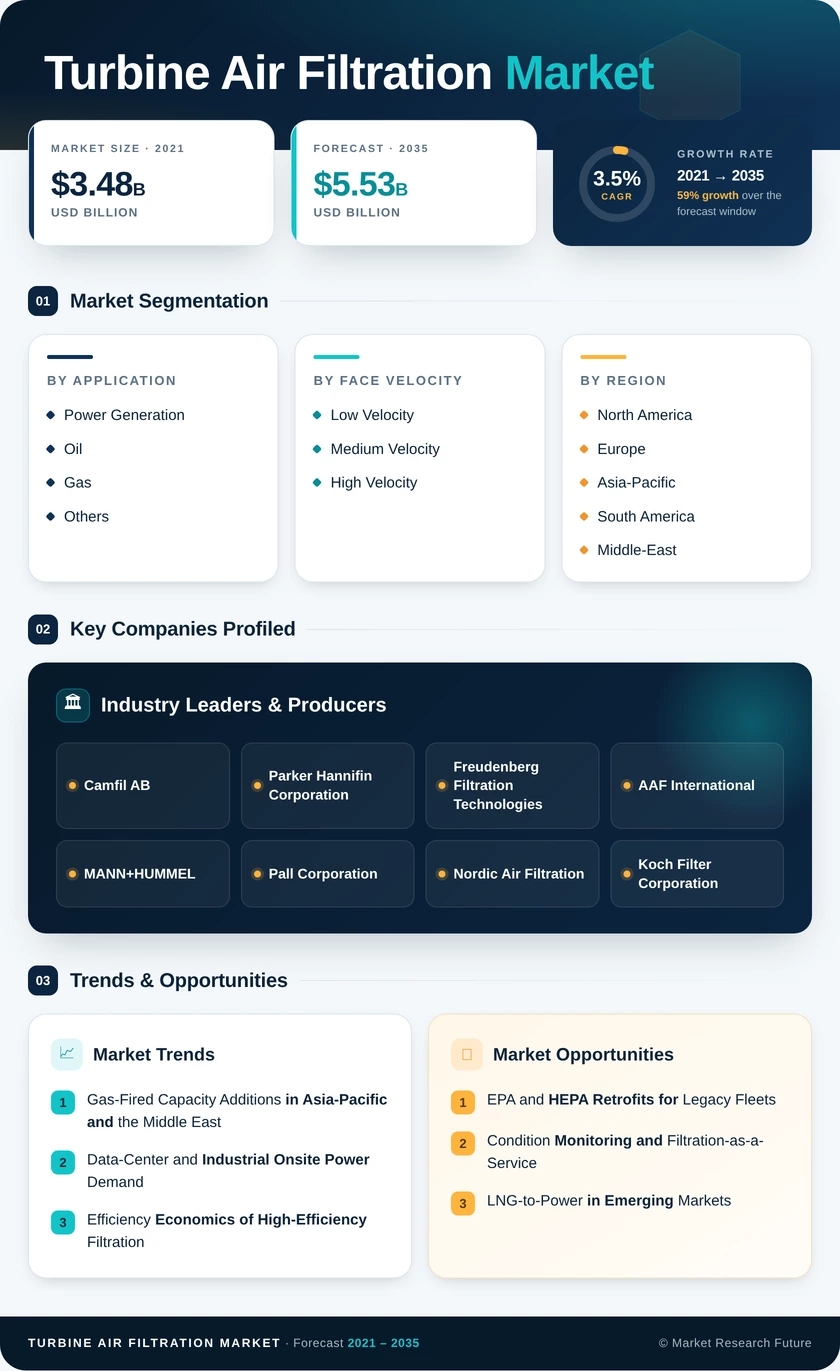
Turbine Air Filtration Market (2026 - 2035)

ID: MRFR/EnP/40254-HCR 128 Pages Snehal Singh Last Updated: October 13, 2026
Turbine Air Filtration Market Research Report By Application (Power Generation, Oil and Gas, Others), By Face Velocity (Low Velocity, Medium Velocity, High Velocity) By Regional (North America, Europe, South America, Asia Pacific, Middle East and Africa) - Growth & Industry Forecast to 2035
Turbine Air Filtration Market
Market Size
Forecast Period2026-2035
CAGR (2026-2035)3.5%
2025 Market SizeUSD 3.92 Billion
2035 Market SizeUSD 5.53 Billion
Key Players
Camfil AB
Parker Hannifin Corporation
Freudenberg Filtration Technologies
AAF International
MANN+HUMMEL
Pall Corporation
Opportunities
  • EPA and HEPA Retrofits for Legacy Fleets
  • Condition Monitoring and Filtration-as-a-Service
  • LNG-to-Power in Emerging Markets
  1. 1 Market Summary | |
  2. 2 Key Report Takeaways | |
    1. 2.1 By Application | |
    2. 2.2 By Face Velocity | |
    3. 2.3 By Region | |
  3. 3 Market Size and Forecast (2021–2035) | |
    1. 3.1 Historical Market Size (2021–2025) | |
    2. 3.2 Forecast Market Size (2026–2035) | |
    3. 3.3 Year-over-Year Growth Analysis | |
  4. 4 Driver Impact Analysis | |
    1. 4.1 Gas-Fired Capacity Additions in Asia-Pacific and the Middle East | |
    2. 4.2 Data-Center and Industrial Onsite Power Demand | |
    3. 4.3 Efficiency Economics of High-Efficiency Filtration | |
    4. 4.4 Upstream Oil and Gas and LNG Expansion | |
    5. 4.5 Replacement Demand from an Ageing Installed Base | |
    6. 4.6 Emissions Regulation and Performance Standards | |
    7. 4.7 Thermal Procurement Mandates in South America | |
  5. 5 Restraints Impact Analysis | |
    1. 5.1 Renewables Compressing Gas-Turbine Run-Hours | |
    2. 5.2 Longer Element Life from Premium Media | |
    3. 5.3 Gas Turbine Supply Bottlenecks | |
    4. 5.4 Raw Material and Fabrication Cost Volatility | |
    5. 5.5 Price Pressure from Regional Manufacturers | |
  6. 6 Opportunities | |
    1. 6.1 EPA and HEPA Retrofits for Legacy Fleets | |
    2. 6.2 Condition Monitoring and Filtration-as-a-Service | |
    3. 6.3 LNG-to-Power in Emerging Markets | |
    4. 6.4 Hydrogen-Ready and Fuel-Flexible Turbines | |
    5. 6.5 Aeroderivative Fleets in Marine and Distributed Power | |
  7. 7 Regional Market Share and Country-Level Analysis | |
    1. 7.1 North America | | |
      1. 7.1.1 US | | |
      2. 7.1.2 Canada | | |
      3. 7.1.3 Mexico | |
    2. 7.2 Europe | | |
      1. 7.2.1 Germany | | |
      2. 7.2.2 UK | | |
      3. 7.2.3 France | | |
      4. 7.2.4 Italy | | |
      5. 7.2.5 Spain | | |
      6. 7.2.6 Nordic Countries | | |
      7. 7.2.7 Russia | | |
      8. 7.2.8 Rest of Europe | |
    3. 7.3 Asia-Pacific | | |
      1. 7.3.1 China | | |
      2. 7.3.2 India | | |
      3. 7.3.3 Japan | | |
      4. 7.3.4 South Korea | | |
      5. 7.3.5 ASEAN | | |
      6. 7.3.6 Rest of Asia-Pacific | |
    4. 7.4 South America | | |
      1. 7.4.1 Brazil | | |
      2. 7.4.2 Argentina | | |
      3. 7.4.3 Rest of South America | |
    5. 7.5 Middle-East and Africa | | |
      1. 7.5.1 Saudi Arabia | | |
      2. 7.5.2 UAE | | |
      3. 7.5.3 South Africa | | |
      4. 7.5.4 Egypt | | |
      5. 7.5.5 Rest of MEA | |
  8. 8 Future Outlook (2026–2035) | |
    1. 8.1 Predictive Filter Management and Digital Twins | |
    2. 8.2 Gas as Firming Capacity in High-Renewable Grids | |
    3. 8.3 Hydrogen Readiness and Fuel Flexibility | |
    4. 8.4 Lifecycle Carbon and Filter Waste Reduction | |
  9. 9 Segmentation Analysis | |
    1. 9.1 By Application | | |
      1. 9.1.1 Power Generation | | |
      2. 9.1.2 Oil and Gas | | |
      3. 9.1.3 Others | |
    2. 9.2 By Face Velocity | | |
      1. 9.2.1 Low Velocity | | |
      2. 9.2.2 Medium Velocity | | |
      3. 9.2.3 High Velocity | |
  10. 10 Competitive Landscape | |
    1. 10.1 Market Concentration Analysis | |
    2. 10.2 Competitive Benchmarking Matrix | |
    3. 10.3 Company Profiles | | |
      1. 10.3.1 Donaldson Company | | |
      2. 10.3.2 Camfil AB | | |
      3. 10.3.3 Parker Hannifin Corporation | | |
      4. 10.3.4 Freudenberg Filtration Technologies | | |
      5. 10.3.5 AAF International | | |
      6. 10.3.6 MANN+HUMMEL | | |
      7. 10.3.7 Pall Corporation | | |
      8. 10.3.8 Nordic Air Filtration | | |
      9. 10.3.9 Koch Filter Corporation | | |
      10. 10.3.10 Filtration Group Corporation | |
  11. 11 Recent News & Developments | |
  12. 12 Report Scope and Methodology | |
  13. 13 Detailed Sources and Citations | |
  14. 14 Frequently Asked Questions (FAQs) | | LIST OF TABLES | |
  15. TABLE 1 Global Market Size & Forecast, by Revenue (USD Billion), 2021–2035 | |
  16. TABLE 2 Global Market – Year-over-Year Growth Analysis, 2021–2035 | |
  17. TABLE 3 Driver Impact Analysis, 2026–2035 | |
  18. TABLE 4 Restraints Impact Analysis, 2026–2035 | |
  19. TABLE 5 Global Market Size, by Region, 2025 (USD Billion) | |
  20. TABLE 6 North America Market Size, by Country, 2021–2035 (USD Billion) | |
  21. TABLE 7 Europe Market Size, by Country, 2021–2035 (USD Billion) | |
  22. TABLE 8 Asia-Pacific Market Size, by Country, 2021–2035 (USD Billion) | |
  23. TABLE 9 South America Market Size, by Country, 2021–2035 (USD Billion) | |
  24. TABLE 10 Middle-East and Africa Market Size, by Country, 2021–2035 (USD Billion) | |
  25. TABLE 11 Global Market Size, by Application, 2021–2035 (USD Billion) | |
  26. TABLE 12 Global Market Size, by Face Velocity, 2021–2035 (USD Billion) | |
  27. TABLE 13 Competitive Benchmarking Matrix, 2025 | |
  28. TABLE 14 Recent Developments & Strategic Announcements, 2024–2025 | |
  29. TABLE 15 Report Scope and Methodology | |
  30. TABLE 16 Detailed Sources and Citations | | LIST OF FIGURES | |
  31. FIGURE 1 Market Dynamics – Drivers, Restraints and Opportunities | |
  32. FIGURE 2 Value Chain Analysis – Media Suppliers to End Users | |
  33. FIGURE 3 Porter's Five Forces Analysis | |
  34. FIGURE 4 Global Market Size Trend, 2021–2035 (USD Billion) | |
  35. FIGURE 5 Market Share by Application, 2025 (%) | |
  36. FIGURE 6 Market Share by Face Velocity, 2025 (%) | |
  37. FIGURE 7 Regional Market Share, 2025 (%) | |
  38. FIGURE 8 Regional Growth Comparison, 2026–2035 (CAGR %) | |
  39. FIGURE 9 Competitive Landscape – Estimated Revenue Share of Key Players, 2025 | |
  40. FIGURE 10 Competitive Positioning Matrix – Product Breadth vs. Aftermarket Reach

Segmentation Quick Reference

DimensionSub-SegmentsDominant SegmentFastest Growing Segment
By ApplicationPower Generation, Oil and Gas, OthersPower Generation (61.5% share)Oil and Gas (3.9% CAGR)
By Face VelocityLow Velocity, Medium Velocity, High VelocityMedium Velocity (41.0% share)High Velocity (4.2% CAGR)
By RegionNorth America, Europe, Asia-Pacific, South America, Middle-East and AfricaAsia-Pacific (38.5% share)South America (4.6% CAGR)

Market Segmentation Overview

By Application

Sub-SegmentKey Trend
Power GenerationEPA/HEPA retrofits on combined-cycle fleets and new gas capacity in Asia and the Gulf
Oil and GasCorrosion-resistant systems for LNG trains, offshore platforms and pipeline compression
OthersSalt-separation packages for marine propulsion and compact systems for cogeneration

Power Generation leads with a 61.5% share because utility frames run long hours and move the largest air volumes, consuming the most replacement elements. Oil and Gas grows fastest at a 3.9% CAGR, as LNG liquefaction and offshore compression turbines operate in salt-laden settings that demand multi-stage, higher-value systems. Others remains a specialised niche where marine and cogeneration users pay for compact salt and moisture protection.

By Face Velocity

Sub-SegmentKey Trend
Low VelocityPreferred on large onshore frames for maximum separation efficiency and element life
Medium VelocityStandard choice for heavy-duty units balancing housing size and pressure loss
High VelocityRising adoption on offshore, marine and containerised aeroderivative turbines

Medium Velocity holds the largest share at 41.0%, offering the best trade-off between filter-house footprint and pressure drop for most heavy-duty installations. High Velocity expands fastest at a 4.2% CAGR because offshore platforms and ships must fit filtration into very tight spaces, and vane-plus-cartridge designs make that possible. Low Velocity keeps a solid base on large onshore frames where plot space allows slower airflow and longer element life.


Download PDF ×

We do not share your information with anyone. However, we may send you emails based on your report interest from time to time. You may contact us at any time to opt-out.