
Request Free Sample ×

Kindly complete the form below to receive a free sample of this Report

* Please use a valid business email

Leading companies partner with us for data-driven Insights

clients tt-cursor
Hero Background
English
Chinese
French
Japanese
Korean
German
Spanish

Trimmer Potentiometer Market Trends

ID: MRFR/SEM/10984-HCR
128 Pages
Shubham Munde
December 2024

Trimmer Potentiometer Market Size, Share and Research Report By Type (Single Turn, Multi Turn), By Application (Communications, Medical, Industry, Automotive, Consumer Electronics, Aerospace & Defense) And By Region (North America, Europe, Asia-Pacific, And Rest Of The World) – Industry Forecast Till 2035

Share:
Download PDF ×

We do not share your information with anyone. However, we may send you emails based on your report interest from time to time. You may contact us at any time to opt-out.

Trimmer Potentiometer Market Infographic
Purchase Options

Market Trends

Key Emerging Trends in the Trimmer Potentiometer Market

The Trimmer Potentiometer Market is experiencing notable trends that are shaping the industry's landscape. One significant trend is the miniaturization of electronic devices. As consumers and industries demand smaller and more compact electronic products, there is a parallel need for trimmer potentiometers that occupy less space while maintaining high performance. Manufacturers are responding by developing smaller form factor potentiometers with advanced functionalities, catering to the trend of miniaturization across various applications, from wearables to industrial equipment.

Another prevailing trend in the Trimmer Potentiometer Market is the increasing emphasis on precision and accuracy. As electronic systems become more intricate, there is a growing demand for trimmer potentiometers that offer precise adjustments. Multi-turn potentiometers, which provide finer adjustments compared to traditional single-turn counterparts, are gaining popularity. This trend is particularly evident in applications where precise calibration and control are essential, such as medical devices and high-precision instrumentation.

Technological advancements are driving innovation in the Trimmer Potentiometer Market. The integration of smart and digital technologies is transforming the landscape, with the emergence of digitally controlled trimmer potentiometers. These digital variants allow for remote control, programmability, and automation, catering to industries seeking more advanced and intelligent solutions. The incorporation of digital features aligns with the broader trend of Industry 4.0, where connectivity and smart functionality are becoming increasingly integral to industrial processes.

Environmental sustainability is a growing concern across industries, and this is reflected in the Trimmer Potentiometer Market's trends. Manufacturers are increasingly focusing on developing environmentally friendly potentiometers by using materials that are less harmful to the environment and implementing energy-efficient manufacturing processes. This trend aligns with the broader global movement towards sustainability and green technologies.

Customization is becoming a key trend in the Trimmer Potentiometer Market as industries seek tailor-made solutions to meet specific application requirements. Manufacturers are offering customizable potentiometers, allowing customers to choose parameters such as resistance range, tolerance, and physical dimensions. This trend caters to the diverse needs of different industries and applications, providing flexibility and enhancing the overall utility of trimmer potentiometers.

The adoption of automation and robotics across industries is influencing the Trimmer Potentiometer Market. As automated processes become more prevalent, there is a growing demand for potentiometers that can withstand the rigors of automated assembly and usage. Robust designs, durability, and resistance to mechanical stress are becoming essential features, aligning with the trend of increased automation in manufacturing and other sectors.

The Trimmer Potentiometer Market is also witnessing a shift towards a more diversified application base. While traditional applications in consumer electronics remain significant, there is an expanding use of trimmer potentiometers in emerging sectors such as electric vehicles, renewable energy systems, and smart infrastructure. This diversification is a response to the evolving technological landscape and the integration of electronics into various aspects of modern life.

Lastly, the market is experiencing a trend towards improved reliability and longevity of trimmer potentiometers. Manufacturers are investing in materials and designs that enhance the durability of potentiometers, making them suitable for demanding environments and extended usage. This trend aligns with the growing expectations of end-users for electronic components that offer long-term reliability and performance.


Author
Author Profile
Shubham Munde
Team Lead - Research

Shubham brings over 7 years of expertise in Market Intelligence and Strategic Consulting, with a strong focus on the Automotive, Aerospace, and Defense sectors. Backed by a solid foundation in semiconductors, electronics, and software, he has successfully delivered high-impact syndicated and custom research on a global scale. His core strengths include market sizing, forecasting, competitive intelligence, consumer insights, and supply chain mapping. Widely recognized for developing scalable growth strategies, Shubham empowers clients to navigate complex markets and achieve a lasting competitive edge. Trusted by start-ups and Fortune 500 companies alike, he consistently converts challenges into strategic opportunities that drive sustainable growth.

Leave a Comment

FAQs

What is the current valuation of the Trimmer Potentiometer Market as of 2024?

<p>The Trimmer Potentiometer Market was valued at 1.036 USD Billion in 2024.</p>

What is the projected market size for the Trimmer Potentiometer Market in 2035?

<p>The market is projected to reach 1.529 USD Billion by 2035.</p>

What is the expected CAGR for the Trimmer Potentiometer Market during the forecast period 2025 - 2035?

<p>The expected CAGR for the Trimmer Potentiometer Market during 2025 - 2035 is 3.6%.</p>

Which companies are considered key players in the Trimmer Potentiometer Market?

<p>Key players include Vishay Intertechnology, Bourns, TE Connectivity, Panasonic, and Nidec Copal Electronics.</p>

What are the main types of trimmer potentiometers in the market?

<p>The main types are Single Turn and Multi Turn, with valuations of 0.621 and 0.415 USD Billion respectively in 2024.</p>

How does the application of trimmer potentiometers vary across different sectors?

<p>Applications include Communications, Medical, Industry, Automotive, Consumer Electronics, and Aerospace & Defense, with varying valuations.</p>

What was the valuation of the Automotive application segment in 2024?

The Automotive application segment was valued at 0.2 USD Billion in 2024.

What is the projected growth for the Consumer Electronics application segment by 2035?

The Consumer Electronics segment is expected to grow from 0.2 USD Billion in 2024 to 0.3 USD Billion by 2035.

What is the valuation range for the Multi Turn type of trimmer potentiometers?

The valuation range for Multi Turn trimmer potentiometers is between 0.415 and 0.634 USD Billion.

How does the market for trimmer potentiometers in the Medical sector compare to the Industry sector?

In 2024, the Medical sector was valued at 0.12 USD Billion, while the Industry sector was valued at 0.25 USD Billion.

Market Summary

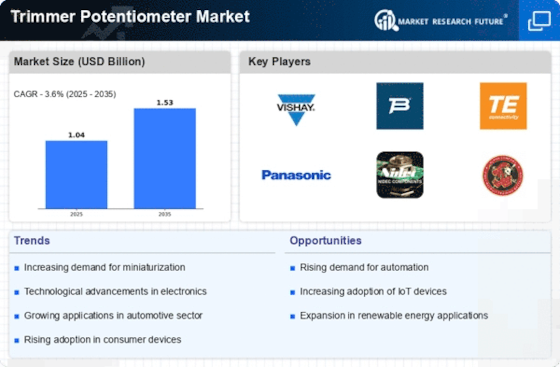
As per Market Research Future analysis, the Trimmer Potentiometer Market Size was estimated at 1.036 USD Billion in 2024. The Trimmer Potentiometer industry is projected to grow from USD 1.073 Billion in 2025 to USD 1.529 Billion by 2035, exhibiting a compound annual growth rate (CAGR) of 3.6% during the forecast period 2025 - 2035

Key Market Trends & Highlights

The Trimmer Potentiometer Market is experiencing robust growth driven by technological advancements and increasing demand across various sectors.

  • Technological advancements are propelling the development of more compact and efficient trimmer potentiometers. North America remains the largest market, while Asia-Pacific is emerging as the fastest-growing region for trimmer potentiometers. The single turn segment holds the largest market share, whereas the multi turn segment is witnessing the fastest growth. Rising demand in automotive applications and increased adoption in consumer electronics are key drivers of market expansion.

Market Size & Forecast

2024 Market Size 1.036 (USD Billion)
2035 Market Size 1.529 (USD Billion)
CAGR (2025 - 2035) 3.6%
Largest Regional Market Share in 2024 North America

Major Players

Vishay Intertechnology (US), Bourns (US), TE Connectivity (US), Panasonic (JP), Nidec Copal Electronics (JP), Alpha (US), Caddock Electronics (US), Ohmite Manufacturing (US), Koa Speer Electronics (JP)

Market Trends

The Trimmer Potentiometer Market is currently experiencing a dynamic evolution, driven by advancements in technology and increasing demand across various sectors. These components, which allow for precise adjustments in electronic circuits, are becoming integral in applications ranging from consumer electronics to automotive systems. As industries continue to innovate, the need for compact and reliable trimmer potentiometers is likely to grow, suggesting a robust trajectory for market expansion. Furthermore, the integration of smart technologies and automation in manufacturing processes may enhance the functionality and efficiency of these components, thereby attracting a broader customer base.

In addition to technological advancements, the Trimmer Potentiometer Market Size is influenced by shifting consumer preferences towards more sustainable and energy-efficient solutions. Manufacturers are increasingly focusing on developing products that not only meet performance standards but also adhere to environmental regulations. This trend indicates a potential shift in production practices, where eco-friendly materials and processes are prioritized. As the market adapts to these changes, it appears poised for continued growth, with opportunities for innovation and differentiation becoming more pronounced.

Technological Advancements

The Trimmer Potentiometer Market is witnessing a surge in technological innovations, particularly in miniaturization and integration with smart devices. These advancements enable more precise control and enhanced performance in various applications, making trimmer potentiometers increasingly essential in modern electronics.

Sustainability Focus

There is a growing emphasis on sustainability within the Trimmer Potentiometer Market Size, as manufacturers strive to produce eco-friendly components. This trend reflects a broader industry movement towards reducing environmental impact, which may influence product design and material selection.

Rising Demand in Automotive Sector

The automotive industry is increasingly adopting trimmer potentiometers for applications such as dashboard controls and electronic stability systems. This rising demand suggests that the market could experience significant growth as vehicles become more technologically advanced.

Trimmer Potentiometer Market Market Drivers

Rising Demand in Automotive Applications

The automotive sector is increasingly driving the Trimmer Potentiometer Market, as vehicles become more technologically advanced. Trimmer potentiometers are utilized in various automotive applications, including dashboard controls, infotainment systems, and electronic stability control systems. The automotive industry is projected to grow significantly, with an estimated market value of USD 3 trillion by 2025. This growth is likely to be accompanied by a heightened demand for precision components like trimmer potentiometers, which are essential for ensuring the reliability and performance of automotive electronics. As electric and hybrid vehicles gain traction, the need for efficient tuning solutions will further bolster the Trimmer Potentiometer Market.

Technological Advancements in Electronics

The Trimmer Potentiometer Market is experiencing a surge due to rapid technological advancements in electronics. As devices become more compact and sophisticated, the demand for precise tuning components like trimmer potentiometers increases. These components are essential in applications such as audio equipment, telecommunications, and consumer electronics, where fine adjustments are crucial for optimal performance. The market is projected to grow at a compound annual growth rate (CAGR) of approximately 5% over the next few years, driven by innovations in circuit design and miniaturization. Manufacturers are focusing on developing trimmer potentiometers that offer enhanced reliability and performance, which is likely to further stimulate market growth. This trend indicates a robust future for the Trimmer Potentiometer Market as it adapts to the evolving needs of modern electronics.

Increased Adoption in Consumer Electronics

The Trimmer Potentiometer Market is witnessing increased adoption in the consumer electronics sector. With the proliferation of smart devices, there is a growing need for components that allow for precise control and calibration. Trimmer potentiometers are integral in devices such as smartphones, tablets, and smart home appliances, where user experience hinges on accurate tuning. The market for consumer electronics is expected to reach USD 1 trillion by 2025, and trimmer potentiometers will play a pivotal role in ensuring the functionality and performance of these devices. As manufacturers strive to enhance product quality and user satisfaction, the demand for trimmer potentiometers is likely to rise, indicating a positive outlook for the Trimmer Potentiometer Market.

Focus on Miniaturization and Compact Designs

The trend towards miniaturization in electronics is significantly influencing the Trimmer Potentiometer Market. As devices become smaller and more compact, the demand for miniature trimmer potentiometers is on the rise. These components are essential in applications where space is limited, such as wearable technology and portable devices. The market for miniaturized electronic components is projected to grow substantially, with trimmer potentiometers playing a crucial role in this evolution. Manufacturers are investing in research and development to create smaller, more efficient designs that meet the needs of modern applications. This focus on miniaturization is likely to drive growth in the Trimmer Potentiometer Market, as it aligns with the broader trends in electronics.

Emerging Applications in Industrial Automation

The Trimmer Potentiometer Market is expanding into industrial automation, where precision control is paramount. As industries increasingly adopt automation technologies, the need for reliable tuning components becomes critical. Trimmer potentiometers are used in various applications, including robotics, process control, and instrumentation. The industrial automation market is expected to grow at a CAGR of around 10% over the next few years, creating substantial opportunities for trimmer potentiometer manufacturers. This trend suggests that as industries seek to enhance efficiency and reduce operational costs, the demand for trimmer potentiometers will likely increase, thereby positively impacting the Trimmer Potentiometer Market.

Market Segment Insights

By Type: Single Turn (Largest) vs. Multi Turn (Fastest-Growing)

<p>In the Trimmer Potentiometer Market, the market share distribution reveals that Single Turn potentiometers dominate this segment, largely due to their widespread application in consumer electronics, communication devices, and automotive systems. Their simplicity and effectiveness in providing precise adjustments contribute to their enduring popularity. In contrast, Multi Turn potentiometers, while currently a smaller segment, are gaining traction due to their enhanced performance in applications that require fine-tuning, such as audio equipment and precision instrumentation.</p>

<p>Trimmer Potentiometer Types: Single Turn (Dominant) vs. Multi Turn (Emerging)</p>

<p>Single Turn trimmer potentiometers are characterized by their ability to provide a single revolution adjustment for voltage or resistance, making them suitable for a variety of applications where space is limited and simplicity is essential. They are widely used in consumer electronics and are favored for their reliability and ease of use. On the other hand, Multi Turn trimmer potentiometers offer multiple turns to achieve adjustments, allowing for more precise tuning in applications that demand high accuracy, such as in laboratories and industrial settings. As technology advances, the Multi Turn segment is expected to see significant growth due to increasing demands for precision control.</p>

By Application: Consumer Electronics (Largest) vs. Automotive (Fastest-Growing)

<p>The application segment of the Trimmer Potentiometer Market exhibits diverse characteristics in market share distribution. Among the various applications, Consumer Electronics holds the largest share, driven by the increasing adoption of portable electronic devices that require precise adjustments. Following closely are the Automotive and Medical sectors, which collectively contribute significantly to market dynamics due to their specialized needs for precision in manufacturing and user experience.</p>

<p>Consumer Electronics: Dominant vs. Automotive: Emerging</p>

<p>Consumer Electronics represents the dominant application in the Trimmer Potentiometer Market, characterized by its integration into devices such as smartphones, tablets, and audio equipment. This segment thrives on innovation, emphasizing miniaturization and energy efficiency. On the other hand, the Automotive sector is emerging rapidly, spurred by advancements in electric vehicles and increased focus on automated systems. Trimmer potentiometers in this segment aid in achieving precision in controls and diagnostics, making them vital as vehicle technology evolves.</p>

Get more detailed insights about Trimmer Potentiometer Market Research Report—Global Forecast till 2035

Regional Insights

North America : Innovation and Demand Surge

North America is the largest market for trimmer potentiometers, holding approximately 40% of the global market share. The region's growth is driven by the increasing demand for electronic devices, automotive applications, and advancements in technology. Regulatory support for electronic manufacturing and innovation further catalyzes market expansion, with a focus on energy efficiency and sustainability. The United States is the leading country in this market, with significant contributions from key players like Vishay Intertechnology, Bourns, and TE Connectivity. The competitive landscape is characterized by continuous innovation and strategic partnerships among manufacturers. Canada also plays a vital role, contributing to the overall growth with its expanding electronics sector.

Europe : Regulatory Support and Growth

Europe is the second-largest market for trimmer potentiometers, accounting for around 30% of the global share. The region benefits from stringent regulations promoting energy efficiency and sustainability in electronic components. The European Union's directives on electronic waste and recycling are significant drivers for market growth, encouraging manufacturers to innovate and comply with environmental standards. Germany and France are the leading countries in this market, with a robust presence of key players like Panasonic and Koa Speer Electronics. The competitive landscape is marked by a focus on high-quality manufacturing and technological advancements. The region's emphasis on research and development fosters a dynamic environment for growth in the trimmer potentiometer sector.

Asia-Pacific : Rapid Growth and Expansion

Asia-Pacific is witnessing rapid growth in the trimmer potentiometer market, driven by increasing electronic manufacturing and consumer demand. The region holds approximately 25% of the global market share, with countries like Japan and China leading the charge. The rise of smart devices and automotive electronics is propelling demand, supported by favorable government policies and investments in technology. Japan is a key player in this market, with companies like Nidec Copal Electronics and Alpha leading the way. The competitive landscape is characterized by a mix of established players and emerging startups, fostering innovation and competitive pricing. The region's focus on technological advancements and manufacturing capabilities positions it as a significant player in the global market.

Middle East and Africa : Untapped Potential and Growth

The Middle East and Africa region is gradually emerging in the trimmer potentiometer market, holding about 5% of the global share. The growth is driven by increasing investments in electronics and telecommunications, alongside a rising demand for consumer electronics. Regulatory frameworks are evolving to support local manufacturing and attract foreign investments, creating a conducive environment for market growth. Countries like South Africa and the UAE are leading the way, with a growing number of local manufacturers entering the market. The competitive landscape is still developing, with opportunities for both established companies and new entrants. The presence of global players is also increasing, contributing to the region's overall market dynamics.

Key Players and Competitive Insights

Leading market players are investing heavily in research and development in order to expand their product lines, which will help the Trimmer Potentiometer Market, grow even more. Market participants are also undertaking a variety of strategic activities to expand their global footprint, with important market developments including new product launches, contractual agreements, mergers and acquisitions, higher investments, and collaboration with other organizations. To expand and survive in a more competitive and rising market climate, Trimmer Potentiometerindustry must offer cost-effective items.
Manufacturing locally to minimize operational costs is one of the key business tactics used by manufacturers in the global Trimmer Potentiometer industry to benefit clients and increase the market sector. In recent years, the Trimmer Potentiometer industry has offered some of the most significant advantages to medicine. Major players in the Trimmer Potentiometer Market, including Bourns, BI Technologies, Copal Electronics, Compit, GC Electronics, Honeywell and others, are attempting to increase market demand by investing in research and development operations.
Honeywell International Inc. is a publicly listed American multinational firm based in Charlotte, North Carolina. Its primary businesses are aircraft, building technologies, performance materials and technologies (PMT), and safety and productivity solutions (SPS). Honeywell is a Fortune 500 firm, and it will be ranked 115th in 2023. The corporation's global employment was estimated 97,000 in 2022, down from 113,000 in 2019. Darius Adamczyk is the current chairman, while Vimal Kapur is the current CEO.
In December 2019, Honeywell announced the acquisition of SCAME, an Italian business, to expand its fire and gas safety capabilities.[95] Scanning and Mobility, Sensing and Internet of Things, and Industrial Safety are all part of Honeywell Safety and Productivity Solutions.
TT Electronics Plc, located in Woking, England, is a global maker of electrical components and a provider of manufacturing services. Sensors, power modules, resistors, magnetics, semiconductors, connectors, and optoelectronics are designed and manufactured by the firm for the industrial, aerospace and military, medical, and transportation industries.
In May The new EBW5216 busbar shunt resistors from TT Electronics are particularly developed for monitoring large currents in the hundreds of amps range. These resistors are ideal for use in a variety of applications such as welding power supply, motor drives, and battery management.
The EBW5216 resistors are made of an electron-beam welded resistance element sandwiched between two big copper terminals. Because of their one-of-a-kind design, the resistors provide remarkable precision, dependability, and surge-proof performance. These resistors are also AEC-Q200 approved, making them appropriate for automotive applications.

Key Companies in the Trimmer Potentiometer Market include

Industry Developments

March 2022, Bourns Introduces New Digital Potentiometer for Industrial Applications. A bourn, a prominent potentiometer manufacturer, has introduced a new digital potentiometer for industrial applications. The new potentiometer is engineered to deliver excellent precision and dependability in severe settings. It is appropriate for a wide range of applications, including process control, machine tools, and robotics.

In March 2020, Honeywell revealed that their quantum computer is built on trapped ions, with a projected quantum volume of at least 64, and that it is the world's most powerful quantum computer, according to Honeywell's CEO.

Future Outlook

Trimmer Potentiometer Market Future Outlook

The Trimmer Potentiometer Market is projected to grow at a 3.6% CAGR from 2025 to 2035, driven by advancements in electronics and increasing demand for precision components.

New opportunities lie in:

  • <p>Development of smart trimmer potentiometers for IoT applications. Expansion into renewable energy sectors with specialized potentiometers. Partnerships with automotive manufacturers for integrated control systems.</p>

By 2035, the market is expected to solidify its position as a key component in various industries.

Market Segmentation

Trimmer Potentiometer Market Type Outlook

  • Single Turn
  • Multi Turn

Trimmer Potentiometer Market Application Outlook

  • Communications
  • Medical
  • Industry
  • Automotive
  • Consumer Electronics
  • Aerospace & Defense

Report Scope

MARKET SIZE 2024 1.036(USD Billion)
MARKET SIZE 2025 1.073(USD Billion)
MARKET SIZE 2035 1.529(USD Billion)
COMPOUND ANNUAL GROWTH RATE (CAGR) 3.6% (2025 - 2035)
REPORT COVERAGE Revenue Forecast, Competitive Landscape, Growth Factors, and Trends
BASE YEAR 2024
Market Forecast Period 2025 - 2035
Historical Data 2019 - 2024
Market Forecast Units USD Billion
Key Companies Profiled Vishay Intertechnology (US), Bourns (US), TE Connectivity (US), Panasonic (JP), Nidec Copal Electronics (JP), Alpha (US), Caddock Electronics (US), Ohmite Manufacturing (US), Koa Speer Electronics (JP)
Segments Covered Type, Application, Region
Key Market Opportunities Growing demand for miniaturized electronic devices drives innovation in the Trimmer Potentiometer Market.
Key Market Dynamics Technological advancements and increasing demand for precision electronics drive growth in the trimmer potentiometer market.
Countries Covered North America, Europe, APAC, South America, MEA

FAQs

What is the current valuation of the Trimmer Potentiometer Market as of 2024?

<p>The Trimmer Potentiometer Market was valued at 1.036 USD Billion in 2024.</p>

What is the projected market size for the Trimmer Potentiometer Market in 2035?

<p>The market is projected to reach 1.529 USD Billion by 2035.</p>

What is the expected CAGR for the Trimmer Potentiometer Market during the forecast period 2025 - 2035?

<p>The expected CAGR for the Trimmer Potentiometer Market during 2025 - 2035 is 3.6%.</p>

Which companies are considered key players in the Trimmer Potentiometer Market?

<p>Key players include Vishay Intertechnology, Bourns, TE Connectivity, Panasonic, and Nidec Copal Electronics.</p>

What are the main types of trimmer potentiometers in the market?

<p>The main types are Single Turn and Multi Turn, with valuations of 0.621 and 0.415 USD Billion respectively in 2024.</p>

How does the application of trimmer potentiometers vary across different sectors?

<p>Applications include Communications, Medical, Industry, Automotive, Consumer Electronics, and Aerospace & Defense, with varying valuations.</p>

What was the valuation of the Automotive application segment in 2024?

The Automotive application segment was valued at 0.2 USD Billion in 2024.

What is the projected growth for the Consumer Electronics application segment by 2035?

The Consumer Electronics segment is expected to grow from 0.2 USD Billion in 2024 to 0.3 USD Billion by 2035.

What is the valuation range for the Multi Turn type of trimmer potentiometers?

The valuation range for Multi Turn trimmer potentiometers is between 0.415 and 0.634 USD Billion.

How does the market for trimmer potentiometers in the Medical sector compare to the Industry sector?

In 2024, the Medical sector was valued at 0.12 USD Billion, while the Industry sector was valued at 0.25 USD Billion.

  1. SECTION I: EXECUTIVE SUMMARY AND KEY HIGHLIGHTS
    1. | 1.1 EXECUTIVE SUMMARY
    2. | | 1.1.1 Market Overview
    3. | | 1.1.2 Key Findings
    4. | | 1.1.3 Market Segmentation
    5. | | 1.1.4 Competitive Landscape
    6. | | 1.1.5 Challenges and Opportunities
    7. | | 1.1.6 Future Outlook
  2. SECTION II: SCOPING, METHODOLOGY AND MARKET STRUCTURE
    1. | 2.1 MARKET INTRODUCTION
    2. | | 2.1.1 Definition
    3. | | 2.1.2 Scope of the study
    4. | | | 2.1.2.1 Research Objective
    5. | | | 2.1.2.2 Assumption
    6. | | | 2.1.2.3 Limitations
    7. | 2.2 RESEARCH METHODOLOGY
    8. | | 2.2.1 Overview
    9. | | 2.2.2 Data Mining
    10. | | 2.2.3 Secondary Research
    11. | | 2.2.4 Primary Research
    12. | | | 2.2.4.1 Primary Interviews and Information Gathering Process
    13. | | | 2.2.4.2 Breakdown of Primary Respondents
    14. | | 2.2.5 Forecasting Model
    15. | | 2.2.6 Market Size Estimation
    16. | | | 2.2.6.1 Bottom-Up Approach
    17. | | | 2.2.6.2 Top-Down Approach
    18. | | 2.2.7 Data Triangulation
    19. | | 2.2.8 Validation
  3. SECTION III: QUALITATIVE ANALYSIS
    1. | 3.1 MARKET DYNAMICS
    2. | | 3.1.1 Overview
    3. | | 3.1.2 Drivers
    4. | | 3.1.3 Restraints
    5. | | 3.1.4 Opportunities
    6. | 3.2 MARKET FACTOR ANALYSIS
    7. | | 3.2.1 Value chain Analysis
    8. | | 3.2.2 Porter's Five Forces Analysis
    9. | | | 3.2.2.1 Bargaining Power of Suppliers
    10. | | | 3.2.2.2 Bargaining Power of Buyers
    11. | | | 3.2.2.3 Threat of New Entrants
    12. | | | 3.2.2.4 Threat of Substitutes
    13. | | | 3.2.2.5 Intensity of Rivalry
    14. | | 3.2.3 COVID-19 Impact Analysis
    15. | | | 3.2.3.1 Market Impact Analysis
    16. | | | 3.2.3.2 Regional Impact
    17. | | | 3.2.3.3 Opportunity and Threat Analysis
  4. SECTION IV: QUANTITATIVE ANALYSIS
    1. | 4.1 Semiconductor & Electronics, BY Type (USD Billion)
    2. | | 4.1.1 Single Turn
    3. | | 4.1.2 Multi Turn
    4. | 4.2 Semiconductor & Electronics, BY Application (USD Billion)
    5. | | 4.2.1 Communications
    6. | | 4.2.2 Medical
    7. | | 4.2.3 Industry
    8. | | 4.2.4 Automotive
    9. | | 4.2.5 Consumer Electronics
    10. | | 4.2.6 Aerospace & Defense
    11. | 4.3 Semiconductor & Electronics, BY Region (USD Billion)
    12. | | 4.3.1 North America
    13. | | | 4.3.1.1 US
    14. | | | 4.3.1.2 Canada
    15. | | 4.3.2 Europe
    16. | | | 4.3.2.1 Germany
    17. | | | 4.3.2.2 UK
    18. | | | 4.3.2.3 France
    19. | | | 4.3.2.4 Russia
    20. | | | 4.3.2.5 Italy
    21. | | | 4.3.2.6 Spain
    22. | | | 4.3.2.7 Rest of Europe
    23. | | 4.3.3 APAC
    24. | | | 4.3.3.1 China
    25. | | | 4.3.3.2 India
    26. | | | 4.3.3.3 Japan
    27. | | | 4.3.3.4 South Korea
    28. | | | 4.3.3.5 Malaysia
    29. | | | 4.3.3.6 Thailand
    30. | | | 4.3.3.7 Indonesia
    31. | | | 4.3.3.8 Rest of APAC
    32. | | 4.3.4 South America
    33. | | | 4.3.4.1 Brazil
    34. | | | 4.3.4.2 Mexico
    35. | | | 4.3.4.3 Argentina
    36. | | | 4.3.4.4 Rest of South America
    37. | | 4.3.5 MEA
    38. | | | 4.3.5.1 GCC Countries
    39. | | | 4.3.5.2 South Africa
    40. | | | 4.3.5.3 Rest of MEA
  5. SECTION V: COMPETITIVE ANALYSIS
    1. | 5.1 Competitive Landscape
    2. | | 5.1.1 Overview
    3. | | 5.1.2 Competitive Analysis
    4. | | 5.1.3 Market share Analysis
    5. | | 5.1.4 Major Growth Strategy in the Semiconductor & Electronics
    6. | | 5.1.5 Competitive Benchmarking
    7. | | 5.1.6 Leading Players in Terms of Number of Developments in the Semiconductor & Electronics
    8. | | 5.1.7 Key developments and growth strategies
    9. | | | 5.1.7.1 New Product Launch/Service Deployment
    10. | | | 5.1.7.2 Merger & Acquisitions
    11. | | | 5.1.7.3 Joint Ventures
    12. | | 5.1.8 Major Players Financial Matrix
    13. | | | 5.1.8.1 Sales and Operating Income
    14. | | | 5.1.8.2 Major Players R&D Expenditure. 2023
    15. | 5.2 Company Profiles
    16. | | 5.2.1 Vishay Intertechnology (US)
    17. | | | 5.2.1.1 Financial Overview
    18. | | | 5.2.1.2 Products Offered
    19. | | | 5.2.1.3 Key Developments
    20. | | | 5.2.1.4 SWOT Analysis
    21. | | | 5.2.1.5 Key Strategies
    22. | | 5.2.2 Bourns (US)
    23. | | | 5.2.2.1 Financial Overview
    24. | | | 5.2.2.2 Products Offered
    25. | | | 5.2.2.3 Key Developments
    26. | | | 5.2.2.4 SWOT Analysis
    27. | | | 5.2.2.5 Key Strategies
    28. | | 5.2.3 TE Connectivity (US)
    29. | | | 5.2.3.1 Financial Overview
    30. | | | 5.2.3.2 Products Offered
    31. | | | 5.2.3.3 Key Developments
    32. | | | 5.2.3.4 SWOT Analysis
    33. | | | 5.2.3.5 Key Strategies
    34. | | 5.2.4 Panasonic (JP)
    35. | | | 5.2.4.1 Financial Overview
    36. | | | 5.2.4.2 Products Offered
    37. | | | 5.2.4.3 Key Developments
    38. | | | 5.2.4.4 SWOT Analysis
    39. | | | 5.2.4.5 Key Strategies
    40. | | 5.2.5 Nidec Copal Electronics (JP)
    41. | | | 5.2.5.1 Financial Overview
    42. | | | 5.2.5.2 Products Offered
    43. | | | 5.2.5.3 Key Developments
    44. | | | 5.2.5.4 SWOT Analysis
    45. | | | 5.2.5.5 Key Strategies
    46. | | 5.2.6 Alpha (US)
    47. | | | 5.2.6.1 Financial Overview
    48. | | | 5.2.6.2 Products Offered
    49. | | | 5.2.6.3 Key Developments
    50. | | | 5.2.6.4 SWOT Analysis
    51. | | | 5.2.6.5 Key Strategies
    52. | | 5.2.7 Caddock Electronics (US)
    53. | | | 5.2.7.1 Financial Overview
    54. | | | 5.2.7.2 Products Offered
    55. | | | 5.2.7.3 Key Developments
    56. | | | 5.2.7.4 SWOT Analysis
    57. | | | 5.2.7.5 Key Strategies
    58. | | 5.2.8 Ohmite Manufacturing (US)
    59. | | | 5.2.8.1 Financial Overview
    60. | | | 5.2.8.2 Products Offered
    61. | | | 5.2.8.3 Key Developments
    62. | | | 5.2.8.4 SWOT Analysis
    63. | | | 5.2.8.5 Key Strategies
    64. | | 5.2.9 Koa Speer Electronics (JP)
    65. | | | 5.2.9.1 Financial Overview
    66. | | | 5.2.9.2 Products Offered
    67. | | | 5.2.9.3 Key Developments
    68. | | | 5.2.9.4 SWOT Analysis
    69. | | | 5.2.9.5 Key Strategies
    70. | 5.3 Appendix
    71. | | 5.3.1 References
    72. | | 5.3.2 Related Reports
  6. LIST OF FIGURES
    1. | 6.1 MARKET SYNOPSIS
    2. | 6.2 NORTH AMERICA MARKET ANALYSIS
    3. | 6.3 US MARKET ANALYSIS BY TYPE
    4. | 6.4 US MARKET ANALYSIS BY APPLICATION
    5. | 6.5 CANADA MARKET ANALYSIS BY TYPE
    6. | 6.6 CANADA MARKET ANALYSIS BY APPLICATION
    7. | 6.7 EUROPE MARKET ANALYSIS
    8. | 6.8 GERMANY MARKET ANALYSIS BY TYPE
    9. | 6.9 GERMANY MARKET ANALYSIS BY APPLICATION
    10. | 6.10 UK MARKET ANALYSIS BY TYPE
    11. | 6.11 UK MARKET ANALYSIS BY APPLICATION
    12. | 6.12 FRANCE MARKET ANALYSIS BY TYPE
    13. | 6.13 FRANCE MARKET ANALYSIS BY APPLICATION
    14. | 6.14 RUSSIA MARKET ANALYSIS BY TYPE
    15. | 6.15 RUSSIA MARKET ANALYSIS BY APPLICATION
    16. | 6.16 ITALY MARKET ANALYSIS BY TYPE
    17. | 6.17 ITALY MARKET ANALYSIS BY APPLICATION
    18. | 6.18 SPAIN MARKET ANALYSIS BY TYPE
    19. | 6.19 SPAIN MARKET ANALYSIS BY APPLICATION
    20. | 6.20 REST OF EUROPE MARKET ANALYSIS BY TYPE
    21. | 6.21 REST OF EUROPE MARKET ANALYSIS BY APPLICATION
    22. | 6.22 APAC MARKET ANALYSIS
    23. | 6.23 CHINA MARKET ANALYSIS BY TYPE
    24. | 6.24 CHINA MARKET ANALYSIS BY APPLICATION
    25. | 6.25 INDIA MARKET ANALYSIS BY TYPE
    26. | 6.26 INDIA MARKET ANALYSIS BY APPLICATION
    27. | 6.27 JAPAN MARKET ANALYSIS BY TYPE
    28. | 6.28 JAPAN MARKET ANALYSIS BY APPLICATION
    29. | 6.29 SOUTH KOREA MARKET ANALYSIS BY TYPE
    30. | 6.30 SOUTH KOREA MARKET ANALYSIS BY APPLICATION
    31. | 6.31 MALAYSIA MARKET ANALYSIS BY TYPE
    32. | 6.32 MALAYSIA MARKET ANALYSIS BY APPLICATION
    33. | 6.33 THAILAND MARKET ANALYSIS BY TYPE
    34. | 6.34 THAILAND MARKET ANALYSIS BY APPLICATION
    35. | 6.35 INDONESIA MARKET ANALYSIS BY TYPE
    36. | 6.36 INDONESIA MARKET ANALYSIS BY APPLICATION
    37. | 6.37 REST OF APAC MARKET ANALYSIS BY TYPE
    38. | 6.38 REST OF APAC MARKET ANALYSIS BY APPLICATION
    39. | 6.39 SOUTH AMERICA MARKET ANALYSIS
    40. | 6.40 BRAZIL MARKET ANALYSIS BY TYPE
    41. | 6.41 BRAZIL MARKET ANALYSIS BY APPLICATION
    42. | 6.42 MEXICO MARKET ANALYSIS BY TYPE
    43. | 6.43 MEXICO MARKET ANALYSIS BY APPLICATION
    44. | 6.44 ARGENTINA MARKET ANALYSIS BY TYPE
    45. | 6.45 ARGENTINA MARKET ANALYSIS BY APPLICATION
    46. | 6.46 REST OF SOUTH AMERICA MARKET ANALYSIS BY TYPE
    47. | 6.47 REST OF SOUTH AMERICA MARKET ANALYSIS BY APPLICATION
    48. | 6.48 MEA MARKET ANALYSIS
    49. | 6.49 GCC COUNTRIES MARKET ANALYSIS BY TYPE
    50. | 6.50 GCC COUNTRIES MARKET ANALYSIS BY APPLICATION
    51. | 6.51 SOUTH AFRICA MARKET ANALYSIS BY TYPE
    52. | 6.52 SOUTH AFRICA MARKET ANALYSIS BY APPLICATION
    53. | 6.53 REST OF MEA MARKET ANALYSIS BY TYPE
    54. | 6.54 REST OF MEA MARKET ANALYSIS BY APPLICATION
    55. | 6.55 KEY BUYING CRITERIA OF SEMICONDUCTOR & ELECTRONICS
    56. | 6.56 RESEARCH PROCESS OF MRFR
    57. | 6.57 DRO ANALYSIS OF SEMICONDUCTOR & ELECTRONICS
    58. | 6.58 DRIVERS IMPACT ANALYSIS: SEMICONDUCTOR & ELECTRONICS
    59. | 6.59 RESTRAINTS IMPACT ANALYSIS: SEMICONDUCTOR & ELECTRONICS
    60. | 6.60 SUPPLY / VALUE CHAIN: SEMICONDUCTOR & ELECTRONICS
    61. | 6.61 SEMICONDUCTOR & ELECTRONICS, BY TYPE, 2024 (% SHARE)
    62. | 6.62 SEMICONDUCTOR & ELECTRONICS, BY TYPE, 2024 TO 2035 (USD Billion)
    63. | 6.63 SEMICONDUCTOR & ELECTRONICS, BY APPLICATION, 2024 (% SHARE)
    64. | 6.64 SEMICONDUCTOR & ELECTRONICS, BY APPLICATION, 2024 TO 2035 (USD Billion)
    65. | 6.65 BENCHMARKING OF MAJOR COMPETITORS
  7. LIST OF TABLES
    1. | 7.1 LIST OF ASSUMPTIONS
    2. | | 7.1.1
    3. | 7.2 North America MARKET SIZE ESTIMATES; FORECAST
    4. | | 7.2.1 BY TYPE, 2025-2035 (USD Billion)
    5. | | 7.2.2 BY APPLICATION, 2025-2035 (USD Billion)
    6. | 7.3 US MARKET SIZE ESTIMATES; FORECAST
    7. | | 7.3.1 BY TYPE, 2025-2035 (USD Billion)
    8. | | 7.3.2 BY APPLICATION, 2025-2035 (USD Billion)
    9. | 7.4 Canada MARKET SIZE ESTIMATES; FORECAST
    10. | | 7.4.1 BY TYPE, 2025-2035 (USD Billion)
    11. | | 7.4.2 BY APPLICATION, 2025-2035 (USD Billion)
    12. | 7.5 Europe MARKET SIZE ESTIMATES; FORECAST
    13. | | 7.5.1 BY TYPE, 2025-2035 (USD Billion)
    14. | | 7.5.2 BY APPLICATION, 2025-2035 (USD Billion)
    15. | 7.6 Germany MARKET SIZE ESTIMATES; FORECAST
    16. | | 7.6.1 BY TYPE, 2025-2035 (USD Billion)
    17. | | 7.6.2 BY APPLICATION, 2025-2035 (USD Billion)
    18. | 7.7 UK MARKET SIZE ESTIMATES; FORECAST
    19. | | 7.7.1 BY TYPE, 2025-2035 (USD Billion)
    20. | | 7.7.2 BY APPLICATION, 2025-2035 (USD Billion)
    21. | 7.8 France MARKET SIZE ESTIMATES; FORECAST
    22. | | 7.8.1 BY TYPE, 2025-2035 (USD Billion)
    23. | | 7.8.2 BY APPLICATION, 2025-2035 (USD Billion)
    24. | 7.9 Russia MARKET SIZE ESTIMATES; FORECAST
    25. | | 7.9.1 BY TYPE, 2025-2035 (USD Billion)
    26. | | 7.9.2 BY APPLICATION, 2025-2035 (USD Billion)
    27. | 7.10 Italy MARKET SIZE ESTIMATES; FORECAST
    28. | | 7.10.1 BY TYPE, 2025-2035 (USD Billion)
    29. | | 7.10.2 BY APPLICATION, 2025-2035 (USD Billion)
    30. | 7.11 Spain MARKET SIZE ESTIMATES; FORECAST
    31. | | 7.11.1 BY TYPE, 2025-2035 (USD Billion)
    32. | | 7.11.2 BY APPLICATION, 2025-2035 (USD Billion)
    33. | 7.12 Rest of Europe MARKET SIZE ESTIMATES; FORECAST
    34. | | 7.12.1 BY TYPE, 2025-2035 (USD Billion)
    35. | | 7.12.2 BY APPLICATION, 2025-2035 (USD Billion)
    36. | 7.13 APAC MARKET SIZE ESTIMATES; FORECAST
    37. | | 7.13.1 BY TYPE, 2025-2035 (USD Billion)
    38. | | 7.13.2 BY APPLICATION, 2025-2035 (USD Billion)
    39. | 7.14 China MARKET SIZE ESTIMATES; FORECAST
    40. | | 7.14.1 BY TYPE, 2025-2035 (USD Billion)
    41. | | 7.14.2 BY APPLICATION, 2025-2035 (USD Billion)
    42. | 7.15 India MARKET SIZE ESTIMATES; FORECAST
    43. | | 7.15.1 BY TYPE, 2025-2035 (USD Billion)
    44. | | 7.15.2 BY APPLICATION, 2025-2035 (USD Billion)
    45. | 7.16 Japan MARKET SIZE ESTIMATES; FORECAST
    46. | | 7.16.1 BY TYPE, 2025-2035 (USD Billion)
    47. | | 7.16.2 BY APPLICATION, 2025-2035 (USD Billion)
    48. | 7.17 South Korea MARKET SIZE ESTIMATES; FORECAST
    49. | | 7.17.1 BY TYPE, 2025-2035 (USD Billion)
    50. | | 7.17.2 BY APPLICATION, 2025-2035 (USD Billion)
    51. | 7.18 Malaysia MARKET SIZE ESTIMATES; FORECAST
    52. | | 7.18.1 BY TYPE, 2025-2035 (USD Billion)
    53. | | 7.18.2 BY APPLICATION, 2025-2035 (USD Billion)
    54. | 7.19 Thailand MARKET SIZE ESTIMATES; FORECAST
    55. | | 7.19.1 BY TYPE, 2025-2035 (USD Billion)
    56. | | 7.19.2 BY APPLICATION, 2025-2035 (USD Billion)
    57. | 7.20 Indonesia MARKET SIZE ESTIMATES; FORECAST
    58. | | 7.20.1 BY TYPE, 2025-2035 (USD Billion)
    59. | | 7.20.2 BY APPLICATION, 2025-2035 (USD Billion)
    60. | 7.21 Rest of APAC MARKET SIZE ESTIMATES; FORECAST
    61. | | 7.21.1 BY TYPE, 2025-2035 (USD Billion)
    62. | | 7.21.2 BY APPLICATION, 2025-2035 (USD Billion)
    63. | 7.22 South America MARKET SIZE ESTIMATES; FORECAST
    64. | | 7.22.1 BY TYPE, 2025-2035 (USD Billion)
    65. | | 7.22.2 BY APPLICATION, 2025-2035 (USD Billion)
    66. | 7.23 Brazil MARKET SIZE ESTIMATES; FORECAST
    67. | | 7.23.1 BY TYPE, 2025-2035 (USD Billion)
    68. | | 7.23.2 BY APPLICATION, 2025-2035 (USD Billion)
    69. | 7.24 Mexico MARKET SIZE ESTIMATES; FORECAST
    70. | | 7.24.1 BY TYPE, 2025-2035 (USD Billion)
    71. | | 7.24.2 BY APPLICATION, 2025-2035 (USD Billion)
    72. | 7.25 Argentina MARKET SIZE ESTIMATES; FORECAST
    73. | | 7.25.1 BY TYPE, 2025-2035 (USD Billion)
    74. | | 7.25.2 BY APPLICATION, 2025-2035 (USD Billion)
    75. | 7.26 Rest of South America MARKET SIZE ESTIMATES; FORECAST
    76. | | 7.26.1 BY TYPE, 2025-2035 (USD Billion)
    77. | | 7.26.2 BY APPLICATION, 2025-2035 (USD Billion)
    78. | 7.27 MEA MARKET SIZE ESTIMATES; FORECAST
    79. | | 7.27.1 BY TYPE, 2025-2035 (USD Billion)
    80. | | 7.27.2 BY APPLICATION, 2025-2035 (USD Billion)
    81. | 7.28 GCC Countries MARKET SIZE ESTIMATES; FORECAST
    82. | | 7.28.1 BY TYPE, 2025-2035 (USD Billion)
    83. | | 7.28.2 BY APPLICATION, 2025-2035 (USD Billion)
    84. | 7.29 South Africa MARKET SIZE ESTIMATES; FORECAST
    85. | | 7.29.1 BY TYPE, 2025-2035 (USD Billion)
    86. | | 7.29.2 BY APPLICATION, 2025-2035 (USD Billion)
    87. | 7.30 Rest of MEA MARKET SIZE ESTIMATES; FORECAST
    88. | | 7.30.1 BY TYPE, 2025-2035 (USD Billion)
    89. | | 7.30.2 BY APPLICATION, 2025-2035 (USD Billion)
    90. | 7.31 PRODUCT LAUNCH/PRODUCT DEVELOPMENT/APPROVAL
    91. | | 7.31.1
    92. | 7.32 ACQUISITION/PARTNERSHIP
    93. | | 7.32.1

Semiconductor & Electronics Market Segmentation

Semiconductor & Electronics By Type (USD Billion, 2025-2035)

  • Single Turn
  • Multi Turn

Semiconductor & Electronics By Application (USD Billion, 2025-2035)

  • Communications
  • Medical
  • Industry
  • Automotive
  • Consumer Electronics
  • Aerospace & Defense
Infographic

Free Sample Request

Kindly complete the form below to receive a free sample of this Report

Get Free Sample

Customer Strories

Compare Licence

×
Features License Type
Single User Multiuser License Enterprise User
Price $4,950 $5,950 $7,250
Maximum User Access Limit 1 User Upto 10 Users Unrestricted Access Throughout the Organization
Free Customization
Direct Access to Analyst
Deliverable Format
Platform Access
Discount on Next Purchase 10% 15% 15%
Printable Versions