×
Request Free Sample ×

Kindly complete the form below to receive a free sample of this Report

* Please use a valid business email

Leading companies partner with us for data-driven Insights

clients tt-cursor
Hero Background
English
Chinese
French
Japanese
Korean
German
Spanish

Treated Distillate Aromatic Extracts (TDAE) Market Trends

ID: MRFR/CnM/3530-CR
137 Pages
Anshula Mandaokar
February 2021

Treated Distillate Aromatic Extracts Market Application (tires & tubes, belting & houses, battery containers, extruded products, & others) and Region (Asia Pacific, Europe, North America, Latin America, Middle east & Africa) - Forecast till 2035

Share:
Download PDF ×

We do not share your information with anyone. However, we may send you emails based on your report interest from time to time. You may contact us at any time to opt-out.

Treated Distillate Aromatic Extracts (TDAE) Market Infographic
Purchase Options

Market Trends

Key Emerging Trends in the Treated Distillate Aromatic Extracts (TDAE) Market

The Treated Distillate Aromatic Extracts (TDAE) market is influenced by several key market trends that shape its dynamics and growth trajectory.

Shift Towards Environmentally Friendly Rubber Processing Oils: There is a growing trend towards environmentally friendly rubber processing oils, driven by increasing regulatory scrutiny and consumer demand for sustainable products. TDAE, being derived from low aromatic content base oils, is gaining popularity as a greener alternative to traditional aromatic extract oils. Manufacturers are focusing on developing TDAE formulations that offer high performance while meeting stringent environmental regulations, leading to increased adoption of TDAE in the rubber industry.

Rising Demand for Tire Manufacturing: The tire manufacturing industry represents a significant market for TDAE, as it is used as a processing aid and extender oil in tire compounding. With the growing automotive sector worldwide and increasing demand for tires, especially in emerging economies, the demand for TDAE in tire manufacturing is on the rise. TDAE offers advantages such as improved processability, reduced rolling resistance, and enhanced tire performance, driving its demand in the tire industry.

Focus on Enhanced Performance and Product Quality: Manufacturers of TDAE are increasingly focusing on enhancing product performance and quality to meet the evolving requirements of end-users in various industries. Advanced refining processes and formulation techniques are being employed to produce TDAE oils with superior properties such as low volatility, high viscosity index, and excellent compatibility with rubber compounds. The emphasis on product innovation and quality enhancement is driving market differentiation and competitiveness in the TDAE market.

Growing Demand for High-Quality Rubber Compounds: The demand for high-quality rubber compounds is rising across industries such as automotive, construction, and industrial manufacturing, driving the demand for TDAE as a key ingredient in rubber formulations. TDAE offers benefits such as improved processing characteristics, better dispersion of fillers and additives, and enhanced mechanical properties in rubber compounds. Manufacturers are catering to the demand for high-performance rubber compounds by offering specialized TDAE formulations tailored to specific application requirements.

Expansion of Rubber Recycling and Reclaiming Industry: The rubber recycling and reclaiming industry is witnessing significant growth, driven by increasing environmental concerns, sustainability initiatives, and regulations related to waste management. TDAE is used as a processing aid in the production of reclaimed rubber from waste tires and rubber scraps. With the growing emphasis on circular economy principles and resource conservation, the demand for TDAE in the rubber recycling and reclaiming industry is expected to increase.

Emergence of Bio-based TDAE Alternatives: With the growing focus on sustainability and renewable resources, there is a rising interest in developing bio-based alternatives to conventional TDAE oils derived from petroleum feedstocks. Manufacturers are exploring bio-based oils and renewable feedstocks as substitutes for TDAE in rubber compounding applications. Bio-based TDAE alternatives offer the potential to reduce carbon footprint, mitigate environmental impact, and meet the sustainability goals of end-users in the rubber industry.

Technological Advancements in TDAE Production: Technological advancements in TDAE production processes are driving efficiency improvements, cost optimization, and quality enhancement in the TDAE market. Advanced refining techniques, process automation, and quality control measures are being implemented to ensure consistent product quality and performance. Additionally, investments in research and development are leading to the development of innovative TDAE formulations with enhanced properties and functionality, catering to diverse application requirements.

Market Consolidation and Strategic Partnerships: The TDAE market is witnessing consolidation through mergers, acquisitions, and strategic partnerships among key players in the industry. Companies are collaborating to expand their product portfolios, geographical presence, and market reach in the global TDAE market. Strategic alliances and partnerships enable companies to leverage synergies, share resources, and enhance their competitiveness in the market, driving market consolidation and growth.

Impact of COVID-19 Pandemic: The COVID-19 pandemic has had a significant impact on the TDAE market, disrupting supply chains, reducing demand from end-user industries, and causing fluctuations in raw material prices. However, as economies recover and industries resume operations, the demand for TDAE is expected to rebound, driven by the revival of automotive production, infrastructure projects, and construction activities worldwide. Companies are adapting to the changing market dynamics and implementing strategies to mitigate the impact of the pandemic on the TDAE market.

Market Expansion in Emerging Economies: Emerging economies in Asia Pacific, Latin America, and Africa present lucrative opportunities for market expansion in the TDAE industry. Rapid industrialization, urbanization, and infrastructure development in these regions are driving the demand for rubber products and TDAE oils. Manufacturers are expanding their presence in emerging markets through investments, partnerships, and distribution networks to capitalize on growth opportunities and establish a strong foothold in dynamic regions.
Author
Anshula Mandaokar
Team Lead - Research

Anshula Mandaokar holds an academic degree in Chemical Engineering and has been contributing to the field for more than 5 years. She has expertise in Market Research and Business Consulting and serves as a Team Lead for a reputed Market Research firm under the Chemicals and Materials domain spectrum. She has worked on multiple projects, generating explicit results in a quick turnaround time. Her understanding of data interpretation justifies her role as a leader.

Leave a Comment

FAQs

What is the projected market valuation for the Treated Distillate Aromatic Extracts Market in 2035?

<p>The projected market valuation for the Treated Distillate Aromatic Extracts Market in 2035 is 1597.04 USD Million.</p>

What was the market valuation of the Treated Distillate Aromatic Extracts Market in 2024?

<p>The market valuation of the Treated Distillate Aromatic Extracts Market in 2024 was 849.9 USD Million.</p>

What is the expected CAGR for the Treated Distillate Aromatic Extracts Market from 2025 to 2035?

<p>The expected CAGR for the Treated Distillate Aromatic Extracts Market during the forecast period 2025 - 2035 is 5.9%.</p>

Which companies are considered key players in the Treated Distillate Aromatic Extracts Market?

<p>Key players in the Treated Distillate Aromatic Extracts Market include ExxonMobil, Shell, TotalEnergies, BASF, Chevron, SABIC, LyondellBasell, Eastman Chemical Company, and Mitsubishi Chemical Corporation.</p>

What application segment had the highest valuation in the Treated Distillate Aromatic Extracts Market?

<p>The Tires and Tubes application segment had the highest valuation, ranging from 300.0 to 600.0 USD Million.</p>

What is the valuation range for the Belting and Hoses application segment?

<p>The valuation range for the Belting and Hoses application segment is between 200.0 and 400.0 USD Million.</p>

How does the projected growth of the Treated Distillate Aromatic Extracts Market compare to its 2024 valuation?

<p>The Treated Distillate Aromatic Extracts Market is expected to grow from a valuation of 849.9 USD Million in 2024 to 1597.04 USD Million by 2035.</p>

What is the valuation range for the Extruded Products application segment?

<p>The valuation range for the Extruded Products application segment is between 200.0 and 400.0 USD Million.</p>

What is the projected valuation for Battery Containers in the Treated Distillate Aromatic Extracts Market?

<p>The projected valuation for Battery Containers in the Treated Distillate Aromatic Extracts Market is between 149.9 and 197.04 USD Million.</p>

How might the performance of key players influence the Treated Distillate Aromatic Extracts Market?

<p>The performance of key players like ExxonMobil and BASF may significantly influence the Treated Distillate Aromatic Extracts Market, given their substantial market presence.</p>

Market Summary

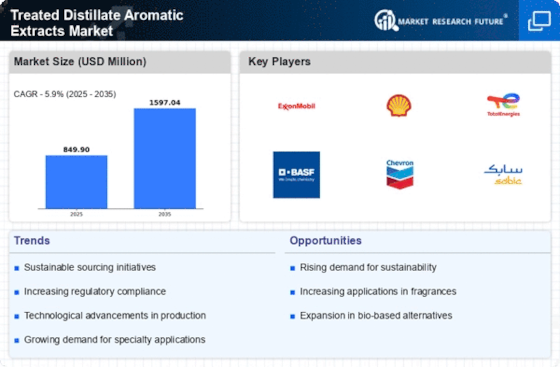
As per Market Research Future analysis, the Treated Distillate Aromatic Extracts Market Size was estimated at 849.9 USD Million in 2024. The Treated Distillate Aromatic Extracts industry is projected to grow from 900.06 USD Million in 2025 to 1597.04 USD Million by 2035, exhibiting a compound annual growth rate (CAGR) of 5.9% during the forecast period 2025 - 2035

Key Market Trends & Highlights

The Treated Distillate Aromatic Extracts Market is experiencing a dynamic shift driven by sustainability and technological advancements.

  • North America remains the largest market for treated distillate aromatic extracts, reflecting robust demand across various applications.
  • Asia-Pacific is emerging as the fastest-growing region, propelled by increasing consumer awareness and market expansion.
  • The Tires and Tubes segment holds the largest share, while the Battery Containers segment is witnessing rapid growth due to innovative applications.
  • Key market drivers include rising demand in the fragrance industry and the expansion of personal care products, highlighting the sector's evolving landscape.

Market Size & Forecast

2024 Market Size 849.9 (USD Million)
2035 Market Size 1597.04 (USD Million)
CAGR (2025 - 2035) 5.9%
Largest Regional Market Share in 2024 Asia Pacific

Major Players

ExxonMobil (US), Shell (GB), TotalEnergies (FR), BASF (DE), Chevron (US), SABIC (SA), LyondellBasell (US), Eastman Chemical Company (US), Mitsubishi Chemical Corporation (JP)

Market Trends

The Treated Distillate Aromatic Extracts Market is currently experiencing a notable evolution, driven by various factors that influence demand and supply dynamics. The increasing application of these extracts in diverse industries, such as fragrances, cosmetics, and food flavoring, appears to be a primary catalyst for market growth. Furthermore, the rising consumer preference for natural and sustainable products suggests a shift towards eco-friendly sourcing and production methods. This trend may lead to innovations in extraction techniques, enhancing the quality and purity of the final products. In addition, regulatory frameworks surrounding the use of aromatic extracts are becoming more stringent, which could impact production processes and market entry for new players. Companies are likely to invest in research and development to comply with these regulations while also meeting consumer expectations for safety and quality. The interplay between regulatory compliance and consumer demand may shape the future landscape of the Treated Distillate Aromatic Extracts Market, fostering a competitive environment that encourages continuous improvement and adaptation to market needs.

Sustainability Initiatives

The Treated Distillate Aromatic Extracts Market is witnessing a growing emphasis on sustainability. Companies are increasingly adopting eco-friendly practices in sourcing and production, responding to consumer demand for environmentally responsible products. This trend may lead to the development of innovative extraction methods that minimize environmental impact.

Technological Advancements

Technological progress in extraction and processing techniques is transforming the Treated Distillate Aromatic Extracts Market. Enhanced methods are likely to improve product quality and efficiency, allowing manufacturers to meet rising consumer expectations for purity and potency. This evolution could also facilitate the introduction of new aromatic profiles.

Regulatory Compliance

The landscape of the Treated Distillate Aromatic Extracts Market is becoming more complex due to evolving regulatory standards. Companies must navigate these regulations to ensure product safety and quality. This compliance focus may drive investment in research and development, fostering innovation and enhancing market competitiveness.

Treated Distillate Aromatic Extracts (TDAE) Market Market Drivers

Expansion in Personal Care Products

The Treated Distillate Aromatic Extracts Market is witnessing significant growth due to the expansion of personal care products. With an increasing focus on personal grooming and hygiene, manufacturers are incorporating treated distillate aromatic extracts into a wide range of items such as lotions, shampoos, and deodorants. Market data suggests that the personal care segment is expected to grow at a rate of around 4% annually, driven by rising disposable incomes and changing consumer lifestyles. The unique properties of treated distillate aromatic extracts, including their ability to enhance fragrance and provide skin benefits, make them a preferred choice among formulators. This trend indicates a robust opportunity for growth within the Treated Distillate Aromatic Extracts Market, as brands strive to differentiate their products in a competitive landscape.

Rising Demand in Fragrance Industry

The Treated Distillate Aromatic Extracts Market is experiencing a notable surge in demand, particularly from the fragrance sector. As consumers increasingly seek high-quality and long-lasting scents, manufacturers are turning to treated distillate aromatic extracts for their superior olfactory properties. This trend is supported by data indicating that the fragrance market is projected to grow at a compound annual growth rate of approximately 5% over the next few years. The versatility of these extracts allows for their application in various products, including perfumes, cosmetics, and personal care items, thereby expanding their market reach. Furthermore, the growing preference for natural and organic ingredients in fragrances is likely to bolster the demand for treated distillate aromatic extracts, as they can be derived from renewable sources, aligning with consumer preferences for sustainability.

Increased Use in Food and Beverage Sector

The Treated Distillate Aromatic Extracts Market is also benefiting from increased utilization in the food and beverage sector. As manufacturers seek to enhance flavor profiles and create unique culinary experiences, treated distillate aromatic extracts are being integrated into various food products. The market for flavoring agents is projected to grow at a compound annual growth rate of approximately 6% in the coming years, indicating a robust demand for high-quality extracts. These extracts not only provide distinct flavors but also contribute to the overall sensory experience of food and beverages. This trend highlights the versatility of treated distillate aromatic extracts, positioning them as essential components in the Treated Distillate Aromatic Extracts Market, catering to both manufacturers and consumers alike.

Growing Awareness of Aromatherapy Benefits

The Treated Distillate Aromatic Extracts Market is experiencing growth driven by the increasing awareness of the benefits of aromatherapy. As consumers become more health-conscious, there is a rising interest in natural remedies and holistic wellness practices. Treated distillate aromatic extracts are often used in aromatherapy for their therapeutic properties, which can promote relaxation and improve overall well-being. Market Research Future indicates that the aromatherapy market is expected to grow significantly, potentially reaching a valuation of several billion dollars in the next few years. This trend is likely to encourage manufacturers to explore the incorporation of treated distillate aromatic extracts into their product lines, thereby expanding the Treated Distillate Aromatic Extracts Market and catering to the growing demand for wellness-oriented products.

Technological Innovations in Extraction Processes

Technological advancements in extraction processes are playing a pivotal role in shaping the Treated Distillate Aromatic Extracts Market. Innovations such as supercritical fluid extraction and advanced distillation techniques are enhancing the efficiency and quality of aromatic extracts. These technologies allow for the extraction of pure and concentrated compounds, which are increasingly sought after by manufacturers across various sectors. The ability to produce high-quality extracts with minimal environmental impact aligns with the growing emphasis on sustainability. As a result, companies are likely to invest in these technologies to improve their product offerings, thereby driving growth in the Treated Distillate Aromatic Extracts Market. This trend suggests a promising future for the industry as it adapts to evolving consumer preferences and regulatory standards.

Market Segment Insights

By Application: Tires and Tubes (Largest) vs. Battery Containers (Fastest-Growing)

<p>In the Treated Distillate Aromatic Extracts Market, the application segment reveals a diverse distribution of market share. Among them, Tires and Tubes holds the largest share, primarily due to its extensive usage in automotive and industrial applications. This segment benefits from the increased demand for high-performance tires, thereby solidifying its position in the market compared to other applications. Battery Containers, in contrast, are emerging as the fastest-growing segment, reflecting the rising trend towards electric vehicles and renewable energy solutions that require advanced battery technologies.</p>

<p>Tires and Tubes (Dominant) vs. Battery Containers (Emerging)</p>

<p>The Tires and Tubes application is pivotal in the Treated Distillate Aromatic Extracts market, characterized by its robust demand driven by the automotive industry's focus on high-performance materials. This segment's established presence and reliable growth make it a dominant force within the market. On the other hand, Battery Containers represent an emerging opportunity, fueled by innovations in electric vehicles and green energy storage. This segment's growth is supported by advancements in material science, which enhance battery efficiency and lifecycle, making it an attractive focus for manufacturers looking to invest in future technologies. Their unique requirements provide a niche for specialized treated distillate aromatic extracts, shaping their market identity.</p>

Get more detailed insights about Treated Distillate Aromatic Extracts (TDAE) Market Research Report- Forecast to 2035

Regional Insights

North America : Innovation and Demand Surge

North America is the largest market for Treated Distillate Aromatic Extracts, holding approximately 40% of the global market share. The region's growth is driven by increasing demand in the automotive and industrial sectors, alongside stringent environmental regulations promoting cleaner production methods. The U.S. is the primary contributor, supported by advancements in technology and a robust regulatory framework that encourages sustainable practices. Key players such as ExxonMobil, Chevron, and Eastman Chemical Company dominate the landscape, leveraging their extensive distribution networks and innovative capabilities. The competitive environment is characterized by significant investments in R&D and strategic partnerships aimed at enhancing product offerings. The presence of established companies ensures a steady supply chain, further solidifying North America's position in the market.

Europe : Regulatory Framework Drives Growth

Europe is the second-largest market for Treated Distillate Aromatic Extracts, accounting for around 30% of the global market share. The region's growth is significantly influenced by stringent environmental regulations and a strong push towards sustainable practices. The European Union's Green Deal and REACH regulations are pivotal in shaping market dynamics, driving demand for eco-friendly products and technologies. Leading countries such as Germany, France, and the UK are at the forefront, with major players like BASF and TotalEnergies investing heavily in sustainable solutions. The competitive landscape is marked by innovation and collaboration among companies to meet regulatory standards. This focus on sustainability not only enhances product offerings but also positions Europe as a leader in the global market for treated distillate aromatic extracts.

Asia-Pacific : Rapid Industrialization and Growth

Asia-Pacific is witnessing rapid growth in the Treated Distillate Aromatic Extracts market, holding approximately 25% of the global market share. The region's industrialization, coupled with increasing urbanization, is driving demand across various sectors, including automotive, construction, and consumer goods. Countries like China and India are leading this growth, supported by government initiatives aimed at boosting manufacturing and infrastructure development. The competitive landscape is evolving, with key players such as Mitsubishi Chemical Corporation and SABIC expanding their operations in the region. The presence of a large consumer base and increasing investments in R&D are fostering innovation. As companies adapt to local market needs, Asia-Pacific is set to become a significant player in The Treated Distillate Aromatic Extracts.

Middle East and Africa : Resource-Rich Market Potential

The Middle East and Africa region is emerging as a significant market for Treated Distillate Aromatic Extracts, holding about 5% of the global market share. The growth is primarily driven by the region's rich natural resources and increasing demand in sectors such as oil and gas, construction, and consumer products. Countries like Saudi Arabia and South Africa are leading the market, supported by government initiatives to diversify economies and enhance industrial capabilities. The competitive landscape is characterized by the presence of key players like SABIC, which is leveraging its resource base to expand its product offerings. The region's strategic location also facilitates trade and distribution, making it an attractive market for investments. As the demand for treated distillate aromatic extracts grows, the Middle East and Africa are poised for significant market development.

Key Players and Competitive Insights

The Treated Distillate Aromatic Extracts Market is characterized by a dynamic competitive landscape, driven by increasing demand for high-quality aromatic extracts across various industries, including automotive, consumer goods, and pharmaceuticals. Key players such as ExxonMobil (US), Shell (GB), and BASF (DE) are strategically positioned to leverage their extensive research and development capabilities, focusing on innovation and sustainability. These companies are actively pursuing partnerships and collaborations to enhance their product offerings and expand their market reach, thereby shaping a competitive environment that emphasizes technological advancement and environmental responsibility.

In terms of business tactics, companies are increasingly localizing manufacturing to reduce lead times and optimize supply chains. The market appears moderately fragmented, with several key players exerting considerable influence. This structure allows for a diverse range of products and services, catering to the specific needs of various regional markets. The collective strategies of these major players indicate a trend towards consolidation, as companies seek to enhance their competitive edge through mergers and acquisitions.

In August 2025, ExxonMobil (US) announced a significant investment in a new facility dedicated to the production of treated distillate aromatic extracts, aimed at increasing production capacity and meeting the growing demand in the automotive sector. This strategic move underscores ExxonMobil's commitment to innovation and its proactive approach to capturing market share in a rapidly evolving landscape. The facility is expected to utilize advanced technologies to enhance efficiency and reduce environmental impact, aligning with global sustainability goals.

Similarly, in July 2025, BASF (DE) launched a new line of treated distillate aromatic extracts designed specifically for the consumer goods industry. This product line is anticipated to meet the rising demand for sustainable and high-performance materials. BASF's focus on sustainability and product differentiation reflects a broader industry trend towards environmentally friendly solutions, positioning the company favorably in a competitive market.

In September 2025, Shell (GB) entered into a strategic partnership with a leading technology firm to develop AI-driven solutions for optimizing the production processes of treated distillate aromatic extracts. This collaboration aims to enhance operational efficiency and reduce costs, showcasing Shell's commitment to integrating digital technologies into its operations. The partnership is likely to provide Shell with a competitive advantage by enabling more agile responses to market demands and improving overall supply chain reliability.

As of October 2025, the competitive trends in the Treated Distillate Aromatic Extracts Market are increasingly defined by digitalization, sustainability, and the integration of advanced technologies. Strategic alliances are becoming more prevalent, as companies recognize the importance of collaboration in driving innovation and enhancing market positioning. Looking ahead, competitive differentiation is expected to evolve, with a notable shift from price-based competition towards a focus on innovation, technological advancements, and supply chain reliability. This transition may redefine the competitive landscape, compelling companies to adapt and innovate continuously to maintain their market positions.

Key Companies in the Treated Distillate Aromatic Extracts (TDAE) Market include

Industry Developments

    • October 2020: Sulzer supplied a customized mass transfer solution to PT Enerco RPO Internasional's grassroots facility in Batam, Indonesia, which produces treated distillate aromatic extract (TDAE). Sulzer created and built the world's largest agitated extraction column, the KuhniTM (ECR). This piece of equipment is critical in the production of environmentally friendly rubber process oils (RPOs) for the tire and rubber industries. This column, which measures 2.8 m (9 ft 2 in.) in diameter and 34 m (111 ft 6 in.) in height, is the largest of its kind and enables PT Enerco RPO International to distribute significant volumes of TDAE.
    • China has become one of the major countries generating revenue in the TDAE market for the Asia-Pacific region. The revenue of USD 133.1 million in 2016 shows its rising growth.
    • Europe has come under the influence of many regulatory precedents in recent times. Therefore, the strict regulations have resulted in major strategic reforms by key players in the existing market.
    • The global TDAE market would most probably reach around USD 1027.1 million by 2027 at an expected CAGR of 3.71%.
    • The tires and tubes segment accounted for around 70% of the overall TDAE market size.
    • Asia Pacific region is the dominant market leader emerging in recent times with around 45% of the global share.

Future Outlook

Treated Distillate Aromatic Extracts (TDAE) Market Future Outlook

The Treated Distillate Aromatic Extracts Market is projected to grow at a 5.9% CAGR from 2024 to 2035, driven by increasing demand in various industrial applications and sustainable practices.

New opportunities lie in:

  • Expansion into bio-based treated distillate aromatic extracts for eco-conscious consumers.
  • Development of customized blends for specific industrial applications.
  • Investment in advanced extraction technologies to enhance product quality and yield.

By 2035, the market is expected to solidify its position as a key player in the global chemical industry.

Market Segmentation

Treated Distillate Aromatic Extracts (TDAE) Market Application Outlook

  • Tires and Tubes
  • Belting and Hoses
  • Extruded Products
  • Battery Containers

Report Scope

MARKET SIZE 2024849.9(USD Million)
MARKET SIZE 2025900.06(USD Million)
MARKET SIZE 20351597.04(USD Million)
COMPOUND ANNUAL GROWTH RATE (CAGR)5.9% (2024 - 2035)
REPORT COVERAGERevenue Forecast, Competitive Landscape, Growth Factors, and Trends
BASE YEAR2024
Market Forecast Period2025 - 2035
Historical Data2019 - 2024
Market Forecast UnitsUSD Million
Key Companies ProfiledMarket analysis in progress
Segments CoveredMarket segmentation analysis in progress
Key Market OpportunitiesGrowing demand for sustainable and eco-friendly products in the Treated Distillate Aromatic Extracts Market.
Key Market DynamicsRising demand for sustainable products drives innovation and competition in the Treated Distillate Aromatic Extracts Market.
Countries CoveredNorth America, Europe, APAC, South America, MEA

FAQs

What is the projected market valuation for the Treated Distillate Aromatic Extracts Market in 2035?

<p>The projected market valuation for the Treated Distillate Aromatic Extracts Market in 2035 is 1597.04 USD Million.</p>

What was the market valuation of the Treated Distillate Aromatic Extracts Market in 2024?

<p>The market valuation of the Treated Distillate Aromatic Extracts Market in 2024 was 849.9 USD Million.</p>

What is the expected CAGR for the Treated Distillate Aromatic Extracts Market from 2025 to 2035?

<p>The expected CAGR for the Treated Distillate Aromatic Extracts Market during the forecast period 2025 - 2035 is 5.9%.</p>

Which companies are considered key players in the Treated Distillate Aromatic Extracts Market?

<p>Key players in the Treated Distillate Aromatic Extracts Market include ExxonMobil, Shell, TotalEnergies, BASF, Chevron, SABIC, LyondellBasell, Eastman Chemical Company, and Mitsubishi Chemical Corporation.</p>

What application segment had the highest valuation in the Treated Distillate Aromatic Extracts Market?

<p>The Tires and Tubes application segment had the highest valuation, ranging from 300.0 to 600.0 USD Million.</p>

What is the valuation range for the Belting and Hoses application segment?

<p>The valuation range for the Belting and Hoses application segment is between 200.0 and 400.0 USD Million.</p>

How does the projected growth of the Treated Distillate Aromatic Extracts Market compare to its 2024 valuation?

<p>The Treated Distillate Aromatic Extracts Market is expected to grow from a valuation of 849.9 USD Million in 2024 to 1597.04 USD Million by 2035.</p>

What is the valuation range for the Extruded Products application segment?

<p>The valuation range for the Extruded Products application segment is between 200.0 and 400.0 USD Million.</p>

What is the projected valuation for Battery Containers in the Treated Distillate Aromatic Extracts Market?

<p>The projected valuation for Battery Containers in the Treated Distillate Aromatic Extracts Market is between 149.9 and 197.04 USD Million.</p>

How might the performance of key players influence the Treated Distillate Aromatic Extracts Market?

<p>The performance of key players like ExxonMobil and BASF may significantly influence the Treated Distillate Aromatic Extracts Market, given their substantial market presence.</p>

  1. SECTION I: EXECUTIVE SUMMARY AND KEY HIGHLIGHTS
    1. | 1.1 EXECUTIVE SUMMARY
    2. | | 1.1.1 Market Overview
    3. | | 1.1.2 Key Findings
    4. | | 1.1.3 Market Segmentation
    5. | | 1.1.4 Competitive Landscape
    6. | | 1.1.5 Challenges and Opportunities
    7. | | 1.1.6 Future Outlook
  2. SECTION II: SCOPING, METHODOLOGY AND MARKET STRUCTURE
    1. | 2.1 MARKET INTRODUCTION
    2. | | 2.1.1 Definition
    3. | | 2.1.2 Scope of the study
    4. | | | 2.1.2.1 Research Objective
    5. | | | 2.1.2.2 Assumption
    6. | | | 2.1.2.3 Limitations
    7. | 2.2 RESEARCH METHODOLOGY
    8. | | 2.2.1 Overview
    9. | | 2.2.2 Data Mining
    10. | | 2.2.3 Secondary Research
    11. | | 2.2.4 Primary Research
    12. | | | 2.2.4.1 Primary Interviews and Information Gathering Process
    13. | | | 2.2.4.2 Breakdown of Primary Respondents
    14. | | 2.2.5 Forecasting Model
    15. | | 2.2.6 Market Size Estimation
    16. | | | 2.2.6.1 Bottom-Up Approach
    17. | | | 2.2.6.2 Top-Down Approach
    18. | | 2.2.7 Data Triangulation
    19. | | 2.2.8 Validation
  3. SECTION III: QUALITATIVE ANALYSIS
    1. | 3.1 MARKET DYNAMICS
    2. | | 3.1.1 Overview
    3. | | 3.1.2 Drivers
    4. | | 3.1.3 Restraints
    5. | | 3.1.4 Opportunities
    6. | 3.2 MARKET FACTOR ANALYSIS
    7. | | 3.2.1 Value chain Analysis
    8. | | 3.2.2 Porter's Five Forces Analysis
    9. | | | 3.2.2.1 Bargaining Power of Suppliers
    10. | | | 3.2.2.2 Bargaining Power of Buyers
    11. | | | 3.2.2.3 Threat of New Entrants
    12. | | | 3.2.2.4 Threat of Substitutes
    13. | | | 3.2.2.5 Intensity of Rivalry
    14. | | 3.2.3 COVID-19 Impact Analysis
    15. | | | 3.2.3.1 Market Impact Analysis
    16. | | | 3.2.3.2 Regional Impact
    17. | | | 3.2.3.3 Opportunity and Threat Analysis
  4. SECTION IV: QUANTITATIVE ANALYSIS
    1. | 4.1 Chemicals and Materials, BY Application (USD Million)
    2. | | 4.1.1 Tires and Tubes
    3. | | 4.1.2 Belting and Hoses
    4. | | 4.1.3 Extruded Products
    5. | | 4.1.4 Battery Containers
    6. | 4.2 Chemicals and Materials, BY Region (USD Million)
    7. | | 4.2.1 North America
    8. | | | 4.2.1.1 US
    9. | | | 4.2.1.2 Canada
    10. | | 4.2.2 Europe
    11. | | | 4.2.2.1 Germany
    12. | | | 4.2.2.2 UK
    13. | | | 4.2.2.3 France
    14. | | | 4.2.2.4 Russia
    15. | | | 4.2.2.5 Italy
    16. | | | 4.2.2.6 Spain
    17. | | | 4.2.2.7 Rest of Europe
    18. | | 4.2.3 APAC
    19. | | | 4.2.3.1 China
    20. | | | 4.2.3.2 India
    21. | | | 4.2.3.3 Japan
    22. | | | 4.2.3.4 South Korea
    23. | | | 4.2.3.5 Malaysia
    24. | | | 4.2.3.6 Thailand
    25. | | | 4.2.3.7 Indonesia
    26. | | | 4.2.3.8 Rest of APAC
    27. | | 4.2.4 South America
    28. | | | 4.2.4.1 Brazil
    29. | | | 4.2.4.2 Mexico
    30. | | | 4.2.4.3 Argentina
    31. | | | 4.2.4.4 Rest of South America
    32. | | 4.2.5 MEA
    33. | | | 4.2.5.1 GCC Countries
    34. | | | 4.2.5.2 South Africa
    35. | | | 4.2.5.3 Rest of MEA
  5. SECTION V: COMPETITIVE ANALYSIS
    1. | 5.1 Competitive Landscape
    2. | | 5.1.1 Overview
    3. | | 5.1.2 Competitive Analysis
    4. | | 5.1.3 Market share Analysis
    5. | | 5.1.4 Major Growth Strategy in the Chemicals and Materials
    6. | | 5.1.5 Competitive Benchmarking
    7. | | 5.1.6 Leading Players in Terms of Number of Developments in the Chemicals and Materials
    8. | | 5.1.7 Key developments and growth strategies
    9. | | | 5.1.7.1 New Product Launch/Service Deployment
    10. | | | 5.1.7.2 Merger & Acquisitions
    11. | | | 5.1.7.3 Joint Ventures
    12. | | 5.1.8 Major Players Financial Matrix
    13. | | | 5.1.8.1 Sales and Operating Income
    14. | | | 5.1.8.2 Major Players R&D Expenditure. 2023
    15. | 5.2 Company Profiles
    16. | | 5.2.1 ExxonMobil (US)
    17. | | | 5.2.1.1 Financial Overview
    18. | | | 5.2.1.2 Products Offered
    19. | | | 5.2.1.3 Key Developments
    20. | | | 5.2.1.4 SWOT Analysis
    21. | | | 5.2.1.5 Key Strategies
    22. | | 5.2.2 Shell (GB)
    23. | | | 5.2.2.1 Financial Overview
    24. | | | 5.2.2.2 Products Offered
    25. | | | 5.2.2.3 Key Developments
    26. | | | 5.2.2.4 SWOT Analysis
    27. | | | 5.2.2.5 Key Strategies
    28. | | 5.2.3 TotalEnergies (FR)
    29. | | | 5.2.3.1 Financial Overview
    30. | | | 5.2.3.2 Products Offered
    31. | | | 5.2.3.3 Key Developments
    32. | | | 5.2.3.4 SWOT Analysis
    33. | | | 5.2.3.5 Key Strategies
    34. | | 5.2.4 BASF (DE)
    35. | | | 5.2.4.1 Financial Overview
    36. | | | 5.2.4.2 Products Offered
    37. | | | 5.2.4.3 Key Developments
    38. | | | 5.2.4.4 SWOT Analysis
    39. | | | 5.2.4.5 Key Strategies
    40. | | 5.2.5 Chevron (US)
    41. | | | 5.2.5.1 Financial Overview
    42. | | | 5.2.5.2 Products Offered
    43. | | | 5.2.5.3 Key Developments
    44. | | | 5.2.5.4 SWOT Analysis
    45. | | | 5.2.5.5 Key Strategies
    46. | | 5.2.6 SABIC (SA)
    47. | | | 5.2.6.1 Financial Overview
    48. | | | 5.2.6.2 Products Offered
    49. | | | 5.2.6.3 Key Developments
    50. | | | 5.2.6.4 SWOT Analysis
    51. | | | 5.2.6.5 Key Strategies
    52. | | 5.2.7 LyondellBasell (US)
    53. | | | 5.2.7.1 Financial Overview
    54. | | | 5.2.7.2 Products Offered
    55. | | | 5.2.7.3 Key Developments
    56. | | | 5.2.7.4 SWOT Analysis
    57. | | | 5.2.7.5 Key Strategies
    58. | | 5.2.8 Eastman Chemical Company (US)
    59. | | | 5.2.8.1 Financial Overview
    60. | | | 5.2.8.2 Products Offered
    61. | | | 5.2.8.3 Key Developments
    62. | | | 5.2.8.4 SWOT Analysis
    63. | | | 5.2.8.5 Key Strategies
    64. | | 5.2.9 Mitsubishi Chemical Corporation (JP)
    65. | | | 5.2.9.1 Financial Overview
    66. | | | 5.2.9.2 Products Offered
    67. | | | 5.2.9.3 Key Developments
    68. | | | 5.2.9.4 SWOT Analysis
    69. | | | 5.2.9.5 Key Strategies
    70. | 5.3 Appendix
    71. | | 5.3.1 References
    72. | | 5.3.2 Related Reports
  6. LIST OF FIGURES
    1. | 6.1 MARKET SYNOPSIS
    2. | 6.2 NORTH AMERICA MARKET ANALYSIS
    3. | 6.3 US MARKET ANALYSIS BY APPLICATION
    4. | 6.4 CANADA MARKET ANALYSIS BY APPLICATION
    5. | 6.5 EUROPE MARKET ANALYSIS
    6. | 6.6 GERMANY MARKET ANALYSIS BY APPLICATION
    7. | 6.7 UK MARKET ANALYSIS BY APPLICATION
    8. | 6.8 FRANCE MARKET ANALYSIS BY APPLICATION
    9. | 6.9 RUSSIA MARKET ANALYSIS BY APPLICATION
    10. | 6.10 ITALY MARKET ANALYSIS BY APPLICATION
    11. | 6.11 SPAIN MARKET ANALYSIS BY APPLICATION
    12. | 6.12 REST OF EUROPE MARKET ANALYSIS BY APPLICATION
    13. | 6.13 APAC MARKET ANALYSIS
    14. | 6.14 CHINA MARKET ANALYSIS BY APPLICATION
    15. | 6.15 INDIA MARKET ANALYSIS BY APPLICATION
    16. | 6.16 JAPAN MARKET ANALYSIS BY APPLICATION
    17. | 6.17 SOUTH KOREA MARKET ANALYSIS BY APPLICATION
    18. | 6.18 MALAYSIA MARKET ANALYSIS BY APPLICATION
    19. | 6.19 THAILAND MARKET ANALYSIS BY APPLICATION
    20. | 6.20 INDONESIA MARKET ANALYSIS BY APPLICATION
    21. | 6.21 REST OF APAC MARKET ANALYSIS BY APPLICATION
    22. | 6.22 SOUTH AMERICA MARKET ANALYSIS
    23. | 6.23 BRAZIL MARKET ANALYSIS BY APPLICATION
    24. | 6.24 MEXICO MARKET ANALYSIS BY APPLICATION
    25. | 6.25 ARGENTINA MARKET ANALYSIS BY APPLICATION
    26. | 6.26 REST OF SOUTH AMERICA MARKET ANALYSIS BY APPLICATION
    27. | 6.27 MEA MARKET ANALYSIS
    28. | 6.28 GCC COUNTRIES MARKET ANALYSIS BY APPLICATION
    29. | 6.29 SOUTH AFRICA MARKET ANALYSIS BY APPLICATION
    30. | 6.30 REST OF MEA MARKET ANALYSIS BY APPLICATION
    31. | 6.31 KEY BUYING CRITERIA OF CHEMICALS AND MATERIALS
    32. | 6.32 RESEARCH PROCESS OF MRFR
    33. | 6.33 DRO ANALYSIS OF CHEMICALS AND MATERIALS
    34. | 6.34 DRIVERS IMPACT ANALYSIS: CHEMICALS AND MATERIALS
    35. | 6.35 RESTRAINTS IMPACT ANALYSIS: CHEMICALS AND MATERIALS
    36. | 6.36 SUPPLY / VALUE CHAIN: CHEMICALS AND MATERIALS
    37. | 6.37 CHEMICALS AND MATERIALS, BY APPLICATION, 2024 (% SHARE)
    38. | 6.38 CHEMICALS AND MATERIALS, BY APPLICATION, 2024 TO 2035 (USD Million)
    39. | 6.39 BENCHMARKING OF MAJOR COMPETITORS
  7. LIST OF TABLES
    1. | 7.1 LIST OF ASSUMPTIONS
    2. | | 7.1.1
    3. | 7.2 North America MARKET SIZE ESTIMATES; FORECAST
    4. | | 7.2.1 BY APPLICATION, 2025-2035 (USD Million)
    5. | 7.3 US MARKET SIZE ESTIMATES; FORECAST
    6. | | 7.3.1 BY APPLICATION, 2025-2035 (USD Million)
    7. | 7.4 Canada MARKET SIZE ESTIMATES; FORECAST
    8. | | 7.4.1 BY APPLICATION, 2025-2035 (USD Million)
    9. | 7.5 Europe MARKET SIZE ESTIMATES; FORECAST
    10. | | 7.5.1 BY APPLICATION, 2025-2035 (USD Million)
    11. | 7.6 Germany MARKET SIZE ESTIMATES; FORECAST
    12. | | 7.6.1 BY APPLICATION, 2025-2035 (USD Million)
    13. | 7.7 UK MARKET SIZE ESTIMATES; FORECAST
    14. | | 7.7.1 BY APPLICATION, 2025-2035 (USD Million)
    15. | 7.8 France MARKET SIZE ESTIMATES; FORECAST
    16. | | 7.8.1 BY APPLICATION, 2025-2035 (USD Million)
    17. | 7.9 Russia MARKET SIZE ESTIMATES; FORECAST
    18. | | 7.9.1 BY APPLICATION, 2025-2035 (USD Million)
    19. | 7.10 Italy MARKET SIZE ESTIMATES; FORECAST
    20. | | 7.10.1 BY APPLICATION, 2025-2035 (USD Million)
    21. | 7.11 Spain MARKET SIZE ESTIMATES; FORECAST
    22. | | 7.11.1 BY APPLICATION, 2025-2035 (USD Million)
    23. | 7.12 Rest of Europe MARKET SIZE ESTIMATES; FORECAST
    24. | | 7.12.1 BY APPLICATION, 2025-2035 (USD Million)
    25. | 7.13 APAC MARKET SIZE ESTIMATES; FORECAST
    26. | | 7.13.1 BY APPLICATION, 2025-2035 (USD Million)
    27. | 7.14 China MARKET SIZE ESTIMATES; FORECAST
    28. | | 7.14.1 BY APPLICATION, 2025-2035 (USD Million)
    29. | 7.15 India MARKET SIZE ESTIMATES; FORECAST
    30. | | 7.15.1 BY APPLICATION, 2025-2035 (USD Million)
    31. | 7.16 Japan MARKET SIZE ESTIMATES; FORECAST
    32. | | 7.16.1 BY APPLICATION, 2025-2035 (USD Million)
    33. | 7.17 South Korea MARKET SIZE ESTIMATES; FORECAST
    34. | | 7.17.1 BY APPLICATION, 2025-2035 (USD Million)
    35. | 7.18 Malaysia MARKET SIZE ESTIMATES; FORECAST
    36. | | 7.18.1 BY APPLICATION, 2025-2035 (USD Million)
    37. | 7.19 Thailand MARKET SIZE ESTIMATES; FORECAST
    38. | | 7.19.1 BY APPLICATION, 2025-2035 (USD Million)
    39. | 7.20 Indonesia MARKET SIZE ESTIMATES; FORECAST
    40. | | 7.20.1 BY APPLICATION, 2025-2035 (USD Million)
    41. | 7.21 Rest of APAC MARKET SIZE ESTIMATES; FORECAST
    42. | | 7.21.1 BY APPLICATION, 2025-2035 (USD Million)
    43. | 7.22 South America MARKET SIZE ESTIMATES; FORECAST
    44. | | 7.22.1 BY APPLICATION, 2025-2035 (USD Million)
    45. | 7.23 Brazil MARKET SIZE ESTIMATES; FORECAST
    46. | | 7.23.1 BY APPLICATION, 2025-2035 (USD Million)
    47. | 7.24 Mexico MARKET SIZE ESTIMATES; FORECAST
    48. | | 7.24.1 BY APPLICATION, 2025-2035 (USD Million)
    49. | 7.25 Argentina MARKET SIZE ESTIMATES; FORECAST
    50. | | 7.25.1 BY APPLICATION, 2025-2035 (USD Million)
    51. | 7.26 Rest of South America MARKET SIZE ESTIMATES; FORECAST
    52. | | 7.26.1 BY APPLICATION, 2025-2035 (USD Million)
    53. | 7.27 MEA MARKET SIZE ESTIMATES; FORECAST
    54. | | 7.27.1 BY APPLICATION, 2025-2035 (USD Million)
    55. | 7.28 GCC Countries MARKET SIZE ESTIMATES; FORECAST
    56. | | 7.28.1 BY APPLICATION, 2025-2035 (USD Million)
    57. | 7.29 South Africa MARKET SIZE ESTIMATES; FORECAST
    58. | | 7.29.1 BY APPLICATION, 2025-2035 (USD Million)
    59. | 7.30 Rest of MEA MARKET SIZE ESTIMATES; FORECAST
    60. | | 7.30.1 BY APPLICATION, 2025-2035 (USD Million)
    61. | 7.31 PRODUCT LAUNCH/PRODUCT DEVELOPMENT/APPROVAL
    62. | | 7.31.1
    63. | 7.32 ACQUISITION/PARTNERSHIP
    64. | | 7.32.1

Chemicals and Materials Market Segmentation

Chemicals and Materials By Application (USD Million, 2025-2035)

  • Tires and Tubes
  • Belting and Hoses
  • Extruded Products
  • Battery Containers
Infographic

Free Sample Request

Kindly complete the form below to receive a free sample of this Report

Get Free Sample

Customer Strories

Compare Licence

×
Features License Type
Single User Multiuser License Enterprise User
Price $4,950 $5,950 $7,250
Maximum User Access Limit 1 User Upto 10 Users Unrestricted Access Throughout the Organization
Free Customization
Direct Access to Analyst
Deliverable Format
Platform Access
Discount on Next Purchase 10% 15% 15%
Printable Versions