×
Request Free Sample ×

Kindly complete the form below to receive a free sample of this Report

* Please use a valid business email

Leading companies partner with us for data-driven Insights

clients tt-cursor
Hero Background
English
Chinese
French
Japanese
Korean
German
Spanish

Transfer Membrane Market Share

ID: MRFR/HC/5920-HCR
110 Pages
Kinjoll Dey
February 2026

Transfer Membrane Market Research Report Information By Type (Nitrocellulose Transfer Membranes, PVDF Transfer Membranes and Nylon Transfer Membranes), By Transfer Method (Semi-Dry Electrotransfer, Dry Electrotransfer, Tank Electrotransfer and Others), By Application (Western Blotting, Southern Blotting, Northern Blotting, Protein Sequencing and Amino Acid Analysis and Others), By End User (Pharmaceutical and Biotechnology Companies, Diagnostic Laboratories, Academic and Research Institutes and Others), and By Region (North America, Europe, Asia-Pacific, And Rest Of The World) - Growth & Industry Forecast 2025 To 2035

Share:
Download PDF ×

We do not share your information with anyone. However, we may send you emails based on your report interest from time to time. You may contact us at any time to opt-out.

Transfer Membrane Market Infographic
Purchase Options

Market Share

Transfer Membrane Market Share Analysis

The transfer membrane market performs a crucial role in diverse life sciences packages, allowing the switch of biomolecules in the course of strategies, which includes Western blotting and nucleic acid transfers. Effective market proportion positioning techniques are important for organizations in this sector to thrive amid opposition. Ensuring compatibility with diverse laboratory strategies is a strategic positioning method. Transfer membranes that may be seamlessly integrated into Western blotting, Southern blotting, and different molecular biology strategies provide versatility to researchers, contributing to a broader market reach and expanded market share. Affordability is a key consideration for laboratories and studies institutions. Companies in the Transfer membrane market strategize to provide price-effective solutions without compromising great. This approach makes their merchandise handy to a bigger patron base, fostering improved market percentage. Offering customizable transfer membranes tailor-made to the particular desires of researchers is a strategic differentiator. Companies that offer membranes with unique sizes and codecs, allowing researchers to adapt to specific experimental conditions, can appeal to a gap market and provide an aggressive benefit in terms of market share. Exploring opportunities for worldwide market penetration is a common approach. Companies that establish a presence in worldwide markets, forming partnerships with distributors or at once attractive with research establishments, can faucet into a broader client base, contributing to increased market share. Simplifying the management and usage of transfer membranes is crucial. Companies that prioritize person-pleasant designs, clear instructions, and packaging that preserves membrane integrity can appeal to more customers. Positive person reviews contribute to logo loyalty and expanded market proportion. Providing complete customer service and training applications is vital in the Transfer membrane market. Companies that provide educational assets, troubleshooting help, and schooling classes for correct membrane handling and application techniques can decorate patron pleasure in the long run, leading to a multiplied market proportion. As environmental cognizance grows, groups inside the Transfer membrane market can gain a competitive facet by adopting sustainable practices. This includes using green materials, implementing recycling applications, and reducing the environmental impact of manufacturing processes. Such tasks resonate with environmentally aware customers, undoubtedly influencing market percentage.


Author
Kinjoll Dey
Senior Research Analyst

He is an extremely curious individual currently working in Healthcare and Medical Devices Domain. Kinjoll is comfortably versed in data centric research backed by healthcare educational background. He leverages extensive data mining and analytics tools such as Primary and Secondary Research, Statistical Analysis, Machine Learning, Data Modelling. His key role also involves Technical Sales Support, Client Interaction and Project management within the Healthcare team. Lastly, he showcases extensive affinity towards learning new skills and remain fascinated in implementing them.

Leave a Comment

FAQs

What is the projected market valuation of the Transfer Membrane Market by 2035?

<p>The Transfer Membrane Market is projected to reach a valuation of 0.7485 USD Billion by 2035.</p>

What was the market valuation of the Transfer Membrane Market in 2024?

<p>In 2024, the Transfer Membrane Market was valued at 0.48 USD Billion.</p>

What is the expected CAGR for the Transfer Membrane Market during the forecast period 2025 - 2035?

<p>The expected CAGR for the Transfer Membrane Market during the forecast period 2025 - 2035 is 4.12%.</p>

Which companies are considered key players in the Transfer Membrane Market?

<p>Key players in the Transfer Membrane Market include Merck KGaA, Pall Corporation, GE Healthcare, and Thermo Fisher Scientific.</p>

What are the main types of transfer membranes in the market?

<p>The main types of transfer membranes include Nitrocellulose, PVDF, and Nylon, with valuations ranging from 0.144 to 0.2937 USD Billion.</p>

What transfer methods are utilized in the Transfer Membrane Market?

<p>Transfer methods include Semi-Dry Electrotransfer, Dry Electrotransfer, and Tank Electrotransfer, with market values between 0.096 and 0.2274 USD Billion.</p>

What applications dominate the Transfer Membrane Market?

Applications such as Western Blotting and Southern Blotting dominate the market, with valuations of 0.15 and 0.1 USD Billion, respectively.

Who are the primary end users of transfer membranes?

Primary end users of transfer membranes include Pharmaceutical and Biotechnology Companies, and Diagnostic Laboratories, with market values of 0.192 and 0.144 USD Billion.

How does the market for Nitrocellulose Transfer Membranes compare to PVDF Transfer Membranes?

The market for Nitrocellulose and PVDF Transfer Membranes is similar, both valued at 0.144 USD Billion in 2024, indicating a competitive landscape.

What trends are influencing the growth of the Transfer Membrane Market?

Trends such as advancements in biotechnology and increasing demand from diagnostic laboratories are likely influencing the growth of the Transfer Membrane Market.

Market Summary

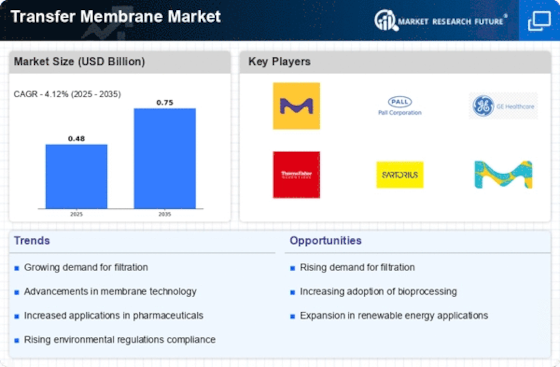
As per Market Research Future analysis, the Transfer Membrane Market Size was estimated at 0.48 USD Billion in 2024. The Transfer Membrane industry is projected to grow from USD 0.4998 Billion in 2025 to USD 0.7485 Billion by 2035, exhibiting a compound annual growth rate (CAGR) of 4.12% during the forecast period 2025 - 2035

Key Market Trends & Highlights

The Transfer Membrane Market is poised for substantial growth driven by technological advancements and increasing demand across various sectors.

  • North America remains the largest market for transfer membranes, driven by robust healthcare and industrial applications. Asia-Pacific is emerging as the fastest-growing region, fueled by rapid technological adoption and increasing investments in research and development. Nitrocellulose transfer membranes dominate the market, while PVDF transfer membranes are experiencing the fastest growth due to their superior properties. Technological advancements and sustainability initiatives are key drivers propelling the market forward, particularly in healthcare applications.

Market Size & Forecast

2024 Market Size 0.48 (USD Billion)
2035 Market Size 0.7485 (USD Billion)
CAGR (2025 - 2035) 4.12%
Largest Regional Market Share in 2024 North America

Major Players

Merck KGaA (DE), Pall Corporation (US), GE Healthcare (US), <a href="https://www.thermofisher.com/order/catalog/product/in/en/88518">Thermo Fisher Scientific</a> (US), Sartorius AG (DE), MilliporeSigma (US), Asahi Kasei Corporation (JP), Repligen Corporation (US), Danaher Corporation (US), 3M Company (US)

Market Trends

The Transfer Membrane Market is currently experiencing a dynamic evolution, driven by advancements in technology and increasing demand across various sectors. This market encompasses a range of products utilized in applications such as biotechnology, pharmaceuticals, and environmental testing. The growing emphasis on research and development in these fields appears to be propelling the need for efficient and reliable transfer membranes. Furthermore, the rising focus on sustainable practices and eco-friendly materials is likely influencing manufacturers to innovate and adapt their offerings to meet these emerging requirements. In addition, the Transfer Membrane Market seems to be benefiting from the expansion of laboratory automation and the integration of advanced filtration technologies. As laboratories strive for higher efficiency and accuracy, the demand for specialized membranes that can facilitate these processes is expected to rise. Moreover, the increasing prevalence of chronic diseases and the corresponding need for advanced diagnostic tools may further stimulate market growth. Overall, the Transfer Membrane Market is poised for continued development, with various factors contributing to its expansion and diversification in the coming years.

Technological Advancements

The Transfer Membrane Market is witnessing a surge in technological innovations that enhance the performance and efficiency of membranes. These advancements may include the development of new materials and manufacturing techniques that improve filtration capabilities and durability.

Sustainability Initiatives

There is a growing trend towards sustainability within the Transfer Membrane Market, as manufacturers increasingly prioritize eco-friendly materials and processes. This shift reflects a broader commitment to environmental responsibility and may influence product design and production methods.

Increased Demand in Healthcare

The healthcare sector's expanding need for advanced diagnostic and therapeutic solutions is likely driving growth in the Transfer Membrane Market. As medical research progresses, the demand for specialized membranes that support various applications is expected to rise.

Transfer Membrane Market Market Drivers

Increased Demand in Healthcare Applications

The Transfer Membrane Market is witnessing heightened demand in healthcare applications, particularly in biopharmaceutical manufacturing and diagnostics. Membranes are essential for processes such as protein purification and cell culture, which are critical in the development of vaccines and therapeutics. The biopharmaceutical sector is projected to grow significantly, with an estimated market value reaching over 500 billion dollars by 2026, thereby driving the demand for advanced membrane technologies. Moreover, the ongoing need for efficient filtration systems in laboratories and hospitals underscores the importance of membranes in ensuring safety and efficacy in medical applications. This trend is likely to propel the market forward, as healthcare providers seek reliable solutions.

Rising Industrial Applications of Membranes

The Transfer Membrane Market is expanding due to the rising industrial applications of membranes across various sectors, including food and beverage, chemical processing, and energy. Membranes are increasingly utilized for processes such as separation, concentration, and purification, which are essential in enhancing product quality and operational efficiency. For instance, in the food industry, membranes are employed for the concentration of fruit juices and dairy products, leading to reduced energy costs and improved product shelf life. The industrial membrane market is expected to grow at a rate of approximately 5% annually, driven by these diverse applications. As industries continue to seek innovative solutions for process optimization, the demand for specialized membranes is likely to increase.

Growing Investment in Research and Development

Investment in research and development is a crucial driver for the Transfer Membrane Market, as companies strive to innovate and improve membrane technologies. Increased funding from both private and public sectors is facilitating the exploration of new materials and processes that enhance membrane performance. This trend is particularly evident in the development of membranes with enhanced selectivity and permeability, which are essential for applications in water treatment and gas separation. The market is expected to benefit from a projected increase in R&D spending, which could reach billions of dollars in the coming years. As a result, advancements in membrane technology are likely to lead to new applications and market opportunities, further propelling industry growth.

Sustainability Initiatives Driving Market Growth

Sustainability initiatives are becoming increasingly pivotal in the Transfer Membrane Market, as companies and governments alike prioritize eco-friendly solutions. The demand for membranes that facilitate water reuse and energy recovery is on the rise, reflecting a broader commitment to environmental stewardship. For example, membranes that enable the treatment of wastewater for reuse in industrial processes are gaining traction, contributing to a more circular economy. This shift is supported by regulatory frameworks that encourage sustainable practices, potentially leading to a market expansion of around 6% annually. Additionally, the focus on reducing plastic waste is prompting innovations in biodegradable membranes, further aligning the industry with sustainability goals.

Technological Advancements in Membrane Technology

The Transfer Membrane Market is experiencing a surge in technological advancements that enhance membrane performance and efficiency. Innovations such as nanotechnology and advanced polymer materials are being integrated into membrane design, leading to improved filtration capabilities and reduced energy consumption. For instance, the introduction of high-flux membranes has been shown to increase productivity in various applications, including water treatment and pharmaceuticals. As a result, the market is projected to grow at a compound annual growth rate of approximately 7% over the next five years, driven by these technological improvements. Furthermore, the development of smart membranes that can adapt to varying conditions is likely to revolutionize the industry, making it more versatile and efficient.

Market Segment Insights

By Type: Nitrocellulose Transfer Membranes (Largest) vs. PVDF Transfer Membranes (Fastest-Growing)

<p>In the Transfer Membrane Market, Nitrocellulose Transfer Membranes represent the largest share, attributed to their extensive applications in various biochemical assays and western blotting techniques. They dominate the market due to their ability to provide high protein retention and improved transfer efficiency, they are widely preferred in laboratories and research institutions. On the other hand, PVDF Transfer Membranes are experiencing rapid growth, driven by their versatility and superior binding capacity compared to Nitrocellulose. The increasing demand for PVDF membranes in sensitive applications such as immunodetection and protein analysis is contributing to their rising popularity, making them the fastest-growing segment in the market.</p>

<p>Transfer Membranes: Nitrocellulose (Dominant) vs. PVDF (Emerging)</p>

<p>Nitrocellulose Transfer Membranes have established a strong dominance in the Transfer Membrane Market due to their historical usage and proven efficacy in various proteins and biomolecule transfers. They offer excellent background clarity and high binding capacity, which makes them the preferred choice for many researchers. However, PVDF Transfer Membranes are emerging rapidly as a viable alternative, offering enhanced durability and robustness under harsher experimental conditions. They are particularly valued in applications requiring high sensitivity and low background noise, positioning them as a favored choice for advanced biomolecular techniques. As innovation continues in membrane technology, both segments are expected to play significant roles in biotechnology and molecular biology.</p>

By Transfer Method: Semi-Dry Electrotransfer (Largest) vs. Dry Electrotransfer (Fastest-Growing)

<p>In the Transfer Membrane Market, Semi-Dry Electrotransfer currently leads the segment with the largest market share, characterized by its established utility in various applications. Dry Electrotransfer, while smaller in market share, is rapidly gaining traction due to its innovative technology that offers superior efficiency and lower operational costs compared to traditional methods. Tank Electrotransfer, although less predominant, plays a niche role in specialized applications, while other methods contribute to the diversity of the market.</p>

<p>Transfer Technologies: Semi-Dry Electrotransfer (Dominant) vs. Dry Electrotransfer (Emerging)</p>

<p>Semi-Dry Electrotransfer is positioned as the dominant transfer method in the market, known for its robust performance and reliability across multiple platforms, making it a preferred choice among manufacturers. In contrast, Dry Electrotransfer is emerging rapidly, driven by technological advances that enhance its efficacy in various applications while reducing energy consumption. Although it is still establishing its presence, its appeal lies in its ability to cater to the evolving needs of end-users seeking efficiency. The increasing adoption of automated processes favors Dry Electrotransfer, making it a segment to watch in the future.</p>

By Application: Western Blotting (Largest) vs. Protein Sequencing and Amino Acid Analysis (Fastest-Growing)

<p>The Transfer Membrane Market displays a diverse application landscape, prominently featuring Western Blotting, which holds the largest share among the various segment values. This technique's established role in protein analysis makes it a preferred choice in laboratories worldwide. Other applications, including Southern and Northern Blotting, have solid market positions but do not match the widespread use of Western Blotting. Meanwhile, Protein Sequencing and Amino Acid Analysis is emerging as a significant player in this market, reflecting a youthful but rapidly growing segment due to advancements in biotechnology. Growth in the Transfer Membrane Market is being driven by increased research and development activities in the life sciences sector, with a notable surge in demand for precise and efficient analysis techniques. The rapid technological advancements are enabling higher accuracy in protein analysis, thus propelling segments like Protein Sequencing to the forefront. Emerging trends indicate a shift towards integrated approaches combining multiple analytical techniques, which will likely bolster growth across these applications. Additionally, increased funding for therapeutic research is expected to create further opportunities for niche application segments within this market.</p>

<p>Western Blotting (Dominant) vs. Protein Sequencing (Emerging)</p>

<p>Western Blotting remains the dominant application in the Transfer Membrane Market, primarily due to its reliability and extensive validation in protein detection and analysis across various fields, including molecular biology and clinical diagnostics. Its established protocols and widespread acceptance foster continued dominance. In contrast, Protein Sequencing is seen as an emerging application that is rapidly gaining momentum thanks to innovations in sequencing techniques and automation, which promise enhanced speed and accuracy. This segment is becoming crucial for understanding complex protein interactions and functions, fueling significant interest and investment from research institutions and biopharmaceutical companies. As the demand for proteomics grows, these applications will likely evolve and adapt, impacting their respective market positions.</p>

By End User: Pharmaceutical and Biotechnology Companies (Largest) vs. Diagnostic Laboratories (Fastest-Growing)

<p>In the Transfer Membrane Market, the end-user segment is prominently led by Pharmaceutical and Biotechnology Companies, which command the largest market share among all user categories. These companies rely heavily on transfer membranes for various applications, including drug formulation and manufacturing processes. Diagnostic Laboratories follow suit, representing a significant portion of the market, driven by the increasing demand for accurate diagnostic tools and testing kits. Academic and Research Institutes contribute to innovation and product development, while the 'Others' category includes various niche applications.</p>

<p>Pharmaceutical and Biotechnology Companies (Dominant) vs. Diagnostic Laboratories (Emerging)</p>

<p>Pharmaceutical and Biotechnology Companies are the dominant players in the Transfer Membrane Market, utilizing these technologies for critical applications such as filtrations, separations, and purifications in drug development. Their investments in R&D and the growing trend towards biologics enhance their market position. On the other hand, Diagnostic Laboratories are emerging as a key segment due to the rising emphasis on preventive healthcare and personalized medicine. They are increasingly adopting novel membrane technologies for quicker and more efficient diagnostic tests, reflecting a robust growth trajectory driven by advancements in laboratory practices and demand for rapid diagnostics.</p>

Get more detailed insights about Transfer Membrane Market Research Report – Global Forecast till 2035

Regional Insights

North America : Innovation and Market Leadership

North America is the largest market for transfer membranes, holding approximately 45% of the global share. The region benefits from advanced healthcare infrastructure, significant R&D investments, and a strong presence of key players like Pall Corporation and Thermo Fisher Scientific. Regulatory support from agencies like the FDA further drives innovation and adoption of new technologies, enhancing market growth. The United States leads the North American market, followed by Canada, which is experiencing increased demand for biopharmaceutical applications. The competitive landscape is characterized by major companies such as Merck KGaA and GE Healthcare, which are continuously innovating to meet the growing needs of the life sciences sector. The presence of these key players ensures a robust supply chain and technological advancements in the region.

Europe : Regulatory Support and Growth

Europe is the second-largest market for transfer membranes, accounting for around 30% of the global market share. The region's growth is driven by stringent regulatory frameworks that promote high-quality manufacturing standards, particularly in biopharmaceuticals. Countries like Germany and the UK are at the forefront, supported by initiatives from the European Medicines Agency to enhance innovation in bioprocessing technologies. Germany leads the European market, followed closely by the UK and France, which are investing heavily in biomanufacturing capabilities. The competitive landscape features key players such as Sartorius AG and MilliporeSigma, which are expanding their product offerings to cater to the increasing demand for advanced filtration solutions. This dynamic environment fosters collaboration between industry and academia, further propelling market growth.

Asia-Pacific : Rapid Growth and Investment

Asia-Pacific is witnessing rapid growth in the transfer membrane market, holding approximately 20% of the global share. The region's expansion is fueled by increasing investments in biotechnology and pharmaceuticals, particularly in countries like China and India. Government initiatives aimed at enhancing healthcare infrastructure and regulatory frameworks are also significant growth drivers, making the region an attractive market for key players. China is the largest market in the Asia-Pacific region, with India following closely behind. The competitive landscape is evolving, with local companies emerging alongside established players like Asahi Kasei Corporation and Repligen Corporation. This growth is supported by a rising demand for bioprocessing technologies, as the region aims to become a global leader in biomanufacturing and healthcare solutions.

Middle East and Africa : Untapped Potential and Growth

The Middle East and Africa region is gradually emerging in the transfer membrane market, currently holding about 5% of the global share. The growth is primarily driven by increasing healthcare investments and a rising demand for biopharmaceuticals. Countries like South Africa and the UAE are focusing on enhancing their healthcare systems, which is expected to catalyze market growth in the coming years. South Africa leads the market in this region, with the UAE also showing significant potential due to its strategic investments in healthcare infrastructure. The competitive landscape is characterized by a mix of local and international players, including 3M Company, which are working to establish a foothold in this developing market. As the region continues to invest in healthcare, the demand for advanced filtration technologies is anticipated to rise significantly.

Key Players and Competitive Insights

Major market players are spending a lot of money on R&D to increase their product lines, which will help the market of transfer membrane grow even more. Market participants are also taking a range of strategic initiatives to grow their worldwide footprint, with key market developments such as new product launches, contractual agreements, mergers and acquisitions, increased investments, and collaboration with other organizations. Competitors in the transfer membrane industry must offer cost-effective items to expand and survive in an increasingly competitive and rising market environment.

One of the primary business strategies adopted by manufacturers in the global transfer membrane industry to benefit clients and expand the market sector is to manufacture locally to reduce operating costs. In recent years, transfer membrane industry has provided medicine with some of the most significant benefits. The transfer membrane market major player such as Axiva Sichem Biotech, Azure Biosystems, Bio-Rad Laboratories, Carl Roth, GE Healthcare, Abcam, Advansta, Atto Corporation, GVS, Macherey-Nagel, Merck KgaA, Pall Corporation (Subsidiary of Danaher Corporation), Perkinelmer, Santa Cruz Biotechnology, Thermo Fisher Scientific and Others.

Named after the Merck Group, which was established in Germany in 1668 and of which it was formerly the American arm, Merck & Co., Inc. is an American global pharmaceutical corporation with its headquarters in Rahway, New Jersey. Outside of the United States and Canada, the corporation trades as Merck Sharp & Dohme or MSD.

In December the United States federal government awarded Merck's Life Science business unit a 121 million euro contract to erect a lateral flow membrane manufacturing facility in Sheboygan, Wisconsin.

The pact intends to improve domestic production and supply of essential goods for the nation's pandemic preparedness.

A biotech company called Creative Biostructure specialises in offering the academic and biotech/pharmaceutical sectors cost-effective contract services in structural biology and membrane protein technologies. We have assisted customers from academic groups, biotech companies, and pharmaceutical companies in solving many complex biomolecule structures using our four industry-leading technology platforms in structural biology, including X-ray crystallography, nuclear magnetic resonance (NMR) spectroscopy, electron microscopy (EM), and membrane protein screening.

In June Creative Biostructure, a leader in biotech, updated its membrane protein service for the pharmaceutical sector. The cell's membrane serves as a wall dividing it from its surroundings.

Different nutrients, ions, and even DNA and proteins are transported into cells through membrane proteins. Moreover, membrane proteins are frequently thought of as the best therapeutic targets because they are crucial to cell function.

Key Companies in the Transfer Membrane Market include

Industry Developments

July 2021: To fulfil the rising need for biotechnology solutions, Cytiva and Pall Corporation invested 1.5 billion USD over a two-year period. The production and delivery capacities for products including membrane and filters will be improved in part by the investments.

January 2019: Reverse osmosis membranes are now available in a wider variety thanks to LANXESS. In Louisiana, USA, during the AMTA/AWWA Membrane Technology Conference & Exposition, they introduced the product.

Future Outlook

Transfer Membrane Market Future Outlook

The Transfer Membrane Market is projected to grow at a 4.12% CAGR from 2025 to 2035, driven by advancements in filtration technology, increasing demand in pharmaceuticals, and environmental regulations.

New opportunities lie in:

  • Development of high-performance membranes for water treatment applications.
  • Expansion into emerging markets with tailored membrane solutions.
  • Integration of smart technologies for real-time monitoring and maintenance.

By 2035, the Transfer Membrane Market is expected to achieve robust growth, reflecting evolving industry needs.

Market Segmentation

Transfer Membrane Market Type Outlook

  • Nitrocellulose Transfer Membranes
  • PVDF Transfer Membranes
  • Nylon Transfer Membranes

Transfer Membrane Market End User Outlook

  • Pharmaceutical and Biotechnology Companies
  • Diagnostic Laboratories
  • Academic and Research Institutes
  • Others

Transfer Membrane Market Application Outlook

  • Western Blotting
  • Southern Blotting
  • Northern Blotting
  • Protein Sequencing and Amino Acid Analysis
  • Others

Transfer Membrane Market Transfer Method Outlook

  • Semi-Dry Electrotransfer
  • Dry Electrotransfer
  • Tank Electrotransfer
  • Others

Report Scope

MARKET SIZE 2024 0.48(USD Billion)
MARKET SIZE 2025 0.4998(USD Billion)
MARKET SIZE 2035 0.7485(USD Billion)
COMPOUND ANNUAL GROWTH RATE (CAGR) 4.12% (2025 - 2035)
REPORT COVERAGE Revenue Forecast, Competitive Landscape, Growth Factors, and Trends
BASE YEAR 2024
Market Forecast Period 2025 - 2035
Historical Data 2019 - 2024
Market Forecast Units USD Billion
Key Companies Profiled Merck KGaA (DE), Pall Corporation (US), GE Healthcare (US), Thermo Fisher Scientific (US), Sartorius AG (DE), MilliporeSigma (US), Asahi Kasei Corporation (JP), Repligen Corporation (US), Danaher Corporation (US), 3M Company (US)
Segments Covered Type, Transfer Method, Application, End User, Region
Key Market Opportunities Advancements in filtration technologies drive growth in the Transfer Membrane Market.
Key Market Dynamics Technological advancements and regulatory changes drive innovation and competition in the Transfer Membrane Market.
Countries Covered North America, Europe, APAC, South America, MEA

FAQs

What is the projected market valuation of the Transfer Membrane Market by 2035?

<p>The Transfer Membrane Market is projected to reach a valuation of 0.7485 USD Billion by 2035.</p>

What was the market valuation of the Transfer Membrane Market in 2024?

<p>In 2024, the Transfer Membrane Market was valued at 0.48 USD Billion.</p>

What is the expected CAGR for the Transfer Membrane Market during the forecast period 2025 - 2035?

<p>The expected CAGR for the Transfer Membrane Market during the forecast period 2025 - 2035 is 4.12%.</p>

Which companies are considered key players in the Transfer Membrane Market?

<p>Key players in the Transfer Membrane Market include Merck KGaA, Pall Corporation, GE Healthcare, and Thermo Fisher Scientific.</p>

What are the main types of transfer membranes in the market?

<p>The main types of transfer membranes include Nitrocellulose, PVDF, and Nylon, with valuations ranging from 0.144 to 0.2937 USD Billion.</p>

What transfer methods are utilized in the Transfer Membrane Market?

<p>Transfer methods include Semi-Dry Electrotransfer, Dry Electrotransfer, and Tank Electrotransfer, with market values between 0.096 and 0.2274 USD Billion.</p>

What applications dominate the Transfer Membrane Market?

Applications such as Western Blotting and Southern Blotting dominate the market, with valuations of 0.15 and 0.1 USD Billion, respectively.

Who are the primary end users of transfer membranes?

Primary end users of transfer membranes include Pharmaceutical and Biotechnology Companies, and Diagnostic Laboratories, with market values of 0.192 and 0.144 USD Billion.

How does the market for Nitrocellulose Transfer Membranes compare to PVDF Transfer Membranes?

The market for Nitrocellulose and PVDF Transfer Membranes is similar, both valued at 0.144 USD Billion in 2024, indicating a competitive landscape.

What trends are influencing the growth of the Transfer Membrane Market?

Trends such as advancements in biotechnology and increasing demand from diagnostic laboratories are likely influencing the growth of the Transfer Membrane Market.

  1. SECTION I: EXECUTIVE SUMMARY AND KEY HIGHLIGHTS
    1. | 1.1 EXECUTIVE SUMMARY
    2. | | 1.1.1 Market Overview
    3. | | 1.1.2 Key Findings
    4. | | 1.1.3 Market Segmentation
    5. | | 1.1.4 Competitive Landscape
    6. | | 1.1.5 Challenges and Opportunities
    7. | | 1.1.6 Future Outlook
  2. SECTION II: SCOPING, METHODOLOGY AND MARKET STRUCTURE
    1. | 2.1 MARKET INTRODUCTION
    2. | | 2.1.1 Definition
    3. | | 2.1.2 Scope of the study
    4. | | | 2.1.2.1 Research Objective
    5. | | | 2.1.2.2 Assumption
    6. | | | 2.1.2.3 Limitations
    7. | 2.2 RESEARCH METHODOLOGY
    8. | | 2.2.1 Overview
    9. | | 2.2.2 Data Mining
    10. | | 2.2.3 Secondary Research
    11. | | 2.2.4 Primary Research
    12. | | | 2.2.4.1 Primary Interviews and Information Gathering Process
    13. | | | 2.2.4.2 Breakdown of Primary Respondents
    14. | | 2.2.5 Forecasting Model
    15. | | 2.2.6 Market Size Estimation
    16. | | | 2.2.6.1 Bottom-Up Approach
    17. | | | 2.2.6.2 Top-Down Approach
    18. | | 2.2.7 Data Triangulation
    19. | | 2.2.8 Validation
  3. SECTION III: QUALITATIVE ANALYSIS
    1. | 3.1 MARKET DYNAMICS
    2. | | 3.1.1 Overview
    3. | | 3.1.2 Drivers
    4. | | 3.1.3 Restraints
    5. | | 3.1.4 Opportunities
    6. | 3.2 MARKET FACTOR ANALYSIS
    7. | | 3.2.1 Value chain Analysis
    8. | | 3.2.2 Porter's Five Forces Analysis
    9. | | | 3.2.2.1 Bargaining Power of Suppliers
    10. | | | 3.2.2.2 Bargaining Power of Buyers
    11. | | | 3.2.2.3 Threat of New Entrants
    12. | | | 3.2.2.4 Threat of Substitutes
    13. | | | 3.2.2.5 Intensity of Rivalry
    14. | | 3.2.3 COVID-19 Impact Analysis
    15. | | | 3.2.3.1 Market Impact Analysis
    16. | | | 3.2.3.2 Regional Impact
    17. | | | 3.2.3.3 Opportunity and Threat Analysis
  4. SECTION IV: QUANTITATIVE ANALYSIS
    1. | 4.1 Healthcare, BY Type (USD Billion)
    2. | | 4.1.1 Nitrocellulose Transfer Membranes
    3. | | 4.1.2 PVDF Transfer Membranes
    4. | | 4.1.3 Nylon Transfer Membranes
    5. | 4.2 Healthcare, BY Transfer Method (USD Billion)
    6. | | 4.2.1 Semi-Dry Electrotransfer
    7. | | 4.2.2 Dry Electrotransfer
    8. | | 4.2.3 Tank Electrotransfer
    9. | | 4.2.4 Others
    10. | 4.3 Healthcare, BY Application (USD Billion)
    11. | | 4.3.1 Western Blotting
    12. | | 4.3.2 Southern Blotting
    13. | | 4.3.3 Northern Blotting
    14. | | 4.3.4 Protein Sequencing and Amino Acid Analysis
    15. | | 4.3.5 Others
    16. | 4.4 Healthcare, BY End User (USD Billion)
    17. | | 4.4.1 Pharmaceutical and Biotechnology Companies
    18. | | 4.4.2 Diagnostic Laboratories
    19. | | 4.4.3 Academic and Research Institutes
    20. | | 4.4.4 Others
    21. | 4.5 Healthcare, BY Region (USD Billion)
    22. | | 4.5.1 North America
    23. | | | 4.5.1.1 US
    24. | | | 4.5.1.2 Canada
    25. | | 4.5.2 Europe
    26. | | | 4.5.2.1 Germany
    27. | | | 4.5.2.2 UK
    28. | | | 4.5.2.3 France
    29. | | | 4.5.2.4 Russia
    30. | | | 4.5.2.5 Italy
    31. | | | 4.5.2.6 Spain
    32. | | | 4.5.2.7 Rest of Europe
    33. | | 4.5.3 APAC
    34. | | | 4.5.3.1 China
    35. | | | 4.5.3.2 India
    36. | | | 4.5.3.3 Japan
    37. | | | 4.5.3.4 South Korea
    38. | | | 4.5.3.5 Malaysia
    39. | | | 4.5.3.6 Thailand
    40. | | | 4.5.3.7 Indonesia
    41. | | | 4.5.3.8 Rest of APAC
    42. | | 4.5.4 South America
    43. | | | 4.5.4.1 Brazil
    44. | | | 4.5.4.2 Mexico
    45. | | | 4.5.4.3 Argentina
    46. | | | 4.5.4.4 Rest of South America
    47. | | 4.5.5 MEA
    48. | | | 4.5.5.1 GCC Countries
    49. | | | 4.5.5.2 South Africa
    50. | | | 4.5.5.3 Rest of MEA
  5. SECTION V: COMPETITIVE ANALYSIS
    1. | 5.1 Competitive Landscape
    2. | | 5.1.1 Overview
    3. | | 5.1.2 Competitive Analysis
    4. | | 5.1.3 Market share Analysis
    5. | | 5.1.4 Major Growth Strategy in the Healthcare
    6. | | 5.1.5 Competitive Benchmarking
    7. | | 5.1.6 Leading Players in Terms of Number of Developments in the Healthcare
    8. | | 5.1.7 Key developments and growth strategies
    9. | | | 5.1.7.1 New Product Launch/Service Deployment
    10. | | | 5.1.7.2 Merger & Acquisitions
    11. | | | 5.1.7.3 Joint Ventures
    12. | | 5.1.8 Major Players Financial Matrix
    13. | | | 5.1.8.1 Sales and Operating Income
    14. | | | 5.1.8.2 Major Players R&D Expenditure. 2023
    15. | 5.2 Company Profiles
    16. | | 5.2.1 Merck KGaA (DE)
    17. | | | 5.2.1.1 Financial Overview
    18. | | | 5.2.1.2 Products Offered
    19. | | | 5.2.1.3 Key Developments
    20. | | | 5.2.1.4 SWOT Analysis
    21. | | | 5.2.1.5 Key Strategies
    22. | | 5.2.2 Pall Corporation (US)
    23. | | | 5.2.2.1 Financial Overview
    24. | | | 5.2.2.2 Products Offered
    25. | | | 5.2.2.3 Key Developments
    26. | | | 5.2.2.4 SWOT Analysis
    27. | | | 5.2.2.5 Key Strategies
    28. | | 5.2.3 GE Healthcare (US)
    29. | | | 5.2.3.1 Financial Overview
    30. | | | 5.2.3.2 Products Offered
    31. | | | 5.2.3.3 Key Developments
    32. | | | 5.2.3.4 SWOT Analysis
    33. | | | 5.2.3.5 Key Strategies
    34. | | 5.2.4 Thermo Fisher Scientific (US)
    35. | | | 5.2.4.1 Financial Overview
    36. | | | 5.2.4.2 Products Offered
    37. | | | 5.2.4.3 Key Developments
    38. | | | 5.2.4.4 SWOT Analysis
    39. | | | 5.2.4.5 Key Strategies
    40. | | 5.2.5 Sartorius AG (DE)
    41. | | | 5.2.5.1 Financial Overview
    42. | | | 5.2.5.2 Products Offered
    43. | | | 5.2.5.3 Key Developments
    44. | | | 5.2.5.4 SWOT Analysis
    45. | | | 5.2.5.5 Key Strategies
    46. | | 5.2.6 MilliporeSigma (US)
    47. | | | 5.2.6.1 Financial Overview
    48. | | | 5.2.6.2 Products Offered
    49. | | | 5.2.6.3 Key Developments
    50. | | | 5.2.6.4 SWOT Analysis
    51. | | | 5.2.6.5 Key Strategies
    52. | | 5.2.7 Asahi Kasei Corporation (JP)
    53. | | | 5.2.7.1 Financial Overview
    54. | | | 5.2.7.2 Products Offered
    55. | | | 5.2.7.3 Key Developments
    56. | | | 5.2.7.4 SWOT Analysis
    57. | | | 5.2.7.5 Key Strategies
    58. | | 5.2.8 Repligen Corporation (US)
    59. | | | 5.2.8.1 Financial Overview
    60. | | | 5.2.8.2 Products Offered
    61. | | | 5.2.8.3 Key Developments
    62. | | | 5.2.8.4 SWOT Analysis
    63. | | | 5.2.8.5 Key Strategies
    64. | | 5.2.9 Danaher Corporation (US)
    65. | | | 5.2.9.1 Financial Overview
    66. | | | 5.2.9.2 Products Offered
    67. | | | 5.2.9.3 Key Developments
    68. | | | 5.2.9.4 SWOT Analysis
    69. | | | 5.2.9.5 Key Strategies
    70. | | 5.2.10 3M Company (US)
    71. | | | 5.2.10.1 Financial Overview
    72. | | | 5.2.10.2 Products Offered
    73. | | | 5.2.10.3 Key Developments
    74. | | | 5.2.10.4 SWOT Analysis
    75. | | | 5.2.10.5 Key Strategies
    76. | 5.3 Appendix
    77. | | 5.3.1 References
    78. | | 5.3.2 Related Reports
  6. LIST OF FIGURES
    1. | 6.1 MARKET SYNOPSIS
    2. | 6.2 NORTH AMERICA MARKET ANALYSIS
    3. | 6.3 US MARKET ANALYSIS BY TYPE
    4. | 6.4 US MARKET ANALYSIS BY TRANSFER METHOD
    5. | 6.5 US MARKET ANALYSIS BY APPLICATION
    6. | 6.6 US MARKET ANALYSIS BY END USER
    7. | 6.7 CANADA MARKET ANALYSIS BY TYPE
    8. | 6.8 CANADA MARKET ANALYSIS BY TRANSFER METHOD
    9. | 6.9 CANADA MARKET ANALYSIS BY APPLICATION
    10. | 6.10 CANADA MARKET ANALYSIS BY END USER
    11. | 6.11 EUROPE MARKET ANALYSIS
    12. | 6.12 GERMANY MARKET ANALYSIS BY TYPE
    13. | 6.13 GERMANY MARKET ANALYSIS BY TRANSFER METHOD
    14. | 6.14 GERMANY MARKET ANALYSIS BY APPLICATION
    15. | 6.15 GERMANY MARKET ANALYSIS BY END USER
    16. | 6.16 UK MARKET ANALYSIS BY TYPE
    17. | 6.17 UK MARKET ANALYSIS BY TRANSFER METHOD
    18. | 6.18 UK MARKET ANALYSIS BY APPLICATION
    19. | 6.19 UK MARKET ANALYSIS BY END USER
    20. | 6.20 FRANCE MARKET ANALYSIS BY TYPE
    21. | 6.21 FRANCE MARKET ANALYSIS BY TRANSFER METHOD
    22. | 6.22 FRANCE MARKET ANALYSIS BY APPLICATION
    23. | 6.23 FRANCE MARKET ANALYSIS BY END USER
    24. | 6.24 RUSSIA MARKET ANALYSIS BY TYPE
    25. | 6.25 RUSSIA MARKET ANALYSIS BY TRANSFER METHOD
    26. | 6.26 RUSSIA MARKET ANALYSIS BY APPLICATION
    27. | 6.27 RUSSIA MARKET ANALYSIS BY END USER
    28. | 6.28 ITALY MARKET ANALYSIS BY TYPE
    29. | 6.29 ITALY MARKET ANALYSIS BY TRANSFER METHOD
    30. | 6.30 ITALY MARKET ANALYSIS BY APPLICATION
    31. | 6.31 ITALY MARKET ANALYSIS BY END USER
    32. | 6.32 SPAIN MARKET ANALYSIS BY TYPE
    33. | 6.33 SPAIN MARKET ANALYSIS BY TRANSFER METHOD
    34. | 6.34 SPAIN MARKET ANALYSIS BY APPLICATION
    35. | 6.35 SPAIN MARKET ANALYSIS BY END USER
    36. | 6.36 REST OF EUROPE MARKET ANALYSIS BY TYPE
    37. | 6.37 REST OF EUROPE MARKET ANALYSIS BY TRANSFER METHOD
    38. | 6.38 REST OF EUROPE MARKET ANALYSIS BY APPLICATION
    39. | 6.39 REST OF EUROPE MARKET ANALYSIS BY END USER
    40. | 6.40 APAC MARKET ANALYSIS
    41. | 6.41 CHINA MARKET ANALYSIS BY TYPE
    42. | 6.42 CHINA MARKET ANALYSIS BY TRANSFER METHOD
    43. | 6.43 CHINA MARKET ANALYSIS BY APPLICATION
    44. | 6.44 CHINA MARKET ANALYSIS BY END USER
    45. | 6.45 INDIA MARKET ANALYSIS BY TYPE
    46. | 6.46 INDIA MARKET ANALYSIS BY TRANSFER METHOD
    47. | 6.47 INDIA MARKET ANALYSIS BY APPLICATION
    48. | 6.48 INDIA MARKET ANALYSIS BY END USER
    49. | 6.49 JAPAN MARKET ANALYSIS BY TYPE
    50. | 6.50 JAPAN MARKET ANALYSIS BY TRANSFER METHOD
    51. | 6.51 JAPAN MARKET ANALYSIS BY APPLICATION
    52. | 6.52 JAPAN MARKET ANALYSIS BY END USER
    53. | 6.53 SOUTH KOREA MARKET ANALYSIS BY TYPE
    54. | 6.54 SOUTH KOREA MARKET ANALYSIS BY TRANSFER METHOD
    55. | 6.55 SOUTH KOREA MARKET ANALYSIS BY APPLICATION
    56. | 6.56 SOUTH KOREA MARKET ANALYSIS BY END USER
    57. | 6.57 MALAYSIA MARKET ANALYSIS BY TYPE
    58. | 6.58 MALAYSIA MARKET ANALYSIS BY TRANSFER METHOD
    59. | 6.59 MALAYSIA MARKET ANALYSIS BY APPLICATION
    60. | 6.60 MALAYSIA MARKET ANALYSIS BY END USER
    61. | 6.61 THAILAND MARKET ANALYSIS BY TYPE
    62. | 6.62 THAILAND MARKET ANALYSIS BY TRANSFER METHOD
    63. | 6.63 THAILAND MARKET ANALYSIS BY APPLICATION
    64. | 6.64 THAILAND MARKET ANALYSIS BY END USER
    65. | 6.65 INDONESIA MARKET ANALYSIS BY TYPE
    66. | 6.66 INDONESIA MARKET ANALYSIS BY TRANSFER METHOD
    67. | 6.67 INDONESIA MARKET ANALYSIS BY APPLICATION
    68. | 6.68 INDONESIA MARKET ANALYSIS BY END USER
    69. | 6.69 REST OF APAC MARKET ANALYSIS BY TYPE
    70. | 6.70 REST OF APAC MARKET ANALYSIS BY TRANSFER METHOD
    71. | 6.71 REST OF APAC MARKET ANALYSIS BY APPLICATION
    72. | 6.72 REST OF APAC MARKET ANALYSIS BY END USER
    73. | 6.73 SOUTH AMERICA MARKET ANALYSIS
    74. | 6.74 BRAZIL MARKET ANALYSIS BY TYPE
    75. | 6.75 BRAZIL MARKET ANALYSIS BY TRANSFER METHOD
    76. | 6.76 BRAZIL MARKET ANALYSIS BY APPLICATION
    77. | 6.77 BRAZIL MARKET ANALYSIS BY END USER
    78. | 6.78 MEXICO MARKET ANALYSIS BY TYPE
    79. | 6.79 MEXICO MARKET ANALYSIS BY TRANSFER METHOD
    80. | 6.80 MEXICO MARKET ANALYSIS BY APPLICATION
    81. | 6.81 MEXICO MARKET ANALYSIS BY END USER
    82. | 6.82 ARGENTINA MARKET ANALYSIS BY TYPE
    83. | 6.83 ARGENTINA MARKET ANALYSIS BY TRANSFER METHOD
    84. | 6.84 ARGENTINA MARKET ANALYSIS BY APPLICATION
    85. | 6.85 ARGENTINA MARKET ANALYSIS BY END USER
    86. | 6.86 REST OF SOUTH AMERICA MARKET ANALYSIS BY TYPE
    87. | 6.87 REST OF SOUTH AMERICA MARKET ANALYSIS BY TRANSFER METHOD
    88. | 6.88 REST OF SOUTH AMERICA MARKET ANALYSIS BY APPLICATION
    89. | 6.89 REST OF SOUTH AMERICA MARKET ANALYSIS BY END USER
    90. | 6.90 MEA MARKET ANALYSIS
    91. | 6.91 GCC COUNTRIES MARKET ANALYSIS BY TYPE
    92. | 6.92 GCC COUNTRIES MARKET ANALYSIS BY TRANSFER METHOD
    93. | 6.93 GCC COUNTRIES MARKET ANALYSIS BY APPLICATION
    94. | 6.94 GCC COUNTRIES MARKET ANALYSIS BY END USER
    95. | 6.95 SOUTH AFRICA MARKET ANALYSIS BY TYPE
    96. | 6.96 SOUTH AFRICA MARKET ANALYSIS BY TRANSFER METHOD
    97. | 6.97 SOUTH AFRICA MARKET ANALYSIS BY APPLICATION
    98. | 6.98 SOUTH AFRICA MARKET ANALYSIS BY END USER
    99. | 6.99 REST OF MEA MARKET ANALYSIS BY TYPE
    100. | 6.100 REST OF MEA MARKET ANALYSIS BY TRANSFER METHOD
    101. | 6.101 REST OF MEA MARKET ANALYSIS BY APPLICATION
    102. | 6.102 REST OF MEA MARKET ANALYSIS BY END USER
    103. | 6.103 KEY BUYING CRITERIA OF HEALTHCARE
    104. | 6.104 RESEARCH PROCESS OF MRFR
    105. | 6.105 DRO ANALYSIS OF HEALTHCARE
    106. | 6.106 DRIVERS IMPACT ANALYSIS: HEALTHCARE
    107. | 6.107 RESTRAINTS IMPACT ANALYSIS: HEALTHCARE
    108. | 6.108 SUPPLY / VALUE CHAIN: HEALTHCARE
    109. | 6.109 HEALTHCARE, BY TYPE, 2024 (% SHARE)
    110. | 6.110 HEALTHCARE, BY TYPE, 2024 TO 2035 (USD Billion)
    111. | 6.111 HEALTHCARE, BY TRANSFER METHOD, 2024 (% SHARE)
    112. | 6.112 HEALTHCARE, BY TRANSFER METHOD, 2024 TO 2035 (USD Billion)
    113. | 6.113 HEALTHCARE, BY APPLICATION, 2024 (% SHARE)
    114. | 6.114 HEALTHCARE, BY APPLICATION, 2024 TO 2035 (USD Billion)
    115. | 6.115 HEALTHCARE, BY END USER, 2024 (% SHARE)
    116. | 6.116 HEALTHCARE, BY END USER, 2024 TO 2035 (USD Billion)
    117. | 6.117 BENCHMARKING OF MAJOR COMPETITORS
  7. LIST OF TABLES
    1. | 7.1 LIST OF ASSUMPTIONS
    2. | | 7.1.1
    3. | 7.2 North America MARKET SIZE ESTIMATES; FORECAST
    4. | | 7.2.1 BY TYPE, 2025-2035 (USD Billion)
    5. | | 7.2.2 BY TRANSFER METHOD, 2025-2035 (USD Billion)
    6. | | 7.2.3 BY APPLICATION, 2025-2035 (USD Billion)
    7. | | 7.2.4 BY END USER, 2025-2035 (USD Billion)
    8. | 7.3 US MARKET SIZE ESTIMATES; FORECAST
    9. | | 7.3.1 BY TYPE, 2025-2035 (USD Billion)
    10. | | 7.3.2 BY TRANSFER METHOD, 2025-2035 (USD Billion)
    11. | | 7.3.3 BY APPLICATION, 2025-2035 (USD Billion)
    12. | | 7.3.4 BY END USER, 2025-2035 (USD Billion)
    13. | 7.4 Canada MARKET SIZE ESTIMATES; FORECAST
    14. | | 7.4.1 BY TYPE, 2025-2035 (USD Billion)
    15. | | 7.4.2 BY TRANSFER METHOD, 2025-2035 (USD Billion)
    16. | | 7.4.3 BY APPLICATION, 2025-2035 (USD Billion)
    17. | | 7.4.4 BY END USER, 2025-2035 (USD Billion)
    18. | 7.5 Europe MARKET SIZE ESTIMATES; FORECAST
    19. | | 7.5.1 BY TYPE, 2025-2035 (USD Billion)
    20. | | 7.5.2 BY TRANSFER METHOD, 2025-2035 (USD Billion)
    21. | | 7.5.3 BY APPLICATION, 2025-2035 (USD Billion)
    22. | | 7.5.4 BY END USER, 2025-2035 (USD Billion)
    23. | 7.6 Germany MARKET SIZE ESTIMATES; FORECAST
    24. | | 7.6.1 BY TYPE, 2025-2035 (USD Billion)
    25. | | 7.6.2 BY TRANSFER METHOD, 2025-2035 (USD Billion)
    26. | | 7.6.3 BY APPLICATION, 2025-2035 (USD Billion)
    27. | | 7.6.4 BY END USER, 2025-2035 (USD Billion)
    28. | 7.7 UK MARKET SIZE ESTIMATES; FORECAST
    29. | | 7.7.1 BY TYPE, 2025-2035 (USD Billion)
    30. | | 7.7.2 BY TRANSFER METHOD, 2025-2035 (USD Billion)
    31. | | 7.7.3 BY APPLICATION, 2025-2035 (USD Billion)
    32. | | 7.7.4 BY END USER, 2025-2035 (USD Billion)
    33. | 7.8 France MARKET SIZE ESTIMATES; FORECAST
    34. | | 7.8.1 BY TYPE, 2025-2035 (USD Billion)
    35. | | 7.8.2 BY TRANSFER METHOD, 2025-2035 (USD Billion)
    36. | | 7.8.3 BY APPLICATION, 2025-2035 (USD Billion)
    37. | | 7.8.4 BY END USER, 2025-2035 (USD Billion)
    38. | 7.9 Russia MARKET SIZE ESTIMATES; FORECAST
    39. | | 7.9.1 BY TYPE, 2025-2035 (USD Billion)
    40. | | 7.9.2 BY TRANSFER METHOD, 2025-2035 (USD Billion)
    41. | | 7.9.3 BY APPLICATION, 2025-2035 (USD Billion)
    42. | | 7.9.4 BY END USER, 2025-2035 (USD Billion)
    43. | 7.10 Italy MARKET SIZE ESTIMATES; FORECAST
    44. | | 7.10.1 BY TYPE, 2025-2035 (USD Billion)
    45. | | 7.10.2 BY TRANSFER METHOD, 2025-2035 (USD Billion)
    46. | | 7.10.3 BY APPLICATION, 2025-2035 (USD Billion)
    47. | | 7.10.4 BY END USER, 2025-2035 (USD Billion)
    48. | 7.11 Spain MARKET SIZE ESTIMATES; FORECAST
    49. | | 7.11.1 BY TYPE, 2025-2035 (USD Billion)
    50. | | 7.11.2 BY TRANSFER METHOD, 2025-2035 (USD Billion)
    51. | | 7.11.3 BY APPLICATION, 2025-2035 (USD Billion)
    52. | | 7.11.4 BY END USER, 2025-2035 (USD Billion)
    53. | 7.12 Rest of Europe MARKET SIZE ESTIMATES; FORECAST
    54. | | 7.12.1 BY TYPE, 2025-2035 (USD Billion)
    55. | | 7.12.2 BY TRANSFER METHOD, 2025-2035 (USD Billion)
    56. | | 7.12.3 BY APPLICATION, 2025-2035 (USD Billion)
    57. | | 7.12.4 BY END USER, 2025-2035 (USD Billion)
    58. | 7.13 APAC MARKET SIZE ESTIMATES; FORECAST
    59. | | 7.13.1 BY TYPE, 2025-2035 (USD Billion)
    60. | | 7.13.2 BY TRANSFER METHOD, 2025-2035 (USD Billion)
    61. | | 7.13.3 BY APPLICATION, 2025-2035 (USD Billion)
    62. | | 7.13.4 BY END USER, 2025-2035 (USD Billion)
    63. | 7.14 China MARKET SIZE ESTIMATES; FORECAST
    64. | | 7.14.1 BY TYPE, 2025-2035 (USD Billion)
    65. | | 7.14.2 BY TRANSFER METHOD, 2025-2035 (USD Billion)
    66. | | 7.14.3 BY APPLICATION, 2025-2035 (USD Billion)
    67. | | 7.14.4 BY END USER, 2025-2035 (USD Billion)
    68. | 7.15 India MARKET SIZE ESTIMATES; FORECAST
    69. | | 7.15.1 BY TYPE, 2025-2035 (USD Billion)
    70. | | 7.15.2 BY TRANSFER METHOD, 2025-2035 (USD Billion)
    71. | | 7.15.3 BY APPLICATION, 2025-2035 (USD Billion)
    72. | | 7.15.4 BY END USER, 2025-2035 (USD Billion)
    73. | 7.16 Japan MARKET SIZE ESTIMATES; FORECAST
    74. | | 7.16.1 BY TYPE, 2025-2035 (USD Billion)
    75. | | 7.16.2 BY TRANSFER METHOD, 2025-2035 (USD Billion)
    76. | | 7.16.3 BY APPLICATION, 2025-2035 (USD Billion)
    77. | | 7.16.4 BY END USER, 2025-2035 (USD Billion)
    78. | 7.17 South Korea MARKET SIZE ESTIMATES; FORECAST
    79. | | 7.17.1 BY TYPE, 2025-2035 (USD Billion)
    80. | | 7.17.2 BY TRANSFER METHOD, 2025-2035 (USD Billion)
    81. | | 7.17.3 BY APPLICATION, 2025-2035 (USD Billion)
    82. | | 7.17.4 BY END USER, 2025-2035 (USD Billion)
    83. | 7.18 Malaysia MARKET SIZE ESTIMATES; FORECAST
    84. | | 7.18.1 BY TYPE, 2025-2035 (USD Billion)
    85. | | 7.18.2 BY TRANSFER METHOD, 2025-2035 (USD Billion)
    86. | | 7.18.3 BY APPLICATION, 2025-2035 (USD Billion)
    87. | | 7.18.4 BY END USER, 2025-2035 (USD Billion)
    88. | 7.19 Thailand MARKET SIZE ESTIMATES; FORECAST
    89. | | 7.19.1 BY TYPE, 2025-2035 (USD Billion)
    90. | | 7.19.2 BY TRANSFER METHOD, 2025-2035 (USD Billion)
    91. | | 7.19.3 BY APPLICATION, 2025-2035 (USD Billion)
    92. | | 7.19.4 BY END USER, 2025-2035 (USD Billion)
    93. | 7.20 Indonesia MARKET SIZE ESTIMATES; FORECAST
    94. | | 7.20.1 BY TYPE, 2025-2035 (USD Billion)
    95. | | 7.20.2 BY TRANSFER METHOD, 2025-2035 (USD Billion)
    96. | | 7.20.3 BY APPLICATION, 2025-2035 (USD Billion)
    97. | | 7.20.4 BY END USER, 2025-2035 (USD Billion)
    98. | 7.21 Rest of APAC MARKET SIZE ESTIMATES; FORECAST
    99. | | 7.21.1 BY TYPE, 2025-2035 (USD Billion)
    100. | | 7.21.2 BY TRANSFER METHOD, 2025-2035 (USD Billion)
    101. | | 7.21.3 BY APPLICATION, 2025-2035 (USD Billion)
    102. | | 7.21.4 BY END USER, 2025-2035 (USD Billion)
    103. | 7.22 South America MARKET SIZE ESTIMATES; FORECAST
    104. | | 7.22.1 BY TYPE, 2025-2035 (USD Billion)
    105. | | 7.22.2 BY TRANSFER METHOD, 2025-2035 (USD Billion)
    106. | | 7.22.3 BY APPLICATION, 2025-2035 (USD Billion)
    107. | | 7.22.4 BY END USER, 2025-2035 (USD Billion)
    108. | 7.23 Brazil MARKET SIZE ESTIMATES; FORECAST
    109. | | 7.23.1 BY TYPE, 2025-2035 (USD Billion)
    110. | | 7.23.2 BY TRANSFER METHOD, 2025-2035 (USD Billion)
    111. | | 7.23.3 BY APPLICATION, 2025-2035 (USD Billion)
    112. | | 7.23.4 BY END USER, 2025-2035 (USD Billion)
    113. | 7.24 Mexico MARKET SIZE ESTIMATES; FORECAST
    114. | | 7.24.1 BY TYPE, 2025-2035 (USD Billion)
    115. | | 7.24.2 BY TRANSFER METHOD, 2025-2035 (USD Billion)
    116. | | 7.24.3 BY APPLICATION, 2025-2035 (USD Billion)
    117. | | 7.24.4 BY END USER, 2025-2035 (USD Billion)
    118. | 7.25 Argentina MARKET SIZE ESTIMATES; FORECAST
    119. | | 7.25.1 BY TYPE, 2025-2035 (USD Billion)
    120. | | 7.25.2 BY TRANSFER METHOD, 2025-2035 (USD Billion)
    121. | | 7.25.3 BY APPLICATION, 2025-2035 (USD Billion)
    122. | | 7.25.4 BY END USER, 2025-2035 (USD Billion)
    123. | 7.26 Rest of South America MARKET SIZE ESTIMATES; FORECAST
    124. | | 7.26.1 BY TYPE, 2025-2035 (USD Billion)
    125. | | 7.26.2 BY TRANSFER METHOD, 2025-2035 (USD Billion)
    126. | | 7.26.3 BY APPLICATION, 2025-2035 (USD Billion)
    127. | | 7.26.4 BY END USER, 2025-2035 (USD Billion)
    128. | 7.27 MEA MARKET SIZE ESTIMATES; FORECAST
    129. | | 7.27.1 BY TYPE, 2025-2035 (USD Billion)
    130. | | 7.27.2 BY TRANSFER METHOD, 2025-2035 (USD Billion)
    131. | | 7.27.3 BY APPLICATION, 2025-2035 (USD Billion)
    132. | | 7.27.4 BY END USER, 2025-2035 (USD Billion)
    133. | 7.28 GCC Countries MARKET SIZE ESTIMATES; FORECAST
    134. | | 7.28.1 BY TYPE, 2025-2035 (USD Billion)
    135. | | 7.28.2 BY TRANSFER METHOD, 2025-2035 (USD Billion)
    136. | | 7.28.3 BY APPLICATION, 2025-2035 (USD Billion)
    137. | | 7.28.4 BY END USER, 2025-2035 (USD Billion)
    138. | 7.29 South Africa MARKET SIZE ESTIMATES; FORECAST
    139. | | 7.29.1 BY TYPE, 2025-2035 (USD Billion)
    140. | | 7.29.2 BY TRANSFER METHOD, 2025-2035 (USD Billion)
    141. | | 7.29.3 BY APPLICATION, 2025-2035 (USD Billion)
    142. | | 7.29.4 BY END USER, 2025-2035 (USD Billion)
    143. | 7.30 Rest of MEA MARKET SIZE ESTIMATES; FORECAST
    144. | | 7.30.1 BY TYPE, 2025-2035 (USD Billion)
    145. | | 7.30.2 BY TRANSFER METHOD, 2025-2035 (USD Billion)
    146. | | 7.30.3 BY APPLICATION, 2025-2035 (USD Billion)
    147. | | 7.30.4 BY END USER, 2025-2035 (USD Billion)
    148. | 7.31 PRODUCT LAUNCH/PRODUCT DEVELOPMENT/APPROVAL
    149. | | 7.31.1
    150. | 7.32 ACQUISITION/PARTNERSHIP
    151. | | 7.32.1

Healthcare Market Segmentation

Healthcare By Type (USD Billion, 2025-2035)

  • Nitrocellulose Transfer Membranes
  • PVDF Transfer Membranes
  • Nylon Transfer Membranes

Healthcare By Transfer Method (USD Billion, 2025-2035)

  • Semi-Dry Electrotransfer
  • Dry Electrotransfer
  • Tank Electrotransfer
  • Others

Healthcare By Application (USD Billion, 2025-2035)

  • Western Blotting
  • Southern Blotting
  • Northern Blotting
  • Protein Sequencing and Amino Acid Analysis
  • Others

Healthcare By End User (USD Billion, 2025-2035)

  • Pharmaceutical and Biotechnology Companies
  • Diagnostic Laboratories
  • Academic and Research Institutes
  • Others
Infographic

Free Sample Request

Kindly complete the form below to receive a free sample of this Report

Get Free Sample

Customer Strories

Compare Licence

×
Features License Type
Single User Multiuser License Enterprise User
Price $4,950 $5,950 $7,250
Maximum User Access Limit 1 User Upto 10 Users Unrestricted Access Throughout the Organization
Free Customization
Direct Access to Analyst
Deliverable Format
Platform Access
Discount on Next Purchase 10% 15% 15%
Printable Versions