
Request Free Sample ×

Kindly complete the form below to receive a free sample of this Report

* Please use a valid business email

Leading companies partner with us for data-driven Insights

clients tt-cursor
Hero Background
English
Chinese
French
Japanese
Korean
German
Spanish

Tractor Market Share

ID: MRFR/AT/10504-HCR
128 Pages
Shubham Munde
April 2026

Tractor Market Size, Share & Growth Analysis Report By Application (Agriculture, Construction, Landscaping, Forestry, Mining), By Engine Type (Internal Combustion Engine, Electric, Hybrid, Alternative Fuel, Hydrogen), By Tractor Size (Compact, Utility, Full-Size, High Horsepower, Sub-Compact), By Transmission Type (Manual, Automatic, Semi-Automatic, CVT, Power Shuttle) and By Regional (North America, Europe, South America, Asia Pacific, Middle East and Africa) - Industry Growth & Forecast to 2035

Share:
Download PDF ×

We do not share your information with anyone. However, we may send you emails based on your report interest from time to time. You may contact us at any time to opt-out.

Tractor Market Infographic
Purchase Options

Market Share

Tractor Market Share Analysis

Moreover, market segmentation plays a pivotal role in positioning tractor manufacturers. Companies perceive unique consumer segments primarily based on factors like farm length, geographical place, or agricultural practices. By tailoring their merchandise to fulfill the specific desires of those segments, groups can correctly goal and capture different market niches. For example, some manufacturers design compact tractors suitable for small farms or vineyards, while others are conscious of heavy-obligation fashions catering to big-scale agricultural operations. This segmentation method allows companies to cope with various patron necessities and enlarge their marketplace share throughout numerous farming demographics. Additionally, brand positioning is crucial in influencing purchaser perceptions and alternatives. Tractor companies put money into marketing and branding efforts to set up a distinct photo within the market. Building a reputation for reliability, sturdiness, or innovation can sway clients' choices when choosing a tractor. Furthermore, strategic partnerships and collaborations make a considerable contribution to market proportion positioning. Collaborating with dealerships, agricultural cooperatives, or government companies facilitates groups to increase their attainment into one-of-a-kind regions or consumer segments. Partnerships can also facilitate entry to new technology, distribution networks, or investment opportunities, empowering tractor producers to reinforce their marketplace presence and outperform the competition. Lastly, non-stop innovation and versions are essential in maintaining and expanding the market percentage. Companies that spend money on research and improvement to introduce new capabilities, improve efficiency, or comply with changing regulations tend to stay beforehand within the marketplace. Adapting to evolving consumer preferences, environmental issues, or technological improvements guarantees that tractor brands continue to be relevant and aggressive in a dynamic marketplace panorama. In essence, the tractor market's positioning strategies revolve around differentiation, price leadership, segmentation, branding, partnerships, and innovation. By strategically implementing these methods, tractor manufacturers' goal is to capture market percentage, meet numerous client desires, and live in advance in a fiercely aggressive enterprise.


Author
Author Profile
Shubham Munde
Team Lead - Research

Shubham brings over 7 years of expertise in Market Intelligence and Strategic Consulting, with a strong focus on the Automotive, Aerospace, and Defense sectors. Backed by a solid foundation in semiconductors, electronics, and software, he has successfully delivered high-impact syndicated and custom research on a global scale. His core strengths include market sizing, forecasting, competitive intelligence, consumer insights, and supply chain mapping. Widely recognized for developing scalable growth strategies, Shubham empowers clients to navigate complex markets and achieve a lasting competitive edge. Trusted by start-ups and Fortune 500 companies alike, he consistently converts challenges into strategic opportunities that drive sustainable growth.

Leave a Comment

FAQs

What is the current valuation of the Tractor Market as of 2024?

<p>The Tractor Market was valued at 76.35 USD Billion in 2024.</p>

What is the projected market valuation for the Tractor Market in 2035?

<p>The projected valuation for the Tractor Market in 2035 is 123.93 USD Billion.</p>

What is the expected CAGR for the Tractor Market during the forecast period 2025 - 2035?

<p>The expected CAGR for the Tractor Market during the forecast period 2025 - 2035 is 4.5%.</p>

Which companies are considered key players in the Tractor Market?

<p>Key players in the Tractor Market include John Deere, CNH Industrial, AGCO Corporation, Kubota Corporation, Mahindra & Mahindra, Yanmar Co Ltd, SDF Group, Deutz-Fahr, and Tafe.</p>

What are the main application segments of the Tractor Market?

<p>The main application segments of the Tractor Market include Agriculture, Construction, Landscaping, Forestry, and Mining.</p>

How much revenue is generated from the Agriculture segment of the Tractor Market?

<p>The Agriculture segment generated revenue between 30.0 and 50.0 USD Billion.</p>

What is the revenue range for the Electric engine type in the Tractor Market?

<p>The revenue range for the Electric engine type in the Tractor Market is between 10.0 and 20.0 USD Billion.</p>

What are the different tractor sizes available in the market?

<p>The Tractor Market offers various sizes, including Compact, Utility, Full-Size, High Horsepower, and Sub-Compact.</p>

What is the revenue range for the Automatic transmission type in the Tractor Market?

<p>The revenue range for the Automatic transmission type in the Tractor Market is between 25.0 and 40.0 USD Billion.</p>

How does the Tractor Market's growth outlook appear for the next decade?

<p>The Tractor Market's growth outlook appears positive, with a projected valuation increase to 123.93 USD Billion by 2035.</p>

Market Summary

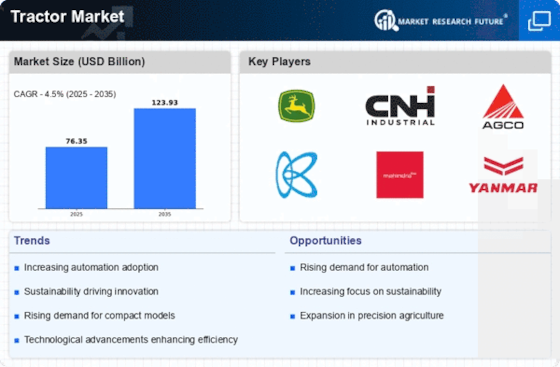
As per Market Research Future analysis, the Tractor Market Size was estimated at 76.35 USD Billion in 2024. The Tractor industry is projected to grow from 79.79 USD Billion in 2025 to 123.93 USD Billion by 2035, exhibiting a compound annual growth rate (CAGR) of 4% during the forecast period 2025 - 2035

Key Market Trends & Highlights

The Tractor Market is experiencing a dynamic shift towards technological innovation and sustainability.

  • Technological advancements are reshaping the tractor market, enhancing efficiency and productivity. Sustainability initiatives are increasingly influencing consumer preferences, particularly in North America. Customization and versatility are becoming essential features, especially in the agriculture segment. The rising demand for agricultural productivity and government support are key drivers propelling market growth.

Market Size & Forecast

2024 Market Size 76.35 (USD Billion)
2035 Market Size 123.93 (USD Billion)
CAGR (2025 - 2035) 4.5%
Largest Regional Market Share in 2024 Europe

Major Players

John Deere (US), CNH Industrial (GB), AGCO Corporation (US), Kubota Corporation (JP), Mahindra &amp; Mahindra (IN), Yanmar Co Ltd (JP), SDF Group (IT), Deutz-Fahr (DE), Tafe (IN)

Market Trends

The Tractor Market is currently experiencing a dynamic evolution, driven by various factors that influence agricultural practices and mechanization. As the global demand for food continues to rise, the need for efficient farming equipment becomes increasingly critical. This market is characterized by a shift towards advanced technologies, including automation and precision farming, which enhance productivity and reduce labor costs.

Furthermore, sustainability concerns are prompting manufacturers to develop eco-friendly tractors that minimize environmental impact while maintaining performance. The integration of smart technologies, such as IoT and data analytics, is also reshaping the landscape, allowing farmers to make informed decisions based on real-time data. In addition to technological advancements, the Agricultural Tractor Market is witnessing a growing trend towards customization and versatility.

Farmers are seeking equipment that can adapt to various tasks, from tilling to harvesting, thereby maximizing utility. This trend is further supported by the increasing availability of attachments and implements that enhance the functionality of tractors. As the market continues to evolve, it appears that the focus will remain on innovation, efficiency, and sustainability, ensuring that the Tractor Market remains a vital component of the agricultural sector.

Technological Advancements

The Agricultural Tractor Market is increasingly influenced by the integration of cutting-edge technologies. Innovations such as automation, precision farming, and smart sensors are enhancing operational efficiency. These advancements enable farmers to optimize their processes, reduce waste, and improve yield, thereby transforming traditional farming practices.

Sustainability Initiatives

There is a notable shift towards sustainability within the Agricultural Tractor Market. Manufacturers are prioritizing the development of eco-friendly tractors that utilize alternative fuels and energy-efficient technologies. This trend reflects a broader commitment to reducing the carbon footprint of agricultural operations and addressing environmental concerns.

Customization and Versatility

The demand for customizable and versatile tractors is on the rise. Farmers are increasingly looking for equipment that can perform multiple functions, allowing them to adapt to various agricultural tasks. This trend is supported by the availability of diverse attachments and implements, enhancing the overall utility of tractors.

Tractor Market Market Drivers

Expansion of Agricultural Land

The expansion of agricultural land is a significant driver for the Tractors Market Industry. As urbanization continues to encroach upon arable land, there is a pressing need to maximize the productivity of existing agricultural areas. This has led to an increased focus on mechanization, with tractors playing a pivotal role in enhancing cultivation efficiency. Recent statistics suggest that the total area under cultivation has seen a gradual increase, particularly in developing regions, where farmers are investing in modern equipment to boost yields. The Tractor Market stands to benefit from this trend, as more farmers recognize the necessity of utilizing advanced machinery to maintain competitiveness in a rapidly evolving agricultural landscape. Consequently, the demand for tractors is expected to rise, driven by the need to optimize land use and improve agricultural output.

Government Support and Subsidies

Government initiatives play a crucial role in shaping the Tractors Market. Various countries have implemented policies aimed at promoting agricultural mechanization through subsidies and financial assistance programs. These initiatives are designed to encourage farmers to invest in modern tractors, thereby enhancing productivity and competitiveness. For instance, certain regions have reported a 20% increase in tractor sales following the introduction of subsidy programs. Such support not only alleviates the financial burden on farmers but also stimulates the overall market. Additionally, governments are increasingly recognizing the importance of sustainable farming practices, which further drives the demand for advanced tractors equipped with eco-friendly technologies. As a result, the Tractor Market is likely to benefit from ongoing governmental support, fostering a conducive environment for growth.

Rising Adoption of Smart Farming Technologies

The integration of smart farming technologies is transforming the Tractors Market. Farmers are increasingly adopting precision agriculture tools, such as GPS and IoT-enabled devices, to enhance operational efficiency. This trend is reflected in the growing sales of smart tractors, which are equipped with advanced features that facilitate data-driven decision-making. Recent data indicates that the market for smart tractors is expected to grow at a compound annual growth rate of over 15% in the coming years. This shift towards technology-driven farming practices not only improves productivity but also promotes sustainable resource management. As farmers seek to optimize their operations, the demand for technologically advanced tractors is likely to rise, positioning the Agri-Equipment Tractor Market for substantial growth in the near future.

Growing Focus on Sustainable Farming Practices

The Tractor Market Industry is increasingly influenced by the growing emphasis on sustainable farming practices. As environmental concerns gain prominence, farmers are seeking tractors that not only enhance productivity but also minimize ecological impact. This shift is evident in the rising demand for tractors equipped with fuel-efficient engines and reduced emissions. Recent market analyses indicate that the segment of eco-friendly tractors is projected to grow significantly, as farmers aim to align their operations with sustainability goals. Additionally, the adoption of organic farming methods is further driving the need for specialized tractors that can cater to these practices. As sustainability becomes a central theme in agriculture, the Agricultural Tractor Market is likely to evolve, with manufacturers focusing on developing innovative solutions that meet the demands of environmentally conscious farmers.

Increasing Demand for Agricultural Productivity

The Farming Tractors Market is experiencing a notable surge in demand driven by the need for enhanced agricultural productivity. As populations grow, the pressure on food production intensifies, prompting farmers to adopt advanced machinery. In recent years, the adoption of tractors has increased significantly, with estimates suggesting that the market could reach a valuation of over 100 billion dollars by 2026. This trend indicates a shift towards mechanization, as tractors enable farmers to cultivate larger areas more efficiently. Furthermore, the integration of precision agriculture technologies into tractors enhances their utility, allowing for better resource management and yield optimization. Consequently, the Farm Tractor Industry is poised for growth as it aligns with the global agricultural sector's objectives of improving efficiency and sustainability.

Market Segment Insights

By Application: Agriculture (Largest) vs. Construction (Fastest-Growing)

<p>In the Tractor Market, Agriculture remains the largest application segment, holding a substantial share due to the ongoing need for effective farming solutions. The increasing demand for food production and advancements in agricultural technologies have bolstered this segment, making it a critical area for manufacturers. Following Agriculture, Construction is rapidly growing and expanding its market presence owing to rising infrastructure projects worldwide. This growth is indicative of the sector's essential requirement for versatile and robust machinery that can efficiently handle various tasks. Recently, there has been a noticeable trend towards automation and the use of precision agriculture tools within the Agriculture segment, enhancing efficiency and productivity. In contrast, the Construction segment is benefiting from urbanization and increased investment in construction activities, driving demand for heavy-duty tractors. Furthermore, innovations such as electric and hybrid tractors are gaining traction, shaping both segments with a focus on sustainability and operational efficiency.</p>

<p>Agriculture: Conventional Tractors (Dominant) vs. Construction: Compact Tractors (Emerging)</p>

<p>In the Agriculture segment, Conventional Tractors remain the dominant choice for farmers, providing the necessary power and versatility for large-scale agricultural operations. Their ability to perform a variety of tasks, including plowing, harvesting, and transporting, makes them indispensable. However, the Construction sector is witnessing a significant shift towards Compact Tractors, which are fast becoming the preferred equipment for smaller sites due to their maneuverability and ease of use. Compact Tractors are particularly suited for landscaping and small construction projects, where space constraints require efficiency and flexibility. This shift is accompanied by technological advancements, providing both segments with innovative features enhancing productivity and minimizing environmental impacts.</p>

By Engine Type: Internal Combustion Engine (Largest) vs. Electric (Fastest-Growing)

<p>The Tractor Market showcases a varied distribution of engine types, with Internal Combustion Engines (ICE) commanding the largest share. They remain the traditional choice among farmers due to their proven performance, reliability, and familiarity. However, Electric and Hybrid engines are gaining traction, driven by the growing interest in sustainable farming practices and regulatory pressures aimed at reducing emissions.</p>

<p>Internal Combustion Engine (Dominant) vs. Electric (Emerging)</p>

<p>Internal Combustion Engines are entrenched in the Tractor Market, owing to their robust performance and adaptability across various agricultural tasks. They thrive in settings that require high power and endurance. Conversely, Electric tractors are emerging as a viable alternative, leveraging advancements in battery technology and increasing awareness of environmental issues. As a result, their market presence is expanding, supported by incentives for sustainable farming and rising fuel costs.</p>

By Tractor Size: Compact (Largest) vs. High Horsepower (Fastest-Growing)

<p>The tractor market exhibits a diverse range of size segments, each catering to specific agricultural needs. Among these, the Compact segment holds the largest market share due to its versatility and suitability for small to mid-size farms. Following closely are the Utility and Full-Size tractors, which serve broader applications in intermediate and larger-scale farming operations. The High Horsepower tractors, despite having a smaller market share currently, are gaining traction among commercial farmers seeking increased productivity and efficiency. Growth trends within the tractor size segment indicate a significant shift towards High Horsepower tractors. As global agricultural practices evolve, there is a rising demand for tractors equipped with advanced technology and greater horsepower to handle larger tasks efficiently. Additionally, increasing investments in precision farming technologies are driving the expansion of the Compact segment, as farmers look for multifunctional equipment that maximizes productivity in confined spaces.</p>

<p>Compact (Dominant) vs. High Horsepower (Emerging)</p>

<p>The Compact tractors have established themselves as a dominant force in the market, primarily due to their adaptability for varied tasks, including landscaping, gardening, and light agricultural work. Their smaller size allows for easier maneuverability, making them ideal for operation in tight spaces. Conversely, High Horsepower tractors are emerging as powerful tools for large-scale agriculture, designed to perform heavy-duty tasks efficiently. These tractors are equipped with advanced features and high-torque engines that enhance their operational capacity. As farmers increasingly opt for larger and more capable machinery to meet the demands of modern farming, High Horsepower tractors are projected to see significant growth.</p>

By Transmission Type: Manual (Largest) vs. Automatic (Fastest-Growing)

<p>In the Tractor Market, the transmission type segment is primarily dominated by Manual transmissions, which cater to a significant portion of operators who value control and precision in their driving experience. They remain the most popular choice due to their simplicity and reliability, especially in agricultural applications where higher torque is often required. Automatic transmissions have been experiencing rapid adoption, attracting new customers who prefer ease of use and reduced driver fatigue during extended periods of operation.</p>

<p>Manual (Dominant) vs. CVT (Emerging)</p>

<p>Manual transmission tractors are characterized by their mechanical simplicity, providing users with direct control over gears and enhanced engine performance. This contributes to their dominance in the market, especially among traditional farmers who often need robust and durable equipment for demanding tasks. In contrast, Continuously Variable Transmissions (CVT) represent an emerging trend, offering seamless gear transitions and improved fuel efficiency. The rising focus on technological advancements in tractor design is propelling the demand for CVT, as modern farmers seek innovative solutions to maximize productivity and reduce operational costs.</p>

Get more detailed insights about Tractor Market Research Report—Global Forecast till 2035

Regional Insights

North America : Agricultural Innovation Leader

North America is witnessing robust growth in the tractor market sector, driven by advancements in agricultural technology and increasing demand for efficient farming practices. The United States holds the largest market share at approximately 60%, followed by Canada at around 25%. Regulatory support for sustainable farming practices is further catalyzing this growth, with initiatives aimed at reducing emissions and promoting precision agriculture. The competitive landscape is dominated by key players such as John Deere and AGCO Corporation, which are leading the charge in innovation and market penetration. The presence of established manufacturers ensures a diverse range of products catering to various agricultural needs. Additionally, the trend towards automation and smart farming solutions is reshaping the market, with companies investing heavily in R&D to stay ahead.

Europe : Sustainable Farming Initiatives

Europe's tractor market is characterized by a strong emphasis on sustainability and innovation, with the European Union implementing stringent regulations to promote eco-friendly farming practices. Germany and France are the largest markets, holding approximately 35% and 30% market shares, respectively. The push for sustainable agriculture is driving demand for advanced tractors equipped with low-emission technologies and precision farming capabilities. Leading countries in this region are Germany, France, and Italy, with major players like Deutz-Fahr and SDF Group making significant contributions. The competitive landscape is marked by a focus on technological advancements, with manufacturers investing in electric and hybrid tractors to meet regulatory standards. This shift towards sustainability is expected to further enhance market growth in the coming years.

Asia-Pacific : Emerging Market Potential

The Asia-Pacific region is experiencing rapid growth in the tractor market, driven by increasing mechanization in agriculture and rising demand for food production. India and China are the largest markets, accounting for approximately 40% and 30% of the market share, respectively. Government initiatives aimed at enhancing agricultural productivity and providing subsidies for tractor purchases are key growth drivers in this region. India is home to major players like Mahindra & Mahindra and Tafe, while Japan's Kubota Corporation is also a significant contributor. The competitive landscape is evolving, with a focus on affordable and efficient tractors tailored to smallholder farmers. The region's diverse agricultural practices necessitate a wide range of tractor models, further fueling market expansion.

Middle East and Africa : Resource-Rich Agricultural Sector

The Middle East and Africa region is witnessing a growing demand for tractors, driven by the need to enhance agricultural productivity and food security. Countries like South Africa and Nigeria are leading the market, holding approximately 30% and 25% of the market share, respectively. The region's agricultural sector is increasingly adopting mechanization to improve efficiency and yield, supported by government initiatives and investments in infrastructure. The competitive landscape features both local and international players, with companies like Yanmar Co Ltd and AGCO Corporation making significant inroads. The focus is on developing tractors that cater to the unique challenges of the region, such as arid climates and varying soil conditions. This adaptability is crucial for meeting the diverse needs of farmers across the region.

Key Players and Competitive Insights

The Tractor Market is characterized by intense competition among manufacturers, driven by the increasing demand for agricultural production and advancements in farming technology. This market has seen consistent growth, fueled by farmers' demand for improved efficiency, productivity, and sustainability in agricultural practices. Companies are continuously innovating, introducing advanced technology such as precision farming tools and automation features to capture a competitive edge.
As a result, market dynamics are influenced by various factors, including global economic conditions, technological advancements, and changing regulatory frameworks. The competitive landscape includes a mix of well-established players and emerging entrants, each vying for market share through differentiation in product offerings, distribution strategies, and customer engagement practices. Same DeutzFahr has established itself as a reputable player in the Farm Tractor Industry, known for its strong emphasis on engineering and high-quality farming machinery.
The company has a broad global presence, with manufacturing facilities and distribution networks that span several regions, ensuring efficient service delivery to diverse markets. Same DeutzFahr takes pride in its innovative approach, focusing on technology that enhances fuel efficiency and lowers emissions, which appeals to environmentally conscious consumers. Their tractors are characterized by performance and reliability, which bolsters customer loyalty and brand reputation.
In addition, Same DeutzFahr's extensive product portfolio allows them to cater to varying agricultural needs, thus enhancing their competitive position within the global market. Tractor Market Supply Company is another significant entity in the Farming Tractor Segment, known primarily for its comprehensive range of outdoor products and supplies catering to farmers and ranchers. The company operates a large retail chain that specializes in agricultural products, equipment, and services, ensuring accessibility for customers across different regions.
Tractor Market Supply Company's key offerings include tractors, farm equipment, tools, and livestock feed, making it a one-stop shop for agricultural needs. Their strong market presence is supported by an effective e-commerce platform and a commitment to customer service, which fosters customer loyalty and repeat business. Strengths in distribution and inventory management have allowed Farming Tractor Sector Supply Company to enhance operational efficiency. The company has also pursued strategic mergers and acquisitions to expand its product range and market reach, positioning itself as a prominent player in the global agricultural sector.
In August 2025, Escorts Kubota announced a ₹4,500-crore investment to establish a new tractor manufacturing plant in India. The facility will expand production capacity and meet rising agricultural machinery demand. This major investment strengthens India’s farm equipment manufacturing ecosystem.
In September 2025, Pritika Auto began production of tractor components for a global manufacturer, indicating India’s growing role as a supplier in global agricultural-equipment supply chains. This production start-up is likely to boost export revenues and support local manufacturing employment. It also signals increased global trust in Indian component quality.

Key Companies in the Tractor Market include

Industry Developments

  • Q4 2025: AGCO and SDF have entered a new strategic partnership to reinforce their global position in the low- and mid-horsepower tractor segment. The collaboration focuses on shared technology platforms, optimized manufacturing, and expanded dealer networks for emerging markets.
  • Q4 2025: Mahindra has expanded its global footprint by debuting the OJA tractor range in Australia, adding advanced farm technologies, higher efficiency powertrains, and enhanced operator comfort for the region.
  • Q3 2025: Kubota revenue down nearly 8% On August 5, 2025, Kubota Tractor Market reported a 7.9% revenue decline for the first half of 2025 compared to the same period in 2024, with North American revenue down 18.4% and operating profit down 31%.
  • Q2 2025: Tractor Market hits 25-year low as confidence wanes: Grain Market Daily In Q1 2025, UK agricultural tractor registrations (>50hp) fell by 23% year-over-year, reaching the lowest level since 1998, with 2,228 units registered between January and March 2025.
  • Q2 2025: April Tractor Market and Combine Sales Down Again From Last Year On May 12, 2025, the Association of Equipment Manufacturers reported that April 2025 tractor sales in the U.S. were down 12.3% compared to April 2024, with sales of 100+ HP two-wheel-drive tractors down 28.5% and four-wheel-drive tractors down 41.5%.

Future Outlook

Tractor Market Future Outlook

The Tractor Market is projected to grow at a 4.5% CAGR from 2025 to 2035, driven by technological advancements, increasing agricultural mechanization, and rising demand for sustainable farming practices.

New opportunities lie in:

  • <p>Development of precision agriculture technologies for enhanced yield Expansion into electric and hybrid tractor models Integration of IoT solutions for fleet management and monitoring</p>

By 2035, the Tractor Market is expected to be robust, reflecting significant advancements and increased adoption of innovative technologies.

Market Segmentation

Tractor Market Application Outlook

  • Agriculture
  • Construction
  • Landscaping
  • Forestry
  • Mining

Tractor Market Engine Type Outlook

  • Internal Combustion Engine
  • Electric
  • Hybrid
  • Alternative Fuel
  • Hydrogen

Tractor Market Tractor Size Outlook

  • Compact
  • Utility
  • Full-Size
  • High Horsepower
  • Sub-Compact

Tractor Market Transmission Type Outlook

  • Manual
  • Automatic
  • Semi-Automatic
  • CVT
  • Power Shuttle

Report Scope

MARKET SIZE 2024 76.35(USD Billion)
MARKET SIZE 2025 79.79(USD Billion)
MARKET SIZE 2035 123.93(USD Billion)
COMPOUND ANNUAL GROWTH RATE (CAGR) 4.5% (2025 - 2035)
REPORT COVERAGE Revenue Forecast, Competitive Landscape, Growth Factors, and Trends
BASE YEAR 2024
Market Forecast Period 2025 - 2035
Historical Data 2019 - 2024
Market Forecast Units USD Billion
Key Companies Profiled John Deere (US), CNH Industrial (GB), AGCO Corporation (US), Kubota Corporation (JP), Mahindra & Mahindra (IN), Yanmar Co Ltd (JP), SDF Group (IT), Deutz-Fahr (DE), Tafe (IN)
Segments Covered Application, Engine Type, Tractor Size, Transmission Type, Regional
Key Market Opportunities Integration of precision agriculture technologies in the Tractor Market enhances efficiency and productivity.
Key Market Dynamics Technological advancements in precision agriculture drive demand for innovative tractor solutions and enhanced operational efficiency.
Countries Covered North America, Europe, APAC, South America, MEA

FAQs

What is the current valuation of the Tractor Market as of 2024?

<p>The Tractor Market was valued at 76.35 USD Billion in 2024.</p>

What is the projected market valuation for the Tractor Market in 2035?

<p>The projected valuation for the Tractor Market in 2035 is 123.93 USD Billion.</p>

What is the expected CAGR for the Tractor Market during the forecast period 2025 - 2035?

<p>The expected CAGR for the Tractor Market during the forecast period 2025 - 2035 is 4.5%.</p>

Which companies are considered key players in the Tractor Market?

<p>Key players in the Tractor Market include John Deere, CNH Industrial, AGCO Corporation, Kubota Corporation, Mahindra & Mahindra, Yanmar Co Ltd, SDF Group, Deutz-Fahr, and Tafe.</p>

What are the main application segments of the Tractor Market?

<p>The main application segments of the Tractor Market include Agriculture, Construction, Landscaping, Forestry, and Mining.</p>

How much revenue is generated from the Agriculture segment of the Tractor Market?

<p>The Agriculture segment generated revenue between 30.0 and 50.0 USD Billion.</p>

What is the revenue range for the Electric engine type in the Tractor Market?

<p>The revenue range for the Electric engine type in the Tractor Market is between 10.0 and 20.0 USD Billion.</p>

What are the different tractor sizes available in the market?

<p>The Tractor Market offers various sizes, including Compact, Utility, Full-Size, High Horsepower, and Sub-Compact.</p>

What is the revenue range for the Automatic transmission type in the Tractor Market?

<p>The revenue range for the Automatic transmission type in the Tractor Market is between 25.0 and 40.0 USD Billion.</p>

How does the Tractor Market's growth outlook appear for the next decade?

<p>The Tractor Market's growth outlook appears positive, with a projected valuation increase to 123.93 USD Billion by 2035.</p>

  1. SECTION I: EXECUTIVE SUMMARY AND KEY HIGHLIGHTS
    1. | 1.1 EXECUTIVE SUMMARY
    2. | | 1.1.1 Market Overview
    3. | | 1.1.2 Key Findings
    4. | | 1.1.3 Market Segmentation
    5. | | 1.1.4 Competitive Landscape
    6. | | 1.1.5 Challenges and Opportunities
    7. | | 1.1.6 Future Outlook
  2. SECTION II: SCOPING, METHODOLOGY AND MARKET STRUCTURE
    1. | 2.1 MARKET INTRODUCTION
    2. | | 2.1.1 Definition
    3. | | 2.1.2 Scope of the study
    4. | | | 2.1.2.1 Research Objective
    5. | | | 2.1.2.2 Assumption
    6. | | | 2.1.2.3 Limitations
    7. | 2.2 RESEARCH METHODOLOGY
    8. | | 2.2.1 Overview
    9. | | 2.2.2 Data Mining
    10. | | 2.2.3 Secondary Research
    11. | | 2.2.4 Primary Research
    12. | | | 2.2.4.1 Primary Interviews and Information Gathering Process
    13. | | | 2.2.4.2 Breakdown of Primary Respondents
    14. | | 2.2.5 Forecasting Model
    15. | | 2.2.6 Market Size Estimation
    16. | | | 2.2.6.1 Bottom-Up Approach
    17. | | | 2.2.6.2 Top-Down Approach
    18. | | 2.2.7 Data Triangulation
    19. | | 2.2.8 Validation
  3. SECTION III: QUALITATIVE ANALYSIS
    1. | 3.1 MARKET DYNAMICS
    2. | | 3.1.1 Overview
    3. | | 3.1.2 Drivers
    4. | | 3.1.3 Restraints
    5. | | 3.1.4 Opportunities
    6. | 3.2 MARKET FACTOR ANALYSIS
    7. | | 3.2.1 Value chain Analysis
    8. | | 3.2.2 Porter's Five Forces Analysis
    9. | | | 3.2.2.1 Bargaining Power of Suppliers
    10. | | | 3.2.2.2 Bargaining Power of Buyers
    11. | | | 3.2.2.3 Threat of New Entrants
    12. | | | 3.2.2.4 Threat of Substitutes
    13. | | | 3.2.2.5 Intensity of Rivalry
    14. | | 3.2.3 COVID-19 Impact Analysis
    15. | | | 3.2.3.1 Market Impact Analysis
    16. | | | 3.2.3.2 Regional Impact
    17. | | | 3.2.3.3 Opportunity and Threat Analysis
  4. SECTION IV: QUANTITATIVE ANALYSIS
    1. | 4.1 Automobile, BY Application (USD Billion)
    2. | | 4.1.1 Agriculture
    3. | | 4.1.2 Construction
    4. | | 4.1.3 Landscaping
    5. | | 4.1.4 Forestry
    6. | | 4.1.5 Mining
    7. | 4.2 Automobile, BY Engine Type (USD Billion)
    8. | | 4.2.1 Internal Combustion Engine
    9. | | 4.2.2 Electric
    10. | | 4.2.3 Hybrid
    11. | | 4.2.4 Alternative Fuel
    12. | | 4.2.5 Hydrogen
    13. | 4.3 Automobile, BY Tractor Size (USD Billion)
    14. | | 4.3.1 Compact
    15. | | 4.3.2 Utility
    16. | | 4.3.3 Full-Size
    17. | | 4.3.4 High Horsepower
    18. | | 4.3.5 Sub-Compact
    19. | 4.4 Automobile, BY Transmission Type (USD Billion)
    20. | | 4.4.1 Manual
    21. | | 4.4.2 Automatic
    22. | | 4.4.3 Semi-Automatic
    23. | | 4.4.4 CVT
    24. | | 4.4.5 Power Shuttle
    25. | 4.5 Automobile, BY Region (USD Billion)
    26. | | 4.5.1 North America
    27. | | | 4.5.1.1 US
    28. | | | 4.5.1.2 Canada
    29. | | 4.5.2 Europe
    30. | | | 4.5.2.1 Germany
    31. | | | 4.5.2.2 UK
    32. | | | 4.5.2.3 France
    33. | | | 4.5.2.4 Russia
    34. | | | 4.5.2.5 Italy
    35. | | | 4.5.2.6 Spain
    36. | | | 4.5.2.7 Rest of Europe
    37. | | 4.5.3 APAC
    38. | | | 4.5.3.1 China
    39. | | | 4.5.3.2 India
    40. | | | 4.5.3.3 Japan
    41. | | | 4.5.3.4 South Korea
    42. | | | 4.5.3.5 Malaysia
    43. | | | 4.5.3.6 Thailand
    44. | | | 4.5.3.7 Indonesia
    45. | | | 4.5.3.8 Rest of APAC
    46. | | 4.5.4 South America
    47. | | | 4.5.4.1 Brazil
    48. | | | 4.5.4.2 Mexico
    49. | | | 4.5.4.3 Argentina
    50. | | | 4.5.4.4 Rest of South America
    51. | | 4.5.5 MEA
    52. | | | 4.5.5.1 GCC Countries
    53. | | | 4.5.5.2 South Africa
    54. | | | 4.5.5.3 Rest of MEA
  5. SECTION V: COMPETITIVE ANALYSIS
    1. | 5.1 Competitive Landscape
    2. | | 5.1.1 Overview
    3. | | 5.1.2 Competitive Analysis
    4. | | 5.1.3 Market share Analysis
    5. | | 5.1.4 Major Growth Strategy in the Automobile
    6. | | 5.1.5 Competitive Benchmarking
    7. | | 5.1.6 Leading Players in Terms of Number of Developments in the Automobile
    8. | | 5.1.7 Key developments and growth strategies
    9. | | | 5.1.7.1 New Product Launch/Service Deployment
    10. | | | 5.1.7.2 Merger & Acquisitions
    11. | | | 5.1.7.3 Joint Ventures
    12. | | 5.1.8 Major Players Financial Matrix
    13. | | | 5.1.8.1 Sales and Operating Income
    14. | | | 5.1.8.2 Major Players R&D Expenditure. 2023
    15. | 5.2 Company Profiles
    16. | | 5.2.1 John Deere (US)
    17. | | | 5.2.1.1 Financial Overview
    18. | | | 5.2.1.2 Products Offered
    19. | | | 5.2.1.3 Key Developments
    20. | | | 5.2.1.4 SWOT Analysis
    21. | | | 5.2.1.5 Key Strategies
    22. | | 5.2.2 CNH Industrial (GB)
    23. | | | 5.2.2.1 Financial Overview
    24. | | | 5.2.2.2 Products Offered
    25. | | | 5.2.2.3 Key Developments
    26. | | | 5.2.2.4 SWOT Analysis
    27. | | | 5.2.2.5 Key Strategies
    28. | | 5.2.3 AGCO Corporation (US)
    29. | | | 5.2.3.1 Financial Overview
    30. | | | 5.2.3.2 Products Offered
    31. | | | 5.2.3.3 Key Developments
    32. | | | 5.2.3.4 SWOT Analysis
    33. | | | 5.2.3.5 Key Strategies
    34. | | 5.2.4 Kubota Corporation (JP)
    35. | | | 5.2.4.1 Financial Overview
    36. | | | 5.2.4.2 Products Offered
    37. | | | 5.2.4.3 Key Developments
    38. | | | 5.2.4.4 SWOT Analysis
    39. | | | 5.2.4.5 Key Strategies
    40. | | 5.2.5 Mahindra & Mahindra (IN)
    41. | | | 5.2.5.1 Financial Overview
    42. | | | 5.2.5.2 Products Offered
    43. | | | 5.2.5.3 Key Developments
    44. | | | 5.2.5.4 SWOT Analysis
    45. | | | 5.2.5.5 Key Strategies
    46. | | 5.2.6 Yanmar Co Ltd (JP)
    47. | | | 5.2.6.1 Financial Overview
    48. | | | 5.2.6.2 Products Offered
    49. | | | 5.2.6.3 Key Developments
    50. | | | 5.2.6.4 SWOT Analysis
    51. | | | 5.2.6.5 Key Strategies
    52. | | 5.2.7 SDF Group (IT)
    53. | | | 5.2.7.1 Financial Overview
    54. | | | 5.2.7.2 Products Offered
    55. | | | 5.2.7.3 Key Developments
    56. | | | 5.2.7.4 SWOT Analysis
    57. | | | 5.2.7.5 Key Strategies
    58. | | 5.2.8 Deutz-Fahr (DE)
    59. | | | 5.2.8.1 Financial Overview
    60. | | | 5.2.8.2 Products Offered
    61. | | | 5.2.8.3 Key Developments
    62. | | | 5.2.8.4 SWOT Analysis
    63. | | | 5.2.8.5 Key Strategies
    64. | | 5.2.9 Tafe (IN)
    65. | | | 5.2.9.1 Financial Overview
    66. | | | 5.2.9.2 Products Offered
    67. | | | 5.2.9.3 Key Developments
    68. | | | 5.2.9.4 SWOT Analysis
    69. | | | 5.2.9.5 Key Strategies
    70. | 5.3 Appendix
    71. | | 5.3.1 References
    72. | | 5.3.2 Related Reports
  6. LIST OF FIGURES
    1. | 6.1 MARKET SYNOPSIS
    2. | 6.2 NORTH AMERICA MARKET ANALYSIS
    3. | 6.3 US MARKET ANALYSIS BY APPLICATION
    4. | 6.4 US MARKET ANALYSIS BY ENGINE TYPE
    5. | 6.5 US MARKET ANALYSIS BY TRACTOR SIZE
    6. | 6.6 US MARKET ANALYSIS BY TRANSMISSION TYPE
    7. | 6.7 CANADA MARKET ANALYSIS BY APPLICATION
    8. | 6.8 CANADA MARKET ANALYSIS BY ENGINE TYPE
    9. | 6.9 CANADA MARKET ANALYSIS BY TRACTOR SIZE
    10. | 6.10 CANADA MARKET ANALYSIS BY TRANSMISSION TYPE
    11. | 6.11 EUROPE MARKET ANALYSIS
    12. | 6.12 GERMANY MARKET ANALYSIS BY APPLICATION
    13. | 6.13 GERMANY MARKET ANALYSIS BY ENGINE TYPE
    14. | 6.14 GERMANY MARKET ANALYSIS BY TRACTOR SIZE
    15. | 6.15 GERMANY MARKET ANALYSIS BY TRANSMISSION TYPE
    16. | 6.16 UK MARKET ANALYSIS BY APPLICATION
    17. | 6.17 UK MARKET ANALYSIS BY ENGINE TYPE
    18. | 6.18 UK MARKET ANALYSIS BY TRACTOR SIZE
    19. | 6.19 UK MARKET ANALYSIS BY TRANSMISSION TYPE
    20. | 6.20 FRANCE MARKET ANALYSIS BY APPLICATION
    21. | 6.21 FRANCE MARKET ANALYSIS BY ENGINE TYPE
    22. | 6.22 FRANCE MARKET ANALYSIS BY TRACTOR SIZE
    23. | 6.23 FRANCE MARKET ANALYSIS BY TRANSMISSION TYPE
    24. | 6.24 RUSSIA MARKET ANALYSIS BY APPLICATION
    25. | 6.25 RUSSIA MARKET ANALYSIS BY ENGINE TYPE
    26. | 6.26 RUSSIA MARKET ANALYSIS BY TRACTOR SIZE
    27. | 6.27 RUSSIA MARKET ANALYSIS BY TRANSMISSION TYPE
    28. | 6.28 ITALY MARKET ANALYSIS BY APPLICATION
    29. | 6.29 ITALY MARKET ANALYSIS BY ENGINE TYPE
    30. | 6.30 ITALY MARKET ANALYSIS BY TRACTOR SIZE
    31. | 6.31 ITALY MARKET ANALYSIS BY TRANSMISSION TYPE
    32. | 6.32 SPAIN MARKET ANALYSIS BY APPLICATION
    33. | 6.33 SPAIN MARKET ANALYSIS BY ENGINE TYPE
    34. | 6.34 SPAIN MARKET ANALYSIS BY TRACTOR SIZE
    35. | 6.35 SPAIN MARKET ANALYSIS BY TRANSMISSION TYPE
    36. | 6.36 REST OF EUROPE MARKET ANALYSIS BY APPLICATION
    37. | 6.37 REST OF EUROPE MARKET ANALYSIS BY ENGINE TYPE
    38. | 6.38 REST OF EUROPE MARKET ANALYSIS BY TRACTOR SIZE
    39. | 6.39 REST OF EUROPE MARKET ANALYSIS BY TRANSMISSION TYPE
    40. | 6.40 APAC MARKET ANALYSIS
    41. | 6.41 CHINA MARKET ANALYSIS BY APPLICATION
    42. | 6.42 CHINA MARKET ANALYSIS BY ENGINE TYPE
    43. | 6.43 CHINA MARKET ANALYSIS BY TRACTOR SIZE
    44. | 6.44 CHINA MARKET ANALYSIS BY TRANSMISSION TYPE
    45. | 6.45 INDIA MARKET ANALYSIS BY APPLICATION
    46. | 6.46 INDIA MARKET ANALYSIS BY ENGINE TYPE
    47. | 6.47 INDIA MARKET ANALYSIS BY TRACTOR SIZE
    48. | 6.48 INDIA MARKET ANALYSIS BY TRANSMISSION TYPE
    49. | 6.49 JAPAN MARKET ANALYSIS BY APPLICATION
    50. | 6.50 JAPAN MARKET ANALYSIS BY ENGINE TYPE
    51. | 6.51 JAPAN MARKET ANALYSIS BY TRACTOR SIZE
    52. | 6.52 JAPAN MARKET ANALYSIS BY TRANSMISSION TYPE
    53. | 6.53 SOUTH KOREA MARKET ANALYSIS BY APPLICATION
    54. | 6.54 SOUTH KOREA MARKET ANALYSIS BY ENGINE TYPE
    55. | 6.55 SOUTH KOREA MARKET ANALYSIS BY TRACTOR SIZE
    56. | 6.56 SOUTH KOREA MARKET ANALYSIS BY TRANSMISSION TYPE
    57. | 6.57 MALAYSIA MARKET ANALYSIS BY APPLICATION
    58. | 6.58 MALAYSIA MARKET ANALYSIS BY ENGINE TYPE
    59. | 6.59 MALAYSIA MARKET ANALYSIS BY TRACTOR SIZE
    60. | 6.60 MALAYSIA MARKET ANALYSIS BY TRANSMISSION TYPE
    61. | 6.61 THAILAND MARKET ANALYSIS BY APPLICATION
    62. | 6.62 THAILAND MARKET ANALYSIS BY ENGINE TYPE
    63. | 6.63 THAILAND MARKET ANALYSIS BY TRACTOR SIZE
    64. | 6.64 THAILAND MARKET ANALYSIS BY TRANSMISSION TYPE
    65. | 6.65 INDONESIA MARKET ANALYSIS BY APPLICATION
    66. | 6.66 INDONESIA MARKET ANALYSIS BY ENGINE TYPE
    67. | 6.67 INDONESIA MARKET ANALYSIS BY TRACTOR SIZE
    68. | 6.68 INDONESIA MARKET ANALYSIS BY TRANSMISSION TYPE
    69. | 6.69 REST OF APAC MARKET ANALYSIS BY APPLICATION
    70. | 6.70 REST OF APAC MARKET ANALYSIS BY ENGINE TYPE
    71. | 6.71 REST OF APAC MARKET ANALYSIS BY TRACTOR SIZE
    72. | 6.72 REST OF APAC MARKET ANALYSIS BY TRANSMISSION TYPE
    73. | 6.73 SOUTH AMERICA MARKET ANALYSIS
    74. | 6.74 BRAZIL MARKET ANALYSIS BY APPLICATION
    75. | 6.75 BRAZIL MARKET ANALYSIS BY ENGINE TYPE
    76. | 6.76 BRAZIL MARKET ANALYSIS BY TRACTOR SIZE
    77. | 6.77 BRAZIL MARKET ANALYSIS BY TRANSMISSION TYPE
    78. | 6.78 MEXICO MARKET ANALYSIS BY APPLICATION
    79. | 6.79 MEXICO MARKET ANALYSIS BY ENGINE TYPE
    80. | 6.80 MEXICO MARKET ANALYSIS BY TRACTOR SIZE
    81. | 6.81 MEXICO MARKET ANALYSIS BY TRANSMISSION TYPE
    82. | 6.82 ARGENTINA MARKET ANALYSIS BY APPLICATION
    83. | 6.83 ARGENTINA MARKET ANALYSIS BY ENGINE TYPE
    84. | 6.84 ARGENTINA MARKET ANALYSIS BY TRACTOR SIZE
    85. | 6.85 ARGENTINA MARKET ANALYSIS BY TRANSMISSION TYPE
    86. | 6.86 REST OF SOUTH AMERICA MARKET ANALYSIS BY APPLICATION
    87. | 6.87 REST OF SOUTH AMERICA MARKET ANALYSIS BY ENGINE TYPE
    88. | 6.88 REST OF SOUTH AMERICA MARKET ANALYSIS BY TRACTOR SIZE
    89. | 6.89 REST OF SOUTH AMERICA MARKET ANALYSIS BY TRANSMISSION TYPE
    90. | 6.90 MEA MARKET ANALYSIS
    91. | 6.91 GCC COUNTRIES MARKET ANALYSIS BY APPLICATION
    92. | 6.92 GCC COUNTRIES MARKET ANALYSIS BY ENGINE TYPE
    93. | 6.93 GCC COUNTRIES MARKET ANALYSIS BY TRACTOR SIZE
    94. | 6.94 GCC COUNTRIES MARKET ANALYSIS BY TRANSMISSION TYPE
    95. | 6.95 SOUTH AFRICA MARKET ANALYSIS BY APPLICATION
    96. | 6.96 SOUTH AFRICA MARKET ANALYSIS BY ENGINE TYPE
    97. | 6.97 SOUTH AFRICA MARKET ANALYSIS BY TRACTOR SIZE
    98. | 6.98 SOUTH AFRICA MARKET ANALYSIS BY TRANSMISSION TYPE
    99. | 6.99 REST OF MEA MARKET ANALYSIS BY APPLICATION
    100. | 6.100 REST OF MEA MARKET ANALYSIS BY ENGINE TYPE
    101. | 6.101 REST OF MEA MARKET ANALYSIS BY TRACTOR SIZE
    102. | 6.102 REST OF MEA MARKET ANALYSIS BY TRANSMISSION TYPE
    103. | 6.103 KEY BUYING CRITERIA OF AUTOMOBILE
    104. | 6.104 RESEARCH PROCESS OF MRFR
    105. | 6.105 DRO ANALYSIS OF AUTOMOBILE
    106. | 6.106 DRIVERS IMPACT ANALYSIS: AUTOMOBILE
    107. | 6.107 RESTRAINTS IMPACT ANALYSIS: AUTOMOBILE
    108. | 6.108 SUPPLY / VALUE CHAIN: AUTOMOBILE
    109. | 6.109 AUTOMOBILE, BY APPLICATION, 2024 (% SHARE)
    110. | 6.110 AUTOMOBILE, BY APPLICATION, 2024 TO 2035 (USD Billion)
    111. | 6.111 AUTOMOBILE, BY ENGINE TYPE, 2024 (% SHARE)
    112. | 6.112 AUTOMOBILE, BY ENGINE TYPE, 2024 TO 2035 (USD Billion)
    113. | 6.113 AUTOMOBILE, BY TRACTOR SIZE, 2024 (% SHARE)
    114. | 6.114 AUTOMOBILE, BY TRACTOR SIZE, 2024 TO 2035 (USD Billion)
    115. | 6.115 AUTOMOBILE, BY TRANSMISSION TYPE, 2024 (% SHARE)
    116. | 6.116 AUTOMOBILE, BY TRANSMISSION TYPE, 2024 TO 2035 (USD Billion)
    117. | 6.117 BENCHMARKING OF MAJOR COMPETITORS
  7. LIST OF TABLES
    1. | 7.1 LIST OF ASSUMPTIONS
    2. | | 7.1.1
    3. | 7.2 North America MARKET SIZE ESTIMATES; FORECAST
    4. | | 7.2.1 BY APPLICATION, 2025-2035 (USD Billion)
    5. | | 7.2.2 BY ENGINE TYPE, 2025-2035 (USD Billion)
    6. | | 7.2.3 BY TRACTOR SIZE, 2025-2035 (USD Billion)
    7. | | 7.2.4 BY TRANSMISSION TYPE, 2025-2035 (USD Billion)
    8. | 7.3 US MARKET SIZE ESTIMATES; FORECAST
    9. | | 7.3.1 BY APPLICATION, 2025-2035 (USD Billion)
    10. | | 7.3.2 BY ENGINE TYPE, 2025-2035 (USD Billion)
    11. | | 7.3.3 BY TRACTOR SIZE, 2025-2035 (USD Billion)
    12. | | 7.3.4 BY TRANSMISSION TYPE, 2025-2035 (USD Billion)
    13. | 7.4 Canada MARKET SIZE ESTIMATES; FORECAST
    14. | | 7.4.1 BY APPLICATION, 2025-2035 (USD Billion)
    15. | | 7.4.2 BY ENGINE TYPE, 2025-2035 (USD Billion)
    16. | | 7.4.3 BY TRACTOR SIZE, 2025-2035 (USD Billion)
    17. | | 7.4.4 BY TRANSMISSION TYPE, 2025-2035 (USD Billion)
    18. | 7.5 Europe MARKET SIZE ESTIMATES; FORECAST
    19. | | 7.5.1 BY APPLICATION, 2025-2035 (USD Billion)
    20. | | 7.5.2 BY ENGINE TYPE, 2025-2035 (USD Billion)
    21. | | 7.5.3 BY TRACTOR SIZE, 2025-2035 (USD Billion)
    22. | | 7.5.4 BY TRANSMISSION TYPE, 2025-2035 (USD Billion)
    23. | 7.6 Germany MARKET SIZE ESTIMATES; FORECAST
    24. | | 7.6.1 BY APPLICATION, 2025-2035 (USD Billion)
    25. | | 7.6.2 BY ENGINE TYPE, 2025-2035 (USD Billion)
    26. | | 7.6.3 BY TRACTOR SIZE, 2025-2035 (USD Billion)
    27. | | 7.6.4 BY TRANSMISSION TYPE, 2025-2035 (USD Billion)
    28. | 7.7 UK MARKET SIZE ESTIMATES; FORECAST
    29. | | 7.7.1 BY APPLICATION, 2025-2035 (USD Billion)
    30. | | 7.7.2 BY ENGINE TYPE, 2025-2035 (USD Billion)
    31. | | 7.7.3 BY TRACTOR SIZE, 2025-2035 (USD Billion)
    32. | | 7.7.4 BY TRANSMISSION TYPE, 2025-2035 (USD Billion)
    33. | 7.8 France MARKET SIZE ESTIMATES; FORECAST
    34. | | 7.8.1 BY APPLICATION, 2025-2035 (USD Billion)
    35. | | 7.8.2 BY ENGINE TYPE, 2025-2035 (USD Billion)
    36. | | 7.8.3 BY TRACTOR SIZE, 2025-2035 (USD Billion)
    37. | | 7.8.4 BY TRANSMISSION TYPE, 2025-2035 (USD Billion)
    38. | 7.9 Russia MARKET SIZE ESTIMATES; FORECAST
    39. | | 7.9.1 BY APPLICATION, 2025-2035 (USD Billion)
    40. | | 7.9.2 BY ENGINE TYPE, 2025-2035 (USD Billion)
    41. | | 7.9.3 BY TRACTOR SIZE, 2025-2035 (USD Billion)
    42. | | 7.9.4 BY TRANSMISSION TYPE, 2025-2035 (USD Billion)
    43. | 7.10 Italy MARKET SIZE ESTIMATES; FORECAST
    44. | | 7.10.1 BY APPLICATION, 2025-2035 (USD Billion)
    45. | | 7.10.2 BY ENGINE TYPE, 2025-2035 (USD Billion)
    46. | | 7.10.3 BY TRACTOR SIZE, 2025-2035 (USD Billion)
    47. | | 7.10.4 BY TRANSMISSION TYPE, 2025-2035 (USD Billion)
    48. | 7.11 Spain MARKET SIZE ESTIMATES; FORECAST
    49. | | 7.11.1 BY APPLICATION, 2025-2035 (USD Billion)
    50. | | 7.11.2 BY ENGINE TYPE, 2025-2035 (USD Billion)
    51. | | 7.11.3 BY TRACTOR SIZE, 2025-2035 (USD Billion)
    52. | | 7.11.4 BY TRANSMISSION TYPE, 2025-2035 (USD Billion)
    53. | 7.12 Rest of Europe MARKET SIZE ESTIMATES; FORECAST
    54. | | 7.12.1 BY APPLICATION, 2025-2035 (USD Billion)
    55. | | 7.12.2 BY ENGINE TYPE, 2025-2035 (USD Billion)
    56. | | 7.12.3 BY TRACTOR SIZE, 2025-2035 (USD Billion)
    57. | | 7.12.4 BY TRANSMISSION TYPE, 2025-2035 (USD Billion)
    58. | 7.13 APAC MARKET SIZE ESTIMATES; FORECAST
    59. | | 7.13.1 BY APPLICATION, 2025-2035 (USD Billion)
    60. | | 7.13.2 BY ENGINE TYPE, 2025-2035 (USD Billion)
    61. | | 7.13.3 BY TRACTOR SIZE, 2025-2035 (USD Billion)
    62. | | 7.13.4 BY TRANSMISSION TYPE, 2025-2035 (USD Billion)
    63. | 7.14 China MARKET SIZE ESTIMATES; FORECAST
    64. | | 7.14.1 BY APPLICATION, 2025-2035 (USD Billion)
    65. | | 7.14.2 BY ENGINE TYPE, 2025-2035 (USD Billion)
    66. | | 7.14.3 BY TRACTOR SIZE, 2025-2035 (USD Billion)
    67. | | 7.14.4 BY TRANSMISSION TYPE, 2025-2035 (USD Billion)
    68. | 7.15 India MARKET SIZE ESTIMATES; FORECAST
    69. | | 7.15.1 BY APPLICATION, 2025-2035 (USD Billion)
    70. | | 7.15.2 BY ENGINE TYPE, 2025-2035 (USD Billion)
    71. | | 7.15.3 BY TRACTOR SIZE, 2025-2035 (USD Billion)
    72. | | 7.15.4 BY TRANSMISSION TYPE, 2025-2035 (USD Billion)
    73. | 7.16 Japan MARKET SIZE ESTIMATES; FORECAST
    74. | | 7.16.1 BY APPLICATION, 2025-2035 (USD Billion)
    75. | | 7.16.2 BY ENGINE TYPE, 2025-2035 (USD Billion)
    76. | | 7.16.3 BY TRACTOR SIZE, 2025-2035 (USD Billion)
    77. | | 7.16.4 BY TRANSMISSION TYPE, 2025-2035 (USD Billion)
    78. | 7.17 South Korea MARKET SIZE ESTIMATES; FORECAST
    79. | | 7.17.1 BY APPLICATION, 2025-2035 (USD Billion)
    80. | | 7.17.2 BY ENGINE TYPE, 2025-2035 (USD Billion)
    81. | | 7.17.3 BY TRACTOR SIZE, 2025-2035 (USD Billion)
    82. | | 7.17.4 BY TRANSMISSION TYPE, 2025-2035 (USD Billion)
    83. | 7.18 Malaysia MARKET SIZE ESTIMATES; FORECAST
    84. | | 7.18.1 BY APPLICATION, 2025-2035 (USD Billion)
    85. | | 7.18.2 BY ENGINE TYPE, 2025-2035 (USD Billion)
    86. | | 7.18.3 BY TRACTOR SIZE, 2025-2035 (USD Billion)
    87. | | 7.18.4 BY TRANSMISSION TYPE, 2025-2035 (USD Billion)
    88. | 7.19 Thailand MARKET SIZE ESTIMATES; FORECAST
    89. | | 7.19.1 BY APPLICATION, 2025-2035 (USD Billion)
    90. | | 7.19.2 BY ENGINE TYPE, 2025-2035 (USD Billion)
    91. | | 7.19.3 BY TRACTOR SIZE, 2025-2035 (USD Billion)
    92. | | 7.19.4 BY TRANSMISSION TYPE, 2025-2035 (USD Billion)
    93. | 7.20 Indonesia MARKET SIZE ESTIMATES; FORECAST
    94. | | 7.20.1 BY APPLICATION, 2025-2035 (USD Billion)
    95. | | 7.20.2 BY ENGINE TYPE, 2025-2035 (USD Billion)
    96. | | 7.20.3 BY TRACTOR SIZE, 2025-2035 (USD Billion)
    97. | | 7.20.4 BY TRANSMISSION TYPE, 2025-2035 (USD Billion)
    98. | 7.21 Rest of APAC MARKET SIZE ESTIMATES; FORECAST
    99. | | 7.21.1 BY APPLICATION, 2025-2035 (USD Billion)
    100. | | 7.21.2 BY ENGINE TYPE, 2025-2035 (USD Billion)
    101. | | 7.21.3 BY TRACTOR SIZE, 2025-2035 (USD Billion)
    102. | | 7.21.4 BY TRANSMISSION TYPE, 2025-2035 (USD Billion)
    103. | 7.22 South America MARKET SIZE ESTIMATES; FORECAST
    104. | | 7.22.1 BY APPLICATION, 2025-2035 (USD Billion)
    105. | | 7.22.2 BY ENGINE TYPE, 2025-2035 (USD Billion)
    106. | | 7.22.3 BY TRACTOR SIZE, 2025-2035 (USD Billion)
    107. | | 7.22.4 BY TRANSMISSION TYPE, 2025-2035 (USD Billion)
    108. | 7.23 Brazil MARKET SIZE ESTIMATES; FORECAST
    109. | | 7.23.1 BY APPLICATION, 2025-2035 (USD Billion)
    110. | | 7.23.2 BY ENGINE TYPE, 2025-2035 (USD Billion)
    111. | | 7.23.3 BY TRACTOR SIZE, 2025-2035 (USD Billion)
    112. | | 7.23.4 BY TRANSMISSION TYPE, 2025-2035 (USD Billion)
    113. | 7.24 Mexico MARKET SIZE ESTIMATES; FORECAST
    114. | | 7.24.1 BY APPLICATION, 2025-2035 (USD Billion)
    115. | | 7.24.2 BY ENGINE TYPE, 2025-2035 (USD Billion)
    116. | | 7.24.3 BY TRACTOR SIZE, 2025-2035 (USD Billion)
    117. | | 7.24.4 BY TRANSMISSION TYPE, 2025-2035 (USD Billion)
    118. | 7.25 Argentina MARKET SIZE ESTIMATES; FORECAST
    119. | | 7.25.1 BY APPLICATION, 2025-2035 (USD Billion)
    120. | | 7.25.2 BY ENGINE TYPE, 2025-2035 (USD Billion)
    121. | | 7.25.3 BY TRACTOR SIZE, 2025-2035 (USD Billion)
    122. | | 7.25.4 BY TRANSMISSION TYPE, 2025-2035 (USD Billion)
    123. | 7.26 Rest of South America MARKET SIZE ESTIMATES; FORECAST
    124. | | 7.26.1 BY APPLICATION, 2025-2035 (USD Billion)
    125. | | 7.26.2 BY ENGINE TYPE, 2025-2035 (USD Billion)
    126. | | 7.26.3 BY TRACTOR SIZE, 2025-2035 (USD Billion)
    127. | | 7.26.4 BY TRANSMISSION TYPE, 2025-2035 (USD Billion)
    128. | 7.27 MEA MARKET SIZE ESTIMATES; FORECAST
    129. | | 7.27.1 BY APPLICATION, 2025-2035 (USD Billion)
    130. | | 7.27.2 BY ENGINE TYPE, 2025-2035 (USD Billion)
    131. | | 7.27.3 BY TRACTOR SIZE, 2025-2035 (USD Billion)
    132. | | 7.27.4 BY TRANSMISSION TYPE, 2025-2035 (USD Billion)
    133. | 7.28 GCC Countries MARKET SIZE ESTIMATES; FORECAST
    134. | | 7.28.1 BY APPLICATION, 2025-2035 (USD Billion)
    135. | | 7.28.2 BY ENGINE TYPE, 2025-2035 (USD Billion)
    136. | | 7.28.3 BY TRACTOR SIZE, 2025-2035 (USD Billion)
    137. | | 7.28.4 BY TRANSMISSION TYPE, 2025-2035 (USD Billion)
    138. | 7.29 South Africa MARKET SIZE ESTIMATES; FORECAST
    139. | | 7.29.1 BY APPLICATION, 2025-2035 (USD Billion)
    140. | | 7.29.2 BY ENGINE TYPE, 2025-2035 (USD Billion)
    141. | | 7.29.3 BY TRACTOR SIZE, 2025-2035 (USD Billion)
    142. | | 7.29.4 BY TRANSMISSION TYPE, 2025-2035 (USD Billion)
    143. | 7.30 Rest of MEA MARKET SIZE ESTIMATES; FORECAST
    144. | | 7.30.1 BY APPLICATION, 2025-2035 (USD Billion)
    145. | | 7.30.2 BY ENGINE TYPE, 2025-2035 (USD Billion)
    146. | | 7.30.3 BY TRACTOR SIZE, 2025-2035 (USD Billion)
    147. | | 7.30.4 BY TRANSMISSION TYPE, 2025-2035 (USD Billion)
    148. | 7.31 PRODUCT LAUNCH/PRODUCT DEVELOPMENT/APPROVAL
    149. | | 7.31.1
    150. | 7.32 ACQUISITION/PARTNERSHIP
    151. | | 7.32.1

Automobile Market Segmentation

Automobile By Application (USD Billion, 2025-2035)

  • Agriculture
  • Construction
  • Landscaping
  • Forestry
  • Mining

Automobile By Engine Type (USD Billion, 2025-2035)

  • Internal Combustion Engine
  • Electric
  • Hybrid
  • Alternative Fuel
  • Hydrogen

Automobile By Tractor Size (USD Billion, 2025-2035)

  • Compact
  • Utility
  • Full-Size
  • High Horsepower
  • Sub-Compact

Automobile By Transmission Type (USD Billion, 2025-2035)

  • Manual
  • Automatic
  • Semi-Automatic
  • CVT
  • Power Shuttle
Infographic

Free Sample Request

Kindly complete the form below to receive a free sample of this Report

Get Free Sample

Customer Strories

Compare Licence

×
Features License Type
Single User Multiuser License Enterprise User
Price $4,950 $5,950 $7,250
Maximum User Access Limit 1 User Upto 10 Users Unrestricted Access Throughout the Organization
Free Customization
Direct Access to Analyst
Deliverable Format
Platform Access
Discount on Next Purchase 10% 15% 15%
Printable Versions
%>