Request Free Sample ×

Kindly complete the form below to receive a free sample of this Report

* Please use a valid business email

Leading companies partner with us for data-driven Insights

clients tt-cursor
Hero Background
English
Chinese
French
Japanese
Korean
German
Spanish

Toxicology Consulting Market Trends

ID: MRFR/HC/10676-HCR
128 Pages
Rahul Gotadki
Last Updated: April 06, 2026

Toxicology Consulting Market Research Report Information by Type (Risk Mitigation Strategy Services, Forensic Investigation Services, Regulatory Advisory Services, Litigation Support Services), Application (Pharmaceutical, Biotechnology, Medical Instruments, Others), by end user (Pharmaceutical Companies, Medical Device Manufacturers, and Research Institutions) and By Region (North America, Europe, Asia-Pacific, And Rest of The World) - Forecast Till 2035

Share:
Download PDF ×

We do not share your information with anyone. However, we may send you emails based on your report interest from time to time. You may contact us at any time to opt-out.

Toxicology Consulting Market Infographic
Purchase Options

Market Trends

Key Emerging Trends in the Toxicology Consulting Market

The globalization of chemical trade has prompted expanded concerns in regards to chemical security and hazard evaluation. Organizations participated in the production, appropriation, and utilization of chemicals look for toxicology consulting administrations to guarantee consistency with global guidelines and norms, in this way satisfying market growth. The fast speed of development in chemical blend and assembling has prompted the rise of new chemical substances with obscure harmfulness profiles. Toxicology consulting firms assume a critical part in surveying the possible wellbeing and natural dangers related with these original chemicals, directing organizations in their protected turn of events and commercialization. Organizations across different businesses, including drugs, customer merchandise, and horticulture, are progressively focusing on item wellbeing and hazard management. Toxicology consulting administrations assist organizations with surveying the security profile of their items, recognize probable dangers, and foster gamble alleviation systems to guarantee shopper wellbeing and administrative consistency. The developing intricacy of toxicological appraisals and the rise of new regions, for example, nanotoxicology, endocrine interruption, and chemical options evaluation are driving interest for specific toxicology consulting ability. Consulting firms with different specialized abilities and mastery in specialty regions are strategically set up to gain by this pattern. The joining of natural toxicology into risk evaluation and management processes is acquiring noticeable quality, driven by developing worries about ecological contamination and biological system wellbeing. Toxicology consulting firms are growing their administration contributions to incorporate natural risk evaluations, biological displaying, and remediation methodologies to address these worries. Viable correspondence of toxicological dangers to partners, including buyers, administrative organizations, and people in general, is turning out to be progressively significant. Toxicology consulting firms offer gamble correspondence administrations, including creating correspondence methodologies, planning risk correspondence materials, and directing partner commitment exercises to improve honesty and collect trust.

Author
Author Profile
Rahul Gotadki
Research Manager

He holds an experience of about 9+ years in Market Research and Business Consulting, working under the spectrum of Life Sciences and Healthcare domains. Rahul conceptualizes and implements a scalable business strategy and provides strategic leadership to the clients. His expertise lies in market estimation, competitive intelligence, pipeline analysis, customer assessment, etc.

Leave a Comment

FAQs

What is the current valuation of the Toxicology Consulting Market?

<p>The Toxicology Consulting Market was valued at 18.03 USD Billion in 2024.</p>

What is the projected market size for the Toxicology Consulting Market by 2035?

<p>The market is projected to reach 84.65 USD Billion by 2035.</p>

What is the expected CAGR for the Toxicology Consulting Market during the forecast period?

<p>The expected CAGR for the Toxicology Consulting Market from 2025 to 2035 is 15.09%.</p>

Which segment generated the highest revenue in the Toxicology Consulting Market in 2024?

<p>In 2024, Regulatory Advisory Services generated the highest revenue at 5.41 USD Billion.</p>

What are the key applications of toxicology consulting services?

<p>Key applications include Pharmaceutical, Biotechnology, Medical Instruments, and Others, with Pharmaceutical leading at 7.21 USD Billion in 2024.</p>

Who are the leading players in the Toxicology Consulting Market?

<p>Key players include Bureau Veritas, Exponent, ToxServices, and Cardno ChemRisk.</p>

What is the revenue generated by Litigation Support Services in 2024?

<p>Litigation Support Services generated 6.31 USD Billion in revenue in 2024.</p>

How much revenue did Medical Device Manufacturers contribute to the market in 2024?

Medical Device Manufacturers contributed 4.51 USD Billion to the market in 2024.

What is the projected growth for Forensic Investigation Services by 2035?

Forensic Investigation Services are projected to grow from 2.7 USD Billion in 2024 to 12.25 USD Billion by 2035.

What role do research institutions play in the Toxicology Consulting Market?

Research Institutions accounted for 6.31 USD Billion in revenue in 2024, indicating their significant role in the market.

Market Summary

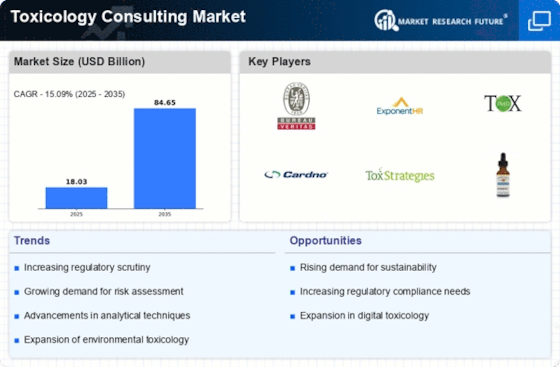
As per Market Research Future analysis, the Toxicology Consulting Market Size was estimated at 18.03 USD Billion in 2024. The Toxicology Consulting industry is projected to grow from 20.76 USD Billion in 2025 to 84.65 USD Billion by 2035, exhibiting a compound annual growth rate (CAGR) of 15.09% during the forecast period 2025 - 2035

Key Market Trends & Highlights

The Toxicology Consulting Market is experiencing robust growth driven by regulatory demands and technological advancements.

  • North America remains the largest market for toxicology consulting services, driven by stringent regulatory compliance requirements. The Asia-Pacific region is emerging as the fastest-growing market, reflecting increasing investments in healthcare and biotechnology. Regulatory Advisory Services dominate the market, while Forensic Investigation Services are witnessing rapid growth due to heightened safety concerns. Key market drivers include the rising demand for regulatory compliance and the growing emphasis on consumer safety awareness.

Market Size & Forecast

2024 Market Size 18.03 (USD Billion)
2035 Market Size 84.65 (USD Billion)
CAGR (2025 - 2035) 15.09%
Largest Regional Market Share in 2024 North America

Major Players

Bureau Veritas (FR), Exponent (US), ToxServices (US), Cardno ChemRisk (US), ToxStrategies (US), EnviroStat (US), Toxicology Excellence for Risk Assessment (US), ToxConsult (DE)

Market Trends

The Toxicology Consulting Market is currently experiencing a dynamic evolution, driven by increasing regulatory scrutiny and a growing emphasis on safety assessments across various industries. As organizations strive to comply with stringent environmental and health regulations, the demand for expert toxicological assessments has surged. This market encompasses a wide range of services, including risk assessment, product safety evaluation, and environmental impact analysis. The integration of advanced technologies, such as artificial intelligence and data analytics, appears to enhance the efficiency and accuracy of toxicological evaluations, thereby attracting more clients seeking reliable consulting services.

 Moreover, the rising awareness of the potential health impacts of chemicals and substances in consumer products is likely to propel the growth of the Toxicology Consulting Market. Companies are increasingly prioritizing the safety of their products to maintain consumer trust and brand integrity. This trend is further supported by the growing collaboration between toxicology consultants and regulatory bodies, which may facilitate the development of more comprehensive safety standards. As the market continues to evolve, it seems poised to adapt to emerging challenges and opportunities, ensuring that toxicological expertise remains a cornerstone of public health and safety initiatives.

Regulatory Compliance Demand

The need for adherence to stringent regulations is driving the Toxicology Consulting Market. Organizations are increasingly seeking expert guidance to navigate complex regulatory landscapes, ensuring that their products meet safety standards and environmental requirements.

Technological Integration

The incorporation of advanced technologies, such as artificial intelligence and machine learning, is transforming the Toxicology Consulting Market. These innovations enhance data analysis capabilities, allowing for more precise risk assessments and streamlined consulting processes.

Consumer Safety Awareness

Growing public awareness regarding the safety of chemicals in products is influencing the Toxicology Consulting Market. Companies are prioritizing toxicological evaluations to build consumer trust and ensure compliance with safety expectations.

Toxicology Consulting Market Market Drivers

Environmental Concerns

Growing environmental concerns are increasingly driving the Toxicology Consulting Market. As awareness of environmental issues rises, companies are under pressure to assess the ecological impact of their products and operations. Toxicology consultants are essential in evaluating the potential risks associated with chemical substances and their effects on ecosystems. In 2025, the market is expected to see a notable increase in demand for consulting services related to environmental toxicology, with projections indicating a growth rate of 12% annually. This trend reflects a broader commitment to sustainability and responsible business practices. Organizations are increasingly engaging toxicology consultants to conduct environmental risk assessments, ensuring compliance with environmental regulations and promoting sustainable practices.

Consumer Safety Awareness

Rising consumer awareness regarding safety and health issues is significantly influencing the Toxicology Consulting Market. As consumers become more informed about the potential risks associated with chemicals in products, companies are compelled to prioritize safety in their offerings. This shift in consumer behavior has led to an increased demand for toxicology consulting services, as businesses seek to validate the safety of their products through rigorous testing and evaluation. In 2025, it is anticipated that the market will experience a surge in demand for consulting services, driven by the need for transparency and accountability in product safety. Companies are increasingly engaging toxicology consultants to conduct thorough assessments, thereby ensuring compliance with safety standards and enhancing consumer trust.

Technological Integration

Technological advancements are reshaping the landscape of the Toxicology Consulting Market. The integration of sophisticated analytical tools and software has enhanced the capabilities of toxicology consultants, allowing for more accurate assessments and faster turnaround times. For instance, the use of high-throughput screening methods and computational toxicology is becoming more prevalent, enabling consultants to evaluate chemical safety more efficiently. As of 2025, the adoption of these technologies is expected to drive market growth, with an estimated increase in demand for consulting services by 15% annually. This technological evolution not only improves the quality of toxicological assessments but also facilitates better communication of findings to stakeholders, thereby enhancing the overall value proposition of toxicology consulting.

Pharmaceutical Development

The pharmaceutical sector is a significant driver of the Toxicology Consulting Market. As the industry continues to innovate and develop new drugs, the need for comprehensive toxicological assessments becomes paramount. Toxicology consultants play a crucial role in the drug development process, providing essential insights into the safety and efficacy of new compounds. In 2025, the pharmaceutical industry is projected to invest heavily in toxicology consulting services, with estimates suggesting a market growth rate of 10% annually. This investment is driven by the necessity to meet regulatory requirements and to mitigate risks associated with drug development. Consequently, toxicology consultants are increasingly sought after to conduct preclinical studies, risk assessments, and to assist in the preparation of regulatory submissions.

Regulatory Compliance Demand

The increasing emphasis on regulatory compliance is a primary driver for the Toxicology Consulting Market. Regulatory bodies are continuously updating guidelines and standards to ensure public safety and environmental protection. This has led to a heightened demand for toxicology consulting services, as companies seek to navigate complex regulations. In 2025, the market for toxicology consulting is projected to reach approximately 2 billion USD, reflecting a growing need for expert guidance in compliance matters. Organizations are increasingly relying on consultants to conduct risk assessments, toxicological evaluations, and to prepare necessary documentation for regulatory submissions. This trend underscores the critical role that toxicology consultants play in helping businesses meet legal requirements while ensuring product safety and efficacy.

Market Segment Insights

By Type: Regulatory Advisory Services (Largest) vs. Forensic Investigation Services (Fastest-Growing)

<p>In the Toxicology Consulting Market, Regulatory Advisory Services hold the largest market share, primarily due to the increasing complexity of regulatory requirements across industries. Clients are seeking these services to navigate compliance with environmental, health, and safety regulations effectively. On the other hand, Forensic Investigation Services are emerging rapidly, owing to the heightened attention on toxicological assessments in legal cases and the growing need for expert testimonies in court. This segment is gaining traction as consumers and industries demand transparency and accountability in product safety. The growth trends within this segment are driven by factors such as rising public awareness regarding toxic substances and their health impacts, which increase the demand for expert consulting in forensic investigations. Additionally, litigation support services are becoming more sought after due to the increasing number of toxic tort litigations and the need for comprehensive risk assessments. As regulatory frameworks continue to evolve, Toxicology Consulting firms must adapt their strategies to meet these changing demands effectively.</p>

<p>Regulatory Advisory Services (Dominant) vs. Risk Mitigation Strategy Services (Emerging)</p>

<p>Regulatory Advisory Services are currently the dominant force in the Toxicology Consulting Market. They provide essential guidance to organizations aiming to comply with complex regulations, ensuring adherence to environmental, health, and safety standards. This segment's strength lies in its established reputation and breadth of expertise across multiple industries, fostering long-term relationships with clients. Conversely, Risk Mitigation Strategy Services are emerging as vital tools, helping businesses proactively manage potential toxicological risks. As industries face new challenges related to public health concerns and environmental regulations, proactive risk management strategies are becoming integral to business operations. These services are gaining recognition for their role in safeguarding brand integrity and mitigating potential liabilities in an increasingly scrutinizing marketplace.</p>

By Application: Pharmaceutical (Largest) vs. Biotechnology (Fastest-Growing)

<p>In the Toxicology Consulting Market, the application segment is largely dominated by pharmaceuticals which holds the largest market share. This is attributable to the extensive need for toxicological assessments in drug development, ensuring safety and compliance with regulatory standards. Biotechnology follows closely, exhibiting a significant share as well, driven by innovations and advancements in biopharmaceutical products that require meticulous toxicological analysis to validate safety and efficacy. Analyzing growth trends, the biotechnology sector is recognized as the fastest-growing application within toxicology consulting. The surge in biotechnological innovations, coupled with stringent regulatory norms, has heightened the demand for consultative expertise in toxicity evaluations. Furthermore, as pharmaceutical companies increasingly explore biologics and advanced therapies, the need for robust toxicology consulting services intensifies, supporting market expansion within this niche.</p>

<p>Pharmaceutical (Dominant) vs. Biotechnology (Emerging)</p>

<p>The pharmaceutical application segment within the Toxicology Consulting Market is characterized by its established dominance, given that pharmaceuticals are the backbone of healthcare. This segment thrives on rigorous toxicological evaluations due to the need for ensuring drug safety, efficacy, and compliance with global regulations. On the other hand, biotechnology is an emerging player that is quickly gaining traction. It encapsulates novel therapeutic modalities such as gene therapy and monoclonal antibodies that necessitate specialized toxicological consultation. The increasing investment in biotechnological research and development reflects its potential to reshape healthcare, while the growing reliance on such innovations pushes the need for advanced toxicological assessments, thereby establishing biotechnology as a vibrant, rapidly evolving segment.</p>

By End User: Pharmaceutical Companies (Largest) vs. Medical Device Manufacturers (Fastest-Growing)

<p>In the Toxicology Consulting Market, the distribution of market share among end users is predominantly led by Pharmaceutical Companies, which hold substantial influence due to their extensive need for toxicological assessments in drug development. They rely heavily on consulting services to ensure compliance with regulatory standards, thereby driving significant demand. Medical Device Manufacturers, while a smaller segment currently, are also gaining traction as they recognize the importance of testing and validation processes in product development, hence forming a critical part of the market landscape. Growth trends indicate that Medical Device Manufacturers are emerging as the fastest-growing segment attributed to increased innovation, heightened regulatory scrutiny, and a growing emphasis on product safety. The shift towards personalized medicine and advanced therapies, alongside a booming healthcare sector, has necessitated the use of toxicology consulting services. The demand for comprehensive consulting solutions is further fueled by technological advancements aimed at enhancing product reliability and meeting stringent safety regulations.</p>

<p>Pharmaceutical Companies (Dominant) vs. Research Institutions (Emerging)</p>

<p>Pharmaceutical Companies are the dominant players in the Toxicology Consulting Market, prioritizing regulatory compliance and risk management in drug development. Their reliance on toxicology consulting is critical for navigating complex regulatory environments and ensuring products meet safety standards. This segment thrives due to extensive research and investment in R&D, necessitating robust testing and evaluation processes. Conversely, Research Institutions represent an emerging segment, focusing on scientific advancements and collaborations with industry players to push the boundaries of toxicological studies. They are increasingly recognized for their contributions to innovative research and are starting to seek consulting services that can aid in translating research findings into practical applications, thereby enhancing their market presence.</p>

Get more detailed insights about Toxicology Consulting Market Research Report—Global Forecast till 2035

Regional Insights

North America : Regulatory Leader in Toxicology

North America is the largest market for toxicology consulting, holding approximately 45% of the global share. The region's growth is driven by stringent regulatory requirements, increasing demand for safety assessments, and advancements in toxicological research. The U.S. Environmental Protection Agency (EPA) and Food and Drug Administration (FDA) play crucial roles in shaping the market landscape through regulations that ensure public health and safety. The United States is the dominant player in this market, with key companies like Exponent, ToxServices, and Cardno ChemRisk leading the charge. Canada also contributes significantly, focusing on environmental assessments and compliance. The competitive landscape is characterized by a mix of established firms and emerging players, all striving to meet the growing demand for toxicological expertise and risk assessment services.

Europe : Emerging Regulatory Frameworks

Europe is the second-largest market for toxicology consulting, accounting for approximately 30% of the global share. The region is witnessing growth driven by the European Union's REACH regulations, which mandate comprehensive safety assessments for chemicals. This regulatory framework is a significant catalyst for demand, as companies seek compliance and risk management solutions in toxicology consulting. Leading countries in this market include Germany, France, and the UK, where firms like ToxConsult and Bureau Veritas are prominent. The competitive landscape is marked by a focus on innovation and sustainability, with many companies investing in advanced toxicological methodologies. The presence of regulatory bodies ensures that the market remains dynamic and responsive to emerging health and safety challenges.

Asia-Pacific : Rapidly Growing Market Potential

Asia-Pacific is an emerging powerhouse in the toxicology consulting market, holding about 20% of the global share. The region's growth is fueled by increasing industrialization, rising awareness of environmental issues, and the need for compliance with international safety standards. Countries like China and India are at the forefront, with regulatory bodies pushing for enhanced toxicological assessments to safeguard public health and the environment. China is the largest market in the region, driven by its vast manufacturing sector and stringent regulations. India follows closely, with a growing emphasis on pharmaceuticals and chemicals. The competitive landscape features both local and international players, with firms expanding their services to meet the diverse needs of the rapidly evolving market. This growth trajectory indicates a promising future for toxicology consulting in Asia-Pacific.

Middle East and Africa : Emerging Market with Challenges

The Middle East and Africa represent a nascent market for toxicology consulting, holding approximately 5% of the global share. Growth in this region is hindered by varying regulatory frameworks and limited awareness of toxicological services. However, increasing industrial activities and a focus on environmental sustainability are driving demand for consulting services. Countries like South Africa and the UAE are beginning to adopt more stringent regulations, which could catalyze market growth in the coming years. South Africa is the leading country in this market, with a growing number of firms offering toxicology consulting services. The competitive landscape is still developing, with many local players emerging to address the unique challenges of the region. As awareness of toxicological risks increases, the market is expected to evolve, presenting opportunities for both local and international firms to establish a foothold in this emerging sector.

Key Players and Competitive Insights

The market of Toxicology Consulting Market is characterized by the presence of many global, regional, and local vendors catering to the demand created by research scientists and pharmaceutical and biotechnology companies operating in the industry. The market comprises tier-1, tier-2, and local players. The tier-1 and tier-2 players have reached across the globe with diverse product portfolios. 
Companies such as Evalueserve (Switzerland), Gad Consulting (US), InterBioTox (Slovakia), and Intertek (UK) dominate the market of Toxicology Consulting Market due to product differentiation, financial stability, strategic developments, and diversified regional presence. The players are focused on investing in extensive research and development as well. Furthermore, they adopt strategic growth initiatives, such as expansion, product launches, joint ventures, and partnerships, to strengthen their market position and capture a large customer base.
Intertek (UK) is a global provider of total quality assurance. It offers cutting-edge and customized assurance, testing, inspection, and certification solutions for our customers' supply chains and operations. The business has a network of more than a thousand laboratories and offices spread over more than a hundred nations. A crucial component of the FTSE 100 corporation Intertek Group, Intertek UK & Ireland employs over 2,000 scientists, engineers, and technicians across 59 labs and sites around the UK. 
The business provides services to major UK supermarkets, home appliance manufacturers, oil and gas companies, and UK government agencies. It operates across North and South America, Asia, the Pacific, Europe, the Middle East, and Africa.
In May Intertek expands pharmaceutical toxicology facility services as global demand increases for specialist inhalation and nasal product development for biologics. The facility will provide a dedicated laboratory space focused on formulation development of inhaled biologics to meet increasing demand from clients globally.

Key Companies in the Toxicology Consulting Market include

Industry Developments

April 2019: J.S. Held expanded EH&S and Forensic Engineering Practices with the Purchase of GT Engineering & Veritox, Inc. (US) By bringing on PhD toxicologists and industrial hygienists, material scientists, and engineers, the expansion strengthens one of its fundamental tenets of offering top-notch technical competence.

Future Outlook

Toxicology Consulting Market Future Outlook

The Toxicology Consulting Market is projected to grow at a 15.09% CAGR from 2025 to 2035, driven by regulatory demands, technological advancements, and increasing awareness of toxicological risks.

New opportunities lie in:

  • <p>Development of AI-driven risk assessment tools for toxicology. Expansion of consulting services into emerging markets. Partnerships with pharmaceutical companies for preclinical testing services.</p>

By 2035, the market is expected to be robust, reflecting substantial growth and innovation.

Market Segmentation

Toxicology Consulting Market Type Outlook

  • Risk Mitigation Strategy Services
  • Forensic Investigation Services
  • Regulatory Advisory Services
  • Litigation Support Services

Toxicology Consulting Market End User Outlook

  • Pharmaceutical Companies
  • Medical Device Manufacturers
  • Research Institutions

Toxicology Consulting Market Application Outlook

  • Pharmaceutical
  • Biotechnology
  • Medical Instruments
  • Others

Report Scope

MARKET SIZE 2024 18.03(USD Billion)
MARKET SIZE 2025 20.76(USD Billion)
MARKET SIZE 2035 84.65(USD Billion)
COMPOUND ANNUAL GROWTH RATE (CAGR) 15.09% (2025 - 2035)
REPORT COVERAGE Revenue Forecast, Competitive Landscape, Growth Factors, and Trends
BASE YEAR 2024
Market Forecast Period 2025 - 2035
Historical Data 2019 - 2024
Market Forecast Units USD Billion
Key Companies Profiled Bureau Veritas (FR), Exponent (US), ToxServices (US), Cardno ChemRisk (US), ToxStrategies (US), EnviroStat (US), Toxicology Excellence for Risk Assessment (US), ToxConsult (DE)
Segments Covered Type, end user, Region
Key Market Opportunities Integration of artificial intelligence in risk assessment enhances efficiency in the Toxicology Consulting Market.
Key Market Dynamics Rising regulatory scrutiny drives demand for toxicology consulting services across various industries and sectors.
Countries Covered North America, Europe, APAC, South America, MEA

FAQs

What is the current valuation of the Toxicology Consulting Market?

<p>The Toxicology Consulting Market was valued at 18.03 USD Billion in 2024.</p>

What is the projected market size for the Toxicology Consulting Market by 2035?

<p>The market is projected to reach 84.65 USD Billion by 2035.</p>

What is the expected CAGR for the Toxicology Consulting Market during the forecast period?

<p>The expected CAGR for the Toxicology Consulting Market from 2025 to 2035 is 15.09%.</p>

Which segment generated the highest revenue in the Toxicology Consulting Market in 2024?

<p>In 2024, Regulatory Advisory Services generated the highest revenue at 5.41 USD Billion.</p>

What are the key applications of toxicology consulting services?

<p>Key applications include Pharmaceutical, Biotechnology, Medical Instruments, and Others, with Pharmaceutical leading at 7.21 USD Billion in 2024.</p>

Who are the leading players in the Toxicology Consulting Market?

<p>Key players include Bureau Veritas, Exponent, ToxServices, and Cardno ChemRisk.</p>

What is the revenue generated by Litigation Support Services in 2024?

<p>Litigation Support Services generated 6.31 USD Billion in revenue in 2024.</p>

How much revenue did Medical Device Manufacturers contribute to the market in 2024?

Medical Device Manufacturers contributed 4.51 USD Billion to the market in 2024.

What is the projected growth for Forensic Investigation Services by 2035?

Forensic Investigation Services are projected to grow from 2.7 USD Billion in 2024 to 12.25 USD Billion by 2035.

What role do research institutions play in the Toxicology Consulting Market?

Research Institutions accounted for 6.31 USD Billion in revenue in 2024, indicating their significant role in the market.

  1. SECTION I: EXECUTIVE SUMMARY AND KEY HIGHLIGHTS
    1. | 1.1 EXECUTIVE SUMMARY
    2. | | 1.1.1 Market Overview
    3. | | 1.1.2 Key Findings
    4. | | 1.1.3 Market Segmentation
    5. | | 1.1.4 Competitive Landscape
    6. | | 1.1.5 Challenges and Opportunities
    7. | | 1.1.6 Future Outlook
  2. SECTION II: SCOPING, METHODOLOGY AND MARKET STRUCTURE
    1. | 2.1 MARKET INTRODUCTION
    2. | | 2.1.1 Definition
    3. | | 2.1.2 Scope of the study
    4. | | | 2.1.2.1 Research Objective
    5. | | | 2.1.2.2 Assumption
    6. | | | 2.1.2.3 Limitations
    7. | 2.2 RESEARCH METHODOLOGY
    8. | | 2.2.1 Overview
    9. | | 2.2.2 Data Mining
    10. | | 2.2.3 Secondary Research
    11. | | 2.2.4 Primary Research
    12. | | | 2.2.4.1 Primary Interviews and Information Gathering Process
    13. | | | 2.2.4.2 Breakdown of Primary Respondents
    14. | | 2.2.5 Forecasting Model
    15. | | 2.2.6 Market Size Estimation
    16. | | | 2.2.6.1 Bottom-Up Approach
    17. | | | 2.2.6.2 Top-Down Approach
    18. | | 2.2.7 Data Triangulation
    19. | | 2.2.8 Validation
  3. SECTION III: QUALITATIVE ANALYSIS
    1. | 3.1 MARKET DYNAMICS
    2. | | 3.1.1 Overview
    3. | | 3.1.2 Drivers
    4. | | 3.1.3 Restraints
    5. | | 3.1.4 Opportunities
    6. | 3.2 MARKET FACTOR ANALYSIS
    7. | | 3.2.1 Value chain Analysis
    8. | | 3.2.2 Porter's Five Forces Analysis
    9. | | | 3.2.2.1 Bargaining Power of Suppliers
    10. | | | 3.2.2.2 Bargaining Power of Buyers
    11. | | | 3.2.2.3 Threat of New Entrants
    12. | | | 3.2.2.4 Threat of Substitutes
    13. | | | 3.2.2.5 Intensity of Rivalry
    14. | | 3.2.3 COVID-19 Impact Analysis
    15. | | | 3.2.3.1 Market Impact Analysis
    16. | | | 3.2.3.2 Regional Impact
    17. | | | 3.2.3.3 Opportunity and Threat Analysis
  4. SECTION IV: QUANTITATIVE ANALYSIS
    1. | 4.1 Healthcare, BY Type (USD Billion)
    2. | | 4.1.1 Risk Mitigation Strategy Services
    3. | | 4.1.2 Forensic Investigation Services
    4. | | 4.1.3 Regulatory Advisory Services
    5. | | 4.1.4 Litigation Support Services
    6. | 4.2 Healthcare, BY Application (USD Billion)
    7. | | 4.2.1 Pharmaceutical
    8. | | 4.2.2 Biotechnology
    9. | | 4.2.3 Medical Instruments
    10. | | 4.2.4 Others
    11. | 4.3 Healthcare, BY End User (USD Billion)
    12. | | 4.3.1 Pharmaceutical Companies
    13. | | 4.3.2 Medical Device Manufacturers
    14. | | 4.3.3 Research Institutions
    15. | 4.4 Healthcare, BY Region (USD Billion)
    16. | | 4.4.1 North America
    17. | | | 4.4.1.1 US
    18. | | | 4.4.1.2 Canada
    19. | | 4.4.2 Europe
    20. | | | 4.4.2.1 Germany
    21. | | | 4.4.2.2 UK
    22. | | | 4.4.2.3 France
    23. | | | 4.4.2.4 Russia
    24. | | | 4.4.2.5 Italy
    25. | | | 4.4.2.6 Spain
    26. | | | 4.4.2.7 Rest of Europe
    27. | | 4.4.3 APAC
    28. | | | 4.4.3.1 China
    29. | | | 4.4.3.2 India
    30. | | | 4.4.3.3 Japan
    31. | | | 4.4.3.4 South Korea
    32. | | | 4.4.3.5 Malaysia
    33. | | | 4.4.3.6 Thailand
    34. | | | 4.4.3.7 Indonesia
    35. | | | 4.4.3.8 Rest of APAC
    36. | | 4.4.4 South America
    37. | | | 4.4.4.1 Brazil
    38. | | | 4.4.4.2 Mexico
    39. | | | 4.4.4.3 Argentina
    40. | | | 4.4.4.4 Rest of South America
    41. | | 4.4.5 MEA
    42. | | | 4.4.5.1 GCC Countries
    43. | | | 4.4.5.2 South Africa
    44. | | | 4.4.5.3 Rest of MEA
  5. SECTION V: COMPETITIVE ANALYSIS
    1. | 5.1 Competitive Landscape
    2. | | 5.1.1 Overview
    3. | | 5.1.2 Competitive Analysis
    4. | | 5.1.3 Market share Analysis
    5. | | 5.1.4 Major Growth Strategy in the Healthcare
    6. | | 5.1.5 Competitive Benchmarking
    7. | | 5.1.6 Leading Players in Terms of Number of Developments in the Healthcare
    8. | | 5.1.7 Key developments and growth strategies
    9. | | | 5.1.7.1 New Product Launch/Service Deployment
    10. | | | 5.1.7.2 Merger & Acquisitions
    11. | | | 5.1.7.3 Joint Ventures
    12. | | 5.1.8 Major Players Financial Matrix
    13. | | | 5.1.8.1 Sales and Operating Income
    14. | | | 5.1.8.2 Major Players R&D Expenditure. 2023
    15. | 5.2 Company Profiles
    16. | | 5.2.1 Bureau Veritas (FR)
    17. | | | 5.2.1.1 Financial Overview
    18. | | | 5.2.1.2 Products Offered
    19. | | | 5.2.1.3 Key Developments
    20. | | | 5.2.1.4 SWOT Analysis
    21. | | | 5.2.1.5 Key Strategies
    22. | | 5.2.2 Exponent (US)
    23. | | | 5.2.2.1 Financial Overview
    24. | | | 5.2.2.2 Products Offered
    25. | | | 5.2.2.3 Key Developments
    26. | | | 5.2.2.4 SWOT Analysis
    27. | | | 5.2.2.5 Key Strategies
    28. | | 5.2.3 ToxServices (US)
    29. | | | 5.2.3.1 Financial Overview
    30. | | | 5.2.3.2 Products Offered
    31. | | | 5.2.3.3 Key Developments
    32. | | | 5.2.3.4 SWOT Analysis
    33. | | | 5.2.3.5 Key Strategies
    34. | | 5.2.4 Cardno ChemRisk (US)
    35. | | | 5.2.4.1 Financial Overview
    36. | | | 5.2.4.2 Products Offered
    37. | | | 5.2.4.3 Key Developments
    38. | | | 5.2.4.4 SWOT Analysis
    39. | | | 5.2.4.5 Key Strategies
    40. | | 5.2.5 ToxStrategies (US)
    41. | | | 5.2.5.1 Financial Overview
    42. | | | 5.2.5.2 Products Offered
    43. | | | 5.2.5.3 Key Developments
    44. | | | 5.2.5.4 SWOT Analysis
    45. | | | 5.2.5.5 Key Strategies
    46. | | 5.2.6 EnviroStat (US)
    47. | | | 5.2.6.1 Financial Overview
    48. | | | 5.2.6.2 Products Offered
    49. | | | 5.2.6.3 Key Developments
    50. | | | 5.2.6.4 SWOT Analysis
    51. | | | 5.2.6.5 Key Strategies
    52. | | 5.2.7 Toxicology Excellence for Risk Assessment (US)
    53. | | | 5.2.7.1 Financial Overview
    54. | | | 5.2.7.2 Products Offered
    55. | | | 5.2.7.3 Key Developments
    56. | | | 5.2.7.4 SWOT Analysis
    57. | | | 5.2.7.5 Key Strategies
    58. | | 5.2.8 ToxConsult (DE)
    59. | | | 5.2.8.1 Financial Overview
    60. | | | 5.2.8.2 Products Offered
    61. | | | 5.2.8.3 Key Developments
    62. | | | 5.2.8.4 SWOT Analysis
    63. | | | 5.2.8.5 Key Strategies
    64. | 5.3 Appendix
    65. | | 5.3.1 References
    66. | | 5.3.2 Related Reports
  6. LIST OF FIGURES
    1. | 6.1 MARKET SYNOPSIS
    2. | 6.2 NORTH AMERICA MARKET ANALYSIS
    3. | 6.3 US MARKET ANALYSIS BY TYPE
    4. | 6.4 US MARKET ANALYSIS BY APPLICATION
    5. | 6.5 US MARKET ANALYSIS BY END USER
    6. | 6.6 CANADA MARKET ANALYSIS BY TYPE
    7. | 6.7 CANADA MARKET ANALYSIS BY APPLICATION
    8. | 6.8 CANADA MARKET ANALYSIS BY END USER
    9. | 6.9 EUROPE MARKET ANALYSIS
    10. | 6.10 GERMANY MARKET ANALYSIS BY TYPE
    11. | 6.11 GERMANY MARKET ANALYSIS BY APPLICATION
    12. | 6.12 GERMANY MARKET ANALYSIS BY END USER
    13. | 6.13 UK MARKET ANALYSIS BY TYPE
    14. | 6.14 UK MARKET ANALYSIS BY APPLICATION
    15. | 6.15 UK MARKET ANALYSIS BY END USER
    16. | 6.16 FRANCE MARKET ANALYSIS BY TYPE
    17. | 6.17 FRANCE MARKET ANALYSIS BY APPLICATION
    18. | 6.18 FRANCE MARKET ANALYSIS BY END USER
    19. | 6.19 RUSSIA MARKET ANALYSIS BY TYPE
    20. | 6.20 RUSSIA MARKET ANALYSIS BY APPLICATION
    21. | 6.21 RUSSIA MARKET ANALYSIS BY END USER
    22. | 6.22 ITALY MARKET ANALYSIS BY TYPE
    23. | 6.23 ITALY MARKET ANALYSIS BY APPLICATION
    24. | 6.24 ITALY MARKET ANALYSIS BY END USER
    25. | 6.25 SPAIN MARKET ANALYSIS BY TYPE
    26. | 6.26 SPAIN MARKET ANALYSIS BY APPLICATION
    27. | 6.27 SPAIN MARKET ANALYSIS BY END USER
    28. | 6.28 REST OF EUROPE MARKET ANALYSIS BY TYPE
    29. | 6.29 REST OF EUROPE MARKET ANALYSIS BY APPLICATION
    30. | 6.30 REST OF EUROPE MARKET ANALYSIS BY END USER
    31. | 6.31 APAC MARKET ANALYSIS
    32. | 6.32 CHINA MARKET ANALYSIS BY TYPE
    33. | 6.33 CHINA MARKET ANALYSIS BY APPLICATION
    34. | 6.34 CHINA MARKET ANALYSIS BY END USER
    35. | 6.35 INDIA MARKET ANALYSIS BY TYPE
    36. | 6.36 INDIA MARKET ANALYSIS BY APPLICATION
    37. | 6.37 INDIA MARKET ANALYSIS BY END USER
    38. | 6.38 JAPAN MARKET ANALYSIS BY TYPE
    39. | 6.39 JAPAN MARKET ANALYSIS BY APPLICATION
    40. | 6.40 JAPAN MARKET ANALYSIS BY END USER
    41. | 6.41 SOUTH KOREA MARKET ANALYSIS BY TYPE
    42. | 6.42 SOUTH KOREA MARKET ANALYSIS BY APPLICATION
    43. | 6.43 SOUTH KOREA MARKET ANALYSIS BY END USER
    44. | 6.44 MALAYSIA MARKET ANALYSIS BY TYPE
    45. | 6.45 MALAYSIA MARKET ANALYSIS BY APPLICATION
    46. | 6.46 MALAYSIA MARKET ANALYSIS BY END USER
    47. | 6.47 THAILAND MARKET ANALYSIS BY TYPE
    48. | 6.48 THAILAND MARKET ANALYSIS BY APPLICATION
    49. | 6.49 THAILAND MARKET ANALYSIS BY END USER
    50. | 6.50 INDONESIA MARKET ANALYSIS BY TYPE
    51. | 6.51 INDONESIA MARKET ANALYSIS BY APPLICATION
    52. | 6.52 INDONESIA MARKET ANALYSIS BY END USER
    53. | 6.53 REST OF APAC MARKET ANALYSIS BY TYPE
    54. | 6.54 REST OF APAC MARKET ANALYSIS BY APPLICATION
    55. | 6.55 REST OF APAC MARKET ANALYSIS BY END USER
    56. | 6.56 SOUTH AMERICA MARKET ANALYSIS
    57. | 6.57 BRAZIL MARKET ANALYSIS BY TYPE
    58. | 6.58 BRAZIL MARKET ANALYSIS BY APPLICATION
    59. | 6.59 BRAZIL MARKET ANALYSIS BY END USER
    60. | 6.60 MEXICO MARKET ANALYSIS BY TYPE
    61. | 6.61 MEXICO MARKET ANALYSIS BY APPLICATION
    62. | 6.62 MEXICO MARKET ANALYSIS BY END USER
    63. | 6.63 ARGENTINA MARKET ANALYSIS BY TYPE
    64. | 6.64 ARGENTINA MARKET ANALYSIS BY APPLICATION
    65. | 6.65 ARGENTINA MARKET ANALYSIS BY END USER
    66. | 6.66 REST OF SOUTH AMERICA MARKET ANALYSIS BY TYPE
    67. | 6.67 REST OF SOUTH AMERICA MARKET ANALYSIS BY APPLICATION
    68. | 6.68 REST OF SOUTH AMERICA MARKET ANALYSIS BY END USER
    69. | 6.69 MEA MARKET ANALYSIS
    70. | 6.70 GCC COUNTRIES MARKET ANALYSIS BY TYPE
    71. | 6.71 GCC COUNTRIES MARKET ANALYSIS BY APPLICATION
    72. | 6.72 GCC COUNTRIES MARKET ANALYSIS BY END USER
    73. | 6.73 SOUTH AFRICA MARKET ANALYSIS BY TYPE
    74. | 6.74 SOUTH AFRICA MARKET ANALYSIS BY APPLICATION
    75. | 6.75 SOUTH AFRICA MARKET ANALYSIS BY END USER
    76. | 6.76 REST OF MEA MARKET ANALYSIS BY TYPE
    77. | 6.77 REST OF MEA MARKET ANALYSIS BY APPLICATION
    78. | 6.78 REST OF MEA MARKET ANALYSIS BY END USER
    79. | 6.79 KEY BUYING CRITERIA OF HEALTHCARE
    80. | 6.80 RESEARCH PROCESS OF MRFR
    81. | 6.81 DRO ANALYSIS OF HEALTHCARE
    82. | 6.82 DRIVERS IMPACT ANALYSIS: HEALTHCARE
    83. | 6.83 RESTRAINTS IMPACT ANALYSIS: HEALTHCARE
    84. | 6.84 SUPPLY / VALUE CHAIN: HEALTHCARE
    85. | 6.85 HEALTHCARE, BY TYPE, 2024 (% SHARE)
    86. | 6.86 HEALTHCARE, BY TYPE, 2024 TO 2035 (USD Billion)
    87. | 6.87 HEALTHCARE, BY APPLICATION, 2024 (% SHARE)
    88. | 6.88 HEALTHCARE, BY APPLICATION, 2024 TO 2035 (USD Billion)
    89. | 6.89 HEALTHCARE, BY END USER, 2024 (% SHARE)
    90. | 6.90 HEALTHCARE, BY END USER, 2024 TO 2035 (USD Billion)
    91. | 6.91 BENCHMARKING OF MAJOR COMPETITORS
  7. LIST OF TABLES
    1. | 7.1 LIST OF ASSUMPTIONS
    2. | | 7.1.1
    3. | 7.2 North America MARKET SIZE ESTIMATES; FORECAST
    4. | | 7.2.1 BY TYPE, 2025-2035 (USD Billion)
    5. | | 7.2.2 BY APPLICATION, 2025-2035 (USD Billion)
    6. | | 7.2.3 BY END USER, 2025-2035 (USD Billion)
    7. | 7.3 US MARKET SIZE ESTIMATES; FORECAST
    8. | | 7.3.1 BY TYPE, 2025-2035 (USD Billion)
    9. | | 7.3.2 BY APPLICATION, 2025-2035 (USD Billion)
    10. | | 7.3.3 BY END USER, 2025-2035 (USD Billion)
    11. | 7.4 Canada MARKET SIZE ESTIMATES; FORECAST
    12. | | 7.4.1 BY TYPE, 2025-2035 (USD Billion)
    13. | | 7.4.2 BY APPLICATION, 2025-2035 (USD Billion)
    14. | | 7.4.3 BY END USER, 2025-2035 (USD Billion)
    15. | 7.5 Europe MARKET SIZE ESTIMATES; FORECAST
    16. | | 7.5.1 BY TYPE, 2025-2035 (USD Billion)
    17. | | 7.5.2 BY APPLICATION, 2025-2035 (USD Billion)
    18. | | 7.5.3 BY END USER, 2025-2035 (USD Billion)
    19. | 7.6 Germany MARKET SIZE ESTIMATES; FORECAST
    20. | | 7.6.1 BY TYPE, 2025-2035 (USD Billion)
    21. | | 7.6.2 BY APPLICATION, 2025-2035 (USD Billion)
    22. | | 7.6.3 BY END USER, 2025-2035 (USD Billion)
    23. | 7.7 UK MARKET SIZE ESTIMATES; FORECAST
    24. | | 7.7.1 BY TYPE, 2025-2035 (USD Billion)
    25. | | 7.7.2 BY APPLICATION, 2025-2035 (USD Billion)
    26. | | 7.7.3 BY END USER, 2025-2035 (USD Billion)
    27. | 7.8 France MARKET SIZE ESTIMATES; FORECAST
    28. | | 7.8.1 BY TYPE, 2025-2035 (USD Billion)
    29. | | 7.8.2 BY APPLICATION, 2025-2035 (USD Billion)
    30. | | 7.8.3 BY END USER, 2025-2035 (USD Billion)
    31. | 7.9 Russia MARKET SIZE ESTIMATES; FORECAST
    32. | | 7.9.1 BY TYPE, 2025-2035 (USD Billion)
    33. | | 7.9.2 BY APPLICATION, 2025-2035 (USD Billion)
    34. | | 7.9.3 BY END USER, 2025-2035 (USD Billion)
    35. | 7.10 Italy MARKET SIZE ESTIMATES; FORECAST
    36. | | 7.10.1 BY TYPE, 2025-2035 (USD Billion)
    37. | | 7.10.2 BY APPLICATION, 2025-2035 (USD Billion)
    38. | | 7.10.3 BY END USER, 2025-2035 (USD Billion)
    39. | 7.11 Spain MARKET SIZE ESTIMATES; FORECAST
    40. | | 7.11.1 BY TYPE, 2025-2035 (USD Billion)
    41. | | 7.11.2 BY APPLICATION, 2025-2035 (USD Billion)
    42. | | 7.11.3 BY END USER, 2025-2035 (USD Billion)
    43. | 7.12 Rest of Europe MARKET SIZE ESTIMATES; FORECAST
    44. | | 7.12.1 BY TYPE, 2025-2035 (USD Billion)
    45. | | 7.12.2 BY APPLICATION, 2025-2035 (USD Billion)
    46. | | 7.12.3 BY END USER, 2025-2035 (USD Billion)
    47. | 7.13 APAC MARKET SIZE ESTIMATES; FORECAST
    48. | | 7.13.1 BY TYPE, 2025-2035 (USD Billion)
    49. | | 7.13.2 BY APPLICATION, 2025-2035 (USD Billion)
    50. | | 7.13.3 BY END USER, 2025-2035 (USD Billion)
    51. | 7.14 China MARKET SIZE ESTIMATES; FORECAST
    52. | | 7.14.1 BY TYPE, 2025-2035 (USD Billion)
    53. | | 7.14.2 BY APPLICATION, 2025-2035 (USD Billion)
    54. | | 7.14.3 BY END USER, 2025-2035 (USD Billion)
    55. | 7.15 India MARKET SIZE ESTIMATES; FORECAST
    56. | | 7.15.1 BY TYPE, 2025-2035 (USD Billion)
    57. | | 7.15.2 BY APPLICATION, 2025-2035 (USD Billion)
    58. | | 7.15.3 BY END USER, 2025-2035 (USD Billion)
    59. | 7.16 Japan MARKET SIZE ESTIMATES; FORECAST
    60. | | 7.16.1 BY TYPE, 2025-2035 (USD Billion)
    61. | | 7.16.2 BY APPLICATION, 2025-2035 (USD Billion)
    62. | | 7.16.3 BY END USER, 2025-2035 (USD Billion)
    63. | 7.17 South Korea MARKET SIZE ESTIMATES; FORECAST
    64. | | 7.17.1 BY TYPE, 2025-2035 (USD Billion)
    65. | | 7.17.2 BY APPLICATION, 2025-2035 (USD Billion)
    66. | | 7.17.3 BY END USER, 2025-2035 (USD Billion)
    67. | 7.18 Malaysia MARKET SIZE ESTIMATES; FORECAST
    68. | | 7.18.1 BY TYPE, 2025-2035 (USD Billion)
    69. | | 7.18.2 BY APPLICATION, 2025-2035 (USD Billion)
    70. | | 7.18.3 BY END USER, 2025-2035 (USD Billion)
    71. | 7.19 Thailand MARKET SIZE ESTIMATES; FORECAST
    72. | | 7.19.1 BY TYPE, 2025-2035 (USD Billion)
    73. | | 7.19.2 BY APPLICATION, 2025-2035 (USD Billion)
    74. | | 7.19.3 BY END USER, 2025-2035 (USD Billion)
    75. | 7.20 Indonesia MARKET SIZE ESTIMATES; FORECAST
    76. | | 7.20.1 BY TYPE, 2025-2035 (USD Billion)
    77. | | 7.20.2 BY APPLICATION, 2025-2035 (USD Billion)
    78. | | 7.20.3 BY END USER, 2025-2035 (USD Billion)
    79. | 7.21 Rest of APAC MARKET SIZE ESTIMATES; FORECAST
    80. | | 7.21.1 BY TYPE, 2025-2035 (USD Billion)
    81. | | 7.21.2 BY APPLICATION, 2025-2035 (USD Billion)
    82. | | 7.21.3 BY END USER, 2025-2035 (USD Billion)
    83. | 7.22 South America MARKET SIZE ESTIMATES; FORECAST
    84. | | 7.22.1 BY TYPE, 2025-2035 (USD Billion)
    85. | | 7.22.2 BY APPLICATION, 2025-2035 (USD Billion)
    86. | | 7.22.3 BY END USER, 2025-2035 (USD Billion)
    87. | 7.23 Brazil MARKET SIZE ESTIMATES; FORECAST
    88. | | 7.23.1 BY TYPE, 2025-2035 (USD Billion)
    89. | | 7.23.2 BY APPLICATION, 2025-2035 (USD Billion)
    90. | | 7.23.3 BY END USER, 2025-2035 (USD Billion)
    91. | 7.24 Mexico MARKET SIZE ESTIMATES; FORECAST
    92. | | 7.24.1 BY TYPE, 2025-2035 (USD Billion)
    93. | | 7.24.2 BY APPLICATION, 2025-2035 (USD Billion)
    94. | | 7.24.3 BY END USER, 2025-2035 (USD Billion)
    95. | 7.25 Argentina MARKET SIZE ESTIMATES; FORECAST
    96. | | 7.25.1 BY TYPE, 2025-2035 (USD Billion)
    97. | | 7.25.2 BY APPLICATION, 2025-2035 (USD Billion)
    98. | | 7.25.3 BY END USER, 2025-2035 (USD Billion)
    99. | 7.26 Rest of South America MARKET SIZE ESTIMATES; FORECAST
    100. | | 7.26.1 BY TYPE, 2025-2035 (USD Billion)
    101. | | 7.26.2 BY APPLICATION, 2025-2035 (USD Billion)
    102. | | 7.26.3 BY END USER, 2025-2035 (USD Billion)
    103. | 7.27 MEA MARKET SIZE ESTIMATES; FORECAST
    104. | | 7.27.1 BY TYPE, 2025-2035 (USD Billion)
    105. | | 7.27.2 BY APPLICATION, 2025-2035 (USD Billion)
    106. | | 7.27.3 BY END USER, 2025-2035 (USD Billion)
    107. | 7.28 GCC Countries MARKET SIZE ESTIMATES; FORECAST
    108. | | 7.28.1 BY TYPE, 2025-2035 (USD Billion)
    109. | | 7.28.2 BY APPLICATION, 2025-2035 (USD Billion)
    110. | | 7.28.3 BY END USER, 2025-2035 (USD Billion)
    111. | 7.29 South Africa MARKET SIZE ESTIMATES; FORECAST
    112. | | 7.29.1 BY TYPE, 2025-2035 (USD Billion)
    113. | | 7.29.2 BY APPLICATION, 2025-2035 (USD Billion)
    114. | | 7.29.3 BY END USER, 2025-2035 (USD Billion)
    115. | 7.30 Rest of MEA MARKET SIZE ESTIMATES; FORECAST
    116. | | 7.30.1 BY TYPE, 2025-2035 (USD Billion)
    117. | | 7.30.2 BY APPLICATION, 2025-2035 (USD Billion)
    118. | | 7.30.3 BY END USER, 2025-2035 (USD Billion)
    119. | 7.31 PRODUCT LAUNCH/PRODUCT DEVELOPMENT/APPROVAL
    120. | | 7.31.1
    121. | 7.32 ACQUISITION/PARTNERSHIP
    122. | | 7.32.1

Healthcare Market Segmentation

Healthcare By Type (USD Billion, 2025-2035)

  • Risk Mitigation Strategy Services
  • Forensic Investigation Services
  • Regulatory Advisory Services
  • Litigation Support Services

Healthcare By Application (USD Billion, 2025-2035)

  • Pharmaceutical
  • Biotechnology
  • Medical Instruments
  • Others

Healthcare By End User (USD Billion, 2025-2035)

  • Pharmaceutical Companies
  • Medical Device Manufacturers
  • Research Institutions
Infographic

Free Sample Request

Kindly complete the form below to receive a free sample of this Report

Get Free Sample

Customer Strories

Compare Licence

×
Features License Type
Single User Multiuser License Enterprise User
Price $4,950 $5,950 $7,250
Maximum User Access Limit 1 User Upto 10 Users Unrestricted Access Throughout the Organization
Free Customization
Direct Access to Analyst
Deliverable Format
Platform Access
Discount on Next Purchase 10% 15% 15%
Printable Versions