Request Free Sample ×

Kindly complete the form below to receive a free sample of this Report

* Please use a valid business email

Leading companies partner with us for data-driven Insights

clients tt-cursor
Hero Background
English
Chinese
French
Japanese
Korean
German
Spanish

Total Hip Knee Replacements Market Share

ID: MRFR/HC/10311-HCR
110 Pages
Rahul Gotadki
Last Updated: April 06, 2026

Total Hip and Knee Replacements Market Research Report: Information by Procedure Type (Total Hip Replacement, Partial Hip Replacement, Revision Hip Replacement, Total Knee Replacement, Partial Knee Replacement, and Revision Knee Replacement), By Implant Type (Mobile Bearing, Fixed Bearing, and Others), By End-User (Hospitals, Ambulatory Surgical Centers, Orthopedic Clinics, and Others), and Region (North America, Europe, Asia-Pacific, and Rest of the World)—Forecast till 2035

Share:
Download PDF ×

We do not share your information with anyone. However, we may send you emails based on your report interest from time to time. You may contact us at any time to opt-out.

Total Hip Knee Replacements Market Infographic
Purchase Options

Market Share

Total Hip Knee Replacements Market Share Analysis

Total hip and knee replacements are developing rapidly due to longer lifespans and greater health issues. In this fast-paced business, companies utilize various market share positioning tactics to become leaders in innovative and successful hip and knee replacement treatments. Innovation in implant techniques is crucial. Companies are developing wear-resistant ceramics and robust polymers to improve hip and knee replacements. Technology puts companies ahead of the pack in delivering cutting-edge operations.

Companies invest money on tailoring since each patient's physique is distinct. Patient-specific gadgets and surgical approaches improve fit and clinical outcomes. Customized and individualized solutions will be supported by Total Hip and Knee Replacements Market companies using this strategy.

Companies invest much in orthopedic doctor training to increase product adoption. Surgeons may learn about hip and knee replacement therapy advances via seminars, simulations, and continuous medical education. Educated physicians increase product utilization and brand loyalty.

Companies promote non-surgical hip and knee replacements. Less intrusive therapies are gaining popularity among physicians and patients. This approach emphasizes smaller cuts, less surgical pain, and quicker recuperation. This technology will make companies pioneers in novel surgical procedures.

Expanding globally is a frequent approach to capitalize on joint replacement surgery demand. Companies locate in locations with an increasing elderly population and medical needs. To flourish in new markets, items must be adapted to local preferences and government regulations. Some companies provide low-cost joint replacement therapies to cover costs. This strategy aims to make hip and knee replacements more accessible, particularly in cost-conscious healthcare systems.

Focusing on patients helps acquire market share. Companies track patient outcomes including pain, mobility, and happiness. Positive patient feedback and outcomes establish confidence between patients and healthcare personnel, boosting corporate image.

Robotic-assisted therapies are planned for the future. Companies buy robotic instruments to help surgeons perform hip and knee replacements more precisely. Innovative surgical solutions are led by companies that promote this technology.

Quality assurance and legal compliance are unchangeable. Companies that prioritize compliance and quality are trusted by healthcare personnel and patients. Our commitment to quality maintains market share and boosts industry reputation.


Author
Author Profile
Rahul Gotadki
Research Manager

He holds an experience of about 9+ years in Market Research and Business Consulting, working under the spectrum of Life Sciences and Healthcare domains. Rahul conceptualizes and implements a scalable business strategy and provides strategic leadership to the clients. His expertise lies in market estimation, competitive intelligence, pipeline analysis, customer assessment, etc.

Leave a Comment

FAQs

What is the projected market valuation for the Total Hip and Knee Replacements Market in 2035?

<p>The projected market valuation for the Total Hip and Knee Replacements Market in 2035 is 37.97 USD Billion.</p>

What was the market valuation for the Total Hip and Knee Replacements Market in 2024?

<p>The market valuation for the Total Hip and Knee Replacements Market in 2024 was 22.67 USD Billion.</p>

What is the expected CAGR for the Total Hip and Knee Replacements Market from 2025 to 2035?

<p>The expected CAGR for the Total Hip and Knee Replacements Market during the forecast period 2025 - 2035 is 4.8%.</p>

Which companies are considered key players in the Total Hip and Knee Replacements Market?

<p>Key players in the Total Hip and Knee Replacements Market include DePuy Synthes, Stryker, Zimmer Biomet, Smith & Nephew, Medtronic, Exactech, Aesculap, Ottobock, and B. Braun.</p>

What segment of the Total Hip and Knee Replacements Market had the highest valuation in 2024?

<p>In 2024, the segment of Total Hip Replacement had the highest valuation at 9.5 USD Billion.</p>

What is the projected valuation for Total Knee Replacement by 2035?

<p>The projected valuation for Total Knee Replacement by 2035 is 10.5 USD Billion.</p>

How does the valuation of Partial Hip Replacement compare to Total Hip Replacement in 2024?

<p>In 2024, Partial Hip Replacement was valued at 3.0 USD Billion, significantly lower than Total Hip Replacement at 9.5 USD Billion.</p>

What is the expected growth for the Mobile Bearing implant type from 2025 to 2035?

The expected growth for the Mobile Bearing implant type is projected to reach 9.5 USD Billion by 2035.

Which end user segment is anticipated to show the most growth in the Total Hip and Knee Replacements Market?

The Hospitals segment is anticipated to show the most growth, with a projected valuation of 14.5 USD Billion by 2035.

What is the valuation range for Revision Knee Replacement in 2024?

The valuation range for Revision Knee Replacement in 2024 was between 0.5 and 1.0 USD Billion.

Market Summary

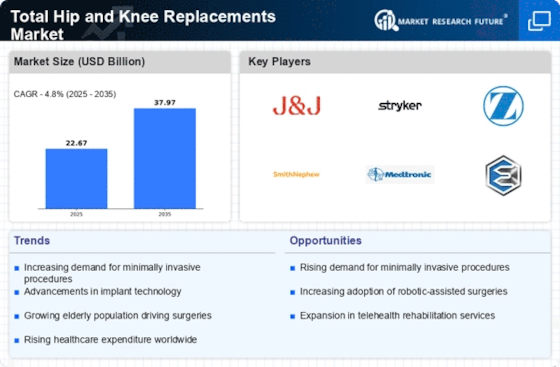
As per Market Research Future analysis, the Total Hip and Knee Replacements Market was estimated at 22.67 USD Billion in 2024. The Total Hip and Knee Replacements industry is projected to grow from 23.76 USD Billion in 2025 to 37.97 USD Billion by 2035, exhibiting a compound annual growth rate (CAGR) of 4.8% during the forecast period 2025 - 2035

Key Market Trends & Highlights

The Total Hip and Knee Replacements Market is experiencing robust growth driven by technological advancements and demographic shifts.

  • North America remains the largest market for total hip and knee replacements, reflecting a high demand for joint surgeries. The Asia-Pacific region is emerging as the fastest-growing market, fueled by increasing healthcare access and awareness. Total knee replacement is the largest segment, while total hip replacement is noted for its rapid growth in adoption. Key market drivers include the rising prevalence of osteoarthritis and advancements in surgical techniques, which are enhancing patient outcomes.

Market Size & Forecast

2024 Market Size 22.67 (USD Billion)
2035 Market Size 37.97 (USD Billion)
CAGR (2025 - 2035) 4.8%
Largest Regional Market Share in 2024 North America

Major Players

DePuy Synthes (US), Stryker (US), Zimmer Biomet (US), Smith &amp; Nephew (GB), <a href="https://www.medtronic.com/en-us/healthcare-professionals/products.html">Medtronic </a>(US), Exactech (US), Aesculap (DE), Ottobock (DE), B. Braun (DE)

Market Trends

The Total Hip and Knee Replacements Market is currently experiencing a notable transformation driven by advancements in surgical techniques and implant technologies. Innovations such as minimally invasive procedures and robotic-assisted surgeries are enhancing patient outcomes and reducing recovery times. Furthermore, the increasing prevalence of osteoarthritis and other degenerative joint diseases is propelling demand for these procedures. As the population ages, the need for effective joint replacement solutions appears to be growing, leading to a more competitive landscape among manufacturers and healthcare providers. In addition to technological advancements, there is a rising emphasis on personalized medicine within the Total Hip and Knee Replacements Market. Tailored implants and customized surgical approaches are becoming more prevalent, as they may improve the fit and functionality for individual patients. This trend suggests a shift towards more patient-centered care, where the focus is on optimizing the overall experience and outcomes for those undergoing joint replacement surgeries. As the market evolves, stakeholders must remain vigilant to adapt to these changes and meet the diverse needs of patients and healthcare systems alike.

Technological Advancements

The Total Hip and Knee Replacements Market is witnessing rapid technological progress, particularly in surgical techniques and implant designs. Innovations such as robotic-assisted surgeries and minimally invasive approaches are enhancing precision and reducing recovery times, which may lead to improved patient satisfaction.

Personalized Medicine

There is a growing trend towards personalized medicine within the Total Hip and Knee Replacements Market. Customized implants and tailored surgical techniques are becoming more common, potentially improving the fit and functionality for individual patients, thereby enhancing overall outcomes.

Aging Population

The increasing prevalence of age-related joint conditions is driving demand in the Total Hip and Knee Replacements Market. As the global population ages, the need for effective joint replacement solutions is likely to expand, prompting healthcare providers to adapt their services accordingly.

Total Hip Knee Replacements Market Market Drivers

Increased Healthcare Expenditure

Rising healthcare expenditure is a significant factor influencing the Total Hip and Knee Replacements Market. As countries invest more in healthcare infrastructure and services, access to joint replacement surgeries improves. In many regions, healthcare spending is projected to grow at a compound annual growth rate of 5% or more, facilitating better access to advanced surgical procedures. This increase in funding allows for the adoption of new technologies and techniques, further enhancing the quality of care. Consequently, the Total Hip and Knee Replacements Market stands to benefit from this upward trend in healthcare investment, as more patients gain access to necessary treatments.

Growing Awareness of Joint Health

The growing awareness of joint health and the benefits of early intervention are driving demand in the Total Hip and Knee Replacements Market. Educational campaigns and outreach programs are informing the public about the importance of maintaining joint health and the options available for treatment. As individuals become more proactive about their health, they are more likely to seek surgical solutions for joint issues. This shift in mindset is expected to lead to an increase in elective surgeries, thereby propelling the Total Hip and Knee Replacements Market forward. The emphasis on preventive care and early treatment is likely to reshape patient behaviors in the coming years.

Advancements in Surgical Techniques

Innovations in surgical techniques are transforming the Total Hip and Knee Replacements Market. Minimally invasive procedures, robotic-assisted surgeries, and enhanced recovery protocols are becoming increasingly prevalent. These advancements not only improve patient outcomes but also reduce recovery times, making joint replacement surgeries more appealing to patients. For instance, the adoption of robotic systems in knee arthroplasty has been shown to enhance precision and reduce complications. As these technologies continue to evolve, they are likely to drive further growth in the Total Hip and Knee Replacements Market, attracting both patients and healthcare providers seeking improved surgical options.

Rising Prevalence of Osteoarthritis

The increasing prevalence of osteoarthritis is a primary driver for the Total Hip and Knee Replacements Market. As populations age, the incidence of osteoarthritis rises, leading to a greater demand for joint replacement surgeries. It is estimated that by 2025, approximately 30 million adults in the United States alone will be affected by osteoarthritis, necessitating surgical interventions. This trend is mirrored in various regions, where healthcare systems are adapting to accommodate the growing number of patients requiring hip and knee replacements. The Total Hip and Knee Replacements Market is thus positioned to expand significantly as healthcare providers seek to address this pressing need.

Aging Population and Increased Life Expectancy

The aging population, coupled with increased life expectancy, is a crucial driver for the Total Hip and Knee Replacements Market. As individuals live longer, the likelihood of developing degenerative joint diseases rises, leading to a higher demand for hip and knee replacements. By 2030, it is projected that nearly 20% of the population in many developed countries will be over the age of 65, significantly impacting healthcare needs. This demographic shift necessitates a robust response from the Total Hip and Knee Replacements Market, as healthcare systems prepare to accommodate the growing number of elderly patients requiring joint replacement surgeries.

Market Segment Insights

By Procedure Type: Total Knee Replacement (Largest) vs. Total Hip Replacement (Fastest-Growing)

The Total Hip and Knee Replacements Market observes significant distribution among various procedure types. Total Knee Replacement holds the largest market share due to its wide acceptance and effectiveness in relieving pain among patients with severe knee osteoarthritis. Meanwhile, Total Hip Replacement is rapidly gaining ground, increasingly becoming the fastest-growing segment, as an aging population and greater awareness of hip-related ailments drive demand. Both segments dominate the surgical landscape, capturing the attention of healthcare providers and patients alike.

Total Knee Replacement (Dominant) vs. Total Hip Replacement (Emerging)

Total Knee Replacement stands out as the dominant procedure in the hip and knee replacements landscape, delivering consistent results and establishing a strong foothold due to its high success rate and predictable outcomes. Its robust acceptance among healthcare practitioners highlights its effectiveness in enhancing patient mobility and quality of life post-surgery. On the other hand, Total Hip Replacement is emerging as a vital choice, particularly as advancements in surgical techniques and implant technologies enhance recovery times and outcomes. The increasing inclination towards minimally invasive strategies has made Total Hip Replacement an appealing option for both patients and surgeons, creating a dynamic growth trajectory in this segment.

By Implant Type: Mobile Bearing (Largest) vs. Fixed Bearing (Fastest-Growing)

In the Total Hip and Knee Replacements Market, the 'By Implant Type' segment shows a diverse distribution among its values, with Mobile Bearing implants leading the market. This segment has gained significant acceptance due to their enhanced mobility and flexibility compared to traditional designs. Fixed Bearing implants, while currently behind in terms of total share, have been gaining traction as surgeons recognize their reliability and lower risk of dislocation. The 'Others' category, which includes novel implant designs, is growing steadily but remains a smaller portion of the overall share.

Implant Type: Mobile Bearing (Dominant) vs. Fixed Bearing (Emerging)

Mobile Bearing implants are recognized for their superior range of motion and functionality, making them a popular choice among orthopedic surgeons for both hip and knee replacements. Their design allows for natural joint motion, leading to quicker recovery times and enhanced patient satisfaction. Fixed Bearing implants, on the other hand, represent a more conservative approach, offering proven longevity and stability, making them appealing to certain patient demographics, particularly the older population. As both types evolve, the preference for materials and design innovations will continue to influence market dynamics, with <a href="https://www.marketresearchfuture.com/reports/mobile-clinic-market-33669">Mobile</a> Bearing maintaining its edge as the preferred option while Fixed Bearing emerges to capture specific market needs.

By End User: Hospitals (Largest) vs. Ambulatory Surgical Centers (Fastest-Growing)

In the Total Hip and Knee Replacements Market, hospitals dominate the end user segment, accounting for a significant portion of the market share due to their comprehensive facilities and advanced surgical capabilities. Ambulatory Surgical Centers (ASCs) are gaining traction, catering to patients seeking outpatient procedures, which reduces recovery time and hospital stays. Other segments like orthopedic clinics and specialized centers contribute to the market, yet they hold a lesser share compared to hospitals and ASCs. The growth trends in the end user segment are largely driven by increasing aging populations and a rise in orthopedic procedures due to a higher prevalence of joint disorders. The appeal of ASCs lies in their cost-effectiveness and convenience for patients, resulting in rapid growth as they typically offer shorter wait times and a more streamlined surgical experience. Hospitals also continue to innovate and enhance their service offerings, ensuring they remain a preferred choice for complex procedures.

Hospitals (Dominant) vs. Orthopedic Clinics (Emerging)

Hospitals remain the dominant end user in the Total Hip and Knee Replacements Market due to their ability to handle complex surgeries, comprehensive care, and resources. They are often equipped with advanced imaging technologies, operating rooms suited for intricate procedures, and interdisciplinary teams of surgeons and specialists. On the other hand, orthopedic clinics are emerging as a viable alternative, focusing on specialized joint replacement procedures and offering personalized patient care. Though their market share is currently smaller, they attract patients looking for more targeted and less invasive options. As insights into orthopedic care evolve, both segments continue to adapt, with hospitals bolstering their services and orthopedic clinics leveraging advancements in treatment techniques.

Get more detailed insights about Total Hip and Knee Replacements Market Research Report—Global Forecast till 2035

Regional Insights

By Region, the study segments the market into North America, Europe, Asia-Pacific, and the Rest of the World. The North American total hip and knee replacements market accounted for the largest market share in 2022. This is attributed to the rising number of hip arthroplasty and increasing strategic collaborations between major players and the rising geriatric population in the region. According to the American Joint Replacement Registry (AJRR), in 2019, around 1.5 million hip and knee arthroplasty surgeries were recorded in the registry. As a result, this promotes the market for total hip and knee replacements to grow.

Due to the increasing frequency of orthopedic diseases and the rapid adoption of novel products, the market for joint replacement is anticipated to grow in the region.

Further, the major countries studied are the U.S., Canada, Germany, France, the UK, Italy, Spain, China, Japan, India, Australia, South Korea, and Brazil.

Figure 3: TOTAL HIP AND KNEE REPLACEMENTS MARKET BY REGION 2022 & 2030

Europe total hip and knee replacements market is expected to account for the second-largest market share due to the favorable health reimbursement, increased demand for customized implants, and an increased number of surgeries in the region. Further, the German market of total hip and knee replacements was attributed to holding the largest market share, and France market of total hip and knee replacements is expected to fastest-growing market in the European region.

The Asia-Pacific total hip and knee replacements market is expected to grow at the fastest rate from 2023 to 2030. This is due to the rising spending in healthcare, quickly evolving healthcare infrastructure, growing medical tourism, and increasing volume of hip replacement surgeries in the region. Moreover, China’s market of total hip and knee replacements is expected to hold the largest market share, and India market of total hip and knee replacements is expected fastest-growing market in the Asia-Pacific region.

Furthermore, according to The Asian Federation of Osteoporosis Societies (AFOS), there were 1.2 million hip fractures overall in 2019, and 2.6 million are anticipated by 2050. Over the next few years, it is anticipated that additional factors will affect the joint replacement market, including the ageing population, and rising healthcare spending in developing Asian economies in the market of total hip and knee replacements.

The Rest of the World includes the Middle East, Africa, and Latin America. The main factors influencing the growth of total hip and knee replacements in the Middle East and Africa are the rising number of orthopedic injuries & diseases and the rise in the adoption of implants, especially in the Middle East. Additionally, it is projected that factors such as the region's aging population, increased disposable income, and changing lifestyles will contribute to the market's expansion.

Key Players and Competitive Insights

The Total Hip and Knee Replacements Market is characterized by the presence of many global, regional, and local vendors catering to the demand created by research scientists and pharmaceutical and biotechnology companies operating in the industry. The market comprises tier-1, tier-2, and local players. The tier-1 and tier-2 players have reached across the globe with diverse Procedure Type portfolios. Companies such as Zimmer Biomet (US), Johnson & Johnson Services, Inc. (US), Stryker (US), and Smith & Nephew (UK) dominate the Total Hip and Knee Replacements Market due to Procedure Type differentiation, financial stability, strategic developments, and diversified regional presence.
The players are focused on investing in extensive research and development as well. Furthermore, they adopt strategic growth initiatives, such as expansion, Procedure Type launches, joint ventures, and partnerships, to strengthen their market position and capture a large customer base.
One of the primary business strategies adopted by manufacturers in the global total hip and knee replacements industry to benefit clients and expand the total hip and knee replacements market sector is to manufacture locally to reduce operating costs
Stryker (US) is engaged in developing, manufacturing, and marketing specialty surgical and medical products. Its products include implants, biologics, surgical, neurologic, ear, throat, interventional pain equipment, endoscopic, surgical navigation, communications, and digital imaging systems. The company also offers products for patient handling and emergency medical equipment. It operates through three major segments: medical & surgical equipment (MedSurg), orthopedics, and neurotechnology & spine. Stryker has been focused on providing automation solutions in its product portfolio. It has a presence in over 75 countries across the globe.
For instance, in March 2023, Stryker (US) introduced Mako Total Knee 2.0 at the AAOS 2023 Annual Meeting in Las Vegas. Mako Total Knee 2.0 is designed to deliver the same, trusted outcomes surgeons expect from Mako with a new, elevated user experience.
Also, Johnson & Johnson Services, Inc. (US) (J&J Services) manufactures and sells a broad range of healthcare products. The company manufactures products related to human health and well-being. Its business segment involves consumer health, pharmaceutical, and medical devices. Its consumer health segment involves skin health/beauty, baby care, over-the-counter medicines, women's health, and wound care markets. Its pharmaceutical segment is focused on six therapeutic areas, including immunology, infectious diseases, oncology, cardiovascular and metabolism, and pulmonary hypertension. It has research facilities in the US, Belgium, Brazil, Canada, China, France, Germany, India, Israel, Japan, the Netherlands, Singapore, Switzerland, and the UK.

Key Companies in the Total Hip Knee Replacements Market include

Industry Developments

August 2021 DJO, LLC (US) launched New EMPOWER Dual Mobility Hip System at AAOS at the 2021 Annual Meeting of the American Academy of Orthopaedic Surgeons (AAOS). EMPOWR Dual Mobility is the latest addition to the EMPOWR Hip portfolio that provides surgeons with a solution to treat a large patient group needing better joint stability.

January 2022 Smith & Nephew (UK) acquired the cementless partial knee system from Engage Uni, LLC (US). By acquiring Nephew, Engage Surgical will be able to connect with the CORI surgical system and broaden its influence.

August 2022 Exactech, Inc. (US) introduced the Spartan Stem and Logical Cup System for complete hip arthroplasty. The launch's objective is to deliver the efficient tools, technologically cutting-edge implants, and ASC-friendly solutions that institutional clients and medical professionals have been requesting.

Future Outlook

Total Hip Knee Replacements Market Future Outlook

The Total Hip and Knee Replacements Market is projected to grow at a 4.8% CAGR from 2025 to 2035, driven by aging populations, technological advancements, and increasing prevalence of orthopedic conditions.

New opportunities lie in:

  • Development of personalized implant solutions using 3D printing technology.
  • Expansion of telehealth services for pre- and post-operative care.
  • Investment in robotic-assisted surgical systems to enhance precision and outcomes.

By 2035, the market is expected to achieve substantial growth, driven by innovation and increasing demand.

Market Segmentation

Total Hip Knee Replacements Market End User Outlook

  • Hospitals
  • Ambulatory Surgical Centers
  • Orthopedic Clinics
  • Others

Total Hip Knee Replacements Market Implant Type Outlook

  • Mobile Bearing
  • Fixed Bearing
  • Others

Total Hip Knee Replacements Market Procedure Type Outlook

  • Total Hip Replacement
  • Partial Hip Replacement
  • Revision Hip Replacement
  • Total Knee Replacement
  • Partial Knee Replacement
  • Revision Knee Replacement

Report Scope

MARKET SIZE 2024 22.67(USD Billion)
MARKET SIZE 2025 23.76(USD Billion)
MARKET SIZE 2035 37.97(USD Billion)
COMPOUND ANNUAL GROWTH RATE (CAGR) 4.8% (2025 - 2035)
REPORT COVERAGE Revenue Forecast, Competitive Landscape, Growth Factors, and Trends
BASE YEAR 2024
Market Forecast Period 2025 - 2035
Historical Data 2019 - 2024
Market Forecast Units USD Billion
Key Companies Profiled DePuy Synthes (US), Stryker (US), Zimmer Biomet (US), Smith & Nephew (GB), Medtronic (US), Exactech (US), Aesculap (DE), Ottobock (DE), B. Braun (DE)
Segments Covered Procedure Type, Implant Type, End-User
Key Market Opportunities Integration of advanced robotics and artificial intelligence in Total Hip and Knee Replacements Market enhances surgical precision and outcomes.
Key Market Dynamics Technological advancements and regulatory changes drive innovation and competition in the Total Hip and Knee Replacements Market.
Countries Covered North America, Europe, APAC, South America, MEA

FAQs

What is the projected market valuation for the Total Hip and Knee Replacements Market in 2035?

<p>The projected market valuation for the Total Hip and Knee Replacements Market in 2035 is 37.97 USD Billion.</p>

What was the market valuation for the Total Hip and Knee Replacements Market in 2024?

<p>The market valuation for the Total Hip and Knee Replacements Market in 2024 was 22.67 USD Billion.</p>

What is the expected CAGR for the Total Hip and Knee Replacements Market from 2025 to 2035?

<p>The expected CAGR for the Total Hip and Knee Replacements Market during the forecast period 2025 - 2035 is 4.8%.</p>

Which companies are considered key players in the Total Hip and Knee Replacements Market?

<p>Key players in the Total Hip and Knee Replacements Market include DePuy Synthes, Stryker, Zimmer Biomet, Smith & Nephew, Medtronic, Exactech, Aesculap, Ottobock, and B. Braun.</p>

What segment of the Total Hip and Knee Replacements Market had the highest valuation in 2024?

<p>In 2024, the segment of Total Hip Replacement had the highest valuation at 9.5 USD Billion.</p>

What is the projected valuation for Total Knee Replacement by 2035?

<p>The projected valuation for Total Knee Replacement by 2035 is 10.5 USD Billion.</p>

How does the valuation of Partial Hip Replacement compare to Total Hip Replacement in 2024?

<p>In 2024, Partial Hip Replacement was valued at 3.0 USD Billion, significantly lower than Total Hip Replacement at 9.5 USD Billion.</p>

What is the expected growth for the Mobile Bearing implant type from 2025 to 2035?

The expected growth for the Mobile Bearing implant type is projected to reach 9.5 USD Billion by 2035.

Which end user segment is anticipated to show the most growth in the Total Hip and Knee Replacements Market?

The Hospitals segment is anticipated to show the most growth, with a projected valuation of 14.5 USD Billion by 2035.

What is the valuation range for Revision Knee Replacement in 2024?

The valuation range for Revision Knee Replacement in 2024 was between 0.5 and 1.0 USD Billion.

  1. SECTION I: EXECUTIVE SUMMARY AND KEY HIGHLIGHTS
    1. | 1.1 EXECUTIVE SUMMARY
    2. | | 1.1.1 Market Overview
    3. | | 1.1.2 Key Findings
    4. | | 1.1.3 Market Segmentation
    5. | | 1.1.4 Competitive Landscape
    6. | | 1.1.5 Challenges and Opportunities
    7. | | 1.1.6 Future Outlook
  2. SECTION II: SCOPING, METHODOLOGY AND MARKET STRUCTURE
    1. | 2.1 MARKET INTRODUCTION
    2. | | 2.1.1 Definition
    3. | | 2.1.2 Scope of the study
    4. | | | 2.1.2.1 Research Objective
    5. | | | 2.1.2.2 Assumption
    6. | | | 2.1.2.3 Limitations
    7. | 2.2 RESEARCH METHODOLOGY
    8. | | 2.2.1 Overview
    9. | | 2.2.2 Data Mining
    10. | | 2.2.3 Secondary Research
    11. | | 2.2.4 Primary Research
    12. | | | 2.2.4.1 Primary Interviews and Information Gathering Process
    13. | | | 2.2.4.2 Breakdown of Primary Respondents
    14. | | 2.2.5 Forecasting Model
    15. | | 2.2.6 Market Size Estimation
    16. | | | 2.2.6.1 Bottom-Up Approach
    17. | | | 2.2.6.2 Top-Down Approach
    18. | | 2.2.7 Data Triangulation
    19. | | 2.2.8 Validation
  3. SECTION III: QUALITATIVE ANALYSIS
    1. | 3.1 MARKET DYNAMICS
    2. | | 3.1.1 Overview
    3. | | 3.1.2 Drivers
    4. | | 3.1.3 Restraints
    5. | | 3.1.4 Opportunities
    6. | 3.2 MARKET FACTOR ANALYSIS
    7. | | 3.2.1 Value chain Analysis
    8. | | 3.2.2 Porter's Five Forces Analysis
    9. | | | 3.2.2.1 Bargaining Power of Suppliers
    10. | | | 3.2.2.2 Bargaining Power of Buyers
    11. | | | 3.2.2.3 Threat of New Entrants
    12. | | | 3.2.2.4 Threat of Substitutes
    13. | | | 3.2.2.5 Intensity of Rivalry
    14. | | 3.2.3 COVID-19 Impact Analysis
    15. | | | 3.2.3.1 Market Impact Analysis
    16. | | | 3.2.3.2 Regional Impact
    17. | | | 3.2.3.3 Opportunity and Threat Analysis
  4. SECTION IV: QUANTITATIVE ANALYSIS
    1. | 4.1 Healthcare, BY Procedure Type (USD Billion)
    2. | | 4.1.1 Total Hip Replacement
    3. | | 4.1.2 Partial Hip Replacement
    4. | | 4.1.3 Revision Hip Replacement
    5. | | 4.1.4 Total Knee Replacement
    6. | | 4.1.5 Partial Knee Replacement
    7. | | 4.1.6 Revision Knee Replacement
    8. | 4.2 Healthcare, BY Implant Type (USD Billion)
    9. | | 4.2.1 Mobile Bearing
    10. | | 4.2.2 Fixed Bearing
    11. | | 4.2.3 Others
    12. | 4.3 Healthcare, BY End User (USD Billion)
    13. | | 4.3.1 Hospitals
    14. | | 4.3.2 Ambulatory Surgical Centers
    15. | | 4.3.3 Orthopedic Clinics
    16. | | 4.3.4 Others
    17. | 4.4 Healthcare, BY Region (USD Billion)
    18. | | 4.4.1 North America
    19. | | | 4.4.1.1 US
    20. | | | 4.4.1.2 Canada
    21. | | 4.4.2 Europe
    22. | | | 4.4.2.1 Germany
    23. | | | 4.4.2.2 UK
    24. | | | 4.4.2.3 France
    25. | | | 4.4.2.4 Russia
    26. | | | 4.4.2.5 Italy
    27. | | | 4.4.2.6 Spain
    28. | | | 4.4.2.7 Rest of Europe
    29. | | 4.4.3 APAC
    30. | | | 4.4.3.1 China
    31. | | | 4.4.3.2 India
    32. | | | 4.4.3.3 Japan
    33. | | | 4.4.3.4 South Korea
    34. | | | 4.4.3.5 Malaysia
    35. | | | 4.4.3.6 Thailand
    36. | | | 4.4.3.7 Indonesia
    37. | | | 4.4.3.8 Rest of APAC
    38. | | 4.4.4 South America
    39. | | | 4.4.4.1 Brazil
    40. | | | 4.4.4.2 Mexico
    41. | | | 4.4.4.3 Argentina
    42. | | | 4.4.4.4 Rest of South America
    43. | | 4.4.5 MEA
    44. | | | 4.4.5.1 GCC Countries
    45. | | | 4.4.5.2 South Africa
    46. | | | 4.4.5.3 Rest of MEA
  5. SECTION V: COMPETITIVE ANALYSIS
    1. | 5.1 Competitive Landscape
    2. | | 5.1.1 Overview
    3. | | 5.1.2 Competitive Analysis
    4. | | 5.1.3 Market share Analysis
    5. | | 5.1.4 Major Growth Strategy in the Healthcare
    6. | | 5.1.5 Competitive Benchmarking
    7. | | 5.1.6 Leading Players in Terms of Number of Developments in the Healthcare
    8. | | 5.1.7 Key developments and growth strategies
    9. | | | 5.1.7.1 New Product Launch/Service Deployment
    10. | | | 5.1.7.2 Merger & Acquisitions
    11. | | | 5.1.7.3 Joint Ventures
    12. | | 5.1.8 Major Players Financial Matrix
    13. | | | 5.1.8.1 Sales and Operating Income
    14. | | | 5.1.8.2 Major Players R&D Expenditure. 2023
    15. | 5.2 Company Profiles
    16. | | 5.2.1 DePuy Synthes (US)
    17. | | | 5.2.1.1 Financial Overview
    18. | | | 5.2.1.2 Products Offered
    19. | | | 5.2.1.3 Key Developments
    20. | | | 5.2.1.4 SWOT Analysis
    21. | | | 5.2.1.5 Key Strategies
    22. | | 5.2.2 Stryker (US)
    23. | | | 5.2.2.1 Financial Overview
    24. | | | 5.2.2.2 Products Offered
    25. | | | 5.2.2.3 Key Developments
    26. | | | 5.2.2.4 SWOT Analysis
    27. | | | 5.2.2.5 Key Strategies
    28. | | 5.2.3 Zimmer Biomet (US)
    29. | | | 5.2.3.1 Financial Overview
    30. | | | 5.2.3.2 Products Offered
    31. | | | 5.2.3.3 Key Developments
    32. | | | 5.2.3.4 SWOT Analysis
    33. | | | 5.2.3.5 Key Strategies
    34. | | 5.2.4 Smith & Nephew (GB)
    35. | | | 5.2.4.1 Financial Overview
    36. | | | 5.2.4.2 Products Offered
    37. | | | 5.2.4.3 Key Developments
    38. | | | 5.2.4.4 SWOT Analysis
    39. | | | 5.2.4.5 Key Strategies
    40. | | 5.2.5 Medtronic (US)
    41. | | | 5.2.5.1 Financial Overview
    42. | | | 5.2.5.2 Products Offered
    43. | | | 5.2.5.3 Key Developments
    44. | | | 5.2.5.4 SWOT Analysis
    45. | | | 5.2.5.5 Key Strategies
    46. | | 5.2.6 Exactech (US)
    47. | | | 5.2.6.1 Financial Overview
    48. | | | 5.2.6.2 Products Offered
    49. | | | 5.2.6.3 Key Developments
    50. | | | 5.2.6.4 SWOT Analysis
    51. | | | 5.2.6.5 Key Strategies
    52. | | 5.2.7 Aesculap (DE)
    53. | | | 5.2.7.1 Financial Overview
    54. | | | 5.2.7.2 Products Offered
    55. | | | 5.2.7.3 Key Developments
    56. | | | 5.2.7.4 SWOT Analysis
    57. | | | 5.2.7.5 Key Strategies
    58. | | 5.2.8 Ottobock (DE)
    59. | | | 5.2.8.1 Financial Overview
    60. | | | 5.2.8.2 Products Offered
    61. | | | 5.2.8.3 Key Developments
    62. | | | 5.2.8.4 SWOT Analysis
    63. | | | 5.2.8.5 Key Strategies
    64. | | 5.2.9 B. Braun (DE)
    65. | | | 5.2.9.1 Financial Overview
    66. | | | 5.2.9.2 Products Offered
    67. | | | 5.2.9.3 Key Developments
    68. | | | 5.2.9.4 SWOT Analysis
    69. | | | 5.2.9.5 Key Strategies
    70. | 5.3 Appendix
    71. | | 5.3.1 References
    72. | | 5.3.2 Related Reports
  6. LIST OF FIGURES
    1. | 6.1 MARKET SYNOPSIS
    2. | 6.2 NORTH AMERICA MARKET ANALYSIS
    3. | 6.3 US MARKET ANALYSIS BY PROCEDURE TYPE
    4. | 6.4 US MARKET ANALYSIS BY IMPLANT TYPE
    5. | 6.5 US MARKET ANALYSIS BY END USER
    6. | 6.6 CANADA MARKET ANALYSIS BY PROCEDURE TYPE
    7. | 6.7 CANADA MARKET ANALYSIS BY IMPLANT TYPE
    8. | 6.8 CANADA MARKET ANALYSIS BY END USER
    9. | 6.9 EUROPE MARKET ANALYSIS
    10. | 6.10 GERMANY MARKET ANALYSIS BY PROCEDURE TYPE
    11. | 6.11 GERMANY MARKET ANALYSIS BY IMPLANT TYPE
    12. | 6.12 GERMANY MARKET ANALYSIS BY END USER
    13. | 6.13 UK MARKET ANALYSIS BY PROCEDURE TYPE
    14. | 6.14 UK MARKET ANALYSIS BY IMPLANT TYPE
    15. | 6.15 UK MARKET ANALYSIS BY END USER
    16. | 6.16 FRANCE MARKET ANALYSIS BY PROCEDURE TYPE
    17. | 6.17 FRANCE MARKET ANALYSIS BY IMPLANT TYPE
    18. | 6.18 FRANCE MARKET ANALYSIS BY END USER
    19. | 6.19 RUSSIA MARKET ANALYSIS BY PROCEDURE TYPE
    20. | 6.20 RUSSIA MARKET ANALYSIS BY IMPLANT TYPE
    21. | 6.21 RUSSIA MARKET ANALYSIS BY END USER
    22. | 6.22 ITALY MARKET ANALYSIS BY PROCEDURE TYPE
    23. | 6.23 ITALY MARKET ANALYSIS BY IMPLANT TYPE
    24. | 6.24 ITALY MARKET ANALYSIS BY END USER
    25. | 6.25 SPAIN MARKET ANALYSIS BY PROCEDURE TYPE
    26. | 6.26 SPAIN MARKET ANALYSIS BY IMPLANT TYPE
    27. | 6.27 SPAIN MARKET ANALYSIS BY END USER
    28. | 6.28 REST OF EUROPE MARKET ANALYSIS BY PROCEDURE TYPE
    29. | 6.29 REST OF EUROPE MARKET ANALYSIS BY IMPLANT TYPE
    30. | 6.30 REST OF EUROPE MARKET ANALYSIS BY END USER
    31. | 6.31 APAC MARKET ANALYSIS
    32. | 6.32 CHINA MARKET ANALYSIS BY PROCEDURE TYPE
    33. | 6.33 CHINA MARKET ANALYSIS BY IMPLANT TYPE
    34. | 6.34 CHINA MARKET ANALYSIS BY END USER
    35. | 6.35 INDIA MARKET ANALYSIS BY PROCEDURE TYPE
    36. | 6.36 INDIA MARKET ANALYSIS BY IMPLANT TYPE
    37. | 6.37 INDIA MARKET ANALYSIS BY END USER
    38. | 6.38 JAPAN MARKET ANALYSIS BY PROCEDURE TYPE
    39. | 6.39 JAPAN MARKET ANALYSIS BY IMPLANT TYPE
    40. | 6.40 JAPAN MARKET ANALYSIS BY END USER
    41. | 6.41 SOUTH KOREA MARKET ANALYSIS BY PROCEDURE TYPE
    42. | 6.42 SOUTH KOREA MARKET ANALYSIS BY IMPLANT TYPE
    43. | 6.43 SOUTH KOREA MARKET ANALYSIS BY END USER
    44. | 6.44 MALAYSIA MARKET ANALYSIS BY PROCEDURE TYPE
    45. | 6.45 MALAYSIA MARKET ANALYSIS BY IMPLANT TYPE
    46. | 6.46 MALAYSIA MARKET ANALYSIS BY END USER
    47. | 6.47 THAILAND MARKET ANALYSIS BY PROCEDURE TYPE
    48. | 6.48 THAILAND MARKET ANALYSIS BY IMPLANT TYPE
    49. | 6.49 THAILAND MARKET ANALYSIS BY END USER
    50. | 6.50 INDONESIA MARKET ANALYSIS BY PROCEDURE TYPE
    51. | 6.51 INDONESIA MARKET ANALYSIS BY IMPLANT TYPE
    52. | 6.52 INDONESIA MARKET ANALYSIS BY END USER
    53. | 6.53 REST OF APAC MARKET ANALYSIS BY PROCEDURE TYPE
    54. | 6.54 REST OF APAC MARKET ANALYSIS BY IMPLANT TYPE
    55. | 6.55 REST OF APAC MARKET ANALYSIS BY END USER
    56. | 6.56 SOUTH AMERICA MARKET ANALYSIS
    57. | 6.57 BRAZIL MARKET ANALYSIS BY PROCEDURE TYPE
    58. | 6.58 BRAZIL MARKET ANALYSIS BY IMPLANT TYPE
    59. | 6.59 BRAZIL MARKET ANALYSIS BY END USER
    60. | 6.60 MEXICO MARKET ANALYSIS BY PROCEDURE TYPE
    61. | 6.61 MEXICO MARKET ANALYSIS BY IMPLANT TYPE
    62. | 6.62 MEXICO MARKET ANALYSIS BY END USER
    63. | 6.63 ARGENTINA MARKET ANALYSIS BY PROCEDURE TYPE
    64. | 6.64 ARGENTINA MARKET ANALYSIS BY IMPLANT TYPE
    65. | 6.65 ARGENTINA MARKET ANALYSIS BY END USER
    66. | 6.66 REST OF SOUTH AMERICA MARKET ANALYSIS BY PROCEDURE TYPE
    67. | 6.67 REST OF SOUTH AMERICA MARKET ANALYSIS BY IMPLANT TYPE
    68. | 6.68 REST OF SOUTH AMERICA MARKET ANALYSIS BY END USER
    69. | 6.69 MEA MARKET ANALYSIS
    70. | 6.70 GCC COUNTRIES MARKET ANALYSIS BY PROCEDURE TYPE
    71. | 6.71 GCC COUNTRIES MARKET ANALYSIS BY IMPLANT TYPE
    72. | 6.72 GCC COUNTRIES MARKET ANALYSIS BY END USER
    73. | 6.73 SOUTH AFRICA MARKET ANALYSIS BY PROCEDURE TYPE
    74. | 6.74 SOUTH AFRICA MARKET ANALYSIS BY IMPLANT TYPE
    75. | 6.75 SOUTH AFRICA MARKET ANALYSIS BY END USER
    76. | 6.76 REST OF MEA MARKET ANALYSIS BY PROCEDURE TYPE
    77. | 6.77 REST OF MEA MARKET ANALYSIS BY IMPLANT TYPE
    78. | 6.78 REST OF MEA MARKET ANALYSIS BY END USER
    79. | 6.79 KEY BUYING CRITERIA OF HEALTHCARE
    80. | 6.80 RESEARCH PROCESS OF MRFR
    81. | 6.81 DRO ANALYSIS OF HEALTHCARE
    82. | 6.82 DRIVERS IMPACT ANALYSIS: HEALTHCARE
    83. | 6.83 RESTRAINTS IMPACT ANALYSIS: HEALTHCARE
    84. | 6.84 SUPPLY / VALUE CHAIN: HEALTHCARE
    85. | 6.85 HEALTHCARE, BY PROCEDURE TYPE, 2024 (% SHARE)
    86. | 6.86 HEALTHCARE, BY PROCEDURE TYPE, 2024 TO 2035 (USD Billion)
    87. | 6.87 HEALTHCARE, BY IMPLANT TYPE, 2024 (% SHARE)
    88. | 6.88 HEALTHCARE, BY IMPLANT TYPE, 2024 TO 2035 (USD Billion)
    89. | 6.89 HEALTHCARE, BY END USER, 2024 (% SHARE)
    90. | 6.90 HEALTHCARE, BY END USER, 2024 TO 2035 (USD Billion)
    91. | 6.91 BENCHMARKING OF MAJOR COMPETITORS
  7. LIST OF TABLES
    1. | 7.1 LIST OF ASSUMPTIONS
    2. | | 7.1.1
    3. | 7.2 North America MARKET SIZE ESTIMATES; FORECAST
    4. | | 7.2.1 BY PROCEDURE TYPE, 2025-2035 (USD Billion)
    5. | | 7.2.2 BY IMPLANT TYPE, 2025-2035 (USD Billion)
    6. | | 7.2.3 BY END USER, 2025-2035 (USD Billion)
    7. | 7.3 US MARKET SIZE ESTIMATES; FORECAST
    8. | | 7.3.1 BY PROCEDURE TYPE, 2025-2035 (USD Billion)
    9. | | 7.3.2 BY IMPLANT TYPE, 2025-2035 (USD Billion)
    10. | | 7.3.3 BY END USER, 2025-2035 (USD Billion)
    11. | 7.4 Canada MARKET SIZE ESTIMATES; FORECAST
    12. | | 7.4.1 BY PROCEDURE TYPE, 2025-2035 (USD Billion)
    13. | | 7.4.2 BY IMPLANT TYPE, 2025-2035 (USD Billion)
    14. | | 7.4.3 BY END USER, 2025-2035 (USD Billion)
    15. | 7.5 Europe MARKET SIZE ESTIMATES; FORECAST
    16. | | 7.5.1 BY PROCEDURE TYPE, 2025-2035 (USD Billion)
    17. | | 7.5.2 BY IMPLANT TYPE, 2025-2035 (USD Billion)
    18. | | 7.5.3 BY END USER, 2025-2035 (USD Billion)
    19. | 7.6 Germany MARKET SIZE ESTIMATES; FORECAST
    20. | | 7.6.1 BY PROCEDURE TYPE, 2025-2035 (USD Billion)
    21. | | 7.6.2 BY IMPLANT TYPE, 2025-2035 (USD Billion)
    22. | | 7.6.3 BY END USER, 2025-2035 (USD Billion)
    23. | 7.7 UK MARKET SIZE ESTIMATES; FORECAST
    24. | | 7.7.1 BY PROCEDURE TYPE, 2025-2035 (USD Billion)
    25. | | 7.7.2 BY IMPLANT TYPE, 2025-2035 (USD Billion)
    26. | | 7.7.3 BY END USER, 2025-2035 (USD Billion)
    27. | 7.8 France MARKET SIZE ESTIMATES; FORECAST
    28. | | 7.8.1 BY PROCEDURE TYPE, 2025-2035 (USD Billion)
    29. | | 7.8.2 BY IMPLANT TYPE, 2025-2035 (USD Billion)
    30. | | 7.8.3 BY END USER, 2025-2035 (USD Billion)
    31. | 7.9 Russia MARKET SIZE ESTIMATES; FORECAST
    32. | | 7.9.1 BY PROCEDURE TYPE, 2025-2035 (USD Billion)
    33. | | 7.9.2 BY IMPLANT TYPE, 2025-2035 (USD Billion)
    34. | | 7.9.3 BY END USER, 2025-2035 (USD Billion)
    35. | 7.10 Italy MARKET SIZE ESTIMATES; FORECAST
    36. | | 7.10.1 BY PROCEDURE TYPE, 2025-2035 (USD Billion)
    37. | | 7.10.2 BY IMPLANT TYPE, 2025-2035 (USD Billion)
    38. | | 7.10.3 BY END USER, 2025-2035 (USD Billion)
    39. | 7.11 Spain MARKET SIZE ESTIMATES; FORECAST
    40. | | 7.11.1 BY PROCEDURE TYPE, 2025-2035 (USD Billion)
    41. | | 7.11.2 BY IMPLANT TYPE, 2025-2035 (USD Billion)
    42. | | 7.11.3 BY END USER, 2025-2035 (USD Billion)
    43. | 7.12 Rest of Europe MARKET SIZE ESTIMATES; FORECAST
    44. | | 7.12.1 BY PROCEDURE TYPE, 2025-2035 (USD Billion)
    45. | | 7.12.2 BY IMPLANT TYPE, 2025-2035 (USD Billion)
    46. | | 7.12.3 BY END USER, 2025-2035 (USD Billion)
    47. | 7.13 APAC MARKET SIZE ESTIMATES; FORECAST
    48. | | 7.13.1 BY PROCEDURE TYPE, 2025-2035 (USD Billion)
    49. | | 7.13.2 BY IMPLANT TYPE, 2025-2035 (USD Billion)
    50. | | 7.13.3 BY END USER, 2025-2035 (USD Billion)
    51. | 7.14 China MARKET SIZE ESTIMATES; FORECAST
    52. | | 7.14.1 BY PROCEDURE TYPE, 2025-2035 (USD Billion)
    53. | | 7.14.2 BY IMPLANT TYPE, 2025-2035 (USD Billion)
    54. | | 7.14.3 BY END USER, 2025-2035 (USD Billion)
    55. | 7.15 India MARKET SIZE ESTIMATES; FORECAST
    56. | | 7.15.1 BY PROCEDURE TYPE, 2025-2035 (USD Billion)
    57. | | 7.15.2 BY IMPLANT TYPE, 2025-2035 (USD Billion)
    58. | | 7.15.3 BY END USER, 2025-2035 (USD Billion)
    59. | 7.16 Japan MARKET SIZE ESTIMATES; FORECAST
    60. | | 7.16.1 BY PROCEDURE TYPE, 2025-2035 (USD Billion)
    61. | | 7.16.2 BY IMPLANT TYPE, 2025-2035 (USD Billion)
    62. | | 7.16.3 BY END USER, 2025-2035 (USD Billion)
    63. | 7.17 South Korea MARKET SIZE ESTIMATES; FORECAST
    64. | | 7.17.1 BY PROCEDURE TYPE, 2025-2035 (USD Billion)
    65. | | 7.17.2 BY IMPLANT TYPE, 2025-2035 (USD Billion)
    66. | | 7.17.3 BY END USER, 2025-2035 (USD Billion)
    67. | 7.18 Malaysia MARKET SIZE ESTIMATES; FORECAST
    68. | | 7.18.1 BY PROCEDURE TYPE, 2025-2035 (USD Billion)
    69. | | 7.18.2 BY IMPLANT TYPE, 2025-2035 (USD Billion)
    70. | | 7.18.3 BY END USER, 2025-2035 (USD Billion)
    71. | 7.19 Thailand MARKET SIZE ESTIMATES; FORECAST
    72. | | 7.19.1 BY PROCEDURE TYPE, 2025-2035 (USD Billion)
    73. | | 7.19.2 BY IMPLANT TYPE, 2025-2035 (USD Billion)
    74. | | 7.19.3 BY END USER, 2025-2035 (USD Billion)
    75. | 7.20 Indonesia MARKET SIZE ESTIMATES; FORECAST
    76. | | 7.20.1 BY PROCEDURE TYPE, 2025-2035 (USD Billion)
    77. | | 7.20.2 BY IMPLANT TYPE, 2025-2035 (USD Billion)
    78. | | 7.20.3 BY END USER, 2025-2035 (USD Billion)
    79. | 7.21 Rest of APAC MARKET SIZE ESTIMATES; FORECAST
    80. | | 7.21.1 BY PROCEDURE TYPE, 2025-2035 (USD Billion)
    81. | | 7.21.2 BY IMPLANT TYPE, 2025-2035 (USD Billion)
    82. | | 7.21.3 BY END USER, 2025-2035 (USD Billion)
    83. | 7.22 South America MARKET SIZE ESTIMATES; FORECAST
    84. | | 7.22.1 BY PROCEDURE TYPE, 2025-2035 (USD Billion)
    85. | | 7.22.2 BY IMPLANT TYPE, 2025-2035 (USD Billion)
    86. | | 7.22.3 BY END USER, 2025-2035 (USD Billion)
    87. | 7.23 Brazil MARKET SIZE ESTIMATES; FORECAST
    88. | | 7.23.1 BY PROCEDURE TYPE, 2025-2035 (USD Billion)
    89. | | 7.23.2 BY IMPLANT TYPE, 2025-2035 (USD Billion)
    90. | | 7.23.3 BY END USER, 2025-2035 (USD Billion)
    91. | 7.24 Mexico MARKET SIZE ESTIMATES; FORECAST
    92. | | 7.24.1 BY PROCEDURE TYPE, 2025-2035 (USD Billion)
    93. | | 7.24.2 BY IMPLANT TYPE, 2025-2035 (USD Billion)
    94. | | 7.24.3 BY END USER, 2025-2035 (USD Billion)
    95. | 7.25 Argentina MARKET SIZE ESTIMATES; FORECAST
    96. | | 7.25.1 BY PROCEDURE TYPE, 2025-2035 (USD Billion)
    97. | | 7.25.2 BY IMPLANT TYPE, 2025-2035 (USD Billion)
    98. | | 7.25.3 BY END USER, 2025-2035 (USD Billion)
    99. | 7.26 Rest of South America MARKET SIZE ESTIMATES; FORECAST
    100. | | 7.26.1 BY PROCEDURE TYPE, 2025-2035 (USD Billion)
    101. | | 7.26.2 BY IMPLANT TYPE, 2025-2035 (USD Billion)
    102. | | 7.26.3 BY END USER, 2025-2035 (USD Billion)
    103. | 7.27 MEA MARKET SIZE ESTIMATES; FORECAST
    104. | | 7.27.1 BY PROCEDURE TYPE, 2025-2035 (USD Billion)
    105. | | 7.27.2 BY IMPLANT TYPE, 2025-2035 (USD Billion)
    106. | | 7.27.3 BY END USER, 2025-2035 (USD Billion)
    107. | 7.28 GCC Countries MARKET SIZE ESTIMATES; FORECAST
    108. | | 7.28.1 BY PROCEDURE TYPE, 2025-2035 (USD Billion)
    109. | | 7.28.2 BY IMPLANT TYPE, 2025-2035 (USD Billion)
    110. | | 7.28.3 BY END USER, 2025-2035 (USD Billion)
    111. | 7.29 South Africa MARKET SIZE ESTIMATES; FORECAST
    112. | | 7.29.1 BY PROCEDURE TYPE, 2025-2035 (USD Billion)
    113. | | 7.29.2 BY IMPLANT TYPE, 2025-2035 (USD Billion)
    114. | | 7.29.3 BY END USER, 2025-2035 (USD Billion)
    115. | 7.30 Rest of MEA MARKET SIZE ESTIMATES; FORECAST
    116. | | 7.30.1 BY PROCEDURE TYPE, 2025-2035 (USD Billion)
    117. | | 7.30.2 BY IMPLANT TYPE, 2025-2035 (USD Billion)
    118. | | 7.30.3 BY END USER, 2025-2035 (USD Billion)
    119. | 7.31 PRODUCT LAUNCH/PRODUCT DEVELOPMENT/APPROVAL
    120. | | 7.31.1
    121. | 7.32 ACQUISITION/PARTNERSHIP
    122. | | 7.32.1

Healthcare Market Segmentation

Healthcare By Procedure Type (USD Billion, 2025-2035)

  • Total Hip Replacement
  • Partial Hip Replacement
  • Revision Hip Replacement
  • Total Knee Replacement
  • Partial Knee Replacement
  • Revision Knee Replacement

Healthcare By Implant Type (USD Billion, 2025-2035)

  • Mobile Bearing
  • Fixed Bearing
  • Others

Healthcare By End User (USD Billion, 2025-2035)

  • Hospitals
  • Ambulatory Surgical Centers
  • Orthopedic Clinics
  • Others
Infographic

Free Sample Request

Kindly complete the form below to receive a free sample of this Report

Get Free Sample

Customer Strories

Compare Licence

×
Features License Type
Single User Multiuser License Enterprise User
Price $4,950 $5,950 $7,250
Maximum User Access Limit 1 User Upto 10 Users Unrestricted Access Throughout the Organization
Free Customization
Direct Access to Analyst
Deliverable Format
Platform Access
Discount on Next Purchase 10% 15% 15%
Printable Versions