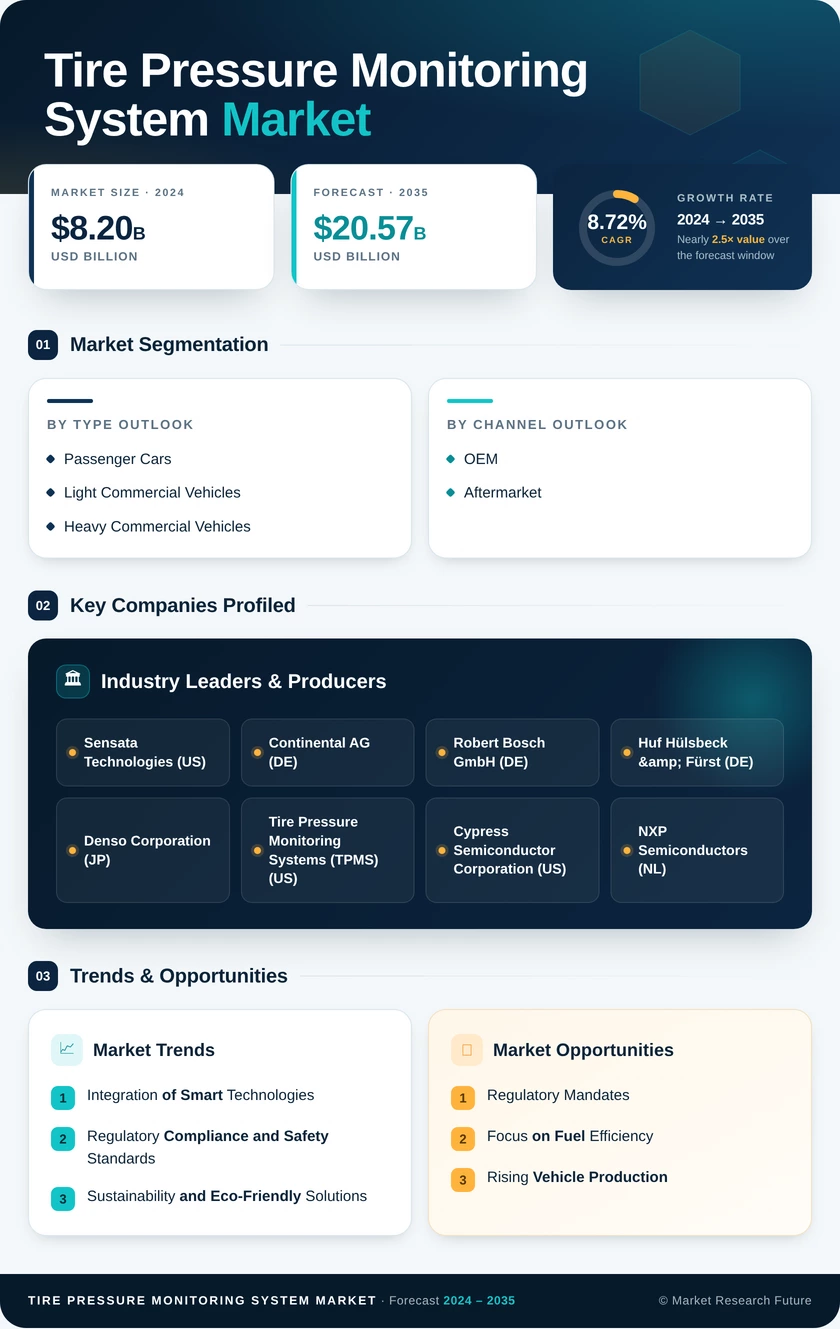
Segmentation Quick Reference
| Dimension | Sub-Segments | Dominant Segment | Fastest Growing Segment |
| By System Type | Direct; Indirect; Indirect-to-Direct Hybrid | Direct | Indirect-to-Direct Hybrid |
| By Sensor Technology | MEMS Capacitive; Piezoelectric; Surface Acoustic Wave; Energy-Harvesting and Other | MEMS Capacitive | Piezoelectric |
| By Fitting Method | Valve-Stem Mounted; Band or Strap Mounted; Embedded Tire Module | Valve-Stem Mounted | Embedded Tire Module |
| By Frequency Band | 433 MHz; 315 MHz; 2.4 GHz and UWB | 433 MHz | 2.4 GHz and UWB |
| By Vehicle Type | Passenger Cars; Light Commercial Vehicles; Medium and Heavy Commercial Vehicles; Two-Wheelers | Passenger Cars | Two-Wheelers |
| By Sales Channel | OEM Factory-Fit; Aftermarket Retrofit | OEM Factory-Fit | Aftermarket Retrofit |
| By Geography | North America; Europe; Asia-Pacific; South America; Middle East & Africa | North America | Asia-Pacific |
Market Segmentation Overview
By System Type
| Sub-Segment | Key Trend |
| Direct | Consolidation of pressure, temperature and acceleration sensing into a single node |
| Indirect | Retained on cost-driven platforms where ABS wheel-speed data is already available |
| Indirect-to-Direct Hybrid | Adopted for functional safety redundancy on higher-automation platforms |
System type is the dimension where regulation most directly shapes technology choice. Direct measurement satisfies every major mandate without interpretation, while indirect approaches survive only where regulators permit equivalent performance. Hybrid designs are the growth story because autonomy requires redundant confirmation of tire state.
By Sensor Technology
| Sub-Segment | Key Trend |
| MEMS Capacitive | Continued die shrink lowering quiescent current and extending service life |
| Piezoelectric | Dual role as sensing element and vibration energy harvester |
| Surface Acoustic Wave | Passive operation favoured in high-temperature commercial applications. |
| Energy-Harvesting and Other | Early commercialisation of cell-free architectures removing scheduled replacement |
Technology selection increasingly follows the power budget rather than the accuracy specification. Buyers now evaluate service life as a total-cost variable, which favours harvesting-compatible elements. MEMS retains volume leadership through supply chain maturity and predictable automotive-grade yields.
By Fitting Method
| Sub-Segment | Key Trend |
| Valve-Stem Mounted | Universal service tooling sustaining aftermarket dominance |
| Band or Strap Mounted | Preferred on heavy-duty wheels where valve integration is impractical |
| Embedded Tire Module | Inner-liner bonding enabling tread, load and friction estimation |
Fitting method determines what data the sensor can physically produce. Valve-stem mounting stays dominant because it is serviceable anywhere, but it caps the measurement set. Embedded modules trade serviceability for richer telemetry, which underpins tire-as-a-service commercial models.
By Frequency Band
| Sub-Segment | Key Trend |
| 433 MHz | Established European and Asian allocation with strong range performance |
| 315 MHz | Legacy North American and Japanese platform continuity |
| 2.4 GHz and UWB | Radio stack consolidation with digital key and interior sensing anchors |
Spectrum choice is largely inherited from platform architecture decisions made years earlier. The meaningful shift is toward reusing ultra-wideband anchors already fitted for phone-as-key, which removes a dedicated receiver from the bill of materials and improves wheel localisation accuracy.
By Vehicle Type
| Sub-Segment | Key Trend |
| Passenger Cars | Near-saturated fitment in mandate markets shifting revenue to replacement |
| Light Commercial Vehicles | Last-mile delivery growth intensifying duty cycles and replacement frequency |
| Medium and Heavy Commercial Vehicles | Multi-axle configurations multiplying sensors per vehicle |
| Two-Wheelers | Cost deflation and pending regulation opening a large emerging-market pool |
Vehicle mix explains why revenue growth outpaces unit growth in some regions and lags it in others. Commercial vehicles deliver high sensor counts per asset. Two-wheelers offer enormous volume at low average selling price, making regulatory timing the decisive variable.
By Sales Channel
| Sub-Segment | Key Trend |
| OEM Factory-Fit | Multi-year sourcing awards tied to type approval requirements |
| Aftermarket Retrofit | Replacement wave from the 2016–2020 fitment cohort entering service |
Channel dynamics are shifting toward the aftermarket as the installed base ages. Factory fitment sets the volume floor, but replacement carries substantially higher margin. Suppliers with recognised replacement brands and programmable universal sensors capture disproportionate value in this transition.


 Noah Malgeri
Co-Founder

 Peter Groot koerkamp
Account and Business Manager

 Younghwan Choi
Senior Retail Manager

 Mark Irwin
Management Consultant

 Akif Moroglu
Strategy & Business Development Director

 Guilherme Gomes Martins
Product Management Director

 Joseph Aguayo
Sales Operations & Pricing Manager

 La Terria Dodd
Program Support Specialist

 Rob Kooiker
Group Product Manager HVAC & Fire Protection GMA