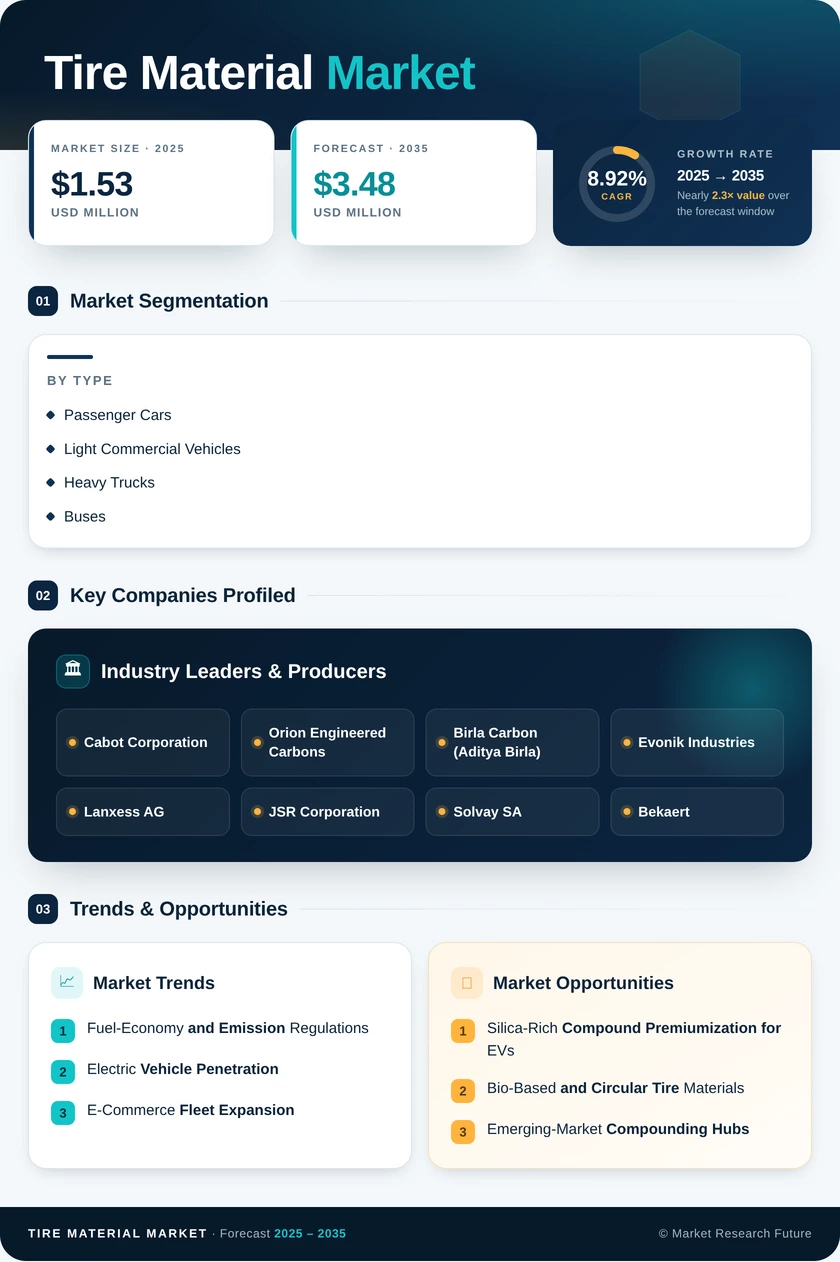
Segmentation Quick Reference
| Dimension | Sub-Segments | Dominant Segment | Fastest Growing Segment |
| Material Type | Elastomers, Reinforcing Fillers, Plasticizers, Chemicals, Metal Reinforcements, Textile Reinforcements | Elastomers | Elastomers |
| Vehicle Type | Passenger Cars, Light Commercial Vehicles, Heavy Trucks, Buses | Passenger Cars | Heavy Trucks |
| Geography | Asia-Pacific, Europe, North America, South America, Middle East & Africa | Asia-Pacific | Middle East & Africa |
Market Segmentation Overview
By Material Type
| Sub-Segment | Key Trend |
| Elastomers | Shift from emulsion SBR to solution SBR for silica compatibility and lower rolling resistance. |
| Reinforcing Fillers | Rapid substitution of carbon black with highly dispersible precipitated silica |
| Plasticizers | Bio-based process oils replacing PAH-restricted petroleum extender oils |
| Chemicals | Advanced vulcanization accelerators extending tire service life for EV applications |
| Metal Reinforcements | Ultra-high-tensile steel cord for autonomous and heavy-truck casing durability |
| Textile Reinforcements | Aramid and hybrid polyester-nylon cords for lightweight, high-modulus casing design |
Elastomers remain the volumetric backbone of tire compounding, with synthetic variants — particularly solution SBR and neodymium-catalyzed BR — gaining share as OEMs specify low-hysteresis tread compounds for electric vehicles. Reinforcing fillers are undergoing the most dramatic transformation, as precipitated silica displaces conventional carbon black in premium and mid-range tires, supported by silane coupling chemistry that ensures filler-polymer bonding.
By Vehicle Type
| Sub-Segment | Key Trend |
| Passenger Cars | Largest volume segment; replacement demand stable at 3+ billion tires annually |
| Light Commercial Vehicles | E-commerce fleet expansion is compressing replacement intervals to 18–24 months. |
| Heavy Trucks | Electrified long-haul platforms are driving demand for specialized high-load compounds. |
| Buses | Urban transit electrification in Asia and Europe is boosting low-noise tread formulations. |
Passenger cars generate the highest absolute tonnage due to sheer fleet size, but heavy trucks represent the most dynamic growth segment. Electrified heavy-truck platforms require tire materials engineered for higher axle loads, extended service intervals, and thermal management — specifications that favor premium elastomer compounds and advanced steel-cord reinforcement systems.
By Geography
| Sub-Segment | Key Trend |
| Asia-Pacific | Global production hub; China and India drive over 60% of regional consumption. |
| Europe | Regulatory premiumization; silica and bio-material adoption fastest globally |
| North America | Reshoring of tire plants; EV OEM specifications upgrading material mix |
| South America | Brazilian natural rubber integration; regional fleet modernization |
| Middle East & Africa | Infrastructure megaprojects; fastest CAGR driven by commercial-vehicle procurement |
Asia-Pacific dominates global tire material consumption by a wide margin, with China alone accounting for over half of regional volume. The Middle East & Africa region, while smaller in absolute terms, is expanding at the fastest rate as large-scale infrastructure and logistics projects in Saudi Arabia and the UAE drive unprecedented demand for commercial-vehicle tires and their constituent materials.


 Noah Malgeri
Co-Founder
Noah Malgeri
Co-Founder

 Peter Groot koerkamp
Account and Business Manager
Peter Groot koerkamp
Account and Business Manager

 Younghwan Choi
Senior Retail Manager
Younghwan Choi
Senior Retail Manager

 Mark Irwin
Management Consultant
Mark Irwin
Management Consultant

 Akif Moroglu
Strategy & Business Development Director
Akif Moroglu
Strategy & Business Development Director

 Guilherme Gomes Martins
Product Management Director
Guilherme Gomes Martins
Product Management Director

 Joseph Aguayo
Sales Operations & Pricing Manager
Joseph Aguayo
Sales Operations & Pricing Manager

 La Terria Dodd
Program Support Specialist
La Terria Dodd
Program Support Specialist

 Rob Kooiker
Group Product Manager HVAC & Fire Protection GMA
Rob Kooiker
Group Product Manager HVAC & Fire Protection GMA