×
Hero Background
English
Chinese
French
Japanese
Korean
German
Spanish

Thyroid Disorder Market Share

ID: MRFR/Pharma/2031-CR
118 Pages
Rahul Gotadki
July 2019

Thyroid Disorder Market Research Report Information by Type (Hypothyroidism and Hyperthyroidism), Treatment (Medications, Radioactive Iodine Therapy, and Surgery), Route of Administration (Oral, Intravenous and others), End-User (Hospitals, Clinics, and others) and Region (Americas, Europe, Asia-Pacific, and Middle East & Africa) - Forecast till 2035

Share:
Download PDF ×

We do not share your information with anyone. However, we may send you emails based on your report interest from time to time. You may contact us at any time to opt-out.

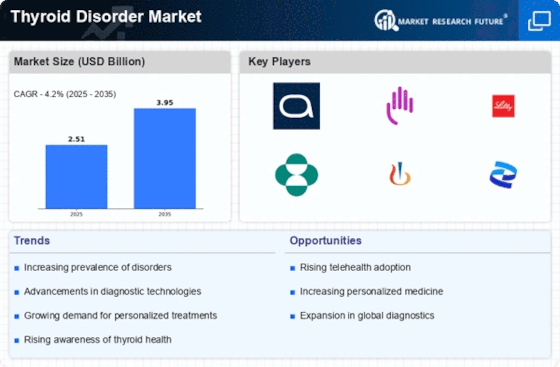
Thyroid Disorder Market Infographic
Purchase Options

Market Share

Thyroid Disorder Market Share Analysis

In the dynamic landscape of the Thyroid Disorder Market, market share positioning strategies are vital for companies aiming to establish their presence and succeed in a competitive environment. These strategies serve as a roadmap for navigating the complexities of the market, differentiating products, and capturing a significant portion of market share. One critical strategy revolves around product innovation and differentiation. Companies in this sector strive to develop thyroid disorder treatments that offer superior efficacy, safety, and convenience compared to competitors. By emphasizing factors such as effectiveness, minimal side effects, and ease of administration, companies can appeal to healthcare providers and patients seeking reliable and user-friendly solutions, thus gaining traction and expanding their market share.

Price positioning is another crucial aspect of market share strategies within the Thyroid Disorder Market. Companies may employ various pricing strategies to gain a competitive advantage and capture market share. Some may opt for a premium pricing strategy, positioning their treatments as high-quality products associated with superior outcomes and patient satisfaction. This approach appeals to patients who prioritize quality and are willing to pay a premium for effective treatments. Conversely, other companies may adopt a more aggressive pricing approach, offering their products at a lower price point to penetrate new market segments or appeal to cost-conscious buyers. By strategically adjusting pricing strategies, companies can effectively position themselves within the market and attract a broader customer base.

Distribution channels play a pivotal role in market share positioning strategies within the Thyroid Disorder Market. Companies must ensure their products are readily available and accessible to healthcare facilities, pharmacies, and patients through various channels. This involves establishing partnerships with distributors, healthcare networks, and online pharmacies to ensure widespread availability and reach. Additionally, companies may leverage direct-to-consumer sales channels and telemedicine platforms to connect with patients directly and streamline the purchasing process. By optimizing distribution channels, companies can enhance their visibility, expand their market reach, and effectively compete for market share.

Marketing and branding strategies also play a significant role in market share positioning within the Thyroid Disorder Market. Companies need to develop compelling marketing campaigns that resonate with healthcare professionals and patients and differentiate their brands from competitors. This may involve leveraging digital marketing channels, social media platforms, and patient education materials to raise awareness about the benefits of their products. Additionally, companies may collaborate with healthcare providers, patient advocacy groups, and influencers to promote their treatments and establish credibility within the industry. By crafting a strong brand identity and communicating value propositions effectively, companies can differentiate themselves in the market and drive market share growth.

Furthermore, strategic partnerships and collaborations can have a substantial impact on market share positioning in the Thyroid Disorder Market. Companies may form alliances with pharmaceutical companies, research institutions, and healthcare providers to drive innovation, expand product offerings, and access new markets. By leveraging complementary strengths and resources, companies can enhance their competitive position, accelerate market penetration, and solidify their position as industry leaders. Strategic partnerships also enable companies to leverage existing distribution channels, amplify marketing efforts, and achieve economies of scale, ultimately leading to increased market share.


Author
Rahul Gotadki
Assistant Manager

He holds an experience of about 7+ years in Market Research and Business Consulting, working under the spectrum of Life Sciences and Healthcare domains. Rahul conceptualizes and implements a scalable business strategy and provides strategic leadership to the clients. His expertise lies in market estimation, competitive intelligence, pipeline analysis, customer assessment, etc. In addition to the above, his other responsibility includes strategic tracking of high growth markets & advising clients on the potential areas of focus they could direct their business initiatives

Leave a Comment

FAQs

What is the projected market valuation of the Thyroid Disorder Market by 2035?

The Thyroid Disorder Market is projected to reach a valuation of 3.948 USD Billion by 2035.

What was the market valuation of the Thyroid Disorder Market in 2024?

In 2024, the Thyroid Disorder Market was valued at 2.511 USD Billion.

What is the expected CAGR for the Thyroid Disorder Market during the forecast period 2025 - 2035?

The expected CAGR for the Thyroid Disorder Market during the forecast period 2025 - 2035 is 4.2%.

Which companies are considered key players in the Thyroid Disorder Market?

Key players in the Thyroid Disorder Market include AbbVie, Bristol-Myers Squibb, Eli Lilly and Company, and Merck & Co.

What are the projected revenues for Hypothyroidism and Hyperthyroidism segments by 2035?

By 2035, the projected revenue for Hypothyroidism is 2.368 USD Billion, while Hyperthyroidism is expected to reach 1.58 USD Billion.

Market Summary

As per MRFR analysis, the Thyroid Disorder Market Size was estimated at 2.511 USD Billion in 2024. The Thyroid Disorder industry is projected to grow from 2.617 USD Billion in 2025 to 3.948 USD Billion by 2035, exhibiting a compound annual growth rate (CAGR) of 4.2 during the forecast period 2025 - 2035.

Key Market Trends & Highlights

The Thyroid Disorder Market is experiencing a dynamic shift towards personalized treatment and advanced diagnostic technologies.

  • North America remains the largest market for thyroid disorders, driven by increased awareness and screening initiatives. The Asia-Pacific region is emerging as the fastest-growing market, fueled by rising healthcare expenditure and a growing patient population. Hypothyroidism continues to dominate the market as the largest segment, while hyperthyroidism is recognized as the fastest-growing segment. Key market drivers include the rising incidence of thyroid disorders and advancements in diagnostic technologies, which are shaping treatment approaches.

Market Size & Forecast

2024 Market Size 2.511 (USD Billion)
2035 Market Size 3.948 (USD Billion)
CAGR (2025 - 2035) 4.2%
Largest Regional Market Share in 2024 Americas

Major Players

<p><a href="https://www.abbvie.com/patients/products.html">AbbVie </a>(US), Bristol-Myers Squibb (US), Eli Lilly and Company (US), Merck &amp; Co. (US), Novartis (CH), <a href="https://www.pfizer.com/news/announcements/understanding-your-thyroid-key-energy-health">Pfizer </a>(US), Sanofi (FR), Takeda Pharmaceutical Company (JP), Amgen (US)</p>

Market Trends

The Thyroid Disorder Market is currently experiencing notable transformations driven by various factors. An increasing prevalence of thyroid disorders, coupled with heightened awareness regarding the importance of early diagnosis and treatment, appears to be propelling market growth. Healthcare providers are increasingly focusing on innovative diagnostic tools and therapeutic options, which may enhance patient outcomes. Furthermore, the integration of advanced technologies in treatment protocols suggests a shift towards more personalized medicine, potentially improving the management of thyroid-related conditions. In addition, the rising demand for effective treatment options is likely to stimulate research and development activities within the pharmaceutical sector. This trend indicates a growing interest in novel therapies, including biologics and targeted treatments, which could redefine standard care practices. As the Thyroid Disorder Market evolves, stakeholders must remain vigilant to emerging trends and adapt strategies accordingly to meet the changing needs of patients and healthcare systems.

Increased Awareness and Screening

There is a growing recognition of thyroid disorders among the general population and healthcare professionals. This heightened awareness is leading to more frequent screenings and early diagnosis, which may contribute to improved patient outcomes.

Technological Advancements in Treatment

The Thyroid Disorder Market is witnessing a surge in the adoption of advanced technologies for treatment. Innovations such as minimally invasive surgical techniques and targeted therapies are becoming more prevalent, potentially enhancing the effectiveness of interventions.

Focus on Personalized Medicine

A shift towards personalized medicine is becoming evident in the management of thyroid disorders. Tailoring treatment plans to individual patient profiles may improve therapeutic efficacy and patient satisfaction, indicating a significant trend in the market.

Thyroid Disorder Market Market Drivers

Rising Healthcare Expenditure

The Thyroid Disorder Market is positively impacted by rising healthcare expenditure across various regions. As governments and private sectors allocate more funds towards healthcare, there is an increased focus on managing chronic conditions, including thyroid disorders. This trend is reflected in the growing availability of healthcare services, improved access to medications, and enhanced patient education initiatives. Higher healthcare spending is likely to facilitate better diagnosis and treatment options for patients suffering from thyroid disorders. Consequently, the Thyroid Disorder Market is expected to expand as more individuals seek care and treatment, driven by the availability of resources and support.

Growing Demand for Targeted Therapies

The Thyroid Disorder Market is witnessing a shift towards targeted therapies, which are designed to address specific molecular targets associated with thyroid disorders. This trend is driven by the increasing understanding of the underlying mechanisms of these conditions, leading to the development of more effective treatment options. Patients are increasingly seeking therapies that offer personalized approaches, which can lead to better management of their conditions. The market for targeted therapies is expected to grow as pharmaceutical companies invest in research and development to create innovative solutions. This focus on precision medicine not only enhances treatment efficacy but also aligns with the evolving expectations of patients within the Thyroid Disorder Market.

Rising Incidence of Thyroid Disorders

The Thyroid Disorder Market is experiencing growth due to the increasing prevalence of thyroid disorders, which affects millions worldwide. According to health statistics, conditions such as hypothyroidism and hyperthyroidism are becoming more common, particularly among women. This rise in incidence is attributed to various factors, including genetic predisposition and environmental influences. As awareness of these disorders grows, more individuals seek diagnosis and treatment, thereby driving demand for therapeutic options. The Thyroid Disorder Market is projected to expand as healthcare providers enhance screening practices and patients become more informed about their health. This trend suggests a potential increase in the market size, as more patients are likely to require ongoing management and treatment for their thyroid conditions.

Advancements in Diagnostic Technologies

The Thyroid Disorder Market is significantly influenced by advancements in diagnostic technologies. Innovations such as high-sensitivity thyroid function tests and imaging techniques have improved the accuracy of diagnosing thyroid disorders. These technologies enable healthcare professionals to detect conditions at earlier stages, which is crucial for effective treatment. The introduction of point-of-care testing devices has also facilitated quicker diagnosis, allowing for timely intervention. As diagnostic capabilities continue to evolve, the Thyroid Disorder Market is likely to see an increase in patient referrals and treatment initiation, ultimately contributing to market growth. Enhanced diagnostic tools not only improve patient outcomes but also expand the overall market by attracting more patients seeking reliable testing.

Increased Investment in Research and Development

The Thyroid Disorder Market is benefiting from increased investment in research and development (R&D) aimed at understanding thyroid disorders better and developing new treatment modalities. Pharmaceutical companies and research institutions are allocating significant resources to explore novel therapeutic agents and improve existing treatments. This influx of funding is likely to accelerate the pace of innovation within the Thyroid Disorder Market, leading to the introduction of new drugs and therapies that can address unmet medical needs. As R&D efforts continue to expand, the market is expected to evolve, offering patients more options and potentially improving overall health outcomes.

Market Segment Insights

By Thyroid Disorder Market Type Outlook: Hypothyroidism (Largest) vs. Hyperthyroidism (Fastest-Growing)

<p>The Thyroid Disorder Market exhibits a distinct segmentation wherein hypothyroidism dominates, attributed to its higher prevalence and awareness among patients and healthcare providers. This segment accounts for a substantial portion of the market, significantly influenced by the aging population and rising incidence rates of thyroid-related diseases. In contrast, hyperthyroidism is gaining traction, gradually increasing its market share as awareness, diagnostic practices, and treatment options for this condition improve. Growth trends within the Thyroid Disorder Market indicate that while hypothyroidism remains the largest segment, hyperthyroidism is emerging as the fastest-growing area. The increasing focus on early diagnosis and treatment, coupled with advancements in pharmaceuticals, contributes to hyperthyroidism's rapid growth. Moreover, the prevalence of risk factors such as autoimmune disorders and stress in modern lifestyles acts as a significant driver for this transformation, making hyperthyroidism a focal point for future market strategies.</p>

<p>Hypothyroidism: Dominant vs. Hyperthyroidism: Emerging</p>

<p>Hypothyroidism is characterized by an underactive thyroid gland, leading to insufficient hormone production responsible for regulating metabolism. This segment has established itself as the dominant player within the Thyroid Disorder Market, greatly influenced by the high prevalence rates and ongoing education initiatives urging individuals to seek medical advice. Patients are often treated with hormone replacement therapies, which ensure consistent demand. On the other hand, hyperthyroidism presents as an emerging segment, marked by an overactive thyroid that accelerates metabolism. Current trends suggest that hyperthyroidism is on an upward trajectory, propelled by advancements in diagnostic tools and treatments. This emerging position attracts significant interest from pharmaceutical companies seeking to develop innovative therapies that cater to the growing patient population.</p>

By Thyroid Disorder Market Treatment Outlook: Medications (Largest) vs. Surgery (Fastest-Growing)

<p>The Thyroid Disorder Market Treatment Market shows a diverse distribution of treatment options, with medications holding the largest market share. This segment is favored for its non-invasive approach and effectiveness in managing hormone levels, making it a preferred choice among patients. In contrast, surgery, though accounting for a smaller percentage, is rapidly gaining traction as an effective option for certain types of thyroid disorders, prompting significant interest from healthcare professionals. Recent trends indicate a growing awareness of thyroid disorders, leading to increased diagnosis and treatment rates. Medications are often first-line treatments, but surgical options are becoming increasingly popular due to advancements in techniques and technologies. As patients seek comprehensive solutions, the market is evolving, resulting in a surge in surgical interventions that cater to more severe cases, thereby driving growth in this segment.</p>

<p>Medications (Dominant) vs. Surgery (Emerging)</p>

<p>Medications stand out as the dominant force within the Thyroid Disorder Market Treatment segment, primarily due to their effectiveness in controlling hormone levels and managing symptoms associated with hypothyroidism and hyperthyroidism. With a wide range of options that include levothyroxine and antithyroid medications, this segment appeals to patients looking for less invasive treatment. On the other hand, surgery is the emerging choice for patients suffering from nodular thyroid disease or cancer, where medications may not be sufficient. This trend is powered by advancements in surgical techniques, such as minimally invasive procedures, which have significantly reduced recovery times and risks. Thus, while medications will maintain dominance, surgery is poised for growth as clinical practices evolve.</p>

By Thyroid Disorder Market Route of Administration Outlook: Oral (Largest) vs. Intravenous (Fastest-Growing)

<p>In the Thyroid Disorder Market, the distribution of routes of administration has shown distinct preferences, with the oral segment commanding the largest share. This preference is largely reflective of its convenience, ease of consumption, and established efficacy among patients. Consequently, the oral route remains the predominant choice for managing thyroid conditions, significantly influencing market dynamics and product development.</p>

<p>Oral (Dominant) vs. Intravenous (Emerging)</p>

<p>The oral administration route for thyroid disorder treatments has established itself as the dominant segment due to its patient-friendly nature. Medications administered orally offer convenient dosage forms like tablets and <a href="https://www.marketresearchfuture.com/reports/capsule-market-2633">capsules</a>, making adherence easier for patients. In contrast, intravenous administration is emerging rapidly, primarily driven by the need for faster therapeutic effects and improved bioavailability in certain patient populations. While oral medications remain the favored choice for long-term management, intravenous treatments are gaining traction for acute care scenarios, signifying a shift towards more personalized treatment options in the thyroid disorder market.</p>

By Thyroid Disorder Market End-User Outlook: Clinics (Largest) vs. Hospitals (Fastest-Growing)

<p>The Thyroid Disorder Market has seen notable segmentation based on end-user outlook, dominated primarily by clinics. Clinics account for a significant portion of the market share, attributed to their accessibility and the convenience they offer for patients seeking diagnosis and treatment. Hospitals follow as a substantial component, benefiting from their comprehensive care capabilities, but are not as prevalent as clinics in day-to-day outpatient management.</p>

<p>Clinics (Dominant) vs. Hospitals (Emerging)</p>

<p>Clinics are the dominant force in the Thyroid Disorder Market due to their focus on outpatient services and specialized care tailored for thyroid conditions. These establishments often provide personalized treatment plans and follow-ups, fostering strong patient relationships. In contrast, hospitals, while currently emerging as a growing segment, are increasingly focusing on expanding their outpatient services for thyroid disorders. They boast advanced medical technologies and specialist networks, allowing them to attract more patients seeking comprehensive care, thus marking a significant pivot in the thyroid disorder care landscape.</p>

Get more detailed insights about Thyroid Disorder Market Research Report - Forecast till 2035

Regional Insights

North America : Leading Market for Innovation

North America is the largest market for thyroid disorders, accounting for approximately 45% of the global market share. The region's growth is driven by increasing prevalence of thyroid diseases, heightened awareness, and advancements in treatment options. Regulatory support from agencies like the FDA facilitates faster drug approvals, enhancing market dynamics. The demand for innovative therapies and personalized medicine is also on the rise, further propelling market growth. The United States is the leading country in this region, with significant contributions from Canada. Major pharmaceutical companies such as AbbVie, Eli Lilly, and Merck & Co. are actively involved in developing and marketing thyroid disorder treatments. The competitive landscape is characterized by a focus on research and development, with companies investing heavily in new therapies to meet the growing demand for effective treatment options.

Europe : Emerging Market with Growth Potential

Europe is witnessing significant growth in the thyroid disorder market, holding approximately 30% of the global share. The increasing incidence of thyroid-related conditions, coupled with rising healthcare expenditure, is driving demand for effective treatments. Regulatory frameworks in countries like Germany and France are supportive of innovative therapies, which enhances market accessibility and patient care. The region is also focusing on preventive healthcare measures, which is expected to further boost market growth. Leading countries in Europe include Germany, France, and the UK, where key players like Novartis and Sanofi are making substantial investments. The competitive landscape is marked by collaborations and partnerships aimed at enhancing product offerings. The presence of well-established healthcare systems facilitates the introduction of new therapies, ensuring that patients have access to the latest treatment options available.

Asia-Pacific : Rapidly Growing Healthcare Sector

The Asia-Pacific region is emerging as a significant player in the thyroid disorder market, accounting for about 20% of the global market share. The growth is driven by increasing awareness of thyroid health, rising disposable incomes, and improvements in healthcare infrastructure. Countries like China and India are witnessing a surge in demand for thyroid treatments, supported by government initiatives aimed at enhancing healthcare access and affordability. Regulatory bodies are also streamlining approval processes for new therapies, fostering market growth. China is the largest market in this region, followed by India, where local and international players are competing to capture market share. Companies like Takeda and Amgen are actively involved in the development of innovative therapies. The competitive landscape is characterized by a mix of multinational corporations and local firms, all striving to meet the growing demand for effective thyroid disorder treatments. This dynamic environment is expected to drive further advancements in the sector.

Middle East and Africa : Untapped Market with Potential

The Middle East and Africa region is gradually emerging in the thyroid disorder market, holding approximately 5% of the global share. The growth is primarily driven by increasing awareness of thyroid health issues and the rising prevalence of thyroid disorders. Government initiatives aimed at improving healthcare access and affordability are also contributing to market expansion. Regulatory bodies are working to enhance the approval processes for new treatments, which is expected to stimulate market growth in the coming years. Leading countries in this region include South Africa and the UAE, where there is a growing presence of international pharmaceutical companies. The competitive landscape is evolving, with both local and The Thyroid Disorder. Companies are focusing on partnerships and collaborations to enhance their product offerings and meet the increasing demand for effective thyroid disorder treatments.

Key Players and Competitive Insights

The Thyroid Disorder Market is characterized by a dynamic competitive landscape, driven by increasing prevalence rates and a growing awareness of thyroid-related health issues. Key players such as AbbVie (US), Eli Lilly and Company (US), and Novartis (CH) are strategically positioned to leverage innovation and expand their market presence. AbbVie (US) focuses on developing novel therapies, while Eli Lilly and Company (US) emphasizes partnerships to enhance its product portfolio. Novartis (CH) is actively pursuing regional expansion, particularly in emerging markets, which collectively shapes a competitive environment that is increasingly focused on patient-centric solutions and advanced therapeutic options.

In terms of business tactics, companies are localizing manufacturing and optimizing supply chains to enhance efficiency and responsiveness to market demands. The Thyroid Disorder Market appears moderately fragmented, with several key players exerting influence over various segments. This fragmentation allows for a diverse range of treatment options, yet the collective strategies of these companies indicate a trend towards consolidation and collaboration, particularly in research and development initiatives.

In August 2025, AbbVie (US) announced a strategic partnership with a leading biotechnology firm to co-develop a new class of thyroid hormone replacement therapies. This collaboration is expected to accelerate the development timeline and enhance the therapeutic efficacy of treatments, thereby positioning AbbVie (US) as a frontrunner in the market. The strategic importance of this partnership lies in its potential to address unmet medical needs and improve patient outcomes, which is increasingly becoming a focal point in the industry.

In September 2025, Eli Lilly and Company (US) launched a digital health platform aimed at improving patient engagement and adherence to thyroid disorder treatments. This initiative reflects a broader trend towards digitalization in healthcare, where technology is utilized to enhance patient experiences and outcomes. The strategic significance of this move is profound, as it not only strengthens Eli Lilly's (US) market position but also aligns with the growing demand for integrated healthcare solutions that prioritize patient-centric care.

In July 2025, Novartis (CH) expanded its manufacturing capabilities in Asia to meet the rising demand for thyroid medications in the region. This expansion is indicative of Novartis's (CH) commitment to regional growth and its strategy to ensure supply chain reliability. The implications of this move are substantial, as it positions Novartis (CH) to better serve a burgeoning market while also mitigating potential supply chain disruptions that could arise from global uncertainties.

As of October 2025, current competitive trends in the Thyroid Disorder Market are increasingly defined by digitalization, sustainability, and the integration of artificial intelligence in treatment protocols. Strategic alliances are shaping the landscape, fostering innovation and enhancing the development of advanced therapies. Looking ahead, competitive differentiation is likely to evolve from traditional price-based competition towards a focus on innovation, technological advancements, and the reliability of supply chains, thereby ensuring that companies remain agile and responsive to the ever-changing healthcare environment.

Key Companies in the Thyroid Disorder Market market include

Industry Developments

Recent development in the thyroid disorder market are

• In November 2015, a program that focuses on managing the daily routine of those having the life-long condition of hypothyroidism was launched by Abbie under Good Morning Hypothyroidism (GMH).

• In October 2016, ThyroTest was introduced by Abbott acquired Alere Inc., a service provider organization and a diagnostic device manufacturer introduced in the market, which is a test to detect hypothyroidism.

• In March 2018, an orally available tyrosine kinase inhibitor was discovered by Eisai.

• Also, in the same month, it was announced by Eisai Co Ltd and Merck about their strategic collar radiation. They are popularly called MSD after the collaboration.

• The commercialization of LENVIMA was also done in the year 2018.

Future Outlook

Thyroid Disorder Market Future Outlook

<p>The Thyroid Disorder Market is projected to grow at a 4.2% CAGR from 2024 to 2035, driven by increasing prevalence, advancements in diagnostics, and enhanced treatment options.</p>

New opportunities lie in:

  • <p>Development of telehealth platforms for remote patient monitoring</p><p>Investment in AI-driven diagnostic tools for early detection</p><p>Expansion of <a href="https://www.marketresearchfuture.com/reports/personalized-medicine-market-2937">personalized medicine</a> approaches in treatment protocols</p>

<p>By 2035, the Thyroid Disorder Market is expected to achieve substantial growth and innovation.</p>

Market Segmentation

Thyroid Disorder Market Thyroid Disorder Type Outlook Outlook

  • Hypothyroidism
  • Hyperthyroidism

Thyroid Disorder Market Thyroid Disorder End-User Outlook Outlook

  • Clinics
  • Hospitals
  • Others

Thyroid Disorder Market Thyroid Disorder Treatment Outlook Outlook

  • Medications
  • Surgery
  • Radioactive iodine therapy

Thyroid Disorder Market Thyroid Disorder Route of Administration Outlook Outlook

  • Intravenous
  • Oral
  • Other

Report Scope

MARKET SIZE 20242.511(USD Billion)
MARKET SIZE 20252.617(USD Billion)
MARKET SIZE 20353.948(USD Billion)
COMPOUND ANNUAL GROWTH RATE (CAGR)4.2% (2024 - 2035)
REPORT COVERAGERevenue Forecast, Competitive Landscape, Growth Factors, and Trends
BASE YEAR2024
Market Forecast Period2025 - 2035
Historical Data2019 - 2024
Market Forecast UnitsUSD Billion
Key Companies ProfiledMarket analysis in progress
Segments CoveredMarket segmentation analysis in progress
Key Market OpportunitiesIntegration of telemedicine and digital health solutions in the Thyroid Disorder Market.
Key Market DynamicsRising prevalence of thyroid disorders drives demand for innovative treatment options and enhanced diagnostic technologies.
Countries CoveredNorth America, Europe, APAC, South America, MEA

FAQs

What is the projected market valuation of the Thyroid Disorder Market by 2035?

The Thyroid Disorder Market is projected to reach a valuation of 3.948 USD Billion by 2035.

What was the market valuation of the Thyroid Disorder Market in 2024?

In 2024, the Thyroid Disorder Market was valued at 2.511 USD Billion.

What is the expected CAGR for the Thyroid Disorder Market during the forecast period 2025 - 2035?

The expected CAGR for the Thyroid Disorder Market during the forecast period 2025 - 2035 is 4.2%.

Which companies are considered key players in the Thyroid Disorder Market?

Key players in the Thyroid Disorder Market include AbbVie, Bristol-Myers Squibb, Eli Lilly and Company, and Merck & Co.

What are the projected revenues for Hypothyroidism and Hyperthyroidism segments by 2035?

By 2035, the projected revenue for Hypothyroidism is 2.368 USD Billion, while Hyperthyroidism is expected to reach 1.58 USD Billion.

  1. SECTION I: EXECUTIVE SUMMARY AND KEY HIGHLIGHTS
    1. EXECUTIVE SUMMARY
      1. Market Overview
      2. Key Findings
      3. Market Segmentation
      4. Competitive Landscape
      5. Challenges and Opportunities
      6. Future Outlook 2 SECTION II: SCOPING, METHODOLOGY AND MARKET STRUCTURE
    2. MARKET INTRODUCTION
      1. Definition
      2. Scope of the study
    3. RESEARCH METHODOLOGY
      1. Overview
      2. Data Mining
      3. Secondary Research
      4. Primary Research
      5. Forecasting Model
      6. Market Size Estimation
      7. Data Triangulation
      8. Validation 3 SECTION III: QUALITATIVE ANALYSIS
    4. MARKET DYNAMICS
      1. Overview
      2. Drivers
      3. Restraints
      4. Opportunities
    5. MARKET FACTOR ANALYSIS
      1. Value chain Analysis
      2. Porter's Five Forces Analysis
      3. COVID-19 Impact Analysis
    6. Healthcare, BY Thyroid Disorder Type Outlook (USD Billion)
      1. Hypothyroidism
      2. Hyperthyroidism
    7. Healthcare, BY Thyroid Disorder Treatment Outlook (USD Billion)
      1. Medications
      2. Surgery
      3. Radioactive iodine therapy
    8. Healthcare, BY Thyroid Disorder Route of Administration Outlook (USD Billion)
      1. Intravenous
      2. Oral
      3. Other
    9. Healthcare, BY Thyroid Disorder End-User Outlook (USD Billion)
      1. Clinics
      2. Hospitals
      3. Others
    10. Healthcare, BY Region (USD Billion)
      1. North America
      2. Europe
      3. APAC
      4. South America
      5. MEA
    11. Competitive Landscape
      1. Overview
      2. Competitive Analysis
      3. Market share Analysis
      4. Major Growth Strategy in the Healthcare
      5. Competitive Benchmarking
      6. Leading Players in Terms of Number of Developments in the Healthcare
      7. Key developments and growth strategies
      8. Major Players Financial Matrix
    12. Company Profiles
      1. AbbVie (US)
      2. Bristol-Myers Squibb (US)
      3. Eli Lilly and Company (US)
      4. Merck & Co. (US)
      5. Novartis (CH)
      6. Pfizer (US)
      7. Sanofi (FR)
      8. Takeda Pharmaceutical Company (JP)
      9. Amgen (US)
    13. Appendix
      1. References
      2. Related Reports 6 LIST OF FIGURES
    14. MARKET SYNOPSIS
    15. NORTH AMERICA MARKET ANALYSIS
    16. US MARKET ANALYSIS BY THYROID DISORDER TYPE OUTLOOK
    17. US MARKET ANALYSIS BY THYROID DISORDER TREATMENT OUTLOOK
    18. US MARKET ANALYSIS BY THYROID DISORDER ROUTE OF ADMINISTRATION OUTLOOK
    19. US MARKET ANALYSIS BY THYROID DISORDER END-USER OUTLOOK
    20. CANADA MARKET ANALYSIS BY THYROID DISORDER TYPE OUTLOOK
    21. CANADA MARKET ANALYSIS BY THYROID DISORDER TREATMENT OUTLOOK
    22. CANADA MARKET ANALYSIS BY THYROID DISORDER ROUTE OF ADMINISTRATION OUTLOOK
    23. CANADA MARKET ANALYSIS BY THYROID DISORDER END-USER OUTLOOK
    24. EUROPE MARKET ANALYSIS
    25. GERMANY MARKET ANALYSIS BY THYROID DISORDER TYPE OUTLOOK
    26. GERMANY MARKET ANALYSIS BY THYROID DISORDER TREATMENT OUTLOOK
    27. GERMANY MARKET ANALYSIS BY THYROID DISORDER ROUTE OF ADMINISTRATION OUTLOOK
    28. GERMANY MARKET ANALYSIS BY THYROID DISORDER END-USER OUTLOOK
    29. UK MARKET ANALYSIS BY THYROID DISORDER TYPE OUTLOOK
    30. UK MARKET ANALYSIS BY THYROID DISORDER TREATMENT OUTLOOK
    31. UK MARKET ANALYSIS BY THYROID DISORDER ROUTE OF ADMINISTRATION OUTLOOK
    32. UK MARKET ANALYSIS BY THYROID DISORDER END-USER OUTLOOK
    33. FRANCE MARKET ANALYSIS BY THYROID DISORDER TYPE OUTLOOK
    34. FRANCE MARKET ANALYSIS BY THYROID DISORDER TREATMENT OUTLOOK
    35. FRANCE MARKET ANALYSIS BY THYROID DISORDER ROUTE OF ADMINISTRATION OUTLOOK
    36. FRANCE MARKET ANALYSIS BY THYROID DISORDER END-USER OUTLOOK
    37. RUSSIA MARKET ANALYSIS BY THYROID DISORDER TYPE OUTLOOK
    38. RUSSIA MARKET ANALYSIS BY THYROID DISORDER TREATMENT OUTLOOK
    39. RUSSIA MARKET ANALYSIS BY THYROID DISORDER ROUTE OF ADMINISTRATION OUTLOOK
    40. RUSSIA MARKET ANALYSIS BY THYROID DISORDER END-USER OUTLOOK
    41. ITALY MARKET ANALYSIS BY THYROID DISORDER TYPE OUTLOOK
    42. ITALY MARKET ANALYSIS BY THYROID DISORDER TREATMENT OUTLOOK
    43. ITALY MARKET ANALYSIS BY THYROID DISORDER ROUTE OF ADMINISTRATION OUTLOOK
    44. ITALY MARKET ANALYSIS BY THYROID DISORDER END-USER OUTLOOK
    45. SPAIN MARKET ANALYSIS BY THYROID DISORDER TYPE OUTLOOK
    46. SPAIN MARKET ANALYSIS BY THYROID DISORDER TREATMENT OUTLOOK
    47. SPAIN MARKET ANALYSIS BY THYROID DISORDER ROUTE OF ADMINISTRATION OUTLOOK
    48. SPAIN MARKET ANALYSIS BY THYROID DISORDER END-USER OUTLOOK
    49. REST OF EUROPE MARKET ANALYSIS BY THYROID DISORDER TYPE OUTLOOK
    50. REST OF EUROPE MARKET ANALYSIS BY THYROID DISORDER TREATMENT OUTLOOK
    51. REST OF EUROPE MARKET ANALYSIS BY THYROID DISORDER ROUTE OF ADMINISTRATION OUTLOOK
    52. REST OF EUROPE MARKET ANALYSIS BY THYROID DISORDER END-USER OUTLOOK
    53. APAC MARKET ANALYSIS
    54. CHINA MARKET ANALYSIS BY THYROID DISORDER TYPE OUTLOOK
    55. CHINA MARKET ANALYSIS BY THYROID DISORDER TREATMENT OUTLOOK
    56. CHINA MARKET ANALYSIS BY THYROID DISORDER ROUTE OF ADMINISTRATION OUTLOOK
    57. CHINA MARKET ANALYSIS BY THYROID DISORDER END-USER OUTLOOK
    58. INDIA MARKET ANALYSIS BY THYROID DISORDER TYPE OUTLOOK
    59. INDIA MARKET ANALYSIS BY THYROID DISORDER TREATMENT OUTLOOK
    60. INDIA MARKET ANALYSIS BY THYROID DISORDER ROUTE OF ADMINISTRATION OUTLOOK
    61. INDIA MARKET ANALYSIS BY THYROID DISORDER END-USER OUTLOOK
    62. JAPAN MARKET ANALYSIS BY THYROID DISORDER TYPE OUTLOOK
    63. JAPAN MARKET ANALYSIS BY THYROID DISORDER TREATMENT OUTLOOK
    64. JAPAN MARKET ANALYSIS BY THYROID DISORDER ROUTE OF ADMINISTRATION OUTLOOK
    65. JAPAN MARKET ANALYSIS BY THYROID DISORDER END-USER OUTLOOK
    66. SOUTH KOREA MARKET ANALYSIS BY THYROID DISORDER TYPE OUTLOOK
    67. SOUTH KOREA MARKET ANALYSIS BY THYROID DISORDER TREATMENT OUTLOOK
    68. SOUTH KOREA MARKET ANALYSIS BY THYROID DISORDER ROUTE OF ADMINISTRATION OUTLOOK
    69. SOUTH KOREA MARKET ANALYSIS BY THYROID DISORDER END-USER OUTLOOK
    70. MALAYSIA MARKET ANALYSIS BY THYROID DISORDER TYPE OUTLOOK
    71. MALAYSIA MARKET ANALYSIS BY THYROID DISORDER TREATMENT OUTLOOK
    72. MALAYSIA MARKET ANALYSIS BY THYROID DISORDER ROUTE OF ADMINISTRATION OUTLOOK
    73. MALAYSIA MARKET ANALYSIS BY THYROID DISORDER END-USER OUTLOOK
    74. THAILAND MARKET ANALYSIS BY THYROID DISORDER TYPE OUTLOOK
    75. THAILAND MARKET ANALYSIS BY THYROID DISORDER TREATMENT OUTLOOK
    76. THAILAND MARKET ANALYSIS BY THYROID DISORDER ROUTE OF ADMINISTRATION OUTLOOK
    77. THAILAND MARKET ANALYSIS BY THYROID DISORDER END-USER OUTLOOK
    78. INDONESIA MARKET ANALYSIS BY THYROID DISORDER TYPE OUTLOOK
    79. INDONESIA MARKET ANALYSIS BY THYROID DISORDER TREATMENT OUTLOOK
    80. INDONESIA MARKET ANALYSIS BY THYROID DISORDER ROUTE OF ADMINISTRATION OUTLOOK
    81. INDONESIA MARKET ANALYSIS BY THYROID DISORDER END-USER OUTLOOK
    82. REST OF APAC MARKET ANALYSIS BY THYROID DISORDER TYPE OUTLOOK
    83. REST OF APAC MARKET ANALYSIS BY THYROID DISORDER TREATMENT OUTLOOK
    84. REST OF APAC MARKET ANALYSIS BY THYROID DISORDER ROUTE OF ADMINISTRATION OUTLOOK
    85. REST OF APAC MARKET ANALYSIS BY THYROID DISORDER END-USER OUTLOOK
    86. SOUTH AMERICA MARKET ANALYSIS
    87. BRAZIL MARKET ANALYSIS BY THYROID DISORDER TYPE OUTLOOK
    88. BRAZIL MARKET ANALYSIS BY THYROID DISORDER TREATMENT OUTLOOK
    89. BRAZIL MARKET ANALYSIS BY THYROID DISORDER ROUTE OF ADMINISTRATION OUTLOOK
    90. BRAZIL MARKET ANALYSIS BY THYROID DISORDER END-USER OUTLOOK
    91. MEXICO MARKET ANALYSIS BY THYROID DISORDER TYPE OUTLOOK
    92. MEXICO MARKET ANALYSIS BY THYROID DISORDER TREATMENT OUTLOOK
    93. MEXICO MARKET ANALYSIS BY THYROID DISORDER ROUTE OF ADMINISTRATION OUTLOOK
    94. MEXICO MARKET ANALYSIS BY THYROID DISORDER END-USER OUTLOOK
    95. ARGENTINA MARKET ANALYSIS BY THYROID DISORDER TYPE OUTLOOK
    96. ARGENTINA MARKET ANALYSIS BY THYROID DISORDER TREATMENT OUTLOOK
    97. ARGENTINA MARKET ANALYSIS BY THYROID DISORDER ROUTE OF ADMINISTRATION OUTLOOK
    98. ARGENTINA MARKET ANALYSIS BY THYROID DISORDER END-USER OUTLOOK
    99. REST OF SOUTH AMERICA MARKET ANALYSIS BY THYROID DISORDER TYPE OUTLOOK
    100. REST OF SOUTH AMERICA MARKET ANALYSIS BY THYROID DISORDER TREATMENT OUTLOOK
    101. REST OF SOUTH AMERICA MARKET ANALYSIS BY THYROID DISORDER ROUTE OF ADMINISTRATION OUTLOOK
    102. REST OF SOUTH AMERICA MARKET ANALYSIS BY THYROID DISORDER END-USER OUTLOOK
    103. MEA MARKET ANALYSIS
    104. GCC COUNTRIES MARKET ANALYSIS BY THYROID DISORDER TYPE OUTLOOK
    105. GCC COUNTRIES MARKET ANALYSIS BY THYROID DISORDER TREATMENT OUTLOOK
    106. GCC COUNTRIES MARKET ANALYSIS BY THYROID DISORDER ROUTE OF ADMINISTRATION OUTLOOK
    107. GCC COUNTRIES MARKET ANALYSIS BY THYROID DISORDER END-USER OUTLOOK
    108. SOUTH AFRICA MARKET ANALYSIS BY THYROID DISORDER TYPE OUTLOOK
    109. SOUTH AFRICA MARKET ANALYSIS BY THYROID DISORDER TREATMENT OUTLOOK
    110. SOUTH AFRICA MARKET ANALYSIS BY THYROID DISORDER ROUTE OF ADMINISTRATION OUTLOOK
    111. SOUTH AFRICA MARKET ANALYSIS BY THYROID DISORDER END-USER OUTLOOK
    112. REST OF MEA MARKET ANALYSIS BY THYROID DISORDER TYPE OUTLOOK
    113. REST OF MEA MARKET ANALYSIS BY THYROID DISORDER TREATMENT OUTLOOK
    114. REST OF MEA MARKET ANALYSIS BY THYROID DISORDER ROUTE OF ADMINISTRATION OUTLOOK
    115. REST OF MEA MARKET ANALYSIS BY THYROID DISORDER END-USER OUTLOOK
    116. KEY BUYING CRITERIA OF HEALTHCARE
    117. RESEARCH PROCESS OF MRFR
    118. DRO ANALYSIS OF HEALTHCARE
    119. DRIVERS IMPACT ANALYSIS: HEALTHCARE
    120. RESTRAINTS IMPACT ANALYSIS: HEALTHCARE
    121. SUPPLY / VALUE CHAIN: HEALTHCARE
    122. HEALTHCARE, BY THYROID DISORDER TYPE OUTLOOK, 2024 (% SHARE)
    123. HEALTHCARE, BY THYROID DISORDER TYPE OUTLOOK, 2024 TO 2035 (USD Billion)
    124. HEALTHCARE, BY THYROID DISORDER TREATMENT OUTLOOK, 2024 (% SHARE)
    125. HEALTHCARE, BY THYROID DISORDER TREATMENT OUTLOOK, 2024 TO 2035 (USD Billion)
    126. HEALTHCARE, BY THYROID DISORDER ROUTE OF ADMINISTRATION OUTLOOK, 2024 (% SHARE)
    127. HEALTHCARE, BY THYROID DISORDER ROUTE OF ADMINISTRATION OUTLOOK, 2024 TO 2035 (USD Billion)
    128. HEALTHCARE, BY THYROID DISORDER END-USER OUTLOOK, 2024 (% SHARE)
    129. HEALTHCARE, BY THYROID DISORDER END-USER OUTLOOK, 2024 TO 2035 (USD Billion)
    130. BENCHMARKING OF MAJOR COMPETITORS 7 LIST OF TABLES
    131. LIST OF ASSUMPTIONS
    132. North America MARKET SIZE ESTIMATES; FORECAST
      1. BY THYROID DISORDER TYPE OUTLOOK, 2025-2035 (USD Billion)
      2. BY THYROID DISORDER TREATMENT OUTLOOK, 2025-2035 (USD Billion)
      3. BY THYROID DISORDER ROUTE OF ADMINISTRATION OUTLOOK, 2025-2035 (USD Billion)
      4. BY THYROID DISORDER END-USER OUTLOOK, 2025-2035 (USD Billion)
    133. US MARKET SIZE ESTIMATES; FORECAST
      1. BY THYROID DISORDER TYPE OUTLOOK, 2025-2035 (USD Billion)
      2. BY THYROID DISORDER TREATMENT OUTLOOK, 2025-2035 (USD Billion)
      3. BY THYROID DISORDER ROUTE OF ADMINISTRATION OUTLOOK, 2025-2035 (USD Billion)
      4. BY THYROID DISORDER END-USER OUTLOOK, 2025-2035 (USD Billion)
    134. Canada MARKET SIZE ESTIMATES; FORECAST
      1. BY THYROID DISORDER TYPE OUTLOOK, 2025-2035 (USD Billion)
      2. BY THYROID DISORDER TREATMENT OUTLOOK, 2025-2035 (USD Billion)
      3. BY THYROID DISORDER ROUTE OF ADMINISTRATION OUTLOOK, 2025-2035 (USD Billion)
      4. BY THYROID DISORDER END-USER OUTLOOK, 2025-2035 (USD Billion)
    135. Europe MARKET SIZE ESTIMATES; FORECAST
      1. BY THYROID DISORDER TYPE OUTLOOK, 2025-2035 (USD Billion)
      2. BY THYROID DISORDER TREATMENT OUTLOOK, 2025-2035 (USD Billion)
      3. BY THYROID DISORDER ROUTE OF ADMINISTRATION OUTLOOK, 2025-2035 (USD Billion)
      4. BY THYROID DISORDER END-USER OUTLOOK, 2025-2035 (USD Billion)
    136. Germany MARKET SIZE ESTIMATES; FORECAST
      1. BY THYROID DISORDER TYPE OUTLOOK, 2025-2035 (USD Billion)
      2. BY THYROID DISORDER TREATMENT OUTLOOK, 2025-2035 (USD Billion)
      3. BY THYROID DISORDER ROUTE OF ADMINISTRATION OUTLOOK, 2025-2035 (USD Billion)
      4. BY THYROID DISORDER END-USER OUTLOOK, 2025-2035 (USD Billion)
    137. UK MARKET SIZE ESTIMATES; FORECAST
      1. BY THYROID DISORDER TYPE OUTLOOK, 2025-2035 (USD Billion)
      2. BY THYROID DISORDER TREATMENT OUTLOOK, 2025-2035 (USD Billion)
      3. BY THYROID DISORDER ROUTE OF ADMINISTRATION OUTLOOK, 2025-2035 (USD Billion)
      4. BY THYROID DISORDER END-USER OUTLOOK, 2025-2035 (USD Billion)
    138. France MARKET SIZE ESTIMATES; FORECAST
      1. BY THYROID DISORDER TYPE OUTLOOK, 2025-2035 (USD Billion)
      2. BY THYROID DISORDER TREATMENT OUTLOOK, 2025-2035 (USD Billion)
      3. BY THYROID DISORDER ROUTE OF ADMINISTRATION OUTLOOK, 2025-2035 (USD Billion)
      4. BY THYROID DISORDER END-USER OUTLOOK, 2025-2035 (USD Billion)
    139. Russia MARKET SIZE ESTIMATES; FORECAST
      1. BY THYROID DISORDER TYPE OUTLOOK, 2025-2035 (USD Billion)
      2. BY THYROID DISORDER TREATMENT OUTLOOK, 2025-2035 (USD Billion)
      3. BY THYROID DISORDER ROUTE OF ADMINISTRATION OUTLOOK, 2025-2035 (USD Billion)
      4. BY THYROID DISORDER END-USER OUTLOOK, 2025-2035 (USD Billion)
    140. Italy MARKET SIZE ESTIMATES; FORECAST
      1. BY THYROID DISORDER TYPE OUTLOOK, 2025-2035 (USD Billion)
      2. BY THYROID DISORDER TREATMENT OUTLOOK, 2025-2035 (USD Billion)
      3. BY THYROID DISORDER ROUTE OF ADMINISTRATION OUTLOOK, 2025-2035 (USD Billion)
      4. BY THYROID DISORDER END-USER OUTLOOK, 2025-2035 (USD Billion)
    141. Spain MARKET SIZE ESTIMATES; FORECAST
      1. BY THYROID DISORDER TYPE OUTLOOK, 2025-2035 (USD Billion)
      2. BY THYROID DISORDER TREATMENT OUTLOOK, 2025-2035 (USD Billion)
      3. BY THYROID DISORDER ROUTE OF ADMINISTRATION OUTLOOK, 2025-2035 (USD Billion)
      4. BY THYROID DISORDER END-USER OUTLOOK, 2025-2035 (USD Billion)
    142. Rest of Europe MARKET SIZE ESTIMATES; FORECAST
      1. BY THYROID DISORDER TYPE OUTLOOK, 2025-2035 (USD Billion)
      2. BY THYROID DISORDER TREATMENT OUTLOOK, 2025-2035 (USD Billion)
      3. BY THYROID DISORDER ROUTE OF ADMINISTRATION OUTLOOK, 2025-2035 (USD Billion)
      4. BY THYROID DISORDER END-USER OUTLOOK, 2025-2035 (USD Billion)
    143. APAC MARKET SIZE ESTIMATES; FORECAST
      1. BY THYROID DISORDER TYPE OUTLOOK, 2025-2035 (USD Billion)
      2. BY THYROID DISORDER TREATMENT OUTLOOK, 2025-2035 (USD Billion)
      3. BY THYROID DISORDER ROUTE OF ADMINISTRATION OUTLOOK, 2025-2035 (USD Billion)
      4. BY THYROID DISORDER END-USER OUTLOOK, 2025-2035 (USD Billion)
    144. China MARKET SIZE ESTIMATES; FORECAST
      1. BY THYROID DISORDER TYPE OUTLOOK, 2025-2035 (USD Billion)
      2. BY THYROID DISORDER TREATMENT OUTLOOK, 2025-2035 (USD Billion)
      3. BY THYROID DISORDER ROUTE OF ADMINISTRATION OUTLOOK, 2025-2035 (USD Billion)
      4. BY THYROID DISORDER END-USER OUTLOOK, 2025-2035 (USD Billion)
    145. India MARKET SIZE ESTIMATES; FORECAST
      1. BY THYROID DISORDER TYPE OUTLOOK, 2025-2035 (USD Billion)
      2. BY THYROID DISORDER TREATMENT OUTLOOK, 2025-2035 (USD Billion)
      3. BY THYROID DISORDER ROUTE OF ADMINISTRATION OUTLOOK, 2025-2035 (USD Billion)
      4. BY THYROID DISORDER END-USER OUTLOOK, 2025-2035 (USD Billion)
    146. Japan MARKET SIZE ESTIMATES; FORECAST
      1. BY THYROID DISORDER TYPE OUTLOOK, 2025-2035 (USD Billion)
      2. BY THYROID DISORDER TREATMENT OUTLOOK, 2025-2035 (USD Billion)
      3. BY THYROID DISORDER ROUTE OF ADMINISTRATION OUTLOOK, 2025-2035 (USD Billion)
      4. BY THYROID DISORDER END-USER OUTLOOK, 2025-2035 (USD Billion)
    147. South Korea MARKET SIZE ESTIMATES; FORECAST
      1. BY THYROID DISORDER TYPE OUTLOOK, 2025-2035 (USD Billion)
      2. BY THYROID DISORDER TREATMENT OUTLOOK, 2025-2035 (USD Billion)
      3. BY THYROID DISORDER ROUTE OF ADMINISTRATION OUTLOOK, 2025-2035 (USD Billion)
      4. BY THYROID DISORDER END-USER OUTLOOK, 2025-2035 (USD Billion)
    148. Malaysia MARKET SIZE ESTIMATES; FORECAST
      1. BY THYROID DISORDER TYPE OUTLOOK, 2025-2035 (USD Billion)
      2. BY THYROID DISORDER TREATMENT OUTLOOK, 2025-2035 (USD Billion)
      3. BY THYROID DISORDER ROUTE OF ADMINISTRATION OUTLOOK, 2025-2035 (USD Billion)
      4. BY THYROID DISORDER END-USER OUTLOOK, 2025-2035 (USD Billion)
    149. Thailand MARKET SIZE ESTIMATES; FORECAST
      1. BY THYROID DISORDER TYPE OUTLOOK, 2025-2035 (USD Billion)
      2. BY THYROID DISORDER TREATMENT OUTLOOK, 2025-2035 (USD Billion)
      3. BY THYROID DISORDER ROUTE OF ADMINISTRATION OUTLOOK, 2025-2035 (USD Billion)
      4. BY THYROID DISORDER END-USER OUTLOOK, 2025-2035 (USD Billion)
    150. Indonesia MARKET SIZE ESTIMATES; FORECAST
      1. BY THYROID DISORDER TYPE OUTLOOK, 2025-2035 (USD Billion)
      2. BY THYROID DISORDER TREATMENT OUTLOOK, 2025-2035 (USD Billion)
      3. BY THYROID DISORDER ROUTE OF ADMINISTRATION OUTLOOK, 2025-2035 (USD Billion)
      4. BY THYROID DISORDER END-USER OUTLOOK, 2025-2035 (USD Billion)
    151. Rest of APAC MARKET SIZE ESTIMATES; FORECAST
      1. BY THYROID DISORDER TYPE OUTLOOK, 2025-2035 (USD Billion)
      2. BY THYROID DISORDER TREATMENT OUTLOOK, 2025-2035 (USD Billion)
      3. BY THYROID DISORDER ROUTE OF ADMINISTRATION OUTLOOK, 2025-2035 (USD Billion)
      4. BY THYROID DISORDER END-USER OUTLOOK, 2025-2035 (USD Billion)
    152. South America MARKET SIZE ESTIMATES; FORECAST
      1. BY THYROID DISORDER TYPE OUTLOOK, 2025-2035 (USD Billion)
      2. BY THYROID DISORDER TREATMENT OUTLOOK, 2025-2035 (USD Billion)
      3. BY THYROID DISORDER ROUTE OF ADMINISTRATION OUTLOOK, 2025-2035 (USD Billion)
      4. BY THYROID DISORDER END-USER OUTLOOK, 2025-2035 (USD Billion)
    153. Brazil MARKET SIZE ESTIMATES; FORECAST
      1. BY THYROID DISORDER TYPE OUTLOOK, 2025-2035 (USD Billion)
      2. BY THYROID DISORDER TREATMENT OUTLOOK, 2025-2035 (USD Billion)
      3. BY THYROID DISORDER ROUTE OF ADMINISTRATION OUTLOOK, 2025-2035 (USD Billion)
      4. BY THYROID DISORDER END-USER OUTLOOK, 2025-2035 (USD Billion)
    154. Mexico MARKET SIZE ESTIMATES; FORECAST
      1. BY THYROID DISORDER TYPE OUTLOOK, 2025-2035 (USD Billion)
      2. BY THYROID DISORDER TREATMENT OUTLOOK, 2025-2035 (USD Billion)
      3. BY THYROID DISORDER ROUTE OF ADMINISTRATION OUTLOOK, 2025-2035 (USD Billion)
      4. BY THYROID DISORDER END-USER OUTLOOK, 2025-2035 (USD Billion)
    155. Argentina MARKET SIZE ESTIMATES; FORECAST
      1. BY THYROID DISORDER TYPE OUTLOOK, 2025-2035 (USD Billion)
      2. BY THYROID DISORDER TREATMENT OUTLOOK, 2025-2035 (USD Billion)
      3. BY THYROID DISORDER ROUTE OF ADMINISTRATION OUTLOOK, 2025-2035 (USD Billion)
      4. BY THYROID DISORDER END-USER OUTLOOK, 2025-2035 (USD Billion)
    156. Rest of South America MARKET SIZE ESTIMATES; FORECAST
      1. BY THYROID DISORDER TYPE OUTLOOK, 2025-2035 (USD Billion)
      2. BY THYROID DISORDER TREATMENT OUTLOOK, 2025-2035 (USD Billion)
      3. BY THYROID DISORDER ROUTE OF ADMINISTRATION OUTLOOK, 2025-2035 (USD Billion)
      4. BY THYROID DISORDER END-USER OUTLOOK, 2025-2035 (USD Billion)
    157. MEA MARKET SIZE ESTIMATES; FORECAST
      1. BY THYROID DISORDER TYPE OUTLOOK, 2025-2035 (USD Billion)
      2. BY THYROID DISORDER TREATMENT OUTLOOK, 2025-2035 (USD Billion)
      3. BY THYROID DISORDER ROUTE OF ADMINISTRATION OUTLOOK, 2025-2035 (USD Billion)
      4. BY THYROID DISORDER END-USER OUTLOOK, 2025-2035 (USD Billion)
    158. GCC Countries MARKET SIZE ESTIMATES; FORECAST
      1. BY THYROID DISORDER TYPE OUTLOOK, 2025-2035 (USD Billion)
      2. BY THYROID DISORDER TREATMENT OUTLOOK, 2025-2035 (USD Billion)
      3. BY THYROID DISORDER ROUTE OF ADMINISTRATION OUTLOOK, 2025-2035 (USD Billion)
      4. BY THYROID DISORDER END-USER OUTLOOK, 2025-2035 (USD Billion)
    159. South Africa MARKET SIZE ESTIMATES; FORECAST
      1. BY THYROID DISORDER TYPE OUTLOOK, 2025-2035 (USD Billion)
      2. BY THYROID DISORDER TREATMENT OUTLOOK, 2025-2035 (USD Billion)
      3. BY THYROID DISORDER ROUTE OF ADMINISTRATION OUTLOOK, 2025-2035 (USD Billion)
      4. BY THYROID DISORDER END-USER OUTLOOK, 2025-2035 (USD Billion)
    160. Rest of MEA MARKET SIZE ESTIMATES; FORECAST
      1. BY THYROID DISORDER TYPE OUTLOOK, 2025-2035 (USD Billion)
      2. BY THYROID DISORDER TREATMENT OUTLOOK, 2025-2035 (USD Billion)
      3. BY THYROID DISORDER ROUTE OF ADMINISTRATION OUTLOOK, 2025-2035 (USD Billion)
      4. BY THYROID DISORDER END-USER OUTLOOK, 2025-2035 (USD Billion)
    161. PRODUCT LAUNCH/PRODUCT DEVELOPMENT/APPROVAL
    162. ACQUISITION/PARTNERSHIP

Thyroid Disorder Market Segmentation

Market Segmentation Overview

  • Detailed segmentation data will be available in the full report
  • Comprehensive analysis by multiple parameters
  • Regional and country-level breakdowns
  • Market size forecasts by segment
Infographic

Free Sample Request

Kindly complete the form below to receive a free sample of this Report

Get Free Sample

Customer Strories

Compare Licence

×
Features License Type
Single User Multiuser License Enterprise User
Price $4,950 $5,950 $7,250
Maximum User Access Limit 1 User Upto 10 Users Unrestricted Access Throughout the Organization
Free Customization
Direct Access to Analyst
Deliverable Format
Platform Access
Discount on Next Purchase 10% 15% 15%
Printable Versions