×
Request Free Sample ×

Kindly complete the form below to receive a free sample of this Report

* Please use a valid business email

Leading companies partner with us for data-driven Insights

clients tt-cursor
Hero Background

Third Party Logistics 3PL Market

ID: MRFR/PCM/8518-HCR
111 Pages
Snehal Singh
February 2026

Third-Party Logistics (3PL) Market Size, Share & Industry Analysis Research Report: By Service Type (Transportation, Warehousing, Integrated), By End User (Retail, Manufacturing, Healthcare, Automotive), By Mode of Transport (Road, Rail, Air, Sea), By Solution Type (Dedicated Contract Carriage, Brokerage, Freight Forwarding) and By Regional (North America, Europe, South America, Asia Pacific, Middle East and Africa) - Forecast to 2035.

Share:
Download PDF ×

We do not share your information with anyone. However, we may send you emails based on your report interest from time to time. You may contact us at any time to opt-out.

Purchase Options

Third Party Logistics 3PL Market Summary

As per MRFR analysis, the Third Party Logistics 3PL Market Size was estimated at 1178932.0 USD Billion in 2024. The Third Party Logistics 3PL industry is projected to grow from 1282701.88 USD Billion in 2025 to 2981916.54 USD Billion by 2035, exhibiting a compound annual growth rate (CAGR) of 8.8 during the forecast period 2025 - 2035.

Key Market Trends & Highlights

The Third Party Logistics (3PL) market is experiencing robust growth driven by technological advancements and evolving consumer demands.

  • Technological integration is reshaping logistics operations, enhancing efficiency and service delivery.
  • Sustainability initiatives are becoming increasingly vital as companies seek to reduce their environmental impact.
  • E-commerce growth continues to drive demand for flexible and responsive logistics solutions, particularly in North America.
  • Rising demand for e-commerce fulfillment and technological advancements in logistics are key drivers propelling market expansion.

Market Size & Forecast

2024 Market Size 1178932.0 (USD Billion)
2035 Market Size 2981916.54 (USD Billion)
CAGR (2025 - 2035) 8.8%

Major Players

DHL Supply Chain (DE), XPO Logistics (US), Kuehne + Nagel (CH), C.H. Robinson (US), DB Schenker (DE), UPS Supply Chain Solutions (US), Nippon Express (JP), Geodis (FR), Sinotrans Limited (CN)

Our Impact
Enabled $4.3B Revenue Impact for Fortune 500 and Leading Multinationals
Partnering with 2000+ Global Organizations Each Year
30K+ Citations by Top-Tier Firms in the Industry

Third Party Logistics 3PL Market Trends

The Third Party Logistics 3PL Market is currently experiencing a transformative phase, driven by evolving consumer expectations and technological advancements. Companies are increasingly recognizing the value of outsourcing logistics functions to specialized providers, which allows them to focus on core competencies while enhancing operational efficiency. This shift is further fueled by the growing demand for e-commerce solutions, as businesses seek to streamline their supply chains and improve delivery times. As a result, the market is witnessing a surge in partnerships between logistics providers and technology firms, fostering innovation and the development of integrated solutions that cater to diverse customer needs. Moreover, sustainability has emerged as a pivotal consideration within the Third Party Logistics 3PL Market. Organizations are increasingly prioritizing environmentally friendly practices, such as reducing carbon footprints and optimizing resource utilization. This trend is not merely a response to regulatory pressures but also reflects a broader societal shift towards responsible consumption. Consequently, logistics providers are adapting their operations to incorporate sustainable practices, which may enhance their competitive edge and appeal to environmentally conscious consumers. Overall, the Third Party Logistics 3PL Market appears poised for continued growth, driven by technological integration and a commitment to sustainability.

Technological Integration

The integration of advanced technologies, such as artificial intelligence and automation, is reshaping the Third Party Logistics 3PL Market. These innovations enhance operational efficiency, improve inventory management, and facilitate real-time tracking of shipments.

Sustainability Initiatives

A growing emphasis on sustainability is influencing the strategies of logistics providers. Companies are adopting eco-friendly practices, such as optimizing transportation routes and utilizing renewable energy sources, to meet consumer demand for greener solutions.

E-commerce Growth

The rapid expansion of e-commerce is significantly impacting the Third Party Logistics 3PL Market. As online shopping continues to rise, logistics providers are adapting their services to ensure faster delivery times and improved customer satisfaction.

Third Party Logistics 3PL Market Drivers

Focus on Cost Efficiency

Cost efficiency remains a pivotal driver in the Third Party Logistics 3PL Market Industry, as businesses seek to minimize expenses while maximizing service quality. By outsourcing logistics functions to 3PL providers, companies can leverage economies of scale and specialized expertise, resulting in significant cost savings. In 2025, it is projected that businesses utilizing 3PL services will experience a reduction in logistics costs by approximately 15% compared to in-house operations. This financial incentive encourages more companies to partner with 3PL providers, thereby fostering growth within the industry. The emphasis on cost efficiency is likely to persist as businesses navigate competitive pressures.

Increased Global Trade Activities

The Third Party Logistics 3PL Market Industry is significantly influenced by the rise in global trade activities. As international trade continues to expand, businesses are increasingly reliant on 3PL providers to navigate complex logistics challenges associated with cross-border transactions. In 2025, global trade is expected to grow by approximately 5%, further amplifying the demand for efficient logistics solutions. 3PL providers play a crucial role in facilitating customs clearance, transportation, and warehousing, which are essential for successful international operations. This growing interdependence between global trade and logistics services is likely to drive the expansion of the 3PL market.

Emphasis on Sustainability Practices

Sustainability practices are becoming increasingly important within the Third Party Logistics 3PL Market Industry, as companies strive to reduce their environmental impact. Many 3PL providers are adopting green logistics strategies, such as optimizing transportation routes and utilizing eco-friendly packaging materials. In 2025, it is anticipated that around 40% of 3PL companies will implement sustainability initiatives as part of their operational framework. This shift not only aligns with consumer preferences for environmentally responsible practices but also enhances the competitive edge of 3PL providers. The focus on sustainability is likely to shape the future of logistics, driving innovation and attracting environmentally conscious clients.

Technological Advancements in Logistics

Technological advancements are reshaping the Third Party Logistics 3PL Market Industry, as companies increasingly adopt innovative solutions to enhance operational efficiency. The integration of technologies such as artificial intelligence, machine learning, and the Internet of Things (IoT) is streamlining logistics processes. For instance, AI-driven analytics can optimize route planning and inventory management, leading to reduced operational costs. In 2025, it is estimated that over 60% of 3PL providers have implemented some form of advanced technology in their operations. This trend not only improves service delivery but also enhances customer satisfaction, making technology a critical driver in the evolving logistics landscape.

Rising Demand for E-commerce Fulfillment

The Third Party Logistics 3PL Market Industry is experiencing a notable surge in demand driven by the rapid expansion of e-commerce. As online shopping continues to gain traction, businesses are increasingly relying on 3PL providers to manage their logistics and supply chain operations. In 2025, the e-commerce sector accounted for approximately 20% of total retail sales, a figure that is projected to rise further. This trend compels retailers to seek efficient logistics solutions, thereby enhancing the role of 3PL providers in ensuring timely deliveries and inventory management. The ability of 3PL companies to offer scalable solutions tailored to the fluctuating demands of e-commerce is likely to solidify their position in the market.
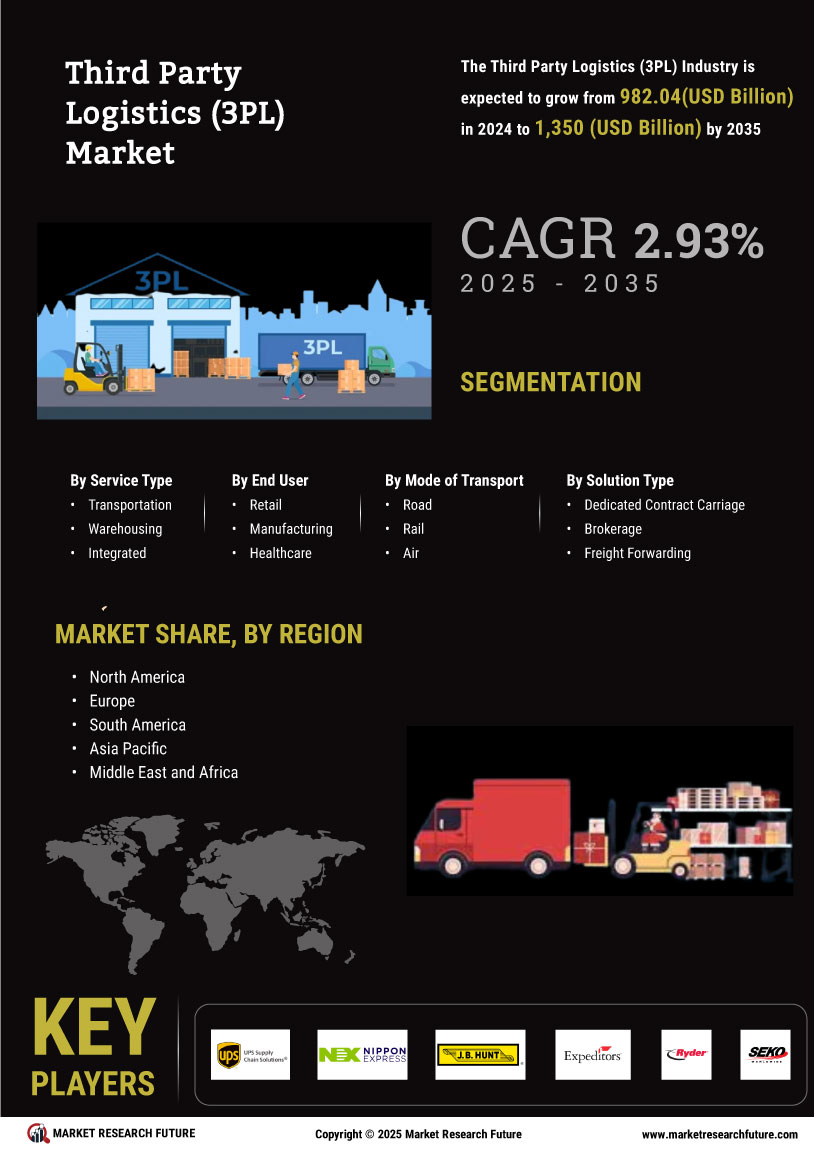

Market Segment Insights

By Service Type: Transportation (Largest) vs. Value-Added Services (Fastest-Growing)

In the Third Party Logistics (3PL) market, the service type segment showcases diverse offerings with varying degrees of market share. Transportation remains the largest segment, significantly contributing to the overall logistics services landscape. In contrast, value-added services are quickly gaining traction, characterized by their flexible nature and ability to cater to evolving customer needs. Warehousing and freight forwarding also have their respective shares, but they do not match the dominance of transportation or the growth potential of value-added services.

Transportation (Dominant) vs. Value-Added Services (Emerging)

Transportation has long been the backbone of the 3PL sector, providing essential shipping and logistics capabilities to businesses across various industries. This segment is characterized by extensive networks, efficiency in moving goods, and the ability to adapt to new technologies such as real-time tracking and automated systems. On the other hand, value-added services are gaining ground by offering customized solutions that enhance supply chain efficiency and customer satisfaction. This segment includes services like bottling, kitting, and packaging, which create a competitive advantage by meeting specific market demands and supporting brands in their growth efforts.

By End User: Retail (Largest) vs. Healthcare (Fastest-Growing)

In the Third Party Logistics (3PL) market, the retail sector holds the largest market share, driven by the consistent demand for efficient distribution channels to meet consumer expectations. Retailers capitalize on 3PL services to enhance their supply chain efficacy, improving order fulfillment and customer satisfaction. Following closely, the healthcare segment is emerging rapidly, propelled by the increasing demand for timely and secure distribution of medical supplies and pharmaceuticals, particularly in the wake of global health crises.

Retail (Dominant) vs. Healthcare (Emerging)

The retail segment stands as the dominant force in the 3PL market, characterized by its reliance on innovative logistics solutions to streamline inventory management and delivery processes. Retailers leverage 3PL services to gain a competitive edge through enhanced customer experience and operational efficiency. Conversely, the healthcare segment is emerging as a critical player, underscored by stringent regulatory requirements and the necessity for temperature-controlled logistics. The demand for reliable transportation of sensitive medical products continues to drive innovation and growth within this sector, making it a focal point for 3PL providers.

By Technology: Cloud-Based Solutions (Largest) vs. Transportation Management Systems (Fastest-Growing)

In the Third Party Logistics 3PL Market, the distribution of market share among various technology segments illustrates a dynamic landscape. Cloud-Based Solutions currently holds the largest segment share, driven by the increasing demand for flexibility and scalability in logistics operations. This is followed closely by Warehouse Management Systems and Transportation Management Systems, which are also significant players in the market, catering to the growing needs for operational efficiency and improved visibility in supply chain management. Growth trends for technology in the 3PL market point toward a rapid adoption of advanced solutions. Transportation Management Systems are emerging as the fastest-growing segment, fueled by the need for enhanced routing and freight optimization capabilities. Meanwhile, the Internet of Things is also gaining traction, contributing to real-time tracking and inventory management, which are essential for modern logistics operations. These technological advancements are not only transforming logistics processes but also paving the way for increased automation and data analytics within the sector.

Technology: Cloud-Based Solutions (Dominant) vs. Transportation Management Systems (Emerging)

Cloud-Based Solutions serve as the dominant force in the technology segment of the Third Party Logistics 3PL Market. Their ability to offer scalable and flexible services has positioned them at the forefront of logistics operations, allowing companies to effectively manage their supply chains with improved collaboration and efficiency. On the other hand, Transportation Management Systems are emerging as critical tools for businesses looking to optimize their shipping and freight processes. This segment capitalizes on the growing emphasis for data-driven decision-making, offering advanced analytics and operational visibility. Together, these technologies are reshaping the logistics landscape by enhancing operational efficiency and customer satisfaction.

By Business Model: Asset-Based (Largest) vs. Non-Asset-Based (Fastest-Growing)

In the Third Party Logistics (3PL) market, the distribution of business models significantly shapes the competitive landscape. Asset-Based logistics providers dominate the market share, leveraging their owned transportation and warehousing resources to offer integrated services. On the other hand, Non-Asset-Based models are gaining traction, accounting for a notable portion of the market, driven by their flexible operational structure and ability to scale services without heavy capital investment. The growth trends in this segment reflect the changing demands of businesses looking for agile supply chain solutions. Non-Asset-Based providers are rapidly expanding, emerging as the fastest-growing segment due to their capability to adapt to market fluctuations and digital transformation. Simultaneously, Asset-Based providers continue to innovate their service offerings to maintain their market lead amid the competitive pressure from emerging models.

Asset-Based (Dominant) vs. Non-Asset-Based (Emerging)

In the Third Party Logistics 3PL market, Asset-Based providers are often seen as the dominant players due to their ownership of the necessary infrastructure, which allows for greater control over service delivery and quality. This model typically offers a wide range of integrated solutions, supporting long-term contracts with established clientele, thus ensuring a steady revenue stream. Conversely, Non-Asset-Based providers are emerging as significant competitors by focusing on flexibility and cost-effectiveness, allowing them to cater to diverse customer needs without the overhead of owning physical assets. This agility enables them to capitalize on evolving market conditions quickly, positioning them well for continued growth in a rapidly changing logistics landscape.

By Industry Vertical: E-commerce (Largest) vs. Pharmaceutical (Fastest-Growing)

In the Third Party Logistics (3PL) market, the E-commerce sector stands out as the largest industry vertical, driven by the rapid growth of online shopping and consumer demand for quick delivery services. The surge in E-commerce has significantly increased the reliance on 3PL providers to streamline logistics operations, addressing challenges related to warehousing, inventory management, and last-mile delivery solutions. On the other hand, the Pharmaceutical sector is recognized as the fastest-growing segment within the 3PL industry, influenced by the heightened need for specialized logistics services for temperature-sensitive pharmaceuticals and the rise of telehealth services. The pandemic further accelerated these trends as pharmaceutical companies sought efficient logistics partners to ensure timely delivery of critical medical supplies. Growth trends in the 3PL market highlight a substantial demand for E-commerce logistics solutions, which is projected to remain strong as consumer preferences shift towards online shopping. The rapid expansion in the Pharmaceutical sector illustrates an increasing focus on supply chain robustness and compliance, driving 3PL providers to develop innovative solutions tailored to meet regulatory requirements. Additionally, the Food and Beverage and Consumer Electronics segments are also experiencing growth, though they do not match the pace of E-commerce and Pharmaceutical. Overall, 3PL providers must adapt swiftly to evolving consumer behaviors and industry regulations to capture growth opportunities in these diverse segments.

E-commerce (Dominant) vs. Pharmaceutical (Emerging)

The E-commerce sector is a dominant force in the Third Party Logistics market, exhibiting characteristics such as high volume, rapid turnaround times, and a strong emphasis on customer satisfaction. Businesses in this sector rely heavily on advanced logistics technology, including automation and data analytics, to optimize operations and enhance delivery speed. Conversely, the Pharmaceutical sector represents an emerging segment characterized by the need for specialized logistics capabilities, including cold chain management and compliance with stringent regulations. As the demand for healthcare products grows, especially with the rise of e-pharmacies, 3PL providers are increasingly offering innovative solutions that cater to the unique requirements of pharmaceutical clients, such as secure transportation and real-time tracking. This dynamic interplay between E-commerce and Pharmaceutical logistics showcases the evolving landscape and the necessity for 3PL providers to develop tailored solutions that meet diverse needs.

Get more detailed insights about Third Party Logistics 3PL Market

Regional Insights

The Third-Party Logistics (3PL) Market showcases significant regional variations in its valuation. In 2024, North America is projected to hold a majority stake, with a valuation of 400.0 USD billion, followed closely by Europe at 350.0 USD billion. This dominance is attributed to the advanced logistics infrastructure and high demand for efficient supply chain management in these regions.

Asia Pacific, valued at 150.0 USD Billion, reflects robust growth potential due to its expanding manufacturing base and booming e-commerce sector, while South America, valued at 60.0 USD Billion, is gradually increasing its contribution, driven by economic development and regional trade agreements.Conversely, the Middle East and Africa hold the smallest share at 22.04 USD billion, facing challenges like infrastructural deficits, although the market shows opportunity for growth as investment in logistics improves.

The overall regional landscape of the Third-Party Logistics (3PL) Market highlights how varying economic conditions and infrastructure capabilities influence the logistics sector's expansion across different parts of the world, emphasizing the importance of strategic regional partnerships and investments for future growth.The statistics further reinforce the trends in this market, illustrating varying growth trajectories across regions.

Key Players and Competitive Insights

The Third Party Logistics 3PL Market is currently characterized by a dynamic competitive landscape, driven by factors such as globalization, e-commerce growth, and technological advancements. Major players like DHL Supply Chain (DE), XPO Logistics (US), and Kuehne + Nagel (CH) are strategically positioning themselves to leverage these trends. For instance, DHL Supply Chain (DE) focuses on enhancing its digital capabilities and sustainability initiatives, while XPO Logistics (US) emphasizes supply chain optimization through advanced analytics and automation. Kuehne + Nagel (CH) is also investing in digital transformation, particularly in its logistics management systems, which collectively shape a competitive environment that prioritizes efficiency and innovation.

The market structure appears moderately fragmented, with a mix of large multinational corporations and regional players. Key business tactics include localizing manufacturing and optimizing supply chains to enhance responsiveness and reduce costs. The collective influence of these major players fosters a competitive atmosphere where agility and technological integration are paramount.

In January 2026, XPO Logistics (US) announced a strategic partnership with a leading technology firm to develop AI-driven logistics solutions. This move is likely to enhance their operational efficiency and provide clients with predictive analytics capabilities, thereby solidifying their market position. The integration of AI into logistics operations may also streamline processes and reduce lead times, which is crucial in today’s fast-paced market.

In December 2025, Kuehne + Nagel (CH) expanded its presence in Asia by acquiring a regional logistics provider. This acquisition is significant as it not only broadens their geographical footprint but also enhances their service offerings in a rapidly growing market. The strategic importance of this move lies in the potential to capture a larger share of the Asian logistics market, which is increasingly vital for global supply chains.

In November 2025, DHL Supply Chain (DE) launched a new sustainability initiative aimed at reducing carbon emissions across its operations by 30% by 2030. This initiative reflects a growing trend among logistics providers to prioritize sustainability, which is becoming a key differentiator in the market. The emphasis on environmentally friendly practices may attract clients who are increasingly concerned about their own carbon footprints.

As of February 2026, current competitive trends in the 3PL market include a pronounced focus on digitalization, sustainability, and AI integration. Strategic alliances are shaping the landscape, enabling companies to pool resources and expertise to enhance service offerings. The shift from price-based competition to a focus on innovation, technology, and supply chain reliability is evident, suggesting that future competitive differentiation will hinge on the ability to adapt to these evolving trends.

Industry Developments

  • Q2 2024: Maersk launches new AI-powered logistics platform for third-party logistics customers Maersk announced the launch of an AI-driven logistics platform designed to optimize supply chain management for its third-party logistics clients, aiming to improve efficiency and visibility across global operations.
  • Q2 2024: FedEx appoints new CEO for its third-party logistics division FedEx named a new chief executive officer to lead its third-party logistics business, signaling a strategic shift to expand its service offerings and strengthen its position in the global logistics market.
  • Q2 2024: UPS opens new state-of-the-art third-party logistics facility in Texas UPS inaugurated a new logistics center in Texas dedicated to third-party logistics services, featuring advanced automation and expanded warehousing capacity to support growing demand from e-commerce and retail clients.
  • Q3 2024: DHL Supply Chain acquires regional 3PL provider in Southeast Asia DHL Supply Chain completed the acquisition of a leading regional third-party logistics provider in Southeast Asia, expanding its footprint and service capabilities in the fast-growing market.
  • Q3 2024: Flexport raises $260 million in Series D funding to expand third-party logistics platform Flexport secured $260 million in Series D funding to accelerate the development of its digital third-party logistics platform and support global expansion efforts.
  • Q3 2024: XPO Logistics announces strategic partnership with Amazon for third-party logistics services XPO Logistics entered into a strategic partnership with Amazon to provide enhanced third-party logistics solutions, focusing on last-mile delivery and supply chain optimization for Amazon's marketplace sellers.
  • Q4 2024: Kuehne+Nagel opens new third-party logistics hub in Poland Kuehne+Nagel launched a new logistics hub in Poland, expanding its third-party logistics network in Central Europe to meet rising demand from manufacturing and retail sectors.
  • Q4 2024: DHL Supply Chain wins multi-year contract with leading automotive manufacturer DHL Supply Chain secured a multi-year contract to provide third-party logistics services for a major automotive manufacturer, including warehousing, distribution, and supply chain management.
  • Q1 2025: CEVA Logistics acquires e-commerce fulfillment specialist in Europe CEVA Logistics acquired a European e-commerce fulfillment company, strengthening its third-party logistics capabilities and expanding its service portfolio for online retailers.
  • Q1 2025: UPS announces partnership with Shopify to offer integrated third-party logistics solutions UPS partnered with Shopify to deliver integrated third-party logistics services, enabling Shopify merchants to access UPS's warehousing, fulfillment, and delivery network.
  • Q2 2025: DB Schenker opens new third-party logistics facility in India DB Schenker opened a new logistics center in India dedicated to third-party logistics operations, supporting the country's growing manufacturing and export sectors.
  • Q2 2025: Ryder System acquires last-mile delivery startup to expand third-party logistics offerings Ryder System completed the acquisition of a last-mile delivery startup, enhancing its third-party logistics capabilities and expanding its service portfolio for e-commerce and retail clients.

Future Outlook

Third Party Logistics 3PL Market Future Outlook

The Third Party Logistics (3PL) Market is projected to grow at an 8.8% CAGR from 2024 to 2035, driven by e-commerce expansion, technological advancements, and increasing demand for supply chain efficiency.

New opportunities lie in:

  • Integration of AI-driven logistics management systems
  • Expansion of last-mile delivery solutions in urban areas
  • Development of sustainable logistics practices and green supply chains

By 2035, the 3PL market is expected to be robust, reflecting substantial growth and innovation.

Market Segmentation

Third Party Logistics 3PL Market End User Outlook

  • Retail
  • Manufacturing
  • Healthcare
  • Automotive

Third Party Logistics 3PL Market Technology Outlook

  • Cloud-Based Solutions
  • Warehouse Management Systems
  • Transportation Management Systems
  • Internet of Things

Third Party Logistics 3PL Market Service Type Outlook

  • Transportation
  • Warehousing
  • Value-Added Services
  • Freight Forwarding

Third Party Logistics 3PL Market Business Model Outlook

  • Asset-Based
  • Non-Asset-Based
  • Hybrid

Third Party Logistics 3PL Market Industry Vertical Outlook

  • E-commerce
  • Pharmaceutical
  • Food and Beverage
  • Consumer Electronics

Report Scope

MARKET SIZE 20241178932.0(USD Billion)
MARKET SIZE 20251282701.88(USD Billion)
MARKET SIZE 20352981916.54(USD Billion)
COMPOUND ANNUAL GROWTH RATE (CAGR)8.8% (2024 - 2035)
REPORT COVERAGERevenue Forecast, Competitive Landscape, Growth Factors, and Trends
BASE YEAR2024
Market Forecast Period2025 - 2035
Historical Data2019 - 2024
Market Forecast UnitsUSD Billion
Key Companies ProfiledDHL Supply Chain (DE), XPO Logistics (US), Kuehne + Nagel (CH), C.H. Robinson (US), DB Schenker (DE), UPS Supply Chain Solutions (US), Nippon Express (JP), Geodis (FR), Sinotrans Limited (CN)
Segments CoveredService Type, End User, Technology, Business Model, Industry Vertical
Key Market OpportunitiesIntegration of advanced technologies enhances efficiency in the Third Party Logistics 3PL Market.
Key Market DynamicsRising demand for integrated logistics solutions drives competition and innovation in the Third Party Logistics market.
Countries CoveredNorth America, Europe, APAC, South America, MEA

Market Highlights

Author
Snehal Singh
Assistant Manager - Research

High acumen in analyzing complex macro & micro markets with more than 6 years of work experience in the field of market research. By implementing her analytical skills in forecasting and estimation into market research reports, she has expertise in Packaging, Construction, and Equipment domains. She handles a team size of 20-25 resources and ensures smooth running of the projects, associated marketing activities, and client servicing.

Leave a Comment

FAQs

What is the current valuation of the Germany third party logistics (3PL) market?

The Germany third party logistics market was valued at 73.65 USD Billion in 2024.

What is the projected market size for the Germany 3PL market by 2035?

The projected valuation for the Germany 3PL market is 171.19 USD Billion by 2035.

What is the expected CAGR for the Germany 3PL market during the forecast period?

The expected CAGR for the Germany 3PL market during the forecast period 2025 - 2035 is 7.97%.

Who are the key players in the Germany 3PL market?

Key players in the Germany 3PL market include DHL Supply Chain, Kuehne + Nagel, DB Schenker, and XPO Logistics.

What are the main service types in the Germany 3PL market?

Main service types in the Germany 3PL market include Transportation, Warehousing, Value Added Services, and Freight Forwarding.

How does the retail sector perform in the Germany 3PL market?

The retail sector was valued between 20.0 and 50.0 USD Billion in the Germany 3PL market.

What is the valuation range for integrated logistics in the Germany 3PL market?

Integrated logistics in the Germany 3PL market has a valuation range of 25.0 to 60.0 USD Billion.

What technological advancements are influencing the Germany 3PL market?

Technological advancements such as Artificial Intelligence and the Internet of Things are influencing the Germany 3PL market.

What is the valuation range for automation in the Germany 3PL market?

The valuation range for automation in the Germany 3PL market is between 15.0 and 35.0 USD Billion.

Download Free Sample

Kindly complete the form below to receive a free sample of this Report

Compare Licence

×
Features License Type
Single User Multiuser License Enterprise User
Price $4,950 $5,950 $7,250
Maximum User Access Limit 1 User Upto 10 Users Unrestricted Access Throughout the Organization
Free Customization
Direct Access to Analyst
Deliverable Format
Platform Access
Discount on Next Purchase 10% 15% 15%
Printable Versions













