Request Free Sample ×

Kindly complete the form below to receive a free sample of this Report

* Please use a valid business email

Leading companies partner with us for data-driven Insights

clients tt-cursor
Hero Background
English
Chinese
French
Japanese
Korean
German
Spanish

Thermal Systems Market Analysis

ID: MRFR/SEM/15662-HCR
128 Pages
Ankit Gupta
April 2026

Thermal Systems Market Size, Share and Research Report By Component (Compressor, HVAC, Powertrain Cooling, and Fluid Transport), By Vehicle Type (Passenger Vehicles and Commercial Vehicles), By Propulsion Type (IC Engine Vehicles, Electric Vehicles, and Hybrid Vehicles) And By Region (North America, Europe, Asia-Pacific, And Rest Of The World) –Industry Forecast Till 2035

Share:
Download PDF ×

We do not share your information with anyone. However, we may send you emails based on your report interest from time to time. You may contact us at any time to opt-out.

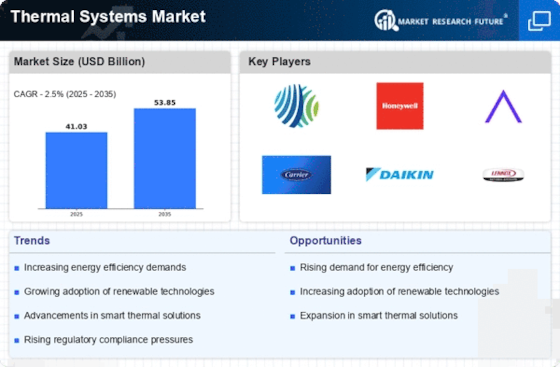
Thermal Systems Market Infographic
Purchase Options

Market Analysis

In-depth Analysis of Thermal Systems Market Industry Landscape

The market dynamics of the Thermal Systems Market are shaped by a range of interconnected factors that influence its growth, trends, and overall functioning. One crucial dynamic is the ever-evolving technological landscape. Advances in technology continually drive innovation within the thermal systems industry. From more energy-efficient HVAC systems to the integration of smart and connected features, technological developments play a pivotal role in shaping the market dynamics. Companies that stay abreast of these technological shifts position themselves for success in a market that demands efficiency and sustainability.

Economic factors also exert a significant influence on the market dynamics of thermal systems. Fluctuations in global economic conditions impact construction and industrial activities, major consumers of thermal systems. Economic downturns may lead to a slowdown in construction projects, affecting the demand for heating and cooling solutions. Conversely, periods of economic growth can spur increased construction activities, driving the market for thermal systems.

Government regulations and policies contribute to the dynamic nature of the thermal systems market. With a growing emphasis on energy efficiency and environmental sustainability, governments worldwide are enacting strict regulations to curb emissions and promote greener solutions. Compliance with these regulations not only shapes product development but also influences consumer choices, as eco-friendly options become increasingly sought after in the market.

Consumer preferences and awareness are key drivers of market dynamics in the thermal systems industry. As environmental consciousness grows, consumers are inclined towards products that align with sustainability goals. This shift in consumer preferences has prompted manufacturers to focus on developing energy-efficient and eco-friendly thermal systems. Additionally, the rise of smart technology has led to increased demand for connected and intelligent thermal solutions that offer greater control and convenience.

Market competition and industry consolidation contribute to the dynamic nature of the thermal systems market. Intense competition among various players fosters innovation, with companies striving to differentiate their products through features, pricing, and overall performance. Mergers and acquisitions within the industry also impact market dynamics by reshaping the competitive landscape and influencing the market share of key players.

Geopolitical factors introduce an element of uncertainty into the thermal systems market dynamics. Trade tensions, political instability, and changes in diplomatic relations can disrupt the global supply chain for thermal system components. Companies in the industry must navigate geopolitical challenges to ensure a stable supply of raw materials and components, which can, in turn, impact pricing and product availability.

Societal trends and demographic shifts play a role in shaping the market dynamics of thermal systems. Urbanization, changing lifestyles, and an aging population influence the demand for different types of thermal solutions. Urban dwellers may prioritize compact and efficient HVAC systems, while an aging population may drive demand for heating solutions that cater to specific comfort needs. Adapting to these societal trends is essential for companies looking to stay relevant and responsive to market dynamics.


Author
Author Profile
Ankit Gupta
Team Lead - Research

Ankit Gupta is a seasoned market intelligence and strategic research professional with over six plus years of experience in the ICT and Semiconductor industries. With academic roots in Telecom, Marketing, and Electronics, he blends technical insight with business strategy. Ankit has led 200+ projects, including work for Fortune 500 clients like Microsoft and Rio Tinto, covering market sizing, tech forecasting, and go-to-market strategies. Known for bridging engineering and enterprise decision-making, his insights support growth, innovation, and investment planning across diverse technology markets.

Leave a Comment

FAQs

What is the projected market valuation of the Thermal Systems Market by 2035?

<p>The Thermal Systems Market is projected to reach a valuation of 53.85 USD Billion by 2035.</p>

What was the market valuation of the Thermal Systems Market in 2024?

<p>In 2024, the Thermal Systems Market was valued at 41.03 USD Billion.</p>

What is the expected CAGR for the Thermal Systems Market during the forecast period 2025 - 2035?

<p>The expected CAGR for the Thermal Systems Market during the forecast period 2025 - 2035 is 2.5%.</p>

Which companies are considered key players in the Thermal Systems Market?

<p>Key players in the Thermal Systems Market include Johnson Controls, Honeywell, Trane Technologies, Carrier Global, Daikin Industries, Lennox International, Mitsubishi Electric, Bosch Thermotechnology, and Rheem Manufacturing.</p>

What are the projected valuations for the HVAC segment in the Thermal Systems Market?

<p>The HVAC segment is projected to grow from 15.0 USD Billion to 19.0 USD Billion during the forecast period.</p>

How does the valuation of Electric Vehicles compare to IC Engine Vehicles in the Thermal Systems Market?

<p>Electric Vehicles are projected to grow from 10.0 USD Billion to 15.0 USD Billion, while IC Engine Vehicles are expected to increase from 25.0 USD Billion to 32.0 USD Billion.</p>

What is the projected growth for the Fluid Transport segment in the Thermal Systems Market?

The Fluid Transport segment is anticipated to grow from 8.03 USD Billion to 12.35 USD Billion by 2035.

What are the expected valuations for the Commercial Vehicles segment in the Thermal Systems Market?

The Commercial Vehicles segment is projected to grow from 16.03 USD Billion to 21.85 USD Billion during the forecast period.

What is the growth outlook for the Powertrain Cooling segment in the Thermal Systems Market?

The Powertrain Cooling segment is expected to increase from 8.0 USD Billion to 10.0 USD Billion by 2035.

How do the projected valuations of Hybrid Vehicles compare to Electric Vehicles in the Thermal Systems Market?

Hybrid Vehicles are projected to grow from 6.03 USD Billion to 6.85 USD Billion, while Electric Vehicles are expected to increase from 10.0 USD Billion to 15.0 USD Billion.

Market Summary

As per Market Research Future analysis, the Thermal Systems Market Size was estimated at 41.03 USD Billion in 2024. The Thermal Systems industry is projected to grow from 42.06 USD Billion in 2025 to 53.85 USD Billion by 2035, exhibiting a compound annual growth rate (CAGR) of 2.5% during the forecast period 2025 - 2035

Key Market Trends & Highlights

The Thermal Systems Market is experiencing a transformative shift towards sustainability and smart technologies.

  • The integration of smart technologies is revolutionizing thermal management solutions across various sectors. North America remains the largest market, driven by advancements in energy efficiency and regulatory compliance. The HVAC segment is witnessing rapid growth, reflecting a broader trend towards sustainable building practices. Rising demand for energy efficiency and increasing regulatory pressure for emission reductions are key drivers propelling market expansion.

Market Size & Forecast

2024 Market Size 41.03 (USD Billion)
2035 Market Size 53.85 (USD Billion)
CAGR (2025 - 2035) 2.5%
Largest Regional Market Share in 2024 North America

Major Players

Johnson Controls (US), Honeywell (US), Trane Technologies (IE), Carrier Global (US), Daikin Industries (JP), Lennox International (US), Mitsubishi Electric (JP), Bosch Thermotechnology (DE), Rheem Manufacturing (US)

Market Trends

The Thermal Systems Market is currently experiencing a dynamic evolution, driven by advancements in technology and increasing demand for energy efficiency. As industries strive to reduce their carbon footprints, innovative thermal management solutions are emerging. This market encompasses a wide range of applications, including heating, ventilation, air conditioning, and refrigeration systems. The integration of smart technologies and automation is reshaping traditional thermal systems, enhancing their performance and reliability. Furthermore, the growing emphasis on sustainability is prompting manufacturers to develop eco-friendly products that align with regulatory standards and consumer preferences. In addition, the Thermal Systems Market is witnessing a shift towards renewable energy sources, which is likely to influence product development and market strategies. Companies are increasingly investing in research and development to create systems that utilize solar, geothermal, and other renewable resources. This trend not only addresses environmental concerns but also offers potential cost savings for end-users. As the market continues to evolve, collaboration among stakeholders, including manufacturers, suppliers, and regulatory bodies, appears essential for fostering innovation and ensuring compliance with emerging standards. Overall, the Thermal Systems Market is poised for growth, driven by technological advancements and a collective commitment to sustainability.

Integration of Smart Technologies

The incorporation of smart technologies into thermal systems is transforming the market landscape. Automation and IoT-enabled devices enhance operational efficiency, allowing for real-time monitoring and control. This trend not only improves energy management but also provides users with valuable insights into system performance.

Focus on Sustainability

A growing emphasis on sustainability is shaping product development within the Thermal Systems Market. Manufacturers are increasingly prioritizing eco-friendly materials and energy-efficient designs. This shift aligns with global efforts to reduce greenhouse gas emissions and meet regulatory requirements.

Shift Towards Renewable Energy

The transition towards renewable energy sources is influencing the Thermal Systems Market significantly. Companies are exploring innovative solutions that harness solar, geothermal, and other sustainable resources. This trend reflects a broader commitment to environmental stewardship and energy independence.

Thermal Systems Market Market Drivers

Growth in Industrial Applications

The Thermal Systems Market is witnessing significant growth in industrial applications, driven by the need for efficient thermal management in manufacturing processes. Industries such as food and beverage, pharmaceuticals, and chemicals are increasingly relying on advanced thermal systems to maintain optimal operating conditions. This trend is supported by data indicating that the industrial sector accounts for a substantial portion of thermal system installations. As industries continue to expand and modernize, the demand for reliable and efficient thermal solutions is likely to increase, further propelling the growth of the Thermal Systems Market. This expansion presents opportunities for manufacturers to develop tailored solutions that meet the specific needs of various industrial sectors.

Rising Demand for Energy Efficiency

The Thermal Systems Market is experiencing a notable increase in demand for energy-efficient solutions. As energy costs continue to rise, consumers and businesses alike are seeking systems that minimize energy consumption while maximizing performance. This trend is reflected in the growing adoption of advanced thermal management technologies, which are designed to optimize energy use. According to recent data, energy-efficient thermal systems can reduce energy consumption by up to 30%, making them an attractive option for various applications. This heightened focus on energy efficiency is likely to drive innovation within the Thermal Systems Market, as manufacturers strive to develop products that meet these evolving consumer expectations.

Emerging Markets and Economic Development

Emerging markets are becoming increasingly important for the Thermal Systems Market, as economic development drives infrastructure growth and energy demand. Countries experiencing rapid industrialization are investing in thermal systems to support their expanding energy needs. This trend is particularly evident in regions where urbanization is accelerating, leading to higher energy consumption and a greater need for efficient thermal management solutions. As these markets continue to develop, they present significant opportunities for companies within the Thermal Systems Market to establish a presence and cater to the growing demand for advanced thermal technologies. The potential for growth in these regions is substantial, as they seek to modernize their energy infrastructure.

Technological Advancements in Thermal Management

Technological advancements are playing a crucial role in shaping the Thermal Systems Market. Innovations such as phase change materials, advanced heat exchangers, and smart thermal controls are enhancing the performance and efficiency of thermal systems. These technologies not only improve energy efficiency but also contribute to the overall effectiveness of thermal management solutions. The integration of Internet of Things (IoT) capabilities into thermal systems allows for real-time monitoring and optimization, further driving market growth. As these technologies continue to evolve, they are expected to create new opportunities within the Thermal Systems Market, potentially leading to more sophisticated and efficient thermal solutions.

Increasing Regulatory Pressure for Emission Reductions

The Thermal Systems Market is facing increasing regulatory pressure aimed at reducing greenhouse gas emissions. Governments worldwide are implementing stricter regulations to combat climate change, which is prompting industries to adopt more sustainable thermal solutions. This regulatory environment is likely to accelerate the transition towards low-emission thermal systems, as companies seek to comply with new standards. For instance, regulations may require the use of specific materials or technologies that minimize environmental impact. As a result, the Thermal Systems Market is expected to witness a shift towards more eco-friendly products, which could reshape the competitive landscape and drive innovation.

Market Segment Insights

By Component: Compressors (Largest) vs. HVAC (Fastest-Growing)

<p>In the Thermal Systems Market, the component segment is significantly diversified with key players in Compressors, HVAC, Powertrain Cooling, and Fluid Transport. Compressors hold the largest share within this segment, attributed to their vital role in enhancing system efficiency and performance across various applications. HVAC systems, while currently smaller in market share, are rapidly gaining traction due to the increasing demand for energy-efficient and environmentally friendly temperature control solutions, particularly in residential and commercial buildings.</p>

<p>HVAC (Dominant) vs. Fluid Transport (Emerging)</p>

<p>The HVAC sector is currently a dominant player within the Thermal Systems Market, driven largely by technology advancements and a growing emphasis on sustainability. Its systems are integral for heating and cooling solutions, making them essential in sectors ranging from residential to industrial applications. Meanwhile, the Fluid Transport segment is emerging with increasing relevance, particularly in the context of enhanced cooling systems that prioritize efficiency and performance. As industries strive for optimal thermal management, Fluid Transport's role in facilitating efficient fluid dynamics in thermal systems is anticipated to rise, making it a crucial area for future innovation.</p>

By Vehicle Type: Passenger Vehicles (Largest) vs. Commercial Vehicles (Fastest-Growing)

<p>In the Thermal Systems Market, Passenger Vehicles hold a significant share, dominating the landscape due to their extensive usage and constant demand in personal transportation. The focus on comfort and efficiency in this segment drives manufacturers to innovate thermal system technologies aimed at enhancing passenger experiences. Meanwhile, Commercial Vehicles, although smaller in market share, exhibit rapid growth attributed to increasing logistics demands and the rise of e-commerce, prompting businesses to invest in efficient thermal management solutions.</p>

<p>Passenger Vehicles: Dominant vs. Commercial Vehicles: Emerging</p>

<p>Passenger Vehicles are characterized by their widespread adoption and continuous advancements in thermal systems designed for improved performance and energy efficiency. These vehicles incorporate complex heating and cooling systems to provide optimal comfort for users. On the other hand, Commercial Vehicles show emerging prospects driven by the need for efficiency in fleet operations and stringent emissions regulations. These vehicles are increasingly equipped with innovative thermal solutions that enhance engine performance and reduce fuel consumption, making them more appealing to businesses looking to optimize operational costs.</p>

By Propulsion: IC Engine Vehicles (Largest) vs. Electric Vehicles (Fastest-Growing)

<p>The Thermal Systems Market is primarily driven by the presence of Internal Combustion (IC) Engine Vehicles, which currently hold the largest market share. This segment benefits from a well-established infrastructure and consumer familiarity, positioning it as a strong foundation for the thermal systems that support vehicle operations. In contrast, Electric Vehicles (EVs) are rapidly gaining traction, fueled by rising environmental awareness and government incentives aimed at promoting cleaner energy solutions. Their market share, although smaller than IC Engine Vehicles, is expanding swiftly, indicating a shift in consumer preference and technological advancements. Growth trends in the thermal systems segment are significantly influenced by the global transition towards sustainable transportation and the introduction of stringent emission regulations. Hybrid Vehicles, falling between IC Engine and Electric Vehicles, are capitalizing on this transition, offering a blend of traditional and electric propulsion technologies. The rapid development of battery technology and a growing network of charging stations further enhance the attractiveness of Electric Vehicles, promoting their inclusion in the thermal systems market. Overall, the landscape is evolving, creating opportunities for innovation and adaptation in response to changing consumer demands and regulatory frameworks.</p>

<p>IC Engine Vehicles (Dominant) vs. Electric Vehicles (Emerging)</p>

<p>IC Engine Vehicles (ICEVs) have long dominated the Thermal Systems Market, primarily due to their extensive deployment and proven reliability. These vehicles utilize traditional combustion engines, necessitating sophisticated thermal management systems to optimize performance and meet emission standards. The established supply chains and service networks further bolster their position in the market, making them the preferred choice for many consumers. On the other hand, Electric Vehicles (EVs) represent an emerging force within this segment, characterized by their reliance on electric powertrains that significantly reduce greenhouse gas emissions. The growing trend towards sustainability, coupled with advancements in battery technology, makes EVs increasingly appealing. They offer lower operating costs and fewer mechanical complications compared to traditional vehicles. The competition between ICEVs and EVs is heating up, as manufacturers invest heavily in R&D to improve thermal systems that can cater to both types of propulsion.</p>

Get more detailed insights about Thermal Systems Market Research Report — Global Forecast till 2035

Regional Insights

North America : Innovation and Sustainability Focus

North America is the largest market for thermal systems, holding approximately 40% of the global share. The region's growth is driven by increasing energy efficiency regulations, a shift towards sustainable technologies, and rising demand for HVAC systems in residential and commercial sectors. The U.S. and Canada are the primary contributors, with significant investments in smart building technologies and renewable energy initiatives. The competitive landscape is dominated by key players such as Johnson Controls, Honeywell, and Carrier Global, which are innovating to meet regulatory standards and consumer demands. The presence of established companies fosters a robust market environment, while emerging players are also gaining traction. The focus on energy-efficient solutions and smart technologies is expected to further enhance market growth in the coming years.

Europe : Regulatory-Driven Market Growth

Europe is the second-largest market for thermal systems, accounting for approximately 30% of the global market share. The region's growth is significantly influenced by stringent environmental regulations and a strong commitment to reducing carbon emissions. The European Union's Green Deal and various national initiatives are driving demand for energy-efficient thermal systems, particularly in the residential and commercial sectors. Leading countries in this market include Germany, France, and the UK, where companies like Bosch Thermotechnology and Trane Technologies are prominent. The competitive landscape is characterized by innovation and collaboration among key players to develop sustainable solutions. The focus on smart technologies and integration with renewable energy sources is expected to shape the future of the thermal systems market in Europe.

Asia-Pacific : Emerging Market Potential

Asia-Pacific is witnessing rapid growth in the thermal systems market, holding approximately 25% of the global share. The region's expansion is driven by urbanization, increasing disposable incomes, and a growing focus on energy efficiency. Countries like China and India are leading this growth, with significant investments in infrastructure and smart city projects that demand advanced thermal solutions. The competitive landscape is becoming increasingly dynamic, with key players such as Daikin Industries and Mitsubishi Electric expanding their presence. Local manufacturers are also emerging, contributing to a competitive environment. The demand for innovative and energy-efficient thermal systems is expected to rise, supported by government initiatives aimed at promoting sustainable development and reducing energy consumption.

Middle East and Africa : Resource-Rich Market Dynamics

The Middle East and Africa region is gradually developing its thermal systems market, currently holding about 5% of the global share. The growth is primarily driven by increasing investments in infrastructure, particularly in the Gulf Cooperation Council (GCC) countries, where there is a rising demand for HVAC systems due to extreme weather conditions. Additionally, government initiatives aimed at diversifying economies are fostering market growth. Leading countries in this region include the UAE and Saudi Arabia, where major players like Lennox International and Rheem Manufacturing are establishing a foothold. The competitive landscape is evolving, with both international and local companies vying for market share. The focus on energy-efficient solutions and sustainable practices is expected to shape the future of the thermal systems market in this region.

Key Players and Competitive Insights

Leading market players are investing heavily in the research and development in order to expand their product lines, which will help the Thermal Systems Market grow even more. Market players are also undertaking a variety of strategic activities to spread their global footprint, with important market developments including mergers and acquisitions, new product launches, contractual agreements, higher investments, and collaboration with other organizations. To spread and survive in a more competitive and rising market climate, the Thermal Systems industry must offer cost-effective items.

Manufacturing locally to minimize the operational costs is one of the key business tactics used by the manufacturers in the global Thermal Systems industry to benefit the clients and increase the market sector. In recent years, the Thermal Systems industry has offered some of the most significant advantages to several industries.

Major players in the Thermal Systems Market, including 3M, Intel Corporation, Parker Hannifin Corporation, Honeywell International Inc., Siemens AG, Johnson Controls International Plc, Emerson Electric Co., Schneider Electric SE, Daikin Industries, Ltd, Mitsubishi Electric Corporation, and others, are attempting to increase market demand by investing in the research and development operations.

3M, officially known as the Minnesota Mining and Manufacturing Company, is a multinational conglomerate with a diverse portfolio of products and technologies. 3M has evolved into a global innovation powerhouse. The company is renowned for its commitment to research and development, producing a wide array of solutions that span multiple industries, including healthcare, transportation, consumer goods, and electronics.

In January 3M Company announced that it had acquired C&H Technologies for US$9.3 billion. C&H Technologies is a leading provider of critical environment solutions, including thermal management solutions. The acquisition is expected to close in the second half of 2023.

These are just a few examples of the recent acquisitions and partnerships in the thermal systems market. The market is expected to continue to consolidate in the coming years as companies look to spread their product offerings and gain access to new technologies.

Intel Corporation is a global technology company that holds a prominent position in the semiconductor industry. Founded in 1968, Intel has become one of the world's largest and most influential semiconductor chip manufacturers. Intel's contributions to the technology landscape go beyond microprocessors; the company is involved in various areas, including memory products, networking solutions, and other semiconductor-based technologies. Intel's x86 architecture has been a standard in the computing industry for several decades. The company has played a crucial role in driving advancements in computing and technology, fostering the development of faster, more efficient, and powerful processors.

Intel Corporation announced on December 21, 2022, that it had acquired Tower Semiconductor Ltd. for US$5.4 billion. Tower Semiconductor is a leading foundry that manufactures semiconductors for a variety of applications, including automotive, industrial, and consumer electronics. The acquisition is expected to close in the second half of 2023.

Key Companies in the Thermal Systems Market include

Industry Developments

June 2023: Parker Hannifin Corporation announced that it has acquired Lord Corporation for US$4.4 billion. Lord is a leading provider of vibration and motion control products, including thermal management solutions. The acquisition is expected to close in the fourth quarter of 2023.

April 2023: Eaton Corporation announced that it has acquired Cooper Standard Automotive for US$2.9 billion. Cooper Standard is a leading provider of fluid handling systems, including thermal management solutions. The acquisition is expected to close in the second half of 2023.

February 2023: Honeywell International Inc. announced that it has acquired United Technologies Corporation for US$90 billion. United Technologies is a leading provider of aerospace and building technologies, including thermal management solutions. The acquisition is expected to close in the second half of 2023.

Future Outlook

Thermal Systems Market Future Outlook

The Thermal Systems Market is projected to grow at a 2.5% CAGR from 2025 to 2035, driven by advancements in energy efficiency, regulatory support, and increasing demand for sustainable solutions.

New opportunities lie in:

  • Development of smart thermal management systems for industrial applications.
  • Expansion into renewable energy integration for thermal systems.
  • Investment in advanced materials for enhanced thermal performance.

By 2035, the Thermal Systems Market is expected to achieve robust growth, reflecting evolving industry demands.

Market Segmentation

Thermal Systems Market Component Outlook

  • Compressors
  • HVAC
  • Powertrain Cooling
  • Fluid Transport

Thermal Systems Market Propulsion Outlook

  • IC Engine Vehicles
  • Electric Vehicles
  • Hybrid Vehicles

Thermal Systems Market Vehicle Type Outlook

  • Passenger Vehicles
  • Commercial Vehicles

Report Scope

MARKET SIZE 2024 41.03(USD Billion)
MARKET SIZE 2025 42.06(USD Billion)
MARKET SIZE 2035 53.85(USD Billion)
COMPOUND ANNUAL GROWTH RATE (CAGR) 2.5% (2025 - 2035)
REPORT COVERAGE Revenue Forecast, Competitive Landscape, Growth Factors, and Trends
BASE YEAR 2024
Market Forecast Period 2025 - 2035
Historical Data 2019 - 2024
Market Forecast Units USD Billion
Key Companies Profiled Johnson Controls (US), Honeywell (US), Trane Technologies (IE), Carrier Global (US), Daikin Industries (JP), Lennox International (US), Mitsubishi Electric (JP), Bosch Thermotechnology (DE), Rheem Manufacturing (US)
Segments Covered Component, Vehicle Type, Propulsion Type, Region
Key Market Opportunities Integration of advanced materials for enhanced thermal efficiency in the Thermal Systems Market.
Key Market Dynamics Rising demand for energy-efficient thermal systems drives innovation and competition among manufacturers and suppliers.
Countries Covered North America, Europe, APAC, South America, MEA

FAQs

What is the projected market valuation of the Thermal Systems Market by 2035?

<p>The Thermal Systems Market is projected to reach a valuation of 53.85 USD Billion by 2035.</p>

What was the market valuation of the Thermal Systems Market in 2024?

<p>In 2024, the Thermal Systems Market was valued at 41.03 USD Billion.</p>

What is the expected CAGR for the Thermal Systems Market during the forecast period 2025 - 2035?

<p>The expected CAGR for the Thermal Systems Market during the forecast period 2025 - 2035 is 2.5%.</p>

Which companies are considered key players in the Thermal Systems Market?

<p>Key players in the Thermal Systems Market include Johnson Controls, Honeywell, Trane Technologies, Carrier Global, Daikin Industries, Lennox International, Mitsubishi Electric, Bosch Thermotechnology, and Rheem Manufacturing.</p>

What are the projected valuations for the HVAC segment in the Thermal Systems Market?

<p>The HVAC segment is projected to grow from 15.0 USD Billion to 19.0 USD Billion during the forecast period.</p>

How does the valuation of Electric Vehicles compare to IC Engine Vehicles in the Thermal Systems Market?

<p>Electric Vehicles are projected to grow from 10.0 USD Billion to 15.0 USD Billion, while IC Engine Vehicles are expected to increase from 25.0 USD Billion to 32.0 USD Billion.</p>

What is the projected growth for the Fluid Transport segment in the Thermal Systems Market?

The Fluid Transport segment is anticipated to grow from 8.03 USD Billion to 12.35 USD Billion by 2035.

What are the expected valuations for the Commercial Vehicles segment in the Thermal Systems Market?

The Commercial Vehicles segment is projected to grow from 16.03 USD Billion to 21.85 USD Billion during the forecast period.

What is the growth outlook for the Powertrain Cooling segment in the Thermal Systems Market?

The Powertrain Cooling segment is expected to increase from 8.0 USD Billion to 10.0 USD Billion by 2035.

How do the projected valuations of Hybrid Vehicles compare to Electric Vehicles in the Thermal Systems Market?

Hybrid Vehicles are projected to grow from 6.03 USD Billion to 6.85 USD Billion, while Electric Vehicles are expected to increase from 10.0 USD Billion to 15.0 USD Billion.

  1. SECTION I: EXECUTIVE SUMMARY AND KEY HIGHLIGHTS
    1. | 1.1 EXECUTIVE SUMMARY
    2. | | 1.1.1 Market Overview
    3. | | 1.1.2 Key Findings
    4. | | 1.1.3 Market Segmentation
    5. | | 1.1.4 Competitive Landscape
    6. | | 1.1.5 Challenges and Opportunities
    7. | | 1.1.6 Future Outlook
  2. SECTION II: SCOPING, METHODOLOGY AND MARKET STRUCTURE
    1. | 2.1 MARKET INTRODUCTION
    2. | | 2.1.1 Definition
    3. | | 2.1.2 Scope of the study
    4. | | | 2.1.2.1 Research Objective
    5. | | | 2.1.2.2 Assumption
    6. | | | 2.1.2.3 Limitations
    7. | 2.2 RESEARCH METHODOLOGY
    8. | | 2.2.1 Overview
    9. | | 2.2.2 Data Mining
    10. | | 2.2.3 Secondary Research
    11. | | 2.2.4 Primary Research
    12. | | | 2.2.4.1 Primary Interviews and Information Gathering Process
    13. | | | 2.2.4.2 Breakdown of Primary Respondents
    14. | | 2.2.5 Forecasting Model
    15. | | 2.2.6 Market Size Estimation
    16. | | | 2.2.6.1 Bottom-Up Approach
    17. | | | 2.2.6.2 Top-Down Approach
    18. | | 2.2.7 Data Triangulation
    19. | | 2.2.8 Validation
  3. SECTION III: QUALITATIVE ANALYSIS
    1. | 3.1 MARKET DYNAMICS
    2. | | 3.1.1 Overview
    3. | | 3.1.2 Drivers
    4. | | 3.1.3 Restraints
    5. | | 3.1.4 Opportunities
    6. | 3.2 MARKET FACTOR ANALYSIS
    7. | | 3.2.1 Value chain Analysis
    8. | | 3.2.2 Porter's Five Forces Analysis
    9. | | | 3.2.2.1 Bargaining Power of Suppliers
    10. | | | 3.2.2.2 Bargaining Power of Buyers
    11. | | | 3.2.2.3 Threat of New Entrants
    12. | | | 3.2.2.4 Threat of Substitutes
    13. | | | 3.2.2.5 Intensity of Rivalry
    14. | | 3.2.3 COVID-19 Impact Analysis
    15. | | | 3.2.3.1 Market Impact Analysis
    16. | | | 3.2.3.2 Regional Impact
    17. | | | 3.2.3.3 Opportunity and Threat Analysis
  4. SECTION IV: QUANTITATIVE ANALYSIS
    1. | 4.1 Semiconductor & Electronics, BY Component (USD Billion)
    2. | | 4.1.1 Compressors
    3. | | 4.1.2 HVAC
    4. | | 4.1.3 Powertrain Cooling
    5. | | 4.1.4 Fluid Transport
    6. | 4.2 Semiconductor & Electronics, BY Vehicle Type (USD Billion)
    7. | | 4.2.1 Passenger Vehicles
    8. | | 4.2.2 Commercial Vehicles
    9. | 4.3 Semiconductor & Electronics, BY Propulsion (USD Billion)
    10. | | 4.3.1 IC Engine Vehicles
    11. | | 4.3.2 Electric Vehicles
    12. | | 4.3.3 Hybrid Vehicles
    13. | 4.4 Semiconductor & Electronics, BY Region (USD Billion)
    14. | | 4.4.1 North America
    15. | | | 4.4.1.1 US
    16. | | | 4.4.1.2 Canada
    17. | | 4.4.2 Europe
    18. | | | 4.4.2.1 Germany
    19. | | | 4.4.2.2 UK
    20. | | | 4.4.2.3 France
    21. | | | 4.4.2.4 Russia
    22. | | | 4.4.2.5 Italy
    23. | | | 4.4.2.6 Spain
    24. | | | 4.4.2.7 Rest of Europe
    25. | | 4.4.3 APAC
    26. | | | 4.4.3.1 China
    27. | | | 4.4.3.2 India
    28. | | | 4.4.3.3 Japan
    29. | | | 4.4.3.4 South Korea
    30. | | | 4.4.3.5 Malaysia
    31. | | | 4.4.3.6 Thailand
    32. | | | 4.4.3.7 Indonesia
    33. | | | 4.4.3.8 Rest of APAC
    34. | | 4.4.4 South America
    35. | | | 4.4.4.1 Brazil
    36. | | | 4.4.4.2 Mexico
    37. | | | 4.4.4.3 Argentina
    38. | | | 4.4.4.4 Rest of South America
    39. | | 4.4.5 MEA
    40. | | | 4.4.5.1 GCC Countries
    41. | | | 4.4.5.2 South Africa
    42. | | | 4.4.5.3 Rest of MEA
  5. SECTION V: COMPETITIVE ANALYSIS
    1. | 5.1 Competitive Landscape
    2. | | 5.1.1 Overview
    3. | | 5.1.2 Competitive Analysis
    4. | | 5.1.3 Market share Analysis
    5. | | 5.1.4 Major Growth Strategy in the Semiconductor & Electronics
    6. | | 5.1.5 Competitive Benchmarking
    7. | | 5.1.6 Leading Players in Terms of Number of Developments in the Semiconductor & Electronics
    8. | | 5.1.7 Key developments and growth strategies
    9. | | | 5.1.7.1 New Product Launch/Service Deployment
    10. | | | 5.1.7.2 Merger & Acquisitions
    11. | | | 5.1.7.3 Joint Ventures
    12. | | 5.1.8 Major Players Financial Matrix
    13. | | | 5.1.8.1 Sales and Operating Income
    14. | | | 5.1.8.2 Major Players R&D Expenditure. 2023
    15. | 5.2 Company Profiles
    16. | | 5.2.1 Johnson Controls (US)
    17. | | | 5.2.1.1 Financial Overview
    18. | | | 5.2.1.2 Products Offered
    19. | | | 5.2.1.3 Key Developments
    20. | | | 5.2.1.4 SWOT Analysis
    21. | | | 5.2.1.5 Key Strategies
    22. | | 5.2.2 Honeywell (US)
    23. | | | 5.2.2.1 Financial Overview
    24. | | | 5.2.2.2 Products Offered
    25. | | | 5.2.2.3 Key Developments
    26. | | | 5.2.2.4 SWOT Analysis
    27. | | | 5.2.2.5 Key Strategies
    28. | | 5.2.3 Trane Technologies (IE)
    29. | | | 5.2.3.1 Financial Overview
    30. | | | 5.2.3.2 Products Offered
    31. | | | 5.2.3.3 Key Developments
    32. | | | 5.2.3.4 SWOT Analysis
    33. | | | 5.2.3.5 Key Strategies
    34. | | 5.2.4 Carrier Global (US)
    35. | | | 5.2.4.1 Financial Overview
    36. | | | 5.2.4.2 Products Offered
    37. | | | 5.2.4.3 Key Developments
    38. | | | 5.2.4.4 SWOT Analysis
    39. | | | 5.2.4.5 Key Strategies
    40. | | 5.2.5 Daikin Industries (JP)
    41. | | | 5.2.5.1 Financial Overview
    42. | | | 5.2.5.2 Products Offered
    43. | | | 5.2.5.3 Key Developments
    44. | | | 5.2.5.4 SWOT Analysis
    45. | | | 5.2.5.5 Key Strategies
    46. | | 5.2.6 Lennox International (US)
    47. | | | 5.2.6.1 Financial Overview
    48. | | | 5.2.6.2 Products Offered
    49. | | | 5.2.6.3 Key Developments
    50. | | | 5.2.6.4 SWOT Analysis
    51. | | | 5.2.6.5 Key Strategies
    52. | | 5.2.7 Mitsubishi Electric (JP)
    53. | | | 5.2.7.1 Financial Overview
    54. | | | 5.2.7.2 Products Offered
    55. | | | 5.2.7.3 Key Developments
    56. | | | 5.2.7.4 SWOT Analysis
    57. | | | 5.2.7.5 Key Strategies
    58. | | 5.2.8 Bosch Thermotechnology (DE)
    59. | | | 5.2.8.1 Financial Overview
    60. | | | 5.2.8.2 Products Offered
    61. | | | 5.2.8.3 Key Developments
    62. | | | 5.2.8.4 SWOT Analysis
    63. | | | 5.2.8.5 Key Strategies
    64. | | 5.2.9 Rheem Manufacturing (US)
    65. | | | 5.2.9.1 Financial Overview
    66. | | | 5.2.9.2 Products Offered
    67. | | | 5.2.9.3 Key Developments
    68. | | | 5.2.9.4 SWOT Analysis
    69. | | | 5.2.9.5 Key Strategies
    70. | 5.3 Appendix
    71. | | 5.3.1 References
    72. | | 5.3.2 Related Reports
  6. LIST OF FIGURES
    1. | 6.1 MARKET SYNOPSIS
    2. | 6.2 NORTH AMERICA MARKET ANALYSIS
    3. | 6.3 US MARKET ANALYSIS BY COMPONENT
    4. | 6.4 US MARKET ANALYSIS BY VEHICLE TYPE
    5. | 6.5 US MARKET ANALYSIS BY PROPULSION
    6. | 6.6 CANADA MARKET ANALYSIS BY COMPONENT
    7. | 6.7 CANADA MARKET ANALYSIS BY VEHICLE TYPE
    8. | 6.8 CANADA MARKET ANALYSIS BY PROPULSION
    9. | 6.9 EUROPE MARKET ANALYSIS
    10. | 6.10 GERMANY MARKET ANALYSIS BY COMPONENT
    11. | 6.11 GERMANY MARKET ANALYSIS BY VEHICLE TYPE
    12. | 6.12 GERMANY MARKET ANALYSIS BY PROPULSION
    13. | 6.13 UK MARKET ANALYSIS BY COMPONENT
    14. | 6.14 UK MARKET ANALYSIS BY VEHICLE TYPE
    15. | 6.15 UK MARKET ANALYSIS BY PROPULSION
    16. | 6.16 FRANCE MARKET ANALYSIS BY COMPONENT
    17. | 6.17 FRANCE MARKET ANALYSIS BY VEHICLE TYPE
    18. | 6.18 FRANCE MARKET ANALYSIS BY PROPULSION
    19. | 6.19 RUSSIA MARKET ANALYSIS BY COMPONENT
    20. | 6.20 RUSSIA MARKET ANALYSIS BY VEHICLE TYPE
    21. | 6.21 RUSSIA MARKET ANALYSIS BY PROPULSION
    22. | 6.22 ITALY MARKET ANALYSIS BY COMPONENT
    23. | 6.23 ITALY MARKET ANALYSIS BY VEHICLE TYPE
    24. | 6.24 ITALY MARKET ANALYSIS BY PROPULSION
    25. | 6.25 SPAIN MARKET ANALYSIS BY COMPONENT
    26. | 6.26 SPAIN MARKET ANALYSIS BY VEHICLE TYPE
    27. | 6.27 SPAIN MARKET ANALYSIS BY PROPULSION
    28. | 6.28 REST OF EUROPE MARKET ANALYSIS BY COMPONENT
    29. | 6.29 REST OF EUROPE MARKET ANALYSIS BY VEHICLE TYPE
    30. | 6.30 REST OF EUROPE MARKET ANALYSIS BY PROPULSION
    31. | 6.31 APAC MARKET ANALYSIS
    32. | 6.32 CHINA MARKET ANALYSIS BY COMPONENT
    33. | 6.33 CHINA MARKET ANALYSIS BY VEHICLE TYPE
    34. | 6.34 CHINA MARKET ANALYSIS BY PROPULSION
    35. | 6.35 INDIA MARKET ANALYSIS BY COMPONENT
    36. | 6.36 INDIA MARKET ANALYSIS BY VEHICLE TYPE
    37. | 6.37 INDIA MARKET ANALYSIS BY PROPULSION
    38. | 6.38 JAPAN MARKET ANALYSIS BY COMPONENT
    39. | 6.39 JAPAN MARKET ANALYSIS BY VEHICLE TYPE
    40. | 6.40 JAPAN MARKET ANALYSIS BY PROPULSION
    41. | 6.41 SOUTH KOREA MARKET ANALYSIS BY COMPONENT
    42. | 6.42 SOUTH KOREA MARKET ANALYSIS BY VEHICLE TYPE
    43. | 6.43 SOUTH KOREA MARKET ANALYSIS BY PROPULSION
    44. | 6.44 MALAYSIA MARKET ANALYSIS BY COMPONENT
    45. | 6.45 MALAYSIA MARKET ANALYSIS BY VEHICLE TYPE
    46. | 6.46 MALAYSIA MARKET ANALYSIS BY PROPULSION
    47. | 6.47 THAILAND MARKET ANALYSIS BY COMPONENT
    48. | 6.48 THAILAND MARKET ANALYSIS BY VEHICLE TYPE
    49. | 6.49 THAILAND MARKET ANALYSIS BY PROPULSION
    50. | 6.50 INDONESIA MARKET ANALYSIS BY COMPONENT
    51. | 6.51 INDONESIA MARKET ANALYSIS BY VEHICLE TYPE
    52. | 6.52 INDONESIA MARKET ANALYSIS BY PROPULSION
    53. | 6.53 REST OF APAC MARKET ANALYSIS BY COMPONENT
    54. | 6.54 REST OF APAC MARKET ANALYSIS BY VEHICLE TYPE
    55. | 6.55 REST OF APAC MARKET ANALYSIS BY PROPULSION
    56. | 6.56 SOUTH AMERICA MARKET ANALYSIS
    57. | 6.57 BRAZIL MARKET ANALYSIS BY COMPONENT
    58. | 6.58 BRAZIL MARKET ANALYSIS BY VEHICLE TYPE
    59. | 6.59 BRAZIL MARKET ANALYSIS BY PROPULSION
    60. | 6.60 MEXICO MARKET ANALYSIS BY COMPONENT
    61. | 6.61 MEXICO MARKET ANALYSIS BY VEHICLE TYPE
    62. | 6.62 MEXICO MARKET ANALYSIS BY PROPULSION
    63. | 6.63 ARGENTINA MARKET ANALYSIS BY COMPONENT
    64. | 6.64 ARGENTINA MARKET ANALYSIS BY VEHICLE TYPE
    65. | 6.65 ARGENTINA MARKET ANALYSIS BY PROPULSION
    66. | 6.66 REST OF SOUTH AMERICA MARKET ANALYSIS BY COMPONENT
    67. | 6.67 REST OF SOUTH AMERICA MARKET ANALYSIS BY VEHICLE TYPE
    68. | 6.68 REST OF SOUTH AMERICA MARKET ANALYSIS BY PROPULSION
    69. | 6.69 MEA MARKET ANALYSIS
    70. | 6.70 GCC COUNTRIES MARKET ANALYSIS BY COMPONENT
    71. | 6.71 GCC COUNTRIES MARKET ANALYSIS BY VEHICLE TYPE
    72. | 6.72 GCC COUNTRIES MARKET ANALYSIS BY PROPULSION
    73. | 6.73 SOUTH AFRICA MARKET ANALYSIS BY COMPONENT
    74. | 6.74 SOUTH AFRICA MARKET ANALYSIS BY VEHICLE TYPE
    75. | 6.75 SOUTH AFRICA MARKET ANALYSIS BY PROPULSION
    76. | 6.76 REST OF MEA MARKET ANALYSIS BY COMPONENT
    77. | 6.77 REST OF MEA MARKET ANALYSIS BY VEHICLE TYPE
    78. | 6.78 REST OF MEA MARKET ANALYSIS BY PROPULSION
    79. | 6.79 KEY BUYING CRITERIA OF SEMICONDUCTOR & ELECTRONICS
    80. | 6.80 RESEARCH PROCESS OF MRFR
    81. | 6.81 DRO ANALYSIS OF SEMICONDUCTOR & ELECTRONICS
    82. | 6.82 DRIVERS IMPACT ANALYSIS: SEMICONDUCTOR & ELECTRONICS
    83. | 6.83 RESTRAINTS IMPACT ANALYSIS: SEMICONDUCTOR & ELECTRONICS
    84. | 6.84 SUPPLY / VALUE CHAIN: SEMICONDUCTOR & ELECTRONICS
    85. | 6.85 SEMICONDUCTOR & ELECTRONICS, BY COMPONENT, 2024 (% SHARE)
    86. | 6.86 SEMICONDUCTOR & ELECTRONICS, BY COMPONENT, 2024 TO 2035 (USD Billion)
    87. | 6.87 SEMICONDUCTOR & ELECTRONICS, BY VEHICLE TYPE, 2024 (% SHARE)
    88. | 6.88 SEMICONDUCTOR & ELECTRONICS, BY VEHICLE TYPE, 2024 TO 2035 (USD Billion)
    89. | 6.89 SEMICONDUCTOR & ELECTRONICS, BY PROPULSION, 2024 (% SHARE)
    90. | 6.90 SEMICONDUCTOR & ELECTRONICS, BY PROPULSION, 2024 TO 2035 (USD Billion)
    91. | 6.91 BENCHMARKING OF MAJOR COMPETITORS
  7. LIST OF TABLES
    1. | 7.1 LIST OF ASSUMPTIONS
    2. | | 7.1.1
    3. | 7.2 North America MARKET SIZE ESTIMATES; FORECAST
    4. | | 7.2.1 BY COMPONENT, 2025-2035 (USD Billion)
    5. | | 7.2.2 BY VEHICLE TYPE, 2025-2035 (USD Billion)
    6. | | 7.2.3 BY PROPULSION, 2025-2035 (USD Billion)
    7. | 7.3 US MARKET SIZE ESTIMATES; FORECAST
    8. | | 7.3.1 BY COMPONENT, 2025-2035 (USD Billion)
    9. | | 7.3.2 BY VEHICLE TYPE, 2025-2035 (USD Billion)
    10. | | 7.3.3 BY PROPULSION, 2025-2035 (USD Billion)
    11. | 7.4 Canada MARKET SIZE ESTIMATES; FORECAST
    12. | | 7.4.1 BY COMPONENT, 2025-2035 (USD Billion)
    13. | | 7.4.2 BY VEHICLE TYPE, 2025-2035 (USD Billion)
    14. | | 7.4.3 BY PROPULSION, 2025-2035 (USD Billion)
    15. | 7.5 Europe MARKET SIZE ESTIMATES; FORECAST
    16. | | 7.5.1 BY COMPONENT, 2025-2035 (USD Billion)
    17. | | 7.5.2 BY VEHICLE TYPE, 2025-2035 (USD Billion)
    18. | | 7.5.3 BY PROPULSION, 2025-2035 (USD Billion)
    19. | 7.6 Germany MARKET SIZE ESTIMATES; FORECAST
    20. | | 7.6.1 BY COMPONENT, 2025-2035 (USD Billion)
    21. | | 7.6.2 BY VEHICLE TYPE, 2025-2035 (USD Billion)
    22. | | 7.6.3 BY PROPULSION, 2025-2035 (USD Billion)
    23. | 7.7 UK MARKET SIZE ESTIMATES; FORECAST
    24. | | 7.7.1 BY COMPONENT, 2025-2035 (USD Billion)
    25. | | 7.7.2 BY VEHICLE TYPE, 2025-2035 (USD Billion)
    26. | | 7.7.3 BY PROPULSION, 2025-2035 (USD Billion)
    27. | 7.8 France MARKET SIZE ESTIMATES; FORECAST
    28. | | 7.8.1 BY COMPONENT, 2025-2035 (USD Billion)
    29. | | 7.8.2 BY VEHICLE TYPE, 2025-2035 (USD Billion)
    30. | | 7.8.3 BY PROPULSION, 2025-2035 (USD Billion)
    31. | 7.9 Russia MARKET SIZE ESTIMATES; FORECAST
    32. | | 7.9.1 BY COMPONENT, 2025-2035 (USD Billion)
    33. | | 7.9.2 BY VEHICLE TYPE, 2025-2035 (USD Billion)
    34. | | 7.9.3 BY PROPULSION, 2025-2035 (USD Billion)
    35. | 7.10 Italy MARKET SIZE ESTIMATES; FORECAST
    36. | | 7.10.1 BY COMPONENT, 2025-2035 (USD Billion)
    37. | | 7.10.2 BY VEHICLE TYPE, 2025-2035 (USD Billion)
    38. | | 7.10.3 BY PROPULSION, 2025-2035 (USD Billion)
    39. | 7.11 Spain MARKET SIZE ESTIMATES; FORECAST
    40. | | 7.11.1 BY COMPONENT, 2025-2035 (USD Billion)
    41. | | 7.11.2 BY VEHICLE TYPE, 2025-2035 (USD Billion)
    42. | | 7.11.3 BY PROPULSION, 2025-2035 (USD Billion)
    43. | 7.12 Rest of Europe MARKET SIZE ESTIMATES; FORECAST
    44. | | 7.12.1 BY COMPONENT, 2025-2035 (USD Billion)
    45. | | 7.12.2 BY VEHICLE TYPE, 2025-2035 (USD Billion)
    46. | | 7.12.3 BY PROPULSION, 2025-2035 (USD Billion)
    47. | 7.13 APAC MARKET SIZE ESTIMATES; FORECAST
    48. | | 7.13.1 BY COMPONENT, 2025-2035 (USD Billion)
    49. | | 7.13.2 BY VEHICLE TYPE, 2025-2035 (USD Billion)
    50. | | 7.13.3 BY PROPULSION, 2025-2035 (USD Billion)
    51. | 7.14 China MARKET SIZE ESTIMATES; FORECAST
    52. | | 7.14.1 BY COMPONENT, 2025-2035 (USD Billion)
    53. | | 7.14.2 BY VEHICLE TYPE, 2025-2035 (USD Billion)
    54. | | 7.14.3 BY PROPULSION, 2025-2035 (USD Billion)
    55. | 7.15 India MARKET SIZE ESTIMATES; FORECAST
    56. | | 7.15.1 BY COMPONENT, 2025-2035 (USD Billion)
    57. | | 7.15.2 BY VEHICLE TYPE, 2025-2035 (USD Billion)
    58. | | 7.15.3 BY PROPULSION, 2025-2035 (USD Billion)
    59. | 7.16 Japan MARKET SIZE ESTIMATES; FORECAST
    60. | | 7.16.1 BY COMPONENT, 2025-2035 (USD Billion)
    61. | | 7.16.2 BY VEHICLE TYPE, 2025-2035 (USD Billion)
    62. | | 7.16.3 BY PROPULSION, 2025-2035 (USD Billion)
    63. | 7.17 South Korea MARKET SIZE ESTIMATES; FORECAST
    64. | | 7.17.1 BY COMPONENT, 2025-2035 (USD Billion)
    65. | | 7.17.2 BY VEHICLE TYPE, 2025-2035 (USD Billion)
    66. | | 7.17.3 BY PROPULSION, 2025-2035 (USD Billion)
    67. | 7.18 Malaysia MARKET SIZE ESTIMATES; FORECAST
    68. | | 7.18.1 BY COMPONENT, 2025-2035 (USD Billion)
    69. | | 7.18.2 BY VEHICLE TYPE, 2025-2035 (USD Billion)
    70. | | 7.18.3 BY PROPULSION, 2025-2035 (USD Billion)
    71. | 7.19 Thailand MARKET SIZE ESTIMATES; FORECAST
    72. | | 7.19.1 BY COMPONENT, 2025-2035 (USD Billion)
    73. | | 7.19.2 BY VEHICLE TYPE, 2025-2035 (USD Billion)
    74. | | 7.19.3 BY PROPULSION, 2025-2035 (USD Billion)
    75. | 7.20 Indonesia MARKET SIZE ESTIMATES; FORECAST
    76. | | 7.20.1 BY COMPONENT, 2025-2035 (USD Billion)
    77. | | 7.20.2 BY VEHICLE TYPE, 2025-2035 (USD Billion)
    78. | | 7.20.3 BY PROPULSION, 2025-2035 (USD Billion)
    79. | 7.21 Rest of APAC MARKET SIZE ESTIMATES; FORECAST
    80. | | 7.21.1 BY COMPONENT, 2025-2035 (USD Billion)
    81. | | 7.21.2 BY VEHICLE TYPE, 2025-2035 (USD Billion)
    82. | | 7.21.3 BY PROPULSION, 2025-2035 (USD Billion)
    83. | 7.22 South America MARKET SIZE ESTIMATES; FORECAST
    84. | | 7.22.1 BY COMPONENT, 2025-2035 (USD Billion)
    85. | | 7.22.2 BY VEHICLE TYPE, 2025-2035 (USD Billion)
    86. | | 7.22.3 BY PROPULSION, 2025-2035 (USD Billion)
    87. | 7.23 Brazil MARKET SIZE ESTIMATES; FORECAST
    88. | | 7.23.1 BY COMPONENT, 2025-2035 (USD Billion)
    89. | | 7.23.2 BY VEHICLE TYPE, 2025-2035 (USD Billion)
    90. | | 7.23.3 BY PROPULSION, 2025-2035 (USD Billion)
    91. | 7.24 Mexico MARKET SIZE ESTIMATES; FORECAST
    92. | | 7.24.1 BY COMPONENT, 2025-2035 (USD Billion)
    93. | | 7.24.2 BY VEHICLE TYPE, 2025-2035 (USD Billion)
    94. | | 7.24.3 BY PROPULSION, 2025-2035 (USD Billion)
    95. | 7.25 Argentina MARKET SIZE ESTIMATES; FORECAST
    96. | | 7.25.1 BY COMPONENT, 2025-2035 (USD Billion)
    97. | | 7.25.2 BY VEHICLE TYPE, 2025-2035 (USD Billion)
    98. | | 7.25.3 BY PROPULSION, 2025-2035 (USD Billion)
    99. | 7.26 Rest of South America MARKET SIZE ESTIMATES; FORECAST
    100. | | 7.26.1 BY COMPONENT, 2025-2035 (USD Billion)
    101. | | 7.26.2 BY VEHICLE TYPE, 2025-2035 (USD Billion)
    102. | | 7.26.3 BY PROPULSION, 2025-2035 (USD Billion)
    103. | 7.27 MEA MARKET SIZE ESTIMATES; FORECAST
    104. | | 7.27.1 BY COMPONENT, 2025-2035 (USD Billion)
    105. | | 7.27.2 BY VEHICLE TYPE, 2025-2035 (USD Billion)
    106. | | 7.27.3 BY PROPULSION, 2025-2035 (USD Billion)
    107. | 7.28 GCC Countries MARKET SIZE ESTIMATES; FORECAST
    108. | | 7.28.1 BY COMPONENT, 2025-2035 (USD Billion)
    109. | | 7.28.2 BY VEHICLE TYPE, 2025-2035 (USD Billion)
    110. | | 7.28.3 BY PROPULSION, 2025-2035 (USD Billion)
    111. | 7.29 South Africa MARKET SIZE ESTIMATES; FORECAST
    112. | | 7.29.1 BY COMPONENT, 2025-2035 (USD Billion)
    113. | | 7.29.2 BY VEHICLE TYPE, 2025-2035 (USD Billion)
    114. | | 7.29.3 BY PROPULSION, 2025-2035 (USD Billion)
    115. | 7.30 Rest of MEA MARKET SIZE ESTIMATES; FORECAST
    116. | | 7.30.1 BY COMPONENT, 2025-2035 (USD Billion)
    117. | | 7.30.2 BY VEHICLE TYPE, 2025-2035 (USD Billion)
    118. | | 7.30.3 BY PROPULSION, 2025-2035 (USD Billion)
    119. | 7.31 PRODUCT LAUNCH/PRODUCT DEVELOPMENT/APPROVAL
    120. | | 7.31.1
    121. | 7.32 ACQUISITION/PARTNERSHIP
    122. | | 7.32.1

Semiconductor & Electronics Market Segmentation

Semiconductor & Electronics By Component (USD Billion, 2025-2035)

  • Compressors
  • HVAC
  • Powertrain Cooling
  • Fluid Transport

Semiconductor & Electronics By Vehicle Type (USD Billion, 2025-2035)

  • Passenger Vehicles
  • Commercial Vehicles

Semiconductor & Electronics By Propulsion (USD Billion, 2025-2035)

  • IC Engine Vehicles
  • Electric Vehicles
  • Hybrid Vehicles
Infographic

Free Sample Request

Kindly complete the form below to receive a free sample of this Report

Get Free Sample

Customer Strories

Compare Licence

×
Features License Type
Single User Multiuser License Enterprise User
Price $4,950 $5,950 $7,250
Maximum User Access Limit 1 User Upto 10 Users Unrestricted Access Throughout the Organization
Free Customization
Direct Access to Analyst
Deliverable Format
Platform Access
Discount on Next Purchase 10% 15% 15%
Printable Versions