×
Hero Background
English
Chinese
French
Japanese
Korean
German
Spanish

Thermal Ceramics Market Size

ID: MRFR/CnM/8036-HCR
449 Pages
Chitranshi Jaiswal
October 2025

Thermal Ceramics Market Research Report Information By Type (Ceramic Fiber, Insulation Bricks, Others), By End-Use (Chemical & Petrochemical, Metal & Metallurgy, Power Generation, Manufacturing, Others) and By Region (North America, Europe, Asia-Pacific, Latin America, Middle East & Africa) - Forecast till 2035

Share:
Download PDF ×

We do not share your information with anyone. However, we may send you emails based on your report interest from time to time. You may contact us at any time to opt-out.

Thermal Ceramics Market Infographic
Purchase Options

Thermal Ceramics Size

Thermal Ceramics Market Growth Projections and Opportunities

By the year 2027, it is predicted that the Thermal Ceramics Market will have surpassed a market value of USD 5.5 billion, exhibiting a Compound Annual Growth Rate (CAGR) of 4.7% throughout the course of the forecast period. The expansion of a number of different industries, including as the chemical, petrochemical, cement, energy and power, and iron and steel industries, is the primary driver of this growth. Furthermore, the projected demand for thermal ceramics is expected to be driven by our shift to energy efficient and environmentally friendly sustainable applications across various industries. Besides offering an almost flawless thermal performance, thermal ceramics also help in reducing the amount of heat loss, the conservation of energy, and the decrease in the overall operating costs. Ceramics that are thermally insulated can withstand the highest temperatures, that are due to the fact that they have been made for a particular purpose. They carry out numerous industrial jobs such as the lining of boilers, kilns, machines, and walls alongside others. Thermal ceramics which is found in so different types such as blanket, boards, belt, paper and so on is used in different processes and any place. Companies and users alike are by nature insensitive to temperature, which is one of the reasons that makes them the product of choice. The market for thermal ceramics exhibits year-on-year growth, due to the unique properties it holds. During the most recent years, thermal ceramics have also discovered applications in the construction and automotive industries. For instance, they play a significant part in the production of critical components for the automotive industry, such as noise reduction systems, thermal management systems, seats, eyewear, and a variety of other components. In addition, thermal ceramic construction materials are becoming increasingly popular due to the energy conservation features the materials possess. Over the course of the projection period, it is anticipated that the overall expansion of the thermal ceramics sector will be bolstered by the fact that countries are working toward the achievement of higher energy conservation objectives. These ceramics find widespread application in the manufacturing industries that deal with thermal processing operations.
Thermal Ceramics Market Size Graph
Author
Chitranshi Jaiswal
Research Analyst Level I

In her 3 years of experience in the market research field, she has handled critical cross-domain projects. She has an in-depth knowledge of market estimation & analysis, problem-solving, primary as well as secondary research, and team management.She holds an engineering degree and is an MBA professional from a well-known university, capable of evaluating the market and competitive conditions. An exceptional strategist with excellent communication skills and a passion for delivering cutting-edge & practical insights for the market. Proficient in multi-tasking, and can successfully deal with competing demands, while maintaining complete confidentiality. Generated business through active client and project development, networking, and high-quality responses. Her knowledge and skills have helped in making solid business decisions, securing funding from investors, and avoiding business failures.

Leave a Comment

FAQs

What is the size of the thermal ceramics industry?

The market value of the thermal ceramics industry was at USD 3.8 billion in the year 2019 and it is expected to surpass the market value of over USD 5.5 billion by the year 2035 while registering a CAGR of 4.7% during the forecast period.

What is the estimated growth rate of the global thermal ceramics market?

The market value of the thermal ceramics industry was at USD 3.8 billion in the year 2019 and it is expected to surpass the market value of over USD 5.5 billion by the year 2035 while registering a CAGR of 4.7% during the forecast period.

Which type segment is touted to witness the highest growth?

The ceramics fiber segment is expected to observe substantial demand over the review period.

What is the end-users segment of the global thermal ceramics market expected to witness the highest growth?

The chemical and petrochemical segment is slated to expand as the fastest-growing segment.

Who are the significant players operative in the global thermal ceramics market?

A few eminent market players operating in the global thermal ceramics market are Fibrecast Inc. (Canada), 3M (US), HIL Limited (India), among others.

Market Summary

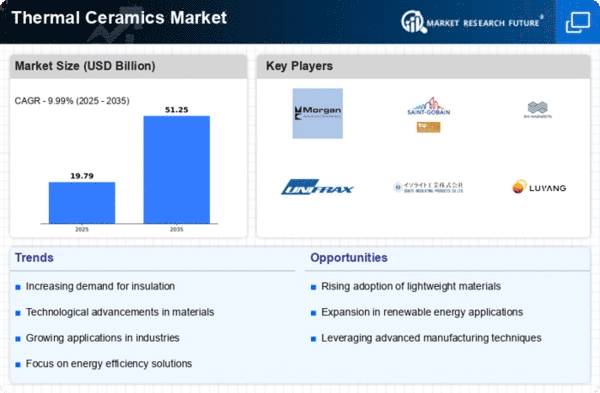
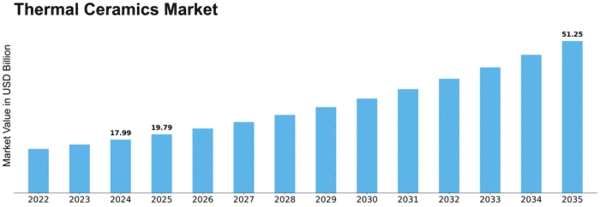
As per MRFR analysis, the Thermal Ceramics Market was estimated at 17.99 USD Billion in 2024. The Thermal Ceramics industry is projected to grow from 19.78 USD Billion in 2025 to 51.25 USD Billion by 2035, exhibiting a compound annual growth rate (CAGR) of 9.99 during the forecast period 2025 - 2035.

Key Market Trends & Highlights

The Thermal Ceramics Market is poised for substantial growth driven by energy efficiency and technological advancements.

  • The market experiences rising demand for energy efficiency, particularly in North America, which remains the largest market.
  • Sustainability and eco-friendly materials are becoming increasingly important, especially in the Asia-Pacific region, the fastest-growing market.
  • Technological advancements in manufacturing are enhancing product performance in the thermal insulation segment, which is the largest.
  • Rising industrial applications and a growing focus on energy efficiency are key drivers propelling the market forward.

Market Size & Forecast

2024 Market Size 17.99 (USD Billion)
2035 Market Size 51.25 (USD Billion)
CAGR (2025 - 2035) 9.99%
Largest Regional Market Share in 2024 North America

Major Players

<p>Morgan Advanced Materials (GB), Saint-Gobain (FR), RHI Magnesita (AT), Unifrax (US), Isolite Insulating Products Co., Ltd. (JP), Luyang Energy-Saving Materials Co., Ltd. (CN), Promat (BE), Skamol (DK), Zircar Ceramics, Inc. (US)</p>

Market Trends

The Thermal Ceramics Market is currently experiencing a dynamic evolution, driven by various factors that influence its growth trajectory. The increasing demand for energy-efficient materials across multiple industries, including construction, aerospace, and automotive, appears to be a primary catalyst. As industries strive to enhance thermal insulation and reduce energy consumption, the adoption of advanced thermal ceramics is likely to rise. Furthermore, the ongoing advancements in manufacturing technologies may facilitate the development of innovative products that cater to specific applications, thereby expanding the market's scope. In addition to energy efficiency, the Thermal Ceramics Market is also shaped by environmental considerations. Regulatory frameworks aimed at reducing carbon footprints and promoting sustainable practices are prompting manufacturers to explore eco-friendly materials. This shift towards sustainability may lead to the emergence of new product lines that align with these environmental goals. Overall, the Thermal Ceramics Market seems poised for growth, with a focus on innovation and sustainability driving its future prospects.

Rising Demand for Energy Efficiency

The Thermal Ceramics Market is witnessing an increasing emphasis on energy-efficient solutions. Industries are actively seeking materials that enhance thermal insulation, thereby reducing energy consumption. This trend is particularly evident in sectors such as construction and automotive, where energy efficiency is paramount.

Sustainability and Eco-Friendly Materials

There is a growing inclination towards sustainable practices within the Thermal Ceramics Market. Manufacturers are exploring eco-friendly materials in response to regulatory pressures and consumer preferences. This trend may lead to the development of innovative products that align with environmental goals.

Technological Advancements in Manufacturing

The Thermal Ceramics Market is benefiting from advancements in manufacturing technologies. These innovations enable the production of high-performance materials tailored for specific applications. As technology continues to evolve, the market is likely to see a surge in product offerings that meet diverse industry needs.

Thermal Ceramics Market Market Drivers

Growing Demand in Energy Sector

The Global Thermal Ceramics Market Industry is experiencing heightened demand from the energy sector, particularly in applications such as insulation for power generation and transmission. As energy efficiency becomes increasingly critical, thermal ceramics are utilized to enhance the performance of turbines and boilers. This trend is underscored by the projected market value of 4.5 USD Billion in 2024, indicating a robust growth trajectory. The shift towards renewable energy sources further propels the need for advanced thermal management solutions, suggesting that the energy sector will remain a pivotal driver for the Global Thermal Ceramics Market.

Market Segment Insights

By Application: Thermal Insulation (Largest) vs. Fire Protection (Fastest-Growing)

<p>In the Thermal Ceramics Market, the application segment is prominently dominated by Thermal Insulation, which holds the largest market share. This segment encompasses various materials and solutions designed to minimize heat loss and enhance energy efficiency in industrial and commercial applications. Following closely is the Fire Protection segment, which is witnessing significant uptake as stringent regulations and safety standards drive the demand for effective fire-resistant materials. Together, these segments portray a robust distribution that highlights the importance of thermal management in multiple industries.</p>

<p>Thermal Insulation (Dominant) vs. Heat Management (Emerging)</p>

<p>Thermal Insulation is a dominant segment in the Thermal Ceramics Market, serving a critical function in conserving energy and protecting against thermal losses in buildings and industrial processes. It encompasses a wide range of products, including ceramic fibers and boards, specifically engineered to withstand high temperatures while providing exceptional thermal resistance. Conversely, the Heat Management segment is emerging as a key area of innovation, focusing on advanced solutions that optimize temperature control in applications such as automotive and energy production. This segment is characterized by the development of sophisticated materials that enhance operational efficiency, thus appealing to industries aiming to reduce energy consumption and improve sustainability.</p>

By End Use Industry: Aerospace (Largest) vs. Electronics (Fastest-Growing)

<p>In the Thermal Ceramics Market, the distribution of market share among end-use industries highlights aerospace as the largest segment, driven by the increasing demand for advanced materials in high-performance applications. This segment benefits from aerospace expansions and technological innovations in aircraft design. Following aerospace, other significant segments include automotive and construction, which hold substantial shares due to their extensive use of thermal ceramics in insulation and heat protection, ensuring the materials' importance across industries. The growth trends in the Thermal Ceramics Market are propelled by the increasing emphasis on energy efficiency and environmental sustainability. In particular, the electronics sector emerges as the fastest-growing segment, fueled by advances in technology and the demand for miniaturized, efficient components. As industries strive for better thermal management solutions, innovations in ceramic materials enhance performance and expand applications, indicating a dynamic shift towards a more diversified market landscape.</p>

<p>Aerospace: Dominant vs. Electronics: Emerging</p>

<p>The aerospace segment is characterized by high-performance thermal ceramics that are essential in engine components and thermal insulation for aircraft. This dominance stems from a stringent need for lightweight materials that can withstand extreme temperatures and pressures in flight. In contrast, the electronics segment is emerging rapidly, driven by trends towards miniaturization and the growing demand for thermal management solutions in electronic devices. This sector is leveraging innovative ceramic materials to effectively dissipate heat, address thermal challenges in consumer electronics, and support the evolution of next-gen technology. Both segments showcase distinct requirements, yet they share the common goal of enhancing performance and reliability in their respective applications.</p>

By Material Type: Ceramic Fiber (Largest) vs. Refractory Bricks (Fastest-Growing)

<p>In the Thermal Ceramics Market, the material type segment showcases a dynamic distribution where Ceramic Fiber takes the lead due to its superior thermal insulation properties and versatility across various industries. Following closely are Refractory Bricks, Insulating Firebricks, and Castable Refractories, which play significant roles in high-temperature applications. Each segment exhibits unique attributes that cater to specific market demands, influencing their share within the overall market framework. The growth trends in the material type segment are driven by an increasing demand for energy-efficient materials and innovation in high-temperature applications. Refractory Bricks, for instance, are witnessing rapid growth due to their crucial role in industries, such as metallurgy and petrochemicals, while Ceramic Fiber remains predominant due to its lightweight and efficient thermal performance. Such trends indicate a shift towards sustainable and high-performing materials in the Thermal Ceramics Market, suggesting opportunities for emerging technologies and products.</p>

<p>Ceramic Fiber (Dominant) vs. Castable Refractories (Emerging)</p>

<p>Ceramic Fiber remains the dominant player in the Thermal Ceramics Market, recognized for its lightweight structure and exceptional thermal performance. It is widely used in various applications ranging from manufacturing to power generation, catering to industries that prioritize thermal efficiency and insulation. Conversely, Castable Refractories represent an emerging segment characterized by their adaptability and ease of installation. These materials are increasingly utilized in the construction of furnaces and kilns, as they can be cast into complex shapes, offering substantial operational benefits. As industries evolve, the demand for both traditional and innovative materials like Castable Refractories is on the rise, highlighting a growing trend towards customized thermal solutions.</p>

By Form: Boards (Largest) vs. Blankets (Fastest-Growing)

<p>In the Thermal Ceramics Market, the form segment is subdivided into boards, blankets, papers, and modules. Boards account for the largest market share, primarily driven by their extensive application in insulation and fire protection. Blankets are emerging as the fastest-growing segment, spurred by high demand in industries requiring flexible thermal solutions due to their lightweight and efficient insulating properties. Papers and modules also contribute significantly, catering to specialized needs within the market.</p>

<p>Insulation: Boards (Dominant) vs. Blankets (Emerging)</p>

<p>Boards are the dominant form in the Thermal Ceramics Market, known for their robust insulating capabilities and versatility in applications ranging from industrial furnaces to building insulation. Their structural integrity and ease of installation make them a preferred choice among end-users. Conversely, blankets represent an emerging segment with rapid growth, appealing particularly to sectors that require lightweight and flexible insulation materials. They are ideal for applications in aerospace and automotive industries due to their adaptability and superior thermal performance, highlighting a shift towards innovative insulation solutions as industries evolve.</p>

By Temperature Range: High Temperature (Largest) vs. Medium Temperature (Fastest-Growing)

<p>The Thermal Ceramics Market exhibits a diverse distribution across various temperature ranges. The High Temperature segment leads in market share, primarily due to its extensive applications in industries such as aerospace, automotive, and energy. This dominance is supported by the increasing demand for high-performance materials capable of withstanding extreme conditions. Meanwhile, the Medium Temperature segment is gaining traction, leveraging advancements in material technology to address the needs of more diverse applications, notably in manufacturing processes that require thermal insulation without extreme temperatures. Growth trends indicate a robust expansion in the Medium Temperature segment, driven by industrial innovation and the pursuit of energy-efficient solutions. As manufacturers prioritize sustainability and cost-effectiveness, the demand for medium-temperature ceramics is projected to rise significantly. Furthermore, regulatory pressures favoring energy efficiency in processing industries are paving the way for sustained growth, positioning this segment as a vital player in the overall market landscape.</p>

<p>High Temperature (Dominant) vs. Medium Temperature (Emerging)</p>

<p>The High Temperature segment of the Thermal Ceramics Market is characterized by its robust applications in high-stakes industries requiring materials that can withstand severe thermal stress. This dominance is attributed to the segment’s ability to deliver exceptional performance in extreme environments, making it the preferred choice for sectors like aerospace and power generation. In contrast, the Medium Temperature segment is emerging as a noteworthy player, catering to industries focused on energy efficiency and operational flexibility. Its growth is fueled by advances in ceramic technology that allow these materials to maintain optimal performance at intermediate temperature levels, facilitating their adaptation in various manufacturing processes. Both segments play distinct yet complementary roles in the market, with high temperature ceramics typically offering unparalleled performance and medium temperature ceramics increasingly being recognized for their innovative applications.</p>

Get more detailed insights about Thermal Ceramics Market Research Report - Global Forecast till 2035

Regional Insights

North America : Market Leader in Thermal Ceramics

North America is poised to maintain its leadership in the thermal ceramics market, holding a significant share of 7.5 in 2025. The region's growth is driven by robust industrial activities, particularly in aerospace and automotive sectors, alongside stringent energy efficiency regulations. The increasing demand for high-performance insulation materials is further propelling market expansion. Key players such as Morgan Advanced Materials and Unifrax are strategically positioned in the U.S. and Canada, leveraging advanced technologies to enhance product offerings. The competitive landscape is characterized by innovation and partnerships, ensuring a steady supply of high-quality thermal ceramics. The region's focus on sustainability and energy conservation is expected to bolster market growth further.

Europe : Emerging Market with Growth Potential

Europe's thermal ceramics market is projected to grow, with a market size of 4.5 in 2025. The region benefits from a strong manufacturing base and increasing investments in energy-efficient technologies. Regulatory frameworks, such as the EU's Green Deal, are driving demand for sustainable insulation solutions, enhancing market dynamics. Leading countries like Germany and France are at the forefront, with companies such as Saint-Gobain and RHI Magnesita leading the charge. The competitive landscape is marked by innovation and a focus on eco-friendly products. The presence of established players and a growing emphasis on reducing carbon footprints are expected to fuel market growth in the coming years.

Asia-Pacific : Rapid Growth in Emerging Markets

The Asia-Pacific region is witnessing rapid growth in the thermal ceramics market, with a projected size of 4.0 in 2025. This growth is driven by increasing industrialization, urbanization, and a rising demand for energy-efficient materials. Countries like China and Japan are leading the charge, supported by government initiatives promoting sustainable practices. The competitive landscape features key players such as Isolite Insulating Products and Luyang Energy-Saving Materials, who are innovating to meet the growing demand. The region's focus on infrastructure development and energy conservation is expected to further enhance market opportunities, making it a vital area for thermal ceramics investment.

Middle East and Africa : Emerging Market with Untapped Potential

The Middle East and Africa (MEA) region is emerging as a potential market for thermal ceramics, with a market size of 2.0 in 2025. The growth is driven by increasing industrial activities and a focus on energy efficiency in construction and manufacturing sectors. Government initiatives aimed at diversifying economies are also contributing to market expansion. Countries like South Africa and the UAE are leading the way, with investments in infrastructure and energy projects. The competitive landscape is still developing, with opportunities for both local and international players to establish a foothold. The region's untapped potential presents significant opportunities for growth in the thermal ceramics market.

Key Players and Competitive Insights

The Thermal Ceramics Market is characterized by a dynamic competitive landscape, driven by increasing demand for energy efficiency and high-temperature insulation solutions across various industries. Key players such as Morgan Advanced Materials (GB), Saint-Gobain (FR), and Unifrax (US) are strategically positioned to leverage innovation and technological advancements. Morgan Advanced Materials (GB) focuses on enhancing its product portfolio through research and development, while Saint-Gobain (FR) emphasizes sustainability and eco-friendly solutions. Unifrax (US) is actively pursuing regional expansion to tap into emerging markets, thereby shaping a competitive environment that is increasingly focused on innovation and sustainability.

The market structure appears moderately fragmented, with several players vying for market share. Key business tactics include localizing manufacturing to reduce costs and optimize supply chains. This approach not only enhances operational efficiency but also allows companies to respond swiftly to regional demands. The collective influence of these major players fosters a competitive atmosphere where agility and responsiveness are paramount, further driving the need for strategic collaborations and partnerships.

In November 2025, RHI Magnesita (AT) announced a significant investment in a new manufacturing facility in Eastern Europe, aimed at increasing production capacity for high-performance thermal ceramics. This strategic move is likely to enhance their market presence in the region, allowing for better service delivery and reduced lead times. Such investments indicate a commitment to meeting the growing demand for advanced thermal insulation solutions, positioning RHI Magnesita as a formidable competitor in the market.

In October 2025, Isolite Insulating Products Co., Ltd. (JP) launched a new line of eco-friendly thermal insulation products designed to meet stringent environmental regulations. This initiative not only aligns with The Thermal Ceramics. By focusing on environmentally friendly solutions, Isolite is likely to attract a broader customer base, particularly among industries prioritizing sustainability in their operations.

In September 2025, Promat (BE) entered into a strategic partnership with a leading technology firm to integrate AI-driven analytics into their manufacturing processes. This collaboration aims to optimize production efficiency and reduce waste, reflecting a broader trend towards digital transformation in the industry. The integration of AI technologies could potentially revolutionize operational capabilities, allowing Promat to maintain a competitive edge through enhanced productivity and innovation.

As of December 2025, the Thermal Ceramics Market is witnessing a shift towards digitalization, sustainability, and AI integration, which are defining current competitive trends. Strategic alliances are increasingly shaping the landscape, enabling companies to pool resources and expertise. The competitive differentiation is likely to evolve from traditional price-based competition to a focus on innovation, technology, and supply chain reliability. This transition underscores the importance of adaptability and forward-thinking strategies in maintaining a competitive advantage in the evolving market.

Key Companies in the Thermal Ceramics Market market include

Industry Developments

One of the leading market players, Morgan thermal ceramics had introduced a series of thermal bricks to their existing products. The novel invention has favorable characteristics such as lighter and more efficient insulation properties.

One of the leading market players, Unifrax had introduced the low bio-persistent thermal insulation material that is named as Isofrax 1400 blanket. This material utilized the high-temperature LBP technology and is considered a major evolution in the industry.

Future Outlook

Thermal Ceramics Market Future Outlook

<p>The Thermal Ceramics Market is projected to grow at a 9.99% CAGR from 2024 to 2035, driven by increasing demand in energy efficiency and industrial applications.</p>

New opportunities lie in:

  • <p>Development of advanced insulation materials for high-temperature applications.</p>
  • <p>Expansion into emerging markets with tailored thermal solutions.</p>
  • <p>Integration of smart technologies for real-time thermal monitoring.</p>

<p>By 2035, the Thermal Ceramics Market is expected to achieve robust growth, solidifying its position in various industries.</p>

Market Segmentation

Thermal Ceramics Market Form Outlook

  • Boards
  • Blankets
  • Papers
  • Modules

Thermal Ceramics Market Application Outlook

  • Thermal Insulation
  • Fire Protection
  • Heat Management
  • Electrical Insulation

Thermal Ceramics Market Material Type Outlook

  • Ceramic Fiber
  • Refractory Bricks
  • Insulating Firebricks
  • Castable Refractories

Thermal Ceramics Market End Use Industry Outlook

  • Aerospace
  • Automotive
  • Construction
  • Energy
  • Electronics

Thermal Ceramics Market Temperature Range Outlook

  • Low Temperature
  • Medium Temperature
  • High Temperature

Report Scope

MARKET SIZE 202417.99(USD Billion)
MARKET SIZE 202519.78(USD Billion)
MARKET SIZE 203551.25(USD Billion)
COMPOUND ANNUAL GROWTH RATE (CAGR)9.99% (2024 - 2035)
REPORT COVERAGERevenue Forecast, Competitive Landscape, Growth Factors, and Trends
BASE YEAR2024
Market Forecast Period2025 - 2035
Historical Data2019 - 2024
Market Forecast UnitsUSD Billion
Key Companies ProfiledMorgan Advanced Materials (GB), Saint-Gobain (FR), RHI Magnesita (AT), Unifrax (US), Isolite Insulating Products Co., Ltd. (JP), Luyang Energy-Saving Materials Co., Ltd. (CN), Promat (BE), Skamol (DK), Zircar Ceramics, Inc. (US)
Segments CoveredApplication, End Use Industry, Material Type, Form, Temperature Range
Key Market OpportunitiesGrowing demand for energy-efficient insulation solutions in industrial applications drives Thermal Ceramics Market opportunities.
Key Market DynamicsRising demand for energy-efficient solutions drives innovation and competition in the Thermal Ceramics Market.
Countries CoveredNorth America, Europe, APAC, South America, MEA

FAQs

What is the size of the thermal ceramics industry?

The market value of the thermal ceramics industry was at USD 3.8 billion in the year 2019 and it is expected to surpass the market value of over USD 5.5 billion by the year 2035 while registering a CAGR of 4.7% during the forecast period.

What is the estimated growth rate of the global thermal ceramics market?

The market value of the thermal ceramics industry was at USD 3.8 billion in the year 2019 and it is expected to surpass the market value of over USD 5.5 billion by the year 2035 while registering a CAGR of 4.7% during the forecast period.

Which type segment is touted to witness the highest growth?

The ceramics fiber segment is expected to observe substantial demand over the review period.

What is the end-users segment of the global thermal ceramics market expected to witness the highest growth?

The chemical and petrochemical segment is slated to expand as the fastest-growing segment.

Who are the significant players operative in the global thermal ceramics market?

A few eminent market players operating in the global thermal ceramics market are Fibrecast Inc. (Canada), 3M (US), HIL Limited (India), among others.

  1. Executive Summary
  2. Scope of the Report
    1. Market
    2. Definition
    3. Scope of the Study
    4. List of Assumptions
    5. Markets Structure
    6. Market Research Methodology
    7. Research Process
    8. Primary Research
    9. Secondary Research
    10. Market Size Estimation
    11. Forecast Model
  3. Market Factor Analysis
    1. Supply Chain Analysis
      1. Raw Material Suppliers
      2. Manufacturers/Producers of Thermal Ceramics
      3. Distributors/Retailers/Wholesalers/E-Commerce
      4. Threat of New Entrants
      5. Intensity of Competitive Rivalry
      6. Threat of Substitutes
      7. Bargaining
    2. Merchants
    3. End-Use Industries
    4. Porter’s Five Forces Model
    5. Power of Suppliers
    6. Bargaining Power of Buyers
    7. Pricing Analysis
  4. Market Dynamics of Global Thermal Ceramics Market
    1. Introduction
    2. Drivers
    3. Restraints
    4. Opportunities
    5. Challenges
  5. Global Thermal Ceramics
  6. Market, by Type
    1. Introduction
    2. Ceramic Fiber
    3. Market Estimates & Forecast, 2018–2027
    4. Insulation Bricks
    5. Market Estimates & Forecast, 2018–2027
    6. Others
    7. Market Estimates & Forecast, 2018–2027
  7. Market Estimates & Forecast, by Region,
  8. Market Estimates & Forecast, by Region,
  9. Market Estimates & Forecast, by Region,
  10. Global Thermal Ceramics Market, by End-Use Industry
    1. Introduction
    2. Chemical & Petrochemical
      1. Market Estimates &
      2. Market Estimates & Forecast, by Region, 2018–2027
    3. Forecast, 2018–2027
    4. Metal & Metallurgy
      1. Market Estimates
      2. Market Estimates & Forecast, by Region, 2018–2027
    5. & Forecast, 2018–2027
    6. Power Generation
      1. Market Estimates
      2. Market Estimates & Forecast, by Region, 2018–2027
    7. & Forecast, 2018–2027
    8. Manufacturing
      1. Market Estimates
      2. Market Estimates & Forecast, by Region, 2018–2027
    9. & Forecast, 2018–2027
    10. Others
      1. Market Estimates
      2. Market Estimates & Forecast, by Region, 2018–2027
    11. & Forecast, 2018–2027
  11. Global Thermal Ceramics
  12. Market, by Region
    1. Introduction
    2. North America
    3. Market Estimates & Forecast, 2018–2027
    4. & Forecast, by End-Use Industry, 2018–2027
    5. & Forecast, by Type, 2018–2027
    6. Canada
    7. Market Estimates & Forecast, 2018–2027
  13. Market Estimates & Forecast, by Type, 2018–2027
  14. Market Estimates
  15. US
  16. Market Estimates & Forecast, 2018–2027
  17. Market Estimates
  18. Market Estimates & Forecast, by End-Use Industry,
  19. Market Estimates & Forecast, by Type,
  20. Market Estimates & Forecast, by End-Use Industry, 2018–2027
    1. Europe
      1. Market Estimates
      2. Market Estimates & Forecast, by Type, 2018–2027
      3. Market Estimates
      4. Germany
    2. & Forecast, 2018–2027
    3. & Forecast, by End-Use Industry, 2018–2027
    4. & Forecast, by Type, 2018–2027
    5. France
    6. Market Estimates & Forecast, 2018–2027
  21. Market Estimates & Forecast, by End-Use Industry, 2018–2027
    1. & Forecast, 2018–2027
    2. & Forecast, by End-Use Industry, 2018–2027
    3. & Forecast, by Type, 2018–2027
    4. UK
    5. Market Estimates & Forecast, 2018–2027
  22. Italy
  23. Market Estimates
  24. Market Estimates & Forecast, by Type, 2018–2027
  25. Market Estimates
  26. Spain
  27. Market Estimates & Forecast, 2018–2027
  28. Market Estimates
  29. Market Estimates & Forecast, by End-Use Industry,
  30. Market Estimates & Forecast, by Type,
  31. Market Estimates & Forecast, by End-Use Industry, 2018–2027
    1. & Forecast, 2018–2027
    2. & Forecast, by End-Use Industry, 2018–2027
    3. & Forecast, by Type, 2018–2027
    4. Asia-Pacific
    5. Market Estimates & Forecast, 2018–2027
    6. & Forecast, by End-Use Industry, 2018–2027
    7. & Forecast, by Type, 2018–2027
    8. India
    9. Market Estimates & Forecast, 2018–2027
  32. Russia
  33. Market Estimates
  34. Market Estimates & Forecast, by Type, 2018–2027
  35. Market Estimates
  36. Poland
  37. Market Estimates & Forecast, 2018–2027
  38. Market Estimates
  39. Market Estimates & Forecast, by End-Use Industry,
  40. Market Estimates & Forecast, by Type, 2018–2027
  41. Market Estimates
  42. China
  43. Market Estimates & Forecast, 2018–2027
  44. Market Estimates
  45. Market Estimates & Forecast, by End-Use Industry,
  46. Market Estimates & Forecast, by Type,
  47. Market Estimates & Forecast, by End-Use Industry, 2018–2027
    1. & Forecast, 2018–2027
    2. & Forecast, by End-Use Industry, 2018–2027
    3. & Forecast, by Type, 2018–2027
    4. New Zealand
    5. Market Estimates & Forecast, 2018–2027
  48. Japan
  49. Market Estimates
  50. Market Estimates & Forecast, by Type, 2018–2027
  51. Market Estimates
  52. Australia
  53. Market Estimates & Forecast, 2018–2027
  54. Market Estimates
  55. Market Estimates & Forecast, by End-Use Industry,
  56. Market Estimates & Forecast, by Type,
  57. Market Estimates & Forecast, by End-Use Industry, 2018–2027
    1. & Forecast, 2018–2027
    2. & Forecast, by End-Use Industry, 2018–2027
    3. & Forecast, by Type, 2018–2027
    4. Turkey
    5. Market Estimates & Forecast, 2018–2027
  58. Rest of Asia-Pacific
  59. Market Estimates
  60. Market Estimates & Forecast, by Type, 2018–2027
  61. Market Estimates
    1. Middle East & Africa
      1. Market Estimates & Forecast, 2018–2027
      2. Market Estimates
      3. Market Estimates & Forecast, by End-Use Industry,
  62. Market Estimates & Forecast, by End-Use Industry, 2018–2027
    1. & Forecast, 2018–2027
    2. & Forecast, by End-Use Industry, 2018–2027
    3. & Forecast, by Type, 2018–2027
    4. GCC
    5. Market Estimates & Forecast, 2018–2027
  63. Israel
  64. Market Estimates
  65. Market Estimates & Forecast, by Type, 2018–2027
  66. Market Estimates
  67. South Africa
  68. Market Estimates & Forecast, 2018–2027
  69. Market Estimates
  70. Market Estimates & Forecast, by End-Use Industry,
  71. Market Estimates & Forecast, by Type,
  72. Market Estimates & Forecast, by End-Use Industry, 2018–2027
    1. East & Africa
    2. Market Estimates & Forecast, 2018–2027
  73. Rest of the Middle
  74. Market Estimates & Forecast, by Type,
  75. Market Estimates & Forecast, by End-Use Industry, 2018–2027
    1. Latin America
      1. Market Estimates
      2. Market Estimates & Forecast, by Type, 2018–2027
      3. Market Estimates
      4. Brazil
    2. & Forecast, 2018–2027
    3. & Forecast, by End-Use Industry, 2018–2027
    4. & Forecast, by Type, 2018–2027
    5. Argentina
    6. Market Estimates & Forecast, 2018–2027
  76. Market Estimates & Forecast, by End-Use Industry, 2018–2027
    1. & Forecast, 2018–2027
    2. & Forecast, by End-Use Industry, 2018–2027
    3. & Forecast, by Type, 2018–2027
    4. Competitive Landscape
    5. Introduction
    6. Market Key Strategies
    7. Key Development Analysis
    8. (Expansions/Mergers & Acquisitions/Joint Ventures/New Product Developments/Agreements/Investments)
  77. Mexico
  78. Market Estimates
  79. Market Estimates & Forecast, by Type, 2018–2027
  80. Market Estimates
  81. Rest of Latin America
  82. Market Estimates & Forecast, 2018–2027
  83. Market Estimates
  84. Market Estimates & Forecast, by End-Use Industry,
  85. Company
    1. Profiles
    2. Morgan Advanced Materials PLC
    3. Products Co. Ltd.
    4. Company Overview
    5. Financial Overview
    6. Products Offered
    7. Key Developments
    8. SWOT Analysis
    9. Key Strategies
    10. Nutec Fibratec
    11. Company Overview
    12. Financial Overview
    13. Products Offered
    14. Key Developments
    15. SWOT Analysis
    16. Key Strategies
    17. Fibrecast Inc.
    18. Company Overview
    19. Financial Overview
    20. Products Offered
    21. Key Developments
    22. SWOT Analysis
    23. Key Strategies
    24. 3M
    25. Overview
    26. Financial Overview
    27. Products Offered
    28. Key Developments
    29. SWOT Analysis
    30. Key Strategies
    31. HIL Limited
    32. Company Overview
    33. Financial Overview
    34. Products Offered
    35. Key Developments
    36. SWOT Analysis
    37. Key Strategies
    38. Appendix
  86. Company Overview
  87. Financial Overview
  88. Products Offered
  89. Key Developments
  90. SWOT Analysis
  91. Key Strategies
    1. Unifrax LLC
      1. Company Overview
      2. Financial Overview
      3. Products Offered
      4. Key Developments
      5. SWOT Analysis
      6. Key Strategies
    2. Luyang Energy-Saving Materials Co., Ltd
      1. Company Overview
      2. Financial Overview
      3. Products Offered
      4. Key Developments
      5. SWOT Analysis
      6. Key Strategies
    3. Ibiden Co., Ltd.
      1. Company Overview
      2. Financial Overview
      3. Products Offered
      4. Key Developments
      5. SWOT Analysis
      6. Key Strategies
    4. Isolite Insulating
      1. Company
  92. LIST OF TABLES
  93. Global
  94. Thermal Ceramics Market, by Region, 2018–2027
  95. North America: Thermal Ceramics Market, by
    1. Country, 2018–2027
  96. Europe: Thermal Ceramics Market, by Country, 2018–2027
  97. Asia-Pacific:
  98. Thermal Ceramics Market, by Country, 2018–2027
  99. Middle East & Africa: Thermal Ceramics
  100. Market, by Country, 2018–2027
  101. Latin America: Thermal Ceramics Market, by Country,
    1. Table
  102. Global Thermal Ceramics Type Market, by Region, 2018–2027
  103. North America: Thermal
  104. Ceramics Type Market, by Country, 2018–2027
  105. Europe: Thermal Ceramics Type Market, by
    1. Country, 2018–2027
  106. Asia-Pacific: Thermal Ceramics Type Market, by Country, 2018–2027
  107. Middle
  108. East & Africa: Thermal Ceramics Type Market, by Country, 2018–2027
  109. Latin America:
  110. Thermal Ceramics Type Market, by Country, 2018–2027
  111. Global Thermal Ceramics End-Use Industry
  112. Market, by Region, 2018–2027
  113. North America: Thermal Ceramics End-Use Industry
  114. Market, by Country, 2018–2027
  115. Europe: Thermal Ceramics End-Use Industry Market,
    1. by Country, 2018–2027
  116. Asia-Pacific: Thermal Ceramics End-Use Industry Market, by
    1. Country, 2018–2027
  117. Middle East & Africa: Thermal Ceramics End-Use Industry
  118. Market, by Country, 2018–2027
  119. Latin America: Thermal Ceramics End-Use Industry
  120. Market, by Country, 2018–2027
  121. Global Type Market, by Region, 2018–2027
  122. Global
  123. End-Use Industry Market, by Region, 2018–2027
  124. North America: Thermal Ceramics Market,
    1. by Country, 2018–2027
  125. North America: Thermal Ceramics Market, by Type, 2018–2027
  126. North America:
  127. Thermal Ceramics Market, by End-Use Industry, 2018–2027
  128. Europe: Thermal Ceramics
  129. Market, by Country, 2018–2027
  130. Europe: Thermal Ceramics Market, by Type, 2018–2027
  131. Europe: Thermal
  132. Ceramics Market, by End-Use Industry, 2018–2027
  133. Asia-Pacific: Thermal Ceramics Market, by
    1. Country, 2018–2027
  134. Asia-Pacific: Thermal Ceramics Market, by Type, 2018–2027
  135. Asia-Pacific:
  136. Thermal Ceramics Market, by End-Use Industry, 2018–2027
  137. Middle East & Africa:
  138. Thermal Ceramics Market, by Country, 2018–2027
  139. Middle East & Africa: Thermal Ceramics
  140. Market, by Type, 2018–2027
  141. Middle East & Africa: Thermal Ceramics Market, by End-Use
    1. Industry, 2018–2027
  142. Latin America: Thermal Ceramics Market, by Country, 2018–2027
  143. Latin America:
  144. Thermal Ceramics Market, by Type, 2018–2027
  145. Latin America: Thermal Ceramics Market,
    1. by End-Use Industry, 2018–2027
  146. LIST OF FIGURES
  147. Global Thermal Ceramics Market Segmentation
  148. Forecast Research
    1. Methodology
    2. FIGURE
  149. Porter’s Five Forces Analysis of Global Thermal Ceramics Market
  150. Value Chain/Supply
    1. Chain of Global Thermal Ceramics Market
  151. Share of Global Thermal Ceramics Market, by Country,
    1. FIGURE
  152. Global Thermal Ceramics Market, 2018–2027
  153. Global Thermal Ceramics Market Size, by
    1. Type, 2019 (%)
    2. FIGURE
  154. Share of Global Thermal Ceramics Market, by Type, 2018–2027
  155. Global Thermal Ceramics
  156. Market Size, by End-Use Industry, 2019 (%)
  157. Share of Global Thermal Ceramics Market,
    1. by End-Use Industry, 2018–2027

Thermal Ceramics Market Segmentation

Market Segmentation Overview

  • Detailed segmentation data will be available in the full report
  • Comprehensive analysis by multiple parameters
  • Regional and country-level breakdowns
  • Market size forecasts by segment
Infographic

Free Sample Request

Kindly complete the form below to receive a free sample of this Report

Get Free Sample

Customer Strories

Compare Licence

×
Features License Type
Single User Multiuser License Enterprise User
Price $4,950 $5,950 $7,250
Maximum User Access Limit 1 User Upto 10 Users Unrestricted Access Throughout the Organization
Free Customization
Direct Access to Analyst
Deliverable Format
Platform Access
Discount on Next Purchase 10% 15% 15%
Printable Versions