Request Free Sample ×

Kindly complete the form below to receive a free sample of this Report

* Please use a valid business email

Leading companies partner with us for data-driven Insights

clients tt-cursor
Hero Background
English
Chinese
French
Japanese
Korean
German
Spanish

Thawing System Market Size

ID: MRFR/MED/5494-HCR
90 Pages
Vikita Thakur
April 2026

Thawing System Market Research Report Information by Type (Manual Devices and Automated Devices), Sample Type (Blood, Plasma, Stem Cells, Whole Blood & Red Blood Cells, Ovum, Semen, and others), End User (Blood Banks & Transfusion Centers) - Forecast Till 2035

Share:
Download PDF ×

We do not share your information with anyone. However, we may send you emails based on your report interest from time to time. You may contact us at any time to opt-out.

Thawing System Market Infographic
Purchase Options

Thawing System Size

Thawing System Market Growth Projections and Opportunities

This market is driven by several market forces that shape its dynamics and growth path. One important factor is the growing demand for sophisticated medical technologies, particularly in healthcare. The continuous need for efficient and fast thawing of biological samples and products in the health care sector has led to the expansion of this market. Consequently, thawing systems are increasingly being adopted as medical researches/ applications grow more complex necessitating precise and swift thawing procedures.

Furthermore, global rise in chronic diseases together with increasing focus on personalized medicine are playing a leading role towards its evolution. Thawing system plays an essential role in conserving the integrity of biological materials including blood components or stem cells which are used in modern medical treatments. Increasing prevalence of chronic diseases alongside growing scope of personalized medication are driving demand for thawing systems across various healthcare facilities.

Another key market factor is the growing emphasis on food safety as well as surging demand for quick and convenient solutions in the food industry. They find extensive use when it comes to unfreezing frozen food products thereby ensuring rapid and controlled manner of achieving this objective. In order to improve their processes of production, food manufacturers have started adopting thawing systems because consumers have become increasingly critical about quality and safety issues related to food stuffs.Why then does all this mean?

Moreover, advancements and innovations taking place in this area dictate the market landscape today . Manufactures continue investing lots resources on research with an aim to come up with cutting-edge thawing technologies that offer enhanced efficiency, accuracy aiming at enhancing user-friendliness as well. At present, smart technology integration together with automation has taken roots into these defrost devices which cascades greater controls-monitoring by end users themselves.Consequently, there is expanding product base but also they are getting popular among various industries through such innovative processes.

Similarly, strict regulations & standards regarding handling or thawing biological materials affect how it operates.Thermo-Regulatory measures are very stringent in the healthcare, biotechnology & pharmaceutical sectors. These types of thawing systems which meet such standards that are set by authorities can experience an increase in demand as they help to maintain product integrity and quality. Therefore, manufacturers within the thawing system markets align their product development strategies with regulatory requirements in order to comply with strict standards.

Additionally, some regional factors such as economic development; healthcare infrastructure and overall industrial condition also affect the market. Emerging economies having a growing healthcare sector coupled with increasing investments into r&d represent lucrative thawing systems’ markets. In addition, expansion of these regions’ biopharmaceutical industries has resulted to the growth of this market since defrosting systems form a critical part of the production and development processes for biopharmaceutical products.”
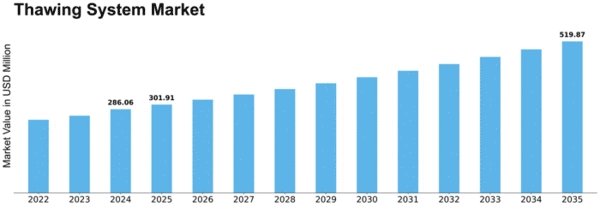
Thawing System Market Size Graph
Author
Author Profile
Vikita Thakur
Senior Research Analyst

She holds an experience of about 5+ years in market research and business consulting projects for sectors such as life sciences, medical devices, and healthcare IT. She possesses a robust background in data analysis, market estimation, competitive intelligence, pipeline analysis market trend identification, and consumer behavior insights. Her expertise lies in technical Sales support, client interaction and project management, designing and implementing market research studies, conducting competitive analysis, and synthesizing complex data into actionable recommendations that drive business growth.

Leave a Comment

FAQs

What is the current valuation of the Thawing System Market?

<p>The Thawing System Market was valued at 286.06 USD Million in 2024.</p>

What is the projected market size for the Thawing System Market by 2035?

<p>The market is projected to reach 519.87 USD Million by 2035.</p>

What is the expected CAGR for the Thawing System Market during the forecast period 2025 - 2035?

<p>The expected CAGR for the Thawing System Market during 2025 - 2035 is 5.54%.</p>

Which application segments are leading in the Thawing System Market?

<p>The leading application segments include Food Thawing, Pharmaceutical Thawing, Biological Sample Thawing, and Meat Thawing.</p>

What are the key players in the Thawing System Market?

<p>Key players include Thermo Fisher Scientific, Waters Corporation, Merck KGaA, GE Healthcare, and Sartorius AG.</p>

How does the Food Industry segment perform in the Thawing System Market?

The Food Industry segment was valued between 80.0 and 150.0 USD Million.

What is the valuation range for Automated Thawing Systems?

Automated Thawing Systems are valued between 114.42 and 208.0 USD Million.

Which technology segment shows the highest valuation in the Thawing System Market?

Convection Thawing shows the highest valuation, ranging from 113.0 to 205.87 USD Million.

What is the market performance of Industrial Thawing Systems?

Industrial Thawing Systems were valued between 136.06 and 219.87 USD Million.

What end-use segments are included in the Thawing System Market analysis?

End-use segments include the Food Industry, Healthcare, Laboratories, and Research Institutions.

Market Summary

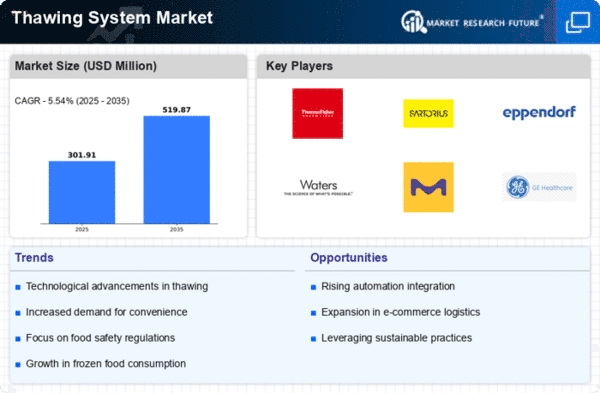
As per MRFR analysis, the Thawing System Market Size was estimated at 286.06 USD Million in 2024. The Thawing System industry is projected to grow from 305.18 USD Million in 2025 to 519.87 USD Million by 2035, exhibiting a compound annual growth rate (CAGR) of 5.54% during the forecast period 2025 - 2035.

Key Market Trends & Highlights

The Thawing System Market is experiencing robust growth driven by technological advancements and increasing demand across various sectors.

  • Technological advancements are enhancing the efficiency and effectiveness of thawing systems in both food and pharmaceutical applications.
  • North America remains the largest market for thawing systems, while the Asia-Pacific region is emerging as the fastest-growing market.
  • The food thawing segment dominates the market, whereas the pharmaceutical thawing segment is witnessing rapid growth due to increased healthcare demands.
  • Key market drivers include the rising demand for frozen foods and the shift towards automation in food processing, which are shaping industry dynamics.

Market Size & Forecast

2024 Market Size 286.06 (USD Million)
2035 Market Size 519.87 (USD Million)
CAGR (2025 - 2035) 5.54%
Largest Regional Market Share in 2024 North America

Major Players

Thermo Fisher Scientific (US), Sartorius AG (DE), Eppendorf AG (DE), Waters Corporation (US), Merck KGaA (DE), GE Healthcare (US), Bio-Rad Laboratories (US), Agilent Technologies (US), PerkinElmer (US)

Market Trends

The Thawing System Market is currently experiencing a notable evolution, driven by advancements in technology and increasing demand for efficient thawing solutions across various sectors. The growing emphasis on food safety and quality has led to the adoption of innovative thawing systems that ensure uniform temperature control and minimize the risk of bacterial growth. Additionally, the rise in the consumption of frozen foods has further propelled the need for effective thawing methods, as businesses seek to optimize their operations and enhance product quality. As a result, manufacturers are focusing on developing systems that not only meet regulatory standards but also improve energy efficiency and reduce operational costs. Moreover, the Thawing System Market is witnessing a shift towards automation and smart technologies. The integration of IoT and AI in thawing systems appears to enhance monitoring capabilities and streamline processes, allowing for real-time adjustments and data collection. This trend suggests a growing preference for systems that offer greater control and flexibility, catering to the evolving needs of consumers and businesses alike. As the market continues to expand, stakeholders are likely to explore new opportunities for innovation, ensuring that thawing solutions remain at the forefront of food processing and preservation practices.

Technological Advancements

The Thawing System Market is increasingly influenced by technological innovations that enhance thawing efficiency and safety. New systems are being developed with advanced features such as precise temperature control and automated monitoring, which help mitigate risks associated with improper thawing.

Rising Demand for Frozen Foods

The growing popularity of frozen food products is driving the Thawing System Market. As consumers seek convenience and longer shelf life, businesses are compelled to invest in effective thawing solutions to maintain product quality and safety.

Shift Towards Automation

There is a noticeable trend towards automation within the Thawing System Market. The incorporation of smart technologies and IoT capabilities allows for improved process management, enabling businesses to optimize their thawing operations and enhance overall efficiency.

Thawing System Market Market Drivers

Rising Demand for Frozen Foods

The Global Thawing System Market Industry experiences a notable surge in demand for frozen foods, driven by changing consumer preferences and lifestyles. As more individuals seek convenience in meal preparation, the consumption of frozen products continues to rise. In 2024, the market is valued at approximately 1250 USD Million, reflecting the growing inclination towards ready-to-eat meals. This trend is likely to propel the adoption of thawing systems, which are essential for maintaining food quality and safety. The increasing reliance on frozen foods suggests a robust growth trajectory for the thawing system market, as it aligns with the evolving dietary habits of consumers.

Consumer Awareness of Food Quality

Increasing consumer awareness regarding food quality and safety is a driving force in the Global Thawing System Market Industry. As consumers become more informed about the implications of improper thawing methods, they are more likely to seek products that utilize advanced thawing technologies. This heightened awareness encourages food manufacturers to invest in state-of-the-art thawing systems that ensure optimal food quality. The market's growth trajectory, projected at a CAGR of 7.43% from 2025 to 2035, reflects this shift in consumer behavior. As the demand for high-quality food products rises, the thawing system market is poised for substantial growth, aligning with consumer expectations.

Market Trends and Growth Projections

The Global Thawing System Market Industry is characterized by dynamic trends and growth projections that indicate a promising future. The market is expected to experience a significant increase in value, with estimates suggesting a rise from 1250 USD Million in 2024 to 2750 USD Million by 2035. This growth is underpinned by a compound annual growth rate (CAGR) of 7.43% from 2025 to 2035. The evolving landscape of food processing and consumer preferences is likely to shape the market, creating opportunities for innovation and expansion. As the industry adapts to these trends, stakeholders can anticipate a vibrant market environment.

Regulatory Standards for Food Safety

The Global Thawing System Market Industry is influenced by stringent regulatory standards aimed at ensuring food safety. Governments worldwide implement regulations that mandate proper thawing practices to prevent foodborne illnesses. Compliance with these regulations necessitates the use of efficient thawing systems that adhere to safety protocols. As food safety becomes a priority for both consumers and regulatory bodies, the demand for reliable thawing solutions is expected to rise. This regulatory landscape not only drives market growth but also encourages manufacturers to innovate and enhance their thawing technologies, thereby contributing to the overall expansion of the industry.

Growth of the Food Processing Industry

The expansion of the food processing industry significantly impacts the Global Thawing System Market Industry. As food processing facilities scale up operations to meet increasing consumer demand, the need for efficient thawing systems becomes paramount. The industry is witnessing a shift towards larger production capacities, necessitating advanced thawing solutions that can handle bulk quantities. This growth is reflected in the projected market value of 1250 USD Million in 2024, with expectations of reaching 2750 USD Million by 2035. The robust growth of the food processing sector indicates a sustained demand for thawing systems, as they are integral to maintaining product quality and safety during processing.

Technological Advancements in Thawing Systems

Technological innovations play a pivotal role in shaping the Global Thawing System Market Industry. The introduction of advanced thawing technologies, such as microwave and water immersion systems, enhances efficiency and reduces thawing time. These innovations not only improve food safety but also preserve the texture and flavor of thawed products. As the industry embraces automation and smart technologies, the market is projected to grow significantly. By 2035, the market is expected to reach 2750 USD Million, indicating a compound annual growth rate (CAGR) of 7.43% from 2025 to 2035. This growth underscores the importance of technology in meeting the demands of modern food processing.

Market Segment Insights

By Application: Food Thawing (Largest) vs. Pharmaceutical Thawing (Fastest-Growing)

In the Thawing System Market, Food Thawing represents the largest application segment, capturing a substantial portion of the market share due to increasing demand for convenience food and ready-to-cook meals. This segment remains vital for food processors and restaurants, particularly as consumer preferences shift towards freshly prepared meals. Conversely, Pharmaceutical Thawing has emerged as the fastest-growing segment, driven by the rising need for biopharmaceuticals and advanced therapies that necessitate precise temperature control during storage and thawing processes.

Food Thawing (Dominant) vs. Biological Sample Thawing (Emerging)

Food Thawing stands out as the dominant application segment in the Thawing System Market due to its significance in maintaining food safety and quality. Businesses in this segment utilize advanced thawing systems to streamline operations and comply with health regulations. Meanwhile, Biological Sample Thawing is an emerging segment gaining traction within research laboratories and healthcare institutions. This application is essential for the preservation of cellular integrity in samples prior to analysis. Both segments showcase the necessity of thawing technologies, each catering to distinct market needs while emphasizing efficiency and reliability in their operations.

By End Use: Food Industry (Largest) vs. Healthcare (Fastest-Growing)

The Thawing System Market exhibits significant segmentation by end use, with the Food Industry holding the largest market share due to the growing demand for convenient food preparation. In this sector, thawing systems have become crucial for maintaining food quality and safety, aligning with increasingly health-conscious consumer preferences. Healthcare follows as a vital segment, propelled by the need for thawing systems in various medical applications, including blood plasma and <a href="https://www.marketresearchfuture.com/reports/organ-preservation-market-6073" target="_blank" title="organ preservation">organ preservation</a>. As the market evolves, the Healthcare segment is projected to experience the fastest growth. This surge is driven by advancements in medical technology, emphasizing efficient cryopreservation and thawing processes. The growing healthcare infrastructure and increasing investments in biotechnology and pharmaceuticals further encourage the adoption of thawing systems, enhancing efficiency in life-saving applications.

Food Industry (Dominant) vs. Pharmaceuticals (Emerging)

In the Thawing System Market, the Food Industry stands out as the dominant segment, characterized by its extensive use of thawing systems for food safety and quality enhancement. Automated thawing systems are becoming an essential part of food processing chains, allowing for faster meal preparation while preserving nutritional value. The growth in ready-to-eat meals and frozen food items has solidified the food sector's leading position. Conversely, the Pharmaceuticals segment is an emerging player, yet its significance is growing rapidly amidst the rise of biopharmaceuticals. This sector requires specialized thawing systems for the proper handling of temperature-sensitive medications and vaccine components. The innovation in bioprocessing technology is expected to ramp up the demand for advanced thawing solutions, establishing pharmaceuticals as a strong competitor in the market over time.

By Technology: Microwave Thawing (Largest) vs. Water Bath Thawing (Fastest-Growing)

<p>In the Thawing System Market, Microwave Thawing holds the largest market share among the various thawing methods due to its speed and efficiency. This technology is widely adopted in both commercial and residential settings, making it a preferred choice for quick meal preparation. In contrast, Water Bath Thawing is gaining traction as an emerging method, particularly within food service operations where precise temperature control is necessary. This method is valued for its ability to thaw food evenly, thereby reducing the risk of partially cooked items.</p>

<p>Thawing Technologies: Microwave Thawing (Dominant) vs. Water Bath Thawing (Emerging)</p>

<p>Microwave Thawing distinguishes itself in the Thawing System Market as a dominant technology, known for its rapid thawing capabilities. It enables users to thaw food items in minimized time without compromising quality, making it highly favored in time-sensitive environments like kitchens. On the other hand, Water Bath Thawing is emerging as a viable alternative, especially for chefs who prioritize the integrity of food texture. This method allows for gradual thawing, ensuring the food retains its moisture and flavor. As the industry evolves, both technologies are likely to coexist, catering to diverse consumer preferences and operational needs.</p>

By Product Type: Countertop Thawing Systems (Largest) vs. Industrial Thawing Systems (Fastest-Growing)

<p>In the Thawing System Market, the distribution of market share among product types indicates a prominent position for Countertop Thawing Systems, which cater primarily to residential and small commercial needs. Their user-friendly design and efficiency make them a preferred choice across various sectors. Conversely, Industrial Thawing Systems are emerging rapidly, primarily serving large-scale producers and processors who require efficient thawing solutions for bulk quantities, demonstrating a notable shift towards automation and technology integration in industrial applications.</p>

<p>Countertop Thawing Systems (Dominant) vs. Industrial Thawing Systems (Emerging)</p>

<p>Countertop Thawing Systems dominate the Thawing System Market due to their versatility and accessibility, designed to fit seamlessly into both home kitchens and smaller foodservice operations. They appeal to users looking for quick and efficient thawing solutions with compact usability. On the other hand, Industrial Thawing Systems represent an emerging trend within the market, driven by the increasing demand for food processing efficiency in commercial environments. These systems focus on large capacities and advanced features, catering to industrial needs, supporting processors in maintaining food safety while enhancing operational workflows.</p>

By Mode of Operation: Automated Thawing Systems (Largest) vs. Manual Thawing Systems (Fastest-Growing)

<p>The Thawing System Market is currently dominated by Automated Thawing Systems, which have established themselves as the largest segment due to their efficiency and precision in thawing processes. This category significantly contributes to the overall functionality and effectiveness desired in laboratories and other applications that require quick and reliable thawing. On the other hand, Manual Thawing Systems have been gaining traction in recent years, particularly among smaller facilities or those with lower volume needs, due to their lower initial investment and simplicity of use.</p>

<p>Thawing Systems: Automated (Dominant) vs. Manual (Emerging)</p>

<p>Automated Thawing Systems are characterized by their high precision and ability to handle large quantities with minimal human intervention, making them the preferred choice for institutions that require consistent and reliable results. This segment not only enhances operational efficiency but also ensures that samples are thawed uniformly, thereby preserving their quality. In contrast, Manual Thawing Systems are emerging as a viable alternative for setups that prioritize cost-effectiveness and ease of operation. These systems are particularly appealing for smaller research labs and clinics that may not necessitate the advanced features of automated solutions, allowing for a more hands-on approach to thawing while still maintaining acceptable effectiveness.</p>

Get more detailed insights about Thawing System Market Research Report – Forecast till 2035

Regional Insights

North America : Market Leader in Thawing Systems

North America continues to lead the thawing system market, holding a significant share of 143.62 million in 2024. The region's growth is driven by increasing demand for biopharmaceuticals and advancements in laboratory technologies. Regulatory support from agencies like the FDA further catalyzes market expansion, ensuring compliance and safety in thawing processes. The rising prevalence of chronic diseases necessitates efficient thawing solutions, contributing to market growth. The competitive landscape in North America is robust, featuring key players such as Thermo Fisher Scientific, GE Healthcare, and Bio-Rad Laboratories. The U.S. stands out as the largest market, driven by its strong healthcare infrastructure and research capabilities. Companies are focusing on innovation and strategic partnerships to enhance their product offerings, ensuring they meet the evolving needs of the healthcare sector. This competitive edge positions North America as a pivotal player in The Thawing System.

Europe : Emerging Market with Growth Potential

Europe's thawing system market is valued at 78.0 million, reflecting a growing demand for advanced laboratory solutions. The region benefits from stringent regulatory frameworks that ensure product quality and safety, driving innovation in thawing technologies. Countries like Germany and the UK are at the forefront, with increasing investments in healthcare and biotechnology sectors. The rising focus on personalized medicine and cell therapies is expected to further boost market growth in the coming years. Germany leads the European market, supported by a strong presence of key players such as Sartorius AG and Eppendorf AG. The competitive landscape is characterized by collaborations and mergers aimed at enhancing product portfolios. The European market is also witnessing a shift towards automation and digitalization in laboratory processes, which is likely to create new opportunities for thawing system manufacturers. As stated by the European Medicines Agency, "The advancement of biopharmaceuticals necessitates innovative thawing solutions to ensure patient safety and efficacy."

Asia-Pacific : Rapidly Growing Thawing Market

The Asia-Pacific thawing system market, valued at 52.44 million, is experiencing rapid growth driven by increasing healthcare investments and a rising number of research facilities. Countries like China and India are leading this growth, supported by government initiatives aimed at enhancing healthcare infrastructure. The demand for thawing systems is also fueled by the growing biopharmaceutical sector, which requires efficient thawing solutions for cell and gene therapies. China is emerging as a key player in the thawing system market, with significant contributions from local manufacturers and international companies. The competitive landscape is evolving, with a focus on technological advancements and cost-effective solutions. As the region continues to invest in healthcare and biotechnology, the thawing system market is expected to expand significantly, providing opportunities for both established and new players. The increasing collaboration between public and private sectors is likely to further enhance market dynamics.

Middle East and Africa : Developing Market with Opportunities

The Middle East and Africa thawing system market is valued at 12.0 million, reflecting a developing landscape with significant growth potential. The region is witnessing an increase in healthcare investments, driven by government initiatives aimed at improving healthcare access and quality. The demand for thawing systems is expected to rise as the biopharmaceutical sector expands, necessitating efficient thawing solutions for various applications. Countries like South Africa and the UAE are emerging as key markets, with a growing number of research institutions and healthcare facilities. The competitive landscape is characterized by a mix of local and international players, focusing on innovative solutions to meet the unique needs of the region. As the healthcare sector continues to evolve, the thawing system market is poised for growth, presenting opportunities for investment and development. The World Health Organization emphasizes the importance of enhancing laboratory capabilities to support healthcare advancements in the region.

Key Players and Competitive Insights

The Thawing System Market is characterized by a dynamic competitive landscape, driven by increasing demand for efficient thawing solutions in various sectors, including biopharmaceuticals and research laboratories. Key players such as Thermo Fisher Scientific (US), Sartorius AG (DE), and Eppendorf AG (DE) are strategically positioned to leverage innovation and technological advancements. These companies focus on enhancing product offerings through research and development, thereby fostering a competitive environment that emphasizes quality and efficiency in thawing processes.In terms of business tactics, companies are increasingly localizing manufacturing to reduce lead times and optimize supply chains. The market appears moderately fragmented, with several players vying for market share. However, the collective influence of major companies like Waters Corporation (US) and Merck KGaA (DE) suggests a trend towards consolidation, as these firms seek to enhance their operational capabilities and market reach.

In November Thermo Fisher Scientific (US) announced the launch of a new line of automated thawing systems designed to improve throughput and reduce human error in laboratory settings. This strategic move is likely to enhance their competitive edge by addressing the growing need for automation in laboratory processes, thereby appealing to a broader customer base seeking efficiency and reliability.

In October Sartorius AG (DE) expanded its product portfolio by acquiring a small biotech firm specializing in thawing technologies. This acquisition is indicative of Sartorius's commitment to innovation and its strategy to integrate advanced thawing solutions into its existing offerings, potentially enhancing its market position and driving future growth.

In September Eppendorf AG (DE) launched a new software platform that integrates with its thawing systems, allowing for real-time monitoring and data analysis. This development not only underscores Eppendorf's focus on digital transformation but also positions the company to meet the increasing demand for data-driven solutions in laboratory environments, thereby enhancing user experience and operational efficiency.

As of December the Thawing System Market is witnessing trends such as digitalization, sustainability, and the integration of artificial intelligence (AI) into thawing processes. Strategic alliances among key players are shaping the competitive landscape, fostering innovation and collaboration. The shift from price-based competition to a focus on technological advancement and supply chain reliability is evident, suggesting that future differentiation will hinge on the ability to innovate and adapt to evolving market demands.

Key Companies in the Thawing System Market include

Industry Developments

Future Outlook

Thawing System Market Future Outlook

The Thawing System Market is projected to grow at a 5.54% CAGR from 2025 to 2035, driven by technological advancements, increasing demand for food safety, and automation in food processing.

New opportunities lie in:

  • Development of automated thawing solutions for large-scale food processors.
  • Integration of IoT technology for real-time monitoring of thawing processes.
  • Expansion into emerging markets with tailored thawing systems for local needs.

By 2035, the Thawing System Market is expected to achieve robust growth and innovation.

Market Segmentation

Thawing System Market End Use Outlook

  • Food Industry
  • Healthcare
  • Research Laboratories
  • Pharmaceuticals

Thawing System Market Technology Outlook

  • Water Bath Thawing
  • Microwave Thawing
  • Air Thawing
  • Vacuum Thawing

Thawing System Market Application Outlook

  • Food Thawing
  • Pharmaceutical Thawing
  • Biological Sample Thawing
  • Industrial Thawing

Thawing System Market Product Type Outlook

  • Thawing Cabinets
  • Thawing Trays
  • Thawing Machines

Thawing System Market Mode of Operation Outlook

  • Manual Thawing
  • Automated Thawing
  • Semi-Automated Thawing

Report Scope

MARKET SIZE 2024 286.06(USD Million)
MARKET SIZE 2025 305.18(USD Million)
MARKET SIZE 2035 519.87(USD Million)
COMPOUND ANNUAL GROWTH RATE (CAGR) 5.54% (2025 - 2035)
REPORT COVERAGE Revenue Forecast, Competitive Landscape, Growth Factors, and Trends
BASE YEAR 2024
Market Forecast Period 2025 - 2035
Historical Data 2019 - 2024
Market Forecast Units USD Million
Key Companies Profiled Thermo Fisher Scientific (US), Sartorius AG (DE), Eppendorf AG (DE), Waters Corporation (US), Merck KGaA (DE), GE Healthcare (US), Bio-Rad Laboratories (US), Agilent Technologies (US), PerkinElmer (US)
Segments Covered Application, End Use, Technology, Product Type, Mode of Operation
Key Market Opportunities Integration of advanced automation technologies enhances efficiency in the Thawing System Market.
Key Market Dynamics Rising demand for efficient thawing systems drives innovation and competition among manufacturers in the food processing sector.
Countries Covered North America, Europe, APAC, South America, MEA

FAQs

What is the current valuation of the Thawing System Market?

<p>The Thawing System Market was valued at 286.06 USD Million in 2024.</p>

What is the projected market size for the Thawing System Market by 2035?

<p>The market is projected to reach 519.87 USD Million by 2035.</p>

What is the expected CAGR for the Thawing System Market during the forecast period 2025 - 2035?

<p>The expected CAGR for the Thawing System Market during 2025 - 2035 is 5.54%.</p>

Which application segments are leading in the Thawing System Market?

<p>The leading application segments include Food Thawing, Pharmaceutical Thawing, Biological Sample Thawing, and Meat Thawing.</p>

What are the key players in the Thawing System Market?

<p>Key players include Thermo Fisher Scientific, Waters Corporation, Merck KGaA, GE Healthcare, and Sartorius AG.</p>

How does the Food Industry segment perform in the Thawing System Market?

The Food Industry segment was valued between 80.0 and 150.0 USD Million.

What is the valuation range for Automated Thawing Systems?

Automated Thawing Systems are valued between 114.42 and 208.0 USD Million.

Which technology segment shows the highest valuation in the Thawing System Market?

Convection Thawing shows the highest valuation, ranging from 113.0 to 205.87 USD Million.

What is the market performance of Industrial Thawing Systems?

Industrial Thawing Systems were valued between 136.06 and 219.87 USD Million.

What end-use segments are included in the Thawing System Market analysis?

End-use segments include the Food Industry, Healthcare, Laboratories, and Research Institutions.

  1. SECTION I: EXECUTIVE SUMMARY AND KEY HIGHLIGHTS
    1. | 1.1 EXECUTIVE SUMMARY
    2. | | 1.1.1 Market Overview
    3. | | 1.1.2 Key Findings
    4. | | 1.1.3 Market Segmentation
    5. | | 1.1.4 Competitive Landscape
    6. | | 1.1.5 Challenges and Opportunities
    7. | | 1.1.6 Future Outlook
  2. SECTION II: SCOPING, METHODOLOGY AND MARKET STRUCTURE
    1. | 2.1 MARKET INTRODUCTION
    2. | | 2.1.1 Definition
    3. | | 2.1.2 Scope of the study
    4. | | | 2.1.2.1 Research Objective
    5. | | | 2.1.2.2 Assumption
    6. | | | 2.1.2.3 Limitations
    7. | 2.2 RESEARCH METHODOLOGY
    8. | | 2.2.1 Overview
    9. | | 2.2.2 Data Mining
    10. | | 2.2.3 Secondary Research
    11. | | 2.2.4 Primary Research
    12. | | | 2.2.4.1 Primary Interviews and Information Gathering Process
    13. | | | 2.2.4.2 Breakdown of Primary Respondents
    14. | | 2.2.5 Forecasting Model
    15. | | 2.2.6 Market Size Estimation
    16. | | | 2.2.6.1 Bottom-Up Approach
    17. | | | 2.2.6.2 Top-Down Approach
    18. | | 2.2.7 Data Triangulation
    19. | | 2.2.8 Validation
  3. SECTION III: QUALITATIVE ANALYSIS
    1. | 3.1 MARKET DYNAMICS
    2. | | 3.1.1 Overview
    3. | | 3.1.2 Drivers
    4. | | 3.1.3 Restraints
    5. | | 3.1.4 Opportunities
    6. | 3.2 MARKET FACTOR ANALYSIS
    7. | | 3.2.1 Value chain Analysis
    8. | | 3.2.2 Porter's Five Forces Analysis
    9. | | | 3.2.2.1 Bargaining Power of Suppliers
    10. | | | 3.2.2.2 Bargaining Power of Buyers
    11. | | | 3.2.2.3 Threat of New Entrants
    12. | | | 3.2.2.4 Threat of Substitutes
    13. | | | 3.2.2.5 Intensity of Rivalry
    14. | | 3.2.3 COVID-19 Impact Analysis
    15. | | | 3.2.3.1 Market Impact Analysis
    16. | | | 3.2.3.2 Regional Impact
    17. | | | 3.2.3.3 Opportunity and Threat Analysis
  4. SECTION IV: QUANTITATIVE ANALYSIS
    1. | 4.1 Healthcare, BY Application (USD Million)
    2. | | 4.1.1 Food Thawing
    3. | | 4.1.2 Pharmaceutical Thawing
    4. | | 4.1.3 Biological Sample Thawing
    5. | | 4.1.4 Meat Thawing
    6. | 4.2 Healthcare, BY End Use (USD Million)
    7. | | 4.2.1 Food Industry
    8. | | 4.2.2 Healthcare
    9. | | 4.2.3 Laboratories
    10. | | 4.2.4 Research Institutions
    11. | 4.3 Healthcare, BY Technology (USD Million)
    12. | | 4.3.1 Microwave Thawing
    13. | | 4.3.2 Water Bath Thawing
    14. | | 4.3.3 Air Thawing
    15. | | 4.3.4 Convection Thawing
    16. | 4.4 Healthcare, BY Product Type (USD Million)
    17. | | 4.4.1 Countertop Thawing Systems
    18. | | 4.4.2 Commercial Thawing Systems
    19. | | 4.4.3 Industrial Thawing Systems
    20. | 4.5 Healthcare, BY Mode of Operation (USD Million)
    21. | | 4.5.1 Manual Thawing Systems
    22. | | 4.5.2 Automated Thawing Systems
    23. | | 4.5.3 Semi-Automated Thawing Systems
    24. | 4.6 Healthcare, BY Region (USD Million)
    25. | | 4.6.1 North America
    26. | | | 4.6.1.1 US
    27. | | | 4.6.1.2 Canada
    28. | | 4.6.2 Europe
    29. | | | 4.6.2.1 Germany
    30. | | | 4.6.2.2 UK
    31. | | | 4.6.2.3 France
    32. | | | 4.6.2.4 Russia
    33. | | | 4.6.2.5 Italy
    34. | | | 4.6.2.6 Spain
    35. | | | 4.6.2.7 Rest of Europe
    36. | | 4.6.3 APAC
    37. | | | 4.6.3.1 China
    38. | | | 4.6.3.2 India
    39. | | | 4.6.3.3 Japan
    40. | | | 4.6.3.4 South Korea
    41. | | | 4.6.3.5 Malaysia
    42. | | | 4.6.3.6 Thailand
    43. | | | 4.6.3.7 Indonesia
    44. | | | 4.6.3.8 Rest of APAC
    45. | | 4.6.4 South America
    46. | | | 4.6.4.1 Brazil
    47. | | | 4.6.4.2 Mexico
    48. | | | 4.6.4.3 Argentina
    49. | | | 4.6.4.4 Rest of South America
    50. | | 4.6.5 MEA
    51. | | | 4.6.5.1 GCC Countries
    52. | | | 4.6.5.2 South Africa
    53. | | | 4.6.5.3 Rest of MEA
  5. SECTION V: COMPETITIVE ANALYSIS
    1. | 5.1 Competitive Landscape
    2. | | 5.1.1 Overview
    3. | | 5.1.2 Competitive Analysis
    4. | | 5.1.3 Market share Analysis
    5. | | 5.1.4 Major Growth Strategy in the Healthcare
    6. | | 5.1.5 Competitive Benchmarking
    7. | | 5.1.6 Leading Players in Terms of Number of Developments in the Healthcare
    8. | | 5.1.7 Key developments and growth strategies
    9. | | | 5.1.7.1 New Product Launch/Service Deployment
    10. | | | 5.1.7.2 Merger & Acquisitions
    11. | | | 5.1.7.3 Joint Ventures
    12. | | 5.1.8 Major Players Financial Matrix
    13. | | | 5.1.8.1 Sales and Operating Income
    14. | | | 5.1.8.2 Major Players R&D Expenditure. 2023
    15. | 5.2 Company Profiles
    16. | | 5.2.1 Thermo Fisher Scientific (US)
    17. | | | 5.2.1.1 Financial Overview
    18. | | | 5.2.1.2 Products Offered
    19. | | | 5.2.1.3 Key Developments
    20. | | | 5.2.1.4 SWOT Analysis
    21. | | | 5.2.1.5 Key Strategies
    22. | | 5.2.2 Waters Corporation (US)
    23. | | | 5.2.2.1 Financial Overview
    24. | | | 5.2.2.2 Products Offered
    25. | | | 5.2.2.3 Key Developments
    26. | | | 5.2.2.4 SWOT Analysis
    27. | | | 5.2.2.5 Key Strategies
    28. | | 5.2.3 Merck KGaA (DE)
    29. | | | 5.2.3.1 Financial Overview
    30. | | | 5.2.3.2 Products Offered
    31. | | | 5.2.3.3 Key Developments
    32. | | | 5.2.3.4 SWOT Analysis
    33. | | | 5.2.3.5 Key Strategies
    34. | | 5.2.4 GE Healthcare (US)
    35. | | | 5.2.4.1 Financial Overview
    36. | | | 5.2.4.2 Products Offered
    37. | | | 5.2.4.3 Key Developments
    38. | | | 5.2.4.4 SWOT Analysis
    39. | | | 5.2.4.5 Key Strategies
    40. | | 5.2.5 Sartorius AG (DE)
    41. | | | 5.2.5.1 Financial Overview
    42. | | | 5.2.5.2 Products Offered
    43. | | | 5.2.5.3 Key Developments
    44. | | | 5.2.5.4 SWOT Analysis
    45. | | | 5.2.5.5 Key Strategies
    46. | | 5.2.6 Eppendorf AG (DE)
    47. | | | 5.2.6.1 Financial Overview
    48. | | | 5.2.6.2 Products Offered
    49. | | | 5.2.6.3 Key Developments
    50. | | | 5.2.6.4 SWOT Analysis
    51. | | | 5.2.6.5 Key Strategies
    52. | | 5.2.7 Bio-Rad Laboratories (US)
    53. | | | 5.2.7.1 Financial Overview
    54. | | | 5.2.7.2 Products Offered
    55. | | | 5.2.7.3 Key Developments
    56. | | | 5.2.7.4 SWOT Analysis
    57. | | | 5.2.7.5 Key Strategies
    58. | | 5.2.8 Agilent Technologies (US)
    59. | | | 5.2.8.1 Financial Overview
    60. | | | 5.2.8.2 Products Offered
    61. | | | 5.2.8.3 Key Developments
    62. | | | 5.2.8.4 SWOT Analysis
    63. | | | 5.2.8.5 Key Strategies
    64. | | 5.2.9 PerkinElmer (US)
    65. | | | 5.2.9.1 Financial Overview
    66. | | | 5.2.9.2 Products Offered
    67. | | | 5.2.9.3 Key Developments
    68. | | | 5.2.9.4 SWOT Analysis
    69. | | | 5.2.9.5 Key Strategies
    70. | 5.3 Appendix
    71. | | 5.3.1 References
    72. | | 5.3.2 Related Reports
  6. LIST OF FIGURES
    1. | 6.1 MARKET SYNOPSIS
    2. | 6.2 NORTH AMERICA MARKET ANALYSIS
    3. | 6.3 US MARKET ANALYSIS BY APPLICATION
    4. | 6.4 US MARKET ANALYSIS BY END USE
    5. | 6.5 US MARKET ANALYSIS BY TECHNOLOGY
    6. | 6.6 US MARKET ANALYSIS BY PRODUCT TYPE
    7. | 6.7 US MARKET ANALYSIS BY MODE OF OPERATION
    8. | 6.8 CANADA MARKET ANALYSIS BY APPLICATION
    9. | 6.9 CANADA MARKET ANALYSIS BY END USE
    10. | 6.10 CANADA MARKET ANALYSIS BY TECHNOLOGY
    11. | 6.11 CANADA MARKET ANALYSIS BY PRODUCT TYPE
    12. | 6.12 CANADA MARKET ANALYSIS BY MODE OF OPERATION
    13. | 6.13 EUROPE MARKET ANALYSIS
    14. | 6.14 GERMANY MARKET ANALYSIS BY APPLICATION
    15. | 6.15 GERMANY MARKET ANALYSIS BY END USE
    16. | 6.16 GERMANY MARKET ANALYSIS BY TECHNOLOGY
    17. | 6.17 GERMANY MARKET ANALYSIS BY PRODUCT TYPE
    18. | 6.18 GERMANY MARKET ANALYSIS BY MODE OF OPERATION
    19. | 6.19 UK MARKET ANALYSIS BY APPLICATION
    20. | 6.20 UK MARKET ANALYSIS BY END USE
    21. | 6.21 UK MARKET ANALYSIS BY TECHNOLOGY
    22. | 6.22 UK MARKET ANALYSIS BY PRODUCT TYPE
    23. | 6.23 UK MARKET ANALYSIS BY MODE OF OPERATION
    24. | 6.24 FRANCE MARKET ANALYSIS BY APPLICATION
    25. | 6.25 FRANCE MARKET ANALYSIS BY END USE
    26. | 6.26 FRANCE MARKET ANALYSIS BY TECHNOLOGY
    27. | 6.27 FRANCE MARKET ANALYSIS BY PRODUCT TYPE
    28. | 6.28 FRANCE MARKET ANALYSIS BY MODE OF OPERATION
    29. | 6.29 RUSSIA MARKET ANALYSIS BY APPLICATION
    30. | 6.30 RUSSIA MARKET ANALYSIS BY END USE
    31. | 6.31 RUSSIA MARKET ANALYSIS BY TECHNOLOGY
    32. | 6.32 RUSSIA MARKET ANALYSIS BY PRODUCT TYPE
    33. | 6.33 RUSSIA MARKET ANALYSIS BY MODE OF OPERATION
    34. | 6.34 ITALY MARKET ANALYSIS BY APPLICATION
    35. | 6.35 ITALY MARKET ANALYSIS BY END USE
    36. | 6.36 ITALY MARKET ANALYSIS BY TECHNOLOGY
    37. | 6.37 ITALY MARKET ANALYSIS BY PRODUCT TYPE
    38. | 6.38 ITALY MARKET ANALYSIS BY MODE OF OPERATION
    39. | 6.39 SPAIN MARKET ANALYSIS BY APPLICATION
    40. | 6.40 SPAIN MARKET ANALYSIS BY END USE
    41. | 6.41 SPAIN MARKET ANALYSIS BY TECHNOLOGY
    42. | 6.42 SPAIN MARKET ANALYSIS BY PRODUCT TYPE
    43. | 6.43 SPAIN MARKET ANALYSIS BY MODE OF OPERATION
    44. | 6.44 REST OF EUROPE MARKET ANALYSIS BY APPLICATION
    45. | 6.45 REST OF EUROPE MARKET ANALYSIS BY END USE
    46. | 6.46 REST OF EUROPE MARKET ANALYSIS BY TECHNOLOGY
    47. | 6.47 REST OF EUROPE MARKET ANALYSIS BY PRODUCT TYPE
    48. | 6.48 REST OF EUROPE MARKET ANALYSIS BY MODE OF OPERATION
    49. | 6.49 APAC MARKET ANALYSIS
    50. | 6.50 CHINA MARKET ANALYSIS BY APPLICATION
    51. | 6.51 CHINA MARKET ANALYSIS BY END USE
    52. | 6.52 CHINA MARKET ANALYSIS BY TECHNOLOGY
    53. | 6.53 CHINA MARKET ANALYSIS BY PRODUCT TYPE
    54. | 6.54 CHINA MARKET ANALYSIS BY MODE OF OPERATION
    55. | 6.55 INDIA MARKET ANALYSIS BY APPLICATION
    56. | 6.56 INDIA MARKET ANALYSIS BY END USE
    57. | 6.57 INDIA MARKET ANALYSIS BY TECHNOLOGY
    58. | 6.58 INDIA MARKET ANALYSIS BY PRODUCT TYPE
    59. | 6.59 INDIA MARKET ANALYSIS BY MODE OF OPERATION
    60. | 6.60 JAPAN MARKET ANALYSIS BY APPLICATION
    61. | 6.61 JAPAN MARKET ANALYSIS BY END USE
    62. | 6.62 JAPAN MARKET ANALYSIS BY TECHNOLOGY
    63. | 6.63 JAPAN MARKET ANALYSIS BY PRODUCT TYPE
    64. | 6.64 JAPAN MARKET ANALYSIS BY MODE OF OPERATION
    65. | 6.65 SOUTH KOREA MARKET ANALYSIS BY APPLICATION
    66. | 6.66 SOUTH KOREA MARKET ANALYSIS BY END USE
    67. | 6.67 SOUTH KOREA MARKET ANALYSIS BY TECHNOLOGY
    68. | 6.68 SOUTH KOREA MARKET ANALYSIS BY PRODUCT TYPE
    69. | 6.69 SOUTH KOREA MARKET ANALYSIS BY MODE OF OPERATION
    70. | 6.70 MALAYSIA MARKET ANALYSIS BY APPLICATION
    71. | 6.71 MALAYSIA MARKET ANALYSIS BY END USE
    72. | 6.72 MALAYSIA MARKET ANALYSIS BY TECHNOLOGY
    73. | 6.73 MALAYSIA MARKET ANALYSIS BY PRODUCT TYPE
    74. | 6.74 MALAYSIA MARKET ANALYSIS BY MODE OF OPERATION
    75. | 6.75 THAILAND MARKET ANALYSIS BY APPLICATION
    76. | 6.76 THAILAND MARKET ANALYSIS BY END USE
    77. | 6.77 THAILAND MARKET ANALYSIS BY TECHNOLOGY
    78. | 6.78 THAILAND MARKET ANALYSIS BY PRODUCT TYPE
    79. | 6.79 THAILAND MARKET ANALYSIS BY MODE OF OPERATION
    80. | 6.80 INDONESIA MARKET ANALYSIS BY APPLICATION
    81. | 6.81 INDONESIA MARKET ANALYSIS BY END USE
    82. | 6.82 INDONESIA MARKET ANALYSIS BY TECHNOLOGY
    83. | 6.83 INDONESIA MARKET ANALYSIS BY PRODUCT TYPE
    84. | 6.84 INDONESIA MARKET ANALYSIS BY MODE OF OPERATION
    85. | 6.85 REST OF APAC MARKET ANALYSIS BY APPLICATION
    86. | 6.86 REST OF APAC MARKET ANALYSIS BY END USE
    87. | 6.87 REST OF APAC MARKET ANALYSIS BY TECHNOLOGY
    88. | 6.88 REST OF APAC MARKET ANALYSIS BY PRODUCT TYPE
    89. | 6.89 REST OF APAC MARKET ANALYSIS BY MODE OF OPERATION
    90. | 6.90 SOUTH AMERICA MARKET ANALYSIS
    91. | 6.91 BRAZIL MARKET ANALYSIS BY APPLICATION
    92. | 6.92 BRAZIL MARKET ANALYSIS BY END USE
    93. | 6.93 BRAZIL MARKET ANALYSIS BY TECHNOLOGY
    94. | 6.94 BRAZIL MARKET ANALYSIS BY PRODUCT TYPE
    95. | 6.95 BRAZIL MARKET ANALYSIS BY MODE OF OPERATION
    96. | 6.96 MEXICO MARKET ANALYSIS BY APPLICATION
    97. | 6.97 MEXICO MARKET ANALYSIS BY END USE
    98. | 6.98 MEXICO MARKET ANALYSIS BY TECHNOLOGY
    99. | 6.99 MEXICO MARKET ANALYSIS BY PRODUCT TYPE
    100. | 6.100 MEXICO MARKET ANALYSIS BY MODE OF OPERATION
    101. | 6.101 ARGENTINA MARKET ANALYSIS BY APPLICATION
    102. | 6.102 ARGENTINA MARKET ANALYSIS BY END USE
    103. | 6.103 ARGENTINA MARKET ANALYSIS BY TECHNOLOGY
    104. | 6.104 ARGENTINA MARKET ANALYSIS BY PRODUCT TYPE
    105. | 6.105 ARGENTINA MARKET ANALYSIS BY MODE OF OPERATION
    106. | 6.106 REST OF SOUTH AMERICA MARKET ANALYSIS BY APPLICATION
    107. | 6.107 REST OF SOUTH AMERICA MARKET ANALYSIS BY END USE
    108. | 6.108 REST OF SOUTH AMERICA MARKET ANALYSIS BY TECHNOLOGY
    109. | 6.109 REST OF SOUTH AMERICA MARKET ANALYSIS BY PRODUCT TYPE
    110. | 6.110 REST OF SOUTH AMERICA MARKET ANALYSIS BY MODE OF OPERATION
    111. | 6.111 MEA MARKET ANALYSIS
    112. | 6.112 GCC COUNTRIES MARKET ANALYSIS BY APPLICATION
    113. | 6.113 GCC COUNTRIES MARKET ANALYSIS BY END USE
    114. | 6.114 GCC COUNTRIES MARKET ANALYSIS BY TECHNOLOGY
    115. | 6.115 GCC COUNTRIES MARKET ANALYSIS BY PRODUCT TYPE
    116. | 6.116 GCC COUNTRIES MARKET ANALYSIS BY MODE OF OPERATION
    117. | 6.117 SOUTH AFRICA MARKET ANALYSIS BY APPLICATION
    118. | 6.118 SOUTH AFRICA MARKET ANALYSIS BY END USE
    119. | 6.119 SOUTH AFRICA MARKET ANALYSIS BY TECHNOLOGY
    120. | 6.120 SOUTH AFRICA MARKET ANALYSIS BY PRODUCT TYPE
    121. | 6.121 SOUTH AFRICA MARKET ANALYSIS BY MODE OF OPERATION
    122. | 6.122 REST OF MEA MARKET ANALYSIS BY APPLICATION
    123. | 6.123 REST OF MEA MARKET ANALYSIS BY END USE
    124. | 6.124 REST OF MEA MARKET ANALYSIS BY TECHNOLOGY
    125. | 6.125 REST OF MEA MARKET ANALYSIS BY PRODUCT TYPE
    126. | 6.126 REST OF MEA MARKET ANALYSIS BY MODE OF OPERATION
    127. | 6.127 KEY BUYING CRITERIA OF HEALTHCARE
    128. | 6.128 RESEARCH PROCESS OF MRFR
    129. | 6.129 DRO ANALYSIS OF HEALTHCARE
    130. | 6.130 DRIVERS IMPACT ANALYSIS: HEALTHCARE
    131. | 6.131 RESTRAINTS IMPACT ANALYSIS: HEALTHCARE
    132. | 6.132 SUPPLY / VALUE CHAIN: HEALTHCARE
    133. | 6.133 HEALTHCARE, BY APPLICATION, 2024 (% SHARE)
    134. | 6.134 HEALTHCARE, BY APPLICATION, 2024 TO 2035 (USD Million)
    135. | 6.135 HEALTHCARE, BY END USE, 2024 (% SHARE)
    136. | 6.136 HEALTHCARE, BY END USE, 2024 TO 2035 (USD Million)
    137. | 6.137 HEALTHCARE, BY TECHNOLOGY, 2024 (% SHARE)
    138. | 6.138 HEALTHCARE, BY TECHNOLOGY, 2024 TO 2035 (USD Million)
    139. | 6.139 HEALTHCARE, BY PRODUCT TYPE, 2024 (% SHARE)
    140. | 6.140 HEALTHCARE, BY PRODUCT TYPE, 2024 TO 2035 (USD Million)
    141. | 6.141 HEALTHCARE, BY MODE OF OPERATION, 2024 (% SHARE)
    142. | 6.142 HEALTHCARE, BY MODE OF OPERATION, 2024 TO 2035 (USD Million)
    143. | 6.143 BENCHMARKING OF MAJOR COMPETITORS
  7. LIST OF TABLES
    1. | 7.1 LIST OF ASSUMPTIONS
    2. | | 7.1.1
    3. | 7.2 North America MARKET SIZE ESTIMATES; FORECAST
    4. | | 7.2.1 BY APPLICATION, 2025-2035 (USD Million)
    5. | | 7.2.2 BY END USE, 2025-2035 (USD Million)
    6. | | 7.2.3 BY TECHNOLOGY, 2025-2035 (USD Million)
    7. | | 7.2.4 BY PRODUCT TYPE, 2025-2035 (USD Million)
    8. | | 7.2.5 BY MODE OF OPERATION, 2025-2035 (USD Million)
    9. | 7.3 US MARKET SIZE ESTIMATES; FORECAST
    10. | | 7.3.1 BY APPLICATION, 2025-2035 (USD Million)
    11. | | 7.3.2 BY END USE, 2025-2035 (USD Million)
    12. | | 7.3.3 BY TECHNOLOGY, 2025-2035 (USD Million)
    13. | | 7.3.4 BY PRODUCT TYPE, 2025-2035 (USD Million)
    14. | | 7.3.5 BY MODE OF OPERATION, 2025-2035 (USD Million)
    15. | 7.4 Canada MARKET SIZE ESTIMATES; FORECAST
    16. | | 7.4.1 BY APPLICATION, 2025-2035 (USD Million)
    17. | | 7.4.2 BY END USE, 2025-2035 (USD Million)
    18. | | 7.4.3 BY TECHNOLOGY, 2025-2035 (USD Million)
    19. | | 7.4.4 BY PRODUCT TYPE, 2025-2035 (USD Million)
    20. | | 7.4.5 BY MODE OF OPERATION, 2025-2035 (USD Million)
    21. | 7.5 Europe MARKET SIZE ESTIMATES; FORECAST
    22. | | 7.5.1 BY APPLICATION, 2025-2035 (USD Million)
    23. | | 7.5.2 BY END USE, 2025-2035 (USD Million)
    24. | | 7.5.3 BY TECHNOLOGY, 2025-2035 (USD Million)
    25. | | 7.5.4 BY PRODUCT TYPE, 2025-2035 (USD Million)
    26. | | 7.5.5 BY MODE OF OPERATION, 2025-2035 (USD Million)
    27. | 7.6 Germany MARKET SIZE ESTIMATES; FORECAST
    28. | | 7.6.1 BY APPLICATION, 2025-2035 (USD Million)
    29. | | 7.6.2 BY END USE, 2025-2035 (USD Million)
    30. | | 7.6.3 BY TECHNOLOGY, 2025-2035 (USD Million)
    31. | | 7.6.4 BY PRODUCT TYPE, 2025-2035 (USD Million)
    32. | | 7.6.5 BY MODE OF OPERATION, 2025-2035 (USD Million)
    33. | 7.7 UK MARKET SIZE ESTIMATES; FORECAST
    34. | | 7.7.1 BY APPLICATION, 2025-2035 (USD Million)
    35. | | 7.7.2 BY END USE, 2025-2035 (USD Million)
    36. | | 7.7.3 BY TECHNOLOGY, 2025-2035 (USD Million)
    37. | | 7.7.4 BY PRODUCT TYPE, 2025-2035 (USD Million)
    38. | | 7.7.5 BY MODE OF OPERATION, 2025-2035 (USD Million)
    39. | 7.8 France MARKET SIZE ESTIMATES; FORECAST
    40. | | 7.8.1 BY APPLICATION, 2025-2035 (USD Million)
    41. | | 7.8.2 BY END USE, 2025-2035 (USD Million)
    42. | | 7.8.3 BY TECHNOLOGY, 2025-2035 (USD Million)
    43. | | 7.8.4 BY PRODUCT TYPE, 2025-2035 (USD Million)
    44. | | 7.8.5 BY MODE OF OPERATION, 2025-2035 (USD Million)
    45. | 7.9 Russia MARKET SIZE ESTIMATES; FORECAST
    46. | | 7.9.1 BY APPLICATION, 2025-2035 (USD Million)
    47. | | 7.9.2 BY END USE, 2025-2035 (USD Million)
    48. | | 7.9.3 BY TECHNOLOGY, 2025-2035 (USD Million)
    49. | | 7.9.4 BY PRODUCT TYPE, 2025-2035 (USD Million)
    50. | | 7.9.5 BY MODE OF OPERATION, 2025-2035 (USD Million)
    51. | 7.10 Italy MARKET SIZE ESTIMATES; FORECAST
    52. | | 7.10.1 BY APPLICATION, 2025-2035 (USD Million)
    53. | | 7.10.2 BY END USE, 2025-2035 (USD Million)
    54. | | 7.10.3 BY TECHNOLOGY, 2025-2035 (USD Million)
    55. | | 7.10.4 BY PRODUCT TYPE, 2025-2035 (USD Million)
    56. | | 7.10.5 BY MODE OF OPERATION, 2025-2035 (USD Million)
    57. | 7.11 Spain MARKET SIZE ESTIMATES; FORECAST
    58. | | 7.11.1 BY APPLICATION, 2025-2035 (USD Million)
    59. | | 7.11.2 BY END USE, 2025-2035 (USD Million)
    60. | | 7.11.3 BY TECHNOLOGY, 2025-2035 (USD Million)
    61. | | 7.11.4 BY PRODUCT TYPE, 2025-2035 (USD Million)
    62. | | 7.11.5 BY MODE OF OPERATION, 2025-2035 (USD Million)
    63. | 7.12 Rest of Europe MARKET SIZE ESTIMATES; FORECAST
    64. | | 7.12.1 BY APPLICATION, 2025-2035 (USD Million)
    65. | | 7.12.2 BY END USE, 2025-2035 (USD Million)
    66. | | 7.12.3 BY TECHNOLOGY, 2025-2035 (USD Million)
    67. | | 7.12.4 BY PRODUCT TYPE, 2025-2035 (USD Million)
    68. | | 7.12.5 BY MODE OF OPERATION, 2025-2035 (USD Million)
    69. | 7.13 APAC MARKET SIZE ESTIMATES; FORECAST
    70. | | 7.13.1 BY APPLICATION, 2025-2035 (USD Million)
    71. | | 7.13.2 BY END USE, 2025-2035 (USD Million)
    72. | | 7.13.3 BY TECHNOLOGY, 2025-2035 (USD Million)
    73. | | 7.13.4 BY PRODUCT TYPE, 2025-2035 (USD Million)
    74. | | 7.13.5 BY MODE OF OPERATION, 2025-2035 (USD Million)
    75. | 7.14 China MARKET SIZE ESTIMATES; FORECAST
    76. | | 7.14.1 BY APPLICATION, 2025-2035 (USD Million)
    77. | | 7.14.2 BY END USE, 2025-2035 (USD Million)
    78. | | 7.14.3 BY TECHNOLOGY, 2025-2035 (USD Million)
    79. | | 7.14.4 BY PRODUCT TYPE, 2025-2035 (USD Million)
    80. | | 7.14.5 BY MODE OF OPERATION, 2025-2035 (USD Million)
    81. | 7.15 India MARKET SIZE ESTIMATES; FORECAST
    82. | | 7.15.1 BY APPLICATION, 2025-2035 (USD Million)
    83. | | 7.15.2 BY END USE, 2025-2035 (USD Million)
    84. | | 7.15.3 BY TECHNOLOGY, 2025-2035 (USD Million)
    85. | | 7.15.4 BY PRODUCT TYPE, 2025-2035 (USD Million)
    86. | | 7.15.5 BY MODE OF OPERATION, 2025-2035 (USD Million)
    87. | 7.16 Japan MARKET SIZE ESTIMATES; FORECAST
    88. | | 7.16.1 BY APPLICATION, 2025-2035 (USD Million)
    89. | | 7.16.2 BY END USE, 2025-2035 (USD Million)
    90. | | 7.16.3 BY TECHNOLOGY, 2025-2035 (USD Million)
    91. | | 7.16.4 BY PRODUCT TYPE, 2025-2035 (USD Million)
    92. | | 7.16.5 BY MODE OF OPERATION, 2025-2035 (USD Million)
    93. | 7.17 South Korea MARKET SIZE ESTIMATES; FORECAST
    94. | | 7.17.1 BY APPLICATION, 2025-2035 (USD Million)
    95. | | 7.17.2 BY END USE, 2025-2035 (USD Million)
    96. | | 7.17.3 BY TECHNOLOGY, 2025-2035 (USD Million)
    97. | | 7.17.4 BY PRODUCT TYPE, 2025-2035 (USD Million)
    98. | | 7.17.5 BY MODE OF OPERATION, 2025-2035 (USD Million)
    99. | 7.18 Malaysia MARKET SIZE ESTIMATES; FORECAST
    100. | | 7.18.1 BY APPLICATION, 2025-2035 (USD Million)
    101. | | 7.18.2 BY END USE, 2025-2035 (USD Million)
    102. | | 7.18.3 BY TECHNOLOGY, 2025-2035 (USD Million)
    103. | | 7.18.4 BY PRODUCT TYPE, 2025-2035 (USD Million)
    104. | | 7.18.5 BY MODE OF OPERATION, 2025-2035 (USD Million)
    105. | 7.19 Thailand MARKET SIZE ESTIMATES; FORECAST
    106. | | 7.19.1 BY APPLICATION, 2025-2035 (USD Million)
    107. | | 7.19.2 BY END USE, 2025-2035 (USD Million)
    108. | | 7.19.3 BY TECHNOLOGY, 2025-2035 (USD Million)
    109. | | 7.19.4 BY PRODUCT TYPE, 2025-2035 (USD Million)
    110. | | 7.19.5 BY MODE OF OPERATION, 2025-2035 (USD Million)
    111. | 7.20 Indonesia MARKET SIZE ESTIMATES; FORECAST
    112. | | 7.20.1 BY APPLICATION, 2025-2035 (USD Million)
    113. | | 7.20.2 BY END USE, 2025-2035 (USD Million)
    114. | | 7.20.3 BY TECHNOLOGY, 2025-2035 (USD Million)
    115. | | 7.20.4 BY PRODUCT TYPE, 2025-2035 (USD Million)
    116. | | 7.20.5 BY MODE OF OPERATION, 2025-2035 (USD Million)
    117. | 7.21 Rest of APAC MARKET SIZE ESTIMATES; FORECAST
    118. | | 7.21.1 BY APPLICATION, 2025-2035 (USD Million)
    119. | | 7.21.2 BY END USE, 2025-2035 (USD Million)
    120. | | 7.21.3 BY TECHNOLOGY, 2025-2035 (USD Million)
    121. | | 7.21.4 BY PRODUCT TYPE, 2025-2035 (USD Million)
    122. | | 7.21.5 BY MODE OF OPERATION, 2025-2035 (USD Million)
    123. | 7.22 South America MARKET SIZE ESTIMATES; FORECAST
    124. | | 7.22.1 BY APPLICATION, 2025-2035 (USD Million)
    125. | | 7.22.2 BY END USE, 2025-2035 (USD Million)
    126. | | 7.22.3 BY TECHNOLOGY, 2025-2035 (USD Million)
    127. | | 7.22.4 BY PRODUCT TYPE, 2025-2035 (USD Million)
    128. | | 7.22.5 BY MODE OF OPERATION, 2025-2035 (USD Million)
    129. | 7.23 Brazil MARKET SIZE ESTIMATES; FORECAST
    130. | | 7.23.1 BY APPLICATION, 2025-2035 (USD Million)
    131. | | 7.23.2 BY END USE, 2025-2035 (USD Million)
    132. | | 7.23.3 BY TECHNOLOGY, 2025-2035 (USD Million)
    133. | | 7.23.4 BY PRODUCT TYPE, 2025-2035 (USD Million)
    134. | | 7.23.5 BY MODE OF OPERATION, 2025-2035 (USD Million)
    135. | 7.24 Mexico MARKET SIZE ESTIMATES; FORECAST
    136. | | 7.24.1 BY APPLICATION, 2025-2035 (USD Million)
    137. | | 7.24.2 BY END USE, 2025-2035 (USD Million)
    138. | | 7.24.3 BY TECHNOLOGY, 2025-2035 (USD Million)
    139. | | 7.24.4 BY PRODUCT TYPE, 2025-2035 (USD Million)
    140. | | 7.24.5 BY MODE OF OPERATION, 2025-2035 (USD Million)
    141. | 7.25 Argentina MARKET SIZE ESTIMATES; FORECAST
    142. | | 7.25.1 BY APPLICATION, 2025-2035 (USD Million)
    143. | | 7.25.2 BY END USE, 2025-2035 (USD Million)
    144. | | 7.25.3 BY TECHNOLOGY, 2025-2035 (USD Million)
    145. | | 7.25.4 BY PRODUCT TYPE, 2025-2035 (USD Million)
    146. | | 7.25.5 BY MODE OF OPERATION, 2025-2035 (USD Million)
    147. | 7.26 Rest of South America MARKET SIZE ESTIMATES; FORECAST
    148. | | 7.26.1 BY APPLICATION, 2025-2035 (USD Million)
    149. | | 7.26.2 BY END USE, 2025-2035 (USD Million)
    150. | | 7.26.3 BY TECHNOLOGY, 2025-2035 (USD Million)
    151. | | 7.26.4 BY PRODUCT TYPE, 2025-2035 (USD Million)
    152. | | 7.26.5 BY MODE OF OPERATION, 2025-2035 (USD Million)
    153. | 7.27 MEA MARKET SIZE ESTIMATES; FORECAST
    154. | | 7.27.1 BY APPLICATION, 2025-2035 (USD Million)
    155. | | 7.27.2 BY END USE, 2025-2035 (USD Million)
    156. | | 7.27.3 BY TECHNOLOGY, 2025-2035 (USD Million)
    157. | | 7.27.4 BY PRODUCT TYPE, 2025-2035 (USD Million)
    158. | | 7.27.5 BY MODE OF OPERATION, 2025-2035 (USD Million)
    159. | 7.28 GCC Countries MARKET SIZE ESTIMATES; FORECAST
    160. | | 7.28.1 BY APPLICATION, 2025-2035 (USD Million)
    161. | | 7.28.2 BY END USE, 2025-2035 (USD Million)
    162. | | 7.28.3 BY TECHNOLOGY, 2025-2035 (USD Million)
    163. | | 7.28.4 BY PRODUCT TYPE, 2025-2035 (USD Million)
    164. | | 7.28.5 BY MODE OF OPERATION, 2025-2035 (USD Million)
    165. | 7.29 South Africa MARKET SIZE ESTIMATES; FORECAST
    166. | | 7.29.1 BY APPLICATION, 2025-2035 (USD Million)
    167. | | 7.29.2 BY END USE, 2025-2035 (USD Million)
    168. | | 7.29.3 BY TECHNOLOGY, 2025-2035 (USD Million)
    169. | | 7.29.4 BY PRODUCT TYPE, 2025-2035 (USD Million)
    170. | | 7.29.5 BY MODE OF OPERATION, 2025-2035 (USD Million)
    171. | 7.30 Rest of MEA MARKET SIZE ESTIMATES; FORECAST
    172. | | 7.30.1 BY APPLICATION, 2025-2035 (USD Million)
    173. | | 7.30.2 BY END USE, 2025-2035 (USD Million)
    174. | | 7.30.3 BY TECHNOLOGY, 2025-2035 (USD Million)
    175. | | 7.30.4 BY PRODUCT TYPE, 2025-2035 (USD Million)
    176. | | 7.30.5 BY MODE OF OPERATION, 2025-2035 (USD Million)
    177. | 7.31 PRODUCT LAUNCH/PRODUCT DEVELOPMENT/APPROVAL
    178. | | 7.31.1
    179. | 7.32 ACQUISITION/PARTNERSHIP
    180. | | 7.32.1

Healthcare Market Segmentation

Healthcare By Application (USD Million, 2025-2035)

  • Food Thawing
  • Pharmaceutical Thawing
  • Biological Sample Thawing
  • Meat Thawing

Healthcare By End Use (USD Million, 2025-2035)

  • Food Industry
  • Healthcare
  • Laboratories
  • Research Institutions

Healthcare By Technology (USD Million, 2025-2035)

  • Microwave Thawing
  • Water Bath Thawing
  • Air Thawing
  • Convection Thawing

Healthcare By Product Type (USD Million, 2025-2035)

  • Countertop Thawing Systems
  • Commercial Thawing Systems
  • Industrial Thawing Systems

Healthcare By Mode of Operation (USD Million, 2025-2035)

  • Manual Thawing Systems
  • Automated Thawing Systems
  • Semi-Automated Thawing Systems
Infographic

Free Sample Request

Kindly complete the form below to receive a free sample of this Report

Get Free Sample

Customer Strories

Compare Licence

×
Features License Type
Single User Multiuser License Enterprise User
Price $4,950 $5,950 $7,250
Maximum User Access Limit 1 User Upto 10 Users Unrestricted Access Throughout the Organization
Free Customization
Direct Access to Analyst
Deliverable Format
Platform Access
Discount on Next Purchase 10% 15% 15%
Printable Versions
%>