
×
Hero Background
English
Chinese
French
Japanese
Korean
German
Spanish

Telehandlers Market Trends

ID: MRFR/PCM/6697-HCR
100 Pages
Varsha More
October 2025

Telehandlers Market Research Report Information, by Product (Large Telehandlers and Compact Telehandlers), by Technology (Hybrid Telehandlers and Electric Telehandlers), by Application (Residential, Commercial and Infrastructural) and Region (North America, Europe, Asia-Pacific and Rest of the World) - Forecast till 2035

Share:
Download PDF ×

We do not share your information with anyone. However, we may send you emails based on your report interest from time to time. You may contact us at any time to opt-out.

Telehandlers Market Infographic
Purchase Options

Market Trends

Key Emerging Trends in the Telehandlers Market

The construction sector is continuously evolving, hence resulting in notable trends within telehandler markets. For quite some time now, there has been an increased demand for compact machines since developers want equipment that can be moved easily and turned around, even in small spaces. Furthermore, as industries move towards more sustainable practices, electric-powered machines are preferred over others since they cut fuel consumption and pollution levels associated with diesel engine use. Specifically designed for low emissions in terms of carbon footprint, these machines make less noise while operating. Accordingly, electric-operated telescopic handlers best suit the present global drive towards greener technologies for construction and agriculture sustainability in general. The integration of advanced technologies and telematics is reshaping the telehandler market. As a result, telematics has helped in the real-time monitoring of equipment, which is good in terms of better fleet management, predictive maintenance, and overall improved performance. This technology-based approach not only streamlines operations but also enhances safety and reduces downtime, which are important considerations for telehandler buyers when making purchase decisions. By doing so, it will significantly enhance their fleets' productivity. Additionally, one notable trend is that there is a growing demand for telehandlers with increased lifting capacity. The telehandler manufacturers have responded by producing models that can lift much heavier loads due to their complexity. Hence, this trend mostly characterizes the construction of high-rise buildings or any large infrastructure projects where higher lifting capacities are required. Regional variations also shape the telehandler's market trends. Ongoing urbanization and infrastructure development projects in emerging economies have led to an increase in the demand for telehandlers. In these regions, there is a need for telehandlers as residential and commercial spaces are built while agricultural modernization takes place. Replacement demand and adoption of advanced technologies drive mature markets. Moreover, rather than buying equipment outright, many businesses now prefer renting it as rental services have become more popular within the telehandler markets. Renting has become a popular option among businesses because it is cost-effective and flexible, helping them to acquire the latest models of telehandlers without a long-term commitment towards ownership. This will enable companies to scale their operations through rental services that cater to seasonal ups and downs.


Author
Varsha More
Research Analyst

Experienced business professional with a demonstrated history of working in the CFnB industry. Skilled in market research, and market estimation. Strong professional with a Masters focused in marketing management.

Leave a Comment

FAQs

What is the projected market valuation of the Telehandlers Market by 2035?

The Telehandlers Market is projected to reach a valuation of 6456.76 USD Million by 2035.

What was the market valuation of the Telehandlers Market in 2024?

In 2024, the Telehandlers Market was valued at 4664.5 USD Million.

What is the expected CAGR for the Telehandlers Market during the forecast period 2025 - 2035?

The expected CAGR for the Telehandlers Market during the forecast period 2025 - 2035 is 3.0%.

Which companies are considered key players in the Telehandlers Market?

Key players in the Telehandlers Market include JCB, Caterpillar, Manitou, Bobcat, Liebherr, Doosan, Merlo, Genie, and Skyjack.

What are the projected revenues for hybrid telehandlers by 2035?

The projected revenues for hybrid telehandlers are expected to reach 2656.76 USD Million by 2035.

Market Summary

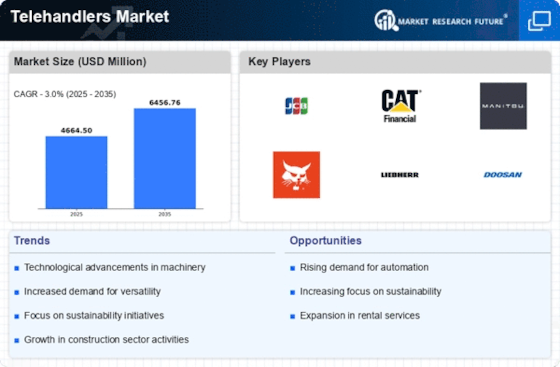
As per MRFR analysis, the Telehandlers Market Size was estimated at 4664.5 USD Million in 2024. The Telehandlers industry is projected to grow from 4804.44 USD Million in 2025 to 6456.76 USD Million by 2035, exhibiting a compound annual growth rate (CAGR) of 3.0 during the forecast period 2025 - 2035.

Key Market Trends & Highlights

The Telehandlers Market is experiencing robust growth driven by technological advancements and increasing demand across various sectors.

  • North America remains the largest market for telehandlers, driven by extensive construction activities.
  • The Asia-Pacific region is emerging as the fastest-growing market, fueled by rapid urbanization and infrastructure development.
  • Hybrid telehandlers dominate the market, while electric telehandlers are gaining traction as the fastest-growing segment.
  • Rising construction activities and infrastructure development initiatives are key drivers propelling market expansion.

Market Size & Forecast

2024 Market Size 4664.5 (USD Million)
2035 Market Size 6456.76 (USD Million)
CAGR (2025 - 2035) 3.0%
Largest Regional Market Share in 2024 Asia Pacific

Major Players

<p>JCB (GB), Caterpillar (US), Manitou (FR), Bobcat (US), Liebherr (DE), Doosan (KR), Merlo (IT), Genie (US), Skyjack (CA)</p>

Market Trends

The Telehandlers Market is currently experiencing a dynamic evolution, driven by advancements in technology and increasing demand across various sectors. The versatility of telehandlers, which can perform multiple functions such as lifting, moving, and placing materials, makes them indispensable in construction, agriculture, and industrial applications. As industries seek to enhance productivity and efficiency, the adoption of telehandlers is likely to rise, reflecting a shift towards more automated and flexible equipment solutions. Furthermore, the growing emphasis on sustainability and eco-friendly practices may influence manufacturers to develop telehandlers that are more energy-efficient and environmentally conscious. In addition to technological advancements, the Telehandlers Market is also shaped by changing consumer preferences and regulatory frameworks. Companies are increasingly focusing on safety features and operator comfort, which could lead to innovations in design and functionality. The integration of smart technologies, such as telematics and IoT capabilities, appears to be a significant trend, enabling real-time monitoring and improved operational efficiency. As the market continues to evolve, stakeholders must remain vigilant to emerging trends and adapt their strategies accordingly to maintain competitiveness in this rapidly changing landscape.

Technological Advancements

The Telehandlers Market is witnessing a surge in technological innovations, particularly in automation and smart features. Manufacturers are increasingly incorporating advanced systems that enhance operational efficiency and safety, such as telematics and remote monitoring capabilities.

Sustainability Focus

There is a growing emphasis on sustainability within the Telehandlers Market, with manufacturers striving to produce more energy-efficient models. This trend reflects a broader industry shift towards environmentally friendly practices and compliance with stricter regulations.

Enhanced Safety Features

Safety remains a paramount concern in the Telehandlers Market, prompting companies to prioritize the development of enhanced safety features. Innovations such as improved visibility, stability systems, and operator assistance technologies are becoming more prevalent.

Telehandlers Market Market Drivers

Technological Innovations

Technological advancements are revolutionizing the Telehandlers Market, leading to the development of more efficient and user-friendly machines. Innovations such as telematics, which provide real-time data on machine performance, are becoming standard features. These technologies enable operators to monitor fuel consumption, maintenance needs, and operational efficiency, thereby reducing downtime and costs. The integration of automation and smart technologies is also enhancing the capabilities of telehandlers, making them more versatile and efficient. As these innovations continue to emerge, the Telehandlers Market is likely to see increased adoption rates, as companies seek to leverage technology for competitive advantage.

Agricultural Sector Growth

The agricultural sector's expansion is significantly influencing the Telehandlers Market. With the increasing need for efficient farming practices, telehandlers are becoming indispensable for tasks such as lifting bales, transporting feed, and handling equipment. The agricultural machinery market is expected to grow at a compound annual growth rate of around 4.2%, which directly correlates with the rising adoption of telehandlers. These machines provide farmers with the ability to perform multiple tasks with a single piece of equipment, thus improving operational efficiency. As the demand for food production rises, the Telehandlers Market is likely to benefit from the agricultural sector's ongoing modernization and mechanization efforts.

Rising Construction Activities

The Telehandlers Market is experiencing a surge in demand due to increasing construction activities across various sectors. As urbanization accelerates, the need for efficient material handling solutions becomes paramount. In 2025, the construction sector is projected to grow at a rate of approximately 5.5% annually, driving the demand for telehandlers. These machines are essential for lifting and transporting heavy materials on construction sites, thereby enhancing productivity. The versatility of telehandlers allows them to operate in diverse environments, from residential buildings to large-scale infrastructure projects. This trend indicates a robust future for the Telehandlers Market, as construction companies seek to optimize their operations and reduce labor costs through mechanization.

Increased Demand for Rental Services

The growing trend of renting equipment rather than purchasing it outright is significantly impacting the Telehandlers Market. Many construction and agricultural companies are opting for rental services to reduce capital expenditure and maintenance costs. The equipment rental market is projected to grow at a rate of approximately 6% annually, indicating a shift in how businesses approach machinery acquisition. Telehandlers Market, with their versatility and efficiency, are among the most sought-after rental equipment. This trend suggests that the Telehandlers Market will continue to thrive as rental services expand, providing companies with flexible solutions to meet their operational needs.

Infrastructure Development Initiatives

Government initiatives aimed at infrastructure development are playing a crucial role in shaping the Telehandlers Market. Investments in transportation, energy, and public facilities are on the rise, with many countries allocating substantial budgets for infrastructure projects. In 2025, it is estimated that infrastructure spending will reach trillions of dollars, creating a favorable environment for telehandler adoption. These machines are vital for moving materials and equipment on large-scale projects, such as highways and bridges. The Telehandlers Market stands to gain from this trend, as contractors increasingly rely on telehandlers to meet project deadlines and enhance operational efficiency.

Market Segment Insights

By technology: Hybrid Telehandlers (Largest) vs. Electric Telehandlers (Fastest-Growing)

<p>The telehandlers market exhibits a significant distribution of market share between hybrid and electric telehandlers. Hybrid telehandlers account for the largest share, driven by their ability to combine traditional and modern power sources, appealing to a wide range of users across construction and agriculture sectors. In contrast, electric telehandlers are rapidly gaining traction due to increasing demand for sustainable and zero-emission machinery, particularly in urban environments and enclosed job sites.</p>

<p>Telehandlers: Hybrid (Dominant) vs. Electric (Emerging)</p>

<p>Hybrid telehandlers are characterized by their versatile operating capabilities and fuel efficiency, making them the dominant technology in the telehandlers market. They are particularly favored in larger construction projects where power and flexibility are paramount. On the other hand, electric telehandlers represent an emerging segment, showcasing advancements in battery technologies and eco-friendly designs. As regulatory pressures around emissions intensify, electric telehandlers are positioned for significant growth, appealing to environmentally conscious operators looking for sustainable solutions without sacrificing performance.</p>

By application: Residential (Largest) vs. Infrastructure (Fastest-Growing)

<p>In the telehandlers market, the application segment is primarily dominated by residential construction, which commands the largest market share due to its extensive utilization in building projects and home renovations. This segment benefits from a consistent demand driven by urbanization and the growing preference for residential developments. On the other hand, the infrastructure sector is witnessing a surge in growth, attributed to increasing public and private investments in infrastructure projects such as roads, bridges, and transportation systems. Telehandlers are becoming integral in these large-scale projects where versatility and lifting capabilities are paramount. The growth trends within this segment highlight a shift towards more advanced telehandler models that cater to the specific needs of both residential and infrastructure applications. Factors such as the need for efficient construction processes, enhanced safety features, and the push towards sustainable building practices are driving demand. The construction industry's focus on reducing time and labor costs further propels the telehandlers' adoption in residential applications, while government initiatives to improve infrastructure continue to enhance the growth potential of this segment.</p>

<p>Residential (Dominant) vs. Infrastructure (Emerging)</p>

<p>The residential application of telehandlers is characterized by its strong presence in construction and renovation projects, necessitating machines that offer flexibility and ease of use in confined spaces. Telehandlers in this segment are often equipped with specialized attachments to handle various tasks, making them a reliable choice for builders and contractors. The dominant nature of this segment is fueled by the shift towards modular and prefabricated construction, which requires efficient material handling solutions. In contrast, the infrastructure application is emerging rapidly as project demands escalate, with telehandlers being deployed in larger quantities for tasks that require heavy lifting and mobility across uneven terrains. This segment focuses on high-capacity machines that can adapt to various construction trends, reflecting the growing need for robust equipment that meets the challenges of large-scale infrastructure projects.</p>

By lifting heights: More than 60' (Largest) vs. Up to 30' (Fastest-Growing)

<p>The lifting heights segment of the Telehandlers Market is significantly characterized by its distribution among three key values: More than 60', 30' - 60', and Up to 30'. The 'More than 60'' segment holds the largest share, appealing to industries that require heavy lifting capabilities, whereas 'Up to 30'' is witnessing rapid growth due to increasing demand in urban construction and renovation projects. The segment between 30' to 60' caters to varied applications but lags in comparative growth rates and market share. Growth trends in the lifting heights segment are being influenced by evolving construction practices and technological advancements. The need for versatile machinery in tighter spaces is driving the popularity of the 'Up to 30'' segment, whereas the robust performance capability of the 'More than 60'' segment continues to dominate sectors such as agriculture and large-scale construction. The market is expected to evolve with innovations in telehandler capabilities, further shaping user preferences and operational demands.</p>

<p>More than 60' (Dominant) vs. Up to 30' (Emerging)</p>

<p>The 'More than 60'' lifting height category is a cornerstone in the Telehandlers Market, designed for high-capacity operations such as heavy lifting on construction sites and outdoor applications. This segment primarily caters to industries requiring significant lifting heights, ensuring that telehandlers perform efficiently in challenging environments. On the other hand, the 'Up to 30'' segment is emerging rapidly, driven by demand in urban construction where space limitations are common. This segment emphasizes maneuverability and adaptability, attracting contractors and companies focused on efficiency and ease-of-use. Both segments are pivotal, but while 'More than 60'' offers established reliability, 'Up to 30'' presents innovative solutions for modern projects.</p>

By product type: Large Telehandlers (Largest) vs. Compact Telehandlers (Fastest-Growing)

<p>In the Telehandlers Market, the product type segment is distinguished between large telehandlers and compact telehandlers, with large telehandlers commanding a major share. Large telehandlers are preferred for their lifting capacity and versatility on construction sites, making them a go-to choice for many contractors who require robust machinery to handle heavy loads. Their ability to operate in various terrains enhances their appeal, ensuring they remain at the forefront of this market segment. Conversely, compact telehandlers are rapidly gaining traction, owing to their maneuverability in confined spaces and lower operational costs. As urban construction projects become more prevalent, the demand for compact telehandlers is driving significant growth, appealing to businesses that prioritize efficiency and space utilization. This trend indicates a shift toward versatile equipment that can adapt to various operational needs in increasingly urbanized environments.</p>

<p>Large Telehandlers (Dominant) vs. Compact Telehandlers (Emerging)</p>

<p>Large telehandlers are characterized by their impressive lift heights and capacities, making them the dominant choice in large-scale construction and infrastructure projects. Typically equipped with powerful engines and advanced hydraulic systems, they excel in handling substantial loads, thereby enhancing productivity on demanding job sites. Their durability and performance in rugged conditions position them as a reliable asset for contractors looking for efficiency and effectiveness. On the other hand, compact telehandlers, while emerging, are tailored for versatility and efficiency in smaller workspaces. Their design prioritizes maneuverability, allowing them to easily navigate tight areas where larger equipment may struggle. With a growing emphasis on urbanization and space constraints, these compact machines offer a practical solution for construction and landscaping projects, combining efficiency with the flexibility to perform a range of tasks. As the market evolves, compact telehandlers are expected to carve out a significant niche, appealing to a broader range of customers.</p>

By ownership: Rental (Largest) vs. Personal (Fastest-Growing)

<p>In the Telehandlers Market, the ownership segment is primarily dominated by the rental category, which accounts for a significant portion of market activity due to its flexibility and lower upfront costs. Rental telehandlers are favored by construction companies and contractors as they allow for the efficient allocation of capital and enable operations to scale as project demands fluctuate. Personal ownership, while smaller in scale, has shown increasing traction among individual users and small businesses seeking to own telehandlers for regular, personalized projects.</p>

<p>Ownership Model: Rental (Dominant) vs. Personal (Emerging)</p>

<p>The rental segment of the Telehandlers Market holds a dominant position primarily because it offers a cost-effective solution for users who require telehandlers intermittently. This model is particularly beneficial for large-scale construction projects that need high-capacity equipment without the burden of maintenance and storage. On the other hand, the personal ownership segment is emerging strongly as it appeals to small business owners and those in niche markets who seek the convenience of having telehandlers readily available for personal use. This trend is driven by the growing demand for flexibility in operations and the potential for customized ownership experiences.</p>

Get more detailed insights about Telehandlers Market Research Report - Global Forecast 2035

Regional Insights

North America : Market Leader in Telehandlers Market

North America is the largest market for telehandlers, accounting for approximately 40% of the global market share. The growth is driven by increasing construction activities, particularly in the U.S. and Canada, where infrastructure projects are on the rise. Regulatory support for construction safety and efficiency is also a significant catalyst, enhancing demand for advanced machinery. The U.S. leads the market, followed by Canada, with key players like Caterpillar, JCB, and Genie dominating the landscape. The competitive environment is characterized by innovation and technological advancements, with companies focusing on enhancing fuel efficiency and operator safety. The presence of established manufacturers ensures a robust supply chain and availability of parts, further supporting market growth.

Europe : Emerging Market Dynamics

Europe is witnessing a significant increase in telehandler demand, holding approximately 30% of the global market share. The growth is fueled by a surge in construction and agricultural activities, particularly in countries like Germany and France. Regulatory frameworks promoting sustainable construction practices are also driving the adoption of telehandlers, as they offer versatility and efficiency in various applications. Germany is the largest market in Europe, followed by France and the UK. Key players such as Manitou and Liebherr are at the forefront, focusing on innovation and sustainability. The competitive landscape is marked by collaborations and partnerships aimed at enhancing product offerings. The presence of a skilled workforce and advanced manufacturing capabilities further strengthens the region's market position.

Asia-Pacific : Rapid Growth in Emerging Markets

Asia-Pacific is rapidly emerging as a significant player in the telehandler market, accounting for about 25% of the global share. The region's growth is driven by urbanization, infrastructure development, and increasing agricultural mechanization, particularly in countries like China and India. Government initiatives aimed at enhancing infrastructure are acting as key catalysts for market expansion. China is the largest market in the region, followed by India and Australia. The competitive landscape features both global and local players, with companies like Doosan and Merlo making substantial inroads. The focus on innovation and cost-effective solutions is shaping the market, as manufacturers strive to meet the diverse needs of various sectors, including construction and agriculture.

Middle East and Africa : Untapped Market Potential

The Middle East and Africa region is gradually emerging in the telehandler market, holding around 5% of the global share. The growth is primarily driven by increasing investments in infrastructure and construction projects, particularly in the Gulf Cooperation Council (GCC) countries. Regulatory support for construction safety and efficiency is also enhancing the demand for telehandlers in this region. The UAE and South Africa are the leading markets, with significant contributions from local and international players. Companies like Bobcat and Skyjack are expanding their presence, focusing on meeting the unique demands of the region. The competitive landscape is evolving, with a growing emphasis on sustainability and innovation, positioning the region for future growth.

Key Companies in the Telehandlers Market market include

Industry Developments

  • In 2020, the Linamar corporation has completed its acquisition with the MacDon for designing the agricultural harvesting equipment
  • In 2019, the CLAAS has launched the SCORPION range which can lift the 960 with a 6.5 t lifting capacity.

Market overview

  • Overall growth analysis of the market
  • Pandemic analysis
  • Market dynamics
  • Cumulative growth analysis
  • Value chain analysis
  • Market segmentation
  • Competitive landscape
  • Regional analysis
  • Key players
  • Recent updates

Future Outlook

Telehandlers Market Future Outlook

<p>The Telehandlers Market is projected to grow at a 3.0% CAGR from 2024 to 2035, driven by increased construction activities, technological advancements, and rising demand for material handling solutions.</p>

New opportunities lie in:

  • <p>Development of electric telehandlers for eco-friendly operations.</p>
  • <p>Integration of telematics for enhanced fleet management.</p>
  • <p>Expansion into emerging markets with tailored product offerings.</p>

<p>By 2035, the Telehandlers Market is expected to achieve robust growth, reflecting evolving industry needs and technological innovations.</p>

Market Segmentation

Telehandlers Market ownership Outlook

  • Personal
  • Rental

Telehandlers Market technology Outlook

  • Hybrid telehandlers
  • Electric telehandlers

Telehandlers Market application Outlook

  • Residential
  • Infrastructure
  • Non – residential

Telehandlers Market product type Outlook

  • Large telehandlers
  • Compact telehandlers

Telehandlers Market lifting heights Outlook

  • More than 60'
  • 30' - 60'
  • Up to 30'

Report Scope

MARKET SIZE 20244664.5(USD Million)
MARKET SIZE 20254804.44(USD Million)
MARKET SIZE 20356456.76(USD Million)
COMPOUND ANNUAL GROWTH RATE (CAGR)3.0% (2024 - 2035)
REPORT COVERAGERevenue Forecast, Competitive Landscape, Growth Factors, and Trends
BASE YEAR2024
Market Forecast Period2025 - 2035
Historical Data2019 - 2024
Market Forecast UnitsUSD Million
Key Companies ProfiledMarket analysis in progress
Segments CoveredMarket segmentation analysis in progress
Key Market OpportunitiesIntegration of advanced automation and telematics in the Telehandlers Market enhances operational efficiency and safety.
Key Market DynamicsRising demand for versatile lifting solutions drives innovation and competition in the telehandlers market.
Countries CoveredNorth America, Europe, APAC, South America, MEA

FAQs

What is the projected market valuation of the Telehandlers Market by 2035?

The Telehandlers Market is projected to reach a valuation of 6456.76 USD Million by 2035.

What was the market valuation of the Telehandlers Market in 2024?

In 2024, the Telehandlers Market was valued at 4664.5 USD Million.

What is the expected CAGR for the Telehandlers Market during the forecast period 2025 - 2035?

The expected CAGR for the Telehandlers Market during the forecast period 2025 - 2035 is 3.0%.

Which companies are considered key players in the Telehandlers Market?

Key players in the Telehandlers Market include JCB, Caterpillar, Manitou, Bobcat, Liebherr, Doosan, Merlo, Genie, and Skyjack.

What are the projected revenues for hybrid telehandlers by 2035?

The projected revenues for hybrid telehandlers are expected to reach 2656.76 USD Million by 2035.

  1. SECTION I: EXECUTIVE SUMMARY AND KEY HIGHLIGHTS
    1. EXECUTIVE SUMMARY
      1. Market Overview
      2. Key Findings
      3. Market Segmentation
      4. Competitive Landscape
      5. Challenges and Opportunities
      6. Future Outlook
  2. SECTION II: SCOPING, METHODOLOGY AND MARKET STRUCTURE
    1. MARKET INTRODUCTION
      1. Definition
      2. Scope of the study
    2. RESEARCH METHODOLOGY
      1. Overview
      2. Data Mining
      3. Secondary Research
      4. Primary Research
      5. Forecasting Model
      6. Market Size Estimation
      7. Data Triangulation
      8. Validation
  3. SECTION III: QUALITATIVE ANALYSIS
    1. MARKET DYNAMICS
      1. Overview
      2. Drivers
      3. Restraints
      4. Opportunities
    2. MARKET FACTOR ANALYSIS
      1. Value chain Analysis
      2. Porter's Five Forces Analysis
      3. COVID-19 Impact Analysis
  4. SECTION IV: QUANTITATIVE ANALYSIS
    1. Packaging & Transport, BY technology (USD Million)
      1. Hybrid telehandlers
      2. Electric telehandlers
    2. Packaging & Transport, BY application (USD Million)
      1. Residential
      2. Infrastructure
      3. Non – residential
    3. Packaging & Transport, BY lifting heights (USD Million)
      1. More than 60'
      2. 30' - 60'
      3. Up to 30'
    4. Packaging & Transport, BY product type (USD Million)
      1. Large telehandlers
      2. Compact telehandlers
    5. Packaging & Transport, BY ownership (USD Million)
      1. Personal
      2. Rental
    6. Packaging & Transport, BY Region (USD Million)
      1. North America
      2. Europe
      3. APAC
      4. South America
      5. MEA
  5. SECTION V: COMPETITIVE ANALYSIS
    1. Competitive Landscape
      1. Overview
      2. Competitive Analysis
      3. Market share Analysis
      4. Major Growth Strategy in the Packaging & Transport
      5. Competitive Benchmarking
      6. Leading Players in Terms of Number of Developments in the Packaging & Transport
      7. Key developments and growth strategies
      8. Major Players Financial Matrix
    2. Company Profiles
      1. JCB (GB)
      2. Caterpillar (US)
      3. Manitou (FR)
      4. Bobcat (US)
      5. Liebherr (DE)
      6. Doosan (KR)
      7. Merlo (IT)
      8. Genie (US)
      9. Skyjack (CA)
    3. Appendix
      1. References
      2. Related Reports
  6. LIST OF FIGURES
    1. MARKET SYNOPSIS
    2. NORTH AMERICA MARKET ANALYSIS
    3. US MARKET ANALYSIS BY TECHNOLOGY
    4. US MARKET ANALYSIS BY APPLICATION
    5. US MARKET ANALYSIS BY LIFTING HEIGHTS
    6. US MARKET ANALYSIS BY PRODUCT TYPE
    7. US MARKET ANALYSIS BY OWNERSHIP
    8. CANADA MARKET ANALYSIS BY TECHNOLOGY
    9. CANADA MARKET ANALYSIS BY APPLICATION
    10. CANADA MARKET ANALYSIS BY LIFTING HEIGHTS
    11. CANADA MARKET ANALYSIS BY PRODUCT TYPE
    12. CANADA MARKET ANALYSIS BY OWNERSHIP
    13. EUROPE MARKET ANALYSIS
    14. GERMANY MARKET ANALYSIS BY TECHNOLOGY
    15. GERMANY MARKET ANALYSIS BY APPLICATION
    16. GERMANY MARKET ANALYSIS BY LIFTING HEIGHTS
    17. GERMANY MARKET ANALYSIS BY PRODUCT TYPE
    18. GERMANY MARKET ANALYSIS BY OWNERSHIP
    19. UK MARKET ANALYSIS BY TECHNOLOGY
    20. UK MARKET ANALYSIS BY APPLICATION
    21. UK MARKET ANALYSIS BY LIFTING HEIGHTS
    22. UK MARKET ANALYSIS BY PRODUCT TYPE
    23. UK MARKET ANALYSIS BY OWNERSHIP
    24. FRANCE MARKET ANALYSIS BY TECHNOLOGY
    25. FRANCE MARKET ANALYSIS BY APPLICATION
    26. FRANCE MARKET ANALYSIS BY LIFTING HEIGHTS
    27. FRANCE MARKET ANALYSIS BY PRODUCT TYPE
    28. FRANCE MARKET ANALYSIS BY OWNERSHIP
    29. RUSSIA MARKET ANALYSIS BY TECHNOLOGY
    30. RUSSIA MARKET ANALYSIS BY APPLICATION
    31. RUSSIA MARKET ANALYSIS BY LIFTING HEIGHTS
    32. RUSSIA MARKET ANALYSIS BY PRODUCT TYPE
    33. RUSSIA MARKET ANALYSIS BY OWNERSHIP
    34. ITALY MARKET ANALYSIS BY TECHNOLOGY
    35. ITALY MARKET ANALYSIS BY APPLICATION
    36. ITALY MARKET ANALYSIS BY LIFTING HEIGHTS
    37. ITALY MARKET ANALYSIS BY PRODUCT TYPE
    38. ITALY MARKET ANALYSIS BY OWNERSHIP
    39. SPAIN MARKET ANALYSIS BY TECHNOLOGY
    40. SPAIN MARKET ANALYSIS BY APPLICATION
    41. SPAIN MARKET ANALYSIS BY LIFTING HEIGHTS
    42. SPAIN MARKET ANALYSIS BY PRODUCT TYPE
    43. SPAIN MARKET ANALYSIS BY OWNERSHIP
    44. REST OF EUROPE MARKET ANALYSIS BY TECHNOLOGY
    45. REST OF EUROPE MARKET ANALYSIS BY APPLICATION
    46. REST OF EUROPE MARKET ANALYSIS BY LIFTING HEIGHTS
    47. REST OF EUROPE MARKET ANALYSIS BY PRODUCT TYPE
    48. REST OF EUROPE MARKET ANALYSIS BY OWNERSHIP
    49. APAC MARKET ANALYSIS
    50. CHINA MARKET ANALYSIS BY TECHNOLOGY
    51. CHINA MARKET ANALYSIS BY APPLICATION
    52. CHINA MARKET ANALYSIS BY LIFTING HEIGHTS
    53. CHINA MARKET ANALYSIS BY PRODUCT TYPE
    54. CHINA MARKET ANALYSIS BY OWNERSHIP
    55. INDIA MARKET ANALYSIS BY TECHNOLOGY
    56. INDIA MARKET ANALYSIS BY APPLICATION
    57. INDIA MARKET ANALYSIS BY LIFTING HEIGHTS
    58. INDIA MARKET ANALYSIS BY PRODUCT TYPE
    59. INDIA MARKET ANALYSIS BY OWNERSHIP
    60. JAPAN MARKET ANALYSIS BY TECHNOLOGY
    61. JAPAN MARKET ANALYSIS BY APPLICATION
    62. JAPAN MARKET ANALYSIS BY LIFTING HEIGHTS
    63. JAPAN MARKET ANALYSIS BY PRODUCT TYPE
    64. JAPAN MARKET ANALYSIS BY OWNERSHIP
    65. SOUTH KOREA MARKET ANALYSIS BY TECHNOLOGY
    66. SOUTH KOREA MARKET ANALYSIS BY APPLICATION
    67. SOUTH KOREA MARKET ANALYSIS BY LIFTING HEIGHTS
    68. SOUTH KOREA MARKET ANALYSIS BY PRODUCT TYPE
    69. SOUTH KOREA MARKET ANALYSIS BY OWNERSHIP
    70. MALAYSIA MARKET ANALYSIS BY TECHNOLOGY
    71. MALAYSIA MARKET ANALYSIS BY APPLICATION
    72. MALAYSIA MARKET ANALYSIS BY LIFTING HEIGHTS
    73. MALAYSIA MARKET ANALYSIS BY PRODUCT TYPE
    74. MALAYSIA MARKET ANALYSIS BY OWNERSHIP
    75. THAILAND MARKET ANALYSIS BY TECHNOLOGY
    76. THAILAND MARKET ANALYSIS BY APPLICATION
    77. THAILAND MARKET ANALYSIS BY LIFTING HEIGHTS
    78. THAILAND MARKET ANALYSIS BY PRODUCT TYPE
    79. THAILAND MARKET ANALYSIS BY OWNERSHIP
    80. INDONESIA MARKET ANALYSIS BY TECHNOLOGY
    81. INDONESIA MARKET ANALYSIS BY APPLICATION
    82. INDONESIA MARKET ANALYSIS BY LIFTING HEIGHTS
    83. INDONESIA MARKET ANALYSIS BY PRODUCT TYPE
    84. INDONESIA MARKET ANALYSIS BY OWNERSHIP
    85. REST OF APAC MARKET ANALYSIS BY TECHNOLOGY
    86. REST OF APAC MARKET ANALYSIS BY APPLICATION
    87. REST OF APAC MARKET ANALYSIS BY LIFTING HEIGHTS
    88. REST OF APAC MARKET ANALYSIS BY PRODUCT TYPE
    89. REST OF APAC MARKET ANALYSIS BY OWNERSHIP
    90. SOUTH AMERICA MARKET ANALYSIS
    91. BRAZIL MARKET ANALYSIS BY TECHNOLOGY
    92. BRAZIL MARKET ANALYSIS BY APPLICATION
    93. BRAZIL MARKET ANALYSIS BY LIFTING HEIGHTS
    94. BRAZIL MARKET ANALYSIS BY PRODUCT TYPE
    95. BRAZIL MARKET ANALYSIS BY OWNERSHIP
    96. MEXICO MARKET ANALYSIS BY TECHNOLOGY
    97. MEXICO MARKET ANALYSIS BY APPLICATION
    98. MEXICO MARKET ANALYSIS BY LIFTING HEIGHTS
    99. MEXICO MARKET ANALYSIS BY PRODUCT TYPE
    100. MEXICO MARKET ANALYSIS BY OWNERSHIP
    101. ARGENTINA MARKET ANALYSIS BY TECHNOLOGY
    102. ARGENTINA MARKET ANALYSIS BY APPLICATION
    103. ARGENTINA MARKET ANALYSIS BY LIFTING HEIGHTS
    104. ARGENTINA MARKET ANALYSIS BY PRODUCT TYPE
    105. ARGENTINA MARKET ANALYSIS BY OWNERSHIP
    106. REST OF SOUTH AMERICA MARKET ANALYSIS BY TECHNOLOGY
    107. REST OF SOUTH AMERICA MARKET ANALYSIS BY APPLICATION
    108. REST OF SOUTH AMERICA MARKET ANALYSIS BY LIFTING HEIGHTS
    109. REST OF SOUTH AMERICA MARKET ANALYSIS BY PRODUCT TYPE
    110. REST OF SOUTH AMERICA MARKET ANALYSIS BY OWNERSHIP
    111. MEA MARKET ANALYSIS
    112. GCC COUNTRIES MARKET ANALYSIS BY TECHNOLOGY
    113. GCC COUNTRIES MARKET ANALYSIS BY APPLICATION
    114. GCC COUNTRIES MARKET ANALYSIS BY LIFTING HEIGHTS
    115. GCC COUNTRIES MARKET ANALYSIS BY PRODUCT TYPE
    116. GCC COUNTRIES MARKET ANALYSIS BY OWNERSHIP
    117. SOUTH AFRICA MARKET ANALYSIS BY TECHNOLOGY
    118. SOUTH AFRICA MARKET ANALYSIS BY APPLICATION
    119. SOUTH AFRICA MARKET ANALYSIS BY LIFTING HEIGHTS
    120. SOUTH AFRICA MARKET ANALYSIS BY PRODUCT TYPE
    121. SOUTH AFRICA MARKET ANALYSIS BY OWNERSHIP
    122. REST OF MEA MARKET ANALYSIS BY TECHNOLOGY
    123. REST OF MEA MARKET ANALYSIS BY APPLICATION
    124. REST OF MEA MARKET ANALYSIS BY LIFTING HEIGHTS
    125. REST OF MEA MARKET ANALYSIS BY PRODUCT TYPE
    126. REST OF MEA MARKET ANALYSIS BY OWNERSHIP
    127. KEY BUYING CRITERIA OF PACKAGING & TRANSPORT
    128. RESEARCH PROCESS OF MRFR
    129. DRO ANALYSIS OF PACKAGING & TRANSPORT
    130. DRIVERS IMPACT ANALYSIS: PACKAGING & TRANSPORT
    131. RESTRAINTS IMPACT ANALYSIS: PACKAGING & TRANSPORT
    132. SUPPLY / VALUE CHAIN: PACKAGING & TRANSPORT
    133. PACKAGING & TRANSPORT, BY TECHNOLOGY, 2024 (% SHARE)
    134. PACKAGING & TRANSPORT, BY TECHNOLOGY, 2024 TO 2035 (USD Million)
    135. PACKAGING & TRANSPORT, BY APPLICATION, 2024 (% SHARE)
    136. PACKAGING & TRANSPORT, BY APPLICATION, 2024 TO 2035 (USD Million)
    137. PACKAGING & TRANSPORT, BY LIFTING HEIGHTS, 2024 (% SHARE)
    138. PACKAGING & TRANSPORT, BY LIFTING HEIGHTS, 2024 TO 2035 (USD Million)
    139. PACKAGING & TRANSPORT, BY PRODUCT TYPE, 2024 (% SHARE)
    140. PACKAGING & TRANSPORT, BY PRODUCT TYPE, 2024 TO 2035 (USD Million)
    141. PACKAGING & TRANSPORT, BY OWNERSHIP, 2024 (% SHARE)
    142. PACKAGING & TRANSPORT, BY OWNERSHIP, 2024 TO 2035 (USD Million)
    143. BENCHMARKING OF MAJOR COMPETITORS
  7. LIST OF TABLES
    1. LIST OF ASSUMPTIONS
    2. North America MARKET SIZE ESTIMATES; FORECAST
      1. BY TECHNOLOGY, 2025-2035 (USD Million)
      2. BY APPLICATION, 2025-2035 (USD Million)
      3. BY LIFTING HEIGHTS, 2025-2035 (USD Million)
      4. BY PRODUCT TYPE, 2025-2035 (USD Million)
      5. BY OWNERSHIP, 2025-2035 (USD Million)
    3. US MARKET SIZE ESTIMATES; FORECAST
      1. BY TECHNOLOGY, 2025-2035 (USD Million)
      2. BY APPLICATION, 2025-2035 (USD Million)
      3. BY LIFTING HEIGHTS, 2025-2035 (USD Million)
      4. BY PRODUCT TYPE, 2025-2035 (USD Million)
      5. BY OWNERSHIP, 2025-2035 (USD Million)
    4. Canada MARKET SIZE ESTIMATES; FORECAST
      1. BY TECHNOLOGY, 2025-2035 (USD Million)
      2. BY APPLICATION, 2025-2035 (USD Million)
      3. BY LIFTING HEIGHTS, 2025-2035 (USD Million)
      4. BY PRODUCT TYPE, 2025-2035 (USD Million)
      5. BY OWNERSHIP, 2025-2035 (USD Million)
    5. Europe MARKET SIZE ESTIMATES; FORECAST
      1. BY TECHNOLOGY, 2025-2035 (USD Million)
      2. BY APPLICATION, 2025-2035 (USD Million)
      3. BY LIFTING HEIGHTS, 2025-2035 (USD Million)
      4. BY PRODUCT TYPE, 2025-2035 (USD Million)
      5. BY OWNERSHIP, 2025-2035 (USD Million)
    6. Germany MARKET SIZE ESTIMATES; FORECAST
      1. BY TECHNOLOGY, 2025-2035 (USD Million)
      2. BY APPLICATION, 2025-2035 (USD Million)
      3. BY LIFTING HEIGHTS, 2025-2035 (USD Million)
      4. BY PRODUCT TYPE, 2025-2035 (USD Million)
      5. BY OWNERSHIP, 2025-2035 (USD Million)
    7. UK MARKET SIZE ESTIMATES; FORECAST
      1. BY TECHNOLOGY, 2025-2035 (USD Million)
      2. BY APPLICATION, 2025-2035 (USD Million)
      3. BY LIFTING HEIGHTS, 2025-2035 (USD Million)
      4. BY PRODUCT TYPE, 2025-2035 (USD Million)
      5. BY OWNERSHIP, 2025-2035 (USD Million)
    8. France MARKET SIZE ESTIMATES; FORECAST
      1. BY TECHNOLOGY, 2025-2035 (USD Million)
      2. BY APPLICATION, 2025-2035 (USD Million)
      3. BY LIFTING HEIGHTS, 2025-2035 (USD Million)
      4. BY PRODUCT TYPE, 2025-2035 (USD Million)
      5. BY OWNERSHIP, 2025-2035 (USD Million)
    9. Russia MARKET SIZE ESTIMATES; FORECAST
      1. BY TECHNOLOGY, 2025-2035 (USD Million)
      2. BY APPLICATION, 2025-2035 (USD Million)
      3. BY LIFTING HEIGHTS, 2025-2035 (USD Million)
      4. BY PRODUCT TYPE, 2025-2035 (USD Million)
      5. BY OWNERSHIP, 2025-2035 (USD Million)
    10. Italy MARKET SIZE ESTIMATES; FORECAST
      1. BY TECHNOLOGY, 2025-2035 (USD Million)
      2. BY APPLICATION, 2025-2035 (USD Million)
      3. BY LIFTING HEIGHTS, 2025-2035 (USD Million)
      4. BY PRODUCT TYPE, 2025-2035 (USD Million)
      5. BY OWNERSHIP, 2025-2035 (USD Million)
    11. Spain MARKET SIZE ESTIMATES; FORECAST
      1. BY TECHNOLOGY, 2025-2035 (USD Million)
      2. BY APPLICATION, 2025-2035 (USD Million)
      3. BY LIFTING HEIGHTS, 2025-2035 (USD Million)
      4. BY PRODUCT TYPE, 2025-2035 (USD Million)
      5. BY OWNERSHIP, 2025-2035 (USD Million)
    12. Rest of Europe MARKET SIZE ESTIMATES; FORECAST
      1. BY TECHNOLOGY, 2025-2035 (USD Million)
      2. BY APPLICATION, 2025-2035 (USD Million)
      3. BY LIFTING HEIGHTS, 2025-2035 (USD Million)
      4. BY PRODUCT TYPE, 2025-2035 (USD Million)
      5. BY OWNERSHIP, 2025-2035 (USD Million)
    13. APAC MARKET SIZE ESTIMATES; FORECAST
      1. BY TECHNOLOGY, 2025-2035 (USD Million)
      2. BY APPLICATION, 2025-2035 (USD Million)
      3. BY LIFTING HEIGHTS, 2025-2035 (USD Million)
      4. BY PRODUCT TYPE, 2025-2035 (USD Million)
      5. BY OWNERSHIP, 2025-2035 (USD Million)
    14. China MARKET SIZE ESTIMATES; FORECAST
      1. BY TECHNOLOGY, 2025-2035 (USD Million)
      2. BY APPLICATION, 2025-2035 (USD Million)
      3. BY LIFTING HEIGHTS, 2025-2035 (USD Million)
      4. BY PRODUCT TYPE, 2025-2035 (USD Million)
      5. BY OWNERSHIP, 2025-2035 (USD Million)
    15. India MARKET SIZE ESTIMATES; FORECAST
      1. BY TECHNOLOGY, 2025-2035 (USD Million)
      2. BY APPLICATION, 2025-2035 (USD Million)
      3. BY LIFTING HEIGHTS, 2025-2035 (USD Million)
      4. BY PRODUCT TYPE, 2025-2035 (USD Million)
      5. BY OWNERSHIP, 2025-2035 (USD Million)
    16. Japan MARKET SIZE ESTIMATES; FORECAST
      1. BY TECHNOLOGY, 2025-2035 (USD Million)
      2. BY APPLICATION, 2025-2035 (USD Million)
      3. BY LIFTING HEIGHTS, 2025-2035 (USD Million)
      4. BY PRODUCT TYPE, 2025-2035 (USD Million)
      5. BY OWNERSHIP, 2025-2035 (USD Million)
    17. South Korea MARKET SIZE ESTIMATES; FORECAST
      1. BY TECHNOLOGY, 2025-2035 (USD Million)
      2. BY APPLICATION, 2025-2035 (USD Million)
      3. BY LIFTING HEIGHTS, 2025-2035 (USD Million)
      4. BY PRODUCT TYPE, 2025-2035 (USD Million)
      5. BY OWNERSHIP, 2025-2035 (USD Million)
    18. Malaysia MARKET SIZE ESTIMATES; FORECAST
      1. BY TECHNOLOGY, 2025-2035 (USD Million)
      2. BY APPLICATION, 2025-2035 (USD Million)
      3. BY LIFTING HEIGHTS, 2025-2035 (USD Million)
      4. BY PRODUCT TYPE, 2025-2035 (USD Million)
      5. BY OWNERSHIP, 2025-2035 (USD Million)
    19. Thailand MARKET SIZE ESTIMATES; FORECAST
      1. BY TECHNOLOGY, 2025-2035 (USD Million)
      2. BY APPLICATION, 2025-2035 (USD Million)
      3. BY LIFTING HEIGHTS, 2025-2035 (USD Million)
      4. BY PRODUCT TYPE, 2025-2035 (USD Million)
      5. BY OWNERSHIP, 2025-2035 (USD Million)
    20. Indonesia MARKET SIZE ESTIMATES; FORECAST
      1. BY TECHNOLOGY, 2025-2035 (USD Million)
      2. BY APPLICATION, 2025-2035 (USD Million)
      3. BY LIFTING HEIGHTS, 2025-2035 (USD Million)
      4. BY PRODUCT TYPE, 2025-2035 (USD Million)
      5. BY OWNERSHIP, 2025-2035 (USD Million)
    21. Rest of APAC MARKET SIZE ESTIMATES; FORECAST
      1. BY TECHNOLOGY, 2025-2035 (USD Million)
      2. BY APPLICATION, 2025-2035 (USD Million)
      3. BY LIFTING HEIGHTS, 2025-2035 (USD Million)
      4. BY PRODUCT TYPE, 2025-2035 (USD Million)
      5. BY OWNERSHIP, 2025-2035 (USD Million)
    22. South America MARKET SIZE ESTIMATES; FORECAST
      1. BY TECHNOLOGY, 2025-2035 (USD Million)
      2. BY APPLICATION, 2025-2035 (USD Million)
      3. BY LIFTING HEIGHTS, 2025-2035 (USD Million)
      4. BY PRODUCT TYPE, 2025-2035 (USD Million)
      5. BY OWNERSHIP, 2025-2035 (USD Million)
    23. Brazil MARKET SIZE ESTIMATES; FORECAST
      1. BY TECHNOLOGY, 2025-2035 (USD Million)
      2. BY APPLICATION, 2025-2035 (USD Million)
      3. BY LIFTING HEIGHTS, 2025-2035 (USD Million)
      4. BY PRODUCT TYPE, 2025-2035 (USD Million)
      5. BY OWNERSHIP, 2025-2035 (USD Million)
    24. Mexico MARKET SIZE ESTIMATES; FORECAST
      1. BY TECHNOLOGY, 2025-2035 (USD Million)
      2. BY APPLICATION, 2025-2035 (USD Million)
      3. BY LIFTING HEIGHTS, 2025-2035 (USD Million)
      4. BY PRODUCT TYPE, 2025-2035 (USD Million)
      5. BY OWNERSHIP, 2025-2035 (USD Million)
    25. Argentina MARKET SIZE ESTIMATES; FORECAST
      1. BY TECHNOLOGY, 2025-2035 (USD Million)
      2. BY APPLICATION, 2025-2035 (USD Million)
      3. BY LIFTING HEIGHTS, 2025-2035 (USD Million)
      4. BY PRODUCT TYPE, 2025-2035 (USD Million)
      5. BY OWNERSHIP, 2025-2035 (USD Million)
    26. Rest of South America MARKET SIZE ESTIMATES; FORECAST
      1. BY TECHNOLOGY, 2025-2035 (USD Million)
      2. BY APPLICATION, 2025-2035 (USD Million)
      3. BY LIFTING HEIGHTS, 2025-2035 (USD Million)
      4. BY PRODUCT TYPE, 2025-2035 (USD Million)
      5. BY OWNERSHIP, 2025-2035 (USD Million)
    27. MEA MARKET SIZE ESTIMATES; FORECAST
      1. BY TECHNOLOGY, 2025-2035 (USD Million)
      2. BY APPLICATION, 2025-2035 (USD Million)
      3. BY LIFTING HEIGHTS, 2025-2035 (USD Million)
      4. BY PRODUCT TYPE, 2025-2035 (USD Million)
      5. BY OWNERSHIP, 2025-2035 (USD Million)
    28. GCC Countries MARKET SIZE ESTIMATES; FORECAST
      1. BY TECHNOLOGY, 2025-2035 (USD Million)
      2. BY APPLICATION, 2025-2035 (USD Million)
      3. BY LIFTING HEIGHTS, 2025-2035 (USD Million)
      4. BY PRODUCT TYPE, 2025-2035 (USD Million)
      5. BY OWNERSHIP, 2025-2035 (USD Million)
    29. South Africa MARKET SIZE ESTIMATES; FORECAST
      1. BY TECHNOLOGY, 2025-2035 (USD Million)
      2. BY APPLICATION, 2025-2035 (USD Million)
      3. BY LIFTING HEIGHTS, 2025-2035 (USD Million)
      4. BY PRODUCT TYPE, 2025-2035 (USD Million)
      5. BY OWNERSHIP, 2025-2035 (USD Million)
    30. Rest of MEA MARKET SIZE ESTIMATES; FORECAST
      1. BY TECHNOLOGY, 2025-2035 (USD Million)
      2. BY APPLICATION, 2025-2035 (USD Million)
      3. BY LIFTING HEIGHTS, 2025-2035 (USD Million)
      4. BY PRODUCT TYPE, 2025-2035 (USD Million)
      5. BY OWNERSHIP, 2025-2035 (USD Million)
    31. PRODUCT LAUNCH/PRODUCT DEVELOPMENT/APPROVAL
    32. ACQUISITION/PARTNERSHIP

Telehandlers Market Segmentation

Market Segmentation Overview

  • Detailed segmentation data will be available in the full report
  • Comprehensive analysis by multiple parameters
  • Regional and country-level breakdowns
  • Market size forecasts by segment
Infographic

Free Sample Request

Kindly complete the form below to receive a free sample of this Report

Get Free Sample

Customer Strories

Compare Licence

×
Features License Type
Single User Multiuser License Enterprise User
Price $4,950 $5,950 $7,250
Maximum User Access Limit 1 User Upto 10 Users Unrestricted Access Throughout the Organization
Free Customization
Direct Access to Analyst
Deliverable Format
Platform Access
Discount on Next Purchase 10% 15% 15%
Printable Versions