


Market Share
Teledermatology Market Share Analysis
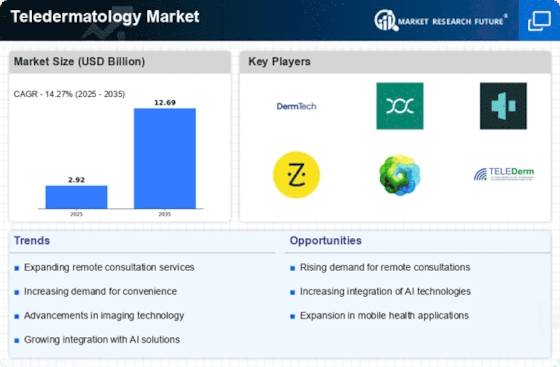
The market of the Teledermatology is growing fast which can be attributed to innovations in IT sphere and rising popularity of distance healthcare programs. To gain leading positions in this niche market, companies require powerful positioning strategies. Firms should consider the use of advanced imaging technologies as well high-resolution cameras to enable accurate and detailed visual assessment at all times. User-Friendly Platforms for Both Patients and Dermatologists: To become popular, developing user-friendly platforms is a necessity. The best teledermatology solutions should
be easily accessible for both patients and dermatologists, facilitating smooth communication as well as the uploading of images without hassle along with ready access to medical records. Security is also high in healthcare, especially when you deal with sensitive patient information. Teledermatology companies should focus on HIPAA compliant security measures in order to gain patients’ and doctors’ trust, which equals the confidentiality of medical data. Integrating with EHR systems seamlessly is a strategic initiative. Teledermatology solutions should also enable the easy transfer of patient data from one platform to another, reducing administrative tasks for healthcare providers and enhancing overall coordination in care. With the increasing use of smartphones, availability via mobile app is a necessity. The companies should come up with mobile apps that enable patients to easily contact dermatologists, photo take and upload these images all without much strain thus accelerating the use of teledermatology services. This is a growing trend with it incorporating remote monitoring features. As teledermatology solutions enable constant observation of skin conditions, healthcare providers will develop real-time data for proactive actions and benefit from enhanced patients’ care beyond the long term. Collaborating with dermatology practices is a strategic alliance. Teledermatology companies can take advantage of existing networks with established dermatologists thus achieving endorsements by them and increasing their outreach in terms of patient numbers. Emphasizing the positive aspects of teledermatology and encouraging patients’ involvement is necessary. Appropriate educational measures should help to make people conscious about their skin health, encourage and enable them to control it while increasing demand for distant dermatology consultations. Regulatory standards and licensing requirements must be complied with. Teledermatology companies must navigate through the complex regulatory framework, ensuring that their solutions are in line with local and global standards to achieve wide acceptance. Market penetration is characterized by a high emphasis on cost- effectiveness. Teledermatology solutions should not be costly to the extent that they would compete favorably with those who are traditionally seeking in-person consultations while at the same time enabling clients and patients served through referrals find a more affordable route. Advocating for favorable telemedicine policies is a proactive strategy. Teledermatology companies can engage with policymakers to shape regulations that support the widespread adoption of remote dermatological services, creating an enabling environment for market growth.






















Leave a Comment