• Cat-intel
  • MedIntelliX
  • Resources
  • About Us
  • Request Free Sample ×

    Kindly complete the form below to receive a free sample of this Report

    Leading companies partner with us for data-driven Insights

    clients tt-cursor
    Hero Background

    Gout Market

    ID: MRFR/HC/4453-CR
    128 Pages
    Rahul Gotadki
    August 2023

    Gout Market Research Report Information By Treatment and Diagnosis (Diagnosis, Treatment (NSAIDs, Corticosteroids, Colchicine, Urate-Lowering Agents, Others)), Application (Acute Gout, Chronic Gout), End User (Hospitals & Clinics, Specialty Centers, Others) and Region (North America, Europe, Asia-Pacific, and Rest of the World)—Forecast till 2035

    Share:
    Download PDF ×

    We do not share your information with anyone. However, we may send you emails based on your report interest from time to time. You may contact us at any time to opt-out.

    Gout Market Infographic
    Purchase Options

    Gout Market Summary

    As per MRFR analysis, the Gout Market Size was estimated at 5.666 USD Billion in 2024. The Gout industry is projected to grow from 6.331 USD Billion in 2025 to 19.23 USD Billion by 2035, exhibiting a compound annual growth rate (CAGR) of 11.75 during the forecast period 2025 - 2035.

    Key Market Trends & Highlights

    The Gout Market is experiencing a dynamic shift driven by increased awareness and innovative treatment options.

    • North America remains the largest market for gout treatments, reflecting a robust healthcare infrastructure and high prevalence rates.
    • The Asia-Pacific region is emerging as the fastest-growing market, fueled by rising healthcare investments and increasing awareness of gout.
    • Urate-lowering agents dominate the market, while NSAIDs are witnessing rapid growth due to their effectiveness in acute pain management.
    • The increasing prevalence of gout and advancements in diagnostic techniques are key drivers propelling market expansion.

    Market Size & Forecast

    2024 Market Size 5.666 (USD Billion)
    2035 Market Size 19.23 (USD Billion)
    CAGR (2025 - 2035) 11.75%

    Major Players

    AstraZeneca (GB), Novartis (CH), Takeda (JP), Amgen (US), Sanofi (FR), Pfizer (US), Horizon Therapeutics (IE), Bristol-Myers Squibb (US)

    Gout Market Trends

    The Gout Market is currently experiencing notable transformations driven by various factors. Increasing awareness regarding the condition, characterized by painful inflammation of joints, has led to a rise in diagnosis and treatment options. Healthcare professionals are emphasizing the importance of early intervention, which appears to be influencing patient outcomes positively. Furthermore, advancements in pharmaceutical research are yielding innovative therapies that target the underlying causes of gout, potentially improving the quality of life for those affected. As a result, the market is witnessing a shift towards more effective and personalized treatment regimens. In addition to pharmaceutical developments, lifestyle modifications are gaining traction among patients. Dietary changes and increased physical activity are being recognized as essential components in managing gout. This holistic approach may contribute to a more comprehensive understanding of the condition, encouraging patients to take an active role in their health. The Gout Market, therefore, seems poised for growth as it adapts to these evolving dynamics, with a focus on both medical and lifestyle interventions that could enhance patient care and outcomes.

    Rising Awareness and Diagnosis

    There is a growing recognition of gout as a prevalent condition, leading to increased awareness among both healthcare providers and patients. This trend is likely to result in more individuals seeking medical advice and receiving timely diagnoses, which may facilitate earlier treatment interventions.

    Innovative Therapeutic Approaches

    The Gout Market is witnessing a surge in the development of novel therapies aimed at addressing the root causes of the disease. These advancements in treatment options could potentially enhance patient outcomes and satisfaction, as they offer more targeted and effective solutions.

    Holistic Management Strategies

    An emerging trend in the Gout Market is the emphasis on holistic management strategies that incorporate lifestyle changes alongside medical treatments. This approach may empower patients to take control of their condition, fostering a more proactive attitude towards health and wellness.

    The increasing prevalence of gout, driven by lifestyle factors and dietary choices, suggests a growing need for effective management strategies and innovative treatment options in the global healthcare landscape.

    Centers for Disease Control and Prevention (CDC)

    Gout Market Drivers

    Increasing Prevalence of Gout

    The rising incidence of gout is a notable driver in the Gout Market. Recent studies indicate that the prevalence of gout has been steadily increasing, particularly among older adults and those with comorbidities such as obesity and hypertension. This trend is likely attributed to lifestyle factors, including dietary habits and sedentary behavior. As more individuals are diagnosed with gout, the demand for effective treatment options and management strategies intensifies. The Gout Market is responding to this growing need by developing innovative therapies and medications aimed at alleviating symptoms and preventing flare-ups. Furthermore, the increasing prevalence of gout is expected to drive market growth, as healthcare providers seek to address the needs of a larger patient population.

    Rising Healthcare Expenditure

    The increase in healthcare expenditure is influencing the Gout Market positively. As healthcare budgets expand, there is a greater focus on managing chronic conditions, including gout. This trend is particularly evident in developed regions, where healthcare systems are prioritizing the treatment of diseases that significantly impact quality of life. The allocation of funds towards gout management, including medications and patient education, is expected to enhance the accessibility of treatment options. Consequently, this rise in healthcare expenditure may lead to increased patient engagement and adherence to treatment regimens, ultimately driving growth in the Gout Market. The financial commitment to gout management reflects a broader recognition of the condition's impact on public health.

    Advancements in Diagnostic Techniques

    The evolution of diagnostic methods plays a crucial role in the Gout Market. Enhanced diagnostic techniques, such as dual-energy computed tomography and advanced blood tests, have improved the accuracy of gout diagnoses. These advancements enable healthcare professionals to identify gout more effectively, leading to timely treatment interventions. As awareness of gout increases, the demand for precise diagnostic tools is likely to rise, further propelling the Gout Market. The ability to differentiate gout from other forms of arthritis is essential for appropriate management, and as diagnostic technologies continue to advance, the market is expected to expand. This trend suggests that improved diagnostics will not only enhance patient outcomes but also stimulate growth within the Gout Market.

    Increased Awareness of Lifestyle Factors

    The growing awareness of lifestyle factors contributing to gout is a pivotal driver in the Gout Market. Public health campaigns and educational initiatives are shedding light on the relationship between diet, exercise, and gout management. As individuals become more informed about the impact of purine-rich foods and alcohol consumption on uric acid levels, there is a potential shift towards healthier lifestyle choices. This awareness may lead to a decrease in gout flare-ups and a subsequent demand for supportive therapies. The Gout Market is likely to benefit from this trend, as healthcare providers emphasize holistic management strategies that incorporate lifestyle modifications alongside pharmacological treatments. This multifaceted approach could enhance patient outcomes and foster a more comprehensive understanding of gout.

    Growing Investment in Research and Development

    Investment in research and development is a significant driver of the Gout Market. Pharmaceutical companies are increasingly allocating resources to discover new therapies and treatment modalities for gout. This focus on innovation is driven by the need for more effective medications that can address the underlying causes of gout, such as hyperuricemia. Recent data indicates that The Gout is projected to witness substantial growth, with a compound annual growth rate of over 6 percent in the coming years. This investment in R&D is likely to yield novel treatment options, enhancing the Gout Market's ability to meet patient needs and improve quality of life for those affected by gout.

    Market Segment Insights

    By Treatment: Urate-Lowering Agents (Largest) vs. NSAIDs (Fastest-Growing)

    The Gout Market is primarily driven by Urate-Lowering Agents, which command a substantial share of the market due to their effectiveness in managing hyperuricemia and preventing gout attacks. NSAIDs hold a significant place in treatment options and are favored for immediate symptom relief during acute gout flares. Colchicine and corticosteroids, while essential, occupy smaller segments, as they are often used in specific situations and have seen a slow decline in preference against the growing acceptance of urate-lowering therapies.

    Urate-Lowering Agents (Dominant) vs. NSAIDs (Emerging)

    Urate-Lowering Agents are critical in the long-term management of gout, as they not only provide symptomatic relief but also actively reduce uric acid levels to prevent future attacks. Medications like allopurinol and febuxostat have become pivotal in therapy guidelines, showcasing their dominance in the market. In contrast, NSAIDs, while still popular for their immediate analgesic effect during flare-ups, are increasingly seen as an emerging option due to their rapid effectiveness. Despite their longstanding use, the growing risk of side effects and the emergence of more targeted treatments has slightly diminished their stronghold in the gout treatment landscape.

    By Application: Acute Gout (Largest) vs. Chronic Gout (Fastest-Growing)

    In the Gout Market, Acute Gout remains the largest segment, accounting for a significant portion of overall market share due to its prevalence. Acute Gout affects a larger number of individuals, frequently triggered by dietary choices and lifestyle factors. This results in a substantial demand for effective therapies and management strategies aimed at rapid symptom relief. Conversely, the Chronic Gout segment is experiencing robust growth, fueled by an increasing awareness of the condition and the long-term management of gout flares. With advancements in treatment options, more patients are seeking to manage chronic conditions efficiently.

    Acute Gout (Dominant) vs. Chronic Gout (Emerging)

    Acute Gout is characterized by sudden episodes of intense pain, swelling, and inflammation, primarily affecting the joints, often the big toe. The dominance of Acute Gout in the market stems from its higher incidence rate and the immediate need for intervention. On the other hand, Chronic Gout, marked by persistent symptoms and recurrent flares, is emerging rapidly due to heightened awareness and improved treatments that allow sustained management. Patients with Chronic Gout are increasingly turning to long-term solutions that help reduce the frequency of flares, thus promoting a shift in treatment paradigms and indicating a growing market potential for chronic management solutions.

    By End User: Hospitals & Clinics (Largest) vs. Specialty Centers (Fastest-Growing)

    In the Gout Market, the distribution among end user segments showcases that Hospitals & Clinics hold a significant share, serving as the primary treatment centers for patients with gout. These facilities benefit from established infrastructures and a broad range of healthcare services, making them the go-to choice for many patients seeking gout management. Additionally, Specialty Centers are emerging rapidly in this market, focusing specifically on gout and other related rheumatological conditions, capturing a growing share of the market due to their targeted expertise. The growth trends for both segments indicate a notable shift towards Specialty Centers, which are gaining traction as patients seek more personalized and specialized care. The rising prevalence of gout and the increasing awareness regarding its management are driving patients towards these dedicated units. Moreover, advancements in treatment methodologies and an uptick in lifestyle diseases are expected to further elevate the demand for these specialized care facilities in the coming years.

    Hospitals & Clinics (Dominant) vs. Specialty Centers (Emerging)

    Hospitals & Clinics, recognized as the dominant players in the Gout Market, offer a comprehensive array of services and are well-equipped to manage complicated cases and emergencies associated with gout. Their vast patient networks and existing healthcare frameworks allow them to provide extensive treatment options. Conversely, Specialty Centers are emerging as crucial players focusing directly on gout treatment, providing innovative solutions and personalized care that some larger hospitals may lack. The growing demand for specialized knowledge and treatment presents a significant opportunity for these centers to expand their market share and cater efficiently to the specific needs of gout patients.

    Get more detailed insights about Gout Market

    Regional Insights

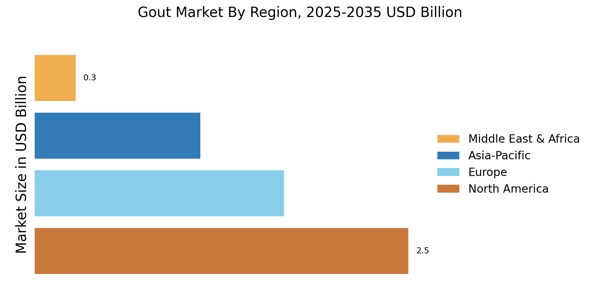
    By Region, the study segments the market into North America, Europe, Asia-Pacific, and Rest of the World.

    The North America region segmented into US, and Canada. The North America region held the largest market share in the Gout Market and market is accounted for USD 1.80 billion in 2022 and is expected to exhibit a 12.03% CAGR during the study period. Further, in the North America region the US gout market accounted for the largest market share. This is attributed to the increasing prevalence of gout, growing adoption of biologics, and rising R&D activities on regenerative medicines.

    Moreover, the growing awareness about the health & accessibility of new treatment methods, the presence of well-developed healthcare infrastructure, and the rapid adoption of advanced medical technologies in the region drive the regional market growth during the forecast period.

    In 2021, as per the Journal of the American Medical Association (JAMA) Network, an estimated 9.2 million people are affected by gout in the US, and it is more common in men and older people. The rising prevalence of gout demands effective treatment such as NSAIDs, corticosteroids, colchicine, urate-lowering agents, and others for treating this condition. In addition, the rising product launches are also contributing to market growth over the forecast period.

    Further, the major countries studied are the U.S., Canada, Germany, France, the UK, Italy, Spain, China, Japan, India, Australia, South Korea, and Brazil.

    Figure 3: Gout Market Share By Region 2022 (USD Billion)

    Gout Market Share By Region 2022 (USD Billion)

    Source: Secondary Research, Primary Research, Market Research Future Database, and Analyst Review

    Europe gout market is expected to account for the second-largest market share due to the accessibility to advanced diagnosis & treatment facilities, the rising geriatric population prone to gout is driving up demand for effective treatment & therapeutics, and growing healthcare expenditure. For instance, according to the Eurostat database, healthcare expenditure was USD 176.61 billion in 2021.

    Owing to rising healthcare expenditure also increases the company activities and government initiatives in developing effective diagnoses and treatment & therapeutics for gout, the Italy gout market is expected to be fastest growing market in the European region, followed by UK gout market. These factors are anticipated to positively impact the growth of the gout market. Additionally, improving government initiatives & healthcare frameworks and the presence of government organizations are boosting the growth of the gout market in Europe.

    The Asia-Pacific gout market is expected to grow at a CAGR of 13.12% from 2023 to 2032. This is due to factors such as improving healthcare infrastructure, growing investment by major players with local manufacturers, and the increasing patient population suffering from gout. For instance, according to the Australian Bureau of Statistics, in 2018, an estimated 4.5% of Australians have gout. Gout is more common in males than females almost 8 in 10 (79%) people with gout are males.

    Hence, the rise in patients suffering from gout drives the market growth in the region as gout medications such as allopurinol, febuxostat, and probenecid among others are extensively used to reduce uric acid levels in the blood. 

    This can help reduce the number of future flares and make them less severe. Additionally, the availability of technical expertise, reduced cost of labor, and funding from governments for R&D investment to accelerate new product development have made Asia-Pacific the most favored region for outsourcing manufacturing services.

    The Rest of the World includes the Middle East, Africa, and Latin America. Middle East hold the major market share in middle east and Africa region due to limited healthcare infrastructure, a dearth of awareness regarding the symptoms of the disease, and a lack of skilled professionals to manufacture gout therapeutics drugs are restricting the growth of the gout market in Sub-Saharan Africa. Additionally, low healthcare expenditure and unstable political situations are also affecting the market growth to an extent in the Middle East.

    However, growing healthcare infrastructure, increasing government initiatives for improving the healthcare sector, and the growing geriatric population in the Middle East region are likely to favor market growth.

    Key Players and Competitive Insights

    The Gout Market is distinguished by the presence of numerous global, regional, and local players catering to the increasing prevalence of gout, rising healthcare expenditure, and increasing research and development activities. However, the side effects of gout therapeutic drugs and the lack of awareness among people may hamper the growth of the Gout Market. The major players have adopted a strategy of obtaining regulatory approval from government agencies for their products to broaden their reach.

    The Gout Market is extremely competitive, with players competing, partnering, and investing heavily in research and development to gain a significant market share. The market is moderately fragmented with rising competition, product launches, increasing collaborative partnerships, and other strategic decisions to achieve operational efficiency.

    The business model developed by manufacturers in the Gout Market includes offering high-quality products. The growth of prominent industry players is dependent on various factors, such as market conditions, government support, and industry development. Key players in the gout market are focusing on offering high-quality products to their customers. It is also projected that a rising number of strategic initiatives will boost the market's growth in the upcoming future.

    Key Companies in the Gout Market market include

    Industry Developments

    March 2023: Selecta Biosciences, Inc revealed positive results for the Phase 3 DISSOLVE I & II placebo-controlled randomized clinical trials of SEL-212. SEL-212 is used for chronic refractory gout.

    July 2022: The company received expanded FDA approval for Krystexxa for patients with uncontrolled gout. It is used in combination with immunotherapy and chemotherapy drug, methotrexate.

    July 2022: ROMEG Therapeutics, LLC (US) and Scilex Holding Company (US) enters into an agreement for an exclusive license to market Gloperba, an FDA-approved preventative medication for excruciating gout flare-ups in adults, in the US.

    April 2019: The U.S. Food and Drug Administration (FDA) has approved GLOPERBA (colchicine) to treat adult gout flare-ups.

    March 2022: the United States Food and Drug Administration approved Strides Pharma's Colchicine tablets USP, 0.6 mg, used for the treatment and prevention of gout.

    Future Outlook

    Gout Market Future Outlook

    The Global Gout Market is projected to grow at a 9.45% CAGR from 2024 to 2032, driven by rising prevalence, innovative therapies, and increased awareness.

    New opportunities lie in:

    • Develop targeted biologics for treatment-resistant gout patients. Leverage telemedicine for remote patient monitoring and management. Invest in educational campaigns to raise awareness about gout prevention.

    By 2035, the Gout Market is expected to reach a robust position, reflecting substantial growth and innovation.

    Market Segmentation

    Gout End User Outlook

    • Hospitals & Clinics
    • Specialty Centers
    • Others

    Gout Regional Outlook

    • {""=>["US"
    • "Canada"]}
    • {""=>["Germany"
    • "France"
    • "UK"
    • "Italy"
    • "Spain"
    • "Rest of Europe"]}
    • {""=>["China"
    • "Japan"
    • "India"
    • "Australia"
    • "South Korea"
    • "Rest of Asia-Pacific"]}
    • {""=>["Middle East"
    • "Africa"]}

    Gout Application Outlook

    • Acute Gout
    • Chronic Gout

    Gout Treatment and Diagnosis Outlook

    • {""=>["NSAIDs"
    • "Corticosteroids"
    • "Colchicine"
    • "Urate-Lowering Agents"
    • "Others"]}

    Report Scope

    Report Attribute/MetricDetails
     Market Size 2022USD 4.57 billion
     Market Size 2023USD 5.07 billion
    Market Size 2032USD 11.13 billion
    Compound Annual Growth Rate (CAGR)11.75% (2023- 2032)
    Base Year2023
    Forecast Period2023- 2032
    Historical Data2018-2022
    Forecast UnitsValue (USD Billion)
    Report CoverageRevenue Forecast, Competitive Landscape, Growth Factors, and Trends
    Segments CoveredTreatment and Diagnosis, Application, End User, and Region
    Geographies CoveredNorth America, Europe, Asia Pacific, and Rest of the World
    Countries CoveredThe U.S, Canada, Germany, France, the UK, Italy, Spain, China, Japan, India, Australia, South Korea, and Brazil
    Key Companies ProfiledNovartis AG (Switzerland), Lannett (US), Horizon Therapeutics plc (US), Takeda Pharmaceutical Company Limited (Japan), GlaxoSmithKline plc (UK), Regeneron Pharmaceuticals, Inc (US), Teijin Limited (Japan), Viatris Inc (US), Boehringer Ingelheim International GmbH (Germany), ROMEG Therapeutics, LLC (US)
    Key Market OpportunitiesRising number of strategic initiatives
    Key Market DynamicsIncreasing prevalence of gout Rising incidence of genetic disorders

    Market Highlights

    Author
    Rahul Gotadki
    Assistant Manager

    He holds an experience of about 7+ years in Market Research and Business Consulting, working under the spectrum of Life Sciences and Healthcare domains. Rahul conceptualizes and implements a scalable business strategy and provides strategic leadership to the clients. His expertise lies in market estimation, competitive intelligence, pipeline analysis, customer assessment, etc. In addition to the above, his other responsibility includes strategic tracking of high growth markets & advising clients on the potential areas of focus they could direct their business initiatives

    Leave a Comment

    FAQs

    How much is the gout market?

    The Gout Market is anticipated to reach USD 11.13 billion at a CAGR of 11.75% during the forecast period of 2023 to 2032.

    How big is the US gout market?

    The US gout market is anticipated to reach USD 4.64 billion at a CAGR of 11.89% during the forecast year of 2032.

    What is the growth rate of the gout market?

    The Gout Market is expected to register a CAGR of 11.75% during the forecast period of 2023 to 2032.

    Which region held the largest market share in the gout market?

    The North America gout market accounted for USD 1.80 billion in 2022 and is expected to exhibit a 12.03% CAGR during the study period.

    Who are the key players in the gout market?

    Novartis AG (Switzerland), Lannett (US), Horizon Therapeutics plc (US), Takeda Pharmaceutical Company Limited (Japan), GlaxoSmithKline plc (UK), Regeneron Pharmaceuticals, Inc (US), Teijin Limited (Japan), Viatris Inc (US), Boehringer Ingelheim International GmbH (Germany), ROMEG Therapeutics, LLC (US).

    Which application had the largest market share in the gout market?

    The chronic gout segment held the majority share in 2022 contributing to around 35.5% with respect to the Gout Market.

    Which end user holds the largest segment share in the gout market?

    The hospitals & clinics segment held the majority share in 2022 contributing to around 53.5% with respect to the Gout Market.

    Download Free Sample

    Kindly complete the form below to receive a free sample of this Report

    Case Study
    Chemicals and Materials

    Compare Licence

    ×
    Features License Type
    Single User Multiuser License Enterprise User
    Price $4,950 $5,950 $7,250
    Maximum User Access Limit 1 User Upto 10 Users Unrestricted Access Throughout the Organization
    Free Customization
    Direct Access to Analyst
    Deliverable Format
    Platform Access
    Discount on Next Purchase 10% 15% 15%
    Printable Versions