
×
Hero Background
English
Chinese
French
Japanese
Korean
German
Spanish

Targeting Pods Market Analysis

ID: MRFR/AD/4563-HCR
128 Pages
Sejal Akre
October 2025

Targeting Pods Market Research Report Information by Fit (OEM and Upgrade), Type (FLIR & Laser Designator and Laser Spot Tracker), Component (FLIR Sensor, CCD Camera, MMS, ECU, HD TV, and Video Datalink), Platform (Combat Aircraft, Helicopters, and UAV), and Region (North America, Asia Pacific, Europe, Middle East, and South America) Forecast till 2035

Share:
Download PDF ×

We do not share your information with anyone. However, we may send you emails based on your report interest from time to time. You may contact us at any time to opt-out.

Targeting Pods Market Infographic
Purchase Options

Market Analysis

In-depth Analysis of Targeting Pods Market Industry Landscape

The Targeting Pods Market operates at the forefront of modern military aviation, driven by the increasing need for advanced targeting and surveillance capabilities in complex operational environments. A primary driver in this market is the growing demand for targeting pods equipped with cutting-edge sensors, cameras, and laser designators to enhance precision targeting, reconnaissance, and intelligence gathering. As global security challenges evolve, armed forces invest in targeting pods for a range of platforms, including fighter jets, unmanned aerial vehicles (UAVs), and reconnaissance aircraft. The market caters to the imperative of developing versatile, high-performance targeting pods that enable military forces to conduct accurate and mission-critical operations.

Technological advancements in targeting pod systems contribute significantly to the dynamics of the market. Innovations in sensor technologies, electro-optical and infrared (EO/IR) imaging, laser designator capabilities, and data processing enhance the overall performance and effectiveness of targeting pods. Technology plays a crucial role in ensuring that these systems meet the evolving demands of modern warfare, providing defense forces with the capability to conduct precision strikes, conduct surveillance, and gather intelligence in contested and dynamic operational environments.

Geopolitical considerations and evolving security threats play a central role in shaping the targeting pods market. Nations and defense forces prioritize the development and procurement of advanced targeting pod systems to maintain a technological edge and address emerging threats. The market responds to these strategic imperatives by offering cutting-edge technologies that provide superior targeting accuracy, range, and versatility, ensuring the effectiveness of military aircraft in a variety of mission scenarios.

Budgetary considerations and defense spending influence the targeting pods market. Governments allocate resources to research, develop, and deploy targeting pod systems that align with their strategic defense priorities and operational requirements. The market's growth is influenced by the economic feasibility of investing in advanced targeting capabilities that offer a balance between cutting-edge technology and cost-effectiveness. Economic fluctuations, geopolitical tensions, and defense budget allocations impact the pace and scale of procurement, requiring targeting pod manufacturers to navigate a dynamic landscape.

Collaborations and partnerships between defense contractors, research institutions, and governments contribute to the market dynamics. Joint development programs, international collaborations, and technology transfers play a pivotal role in advancing targeting pod capabilities and fostering interoperability among allied forces. These partnerships allow nations to pool resources, share technological expertise, and collectively address evolving security challenges, shaping the landscape of the targeting pods market.

Operational requirements and mission profiles influence the customization and integration of targeting pods onto various airborne platforms. Different military aircraft, including fighter jets, UAVs, and reconnaissance planes, have distinct operational needs, prompting manufacturers to tailor targeting pod solutions to specific mission profiles. The market caters to these diverse requirements by offering modular and adaptable targeting pod systems optimized for air-to-ground strikes, surveillance, and intelligence, surveillance, and reconnaissance (ISR) missions.

Testing and validation efforts are crucial components of the targeting pods market. Manufacturers and defense organizations conduct extensive testing to ensure the reliability, accuracy, and durability of targeting pod systems in real-world conditions. Successful tests and demonstrations contribute to the market's credibility and drive further investment in targeting pod technologies as indispensable tools for enhancing military capabilities.


Author
Sejal Akre
Senior Research Analyst

She has over 5 years of rich experience, in market research and consulting providing valuable market insights to client. Hands on expertise in management consulting, and extensive knowledge in domain including ICT, Automotive & Transportation and Aerospace & Defense. She is skilled in Go-to market strategy, industry analysis, market sizing, in depth company profiling, competitive intelligence & benchmarking and value chain amongst others.

Leave a Comment

FAQs

How much does a Litening Targeting Pods Market cost?

Targeting Pods Market Size at USD 4.5 Billion, Grow at a CAGR Of 6.40% 2030

Who are the key players in the Targeting Pods Market?

Lockheed Martin (US),Aselsan (Turkey),Thales Group (France), Raytheon Company (US),Northrop Grumman (US),L-3 Technologies (US),Ultra Electronics (UK),Israel Aerospace Industries (Israel),MOOG Inc. (US),FLIR Systems (US),Rafael Advanced Defense Systems Ltd (Israel),Qioptik (Paris)

Depending on component, which segment could take the lead?

Depending on component, the FLIR sensor segment could take the lead.

Which region is expected to be the dominant market?

Europe is expected to be the dominant market.

What factors bolster the market expansion in APAC?

Factors that bolster the market expansion in APAC are the rising need for public safety and increased defense budgets of developing countries like India, Japan and China.

Market Summary

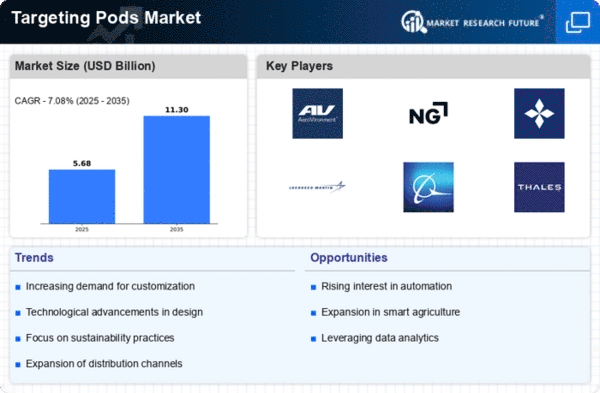
As per MRFR analysis, the Targeting Pods Market Size was estimated at 5.3 USD Billion in 2024. The Targeting Pods industry is projected to grow from 5.7 in 2025 to 11.3 by 2035, exhibiting a compound annual growth rate (CAGR) of 7.08 during the forecast period 2025 - 2035.

Key Market Trends & Highlights

The Targeting Pods Market is experiencing robust growth driven by technological advancements and increasing consumer demand for personalized solutions.

  • Technological advancements are reshaping the Targeting Pods Market, enhancing efficiency and effectiveness.
  • Increased demand for personalization is driving innovation across various market segments, particularly in agriculture and consumer electronics.
  • Sustainability initiatives are becoming a focal point, influencing product development and consumer preferences in North America and Asia-Pacific.
  • Market drivers such as technological integration and the shift towards omnichannel marketing are propelling growth in the commercial and industrial segments.

Market Size & Forecast

2024 Market Size 5.3 (USD Billion)
2035 Market Size 11.3 (USD Billion)
CAGR (2025 - 2035) 7.08%
Largest Regional Market Share in 2024 North America

Major Players

<p>AeroVironment (US), Northrop Grumman (US), General Atomics (US), Lockheed Martin (US), Thales Group (FR), Elbit Systems (IL), Boeing (US), Textron (US), Leonardo (IT)</p>

Market Trends

The Targeting Pods Market is currently experiencing a notable evolution, driven by advancements in technology and increasing consumer demand for personalized experiences. This market encompasses a variety of products designed to enhance targeting capabilities in various applications, including advertising, agriculture, and environmental monitoring. As organizations seek to optimize their strategies, the integration of innovative solutions appears to be a key focus. Companies are investing in research and development to create more efficient and effective targeting pods, which may lead to improved performance and user satisfaction. Moreover, the competitive landscape of the Targeting Pods Market is becoming increasingly dynamic. New entrants are emerging, bringing fresh ideas and technologies that challenge established players. This influx of innovation suggests a potential shift in market dynamics, as traditional methods may be supplanted by more advanced approaches. Collaboration between technology providers and end-users is likely to foster the development of tailored solutions that meet specific needs. As the market continues to mature, it seems poised for further growth, with opportunities for expansion across various sectors.

Technological Advancements

The Targeting Pods Market is witnessing rapid technological advancements that enhance the functionality and efficiency of targeting solutions. Innovations in sensor technology, data analytics, and artificial intelligence are driving the development of more sophisticated targeting pods. These advancements enable users to achieve greater precision in their targeting efforts, thereby improving overall outcomes.

Increased Demand for Personalization

There is a growing trend towards personalization within the Targeting Pods Market, as consumers increasingly seek tailored experiences. This demand is prompting companies to develop targeting solutions that can adapt to individual preferences and behaviors. As a result, businesses are focusing on creating more customized offerings to meet the evolving expectations of their customers.

Sustainability Initiatives

Sustainability is becoming a prominent theme in the Targeting Pods Market, with companies striving to develop eco-friendly solutions. This trend reflects a broader societal shift towards environmental responsibility, as organizations recognize the importance of minimizing their ecological footprint. The integration of sustainable practices in the design and production of targeting pods may enhance brand reputation and appeal to environmentally conscious consumers.

Targeting Pods Market Market Drivers

Increasing Demand for Precision Agriculture

The Global Targeting Pods Market Industry experiences a notable surge in demand driven by the increasing adoption of precision agriculture techniques. Farmers are increasingly utilizing targeting pods to enhance crop yields and optimize resource usage. This trend is particularly evident in regions where agricultural productivity is paramount. For instance, the market is projected to reach 4.5 USD Billion in 2024, reflecting a growing recognition of the benefits associated with precision farming. The integration of targeting pods allows for more accurate planting and resource allocation, thereby contributing to sustainable agricultural practices and improved food security on a global scale.

Market Segment Insights

By Application: Agriculture (Largest) vs. Consumer Electronics (Fastest-Growing)

<p>The Targeting Pods Market exhibits varied market share across its application segments, with Agriculture leading in overall consumption and production. Agriculture's extensive reliance on targeted technology for crop management and yield enhancement grants it a significant footprint in the market. Conversely, Consumer Electronics represents the fastest-growing segment as manufacturers increasingly adopt targeting pod technology to enhance user experience and product functionality, driven by rising consumer electronics demand globally.</p>

<p>Aerospace (Dominant) vs. Automotive (Emerging)</p>

<p>Aerospace stands as a dominant player in the Targeting Pods Market, marked by its advanced technological requirements and rigorous standards for precision and reliability. This segment benefits greatly from advancements in materials and design processes, leading to increased efficiencies in targeting pods utilized for navigation, communication, and surveillance in aircraft. In contrast, the Automotive segment is emerging rapidly as electric vehicles and smart transportation systems demand more sophisticated targeting solutions, creating opportunities for innovative applications in autonomous driving and vehicle connectivity.</p>

By End Use: Commercial (Largest) vs. Industrial (Fastest-Growing)

<p>The Targeting Pods Market is experiencing a diverse distribution across its end-use segments, with the Commercial segment taking the lead. This segment benefits significantly from the increasing demand for advanced technology in defense and commercial applications. Following closely behind is the Industrial segment, which is showing a promising rise in adoption rates. While both segments are thriving, their market share dynamics highlight the Commercial segment as the key player amidst growing competition in industrial applications. Growth trends in the Targeting Pods Market reveal that the Commercial segment is primarily driven by investments in military projects and defense modernization programs. Conversely, the Industrial segment is witnessing a surge due to automation and technological advancements in various industries. The push for enhanced capabilities and precision in targeting systems fuels the momentum of these segments, making them crucial for market growth in the coming years.</p>

<p>Commercial (Dominant) vs. Industrial (Emerging)</p>

<p>The Commercial segment in the Targeting Pods Market is characterized by its vast applications in sectors such as defense and surveillance where high precision and reliability are paramount. Dominating the market, this segment attracts major investments due to the increasing reliance on advanced targeting for strategic operations. In contrast, the Industrial segment, though currently emerging, is gaining traction owing to the integration of smart technologies and automation. This segment caters to diverse requirements across various industries, showcasing its potential to evolve rapidly. Both segments signal a shift towards sophisticated targeting systems, addressing the growing need for efficiency and effectiveness in resource deployment.</p>

By Technology: Active Targeting (Largest) vs. Smart Targeting (Fastest-Growing)

<p>In the Targeting Pods Market, Active Targeting holds the largest share due to its adeptness in enabling marketers to engage their audience effectively. Its strategic applications have made it a preferred choice among businesses aiming for precision marketing. Following closely are Passive Targeting and Hybrid Targeting, which also have significant market segments but are currently overshadowed by the increasing demand and adaptability of Active Targeting. Smart Targeting, while still a smaller segment, is emerging rapidly as technology evolves, capturing attention for its personalized approach. Growth trends signify a pivotal shift towards technologies that enhance user engagement and optimize marketing efforts. Active Targeting continues to drive sales as brands recognize the power of targeting based on user behavior and preferences. Smart Targeting is projected to experience the fastest growth due to advancements in artificial intelligence and machine learning, which enable deeper data analysis and personalized experiences, presenting substantial opportunities for marketers to enhance their strategies through innovative technology solutions.</p>

<p>Technology: Active Targeting (Dominant) vs. Smart Targeting (Emerging)</p>

<p>Active Targeting represents the dominant technology in the Targeting Pods Market, characterized by its proactive methodologies that allow brands to leverage user data for highly tailored marketing campaigns. This technology focuses on real-time data gathering, enabling marketers to target their audiences more effectively and improve conversion rates. In contrast, Smart Targeting is an emerging technology that utilizes advanced algorithms and AI to analyze vast amounts of data for even smarter advertising solutions. It enables brands to anticipate consumer needs more accurately, enhancing engagement through personalization. As marketers are increasingly adopting these innovative methods, Smart Targeting is gaining traction, indicating a growing trend towards personalized marketing strategies that resonate with consumers.</p>

By Material: Plastic (Largest) vs. Metal (Fastest-Growing)

<p>In the Targeting Pods Market, the distribution of the material segment reveals a significant lead for plastic, which has become the largest material due to its cost-effectiveness and versatility. Plastic targeting pods are favored for their lightweight properties and ease of manufacturing, making them ideal for a wide range of military and commercial applications. Following plastic, metal is gaining traction as the fastest-growing segment, driven by an increase in demand for durability and performance in harsh environments. Metals, particularly advanced alloys, are increasingly being adopted for targeting pods to enhance functionality and resilience during missions. Moreover, the growth trends in the material segment are primarily influenced by advancements in material science and engineering. Innovations in composites and ceramics also contribute to the evolution of targeting pods, promoting lighter and stronger alternatives that meet military specifications. The rising need for precision targeting systems in defense strategies also propels the growth of these materials. As military forces worldwide prioritize innovation, industries are likely to witness heightened adoption of advanced materials, with a keen focus on improving stealth, impact resistance, and operational efficiency.</p>

<p>Plastic (Dominant) vs. Metal (Emerging)</p>

<p>In the current landscape of the Targeting Pods Market, plastic reigns as the dominant material due to its exceptional adaptability and lower production costs. It is prevalent in various applications, providing a lightweight solution that does not compromise functionality. Plastic materials are also conducive to quick manufacturing processes, enabling rapid deployments by military and defense forces. On the other hand, metal is positioned as an emerging material that emphasizes strength and durability. With ongoing advancements in alloy technologies, metal targeting pods are being engineered to endure extreme conditions while improving accuracy and performance. This shift towards metal also reflects a growing preference for robust systems capable of surviving complex operational scenarios, representing an important trend within the market.</p>

By Size: Large (Largest) vs. Medium (Fastest-Growing)

<p>In the Targeting Pods Market, the distribution of market share among different size segments reveals a strong preference for Large pods, which have established themselves as the largest category. Medium pods are emerging rapidly, appealing to a growing segment of users who require flexibility and efficiency. The demand for Small and Extra Large pods remains limited compared to these two leading categories. As a result, understanding the dynamics of these market segments is crucial for stakeholders aiming to capture a broader audience.</p>

<p>Large (Dominant) vs. Medium (Emerging)</p>

<p>Large targeting pods hold a dominant position in the market owing to their robust capabilities and adaptability in various applications. They cater primarily to sectors that require significant targeting power and precision, making them indispensable for large-scale operations. On the other hand, Medium pods are viewed as the fast-growing subset, gaining traction among users who prefer a balance between functionality and portability. These Medium-sized options are appealing to businesses looking for versatility without compromising on performance. As new technologies emerge, both segments are likely to see shifts in demand, with Medium pods increasingly attracting interest due to their size and efficiency.</p>

Get more detailed insights about Targeting Pods Market Research Report - Forecast till 2035

Regional Insights

North America : Market Leader in Technology

North America continues to lead the Targeting Pods Market, holding a significant share of 2.65 billion in 2024. The region's growth is driven by increasing defense budgets, technological advancements, and a focus on enhancing military capabilities. Regulatory support from government initiatives further fuels demand, ensuring a robust market environment for innovation and development. The competitive landscape is characterized by major players such as AeroVironment, Northrop Grumman, and Lockheed Martin, which are at the forefront of technological advancements. The U.S. remains the leading country, with substantial investments in defense technologies. This concentration of key players and government support positions North America as a powerhouse in The Targeting Pods.

Europe : Emerging Market with Growth Potential

Europe's Targeting Pods Market is valued at 1.5 billion, reflecting a growing emphasis on defense and security. The region is witnessing increased investments in military technology, driven by geopolitical tensions and the need for enhanced surveillance capabilities. Regulatory frameworks are evolving to support innovation, making Europe a key player in the global market. Leading countries such as France, Germany, and the UK are investing heavily in defense technologies, with companies like Thales Group and Leonardo playing pivotal roles. The competitive landscape is marked by collaborations and partnerships aimed at advancing technology. As Europe strengthens its defense posture, the demand for advanced targeting solutions is expected to rise significantly.

Asia-Pacific : Rapidly Growing Defense Sector

The Asia-Pacific region, with a market size of 1.0 billion, is experiencing rapid growth in the Targeting Pods Market. This growth is fueled by increasing defense budgets, modernization efforts, and a rising focus on indigenous defense production. Countries in this region are prioritizing advanced military technologies to enhance their operational capabilities, supported by favorable government policies. Key players in the region include Elbit Systems and other local manufacturers, with countries like India, Japan, and Australia leading the charge. The competitive landscape is evolving, with a mix of domestic and international players vying for market share. As regional tensions rise, the demand for sophisticated targeting solutions is expected to escalate, positioning Asia-Pacific as a significant market in the coming years.

Middle East and Africa : Emerging Market with Challenges

The Middle East and Africa represent a nascent market for Targeting Pods, valued at 0.15 billion. The region faces unique challenges, including political instability and varying defense priorities among countries. However, there is a growing recognition of the need for advanced military capabilities, which is gradually driving demand for targeting solutions. Regulatory frameworks are beginning to adapt to support this emerging market. Countries like the UAE and South Africa are taking steps to enhance their defense capabilities, with a focus on acquiring advanced technologies. The competitive landscape is still developing, with a mix of local and international players. As the region stabilizes, the demand for sophisticated targeting systems is expected to grow, albeit at a slower pace compared to other regions.

Key Players and Competitive Insights

The Targeting Pods Market is currently characterized by a dynamic competitive landscape, driven by technological advancements and increasing defense budgets across various nations. Key players such as AeroVironment (US), Northrop Grumman (US), and Thales Group (FR) are strategically positioning themselves through innovation and partnerships. AeroVironment (US) focuses on enhancing its product offerings through advanced sensor technologies, while Northrop Grumman (US) emphasizes its capabilities in integrating artificial intelligence into targeting systems. Thales Group (FR) is actively pursuing collaborations with regional defense contractors to expand its market reach, thereby shaping a competitive environment that is increasingly reliant on technological prowess and strategic alliances.

In terms of business tactics, companies are localizing manufacturing to reduce costs and enhance supply chain efficiency. The market structure appears moderately fragmented, with several players vying for market share. However, the collective influence of major companies like Lockheed Martin (US) and Boeing (US) suggests a trend towards consolidation, as these firms leverage their extensive resources to dominate the market.

In November 2025, Lockheed Martin (US) announced a partnership with a leading tech firm to develop next-generation targeting pods that incorporate machine learning algorithms. This strategic move is likely to enhance Lockheed Martin's competitive edge by enabling faster data processing and improved targeting accuracy, which are critical in modern warfare scenarios. The collaboration underscores the importance of integrating cutting-edge technology into defense systems to meet evolving operational demands.

In October 2025, Boeing (US) unveiled a new line of targeting pods designed for unmanned aerial vehicles (UAVs), showcasing its commitment to innovation in the sector. This launch is significant as it positions Boeing to capture a growing segment of the market that increasingly favors UAV applications. The introduction of these advanced systems may also stimulate further competition among existing players, pushing them to enhance their product offerings.

In September 2025, Thales Group (FR) secured a contract with a European defense agency to supply advanced targeting pods, marking a strategic expansion into the European market. This contract not only reinforces Thales's position in the region but also highlights the growing demand for sophisticated targeting solutions among European nations. Such strategic moves are indicative of a broader trend where companies are seeking to establish a foothold in emerging markets to drive growth.

As of December 2025, the competitive trends in the Targeting Pods Market are increasingly defined by digitalization, sustainability, and the integration of artificial intelligence. Strategic alliances are becoming pivotal in shaping the landscape, as companies recognize the need for collaboration to enhance technological capabilities. The shift from price-based competition to a focus on innovation and supply chain reliability is evident, suggesting that future competitive differentiation will hinge on the ability to deliver advanced, reliable, and sustainable solutions.

Key Companies in the Targeting Pods Market market include

Industry Developments

Future Outlook

Targeting Pods Market Future Outlook

<p>The Targeting Pods Market is projected to grow at a 7.08% CAGR from 2024 to 2035, driven by technological advancements, increasing defense budgets, and rising demand for precision targeting solutions.</p>

New opportunities lie in:

  • <p>Development of advanced targeting algorithms for enhanced accuracy</p>
  • <p>Integration of AI-driven analytics for real-time decision-making</p>
  • <p>Expansion into emerging markets with tailored targeting solutions</p>

<p>By 2035, the Targeting Pods Market is expected to achieve substantial growth and innovation.</p>

Market Segmentation

Targeting Pods Market Size Outlook

  • Small
  • Medium
  • Large
  • Extra Large

Targeting Pods Market End Use Outlook

  • Commercial
  • Industrial
  • Residential
  • Military
  • Research

Targeting Pods Market Material Outlook

  • Plastic
  • Metal
  • Composite
  • Ceramic

Targeting Pods Market Technology Outlook

  • Active Targeting
  • Passive Targeting
  • Hybrid Targeting
  • Smart Targeting

Targeting Pods Market Application Outlook

  • Agriculture
  • Aerospace
  • Automotive
  • Consumer Electronics
  • Healthcare

Report Scope

MARKET SIZE 20245.3(USD Billion)
MARKET SIZE 20255.7(USD Billion)
MARKET SIZE 203511.3(USD Billion)
COMPOUND ANNUAL GROWTH RATE (CAGR)7.08% (2024 - 2035)
REPORT COVERAGERevenue Forecast, Competitive Landscape, Growth Factors, and Trends
BASE YEAR2024
Market Forecast Period2025 - 2035
Historical Data2019 - 2024
Market Forecast UnitsUSD Billion
Key Companies ProfiledAeroVironment (US), Northrop Grumman (US), General Atomics (US), Lockheed Martin (US), Thales Group (FR), Elbit Systems (IL), Boeing (US), Textron (US), Leonardo (IT)
Segments CoveredApplication, End Use, Technology, Material, Size
Key Market OpportunitiesIntegration of advanced analytics and artificial intelligence in the Targeting Pods Market enhances precision targeting capabilities.
Key Market DynamicsRising demand for precision agriculture drives innovation and competition in the targeting pods market.
Countries CoveredNorth America, Europe, APAC, South America, MEA

FAQs

How much does a Litening Targeting Pods Market cost?

Targeting Pods Market Size at USD 4.5 Billion, Grow at a CAGR Of 6.40% 2030

Who are the key players in the Targeting Pods Market?

Lockheed Martin (US),Aselsan (Turkey),Thales Group (France), Raytheon Company (US),Northrop Grumman (US),L-3 Technologies (US),Ultra Electronics (UK),Israel Aerospace Industries (Israel),MOOG Inc. (US),FLIR Systems (US),Rafael Advanced Defense Systems Ltd (Israel),Qioptik (Paris)

Depending on component, which segment could take the lead?

Depending on component, the FLIR sensor segment could take the lead.

Which region is expected to be the dominant market?

Europe is expected to be the dominant market.

What factors bolster the market expansion in APAC?

Factors that bolster the market expansion in APAC are the rising need for public safety and increased defense budgets of developing countries like India, Japan and China.

  1. Executive Summary
    1. Market Attractiveness Analysis
  2. Global Targeting Pods Market, by Type
  3. Global Targeting Pods Market, by Fit
  4. Global Targeting Pods
  5. Market, by Platform
  6. Global Targeting Pods Market, by Application
  7. Global Targeting Pods Market, by Region
  8. Scope of the Report
    1. Market Definition
    2. Scope of the Study
    3. Research Process
    4. Market Size Estimation
    5. Forecast Model
  9. Market Landscape
    1. Porter’s Five Forces Analysis
    2. Bargaining Power of Buyers
  10. Threat of New Entrants
  11. Threat of Substitutes
  12. Segment Rivalry
  13. Bargaining Power of Buyers
    1. Value Chain/Supply Chain Analysis
  14. Market Dynamics
    1. Introduction
    2. Market Drivers
    3. Market
    4. Restraints
    5. Market Opportunities
    6. Market Trends
  15. Global Targeting
  16. Pods Market, by Type
    1. Introduction
    2. FLIR & Laser Designator
      1. Market Estimates & Forecast, 2022–2030
      2. Market Estimates
    3. & Forecast, by Region, 2022–2030
    4. Laser Spot Tracker
      1. Market Estimates &
    5. Market Estimates & Forecast, 2022–2030
    6. Forecast, by Region, 2022–2030
  17. Global Targeting Pods Market, by Component
    1. Introduction
    2. FLIR Sensor
      1. Market Estimates & Forecast,
      2. Market Estimates & Forecast, by Region, 2022–2030
    3. CCD Camera
      1. Market Estimates & Forecast, 2022–2030
      2. Market Estimates & Forecast, by Region, 2022–2030
    4. MMS
      1. Market Estimates & Forecast, 2022–2030
      2. Market Estimates
    5. & Forecast, by Region, 2022–2030
    6. ECU
      1. Market Estimates
      2. Market Estimates & Forecast, by Region,
    7. & Forecast, 2022–2030
    8. HD TV
      1. Market Estimates & Forecast, 2022–2030
      2. Market Estimates & Forecast, by Region, 2022–2030
    9. Video
      1. Market Estimates & Forecast, 2022–2030
    10. Datalink
  18. Market Estimates & Forecast, by Region, 2022–2030
  19. Global Targeting
  20. Pods Market, by Platform
    1. Introduction
    2. Combat Aircraft
      1. Market Estimates &
    3. Market Estimates & Forecast, 2022–2030
    4. Forecast, by Region, 2022–2030
    5. Helicopters
      1. Market Estimates
      2. Market Estimates & Forecast, by Region,
    6. & Forecast, 2022–2030
    7. UAV
      1. Market Estimates & Forecast, 2022–2030
      2. Market Estimates & Forecast, by Region, 2022–2030
  21. Global
  22. Targeting Pods Market, by Fit
    1. Introduction
    2. OEM Fit
      1. Market Estimates &
    3. Market Estimates & Forecast, 2022–2030
    4. Forecast, by Region, 2022–2030
    5. Upgrade
      1. Market Estimates
      2. Market Estimates & Forecast, by Region,
    6. & Forecast, 2022–2030
  23. Global Targeting Pods Market, by Region
    1. Introduction
    2. North America
      1. Market Estimates & Forecast, 2022–2030
      2. Market Estimates & Forecast, by Type, 2022–2030
      3. Market
      4. Market Estimates
      5. Market Estimates & Forecast,
      6. US
    3. Estimates & Forecast, by Component, 2022–2030
    4. & Forecast, by Platform, 2022–2030
    5. by Fit, 2022–2030
  24. Market Estimates & Forecast, by Platform, 2022–2030
    1. Estimates & Forecast, by Fit, 2022–2030
    2. Market Estimates & Forecast, 2022–2030
    3. Forecast, by Type, 2022–2030
    4. by Component, 2022–2030
  25. Market
  26. Canada
  27. Market Estimates &
  28. Market Estimates & Forecast,
  29. Market Estimates & Forecast, by Platform,
  30. Market Estimates & Forecast, by Fit, 2022–2030
    1. Europe
      1. Market Estimates & Forecast, 2022–2030
  31. Market Estimates & Forecast, by Type, 2022–2030
    1. & Forecast, by Component, 2022–2030
    2. Forecast, by Platform, 2022–2030
    3. by Fit, 2022–2030
  32. Market Estimates
  33. Market Estimates &
  34. Market Estimates & Forecast,
  35. UK
  36. Market Estimates & Forecast,
  37. Market Estimates & Forecast, by Type, 2022–2030
  38. Market Estimates & Forecast, by Component, 2022–2030
  39. Market Estimates & Forecast, by Platform, 2022–2030
    1. Estimates & Forecast, by Fit, 2022–2030
    2. Market Estimates & Forecast, 2022–2030
    3. Forecast, by Type, 2022–2030
    4. by Component, 2022–2030
  40. Market
  41. Germany
  42. Market Estimates &
  43. Market Estimates & Forecast,
  44. Market Estimates & Forecast, by Platform,
  45. Market Estimates & Forecast, by Fit, 2022–2030
  46. France
  47. Market Estimates & Forecast, 2022–2030
  48. Market Estimates & Forecast, by Type, 2022–2030
  49. Market Estimates & Forecast, by Component, 2022–2030
    1. Estimates & Forecast, by Platform, 2022–2030
    2. & Forecast, by Fit, 2022–2030
    3. & Forecast, 2022–2030
    4. Type, 2022–2030
    5. of Europe
  50. Market
  51. Market Estimates
  52. Russia
  53. Market Estimates
  54. Market Estimates & Forecast, by
  55. Market Estimates & Forecast, by Component,
  56. Market Estimates & Forecast, by Platform, 2022–2030
  57. Market Estimates & Forecast, by Fit, 2022–2030
  58. Rest
  59. Market Estimates & Forecast, 2022–2030
  60. Market Estimates & Forecast, by Type, 2022–2030
    1. & Forecast, by Component, 2022–2030
    2. Forecast, by Platform, 2022–2030
    3. by Fit, 2022–2030
    4. Forecast, 2022–2030
  61. Market Estimates
  62. Market Estimates &
  63. Market Estimates & Forecast,
    1. Asia-Pacific
      1. Market Estimates &
      2. Market Estimates & Forecast, by Type, 2022–2030
      3. Market Estimates & Forecast, by Component, 2022–2030
  64. Market Estimates & Forecast, by Platform, 2022–2030
    1. Estimates & Forecast, by Fit, 2022–2030
    2. Market Estimates & Forecast, 2022–2030
    3. Forecast, by Type, 2022–2030
    4. by Component, 2022–2030
  65. Market
  66. China
  67. Market Estimates &
  68. Market Estimates & Forecast,
  69. Market Estimates & Forecast, by Platform,
  70. Market Estimates & Forecast, by Fit, 2022–2030
  71. Japan
  72. Market Estimates & Forecast, 2022–2030
  73. Market Estimates & Forecast, by Type, 2022–2030
    1. & Forecast, by Component, 2022–2030
    2. Forecast, by Platform, 2022–2030
    3. by Fit, 2022–2030
  74. Market Estimates
  75. Market Estimates &
  76. Market Estimates & Forecast,
  77. India
  78. Market Estimates & Forecast,
  79. Market Estimates & Forecast, by Type, 2022–2030
  80. Market Estimates & Forecast, by Component, 2022–2030
  81. Market Estimates & Forecast, by Platform 2022–2030
    1. Estimates & Forecast, by Fit, 2022–2030
    2. & Forecast, by Type, 2022–2030
    3. by Component, 2022–2030
    4. Estimates & Forecast, by Component, 2022–2030
    5. & Forecast, by Platform, 2022–2030
    6. by Fit, 2022–2030
    7. Forecast, 2022–2030
  82. Market
  83. Rest of Asia-Pacific
  84. Market Estimates & Forecast, 2022–2030
  85. Market Estimates
  86. Market Estimates & Forecast,
  87. Market Estimates & Forecast, by Platform,
  88. Market Estimates & Forecast, by Fit, 2022–2030
    1. Middle East & Africa
      1. Market Estimates & Forecast, 2022–2030
      2. Market Estimates & Forecast, by Type, 2022–2030
      3. Market
      4. Market Estimates
      5. Market Estimates & Forecast,
      6. Saudi Arabia
  89. Market Estimates & Forecast, by Fit, 2022–2030
    1. Market Estimates & Forecast, 2022–2030
    2. Forecast, by Type, 2022–2030
    3. by Component, 2022–2030
  90. UAE
  91. Market Estimates &
  92. Market Estimates & Forecast,
  93. Market Estimates & Forecast, by Platform
  94. Market Estimates & Forecast, by Fit, 2022–2030
  95. Rest of Middle East & Africa
  96. Market Estimates & Forecast,
  97. Market Estimates & Forecast, by Type, 2022–2030
  98. Market Estimates & Forecast, by Component, 2022–2030
  99. Market Estimates & Forecast, by Platform, 2022–2030
    1. Estimates & Forecast, by Fit, 2022–2030
    2. Market Estimates & Forecast, 2022–2030
    3. Forecast, by Type, 2022–2030
    4. Component, 2022–2030
  100. Market
    1. Latin America
      1. Market Estimates &
      2. Market Estimates & Forecast, by
      3. Market Estimates & Forecast, by Platform,
      4. Market Estimates & Forecast, by Fit, 2022–2030
      5. Brazil
  101. Market Estimates & Forecast, by Component, 2022–2030
    1. Estimates & Forecast, by Platform 2022–2030
    2. & Forecast, by Fit, 2022–2030
    3. Market Estimates & Forecast, 2022–2030
    4. Forecast, by Type, 2022–2030
    5. by Component, 2022–2030
  102. Market
  103. Market Estimates
  104. Rest of Latin America
  105. Market Estimates &
  106. Market Estimates & Forecast,
  107. Market Estimates & Forecast, by Platform,
  108. Market Estimates & Forecast, by Fit, 2022–2030
  109. Competitive Landscape
  110. Company Profile
    1. Lockheed Martin
      1. Company Overview
      2. Products/Services Offering
      3. Financial
      4. Key Developments
      5. Key Strategies
      6. SWOT
    2. Overview
    3. Analysis
    4. Aselsan
      1. Company Overview
      2. Products/Services
      3. Financial Overview
      4. Key Developments
      5. SWOT Analysis
    5. Offering
    6. Key Strategies
    7. Thales Group
      1. Company
      2. Products/Services Offering
      3. Financial Overview
      4. Key Developments
      5. Key Strategies
      6. SWOT Analysis
    8. Overview
    9. Raytheon Company
      1. Company Overview
      2. Products/Services
      3. Financial Overview
      4. Key Developments
      5. SWOT Analysis
    10. Offering
    11. Key Strategies
    12. Northrop Grumman
      1. Products/Services Offering
      2. Financial Overview
      3. Key Developments
      4. Key Strategies
      5. SWOT Analysis
    13. Company Overview
    14. L-3 Technologies
      1. Company Overview
      2. Products/Services
      3. Financial Overview
      4. Key Developments
      5. SWOT Analysis
    15. Offering
    16. Key Strategies
    17. Ultra Electronics
      1. Products/Services Offering
      2. Financial Overview
      3. Key Developments
      4. Key Strategies
      5. SWOT Analysis
    18. Company Overview
    19. Israel Aerospace Industries
      1. Company Overview
      2. Products/Services
      3. Financial Overview
      4. Key Developments
      5. SWOT Analysis
    20. Offering
    21. Key Strategies
    22. MOOG Inc.
      1. Company
      2. Products/Services Offering
      3. Financial Overview
      4. Key Developments
      5. Key Strategies
      6. SWOT Analysis
    23. Overview
    24. Flir Systems
      1. Company Overview
      2. Products/Services
      3. Financial Overview
      4. Key Developments
      5. SWOT Analysis
    25. Offering
    26. Key Strategies
    27. Rafael Advanced Defense Systems
      1. Company Overview
      2. Products/Services Offering
      3. Key Developments
      4. Key Strategies
      5. SWOT Analysis
    28. Financial Overview
    29. Qioptik
      1. Company Overview
      2. Financial Overview
      3. Key Developments
      4. Key Strategies
      5. SWOT Analysis
    30. Products/Services Offering
  111. Appendix
    1. References
    2. Related Reports
    3. List of Abbreviations
  112. Industry Insights
    1. Note: This table of contents is tentative and subject to change as the research
    2. progresses.
    3. List of Tables
  113. Global Targeting Pods Market,
    1. by Region, 2022–2030
  114. North America Targeting Pods Market, by
    1. Country, 2022–2030
  115. Europe Targeting Pods Market, by Country,
  116. Asia-Pacific Targeting Pods Market, by Country, 2022–2030
  117. Middle East & Africa Targeting Pods Market, by Country, 2022–2030
  118. Latin America Targeting Pods Market, by Country, 2022–2030
  119. Global Targeting Pods Market, by Region, 2022–2030
    1. Table 8
  120. Global Targeting Pods Market, by Type, 2022–2030
  121. Global Targeting
  122. Pods Market, by Fit, 2022–2030
  123. Global Targeting Pods Market,
    1. by Platform, 2022–2030
  124. Global Targeting Pods Market, by Component,
  125. North America: Targeting Pods Market, by Country,
  126. North America: Targeting Pods Market, by Type, 2022–2030
  127. North America: Targeting Pods Market, by Fit, 2022–2030
  128. North America: Targeting Pods Market, by Platform, 2022–2030
  129. North America: Targeting Pods Market, by Component, 2022–2030
  130. Europe: Targeting Pods Market, by Country, 2022–2030
    1. Table
  131. Europe: Targeting Pods Market, by Type, 2022–2030
  132. Europe:
  133. Targeting Pods Market, by Fit, 2022–2030
  134. Europe: Targeting
  135. Pods Market, by Platform, 2022–2030
  136. Europe: Targeting Pods
  137. Market, by Component, 2022–2030
  138. Asia-Pacific: Targeting Pods
  139. Market, by Country, 2022–2030
  140. Asia-Pacific: Targeting Pods
  141. Market, by Type, 2022–2030
  142. Asia-Pacific: Targeting Pods Market,
    1. by Fit, 2022–2030
  143. Asia-Pacific: Targeting Pods Market, by Platform,
  144. Asia-Pacific: Targeting Pods Market, by Component,
  145. Middle East & Africa: Targeting Pods Market, by
    1. Region, 2022–2030
  146. Middle East & Africa: Targeting Pods
  147. Market, by Type, 2022–2030
  148. Middle East & Africa: Targeting
  149. Pods Market, by Fit, 2022–2030
  150. Middle East & Africa: Targeting
  151. Pods Market, by Platform, 2022–2030
  152. Middle East & Africa:
  153. Targeting Pods Market, by Component, 2022–2030
  154. Latin America:
  155. Targeting Pods Market, by Region, 2022–2030
  156. Latin America:
  157. Targeting Pods Market, by Type, 2022–2030
  158. Latin America: Targeting
  159. Pods Market, by Fit, 2022–2030
  160. Latin America: Targeting Pods
  161. Market, by Platform, 2022–2030
  162. Latin America: Targeting Pods
  163. Market, by Component, 2022–2030
    1. List of Figures
  164. Research
    1. Process of MRFR
  165. Top-Down and Bottom-Up Approaches
  166. Market
    1. Dynamics
  167. Impact Analysis: Market Drivers
  168. Impact Analysis:
    1. Market Restraints
  169. Porter's Five Forces Analysis
  170. Value
    1. Chain Analysis
  171. Global Targeting Pods Market Share, by Type, 2022 (%)
  172. Global Targeting Pods Market, by Type, 2022–2030 (USD Million)
  173. Global Targeting Pods Market Share, by Fit, 2022 (%)
    1. FIGURE 11
  174. Global Targeting Pods Market, by Fit, 2022–2030 (USD Million)
    1. FIGURE
  175. Global Targeting Pods Market Share, by Platform, 2022 (%)
  176. Global
  177. Targeting Pods Market, by Platform, 2022–2030 (USD Million)
    1. FIGURE 14
  178. Global Targeting Pods Market Share, by Component, 2022 (%)
  179. Global
  180. Targeting Pods Market, by Component, 2022–2030 (USD Million)
    1. FIGURE 16
  181. Global Targeting Pods Market Share (%), by Region, 2022
  182. Global Targeting
  183. Pods Market, by Region, 2022–2030 (USD Million)
  184. North America:
    1. Targeting Pods Market Share (%), 2022
  185. North America: Targeting Pods
  186. Market, by Country, 2022–2030 (USD Million)
  187. Europe: Targeting
    1. Pods Market Share (%), 2022
  188. Europe: Targeting Pods Market, by Country,
  189. Asia-Pacific: Targeting Pods Market
    1. Share (%), 2022
  190. Asia-Pacific: Targeting Pods Market, by Country,
  191. Middle East & Africa Targeting
    1. Pods Market Share (%), 2022
  192. Middle East & Africa Targeting Pods
  193. Market, by Region, 2022–2030 (USD Million)
  194. Latin America Targeting
    1. Pods Market Share (%), 2022
  195. Latin America Targeting Pods Market,
    1. by Region, 2022–2030 (USD Million)

Targeting Pods Market Segmentation

Market Segmentation Overview

  • Detailed segmentation data will be available in the full report
  • Comprehensive analysis by multiple parameters
  • Regional and country-level breakdowns
  • Market size forecasts by segment
Infographic

Free Sample Request

Kindly complete the form below to receive a free sample of this Report

Get Free Sample

Customer Strories

Compare Licence

×
Features License Type
Single User Multiuser License Enterprise User
Price $4,950 $5,950 $7,250
Maximum User Access Limit 1 User Upto 10 Users Unrestricted Access Throughout the Organization
Free Customization
Direct Access to Analyst
Deliverable Format
Platform Access
Discount on Next Purchase 10% 15% 15%
Printable Versions