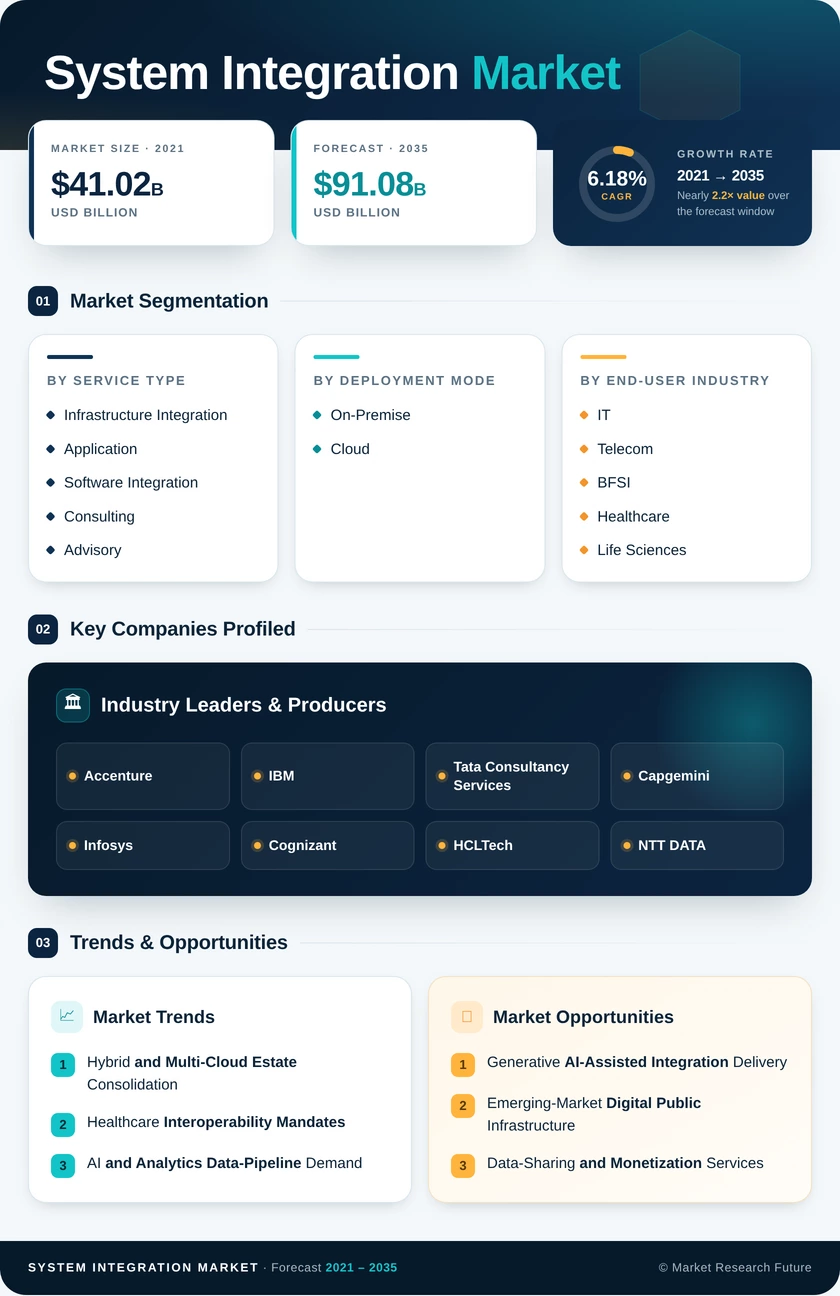
Segmentation Quick Reference
| Dimension | Sub-Segments | Dominant Segment | Fastest Growing Segment |
|---|
| By Service Type | Infrastructure Integration; Application and Software Integration; Consulting and Advisory | Infrastructure Integration (42.6%) | Application and Software Integration (6.78% CAGR) |
| By Deployment Mode | On-Premise; Cloud | On-Premise (55.2%) | Cloud (6.60% CAGR) |
| By End-User Industry | IT and Telecom; BFSI; Healthcare and Life Sciences; Manufacturing; Government and Utilities; Energy and Oil and Gas; Retail and E-Commerce; Aerospace and Defense; Automotive; Other End-User Industries | IT and Telecom (25.9%) | Healthcare and Life Sciences (8.25% CAGR) |
| By Integration Type | Data Integration; Process / Workflow Integration; Application / API Integration; Device / IoT Integration | Data Integration (31.4%) | Application / API Integration (6.98% CAGR) |
| By Organization Size | Large Enterprises; Small and Medium Enterprises | Large Enterprises (58.2%) | Small and Medium Enterprises (7.05% CAGR) |
| By Region | North America; Europe; Asia Pacific; South America; Middle East and Africa | North America (36.8%) | Asia Pacific (7.9% CAGR) |
Market Segmentation Overview
| Sub-Segment | Key Trend |
|---|
| Infrastructure Integration | Outcome-based managed contracts covering monitoring, patching, and capacity planning |
| Application and Software Integration | API-first designs separating front ends from core systems |
| Consulting and Advisory | Independent integration roadmaps and cost-governance assessments |
Infrastructure Integration leads because hybrid estates in banking and government still need hands-on orchestration of servers, storage, and networks. Application and Software Integration grows fastest as API-first architectures let enterprises modernize mobile and analytics layers without replacing core platforms. Consulting and Advisory increasingly sets the scope for both, since buyers want vendor-neutral roadmaps before committing capital.
| Sub-Segment | Key Trend |
|---|
| On-Premise | Physical control of mission-critical middleware for regulated workloads |
| Cloud | Subscription-based integration platforms with auto-scaling |
On-Premise dominates because data sovereignty and audit rules keep regulated integration hubs inside customer data centers. Cloud deployment grows faster as mid-market firms adopt subscription platforms that remove upgrade cycles and scale with transaction volumes. Hybrid control-plane designs let buyers keep data local while running orchestration in the cloud, which narrows the gap over time.
| Sub-Segment | Key Trend |
|---|
| IT and Telecom | 5G standalone core and OSS/BSS integration |
| BFSI | DORA-driven ICT risk and core banking modernization |
| Healthcare and Life Sciences | FHIR APIs for payers and providers |
| Manufacturing | OT/IT convergence and smart factory programs |
| Government and Utilities | E-government platforms and grid digitization |
| Energy and Oil and Gas | Asset monitoring and trading platform integration |
| Retail and E-Commerce | Omnichannel order and inventory synchronization |
| Aerospace and Defense | Secure mission-system and supply-chain integration |
| Automotive | Software-defined vehicle and dealer network systems |
| Other End-User Industries | Education, media, and logistics digitization |
IT and Telecom leads because carriers must stitch 5G cores, charging engines, and customer-experience systems together under strict uptime guarantees. Healthcare and Life Sciences grows fastest as CMS payer API deadlines and ONC certification updates force hospitals and insurers into FHIR-based integration work. BFSI and Manufacturing remain large, stable contributors driven by resilience rules and plant-floor connectivity.
| Sub-Segment | Key Trend |
|---|
| Data Integration | ETL, data virtualization, and master data management for AI |
| Process / Workflow Integration | Cross-system automation of business processes |
| Application / API Integration | Service meshes and API gateways replacing enterprise service buses |
| Device / IoT Integration | Edge gateways linking sensors and controllers to enterprise platforms |
Data Integration leads because AI and analytics programs depend on governed, well-lineaged data feeds that most enterprises still lack. Application / API Integration grows fastest as microservices architectures replace monolithic buses and demand encrypted service-to-service traffic management. Device / IoT Integration and Process / Workflow Integration round out demand as factories and back offices automate end-to-end.
| Sub-Segment | Key Trend |
|---|
| Large Enterprises | Multi-year managed integration contracts across global estates |
| Small and Medium Enterprises | Packaged connectors delivered through cloud marketplaces |
Large Enterprises dominate because complex, multi-country estates and strict audit requirements need top-tier orchestration and long managed-service commitments. Small and Medium Enterprises grow faster as fixed-scope, subscription-priced connectors lower the cost of linking ERP, CRM, and e-commerce systems. Integrators with repeatable, productized assets are best positioned to capture this mid-market demand.


 Noah Malgeri
Co-Founder

 Peter Groot koerkamp
Account and Business Manager

 Younghwan Choi
Senior Retail Manager

 Mark Irwin
Management Consultant

 Akif Moroglu
Strategy & Business Development Director

 Guilherme Gomes Martins
Product Management Director

 Joseph Aguayo
Sales Operations & Pricing Manager

 La Terria Dodd
Program Support Specialist

 Rob Kooiker
Group Product Manager HVAC & Fire Protection GMA