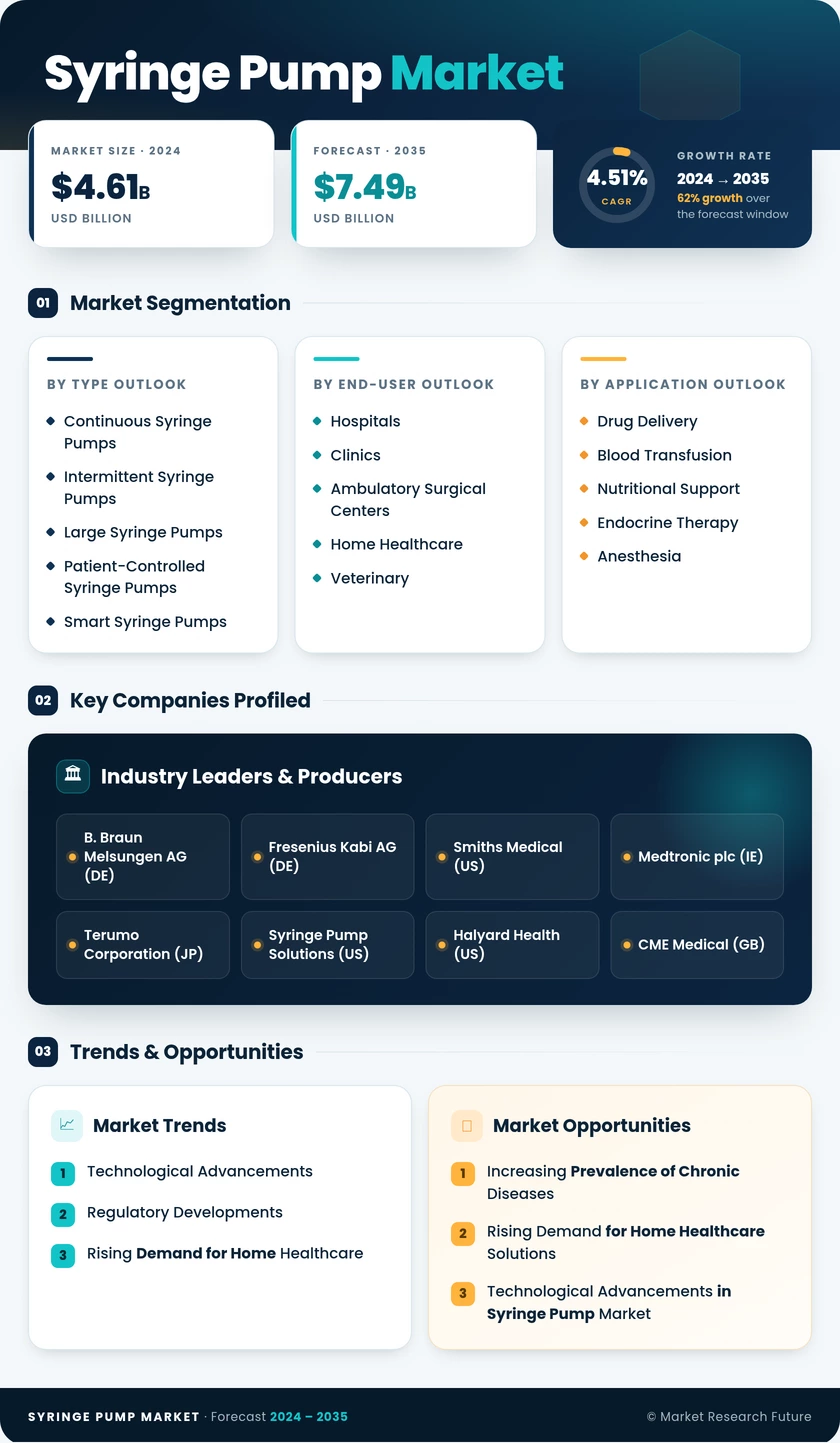
Segmentation Quick Reference
| Dimension | Sub-Segments | Dominant Segment | Fastest Growing Segment |
|---|
| By Type | Infusion Syringe Pumps; Withdrawal Syringe Pumps; Push-Pull / Dual Syringe Pumps; Programmable / Smart Syringe Pumps | Infusion Syringe Pumps (59.8% share) | Programmable / Smart Syringe Pumps (8.8% CAGR) |
| By Channel | Single-Channel; Dual-Channel; Multi-Channel (≥3) | Single-Channel (42.4% share) | Multi-Channel (≥3) (7.6% CAGR) |
| By Application | Oncology & Chemotherapy; Anesthesia; Neonatal & Pediatric Care; Pain Management; Critical Care & ICU; Veterinary Medicine | Oncology & Chemotherapy (40.6% share) | Veterinary Medicine (6.8% CAGR) |
| By End-user | Hospitals; Ambulatory Surgical Centers; Clinics; Homecare Settings; Research Laboratories | Hospitals (66.4% share) | Homecare Settings (7.3% CAGR) |
| By Region | North America; Europe; Asia-Pacific; Middle East & Africa; South America | North America (38.6% share) | Asia-Pacific (6.1% CAGR) |
Market Segmentation Overview
| Sub-Segment | Key Trend |
|---|
| Infusion Syringe Pumps | Standard platform for anesthesia, ICU, and NICU delivery |
| Withdrawal Syringe Pumps | Gradual displacement by automated laboratory systems |
| Push-Pull / Dual Syringe Pumps | Niche use in contrast delivery and continuous-flow research |
| Programmable / Smart Syringe Pumps | Rapid adoption driven by dose-error reduction software |
Infusion Syringe Pumps lead this dimension with a 59.8% share because they handle the everyday low-volume infusions in operating rooms and neonatal units. Programmable / Smart Syringe Pumps grow fastest at an 8.8% CAGR, as drug-library enforcement and wireless updates become accreditation expectations. Withdrawal Syringe Pumps and Push-Pull / Dual Syringe Pumps remain specialized tools whose demand depends on laboratory and radiology workflows rather than bedside care.
| Sub-Segment | Key Trend |
|---|
| Single-Channel | Preferred in clinics, veterinary practices, and home care |
| Dual-Channel | Pediatric line isolation and cumulative-dose display upgrades |
| Multi-Channel (≥3) | ICU consolidation of simultaneous titrated infusions |
Single-Channel pumps lead with a 42.4% share, since portability and low cost suit outpatient and home use. Multi-Channel (≥3) systems grow fastest at a 7.6% CAGR, because ICUs managing vasopressors, sedatives, and analgesics benefit from one integrated interface that tracks every line. Dual-Channel units sit between the two, valued in pediatric wards that need two isolated infusions.
| Sub-Segment | Key Trend |
|---|
| Oncology & Chemotherapy | Expansion of outpatient chemotherapy chairs |
| Anesthesia | Growth of total intravenous anesthesia protocols |
| Neonatal & Pediatric Care | Demand for ultra-low flow certified models |
| Pain Management | Migration of PCA therapy to ambulatory settings |
| Critical Care & ICU | Multi-drug titration for high-acuity patients |
| Veterinary Medicine | Specialty animal hospitals adopting continuous infusion |
Oncology & Chemotherapy holds the largest share at 40.6%, as cytotoxic regimens require precise, documented dosing that syringe pumps provide. Veterinary Medicine grows fastest at a 6.8% CAGR, driven by emergency animal hospitals that now run continuous anesthesia and analgesia. Neonatal & Pediatric Care and Critical Care & ICU depend on specialized flow accuracy and multi-line management.
| Sub-Segment | Key Trend |
|---|
| Hospitals | Enterprise smart-fleet replacement tied to EHR integration |
| Ambulatory Surgical Centers | Same-day anesthesia with compact pumps |
| Clinics | Standalone pumps for outpatient infusions |
| Homecare Settings | Reimbursed ambulatory infusion and remote monitoring |
| Research Laboratories | High-stability programmable pumps for microfluidics |
Hospitals dominate with a 66.4% share because accreditation rules and patient acuity concentrate the most complex infusions in acute care. Homecare Settings grow fastest at a 7.3% CAGR, as Medicare coverage for external infusion pumps moves chemotherapy, pain, and nutrition therapy into patients' homes. Ambulatory Surgical Centers and Research Laboratories add steady, specialized demand for compact and ultra-stable devices.


 Noah Malgeri
Co-Founder

 Peter Groot koerkamp
Account and Business Manager

 Younghwan Choi
Senior Retail Manager

 Mark Irwin
Management Consultant

 Akif Moroglu
Strategy & Business Development Director

 Guilherme Gomes Martins
Product Management Director

 Joseph Aguayo
Sales Operations & Pricing Manager

 La Terria Dodd
Program Support Specialist

 Rob Kooiker
Group Product Manager HVAC & Fire Protection GMA