Request Free Sample ×

Kindly complete the form below to receive a free sample of this Report

* Please use a valid business email

Leading companies partner with us for data-driven Insights

clients tt-cursor
Hero Background
English
Chinese
French
Japanese
Korean
German
Spanish

Synthetic Lubricant Market Share

ID: MRFR/CnM/2109-HCR
140 Pages
Priya Nagrale
March 2026

Synthetic Lubricants Market Research Report Information By Type (Silicones, Esters, PAO, PAG, Others), By Application (Engine Oil, Process Oil, Hydraulic Oil, Marine Lubricants, Metal Working Fluids, Others), By End user (Automobile, Construction, Power & Energy, Mining, Oil & Gas, Food Processing, Others), And By Region (North America, Europe, Asia-Pacific, And Rest Of The World) – Market Forecast Till 2035

Share:
Download PDF ×

We do not share your information with anyone. However, we may send you emails based on your report interest from time to time. You may contact us at any time to opt-out.

Synthetic Lubricant Market Infographic
Purchase Options

Market Share

Synthetic Lubricant Market Share Analysis

In the competitive landscape of the Synthetic Lubricant market, companies deploy various strategies to position themselves strategically and thrive in this dynamic industry. A fundamental approach is product differentiation, where companies aim to distinguish their synthetic lubricants from competitors by highlighting unique features such as superior temperature stability, extended service intervals, or specific applications in industries like automotive, aerospace, or industrial machinery. By offering distinct advantages, companies can attract customers with specific needs, contributing to a robust market presence.

Lubricant is used between the two surfaces of the engine component or machinery to control or reduce friction. Synthetic lubricants can be produced from synthetic base oil which replaces mineral oil from crude oil like esters, PAO, and others. It is generally characterized as oily and liquid material. Even though it is not directly from petroleum, it shows similar properties to petroleum lubricants. These lubricants control the temperature of the vehicles by absorbing the heat generated by moving parts of the vehicle and transfer it to the cooler. Hence these lubricants enhance the lifecycle of the vehicles.

Cost leadership is another pivotal strategy within the Synthetic Lubricant market. Some companies focus on becoming low-cost producers, aiming to provide competitive pricing without compromising on the quality and performance of their synthetic lubricants. Achieving cost leadership often involves optimizing manufacturing processes, sourcing raw materials efficiently, and investing in economies of scale. This strategy is particularly effective in appealing to cost-conscious industries, allowing companies to capture a significant market share by providing cost-effective yet high-quality synthetic lubricant solutions.

Market segmentation is a key aspect of positioning strategies in the Synthetic Lubricant market. Companies analyze diverse industry needs, including automotive, industrial, and marine applications, and tailor their synthetic lubricants accordingly. By catering to the specific requirements of each segment, companies can effectively target their offerings, enhancing customer satisfaction and solidifying their position within distinct markets.

Collaboration and partnerships play a crucial role in market share positioning in the Synthetic Lubricant industry. Companies often form strategic alliances with original equipment manufacturers (OEMs), distributors, and research institutions to gain insights into emerging applications, access new technologies, and expand their market reach. Collaborative efforts enable companies to leverage complementary strengths, share resources, and collectively address challenges, resulting in a more robust market presence.

Continuous innovation is imperative for success in the Synthetic Lubricant market. Companies invest in research and development to introduce lubricants with improved wear protection, enhanced thermal stability, and adaptability to diverse operating conditions. Innovations may focus on developing bio-based lubricants, improving the biodegradability of products, or addressing specific regulatory requirements. Staying ahead in terms of technological advancements ensures that companies remain competitive and adaptable to changing demands in the synthetic lubricant sector.

Effective marketing and branding initiatives contribute significantly to market share positioning. Establishing a strong brand image, emphasizing the performance and longevity of synthetic lubricants, and highlighting endorsements or certifications can influence buyer perceptions. Targeted marketing campaigns create awareness among industries reliant on synthetic lubricants, fostering customer loyalty and attracting new clients.

Global expansion is a strategic move employed by companies to secure a larger market share in the Synthetic Lubricant market. As industries using synthetic lubricants operate globally, companies explore opportunities in international markets. Adapting to global regulations, understanding diverse customer preferences, and addressing market dynamics in different regions allow companies to expand their presence globally, tapping into the growing demand for high-performance synthetic lubricants.

Author
Author Profile
Priya Nagrale
Senior Research Analyst

With an experience of over five years in market research industry (Chemicals & Materials domain), I gather and analyze market data from diverse sources to produce results, which are then presented back to a client. Also, provide recommendations based on the findings. As a Senior Research Analyst, I perform quality checks (QC) for market estimations, QC for reports, and handle queries and work extensively on client customizations. Also, handle the responsibilities of client proposals, report planning, report finalization, and execution

Leave a Comment

FAQs

What is the current valuation of the Synthetic Lubricants Market in 2025?

<p>The Synthetic Lubricants Market is valued at approximately 42.48 USD Billion in 2024.</p>

What is the projected market size for the Synthetic Lubricants Market by 2035?

<p>The market is projected to reach around 58.63 USD Billion by 2035.</p>

What is the expected CAGR for the Synthetic Lubricants Market during the forecast period 2025 - 2035?

<p>The expected CAGR for the Synthetic Lubricants Market during the forecast period is 2.97%.</p>

Which companies are considered key players in the Synthetic Lubricants Market?

<p>Key players in the market include ExxonMobil, Royal Dutch Shell, BP, Chevron, TotalEnergies, Fuchs Petrolub SE, Castrol, Sinopec, and Valvoline.</p>

What are the main types of synthetic lubricants and their market valuations?

<p>The main types include PAO valued at 15.0 to 20.0 USD Billion, Esters at 10.0 to 15.0 USD Billion, and Silicones at 5.0 to 7.0 USD Billion.</p>

What applications dominate the Synthetic Lubricants Market?

<p>Dominant applications include Engine Oil valued at 15.0 to 20.0 USD Billion and Process Oil at 8.0 to 10.0 USD Billion.</p>

Which end-user segments are significant in the Synthetic Lubricants Market?

Significant end-user segments include Automobile valued at 10.0 to 13.0 USD Billion and Oil &amp; Gas at 7.0 to 9.0 USD Billion.

How does the market for synthetic lubricants in the automobile sector compare to other sectors?

The automobile sector leads with a valuation of 10.0 to 13.0 USD Billion, surpassing sectors like Construction and Mining.

What is the valuation range for hydraulic oil within the Synthetic Lubricants Market?

The valuation range for hydraulic oil is between 7.0 to 9.0 USD Billion.

What trends are anticipated for the Synthetic Lubricants Market in the coming years?

Trends suggest a steady growth trajectory, with increasing demand across various applications and end-user segments.

Market Summary

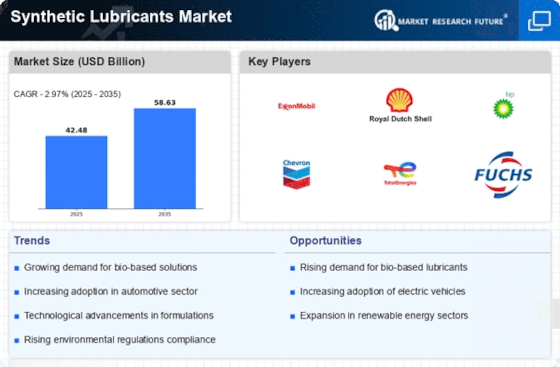
As per Market Research Future analysis, the Synthetic Lubricants Market Size was estimated at 42.48 USD Billion in 2024. The Synthetic Lubricants industry is projected to grow from 43.74 USD Billion in 2025 to 58.63 USD Billion by 2035, exhibiting a compound annual growth rate (CAGR) of 2.9% during the forecast period 2025 - 2035

Key Market Trends & Highlights

The Synthetic Lubricants Market is poised for robust growth driven by sustainability and technological advancements.

  • North America remains the largest market for synthetic lubricants, reflecting a strong demand across various sectors. The Asia-Pacific region is emerging as the fastest-growing market, fueled by rapid industrialization and urbanization. Esters dominate the market as the largest segment, while silicones are gaining traction as the fastest-growing segment. Rising demand for energy efficiency and stringent environmental regulations are key drivers propelling market expansion.

Market Size & Forecast

2024 Market Size 42.48 (USD Billion)
2035 Market Size 58.63 (USD Billion)
CAGR (2025 - 2035) 2.97%
Largest Regional Market Share in 2024 Asia Pacific

Major Players

ExxonMobil (US), Royal Dutch Shell (NL), BP (GB), Chevron (US), TotalEnergies (FR), Fuchs Petrolub SE (DE), Castrol (GB), Sinopec (CN), Valvoline (US)

Market Trends

The Synthetic Lubricants Market is currently experiencing a notable transformation, driven by advancements in technology and increasing environmental awareness. Manufacturers are focusing on developing high-performance products that not only enhance efficiency but also reduce environmental impact. This shift is largely influenced by stringent regulations aimed at minimizing emissions and promoting sustainability. As a result, the market is witnessing a growing demand for bio-based and synthetic alternatives that offer superior lubrication properties while being less harmful to the ecosystem. Furthermore, the automotive sector is increasingly adopting synthetic lubricants due to their ability to improve fuel efficiency and extend engine life, which aligns with the industry's push towards greener technologies. In addition to automotive applications, the Synthetic Lubricants Market is expanding into various industrial sectors, including manufacturing and energy. The versatility of synthetic lubricants makes them suitable for a wide range of applications, from high-temperature environments to extreme pressure conditions. This adaptability is likely to drive further innovation and product development. As companies continue to invest in research and development, the market is poised for growth, with an emphasis on creating formulations that meet the evolving needs of consumers and industries alike. Overall, the Synthetic Lubricants Market appears to be on a promising trajectory, characterized by innovation, sustainability, and a commitment to performance enhancement.

Sustainability Initiatives

The focus on sustainability within the Synthetic Lubricants Market is becoming increasingly pronounced. Companies are prioritizing the development of eco-friendly products that comply with environmental regulations. This trend reflects a broader commitment to reducing carbon footprints and promoting responsible sourcing of raw materials.

Technological Advancements

Technological innovations are reshaping the Synthetic Lubricants Market, with new formulations and production techniques enhancing product performance. These advancements enable manufacturers to create lubricants that offer improved thermal stability, reduced friction, and longer service life, catering to the demands of modern machinery.

Diverse Applications

The versatility of synthetic lubricants is leading to their adoption across various industries, including automotive, aerospace, and manufacturing. This trend indicates a growing recognition of the benefits of synthetic lubricants in enhancing operational efficiency and extending equipment lifespan.

Synthetic Lubricant Market Market Drivers

Growing Automotive Sector

The burgeoning automotive sector is a significant driver for the Synthetic Lubricants Market. With the increasing production of vehicles and the rising demand for high-performance engines, the need for advanced lubricants is becoming more pronounced. Synthetic lubricants are favored for their ability to withstand extreme temperatures and provide superior protection against wear and tear. Recent statistics suggest that the automotive segment accounts for over 40% of the total synthetic lubricants market share. As electric vehicles and hybrid technologies gain traction, the demand for specialized synthetic lubricants tailored for these applications is expected to rise. This growth trajectory in the automotive sector is likely to bolster the Synthetic Lubricants Market in the coming years.

Rising Demand for Energy Efficiency

The increasing emphasis on energy efficiency across various industries appears to be a pivotal driver for the Synthetic Lubricants Market. As organizations strive to reduce operational costs and enhance productivity, the demand for lubricants that minimize friction and wear is likely to surge. Synthetic lubricants, known for their superior performance and longevity, can significantly lower energy consumption in machinery and engines. According to recent data, synthetic lubricants can improve energy efficiency by up to 5-10% compared to conventional oils. This trend is particularly evident in sectors such as automotive and manufacturing, where the need for high-performance lubricants is paramount. Consequently, the rising demand for energy-efficient solutions is expected to propel the growth of the Synthetic Lubricants Market.

Stringent Environmental Regulations

The implementation of stringent environmental regulations is increasingly influencing the Synthetic Lubricants Market. Governments worldwide are enacting policies aimed at reducing emissions and promoting sustainable practices. Synthetic lubricants, which often contain fewer harmful substances than their conventional counterparts, are becoming more favorable in this regulatory landscape. For instance, the European Union has introduced regulations that encourage the use of biodegradable lubricants, which has led to a notable shift in consumer preferences. This regulatory push not only fosters innovation in lubricant formulations but also drives manufacturers to invest in environmentally friendly products. As a result, the Synthetic Lubricants Market is likely to experience growth as companies adapt to these regulations and seek compliant solutions.

Expansion in Industrial Applications

The expansion of industrial applications is emerging as a key driver for the Synthetic Lubricants Market. Industries such as manufacturing, construction, and mining are increasingly recognizing the benefits of synthetic lubricants, which offer enhanced performance and longer service life. The ability of synthetic lubricants to operate effectively under extreme conditions makes them ideal for heavy machinery and equipment. Market analysis indicates that the industrial segment is projected to grow at a CAGR of approximately 6% over the next five years. This growth is attributed to the rising need for efficient lubrication solutions that can reduce downtime and maintenance costs. As industries continue to evolve, the demand for synthetic lubricants is expected to rise, further propelling the Synthetic Lubricants Market.

Technological Innovations in Lubricant Formulation

Technological innovations in lubricant formulation are playing a crucial role in shaping the Synthetic Lubricants Market. Advances in chemical engineering and materials science have led to the development of high-performance synthetic lubricants that offer enhanced properties such as improved thermal stability, oxidation resistance, and lower volatility. These innovations are particularly relevant in high-stress applications, such as aerospace and automotive sectors, where performance is critical. Market data indicates that the introduction of new synthetic formulations has resulted in a 15% increase in market share for synthetic lubricants over the past few years. As manufacturers continue to invest in research and development, the Synthetic Lubricants Market is poised for further expansion driven by these technological advancements.

Market Segment Insights

By Type: Esters (Largest) vs. Silicones (Fastest-Growing)

In the Synthetic Lubricants Market, the type segment is characterized by diverse formulations, prominently featuring Esters, Silicones, PAO, PAG, and Others. Esters hold the largest share of the market due to their excellent lubrication properties and ability to perform under extreme temperatures. The inclusion of <a href="https://www.marketresearchfuture.com/reports/silicones-market-5476">Silicones</a>, while smaller in comparison, showcases a notable growth trajectory, enhanced by their unique performance characteristics in niche applications. This segmentation reveals a healthy competition where traditional lubricants are steadily being challenged by innovative formulations.

Esters (Dominant) vs. Silicones (Emerging)

Esters emerged as the dominant type in the Synthetic Lubricants Market, favored for their biodegradable properties and superior lubricating qualities, making them suitable for both industrial and automotive applications. Their versatility in formulation contributes to their strong market presence. Meanwhile, Silicones are classified as an emerging segment, gaining traction due to their high thermal stability and unique properties that cater to specialized applications, such as in the aerospace and electronics sectors. This shift towards Silicones reflects an evolving market where specialized performance requirements are driving the demand for innovative lubrication solutions.

By Application: Engine Oil (Largest) vs. Hydraulic Oil (Fastest-Growing)

In the Synthetic Lubricants Market, Engine Oil holds the largest market share, driven primarily by the increasing demand for high-performance lubricants in automotive applications. This segment's dominance is attributed to the growing number of vehicles and the push for fuel-efficient lubricants that can enhance engine performance while reducing emissions. Following Engine Oil, Hydraulic Oil represents a significant portion of the market, benefiting from robust applications in various industries, including construction and manufacturing, due to its essential role in machinery operation. The growth trends within the Synthetic Lubricants Market highlight the rapid expansion of Hydraulic Oils, which are experiencing the fastest growth rate among application segments. This surge is propelled by the increasing adoption of synthetic oils that offer better thermal stability and resistance to oxidation. As industries modernize and machinery becomes more advanced, the demand for reliable and effective hydraulic fluids is escalating. Furthermore, increasing awareness regarding the environmental benefits of synthetic options is driving a shift away from conventional oils towards more sustainable alternatives, paving the way for sustained growth within this segment.

Engine Oil (Dominant) vs. Hydraulic Oil (Emerging)

Engine Oil, being a dominant player in the Synthetic Lubricants Market, is renowned for its essential role in the automotive sector, often formulated to enhance engine efficiency and longevity. Its characteristics include superior lubrication properties, improved thermal stability, and the ability to operate under extreme conditions. As vehicles become more technologically sophisticated, the demands for high-quality engine oils continue to grow, solidifying its position as a market leader. In contrast, Hydraulic Oil is an emerging segment, characterized by its wide range of applications in industrial machinery and equipment. With advancements in formulations leading to better performance attributes such as biodegradability and increased resistance to wear, this segment is quickly gaining traction. The expanding use of hydraulic systems in various industries is driving demand, making Hydraulic Oil a significant focus for future growth within the synthetic <a href="https://www.marketresearchfuture.com/reports/lubricants-market-5449">lubricants</a> landscape.

By End User: Automobile (Largest) vs. Construction (Fastest-Growing)

In the Synthetic Lubricants Market, the distribution of end-user segments reveals the automobile sector as the largest contributor. This segment benefits from the high demand for advanced lubricants to enhance vehicle performance. Other notable segments include construction, power &amp; energy, mining, and oil &amp; gas, which collectively contribute to steady market presence. The food processing industry also plays a crucial role, although it remains less prominent in overall share compared to its counterparts.

Automobile (Dominant) vs. Construction (Emerging)

The automobile sector has established itself as the dominant user of synthetic lubricants, primarily due to the increasing emphasis on efficiency and performance in vehicles. Synthetic lubricants are preferred in this segment for their superior thermal stability, ability to enhance fuel economy, and extend engine life. On the other hand, the construction sector is emerging rapidly, driven by the need for high-performance lubricants that can withstand extreme conditions. As construction activities ramp up globally, the demand for specialized lubricants tailored to heavy machinery increases, positioning this segment as a key growth area in the synthetic lubricants market.

Get more detailed insights about Synthetic Lubricant Market Research Report- Forecast to 2035

Regional Insights

By Region, the study provides market insights into North America, Europe, Asia-Pacific, and the Rest of the World. In 2022, Asia Pacific had the highest revenue share of almost 35%-40.0%. The region's expanding automotive and petrochemical sectors are too accountable for this rise. Several large oil companies that produce synthetic lubricants and have substantial distribution networks dominate the vast majority of the market. The Asia Pacific refinery industry, particularly in countries such as India, China, and Singapore, has benefited from the low price of crude oil, which has led to growth in the region's petrochemical production.

Further, the major countries studied in the market report are The U.S, Canada, Germany, France, UK, Italy, Spain, China, Japan, India, Australia, South Korea, and Brazil.

Figure 3:  SYNTHETIC LUBRICANTS MARKET SHARE BY REGION 2021 (%)

Europe synthetic lubricants market is expected to grow at the fastest CAGR from 2022 to 2030. This growth is linked to factors including the region's manufacturing sector's recovery, greater emphasis on lowering vehicle CO2 emissions, improvements in product quality, and the availability of base oil. The product's demand in the region is also being fueled by rising investment in synthetic lubricant mixing facilities in Russia and the Netherlands. The European Union's rules and regulations for environmental and public health safety, however, could be a risk to the market.

Further, the Germany synthetic lubricants market held the largest market share, and the UK synthetic lubricants market was the fastest-growing market in the European region

The North America Synthetic Lubricants Market is expected to grow significantly from 2022 to 2030. The growing demand from the engine oil application area is also anticipated to boost the supply of synthetic lubricants in North America. Due to the expansion of the region's automotive industry, the supply of engine oil is increasing. Due to their higher thermal stability and decreased friction resistance, synthetic lubricants are necessary as functional consumables. Consequently, each of these factors is supporting regional development.

Moreover, United States synthetic lubricants market held the largest and fastest growing market and Canada synthetic lubricants market is the second-fastest growing market in the North America region.

Key Players and Competitive Insights

Major market players are spending a lot of money on R&D to increase their product lines, which will help the synthetic lubricants market grow even more. Market participants are also taking a range of strategic initiatives to grow their worldwide footprint, with key market developments such as new product launches, contractual agreements, mergers and acquisitions, increased investments, and collaboration with other organizations. Competitors in the synthetic lubricants industry must offer cost-effective products to expand and survive in an increasingly competitive and rising market environment.

One of the primary business strategies adopted by manufacturers in the synthetic lubricants industry to benefit customers and expand the market sector is to manufacture locally to reduce operating costs. In recent years, the synthetic lubricants industry has provided lubricants with some of the most significant benefits. The synthetic lubricants market major players such as Chevron Corporation, ExxonMobil Corporation, Total Lubricants, and others are working to expand the market demand by investing in research and development activities.

American multinational oil and gas company Chevron Corporation specializes mostly in oil and gas. Its headquarters are in San Ramon, California, and it operates in more than 175 countries. It is the second-largest direct descendant of Standard Oil and was once known as the Standard Oil Company of California. The company’s Chevron, Texaco, and Caltex brands are well known for their high standards of performance, quality, and technology. Their lubricating products are commonly used in automobiles, trucks, buses, and industrial machinery.

In Jan 2023, Chevron announced intentions to increase its share buyback budget by three times, to a stunning USD 75 billion, making it the largest shareholder payout in the history of the oil industry. The decision was made as the company prepares to announce 2022 profits that have increased by a factor of two to USD 37.2 billion.

Also, The Irving, Texas-based ExxonMobil Corporation is a multinational American oil and gas company. ExxonMobil develops and deploys next-generation technologies to enable safely and ethically meet the world's growing demand for energy and high-quality chemical products. ExxonMobil is one of the leading public companies’ energy providers and chemical manufacturers in the world.

In March Mobil Serv SM Lubrication Management, a low-cost automated maintenance management system that enables operators to effectively coordinate, automate, and accelerate maintenance-related processes, has been launched by ExxonMobil.

Bharat Petroleum Corporation Ltd (BPCL), which controls around 12 percent of the lubes market through Mak-branded lubricants, will introduce two high-quality synthetic lubes for premium cars and bikes next week. Mak’s main brand sells about 3.3 lakh tonnes of lubes yearly, valued at around Rs 3,000 crore. The company said it would launch Mak TitaniumCK4, which is an ultra-low emission diesel engine lube for BS-VI cars, and Mak BlazeSynth for high-end bikes; both are fully synthetic oils.

Steelbird International, a Delhi-based automotive system maker, has launched its own motorcycle engine oil, including lubricants, into a new market segment in July 2021. Helmets manufacturer Steelbird International has entered into a new line of business with its latest venture into the lubricant market space targeting two-wheelers. The Steelbird’s lubricating agent line counts on starting from 4T engine oil SAE 20W40 API SL (900 ml), having a price as low as Rs.366 per unit. The lubricant sold in the quantity of one liter is Steelbird 4T engine oil SAE 20W40 API SL, which costs Rs. 394.

The third oil listed under lubricants is Steelbird 4T engine oil SAE 15W50 API Semi-Synthetic (2.5L); its price is Rs.1075.

Key Companies in the Synthetic Lubricant Market include

Industry Developments

  • Q2 2024: ExxonMobil launches new Mobil SHC Elite synthetic lubricant for industrial applications ExxonMobil announced the launch of Mobil SHC Elite, a new high-performance synthetic lubricant designed to extend equipment life and reduce maintenance in industrial settings.
  • Q1 2024: Shell opens new synthetic lubricants blending plant in Tianjin, China Shell inaugurated a state-of-the-art synthetic lubricants blending facility in Tianjin to meet growing demand in the Asia-Pacific region, expanding its production capacity for advanced lubricants.
  • Q2 2024: Chevron launches Delo 600 ADF synthetic engine oil for heavy-duty vehicles Chevron introduced Delo 600 ADF, a new synthetic engine oil formulated to reduce ash buildup and extend drain intervals for heavy-duty diesel engines.
  • Q2 2024: TotalEnergies partners with BYD to supply synthetic lubricants for electric vehicles TotalEnergies announced a partnership with BYD to supply advanced synthetic lubricants tailored for electric vehicle applications, supporting BYD’s global expansion.
  • Q1 2024: Fuchs Petrolub acquires specialty synthetic lubricant producer Nye Lubricants Fuchs Petrolub completed the acquisition of Nye Lubricants, expanding its portfolio of specialty synthetic lubricants for automotive and electronics sectors.
  • Q2 2024: Petro-Canada Lubricants announces $50 million investment in synthetic lubricant R&D center Petro-Canada Lubricants revealed plans to invest $50 million in a new research and development center focused on synthetic lubricant innovation and sustainability.
  • Q2 2024: Valvoline launches new full synthetic motor oil for hybrid vehicles Valvoline introduced a new full synthetic motor oil specifically formulated for hybrid vehicles, aiming to improve fuel efficiency and engine protection.
  • Q1 2024: BP signs multi-year supply contract for synthetic lubricants with Tata Motors BP entered into a multi-year agreement to supply synthetic lubricants to Tata Motors, supporting the automaker’s push for higher efficiency and lower emissions.
  • Q2 2024: Castrol unveils new synthetic gear oil for wind turbine applications Castrol launched a new synthetic gear oil designed to enhance the reliability and lifespan of wind turbine gearboxes, targeting the renewable energy sector.
  • Q2 2024: SK Lubricants announces expansion of synthetic lubricant production facility in Ulsan, South Korea SK Lubricants began construction to expand its synthetic lubricant production facility in Ulsan, aiming to meet rising global demand for high-performance lubricants.
  • Q1 2024: Idemitsu Kosan launches new synthetic transmission fluid for electric vehicles Idemitsu Kosan introduced a new synthetic transmission fluid engineered for electric vehicles, focusing on improved thermal stability and energy efficiency.
  • Q2 2024: Quaker Houghton acquires specialty synthetic lubricant business of Chemours Quaker Houghton completed the acquisition of Chemours’ specialty synthetic lubricant business, strengthening its position in the industrial lubricants market.

Future Outlook

Synthetic Lubricant Market Future Outlook

The Synthetic Lubricants Market is projected to grow at a 2.97% CAGR from 2025 to 2035, driven by technological advancements, increasing automotive production, and environmental regulations.

New opportunities lie in:

  • Development of bio-based synthetic lubricants for eco-conscious consumers.
  • Expansion into emerging markets with tailored product offerings.
  • Investment in advanced lubricant recycling technologies to enhance sustainability.

By 2035, the market is expected to achieve robust growth, driven by innovation and sustainability initiatives.

Market Segmentation

Synthetic Lubricant Market Type Outlook

  • Silicones
  • Esters
  • PAO
  • PAG
  • Others

Synthetic Lubricant Market End User Outlook

  • Automobile
  • Construction
  • Power & Energy
  • Mining
  • Oil & Gas
  • Food Processing
  • Others

Synthetic Lubricant Market Application Outlook

  • Engine Oil
  • Process Oil
  • Hydraulic Oil
  • Marine Lubricants
  • Metal Working Fluids
  • Others

Report Scope

MARKET SIZE 2024 42.48(USD Billion)
MARKET SIZE 2025 43.74(USD Billion)
MARKET SIZE 2035 58.63(USD Billion)
COMPOUND ANNUAL GROWTH RATE (CAGR) 2.97% (2025 - 2035)
REPORT COVERAGE Revenue Forecast, Competitive Landscape, Growth Factors, and Trends
BASE YEAR 2024
Market Forecast Period 2025 - 2035
Historical Data 2019 - 2024
Market Forecast Units USD Billion
Key Companies Profiled ExxonMobil (US), Royal Dutch Shell (NL), BP (GB), Chevron (US), TotalEnergies (FR), Fuchs Petrolub SE (DE), Castrol (GB), Sinopec (CN), Valvoline (US)
Segments Covered Type, Application, End user, Region
Key Market Opportunities Growing demand for environmentally friendly synthetic lubricants drives innovation and market expansion opportunities.
Key Market Dynamics Rising demand for high-performance synthetic lubricants driven by stringent environmental regulations and technological advancements.
Countries Covered North America, Europe, APAC, South America, MEA

FAQs

What is the current valuation of the Synthetic Lubricants Market in 2025?

<p>The Synthetic Lubricants Market is valued at approximately 42.48 USD Billion in 2024.</p>

What is the projected market size for the Synthetic Lubricants Market by 2035?

<p>The market is projected to reach around 58.63 USD Billion by 2035.</p>

What is the expected CAGR for the Synthetic Lubricants Market during the forecast period 2025 - 2035?

<p>The expected CAGR for the Synthetic Lubricants Market during the forecast period is 2.97%.</p>

Which companies are considered key players in the Synthetic Lubricants Market?

<p>Key players in the market include ExxonMobil, Royal Dutch Shell, BP, Chevron, TotalEnergies, Fuchs Petrolub SE, Castrol, Sinopec, and Valvoline.</p>

What are the main types of synthetic lubricants and their market valuations?

<p>The main types include PAO valued at 15.0 to 20.0 USD Billion, Esters at 10.0 to 15.0 USD Billion, and Silicones at 5.0 to 7.0 USD Billion.</p>

What applications dominate the Synthetic Lubricants Market?

<p>Dominant applications include Engine Oil valued at 15.0 to 20.0 USD Billion and Process Oil at 8.0 to 10.0 USD Billion.</p>

Which end-user segments are significant in the Synthetic Lubricants Market?

Significant end-user segments include Automobile valued at 10.0 to 13.0 USD Billion and Oil &amp; Gas at 7.0 to 9.0 USD Billion.

How does the market for synthetic lubricants in the automobile sector compare to other sectors?

The automobile sector leads with a valuation of 10.0 to 13.0 USD Billion, surpassing sectors like Construction and Mining.

What is the valuation range for hydraulic oil within the Synthetic Lubricants Market?

The valuation range for hydraulic oil is between 7.0 to 9.0 USD Billion.

What trends are anticipated for the Synthetic Lubricants Market in the coming years?

Trends suggest a steady growth trajectory, with increasing demand across various applications and end-user segments.

  1. SECTION I: EXECUTIVE SUMMARY AND KEY HIGHLIGHTS
    1. | 1.1 EXECUTIVE SUMMARY
    2. | | 1.1.1 Market Overview
    3. | | 1.1.2 Key Findings
    4. | | 1.1.3 Market Segmentation
    5. | | 1.1.4 Competitive Landscape
    6. | | 1.1.5 Challenges and Opportunities
    7. | | 1.1.6 Future Outlook
  2. SECTION II: SCOPING, METHODOLOGY AND MARKET STRUCTURE
    1. | 2.1 MARKET INTRODUCTION
    2. | | 2.1.1 Definition
    3. | | 2.1.2 Scope of the study
    4. | | | 2.1.2.1 Research Objective
    5. | | | 2.1.2.2 Assumption
    6. | | | 2.1.2.3 Limitations
    7. | 2.2 RESEARCH METHODOLOGY
    8. | | 2.2.1 Overview
    9. | | 2.2.2 Data Mining
    10. | | 2.2.3 Secondary Research
    11. | | 2.2.4 Primary Research
    12. | | | 2.2.4.1 Primary Interviews and Information Gathering Process
    13. | | | 2.2.4.2 Breakdown of Primary Respondents
    14. | | 2.2.5 Forecasting Model
    15. | | 2.2.6 Market Size Estimation
    16. | | | 2.2.6.1 Bottom-Up Approach
    17. | | | 2.2.6.2 Top-Down Approach
    18. | | 2.2.7 Data Triangulation
    19. | | 2.2.8 Validation
  3. SECTION III: QUALITATIVE ANALYSIS
    1. | 3.1 MARKET DYNAMICS
    2. | | 3.1.1 Overview
    3. | | 3.1.2 Drivers
    4. | | 3.1.3 Restraints
    5. | | 3.1.4 Opportunities
    6. | 3.2 MARKET FACTOR ANALYSIS
    7. | | 3.2.1 Value chain Analysis
    8. | | 3.2.2 Porter's Five Forces Analysis
    9. | | | 3.2.2.1 Bargaining Power of Suppliers
    10. | | | 3.2.2.2 Bargaining Power of Buyers
    11. | | | 3.2.2.3 Threat of New Entrants
    12. | | | 3.2.2.4 Threat of Substitutes
    13. | | | 3.2.2.5 Intensity of Rivalry
    14. | | 3.2.3 COVID-19 Impact Analysis
    15. | | | 3.2.3.1 Market Impact Analysis
    16. | | | 3.2.3.2 Regional Impact
    17. | | | 3.2.3.3 Opportunity and Threat Analysis
  4. SECTION IV: QUANTITATIVE ANALYSIS
    1. | 4.1 Chemicals and Materials, BY Type (USD Billion)
    2. | | 4.1.1 Silicones
    3. | | 4.1.2 Esters
    4. | | 4.1.3 PAO
    5. | | 4.1.4 PAG
    6. | | 4.1.5 Others
    7. | 4.2 Chemicals and Materials, BY Application (USD Billion)
    8. | | 4.2.1 Engine Oil
    9. | | 4.2.2 Process Oil
    10. | | 4.2.3 Hydraulic Oil
    11. | | 4.2.4 Marine Lubricants
    12. | | 4.2.5 Metal Working Fluids
    13. | | 4.2.6 Others
    14. | 4.3 Chemicals and Materials, BY End User (USD Billion)
    15. | | 4.3.1 Automobile
    16. | | 4.3.2 Construction
    17. | | 4.3.3 Power & Energy
    18. | | 4.3.4 Mining
    19. | | 4.3.5 Oil & Gas
    20. | | 4.3.6 Food Processing
    21. | | 4.3.7 Others
    22. | 4.4 Chemicals and Materials, BY Region (USD Billion)
    23. | | 4.4.1 North America
    24. | | | 4.4.1.1 US
    25. | | | 4.4.1.2 Canada
    26. | | 4.4.2 Europe
    27. | | | 4.4.2.1 Germany
    28. | | | 4.4.2.2 UK
    29. | | | 4.4.2.3 France
    30. | | | 4.4.2.4 Russia
    31. | | | 4.4.2.5 Italy
    32. | | | 4.4.2.6 Spain
    33. | | | 4.4.2.7 Rest of Europe
    34. | | 4.4.3 APAC
    35. | | | 4.4.3.1 China
    36. | | | 4.4.3.2 India
    37. | | | 4.4.3.3 Japan
    38. | | | 4.4.3.4 South Korea
    39. | | | 4.4.3.5 Malaysia
    40. | | | 4.4.3.6 Thailand
    41. | | | 4.4.3.7 Indonesia
    42. | | | 4.4.3.8 Rest of APAC
    43. | | 4.4.4 South America
    44. | | | 4.4.4.1 Brazil
    45. | | | 4.4.4.2 Mexico
    46. | | | 4.4.4.3 Argentina
    47. | | | 4.4.4.4 Rest of South America
    48. | | 4.4.5 MEA
    49. | | | 4.4.5.1 GCC Countries
    50. | | | 4.4.5.2 South Africa
    51. | | | 4.4.5.3 Rest of MEA
  5. SECTION V: COMPETITIVE ANALYSIS
    1. | 5.1 Competitive Landscape
    2. | | 5.1.1 Overview
    3. | | 5.1.2 Competitive Analysis
    4. | | 5.1.3 Market share Analysis
    5. | | 5.1.4 Major Growth Strategy in the Chemicals and Materials
    6. | | 5.1.5 Competitive Benchmarking
    7. | | 5.1.6 Leading Players in Terms of Number of Developments in the Chemicals and Materials
    8. | | 5.1.7 Key developments and growth strategies
    9. | | | 5.1.7.1 New Product Launch/Service Deployment
    10. | | | 5.1.7.2 Merger & Acquisitions
    11. | | | 5.1.7.3 Joint Ventures
    12. | | 5.1.8 Major Players Financial Matrix
    13. | | | 5.1.8.1 Sales and Operating Income
    14. | | | 5.1.8.2 Major Players R&D Expenditure. 2023
    15. | 5.2 Company Profiles
    16. | | 5.2.1 ExxonMobil (US)
    17. | | | 5.2.1.1 Financial Overview
    18. | | | 5.2.1.2 Products Offered
    19. | | | 5.2.1.3 Key Developments
    20. | | | 5.2.1.4 SWOT Analysis
    21. | | | 5.2.1.5 Key Strategies
    22. | | 5.2.2 Royal Dutch Shell (NL)
    23. | | | 5.2.2.1 Financial Overview
    24. | | | 5.2.2.2 Products Offered
    25. | | | 5.2.2.3 Key Developments
    26. | | | 5.2.2.4 SWOT Analysis
    27. | | | 5.2.2.5 Key Strategies
    28. | | 5.2.3 BP (GB)
    29. | | | 5.2.3.1 Financial Overview
    30. | | | 5.2.3.2 Products Offered
    31. | | | 5.2.3.3 Key Developments
    32. | | | 5.2.3.4 SWOT Analysis
    33. | | | 5.2.3.5 Key Strategies
    34. | | 5.2.4 Chevron (US)
    35. | | | 5.2.4.1 Financial Overview
    36. | | | 5.2.4.2 Products Offered
    37. | | | 5.2.4.3 Key Developments
    38. | | | 5.2.4.4 SWOT Analysis
    39. | | | 5.2.4.5 Key Strategies
    40. | | 5.2.5 TotalEnergies (FR)
    41. | | | 5.2.5.1 Financial Overview
    42. | | | 5.2.5.2 Products Offered
    43. | | | 5.2.5.3 Key Developments
    44. | | | 5.2.5.4 SWOT Analysis
    45. | | | 5.2.5.5 Key Strategies
    46. | | 5.2.6 Fuchs Petrolub SE (DE)
    47. | | | 5.2.6.1 Financial Overview
    48. | | | 5.2.6.2 Products Offered
    49. | | | 5.2.6.3 Key Developments
    50. | | | 5.2.6.4 SWOT Analysis
    51. | | | 5.2.6.5 Key Strategies
    52. | | 5.2.7 Castrol (GB)
    53. | | | 5.2.7.1 Financial Overview
    54. | | | 5.2.7.2 Products Offered
    55. | | | 5.2.7.3 Key Developments
    56. | | | 5.2.7.4 SWOT Analysis
    57. | | | 5.2.7.5 Key Strategies
    58. | | 5.2.8 Sinopec (CN)
    59. | | | 5.2.8.1 Financial Overview
    60. | | | 5.2.8.2 Products Offered
    61. | | | 5.2.8.3 Key Developments
    62. | | | 5.2.8.4 SWOT Analysis
    63. | | | 5.2.8.5 Key Strategies
    64. | | 5.2.9 Valvoline (US)
    65. | | | 5.2.9.1 Financial Overview
    66. | | | 5.2.9.2 Products Offered
    67. | | | 5.2.9.3 Key Developments
    68. | | | 5.2.9.4 SWOT Analysis
    69. | | | 5.2.9.5 Key Strategies
    70. | 5.3 Appendix
    71. | | 5.3.1 References
    72. | | 5.3.2 Related Reports
  6. LIST OF FIGURES
    1. | 6.1 MARKET SYNOPSIS
    2. | 6.2 NORTH AMERICA MARKET ANALYSIS
    3. | 6.3 US MARKET ANALYSIS BY TYPE
    4. | 6.4 US MARKET ANALYSIS BY APPLICATION
    5. | 6.5 US MARKET ANALYSIS BY END USER
    6. | 6.6 CANADA MARKET ANALYSIS BY TYPE
    7. | 6.7 CANADA MARKET ANALYSIS BY APPLICATION
    8. | 6.8 CANADA MARKET ANALYSIS BY END USER
    9. | 6.9 EUROPE MARKET ANALYSIS
    10. | 6.10 GERMANY MARKET ANALYSIS BY TYPE
    11. | 6.11 GERMANY MARKET ANALYSIS BY APPLICATION
    12. | 6.12 GERMANY MARKET ANALYSIS BY END USER
    13. | 6.13 UK MARKET ANALYSIS BY TYPE
    14. | 6.14 UK MARKET ANALYSIS BY APPLICATION
    15. | 6.15 UK MARKET ANALYSIS BY END USER
    16. | 6.16 FRANCE MARKET ANALYSIS BY TYPE
    17. | 6.17 FRANCE MARKET ANALYSIS BY APPLICATION
    18. | 6.18 FRANCE MARKET ANALYSIS BY END USER
    19. | 6.19 RUSSIA MARKET ANALYSIS BY TYPE
    20. | 6.20 RUSSIA MARKET ANALYSIS BY APPLICATION
    21. | 6.21 RUSSIA MARKET ANALYSIS BY END USER
    22. | 6.22 ITALY MARKET ANALYSIS BY TYPE
    23. | 6.23 ITALY MARKET ANALYSIS BY APPLICATION
    24. | 6.24 ITALY MARKET ANALYSIS BY END USER
    25. | 6.25 SPAIN MARKET ANALYSIS BY TYPE
    26. | 6.26 SPAIN MARKET ANALYSIS BY APPLICATION
    27. | 6.27 SPAIN MARKET ANALYSIS BY END USER
    28. | 6.28 REST OF EUROPE MARKET ANALYSIS BY TYPE
    29. | 6.29 REST OF EUROPE MARKET ANALYSIS BY APPLICATION
    30. | 6.30 REST OF EUROPE MARKET ANALYSIS BY END USER
    31. | 6.31 APAC MARKET ANALYSIS
    32. | 6.32 CHINA MARKET ANALYSIS BY TYPE
    33. | 6.33 CHINA MARKET ANALYSIS BY APPLICATION
    34. | 6.34 CHINA MARKET ANALYSIS BY END USER
    35. | 6.35 INDIA MARKET ANALYSIS BY TYPE
    36. | 6.36 INDIA MARKET ANALYSIS BY APPLICATION
    37. | 6.37 INDIA MARKET ANALYSIS BY END USER
    38. | 6.38 JAPAN MARKET ANALYSIS BY TYPE
    39. | 6.39 JAPAN MARKET ANALYSIS BY APPLICATION
    40. | 6.40 JAPAN MARKET ANALYSIS BY END USER
    41. | 6.41 SOUTH KOREA MARKET ANALYSIS BY TYPE
    42. | 6.42 SOUTH KOREA MARKET ANALYSIS BY APPLICATION
    43. | 6.43 SOUTH KOREA MARKET ANALYSIS BY END USER
    44. | 6.44 MALAYSIA MARKET ANALYSIS BY TYPE
    45. | 6.45 MALAYSIA MARKET ANALYSIS BY APPLICATION
    46. | 6.46 MALAYSIA MARKET ANALYSIS BY END USER
    47. | 6.47 THAILAND MARKET ANALYSIS BY TYPE
    48. | 6.48 THAILAND MARKET ANALYSIS BY APPLICATION
    49. | 6.49 THAILAND MARKET ANALYSIS BY END USER
    50. | 6.50 INDONESIA MARKET ANALYSIS BY TYPE
    51. | 6.51 INDONESIA MARKET ANALYSIS BY APPLICATION
    52. | 6.52 INDONESIA MARKET ANALYSIS BY END USER
    53. | 6.53 REST OF APAC MARKET ANALYSIS BY TYPE
    54. | 6.54 REST OF APAC MARKET ANALYSIS BY APPLICATION
    55. | 6.55 REST OF APAC MARKET ANALYSIS BY END USER
    56. | 6.56 SOUTH AMERICA MARKET ANALYSIS
    57. | 6.57 BRAZIL MARKET ANALYSIS BY TYPE
    58. | 6.58 BRAZIL MARKET ANALYSIS BY APPLICATION
    59. | 6.59 BRAZIL MARKET ANALYSIS BY END USER
    60. | 6.60 MEXICO MARKET ANALYSIS BY TYPE
    61. | 6.61 MEXICO MARKET ANALYSIS BY APPLICATION
    62. | 6.62 MEXICO MARKET ANALYSIS BY END USER
    63. | 6.63 ARGENTINA MARKET ANALYSIS BY TYPE
    64. | 6.64 ARGENTINA MARKET ANALYSIS BY APPLICATION
    65. | 6.65 ARGENTINA MARKET ANALYSIS BY END USER
    66. | 6.66 REST OF SOUTH AMERICA MARKET ANALYSIS BY TYPE
    67. | 6.67 REST OF SOUTH AMERICA MARKET ANALYSIS BY APPLICATION
    68. | 6.68 REST OF SOUTH AMERICA MARKET ANALYSIS BY END USER
    69. | 6.69 MEA MARKET ANALYSIS
    70. | 6.70 GCC COUNTRIES MARKET ANALYSIS BY TYPE
    71. | 6.71 GCC COUNTRIES MARKET ANALYSIS BY APPLICATION
    72. | 6.72 GCC COUNTRIES MARKET ANALYSIS BY END USER
    73. | 6.73 SOUTH AFRICA MARKET ANALYSIS BY TYPE
    74. | 6.74 SOUTH AFRICA MARKET ANALYSIS BY APPLICATION
    75. | 6.75 SOUTH AFRICA MARKET ANALYSIS BY END USER
    76. | 6.76 REST OF MEA MARKET ANALYSIS BY TYPE
    77. | 6.77 REST OF MEA MARKET ANALYSIS BY APPLICATION
    78. | 6.78 REST OF MEA MARKET ANALYSIS BY END USER
    79. | 6.79 KEY BUYING CRITERIA OF CHEMICALS AND MATERIALS
    80. | 6.80 RESEARCH PROCESS OF MRFR
    81. | 6.81 DRO ANALYSIS OF CHEMICALS AND MATERIALS
    82. | 6.82 DRIVERS IMPACT ANALYSIS: CHEMICALS AND MATERIALS
    83. | 6.83 RESTRAINTS IMPACT ANALYSIS: CHEMICALS AND MATERIALS
    84. | 6.84 SUPPLY / VALUE CHAIN: CHEMICALS AND MATERIALS
    85. | 6.85 CHEMICALS AND MATERIALS, BY TYPE, 2024 (% SHARE)
    86. | 6.86 CHEMICALS AND MATERIALS, BY TYPE, 2024 TO 2035 (USD Billion)
    87. | 6.87 CHEMICALS AND MATERIALS, BY APPLICATION, 2024 (% SHARE)
    88. | 6.88 CHEMICALS AND MATERIALS, BY APPLICATION, 2024 TO 2035 (USD Billion)
    89. | 6.89 CHEMICALS AND MATERIALS, BY END USER, 2024 (% SHARE)
    90. | 6.90 CHEMICALS AND MATERIALS, BY END USER, 2024 TO 2035 (USD Billion)
    91. | 6.91 BENCHMARKING OF MAJOR COMPETITORS
  7. LIST OF TABLES
    1. | 7.1 LIST OF ASSUMPTIONS
    2. | | 7.1.1
    3. | 7.2 North America MARKET SIZE ESTIMATES; FORECAST
    4. | | 7.2.1 BY TYPE, 2025-2035 (USD Billion)
    5. | | 7.2.2 BY APPLICATION, 2025-2035 (USD Billion)
    6. | | 7.2.3 BY END USER, 2025-2035 (USD Billion)
    7. | 7.3 US MARKET SIZE ESTIMATES; FORECAST
    8. | | 7.3.1 BY TYPE, 2025-2035 (USD Billion)
    9. | | 7.3.2 BY APPLICATION, 2025-2035 (USD Billion)
    10. | | 7.3.3 BY END USER, 2025-2035 (USD Billion)
    11. | 7.4 Canada MARKET SIZE ESTIMATES; FORECAST
    12. | | 7.4.1 BY TYPE, 2025-2035 (USD Billion)
    13. | | 7.4.2 BY APPLICATION, 2025-2035 (USD Billion)
    14. | | 7.4.3 BY END USER, 2025-2035 (USD Billion)
    15. | 7.5 Europe MARKET SIZE ESTIMATES; FORECAST
    16. | | 7.5.1 BY TYPE, 2025-2035 (USD Billion)
    17. | | 7.5.2 BY APPLICATION, 2025-2035 (USD Billion)
    18. | | 7.5.3 BY END USER, 2025-2035 (USD Billion)
    19. | 7.6 Germany MARKET SIZE ESTIMATES; FORECAST
    20. | | 7.6.1 BY TYPE, 2025-2035 (USD Billion)
    21. | | 7.6.2 BY APPLICATION, 2025-2035 (USD Billion)
    22. | | 7.6.3 BY END USER, 2025-2035 (USD Billion)
    23. | 7.7 UK MARKET SIZE ESTIMATES; FORECAST
    24. | | 7.7.1 BY TYPE, 2025-2035 (USD Billion)
    25. | | 7.7.2 BY APPLICATION, 2025-2035 (USD Billion)
    26. | | 7.7.3 BY END USER, 2025-2035 (USD Billion)
    27. | 7.8 France MARKET SIZE ESTIMATES; FORECAST
    28. | | 7.8.1 BY TYPE, 2025-2035 (USD Billion)
    29. | | 7.8.2 BY APPLICATION, 2025-2035 (USD Billion)
    30. | | 7.8.3 BY END USER, 2025-2035 (USD Billion)
    31. | 7.9 Russia MARKET SIZE ESTIMATES; FORECAST
    32. | | 7.9.1 BY TYPE, 2025-2035 (USD Billion)
    33. | | 7.9.2 BY APPLICATION, 2025-2035 (USD Billion)
    34. | | 7.9.3 BY END USER, 2025-2035 (USD Billion)
    35. | 7.10 Italy MARKET SIZE ESTIMATES; FORECAST
    36. | | 7.10.1 BY TYPE, 2025-2035 (USD Billion)
    37. | | 7.10.2 BY APPLICATION, 2025-2035 (USD Billion)
    38. | | 7.10.3 BY END USER, 2025-2035 (USD Billion)
    39. | 7.11 Spain MARKET SIZE ESTIMATES; FORECAST
    40. | | 7.11.1 BY TYPE, 2025-2035 (USD Billion)
    41. | | 7.11.2 BY APPLICATION, 2025-2035 (USD Billion)
    42. | | 7.11.3 BY END USER, 2025-2035 (USD Billion)
    43. | 7.12 Rest of Europe MARKET SIZE ESTIMATES; FORECAST
    44. | | 7.12.1 BY TYPE, 2025-2035 (USD Billion)
    45. | | 7.12.2 BY APPLICATION, 2025-2035 (USD Billion)
    46. | | 7.12.3 BY END USER, 2025-2035 (USD Billion)
    47. | 7.13 APAC MARKET SIZE ESTIMATES; FORECAST
    48. | | 7.13.1 BY TYPE, 2025-2035 (USD Billion)
    49. | | 7.13.2 BY APPLICATION, 2025-2035 (USD Billion)
    50. | | 7.13.3 BY END USER, 2025-2035 (USD Billion)
    51. | 7.14 China MARKET SIZE ESTIMATES; FORECAST
    52. | | 7.14.1 BY TYPE, 2025-2035 (USD Billion)
    53. | | 7.14.2 BY APPLICATION, 2025-2035 (USD Billion)
    54. | | 7.14.3 BY END USER, 2025-2035 (USD Billion)
    55. | 7.15 India MARKET SIZE ESTIMATES; FORECAST
    56. | | 7.15.1 BY TYPE, 2025-2035 (USD Billion)
    57. | | 7.15.2 BY APPLICATION, 2025-2035 (USD Billion)
    58. | | 7.15.3 BY END USER, 2025-2035 (USD Billion)
    59. | 7.16 Japan MARKET SIZE ESTIMATES; FORECAST
    60. | | 7.16.1 BY TYPE, 2025-2035 (USD Billion)
    61. | | 7.16.2 BY APPLICATION, 2025-2035 (USD Billion)
    62. | | 7.16.3 BY END USER, 2025-2035 (USD Billion)
    63. | 7.17 South Korea MARKET SIZE ESTIMATES; FORECAST
    64. | | 7.17.1 BY TYPE, 2025-2035 (USD Billion)
    65. | | 7.17.2 BY APPLICATION, 2025-2035 (USD Billion)
    66. | | 7.17.3 BY END USER, 2025-2035 (USD Billion)
    67. | 7.18 Malaysia MARKET SIZE ESTIMATES; FORECAST
    68. | | 7.18.1 BY TYPE, 2025-2035 (USD Billion)
    69. | | 7.18.2 BY APPLICATION, 2025-2035 (USD Billion)
    70. | | 7.18.3 BY END USER, 2025-2035 (USD Billion)
    71. | 7.19 Thailand MARKET SIZE ESTIMATES; FORECAST
    72. | | 7.19.1 BY TYPE, 2025-2035 (USD Billion)
    73. | | 7.19.2 BY APPLICATION, 2025-2035 (USD Billion)
    74. | | 7.19.3 BY END USER, 2025-2035 (USD Billion)
    75. | 7.20 Indonesia MARKET SIZE ESTIMATES; FORECAST
    76. | | 7.20.1 BY TYPE, 2025-2035 (USD Billion)
    77. | | 7.20.2 BY APPLICATION, 2025-2035 (USD Billion)
    78. | | 7.20.3 BY END USER, 2025-2035 (USD Billion)
    79. | 7.21 Rest of APAC MARKET SIZE ESTIMATES; FORECAST
    80. | | 7.21.1 BY TYPE, 2025-2035 (USD Billion)
    81. | | 7.21.2 BY APPLICATION, 2025-2035 (USD Billion)
    82. | | 7.21.3 BY END USER, 2025-2035 (USD Billion)
    83. | 7.22 South America MARKET SIZE ESTIMATES; FORECAST
    84. | | 7.22.1 BY TYPE, 2025-2035 (USD Billion)
    85. | | 7.22.2 BY APPLICATION, 2025-2035 (USD Billion)
    86. | | 7.22.3 BY END USER, 2025-2035 (USD Billion)
    87. | 7.23 Brazil MARKET SIZE ESTIMATES; FORECAST
    88. | | 7.23.1 BY TYPE, 2025-2035 (USD Billion)
    89. | | 7.23.2 BY APPLICATION, 2025-2035 (USD Billion)
    90. | | 7.23.3 BY END USER, 2025-2035 (USD Billion)
    91. | 7.24 Mexico MARKET SIZE ESTIMATES; FORECAST
    92. | | 7.24.1 BY TYPE, 2025-2035 (USD Billion)
    93. | | 7.24.2 BY APPLICATION, 2025-2035 (USD Billion)
    94. | | 7.24.3 BY END USER, 2025-2035 (USD Billion)
    95. | 7.25 Argentina MARKET SIZE ESTIMATES; FORECAST
    96. | | 7.25.1 BY TYPE, 2025-2035 (USD Billion)
    97. | | 7.25.2 BY APPLICATION, 2025-2035 (USD Billion)
    98. | | 7.25.3 BY END USER, 2025-2035 (USD Billion)
    99. | 7.26 Rest of South America MARKET SIZE ESTIMATES; FORECAST
    100. | | 7.26.1 BY TYPE, 2025-2035 (USD Billion)
    101. | | 7.26.2 BY APPLICATION, 2025-2035 (USD Billion)
    102. | | 7.26.3 BY END USER, 2025-2035 (USD Billion)
    103. | 7.27 MEA MARKET SIZE ESTIMATES; FORECAST
    104. | | 7.27.1 BY TYPE, 2025-2035 (USD Billion)
    105. | | 7.27.2 BY APPLICATION, 2025-2035 (USD Billion)
    106. | | 7.27.3 BY END USER, 2025-2035 (USD Billion)
    107. | 7.28 GCC Countries MARKET SIZE ESTIMATES; FORECAST
    108. | | 7.28.1 BY TYPE, 2025-2035 (USD Billion)
    109. | | 7.28.2 BY APPLICATION, 2025-2035 (USD Billion)
    110. | | 7.28.3 BY END USER, 2025-2035 (USD Billion)
    111. | 7.29 South Africa MARKET SIZE ESTIMATES; FORECAST
    112. | | 7.29.1 BY TYPE, 2025-2035 (USD Billion)
    113. | | 7.29.2 BY APPLICATION, 2025-2035 (USD Billion)
    114. | | 7.29.3 BY END USER, 2025-2035 (USD Billion)
    115. | 7.30 Rest of MEA MARKET SIZE ESTIMATES; FORECAST
    116. | | 7.30.1 BY TYPE, 2025-2035 (USD Billion)
    117. | | 7.30.2 BY APPLICATION, 2025-2035 (USD Billion)
    118. | | 7.30.3 BY END USER, 2025-2035 (USD Billion)
    119. | 7.31 PRODUCT LAUNCH/PRODUCT DEVELOPMENT/APPROVAL
    120. | | 7.31.1
    121. | 7.32 ACQUISITION/PARTNERSHIP
    122. | | 7.32.1

Chemicals and Materials Market Segmentation

Chemicals and Materials By Type (USD Billion, 2025-2035)

  • Silicones
  • Esters
  • PAO
  • PAG
  • Others

Chemicals and Materials By Application (USD Billion, 2025-2035)

  • Engine Oil
  • Process Oil
  • Hydraulic Oil
  • Marine Lubricants
  • Metal Working Fluids
  • Others

Chemicals and Materials By End User (USD Billion, 2025-2035)

  • Automobile
  • Construction
  • Power & Energy
  • Mining
  • Oil & Gas
  • Food Processing
  • Others
Infographic

Free Sample Request

Kindly complete the form below to receive a free sample of this Report

Get Free Sample

Customer Strories

Compare Licence

×
Features License Type
Single User Multiuser License Enterprise User
Price $4,950 $5,950 $7,250
Maximum User Access Limit 1 User Upto 10 Users Unrestricted Access Throughout the Organization
Free Customization
Direct Access to Analyst
Deliverable Format
Platform Access
Discount on Next Purchase 10% 15% 15%
Printable Versions
%>