×
Request Free Sample ×

Kindly complete the form below to receive a free sample of this Report

* Please use a valid business email

Leading companies partner with us for data-driven Insights

clients tt-cursor
Hero Background
English
Chinese
French
Japanese
Korean
German
Spanish

Synthetic Gypsum Market Size

ID: MRFR/PCM/6491-HCR
107 Pages
Snehal Singh
February 2026

Synthetic Gypsum Market Research Report Information by Type (FGD Gypsum, Citrogypsum, Fluorogypsum, Phosphogypsum and others), Application (Cement, Drywall, Soil Amendment, Glass Manufacturing, Plaster and others), Region (North America, Europe, Asia-Pacific, Rest of the World) - Forecast till 2035

Share:
Download PDF ×

We do not share your information with anyone. However, we may send you emails based on your report interest from time to time. You may contact us at any time to opt-out.

Synthetic Gypsum Market Infographic
Purchase Options

Synthetic Gypsum Size

Synthetic Gypsum Market Growth Projections and Opportunities

As every market does, the synthetic gypsum market is influenced by some factors that shape its behavior and determine the growth path. The biggest of them all involves the increased demand for green building materials driving this market. Consequently, the construction industry turns to more sustainable alternatives in response to concerns towards environment with synthetic gypsum made out of waste generated into industries serving as a perfect match. In fact, applying it in construction not only cuts down on its carbon emissions but also helps manage waste.

During forecast period 2022-2030, it is estimated that Synthetic Gypsum Market will grow at a CAGR of about 4.5% and will have an approximate value of $2.23 billion by the end of forecast period.

In addition, government regulations play a role in shaping the synthetic gypsum market. To control pollution from factories most countries have enacted stringent environmental laws hence prefer artificial gypsum to natural one as they are alternative sources. This has led to cleaner technologies adopted in various industries increasing again their need for synthetic gypsum under such regulatory context.

On another hand, construction industry remains a vital factor driving growth of synthetic gypsum market. Increase in Gypsum based product demand due to rising urbanization and infrastructure development leads into surge in several countries across globe activities related with construction . For this reason rapidly growing markets for Synthetic Gypsum especially due to affordability and environmental sustainability issues associated with its use.

Similarly rising awareness among users about benefits associated with synthetic Gypsum drives their usage even more widening its market size and scope throughout construction sector thereby expanding business areas incorporating these elements into final goods too.

Synthetic Gypsum Market Size Graph
Author
Snehal Singh
Assistant Manager - Research

High acumen in analyzing complex macro & micro markets with more than 6 years of work experience in the field of market research. By implementing her analytical skills in forecasting and estimation into market research reports, she has expertise in Packaging, Construction, and Equipment domains. She handles a team size of 20-25 resources and ensures smooth running of the projects, associated marketing activities, and client servicing.

Leave a Comment

FAQs

What is the projected market valuation of the Synthetic Gypsum Market by 2035?

<p>The Synthetic Gypsum Market is projected to reach a valuation of 2833.76 USD Million by 2035.</p>

What was the overall market valuation of the Synthetic Gypsum Market in 2024?

<p>In 2024, the overall market valuation of the Synthetic Gypsum Market was 1821.4 USD Million.</p>

What is the expected CAGR for the Synthetic Gypsum Market during the forecast period 2025 - 2035?

<p>The expected CAGR for the Synthetic Gypsum Market during the forecast period 2025 - 2035 is 4.1%.</p>

Which companies are considered key players in the Synthetic Gypsum Market?

<p>Key players in the Synthetic Gypsum Market include USG Corporation, Knauf Gips KG, Georgia-Pacific Gypsum LLC, and Saint-Gobain.</p>

What are the main types of synthetic gypsum and their market valuations?

<p>The main types of synthetic gypsum include FGD gypsum, phosphogypsum, and citrogypsum, with valuations ranging from 200.0 to 900.0 USD Million.</p>

How does the application of synthetic gypsum in cement compare to other applications?

The application of synthetic gypsum in cement is valued between 600.0 and 900.0 USD Million, making it one of the leading applications.

What is the market valuation range for fluorogypsum in the Synthetic Gypsum Market?

The market valuation range for fluorogypsum in the Synthetic Gypsum Market is between 200.0 and 300.0 USD Million.

What is the projected growth trend for the synthetic gypsum market from 2025 to 2035?

The synthetic gypsum market is expected to grow steadily, with a projected CAGR of 4.1% from 2025 to 2035.

What is the valuation range for soil amendment applications of synthetic gypsum?

The valuation range for soil amendment applications of synthetic gypsum is between 300.0 and 450.0 USD Million.

How does the market for drywall applications of synthetic gypsum compare to other segments?

The market for drywall applications of synthetic gypsum is valued between 400.0 and 600.0 USD Million, indicating a robust segment within the market.

Market Summary

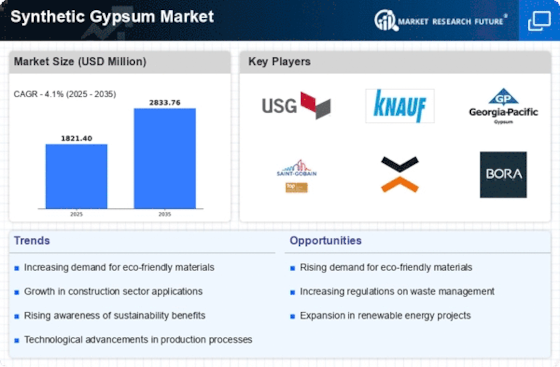
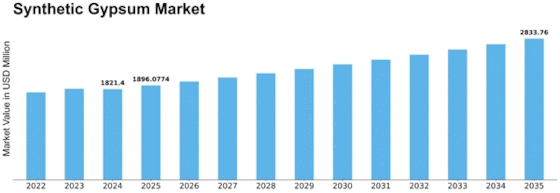
As per Market Research Future analysis, the Synthetic Gypsum Market Size was estimated at 1821.4 USD Million in 2024. The Synthetic Gypsum industry is projected to grow from 1896.08 USD Million in 2025 to 2833.76 USD Million by 2035, exhibiting a compound annual growth rate (CAGR) of 4.1% during the forecast period 2025 - 2035

Key Market Trends & Highlights

The Synthetic Gypsum Market is poised for growth driven by sustainability and technological advancements.

  • The market is increasingly influenced by a focus on sustainability, particularly in North America. Technological advancements are enhancing production efficiency, especially in the FGD Gypsum segment. Asia-Pacific is emerging as the fastest-growing region, driven by rising demand for eco-friendly materials. Key market drivers include the rising demand for eco-friendly construction materials and regulatory support for waste management.

Market Size & Forecast

2024 Market Size 1821.4 (USD Million)
2035 Market Size 2833.76 (USD Million)
CAGR (2025 - 2035) 4.1%
Largest Regional Market Share in 2024 Asia-Pacific

Major Players

USG Corporation (US), Knauf Gips KG (DE), Georgia-Pacific Gypsum LLC (US), Saint-Gobain (FR), Etex Group (BE), Boral Limited (AU), National Gypsum Company (US), Siniat (GB)

Market Trends

The Synthetic Gypsum Market is currently experiencing a notable transformation, driven by increasing environmental awareness and the demand for sustainable construction materials. This market, which encompasses by-products from various industrial processes, is gaining traction due to its potential to replace natural gypsum in numerous applications. The growing emphasis on recycling and waste management is likely to further bolster the market, as synthetic gypsum is often derived from flue gas desulfurization and other industrial activities. As industries strive to reduce their carbon footprint, the adoption of synthetic gypsum appears to be a viable solution that aligns with global sustainability goals.

Moreover, the synthetic gypsum marketis influenced by advancements in technology and manufacturing processes. Innovations in production techniques may enhance the quality and efficiency of synthetic gypsum, making it a more attractive option for construction and agriculture. The increasing use of synthetic gypsum in cement production and soil amendment is indicative of its versatility and potential to meet diverse market needs. As stakeholders continue to explore the benefits of synthetic gypsum, its role in the construction and agricultural sectors is expected to expand, reflecting a broader trend towards eco-friendly materials and practices.

Sustainability Focus

The emphasis on sustainable practices is reshaping the Synthetic Gypsum Market. As industries seek to minimize environmental impact, the use of synthetic gypsum as a green alternative to natural gypsum is becoming more prevalent. This trend is driven by regulatory pressures and consumer preferences for eco-friendly products.

Technological Advancements

Innovations in production technologies are enhancing the efficiency and quality of synthetic gypsum. These advancements may lead to improved processing methods, making synthetic gypsum more competitive in various applications, including construction and agriculture.

Regulatory Support

Government policies aimed at promoting sustainable materials are likely to support the growth of the synthetic gypsum market. Incentives for recycling and the use of by-products in construction may encourage wider adoption of synthetic gypsum, aligning with broader environmental goals.

Synthetic Gypsum Market Market Drivers

Increased Use in Agriculture

The Synthetic Gypsum Market is experiencing a notable uptick in demand from the agricultural sector. Farmers are increasingly recognizing the benefits of synthetic gypsum as a soil amendment, particularly for improving soil structure and reducing compaction. This material provides essential nutrients such as calcium and sulfur, which are vital for crop growth. Recent studies indicate that the application of synthetic gypsum can lead to yield increases of up to 20% in certain crops. As agricultural practices evolve towards more sustainable methods, the adoption of synthetic gypsum is expected to rise, further propelling the Synthetic Gypsum Market. The potential for enhanced crop productivity and soil health positions synthetic gypsum as a key player in modern agriculture.

Regulatory Support for Waste Management

The Synthetic Gypsum Market is benefiting from increasing regulatory support aimed at promoting waste management and recycling initiatives. Governments are implementing stricter regulations on industrial waste disposal, encouraging the use of by-products like synthetic gypsum in construction and agriculture. This regulatory landscape not only fosters a more sustainable approach to waste management but also creates a favorable environment for the growth of the synthetic gypsum sector. As industries seek to comply with these regulations, the demand for synthetic gypsum is expected to rise, further solidifying its position in the market. The alignment of regulatory frameworks with sustainability goals is likely to enhance the visibility and acceptance of synthetic gypsum across various sectors.

Technological Innovations in Production

Advancements in production technologies are significantly influencing the Synthetic Gypsum Market. Innovations such as improved calcination processes and enhanced purification techniques are enabling manufacturers to produce higher quality synthetic gypsum more efficiently. These technological developments not only reduce production costs but also enhance the material's properties, making it more appealing for various applications. For instance, the introduction of advanced filtration systems has improved the purity levels of synthetic gypsum, thereby increasing its suitability for use in drywall and cement products. As these technologies continue to evolve, they are likely to bolster the competitiveness of the Synthetic Gypsum Market, attracting new players and expanding market reach.

Growing Awareness of Environmental Benefits

There is a growing awareness among consumers and industries regarding the environmental benefits of synthetic gypsum, which is positively impacting the Synthetic Gypsum Market. As stakeholders become more informed about the advantages of using synthetic gypsum over traditional materials, the demand is likely to increase. This awareness is driven by educational campaigns and research highlighting the reduced carbon footprint associated with synthetic gypsum production. Furthermore, the material's role in reducing landfill waste and promoting recycling aligns with the broader sustainability goals of many organizations. As this awareness continues to spread, it is anticipated that the Synthetic Gypsum Market will experience a significant boost, as more companies and consumers opt for environmentally friendly alternatives.

Rising Demand for Eco-Friendly Construction Materials

The increasing emphasis on sustainable building practices is driving the Synthetic Gypsum Market. As construction companies seek to reduce their environmental footprint, synthetic gypsum emerges as a viable alternative to natural gypsum. This material, produced from industrial by-products, aligns with the growing trend towards eco-friendly construction. In recent years, the demand for synthetic gypsum has surged, with estimates suggesting a compound annual growth rate of approximately 5% through 2025. This growth is attributed to the material's ability to enhance the performance of drywall and cement products while minimizing waste. Consequently, the Synthetic Gypsum Market is likely to witness a robust expansion as more builders and developers prioritize sustainability in their projects.


Market Segment Insights

By Type: FGD Gypsum (Largest) vs. Phosphogypsum (Fastest-Growing)

In the Synthetic Gypsum Market, FGD gypsum holds the largest market share among the various types of gypsum available. It has been the most widely utilized due to its cost-effectiveness and availability, making it a preferred choice for various applications, including cement production and wallboard manufacturing. Following closely is phosphogypsum, which, while smaller in share, showcases significant potential due to its unique properties and suitability for agricultural applications, prompting heightened interest from producers and end-users alike.

FGD Gypsum (Dominant) vs. Phosphogypsum (Emerging)

FGD gypsum is derived from the flue gas desulfurization process and has established its dominance in the synthetic gypsum market with a strong reputation in construction and industrial applications. Its properties, such as high purity and consistency, make it an ideal substitute for natural gypsum in soil amendment and cement manufacturing, aiding sustainability goals. On the other hand, phosphogypsum, a byproduct of phosphate fertilizer production, is emerging rapidly in the market for its potential agricultural benefits. Despite regulatory challenges, its usage as a soil conditioner and its ability to enhance crop yield are driving innovations in its application, setting the stage for growth in this segment.

By Application: Cement (Largest) vs. Drywall (Fastest-Growing)

The Synthetic Gypsum Market is predominantly driven by its application in cement production, which holds the largest share, owing to its pivotal role in enhancing strength and durability. Following cement, the drywall application contributes significantly, reflecting a robust market presence thanks to the increasing demand for energy-efficient and environmentally friendly building materials. Soil amendment, glass manufacturing, and plaster follow, each playing vital roles within their specific niches by providing sustainable solutions and enhancing product quality.

Cement (Dominant) vs. Drywall (Emerging)

Cement stands as the dominant application in the Synthetic Gypsum Market, primarily due to its critical function as a cement additive that improves workability and prevents efflorescence. The ongoing global emphasis on sustainable construction practices has driven the adoption of synthetic gypsum in cement manufacturing. Meanwhile, drywall is emerging, with its application growing swiftly, spurred by the demand for lightweight, durable wall systems in construction and renovation projects. As environmental regulations tighten, the drywall sector is increasingly leveraging synthetic gypsum for its ecological benefits, making it a valuable alternative to traditional materials.

Get more detailed insights about Synthetic Gypsum Market Research Report - Global Forecast 2035

Regional Insights

North America : Market Leader in Gypsum Production

North America is the largest market for synthetic gypsum, holding approximately 45% of the global share. The region's growth is driven by increasing demand from the construction sector, particularly in residential and commercial buildings. Regulatory support for sustainable building materials further catalyzes market expansion, with initiatives promoting the use of recycled materials in construction. The United States is the leading country in this region, with major players like USG Corporation and Georgia-Pacific Gypsum LLC dominating the market. The competitive landscape is characterized by innovation and strategic partnerships among key players, ensuring a steady supply of synthetic gypsum. The presence of advanced manufacturing facilities enhances production efficiency, contributing to the region's market leadership.

Europe : Sustainable Building Practices

Europe is witnessing significant growth in the synthetic gypsum market, accounting for approximately 30% of the global share. The region's demand is primarily driven by stringent environmental regulations and a strong focus on sustainable construction practices. Countries like Germany and France are at the forefront, implementing policies that encourage the use of eco-friendly materials in building projects. Germany leads the market, supported by key players such as Knauf Gips KG and Saint-Gobain. The competitive landscape is marked by innovation in product development and a growing emphasis on recycling industrial by-products. The presence of established manufacturers and a robust distribution network further strengthens the market position in Europe.

Asia-Pacific : Emerging Market Potential

Asia-Pacific is rapidly emerging as a significant player in the synthetic gypsum market, holding around 20% of the global share. The region's growth is fueled by increasing urbanization and infrastructure development, particularly in countries like China and India. Government initiatives aimed at promoting sustainable construction practices are also driving demand for synthetic gypsum as a viable alternative to natural gypsum. China is the largest market in this region, with a growing number of local manufacturers entering the market. The competitive landscape is evolving, with both domestic and international players vying for market share. Key companies like Boral Limited and Etex Group are expanding their operations to meet the rising demand, enhancing their market presence in Asia-Pacific.

Middle East and Africa : Resource-Rich Opportunities

The Middle East and Africa region is gradually developing its synthetic gypsum market, currently holding about 5% of the global share. The growth is primarily driven by increasing construction activities and a rising awareness of sustainable building materials. Countries like the UAE and South Africa are leading the charge, with government initiatives supporting the use of synthetic gypsum in construction projects. The competitive landscape is still in its nascent stages, with a few key players like National Gypsum Company and Siniat establishing their presence. As the region continues to invest in infrastructure and urban development, the demand for synthetic gypsum is expected to rise, presenting significant opportunities for growth in the coming years.

Key Players and Competitive Insights

The Synthetic Gypsum Market is currently characterized by a dynamic competitive landscape, driven by increasing demand for sustainable building materials and stringent environmental regulations. Key players such as USG Corporation (US), Knauf Gips KG (DE), and Saint-Gobain (FR) are strategically positioning themselves through innovation and regional expansion. USG Corporation (US) focuses on enhancing its product portfolio with advanced synthetic gypsum solutions, while Knauf Gips KG (DE) emphasizes its commitment to sustainability by investing in eco-friendly production processes. Saint-Gobain (FR) is leveraging its global presence to optimize supply chains and enhance operational efficiency, collectively shaping a competitive environment that prioritizes sustainability and innovation.

In terms of business tactics, companies are increasingly localizing manufacturing to reduce transportation costs and improve supply chain resilience. The market appears moderately fragmented, with several players vying for market share. However, the collective influence of major companies is significant, as they drive industry standards and foster competitive dynamics that encourage innovation and sustainability.

In August 2025, USG Corporation (US) announced the launch of a new line of synthetic gypsum products designed to meet the growing demand for environmentally friendly construction materials. This strategic move not only enhances their product offerings but also aligns with the global trend towards sustainable building practices, potentially positioning USG as a leader in the eco-friendly segment of the market.

In September 2025, Knauf Gips KG (DE) expanded its operations in Eastern Europe by acquiring a local synthetic gypsum manufacturer. This acquisition is likely to bolster Knauf's market presence in the region, allowing for improved distribution capabilities and a stronger foothold in a rapidly growing market. Such strategic expansions may enhance their competitive edge by providing localized solutions to customers.

In July 2025, Saint-Gobain (FR) launched a digital platform aimed at optimizing the supply chain for synthetic gypsum products. This initiative reflects a broader trend towards digital transformation within the industry, potentially improving operational efficiencies and customer engagement. By integrating advanced technologies, Saint-Gobain may enhance its competitive positioning in a market increasingly driven by technological advancements.

As of October 2025, the Synthetic Gypsum Market is witnessing trends that emphasize digitalization, sustainability, and the integration of artificial intelligence. Strategic alliances among key players are shaping the competitive landscape, fostering innovation and collaboration. The shift from price-based competition to a focus on technological differentiation and supply chain reliability is evident. Companies that prioritize innovation and sustainable practices are likely to thrive, as the market evolves towards a more environmentally conscious and technologically advanced future.

Key Companies in the Synthetic Gypsum Market include

Industry Developments

Future Outlook

Synthetic Gypsum Market Future Outlook

The Synthetic Gypsum Market is projected to grow at a 4.1% CAGR from 2025 to 2035, driven by increasing demand for sustainable construction materials and regulatory support for waste recycling.

New opportunities lie in:

  • <p>Expansion into emerging markets with tailored product offerings. Development of advanced synthetic gypsum production technologies. Partnerships with construction firms for integrated supply solutions.</p>

By 2035, the market is expected to solidify its position as a leader in sustainable building materials.

Market Segmentation

Synthetic Gypsum Market Type Outlook

  • FGD gypsum
  • citrogypsum
  • fluorogypsum
  • phosphogypsum
  • others

Synthetic Gypsum Market Application Outlook

  • cement
  • drywall
  • soil amendment
  • glass manufacturing
  • plaster
  • others

Report Scope

MARKET SIZE 2024 1821.4(USD Million)
MARKET SIZE 2025 1896.08(USD Million)
MARKET SIZE 2035 2833.76(USD Million)
COMPOUND ANNUAL GROWTH RATE (CAGR) 4.1% (2025 - 2035)
REPORT COVERAGE Revenue Forecast, Competitive Landscape, Growth Factors, and Trends
BASE YEAR 2024
Market Forecast Period 2025 - 2035
Historical Data 2019 - 2024
Market Forecast Units USD Million
Key Companies Profiled USG Corporation (US), Knauf Gips KG (DE), Georgia-Pacific Gypsum LLC (US), Saint-Gobain (FR), Etex Group (BE), Boral Limited (AU), National Gypsum Company (US), Siniat (GB)
Segments Covered Type
Key Market Opportunities Growing demand for sustainable construction materials drives innovation in the Synthetic Gypsum Market.
Key Market Dynamics Rising demand for sustainable construction materials drives growth in the synthetic gypsum market amid regulatory shifts.
Countries Covered North America, Europe, APAC, South America, MEA

FAQs

What is the projected market valuation of the Synthetic Gypsum Market by 2035?

<p>The Synthetic Gypsum Market is projected to reach a valuation of 2833.76 USD Million by 2035.</p>

What was the overall market valuation of the Synthetic Gypsum Market in 2024?

<p>In 2024, the overall market valuation of the Synthetic Gypsum Market was 1821.4 USD Million.</p>

What is the expected CAGR for the Synthetic Gypsum Market during the forecast period 2025 - 2035?

<p>The expected CAGR for the Synthetic Gypsum Market during the forecast period 2025 - 2035 is 4.1%.</p>

Which companies are considered key players in the Synthetic Gypsum Market?

<p>Key players in the Synthetic Gypsum Market include USG Corporation, Knauf Gips KG, Georgia-Pacific Gypsum LLC, and Saint-Gobain.</p>

What are the main types of synthetic gypsum and their market valuations?

<p>The main types of synthetic gypsum include FGD gypsum, phosphogypsum, and citrogypsum, with valuations ranging from 200.0 to 900.0 USD Million.</p>

How does the application of synthetic gypsum in cement compare to other applications?

The application of synthetic gypsum in cement is valued between 600.0 and 900.0 USD Million, making it one of the leading applications.

What is the market valuation range for fluorogypsum in the Synthetic Gypsum Market?

The market valuation range for fluorogypsum in the Synthetic Gypsum Market is between 200.0 and 300.0 USD Million.

What is the projected growth trend for the synthetic gypsum market from 2025 to 2035?

The synthetic gypsum market is expected to grow steadily, with a projected CAGR of 4.1% from 2025 to 2035.

What is the valuation range for soil amendment applications of synthetic gypsum?

The valuation range for soil amendment applications of synthetic gypsum is between 300.0 and 450.0 USD Million.

How does the market for drywall applications of synthetic gypsum compare to other segments?

The market for drywall applications of synthetic gypsum is valued between 400.0 and 600.0 USD Million, indicating a robust segment within the market.

  1. SECTION I: EXECUTIVE SUMMARY AND KEY HIGHLIGHTS
    1. | 1.1 EXECUTIVE SUMMARY
    2. | | 1.1.1 Market Overview
    3. | | 1.1.2 Key Findings
    4. | | 1.1.3 Market Segmentation
    5. | | 1.1.4 Competitive Landscape
    6. | | 1.1.5 Challenges and Opportunities
    7. | | 1.1.6 Future Outlook
  2. SECTION II: SCOPING, METHODOLOGY AND MARKET STRUCTURE
    1. | 2.1 MARKET INTRODUCTION
    2. | | 2.1.1 Definition
    3. | | 2.1.2 Scope of the study
    4. | | | 2.1.2.1 Research Objective
    5. | | | 2.1.2.2 Assumption
    6. | | | 2.1.2.3 Limitations
    7. | 2.2 RESEARCH METHODOLOGY
    8. | | 2.2.1 Overview
    9. | | 2.2.2 Data Mining
    10. | | 2.2.3 Secondary Research
    11. | | 2.2.4 Primary Research
    12. | | | 2.2.4.1 Primary Interviews and Information Gathering Process
    13. | | | 2.2.4.2 Breakdown of Primary Respondents
    14. | | 2.2.5 Forecasting Model
    15. | | 2.2.6 Market Size Estimation
    16. | | | 2.2.6.1 Bottom-Up Approach
    17. | | | 2.2.6.2 Top-Down Approach
    18. | | 2.2.7 Data Triangulation
    19. | | 2.2.8 Validation
  3. SECTION III: QUALITATIVE ANALYSIS
    1. | 3.1 MARKET DYNAMICS
    2. | | 3.1.1 Overview
    3. | | 3.1.2 Drivers
    4. | | 3.1.3 Restraints
    5. | | 3.1.4 Opportunities
    6. | 3.2 MARKET FACTOR ANALYSIS
    7. | | 3.2.1 Value chain Analysis
    8. | | 3.2.2 Porter's Five Forces Analysis
    9. | | | 3.2.2.1 Bargaining Power of Suppliers
    10. | | | 3.2.2.2 Bargaining Power of Buyers
    11. | | | 3.2.2.3 Threat of New Entrants
    12. | | | 3.2.2.4 Threat of Substitutes
    13. | | | 3.2.2.5 Intensity of Rivalry
    14. | | 3.2.3 COVID-19 Impact Analysis
    15. | | | 3.2.3.1 Market Impact Analysis
    16. | | | 3.2.3.2 Regional Impact
    17. | | | 3.2.3.3 Opportunity and Threat Analysis
  4. SECTION IV: QUANTITATIVE ANALYSIS
    1. | 4.1 Packaging & Transport, BY Type (USD Million)
    2. | | 4.1.1 FGD gypsum
    3. | | 4.1.2 citrogypsum
    4. | | 4.1.3 fluorogypsum
    5. | | 4.1.4 phosphogypsum
    6. | | 4.1.5 others
    7. | 4.2 Packaging & Transport, BY Application (USD Million)
    8. | | 4.2.1 cement
    9. | | 4.2.2 drywall
    10. | | 4.2.3 soil amendment
    11. | | 4.2.4 glass manufacturing
    12. | | 4.2.5 plaster
    13. | | 4.2.6 others
    14. | 4.3 Packaging & Transport, BY Region (USD Million)
    15. | | 4.3.1 North America
    16. | | | 4.3.1.1 US
    17. | | | 4.3.1.2 Canada
    18. | | 4.3.2 Europe
    19. | | | 4.3.2.1 Germany
    20. | | | 4.3.2.2 UK
    21. | | | 4.3.2.3 France
    22. | | | 4.3.2.4 Russia
    23. | | | 4.3.2.5 Italy
    24. | | | 4.3.2.6 Spain
    25. | | | 4.3.2.7 Rest of Europe
    26. | | 4.3.3 APAC
    27. | | | 4.3.3.1 China
    28. | | | 4.3.3.2 India
    29. | | | 4.3.3.3 Japan
    30. | | | 4.3.3.4 South Korea
    31. | | | 4.3.3.5 Malaysia
    32. | | | 4.3.3.6 Thailand
    33. | | | 4.3.3.7 Indonesia
    34. | | | 4.3.3.8 Rest of APAC
    35. | | 4.3.4 South America
    36. | | | 4.3.4.1 Brazil
    37. | | | 4.3.4.2 Mexico
    38. | | | 4.3.4.3 Argentina
    39. | | | 4.3.4.4 Rest of South America
    40. | | 4.3.5 MEA
    41. | | | 4.3.5.1 GCC Countries
    42. | | | 4.3.5.2 South Africa
    43. | | | 4.3.5.3 Rest of MEA
  5. SECTION V: COMPETITIVE ANALYSIS
    1. | 5.1 Competitive Landscape
    2. | | 5.1.1 Overview
    3. | | 5.1.2 Competitive Analysis
    4. | | 5.1.3 Market share Analysis
    5. | | 5.1.4 Major Growth Strategy in the Packaging & Transport
    6. | | 5.1.5 Competitive Benchmarking
    7. | | 5.1.6 Leading Players in Terms of Number of Developments in the Packaging & Transport
    8. | | 5.1.7 Key developments and growth strategies
    9. | | | 5.1.7.1 New Product Launch/Service Deployment
    10. | | | 5.1.7.2 Merger & Acquisitions
    11. | | | 5.1.7.3 Joint Ventures
    12. | | 5.1.8 Major Players Financial Matrix
    13. | | | 5.1.8.1 Sales and Operating Income
    14. | | | 5.1.8.2 Major Players R&D Expenditure. 2023
    15. | 5.2 Company Profiles
    16. | | 5.2.1 USG Corporation (US)
    17. | | | 5.2.1.1 Financial Overview
    18. | | | 5.2.1.2 Products Offered
    19. | | | 5.2.1.3 Key Developments
    20. | | | 5.2.1.4 SWOT Analysis
    21. | | | 5.2.1.5 Key Strategies
    22. | | 5.2.2 Knauf Gips KG (DE)
    23. | | | 5.2.2.1 Financial Overview
    24. | | | 5.2.2.2 Products Offered
    25. | | | 5.2.2.3 Key Developments
    26. | | | 5.2.2.4 SWOT Analysis
    27. | | | 5.2.2.5 Key Strategies
    28. | | 5.2.3 Georgia-Pacific Gypsum LLC (US)
    29. | | | 5.2.3.1 Financial Overview
    30. | | | 5.2.3.2 Products Offered
    31. | | | 5.2.3.3 Key Developments
    32. | | | 5.2.3.4 SWOT Analysis
    33. | | | 5.2.3.5 Key Strategies
    34. | | 5.2.4 Saint-Gobain (FR)
    35. | | | 5.2.4.1 Financial Overview
    36. | | | 5.2.4.2 Products Offered
    37. | | | 5.2.4.3 Key Developments
    38. | | | 5.2.4.4 SWOT Analysis
    39. | | | 5.2.4.5 Key Strategies
    40. | | 5.2.5 Etex Group (BE)
    41. | | | 5.2.5.1 Financial Overview
    42. | | | 5.2.5.2 Products Offered
    43. | | | 5.2.5.3 Key Developments
    44. | | | 5.2.5.4 SWOT Analysis
    45. | | | 5.2.5.5 Key Strategies
    46. | | 5.2.6 Boral Limited (AU)
    47. | | | 5.2.6.1 Financial Overview
    48. | | | 5.2.6.2 Products Offered
    49. | | | 5.2.6.3 Key Developments
    50. | | | 5.2.6.4 SWOT Analysis
    51. | | | 5.2.6.5 Key Strategies
    52. | | 5.2.7 National Gypsum Company (US)
    53. | | | 5.2.7.1 Financial Overview
    54. | | | 5.2.7.2 Products Offered
    55. | | | 5.2.7.3 Key Developments
    56. | | | 5.2.7.4 SWOT Analysis
    57. | | | 5.2.7.5 Key Strategies
    58. | | 5.2.8 Siniat (GB)
    59. | | | 5.2.8.1 Financial Overview
    60. | | | 5.2.8.2 Products Offered
    61. | | | 5.2.8.3 Key Developments
    62. | | | 5.2.8.4 SWOT Analysis
    63. | | | 5.2.8.5 Key Strategies
    64. | 5.3 Appendix
    65. | | 5.3.1 References
    66. | | 5.3.2 Related Reports
  6. LIST OF FIGURES
    1. | 6.1 MARKET SYNOPSIS
    2. | 6.2 NORTH AMERICA MARKET ANALYSIS
    3. | 6.3 US MARKET ANALYSIS BY TYPE
    4. | 6.4 US MARKET ANALYSIS BY APPLICATION
    5. | 6.5 CANADA MARKET ANALYSIS BY TYPE
    6. | 6.6 CANADA MARKET ANALYSIS BY APPLICATION
    7. | 6.7 EUROPE MARKET ANALYSIS
    8. | 6.8 GERMANY MARKET ANALYSIS BY TYPE
    9. | 6.9 GERMANY MARKET ANALYSIS BY APPLICATION
    10. | 6.10 UK MARKET ANALYSIS BY TYPE
    11. | 6.11 UK MARKET ANALYSIS BY APPLICATION
    12. | 6.12 FRANCE MARKET ANALYSIS BY TYPE
    13. | 6.13 FRANCE MARKET ANALYSIS BY APPLICATION
    14. | 6.14 RUSSIA MARKET ANALYSIS BY TYPE
    15. | 6.15 RUSSIA MARKET ANALYSIS BY APPLICATION
    16. | 6.16 ITALY MARKET ANALYSIS BY TYPE
    17. | 6.17 ITALY MARKET ANALYSIS BY APPLICATION
    18. | 6.18 SPAIN MARKET ANALYSIS BY TYPE
    19. | 6.19 SPAIN MARKET ANALYSIS BY APPLICATION
    20. | 6.20 REST OF EUROPE MARKET ANALYSIS BY TYPE
    21. | 6.21 REST OF EUROPE MARKET ANALYSIS BY APPLICATION
    22. | 6.22 APAC MARKET ANALYSIS
    23. | 6.23 CHINA MARKET ANALYSIS BY TYPE
    24. | 6.24 CHINA MARKET ANALYSIS BY APPLICATION
    25. | 6.25 INDIA MARKET ANALYSIS BY TYPE
    26. | 6.26 INDIA MARKET ANALYSIS BY APPLICATION
    27. | 6.27 JAPAN MARKET ANALYSIS BY TYPE
    28. | 6.28 JAPAN MARKET ANALYSIS BY APPLICATION
    29. | 6.29 SOUTH KOREA MARKET ANALYSIS BY TYPE
    30. | 6.30 SOUTH KOREA MARKET ANALYSIS BY APPLICATION
    31. | 6.31 MALAYSIA MARKET ANALYSIS BY TYPE
    32. | 6.32 MALAYSIA MARKET ANALYSIS BY APPLICATION
    33. | 6.33 THAILAND MARKET ANALYSIS BY TYPE
    34. | 6.34 THAILAND MARKET ANALYSIS BY APPLICATION
    35. | 6.35 INDONESIA MARKET ANALYSIS BY TYPE
    36. | 6.36 INDONESIA MARKET ANALYSIS BY APPLICATION
    37. | 6.37 REST OF APAC MARKET ANALYSIS BY TYPE
    38. | 6.38 REST OF APAC MARKET ANALYSIS BY APPLICATION
    39. | 6.39 SOUTH AMERICA MARKET ANALYSIS
    40. | 6.40 BRAZIL MARKET ANALYSIS BY TYPE
    41. | 6.41 BRAZIL MARKET ANALYSIS BY APPLICATION
    42. | 6.42 MEXICO MARKET ANALYSIS BY TYPE
    43. | 6.43 MEXICO MARKET ANALYSIS BY APPLICATION
    44. | 6.44 ARGENTINA MARKET ANALYSIS BY TYPE
    45. | 6.45 ARGENTINA MARKET ANALYSIS BY APPLICATION
    46. | 6.46 REST OF SOUTH AMERICA MARKET ANALYSIS BY TYPE
    47. | 6.47 REST OF SOUTH AMERICA MARKET ANALYSIS BY APPLICATION
    48. | 6.48 MEA MARKET ANALYSIS
    49. | 6.49 GCC COUNTRIES MARKET ANALYSIS BY TYPE
    50. | 6.50 GCC COUNTRIES MARKET ANALYSIS BY APPLICATION
    51. | 6.51 SOUTH AFRICA MARKET ANALYSIS BY TYPE
    52. | 6.52 SOUTH AFRICA MARKET ANALYSIS BY APPLICATION
    53. | 6.53 REST OF MEA MARKET ANALYSIS BY TYPE
    54. | 6.54 REST OF MEA MARKET ANALYSIS BY APPLICATION
    55. | 6.55 KEY BUYING CRITERIA OF PACKAGING & TRANSPORT
    56. | 6.56 RESEARCH PROCESS OF MRFR
    57. | 6.57 DRO ANALYSIS OF PACKAGING & TRANSPORT
    58. | 6.58 DRIVERS IMPACT ANALYSIS: PACKAGING & TRANSPORT
    59. | 6.59 RESTRAINTS IMPACT ANALYSIS: PACKAGING & TRANSPORT
    60. | 6.60 SUPPLY / VALUE CHAIN: PACKAGING & TRANSPORT
    61. | 6.61 PACKAGING & TRANSPORT, BY TYPE, 2024 (% SHARE)
    62. | 6.62 PACKAGING & TRANSPORT, BY TYPE, 2024 TO 2035 (USD Million)
    63. | 6.63 PACKAGING & TRANSPORT, BY APPLICATION, 2024 (% SHARE)
    64. | 6.64 PACKAGING & TRANSPORT, BY APPLICATION, 2024 TO 2035 (USD Million)
    65. | 6.65 BENCHMARKING OF MAJOR COMPETITORS
  7. LIST OF TABLES
    1. | 7.1 LIST OF ASSUMPTIONS
    2. | | 7.1.1
    3. | 7.2 North America MARKET SIZE ESTIMATES; FORECAST
    4. | | 7.2.1 BY TYPE, 2025-2035 (USD Million)
    5. | | 7.2.2 BY APPLICATION, 2025-2035 (USD Million)
    6. | 7.3 US MARKET SIZE ESTIMATES; FORECAST
    7. | | 7.3.1 BY TYPE, 2025-2035 (USD Million)
    8. | | 7.3.2 BY APPLICATION, 2025-2035 (USD Million)
    9. | 7.4 Canada MARKET SIZE ESTIMATES; FORECAST
    10. | | 7.4.1 BY TYPE, 2025-2035 (USD Million)
    11. | | 7.4.2 BY APPLICATION, 2025-2035 (USD Million)
    12. | 7.5 Europe MARKET SIZE ESTIMATES; FORECAST
    13. | | 7.5.1 BY TYPE, 2025-2035 (USD Million)
    14. | | 7.5.2 BY APPLICATION, 2025-2035 (USD Million)
    15. | 7.6 Germany MARKET SIZE ESTIMATES; FORECAST
    16. | | 7.6.1 BY TYPE, 2025-2035 (USD Million)
    17. | | 7.6.2 BY APPLICATION, 2025-2035 (USD Million)
    18. | 7.7 UK MARKET SIZE ESTIMATES; FORECAST
    19. | | 7.7.1 BY TYPE, 2025-2035 (USD Million)
    20. | | 7.7.2 BY APPLICATION, 2025-2035 (USD Million)
    21. | 7.8 France MARKET SIZE ESTIMATES; FORECAST
    22. | | 7.8.1 BY TYPE, 2025-2035 (USD Million)
    23. | | 7.8.2 BY APPLICATION, 2025-2035 (USD Million)
    24. | 7.9 Russia MARKET SIZE ESTIMATES; FORECAST
    25. | | 7.9.1 BY TYPE, 2025-2035 (USD Million)
    26. | | 7.9.2 BY APPLICATION, 2025-2035 (USD Million)
    27. | 7.10 Italy MARKET SIZE ESTIMATES; FORECAST
    28. | | 7.10.1 BY TYPE, 2025-2035 (USD Million)
    29. | | 7.10.2 BY APPLICATION, 2025-2035 (USD Million)
    30. | 7.11 Spain MARKET SIZE ESTIMATES; FORECAST
    31. | | 7.11.1 BY TYPE, 2025-2035 (USD Million)
    32. | | 7.11.2 BY APPLICATION, 2025-2035 (USD Million)
    33. | 7.12 Rest of Europe MARKET SIZE ESTIMATES; FORECAST
    34. | | 7.12.1 BY TYPE, 2025-2035 (USD Million)
    35. | | 7.12.2 BY APPLICATION, 2025-2035 (USD Million)
    36. | 7.13 APAC MARKET SIZE ESTIMATES; FORECAST
    37. | | 7.13.1 BY TYPE, 2025-2035 (USD Million)
    38. | | 7.13.2 BY APPLICATION, 2025-2035 (USD Million)
    39. | 7.14 China MARKET SIZE ESTIMATES; FORECAST
    40. | | 7.14.1 BY TYPE, 2025-2035 (USD Million)
    41. | | 7.14.2 BY APPLICATION, 2025-2035 (USD Million)
    42. | 7.15 India MARKET SIZE ESTIMATES; FORECAST
    43. | | 7.15.1 BY TYPE, 2025-2035 (USD Million)
    44. | | 7.15.2 BY APPLICATION, 2025-2035 (USD Million)
    45. | 7.16 Japan MARKET SIZE ESTIMATES; FORECAST
    46. | | 7.16.1 BY TYPE, 2025-2035 (USD Million)
    47. | | 7.16.2 BY APPLICATION, 2025-2035 (USD Million)
    48. | 7.17 South Korea MARKET SIZE ESTIMATES; FORECAST
    49. | | 7.17.1 BY TYPE, 2025-2035 (USD Million)
    50. | | 7.17.2 BY APPLICATION, 2025-2035 (USD Million)
    51. | 7.18 Malaysia MARKET SIZE ESTIMATES; FORECAST
    52. | | 7.18.1 BY TYPE, 2025-2035 (USD Million)
    53. | | 7.18.2 BY APPLICATION, 2025-2035 (USD Million)
    54. | 7.19 Thailand MARKET SIZE ESTIMATES; FORECAST
    55. | | 7.19.1 BY TYPE, 2025-2035 (USD Million)
    56. | | 7.19.2 BY APPLICATION, 2025-2035 (USD Million)
    57. | 7.20 Indonesia MARKET SIZE ESTIMATES; FORECAST
    58. | | 7.20.1 BY TYPE, 2025-2035 (USD Million)
    59. | | 7.20.2 BY APPLICATION, 2025-2035 (USD Million)
    60. | 7.21 Rest of APAC MARKET SIZE ESTIMATES; FORECAST
    61. | | 7.21.1 BY TYPE, 2025-2035 (USD Million)
    62. | | 7.21.2 BY APPLICATION, 2025-2035 (USD Million)
    63. | 7.22 South America MARKET SIZE ESTIMATES; FORECAST
    64. | | 7.22.1 BY TYPE, 2025-2035 (USD Million)
    65. | | 7.22.2 BY APPLICATION, 2025-2035 (USD Million)
    66. | 7.23 Brazil MARKET SIZE ESTIMATES; FORECAST
    67. | | 7.23.1 BY TYPE, 2025-2035 (USD Million)
    68. | | 7.23.2 BY APPLICATION, 2025-2035 (USD Million)
    69. | 7.24 Mexico MARKET SIZE ESTIMATES; FORECAST
    70. | | 7.24.1 BY TYPE, 2025-2035 (USD Million)
    71. | | 7.24.2 BY APPLICATION, 2025-2035 (USD Million)
    72. | 7.25 Argentina MARKET SIZE ESTIMATES; FORECAST
    73. | | 7.25.1 BY TYPE, 2025-2035 (USD Million)
    74. | | 7.25.2 BY APPLICATION, 2025-2035 (USD Million)
    75. | 7.26 Rest of South America MARKET SIZE ESTIMATES; FORECAST
    76. | | 7.26.1 BY TYPE, 2025-2035 (USD Million)
    77. | | 7.26.2 BY APPLICATION, 2025-2035 (USD Million)
    78. | 7.27 MEA MARKET SIZE ESTIMATES; FORECAST
    79. | | 7.27.1 BY TYPE, 2025-2035 (USD Million)
    80. | | 7.27.2 BY APPLICATION, 2025-2035 (USD Million)
    81. | 7.28 GCC Countries MARKET SIZE ESTIMATES; FORECAST
    82. | | 7.28.1 BY TYPE, 2025-2035 (USD Million)
    83. | | 7.28.2 BY APPLICATION, 2025-2035 (USD Million)
    84. | 7.29 South Africa MARKET SIZE ESTIMATES; FORECAST
    85. | | 7.29.1 BY TYPE, 2025-2035 (USD Million)
    86. | | 7.29.2 BY APPLICATION, 2025-2035 (USD Million)
    87. | 7.30 Rest of MEA MARKET SIZE ESTIMATES; FORECAST
    88. | | 7.30.1 BY TYPE, 2025-2035 (USD Million)
    89. | | 7.30.2 BY APPLICATION, 2025-2035 (USD Million)
    90. | 7.31 PRODUCT LAUNCH/PRODUCT DEVELOPMENT/APPROVAL
    91. | | 7.31.1
    92. | 7.32 ACQUISITION/PARTNERSHIP
    93. | | 7.32.1

Packaging & Transport Market Segmentation

Packaging & Transport By Type (USD Million, 2025-2035)

  • FGD gypsum
  • citrogypsum
  • fluorogypsum
  • phosphogypsum
  • others

Packaging & Transport By Application (USD Million, 2025-2035)

  • cement
  • drywall
  • soil amendment
  • glass manufacturing
  • plaster
  • others
Infographic

Free Sample Request

Kindly complete the form below to receive a free sample of this Report

Get Free Sample

Customer Strories

Compare Licence

×
Features License Type
Single User Multiuser License Enterprise User
Price $4,950 $5,950 $7,250
Maximum User Access Limit 1 User Upto 10 Users Unrestricted Access Throughout the Organization
Free Customization
Direct Access to Analyst
Deliverable Format
Platform Access
Discount on Next Purchase 10% 15% 15%
Printable Versions