Request Free Sample ×

Kindly complete the form below to receive a free sample of this Report

* Please use a valid business email

Leading companies partner with us for data-driven Insights

clients tt-cursor
Hero Background
English
Chinese
French
Japanese
Korean
German
Spanish

Synthetic Biology Market Trends

ID: MRFR/HC/9417-HCR
200 Pages
Rahul Gotadki
March 2026

Synthetic Biology Market Research Report: Size, Share, Trend Analysis By Applications (Healthcare, Industrial Biotechnology, Agriculture, Environmental Applications, Food and Nutrition), By Technology (Gene Synthesis, Gene Editing, Synthetic Genomics, Metabolic Engineering, Cloning), By Product Type (Synthetic Genes, Enzymes, Chassis Organisms, Nucleotides, Bioinformatics Tools), By End-use Industry (Pharmaceuticals, Biochemicals, Crop Production, Biofuels, Food and Beverage), and By Regional (North America, Europe, South America, Asia Pacific, Middle East and Africa) - Growth Outlook & Industry Forecast 2025 To 2035

Share:
Download PDF ×

We do not share your information with anyone. However, we may send you emails based on your report interest from time to time. You may contact us at any time to opt-out.

Synthetic Biology Market Infographic
Purchase Options

Market Trends

Key Emerging Trends in the Synthetic Biology Market

The change of the synthetic biology market is being impelled by innovative headways and interdisciplinary joint efforts. This is working with the plan and gathering of custom DNA, which is tracking down applications in modern biotechnology and helpful mediations. Because of their exact and designated genome altering capacities, CRISPR-based quality altering methods are acquiring acknowledgment, changing hereditary designing for the progression of GMOs, quality treatments, and utilitarian genomics research, and empowering quality adjustment with a remarkable level of precision. Designing microorganisms for incomprehensible modern applications, for example, biofuels, specialty synthetic compounds, and drugs, with the objective of bio-based, maintainable substitutions and expanded creation productivity, is the focal point of the synthetic biology market. The use of synthetic biology in farming includes the improvement of hereditarily adjusted crops that have upgraded attributes like protection from bugs, natural kind disposition, and dietary benefit. This try looks to work on horticultural practices and improve worldwide food security. The synthetic biology industry is embracing democratization as organizations give practical and easy to understand hereditary designing arrangements, which advances development and speeds up the execution of designed natural frameworks in a great many logical fields. A thriving pattern, without cell synthetic biology empowers researchers to direct tests without the utilization of living cells, while likewise giving benefits, for example, fast prototyping, adaptable response control, and counterfeit circuit plan. Synthetic biology is upsetting the clinical field through the advancement of customized medication and quality treatments. The utilization of designed cells and quality circuits to treat malignant growth, hereditary issues, and different sicknesses prepares for the advancement of altered mediations in complex clinical circumstances. The utilization of synthetic biology in natural settings, explicitly bioremediation and bioenergy creation, is expanding. This is because of its capacity to work with the corruption of contaminations, purge environments, and produce biofuels from sustainable assets. Via mechanizing the plan assemble test-learn cycle, dissecting huge datasets, and foreseeing prime hereditary plans, synthetic biology and simulated intelligence are changing organic plan, consequently speeding up disclosure and enhancement. Synthetic biology organizations, scholastic foundations, and industry areas are teaming up in a powerful biological system for extending applications to encourage development, work with the trading of information, and tackle complex difficulties. The moral talk encompassing hereditary designing, ecological effect, and guideline is common in the synthetic biology market, which exhibits a devotion to the capable and practical improvement of manufactured science advances. As administrative systems and guidelines adjust to manufactured science applications, wellbeing and morals concerns are acquiring unmistakable quality, highlighting the criticality of administrative oversight.


Author
Author Profile
Rahul Gotadki
Research Manager

He holds an experience of about 9+ years in Market Research and Business Consulting, working under the spectrum of Life Sciences and Healthcare domains. Rahul conceptualizes and implements a scalable business strategy and provides strategic leadership to the clients. His expertise lies in market estimation, competitive intelligence, pipeline analysis, customer assessment, etc.

Leave a Comment

FAQs

What is the current valuation of the Synthetic Biology Market as of 2024?

<p>The Synthetic Biology Market was valued at 18.63 USD Billion in 2024.</p>

What is the projected market valuation for the Synthetic Biology Market in 2035?

<p>The market is projected to reach a valuation of 234.78 USD Billion by 2035.</p>

What is the expected CAGR for the Synthetic Biology Market during the forecast period 2025 - 2035?

<p>The expected CAGR for the Synthetic Biology Market during 2025 - 2035 is 25.9%.</p>

Which application segment holds the highest valuation in the Synthetic Biology Market?

<p>The Industrial Biotechnology segment holds the highest valuation at 5.0 USD Billion.</p>

What is the valuation of the Healthcare segment in the Synthetic Biology Market?

<p>The Healthcare segment was valued at 3.73 USD Billion in 2024.</p>

Which technology segment is projected to grow significantly in the Synthetic Biology Market?

<p>The Cellular Engineering segment is projected to grow significantly, with a valuation of 4.4 USD Billion.</p>

What is the valuation of the Pharmaceuticals end-use segment in the Synthetic Biology Market?

<p>The Pharmaceuticals end-use segment was valued at 5.0 USD Billion in 2024.</p>

Who are the key players in the Synthetic Biology Market?

<p>Key players include Ginkgo Bioworks, Amgen, DuPont, BASF, and others.</p>

What is the valuation of the Bioinformatics technology segment in the Synthetic Biology Market?

<p>The Bioinformatics technology segment was valued at 3.5 USD Billion in 2024.</p>

What is the projected growth trend for the Agricultural Products end-use segment?

<p>The Agricultural Products end-use segment is projected to grow, with a valuation of 4.0 USD Billion.</p>

Market Summary

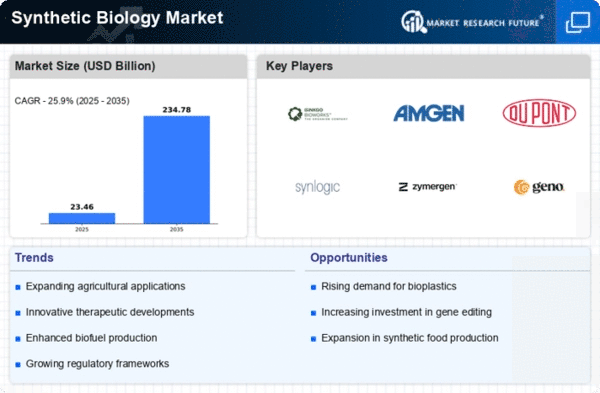
According to MRFR analysis, the Synthetic Biology Market Size was valued at USD 18.63 Billion in 2024. The market is projected to grow from USD 23.46 Billion in 2025 to USD 234.78 Billion by 2035, registering a CAGR of 25.9% during the forecast period (2025–2035). North America led the market with over 49.92% share, generating around USD 9.3 billion in revenue.
 
The Synthetic Biology Market is expanding due to increasing demand for advanced biotechnology solutions and rising investments in genetic engineering research. Key trends include development of engineered microorganisms, advancements in DNA synthesis technologies, and growing applications in healthcare, agriculture, and bio-based manufacturing industries.

Key Market Trends & Highlights

The Synthetic Biology Market is poised for substantial growth driven by technological advancements and increasing demand across various sectors.

  • North America remains the largest market for synthetic biology, driven by robust investments in research and development. The Asia-Pacific region is emerging as the fastest-growing market, projected to reach USD 3.5 billion by 2025, driven by the increasing adoption of biotechnological innovations. Biomanufacturing continues to dominate the market, while the pharmaceuticals segment is experiencing rapid growth due to rising healthcare needs. Key market drivers include the rising demand for biopharmaceuticals and innovations in agricultural biotechnology, which are shaping the industry's future.

Market Size & Forecast

2024 Market Size 18.63 (USD Billion)
2035 Market Size 234.78 (USD Billion)
CAGR (2025 - 2035) 25.9%
Largest Regional Market Share in 2024 North America

Major Players

Companies such as Ginkgo Bioworks (US), <a href="https://www.amgenbiotechexperience.com/curriculum-resources/synthetic-biology" target="_blank" rel="noopener">Amgen </a>(US), <a href="https://www.dupont.com/water/industries/life-sciences/bioprocessing.html" target="_blank" rel="noopener">DuPont</a> (US), BASF (DE), Synlogic (US), Zymergen (US), Codexis (US), Genomatica (US), Arzeda (US), Novozymes (DK) are some of the major participants in the global market.

Market Trends

The Synthetic Biology Market is currently experiencing a transformative phase characterized by rapid advancements in technology and increasing applications across various sectors within the synthetic biology industry. This market encompasses a wide array of disciplines, including genetic engineering, bioinformatics, metabolic engineering, and synthetics genomics, which collectively contribute to innovative solutions in healthcare, agriculture, and environmental sustainability.

The integration of synthetic biology into these fields appears to support exponential growth biology, enhancing productivity and efficiency across the biology industry. Furthermore, the rising demand for sustainable practices and bio-based products is likely to drive further investment and research, reinforcing the future of synthetic biology as a cornerstone of innovation.

The market is also witnessing increased visibility across scientific publications and industry platforms such as grow magazine synthetic biology, reflecting broader awareness of the synthetic biology future. Collaboration among academic institutions, private enterprises, and governmental bodies continues to accelerate innovation and adoption. Overall, the current landscape of the market suggests a dynamic environment ripe for exploration and investment, with the potential to revolutionize multiple industries in the coming years.

Advancements in Genetic Engineering

Recent developments in genetic engineering techniques, such as CRISPR, gene synthesis, and advances influencing the dna synthesis market size, are reshaping the market. These innovations enable precise modifications of organisms, supporting breakthroughs aligned with the future of synthetic biology. As these technologies become more accessible, their adoption across various sectors is likely to increase.

The Synthetic Biology Market is expanding due to innovations in gene editing technologies such as CRISPR and automated DNA synthesis. According to the National Human Genome Research Institute, CRISPR technology is now used in thousands of laboratories worldwide, accelerating research in genomics and biotechnology.

Sustainability and Eco-Friendly Solutions

The growing emphasis on sustainability is driving the Synthetic Biology Market toward bio-based alternatives that reduce dependence on inorganics in industrial processes. This transition supports long-term environmental goals and strengthens the synthetic biology industry ecosystem. This trend not only addresses ecological concerns but also aligns with consumer preferences for sustainable products.

Synthetic biology is increasingly used to develop bio-based chemicals, fuels, and materials that reduce environmental impact. The International Energy Agency states that bio-based technologies could reduce industrial carbon emissions by up to 10% by 2050, supporting sustainable manufacturing.

Collaborative Research and Development

Collaborative ecosystems involving syn bio companies, academia, and government agencies are accelerating innovation. These partnerships are central to unlocking the synthetic biology future and reinforcing the future of synthetic biology across applications. This collaborative spirit is expected to enhance the market's growth and lead to the emergence of novel applications.

Collaboration among biotechnology companies, universities, and governments is driving innovation in the Synthetic Biology Market. The Organisation for Economic Co-operation and Development reports that over 50 countries have national bioeconomy strategies, strengthening global investment in synthetic biology research.

Synthetic Biology Market Market Drivers

Market Growth Projections

The Global Synthetic Biology Market is projected to experience substantial growth over the next decade. With a market value of 11.5 USD Billion in 2024, it is expected to reach 40.2 USD Billion by 2035. This growth trajectory indicates a robust compound annual growth rate (CAGR) of 12.06% from 2025 to 2035. 
 
Such projections reflect the increasing adoption of synthetic biology across various sectors, driven by technological advancements, rising demand for sustainable solutions, and enhanced investment in research and development. The market's expansion is indicative of the transformative potential of synthetic biology in addressing global challenges.

Regulatory Support and Frameworks

Regulatory support is emerging as a vital driver for the Global Synthetic Biology Market. Governments are recognizing the potential of synthetic biology to address global challenges and are establishing frameworks to facilitate research and commercialization. 
 
This includes guidelines for biosafety and bioethics, which aim to ensure responsible development and application of synthetic biology technologies. Such regulatory clarity not only fosters innovation but also builds public trust, encouraging investment and collaboration across sectors. As regulatory environments become more supportive, the market is likely to experience accelerated growth, paving the way for new applications and technologies.

Growing Applications in Healthcare

The healthcare sector is increasingly leveraging synthetic biology, significantly impacting the Global Synthetic Biology Market. Applications range from the development of novel therapeutics to advanced diagnostic tools. Synthetic biology enables the design of customized medicines and biologics that can target specific diseases more effectively. 
 
For instance, engineered microbes are being used to produce insulin and other essential drugs. This trend is likely to continue as the demand for personalized medicine rises, driving market expansion. The integration of synthetic biology into healthcare is expected to contribute to the overall growth of the industry in the coming years.

Rising Demand for Sustainable Solutions

The Global Synthetic Biology Market is witnessing an increasing demand for sustainable solutions across various sectors, including agriculture, energy, and pharmaceuticals. This shift is driven by the need to address environmental challenges and reduce reliance on fossil fuels. 
 
For instance, synthetic biology enables the development of biofuels and biodegradable materials, which are essential for a sustainable future. As consumers and industries prioritize eco-friendly practices, the market is projected to reach 11.5 USD Billion in 2024, reflecting a growing commitment to sustainability in production processes.

Advancements in Genetic Engineering Technologies

Technological advancements in genetic engineering are propelling the Global Synthetic Biology Market forward. Innovations such as CRISPR and gene synthesis techniques have revolutionized the ability to manipulate genetic material with precision. 
 
These technologies facilitate the creation of engineered organisms that can produce valuable compounds, such as pharmaceuticals and bio-based chemicals. The rapid evolution of these tools is likely to enhance productivity and reduce costs, thereby attracting investment and fostering growth. As a result, the market is expected to expand significantly, with a projected CAGR of 12.06% from 2025 to 2035.

Increased Investment in Research and Development

Investment in research and development is a critical driver of the Global Synthetic Biology Market. Governments and private entities are allocating substantial funds to explore the potential applications of synthetic biology in healthcare, agriculture, and environmental management. 
 
For example, initiatives aimed at developing synthetic vaccines and engineered crops are gaining traction, leading to breakthroughs that could transform industries. This influx of funding not only accelerates innovation but also supports the establishment of startups and collaborations, further enhancing market growth. The industry is anticipated to reach 40.2 USD Billion by 2035, underscoring the importance of R&D.

Market Segment Insights

By Application: Healthcare (Largest) vs. Agriculture (Fastest-Growing)

<p>The Synthetic Biology Market displays diverse application segments, with healthcare leading the pack due to its robust demand for innovative therapies and diagnostics. Key areas within healthcare include <a href="https://www.marketresearchfuture.com/reports/gene-editing-market-707" target="_blank" title="gene editing">gene editing</a>, personalized medicine, and biopharmaceuticals, where synthetic biology tools are increasingly being integrated to improve patient outcomes. Following healthcare, agriculture is gaining traction, leveraging synthetic biology for enhanced crop yields, pest resistance, and sustainable practices, thus presenting significant growth potential. As the synthetic biology sector evolves, agriculture is emerging as the fastest-growing segment. This growth is driven by rising global food demands and the need for sustainable agricultural solutions. Innovations in genetically modified organisms and bio-based fertilizers are expected to shape the future of agriculture application in synthetic biology, aligning with environmental sustainability goals and adapting to climate change challenges.</p>

<p>Healthcare (Dominant) vs. Agriculture (Emerging)</p>

<p>In the Synthetic Biology Market, the healthcare application stands out as a dominant force, revolutionizing the medical landscape through advanced therapies and <a href="https://www.marketresearchfuture.com/reports/precision-medicine-market-925" target="_blank" title="precision medicine">precision medicine</a>. This segment harnesses synthetic biology to develop novel treatments, including gene therapies and personalized drugs, positioning it as a critical area for investment and research. In contrast, the agriculture application is an emerging segment, focusing on the transformation of crop production with synthetic biology innovations. Techniques such as CRISPR and synthetic gene circuits enable the development of crops that are resistant to diseases and environmental stresses, making agriculture a competitive and high-potential area in the synthetic biology market.</p>

By Technology: Gene Editing (Largest) vs. Bioinformatics (Fastest-Growing)

<p>The Synthetic Biology Market is seeing a balanced distribution of market share across various technology segments. Gene Editing remains the largest contributor, driven by the growing demand for precision medicine and agricultural biotechnology. Following closely, Synthetic Genomics and Cellular Engineering are also significant players; however, Bioinformatics has begun to capture substantial attention due to the increasing need for data analysis in genomics and the overall digital transformation within the sector. Growth trends demonstrate a pivotal shift towards Bioinformatics, primarily led by advancements in big data analytics and machine learning. This segment is projected as the fastest-growing technology, propelled by the pressing need for data-driven solutions in genetic research. Concurrently, the Gene Editing segment continues to thrive owing to innovations in CRISPR technology and other editing tools, fostering an environment ripe for potential breakthroughs and enhanced research efficiency.</p>

<p>Gene Editing: Dominant vs. Cellular Engineering: Emerging</p>

<p>Gene Editing has established itself as the dominant force within the Synthetic Biology Market, characterized by its transformative applications across healthcare, agriculture, and environmental sectors. This segment includes technologies like CRISPR and TALENs, which enable precise modifications in organisms, leading to breakthroughs in disease treatment and crop improvement. Meanwhile, Cellular Engineering, categorized as an emerging sector, focuses on the manipulation of cellular systems for therapeutic purposes, including regenerative medicine and cell therapy. This segment is gaining traction due to the potential for personalized medicine and advanced treatment options, leveraging innovative approaches to understand and harness cellular behavior. As research progresses, both segments hold significant promise, although Gene Editing's established status gives it a current edge.</p>

By End Use: Pharmaceuticals (Largest) vs. Biofuels (Fastest-Growing)

<p>In the Synthetic Biology Market, the End Use segment is notably diverse, comprising Pharmaceuticals, Agricultural Products, Biofuels, Bioplastics, and Food Ingredients. Pharmaceuticals hold the largest market share, driven by advancements in drug development and personalized medicine. Agricultural Products encompass a range of biopesticides and biofertilizers that utilize synthetic biology, contributing significantly to the market but capturing a smaller share compared to pharmaceuticals. Biofuels, while currently less dominant in terms of share, are on a promising growth trajectory, fueled by the global shift towards renewable energy sources.</p>

<p>Pharmaceuticals (Dominant) vs. Biofuels (Emerging)</p>

<p>Pharmaceuticals represent a dominant segment in the Synthetic Biology Market, leveraging synthetic biology techniques for targeted drug therapies and biopharmaceutical production. This segment benefits from continuous innovation and increasing investments in biotechnology. On the other hand, Biofuels, as an emerging segment, are rapidly gaining traction due to the growing demand for sustainable energy options. The innovation in synthetic biology is enhancing the efficiency and effectiveness of biofuel production processes, making it a critical focus area for future energy solutions. As regulations around emissions tighten and consumer preferences shift towards greener solutions, biofuels are expected to capture an increasing share of the market.</p>

Get more detailed insights about Synthetic Biology Market Research Report—Global Forecast till 2035

Regional Insights

North America : Innovation and Leadership Hub

North America leads in the Synthetic Biology Market Size, accounting for over 49.92% of the global revenue in 2024, driven by robust investment in biotechnology and supportive regulatory frameworks. North America continues to lead due to strong investments, presence of major syn bio companies, and dominance of players such as ginko bioworks, reinforcing its leadership in the market report landscape.

Government initiatives and funding programs are catalyzing research and development, enhancing the region's competitive edge in synthetic biology innovations. The United States stands out as a key player, hosting major companies like Ginkgo Bioworks, Amgen, and DuPont. The competitive landscape is characterized by a mix of established firms and startups, fostering innovation and collaboration.

The presence of leading research institutions further strengthens the ecosystem, ensuring a continuous flow of talent and ideas. As the market evolves, North America is poised to maintain its leadership position in synthetic biology.

Europe : Emerging Market with Potential

Europe Synthetic Biology Market size was valued at USD 4.5 Billion in 2024, making it the second-largest regional market with a 24.15% share, driven by increasing regulatory support and a strong focus on sustainability. The European Union's Green Deal and various funding initiatives are propelling research and development in synthetic biology, particularly in healthcare and environmental applications.

This regulatory environment encourages innovation and attracts investments, enhancing the region's market potential. Leading countries like Germany, the UK, and France are at the forefront of this growth, with a competitive landscape featuring companies such as Novozymes and BASF. The presence of strong academic institutions and research organizations further bolsters the market, fostering collaboration between academia and industry. This synergy is crucial for advancing synthetic biology technologies in Europe.

Asia-Pacific : Rapidly Growing Market

The Asia-Pacific synthetic biology market is expected to reach 3.5B by 2025, driven by increasing investments in biotechnology and a growing focus on sustainable practices. Countries like China and India are leading this growth, supported by government initiatives aimed at fostering innovation in synthetic biology. The region's diverse applications in agriculture, healthcare, and industrial sectors are attracting significant attention from investors and researchers alike.

China is emerging as a key player, with substantial investments in biotech startups and research institutions. The competitive landscape is evolving, with local companies and international players collaborating to enhance their capabilities. This dynamic environment is positioning Asia-Pacific as a significant contributor to The Synthetic Biology, with a focus on addressing regional challenges through innovative solutions.

Middle East and Africa : Untapped Market Potential

The Middle East and Africa market is projected to reach 1.33B by 2025, with significant growth potential driven by increasing awareness of biotechnology applications. The region is witnessing a gradual shift towards sustainable practices in agriculture and healthcare, supported by government initiatives aimed at fostering innovation. This emerging market is characterized by a growing interest in synthetic biology solutions to address local challenges.

Countries like South Africa and the UAE are leading the charge, with investments in research and development. The competitive landscape is still developing, with a mix of local startups and international companies exploring opportunities. As the region continues to invest in biotechnology, it is poised to become a key player in The Synthetic Biology, leveraging its unique resources and challenges.

Key Players and Competitive Insights

The Synthetic Biology Market is characterized by a dynamic competitive landscape, driven by innovation, sustainability, and strategic partnerships. Key players such as Ginkgo Bioworks (US), Amgen (US), and Novozymes (DK) are at the forefront, each adopting distinct strategies to enhance their market positioning. Ginkgo Bioworks (US) focuses on leveraging its advanced platform for organism design, which allows for rapid development of custom microbes for various applications, thereby fostering innovation.
 
Meanwhile, Amgen (US) emphasizes biopharmaceuticals, integrating synthetic biology into its drug development processes to enhance therapeutic efficacy. Novozymes (DK) is committed to sustainability, utilizing synthetic biology to create enzymes that reduce environmental impact in industrial processes, thus appealing to eco-conscious consumers. 
 
The business tactics employed by these companies reflect a trend towards localized manufacturing and supply chain optimization, which are essential in a moderately fragmented market. This competitive structure allows for a diverse range of offerings, with key players influencing market dynamics through their operational strategies. The collective efforts of these companies not only enhance their individual market shares but also contribute to a more resilient and responsive industry. 
 
In October 2025, Ginkgo Bioworks (US) announced a strategic partnership with a leading agricultural firm to develop bio-based solutions aimed at improving crop yields. This collaboration is significant as it aligns with the growing demand for sustainable agricultural practices, potentially positioning Ginkgo as a leader in the agricultural biotechnology sector. The partnership underscores the importance of cross-industry collaboration in driving innovation and addressing global challenges. 
 
In November 2025, Amgen (US) unveiled a new initiative focused on integrating artificial intelligence (AI) into its synthetic biology research. This move is pivotal, as it enhances the efficiency of drug discovery processes, allowing for faster identification of viable therapeutic candidates. By harnessing AI, Amgen aims to streamline its operations and maintain a competitive edge in the biopharmaceutical landscape. 
 
In September 2025, Novozymes (DK) launched a new line of enzymes designed for use in sustainable textile production. This initiative not only reflects Novozymes' commitment to sustainability but also highlights the growing trend of eco-friendly practices within the synthetic biology sector. The introduction of these enzymes is expected to meet the increasing consumer demand for sustainable products, thereby reinforcing Novozymes' market position. 
 
As of December 2025, the competitive trends within the Synthetic Biology Market are increasingly defined by digitalization, sustainability, and the integration of AI technologies. Strategic alliances are becoming more prevalent, shaping the landscape as companies seek to enhance their capabilities and market reach. Looking ahead, competitive differentiation is likely to evolve from traditional price-based competition towards a focus on innovation, technological advancement, and supply chain reliability, indicating a transformative shift in how companies operate within this sector.

Key Companies in the Synthetic Biology Market include

Industry Developments

Recent breakthroughs in CRISPR therapies, AI-driven genomics, and microbial manufacturing underscore the accelerating synthetic biology future and validate expectations around synthetic biology emerging global markets. In the first-ever case of a customized CRISPR treatment for a single patient, Acuitas Therapeutics reported in April 2025 that it had successfully used its lipid nanoparticle (LNP) delivery platform to deliver a personalized CRISPR-based gene-editing therapy to a newborn with an extremely rare genetic disorder.In order to strengthen its synthetic biology skills by incorporating Verve Therapeutics' CRISPR-based PCSK9 gene therapy, which recently progressed from Phase I to Phase II studies aimed at cardiovascular illness.

Basecamp Research announced in June 2025 that its environmental DNA (eDNA) sequencing project had identified more than a million new microbial species. These findings were used to train artificial intelligence (AI) models that could create programmable large serine recombinases (LSRs), which could have implications for advanced oncology gene editing.

Constructive Bio, a spin-out from Cambridge University, received $58 million in financing in March 2025 to set up sustainable microbial manufacturing methods for new chemical molecules, including as antibody-drug conjugates and semaglutide precursors.Ginkgo Bioworks solidified its position as a leader in synthetic biology platforms in October 2024 by continuing to grow its "biofoundry" model by collaborating with significant industrial clients to create unique microorganisms for uses ranging from biodegradable materials to self-fertilizing crops.

Future Outlook

Synthetic Biology Market Future Outlook

The Synthetic Biology Market size is projected to reach USD 234.78 Billion by 2035, growing at a CAGR of 25.9%, driven by advancements in genetic engineering, increased demand for sustainable solutions, and rising investments in biotechnology.

New opportunities lie in:

  • <p>Development of customized synthetic organisms for agriculture Integration of AI in synthetic biology research Expansion of biomanufacturing facilities for bio-based products</p>

By 2035, the Synthetic Biology Market is poised for substantial growth, reflecting its critical role in various industries.

Market Segmentation

Synthetic Biology Market End Use Outlook

  • Healthcare
  • Agriculture
  • Industrial Biotechnology
  • Environmental Applications
  • Food and Beverage

Synthetic Biology Market Technology Outlook

  • Gene Editing
  • Synthetic Biology Tools
  • Bioinformatics
  • Metabolic Engineering
  • DNA Synthesis

Synthetic Biology Market Application Outlook

  • Genetic Engineering
  • Biomanufacturing
  • Synthetic Genomics
  • Biofuels
  • Pharmaceuticals

Report Scope

MARKET SIZE 2024 18.63(USD Billion)
MARKET SIZE 2025 23.46(USD Billion)
MARKET SIZE 2035 234.78(USD Billion)
COMPOUND ANNUAL GROWTH RATE (CAGR) 25.9% (2025 - 2035)
REPORT COVERAGE Revenue Forecast, Competitive Landscape, Growth Factors, and Trends
BASE YEAR 2024
Market Forecast Period 2025 - 2035
Historical Data 2019 - 2024
Market Forecast Units USD Billion
Key Companies Profiled Ginkgo Bioworks (US), Amgen (US), DuPont (US), Synlogic (US), Zymergen (US), Genomatica (US), Novozymes (DK), BASF (DE), Corteva (US)
Segments Covered Application, Technology, End Use
Key Market Opportunities Advancements in gene editing technologies drive innovation in the market.
Key Market Dynamics Rising demand for sustainable solutions drives innovation and investment in the market.
Countries Covered North America, Europe, APAC, South America, MEA

FAQs

What is the current valuation of the Synthetic Biology Market as of 2024?

<p>The Synthetic Biology Market was valued at 18.63 USD Billion in 2024.</p>

What is the projected market valuation for the Synthetic Biology Market in 2035?

<p>The market is projected to reach a valuation of 234.78 USD Billion by 2035.</p>

What is the expected CAGR for the Synthetic Biology Market during the forecast period 2025 - 2035?

<p>The expected CAGR for the Synthetic Biology Market during 2025 - 2035 is 25.9%.</p>

Which application segment holds the highest valuation in the Synthetic Biology Market?

<p>The Industrial Biotechnology segment holds the highest valuation at 5.0 USD Billion.</p>

What is the valuation of the Healthcare segment in the Synthetic Biology Market?

<p>The Healthcare segment was valued at 3.73 USD Billion in 2024.</p>

Which technology segment is projected to grow significantly in the Synthetic Biology Market?

<p>The Cellular Engineering segment is projected to grow significantly, with a valuation of 4.4 USD Billion.</p>

What is the valuation of the Pharmaceuticals end-use segment in the Synthetic Biology Market?

<p>The Pharmaceuticals end-use segment was valued at 5.0 USD Billion in 2024.</p>

Who are the key players in the Synthetic Biology Market?

<p>Key players include Ginkgo Bioworks, Amgen, DuPont, BASF, and others.</p>

What is the valuation of the Bioinformatics technology segment in the Synthetic Biology Market?

<p>The Bioinformatics technology segment was valued at 3.5 USD Billion in 2024.</p>

What is the projected growth trend for the Agricultural Products end-use segment?

<p>The Agricultural Products end-use segment is projected to grow, with a valuation of 4.0 USD Billion.</p>

  1. SECTION I: EXECUTIVE SUMMARY AND KEY HIGHLIGHTS
    1. | 1.1 EXECUTIVE SUMMARY
    2. | | 1.1.1 Market Overview
    3. | | 1.1.2 Key Findings
    4. | | 1.1.3 Market Segmentation
    5. | | 1.1.4 Competitive Landscape
    6. | | 1.1.5 Challenges and Opportunities
    7. | | 1.1.6 Future Outlook
  2. SECTION II: SCOPING, METHODOLOGY AND MARKET STRUCTURE
    1. | 2.1 MARKET INTRODUCTION
    2. | | 2.1.1 Definition
    3. | | 2.1.2 Scope of the study
    4. | | | 2.1.2.1 Research Objective
    5. | | | 2.1.2.2 Assumption
    6. | | | 2.1.2.3 Limitations
    7. | 2.2 RESEARCH METHODOLOGY
    8. | | 2.2.1 Overview
    9. | | 2.2.2 Data Mining
    10. | | 2.2.3 Secondary Research
    11. | | 2.2.4 Primary Research
    12. | | | 2.2.4.1 Primary Interviews and Information Gathering Process
    13. | | | 2.2.4.2 Breakdown of Primary Respondents
    14. | | 2.2.5 Forecasting Model
    15. | | 2.2.6 Market Size Estimation
    16. | | | 2.2.6.1 Bottom-Up Approach
    17. | | | 2.2.6.2 Top-Down Approach
    18. | | 2.2.7 Data Triangulation
    19. | | 2.2.8 Validation
  3. SECTION III: QUALITATIVE ANALYSIS
    1. | 3.1 MARKET DYNAMICS
    2. | | 3.1.1 Overview
    3. | | 3.1.2 Drivers
    4. | | 3.1.3 Restraints
    5. | | 3.1.4 Opportunities
    6. | 3.2 MARKET FACTOR ANALYSIS
    7. | | 3.2.1 Value chain Analysis
    8. | | 3.2.2 Porter's Five Forces Analysis
    9. | | | 3.2.2.1 Bargaining Power of Suppliers
    10. | | | 3.2.2.2 Bargaining Power of Buyers
    11. | | | 3.2.2.3 Threat of New Entrants
    12. | | | 3.2.2.4 Threat of Substitutes
    13. | | | 3.2.2.5 Intensity of Rivalry
    14. | | 3.2.3 COVID-19 Impact Analysis
    15. | | | 3.2.3.1 Market Impact Analysis
    16. | | | 3.2.3.2 Regional Impact
    17. | | | 3.2.3.3 Opportunity and Threat Analysis
  4. SECTION IV: QUANTITATIVE ANALYSIS
    1. | 4.1 Healthcare, BY Application (USD Billion)
    2. | | 4.1.1 Healthcare
    3. | | 4.1.2 Agriculture
    4. | | 4.1.3 Industrial Biotechnology
    5. | | 4.1.4 Environmental Management
    6. | | 4.1.5 Food and Beverage
    7. | 4.2 Healthcare, BY Technology (USD Billion)
    8. | | 4.2.1 Gene Editing
    9. | | 4.2.2 Synthetic Genomics
    10. | | 4.2.3 Bioinformatics
    11. | | 4.2.4 Metabolic Engineering
    12. | | 4.2.5 Cellular Engineering
    13. | 4.3 Healthcare, BY End Use (USD Billion)
    14. | | 4.3.1 Pharmaceuticals
    15. | | 4.3.2 Agricultural Products
    16. | | 4.3.3 Biofuels
    17. | | 4.3.4 Bioplastics
    18. | | 4.3.5 Food Ingredients
    19. | 4.4 Healthcare, BY Region (USD Billion)
    20. | | 4.4.1 North America
    21. | | | 4.4.1.1 US
    22. | | | 4.4.1.2 Canada
    23. | | 4.4.2 Europe
    24. | | | 4.4.2.1 Germany
    25. | | | 4.4.2.2 UK
    26. | | | 4.4.2.3 France
    27. | | | 4.4.2.4 Russia
    28. | | | 4.4.2.5 Italy
    29. | | | 4.4.2.6 Spain
    30. | | | 4.4.2.7 Rest of Europe
    31. | | 4.4.3 APAC
    32. | | | 4.4.3.1 China
    33. | | | 4.4.3.2 India
    34. | | | 4.4.3.3 Japan
    35. | | | 4.4.3.4 South Korea
    36. | | | 4.4.3.5 Malaysia
    37. | | | 4.4.3.6 Thailand
    38. | | | 4.4.3.7 Indonesia
    39. | | | 4.4.3.8 Rest of APAC
    40. | | 4.4.4 South America
    41. | | | 4.4.4.1 Brazil
    42. | | | 4.4.4.2 Mexico
    43. | | | 4.4.4.3 Argentina
    44. | | | 4.4.4.4 Rest of South America
    45. | | 4.4.5 MEA
    46. | | | 4.4.5.1 GCC Countries
    47. | | | 4.4.5.2 South Africa
    48. | | | 4.4.5.3 Rest of MEA
  5. SECTION V: COMPETITIVE ANALYSIS
    1. | 5.1 Competitive Landscape
    2. | | 5.1.1 Overview
    3. | | 5.1.2 Competitive Analysis
    4. | | 5.1.3 Market share Analysis
    5. | | 5.1.4 Major Growth Strategy in the Healthcare
    6. | | 5.1.5 Competitive Benchmarking
    7. | | 5.1.6 Leading Players in Terms of Number of Developments in the Healthcare
    8. | | 5.1.7 Key developments and growth strategies
    9. | | | 5.1.7.1 New Product Launch/Service Deployment
    10. | | | 5.1.7.2 Merger & Acquisitions
    11. | | | 5.1.7.3 Joint Ventures
    12. | | 5.1.8 Major Players Financial Matrix
    13. | | | 5.1.8.1 Sales and Operating Income
    14. | | | 5.1.8.2 Major Players R&D Expenditure. 2023
    15. | 5.2 Company Profiles
    16. | | 5.2.1 Ginkgo Bioworks (US)
    17. | | | 5.2.1.1 Financial Overview
    18. | | | 5.2.1.2 Products Offered
    19. | | | 5.2.1.3 Key Developments
    20. | | | 5.2.1.4 SWOT Analysis
    21. | | | 5.2.1.5 Key Strategies
    22. | | 5.2.2 Amgen (US)
    23. | | | 5.2.2.1 Financial Overview
    24. | | | 5.2.2.2 Products Offered
    25. | | | 5.2.2.3 Key Developments
    26. | | | 5.2.2.4 SWOT Analysis
    27. | | | 5.2.2.5 Key Strategies
    28. | | 5.2.3 DuPont (US)
    29. | | | 5.2.3.1 Financial Overview
    30. | | | 5.2.3.2 Products Offered
    31. | | | 5.2.3.3 Key Developments
    32. | | | 5.2.3.4 SWOT Analysis
    33. | | | 5.2.3.5 Key Strategies
    34. | | 5.2.4 BASF (DE)
    35. | | | 5.2.4.1 Financial Overview
    36. | | | 5.2.4.2 Products Offered
    37. | | | 5.2.4.3 Key Developments
    38. | | | 5.2.4.4 SWOT Analysis
    39. | | | 5.2.4.5 Key Strategies
    40. | | 5.2.5 Synlogic (US)
    41. | | | 5.2.5.1 Financial Overview
    42. | | | 5.2.5.2 Products Offered
    43. | | | 5.2.5.3 Key Developments
    44. | | | 5.2.5.4 SWOT Analysis
    45. | | | 5.2.5.5 Key Strategies
    46. | | 5.2.6 Zymergen (US)
    47. | | | 5.2.6.1 Financial Overview
    48. | | | 5.2.6.2 Products Offered
    49. | | | 5.2.6.3 Key Developments
    50. | | | 5.2.6.4 SWOT Analysis
    51. | | | 5.2.6.5 Key Strategies
    52. | | 5.2.7 Codexis (US)
    53. | | | 5.2.7.1 Financial Overview
    54. | | | 5.2.7.2 Products Offered
    55. | | | 5.2.7.3 Key Developments
    56. | | | 5.2.7.4 SWOT Analysis
    57. | | | 5.2.7.5 Key Strategies
    58. | | 5.2.8 Genomatica (US)
    59. | | | 5.2.8.1 Financial Overview
    60. | | | 5.2.8.2 Products Offered
    61. | | | 5.2.8.3 Key Developments
    62. | | | 5.2.8.4 SWOT Analysis
    63. | | | 5.2.8.5 Key Strategies
    64. | | 5.2.9 Arzeda (US)
    65. | | | 5.2.9.1 Financial Overview
    66. | | | 5.2.9.2 Products Offered
    67. | | | 5.2.9.3 Key Developments
    68. | | | 5.2.9.4 SWOT Analysis
    69. | | | 5.2.9.5 Key Strategies
    70. | | 5.2.10 Novozymes (DK)
    71. | | | 5.2.10.1 Financial Overview
    72. | | | 5.2.10.2 Products Offered
    73. | | | 5.2.10.3 Key Developments
    74. | | | 5.2.10.4 SWOT Analysis
    75. | | | 5.2.10.5 Key Strategies
    76. | 5.3 Appendix
    77. | | 5.3.1 References
    78. | | 5.3.2 Related Reports
  6. LIST OF FIGURES
    1. | 6.1 MARKET SYNOPSIS
    2. | 6.2 NORTH AMERICA MARKET ANALYSIS
    3. | 6.3 US MARKET ANALYSIS BY APPLICATION
    4. | 6.4 US MARKET ANALYSIS BY TECHNOLOGY
    5. | 6.5 US MARKET ANALYSIS BY END USE
    6. | 6.6 CANADA MARKET ANALYSIS BY APPLICATION
    7. | 6.7 CANADA MARKET ANALYSIS BY TECHNOLOGY
    8. | 6.8 CANADA MARKET ANALYSIS BY END USE
    9. | 6.9 EUROPE MARKET ANALYSIS
    10. | 6.10 GERMANY MARKET ANALYSIS BY APPLICATION
    11. | 6.11 GERMANY MARKET ANALYSIS BY TECHNOLOGY
    12. | 6.12 GERMANY MARKET ANALYSIS BY END USE
    13. | 6.13 UK MARKET ANALYSIS BY APPLICATION
    14. | 6.14 UK MARKET ANALYSIS BY TECHNOLOGY
    15. | 6.15 UK MARKET ANALYSIS BY END USE
    16. | 6.16 FRANCE MARKET ANALYSIS BY APPLICATION
    17. | 6.17 FRANCE MARKET ANALYSIS BY TECHNOLOGY
    18. | 6.18 FRANCE MARKET ANALYSIS BY END USE
    19. | 6.19 RUSSIA MARKET ANALYSIS BY APPLICATION
    20. | 6.20 RUSSIA MARKET ANALYSIS BY TECHNOLOGY
    21. | 6.21 RUSSIA MARKET ANALYSIS BY END USE
    22. | 6.22 ITALY MARKET ANALYSIS BY APPLICATION
    23. | 6.23 ITALY MARKET ANALYSIS BY TECHNOLOGY
    24. | 6.24 ITALY MARKET ANALYSIS BY END USE
    25. | 6.25 SPAIN MARKET ANALYSIS BY APPLICATION
    26. | 6.26 SPAIN MARKET ANALYSIS BY TECHNOLOGY
    27. | 6.27 SPAIN MARKET ANALYSIS BY END USE
    28. | 6.28 REST OF EUROPE MARKET ANALYSIS BY APPLICATION
    29. | 6.29 REST OF EUROPE MARKET ANALYSIS BY TECHNOLOGY
    30. | 6.30 REST OF EUROPE MARKET ANALYSIS BY END USE
    31. | 6.31 APAC MARKET ANALYSIS
    32. | 6.32 CHINA MARKET ANALYSIS BY APPLICATION
    33. | 6.33 CHINA MARKET ANALYSIS BY TECHNOLOGY
    34. | 6.34 CHINA MARKET ANALYSIS BY END USE
    35. | 6.35 INDIA MARKET ANALYSIS BY APPLICATION
    36. | 6.36 INDIA MARKET ANALYSIS BY TECHNOLOGY
    37. | 6.37 INDIA MARKET ANALYSIS BY END USE
    38. | 6.38 JAPAN MARKET ANALYSIS BY APPLICATION
    39. | 6.39 JAPAN MARKET ANALYSIS BY TECHNOLOGY
    40. | 6.40 JAPAN MARKET ANALYSIS BY END USE
    41. | 6.41 SOUTH KOREA MARKET ANALYSIS BY APPLICATION
    42. | 6.42 SOUTH KOREA MARKET ANALYSIS BY TECHNOLOGY
    43. | 6.43 SOUTH KOREA MARKET ANALYSIS BY END USE
    44. | 6.44 MALAYSIA MARKET ANALYSIS BY APPLICATION
    45. | 6.45 MALAYSIA MARKET ANALYSIS BY TECHNOLOGY
    46. | 6.46 MALAYSIA MARKET ANALYSIS BY END USE
    47. | 6.47 THAILAND MARKET ANALYSIS BY APPLICATION
    48. | 6.48 THAILAND MARKET ANALYSIS BY TECHNOLOGY
    49. | 6.49 THAILAND MARKET ANALYSIS BY END USE
    50. | 6.50 INDONESIA MARKET ANALYSIS BY APPLICATION
    51. | 6.51 INDONESIA MARKET ANALYSIS BY TECHNOLOGY
    52. | 6.52 INDONESIA MARKET ANALYSIS BY END USE
    53. | 6.53 REST OF APAC MARKET ANALYSIS BY APPLICATION
    54. | 6.54 REST OF APAC MARKET ANALYSIS BY TECHNOLOGY
    55. | 6.55 REST OF APAC MARKET ANALYSIS BY END USE
    56. | 6.56 SOUTH AMERICA MARKET ANALYSIS
    57. | 6.57 BRAZIL MARKET ANALYSIS BY APPLICATION
    58. | 6.58 BRAZIL MARKET ANALYSIS BY TECHNOLOGY
    59. | 6.59 BRAZIL MARKET ANALYSIS BY END USE
    60. | 6.60 MEXICO MARKET ANALYSIS BY APPLICATION
    61. | 6.61 MEXICO MARKET ANALYSIS BY TECHNOLOGY
    62. | 6.62 MEXICO MARKET ANALYSIS BY END USE
    63. | 6.63 ARGENTINA MARKET ANALYSIS BY APPLICATION
    64. | 6.64 ARGENTINA MARKET ANALYSIS BY TECHNOLOGY
    65. | 6.65 ARGENTINA MARKET ANALYSIS BY END USE
    66. | 6.66 REST OF SOUTH AMERICA MARKET ANALYSIS BY APPLICATION
    67. | 6.67 REST OF SOUTH AMERICA MARKET ANALYSIS BY TECHNOLOGY
    68. | 6.68 REST OF SOUTH AMERICA MARKET ANALYSIS BY END USE
    69. | 6.69 MEA MARKET ANALYSIS
    70. | 6.70 GCC COUNTRIES MARKET ANALYSIS BY APPLICATION
    71. | 6.71 GCC COUNTRIES MARKET ANALYSIS BY TECHNOLOGY
    72. | 6.72 GCC COUNTRIES MARKET ANALYSIS BY END USE
    73. | 6.73 SOUTH AFRICA MARKET ANALYSIS BY APPLICATION
    74. | 6.74 SOUTH AFRICA MARKET ANALYSIS BY TECHNOLOGY
    75. | 6.75 SOUTH AFRICA MARKET ANALYSIS BY END USE
    76. | 6.76 REST OF MEA MARKET ANALYSIS BY APPLICATION
    77. | 6.77 REST OF MEA MARKET ANALYSIS BY TECHNOLOGY
    78. | 6.78 REST OF MEA MARKET ANALYSIS BY END USE
    79. | 6.79 KEY BUYING CRITERIA OF HEALTHCARE
    80. | 6.80 RESEARCH PROCESS OF MRFR
    81. | 6.81 DRO ANALYSIS OF HEALTHCARE
    82. | 6.82 DRIVERS IMPACT ANALYSIS: HEALTHCARE
    83. | 6.83 RESTRAINTS IMPACT ANALYSIS: HEALTHCARE
    84. | 6.84 SUPPLY / VALUE CHAIN: HEALTHCARE
    85. | 6.85 HEALTHCARE, BY APPLICATION, 2024 (% SHARE)
    86. | 6.86 HEALTHCARE, BY APPLICATION, 2024 TO 2035 (USD Billion)
    87. | 6.87 HEALTHCARE, BY TECHNOLOGY, 2024 (% SHARE)
    88. | 6.88 HEALTHCARE, BY TECHNOLOGY, 2024 TO 2035 (USD Billion)
    89. | 6.89 HEALTHCARE, BY END USE, 2024 (% SHARE)
    90. | 6.90 HEALTHCARE, BY END USE, 2024 TO 2035 (USD Billion)
    91. | 6.91 BENCHMARKING OF MAJOR COMPETITORS
  7. LIST OF TABLES
    1. | 7.1 LIST OF ASSUMPTIONS
    2. | | 7.1.1
    3. | 7.2 North America MARKET SIZE ESTIMATES; FORECAST
    4. | | 7.2.1 BY APPLICATION, 2025-2035 (USD Billion)
    5. | | 7.2.2 BY TECHNOLOGY, 2025-2035 (USD Billion)
    6. | | 7.2.3 BY END USE, 2025-2035 (USD Billion)
    7. | 7.3 US MARKET SIZE ESTIMATES; FORECAST
    8. | | 7.3.1 BY APPLICATION, 2025-2035 (USD Billion)
    9. | | 7.3.2 BY TECHNOLOGY, 2025-2035 (USD Billion)
    10. | | 7.3.3 BY END USE, 2025-2035 (USD Billion)
    11. | 7.4 Canada MARKET SIZE ESTIMATES; FORECAST
    12. | | 7.4.1 BY APPLICATION, 2025-2035 (USD Billion)
    13. | | 7.4.2 BY TECHNOLOGY, 2025-2035 (USD Billion)
    14. | | 7.4.3 BY END USE, 2025-2035 (USD Billion)
    15. | 7.5 Europe MARKET SIZE ESTIMATES; FORECAST
    16. | | 7.5.1 BY APPLICATION, 2025-2035 (USD Billion)
    17. | | 7.5.2 BY TECHNOLOGY, 2025-2035 (USD Billion)
    18. | | 7.5.3 BY END USE, 2025-2035 (USD Billion)
    19. | 7.6 Germany MARKET SIZE ESTIMATES; FORECAST
    20. | | 7.6.1 BY APPLICATION, 2025-2035 (USD Billion)
    21. | | 7.6.2 BY TECHNOLOGY, 2025-2035 (USD Billion)
    22. | | 7.6.3 BY END USE, 2025-2035 (USD Billion)
    23. | 7.7 UK MARKET SIZE ESTIMATES; FORECAST
    24. | | 7.7.1 BY APPLICATION, 2025-2035 (USD Billion)
    25. | | 7.7.2 BY TECHNOLOGY, 2025-2035 (USD Billion)
    26. | | 7.7.3 BY END USE, 2025-2035 (USD Billion)
    27. | 7.8 France MARKET SIZE ESTIMATES; FORECAST
    28. | | 7.8.1 BY APPLICATION, 2025-2035 (USD Billion)
    29. | | 7.8.2 BY TECHNOLOGY, 2025-2035 (USD Billion)
    30. | | 7.8.3 BY END USE, 2025-2035 (USD Billion)
    31. | 7.9 Russia MARKET SIZE ESTIMATES; FORECAST
    32. | | 7.9.1 BY APPLICATION, 2025-2035 (USD Billion)
    33. | | 7.9.2 BY TECHNOLOGY, 2025-2035 (USD Billion)
    34. | | 7.9.3 BY END USE, 2025-2035 (USD Billion)
    35. | 7.10 Italy MARKET SIZE ESTIMATES; FORECAST
    36. | | 7.10.1 BY APPLICATION, 2025-2035 (USD Billion)
    37. | | 7.10.2 BY TECHNOLOGY, 2025-2035 (USD Billion)
    38. | | 7.10.3 BY END USE, 2025-2035 (USD Billion)
    39. | 7.11 Spain MARKET SIZE ESTIMATES; FORECAST
    40. | | 7.11.1 BY APPLICATION, 2025-2035 (USD Billion)
    41. | | 7.11.2 BY TECHNOLOGY, 2025-2035 (USD Billion)
    42. | | 7.11.3 BY END USE, 2025-2035 (USD Billion)
    43. | 7.12 Rest of Europe MARKET SIZE ESTIMATES; FORECAST
    44. | | 7.12.1 BY APPLICATION, 2025-2035 (USD Billion)
    45. | | 7.12.2 BY TECHNOLOGY, 2025-2035 (USD Billion)
    46. | | 7.12.3 BY END USE, 2025-2035 (USD Billion)
    47. | 7.13 APAC MARKET SIZE ESTIMATES; FORECAST
    48. | | 7.13.1 BY APPLICATION, 2025-2035 (USD Billion)
    49. | | 7.13.2 BY TECHNOLOGY, 2025-2035 (USD Billion)
    50. | | 7.13.3 BY END USE, 2025-2035 (USD Billion)
    51. | 7.14 China MARKET SIZE ESTIMATES; FORECAST
    52. | | 7.14.1 BY APPLICATION, 2025-2035 (USD Billion)
    53. | | 7.14.2 BY TECHNOLOGY, 2025-2035 (USD Billion)
    54. | | 7.14.3 BY END USE, 2025-2035 (USD Billion)
    55. | 7.15 India MARKET SIZE ESTIMATES; FORECAST
    56. | | 7.15.1 BY APPLICATION, 2025-2035 (USD Billion)
    57. | | 7.15.2 BY TECHNOLOGY, 2025-2035 (USD Billion)
    58. | | 7.15.3 BY END USE, 2025-2035 (USD Billion)
    59. | 7.16 Japan MARKET SIZE ESTIMATES; FORECAST
    60. | | 7.16.1 BY APPLICATION, 2025-2035 (USD Billion)
    61. | | 7.16.2 BY TECHNOLOGY, 2025-2035 (USD Billion)
    62. | | 7.16.3 BY END USE, 2025-2035 (USD Billion)
    63. | 7.17 South Korea MARKET SIZE ESTIMATES; FORECAST
    64. | | 7.17.1 BY APPLICATION, 2025-2035 (USD Billion)
    65. | | 7.17.2 BY TECHNOLOGY, 2025-2035 (USD Billion)
    66. | | 7.17.3 BY END USE, 2025-2035 (USD Billion)
    67. | 7.18 Malaysia MARKET SIZE ESTIMATES; FORECAST
    68. | | 7.18.1 BY APPLICATION, 2025-2035 (USD Billion)
    69. | | 7.18.2 BY TECHNOLOGY, 2025-2035 (USD Billion)
    70. | | 7.18.3 BY END USE, 2025-2035 (USD Billion)
    71. | 7.19 Thailand MARKET SIZE ESTIMATES; FORECAST
    72. | | 7.19.1 BY APPLICATION, 2025-2035 (USD Billion)
    73. | | 7.19.2 BY TECHNOLOGY, 2025-2035 (USD Billion)
    74. | | 7.19.3 BY END USE, 2025-2035 (USD Billion)
    75. | 7.20 Indonesia MARKET SIZE ESTIMATES; FORECAST
    76. | | 7.20.1 BY APPLICATION, 2025-2035 (USD Billion)
    77. | | 7.20.2 BY TECHNOLOGY, 2025-2035 (USD Billion)
    78. | | 7.20.3 BY END USE, 2025-2035 (USD Billion)
    79. | 7.21 Rest of APAC MARKET SIZE ESTIMATES; FORECAST
    80. | | 7.21.1 BY APPLICATION, 2025-2035 (USD Billion)
    81. | | 7.21.2 BY TECHNOLOGY, 2025-2035 (USD Billion)
    82. | | 7.21.3 BY END USE, 2025-2035 (USD Billion)
    83. | 7.22 South America MARKET SIZE ESTIMATES; FORECAST
    84. | | 7.22.1 BY APPLICATION, 2025-2035 (USD Billion)
    85. | | 7.22.2 BY TECHNOLOGY, 2025-2035 (USD Billion)
    86. | | 7.22.3 BY END USE, 2025-2035 (USD Billion)
    87. | 7.23 Brazil MARKET SIZE ESTIMATES; FORECAST
    88. | | 7.23.1 BY APPLICATION, 2025-2035 (USD Billion)
    89. | | 7.23.2 BY TECHNOLOGY, 2025-2035 (USD Billion)
    90. | | 7.23.3 BY END USE, 2025-2035 (USD Billion)
    91. | 7.24 Mexico MARKET SIZE ESTIMATES; FORECAST
    92. | | 7.24.1 BY APPLICATION, 2025-2035 (USD Billion)
    93. | | 7.24.2 BY TECHNOLOGY, 2025-2035 (USD Billion)
    94. | | 7.24.3 BY END USE, 2025-2035 (USD Billion)
    95. | 7.25 Argentina MARKET SIZE ESTIMATES; FORECAST
    96. | | 7.25.1 BY APPLICATION, 2025-2035 (USD Billion)
    97. | | 7.25.2 BY TECHNOLOGY, 2025-2035 (USD Billion)
    98. | | 7.25.3 BY END USE, 2025-2035 (USD Billion)
    99. | 7.26 Rest of South America MARKET SIZE ESTIMATES; FORECAST
    100. | | 7.26.1 BY APPLICATION, 2025-2035 (USD Billion)
    101. | | 7.26.2 BY TECHNOLOGY, 2025-2035 (USD Billion)
    102. | | 7.26.3 BY END USE, 2025-2035 (USD Billion)
    103. | 7.27 MEA MARKET SIZE ESTIMATES; FORECAST
    104. | | 7.27.1 BY APPLICATION, 2025-2035 (USD Billion)
    105. | | 7.27.2 BY TECHNOLOGY, 2025-2035 (USD Billion)
    106. | | 7.27.3 BY END USE, 2025-2035 (USD Billion)
    107. | 7.28 GCC Countries MARKET SIZE ESTIMATES; FORECAST
    108. | | 7.28.1 BY APPLICATION, 2025-2035 (USD Billion)
    109. | | 7.28.2 BY TECHNOLOGY, 2025-2035 (USD Billion)
    110. | | 7.28.3 BY END USE, 2025-2035 (USD Billion)
    111. | 7.29 South Africa MARKET SIZE ESTIMATES; FORECAST
    112. | | 7.29.1 BY APPLICATION, 2025-2035 (USD Billion)
    113. | | 7.29.2 BY TECHNOLOGY, 2025-2035 (USD Billion)
    114. | | 7.29.3 BY END USE, 2025-2035 (USD Billion)
    115. | 7.30 Rest of MEA MARKET SIZE ESTIMATES; FORECAST
    116. | | 7.30.1 BY APPLICATION, 2025-2035 (USD Billion)
    117. | | 7.30.2 BY TECHNOLOGY, 2025-2035 (USD Billion)
    118. | | 7.30.3 BY END USE, 2025-2035 (USD Billion)
    119. | 7.31 PRODUCT LAUNCH/PRODUCT DEVELOPMENT/APPROVAL
    120. | | 7.31.1
    121. | 7.32 ACQUISITION/PARTNERSHIP
    122. | | 7.32.1

Healthcare Market Segmentation

Healthcare By Application (USD Billion, 2025-2035)

  • Healthcare
  • Agriculture
  • Industrial Biotechnology
  • Environmental Management
  • Food and Beverage

Healthcare By Technology (USD Billion, 2025-2035)

  • Gene Editing
  • Synthetic Genomics
  • Bioinformatics
  • Metabolic Engineering
  • Cellular Engineering

Healthcare By End Use (USD Billion, 2025-2035)

  • Pharmaceuticals
  • Agricultural Products
  • Biofuels
  • Bioplastics
  • Food Ingredients
Infographic

Free Sample Request

Kindly complete the form below to receive a free sample of this Report

Get Free Sample

Customer Strories

Compare Licence

×
Features License Type
Single User Multiuser License Enterprise User
Price $4,950 $5,950 $7,250
Maximum User Access Limit 1 User Upto 10 Users Unrestricted Access Throughout the Organization
Free Customization
Direct Access to Analyst
Deliverable Format
Platform Access
Discount on Next Purchase 10% 15% 15%
Printable Versions