×
Request Free Sample ×

Kindly complete the form below to receive a free sample of this Report

* Please use a valid business email

Leading companies partner with us for data-driven Insights

clients tt-cursor
Hero Background
English
Chinese
French
Japanese
Korean
German
Spanish

Sustainable Tourism Market Share

ID: MRFR/CG/10190-HCR
128 Pages
Pradeep Nandi
October 2025

Sustainable Tourism Market Size, Share, Industry Trend & Analysis Research Report: By Tourism Type (Ecotourism, Cultural Tourism, Adventure Tourism, Wellness Tourism), By Service Type (Transportation, Accommodation, Food and Beverage, Activities and Experiences), By Consumer Segment (Individual Travelers, Family Travelers, Corporate Travelers, Group Travelers), By Travel Purpose (Leisure, Business, Educational, Volunteer) and By Regional (North America, Europe, South America, Asia Pacific, Middle East and Africa)- Forecast to 2035

Share:
Download PDF ×

We do not share your information with anyone. However, we may send you emails based on your report interest from time to time. You may contact us at any time to opt-out.

Sustainable Tourism Market Infographic
Purchase Options

Market Share

Introduction: Navigating the Competitive Landscape of Sustainable Tourism

As the market for sustainable tourism develops, it is increasingly influenced by technological developments, regulatory changes and a growing demand for sustainable tourism. The market is dominated by a few large players: car manufacturers, IT companies using artificial intelligence for individual travel planning, and companies building green and smart infrastructures. Emerging disruptors, such as start-ups that use automation and the Internet of Things to optimize their business processes, are redefining the business models of established players. These players are mainly using technology-based differentiators such as biometrics for seamless traveler experiences and data analytics for assessing their own performance. Strategic trends are driving the market in Europe and Asia-Pacific, where they are being driven by government initiatives and the demand for sustainable tourism. The upcoming years, 2024 and 2025, will require C-level managers and strategic planners to understand these dynamics.

Competitive Positioning

Full-Suite Integrators

Comprehensive service providers offering a wide range of travel solutions.

Vendor Competitive Edge Solution Focus Regional Focus
Booking Holdings Extensive global reach and diverse offerings Online travel agency services Global
Expedia Group Robust technology platform and partnerships Travel booking and management Global
TUI Group Integrated travel services and sustainability focus Tourism and travel services Europe, Caribbean
Hilton Worldwide Strong brand loyalty and sustainability initiatives Hospitality and accommodation Global
Marriott International Diverse portfolio and commitment to sustainability Hospitality and accommodation Global

Specialized Technology Vendors

Niche players focusing on specific technological solutions for sustainable tourism.

Vendor Competitive Edge Solution Focus Regional Focus
Airbnb Unique local experiences and community focus Home-sharing platform Global
Travelocity User-friendly interface and customer service Online travel agency services North America
Tripadvisor Extensive user-generated content and reviews Travel planning and reviews Global
Responsible Travel Focus on ethical and sustainable travel options Sustainable travel booking Global

Tour Operators and Travel Agencies

Companies specializing in curated travel experiences with a focus on sustainability.

Vendor Competitive Edge Solution Focus Regional Focus
Cox and Kings Heritage and expertise in luxury travel Luxury travel experiences Global
Intrepid Travel Small group adventures and local immersion Adventure travel Global
G Adventures Community-focused travel and responsible tourism Adventure travel Global
Sustainable Travel International Expertise in sustainable tourism practices Sustainability consulting Global

Hospitality Providers

Hotel chains and accommodations prioritizing sustainability in operations.

Vendor Competitive Edge Solution Focus Regional Focus
AccorHotels Commitment to sustainable hospitality practices Hospitality and accommodation Global

Emerging Players & Regional Champions

  • Ecotravel (North America): Specializes in eco-friendly travel packages and carbon-offset programs, and has recently joined with local governments in promoting sustainable tourism initiatives. It complements established travel agencies with its niche-market focus.
  • Greenstay (Europe) : a sustainable hotel concept with a focus on zero waste, which has just launched a partnership with a major hotel chain to increase its green credentials, thus challenging the industry to go greener.
  • The following is the list of ten companies that are already involved in the field of sustainable tourism in Asia. Sustainable Adventures (Asia): focuses on adventure tourism with a commitment to the local population and the conservation of the environment, recently signed a contract with several national parks to promote eco-tours, complementing existing tour operators by adding a strong sustainable tourism component.
  • It has just entered into a partnership with NGOs to develop responsible tourism programmes, and has recently challenged the conventional tour operators by placing a high premium on sustainable tourism.

Regional Trends: Local and community-based tourism is gaining in popularity. The focus is on minimising the impact on the environment and enhancing the cultural experience. There are many new applications for mobile devices: mobile applications for eco-tourism, web platforms for carbon offsetting, and data bases for sustainable travel planning.

Collaborations & M&A Movements

  • Booking.com and the Global Sustainable Tourism Council (GSTC) entered a partnership to promote sustainable travel practices and certifications among their users, aiming to enhance their market positioning in eco-friendly tourism.
  • Airbnb acquired the sustainable travel platform, EcoBnB, in early 2024 to expand its offerings in the sustainable tourism sector and capture a larger share of environmentally conscious travelers.
  • Expedia Group collaborated with the United Nations World Tourism Organization (UNWTO) to launch a new initiative focused on promoting sustainable tourism practices globally, thereby strengthening their brand reputation and competitive edge.

Competitive Summary Table

Capability Leading Players Remarks
Sustainability EcoTour, GreenStay EcoTour has implemented a comprehensive carbon offset program, partnering with local conservation projects, while GreenStay focuses on eco-friendly accommodations and has received certifications from recognized sustainability organizations.
Passenger Experience TravelJoy, EcoTravel TravelJoy utilizes AI to personalize travel itineraries based on user preferences, enhancing customer satisfaction. EcoTravel offers immersive local experiences that promote cultural exchange, as evidenced by their high customer ratings.
AI-Powered Ops Mgmt SmartTour, TourTech SmartTour leverages AI for real-time resource allocation, improving operational efficiency. TourTech has developed predictive analytics tools that optimize tour scheduling, leading to reduced wait times and increased customer throughput.
Biometric Self-Boarding SecureTravel, BioBoard SecureTravel has successfully integrated biometric self-boarding at major airports, reducing boarding times significantly. BioBoard's technology is noted for its high accuracy and user-friendly interface, enhancing the overall travel experience.
Border Control BorderSafe, TravelGuard For example, the security of the border has been enhanced by the implementation of the facial recognition system, which is more reliable and less intrusive. TravelGuard’s solutions have been recognized for their ability to adapt to the different regulatory frameworks, ensuring compliance and security.

Conclusion: Navigating the Sustainable Tourism Landscape

The market for sustainable tourism is characterized by increasing fragmentation. Both established and new entrants are vying for market share with the help of new strategies. There are regional trends that show that consumers are increasingly opting for eco-friendly holiday packages. This has led to the establishment of a sustainable core to the tourist offering. The established players are relying on their brand equity and integrating advanced capabilities such as AI and automation to optimize their operations and customer experiences. Meanwhile, the new entrants are focusing on agility and niche markets, often using technology to provide a more individualized service. As the market develops, the ability to use AI for data-driven decision-making, automation to optimize operations and a strong commitment to sustainable development will be critical in determining the market leader. These capabilities must be a priority for decision-makers if they are to successfully navigate the complexity of this dynamic market.


Author
Pradeep Nandi
Senior Research Analyst

I have a bachelor's degree in mechanical engineering and an MBA. I have more than two years of expertise in the retail, food, and beverage, chemical, and material industries, and hence have developed a sound cross-domain expertise. A firm believer in lifelong learning and sharing of knowledge. Having a proclivity for hatching ideas and trying to absorb as much information as possible in a short amount of time. Introducing corporates to the data and insight, which enables them to move from probability to possibility, has been my key areas of interest. 

Leave a Comment

FAQs

What was at a the expected Market Was at a the Global Sustainable Tourism Market in 2024?

The Global Sustainable Tourism Market 1261.70 Billion USD by 2024

Market Summary

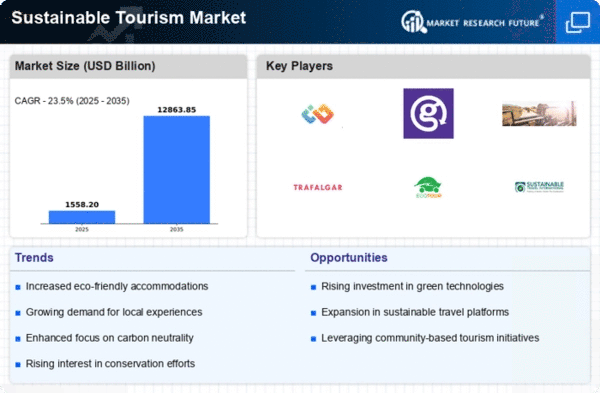
As per MRFR analysis, the Sustainable Tourism Market Size was estimated at 1261.7 USD Billion in 2024. The Sustainable Tourism industry is projected to grow from 1558.23 USD Billion in 2025 to 12863.85 USD Billion by 2035, exhibiting a compound annual growth rate (CAGR) of 23.5 during the forecast period 2025 - 2035.

Key Market Trends & Highlights

The Sustainable Tourism Market is experiencing robust growth driven by increasing consumer awareness and innovative practices.

  • The rise of eco-friendly accommodations is reshaping the hospitality landscape, particularly in North America.
  • Community-based tourism initiatives are gaining traction in the Asia-Pacific region, fostering local engagement and cultural exchange.
  • Technological integration in sustainable travel is enhancing the customer experience and operational efficiency across various segments.
  • Increased consumer awareness and government regulations are major drivers propelling the growth of ecotourism and wellness tourism.

Market Size & Forecast

2024 Market Size 1261.7 (USD Billion)
2035 Market Size 12863.85 (USD Billion)
CAGR (2025 - 2035) 23.5%
Largest Regional Market Share in 2024 Europe

Major Players

Intrepid Group (AU), G Adventures (CA), Responsible Travel (GB), Trafalgar (GB), EcoTour (US), Sustainable Travel International (US), Natural Habitat Adventures (US), Green Globe (AU), Wildlife Conservation Society (US)

Market Trends

The Sustainable Tourism Market is currently experiencing a notable transformation, driven by an increasing awareness of environmental issues and a growing demand for responsible travel options. Travelers today are more inclined to seek experiences that not only provide enjoyment but also contribute positively to local communities and ecosystems. This shift in consumer behavior suggests a potential for growth in eco-friendly accommodations, sustainable transportation, and community-based tourism initiatives. As a result, businesses within this sector are adapting their strategies to align with these evolving preferences, emphasizing sustainability in their operations and offerings. Moreover, the Sustainable Tourism Market appears to be influenced by various factors, including government policies promoting eco-tourism and the rise of digital platforms that facilitate sustainable travel choices. The integration of technology into travel planning is likely to enhance transparency regarding the environmental impact of tourism activities. Consequently, stakeholders in this market may need to remain vigilant and responsive to these trends, ensuring that they not only meet consumer expectations but also contribute to the preservation of natural and cultural resources for future generations.

Rise of Eco-Friendly Accommodations

There is a growing trend towards eco-friendly accommodations, as travelers increasingly prefer lodgings that prioritize sustainability. This includes hotels and resorts that implement green practices, such as energy efficiency, waste reduction, and sourcing local materials. Such establishments not only appeal to environmentally conscious consumers but also contribute to the overall sustainability of the tourism sector.

Community-Based Tourism Initiatives

Community-based tourism initiatives are gaining traction, as they empower local populations and promote cultural exchange. These initiatives often involve travelers engaging directly with local communities, fostering authentic experiences while supporting local economies. This trend indicates a shift towards more meaningful travel experiences that benefit both visitors and host communities.

Technological Integration in Sustainable Travel

The integration of technology in sustainable travel is becoming increasingly prevalent. Digital platforms that provide information on eco-friendly options, carbon offsetting, and sustainable practices are enhancing travelers' ability to make informed choices. This trend suggests that technology could play a crucial role in promoting sustainable tourism practices and increasing awareness among consumers.

Sustainable Tourism Market Market Drivers

Impact of Climate Change

The impact of climate change is a pressing concern that is shaping the Global Sustainable Tourism Industry. As natural disasters and environmental degradation become more prevalent, there is a growing recognition of the need for sustainable tourism practices. Destinations that are vulnerable to climate change are increasingly adopting strategies to mitigate its effects, such as promoting responsible tourism and conservation efforts. This shift not only helps protect ecosystems but also ensures the long-term viability of tourism-dependent economies. The urgency to address climate change is likely to drive further investment in sustainable tourism initiatives, contributing to the industry's projected growth.

Growing Consumer Awareness

The Global Sustainable Tourism Industry is witnessing a notable increase in consumer awareness regarding environmental and social issues. Travelers are increasingly prioritizing eco-friendly options, as evidenced by a 2024 market valuation of 150.3 USD Billion. This heightened awareness drives demand for sustainable practices among tourism providers, compelling them to adopt greener initiatives. For instance, many hotels are now implementing energy-efficient systems and sourcing local products to minimize their carbon footprint. As consumers become more informed, they are likely to choose destinations and services that align with their values, further propelling the growth of the sustainable tourism sector.

Technological Advancements

Technological advancements are significantly influencing the Global Sustainable Tourism Industry. Innovations such as smart travel apps and online platforms facilitate eco-friendly travel planning, allowing consumers to make informed choices. For instance, platforms that highlight sustainable accommodations and activities are gaining traction, enabling travelers to reduce their environmental impact. Additionally, advancements in renewable energy technologies are being adopted by tourism operators, further enhancing sustainability. As technology continues to evolve, it is anticipated that the market will experience a compound annual growth rate of 7.99% from 2025 to 2035, reflecting the growing integration of sustainable practices in tourism.

Rise of Eco-Conscious Travelers

The rise of eco-conscious travelers is a significant driver of the Global Sustainable Tourism Industry. A growing segment of the population seeks experiences that align with their values, favoring destinations that prioritize sustainability. This trend is reflected in the increasing number of eco-tourism packages offered by travel agencies, which cater to environmentally aware consumers. As this demographic expands, the demand for sustainable options is likely to intensify, prompting businesses to innovate and adapt. The market's trajectory suggests that by 2035, the industry could reach a valuation of 350 USD Billion, driven by the preferences of eco-conscious travelers.

Government Initiatives and Policies

Government initiatives play a crucial role in shaping the Global Sustainable Tourism Industry. Various countries are implementing policies aimed at promoting sustainable practices within the tourism sector. For example, the European Union has introduced regulations that encourage sustainable tourism development, which has led to increased funding for eco-friendly projects. These initiatives not only support local economies but also aim to preserve cultural heritage and natural resources. As governments recognize the economic potential of sustainable tourism, investments in infrastructure and incentives for businesses adopting sustainable practices are likely to increase, contributing to the projected market growth to 350 USD Billion by 2035.

Market Segment Insights

By Type of Tourism: Ecotourism (Largest) vs. Wellness Tourism (Fastest-Growing)

<a href="https://www.marketresearchfuture.com/reports/ecotourism-market-29867" target="_blank">ecotourism</a>

Ecotourism: Dominant vs. Wellness Tourism: Emerging

Ecotourism has established itself as a dominant force in the Sustainable Tourism Market, attracting travelers who prioritize environmental conservation and cultural preservation. It offers unique opportunities for immersive experiences in untouched natural landscapes, often emphasizing education on biodiversity and ecosystem sustainability. In contrast, Wellness Tourism is rapidly emerging as a popular choice, focusing on travel experiences that promote holistic health, relaxation, and mental well-being. This segment appeals to health-conscious individuals seeking stress relief through activities such as yoga retreats, spa vacations, and wellness resorts. As consumers increasingly value mental health and personal wellness, Wellness Tourism is poised for substantial growth, thus reshaping the dynamics of tourism in a sustainable context.

By Travel Purpose: Leisure (Largest) vs. Volunteerism (Fastest-Growing)

In the Sustainable Tourism Market, the travel purpose segment is prominently characterized by leisure travel, which continues to hold the largest market share. This segment is driven by increasing consumer awareness of environmentally responsible travel options, with many travelers seeking experiences that reflect their values. Additionally, leisure travel is being prioritized as people look for relaxation and authentic experiences in sustainable settings. In contrast, the volunteerism segment is emerging as the fastest-growing category within the sustainable tourism landscape. This growth is triggered by the rising interest in experiential travel that combines leisure with meaningful contributions to local communities. Travelers are increasingly motivated to participate in activities that allow them to give back while exploring new cultures, driving demand for volunteer-based travel experiences.

Leisure: Dominant vs. Volunteerism: Emerging

Leisure travel remains the dominant force in the Sustainable Tourism Market, appealing to travelers looking for relaxation and eco-friendly experiences. This segment is characterized by vacation packages that include sustainability practices, such as eco-resorts and guided nature tours. On the other hand, volunteerism is rapidly emerging, attracting socially conscious travelers keen to make a difference while exploring. These travelers often engage in community service projects during their trips, promoting sustainable practices and cultural exchange. The contrast between these segments highlights a shift in consumer preferences, with leisure travelers prioritizing ethical travel choices while volunteerism capitalizes on the desire for meaningful engagement.

By Sustainability Practices: Carbon Offsetting (Largest) vs. Waste Reduction (Fastest-Growing)

In the Sustainable Tourism Market, the segment values related to Sustainability Practices are evolving significantly. Carbon Offsetting emerges as the largest practice, widely adopted by tourism businesses to reduce their carbon footprint and appeal to eco-conscious travelers. In contrast, Waste Reduction is rapidly gaining traction, driven by increased awareness of plastic pollution and the desire for cleaner travel experiences, making it one of the fastest-growing practices among various stakeholders in the tourism industry.

Carbon Offsetting (Dominant) vs. Waste Reduction (Emerging)

Carbon Offsetting has established itself as the dominant practice in the Sustainable Tourism Market, with numerous companies implementing offsetting programs that fund initiatives like reforestation and renewable energy projects. It appeals to both providers and consumers, enhancing brand reputation and customer loyalty. On the other hand, Waste Reduction is seen as an emerging practice that is garnering significant attention. Companies are prioritizing strategies to minimize waste through recycling, composting, and reducing single-use plastics, attracting environmentally conscious travelers who seek responsible options. While Carbon Offsetting remains a core strategy for sustainability, Waste Reduction's rapid adoption reflects shifting consumer preferences and regulatory pressures.

By Customer Demographics: Millennials (Largest) vs. Families (Fastest-Growing)

In the Sustainable Tourism Market, Millennials hold the largest market share, emphasizing their preference for eco-friendly travel options that align with their values. They are driven by experiences rather than material possessions, making them a significant demographic in the rising trend of sustainable travel. Families, on the other hand, are emerging as the fastest-growing segment, motivated by an increasing awareness of environmental issues and a desire to instill values of sustainability in their children. This shift reflects broader societal changes and a growing emphasis on responsible tourism among parents. The growth trends among these demographics are reflective of a larger cultural shift towards valuing sustainability. Millennials are increasingly seeking out travel experiences that offer authenticity and minimize their carbon footprint, while families are drawn to destinations that offer eco-friendly accommodations and activities. This convergence of values between the two segments suggests a promising future for sustainable tourism as more travelers prioritize responsible practices in their adventures.

Millennials (Dominant) vs. Baby Boomers (Emerging)

Millennials represent the dominant consumer base in the Sustainable Tourism Market, often prioritizing unique experiences that emphasize environmental awareness and ethical travel practices. They tend to favor options that support local communities, promote conservation efforts, and offer sustainable transportation methods. In contrast, Baby Boomers, while traditionally less engaged in sustainable travel, are emerging as a noteworthy segment. Their growing interest in eco-tourism is driven by a desire for meaningful travel experiences during retirement. This demographic is becoming increasingly aware of environmental impacts and seeks to balance luxury with sustainability, making them a crucial audience for market players who can adapt their offerings to meet these evolving consumer preferences.

By Travel Experience: Nature-Based Experiences (Largest) vs. Sustainable Accommodations (Fastest-Growing)

In the Sustainable Tourism Market, the travel experience segment is prominently led by Nature-Based Experiences, which hold the largest market share among consumers seeking eco-friendly travel options. This segment has gained immense popularity as travelers increasingly prioritize nature-centric activities, allowing them to connect with the environment while minimizing their carbon footprint. Conversely, Sustainable Accommodations are emerging as the fastest-growing segment, reflecting a significant shift in consumer preference towards eco-friendly lodging options that minimize negative impacts on the environment.

Nature-Based Experiences (Dominant) vs. Sustainable Accommodations (Emerging)

Nature-Based Experiences dominate the travel experience segment, appealing to eco-conscious travelers who seek to immerse themselves in natural environments through hiking, wildlife watching, and adventure tourism. This segment thrives as consumers become increasingly aware of the importance of preserving nature while engaging in recreational activities. In contrast, Sustainable Accommodations are rapidly gaining traction, providing eco-friendly lodging options that incorporate sustainability practices. These accommodations prioritize eco-conscious design, renewable energy use, and local sourcing that not only elevate guest experiences but also significantly reduce environmental impacts, positioning themselves as a vital component of the Sustainable Tourism Market.

Get more detailed insights about Sustainable Tourism Market Research Report-Global Forecast till 2035

Regional Insights

North America : Sustainable Travel Growth Engine

The North American sustainable tourism market is projected to reach $315.0 million by December 2025, driven by increasing consumer awareness and demand for eco-friendly travel options. Regulatory support from government initiatives aimed at promoting sustainable practices is also a significant catalyst for growth. The region's focus on reducing carbon footprints and enhancing local economies through responsible tourism is reshaping travel dynamics. Leading countries like the US and Canada are at the forefront of this movement, with key players such as EcoTour and Sustainable Travel International leading the charge. The competitive landscape is characterized by a mix of established companies and innovative startups, all striving to meet the growing demand for sustainable travel experiences. The presence of organizations like the Wildlife Conservation Society further emphasizes the commitment to conservation and responsible tourism practices.

Europe : Leader in Sustainable Practices

Europe holds the largest market share in the sustainable tourism sector, valued at €600.0 million in 2024. The region benefits from strong regulatory frameworks that promote sustainable travel, including initiatives from the European Union aimed at reducing environmental impacts. Growing consumer preference for eco-friendly options and the rise of green certifications are key drivers of this market's expansion. Countries like Germany, France, and the UK are leading the charge, with companies such as Responsible Travel and Trafalgar setting industry standards. The competitive landscape is robust, featuring a mix of local and international players committed to sustainable practices. The presence of organizations advocating for responsible tourism further enhances the region's reputation as a global leader in eco-tourism.

Asia-Pacific : Emerging Market Potential

The Asia-Pacific sustainable tourism market is projected to reach $250.0 million by December 2025, driven by a growing middle class and increasing awareness of environmental issues. Countries in this region are beginning to implement regulations that support sustainable practices, which is expected to catalyze further growth. The demand for eco-friendly travel options is rising, particularly among younger travelers seeking authentic experiences. Leading countries such as Australia and New Zealand are at the forefront, with key players like Intrepid Group and G Adventures making significant contributions to the market. The competitive landscape is evolving, with both established companies and new entrants focusing on sustainable travel solutions. The region's diverse ecosystems and cultural heritage present unique opportunities for responsible tourism initiatives.

Middle East and Africa : Untapped Sustainable Opportunities

The Middle East and Africa sustainable tourism market is valued at $96.7 million, with significant potential for growth as awareness of sustainable practices increases. The region is witnessing a gradual shift towards eco-friendly tourism, driven by both local governments and international organizations promoting sustainable development. Regulatory frameworks are beginning to emerge, supporting the growth of responsible tourism initiatives. Countries like South Africa and Kenya are leading the way, with a focus on wildlife conservation and community-based tourism. Key players such as Green Globe are actively working to promote sustainable practices in the region. The competitive landscape is still developing, but the potential for growth in eco-tourism is substantial, given the region's rich natural resources and cultural diversity.

Key Players and Competitive Insights

The Sustainable Tourism Market is currently characterized by a dynamic competitive landscape, driven by increasing consumer awareness regarding environmental impacts and a growing demand for responsible travel options. Key players such as Intrepid Group (AU), G Adventures (CA), and Responsible Travel (GB) are strategically positioned to capitalize on these trends. Intrepid Group (AU) emphasizes innovation in sustainable travel experiences, focusing on small group tours that minimize environmental footprints. G Adventures (CA) has adopted a community-based approach, fostering partnerships with local businesses to enhance economic benefits for host communities. Responsible Travel (GB) differentiates itself through a strong commitment to ethical travel practices, promoting transparency and accountability in its offerings. Collectively, these strategies not only enhance brand loyalty but also shape a competitive environment that prioritizes sustainability and ethical considerations.In terms of business tactics, companies are increasingly localizing their operations and optimizing supply chains to reduce carbon footprints. The market appears moderately fragmented, with numerous players vying for consumer attention. However, the influence of major companies is substantial, as they set benchmarks for sustainability practices and consumer expectations. This competitive structure encourages smaller firms to innovate and adopt sustainable practices to remain relevant in the market.

In November Intrepid Group (AU) launched a new initiative aimed at carbon neutrality across its entire tour portfolio by 2027. This ambitious goal underscores the company's commitment to sustainability and positions it as a leader in the market. By investing in carbon offset projects and enhancing energy efficiency in operations, Intrepid Group (AU) not only addresses consumer concerns but also sets a precedent for industry standards.

In October G Adventures (CA) announced a partnership with local indigenous communities in Canada to develop culturally immersive travel experiences. This collaboration is strategically significant as it not only enriches the travel experience but also ensures that local communities benefit economically. By integrating cultural education into their offerings, G Adventures (CA) enhances its brand appeal while promoting responsible tourism practices.

In September Responsible Travel (GB) introduced a new certification program for sustainable accommodations, aimed at guiding consumers towards eco-friendly lodging options. This initiative reflects a growing trend towards transparency in the tourism sector, as consumers increasingly seek verified sustainable choices. By establishing this certification, Responsible Travel (GB) strengthens its market position and encourages other players to adopt similar standards.

As of December the competitive trends in the Sustainable Tourism Market are heavily influenced by digitalization, sustainability initiatives, and the integration of AI technologies. Strategic alliances are becoming more prevalent, as companies recognize the value of collaboration in enhancing their sustainability credentials. Looking ahead, competitive differentiation is likely to evolve from traditional price-based competition to a focus on innovation, technological advancements, and supply chain reliability. This shift suggests that companies that prioritize sustainable practices and technological integration will be better positioned to thrive in an increasingly conscientious market.

Key Companies in the Sustainable Tourism Market include

Industry Developments

  • Q2 2024: UNWTO and Google partner to boost digital skills for sustainable tourism The United Nations World Tourism Organization (UNWTO) announced a partnership with Google to provide digital training for tourism businesses, aiming to accelerate sustainable tourism practices and recovery in key destinations.
  • Q2 2024: Intrepid Travel launches new carbon-neutral tours for 2024 Intrepid Travel unveiled a series of new carbon-neutral tours, expanding its sustainable travel offerings and reinforcing its commitment to environmental responsibility in the tourism sector.
  • Q2 2024: Booking.com announces $10 million fund for sustainable tourism startups Booking.com launched a $10 million fund to support startups developing innovative solutions for sustainable tourism, focusing on reducing environmental impact and promoting responsible travel.
  • Q3 2024: Accor opens first net-zero energy hotel in Southeast Asia Accor inaugurated its first net-zero energy hotel in Southeast Asia, marking a significant milestone in the company's sustainability strategy and commitment to eco-friendly hospitality.
  • Q3 2024: Airbnb partners with WWF to promote sustainable travel experiences Airbnb announced a partnership with the World Wildlife Fund (WWF) to develop and promote sustainable travel experiences, aiming to educate travelers and support conservation efforts.
  • Q3 2024: EcoHotels.com secures $5 million Series A funding to expand green hotel platform EcoHotels.com raised $5 million in Series A funding to scale its platform, which connects travelers with certified sustainable hotels and accommodations worldwide.
  • Q4 2024: TUI Group launches new sustainability certification program for resorts TUI Group introduced a new sustainability certification program for its resorts, aiming to standardize and elevate environmental practices across its global portfolio.
  • Q4 2024: Expedia Group appoints Chief Sustainability Officer to lead green initiatives Expedia Group named a new Chief Sustainability Officer to oversee the company's environmental strategy and drive sustainable tourism initiatives across its brands.
  • Q1 2025: Hilton opens eco-friendly resort in Costa Rica Hilton opened a new eco-friendly resort in Costa Rica, featuring renewable energy systems and sustainable design elements to minimize environmental impact.
  • Q1 2025: Adventure Travel Trade Association announces partnership with Rainforest Alliance The Adventure Travel Trade Association (ATTA) formed a partnership with the Rainforest Alliance to promote sustainable tourism standards and support conservation projects in Latin America.
  • Q2 2025: G Adventures acquires sustainable travel startup Rewild G Adventures completed the acquisition of Rewild, a startup specializing in sustainable travel experiences, to expand its eco-tourism offerings and strengthen its commitment to responsible travel.
  • Q2 2025: Trip.com Group launches green travel initiative in Asia-Pacific Trip.com Group launched a new green travel initiative across Asia-Pacific, introducing eco-friendly booking options and partnerships with local conservation organizations.

Future Outlook

Sustainable Tourism Market Future Outlook

The Sustainable Tourism Market is projected to grow at a 23.5% CAGR from 2025 to 2035, driven by increasing consumer awareness, regulatory support, and technological advancements.

New opportunities lie in:

  • Development of eco-friendly accommodations with renewable energy sources.
  • Integration of AI-driven personalized travel planning services.
  • Expansion of carbon offset programs for travelers and businesses.

By 2035, the Sustainable Tourism Market is expected to be a leading sector, reflecting robust growth and innovation.

Market Segmentation

Sustainable Tourism Market Travel Purpose Outlook

  • Leisure
  • Business
  • Education
  • Volunteerism

Sustainable Tourism Market Type of Tourism Outlook

  • Ecotourism
  • Cultural Tourism
  • Adventure Tourism
  • Wellness Tourism

Sustainable Tourism Market Travel Experience Outlook

  • Nature-Based Experiences
  • Cultural Immersion
  • Local Cuisine Exploration
  • Sustainable Accommodations

Sustainable Tourism Market Customer Demographics Outlook

  • Millennials
  • Generation X
  • Baby Boomers
  • Families

Sustainable Tourism Market Sustainability Practices Outlook

  • Carbon Offsetting
  • Waste Reduction
  • Community Engagement
  • Wildlife Conservation

Report Scope

MARKET SIZE 20241261.7(USD Billion)
MARKET SIZE 20251558.23(USD Billion)
MARKET SIZE 203512863.85(USD Billion)
COMPOUND ANNUAL GROWTH RATE (CAGR)23.5% (2025 - 2035)
REPORT COVERAGERevenue Forecast, Competitive Landscape, Growth Factors, and Trends
BASE YEAR2024
Market Forecast Period2025 - 2035
Historical Data2019 - 2024
Market Forecast UnitsUSD Billion
Key Companies ProfiledIntrepid Group (AU), G Adventures (CA), Responsible Travel (GB), Trafalgar (GB), EcoTour (US), Sustainable Travel International (US), Natural Habitat Adventures (US), Green Globe (AU), Wildlife Conservation Society (US)
Segments CoveredType of Tourism, Travel Purpose, Sustainability Practices, Customer Demographics, Travel Experience
Key Market OpportunitiesIntegration of eco-friendly technologies enhances experiences in the Sustainable Tourism Market.
Key Market DynamicsRising consumer demand for eco-friendly travel options drives innovation and competition in the Sustainable Tourism Market.
Countries CoveredNorth America, Europe, APAC, South America, MEA

FAQs

What was at a the expected Market Was at a the Global Sustainable Tourism Market in 2024?

The Global Sustainable Tourism Market 1261.70 Billion USD by 2024

  1. SECTION I: EXECUTIVE SUMMARY AND KEY HIGHLIGHTS
    1. | 1.1 EXECUTIVE SUMMARY
    2. | 1.1.1 Market Overview
    3. | 1.1.2 Key Findings
    4. | 1.1.3 Market Segmentation
    5. | 1.1.4 Competitive Landscape
    6. | 1.1.5 Challenges and Opportunities
    7. | 1.1.6 Future Outlook
  2. SECTION II: SCOPING, METHODOLOGY AND MARKET STRUCTURE
    1. | 2.1 MARKET INTRODUCTION
    2. | 2.1.1 Definition
    3. | 2.1.2 Scope of the study
    4. |-- 2.1.2.1 Research Objective
    5. |-- 2.1.2.2 Assumption
    6. |-- 2.1.2.3 Limitations
    7. | 2.2 RESEARCH METHODOLOGY
    8. | 2.2.1 Overview
    9. | 2.2.2 Data Mining
    10. | 2.2.3 Secondary Research
    11. | 2.2.4 Primary Research
    12. |-- 2.2.4.1 Primary Interviews and Information Gathering Process
    13. |-- 2.2.4.2 Breakdown of Primary Respondents
    14. | 2.2.5 Forecasting Model
    15. | 2.2.6 Market Size Estimation
    16. |-- 2.2.6.1 Bottom-Up Approach
    17. |-- 2.2.6.2 Top-Down Approach
    18. | 2.2.7 Data Triangulation
    19. | 2.2.8 Validation
  3. SECTION III: QUALITATIVE ANALYSIS
    1. | 3.1 MARKET DYNAMICS
    2. | 3.1.1 Overview
    3. | 3.1.2 Drivers
    4. | 3.1.3 Restraints
    5. | 3.1.4 Opportunities
    6. | 3.2 MARKET FACTOR ANALYSIS
    7. | 3.2.1 Value chain Analysis
    8. | 3.2.2 Porter's Five Forces Analysis
    9. |-- 3.2.2.1 Bargaining Power of Suppliers
    10. |-- 3.2.2.2 Bargaining Power of Buyers
    11. |-- 3.2.2.3 Threat of New Entrants
    12. |-- 3.2.2.4 Threat of Substitutes
    13. |-- 3.2.2.5 Intensity of Rivalry
    14. | 3.2.3 COVID-19 Impact Analysis
    15. |-- 3.2.3.1 Market Impact Analysis
    16. |-- 3.2.3.2 Regional Impact
    17. |-- 3.2.3.3 Opportunity and Threat Analysis
  4. SECTION IV: QUANTITATIVE ANALYSIS
    1. | 4.1 Consumer and Retail, BY Type of Tourism (USD Billion)
    2. | 4.1.1 Ecotourism
    3. | 4.1.2 Cultural Tourism
    4. | 4.1.3 Adventure Tourism
    5. | 4.1.4 Wellness Tourism
    6. | 4.2 Consumer and Retail, BY Travel Purpose (USD Billion)
    7. | 4.2.1 Leisure
    8. | 4.2.2 Business
    9. | 4.2.3 Education
    10. | 4.2.4 Volunteerism
    11. | 4.3 Consumer and Retail, BY Sustainability Practices (USD Billion)
    12. | 4.3.1 Carbon Offsetting
    13. | 4.3.2 Waste Reduction
    14. | 4.3.3 Community Engagement
    15. | 4.3.4 Wildlife Conservation
    16. | 4.4 Consumer and Retail, BY Customer Demographics (USD Billion)
    17. | 4.4.1 Millennials
    18. | 4.4.2 Generation X
    19. | 4.4.3 Baby Boomers
    20. | 4.4.4 Families
    21. | 4.5 Consumer and Retail, BY Travel Experience (USD Billion)
    22. | 4.5.1 Nature-Based Experiences
    23. | 4.5.2 Cultural Immersion
    24. | 4.5.3 Local Cuisine Exploration
    25. | 4.5.4 Sustainable Accommodations
    26. | 4.6 Consumer and Retail, BY Region (USD Billion)
    27. | 4.6.1 North America
    28. |-- 4.6.1.1 US
    29. |-- 4.6.1.2 Canada
    30. | 4.6.2 Europe
    31. |-- 4.6.2.1 Germany
    32. |-- 4.6.2.2 UK
    33. |-- 4.6.2.3 France
    34. |-- 4.6.2.4 Russia
    35. |-- 4.6.2.5 Italy
    36. |-- 4.6.2.6 Spain
    37. |-- 4.6.2.7 Rest of Europe
    38. | 4.6.3 APAC
    39. |-- 4.6.3.1 China
    40. |-- 4.6.3.2 India
    41. |-- 4.6.3.3 Japan
    42. |-- 4.6.3.4 South Korea
    43. |-- 4.6.3.5 Malaysia
    44. |-- 4.6.3.6 Thailand
    45. |-- 4.6.3.7 Indonesia
    46. |-- 4.6.3.8 Rest of APAC
    47. | 4.6.4 South America
    48. |-- 4.6.4.1 Brazil
    49. |-- 4.6.4.2 Mexico
    50. |-- 4.6.4.3 Argentina
    51. |-- 4.6.4.4 Rest of South America
    52. | 4.6.5 MEA
    53. |-- 4.6.5.1 GCC Countries
    54. |-- 4.6.5.2 South Africa
    55. |-- 4.6.5.3 Rest of MEA
  5. SECTION V: COMPETITIVE ANALYSIS
    1. | 5.1 Competitive Landscape
    2. | 5.1.1 Overview
    3. | 5.1.2 Competitive Analysis
    4. | 5.1.3 Market share Analysis
    5. | 5.1.4 Major Growth Strategy in the Consumer and Retail
    6. | 5.1.5 Competitive Benchmarking
    7. | 5.1.6 Leading Players in Terms of Number of Developments in the Consumer and Retail
    8. | 5.1.7 Key developments and growth strategies
    9. |-- 5.1.7.1 New Product Launch/Service Deployment
    10. |-- 5.1.7.2 Merger & Acquisitions
    11. |-- 5.1.7.3 Joint Ventures
    12. | 5.1.8 Major Players Financial Matrix
    13. |-- 5.1.8.1 Sales and Operating Income
    14. |-- 5.1.8.2 Major Players R&D Expenditure. 2023
    15. | 5.2 Company Profiles
    16. | 5.2.1 Intrepid Group (AU)
    17. |-- 5.2.1.1 Financial Overview
    18. |-- 5.2.1.2 Products Offered
    19. |-- 5.2.1.3 Key Developments
    20. |-- 5.2.1.4 SWOT Analysis
    21. |-- 5.2.1.5 Key Strategies
    22. | 5.2.2 G Adventures (CA)
    23. |-- 5.2.2.1 Financial Overview
    24. |-- 5.2.2.2 Products Offered
    25. |-- 5.2.2.3 Key Developments
    26. |-- 5.2.2.4 SWOT Analysis
    27. |-- 5.2.2.5 Key Strategies
    28. | 5.2.3 Responsible Travel (GB)
    29. |-- 5.2.3.1 Financial Overview
    30. |-- 5.2.3.2 Products Offered
    31. |-- 5.2.3.3 Key Developments
    32. |-- 5.2.3.4 SWOT Analysis
    33. |-- 5.2.3.5 Key Strategies
    34. | 5.2.4 Trafalgar (GB)
    35. |-- 5.2.4.1 Financial Overview
    36. |-- 5.2.4.2 Products Offered
    37. |-- 5.2.4.3 Key Developments
    38. |-- 5.2.4.4 SWOT Analysis
    39. |-- 5.2.4.5 Key Strategies
    40. | 5.2.5 EcoTour (US)
    41. |-- 5.2.5.1 Financial Overview
    42. |-- 5.2.5.2 Products Offered
    43. |-- 5.2.5.3 Key Developments
    44. |-- 5.2.5.4 SWOT Analysis
    45. |-- 5.2.5.5 Key Strategies
    46. | 5.2.6 Sustainable Travel International (US)
    47. |-- 5.2.6.1 Financial Overview
    48. |-- 5.2.6.2 Products Offered
    49. |-- 5.2.6.3 Key Developments
    50. |-- 5.2.6.4 SWOT Analysis
    51. |-- 5.2.6.5 Key Strategies
    52. | 5.2.7 Natural Habitat Adventures (US)
    53. |-- 5.2.7.1 Financial Overview
    54. |-- 5.2.7.2 Products Offered
    55. |-- 5.2.7.3 Key Developments
    56. |-- 5.2.7.4 SWOT Analysis
    57. |-- 5.2.7.5 Key Strategies
    58. | 5.2.8 Green Globe (AU)
    59. |-- 5.2.8.1 Financial Overview
    60. |-- 5.2.8.2 Products Offered
    61. |-- 5.2.8.3 Key Developments
    62. |-- 5.2.8.4 SWOT Analysis
    63. |-- 5.2.8.5 Key Strategies
    64. | 5.2.9 Wildlife Conservation Society (US)
    65. |-- 5.2.9.1 Financial Overview
    66. |-- 5.2.9.2 Products Offered
    67. |-- 5.2.9.3 Key Developments
    68. |-- 5.2.9.4 SWOT Analysis
    69. |-- 5.2.9.5 Key Strategies
    70. | 5.3 Appendix
    71. | 5.3.1 References
    72. | 5.3.2 Related Reports

Consumer and Retail Market Segmentation

Consumer and Retail By Type of Tourism (USD Billion, 2025-2035)

  • Ecotourism
  • Cultural Tourism
  • Adventure Tourism
  • Wellness Tourism

Consumer and Retail By Travel Purpose (USD Billion, 2025-2035)

  • Leisure
  • Business
  • Education
  • Volunteerism

Consumer and Retail By Sustainability Practices (USD Billion, 2025-2035)

  • Carbon Offsetting
  • Waste Reduction
  • Community Engagement
  • Wildlife Conservation

Consumer and Retail By Customer Demographics (USD Billion, 2025-2035)

  • Millennials
  • Generation X
  • Baby Boomers
  • Families

Consumer and Retail By Travel Experience (USD Billion, 2025-2035)

  • Nature-Based Experiences
  • Cultural Immersion
  • Local Cuisine Exploration
  • Sustainable Accommodations
Infographic

Free Sample Request

Kindly complete the form below to receive a free sample of this Report

Get Free Sample

Customer Strories

Compare Licence

×
Features License Type
Single User Multiuser License Enterprise User
Price $4,950 $5,950 $7,250
Maximum User Access Limit 1 User Upto 10 Users Unrestricted Access Throughout the Organization
Free Customization
Direct Access to Analyst
Deliverable Format
Platform Access
Discount on Next Purchase 10% 15% 15%
Printable Versions