×
Request Free Sample ×

Kindly complete the form below to receive a free sample of this Report

* Please use a valid business email

Leading companies partner with us for data-driven Insights

clients tt-cursor
Hero Background
English
Chinese
French
Japanese
Korean
German
Spanish

Sustainable Fabrics Market Trends

ID: MRFR/CnM/5966-HCR
111 Pages
Anshula Mandaokar
February 2026

Sustainable Fabrics Market Research Report Information By Product Type (Organic, Regenerated, Recycled, and Natural), By Application (Clothing, Furnishing, Medical, and Others), and By Region (North America, Europe, Asia-Pacific, and Rest of The World) – Market Forecast Till 2035

Share:
Download PDF ×

We do not share your information with anyone. However, we may send you emails based on your report interest from time to time. You may contact us at any time to opt-out.

Sustainable Fabrics Market Infographic
Purchase Options

Market Trends

Key Emerging Trends in the Sustainable Fabrics Market

There are notable developments in the sustainable fabrics market that indicate consumers' growing knowledge of and desire for textiles that are socially and environmentally conscious. It is imperative for stakeholders to comprehend these market trends in order to effectively navigate the changing environment and leverage emerging opportunities. Below is a succinct summary of market trends in the Sustainable Fabrics sector: Growing Environmentally Aware Consumerism An important development in the market for sustainable fabrics is consumers' growing inclination toward eco-conscious shopping. Due to their desire to make ecologically beneficial purchases and their rising awareness of environmental issues, consumers are actively seeking out products manufactured from sustainable materials. Growing Use of Recycled Materials: The industry is seeing a sharp increase in the manufacturing of fabrics using recycled materials. Recycled polyester, post-consumer trash, and other upcycled materials can be used to create sustainable fabrics that are becoming more and more fashionable. This movement emphasizes recycling and minimizing environmental effect, which is in line with the circular economy concept.

Growing Need for Organic Cotton: As a sustainable fabric alternative, organic cotton is becoming more and more in demand. Because organic cotton is grown without the use of synthetic fertilizers and pesticides, improving soil health and lowering the environmental impact of cotton production, more and more consumers are preferring apparel made of this fabric. Innovation in Alternative Fibers: The development of alternative fibers is exhibiting innovation in the Sustainable Fabrics market. Because they are less harmful to the environment than traditional fibers like cotton and can be grown sustainably, fabrics made of bamboo, hemp, Tencel, and other plant-based fibers are becoming more and more popular. Traceability and Supply Chain Transparency: In the market for Sustainable Fabrics, supply chain transparency is starting to take center stage. More and more brands and manufacturers are disclosing details on the whole production process, from sourcing raw materials to making fabrics. This openness guarantees accountability for sustainable practices and empowers customers to make educated decisions. Adoption of Water-Saving Technologies: Water scarcity is a global concern, and the textile industry is addressing this issue by adopting water-saving technologies in fabric production. Sustainable fabric manufacturers are implementing dyeing processes that minimize water usage and exploring innovative methods to reduce the environmental impact of water-intensive textile manufacturing.

Author
Anshula Mandaokar
Team Lead - Research

Anshula Mandaokar holds an academic degree in Chemical Engineering and has been contributing to the field for more than 5 years. She has expertise in Market Research and Business Consulting and serves as a Team Lead for a reputed Market Research firm under the Chemicals and Materials domain spectrum. She has worked on multiple projects, generating explicit results in a quick turnaround time. Her understanding of data interpretation justifies her role as a leader.

Leave a Comment

FAQs

What is the current valuation of the Sustainable Fabrics Market?

<p>The Sustainable Fabrics Market was valued at 32.74 USD Billion in 2024.</p>

What is the projected market size for Sustainable Fabrics by 2035?

<p>The market is projected to reach 119.63 USD Billion by 2035.</p>

What is the expected CAGR for the Sustainable Fabrics Market from 2025 to 2035?

<p>The expected CAGR during the forecast period 2025 - 2035 is 12.5%.</p>

Which segments are included in the Sustainable Fabrics Market?

<p>The market segments include Organic, Regenerated, Recycled, and Natural fabrics.</p>

What are the projected valuations for the Organic fabric segment by 2035?

<p>The Organic fabric segment is projected to grow from 5.0 USD Billion to 20.0 USD Billion by 2035.</p>

How does the Clothing application segment perform in the Sustainable Fabrics Market?

<p>The Clothing application segment was valued at 12.0 USD Billion in 2024 and is expected to reach 45.0 USD Billion by 2035.</p>

Who are the key players in the Sustainable Fabrics Market?

Key players include Patagonia, Eileen Fisher, Tencel, Repreve, and Amour Vert.

What is the projected growth for the Recycled fabric segment by 2035?

The Recycled fabric segment is expected to grow from 10.0 USD Billion to 40.0 USD Billion by 2035.

What is the expected valuation for the Medical application segment by 2035?

The Medical application segment is projected to grow from 5.0 USD Billion to 20.0 USD Billion by 2035.

How does the performance of the Furnishing application segment compare to others?

The Furnishing application segment was valued at 8.0 USD Billion in 2024 and is expected to reach 30.0 USD Billion by 2035.

Market Summary

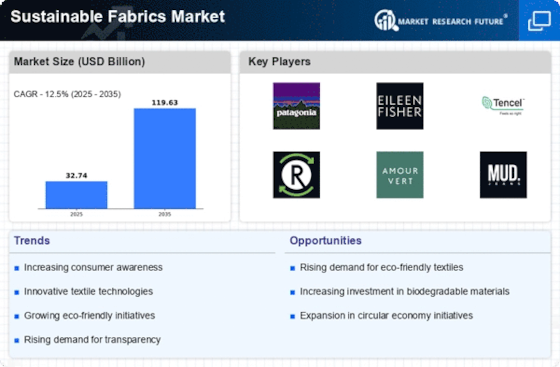
As per Market Research Future analysis, the Sustainable Fabrics Market Size was estimated at 32.74 USD Billion in 2024. The Sustainable Fabrics industry is projected to grow from 36.83 USD Billion in 2025 to 119.63 USD Billion by 2035, exhibiting a compound annual growth rate (CAGR) of 12.5% during the forecast period 2025 - 2035

Key Market Trends & Highlights

The Sustainable Fabrics Market is experiencing robust growth driven by eco-conscious consumerism and technological advancements.

  • North America remains the largest market for sustainable fabrics, driven by increasing consumer awareness and demand. The Asia-Pacific 36.9% share in the Sustainable Fabrics Market propelled by consumer awareness and demand for eco-friendly fabrics The organic segment leads in market share, while the recycled segment is witnessing the fastest growth due to rising environmental concerns. Key market drivers include the rise of eco-conscious consumerism and regulatory support for sustainable practices, which are shaping industry dynamics.

Market Size & Forecast

2024 Market Size 32.74 (USD Billion)
2035 Market Size 119.63 (USD Billion)
CAGR (2025 - 2035) 12.5%
Largest Regional Market Share in 2024 Asia Pacific

Major Players

Patagonia (US), Eileen Fisher (US), Tencel (AT), Repreve (US), Amour Vert (US), MUD Jeans (NL), Nudie Jeans (SE), Outerknown (US), Bamboo Fabric Store (US)

Market Trends

The Sustainable Fabrics Market is currently experiencing a notable transformation, driven by increasing consumer awareness regarding environmental issues and the demand for eco-friendly alternatives. This market encompasses a diverse range of materials, including organic cotton, hemp, and recycled polyester, which are gaining traction among manufacturers and consumers alike. As sustainability becomes a core value for many brands, the emphasis on ethical sourcing and production processes is more pronounced than ever. Companies are actively seeking innovative solutions to reduce their carbon footprint and enhance the lifecycle of their products, which is reshaping the competitive landscape. Moreover, the Sustainable Fabrics Market is likely to witness further growth as technological advancements facilitate the development of new materials that meet both performance and sustainability criteria. The integration of circular economy principles is becoming increasingly relevant, as businesses strive to minimize waste and promote recycling initiatives. This shift not only aligns with consumer preferences but also addresses regulatory pressures aimed at reducing environmental impact. As the market evolves, collaboration among stakeholders, including manufacturers, retailers, and consumers, appears essential for fostering a more sustainable future in the textile industry.  

Rise of Eco-Conscious Consumerism

There is a growing trend of consumers prioritizing sustainability in their purchasing decisions. This shift towards eco-conscious consumerism is compelling brands to adopt sustainable practices and offer environmentally friendly products. As awareness of environmental issues increases, consumers are more inclined to support companies that demonstrate a commitment to sustainability.

Technological Innovations in Fabric Production

Advancements in technology are playing a crucial role in the Sustainable Fabrics Market. Innovations such as bio-based materials and improved recycling processes are emerging, enabling manufacturers to create fabrics that are both sustainable and high-performing. These developments are likely to enhance the appeal of sustainable fabrics to a broader audience.

Collaboration for Sustainability

Collaboration among various stakeholders is becoming increasingly vital in the Sustainable Fabrics Market. Partnerships between brands, suppliers, and non-profit organizations are fostering initiatives aimed at promoting sustainable practices. This collaborative approach is expected to drive industry-wide changes and enhance the overall impact of sustainability efforts.

In May 2025, the European Union passed the Sustainable Textiles Regulation, establishing strict rules for the use of hazardous chemicals in textiles and mandating a 40% reduction in greenhouse gas emissions by 2030.

The market is driven by the surging demand for eco-friendly textiles, particularly in the medical textiles segment.

Sustainable Fabrics Market Market Drivers

Rise of Eco-Conscious Consumerism

The Sustainable Fabrics Market is experiencing a notable shift as consumers increasingly prioritize eco-friendly products. This trend is driven by heightened awareness of environmental issues, leading to a demand for sustainable alternatives in fashion and textiles. According to recent surveys, approximately 70% of consumers express a willingness to pay more for sustainable fabrics, indicating a significant market potential. Brands that align with these values are likely to capture a larger share of the market. This consumer behavior not only influences purchasing decisions but also compels manufacturers to adopt sustainable practices, thereby fostering innovation within the Sustainable Fabrics Market. As a result, companies are investing in sustainable sourcing and production methods to meet the evolving expectations of eco-conscious consumers.
Lululemon Athletica exceeded its recycled polyester target a year ahead of schedule, with 77% of its total procured polyester now recycled, and the brand sourced 11% renewable or recycled nylon in 2024.

Shift Towards Circular Economy Models

The Sustainable Fabrics Market is increasingly embracing circular economy models, which emphasize the reuse and recycling of materials. This shift is driven by the recognition that traditional linear models of production and consumption are unsustainable. Companies are now exploring ways to design fabrics that can be easily recycled or repurposed at the end of their lifecycle. Initiatives such as take-back programs and fabric recycling technologies are gaining traction, with some estimates suggesting that the circular economy could generate USD 4.5 trillion in economic benefits by 2030. This approach not only reduces waste but also conserves resources, making it an attractive proposition for both manufacturers and consumers. As the industry continues to evolve, the integration of circular economy principles is likely to play a pivotal role in shaping the future of the Sustainable Fabrics Market.

Growing Investment in Sustainable Fashion

Investment in sustainable fashion is on the rise, significantly impacting the Sustainable Fabrics Market. Venture capitalists and private equity firms are increasingly directing funds towards companies that prioritize sustainability in their operations. Reports indicate that investments in sustainable fashion startups have surged, with figures reaching over USD 1 billion in recent years. This influx of capital is enabling brands to innovate and expand their offerings of sustainable fabrics. Additionally, established fashion houses are also pivoting towards sustainability, recognizing the long-term benefits of adopting eco-friendly practices. This trend not only enhances brand reputation but also aligns with the growing consumer demand for sustainable products, thereby creating a symbiotic relationship between investment and market growth in the Sustainable Fabrics Market.

Regulatory Support for Sustainable Practices

The Sustainable Fabrics Market is benefiting from an increasing number of regulations aimed at promoting sustainability. Governments worldwide are implementing policies that encourage the use of eco-friendly materials and practices. For example, initiatives that mandate the reduction of carbon emissions in textile production are gaining momentum. These regulations not only create a more favorable environment for sustainable fabric manufacturers but also incentivize companies to innovate and adopt greener practices. As a result, the industry is witnessing a shift towards compliance with sustainability standards, which could potentially lead to a more robust market for sustainable fabrics. This regulatory support is likely to drive growth and foster a competitive landscape where sustainability becomes a key differentiator among brands.

Technological Innovations in Fabric Production

Technological advancements are playing a crucial role in shaping the Sustainable Fabrics Market. Innovations such as bioengineering and the development of recycled materials are revolutionizing fabric production. For instance, the introduction of fabrics made Recycled Polyester segment is projected to grow at the fastest CAGR of 15% during the forecast period These technologies not only reduce waste but also lower the carbon footprint associated with traditional fabric manufacturing. Furthermore, advancements in dyeing processes that utilize less water and energy are becoming increasingly prevalent. As these technologies continue to evolve, they are likely to enhance the sustainability profile of the industry, attracting both consumers and investors who are keen on supporting environmentally responsible practices.

Market Segment Insights

By Type: Organic (Largest) vs. Recycled (Fastest-Growing)

<p>The Sustainable Fabrics Market is significantly influenced by four primary segment values: Organic, Regenerated, Recycled, and Natural. Among these, Organic fabrics hold the largest market share, highlighting their popularity and consumer preference for sustainability and eco-friendliness. Meanwhile, Recycled fabrics exhibit the fastest growth trajectory as they align well with increasing environmental concerns and circular economy initiatives, carving out a rapidly expanding niche in the larger market landscape. In recent years, changing consumer behaviors and heightened awareness around sustainability have propelled the growth of both Organic and Recycled fabrics. Consumers are increasingly seeking products made from renewable and recycled materials, driving manufacturers to innovate and expand their offerings in these segments. Additionally, regulations promoting eco-friendly practices are further driving the adoption of these sustainable fabrics, particularly in fashion and home textiles, spearheading a shift toward more conscientious production practices.</p>

<p>Organic (Dominant) vs. Recycled (Emerging)</p>

<p>Organic fabrics, derived from natural fibers grown without harmful chemicals or synthetic fertilizers, represent the dominant segment in the Sustainable Fabrics Market. Their appeal lies in their environmental benefits and alignment with health-conscious consumer choices. As awareness of sustainable fashion grows, Organic fabrics are more than just a trend; they are now a staple in many eco-friendly apparel lines. In contrast, Recycled fabrics are emerging as a strong competitor, utilizing post-consumer waste and effectively reducing landfill contributions. This segment is favored for its innovative approaches to sustainability, tapping into consumers' growing demand for products that not only reduce their carbon footprint but also promote resource efficiency. Both segments reflect a shift towards a more sustainable lifestyle, appealing to eco-aware consumers.</p>

By Application: Clothing (Largest) vs. Medical (Fastest-Growing)

<p>In the Sustainable Fabrics Market, the application segment reveals significant variability in market share, with clothing taking the lead as the dominant category. Sustainable fabrics used in clothing are favored for their eco-friendly attributes, resonating with the growing consumer demand for responsible fashion choices. Following clothing is the furnishing segment, which utilizes sustainable materials to create environmentally-friendly home products, while medical applications, though smaller in share, are experiencing rapid growth as healthcare providers seek sustainable solutions to enhance patient care and reduce environmental impact. Growth trends in the application segment indicate a robust shift toward sustainability. The clothing sector continues to grow steadily, driven by a general trend toward eco-conscious consumerism. Medical applications show the fastest growth rate, supported by innovations in biodegradable materials and increasing regulatory support for sustainable practices in healthcare. Furnishing applications are also expanding, adapting to consumer preferences for sustainable home products. Overall, the application segment of sustainable fabrics is evolving in response to environmental concerns and changing market dynamics.</p>

<p>Clothing (Dominant) vs. Medical (Emerging)</p>

<p>The clothing segment stands out as the dominant force in the Sustainable Fabrics Market. This application focuses on creating garments that utilize organic, recycled, or sustainable resources, appealing to a consumer base that prioritizes ethical and environmentally-friendly production processes. The growth in the clothing segment reflects a broader movement towards sustainable fashion, which is characterized by transparency in sourcing and production practices. On the other hand, the medical segment has emerged as a rapidly developing area, driven by the healthcare industry's increasing focus on sustainability. This segment is characterized by the use of innovative materials that not only address environmental concerns but also enhance functionality in healthcare settings. As hospitals and medical facilities seek to reduce their carbon footprint, the demand for medical textiles made from sustainable fabrics is anticipated to rise, showcasing the intersection of health and sustainability.</p>

Get more detailed insights about Sustainable Fabrics Market Research Report – Forecast till 2035

Regional Insights

North America : Sustainability Leaders in Textiles

North America is the largest market for sustainable fabrics, holding approximately 12% of the global share. The region's growth is driven by increasing consumer awareness of environmental issues and stringent regulations promoting sustainable practices. The U.S. leads this market, followed closely by Canada, as both countries implement policies to reduce textile waste and promote eco-friendly materials. Key players like Patagonia and Eileen Fisher are at the forefront, pushing innovation in sustainable textiles. The competitive landscape is characterized by a mix of established brands and emerging companies focused on eco-friendly practices. The presence of organizations advocating for sustainable fashion further strengthens the market, ensuring a robust growth trajectory in the coming years.

Europe : Eco-Conscious Fashion Hub

Europe is the second-largest market for sustainable fabrics, accounting for about 30% of the global market share. The region's growth is fueled by strong regulatory frameworks aimed at reducing carbon footprints and promoting circular economy practices. Countries like Germany and the Netherlands are leading the charge, implementing policies that encourage the use of sustainable materials in the fashion industry. The competitive landscape in Europe is vibrant, with key players such as Tencel and MUD Jeans driving innovation. The presence of numerous eco-conscious brands and a growing consumer base that prioritizes sustainability further enhances market dynamics. European initiatives, such as the EU Green Deal, are pivotal in shaping the future of sustainable textiles, ensuring compliance and fostering innovation in the sector.

Asia-Pacific : Emerging Market Potential

Asia-Pacific is witnessing rapid growth in the sustainable fabrics market, holding approximately 36.9% of the global share. The region's demand is driven by increasing urbanization, rising disposable incomes, and a growing awareness of environmental issues. Countries like China and India are emerging as significant players, with governments promoting sustainable practices in the textile industry to combat pollution and resource depletion. The competitive landscape is evolving, with both local and international brands entering the market. Key players like Repreve and Bamboo Fabric Store are capitalizing on the growing demand for eco-friendly textiles. The region's diverse consumer base is increasingly favoring sustainable options, leading to a surge in innovative products and practices that align with global sustainability goals.

Middle East and Africa : Sustainable Growth Opportunities

The Middle East and Africa region is gradually emerging in the sustainable fabrics market, currently holding about 10% of the global share. The growth is primarily driven by increasing awareness of sustainability and the need for eco-friendly practices in the textile industry. Countries like South Africa and the UAE are taking steps to promote sustainable textiles, supported by local initiatives aimed at reducing environmental impact. The competitive landscape is still developing, with a mix of local brands and international players exploring opportunities in the region. The presence of organizations advocating for sustainable practices is crucial in shaping market dynamics. As consumer demand for sustainable options grows, the region is poised for significant growth in the sustainable fabrics sector, attracting investments and fostering innovation.

Key Players and Competitive Insights

Leading market players are investing heavily in research and development in order to expand their product lines, which will help the Sustainable Fabrics Market, grow even more. Market participants are also undertaking a variety of strategic activities to expand their footprint, with important market developments including new product launches, contractual agreements, mergers and acquisitions, higher investments, and collaboration with other organizations. To expand and survive in a more competitive and rising market climate, Sustainable Fabrics industry must offer cost-effective items.Manufacturing locally to minimize operational costs is one of the key business tactics used by manufacturers in the Sustainable Fabrics industry to benefit clients and increase the market sector. In recent years, the Sustainable Fabrics industry has offered some of the most significant advantages to medicine. Major players in the Sustainable Fabrics Market, including Grasim, Vivify Textiles, Foss Performance Materials, Teijin Limited, US Fibers, Pure Waste Textiles Ltd, Polyfibre Industries, Wellman, Advanced Materials, Textil Santanderina, and Pilipinas Ecofiber Corp, are attempting to increase market demand by investing in research and development operations.A division of the Aditya Birla Group, Grasim Industries Ltd. (Grasim) is a producer, distributor, and marketer of building supplies. The business portfolio of the corporation includes viscose, cement, chemicals, and textiles. A broad variety of items are available from it, including grey cement, white cement, viscose staple fiber, yarn, pulp, caustic soda, related chemicals, epoxy, linen, and wool. Through a network of upscale showrooms, distributors, and multi-brand stores, Grasim sells its textile products. In Sweden, China, India, Sri Lanka, Canada, the Middle East, and Bangladesh, the corporation has production facilities, joint ventures, and subsidiaries.In Mumbai, Maharashtra, India, Grasim has its headquarters.Teijin Ltd. (Teijin) is a technology-focused holding corporation that provides solutions in the fields of healthcare, environment and energy, information and electronics, and safety and protection. It produces and sells aramid fiber, carbon fiber goods, synthetic fiber, films, polyester films, resin products, chemical products, IT products, medications, and water purification systems. It also creates and distributes IT products. The business sells medications for the treatment of conditions such as respiratory, cardiovascular, metabolic, and other illnesses as well as ailments of the bones and joints. Devices for home oxygen therapy and those connected to sleep disordered breathing are also available.Teijin has operations in Asia, Europe, America, and Japan. The business offers its goods across Europe, the Americas, and Asia. Tokyo, Japan is home to Teijin's headquarters. Teijin Limited and Fuji Design Co., Ltd., a Japanese corporation building a corporate structure to create, supply, and market items created from recycled carbon fibers using a low environmental impact technology, reached an agreement to collaborate on business matters in February 2022.

Key Companies in the Sustainable Fabrics Market include

Industry Developments

July 2022: In accordance with the UN Sustainable Development Goals, signatories to a new sustainable fashion program that was recently formed in Switzerland are required to push for a more sustainable future for the fashion industry.

In 2024, Adidas made a commitment to use recycled polyester as a raw material in all apparel and other products, reducing reliance on virgin materials, with an aim to achieve climate neutrality by 2050

In October 2024, H&M installed three advanced dyeing and finishing technologies at Chorka Textile in Bangladesh as part of a green fashion plan

Future Outlook

Sustainable Fabrics Market Future Outlook

The Sustainable Fabrics Market share is projected to grow at a 12.5% CAGR from 2025 to 2035, driven by increasing consumer demand for eco-friendly materials and regulatory support for sustainability.

New opportunities lie in:

  • <p>Development of biodegradable textile innovations for fashion brands. Expansion of supply chain partnerships focusing on recycled materials. Investment in digital platforms for sustainable fabric traceability.</p>

By 2035, the Sustainable Fabrics Market is expected to be a leading sector in eco-conscious consumerism.

Market Segmentation

Sustainable Fabrics Market Type Outlook

  • Organic
  • Regenerated
  • Recycled
  • Natural

Sustainable Fabrics Market Application Outlook

  • Clothing
  • Furnishing
  • Medical
  • Others

Report Scope

MARKET SIZE 2024 32.74(USD Billion)
MARKET SIZE 2025 36.83(USD Billion)
MARKET SIZE 2035 119.63(USD Billion)
COMPOUND ANNUAL GROWTH RATE (CAGR) 12.5% (2025 - 2035)
REPORT COVERAGE Revenue Forecast, Competitive Landscape, Growth Factors, and Trends
BASE YEAR 2024
Market Forecast Period 2025 - 2035
Historical Data 2019 - 2024
Market Forecast Units USD Billion
Key Companies Profiled Patagonia (US), Eileen Fisher (US), Tencel (AT), Repreve (US), Amour Vert (US), MUD Jeans (NL), Nudie Jeans (SE), Outerknown (US), Bamboo Fabric Store (US)
Segments Covered Product Type, Application, Region
Key Market Opportunities Growing consumer demand for eco-friendly textiles drives innovation in the Sustainable Fabrics Market.
Key Market Dynamics Rising consumer demand for eco-friendly textiles drives innovation and competition in the sustainable fabrics market.
Countries Covered North America, Europe, APAC, South America, MEA

FAQs

What is the current valuation of the Sustainable Fabrics Market?

<p>The Sustainable Fabrics Market was valued at 32.74 USD Billion in 2024.</p>

What is the projected market size for Sustainable Fabrics by 2035?

<p>The market is projected to reach 119.63 USD Billion by 2035.</p>

What is the expected CAGR for the Sustainable Fabrics Market from 2025 to 2035?

<p>The expected CAGR during the forecast period 2025 - 2035 is 12.5%.</p>

Which segments are included in the Sustainable Fabrics Market?

<p>The market segments include Organic, Regenerated, Recycled, and Natural fabrics.</p>

What are the projected valuations for the Organic fabric segment by 2035?

<p>The Organic fabric segment is projected to grow from 5.0 USD Billion to 20.0 USD Billion by 2035.</p>

How does the Clothing application segment perform in the Sustainable Fabrics Market?

<p>The Clothing application segment was valued at 12.0 USD Billion in 2024 and is expected to reach 45.0 USD Billion by 2035.</p>

Who are the key players in the Sustainable Fabrics Market?

Key players include Patagonia, Eileen Fisher, Tencel, Repreve, and Amour Vert.

What is the projected growth for the Recycled fabric segment by 2035?

The Recycled fabric segment is expected to grow from 10.0 USD Billion to 40.0 USD Billion by 2035.

What is the expected valuation for the Medical application segment by 2035?

The Medical application segment is projected to grow from 5.0 USD Billion to 20.0 USD Billion by 2035.

How does the performance of the Furnishing application segment compare to others?

The Furnishing application segment was valued at 8.0 USD Billion in 2024 and is expected to reach 30.0 USD Billion by 2035.

  1. SECTION I: EXECUTIVE SUMMARY AND KEY HIGHLIGHTS
    1. | 1.1 EXECUTIVE SUMMARY
    2. | | 1.1.1 Market Overview
    3. | | 1.1.2 Key Findings
    4. | | 1.1.3 Market Segmentation
    5. | | 1.1.4 Competitive Landscape
    6. | | 1.1.5 Challenges and Opportunities
    7. | | 1.1.6 Future Outlook
  2. SECTION II: SCOPING, METHODOLOGY AND MARKET STRUCTURE
    1. | 2.1 MARKET INTRODUCTION
    2. | | 2.1.1 Definition
    3. | | 2.1.2 Scope of the study
    4. | | | 2.1.2.1 Research Objective
    5. | | | 2.1.2.2 Assumption
    6. | | | 2.1.2.3 Limitations
    7. | 2.2 RESEARCH METHODOLOGY
    8. | | 2.2.1 Overview
    9. | | 2.2.2 Data Mining
    10. | | 2.2.3 Secondary Research
    11. | | 2.2.4 Primary Research
    12. | | | 2.2.4.1 Primary Interviews and Information Gathering Process
    13. | | | 2.2.4.2 Breakdown of Primary Respondents
    14. | | 2.2.5 Forecasting Model
    15. | | 2.2.6 Market Size Estimation
    16. | | | 2.2.6.1 Bottom-Up Approach
    17. | | | 2.2.6.2 Top-Down Approach
    18. | | 2.2.7 Data Triangulation
    19. | | 2.2.8 Validation
  3. SECTION III: QUALITATIVE ANALYSIS
    1. | 3.1 MARKET DYNAMICS
    2. | | 3.1.1 Overview
    3. | | 3.1.2 Drivers
    4. | | 3.1.3 Restraints
    5. | | 3.1.4 Opportunities
    6. | 3.2 MARKET FACTOR ANALYSIS
    7. | | 3.2.1 Value chain Analysis
    8. | | 3.2.2 Porter's Five Forces Analysis
    9. | | | 3.2.2.1 Bargaining Power of Suppliers
    10. | | | 3.2.2.2 Bargaining Power of Buyers
    11. | | | 3.2.2.3 Threat of New Entrants
    12. | | | 3.2.2.4 Threat of Substitutes
    13. | | | 3.2.2.5 Intensity of Rivalry
    14. | | 3.2.3 COVID-19 Impact Analysis
    15. | | | 3.2.3.1 Market Impact Analysis
    16. | | | 3.2.3.2 Regional Impact
    17. | | | 3.2.3.3 Opportunity and Threat Analysis
  4. SECTION IV: QUANTITATIVE ANALYSIS
    1. | 4.1 Chemicals and Materials, BY Type (USD Billion)
    2. | | 4.1.1 Organic
    3. | | 4.1.2 Regenerated
    4. | | 4.1.3 Recycled
    5. | | 4.1.4 Natural
    6. | 4.2 Chemicals and Materials, BY Application (USD Billion)
    7. | | 4.2.1 Clothing
    8. | | 4.2.2 Furnishing
    9. | | 4.2.3 Medical
    10. | | 4.2.4 Others
    11. | 4.3 Chemicals and Materials, BY Region (USD Billion)
    12. | | 4.3.1 North America
    13. | | | 4.3.1.1 US
    14. | | | 4.3.1.2 Canada
    15. | | 4.3.2 Europe
    16. | | | 4.3.2.1 Germany
    17. | | | 4.3.2.2 UK
    18. | | | 4.3.2.3 France
    19. | | | 4.3.2.4 Russia
    20. | | | 4.3.2.5 Italy
    21. | | | 4.3.2.6 Spain
    22. | | | 4.3.2.7 Rest of Europe
    23. | | 4.3.3 APAC
    24. | | | 4.3.3.1 China
    25. | | | 4.3.3.2 India
    26. | | | 4.3.3.3 Japan
    27. | | | 4.3.3.4 South Korea
    28. | | | 4.3.3.5 Malaysia
    29. | | | 4.3.3.6 Thailand
    30. | | | 4.3.3.7 Indonesia
    31. | | | 4.3.3.8 Rest of APAC
    32. | | 4.3.4 South America
    33. | | | 4.3.4.1 Brazil
    34. | | | 4.3.4.2 Mexico
    35. | | | 4.3.4.3 Argentina
    36. | | | 4.3.4.4 Rest of South America
    37. | | 4.3.5 MEA
    38. | | | 4.3.5.1 GCC Countries
    39. | | | 4.3.5.2 South Africa
    40. | | | 4.3.5.3 Rest of MEA
  5. SECTION V: COMPETITIVE ANALYSIS
    1. | 5.1 Competitive Landscape
    2. | | 5.1.1 Overview
    3. | | 5.1.2 Competitive Analysis
    4. | | 5.1.3 Market share Analysis
    5. | | 5.1.4 Major Growth Strategy in the Chemicals and Materials
    6. | | 5.1.5 Competitive Benchmarking
    7. | | 5.1.6 Leading Players in Terms of Number of Developments in the Chemicals and Materials
    8. | | 5.1.7 Key developments and growth strategies
    9. | | | 5.1.7.1 New Product Launch/Service Deployment
    10. | | | 5.1.7.2 Merger & Acquisitions
    11. | | | 5.1.7.3 Joint Ventures
    12. | | 5.1.8 Major Players Financial Matrix
    13. | | | 5.1.8.1 Sales and Operating Income
    14. | | | 5.1.8.2 Major Players R&D Expenditure. 2023
    15. | 5.2 Company Profiles
    16. | | 5.2.1 Patagonia (US)
    17. | | | 5.2.1.1 Financial Overview
    18. | | | 5.2.1.2 Products Offered
    19. | | | 5.2.1.3 Key Developments
    20. | | | 5.2.1.4 SWOT Analysis
    21. | | | 5.2.1.5 Key Strategies
    22. | | 5.2.2 Eileen Fisher (US)
    23. | | | 5.2.2.1 Financial Overview
    24. | | | 5.2.2.2 Products Offered
    25. | | | 5.2.2.3 Key Developments
    26. | | | 5.2.2.4 SWOT Analysis
    27. | | | 5.2.2.5 Key Strategies
    28. | | 5.2.3 Tencel (AT)
    29. | | | 5.2.3.1 Financial Overview
    30. | | | 5.2.3.2 Products Offered
    31. | | | 5.2.3.3 Key Developments
    32. | | | 5.2.3.4 SWOT Analysis
    33. | | | 5.2.3.5 Key Strategies
    34. | | 5.2.4 Repreve (US)
    35. | | | 5.2.4.1 Financial Overview
    36. | | | 5.2.4.2 Products Offered
    37. | | | 5.2.4.3 Key Developments
    38. | | | 5.2.4.4 SWOT Analysis
    39. | | | 5.2.4.5 Key Strategies
    40. | | 5.2.5 Amour Vert (US)
    41. | | | 5.2.5.1 Financial Overview
    42. | | | 5.2.5.2 Products Offered
    43. | | | 5.2.5.3 Key Developments
    44. | | | 5.2.5.4 SWOT Analysis
    45. | | | 5.2.5.5 Key Strategies
    46. | | 5.2.6 MUD Jeans (NL)
    47. | | | 5.2.6.1 Financial Overview
    48. | | | 5.2.6.2 Products Offered
    49. | | | 5.2.6.3 Key Developments
    50. | | | 5.2.6.4 SWOT Analysis
    51. | | | 5.2.6.5 Key Strategies
    52. | | 5.2.7 Nudie Jeans (SE)
    53. | | | 5.2.7.1 Financial Overview
    54. | | | 5.2.7.2 Products Offered
    55. | | | 5.2.7.3 Key Developments
    56. | | | 5.2.7.4 SWOT Analysis
    57. | | | 5.2.7.5 Key Strategies
    58. | | 5.2.8 Outerknown (US)
    59. | | | 5.2.8.1 Financial Overview
    60. | | | 5.2.8.2 Products Offered
    61. | | | 5.2.8.3 Key Developments
    62. | | | 5.2.8.4 SWOT Analysis
    63. | | | 5.2.8.5 Key Strategies
    64. | | 5.2.9 Bamboo Fabric Store (US)
    65. | | | 5.2.9.1 Financial Overview
    66. | | | 5.2.9.2 Products Offered
    67. | | | 5.2.9.3 Key Developments
    68. | | | 5.2.9.4 SWOT Analysis
    69. | | | 5.2.9.5 Key Strategies
    70. | 5.3 Appendix
    71. | | 5.3.1 References
    72. | | 5.3.2 Related Reports
  6. LIST OF FIGURES
    1. | 6.1 MARKET SYNOPSIS
    2. | 6.2 NORTH AMERICA MARKET ANALYSIS
    3. | 6.3 US MARKET ANALYSIS BY TYPE
    4. | 6.4 US MARKET ANALYSIS BY APPLICATION
    5. | 6.5 CANADA MARKET ANALYSIS BY TYPE
    6. | 6.6 CANADA MARKET ANALYSIS BY APPLICATION
    7. | 6.7 EUROPE MARKET ANALYSIS
    8. | 6.8 GERMANY MARKET ANALYSIS BY TYPE
    9. | 6.9 GERMANY MARKET ANALYSIS BY APPLICATION
    10. | 6.10 UK MARKET ANALYSIS BY TYPE
    11. | 6.11 UK MARKET ANALYSIS BY APPLICATION
    12. | 6.12 FRANCE MARKET ANALYSIS BY TYPE
    13. | 6.13 FRANCE MARKET ANALYSIS BY APPLICATION
    14. | 6.14 RUSSIA MARKET ANALYSIS BY TYPE
    15. | 6.15 RUSSIA MARKET ANALYSIS BY APPLICATION
    16. | 6.16 ITALY MARKET ANALYSIS BY TYPE
    17. | 6.17 ITALY MARKET ANALYSIS BY APPLICATION
    18. | 6.18 SPAIN MARKET ANALYSIS BY TYPE
    19. | 6.19 SPAIN MARKET ANALYSIS BY APPLICATION
    20. | 6.20 REST OF EUROPE MARKET ANALYSIS BY TYPE
    21. | 6.21 REST OF EUROPE MARKET ANALYSIS BY APPLICATION
    22. | 6.22 APAC MARKET ANALYSIS
    23. | 6.23 CHINA MARKET ANALYSIS BY TYPE
    24. | 6.24 CHINA MARKET ANALYSIS BY APPLICATION
    25. | 6.25 INDIA MARKET ANALYSIS BY TYPE
    26. | 6.26 INDIA MARKET ANALYSIS BY APPLICATION
    27. | 6.27 JAPAN MARKET ANALYSIS BY TYPE
    28. | 6.28 JAPAN MARKET ANALYSIS BY APPLICATION
    29. | 6.29 SOUTH KOREA MARKET ANALYSIS BY TYPE
    30. | 6.30 SOUTH KOREA MARKET ANALYSIS BY APPLICATION
    31. | 6.31 MALAYSIA MARKET ANALYSIS BY TYPE
    32. | 6.32 MALAYSIA MARKET ANALYSIS BY APPLICATION
    33. | 6.33 THAILAND MARKET ANALYSIS BY TYPE
    34. | 6.34 THAILAND MARKET ANALYSIS BY APPLICATION
    35. | 6.35 INDONESIA MARKET ANALYSIS BY TYPE
    36. | 6.36 INDONESIA MARKET ANALYSIS BY APPLICATION
    37. | 6.37 REST OF APAC MARKET ANALYSIS BY TYPE
    38. | 6.38 REST OF APAC MARKET ANALYSIS BY APPLICATION
    39. | 6.39 SOUTH AMERICA MARKET ANALYSIS
    40. | 6.40 BRAZIL MARKET ANALYSIS BY TYPE
    41. | 6.41 BRAZIL MARKET ANALYSIS BY APPLICATION
    42. | 6.42 MEXICO MARKET ANALYSIS BY TYPE
    43. | 6.43 MEXICO MARKET ANALYSIS BY APPLICATION
    44. | 6.44 ARGENTINA MARKET ANALYSIS BY TYPE
    45. | 6.45 ARGENTINA MARKET ANALYSIS BY APPLICATION
    46. | 6.46 REST OF SOUTH AMERICA MARKET ANALYSIS BY TYPE
    47. | 6.47 REST OF SOUTH AMERICA MARKET ANALYSIS BY APPLICATION
    48. | 6.48 MEA MARKET ANALYSIS
    49. | 6.49 GCC COUNTRIES MARKET ANALYSIS BY TYPE
    50. | 6.50 GCC COUNTRIES MARKET ANALYSIS BY APPLICATION
    51. | 6.51 SOUTH AFRICA MARKET ANALYSIS BY TYPE
    52. | 6.52 SOUTH AFRICA MARKET ANALYSIS BY APPLICATION
    53. | 6.53 REST OF MEA MARKET ANALYSIS BY TYPE
    54. | 6.54 REST OF MEA MARKET ANALYSIS BY APPLICATION
    55. | 6.55 KEY BUYING CRITERIA OF CHEMICALS AND MATERIALS
    56. | 6.56 RESEARCH PROCESS OF MRFR
    57. | 6.57 DRO ANALYSIS OF CHEMICALS AND MATERIALS
    58. | 6.58 DRIVERS IMPACT ANALYSIS: CHEMICALS AND MATERIALS
    59. | 6.59 RESTRAINTS IMPACT ANALYSIS: CHEMICALS AND MATERIALS
    60. | 6.60 SUPPLY / VALUE CHAIN: CHEMICALS AND MATERIALS
    61. | 6.61 CHEMICALS AND MATERIALS, BY TYPE, 2024 (% SHARE)
    62. | 6.62 CHEMICALS AND MATERIALS, BY TYPE, 2024 TO 2035 (USD Billion)
    63. | 6.63 CHEMICALS AND MATERIALS, BY APPLICATION, 2024 (% SHARE)
    64. | 6.64 CHEMICALS AND MATERIALS, BY APPLICATION, 2024 TO 2035 (USD Billion)
    65. | 6.65 BENCHMARKING OF MAJOR COMPETITORS
  7. LIST OF TABLES
    1. | 7.1 LIST OF ASSUMPTIONS
    2. | | 7.1.1
    3. | 7.2 North America MARKET SIZE ESTIMATES; FORECAST
    4. | | 7.2.1 BY TYPE, 2025-2035 (USD Billion)
    5. | | 7.2.2 BY APPLICATION, 2025-2035 (USD Billion)
    6. | 7.3 US MARKET SIZE ESTIMATES; FORECAST
    7. | | 7.3.1 BY TYPE, 2025-2035 (USD Billion)
    8. | | 7.3.2 BY APPLICATION, 2025-2035 (USD Billion)
    9. | 7.4 Canada MARKET SIZE ESTIMATES; FORECAST
    10. | | 7.4.1 BY TYPE, 2025-2035 (USD Billion)
    11. | | 7.4.2 BY APPLICATION, 2025-2035 (USD Billion)
    12. | 7.5 Europe MARKET SIZE ESTIMATES; FORECAST
    13. | | 7.5.1 BY TYPE, 2025-2035 (USD Billion)
    14. | | 7.5.2 BY APPLICATION, 2025-2035 (USD Billion)
    15. | 7.6 Germany MARKET SIZE ESTIMATES; FORECAST
    16. | | 7.6.1 BY TYPE, 2025-2035 (USD Billion)
    17. | | 7.6.2 BY APPLICATION, 2025-2035 (USD Billion)
    18. | 7.7 UK MARKET SIZE ESTIMATES; FORECAST
    19. | | 7.7.1 BY TYPE, 2025-2035 (USD Billion)
    20. | | 7.7.2 BY APPLICATION, 2025-2035 (USD Billion)
    21. | 7.8 France MARKET SIZE ESTIMATES; FORECAST
    22. | | 7.8.1 BY TYPE, 2025-2035 (USD Billion)
    23. | | 7.8.2 BY APPLICATION, 2025-2035 (USD Billion)
    24. | 7.9 Russia MARKET SIZE ESTIMATES; FORECAST
    25. | | 7.9.1 BY TYPE, 2025-2035 (USD Billion)
    26. | | 7.9.2 BY APPLICATION, 2025-2035 (USD Billion)
    27. | 7.10 Italy MARKET SIZE ESTIMATES; FORECAST
    28. | | 7.10.1 BY TYPE, 2025-2035 (USD Billion)
    29. | | 7.10.2 BY APPLICATION, 2025-2035 (USD Billion)
    30. | 7.11 Spain MARKET SIZE ESTIMATES; FORECAST
    31. | | 7.11.1 BY TYPE, 2025-2035 (USD Billion)
    32. | | 7.11.2 BY APPLICATION, 2025-2035 (USD Billion)
    33. | 7.12 Rest of Europe MARKET SIZE ESTIMATES; FORECAST
    34. | | 7.12.1 BY TYPE, 2025-2035 (USD Billion)
    35. | | 7.12.2 BY APPLICATION, 2025-2035 (USD Billion)
    36. | 7.13 APAC MARKET SIZE ESTIMATES; FORECAST
    37. | | 7.13.1 BY TYPE, 2025-2035 (USD Billion)
    38. | | 7.13.2 BY APPLICATION, 2025-2035 (USD Billion)
    39. | 7.14 China MARKET SIZE ESTIMATES; FORECAST
    40. | | 7.14.1 BY TYPE, 2025-2035 (USD Billion)
    41. | | 7.14.2 BY APPLICATION, 2025-2035 (USD Billion)
    42. | 7.15 India MARKET SIZE ESTIMATES; FORECAST
    43. | | 7.15.1 BY TYPE, 2025-2035 (USD Billion)
    44. | | 7.15.2 BY APPLICATION, 2025-2035 (USD Billion)
    45. | 7.16 Japan MARKET SIZE ESTIMATES; FORECAST
    46. | | 7.16.1 BY TYPE, 2025-2035 (USD Billion)
    47. | | 7.16.2 BY APPLICATION, 2025-2035 (USD Billion)
    48. | 7.17 South Korea MARKET SIZE ESTIMATES; FORECAST
    49. | | 7.17.1 BY TYPE, 2025-2035 (USD Billion)
    50. | | 7.17.2 BY APPLICATION, 2025-2035 (USD Billion)
    51. | 7.18 Malaysia MARKET SIZE ESTIMATES; FORECAST
    52. | | 7.18.1 BY TYPE, 2025-2035 (USD Billion)
    53. | | 7.18.2 BY APPLICATION, 2025-2035 (USD Billion)
    54. | 7.19 Thailand MARKET SIZE ESTIMATES; FORECAST
    55. | | 7.19.1 BY TYPE, 2025-2035 (USD Billion)
    56. | | 7.19.2 BY APPLICATION, 2025-2035 (USD Billion)
    57. | 7.20 Indonesia MARKET SIZE ESTIMATES; FORECAST
    58. | | 7.20.1 BY TYPE, 2025-2035 (USD Billion)
    59. | | 7.20.2 BY APPLICATION, 2025-2035 (USD Billion)
    60. | 7.21 Rest of APAC MARKET SIZE ESTIMATES; FORECAST
    61. | | 7.21.1 BY TYPE, 2025-2035 (USD Billion)
    62. | | 7.21.2 BY APPLICATION, 2025-2035 (USD Billion)
    63. | 7.22 South America MARKET SIZE ESTIMATES; FORECAST
    64. | | 7.22.1 BY TYPE, 2025-2035 (USD Billion)
    65. | | 7.22.2 BY APPLICATION, 2025-2035 (USD Billion)
    66. | 7.23 Brazil MARKET SIZE ESTIMATES; FORECAST
    67. | | 7.23.1 BY TYPE, 2025-2035 (USD Billion)
    68. | | 7.23.2 BY APPLICATION, 2025-2035 (USD Billion)
    69. | 7.24 Mexico MARKET SIZE ESTIMATES; FORECAST
    70. | | 7.24.1 BY TYPE, 2025-2035 (USD Billion)
    71. | | 7.24.2 BY APPLICATION, 2025-2035 (USD Billion)
    72. | 7.25 Argentina MARKET SIZE ESTIMATES; FORECAST
    73. | | 7.25.1 BY TYPE, 2025-2035 (USD Billion)
    74. | | 7.25.2 BY APPLICATION, 2025-2035 (USD Billion)
    75. | 7.26 Rest of South America MARKET SIZE ESTIMATES; FORECAST
    76. | | 7.26.1 BY TYPE, 2025-2035 (USD Billion)
    77. | | 7.26.2 BY APPLICATION, 2025-2035 (USD Billion)
    78. | 7.27 MEA MARKET SIZE ESTIMATES; FORECAST
    79. | | 7.27.1 BY TYPE, 2025-2035 (USD Billion)
    80. | | 7.27.2 BY APPLICATION, 2025-2035 (USD Billion)
    81. | 7.28 GCC Countries MARKET SIZE ESTIMATES; FORECAST
    82. | | 7.28.1 BY TYPE, 2025-2035 (USD Billion)
    83. | | 7.28.2 BY APPLICATION, 2025-2035 (USD Billion)
    84. | 7.29 South Africa MARKET SIZE ESTIMATES; FORECAST
    85. | | 7.29.1 BY TYPE, 2025-2035 (USD Billion)
    86. | | 7.29.2 BY APPLICATION, 2025-2035 (USD Billion)
    87. | 7.30 Rest of MEA MARKET SIZE ESTIMATES; FORECAST
    88. | | 7.30.1 BY TYPE, 2025-2035 (USD Billion)
    89. | | 7.30.2 BY APPLICATION, 2025-2035 (USD Billion)
    90. | 7.31 PRODUCT LAUNCH/PRODUCT DEVELOPMENT/APPROVAL
    91. | | 7.31.1
    92. | 7.32 ACQUISITION/PARTNERSHIP
    93. | | 7.32.1

Chemicals and Materials Market Segmentation

Chemicals and Materials By Type (USD Billion, 2025-2035)

  • Organic
  • Regenerated
  • Recycled
  • Natural

Chemicals and Materials By Application (USD Billion, 2025-2035)

  • Clothing
  • Furnishing
  • Medical
  • Others
Infographic

Free Sample Request

Kindly complete the form below to receive a free sample of this Report

Get Free Sample

Customer Strories

Compare Licence

×
Features License Type
Single User Multiuser License Enterprise User
Price $4,950 $5,950 $7,250
Maximum User Access Limit 1 User Upto 10 Users Unrestricted Access Throughout the Organization
Free Customization
Direct Access to Analyst
Deliverable Format
Platform Access
Discount on Next Purchase 10% 15% 15%
Printable Versions