×
Request Free Sample ×

Kindly complete the form below to receive a free sample of this Report

* Please use a valid business email

Leading companies partner with us for data-driven Insights

clients tt-cursor
Hero Background
English
Chinese
French
Japanese
Korean
German
Spanish

Surgical Navigation Systems Market Analysis

ID: MRFR/MED/6391-CR
200 Pages
Rahul Gotadki
July 2025

Surgical Navigation Systems Market Research Report By Technology (Optical Navigation Systems, Electromagnetic Navigation Systems, Hybrid Navigation Systems, Robotic-Assisted Navigation Systems), By Application (Orthopedics, Neurosurgery, ENT Surgery, Spinal Surgery, Cardiac Surgery), By End Use (Hospitals, Ambulatory Surgical Centers, Research Institutions), By Component (Hardware, Software, Services) and By Regional (North America, Europe, South America, Asia Pacific, Middle East and Africa) - Growth & Industry Forecast 2025 To 2035

Share:
Download PDF ×

We do not share your information with anyone. However, we may send you emails based on your report interest from time to time. You may contact us at any time to opt-out.

Surgical Navigation Systems Market Infographic
Purchase Options

Market Analysis

In-depth Analysis of Surgical Navigation Systems Market Industry Landscape

The demand for surgical navigation systems is rapidly increasing in emerging economies as a solution to challenges posed by traditional surgeries, aiming to enhance the efficiency of patient care. Notably, countries like India and China stand out as promising markets for the global surgical navigation systems industry due to their sizable patient populations and a rising prevalence of chronic diseases. A study published in the Lancet Journal revealed that China has approximately 1.7 million individuals diagnosed with Parkinson's Disease. Similarly, in 2018, around 30,000 people in China were reported to have multiple sclerosis.

The substantial growth potential in these emerging markets is further fueled by the aging demographic, particularly in China. As per the United Nations Population Fund (UNFPA) report, the proportion of individuals aged 60 and above in India was 8% in 2015 and is projected to climb to 19% by 2050. This demographic shift is anticipated to contribute significantly to the expansion of the surgical navigation systems market in the region.

Furthermore, major industry players are actively seeking to establish a stronger foothold in these emerging markets, opening avenues for market growth. For example, in April 2018, B. Braun inaugurated five new production facilities in Malaysia, focusing on the increased manufacturing of pharmaceutical solutions, medical devices for infusion therapy, and surgical instruments. Similarly, Medtronic PLC expanded its presence in the Asia-Pacific region by establishing a new headquarters in Singapore in May 2016. This strategic move is intended to support and reinforce Medtronic's operations across 80 locations in the Asia-Pacific region. The surge in interest from major players in the healthcare industry to extend their reach into these untapped markets have paved the way for collaborative efforts and advancements. As a case in point, B. Braun's initiative to open new production facilities in Malaysia not only addresses the growing demand for surgical navigation systems but also contributes to the local economy by creating jobs and fostering technological development. Similarly, Medtronic PLC's establishment of its Asia-Pacific headquarters in Singapore reflects a commitment to streamline operations and better cater to the diverse healthcare needs across the region.

Author
Rahul Gotadki
Research Manager

He holds an experience of about 9+ years in Market Research and Business Consulting, working under the spectrum of Life Sciences and Healthcare domains. Rahul conceptualizes and implements a scalable business strategy and provides strategic leadership to the clients. His expertise lies in market estimation, competitive intelligence, pipeline analysis, customer assessment, etc.

Leave a Comment

FAQs

What is the projected market valuation of the Surgical Navigation Systems Market by 2035?

<p>The Surgical Navigation Systems Market is projected to reach a valuation of 4.984 USD Billion by 2035.</p>

What was the market valuation of the Surgical Navigation Systems Market in 2024?

<p>In 2024, the market valuation of the Surgical Navigation Systems Market was 2.473 USD Billion.</p>

What is the expected CAGR for the Surgical Navigation Systems Market during the forecast period 2025 - 2035?

<p>The expected CAGR for the Surgical Navigation Systems Market during the forecast period 2025 - 2035 is 6.58%.</p>

Which technology segment is anticipated to have the highest growth in the Surgical Navigation Systems Market?

<p>The Robotic-Assisted Navigation Systems segment is anticipated to grow from 0.738 USD Billion in 2024 to 1.489 USD Billion by 2035.</p>

How does the Orthopedics application segment perform in the Surgical Navigation Systems Market?

<p>The Orthopedics application segment was valued at 0.743 USD Billion in 2024 and is projected to reach 1.487 USD Billion by 2035.</p>

What are the key players in the Surgical Navigation Systems Market?

<p>Key players in the Surgical Navigation Systems Market include Medtronic, Stryker, Brainlab, Zimmer Biomet, Siemens Healthineers, Philips, GE Healthcare, Olympus, and Intuitive Surgical.</p>

What is the expected growth for the Services component in the Surgical Navigation Systems Market?

<p>The Services component is expected to grow from 1.234 USD Billion in 2024 to 2.485 USD Billion by 2035.</p>

Which end-use segment is projected to dominate the Surgical Navigation Systems Market?

<p>The Hospitals end-use segment is projected to dominate, growing from 1.4865 USD Billion in 2024 to 2.487 USD Billion by 2035.</p>

What is the projected growth for the Electromagnetic Navigation Systems segment?

<p>The Electromagnetic Navigation Systems segment is expected to grow from 0.496 USD Billion in 2024 to 1.004 USD Billion by 2035.</p>

How does the market for Ambulatory Surgical Centers compare to other end-use segments?

<p>The Ambulatory Surgical Centers segment is projected to grow from 0.74325 USD Billion in 2024 to 1.243 USD Billion by 2035, indicating robust growth.</p>

Market Summary

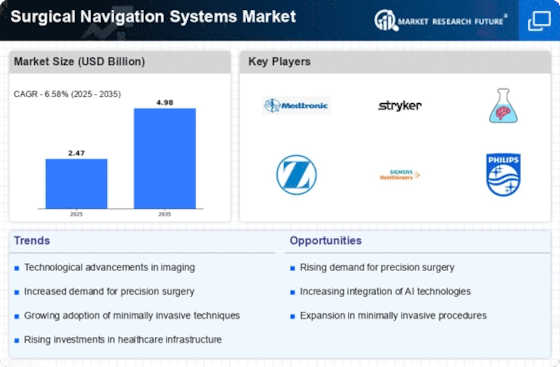
As per Market Research Future analysis, the Surgical Navigation Systems Market was estimated at 2.473 USD Billion in 2024. The Surgical Navigation Systems industry is projected to grow from 2.635 USD Billion in 2025 to 4.984 USD Billion by 2035, exhibiting a compound annual growth rate (CAGR) of 6.58% during the forecast period 2025 - 2035

Key Market Trends & Highlights

The Surgical Navigation Systems Market is poised for substantial growth driven by technological advancements and increasing demand for minimally invasive procedures.

  • North America remains the largest market for surgical navigation systems, driven by advanced healthcare infrastructure and technology adoption. The Asia-Pacific region is emerging as the fastest-growing market, fueled by rising healthcare investments and a growing patient population. Optical navigation systems dominate the market, while robotic-assisted navigation systems are experiencing rapid growth due to their innovative capabilities. Key market drivers include the rising demand for minimally invasive surgeries and a heightened focus on patient safety and outcomes.

Market Size & Forecast

2024 Market Size 2.473 (USD Billion)
2035 Market Size 4.984 (USD Billion)
CAGR (2025 - 2035) 6.58%
Largest Regional Market Share in 2024 North America

Major Players

<a href="https://www.medtronic.com/en-us/healthcare-professionals/products.html">Medtronic </a>(US), Stryker (US), Brainlab (DE), Zimmer Biomet (US), Siemens Healthineers (DE), Philips (NL), GE Healthcare (US), Olympus (JP), Intuitive Surgical (US)

Market Trends

The Surgical Navigation Systems Market is currently experiencing a transformative phase, driven by advancements in technology and an increasing emphasis on precision in surgical procedures enabled by surgical navigation systems. Surgeons and healthcare facilities are increasingly adopting surgical navigation to enhance accuracy during operations, thereby improving patient outcomes. The integration of augmented reality and artificial intelligence into surgical navigation systems appears to be a pivotal factor, as these innovations facilitate real-time data visualization and decision-making. Furthermore, the growing demand for minimally invasive surgeries is likely to propel the market forward, as a reliable surgery navigation system is essential for guiding instruments with minimal disruption to surrounding tissues. In addition, the rising prevalence of chronic diseases necessitates more complex surgical interventions, which in turn fuels the need for sophisticated surgical navigation system solutions. The Surgical Navigation Systems Market seems poised for growth, as healthcare providers seek to optimize surgical workflows and reduce complications through enhanced surgical navigation accuracy. Moreover, the increasing focus on patient safety and regulatory compliance may further drive the adoption of these advanced technologies. As the market evolves, collaboration between technology developers and healthcare professionals will likely play a crucial role in shaping future innovations and applications in surgical navigation.

Technological Advancements

The Surgical Navigation Systems Market is witnessing rapid technological advancements, particularly with the integration of augmented reality and artificial intelligence into surgical navigation systems. These innovations enhance the precision and efficiency of surgical procedures.

Minimally Invasive Surgery Demand

There is a growing trend towards minimally invasive surgical techniques, which require advanced surgical navigation for optimal performance, further strengthening demand for a high-precision surgery navigation system. This shift is driven by the desire for reduced recovery times and lower complication rates, making surgical navigation systems increasingly essential.

Focus on Patient Safety

An increasing emphasis on patient safety and regulatory compliance is influencing the Surgical Navigation Systems Market. Healthcare providers are prioritizing technologies that enhance surgical accuracy and reduce risks, thereby driving the adoption of advanced navigation solutions.

Surgical Navigation Systems Market Market Drivers

Focus on Patient Safety and Outcomes

In the Surgical Navigation Systems Market, there is an increasing emphasis on patient safety and improved surgical outcomes. As healthcare providers prioritize quality care, the adoption of navigation systems that enhance precision and reduce the likelihood of errors is becoming more prevalent. Studies have shown that the use of surgical navigation systems can lead to a significant decrease in intraoperative complications, thereby improving overall patient outcomes. The market is projected to see a rise in demand for systems that incorporate safety features, such as real-time monitoring and alerts for surgical teams. This focus on patient safety is likely to drive investments in advanced navigation technologies, as hospitals and surgical centers seek to enhance their reputations and meet regulatory standards. Thus, the Surgical Navigation Systems Market is expected to grow in response to these evolving priorities.

Rising Demand for Minimally Invasive Surgeries

The Surgical Navigation Systems Market is witnessing a notable increase in the demand for minimally invasive surgeries. This trend is largely attributed to the benefits associated with such procedures, including reduced recovery times, lower risk of complications, and minimal scarring. As healthcare providers strive to meet patient expectations for less invasive options, the integration of surgical navigation systems becomes essential. Data indicates that minimally invasive surgeries are expected to account for over 60% of all surgical procedures by 2026. This shift is prompting manufacturers to develop navigation systems specifically designed for these types of surgeries, thereby enhancing their functionality and effectiveness. Consequently, the Surgical Navigation Systems Market is likely to expand as more healthcare facilities adopt these advanced technologies to facilitate minimally invasive surgical techniques.

Aging Population and Rising Surgical Procedures

The Surgical Navigation Systems Market is significantly influenced by the aging population and the corresponding rise in surgical procedures. As the global population ages, there is an increasing prevalence of chronic diseases that often require surgical intervention. Data suggests that the number of surgical procedures is expected to rise by 20% over the next decade, driven by the need for orthopedic, neurosurgical, and cardiovascular surgeries. This demographic shift is prompting healthcare providers to adopt advanced surgical navigation systems that can improve surgical accuracy and patient outcomes. Additionally, the aging population is likely to demand more personalized and effective surgical solutions, further driving the need for innovative navigation technologies. Consequently, the Surgical Navigation Systems Market is positioned for growth as it adapts to the evolving needs of an aging patient demographic.

Increasing Investment in Healthcare Infrastructure

The Surgical Navigation Systems Market is benefiting from the increasing investment in healthcare infrastructure across various regions. Governments and private entities are allocating substantial funds to upgrade medical facilities and incorporate advanced technologies. This investment is particularly evident in emerging markets, where there is a growing recognition of the importance of modern surgical techniques. As healthcare systems evolve, the demand for sophisticated surgical navigation systems is likely to rise, as these technologies are essential for enhancing surgical capabilities. Recent reports suggest that healthcare spending is expected to increase by 5% annually, which will likely include significant allocations for surgical navigation systems. This trend indicates a robust growth trajectory for the Surgical Navigation Systems Market, as more healthcare providers seek to modernize their surgical practices.

Technological Advancements in Surgical Navigation Systems

The Surgical Navigation Systems Market is experiencing a surge in technological advancements that enhance surgical precision and efficiency. Innovations such as augmented reality and artificial intelligence are being integrated into navigation systems, allowing for real-time data visualization and improved decision-making during procedures. According to recent data, the market for surgical navigation systems is projected to grow at a compound annual growth rate of approximately 10% over the next five years. This growth is driven by the increasing adoption of advanced imaging technologies, which facilitate better surgical outcomes. Furthermore, the development of user-friendly interfaces and portable navigation systems is likely to expand the accessibility of these technologies, making them more appealing to healthcare providers. As a result, the Surgical Navigation Systems Market is poised for significant growth, driven by these technological innovations.


Market Segment Insights

By Technology: Optical Navigation Systems (Largest) vs. Robotic-Assisted Navigation Systems (Fastest-Growing)

In the Surgical Navigation Systems Market, Optical Navigation Systems hold the largest share due to their precision and reliability in surgical procedures. This technology has become the backbone of many surgical practices, providing surgeons with real-time imaging and spatial tracking. In contrast, Robotic-Assisted Navigation Systems, though currently smaller in market share, are quickly gaining traction as robotic technologies continue to advance, enhancing the capabilities of navigational systems in complex surgeries.

Technology: Optical Navigation Systems (Dominant) vs. Robotic-Assisted Navigation Systems (Emerging)

Optical Navigation Systems are considered the dominant technology in the surgical navigation market, characterized by their extensive use in neurosurgery and orthopedic procedures. This technology leverages advanced optics to provide high-definition imaging and enhanced accuracy, enabling surgeons to navigate complex anatomies effectively. On the other hand, Robotic-Assisted Navigation Systems represent an emerging trend, integrating robotics with navigational methodologies to improve surgical outcomes. These systems are known for their precision and ability to reduce the physical strain on surgeons, making them an attractive option for the evolving landscape of minimally invasive surgeries.

By Application: Orthopedics (Largest) vs. Neurosurgery (Fastest-Growing)

The Surgical Navigation Systems Market is witnessing a diverse distribution in its application segments. Orthopedics holds the largest share with a significant adoption rate across hospitals and clinics, primarily due to the growing prevalence of orthopedic disorders. In comparison, neurosurgery is emerging as a vital segment that is rapidly increasing its market share, fueled by advancements in neurological care and an increase in the number of neurological surgeries performed annually.

Application: Orthopedics (Dominant) vs. Neurosurgery (Emerging)

Orthopedics is the dominant application in the Surgical Navigation Systems Market, characterized by its extensive use of surgical navigation technologies in procedures such as joint replacements and fracture repairs. The adoption of these advanced systems aids in enhancing precision and reducing recovery times, making them indispensable in orthopedic surgeries. On the other hand, neurosurgery is an emerging application sector, driven by increasing investments in brain-related navigational techniques and a rise in minimally invasive surgical procedures. This segment benefits from innovative technologies that improve surgical outcomes, thus attracting more surgical centers to integrate navigation systems into their practices.

By End Use: Hospitals (Largest) vs. Ambulatory Surgical Centers (Fastest-Growing)

In the Surgical Navigation Systems Market, hospitals account for the largest share, driven by their extensive surgical procedures and investment in advanced technologies. The widespread adoption of these systems is facilitated by the need for precision in complex surgeries, which hospitals are typically equipped to offer compared to other facilities. Meanwhile, ambulatory surgical centers are emerging as a significant force, benefiting from their ability to provide outpatient services and efficient care, thus carving out a notable share of the market.

Hospitals: Dominant vs. Ambulatory Surgical Centers: Emerging

Hospitals remain the dominant end use segment in the Surgical Navigation Systems Market, characterized by a high volume of surgical procedures and a propensity to invest in cutting-edge technologies. These institutions often integrate surgical navigation systems into their operating rooms to enhance precision and improve patient outcomes. On the other hand, ambulatory surgical centers represent an emerging segment that is rapidly gaining <a href="https://www.marketresearchfuture.com/reports/spinal-traction-market-1902">traction</a>. They are designed for outpatient surgeries, capitalizing on their cost-effectiveness and patient convenience, making them increasingly appealing for less complex procedures. As technologies evolve and patient preferences shift, both segments are expected to play crucial roles in the market's trajectory.

By Component: Hardware (Largest) vs. Software (Fastest-Growing)

In the Surgical Navigation Systems Market, the component segment is primarily composed of hardware, software, and services. Among these, hardware holds the largest market share, underpinned by its essential role in the functionality and effectiveness of surgical navigation systems. Meanwhile, software is recognized as the fastest-growing segment, driven by an increasing demand for precision and enhanced navigational capabilities in surgical procedures. As technology advances, these components are becoming crucial in improving surgical outcomes and efficiency.

Software (Dominant) vs. Services (Emerging)

In the context of the Surgical Navigation Systems Market, software is the dominant player, mainly due to its integral role in coordinating and interpreting data from hardware components to enhance surgical precision. The continuous advancement of software solutions provides surgeons with real-time, insightful guidance during procedures, leading to improved outcomes. On the other hand, services represent an emerging segment, comprising training, maintenance, and support, which are becoming increasingly important as healthcare facilities aim to maximize the efficacy of their navigation systems. The evolving landscape emphasizes the necessity for comprehensive service offerings to support sophisticated hardware and software integrations in surgeries.

Get more detailed insights about Surgical Navigation Systems Market Research Report - Forecast till 2035

Regional Insights

The Surgical Navigation Systems Market is geographically segmented into several regions, with North America leading the way, holding a valuation of 0.847 USD Billion in 2024 and projected to reach 1.792 USD Billion by 2035. This dominance stems from advanced healthcare infrastructure and technological innovations in surgical procedures. Europe follows, valued at 0.643 USD Billion in 2024, showing significant growth potential as the region focuses on integrating advanced technologies into healthcare services.

Meanwhile, Asia Pacific is expected to exhibit substantial growth, increasing from 0.658 USD Billion in 2024 to 1.3 USD Billion in 2035, driven by rising healthcare investments and an increasing aging population. In South America, the market was valued at 0.166 USD Billion in 2024, where the improving healthcare facilities are propelling growth, although at a slower pace compared to other regions. The Middle East and Africa hold a modest valuation of 0.166 USD Billion in 2024, positioning this region as still emerging in the surgical navigation industry.

These regional insights highlight the varying scales of growth and investment opportunities within the Surgical Navigation Systems Market industry, influenced by healthcare advancements and regional economic conditions.

Key Players and Competitive Insights

The Surgical Navigation Systems Market has seen significant advancements and an expanding competitive landscape, driven by technological innovations and a growing demand for precision in surgical procedures. Various key players are striving to enhance their product offerings, focusing on integrating cutting-edge technologies such as augmented reality, robotics, and 3D visualization to improve surgical outcomes. The competitive dynamics are characterized by collaborations, partnerships, and aggressive marketing strategies aimed at increasing market share.The rise in surgical procedures, coupled with an increasing awareness of the benefits of minimally invasive surgeries, has opened up new opportunities and challenges, compelling companies to constantly innovate and differentiate their products in this dynamic environment.DePuy Synthes has established a solid presence within the Surgical Navigation Systems Market by delivering high-quality products and innovative solutions that enhance surgical precision and efficiency. The company is well-regarded for its robust portfolio of surgical navigation systems, which specifically cater to various orthopedic and neurosurgery applications. Known for its continuous investment in research and development, DePuy Synthes is able to offer advanced navigation technologies that improve preoperative planning and intraoperative assistance.This emphasis on innovation is complemented by a strong global footprint, enabling the company to leverage its extensive distribution network and clinical expertise to enhance customer relations and address diverse market needs effectively.Stryker has carved out a significant share of the Surgical Navigation Systems Market by offering a wide array of advanced technologies focused on improving surgical procedures. The company's key products encompass navigation solutions that are integral to orthopedic and neurosurgical interventions, emphasizing precision and workflow efficiency. Stryker's strengths lie in its innovative approaches to surgical navigation and its commitment to providing user-friendly solutions that cater to healthcare professionals. The company has a robust market presence stemming from strategic mergers and acquisitions that enhance its technological capabilities and widen its product range.By actively pursuing synergies through acquisitions and fostering innovative research, Stryker continues to solidify its position as a leader in the surgical navigation space within the global arena.

Key Companies in the Surgical Navigation Systems Market include

Industry Developments

Recent developments in the Surgical Navigation Systems Market have been notable as companies like DePuy Synthes and Stryker continue to innovate within the sector. Advancements in surgical navigation technology, particularly in image-guided surgery, are driving growth as demand for precision and minimally invasive procedures increases. In September 2023, Intuitive Surgical announced upgrades to its robotic-assisted surgical system, enhancing its navigational capabilities which underscores the shift towards automation in the surgical field. Additionally, in August 2023, Medtronic launched a new line of spinal surgical navigation solutions that received positive feedback from healthcare providers.

Mergers and acquisitions have also impacted the landscape; for instance, in July 2023, Zimmer Biomet acquired a leading software company specializing in navigation systems, suggesting a strategic move to expand its technological foothold. The market dynamics from 2021 to 2023 have witnessed significant growth, attributed to the rise in orthopedic and neurosurgical procedures, further amplified by healthcare investments globally. In November 2022, Boston Scientific partnered with GE Healthcare to enhance surgical navigation options for cardiology applications, reflecting the collaborative efforts for improved patient outcomes.

Future Outlook

Surgical Navigation Systems Market Future Outlook

The Surgical Navigation Systems Market is projected to grow at a 6.58% CAGR from 2025 to 2035, driven by technological advancements, increasing surgical procedures, and rising demand for minimally invasive surgeries.

New opportunities lie in:

  • <p>Integration of AI-driven analytics for enhanced surgical precision.</p>
  • <p> </p>
  • <p>Development of portable navigation systems for outpatient settings.</p>
  • <p>Expansion into emerging markets with tailored product offerings.</p>

By 2035, the market is expected to achieve substantial growth, solidifying its position as a critical component in surgical procedures.

Market Segmentation

Surgical Navigation Systems Market End Use Outlook

  • Hospitals
  • Ambulatory Surgical Centers
  • Research Institutions

Surgical Navigation Systems Market Component Outlook

  • Hardware
  • Software
  • Services

Surgical Navigation Systems Market Technology Outlook

  • Optical Navigation Systems
  • Electromagnetic Navigation Systems
  • Hybrid Navigation Systems
  • Robotic-Assisted Navigation Systems

Surgical Navigation Systems Market Application Outlook

  • Orthopedics
  • Neurosurgery
  • ENT Surgery
  • Spinal Surgery
  • Cardiac Surgery

Report Scope

MARKET SIZE 2024 2.473(USD Billion)
MARKET SIZE 2025 2.635(USD Billion)
MARKET SIZE 2035 4.984(USD Billion)
COMPOUND ANNUAL GROWTH RATE (CAGR) 6.58% (2025 - 2035)
REPORT COVERAGE Revenue Forecast, Competitive Landscape, Growth Factors, and Trends
BASE YEAR 2024
Market Forecast Period 2025 - 2035
Historical Data 2019 - 2024
Market Forecast Units USD Billion
Key Companies Profiled Medtronic (US), Stryker (US), Brainlab (DE), Zimmer Biomet (US), Siemens Healthineers (DE), Philips (NL), GE Healthcare (US), Olympus (JP), Intuitive Surgical (US)
Segments Covered Technology, Application, End Use, Component, Regional
Key Market Opportunities Integration of artificial intelligence enhances precision and efficiency in the Surgical Navigation Systems Market.
Key Market Dynamics Technological advancements and regulatory changes drive innovation and competition in the Surgical Navigation Systems market.
Countries Covered North America, Europe, APAC, South America, MEA

FAQs

What is the projected market valuation of the Surgical Navigation Systems Market by 2035?

<p>The Surgical Navigation Systems Market is projected to reach a valuation of 4.984 USD Billion by 2035.</p>

What was the market valuation of the Surgical Navigation Systems Market in 2024?

<p>In 2024, the market valuation of the Surgical Navigation Systems Market was 2.473 USD Billion.</p>

What is the expected CAGR for the Surgical Navigation Systems Market during the forecast period 2025 - 2035?

<p>The expected CAGR for the Surgical Navigation Systems Market during the forecast period 2025 - 2035 is 6.58%.</p>

Which technology segment is anticipated to have the highest growth in the Surgical Navigation Systems Market?

<p>The Robotic-Assisted Navigation Systems segment is anticipated to grow from 0.738 USD Billion in 2024 to 1.489 USD Billion by 2035.</p>

How does the Orthopedics application segment perform in the Surgical Navigation Systems Market?

<p>The Orthopedics application segment was valued at 0.743 USD Billion in 2024 and is projected to reach 1.487 USD Billion by 2035.</p>

What are the key players in the Surgical Navigation Systems Market?

<p>Key players in the Surgical Navigation Systems Market include Medtronic, Stryker, Brainlab, Zimmer Biomet, Siemens Healthineers, Philips, GE Healthcare, Olympus, and Intuitive Surgical.</p>

What is the expected growth for the Services component in the Surgical Navigation Systems Market?

<p>The Services component is expected to grow from 1.234 USD Billion in 2024 to 2.485 USD Billion by 2035.</p>

Which end-use segment is projected to dominate the Surgical Navigation Systems Market?

<p>The Hospitals end-use segment is projected to dominate, growing from 1.4865 USD Billion in 2024 to 2.487 USD Billion by 2035.</p>

What is the projected growth for the Electromagnetic Navigation Systems segment?

<p>The Electromagnetic Navigation Systems segment is expected to grow from 0.496 USD Billion in 2024 to 1.004 USD Billion by 2035.</p>

How does the market for Ambulatory Surgical Centers compare to other end-use segments?

<p>The Ambulatory Surgical Centers segment is projected to grow from 0.74325 USD Billion in 2024 to 1.243 USD Billion by 2035, indicating robust growth.</p>

  1. SECTION I: EXECUTIVE SUMMARY AND KEY HIGHLIGHTS
    1. | 1.1 EXECUTIVE SUMMARY
    2. | | 1.1.1 Market Overview
    3. | | 1.1.2 Key Findings
    4. | | 1.1.3 Market Segmentation
    5. | | 1.1.4 Competitive Landscape
    6. | | 1.1.5 Challenges and Opportunities
    7. | | 1.1.6 Future Outlook
  2. SECTION II: SCOPING, METHODOLOGY AND MARKET STRUCTURE
    1. | 2.1 MARKET INTRODUCTION
    2. | | 2.1.1 Definition
    3. | | 2.1.2 Scope of the study
    4. | | | 2.1.2.1 Research Objective
    5. | | | 2.1.2.2 Assumption
    6. | | | 2.1.2.3 Limitations
    7. | 2.2 RESEARCH METHODOLOGY
    8. | | 2.2.1 Overview
    9. | | 2.2.2 Data Mining
    10. | | 2.2.3 Secondary Research
    11. | | 2.2.4 Primary Research
    12. | | | 2.2.4.1 Primary Interviews and Information Gathering Process
    13. | | | 2.2.4.2 Breakdown of Primary Respondents
    14. | | 2.2.5 Forecasting Model
    15. | | 2.2.6 Market Size Estimation
    16. | | | 2.2.6.1 Bottom-Up Approach
    17. | | | 2.2.6.2 Top-Down Approach
    18. | | 2.2.7 Data Triangulation
    19. | | 2.2.8 Validation
  3. SECTION III: QUALITATIVE ANALYSIS
    1. | 3.1 MARKET DYNAMICS
    2. | | 3.1.1 Overview
    3. | | 3.1.2 Drivers
    4. | | 3.1.3 Restraints
    5. | | 3.1.4 Opportunities
    6. | 3.2 MARKET FACTOR ANALYSIS
    7. | | 3.2.1 Value chain Analysis
    8. | | 3.2.2 Porter's Five Forces Analysis
    9. | | | 3.2.2.1 Bargaining Power of Suppliers
    10. | | | 3.2.2.2 Bargaining Power of Buyers
    11. | | | 3.2.2.3 Threat of New Entrants
    12. | | | 3.2.2.4 Threat of Substitutes
    13. | | | 3.2.2.5 Intensity of Rivalry
    14. | | 3.2.3 COVID-19 Impact Analysis
    15. | | | 3.2.3.1 Market Impact Analysis
    16. | | | 3.2.3.2 Regional Impact
    17. | | | 3.2.3.3 Opportunity and Threat Analysis
  4. SECTION IV: QUANTITATIVE ANALYSIS
    1. | 4.1 Healthcare, BY Technology (USD Billion)
    2. | | 4.1.1 Optical Navigation Systems
    3. | | 4.1.2 Electromagnetic Navigation Systems
    4. | | 4.1.3 Hybrid Navigation Systems
    5. | | 4.1.4 Robotic-Assisted Navigation Systems
    6. | 4.2 Healthcare, BY Application (USD Billion)
    7. | | 4.2.1 Orthopedics
    8. | | 4.2.2 Neurosurgery
    9. | | 4.2.3 ENT Surgery
    10. | | 4.2.4 Spinal Surgery
    11. | | 4.2.5 Cardiac Surgery
    12. | 4.3 Healthcare, BY End Use (USD Billion)
    13. | | 4.3.1 Hospitals
    14. | | 4.3.2 Ambulatory Surgical Centers
    15. | | 4.3.3 Research Institutions
    16. | 4.4 Healthcare, BY Component (USD Billion)
    17. | | 4.4.1 Hardware
    18. | | 4.4.2 Software
    19. | | 4.4.3 Services
    20. | 4.5 Healthcare, BY Region (USD Billion)
    21. | | 4.5.1 North America
    22. | | | 4.5.1.1 US
    23. | | | 4.5.1.2 Canada
    24. | | 4.5.2 Europe
    25. | | | 4.5.2.1 Germany
    26. | | | 4.5.2.2 UK
    27. | | | 4.5.2.3 France
    28. | | | 4.5.2.4 Russia
    29. | | | 4.5.2.5 Italy
    30. | | | 4.5.2.6 Spain
    31. | | | 4.5.2.7 Rest of Europe
    32. | | 4.5.3 APAC
    33. | | | 4.5.3.1 China
    34. | | | 4.5.3.2 India
    35. | | | 4.5.3.3 Japan
    36. | | | 4.5.3.4 South Korea
    37. | | | 4.5.3.5 Malaysia
    38. | | | 4.5.3.6 Thailand
    39. | | | 4.5.3.7 Indonesia
    40. | | | 4.5.3.8 Rest of APAC
    41. | | 4.5.4 South America
    42. | | | 4.5.4.1 Brazil
    43. | | | 4.5.4.2 Mexico
    44. | | | 4.5.4.3 Argentina
    45. | | | 4.5.4.4 Rest of South America
    46. | | 4.5.5 MEA
    47. | | | 4.5.5.1 GCC Countries
    48. | | | 4.5.5.2 South Africa
    49. | | | 4.5.5.3 Rest of MEA
  5. SECTION V: COMPETITIVE ANALYSIS
    1. | 5.1 Competitive Landscape
    2. | | 5.1.1 Overview
    3. | | 5.1.2 Competitive Analysis
    4. | | 5.1.3 Market share Analysis
    5. | | 5.1.4 Major Growth Strategy in the Healthcare
    6. | | 5.1.5 Competitive Benchmarking
    7. | | 5.1.6 Leading Players in Terms of Number of Developments in the Healthcare
    8. | | 5.1.7 Key developments and growth strategies
    9. | | | 5.1.7.1 New Product Launch/Service Deployment
    10. | | | 5.1.7.2 Merger & Acquisitions
    11. | | | 5.1.7.3 Joint Ventures
    12. | | 5.1.8 Major Players Financial Matrix
    13. | | | 5.1.8.1 Sales and Operating Income
    14. | | | 5.1.8.2 Major Players R&D Expenditure. 2023
    15. | 5.2 Company Profiles
    16. | | 5.2.1 Medtronic (US)
    17. | | | 5.2.1.1 Financial Overview
    18. | | | 5.2.1.2 Products Offered
    19. | | | 5.2.1.3 Key Developments
    20. | | | 5.2.1.4 SWOT Analysis
    21. | | | 5.2.1.5 Key Strategies
    22. | | 5.2.2 Stryker (US)
    23. | | | 5.2.2.1 Financial Overview
    24. | | | 5.2.2.2 Products Offered
    25. | | | 5.2.2.3 Key Developments
    26. | | | 5.2.2.4 SWOT Analysis
    27. | | | 5.2.2.5 Key Strategies
    28. | | 5.2.3 Brainlab (DE)
    29. | | | 5.2.3.1 Financial Overview
    30. | | | 5.2.3.2 Products Offered
    31. | | | 5.2.3.3 Key Developments
    32. | | | 5.2.3.4 SWOT Analysis
    33. | | | 5.2.3.5 Key Strategies
    34. | | 5.2.4 Zimmer Biomet (US)
    35. | | | 5.2.4.1 Financial Overview
    36. | | | 5.2.4.2 Products Offered
    37. | | | 5.2.4.3 Key Developments
    38. | | | 5.2.4.4 SWOT Analysis
    39. | | | 5.2.4.5 Key Strategies
    40. | | 5.2.5 Siemens Healthineers (DE)
    41. | | | 5.2.5.1 Financial Overview
    42. | | | 5.2.5.2 Products Offered
    43. | | | 5.2.5.3 Key Developments
    44. | | | 5.2.5.4 SWOT Analysis
    45. | | | 5.2.5.5 Key Strategies
    46. | | 5.2.6 Philips (NL)
    47. | | | 5.2.6.1 Financial Overview
    48. | | | 5.2.6.2 Products Offered
    49. | | | 5.2.6.3 Key Developments
    50. | | | 5.2.6.4 SWOT Analysis
    51. | | | 5.2.6.5 Key Strategies
    52. | | 5.2.7 GE Healthcare (US)
    53. | | | 5.2.7.1 Financial Overview
    54. | | | 5.2.7.2 Products Offered
    55. | | | 5.2.7.3 Key Developments
    56. | | | 5.2.7.4 SWOT Analysis
    57. | | | 5.2.7.5 Key Strategies
    58. | | 5.2.8 Olympus (JP)
    59. | | | 5.2.8.1 Financial Overview
    60. | | | 5.2.8.2 Products Offered
    61. | | | 5.2.8.3 Key Developments
    62. | | | 5.2.8.4 SWOT Analysis
    63. | | | 5.2.8.5 Key Strategies
    64. | | 5.2.9 Intuitive Surgical (US)
    65. | | | 5.2.9.1 Financial Overview
    66. | | | 5.2.9.2 Products Offered
    67. | | | 5.2.9.3 Key Developments
    68. | | | 5.2.9.4 SWOT Analysis
    69. | | | 5.2.9.5 Key Strategies
    70. | 5.3 Appendix
    71. | | 5.3.1 References
    72. | | 5.3.2 Related Reports
  6. LIST OF FIGURES
    1. | 6.1 MARKET SYNOPSIS
    2. | 6.2 NORTH AMERICA MARKET ANALYSIS
    3. | 6.3 US MARKET ANALYSIS BY TECHNOLOGY
    4. | 6.4 US MARKET ANALYSIS BY APPLICATION
    5. | 6.5 US MARKET ANALYSIS BY END USE
    6. | 6.6 US MARKET ANALYSIS BY COMPONENT
    7. | 6.7 CANADA MARKET ANALYSIS BY TECHNOLOGY
    8. | 6.8 CANADA MARKET ANALYSIS BY APPLICATION
    9. | 6.9 CANADA MARKET ANALYSIS BY END USE
    10. | 6.10 CANADA MARKET ANALYSIS BY COMPONENT
    11. | 6.11 EUROPE MARKET ANALYSIS
    12. | 6.12 GERMANY MARKET ANALYSIS BY TECHNOLOGY
    13. | 6.13 GERMANY MARKET ANALYSIS BY APPLICATION
    14. | 6.14 GERMANY MARKET ANALYSIS BY END USE
    15. | 6.15 GERMANY MARKET ANALYSIS BY COMPONENT
    16. | 6.16 UK MARKET ANALYSIS BY TECHNOLOGY
    17. | 6.17 UK MARKET ANALYSIS BY APPLICATION
    18. | 6.18 UK MARKET ANALYSIS BY END USE
    19. | 6.19 UK MARKET ANALYSIS BY COMPONENT
    20. | 6.20 FRANCE MARKET ANALYSIS BY TECHNOLOGY
    21. | 6.21 FRANCE MARKET ANALYSIS BY APPLICATION
    22. | 6.22 FRANCE MARKET ANALYSIS BY END USE
    23. | 6.23 FRANCE MARKET ANALYSIS BY COMPONENT
    24. | 6.24 RUSSIA MARKET ANALYSIS BY TECHNOLOGY
    25. | 6.25 RUSSIA MARKET ANALYSIS BY APPLICATION
    26. | 6.26 RUSSIA MARKET ANALYSIS BY END USE
    27. | 6.27 RUSSIA MARKET ANALYSIS BY COMPONENT
    28. | 6.28 ITALY MARKET ANALYSIS BY TECHNOLOGY
    29. | 6.29 ITALY MARKET ANALYSIS BY APPLICATION
    30. | 6.30 ITALY MARKET ANALYSIS BY END USE
    31. | 6.31 ITALY MARKET ANALYSIS BY COMPONENT
    32. | 6.32 SPAIN MARKET ANALYSIS BY TECHNOLOGY
    33. | 6.33 SPAIN MARKET ANALYSIS BY APPLICATION
    34. | 6.34 SPAIN MARKET ANALYSIS BY END USE
    35. | 6.35 SPAIN MARKET ANALYSIS BY COMPONENT
    36. | 6.36 REST OF EUROPE MARKET ANALYSIS BY TECHNOLOGY
    37. | 6.37 REST OF EUROPE MARKET ANALYSIS BY APPLICATION
    38. | 6.38 REST OF EUROPE MARKET ANALYSIS BY END USE
    39. | 6.39 REST OF EUROPE MARKET ANALYSIS BY COMPONENT
    40. | 6.40 APAC MARKET ANALYSIS
    41. | 6.41 CHINA MARKET ANALYSIS BY TECHNOLOGY
    42. | 6.42 CHINA MARKET ANALYSIS BY APPLICATION
    43. | 6.43 CHINA MARKET ANALYSIS BY END USE
    44. | 6.44 CHINA MARKET ANALYSIS BY COMPONENT
    45. | 6.45 INDIA MARKET ANALYSIS BY TECHNOLOGY
    46. | 6.46 INDIA MARKET ANALYSIS BY APPLICATION
    47. | 6.47 INDIA MARKET ANALYSIS BY END USE
    48. | 6.48 INDIA MARKET ANALYSIS BY COMPONENT
    49. | 6.49 JAPAN MARKET ANALYSIS BY TECHNOLOGY
    50. | 6.50 JAPAN MARKET ANALYSIS BY APPLICATION
    51. | 6.51 JAPAN MARKET ANALYSIS BY END USE
    52. | 6.52 JAPAN MARKET ANALYSIS BY COMPONENT
    53. | 6.53 SOUTH KOREA MARKET ANALYSIS BY TECHNOLOGY
    54. | 6.54 SOUTH KOREA MARKET ANALYSIS BY APPLICATION
    55. | 6.55 SOUTH KOREA MARKET ANALYSIS BY END USE
    56. | 6.56 SOUTH KOREA MARKET ANALYSIS BY COMPONENT
    57. | 6.57 MALAYSIA MARKET ANALYSIS BY TECHNOLOGY
    58. | 6.58 MALAYSIA MARKET ANALYSIS BY APPLICATION
    59. | 6.59 MALAYSIA MARKET ANALYSIS BY END USE
    60. | 6.60 MALAYSIA MARKET ANALYSIS BY COMPONENT
    61. | 6.61 THAILAND MARKET ANALYSIS BY TECHNOLOGY
    62. | 6.62 THAILAND MARKET ANALYSIS BY APPLICATION
    63. | 6.63 THAILAND MARKET ANALYSIS BY END USE
    64. | 6.64 THAILAND MARKET ANALYSIS BY COMPONENT
    65. | 6.65 INDONESIA MARKET ANALYSIS BY TECHNOLOGY
    66. | 6.66 INDONESIA MARKET ANALYSIS BY APPLICATION
    67. | 6.67 INDONESIA MARKET ANALYSIS BY END USE
    68. | 6.68 INDONESIA MARKET ANALYSIS BY COMPONENT
    69. | 6.69 REST OF APAC MARKET ANALYSIS BY TECHNOLOGY
    70. | 6.70 REST OF APAC MARKET ANALYSIS BY APPLICATION
    71. | 6.71 REST OF APAC MARKET ANALYSIS BY END USE
    72. | 6.72 REST OF APAC MARKET ANALYSIS BY COMPONENT
    73. | 6.73 SOUTH AMERICA MARKET ANALYSIS
    74. | 6.74 BRAZIL MARKET ANALYSIS BY TECHNOLOGY
    75. | 6.75 BRAZIL MARKET ANALYSIS BY APPLICATION
    76. | 6.76 BRAZIL MARKET ANALYSIS BY END USE
    77. | 6.77 BRAZIL MARKET ANALYSIS BY COMPONENT
    78. | 6.78 MEXICO MARKET ANALYSIS BY TECHNOLOGY
    79. | 6.79 MEXICO MARKET ANALYSIS BY APPLICATION
    80. | 6.80 MEXICO MARKET ANALYSIS BY END USE
    81. | 6.81 MEXICO MARKET ANALYSIS BY COMPONENT
    82. | 6.82 ARGENTINA MARKET ANALYSIS BY TECHNOLOGY
    83. | 6.83 ARGENTINA MARKET ANALYSIS BY APPLICATION
    84. | 6.84 ARGENTINA MARKET ANALYSIS BY END USE
    85. | 6.85 ARGENTINA MARKET ANALYSIS BY COMPONENT
    86. | 6.86 REST OF SOUTH AMERICA MARKET ANALYSIS BY TECHNOLOGY
    87. | 6.87 REST OF SOUTH AMERICA MARKET ANALYSIS BY APPLICATION
    88. | 6.88 REST OF SOUTH AMERICA MARKET ANALYSIS BY END USE
    89. | 6.89 REST OF SOUTH AMERICA MARKET ANALYSIS BY COMPONENT
    90. | 6.90 MEA MARKET ANALYSIS
    91. | 6.91 GCC COUNTRIES MARKET ANALYSIS BY TECHNOLOGY
    92. | 6.92 GCC COUNTRIES MARKET ANALYSIS BY APPLICATION
    93. | 6.93 GCC COUNTRIES MARKET ANALYSIS BY END USE
    94. | 6.94 GCC COUNTRIES MARKET ANALYSIS BY COMPONENT
    95. | 6.95 SOUTH AFRICA MARKET ANALYSIS BY TECHNOLOGY
    96. | 6.96 SOUTH AFRICA MARKET ANALYSIS BY APPLICATION
    97. | 6.97 SOUTH AFRICA MARKET ANALYSIS BY END USE
    98. | 6.98 SOUTH AFRICA MARKET ANALYSIS BY COMPONENT
    99. | 6.99 REST OF MEA MARKET ANALYSIS BY TECHNOLOGY
    100. | 6.100 REST OF MEA MARKET ANALYSIS BY APPLICATION
    101. | 6.101 REST OF MEA MARKET ANALYSIS BY END USE
    102. | 6.102 REST OF MEA MARKET ANALYSIS BY COMPONENT
    103. | 6.103 KEY BUYING CRITERIA OF HEALTHCARE
    104. | 6.104 RESEARCH PROCESS OF MRFR
    105. | 6.105 DRO ANALYSIS OF HEALTHCARE
    106. | 6.106 DRIVERS IMPACT ANALYSIS: HEALTHCARE
    107. | 6.107 RESTRAINTS IMPACT ANALYSIS: HEALTHCARE
    108. | 6.108 SUPPLY / VALUE CHAIN: HEALTHCARE
    109. | 6.109 HEALTHCARE, BY TECHNOLOGY, 2024 (% SHARE)
    110. | 6.110 HEALTHCARE, BY TECHNOLOGY, 2024 TO 2035 (USD Billion)
    111. | 6.111 HEALTHCARE, BY APPLICATION, 2024 (% SHARE)
    112. | 6.112 HEALTHCARE, BY APPLICATION, 2024 TO 2035 (USD Billion)
    113. | 6.113 HEALTHCARE, BY END USE, 2024 (% SHARE)
    114. | 6.114 HEALTHCARE, BY END USE, 2024 TO 2035 (USD Billion)
    115. | 6.115 HEALTHCARE, BY COMPONENT, 2024 (% SHARE)
    116. | 6.116 HEALTHCARE, BY COMPONENT, 2024 TO 2035 (USD Billion)
    117. | 6.117 BENCHMARKING OF MAJOR COMPETITORS
  7. LIST OF TABLES
    1. | 7.1 LIST OF ASSUMPTIONS
    2. | | 7.1.1
    3. | 7.2 North America MARKET SIZE ESTIMATES; FORECAST
    4. | | 7.2.1 BY TECHNOLOGY, 2025-2035 (USD Billion)
    5. | | 7.2.2 BY APPLICATION, 2025-2035 (USD Billion)
    6. | | 7.2.3 BY END USE, 2025-2035 (USD Billion)
    7. | | 7.2.4 BY COMPONENT, 2025-2035 (USD Billion)
    8. | 7.3 US MARKET SIZE ESTIMATES; FORECAST
    9. | | 7.3.1 BY TECHNOLOGY, 2025-2035 (USD Billion)
    10. | | 7.3.2 BY APPLICATION, 2025-2035 (USD Billion)
    11. | | 7.3.3 BY END USE, 2025-2035 (USD Billion)
    12. | | 7.3.4 BY COMPONENT, 2025-2035 (USD Billion)
    13. | 7.4 Canada MARKET SIZE ESTIMATES; FORECAST
    14. | | 7.4.1 BY TECHNOLOGY, 2025-2035 (USD Billion)
    15. | | 7.4.2 BY APPLICATION, 2025-2035 (USD Billion)
    16. | | 7.4.3 BY END USE, 2025-2035 (USD Billion)
    17. | | 7.4.4 BY COMPONENT, 2025-2035 (USD Billion)
    18. | 7.5 Europe MARKET SIZE ESTIMATES; FORECAST
    19. | | 7.5.1 BY TECHNOLOGY, 2025-2035 (USD Billion)
    20. | | 7.5.2 BY APPLICATION, 2025-2035 (USD Billion)
    21. | | 7.5.3 BY END USE, 2025-2035 (USD Billion)
    22. | | 7.5.4 BY COMPONENT, 2025-2035 (USD Billion)
    23. | 7.6 Germany MARKET SIZE ESTIMATES; FORECAST
    24. | | 7.6.1 BY TECHNOLOGY, 2025-2035 (USD Billion)
    25. | | 7.6.2 BY APPLICATION, 2025-2035 (USD Billion)
    26. | | 7.6.3 BY END USE, 2025-2035 (USD Billion)
    27. | | 7.6.4 BY COMPONENT, 2025-2035 (USD Billion)
    28. | 7.7 UK MARKET SIZE ESTIMATES; FORECAST
    29. | | 7.7.1 BY TECHNOLOGY, 2025-2035 (USD Billion)
    30. | | 7.7.2 BY APPLICATION, 2025-2035 (USD Billion)
    31. | | 7.7.3 BY END USE, 2025-2035 (USD Billion)
    32. | | 7.7.4 BY COMPONENT, 2025-2035 (USD Billion)
    33. | 7.8 France MARKET SIZE ESTIMATES; FORECAST
    34. | | 7.8.1 BY TECHNOLOGY, 2025-2035 (USD Billion)
    35. | | 7.8.2 BY APPLICATION, 2025-2035 (USD Billion)
    36. | | 7.8.3 BY END USE, 2025-2035 (USD Billion)
    37. | | 7.8.4 BY COMPONENT, 2025-2035 (USD Billion)
    38. | 7.9 Russia MARKET SIZE ESTIMATES; FORECAST
    39. | | 7.9.1 BY TECHNOLOGY, 2025-2035 (USD Billion)
    40. | | 7.9.2 BY APPLICATION, 2025-2035 (USD Billion)
    41. | | 7.9.3 BY END USE, 2025-2035 (USD Billion)
    42. | | 7.9.4 BY COMPONENT, 2025-2035 (USD Billion)
    43. | 7.10 Italy MARKET SIZE ESTIMATES; FORECAST
    44. | | 7.10.1 BY TECHNOLOGY, 2025-2035 (USD Billion)
    45. | | 7.10.2 BY APPLICATION, 2025-2035 (USD Billion)
    46. | | 7.10.3 BY END USE, 2025-2035 (USD Billion)
    47. | | 7.10.4 BY COMPONENT, 2025-2035 (USD Billion)
    48. | 7.11 Spain MARKET SIZE ESTIMATES; FORECAST
    49. | | 7.11.1 BY TECHNOLOGY, 2025-2035 (USD Billion)
    50. | | 7.11.2 BY APPLICATION, 2025-2035 (USD Billion)
    51. | | 7.11.3 BY END USE, 2025-2035 (USD Billion)
    52. | | 7.11.4 BY COMPONENT, 2025-2035 (USD Billion)
    53. | 7.12 Rest of Europe MARKET SIZE ESTIMATES; FORECAST
    54. | | 7.12.1 BY TECHNOLOGY, 2025-2035 (USD Billion)
    55. | | 7.12.2 BY APPLICATION, 2025-2035 (USD Billion)
    56. | | 7.12.3 BY END USE, 2025-2035 (USD Billion)
    57. | | 7.12.4 BY COMPONENT, 2025-2035 (USD Billion)
    58. | 7.13 APAC MARKET SIZE ESTIMATES; FORECAST
    59. | | 7.13.1 BY TECHNOLOGY, 2025-2035 (USD Billion)
    60. | | 7.13.2 BY APPLICATION, 2025-2035 (USD Billion)
    61. | | 7.13.3 BY END USE, 2025-2035 (USD Billion)
    62. | | 7.13.4 BY COMPONENT, 2025-2035 (USD Billion)
    63. | 7.14 China MARKET SIZE ESTIMATES; FORECAST
    64. | | 7.14.1 BY TECHNOLOGY, 2025-2035 (USD Billion)
    65. | | 7.14.2 BY APPLICATION, 2025-2035 (USD Billion)
    66. | | 7.14.3 BY END USE, 2025-2035 (USD Billion)
    67. | | 7.14.4 BY COMPONENT, 2025-2035 (USD Billion)
    68. | 7.15 India MARKET SIZE ESTIMATES; FORECAST
    69. | | 7.15.1 BY TECHNOLOGY, 2025-2035 (USD Billion)
    70. | | 7.15.2 BY APPLICATION, 2025-2035 (USD Billion)
    71. | | 7.15.3 BY END USE, 2025-2035 (USD Billion)
    72. | | 7.15.4 BY COMPONENT, 2025-2035 (USD Billion)
    73. | 7.16 Japan MARKET SIZE ESTIMATES; FORECAST
    74. | | 7.16.1 BY TECHNOLOGY, 2025-2035 (USD Billion)
    75. | | 7.16.2 BY APPLICATION, 2025-2035 (USD Billion)
    76. | | 7.16.3 BY END USE, 2025-2035 (USD Billion)
    77. | | 7.16.4 BY COMPONENT, 2025-2035 (USD Billion)
    78. | 7.17 South Korea MARKET SIZE ESTIMATES; FORECAST
    79. | | 7.17.1 BY TECHNOLOGY, 2025-2035 (USD Billion)
    80. | | 7.17.2 BY APPLICATION, 2025-2035 (USD Billion)
    81. | | 7.17.3 BY END USE, 2025-2035 (USD Billion)
    82. | | 7.17.4 BY COMPONENT, 2025-2035 (USD Billion)
    83. | 7.18 Malaysia MARKET SIZE ESTIMATES; FORECAST
    84. | | 7.18.1 BY TECHNOLOGY, 2025-2035 (USD Billion)
    85. | | 7.18.2 BY APPLICATION, 2025-2035 (USD Billion)
    86. | | 7.18.3 BY END USE, 2025-2035 (USD Billion)
    87. | | 7.18.4 BY COMPONENT, 2025-2035 (USD Billion)
    88. | 7.19 Thailand MARKET SIZE ESTIMATES; FORECAST
    89. | | 7.19.1 BY TECHNOLOGY, 2025-2035 (USD Billion)
    90. | | 7.19.2 BY APPLICATION, 2025-2035 (USD Billion)
    91. | | 7.19.3 BY END USE, 2025-2035 (USD Billion)
    92. | | 7.19.4 BY COMPONENT, 2025-2035 (USD Billion)
    93. | 7.20 Indonesia MARKET SIZE ESTIMATES; FORECAST
    94. | | 7.20.1 BY TECHNOLOGY, 2025-2035 (USD Billion)
    95. | | 7.20.2 BY APPLICATION, 2025-2035 (USD Billion)
    96. | | 7.20.3 BY END USE, 2025-2035 (USD Billion)
    97. | | 7.20.4 BY COMPONENT, 2025-2035 (USD Billion)
    98. | 7.21 Rest of APAC MARKET SIZE ESTIMATES; FORECAST
    99. | | 7.21.1 BY TECHNOLOGY, 2025-2035 (USD Billion)
    100. | | 7.21.2 BY APPLICATION, 2025-2035 (USD Billion)
    101. | | 7.21.3 BY END USE, 2025-2035 (USD Billion)
    102. | | 7.21.4 BY COMPONENT, 2025-2035 (USD Billion)
    103. | 7.22 South America MARKET SIZE ESTIMATES; FORECAST
    104. | | 7.22.1 BY TECHNOLOGY, 2025-2035 (USD Billion)
    105. | | 7.22.2 BY APPLICATION, 2025-2035 (USD Billion)
    106. | | 7.22.3 BY END USE, 2025-2035 (USD Billion)
    107. | | 7.22.4 BY COMPONENT, 2025-2035 (USD Billion)
    108. | 7.23 Brazil MARKET SIZE ESTIMATES; FORECAST
    109. | | 7.23.1 BY TECHNOLOGY, 2025-2035 (USD Billion)
    110. | | 7.23.2 BY APPLICATION, 2025-2035 (USD Billion)
    111. | | 7.23.3 BY END USE, 2025-2035 (USD Billion)
    112. | | 7.23.4 BY COMPONENT, 2025-2035 (USD Billion)
    113. | 7.24 Mexico MARKET SIZE ESTIMATES; FORECAST
    114. | | 7.24.1 BY TECHNOLOGY, 2025-2035 (USD Billion)
    115. | | 7.24.2 BY APPLICATION, 2025-2035 (USD Billion)
    116. | | 7.24.3 BY END USE, 2025-2035 (USD Billion)
    117. | | 7.24.4 BY COMPONENT, 2025-2035 (USD Billion)
    118. | 7.25 Argentina MARKET SIZE ESTIMATES; FORECAST
    119. | | 7.25.1 BY TECHNOLOGY, 2025-2035 (USD Billion)
    120. | | 7.25.2 BY APPLICATION, 2025-2035 (USD Billion)
    121. | | 7.25.3 BY END USE, 2025-2035 (USD Billion)
    122. | | 7.25.4 BY COMPONENT, 2025-2035 (USD Billion)
    123. | 7.26 Rest of South America MARKET SIZE ESTIMATES; FORECAST
    124. | | 7.26.1 BY TECHNOLOGY, 2025-2035 (USD Billion)
    125. | | 7.26.2 BY APPLICATION, 2025-2035 (USD Billion)
    126. | | 7.26.3 BY END USE, 2025-2035 (USD Billion)
    127. | | 7.26.4 BY COMPONENT, 2025-2035 (USD Billion)
    128. | 7.27 MEA MARKET SIZE ESTIMATES; FORECAST
    129. | | 7.27.1 BY TECHNOLOGY, 2025-2035 (USD Billion)
    130. | | 7.27.2 BY APPLICATION, 2025-2035 (USD Billion)
    131. | | 7.27.3 BY END USE, 2025-2035 (USD Billion)
    132. | | 7.27.4 BY COMPONENT, 2025-2035 (USD Billion)
    133. | 7.28 GCC Countries MARKET SIZE ESTIMATES; FORECAST
    134. | | 7.28.1 BY TECHNOLOGY, 2025-2035 (USD Billion)
    135. | | 7.28.2 BY APPLICATION, 2025-2035 (USD Billion)
    136. | | 7.28.3 BY END USE, 2025-2035 (USD Billion)
    137. | | 7.28.4 BY COMPONENT, 2025-2035 (USD Billion)
    138. | 7.29 South Africa MARKET SIZE ESTIMATES; FORECAST
    139. | | 7.29.1 BY TECHNOLOGY, 2025-2035 (USD Billion)
    140. | | 7.29.2 BY APPLICATION, 2025-2035 (USD Billion)
    141. | | 7.29.3 BY END USE, 2025-2035 (USD Billion)
    142. | | 7.29.4 BY COMPONENT, 2025-2035 (USD Billion)
    143. | 7.30 Rest of MEA MARKET SIZE ESTIMATES; FORECAST
    144. | | 7.30.1 BY TECHNOLOGY, 2025-2035 (USD Billion)
    145. | | 7.30.2 BY APPLICATION, 2025-2035 (USD Billion)
    146. | | 7.30.3 BY END USE, 2025-2035 (USD Billion)
    147. | | 7.30.4 BY COMPONENT, 2025-2035 (USD Billion)
    148. | 7.31 PRODUCT LAUNCH/PRODUCT DEVELOPMENT/APPROVAL
    149. | | 7.31.1
    150. | 7.32 ACQUISITION/PARTNERSHIP
    151. | | 7.32.1

Healthcare Market Segmentation

Healthcare By Technology (USD Billion, 2025-2035)

  • Optical Navigation Systems
  • Electromagnetic Navigation Systems
  • Hybrid Navigation Systems
  • Robotic-Assisted Navigation Systems

Healthcare By Application (USD Billion, 2025-2035)

  • Orthopedics
  • Neurosurgery
  • ENT Surgery
  • Spinal Surgery
  • Cardiac Surgery

Healthcare By End Use (USD Billion, 2025-2035)

  • Hospitals
  • Ambulatory Surgical Centers
  • Research Institutions

Healthcare By Component (USD Billion, 2025-2035)

  • Hardware
  • Software
  • Services
Infographic

Free Sample Request

Kindly complete the form below to receive a free sample of this Report

Get Free Sample

Customer Strories

Compare Licence

×
Features License Type
Single User Multiuser License Enterprise User
Price $4,950 $5,950 $7,250
Maximum User Access Limit 1 User Upto 10 Users Unrestricted Access Throughout the Organization
Free Customization
Direct Access to Analyst
Deliverable Format
Platform Access
Discount on Next Purchase 10% 15% 15%
Printable Versions