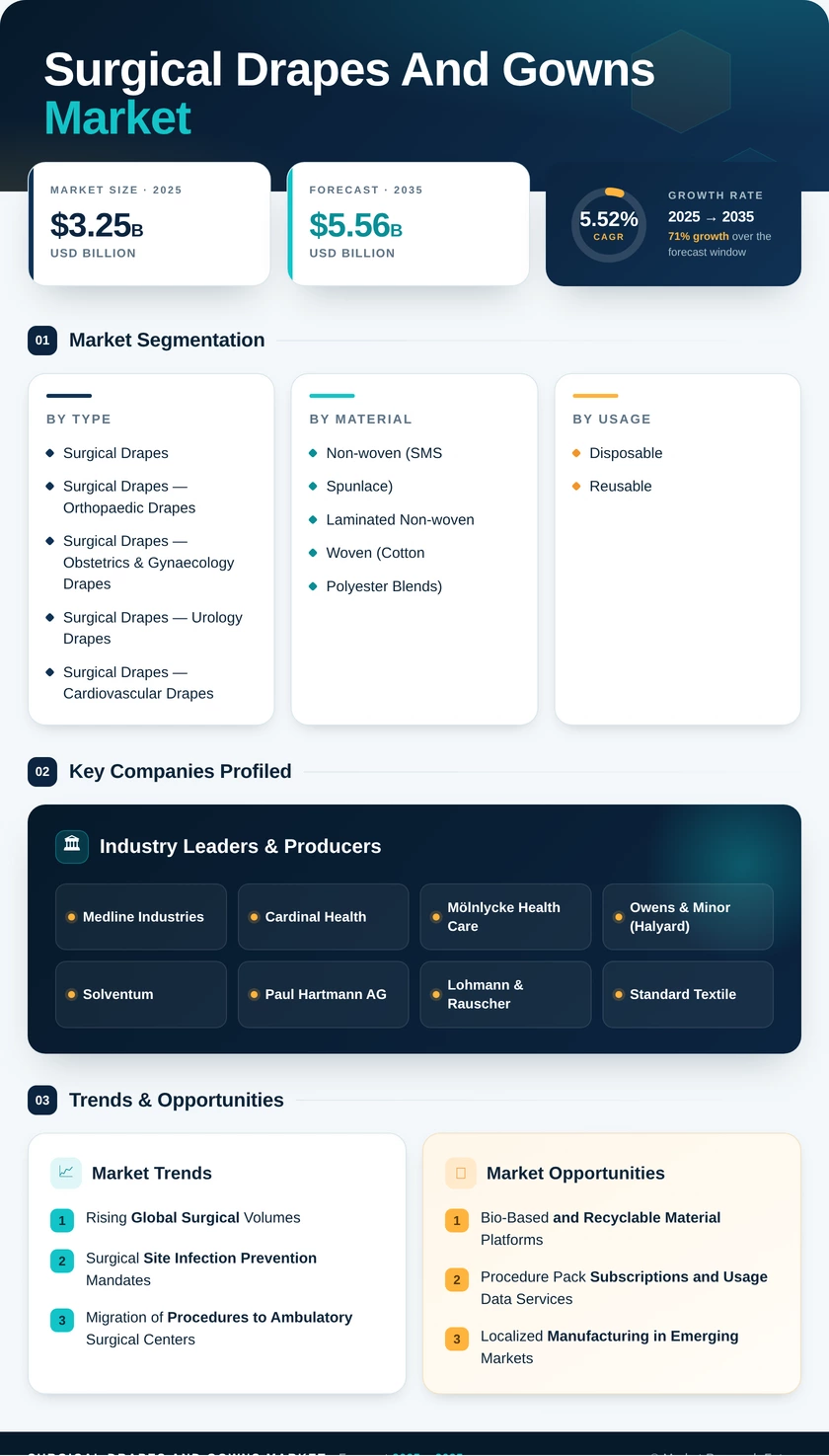
Segmentation Quick Reference
| Dimension | Sub-Segments | Dominant Segment | Fastest Growing Segment |
|---|
| By Product Type | Surgical Drapes (Orthopaedic Drapes, Obstetrics & Gynaecology Drapes, Urology Drapes, Cardiovascular Drapes, Other Specialty Drapes); Surgical Gowns (High-Performance Gowns (AAMI 3-4), Standard-Performance Gowns (AAMI 1-2)) | Surgical Drapes (50.6% share) | Surgical Gowns (6.9% CAGR) |
| By Material | Non-woven (SMS, Spunlace); Laminated Non-woven; Woven (Cotton, Polyester Blends); Bio-based & Recyclable Polymers | Non-woven (SMS, Spunlace) (76.5% share) | Bio-based & Recyclable Polymers (10.3% CAGR) |
| By Usage | Disposable; Reusable | Disposable (84.5% share) | Reusable (7.5% CAGR) |
| By Protection Level | AAMI Level 1; AAMI Level 2; AAMI Level 3; AAMI Level 4 | AAMI Level 3 (37.0% share) | AAMI Level 4 (8.7% CAGR) |
| By End-User | Hospitals; Ambulatory Surgical Centers; Specialty Clinics; Home Healthcare & Hospice | Hospitals (68.0% share) | Ambulatory Surgical Centers (7.8% CAGR) |
| By Region | North America; Europe; Asia Pacific; Middle East and Africa; South America | North America (38.5% share) | Asia Pacific (7.1% CAGR) |
Market Segmentation Overview
| Sub-Segment | Key Trend |
|---|
| Surgical Drapes | Modular, procedure-specific patterns reduce SKU counts |
| Surgical Gowns | Integrated sleeve-glove interfaces limit fluid ingress. |
Surgical Drapes lead because every procedure requires a sterile field, with Orthopaedic Drapes the largest category on joint replacement volume. Surgical Gowns grow faster at 6.9% CAGR as staff-protection protocols push High-Performance Gowns (AAMI 3-4) into routine use. Within drapes, Cardiovascular Drapes expand quickest because complex cardiac cases need custom fenestrations.
| Sub-Segment | Key Trend |
|---|
| Non-woven (SMS, Spunlace) | Lighter basis weights with maintained barrier ratings |
| Laminated Non-woven | Biodegradable back sheets under development |
| Woven (Cotton, Polyester Blends) | Microfilament polyester for reusable programs |
| Bio-based & Recyclable Polymers | Third-party carbon labeling and take-back schemes |
Non-woven (SMS, Spunlace) dominates with a 76.5% share because polypropylene composites deliver certified liquid resistance at the lowest cost per unit. Bio-based & Recyclable Polymers grow fastest at 10.3% CAGR as tender scoring rewards verified emissions reductions. Laminated Non-woven keeps its role in fluid-intensive surgery, while Woven (Cotton, Polyester Blends) survives mainly inside reusable service contracts.
| Sub-Segment | Key Trend |
|---|
| Disposable | Procedure-pack bundling for faster room turnover |
| Reusable | RFID cycle tracking and laundering-as-a-service |
Disposable products hold an 84.5% share because hospitals trust single-use sterility and lack reprocessing infrastructure. Reusable products grow at 7.5% CAGR where water-efficient laundries exist, and net zero commitments shape purchasing. Hybrid systems that pair durable base layers with single-use absorbent tops may narrow the gap over time.
| Sub-Segment | Key Trend |
|---|
| AAMI Level 1 | Gradual phase-out in surgical settings |
| AAMI Level 2 | Retained for short laparoscopic procedures |
| AAMI Level 3 | Default standard for most surgical departments |
| AAMI Level 4 | Expanding use in high-fluid orthopedic and trauma cases |
AAMI Level 3 leads with a 37.0% share by balancing fluid protection with comfort across most surgical departments. AAMI Level 4 grows fastest at 8.7% CAGR because it is the only level requiring viral penetration resistance in critical zones, making it the choice for prolonged, high-fluid cases. AAMI Level 1 and AAMI Level 2 lose ground as hospitals standardize upward.
| Sub-Segment | Key Trend |
|---|
| Hospitals | GPO contracts and centralized purchasing |
| Ambulatory Surgical Centers | All-inclusive kits and fixed-price subscriptions |
| Specialty Clinics | Compact kits for ophthalmic and cosmetic surgery |
| Home Healthcare & Hospice | Small-format sterile drapes for minor procedures |
Hospitals hold a 68.0% share because they perform the most complex procedures and buy through large GPO contracts. Ambulatory Surgical Centers grow fastest at 7.8% CAGR as CMS adds procedures to the ASC list and operators demand turnover-friendly kits. Specialty Clinics and Home Healthcare & Hospice provide smaller but steady demand for compact sterile products.


 Noah Malgeri
Co-Founder

 Peter Groot koerkamp
Account and Business Manager

 Younghwan Choi
Senior Retail Manager

 Mark Irwin
Management Consultant

 Akif Moroglu
Strategy & Business Development Director

 Guilherme Gomes Martins
Product Management Director

 Joseph Aguayo
Sales Operations & Pricing Manager

 La Terria Dodd
Program Support Specialist

 Rob Kooiker
Group Product Manager HVAC & Fire Protection GMA