×
Hero Background
English
Chinese
French
Japanese
Korean
German
Spanish

Surface Plasmon Resonance Market Analysis

ID: MRFR/CnM/17662-HCR
111 Pages
Anshula Mandaokar
October 2025

Surface Plasmon Resonance Market Research Report Information By Product Type (Imaging System, Sensor System, and Reagents), By Application Type (Drug Discovery, Material Science, and Biosensors), By End User (Academic & Research Institutes, Food & Beverage Industry, Biopharmaceutical Companies, CROs, and Others), And By Region (North America, Europe, Asia-Pacific, And Rest Of The World) –Market Forecast Till 2035

Share:
Download PDF ×

We do not share your information with anyone. However, we may send you emails based on your report interest from time to time. You may contact us at any time to opt-out.

Surface Plasmon Resonance Market Infographic
Purchase Options

Market Analysis

In-depth Analysis of Surface Plasmon Resonance Market Industry Landscape

The surface plasmon resonance (SPR) market dynamics are influenced by various factors that shape its demand, supply, and overall growth trajectory. SPR technology is widely used in the fields of life sciences, pharmaceuticals, biotechnology, and materials science for studying biomolecular interactions, drug discovery, and development, as well as for sensor applications. Market dynamics in this industry are driven by changes in research and development activities, technological advancements, regulatory policies, and competitive pressures.

One of the primary drivers of market dynamics in the surface plasmon resonance industry is the increasing demand for advanced analytical techniques in life sciences and drug discovery. SPR technology offers real-time, label-free detection and analysis of biomolecular interactions, providing researchers with valuable insights into binding kinetics, affinity, and specificity of protein-protein, protein-ligand, and DNA-protein interactions. As the demand for high-throughput screening, target validation, and lead optimization grows in pharmaceutical and biotechnology industries, so does the demand for SPR systems and consumables, driving market growth.

Technological advancements play a significant role in shaping the dynamics of the surface plasmon resonance market. Innovations in instrumentation, sensor design, data analysis software, and automation have led to improvements in sensitivity, throughput, and ease of use of SPR systems. Manufacturers are investing in research and development to develop next-generation SPR platforms with enhanced performance characteristics, such as increased sensitivity, multiplexing capabilities, and compatibility with complex biological samples. Additionally, advancements in microfluidics, nanotechnology, and surface chemistry enable the development of novel SPR-based biosensors for point-of-care diagnostics, environmental monitoring, and food safety applications, expanding the market potential of SPR technology.

Furthermore, regulatory factors influence the dynamics of the surface plasmon resonance market, particularly in terms of quality standards, validation requirements, and data integrity regulations. Regulatory agencies impose strict guidelines on the use of SPR technology in pharmaceutical research and development to ensure compliance with Good Laboratory Practices (GLP) and Good Manufacturing Practices (GMP). Compliance with these regulations is essential for manufacturers and researchers to maintain regulatory approval, ensure data reliability, and protect intellectual property rights. Moreover, evolving regulations related to data privacy, patient confidentiality, and product safety may impact the adoption and use of SPR technology in clinical research and diagnostics.

Competitive pressures also shape the dynamics of the surface plasmon resonance market, with numerous players vying for market share through product differentiation, pricing strategies, and marketing initiatives. The market is characterized by the presence of both established multinational corporations and smaller specialized companies offering SPR instruments, consumables, and services. Intense competition drives innovation and drives companies to develop value-added solutions, such as integrated SPR platforms with complementary techniques, customizable assay formats, or specialized sensor coatings tailored to specific applications. Additionally, strategic partnerships, collaborations, and acquisitions enable companies to expand their market presence, access new markets, and gain a competitive edge in the rapidly evolving marketplace.

Economic factors also influence the dynamics of the surface plasmon resonance market, including research funding, capital expenditure budgets, and market competition. Economic downturns or fluctuations may impact research and development budgets in academic institutions, government agencies, and pharmaceutical companies, affecting demand for SPR instrumentation and consumables. Moreover, shifts in market dynamics, such as mergers and acquisitions, changes in regulatory policies, or emerging technologies, may create opportunities or challenges for companies operating in the surface plasmon resonance market.

Author
Anshula Mandaokar
Team Lead - Research

Anshula Mandaokar holds an academic degree in Chemical Engineering and has been contributing to the field for more than 5 years. She has expertise in Market Research and Business Consulting and serves as a Team Lead for a reputed Market Research firm under the Chemicals and Materials domain spectrum. She has worked on multiple projects, generating explicit results in a quick turnaround time. Her understanding of data interpretation justifies her role as a leader.

Leave a Comment

FAQs

What is the projected market valuation of the Surface Plasmon Resonance Market by 2035?

The Surface Plasmon Resonance Market is projected to reach a valuation of 2.577 USD Billion by 2035.

What was the market valuation of the Surface Plasmon Resonance Market in 2024?

In 2024, the Surface Plasmon Resonance Market was valued at 1.25 USD Billion.

What is the expected CAGR for the Surface Plasmon Resonance Market during the forecast period 2025 - 2035?

The expected CAGR for the Surface Plasmon Resonance Market during the forecast period 2025 - 2035 is 6.8%.

Which product type segment is projected to have the highest valuation by 2035?

The Sensor System segment is projected to reach a valuation of 1.15 USD Billion by 2035.

What application type segment is anticipated to grow significantly by 2035?

The Drug Discovery application type segment is anticipated to grow to 1.1 USD Billion by 2035.

Which end user segment is expected to dominate the Surface Plasmon Resonance Market by 2035?

Biopharmaceutical Companies are expected to dominate the market, reaching a valuation of 1.1 USD Billion by 2035.

Market Summary

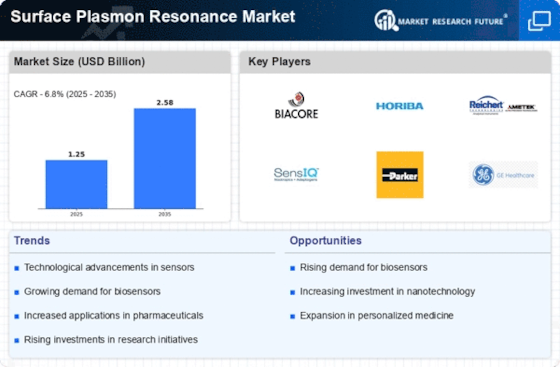
As per MRFR analysis, the Surface Plasmon Resonance Market Size was estimated at 1.25 USD Billion in 2024. The Surface Plasmon Resonance industry is projected to grow from 1.335 in 2025 to 2.577 by 2035, exhibiting a compound annual growth rate (CAGR) of 6.8 during the forecast period 2025 - 2035.

Key Market Trends & Highlights

The Surface Plasmon Resonance Market is poised for substantial growth driven by technological advancements and increasing applications across various sectors.

  • North America remains the largest market for Surface Plasmon Resonance Market, driven by robust research and development activities.
  • The Asia-Pacific region is emerging as the fastest-growing market, fueled by rising investments in healthcare and biotechnology.
  • The Imaging System segment holds the largest share, while the Sensor System segment is witnessing rapid growth due to advancements in biosensing technologies.
  • Key market drivers include the increasing applications in drug development and the rising focus on personalized medicine.

Market Size & Forecast

2024 Market Size 1.25 (USD Billion)
2035 Market Size 2.577 (USD Billion)
CAGR (2025 - 2035) 6.8%
Largest Regional Market Share in 2024 North America

Major Players

<p>Biacore (SE), Horiba (JP), Reichert Technologies (US), SensiQ Technologies (US), Parker Hannifin (US), GE Healthcare (US), Malvern Panalytical (GB), Attune (US)</p>

Market Trends

The Surface Plasmon Resonance Market is currently experiencing a notable evolution, driven by advancements in biosensing technologies and an increasing demand for real-time analysis in various sectors. This market encompasses a range of applications, including pharmaceuticals, biotechnology, and environmental monitoring, where the ability to detect molecular interactions with high sensitivity is paramount. As industries seek to enhance their research capabilities, the integration of Surface Plasmon Resonance Market systems into laboratory settings appears to be gaining traction. Furthermore, the growing emphasis on personalized medicine and the need for rapid diagnostics are likely to propel the adoption of these systems, suggesting a robust future for the market. In addition to technological advancements, the Surface Plasmon Resonance Market is influenced by the rising trend of automation in laboratories. Automated systems not only improve efficiency but also reduce human error, thereby enhancing the reliability of experimental results. This shift towards automation, coupled with the increasing focus on high-throughput screening methods, indicates a transformative phase for the market. As stakeholders continue to invest in innovative solutions, the Surface Plasmon Resonance Market is poised for substantial growth, reflecting the broader trends in scientific research and development.

Technological Advancements in Biosensing

Recent innovations in biosensing technologies are reshaping the Surface Plasmon Resonance Market. Enhanced sensitivity and specificity in detection methods are enabling researchers to conduct more precise analyses, which is crucial for applications in drug discovery and diagnostics.

Growing Demand for Real-Time Analysis

The need for immediate results in various fields, such as healthcare and environmental monitoring, is driving the Surface Plasmon Resonance Market. This trend highlights the importance of rapid detection methods that can provide timely insights into molecular interactions.

Shift Towards Automation in Laboratories

The increasing trend of laboratory automation is influencing the Surface Plasmon Resonance Market. Automated systems streamline workflows, reduce errors, and enhance reproducibility, making them attractive for research institutions and commercial laboratories.

Surface Plasmon Resonance Market Market Drivers

Rising Focus on Personalized Medicine

The Surface Plasmon Resonance Market is increasingly influenced by the rising focus on personalized medicine. As healthcare shifts towards tailored therapies, the need for precise biomolecular interaction analysis becomes paramount. SPR technology offers the capability to assess the binding characteristics of therapeutic agents with high accuracy, facilitating the development of personalized treatment plans. This trend is further supported by the growing prevalence of chronic diseases, which necessitates individualized approaches to treatment. The market for personalized medicine is projected to grow significantly, potentially reaching USD 2 trillion by 2030, thereby driving the demand for advanced SPR systems that can support this paradigm shift in healthcare.

Increasing Applications in Drug Development

The Surface Plasmon Resonance Market is witnessing a notable increase in applications within drug development processes. Pharmaceutical companies are increasingly utilizing SPR technology for high-throughput screening of drug candidates, which accelerates the discovery phase. The ability to monitor real-time interactions between drugs and their targets is invaluable, as it provides insights into binding kinetics and affinities. This trend is supported by the growing investment in biopharmaceutical research, which is expected to reach over USD 300 billion by 2026. As a result, the demand for SPR systems is likely to rise, as they play a crucial role in optimizing drug formulations and ensuring efficacy and safety in clinical trials.

Expansion of Research and Development Activities

The Surface Plasmon Resonance Market is benefiting from the expansion of research and development activities across various sectors. Academic institutions and research organizations are increasingly adopting SPR technology for fundamental research in biochemistry and molecular biology. This trend is evident in the rising number of publications and patents related to SPR applications, indicating a robust interest in the technology. Furthermore, government funding for scientific research is on the rise, with many countries allocating substantial budgets to support innovative projects. This influx of resources is likely to enhance the capabilities of SPR systems, making them more accessible to researchers and thereby stimulating market growth.

Growing Demand for Point-of-Care Testing Solutions

The Surface Plasmon Resonance Market is experiencing a growing demand for point-of-care testing solutions. As healthcare systems strive to improve patient outcomes through rapid diagnostics, SPR technology is emerging as a viable option for on-site testing. The ability to deliver quick and accurate results is particularly beneficial in emergency settings and remote locations. The market for point-of-care testing is projected to expand significantly, with estimates suggesting it could reach USD 50 billion by 2027. This trend is likely to drive innovation in SPR systems, as manufacturers seek to develop compact, user-friendly devices that can be deployed in various healthcare environments.

Technological Advancements in Surface Plasmon Resonance

The Surface Plasmon Resonance Market is experiencing a surge in technological advancements that enhance the sensitivity and specificity of biosensors. Innovations in optical design and materials science are leading to the development of more efficient SPR systems. For instance, the integration of nanomaterials is improving the detection limits of these sensors, making them suitable for a wider range of applications, including drug discovery and biomolecular interactions. The market for SPR systems is projected to grow at a compound annual growth rate of approximately 10% over the next few years, driven by these advancements. Furthermore, the introduction of portable SPR devices is likely to expand the market reach, allowing for on-site testing in various fields such as environmental monitoring and clinical diagnostics.

Market Segment Insights

By Product Type: Imaging System (Largest) vs. Sensor System (Fastest-Growing)

<p>In the Surface Plasmon Resonance Market, the distribution of market share among product types reveals a clear dominance by Imaging Systems, which cater to varied applications in biological and biomedical research. This segment stands out due to its capability to provide high-resolution images and gather real-time data, making it a preferred choice for researchers. On the other hand, the Sensor System segment, while currently smaller, is rapidly gaining traction due to its versatility in various sensing applications and integration with novel technologies. Growth trends in the Surface Plasmon Resonance Market are being significantly influenced by advancements in sensor technology and increasing investments in research activities. The Sensor Systems are witnessing rapid innovation, driven by the demand for efficient and highly sensitive detection methods in medical diagnostics and environmental monitoring. Meanwhile, Imaging Systems continue to evolve, enhancing their functionalities to cater to a broader audience, thus ensuring a sustained competitive edge throughout the forecasted period.</p>

<p>Imaging System (Dominant) vs. Sensor System (Emerging)</p>

<p>The Imaging System segment of the Surface Plasmon Resonance Market remains the dominant player, known for its high-performance capabilities that allow for detailed visualization of biomolecular interactions. Researchers favor this segment for its robustness and reliability. Its applications span across academia and industry, particularly in pharmaceuticals and bioengineering. In contrast, the Sensor System segment is categorized as emerging, characterized by its potential to provide rapid and cost-effective solutions. This segment utilizes cutting-edge technologies to develop sensors that meet the increasing demand for real-time monitoring and analysis in various fields, including healthcare and environmental science. The growing emphasis on miniaturization and integration with digital platforms further enhances its appeal, positioning it as a future leader in the market.</p>

By Application Type: Drug Discovery (Largest) vs. Biosensors (Fastest-Growing)

<p>In the Surface Plasmon Resonance Market, Drug Discovery holds a significant share, emerging as the largest segment due to its critical role in pharmaceutical research and development. This application type benefits from the increasing demand for efficient drug development processes, enabling researchers to screen potential drug candidates more rapidly. Material Science also accounts for a considerable portion of market share, facilitating various innovations in material properties through precise analysis. Meanwhile, Biosensors are gaining traction and represent the fastest-growing segment as they play an essential role in diagnostics and environmental monitoring, driven by the rising trend towards personalized medicine and point-of-care testing.</p>

<p>Drug Discovery (Dominant) vs. Biosensors (Emerging)</p>

<p>In the Surface Plasmon Resonance Market, Drug Discovery is characterized by extensive utilization in exploring drug-target interactions and optimizing lead candidates, thus dominating the overall landscape. This segment is supported by a robust pipeline of therapeutic developments and increasing investment in research initiatives. On the other hand, Biosensors represent an emerging segment that capitalizes on advancements in technology and the growing need for real-time, sensitive detection of biological and chemical substances. Their potential applications in healthcare, including rapid disease diagnostics and monitoring, position them as a key focus area for innovation and growth, thereby attracting significant attention from both academic and industrial sectors.</p>

By End User: Biopharmaceutical Companies (Largest) vs. Academic & Research Institutes (Fastest-Growing)

<p>In the Surface Plasmon Resonance Market (SPR) market, the distribution of market share among end-user segments reveals notable variations. Biopharmaceutical companies dominate the landscape, leveraging SPR technology for pivotal drug development and assay optimization. Following them are academic and research institutes which represent a rapidly growing segment, reflecting the increasing interest in biosensing applications within research settings. Other segments, such as the food and beverage industry and contract research organizations (CROs), hold smaller shares, yet they contribute to the diverse demand for SPR solutions. The growth trends in the 'End User' segment of the SPR market underscore the rising significance of biopharmaceutical companies due to their need for innovative analytical tools in drug discovery and quality control. On the other hand, the academic and research institutes are experiencing the fastest growth, fueled by burgeoning research funding and technological advancements. The increasing demand for precise and real-time analysis in various biological applications propels the adoption of SPR, enhancing research capabilities across sectors. This dynamic interplay indicates a vibrant future driven by innovation and versatile applications of SPR technology.</p>

<p>Biopharmaceutical Companies (Dominant) vs. Academic & Research Institutes (Emerging)</p>

<p>Biopharmaceutical companies are at the forefront of the Surface Plasmon Resonance Market, utilizing this technology for critical applications in drug discovery and development. Their established infrastructure and funding capabilities enable them to integrate SPR into various phases of research, thus solidifying their market position. In contrast, academic and research institutes represent an emerging force, characterized by increasing adoption of SPR in innovative studies. Their growth is primarily driven by expanded research funding and collaboration with industrial partners. This segment is fostering new applications and methodologies that capitalize on SPR for advanced research, making them pivotal in the evolution of biosensing technologies.</p>

Get more detailed insights about Surface Plasmon Resonance Market Research Report - Global Forecast by 2035

Regional Insights

North America : Innovation and Research Hub

North America is the largest market for Surface Plasmon Resonance Market (SPR), accounting for approximately 45% of the global market share. The region's growth is driven by significant investments in biotechnology and pharmaceuticals, alongside a robust regulatory framework that encourages innovation. The increasing demand for rapid and accurate diagnostic tools further propels market expansion, with key players actively engaging in research and development initiatives. The United States stands as the dominant player in this market, with a strong presence of leading companies such as GE Healthcare and Reichert Technologies. Canada also contributes significantly, focusing on academic research and development. The competitive landscape is characterized by continuous technological advancements and collaborations among key players, ensuring a dynamic market environment.

Europe : Emerging Market Dynamics

Europe is the second-largest market for Surface Plasmon Resonance Market, holding around 30% of the global market share. The region benefits from a strong emphasis on research and development, supported by favorable regulations and funding from governmental bodies. The increasing focus on personalized medicine and diagnostics is driving demand for SPR technologies, with countries like Germany and the UK leading the charge in innovation and application. Germany is a key player in the European market, with numerous research institutions and companies like Malvern Panalytical contributing to advancements in SPR technology. The competitive landscape is marked by collaborations between academia and industry, fostering innovation. The European Medicines Agency continues to support the integration of SPR in clinical applications, enhancing the region's market potential.

Asia-Pacific : Rapid Growth and Adoption

Asia-Pacific is witnessing rapid growth in the Surface Plasmon Resonance Market, accounting for approximately 20% of the global share. The region's expansion is driven by increasing investments in healthcare infrastructure and a growing emphasis on research in biotechnology. Countries like China and Japan are at the forefront, with rising demand for advanced diagnostic tools and technologies, supported by government initiatives to enhance healthcare services. China is emerging as a significant player, with numerous startups and established companies investing in SPR technology. Japan also plays a crucial role, focusing on innovation and development in the field. The competitive landscape is characterized by a mix of local and international players, fostering a dynamic environment for growth and collaboration. The region's focus on improving healthcare outcomes is expected to further drive market expansion.

Middle East and Africa : Untapped Market Potential

The Middle East and Africa region is gradually emerging in the Surface Plasmon Resonance Market, holding about 5% of the global share. The growth is primarily driven by increasing investments in healthcare and research initiatives, particularly in countries like South Africa and the UAE. The region is witnessing a growing interest in advanced diagnostic technologies, supported by government efforts to enhance healthcare infrastructure and services. South Africa is leading the market in this region, with several research institutions focusing on biotechnology and diagnostics. The competitive landscape is still developing, with a mix of local and international players entering the market. As awareness of SPR technologies increases, the region is expected to see significant growth in the coming years, driven by both public and private sector investments.

Key Players and Competitive Insights

The Surface Plasmon Resonance Market (SPR) Market is currently characterized by a dynamic competitive landscape, driven by advancements in biosensing technologies and increasing demand for real-time analysis in various applications, including pharmaceuticals and diagnostics. Key players such as Biacore (Sweden), GE Healthcare (US), and Horiba (Japan) are strategically positioning themselves through innovation and partnerships. Biacore (Sweden) focuses on enhancing its product offerings with cutting-edge technology, while GE Healthcare (US) emphasizes expanding its global footprint through strategic collaborations. Horiba (Japan) appears to be investing heavily in R&D to maintain its competitive edge, indicating a collective shift towards innovation as a primary growth driver in the market.

The competitive structure of the SPR market is moderately fragmented, with several players vying for market share. Companies are increasingly localizing manufacturing and optimizing supply chains to enhance operational efficiency. This trend not only reduces costs but also allows for quicker response times to market demands. The collective influence of these key players shapes the market dynamics, as they engage in strategic maneuvers to capture emerging opportunities and mitigate competitive pressures.

In August 2025, GE Healthcare (US) announced a partnership with a leading biotechnology firm to develop a novel SPR-based diagnostic platform. This collaboration is expected to leverage GE's technological expertise and the partner's innovative capabilities, potentially revolutionizing the diagnostic landscape. The strategic importance of this partnership lies in its potential to accelerate product development timelines and enhance market penetration, thereby solidifying GE's position in the SPR market.

In September 2025, Biacore (Sweden) launched a new line of SPR instruments designed for high-throughput applications. This launch is significant as it addresses the growing demand for rapid and efficient analysis in drug discovery processes. By focusing on high-throughput capabilities, Biacore aims to attract a broader customer base, particularly in the pharmaceutical sector, where speed and accuracy are paramount.

In October 2025, Horiba (Japan) unveiled an advanced SPR system that integrates artificial intelligence for data analysis. This innovation is indicative of the increasing trend towards digitalization within the SPR market. By incorporating AI, Horiba not only enhances the analytical capabilities of its systems but also positions itself as a leader in the integration of technology and biosensing, which could redefine competitive standards in the industry.

As of October 2025, the SPR market is witnessing a shift towards digitalization, sustainability, and AI integration, which are becoming defining trends in competition. Strategic alliances are increasingly shaping the landscape, as companies recognize the value of collaboration in driving innovation. Looking ahead, competitive differentiation is likely to evolve from traditional price-based competition to a focus on technological advancements, innovative solutions, and reliable supply chains. This transition underscores the importance of adaptability and forward-thinking strategies in maintaining a competitive edge in the rapidly evolving SPR market.

Key Companies in the Surface Plasmon Resonance Market market include

Industry Developments

January 2023: GE Healthcare witnessed the separation from GE, culminating in the launch of GE HealthCare Technologies Inc. This successful spin-off signals a significant milestone in the company’s journey towards three independent entities, each dedicated to thriving sectors.

February 2023: Horiba Techno Service finalized the construction of its new head office building, marking a significant step in bolstering and broadening its service business globally. The expansion includes an enlarged analysis laboratory, now serving as the analytical solution plaza, doubling as a capacity.

Future Outlook

Surface Plasmon Resonance Market Future Outlook

<p>The Surface Plasmon Resonance Market is projected to grow at a 6.8% CAGR from 2024 to 2035, driven by advancements in biosensing technologies and increasing demand in pharmaceuticals.</p>

New opportunities lie in:

  • <p>Development of portable SPR devices for point-of-care diagnostics.</p>
  • <p>Integration of SPR technology with AI for enhanced data analysis.</p>
  • <p>Expansion into emerging markets with tailored SPR solutions.</p>

<p>By 2035, the Surface Plasmon Resonance Market is expected to achieve substantial growth and innovation.</p>

Market Segmentation

Surface Plasmon Resonance Market End User Outlook

  • Academic & Research Institutes
  • Food & Beverage Industry
  • Biopharmaceutical Companies
  • CROs
  • Others

Surface Plasmon Resonance Market Product Type Outlook

  • Imaging System
  • Sensor System
  • Reagents

Surface Plasmon Resonance Market Application Type Outlook

  • Drug Discovery
  • Material Science
  • Biosensors

Report Scope

MARKET SIZE 20241.25(USD Billion)
MARKET SIZE 20251.335(USD Billion)
MARKET SIZE 20352.577(USD Billion)
COMPOUND ANNUAL GROWTH RATE (CAGR)6.8% (2024 - 2035)
REPORT COVERAGERevenue Forecast, Competitive Landscape, Growth Factors, and Trends
BASE YEAR2024
Market Forecast Period2025 - 2035
Historical Data2019 - 2024
Market Forecast UnitsUSD Billion
Key Companies ProfiledMarket analysis in progress
Segments CoveredMarket segmentation analysis in progress
Key Market OpportunitiesAdvancements in biosensing applications drive growth in the Surface Plasmon Resonance Market.
Key Market DynamicsTechnological advancements in Surface Plasmon Resonance drive innovation and competition among key market players.
Countries CoveredNorth America, Europe, APAC, South America, MEA

FAQs

What is the projected market valuation of the Surface Plasmon Resonance Market by 2035?

The Surface Plasmon Resonance Market is projected to reach a valuation of 2.577 USD Billion by 2035.

What was the market valuation of the Surface Plasmon Resonance Market in 2024?

In 2024, the Surface Plasmon Resonance Market was valued at 1.25 USD Billion.

What is the expected CAGR for the Surface Plasmon Resonance Market during the forecast period 2025 - 2035?

The expected CAGR for the Surface Plasmon Resonance Market during the forecast period 2025 - 2035 is 6.8%.

Which product type segment is projected to have the highest valuation by 2035?

The Sensor System segment is projected to reach a valuation of 1.15 USD Billion by 2035.

What application type segment is anticipated to grow significantly by 2035?

The Drug Discovery application type segment is anticipated to grow to 1.1 USD Billion by 2035.

Which end user segment is expected to dominate the Surface Plasmon Resonance Market by 2035?

Biopharmaceutical Companies are expected to dominate the market, reaching a valuation of 1.1 USD Billion by 2035.

  1. SECTION I: EXECUTIVE SUMMARY AND KEY HIGHLIGHTS
    1. EXECUTIVE SUMMARY
      1. Market Overview
      2. Key Findings
      3. Market Segmentation
      4. Competitive Landscape
      5. Challenges and Opportunities
      6. Future Outlook
  2. SECTION II: SCOPING, METHODOLOGY AND MARKET STRUCTURE
    1. MARKET INTRODUCTION
      1. Definition
      2. Scope of the study
    2. RESEARCH METHODOLOGY
      1. Overview
      2. Data Mining
      3. Secondary Research
      4. Primary Research
      5. Forecasting Model
      6. Market Size Estimation
      7. Data Triangulation
      8. Validation
  3. SECTION III: QUALITATIVE ANALYSIS
    1. MARKET DYNAMICS
      1. Overview
      2. Drivers
      3. Restraints
      4. Opportunities
    2. MARKET FACTOR ANALYSIS
      1. Value chain Analysis
      2. Porter's Five Forces Analysis
      3. COVID-19 Impact Analysis
  4. SECTION IV: QUANTITATIVE ANALYSIS
    1. Chemicals and Materials, BY Product Type (USD Billion)
      1. Imaging System
      2. Sensor System
      3. Reagents
    2. Chemicals and Materials, BY Application Type (USD Billion)
      1. Drug Discovery
      2. Material Science
      3. Biosensors
    3. Chemicals and Materials, BY End User (USD Billion)
      1. Academic & Research Institutes
      2. Food & Beverage Industry
      3. Biopharmaceutical Companies
      4. CROs
      5. Others
    4. Chemicals and Materials, BY Region (USD Billion)
      1. North America
      2. Europe
      3. APAC
      4. South America
      5. MEA
  5. SECTION V: COMPETITIVE ANALYSIS
    1. Competitive Landscape
      1. Overview
      2. Competitive Analysis
      3. Market share Analysis
      4. Major Growth Strategy in the Chemicals and Materials
      5. Competitive Benchmarking
      6. Leading Players in Terms of Number of Developments in the Chemicals and Materials
      7. Key developments and growth strategies
      8. Major Players Financial Matrix
    2. Company Profiles
      1. Biacore (SE)
      2. Horiba (JP)
      3. Reichert Technologies (US)
      4. SensiQ Technologies (US)
      5. Parker Hannifin (US)
      6. GE Healthcare (US)
      7. Malvern Panalytical (GB)
      8. Attune (US)
    3. Appendix
      1. References
      2. Related Reports
  6. LIST OF FIGURES
    1. MARKET SYNOPSIS
    2. NORTH AMERICA MARKET ANALYSIS
    3. US MARKET ANALYSIS BY PRODUCT TYPE
    4. US MARKET ANALYSIS BY APPLICATION TYPE
    5. US MARKET ANALYSIS BY END USER
    6. CANADA MARKET ANALYSIS BY PRODUCT TYPE
    7. CANADA MARKET ANALYSIS BY APPLICATION TYPE
    8. CANADA MARKET ANALYSIS BY END USER
    9. EUROPE MARKET ANALYSIS
    10. GERMANY MARKET ANALYSIS BY PRODUCT TYPE
    11. GERMANY MARKET ANALYSIS BY APPLICATION TYPE
    12. GERMANY MARKET ANALYSIS BY END USER
    13. UK MARKET ANALYSIS BY PRODUCT TYPE
    14. UK MARKET ANALYSIS BY APPLICATION TYPE
    15. UK MARKET ANALYSIS BY END USER
    16. FRANCE MARKET ANALYSIS BY PRODUCT TYPE
    17. FRANCE MARKET ANALYSIS BY APPLICATION TYPE
    18. FRANCE MARKET ANALYSIS BY END USER
    19. RUSSIA MARKET ANALYSIS BY PRODUCT TYPE
    20. RUSSIA MARKET ANALYSIS BY APPLICATION TYPE
    21. RUSSIA MARKET ANALYSIS BY END USER
    22. ITALY MARKET ANALYSIS BY PRODUCT TYPE
    23. ITALY MARKET ANALYSIS BY APPLICATION TYPE
    24. ITALY MARKET ANALYSIS BY END USER
    25. SPAIN MARKET ANALYSIS BY PRODUCT TYPE
    26. SPAIN MARKET ANALYSIS BY APPLICATION TYPE
    27. SPAIN MARKET ANALYSIS BY END USER
    28. REST OF EUROPE MARKET ANALYSIS BY PRODUCT TYPE
    29. REST OF EUROPE MARKET ANALYSIS BY APPLICATION TYPE
    30. REST OF EUROPE MARKET ANALYSIS BY END USER
    31. APAC MARKET ANALYSIS
    32. CHINA MARKET ANALYSIS BY PRODUCT TYPE
    33. CHINA MARKET ANALYSIS BY APPLICATION TYPE
    34. CHINA MARKET ANALYSIS BY END USER
    35. INDIA MARKET ANALYSIS BY PRODUCT TYPE
    36. INDIA MARKET ANALYSIS BY APPLICATION TYPE
    37. INDIA MARKET ANALYSIS BY END USER
    38. JAPAN MARKET ANALYSIS BY PRODUCT TYPE
    39. JAPAN MARKET ANALYSIS BY APPLICATION TYPE
    40. JAPAN MARKET ANALYSIS BY END USER
    41. SOUTH KOREA MARKET ANALYSIS BY PRODUCT TYPE
    42. SOUTH KOREA MARKET ANALYSIS BY APPLICATION TYPE
    43. SOUTH KOREA MARKET ANALYSIS BY END USER
    44. MALAYSIA MARKET ANALYSIS BY PRODUCT TYPE
    45. MALAYSIA MARKET ANALYSIS BY APPLICATION TYPE
    46. MALAYSIA MARKET ANALYSIS BY END USER
    47. THAILAND MARKET ANALYSIS BY PRODUCT TYPE
    48. THAILAND MARKET ANALYSIS BY APPLICATION TYPE
    49. THAILAND MARKET ANALYSIS BY END USER
    50. INDONESIA MARKET ANALYSIS BY PRODUCT TYPE
    51. INDONESIA MARKET ANALYSIS BY APPLICATION TYPE
    52. INDONESIA MARKET ANALYSIS BY END USER
    53. REST OF APAC MARKET ANALYSIS BY PRODUCT TYPE
    54. REST OF APAC MARKET ANALYSIS BY APPLICATION TYPE
    55. REST OF APAC MARKET ANALYSIS BY END USER
    56. SOUTH AMERICA MARKET ANALYSIS
    57. BRAZIL MARKET ANALYSIS BY PRODUCT TYPE
    58. BRAZIL MARKET ANALYSIS BY APPLICATION TYPE
    59. BRAZIL MARKET ANALYSIS BY END USER
    60. MEXICO MARKET ANALYSIS BY PRODUCT TYPE
    61. MEXICO MARKET ANALYSIS BY APPLICATION TYPE
    62. MEXICO MARKET ANALYSIS BY END USER
    63. ARGENTINA MARKET ANALYSIS BY PRODUCT TYPE
    64. ARGENTINA MARKET ANALYSIS BY APPLICATION TYPE
    65. ARGENTINA MARKET ANALYSIS BY END USER
    66. REST OF SOUTH AMERICA MARKET ANALYSIS BY PRODUCT TYPE
    67. REST OF SOUTH AMERICA MARKET ANALYSIS BY APPLICATION TYPE
    68. REST OF SOUTH AMERICA MARKET ANALYSIS BY END USER
    69. MEA MARKET ANALYSIS
    70. GCC COUNTRIES MARKET ANALYSIS BY PRODUCT TYPE
    71. GCC COUNTRIES MARKET ANALYSIS BY APPLICATION TYPE
    72. GCC COUNTRIES MARKET ANALYSIS BY END USER
    73. SOUTH AFRICA MARKET ANALYSIS BY PRODUCT TYPE
    74. SOUTH AFRICA MARKET ANALYSIS BY APPLICATION TYPE
    75. SOUTH AFRICA MARKET ANALYSIS BY END USER
    76. REST OF MEA MARKET ANALYSIS BY PRODUCT TYPE
    77. REST OF MEA MARKET ANALYSIS BY APPLICATION TYPE
    78. REST OF MEA MARKET ANALYSIS BY END USER
    79. KEY BUYING CRITERIA OF CHEMICALS AND MATERIALS
    80. RESEARCH PROCESS OF MRFR
    81. DRO ANALYSIS OF CHEMICALS AND MATERIALS
    82. DRIVERS IMPACT ANALYSIS: CHEMICALS AND MATERIALS
    83. RESTRAINTS IMPACT ANALYSIS: CHEMICALS AND MATERIALS
    84. SUPPLY / VALUE CHAIN: CHEMICALS AND MATERIALS
    85. CHEMICALS AND MATERIALS, BY PRODUCT TYPE, 2024 (% SHARE)
    86. CHEMICALS AND MATERIALS, BY PRODUCT TYPE, 2024 TO 2035 (USD Billion)
    87. CHEMICALS AND MATERIALS, BY APPLICATION TYPE, 2024 (% SHARE)
    88. CHEMICALS AND MATERIALS, BY APPLICATION TYPE, 2024 TO 2035 (USD Billion)
    89. CHEMICALS AND MATERIALS, BY END USER, 2024 (% SHARE)
    90. CHEMICALS AND MATERIALS, BY END USER, 2024 TO 2035 (USD Billion)
    91. BENCHMARKING OF MAJOR COMPETITORS
  7. LIST OF TABLES
    1. LIST OF ASSUMPTIONS
    2. North America MARKET SIZE ESTIMATES; FORECAST
      1. BY PRODUCT TYPE, 2025-2035 (USD Billion)
      2. BY APPLICATION TYPE, 2025-2035 (USD Billion)
      3. BY END USER, 2025-2035 (USD Billion)
    3. US MARKET SIZE ESTIMATES; FORECAST
      1. BY PRODUCT TYPE, 2025-2035 (USD Billion)
      2. BY APPLICATION TYPE, 2025-2035 (USD Billion)
      3. BY END USER, 2025-2035 (USD Billion)
    4. Canada MARKET SIZE ESTIMATES; FORECAST
      1. BY PRODUCT TYPE, 2025-2035 (USD Billion)
      2. BY APPLICATION TYPE, 2025-2035 (USD Billion)
      3. BY END USER, 2025-2035 (USD Billion)
    5. Europe MARKET SIZE ESTIMATES; FORECAST
      1. BY PRODUCT TYPE, 2025-2035 (USD Billion)
      2. BY APPLICATION TYPE, 2025-2035 (USD Billion)
      3. BY END USER, 2025-2035 (USD Billion)
    6. Germany MARKET SIZE ESTIMATES; FORECAST
      1. BY PRODUCT TYPE, 2025-2035 (USD Billion)
      2. BY APPLICATION TYPE, 2025-2035 (USD Billion)
      3. BY END USER, 2025-2035 (USD Billion)
    7. UK MARKET SIZE ESTIMATES; FORECAST
      1. BY PRODUCT TYPE, 2025-2035 (USD Billion)
      2. BY APPLICATION TYPE, 2025-2035 (USD Billion)
      3. BY END USER, 2025-2035 (USD Billion)
    8. France MARKET SIZE ESTIMATES; FORECAST
      1. BY PRODUCT TYPE, 2025-2035 (USD Billion)
      2. BY APPLICATION TYPE, 2025-2035 (USD Billion)
      3. BY END USER, 2025-2035 (USD Billion)
    9. Russia MARKET SIZE ESTIMATES; FORECAST
      1. BY PRODUCT TYPE, 2025-2035 (USD Billion)
      2. BY APPLICATION TYPE, 2025-2035 (USD Billion)
      3. BY END USER, 2025-2035 (USD Billion)
    10. Italy MARKET SIZE ESTIMATES; FORECAST
      1. BY PRODUCT TYPE, 2025-2035 (USD Billion)
      2. BY APPLICATION TYPE, 2025-2035 (USD Billion)
      3. BY END USER, 2025-2035 (USD Billion)
    11. Spain MARKET SIZE ESTIMATES; FORECAST
      1. BY PRODUCT TYPE, 2025-2035 (USD Billion)
      2. BY APPLICATION TYPE, 2025-2035 (USD Billion)
      3. BY END USER, 2025-2035 (USD Billion)
    12. Rest of Europe MARKET SIZE ESTIMATES; FORECAST
      1. BY PRODUCT TYPE, 2025-2035 (USD Billion)
      2. BY APPLICATION TYPE, 2025-2035 (USD Billion)
      3. BY END USER, 2025-2035 (USD Billion)
    13. APAC MARKET SIZE ESTIMATES; FORECAST
      1. BY PRODUCT TYPE, 2025-2035 (USD Billion)
      2. BY APPLICATION TYPE, 2025-2035 (USD Billion)
      3. BY END USER, 2025-2035 (USD Billion)
    14. China MARKET SIZE ESTIMATES; FORECAST
      1. BY PRODUCT TYPE, 2025-2035 (USD Billion)
      2. BY APPLICATION TYPE, 2025-2035 (USD Billion)
      3. BY END USER, 2025-2035 (USD Billion)
    15. India MARKET SIZE ESTIMATES; FORECAST
      1. BY PRODUCT TYPE, 2025-2035 (USD Billion)
      2. BY APPLICATION TYPE, 2025-2035 (USD Billion)
      3. BY END USER, 2025-2035 (USD Billion)
    16. Japan MARKET SIZE ESTIMATES; FORECAST
      1. BY PRODUCT TYPE, 2025-2035 (USD Billion)
      2. BY APPLICATION TYPE, 2025-2035 (USD Billion)
      3. BY END USER, 2025-2035 (USD Billion)
    17. South Korea MARKET SIZE ESTIMATES; FORECAST
      1. BY PRODUCT TYPE, 2025-2035 (USD Billion)
      2. BY APPLICATION TYPE, 2025-2035 (USD Billion)
      3. BY END USER, 2025-2035 (USD Billion)
    18. Malaysia MARKET SIZE ESTIMATES; FORECAST
      1. BY PRODUCT TYPE, 2025-2035 (USD Billion)
      2. BY APPLICATION TYPE, 2025-2035 (USD Billion)
      3. BY END USER, 2025-2035 (USD Billion)
    19. Thailand MARKET SIZE ESTIMATES; FORECAST
      1. BY PRODUCT TYPE, 2025-2035 (USD Billion)
      2. BY APPLICATION TYPE, 2025-2035 (USD Billion)
      3. BY END USER, 2025-2035 (USD Billion)
    20. Indonesia MARKET SIZE ESTIMATES; FORECAST
      1. BY PRODUCT TYPE, 2025-2035 (USD Billion)
      2. BY APPLICATION TYPE, 2025-2035 (USD Billion)
      3. BY END USER, 2025-2035 (USD Billion)
    21. Rest of APAC MARKET SIZE ESTIMATES; FORECAST
      1. BY PRODUCT TYPE, 2025-2035 (USD Billion)
      2. BY APPLICATION TYPE, 2025-2035 (USD Billion)
      3. BY END USER, 2025-2035 (USD Billion)
    22. South America MARKET SIZE ESTIMATES; FORECAST
      1. BY PRODUCT TYPE, 2025-2035 (USD Billion)
      2. BY APPLICATION TYPE, 2025-2035 (USD Billion)
      3. BY END USER, 2025-2035 (USD Billion)
    23. Brazil MARKET SIZE ESTIMATES; FORECAST
      1. BY PRODUCT TYPE, 2025-2035 (USD Billion)
      2. BY APPLICATION TYPE, 2025-2035 (USD Billion)
      3. BY END USER, 2025-2035 (USD Billion)
    24. Mexico MARKET SIZE ESTIMATES; FORECAST
      1. BY PRODUCT TYPE, 2025-2035 (USD Billion)
      2. BY APPLICATION TYPE, 2025-2035 (USD Billion)
      3. BY END USER, 2025-2035 (USD Billion)
    25. Argentina MARKET SIZE ESTIMATES; FORECAST
      1. BY PRODUCT TYPE, 2025-2035 (USD Billion)
      2. BY APPLICATION TYPE, 2025-2035 (USD Billion)
      3. BY END USER, 2025-2035 (USD Billion)
    26. Rest of South America MARKET SIZE ESTIMATES; FORECAST
      1. BY PRODUCT TYPE, 2025-2035 (USD Billion)
      2. BY APPLICATION TYPE, 2025-2035 (USD Billion)
      3. BY END USER, 2025-2035 (USD Billion)
    27. MEA MARKET SIZE ESTIMATES; FORECAST
      1. BY PRODUCT TYPE, 2025-2035 (USD Billion)
      2. BY APPLICATION TYPE, 2025-2035 (USD Billion)
      3. BY END USER, 2025-2035 (USD Billion)
    28. GCC Countries MARKET SIZE ESTIMATES; FORECAST
      1. BY PRODUCT TYPE, 2025-2035 (USD Billion)
      2. BY APPLICATION TYPE, 2025-2035 (USD Billion)
      3. BY END USER, 2025-2035 (USD Billion)
    29. South Africa MARKET SIZE ESTIMATES; FORECAST
      1. BY PRODUCT TYPE, 2025-2035 (USD Billion)
      2. BY APPLICATION TYPE, 2025-2035 (USD Billion)
      3. BY END USER, 2025-2035 (USD Billion)
    30. Rest of MEA MARKET SIZE ESTIMATES; FORECAST
      1. BY PRODUCT TYPE, 2025-2035 (USD Billion)
      2. BY APPLICATION TYPE, 2025-2035 (USD Billion)
      3. BY END USER, 2025-2035 (USD Billion)
    31. PRODUCT LAUNCH/PRODUCT DEVELOPMENT/APPROVAL
    32. ACQUISITION/PARTNERSHIP

Surface Plasmon Resonance Market Segmentation

Surface Plasmon Resonance Product Type Outlook (USD Billion, 2018-2032)

  • Imaging System
  • Sensor System
  • Reagents

Surface Plasmon Resonance Application Type Outlook (USD Billion, 2018-2032)

  • Drug Discovery
  • Material Science
  • Biosensors

Surface Plasmon Resonance End User Outlook (USD Billion, 2018-2032)

  • Academic & Research Institutes
  • Food & Beverage Industry
  • Biopharmaceutical Companies
  • CROs
  • Others

Surface Plasmon Resonance Regional Outlook (USD Billion, 2018-2032)

  • North America Outlook (USD Billion, 2018-2032)

    • North America Surface Plasmon Resonance by Product Type
      • Imaging System
      • Sensor System
      • Reagents
    • North America Surface Plasmon Resonance by Application Type
      • Drug Discovery
      • Material Science
      • Biosensors
    • North America Surface Plasmon Resonance by End User
      • Academic & Research Institutes
      • Food & Beverage Industry
      • Biopharmaceutical Companies
      • CROs
      • Others
    • US Outlook (USD Billion, 2018-2032)

    • US Surface Plasmon Resonance by Product Type
      • Imaging System
      • Sensor System
      • Reagents
    • US Surface Plasmon Resonance by Application Type
      • Drug Discovery
      • Material Science
      • Biosensors
    • US Surface Plasmon Resonance by End User
      • Academic & Research Institutes
      • Food & Beverage Industry
      • Biopharmaceutical Companies
      • CROs
      • Others
    • CANADA Outlook (USD Billion, 2018-2032)

    • CANADA Surface Plasmon Resonance by Product Type
      • Imaging System
      • Sensor System
      • Reagents
    • CANADA Surface Plasmon Resonance by Application Type
      • Drug Discovery
      • Material Science
      • Biosensors
    • CANADA Surface Plasmon Resonance by End User
      • Academic & Research Institutes
      • Food & Beverage Industry
      • Biopharmaceutical Companies
      • CROs
      • Others
  • Europe Outlook (USD Billion, 2018-2032)

    • Europe Surface Plasmon Resonance by Product Type
      • Imaging System
      • Sensor System
      • Reagents
    • Europe Surface Plasmon Resonance by Application Type
      • Drug Discovery
      • Material Science
      • Biosensors
    • Europe Surface Plasmon Resonance by End User
      • Academic & Research Institutes
      • Food & Beverage Industry
      • Biopharmaceutical Companies
      • CROs
      • Others
    • Germany Outlook (USD Billion, 2018-2032)

    • Germany Surface Plasmon Resonance by Product Type
      • Imaging System
      • Sensor System
      • Reagents
    • Germany Surface Plasmon Resonance by Application Type
      • Drug Discovery
      • Material Science
      • Biosensors
    • Germany Surface Plasmon Resonance by End User
      • Academic & Research Institutes
      • Food & Beverage Industry
      • Biopharmaceutical Companies
      • CROs
      • Others
    • France Outlook (USD Billion, 2018-2032)

    • France Surface Plasmon Resonance by Product Type
      • Imaging System
      • Sensor System
      • Reagents
    • France Surface Plasmon Resonance by Application Type
      • Drug Discovery
      • Material Science
      • Biosensors
    • France Surface Plasmon Resonance by End User
      • Academic & Research Institutes
      • Food & Beverage Industry
      • Biopharmaceutical Companies
      • CROs
      • Others
    • UK Outlook (USD Billion, 2018-2032)

    • UK Surface Plasmon Resonance by Product Type
      • Imaging System
      • Sensor System
      • Reagents
    • UK Surface Plasmon Resonance by Application Type
      • Drug Discovery
      • Material Science
      • Biosensors
    • UK Surface Plasmon Resonance by End User
      • Academic & Research Institutes
      • Food & Beverage Industry
      • Biopharmaceutical Companies
      • CROs
      • Others
    • ITALY Outlook (USD Billion, 2018-2032)

    • ITALY Surface Plasmon Resonance by Product Type
      • Imaging System
      • Sensor System
      • Reagents
    • ITALY Surface Plasmon Resonance by Application Type
      • Drug Discovery
      • Material Science
      • Biosensors
    • ITALY Surface Plasmon Resonance by End User
      • Academic & Research Institutes
      • Food & Beverage Industry
      • Biopharmaceutical Companies
      • CROs
      • Others
    • SPAIN Outlook (USD Billion, 2018-2032)

    • Spain Surface Plasmon Resonance by Product Type
      • Imaging System
      • Sensor System
      • Reagents
    • Spain Surface Plasmon Resonance by Application Type
      • Drug Discovery
      • Material Science
      • Biosensors
    • Spain Surface Plasmon Resonance by End User
      • Academic & Research Institutes
      • Food & Beverage Industry
      • Biopharmaceutical Companies
      • CROs
      • Others
    • Rest Of Europe Outlook (USD Billion, 2018-2032)

    • Rest Of Europe Surface Plasmon Resonance by Product Type
      • Imaging System
      • Sensor System
      • Reagents
    • REST OF EUROPE Surface Plasmon Resonance by Application Type
      • Drug Discovery
      • Material Science
      • Biosensors
    • REST OF EUROPE Surface Plasmon Resonance by End User
      • Academic & Research Institutes
      • Food & Beverage Industry
      • Biopharmaceutical Companies
      • CROs
      • Others
  • Asia-Pacific Outlook (USD Billion, 2018-2032)

    • Asia-Pacific Surface Plasmon Resonance by Product Type
      • Imaging System
      • Sensor System
      • Reagents
    • Asia-Pacific Surface Plasmon Resonance by Application Type
      • Drug Discovery
      • Material Science
      • Biosensors
    • Asia-Pacific Surface Plasmon Resonance by End User
      • Academic & Research Institutes
      • Food & Beverage Industry
      • Biopharmaceutical Companies
      • CROs
      • Others
    • China Outlook (USD Billion, 2018-2032)

    • China Surface Plasmon Resonance by Product Type
      • Imaging System
      • Sensor System
      • Reagents
    • China Surface Plasmon Resonance by Application Type
      • Drug Discovery
      • Material Science
      • Biosensors
    • China Surface Plasmon Resonance by End User
      • Academic & Research Institutes
      • Food & Beverage Industry
      • Biopharmaceutical Companies
      • CROs
      • Others
    • Japan Outlook (USD Billion, 2018-2032)

    • Japan Surface Plasmon Resonance by Product Type
      • Imaging System
      • Sensor System
      • Reagents
    • Japan Surface Plasmon Resonance by Application Type
      • Drug Discovery
      • Material Science
      • Biosensors
    • Japan Surface Plasmon Resonance by End User
      • Academic & Research Institutes
      • Food & Beverage Industry
      • Biopharmaceutical Companies
      • CROs
      • Others
    • India Outlook (USD Billion, 2018-2032)

    • India Surface Plasmon Resonance by Product Type
      • Imaging System
      • Sensor System
      • Reagents
    • India Surface Plasmon Resonance by Application Type
      • Drug Discovery
      • Material Science
      • Biosensors
    • India Surface Plasmon Resonance by End User
      • Academic & Research Institutes
      • Food & Beverage Industry
      • Biopharmaceutical Companies
      • CROs
      • Others
    • Australia Outlook (USD Billion, 2018-2032)

    • Australia Surface Plasmon Resonance by Product Type
      • Imaging System
      • Sensor System
      • Reagents
    • Australia Surface Plasmon Resonance by Application Type
      • Drug Discovery
      • Material Science
      • Biosensors
    • Australia Surface Plasmon Resonance by End User
      • Academic & Research Institutes
      • Food & Beverage Industry
      • Biopharmaceutical Companies
      • CROs
      • Others
    • Rest of Asia-Pacific Outlook (USD Billion, 2018-2032)

    • Rest of Asia-Pacific Surface Plasmon Resonance by Product Type
      • Imaging System
      • Sensor System
      • Reagents
    • Rest of Asia-Pacific Surface Plasmon Resonance by Application Type
      • Drug Discovery
      • Material Science
      • Biosensors
    • Rest of Asia-Pacific Surface Plasmon Resonance by End User
      • Academic & Research Institutes
      • Food & Beverage Industry
      • Biopharmaceutical Companies
      • CROs
      • Others
  • Rest of the World Outlook (USD Billion, 2018-2032)

    • Rest of the World Surface Plasmon Resonance by Product Type
      • Imaging System
      • Sensor System
      • Reagents
    • Rest of the World Surface Plasmon Resonance by Application Type
      • Drug Discovery
      • Material Science
      • Biosensors
    • Rest of World Surface Plasmon Resonance by End User
      • Academic & Research Institutes
      • Food & Beverage Industry
      • Biopharmaceutical Companies
      • CROs
      • Others
    • Middle East Outlook (USD Billion, 2018-2032)

    • Middle East Surface Plasmon Resonance by Product Type
      • Imaging System
      • Sensor System
      • Reagents
    • Middle East Surface Plasmon Resonance by Application Type
      • Drug Discovery
      • Material Science
      • Biosensors
    • Middle East Surface Plasmon Resonance by End User
      • Academic & Research Institutes
      • Food & Beverage Industry
      • Biopharmaceutical Companies
      • CROs
      • Others
    • Africa Outlook (USD Billion, 2018-2032)

    • Africa Surface Plasmon Resonance by Product Type
      • Imaging System
      • Sensor System
      • Reagents
    • Africa Surface Plasmon Resonance by Application Type
      • Drug Discovery
      • Material Science
      • Biosensors
    • Africa Surface Plasmon Resonance by End User
      • Academic & Research Institutes
      • Food & Beverage Industry
      • Biopharmaceutical Companies
      • CROs
      • Others
    • Latin America Outlook (USD Billion, 2018-2032)

    • Latin America Surface Plasmon Resonance by Product Type
      • Imaging System
      • Sensor System
      • Reagents
    • Latin America Surface Plasmon Resonance by Application Type
      • Drug Discovery
      • Material Science
      • Biosensors
    • Latin America Surface Plasmon Resonance by End User
      • Academic & Research Institutes
      • Food & Beverage Industry
      • Biopharmaceutical Companies
      • CROs
      • Others
Infographic

Free Sample Request

Kindly complete the form below to receive a free sample of this Report

Get Free Sample

Customer Strories

Compare Licence

×
Features License Type
Single User Multiuser License Enterprise User
Price $4,950 $5,950 $7,250
Maximum User Access Limit 1 User Upto 10 Users Unrestricted Access Throughout the Organization
Free Customization
Direct Access to Analyst
Deliverable Format
Platform Access
Discount on Next Purchase 10% 15% 15%
Printable Versions