×
Request Free Sample ×

Kindly complete the form below to receive a free sample of this Report

* Please use a valid business email

Leading companies partner with us for data-driven Insights

clients tt-cursor
Hero Background
English
Chinese
French
Japanese
Korean
German
Spanish

Sulfur Dyes Market Share

ID: MRFR/CnM/5453-HCR
140 Pages
Anshula Mandaokar
October 2025

Sulfur Dyes Market Research Report Information by Form (Granular, Powder), Color (Black, Blue, Green), Type (Leuco Sulfur Dyes, Condensed Sulfur Dyes), Application (Textile, Leather Processing, Paper) and Region (Asia-Pacific, Europe) - Forecast to 2035

Share:
Download PDF ×

We do not share your information with anyone. However, we may send you emails based on your report interest from time to time. You may contact us at any time to opt-out.

Sulfur Dyes Market Infographic
Purchase Options

Market Share

Sulfur Dyes Market Share Analysis

In the competitive realm of the Sulfur Dyes Market, companies employ diverse market share positioning strategies to establish a robust presence and gain a competitive advantage. One significant strategy is differentiation, where companies focus on producing high-quality sulfur dyes with unique characteristics or applications. Through substantial investments in research and development, companies can formulate innovative dye solutions tailored to specific industry needs. This differentiation not only attracts customers seeking specialized colorfastness and performance but also positions companies distinctively in the market, securing a notable market share. By offering a variety of color options and improved dyeing properties, companies can carve out a niche and cater to diverse customer requirements.

Cost leadership is another essential strategy adopted by companies in the Sulfur Dyes Market. This approach involves becoming a low-cost producer by optimizing manufacturing processes, achieving economies of scale, and efficient supply chain management. Emphasizing cost efficiency allows companies to offer competitive pricing for their sulfur dyes, making them attractive to cost-conscious customers and ultimately gaining a larger market share. The successful execution of this strategy requires continuous improvement, innovative production methods, and a keen focus on operational excellence to maintain profitability while providing cost-competitive products.

Strategic alliances and partnerships play a crucial role in shaping the market share positioning of companies in the Sulfur Dyes Market. Collaborating with key stakeholders such as raw material suppliers, textile manufacturers, or dye distributors enables companies to access essential resources, technologies, and distribution channels. Through strategic partnerships, companies can expand their market reach, leverage shared expertise, and create synergies that enhance their overall competitive position. This collaborative approach fosters innovation, accelerates market penetration, and contributes to a more robust market presence.

Geographical expansion is a strategic imperative for companies aiming to increase their market share in the Sulfur Dyes Market. Identifying and entering new markets or expanding existing operations globally allows companies to tap into regions with growing demand for sulfur dyes. Adapting products to suit the unique requirements of different markets is crucial for success in geographical expansion. This strategy enables companies to diversify their customer base, reduce dependency on specific regions, and strengthen their market share on a global scale.

Moreover, a customer-centric approach is indispensable for gaining and maintaining market share in the Sulfur Dyes Market. Understanding customer preferences, providing technical support, and offering excellent customer service contribute to building strong relationships. Companies that prioritize customer satisfaction often benefit from increased loyalty, positive word-of-mouth marketing, and repeat business, ultimately solidifying their market share. By staying attuned to the evolving needs of the textile and dyeing industries, companies can tailor their sulfur dyes to meet specific customer demands.

Author
Anshula Mandaokar
Team Lead - Research

Anshula Mandaokar holds an academic degree in Chemical Engineering and has been contributing to the field for more than 5 years. She has expertise in Market Research and Business Consulting and serves as a Team Lead for a reputed Market Research firm under the Chemicals and Materials domain spectrum. She has worked on multiple projects, generating explicit results in a quick turnaround time. Her understanding of data interpretation justifies her role as a leader.

Leave a Comment

FAQs

What would hold back the sulfur dyes market growth?

Negative impact on nature and the stringent imposition of government regulations are factors that can restrain the global sulfur dyes market growth.

What factors would ensure a better growth rate for the sulfur dyes market?

Factors like easy availability, cost-effectiveness, and low-water solubility would ensure a better growth rate for the sulfur dyes market growth.

Which region has the scope to drive the global sulfur dyes market ahead?

The Asia Pacific market would make sure that the regional growth of the sulfur dyes market outperforms others.

Name the eminent players making an impact on the sulfur dyes market.

Players from the sulfur dyes market making constant impact on the market growth are Venus Dye Chem (India), Qingdao Sanhuan Colorchem CO., LTD (China), Archroma Brand & Performance Textile Specialties (Singapore), ABS Laboratories (India), Sinochem tianjin Co., LTD (China), TIANJIN SHENYUAN CHEMICAL CO., LTD (China), Atul Ltd (India), NIPPON KAYAKU Co., Ltd. (Japan), Apex Industries (India), Bhanu Dyes Pvt. Ltd. (India), Bengbu Yongyan Dyes & Chemicals Co., Ltd. (China), APCO DYE CHEM PVT. LTD. (India), and others.

What strategies to govern the global sulfur dyes market ahead?

Major market players would implement strategies like brand positioning, acquisition, merger, collaboration, innovation, product launch, rising R&D investment, and others to make sure that the sulfur dyes market gets ample growth opportunities.

Market Summary

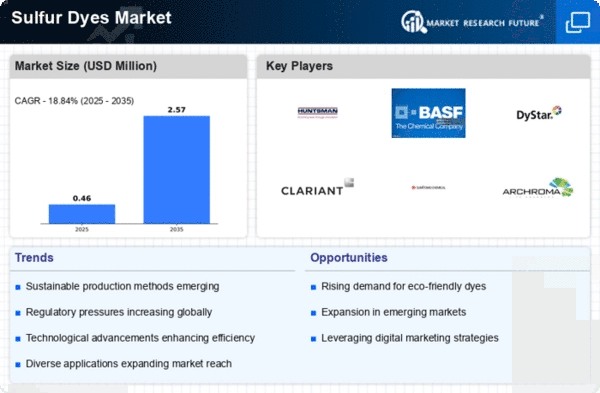
As per MRFR analysis, the Sulfur Dyes Market Size was estimated at 0.386 USD Million in 2024. The Sulfur Dyes industry is projected to grow from 0.458 in 2025 to 2.57 by 2035, exhibiting a compound annual growth rate (CAGR) of 18.84 during the forecast period 2025 - 2035.

Key Market Trends & Highlights

The Sulfur Dyes Market is currently experiencing a shift towards sustainability and technological innovation.

  • The market is witnessing a pronounced focus on sustainability, driven by consumer preferences for eco-friendly products.
  • Technological advancements are enhancing dyeing processes, leading to improved efficiency and reduced environmental impact.
  • North America remains the largest market, while Asia-Pacific is emerging as the fastest-growing region for sulfur dyes.
  • Rising demand for eco-friendly dyes and cost-effectiveness are key drivers propelling growth in the textile and leather segments.

Market Size & Forecast

2024 Market Size 0.386 (USD Million)
2035 Market Size 2.57 (USD Million)
CAGR (2025 - 2035) 18.84%
Largest Regional Market Share in 2024 Asia-Pacific

Major Players

Huntsman Corporation (US), BASF SE (DE), Dystar (DE), Clariant AG (CH), Sumitomo Chemical Co., Ltd. (JP), Archroma (CH), Kiri Industries Ltd. (IN), Rudolf GmbH (DE), Sudarshan Chemical Industries Ltd. (IN)

Market Trends

The Sulfur Dyes Market is currently experiencing a dynamic phase characterized by evolving consumer preferences and increasing demand for sustainable textile solutions. As industries strive to reduce their environmental footprint, the focus on eco-friendly dyeing processes has intensified. This shift is prompting manufacturers to innovate and develop dyes that not only meet aesthetic requirements but also adhere to stringent environmental regulations. The market appears to be influenced by a growing awareness of the ecological impacts of traditional dyeing methods, leading to a gradual transition towards more sustainable alternatives. Moreover, the Sulfur Dyes Market is witnessing a rise in applications beyond textiles, including the paper and leather industries. This diversification indicates a potential for growth as manufacturers explore new avenues for sulfur dyes. The increasing adoption of advanced technologies in dye production is likely to enhance efficiency and reduce waste, further appealing to environmentally conscious consumers. As the market evolves, it seems poised to adapt to changing regulations and consumer demands, potentially leading to a more sustainable future for dyeing practices.

Sustainability Focus

The emphasis on sustainable practices is reshaping the Sulfur Dyes Market. Manufacturers are increasingly prioritizing eco-friendly formulations and processes to align with consumer expectations for environmentally responsible products.

Technological Advancements

Innovations in dye production technology are enhancing the efficiency and effectiveness of sulfur dyes. These advancements may lead to reduced waste and improved colorfastness, appealing to a broader range of industries.

Market Diversification

The expansion of sulfur dyes into non-textile applications, such as paper and leather, suggests a growing versatility. This trend indicates potential new revenue streams and market opportunities for manufacturers.

Sulfur Dyes Market Market Drivers

Expansion of Emerging Markets

The Global Sulfur Dyes Market Industry is poised for growth due to the expansion of emerging markets, particularly in Asia-Pacific and Latin America. These regions are experiencing rapid industrialization and urbanization, leading to increased demand for textiles and related products. As local manufacturers seek cost-effective and high-quality dyeing solutions, sulfur dyes are becoming increasingly popular. The market's potential in these regions is substantial, with projections suggesting a growth trajectory that could see the market reach 4000 USD Million by 2035. This expansion is indicative of the broader economic development and rising consumer spending in these emerging markets.

Rising Demand in Textile Industry

The Global Sulfur Dyes Market Industry experiences a notable surge in demand primarily driven by the textile sector. As fashion trends evolve, the need for vibrant and durable colors in fabrics has increased. Sulfur dyes are favored for their excellent wash and light fastness, making them ideal for various textile applications. In 2024, the market is projected to reach 2500 USD Million, reflecting the textile industry's growing reliance on these dyes. This trend is expected to continue, with the market potentially expanding to 4000 USD Million by 2035, indicating a robust growth trajectory fueled by the textile industry's expansion.

Market Trends and Growth Projections

The Global Sulfur Dyes Market Industry is characterized by various trends that indicate a positive growth outlook. Current projections suggest that the market will reach 2500 USD Million in 2024, with expectations of expanding to 4000 USD Million by 2035. This growth is underpinned by a compound annual growth rate of 4.37% from 2025 to 2035. Key trends include the increasing adoption of sustainable practices, technological advancements in dyeing processes, and the rising demand from the textile industry. These factors collectively contribute to a favorable environment for sulfur dyes, suggesting a robust future for the industry.

Growing Awareness of Sustainable Practices

The Global Sulfur Dyes Market Industry is witnessing a shift towards sustainable practices, driven by increasing consumer awareness regarding environmental impacts. As consumers demand eco-friendly products, manufacturers are compelled to adopt sustainable dyeing methods, including the use of sulfur dyes. These dyes are often perceived as a more environmentally friendly option due to their lower toxicity and reduced water usage. This growing awareness is likely to propel the market forward, with projections indicating a compound annual growth rate of 4.37% from 2025 to 2035. The alignment of consumer preferences with sustainable practices is expected to reshape the industry's landscape.

Environmental Regulations Favoring Sulfur Dyes

The Global Sulfur Dyes Market Industry benefits from stringent environmental regulations that promote the use of eco-friendly dyeing processes. Sulfur dyes are often considered more sustainable compared to other dye types, as they require less water and energy during application. Governments worldwide are increasingly enforcing regulations that encourage the adoption of less harmful chemicals in textile production. This regulatory landscape is likely to drive manufacturers towards sulfur dyes, enhancing their market presence. As sustainability becomes a priority, the market may witness a compound annual growth rate of 4.37% from 2025 to 2035, reflecting a shift towards environmentally responsible practices.

Technological Advancements in Dyeing Processes

Innovations in dyeing technologies significantly impact the Global Sulfur Dyes Market Industry. Advances such as digital printing and improved application techniques enhance the efficiency and effectiveness of sulfur dyes. These technologies allow for more precise color matching and reduced waste, appealing to manufacturers seeking to optimize production processes. As these advancements proliferate, they are likely to increase the adoption of sulfur dyes across various sectors, including textiles and leather. The integration of technology in dyeing processes may contribute to the market's growth, potentially reaching 4000 USD Million by 2035 as industries embrace modern solutions.

Market Segment Insights

By Application: Textile (Largest) vs. Leather (Fastest-Growing)

In the Sulfur Dyes Market, the application segments showcase distinct shares, with textiles leading the market due to their extensive use in fabric dyeing processes. The demand for sulfur dyes in the textile industry is supported by their excellent colorfastness and cost-effectiveness, establishing textiles as a dominant application area. Meanwhile, the leather segment, while smaller, is gaining momentum as manufacturers increasingly opt for these dyes for leather goods due to their ability to achieve rich, vibrant colors that adhere well to leather surfaces.

Textile (Dominant) vs. Leather (Emerging)

The textile application is characterized by its high demand and extensive usage of sulfur dyes, making it the dominant segment in the market. Textiles benefit from the unique properties of sulfur dyes, which offer strong color retention and compatibility with various fabric types. In contrast, the leather segment is emerging as a significant player due to its growing preference among leather producers for sustainable and environmentally friendly dye options. As fashion trends evolve, leather manufacturers are increasingly utilizing sulfur dyes for their ability to provide deep, lasting colors, positioning them as an attractive choice in the luxury leather goods market.

By End Use: Apparel (Largest) vs. Home Furnishings (Fastest-Growing)

The Sulfur Dyes Market exhibits a diverse distribution among its end-use segments, with apparel being the largest contributor. Apparel accounts for a significant share of the market due to the increasing consumer demand for vibrant and colorfast textiles. Following apparel, home furnishings have gained considerable traction, fueled by a growing trend in home decor and customization among consumers. As for growth trends, industrial textiles are gaining momentum, driven by innovations in sustainable practices and eco-friendly materials. Automotive and footwear sectors are also crucial end uses, with a rise in demand for durable textile solutions. The versatility of sulfur dyes in providing shades applicable to various products is expected to promote market expansion across these segments.

Apparel (Dominant) vs. Industrial Textiles (Emerging)

In the Sulfur Dyes Market, the apparel segment stands out as a dominant force, renowned for its wide application across various styles and fabric types. This segment thrives on innovations in dyeing processes that enhance color retention and vibrancy, making it a preferred choice among manufacturers. On the other hand, industrial textiles are emerging as a noteworthy growth area, driven by increasing demand for specialized fabrics used in applications such as construction, automotive, and personal protective equipment. These textiles require dyes that not only provide color but also meet stringent performance standards, opening opportunities for sulfur dyes to penetrate this evolving market. As sustainability gains prominence, both segments are adapting to eco-friendly practices, further shaping their market dynamics.

By Type: Sulfur Black (Largest) vs. Sulfur Yellow (Fastest-Growing)

In the Sulfur Dyes Market, the segment values show a diverse distribution with Sulfur Black emerging as the leading colorant by a significant margin. Its dominance is attributed to its wide application across industries like textiles and leather, where demand continues to grow. Sulfur Yellow, on the other hand, is rapidly gaining traction and is projected to become a key player, driven by the increasing use of vibrant shades in fashion and specialty applications. The growth trends within this segment highlight a clear shift towards environmentally friendly and innovative dyeing techniques. The rising preference for high-performance dyes, such as Sulfur Yellow, is fueled by the demand for brighter and more stable colors, as well as eco-conscious production processes. Market players are focusing on sustainable production methods, enhancing the growth prospects for these dyes.

Sulfur Black (Dominant) vs. Sulfur Red (Emerging)

Sulfur Black stands out as the dominant dye in the Sulfur Dyes Market, recognized for its exceptional penetration and fixation properties, making it ideal for heavy fabrics and garments. Its versatility across multiple sectors, especially textiles, has solidified its market position. Conversely, Sulfur Red is emerging, appealing to niche markets that value its unique shades and color fastness. Its application in specialized textile segments, coupled with increasing consumer preference for red tones, is driving its growth. Additionally, innovations in production techniques are improving the performance and sustainability of Sulfur Red, thereby enhancing its attractiveness in the market.

By Form: Powder (Largest) vs. Liquid (Fastest-Growing)

The Sulfur Dyes Market has a diverse range of forms, with powder dyes holding the largest market share due to their versatility and stability. Powder dyes have been favored for industrial applications, especially in textile and leather industries, due to their ease of storage and long shelf life. Liquid dyes, on the other hand, are gaining significant traction thanks to their convenience and ease of use, particularly in smaller batches and direct dyeing processes. The growth trends for the form segment indicate a notable increase in the adoption of liquid dyes, attributed to changing consumer preferences towards more user-friendly and efficient dyeing methods. This shift is driven by the rising demand in the fashion and garment industry for rapid color change and efficiency in production processes. As sustainability takes center stage, the need for hassle-free application methods will likely propel liquid dyes further into the mainstream market.

Powder (Dominant) vs. Liquid (Emerging)

Powder dyes have established themselves as the dominant form in the Sulfur Dyes Market due to their robust performance in various applications, particularly in textiles. Their ability to provide vibrant colors and excellent wash fastness makes them a preferred choice for producers aiming for high-quality end products. In contrast, liquid dyes are an emerging segment that is rapidly gaining favor due to their ease of use and flexibility, especially in direct and continuous dyeing technologies. The market is witnessing a trend where manufacturers are investing in the development of liquid products that match the performance of traditional powders while offering benefits like faster application and waste reduction. As innovation continues, liquid dyes are likely to present a viable alternative to powder, appealing to environmentally conscious consumers and manufacturers alike.

Get more detailed insights about Sulfur Dyes Market Research Report —Forecast Till 2035

Regional Insights

North America : Stable Market with Growth Potential

The North American sulfur dyes market is projected to grow steadily, driven by increasing demand from the textile and leather industries. With a market size of $0.06 billion, the region is focusing on sustainable practices and eco-friendly dyes, aligning with regulatory trends favoring environmental protection. The growth is also supported by advancements in dyeing technologies and a shift towards natural fibers, enhancing the appeal of sulfur dyes. Leading countries in this region include the US and Canada, where major players like Huntsman Corporation and BASF SE are actively innovating. The competitive landscape is characterized by a mix of established companies and emerging players, all striving to meet the evolving demands of consumers. The presence of stringent regulations regarding chemical usage further drives innovation and compliance, ensuring a robust market environment.

Europe : Innovation and Sustainability Focus

Europe's sulfur dyes market, valued at $0.08 billion, is characterized by a strong emphasis on sustainability and innovation. The region is witnessing a shift towards eco-friendly dyeing processes, driven by stringent regulations and consumer demand for sustainable products. This focus on environmental responsibility is expected to propel market growth, as companies adapt to new standards and invest in research and development for greener alternatives. Germany, France, and the UK are leading countries in this market, with key players like BASF SE and Dystar at the forefront. The competitive landscape is marked by collaborations and partnerships aimed at enhancing product offerings and sustainability practices. The European market is also influenced by regulatory bodies advocating for reduced environmental impact, ensuring that sulfur dyes remain a viable option in the textile industry.

Asia-Pacific : Dominant Market with High Demand

Asia-Pacific holds the largest share of the sulfur dyes market, accounting for $0.22 billion. The region's growth is driven by rapid industrialization, a booming textile sector, and increasing consumer demand for vibrant colors. Countries like China and India are leading the charge, supported by favorable government policies and investments in manufacturing capabilities. The region is also witnessing a trend towards sustainable practices, with manufacturers exploring eco-friendly dye options to meet regulatory standards. China, India, and Japan are the primary markets, with key players such as Sumitomo Chemical Co., Ltd. and Kiri Industries Ltd. actively participating. The competitive landscape is robust, with numerous local and international companies vying for market share. The presence of established players and a growing number of startups contribute to a dynamic market environment, fostering innovation and competitive pricing strategies.

Middle East and Africa : Emerging Market with Growth Potential

The Middle East and Africa region, with a market size of $0.02 billion, is emerging as a potential growth area for sulfur dyes. The market is driven by increasing textile production and a growing demand for vibrant colors in various applications. However, challenges such as limited infrastructure and regulatory hurdles may impact growth. Despite these challenges, the region is witnessing a gradual shift towards adopting sustainable practices in dyeing processes, aligning with global trends. Countries like South Africa and Egypt are leading the market, with local manufacturers beginning to explore sulfur dyes as a viable option. The competitive landscape is still developing, with a mix of local and international players. As the region invests in improving its textile industry, the demand for sulfur dyes is expected to rise, presenting opportunities for growth and innovation.

Key Players and Competitive Insights

The Sulfur Dyes Market is characterized by a competitive landscape that is increasingly shaped by innovation, sustainability, and strategic partnerships. Key players such as Huntsman Corporation (US), BASF SE (DE), and Dystar (DE) are actively pursuing strategies that emphasize product development and market expansion. Huntsman Corporation (US) has focused on enhancing its product portfolio through sustainable practices, which aligns with the growing demand for eco-friendly dyes. Meanwhile, BASF SE (DE) has been investing in digital transformation initiatives to optimize its supply chain and improve operational efficiency, thereby reinforcing its market position. Dystar (DE) appears to be concentrating on regional expansion, particularly in emerging markets, which could potentially enhance its competitive edge in the global arena.The business tactics employed by these companies reflect a moderately fragmented market structure, where local manufacturing and supply chain optimization are pivotal. Companies are increasingly localizing their production to reduce lead times and costs, which is essential in a market that demands quick turnaround times. The collective influence of these key players suggests a dynamic interplay of strategies that not only drive competition but also foster innovation within the market.

In November Huntsman Corporation (US) announced the launch of a new line of eco-friendly sulfur dyes aimed at the textile industry. This strategic move is significant as it not only addresses the rising consumer demand for sustainable products but also positions Huntsman as a leader in environmentally responsible manufacturing. The introduction of these dyes could potentially enhance the company's market share and appeal to environmentally conscious consumers.

In October BASF SE (DE) revealed its plans to implement advanced AI technologies in its production processes. This initiative is expected to streamline operations and reduce waste, thereby improving overall efficiency. The integration of AI could provide BASF with a competitive advantage by enabling faster response times to market changes and enhancing product quality, which is crucial in maintaining customer satisfaction.

In September Dystar (DE) entered into a strategic partnership with a local manufacturer in India to expand its distribution network. This collaboration is likely to enhance Dystar's presence in the Asian market, allowing for better access to local customers and reduced logistical challenges. Such partnerships are indicative of a broader trend where companies seek to leverage local expertise to strengthen their market positions.

As of December the competitive trends within the Sulfur Dyes Market are increasingly defined by digitalization, sustainability, and the integration of advanced technologies. Strategic alliances are becoming more prevalent, as companies recognize the value of collaboration in navigating complex market dynamics. Looking ahead, it appears that competitive differentiation will increasingly hinge on innovation and technology rather than solely on price. Companies that prioritize sustainable practices and reliable supply chains are likely to emerge as leaders in this evolving landscape.

Key Companies in the Sulfur Dyes Market include

Industry Developments

Future Outlook

Sulfur Dyes Market Future Outlook

The Sulfur Dyes Market is projected to grow at an 18.84% CAGR from 2025 to 2035, driven by increasing demand in textiles, eco-friendly dyeing processes, and innovations in dye formulations.

New opportunities lie in:

  • Expansion into emerging markets with tailored sulfur dye solutions.
  • Development of biodegradable sulfur dyes to meet sustainability demands.
  • Investment in advanced manufacturing technologies to enhance production efficiency.

By 2035, the Sulfur Dyes Market is expected to achieve substantial growth and innovation.

Market Segmentation

Sulfur Dyes Market Form Outlook

  • Powder
  • Granule
  • Liquid
  • Paste

Sulfur Dyes Market Type Outlook

  • Sulfur Black
  • Sulfur Yellow
  • Sulfur Blue
  • Sulfur Green
  • Sulfur Red

Sulfur Dyes Market End Use Outlook

  • Apparel
  • Home Furnishings
  • Industrial Textiles
  • Automotive
  • Footwear

Sulfur Dyes Market Application Outlook

  • Textile
  • Leather
  • Paper
  • Plastic
  • Cosmetics

Report Scope

MARKET SIZE 20240.386(USD Million)
MARKET SIZE 20250.458(USD Million)
MARKET SIZE 20352.57(USD Million)
COMPOUND ANNUAL GROWTH RATE (CAGR)18.84% (2025 - 2035)
REPORT COVERAGERevenue Forecast, Competitive Landscape, Growth Factors, and Trends
BASE YEAR2024
Market Forecast Period2025 - 2035
Historical Data2019 - 2024
Market Forecast UnitsUSD Million
Key Companies ProfiledHuntsman Corporation (US), BASF SE (DE), Dystar (DE), Clariant AG (CH), Sumitomo Chemical Co., Ltd. (JP), Archroma (CH), Kiri Industries Ltd. (IN), Rudolf GmbH (DE), Sudarshan Chemical Industries Ltd. (IN)
Segments CoveredApplication, End Use, Type, Form
Key Market OpportunitiesGrowing demand for sustainable and eco-friendly textile solutions drives innovation in the Sulfur Dyes Market.
Key Market DynamicsRising demand for eco-friendly textiles drives innovation and competition in the sulfur dyes market.
Countries CoveredNorth America, Europe, APAC, South America, MEA

FAQs

What would hold back the sulfur dyes market growth?

Negative impact on nature and the stringent imposition of government regulations are factors that can restrain the global sulfur dyes market growth.

What factors would ensure a better growth rate for the sulfur dyes market?

Factors like easy availability, cost-effectiveness, and low-water solubility would ensure a better growth rate for the sulfur dyes market growth.

Which region has the scope to drive the global sulfur dyes market ahead?

The Asia Pacific market would make sure that the regional growth of the sulfur dyes market outperforms others.

Name the eminent players making an impact on the sulfur dyes market.

Players from the sulfur dyes market making constant impact on the market growth are Venus Dye Chem (India), Qingdao Sanhuan Colorchem CO., LTD (China), Archroma Brand & Performance Textile Specialties (Singapore), ABS Laboratories (India), Sinochem tianjin Co., LTD (China), TIANJIN SHENYUAN CHEMICAL CO., LTD (China), Atul Ltd (India), NIPPON KAYAKU Co., Ltd. (Japan), Apex Industries (India), Bhanu Dyes Pvt. Ltd. (India), Bengbu Yongyan Dyes & Chemicals Co., Ltd. (China), APCO DYE CHEM PVT. LTD. (India), and others.

What strategies to govern the global sulfur dyes market ahead?

Major market players would implement strategies like brand positioning, acquisition, merger, collaboration, innovation, product launch, rising R&D investment, and others to make sure that the sulfur dyes market gets ample growth opportunities.

  1. SECTION I: EXECUTIVE SUMMARY AND KEY HIGHLIGHTS
    1. | 1.1 EXECUTIVE SUMMARY
    2. | 1.1.1 Market Overview
    3. | 1.1.2 Key Findings
    4. | 1.1.3 Market Segmentation
    5. | 1.1.4 Competitive Landscape
    6. | 1.1.5 Challenges and Opportunities
    7. | 1.1.6 Future Outlook
  2. SECTION II: SCOPING, METHODOLOGY AND MARKET STRUCTURE
    1. | 2.1 MARKET INTRODUCTION
    2. | 2.1.1 Definition
    3. | 2.1.2 Scope of the study
    4. |-- 2.1.2.1 Research Objective
    5. |-- 2.1.2.2 Assumption
    6. |-- 2.1.2.3 Limitations
    7. | 2.2 RESEARCH METHODOLOGY
    8. | 2.2.1 Overview
    9. | 2.2.2 Data Mining
    10. | 2.2.3 Secondary Research
    11. | 2.2.4 Primary Research
    12. |-- 2.2.4.1 Primary Interviews and Information Gathering Process
    13. |-- 2.2.4.2 Breakdown of Primary Respondents
    14. | 2.2.5 Forecasting Model
    15. | 2.2.6 Market Size Estimation
    16. |-- 2.2.6.1 Bottom-Up Approach
    17. |-- 2.2.6.2 Top-Down Approach
    18. | 2.2.7 Data Triangulation
    19. | 2.2.8 Validation
  3. SECTION III: QUALITATIVE ANALYSIS
    1. | 3.1 MARKET DYNAMICS
    2. | 3.1.1 Overview
    3. | 3.1.2 Drivers
    4. | 3.1.3 Restraints
    5. | 3.1.4 Opportunities
    6. | 3.2 MARKET FACTOR ANALYSIS
    7. | 3.2.1 Value chain Analysis
    8. | 3.2.2 Porter's Five Forces Analysis
    9. |-- 3.2.2.1 Bargaining Power of Suppliers
    10. |-- 3.2.2.2 Bargaining Power of Buyers
    11. |-- 3.2.2.3 Threat of New Entrants
    12. |-- 3.2.2.4 Threat of Substitutes
    13. |-- 3.2.2.5 Intensity of Rivalry
    14. | 3.2.3 COVID-19 Impact Analysis
    15. |-- 3.2.3.1 Market Impact Analysis
    16. |-- 3.2.3.2 Regional Impact
    17. |-- 3.2.3.3 Opportunity and Threat Analysis
  4. SECTION IV: QUANTITATIVE ANALYSIS
    1. | 4.1 Chemicals and Materials, BY Application (USD Million)
    2. | 4.1.1 Textile
    3. | 4.1.2 Leather
    4. | 4.1.3 Paper
    5. | 4.1.4 Plastic
    6. | 4.1.5 Cosmetics
    7. | 4.2 Chemicals and Materials, BY End Use (USD Million)
    8. | 4.2.1 Apparel
    9. | 4.2.2 Home Furnishings
    10. | 4.2.3 Industrial Textiles
    11. | 4.2.4 Automotive
    12. | 4.2.5 Footwear
    13. | 4.3 Chemicals and Materials, BY Type (USD Million)
    14. | 4.3.1 Sulfur Black
    15. | 4.3.2 Sulfur Yellow
    16. | 4.3.3 Sulfur Blue
    17. | 4.3.4 Sulfur Green
    18. | 4.3.5 Sulfur Red
    19. | 4.4 Chemicals and Materials, BY Form (USD Million)
    20. | 4.4.1 Powder
    21. | 4.4.2 Granule
    22. | 4.4.3 Liquid
    23. | 4.4.4 Paste
    24. | 4.5 Chemicals and Materials, BY Region (USD Million)
    25. | 4.5.1 North America
    26. |-- 4.5.1.1 US
    27. |-- 4.5.1.2 Canada
    28. | 4.5.2 Europe
    29. |-- 4.5.2.1 Germany
    30. |-- 4.5.2.2 UK
    31. |-- 4.5.2.3 France
    32. |-- 4.5.2.4 Russia
    33. |-- 4.5.2.5 Italy
    34. |-- 4.5.2.6 Spain
    35. |-- 4.5.2.7 Rest of Europe
    36. | 4.5.3 APAC
    37. |-- 4.5.3.1 China
    38. |-- 4.5.3.2 India
    39. |-- 4.5.3.3 Japan
    40. |-- 4.5.3.4 South Korea
    41. |-- 4.5.3.5 Malaysia
    42. |-- 4.5.3.6 Thailand
    43. |-- 4.5.3.7 Indonesia
    44. |-- 4.5.3.8 Rest of APAC
    45. | 4.5.4 South America
    46. |-- 4.5.4.1 Brazil
    47. |-- 4.5.4.2 Mexico
    48. |-- 4.5.4.3 Argentina
    49. |-- 4.5.4.4 Rest of South America
    50. | 4.5.5 MEA
    51. |-- 4.5.5.1 GCC Countries
    52. |-- 4.5.5.2 South Africa
    53. |-- 4.5.5.3 Rest of MEA
  5. SECTION V: COMPETITIVE ANALYSIS
    1. | 5.1 Competitive Landscape
    2. | 5.1.1 Overview
    3. | 5.1.2 Competitive Analysis
    4. | 5.1.3 Market share Analysis
    5. | 5.1.4 Major Growth Strategy in the Chemicals and Materials
    6. | 5.1.5 Competitive Benchmarking
    7. | 5.1.6 Leading Players in Terms of Number of Developments in the Chemicals and Materials
    8. | 5.1.7 Key developments and growth strategies
    9. |-- 5.1.7.1 New Product Launch/Service Deployment
    10. |-- 5.1.7.2 Merger & Acquisitions
    11. |-- 5.1.7.3 Joint Ventures
    12. | 5.1.8 Major Players Financial Matrix
    13. |-- 5.1.8.1 Sales and Operating Income
    14. |-- 5.1.8.2 Major Players R&D Expenditure. 2023
    15. | 5.2 Company Profiles
    16. | 5.2.1 Huntsman Corporation (US)
    17. |-- 5.2.1.1 Financial Overview
    18. |-- 5.2.1.2 Products Offered
    19. |-- 5.2.1.3 Key Developments
    20. |-- 5.2.1.4 SWOT Analysis
    21. |-- 5.2.1.5 Key Strategies
    22. | 5.2.2 BASF SE (DE)
    23. |-- 5.2.2.1 Financial Overview
    24. |-- 5.2.2.2 Products Offered
    25. |-- 5.2.2.3 Key Developments
    26. |-- 5.2.2.4 SWOT Analysis
    27. |-- 5.2.2.5 Key Strategies
    28. | 5.2.3 Dystar (DE)
    29. |-- 5.2.3.1 Financial Overview
    30. |-- 5.2.3.2 Products Offered
    31. |-- 5.2.3.3 Key Developments
    32. |-- 5.2.3.4 SWOT Analysis
    33. |-- 5.2.3.5 Key Strategies
    34. | 5.2.4 Clariant AG (CH)
    35. |-- 5.2.4.1 Financial Overview
    36. |-- 5.2.4.2 Products Offered
    37. |-- 5.2.4.3 Key Developments
    38. |-- 5.2.4.4 SWOT Analysis
    39. |-- 5.2.4.5 Key Strategies
    40. | 5.2.5 Sumitomo Chemical Co., Ltd. (JP)
    41. |-- 5.2.5.1 Financial Overview
    42. |-- 5.2.5.2 Products Offered
    43. |-- 5.2.5.3 Key Developments
    44. |-- 5.2.5.4 SWOT Analysis
    45. |-- 5.2.5.5 Key Strategies
    46. | 5.2.6 Archroma (CH)
    47. |-- 5.2.6.1 Financial Overview
    48. |-- 5.2.6.2 Products Offered
    49. |-- 5.2.6.3 Key Developments
    50. |-- 5.2.6.4 SWOT Analysis
    51. |-- 5.2.6.5 Key Strategies
    52. | 5.2.7 Kiri Industries Ltd. (IN)
    53. |-- 5.2.7.1 Financial Overview
    54. |-- 5.2.7.2 Products Offered
    55. |-- 5.2.7.3 Key Developments
    56. |-- 5.2.7.4 SWOT Analysis
    57. |-- 5.2.7.5 Key Strategies
    58. | 5.2.8 Rudolf GmbH (DE)
    59. |-- 5.2.8.1 Financial Overview
    60. |-- 5.2.8.2 Products Offered
    61. |-- 5.2.8.3 Key Developments
    62. |-- 5.2.8.4 SWOT Analysis
    63. |-- 5.2.8.5 Key Strategies
    64. | 5.2.9 Sudarshan Chemical Industries Ltd. (IN)
    65. |-- 5.2.9.1 Financial Overview
    66. |-- 5.2.9.2 Products Offered
    67. |-- 5.2.9.3 Key Developments
    68. |-- 5.2.9.4 SWOT Analysis
    69. |-- 5.2.9.5 Key Strategies
    70. | 5.3 Appendix
    71. | 5.3.1 References
    72. | 5.3.2 Related Reports

Chemicals and Materials Market Segmentation

Chemicals and Materials By Application (USD Million, 2025-2035)

  • Textile
  • Leather
  • Paper
  • Plastic
  • Cosmetics

Chemicals and Materials By End Use (USD Million, 2025-2035)

  • Apparel
  • Home Furnishings
  • Industrial Textiles
  • Automotive
  • Footwear

Chemicals and Materials By Type (USD Million, 2025-2035)

  • Sulfur Black
  • Sulfur Yellow
  • Sulfur Blue
  • Sulfur Green
  • Sulfur Red

Chemicals and Materials By Form (USD Million, 2025-2035)

  • Powder
  • Granule
  • Liquid
  • Paste
Infographic

Free Sample Request

Kindly complete the form below to receive a free sample of this Report

Get Free Sample

Customer Strories

Compare Licence

×
Features License Type
Single User Multiuser License Enterprise User
Price $4,950 $5,950 $7,250
Maximum User Access Limit 1 User Upto 10 Users Unrestricted Access Throughout the Organization
Free Customization
Direct Access to Analyst
Deliverable Format
Platform Access
Discount on Next Purchase 10% 15% 15%
Printable Versions