×
Request Free Sample ×

Kindly complete the form below to receive a free sample of this Report

* Please use a valid business email

Leading companies partner with us for data-driven Insights

clients tt-cursor
Hero Background
English
Chinese
French
Japanese
Korean
German
Spanish

Substation Automation Market Size

ID: MRFR/SEM/0510-HCR
100 Pages
Shubham Munde
October 2025

Substation Automation Market Size, Share and Research Report By Component (Load Tap Controller, Smart Meter, Capacitor Bank Controller, Recloser Controller, Others), Communication (Optical Fiber, Power Line, Copper Wire, Ethernet, Others), Module (Communication Networks, Intelligent Electronic Devices, SCADA, Others), End-User (Steel Industry, Mining Industry, Transportation Industry, Utility Industry, Others), And Region (North America, Europe, APAC, & Rest Of The World)– Industry Forecast Till 2035

Share:
Download PDF ×

We do not share your information with anyone. However, we may send you emails based on your report interest from time to time. You may contact us at any time to opt-out.

Substation Automation Market Infographic
Purchase Options

Substation Automation Size

Substation Automation Market Growth Projections and Opportunities

The Substation Automation Market is influenced by a myriad of market factors that shape its growth and dynamics. One key determinant is the increasing demand for reliable and efficient power supply systems. As industries and communities continue to expand, the need for a robust electrical infrastructure becomes paramount. Substation automation, with its ability to enhance grid reliability, reduce downtime, and optimize energy distribution, aligns perfectly with the rising demand for seamless power delivery.

Technological advancements play a pivotal role in steering the Substation Automation Market. The integration of smart technologies, such as sensors, communication networks, and intelligent electronic devices, empowers substations to operate with greater autonomy and efficiency. The advent of the Internet of Things (IoT) and Industry 4.0 has further propelled the market forward, allowing for real-time monitoring, diagnostics, and control of substations. These technological innovations not only enhance operational efficiency but also contribute to minimizing maintenance costs, driving the market's growth.

Moreover, the global push towards sustainable and renewable energy sources significantly influences the Substation Automation Market. As the world increasingly shifts towards cleaner energy solutions, the integration of renewable sources like solar and wind into the power grid necessitates advanced automation in substations. The ability of substation automation systems to adapt to diverse energy sources and manage fluctuations in power generation positions them as crucial components in the transition to a greener energy landscape.

Government initiatives and regulations also act as catalysts for the Substation Automation Market. Authorities worldwide are emphasizing the modernization of existing power infrastructure to enhance grid reliability, reduce transmission losses, and promote energy efficiency. Incentive programs and regulatory frameworks that encourage the adoption of substation automation solutions further stimulate market growth. Compliance with these regulations not only ensures a resilient power grid but also addresses environmental concerns associated with traditional power distribution methods.

The increasing complexity of power grids due to growing urbanization and industrialization is another significant factor shaping the Substation Automation Market. As urban areas expand and industrial facilities multiply, power grids become more intricate, requiring sophisticated automation solutions for effective management. Substation automation not only aids in streamlining grid operations but also facilitates the integration of distributed energy resources, microgrids, and electric vehicles, thereby accommodating the evolving landscape of power consumption.
Market competition and the presence of key players contribute to the dynamics of the Substation Automation Market. The presence of established companies, as well as emerging players, fosters innovation and drives continuous advancements in substation automation technology. Collaborations, partnerships, and strategic alliances among industry players contribute to the development of comprehensive solutions, ensuring a competitive and thriving market ecosystem.

Substation Automation Market Size Graph
Author
Shubham Munde
Research Analyst Level II

With a technical background in information technology & semiconductors, Shubham has 4.5+ years of experience in market research and analytics with the tasks of data mining, analysis, and project execution. He is the POC for our clients, for their consulting projects running under the ICT/Semiconductor domain. Shubham holds a Bachelor’s in Information and Technology and a Master of Business Administration (MBA). Shubham has executed over 150 research projects for our clients under the brand name Market Research Future in the last 2 years. His core skill is building the research respondent relation for gathering the primary information from industry and market estimation for niche markets. He is having expertise in conducting secondary & primary research, market estimations, market projections, competitive analysis, analysing current market trends and market dynamics, deep-dive analysis on market scenarios, consumer behaviour, technological impact analysis, consulting, analytics, etc. He has worked on fortune 500 companies' syndicate and consulting projects along with several government projects. He has worked on the projects of top tech brands such as IBM, Google, Microsoft, AWS, Meta, Oracle, Cisco Systems, Samsung, Accenture, VMware, Schneider Electric, Dell, HP, Ericsson, and so many others. He has worked on Metaverse, Web 3.0, Zero-Trust security, cyber-security, blockchain, quantum computing, robotics, 5G technology, High-Performance computing, data centers, AI, automation, IT equipment, sensors, semiconductors, consumer electronics and so many tech domain projects.

Leave a Comment

FAQs

How much is the Substation Automation market?

The Substation Automation market size was valued at USD 35.01 billion in 2024.

What is the growth rate of the Substation Automation market?

The global market is projected to grow at a CAGR of 8.66% during the forecast period, 2025 to 2035.

Which region held the largest market share in the Substation Automation market?

North America had the largest share in the global Substation Automation market.

Who are the key players in the Substation Automation market?

The key players in the market are SAE IT-Systems GmbH & Co, Toshiba Corporation, Texas Instruments, Larsen & Toubro Limited, Encore Networks, EATON Corp, General Electric, ABB Group, Siemens, and Schneider Electric.

Which Component led the Substation Automation market?

The Smart meter category dominated the market in 2022.

Which Communication had the largest market share in the market?

The Ethernet segment had the largest share in the global market for Substation Automation.

Market Summary

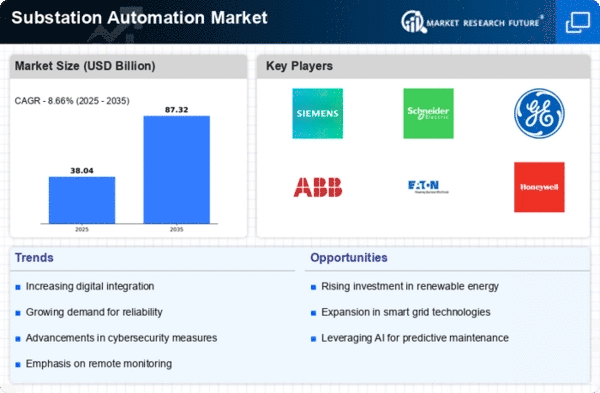
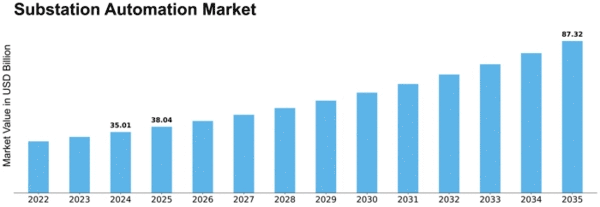
As per MRFR analysis, the Substation Automation Market Size was estimated at 35.01 USD Billion in 2024. The Substation Automation industry is projected to grow from 38.05 USD Billion in 2025 to 87.32 USD Billion by 2035, exhibiting a compound annual growth rate (CAGR) of 8.66 during the forecast period 2025 - 2035.

Key Market Trends & Highlights

The Substation Automation Market is poised for substantial growth driven by technological advancements and increasing demand for reliable power supply.

  • The integration of Artificial Intelligence is transforming operational efficiencies in substation automation.
  • North America remains the largest market, while Asia-Pacific is recognized as the fastest-growing region in this sector.
  • Substation Control is the largest segment, whereas Distribution Automation is experiencing rapid growth.
  • Rising demand for reliable power supply and increased investment in smart grid infrastructure are key drivers propelling market expansion.

Market Size & Forecast

2024 Market Size 35.01 (USD Billion)
2035 Market Size 87.32 (USD Billion)
CAGR (2025 - 2035) 8.66%
Largest Regional Market Share in 2024 North America

Major Players

Siemens (DE), Schneider Electric (FR), General Electric (US), ABB (CH), Eaton (US), Honeywell (US), Rockwell Automation (US), Mitsubishi Electric (JP), Emerson Electric (US)

Market Trends

The Substation Automation Market is currently experiencing a transformative phase, driven by advancements in technology and the increasing demand for efficient energy management. The integration of digital solutions within substations is enhancing operational efficiency, reliability, and safety. As utilities strive to modernize their infrastructure, the adoption of smart grid technologies is becoming more prevalent. This shift not only optimizes performance but also facilitates real-time monitoring and control, which is essential for managing the complexities of contemporary energy systems. Furthermore, the growing emphasis on renewable energy sources necessitates robust automation solutions to ensure seamless integration and distribution of power. In addition to technological advancements, regulatory frameworks are evolving to support the transition towards more sustainable energy practices. Governments worldwide are implementing policies that encourage the adoption of automation in substations, thereby fostering innovation and investment in this sector. The Substation Automation Market appears poised for growth as stakeholders recognize the potential benefits of enhanced automation, including reduced operational costs and improved service reliability. As the landscape continues to evolve, collaboration among industry players, technology providers, and regulatory bodies will likely play a crucial role in shaping the future of this market.

Integration of Artificial Intelligence

The incorporation of artificial intelligence into substation automation systems is gaining traction. This trend suggests that AI can enhance predictive maintenance, optimize asset management, and improve decision-making processes. By analyzing vast amounts of data, AI algorithms may identify patterns and anomalies, leading to more proactive management of electrical infrastructure.

Focus on Cybersecurity

As substations become increasingly interconnected, the focus on cybersecurity is intensifying. This trend indicates that protecting critical infrastructure from cyber threats is paramount. Utilities are likely to invest in advanced security measures to safeguard their automation systems, ensuring the integrity and reliability of energy distribution.

Emphasis on Sustainability

The Substation Automation Market is witnessing a growing emphasis on sustainability. This trend implies that automation solutions are being designed with environmental considerations in mind. By optimizing energy consumption and reducing waste, these technologies may contribute to a more sustainable energy future, aligning with global efforts to combat climate change.

Substation Automation Market Market Drivers

Market Growth Projections

The Global Substation Automation Market Industry is projected to experience substantial growth over the next decade. With a market value of 35.0 USD Billion in 2024, it is anticipated to reach 87.3 USD Billion by 2035. This growth represents a compound annual growth rate of 8.66% from 2025 to 2035. Such projections underscore the increasing importance of automation technologies in the energy sector, driven by factors such as renewable energy integration, regulatory support, and the need for operational efficiency. The market's trajectory reflects a broader trend towards modernization and innovation in electrical infrastructure.

Rising Focus on Operational Efficiency

The Global Substation Automation Market Industry is witnessing a rising focus on operational efficiency among utility companies. Automation solutions enable utilities to optimize their operations, reduce maintenance costs, and enhance overall performance. By implementing automated systems, utilities can achieve real-time monitoring and control, leading to improved decision-making and resource allocation. This emphasis on efficiency is particularly relevant as utilities face increasing pressure to deliver reliable services while managing costs. As a result, the demand for substation automation technologies is expected to grow, contributing to the market's expansion.

Advancements in Smart Grid Technologies

The Global Substation Automation Market Industry is significantly influenced by advancements in smart grid technologies. These innovations enhance the reliability and efficiency of electricity distribution systems. Smart grids utilize digital communication and automation to monitor and manage the flow of electricity, thereby reducing outages and improving service quality. The increasing adoption of smart meters and advanced distribution management systems is indicative of this trend. As utilities invest in modernizing their infrastructure, the demand for substation automation solutions is expected to rise, further propelling market growth.

Growing Demand for Renewable Energy Integration

The Global Substation Automation Market Industry is experiencing a notable shift towards the integration of renewable energy sources. As countries strive to meet their carbon reduction targets, the need for efficient management of renewable energy generation becomes paramount. Substation automation technologies facilitate the seamless integration of solar, wind, and other renewable sources into the grid. This trend is expected to drive substantial investments in automation solutions, contributing to the market's projected growth from 35.0 USD Billion in 2024 to 87.3 USD Billion by 2035, reflecting a compound annual growth rate of 8.66% from 2025 to 2035.

Regulatory Support for Modernization Initiatives

Regulatory frameworks across various regions are increasingly supporting modernization initiatives within the Global Substation Automation Market Industry. Governments are implementing policies that encourage the adoption of advanced technologies to enhance grid resilience and reliability. For instance, initiatives aimed at reducing greenhouse gas emissions often include provisions for upgrading substations with automated systems. This regulatory support not only fosters investment in automation technologies but also aligns with broader energy transition goals. Consequently, the market is likely to benefit from these favorable policies, driving growth and innovation.

Increased Investment in Infrastructure Development

The Global Substation Automation Market Industry is benefiting from increased investment in infrastructure development globally. Many countries are prioritizing the enhancement of their electrical infrastructure to support economic growth and energy demands. This investment often includes the modernization of substations with advanced automation technologies. As governments and private entities allocate funds for infrastructure projects, the demand for substation automation solutions is likely to rise. This trend is expected to play a crucial role in driving the market's growth trajectory over the coming years.

Market Segment Insights

By Application: Substation Control (Largest) vs. Distribution Automation (Fastest-Growing)

The Substation Automation Market is primarily driven by various applications, with Substation Control holding the largest share due to its critical role in managing grid reliability and efficiency. Distribution Automation follows, experiencing considerable growth as utility companies adopt advanced technologies to enhance operational efficiency and reduce outages. Other applications, such as Transmission Automation, Monitoring and Diagnostics, and Protection and Control contribute to the market, albeit at a slower pace than these leading segments.

Substation Control (Dominant) vs. Distribution Automation (Emerging)

Substation Control stands out as the dominant application in the Substation Automation Market, as it is essential for the centralized management of substation operations and safety protocols. This segment offers comprehensive solutions that integrate equipment monitoring, control, and data management, ensuring optimal performance and adherence to regulations. On the other hand, Distribution Automation is emerging rapidly, driven by the need for improved grid resilience and the adoption of smart grid technologies. It focuses on automating distribution networks for real-time monitoring and control, thus facilitating quicker response times to outages and enhancing overall efficiency.

By End Use: Utilities (Largest) vs. Renewable Energy (Fastest-Growing)

The Substation Automation Market is primarily driven by the utilities sector, which holds a significant majority in market share due to the essential need for advanced automation solutions in power generation, transmission, and distribution. This sector's demand is bolstered by increasing investments in infrastructure to modernize aging electrical grids. In contrast, the renewable energy segment is rapidly gaining traction, attributed to the global shift towards sustainable energy production. Continued advancements in renewable technologies are facilitating the integration of automation solutions to manage complex energy sources effectively.

Utilities (Dominant) vs. Renewable Energy (Emerging)

The utilities sector remains the dominant player in the Substation Automation Market, characterized by substantial investment in automation technologies that enhance efficiency and reliability. Utilities focus on upgrading electrical grids to support growing energy demands and incorporate smart grid solutions, allowing for improved monitoring and management. On the other hand, the renewable energy sector is emerging as a crucial area for automation, driven by the need to optimize diverse energy sources like solar and wind. As these energy solutions become more prevalent, the demand for automation systems capable of seamlessly integrating with various energy generation forms is on the rise, presenting significant opportunities for growth.

By Component: Control Systems (Largest) vs. Hardware (Fastest-Growing)

In the Substation Automation Market, the component segment shows a diverse landscape with Control Systems holding a significant market share, emerging as the largest value. Hardware is gaining traction as well, with steady interest driving it to become the fastest-growing segment as more utilities upgrade their infrastructure. Software, Services, and Communication Infrastructure also play vital roles but do not capture as much share as the top two components, indicating a varied preference among market players. In terms of growth trends, the increasing need for enhancing operational efficiency and reliability in power distribution systems is a key driver behind the surge in Control Systems adoption. Meanwhile, Hardware is experiencing rapid growth due to technological advancements, leading to increased demand for better performance and resiliency in substations. The coupled rise in automation and digitalization within utility sectors is further propelling the evolution of both Control Systems and Hardware.

Control Systems: Dominant vs. Hardware: Emerging

Control Systems have solidified their status as a dominant component in the Substation Automation Market, primarily due to their ability to enhance monitoring, control, and automation capabilities within substations. They facilitate real-time data management and ensure optimal performance in electrical grid operations. On the other hand, Hardware, while currently emerging, is swiftly evolving and adapting to new technological requirements, including IoT integration and advanced communication protocols. Their fast-paced development signifies a market shift, with new devices and components continuously entering the fray, aimed at enhancing reliability and efficiency in power systems. The interaction between these two segments is vital, as the growth in Hardware also fuels advancements in Control Systems.

By Technology: Supervisory Control and Data Acquisition (Largest) vs. Intelligent Electronic Device (Fastest-Growing)

In the Substation Automation Market, the distribution of market share among various technologies highlights the dominance of Supervisory Control and Data Acquisition (SCADA) systems. SCADA holds a significant portion of the market due to its extensive application in monitoring and controlling substation operations. Following closely are Intelligent Electronic Devices (IEDs), which are gaining traction for their high-speed data processing and communication capabilities. Other technologies, such as Programmable Logic Controllers (PLCs), Remote Terminal Units (RTUs), and Advanced Metering Infrastructure (AMI), also contribute to the sector, but to a lesser extent, resulting in a diverse technological landscape. Growth trends in this segment are being driven by the increasing adoption of smart grid technologies and the need for improved efficiency in power distribution. Additionally, IEDs are quickly emerging as the fastest-growing segment due to their advanced functionalities, which facilitate real-time monitoring and control in substations. As utilities strive for enhanced operational effectiveness, the demand for these technologies is expected to accelerate, propelling advancements in automation and data management within substations.

Technology: SCADA (Dominant) vs. IED (Emerging)

Supervisory Control and Data Acquisition (SCADA) systems represent the dominant technology in the Substation Automation Market, primarily due to their reliability and comprehensive functionalities in monitoring diverse electrical parameters and ensuring operational resilience. They enable utilities to maintain control over substation operations effectively. In contrast, Intelligent Electronic Devices (IEDs) are emerging as a crucial technology, driven by their capacity for real-time data acquisition and processing. Their advanced functionalities allow for enhanced fault detection, diagnostics, and communication in substation applications. This juxtaposition signifies a shift towards integrating smarter technologies in energy management systems, with SCADA fulfilling the essential role of operational command and IEDs paving the path for future innovations in automation.

By Voltage Level: High Voltage (Largest) vs. Medium Voltage (Fastest-Growing)

The Substation Automation Market is witnessing a diverse distribution across various voltage levels, with High Voltage segments taking the lead in market share. This dominance is driven by an increasing demand for efficient power transmission and distribution networks. Meanwhile, the Medium Voltage segment is experiencing rapid expansion, attributed to growing investments in smart grid technologies and renewable energy integration. As the world transitions towards more sustainable and resilient energy solutions, Medium Voltage automation technologies are at the forefront of innovation. The growth is also prompted by the increasing need for upgraded infrastructure in developing economies and proactive investments in advanced automation systems to enhance operational efficiencies in substations.

Voltage Level: High Voltage (Dominant) vs. Medium Voltage (Emerging)

High Voltage systems are critical to the Substation Automation Market, characterized by their capacity to manage large-scale electrical flows effectively. These systems are essential for long-distance power transmission, thereby reducing energy losses and improving reliability. With advancements in technology, High Voltage automation solutions are being increasingly integrated with data analytics for predictive maintenance and operational efficiency. On the other hand, Medium Voltage systems are emerging rapidly, finding broad applications in urban power distribution and industrial environments. The ongoing upgrade of existing grids to smart grids positions Medium Voltage solutions as a pivotal player, fueled by technological advancements, regulatory support, and the increasing incorporation of IoT devices for enhanced monitoring and control.

Get more detailed insights about Substation Automation Market Research Report - Forecast to 2035

Regional Insights

North America : Leading Market Innovators

North America is poised to maintain its leadership in the Substation Automation Market, holding a significant market share of 15.0 in 2024. The region's growth is driven by increasing investments in smart grid technologies and the need for enhanced energy efficiency. Regulatory support for renewable energy integration and modernization of aging infrastructure further catalyzes demand. The focus on reducing operational costs and improving reliability is also a key driver for market expansion. The competitive landscape in North America is robust, featuring major players such as Siemens, General Electric, and ABB. The U.S. leads the market, supported by substantial government initiatives aimed at upgrading electrical grids. The presence of advanced technology firms and a strong emphasis on R&D contribute to the region's innovative edge. As utilities seek to enhance operational efficiency, the demand for advanced substation automation solutions is expected to grow significantly.

Europe : Emerging Regulatory Frameworks

Europe's Substation Automation Market is projected to reach a size of 10.0 by 2025, driven by stringent regulations aimed at reducing carbon emissions and enhancing energy efficiency. The European Union's Green Deal and various national initiatives are pivotal in promoting smart grid technologies. The increasing integration of renewable energy sources necessitates advanced automation solutions, creating a favorable environment for market growth. The focus on sustainability and digital transformation is reshaping the energy landscape across the region. Leading countries in Europe include Germany, France, and the UK, where major players like Schneider Electric and ABB are actively innovating. The competitive landscape is characterized by collaborations between technology providers and utility companies to develop integrated solutions. As the region transitions to a more sustainable energy model, the demand for substation automation technologies is expected to rise, supported by a strong regulatory framework. "The European energy sector is undergoing a significant transformation, necessitating advanced automation solutions to meet sustainability goals."

Asia-Pacific : Rapid Growth and Adoption

The Asia-Pacific region is witnessing rapid growth in the Substation Automation Market, with a projected size of 8.0 by 2025. This growth is fueled by increasing urbanization, industrialization, and the rising demand for reliable electricity supply. Governments are investing heavily in infrastructure development and smart grid initiatives, which are critical for enhancing energy efficiency and reliability. The region's focus on renewable energy integration is also a significant driver for market expansion, supported by favorable policies and investments. Countries like China, India, and Japan are leading the charge in adopting substation automation technologies. The competitive landscape features key players such as Mitsubishi Electric and Honeywell, who are innovating to meet the growing demand. As utilities in the region seek to modernize their infrastructure, the adoption of advanced automation solutions is expected to accelerate, positioning Asia-Pacific as a key player in the global market. The region's unique challenges and opportunities will shape its future in substation automation.

Middle East and Africa : Emerging Market Opportunities

The Middle East and Africa region is gradually emerging in the Substation Automation Market, with a market size of 2.01 projected for 2025. The growth is primarily driven by increasing investments in energy infrastructure and the need for reliable electricity supply. Governments are focusing on diversifying energy sources and enhancing grid reliability, which is crucial for economic development. The region's commitment to renewable energy projects is also fostering demand for advanced automation solutions, creating new opportunities for market players. Leading countries in this region include South Africa and the UAE, where significant investments are being made in smart grid technologies. The competitive landscape is evolving, with both local and international players vying for market share. As the region continues to develop its energy infrastructure, the demand for substation automation technologies is expected to grow, supported by government initiatives and private sector investments. The future of this market looks promising as the region embraces modernization.

Key Players and Competitive Insights

The Substation Automation Market is currently characterized by a dynamic competitive landscape, driven by the increasing demand for efficient energy management and the integration of renewable energy sources. Key players such as Siemens (DE), Schneider Electric (FR), and General Electric (US) are at the forefront, each adopting distinct strategies to enhance their market positioning. Siemens (DE) emphasizes innovation through its digital solutions, focusing on smart grid technologies and automation systems. Schneider Electric (FR) is heavily investing in sustainability initiatives, aiming to provide eco-friendly solutions that align with global energy transition goals. General Electric (US) is pursuing strategic partnerships to bolster its technological capabilities, particularly in the realm of AI and IoT applications, which are becoming increasingly vital in substation automation.The business tactics employed by these companies reflect a concerted effort to optimize operations and enhance competitiveness. Localizing manufacturing and optimizing supply chains are prevalent strategies, allowing firms to respond swiftly to regional demands and reduce operational costs. The market structure appears moderately fragmented, with several players vying for market share, yet the collective influence of major companies is significant in shaping industry standards and practices.

In November Siemens (DE) announced the launch of its new digital substation automation platform, which integrates advanced analytics and machine learning capabilities. This strategic move is likely to enhance operational efficiency and reduce downtime, positioning Siemens as a leader in the digital transformation of substations. The introduction of this platform underscores the company's commitment to innovation and its proactive approach to meeting the evolving needs of the energy sector.

In October Schneider Electric (FR) unveiled its partnership with a leading renewable energy provider to develop integrated solutions for smart substations. This collaboration is expected to facilitate the seamless integration of renewable energy sources into existing grids, thereby enhancing grid reliability and sustainability. Such strategic alliances not only strengthen Schneider's market position but also reflect a broader trend towards collaborative innovation in the industry.

In September General Electric (US) expanded its portfolio by acquiring a startup specializing in AI-driven predictive maintenance solutions for substations. This acquisition is anticipated to enhance GE's capabilities in predictive analytics, allowing for more proactive maintenance strategies that can significantly reduce operational costs and improve reliability. The move illustrates GE's focus on leveraging cutting-edge technology to maintain a competitive edge in the market.

As of December the Substation Automation Market is witnessing a pronounced shift towards digitalization, sustainability, and AI integration. These trends are reshaping competitive dynamics, with strategic alliances becoming increasingly pivotal in driving innovation and enhancing operational efficiencies. The competitive landscape is evolving from a focus on price-based competition to one that prioritizes technological advancement, reliability, and sustainable practices. As companies continue to adapt to these trends, differentiation will likely hinge on their ability to innovate and optimize supply chains, ensuring they remain responsive to the rapidly changing energy landscape.

Key Companies in the Substation Automation Market include

Industry Developments

  • Q2 2024: ABB launches new digital substation automation solution to enhance grid reliability ABB announced the launch of its latest digital substation automation platform, designed to improve grid reliability and operational efficiency for utilities. The new solution integrates advanced monitoring and control features for real-time data analytics and remote management.
  • Q2 2024: Siemens and Tata Power Delhi Distribution Limited partner to deploy advanced distribution management system Siemens announced a partnership with Tata Power Delhi Distribution Limited to implement an advanced distribution management system, including substation automation technologies, to modernize the power grid in Delhi and improve service reliability.
  • Q3 2024: Schneider Electric unveils EcoStruxure Substation Operation 2024 Schneider Electric launched the 2024 version of its EcoStruxure Substation Operation platform, featuring enhanced cybersecurity and interoperability for digital substations, targeting utilities upgrading to smart grid infrastructure.
  • Q3 2024: Hitachi Energy wins contract to automate substations for major European utility Hitachi Energy secured a contract to provide substation automation systems for a leading European utility, supporting the integration of renewable energy sources and grid modernization efforts.
  • Q4 2024: GE Vernova to supply digital substation automation for Saudi Electricity Company GE Vernova announced it will deliver digital substation automation solutions to Saudi Electricity Company, aiming to enhance grid reliability and support the Kingdom’s energy transition initiatives.
  • Q4 2024: ABB to acquire substation automation specialist MeshGrid for undisclosed sum ABB announced the acquisition of MeshGrid, a company specializing in substation automation and grid-edge intelligence, to strengthen its digital grid portfolio and expand its presence in the smart grid sector.
  • Q1 2025: Siemens Energy opens new substation automation R&D center in Germany Siemens Energy inaugurated a new research and development center focused on substation automation technologies in Erlangen, Germany, to accelerate innovation in digital grid solutions.
  • Q1 2025: Schneider Electric appoints new head of substation automation business unit Schneider Electric announced the appointment of Dr. Maria Lopez as the new head of its substation automation business unit, signaling a strategic focus on digital grid transformation.
  • Q2 2025: Hitachi Energy launches next-generation substation automation controller Hitachi Energy introduced a new substation automation controller with advanced edge computing capabilities, designed to support utilities in managing distributed energy resources and grid complexity.
  • Q2 2025: GE Vernova secures $120 million contract for substation automation in India GE Vernova won a $120 million contract to supply substation automation systems for a major grid modernization project in India, supporting the country’s efforts to improve power reliability and integrate renewables.
  • Q2 2025: ABB and Enel sign partnership to co-develop digital substation solutions ABB and Enel announced a strategic partnership to co-develop digital substation automation solutions, aiming to accelerate the adoption of smart grid technologies across Europe.
  • Q2 2025: Siemens unveils AI-powered substation automation platform Siemens launched a new AI-powered substation automation platform, offering predictive maintenance and real-time grid optimization features for utility customers.

Future Outlook

Substation Automation Market Future Outlook

The Substation Automation Market is projected to grow at an 8.66% CAGR from 2025 to 2035, driven by technological advancements, increasing demand for renewable energy, and enhanced grid reliability.

New opportunities lie in:

  • Integration of AI-driven predictive maintenance solutions
  • Development of modular substation automation systems
  • Expansion of cybersecurity services for substation infrastructure

By 2035, the market is expected to achieve robust growth, driven by innovation and strategic investments.

Market Segmentation

Substation Automation Market End Use Outlook

  • Utilities
  • Industrial
  • Commercial
  • Renewable Energy
  • Transportation

Substation Automation Market Component Outlook

  • Hardware
  • Software
  • Services
  • Communication Infrastructure
  • Control Systems

Substation Automation Market Technology Outlook

  • Supervisory Control and Data Acquisition
  • Programmable Logic Controller
  • Remote Terminal Unit
  • Intelligent Electronic Device
  • Advanced Metering Infrastructure

Substation Automation Market Application Outlook

  • Distribution Automation
  • Transmission Automation
  • Substation Control
  • Monitoring and Diagnostics
  • Protection and Control

Substation Automation Market Voltage Level Outlook

  • Low Voltage
  • Medium Voltage
  • High Voltage
  • Extra High Voltage
  • Ultra High Voltage

Report Scope

MARKET SIZE 202435.01(USD Billion)
MARKET SIZE 202538.05(USD Billion)
MARKET SIZE 203587.32(USD Billion)
COMPOUND ANNUAL GROWTH RATE (CAGR)8.66% (2025 - 2035)
REPORT COVERAGERevenue Forecast, Competitive Landscape, Growth Factors, and Trends
BASE YEAR2024
Market Forecast Period2025 - 2035
Historical Data2019 - 2024
Market Forecast UnitsUSD Billion
Key Companies ProfiledSiemens (DE), Schneider Electric (FR), General Electric (US), ABB (CH), Eaton (US), Honeywell (US), Rockwell Automation (US), Mitsubishi Electric (JP), Emerson Electric (US)
Segments CoveredApplication, End Use, Component, Technology, Voltage Level
Key Market OpportunitiesIntegration of advanced digital technologies enhances efficiency in the Substation Automation Market.
Key Market DynamicsRising demand for efficient energy management drives innovation in substation automation technologies and regulatory compliance.
Countries CoveredNorth America, Europe, APAC, South America, MEA

FAQs

How much is the Substation Automation market?

The Substation Automation market size was valued at USD 35.01 billion in 2024.

What is the growth rate of the Substation Automation market?

The global market is projected to grow at a CAGR of 8.66% during the forecast period, 2025 to 2035.

Which region held the largest market share in the Substation Automation market?

North America had the largest share in the global Substation Automation market.

Who are the key players in the Substation Automation market?

The key players in the market are SAE IT-Systems GmbH & Co, Toshiba Corporation, Texas Instruments, Larsen & Toubro Limited, Encore Networks, EATON Corp, General Electric, ABB Group, Siemens, and Schneider Electric.

Which Component led the Substation Automation market?

The Smart meter category dominated the market in 2022.

Which Communication had the largest market share in the market?

The Ethernet segment had the largest share in the global market for Substation Automation.

  1. SECTION I: EXECUTIVE SUMMARY AND KEY HIGHLIGHTS
    1. EXECUTIVE SUMMARY
      1. Market Overview
      2. Key Findings
      3. Market Segmentation
      4. Competitive Landscape
      5. Challenges and Opportunities
      6. Future Outlook
  2. SECTION II: SCOPING, METHODOLOGY AND MARKET STRUCTURE
    1. MARKET INTRODUCTION
      1. Definition
      2. Scope of the study
    2. RESEARCH METHODOLOGY
      1. Overview
      2. Data Mining
      3. Secondary Research
      4. Primary Research
      5. Forecasting Model
      6. Market Size Estimation
      7. Data Triangulation
      8. Validation
  3. SECTION III: QUALITATIVE ANALYSIS
    1. MARKET DYNAMICS
      1. Overview
      2. Drivers
      3. Restraints
      4. Opportunities
    2. MARKET FACTOR ANALYSIS
      1. Value chain Analysis
      2. Porter's Five Forces Analysis
      3. COVID-19 Impact Analysis
  4. SECTION IV: QUANTITATIVE ANALYSIS
    1. Semiconductor & Electronics, BY Application (USD Billion)
      1. Distribution Automation
      2. Transmission Automation
      3. Substation Control
      4. Monitoring and Diagnostics
      5. Protection and Control
    2. Semiconductor & Electronics, BY End Use (USD Billion)
      1. Utilities
      2. Industrial
      3. Commercial
      4. Renewable Energy
      5. Transportation
    3. Semiconductor & Electronics, BY Component (USD Billion)
      1. Hardware
      2. Software
      3. Services
      4. Communication Infrastructure
      5. Control Systems
    4. Semiconductor & Electronics, BY Technology (USD Billion)
      1. Supervisory Control and Data Acquisition
      2. Programmable Logic Controller
      3. Remote Terminal Unit
      4. Intelligent Electronic Device
      5. Advanced Metering Infrastructure
    5. Semiconductor & Electronics, BY Voltage Level (USD Billion)
      1. Low Voltage
      2. Medium Voltage
      3. High Voltage
      4. Extra High Voltage
      5. Ultra High Voltage
    6. Semiconductor & Electronics, BY Region (USD Billion)
      1. North America
      2. Europe
      3. APAC
      4. South America
      5. MEA
  5. SECTION V: COMPETITIVE ANALYSIS
    1. Competitive Landscape
      1. Overview
      2. Competitive Analysis
      3. Market share Analysis
      4. Major Growth Strategy in the Semiconductor & Electronics
      5. Competitive Benchmarking
      6. Leading Players in Terms of Number of Developments in the Semiconductor & Electronics
      7. Key developments and growth strategies
      8. Major Players Financial Matrix
    2. Company Profiles
      1. Siemens (DE)
      2. Schneider Electric (FR)
      3. General Electric (US)
      4. ABB (CH)
      5. Eaton (US)
      6. Honeywell (US)
      7. Rockwell Automation (US)
      8. Mitsubishi Electric (JP)
      9. Emerson Electric (US)
    3. Appendix
      1. References
      2. Related Reports

Semiconductor & Electronics Market Segmentation

Semiconductor & Electronics By Application (USD Billion, 2025-2035)

  • Distribution Automation
  • Transmission Automation
  • Substation Control
  • Monitoring and Diagnostics
  • Protection and Control

Semiconductor & Electronics By End Use (USD Billion, 2025-2035)

  • Utilities
  • Industrial
  • Commercial
  • Renewable Energy
  • Transportation

Semiconductor & Electronics By Component (USD Billion, 2025-2035)

  • Hardware
  • Software
  • Services
  • Communication Infrastructure
  • Control Systems

Semiconductor & Electronics By Technology (USD Billion, 2025-2035)

  • Supervisory Control and Data Acquisition
  • Programmable Logic Controller
  • Remote Terminal Unit
  • Intelligent Electronic Device
  • Advanced Metering Infrastructure

Semiconductor & Electronics By Voltage Level (USD Billion, 2025-2035)

  • Low Voltage
  • Medium Voltage
  • High Voltage
  • Extra High Voltage
  • Ultra High Voltage
Infographic

Free Sample Request

Kindly complete the form below to receive a free sample of this Report

Get Free Sample

Customer Strories

Compare Licence

×
Features License Type
Single User Multiuser License Enterprise User
Price $4,950 $5,950 $7,250
Maximum User Access Limit 1 User Upto 10 Users Unrestricted Access Throughout the Organization
Free Customization
Direct Access to Analyst
Deliverable Format
Platform Access
Discount on Next Purchase 10% 15% 15%
Printable Versions