Request Free Sample ×

Kindly complete the form below to receive a free sample of this Report

* Please use a valid business email

Leading companies partner with us for data-driven Insights

clients tt-cursor
Hero Background
English
Chinese
French
Japanese
Korean
German
Spanish

Sticker Printer Market Analysis

ID: MRFR/SEM/10199-CR
188 Pages
Aarti Dhapte
August 2023

Sticker Printer Market Size, Share and Research Report By Material (Vinyl, Biaxially Oriented Polypropylene, Holographic, Glitter, and Others), By Format (Pages, Kiss-Cut Singles, Rolles Labels, Die-Cut Singles, Sheet Labels), By Connectivity (Wired, Wireless), By Application (Manufacturing, Healthcare, Food & Beverage, Logistics, Consumer Durables, and Others), and By Region (North America, Europe, Asia-Pacific, Middle East & Africa, and South America) - Industry Forecast Till 2035

Share:
Download PDF ×

We do not share your information with anyone. However, we may send you emails based on your report interest from time to time. You may contact us at any time to opt-out.

Sticker Printer Market Infographic
Purchase Options

Market Analysis

In-depth Analysis of Sticker Printer Market Industry Landscape

The growing adoption of advanced technology solutions in the labeling and packaging industries has empowered sticker printer vendors to enhance profitability, productivity, and customer relationships. Sectors such as food, beverage, spirits, pharmaceuticals, and consumer goods heavily rely on sticker labeling and packaging. The Covid-19 pandemic has significantly impacted the sales of these goods, prompting sticker printer vendors to adopt digital printing as a solution to overcome obstacles. Inkjet printing stands out as a trend creating opportunities for label and packaging end-users, including current providers and small to large organizations aiming to expand their printing businesses. Innovations in printhead inks and substrates have enabled the transition from analog presses to digital printing, providing users with the ability to handle both new and existing products. Inkjet printers offer multiple features such as engaging customers, creating visually attractive stickers, compliance with changing regulations, meeting color and environmental standards, among others. When evaluating the total cost of a sticker printer, three main factors come into play: cost, quality, and productivity. Sticker design is crucial for brand marketing, serving the purpose of product identification. The design elements, especially color, impact customer attitudes towards the brand, emphasizing the need for cohesive design. Printing quality is essential for vibrant stickers, and output quality is crucial in every printing process. Printing speed is a preference for sticker printers, as poor quality and slow printers can result in low productivity. Additionally, consumers prefer printers with low power consumption to reduce maintenance and electricity costs. These considerations collectively contribute to the overall effectiveness and efficiency of sticker printers in meeting market demands. Raw materials are pivotal in the value chain, playing a crucial role that incurs significant costs for both component manufacturers and original device manufacturers (ODMs). Typically, these raw materials are sourced from major suppliers dealing in various materials such as plastics, ceramics, polylactic acid (PLA), polyvinyl chloride (PVC), nylon, carbon fiber, and polycarbonate (PC), among others. The supply chain's efficiency is influenced by several factors, including the cost of materials, timely delivery, quality, compliance with regulations, and supplier preferences.


Author
Author Profile
Aarti Dhapte
AVP - Research

A consulting professional focused on helping businesses navigate complex markets through structured research and strategic insights. I partner with clients to solve high-impact business problems across market entry strategy, competitive intelligence, and opportunity assessment. Over the course of my experience, I have led and contributed to 100+ market research and consulting engagements, delivering insights across multiple industries and geographies, and supporting strategic decisions linked to $500M+ market opportunities. My core expertise lies in building robust market sizing, forecasting, and commercial models (top-down and bottom-up), alongside deep-dive competitive and industry analysis. I have played a key role in shaping go-to-market strategies, investment cases, and growth roadmaps, enabling clients to make confident, data-backed decisions in dynamic markets.

Leave a Comment

FAQs

What is the current valuation of the Sticker Printer Market as of 2024?

<p>The Sticker Printer Market was valued at approximately 3707.74 USD Million in 2024.</p>

What is the projected market valuation for the Sticker Printer Market in 2035?

<p>The market is projected to reach approximately 8231.94 USD Million by 2035.</p>

What is the expected CAGR for the Sticker Printer Market during the forecast period 2025 - 2035?

<p>The expected CAGR for the Sticker Printer Market during the forecast period 2025 - 2035 is 7.52%.</p>

Which companies are considered key players in the Sticker Printer Market?

<p>Key players in the market include Epson, Brother, Zebra Technologies, Dymo, Canon, HP, Roland DG, Silhouette America, and Graphtec.</p>

What are the primary materials used in sticker printing, and what are their market valuations?

<p>The primary materials include vinyl (1110.0 to 2500.0 USD Million), BOPP (740.0 to 1700.0 USD Million), holographic (370.0 to 850.0 USD Million), glitter (185.0 to 420.0 USD Million), and others (1302.74 to 2861.94 USD Million).</p>

What formats are available in the Sticker Printer Market, and what are their respective valuations?

Available formats include pages (370.77 to 823.19 USD Million), kiss-cut singles (555.16 to 1234.56 USD Million), rolls labels (1111.55 to 2469.12 USD Million), die-cut singles (740.77 to 1646.38 USD Million), and sheet labels (1929.49 to 4258.69 USD Million).

How does connectivity impact the Sticker Printer Market, and what are the valuations for wired and wireless options?

Connectivity options include wired (1480.0 to 3200.0 USD Million) and wireless (2227.74 to 5031.94 USD Million), indicating a strong preference for wireless solutions.

What applications are driving growth in the Sticker Printer Market, and what are their market valuations?

Key applications include manufacturing (800.0 to 1800.0 USD Million), healthcare (600.0 to 1300.0 USD Million), food &amp; beverage (700.0 to 1500.0 USD Million), logistics (500.0 to 1200.0 USD Million), and consumer durables (600.0 to 1300.0 USD Million).

What trends are influencing the Sticker Printer Market in 2025?

In 2025, trends such as increased demand for customized printing solutions and advancements in printing technology appear to be influencing the market.

How does the Sticker Printer Market compare to other printing markets in terms of growth?

The Sticker Printer Market's projected growth rate of 7.52% during 2025 - 2035 suggests a robust expansion compared to other printing segments.

Market Summary

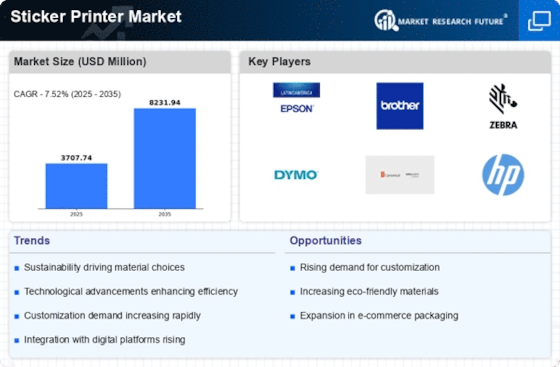
As per Market Research Future analysis, the Sticker Printer Market Size was estimated at 3707.74 USD Million in 2024. The Sticker Printer industry is projected to grow from 3986.57 USD Million in 2025 to 8231.94 USD Million by 2035, exhibiting a compound annual growth rate (CAGR) of 7.52% during the forecast period 2025 - 2035

Key Market Trends & Highlights

The Sticker Printer Market is experiencing robust growth driven by technological advancements and increasing customization demands.

  • North America remains the largest market for sticker printers, driven by a strong demand for custom labels. Asia-Pacific is emerging as the fastest-growing region, fueled by the rise of e-commerce and online retail. Vinyl continues to dominate as the largest segment, while Biaxially Oriented Polypropylene (BOPP) is witnessing rapid growth. Key market drivers include the rising demand for custom labels and sustainability trends in packaging.

Market Size & Forecast

2024 Market Size 3707.74 (USD Million)
2035 Market Size 8231.94 (USD Million)
CAGR (2025 - 2035) 7.52%
Largest Regional Market Share in 2024 North America

Major Players

Epson (JP), Brother (JP), Zebra Technologies (US), Dymo (US), Canon (JP), HP (US), Roland DG (JP), Silhouette America (US), Graphtec (JP)

Market Trends

The Sticker Printer Market is currently experiencing a dynamic evolution, driven by advancements in technology and changing consumer preferences. As businesses and individuals increasingly seek personalized products, the demand for high-quality sticker printing solutions appears to be on the rise. This market encompasses a diverse range of applications, from promotional materials to custom labels, indicating a broad spectrum of potential users. Furthermore, the integration of digital printing technologies is likely enhancing the efficiency and quality of sticker production, making it more accessible to small businesses and hobbyists alike. In addition, sustainability concerns are influencing purchasing decisions within the Sticker Printer Market. Manufacturers are exploring eco-friendly materials and processes, which may appeal to environmentally conscious consumers. This shift towards sustainable practices suggests a potential for growth in segments that prioritize green solutions. Overall, the Sticker Printer Market seems poised for continued expansion, with innovation and consumer trends shaping its trajectory in the coming years.

Technological Advancements

The Sticker Printer Market is witnessing rapid technological innovations, particularly in digital printing techniques. These advancements enable faster production times and improved print quality, catering to the growing demand for customized stickers. As technology evolves, manufacturers are likely to adopt more sophisticated printing methods, enhancing the overall user experience.

Sustainability Initiatives

There is a noticeable shift towards sustainability within the Sticker Printer Market. Companies are increasingly focusing on eco-friendly materials and processes, responding to consumer demand for environmentally responsible products. This trend may lead to the development of biodegradable stickers and recyclable packaging, appealing to a broader audience.

Customization and Personalization

The desire for unique and personalized products is driving growth in the Sticker Printer Market. Consumers are seeking customized stickers for various applications, from personal use to business branding. This trend suggests that companies offering tailored solutions may find a competitive edge, as they cater to the specific needs of their clientele.

Sticker Printer Market Market Drivers

Rising Demand for Custom Labels

The Sticker Printer Market experiences a notable increase in demand for custom labels across various sectors, including retail, logistics, and food and beverage. Businesses are increasingly recognizing the value of personalized branding, which drives the need for high-quality sticker printing solutions. According to recent data, the market for custom labels is projected to grow at a compound annual growth rate of approximately 5.5% over the next five years. This trend indicates that companies are investing in sticker printers to enhance their product visibility and customer engagement. As a result, the Sticker Printer Market is likely to see a surge in sales, as businesses seek to differentiate themselves in a competitive landscape.

Sustainability Trends in Packaging

The Sticker Printer Market is increasingly influenced by sustainability trends, as consumers and businesses alike prioritize eco-friendly practices. There is a growing demand for biodegradable and recyclable sticker materials, prompting manufacturers to innovate and adapt their offerings. Recent surveys indicate that over 60% of consumers prefer products with sustainable packaging, which directly impacts purchasing decisions. As companies strive to meet these expectations, the Sticker Printer Market is likely to see a rise in the production of environmentally friendly stickers. This shift not only aligns with consumer preferences but also positions businesses as responsible entities in the marketplace, potentially enhancing brand loyalty and customer trust.

Growing Interest in DIY and Crafting

The Sticker Printer Market is benefiting from a rising interest in DIY projects and crafting among consumers. This trend is particularly evident in the younger demographic, who are increasingly engaging in creative activities that involve personalized stickers. The proliferation of social media platforms has further fueled this interest, as individuals share their unique creations online. Market Research Future indicates that the crafting industry has seen a growth rate of approximately 7% annually, which positively impacts the demand for sticker printers. Consequently, the Sticker Printer Market is likely to expand as manufacturers cater to the needs of hobbyists and crafters seeking innovative printing solutions.

Growth of E-commerce and Online Retail

The Sticker Printer Market is significantly influenced by the expansion of e-commerce and online retail platforms. As more businesses transition to digital sales channels, the need for effective packaging and branding solutions becomes paramount. Stickers play a crucial role in enhancing product presentation and providing essential information to consumers. Recent statistics suggest that e-commerce sales have increased by over 20% in the past year, leading to a corresponding rise in demand for sticker printing services. This growth trajectory indicates that the Sticker Printer Market is poised for further expansion, as online retailers seek innovative ways to attract and retain customers through visually appealing packaging.

Increased Adoption of Digital Printing Technologies

The Sticker Printer Market is witnessing a shift towards digital printing technologies, which offer enhanced efficiency and flexibility. Digital printers enable businesses to produce high-quality stickers with shorter turnaround times and lower production costs. This technological advancement is particularly appealing to small and medium-sized enterprises that require quick and cost-effective solutions. Data indicates that the digital printing segment is expected to account for over 40% of the total sticker printing market by 2026. As more companies adopt these technologies, the Sticker Printer Market is likely to experience a transformation, characterized by increased innovation and a broader range of product offerings.

Market Segment Insights

By Material: Vinyl (Largest) vs. Biaxially Oriented Polypropylene (BOPP) (Fastest-Growing)

<p>In the Sticker Printer Market, the material segment showcases a varied distribution of shares among its constituents. Vinyl stands out as the largest segment due to its durability and weather-resistant properties, making it a preferred choice for outdoor applications. On the other hand, BOPP is gaining momentum, capitalizing on its recyclability and advanced printing characteristics, which attracts environmentally-conscious consumers. The holographic and glitter materials also have a niche appeal but represent a smaller portion of the overall market. Growth trends within this segment indicate a shift towards sustainable materials, with a growing demand for eco-friendly options such as BOPP. Consumers are increasingly inclined to choose materials that not only serve functional purposes but also align with their environmental values. Moreover, the rise of e-commerce and personalized products drives the innovation in sticker printing materials, further enhancing market dynamics and the adoption of diverse materials.</p>

<p>Vinyl (Dominant) vs. Glitter (Emerging)</p>

<p>Vinyl remains the dominant material in the Sticker Printer Market, known for its flexibility and high durability, making it ideal for a variety of applications including labels and stickers for outdoor use. Its resistance to moisture and UV light contributes to its widespread acceptance across industries. Conversely, glitter is emerging as a trendy segment, capturing the market's creative aspect. Its eye-catching appeal makes it a popular choice for personal projects and events. While glitter stickers are often used for decorative purposes, they introduce unique challenges in printing and durability, setting them apart from more conventional materials. Both segments highlight the diverse preferences of consumers, emphasizing the balance between functionality and aesthetic in sticker printing.</p>

By Format: Sheet Labels (Largest) vs. Roll Labels (Fastest-Growing)

<p>In the Sticker Printer Market, the format segment displays a diverse distribution among various types, with sheet labels emerging as the largest contributor. Sheet labels capture significant consumer preference due to their versatility and ease of use. On the other hand, roll labels are gaining traction as a preferred choice for mass production, reflecting a shift in market dynamics. As businesses aim for efficiency in labeling processes, the adoption of roll labels is increasing, highlighting an evolving landscape in the sticker printing sector. The demand for these formats is largely driven by the growing need for customized solutions across different industries. With businesses seeking agility and quick turnaround times, the rapid growth of roll labels is indicative of their importance in automated processes. Additionally, kiss-cut singles and die-cut singles cater to niche markets, appealing to customers looking for specific applications, thus contributing to the overall growth within the segment.</p>

<p>Sheet Labels (Dominant) vs. Kiss-Cut Singles (Emerging)</p>

<p>Sheet labels dominate the sticker printing landscape due to their adaptability and widespread application across various sectors, including cosmetics, food, and retail. They are favored for their ability to be printed in bulk and their compatibility with different printing technologies. In contrast, kiss-cut singles represent an emerging trend, appealing more to businesses and individuals looking for unique and custom designs. Their easy removal and versatile applications in promotional materials make them attractive to smaller sectors. The demand for innovative and eye-catching marketing materials drives the growth of kiss-cut singles, positioning them as a notable player in the evolving sticker printer market.</p>

By Connectivity: Wired (Largest) vs. Wireless (Fastest-Growing)

<p>In the Sticker Printer Market, the connectivity segment is bifurcated into wired and wireless technologies. Wired connectivity currently holds the largest share, favored for its reliability and consistent performance in high-volume printing scenarios. Many commercial applications continue to prefer wired options due to their ability to deliver high-quality prints without interruptions caused by connectivity issues. In contrast, wireless connectivity solutions are gaining traction among smaller businesses and home users, driven by their convenience and ease of use, especially in setups where mobility and flexibility are crucial.</p>

<p>Connectivity: Wired (Dominant) vs. Wireless (Emerging)</p>

<p>Wired connectivity remains dominant in the Sticker Printer Market, favored primarily for its reliability, speed, and capability to handle large print jobs effectively. This segment caters to industries that require robust printing solutions with minimal downtime. On the other hand, wireless connectivity is emerging as a significant trend, appealing to users who prioritize convenience and flexibility. As technology advances, wireless printers are becoming more sophisticated, enabling users to print directly from various devices without the constraints of physical connections. This shift reflects evolving consumer preferences for versatile and mobile printing options, positioning wireless technology as a key area of growth in the sticker printing sector.</p>

By Application: Manufacturing (Largest) vs. Healthcare (Fastest-Growing)

<p>The sticker printer market is witnessing a diverse application spectrum, with manufacturing being the largest segment due to the high demand for labeling products, components, and assets. The manufacturing sector utilizes sticker printers extensively for providing essential information on product packaging and compliance labeling, leading to significant market share. In contrast, the healthcare sector is emerging as a rapidly growing segment, driven by the need for enhanced patient identification and medication labeling solutions in an increasingly digitized healthcare environment.</p>

<p>Manufacturing: Dominant vs. Healthcare: Emerging</p>

<p>The manufacturing application remains dominant in the sticker printer market, primarily because enterprises prioritize accurate labeling for production efficiency and regulatory compliance. Sticker printers facilitate quick and effective printing for various materials, including packaging and equipment tracking. In contrast, the healthcare application is rapidly emerging, characterized by innovative uses such as patient identification badges and medication labeling. This sector's growth is propelled by trends toward automation and technology enhancement, ensuring that healthcare providers can improve patient safety, reduce errors, and streamline operations.</p>

Get more detailed insights about Sticker Printer Market Research Report—Global Forecast till 2035

Regional Insights

North America : Market Leader in Innovation

North America is the largest market for sticker printers, holding approximately 40% of the global market share. The region's growth is driven by increasing demand for customized printing solutions across various sectors, including retail and packaging. Regulatory support for small businesses and technological advancements in printing technology further catalyze market expansion. The rise of e-commerce has also fueled demand for personalized products, enhancing market dynamics. The United States is the leading country in this region, with significant contributions from Canada. Major players like Zebra Technologies, Dymo, and HP are well-established, providing a competitive landscape that fosters innovation. The presence of advanced manufacturing facilities and a strong distribution network enhances the market's growth potential. As consumer preferences shift towards personalized products, the sticker printer market is expected to thrive in North America.

Europe : Emerging Market with Growth Potential

Europe is witnessing a growing demand for sticker printers, accounting for approximately 30% of the global market share. The region's growth is fueled by increasing consumer interest in personalized products and sustainable printing solutions. Regulatory initiatives promoting eco-friendly practices are also driving market expansion. Countries like Germany and the UK are at the forefront, contributing significantly to the market's growth trajectory. Germany leads the European market, followed closely by the UK and France. The competitive landscape features key players such as Epson and Brother, who are innovating to meet the rising demand for high-quality printing solutions. The presence of various small and medium enterprises also enriches the market, fostering competition and innovation. As the trend towards customization continues, Europe is poised for substantial growth in the sticker printer market.

Asia-Pacific : Rapid Growth in Emerging Economies

Asia-Pacific is rapidly emerging as a significant player in the sticker printer market, holding around 25% of the global market share. The region's growth is driven by rising disposable incomes, urbanization, and a growing middle class that demands personalized products. Countries like China and India are leading this growth, supported by favorable government policies and investments in manufacturing capabilities. China is the largest market in the region, with India following closely. The competitive landscape is characterized by the presence of both global and local players, including Canon and Roland DG. The increasing adoption of digital printing technologies and e-commerce platforms is further enhancing market dynamics. As consumer preferences shift towards customization, the Asia-Pacific region is expected to see significant growth in the sticker printer market.

Middle East and Africa : Untapped Market with Potential

The Middle East and Africa region is gradually emerging in the sticker printer market, holding about 5% of the global market share. The growth is primarily driven by increasing urbanization, a rise in small businesses, and a growing demand for customized products. Regulatory frameworks are evolving to support small and medium enterprises, which is expected to further stimulate market growth in the coming years. Countries like South Africa and the UAE are leading the market, with a growing number of local manufacturers entering the space. The competitive landscape is still developing, with opportunities for both established and new players. As the region continues to invest in technology and infrastructure, the sticker printer market is poised for growth, driven by the demand for personalized and innovative printing solutions.

Key Players and Competitive Insights

The Sticker Printer Market has witnessed significant growth due to the rising adoption of sticker printer products and shift towards variable data print and customization. There are several domestic, regional, and global players operating in the sticker printer market who continuously strive to gain a significant share of the overall market. During the study, MRFR has analyzed some of the major players in the Sticker Printer Market who have contributed to the market growth.
These include EastRoyceTechnology Co., Ltd, GuangZhouWinprtTechnology Co., Ltd., XIAMEN ATP TECHNOLOGY CO., LTD., Minjcode, Shenzhen JusttideTech Co., Ltd, LASA Electronics Technologies CO., LTD, Canon Inc., Xprinters, VIP COLOR, Hewlett-Packard Development Company, L.P., and SEIKO EPSON CORPORATION.
Among these, Canon Inc., Hewlett-Packard Development Company, L.P., SEIKO EPSON CORPORATION, Shenzhen JusttideTech Co., Ltd, and VIP COLOR are the top 5 market players. These players focus on expanding and enhancing their product portfolio and services to remain competitive and increase their customer base. Additionally, these players are focusing on partnerships & collaborations to expand their business and customer base to enhance their market position.
October 2021: Canon launched large format sticker and label printers PROGRAF GP-540, GP-520, PROGRAF GP-5300, and GP 5200.

Key Companies in the Sticker Printer Market include

Industry Developments

January 2021 Eastroycetechnology Co., Ltd launched a new ER-5801 portable label printer which can be used for printing jewelry tags, cable tags, clothing tags, price tags, and mini label.

September 2021 Xiamen ATP Technology Co., Ltd. launched the upgraded version of the multi-function 4-inch shipping label barcode printer LP45, a newer and developed version of LP42A that was launched the previous year.

February 2021 Hewlett-Packard launched latex 700 and 800 series of sticker printers which are expected to have an increased productivity range of more than 50% than its predecessor.

Future Outlook

Sticker Printer Market Future Outlook

The Sticker Printer Market is projected to grow at a 7.52% CAGR from 2025 to 2035, driven by technological advancements, increasing customization demand, and eco-friendly materials.

New opportunities lie in:

  • Expansion into mobile sticker printing solutions for on-the-go businesses.
  • Development of eco-friendly ink options to attract environmentally conscious consumers.
  • Integration of AI for personalized sticker design and production efficiency.

By 2035, the Sticker Printer Market is expected to be robust, driven by innovation and diverse applications.

Market Segmentation

Sticker Printer Market Format Outlook

  • pages
  • kiss-cut singles (handouts)
  • rolls labels
  • die-cut singles
  • sheet labels

Sticker Printer Market Material Outlook

  • vinyl
  • Biaxially Oriented Polypropylene (BOPP)
  • holographic
  • glitter
  • others

Sticker Printer Market Application Outlook

  • manufacturing
  • healthcare
  • food & beverage
  • logistics
  • consumer durables
  • others

Sticker Printer Market Connectivity Outlook

  • wired
  • wireless

Report Scope

MARKET SIZE 2024 3707.74(USD Million)
MARKET SIZE 2025 3986.57(USD Million)
MARKET SIZE 2035 8231.94(USD Million)
COMPOUND ANNUAL GROWTH RATE (CAGR) 7.52% (2025 - 2035)
REPORT COVERAGE Revenue Forecast, Competitive Landscape, Growth Factors, and Trends
BASE YEAR 2024
Market Forecast Period 2025 - 2035
Historical Data 2019 - 2024
Market Forecast Units USD Million
Key Companies Profiled Epson (JP), Brother (JP), Zebra Technologies (US), Dymo (US), Canon (JP), HP (US), Roland DG (JP), Silhouette America (US), Graphtec (JP)
Segments Covered Material, Format, Connectivity, Application, Region
Key Market Opportunities Integration of advanced digital printing technologies enhances customization in the Sticker Printer Market.
Key Market Dynamics Rising demand for customized products drives innovation and competition in the sticker printer market.
Countries Covered North America, Europe, APAC, South America, MEA

FAQs

What is the current valuation of the Sticker Printer Market as of 2024?

<p>The Sticker Printer Market was valued at approximately 3707.74 USD Million in 2024.</p>

What is the projected market valuation for the Sticker Printer Market in 2035?

<p>The market is projected to reach approximately 8231.94 USD Million by 2035.</p>

What is the expected CAGR for the Sticker Printer Market during the forecast period 2025 - 2035?

<p>The expected CAGR for the Sticker Printer Market during the forecast period 2025 - 2035 is 7.52%.</p>

Which companies are considered key players in the Sticker Printer Market?

<p>Key players in the market include Epson, Brother, Zebra Technologies, Dymo, Canon, HP, Roland DG, Silhouette America, and Graphtec.</p>

What are the primary materials used in sticker printing, and what are their market valuations?

<p>The primary materials include vinyl (1110.0 to 2500.0 USD Million), BOPP (740.0 to 1700.0 USD Million), holographic (370.0 to 850.0 USD Million), glitter (185.0 to 420.0 USD Million), and others (1302.74 to 2861.94 USD Million).</p>

What formats are available in the Sticker Printer Market, and what are their respective valuations?

Available formats include pages (370.77 to 823.19 USD Million), kiss-cut singles (555.16 to 1234.56 USD Million), rolls labels (1111.55 to 2469.12 USD Million), die-cut singles (740.77 to 1646.38 USD Million), and sheet labels (1929.49 to 4258.69 USD Million).

How does connectivity impact the Sticker Printer Market, and what are the valuations for wired and wireless options?

Connectivity options include wired (1480.0 to 3200.0 USD Million) and wireless (2227.74 to 5031.94 USD Million), indicating a strong preference for wireless solutions.

What applications are driving growth in the Sticker Printer Market, and what are their market valuations?

Key applications include manufacturing (800.0 to 1800.0 USD Million), healthcare (600.0 to 1300.0 USD Million), food &amp; beverage (700.0 to 1500.0 USD Million), logistics (500.0 to 1200.0 USD Million), and consumer durables (600.0 to 1300.0 USD Million).

What trends are influencing the Sticker Printer Market in 2025?

In 2025, trends such as increased demand for customized printing solutions and advancements in printing technology appear to be influencing the market.

How does the Sticker Printer Market compare to other printing markets in terms of growth?

The Sticker Printer Market's projected growth rate of 7.52% during 2025 - 2035 suggests a robust expansion compared to other printing segments.

  1. SECTION I: EXECUTIVE SUMMARY AND KEY HIGHLIGHTS
    1. | 1.1 EXECUTIVE SUMMARY
    2. | | 1.1.1 Market Overview
    3. | | 1.1.2 Key Findings
    4. | | 1.1.3 Market Segmentation
    5. | | 1.1.4 Competitive Landscape
    6. | | 1.1.5 Challenges and Opportunities
    7. | | 1.1.6 Future Outlook
  2. SECTION II: SCOPING, METHODOLOGY AND MARKET STRUCTURE
    1. | 2.1 MARKET INTRODUCTION
    2. | | 2.1.1 Definition
    3. | | 2.1.2 Scope of the study
    4. | | | 2.1.2.1 Research Objective
    5. | | | 2.1.2.2 Assumption
    6. | | | 2.1.2.3 Limitations
    7. | 2.2 RESEARCH METHODOLOGY
    8. | | 2.2.1 Overview
    9. | | 2.2.2 Data Mining
    10. | | 2.2.3 Secondary Research
    11. | | 2.2.4 Primary Research
    12. | | | 2.2.4.1 Primary Interviews and Information Gathering Process
    13. | | | 2.2.4.2 Breakdown of Primary Respondents
    14. | | 2.2.5 Forecasting Model
    15. | | 2.2.6 Market Size Estimation
    16. | | | 2.2.6.1 Bottom-Up Approach
    17. | | | 2.2.6.2 Top-Down Approach
    18. | | 2.2.7 Data Triangulation
    19. | | 2.2.8 Validation
  3. SECTION III: QUALITATIVE ANALYSIS
    1. | 3.1 MARKET DYNAMICS
    2. | | 3.1.1 Overview
    3. | | 3.1.2 Drivers
    4. | | 3.1.3 Restraints
    5. | | 3.1.4 Opportunities
    6. | 3.2 MARKET FACTOR ANALYSIS
    7. | | 3.2.1 Value chain Analysis
    8. | | 3.2.2 Porter's Five Forces Analysis
    9. | | | 3.2.2.1 Bargaining Power of Suppliers
    10. | | | 3.2.2.2 Bargaining Power of Buyers
    11. | | | 3.2.2.3 Threat of New Entrants
    12. | | | 3.2.2.4 Threat of Substitutes
    13. | | | 3.2.2.5 Intensity of Rivalry
    14. | | 3.2.3 COVID-19 Impact Analysis
    15. | | | 3.2.3.1 Market Impact Analysis
    16. | | | 3.2.3.2 Regional Impact
    17. | | | 3.2.3.3 Opportunity and Threat Analysis
  4. SECTION IV: QUANTITATIVE ANALYSIS
    1. | 4.1 Semiconductor & Electronics, BY Material (USD Million)
    2. | | 4.1.1 vinyl
    3. | | 4.1.2 Biaxially Oriented Polypropylene (BOPP)
    4. | | 4.1.3 holographic
    5. | | 4.1.4 glitter
    6. | | 4.1.5 others
    7. | 4.2 Semiconductor & Electronics, BY Format (USD Million)
    8. | | 4.2.1 pages
    9. | | 4.2.2 kiss-cut singles (handouts)
    10. | | 4.2.3 rolls labels
    11. | | 4.2.4 die-cut singles
    12. | | 4.2.5 sheet labels
    13. | 4.3 Semiconductor & Electronics, BY Connectivity (USD Million)
    14. | | 4.3.1 wired
    15. | | 4.3.2 wireless
    16. | 4.4 Semiconductor & Electronics, BY Application (USD Million)
    17. | | 4.4.1 manufacturing
    18. | | 4.4.2 healthcare
    19. | | 4.4.3 food & beverage
    20. | | 4.4.4 logistics
    21. | | 4.4.5 consumer durables
    22. | | 4.4.6 others
    23. | 4.5 Semiconductor & Electronics, BY Region (USD Million)
    24. | | 4.5.1 North America
    25. | | | 4.5.1.1 US
    26. | | | 4.5.1.2 Canada
    27. | | 4.5.2 Europe
    28. | | | 4.5.2.1 Germany
    29. | | | 4.5.2.2 UK
    30. | | | 4.5.2.3 France
    31. | | | 4.5.2.4 Russia
    32. | | | 4.5.2.5 Italy
    33. | | | 4.5.2.6 Spain
    34. | | | 4.5.2.7 Rest of Europe
    35. | | 4.5.3 APAC
    36. | | | 4.5.3.1 China
    37. | | | 4.5.3.2 India
    38. | | | 4.5.3.3 Japan
    39. | | | 4.5.3.4 South Korea
    40. | | | 4.5.3.5 Malaysia
    41. | | | 4.5.3.6 Thailand
    42. | | | 4.5.3.7 Indonesia
    43. | | | 4.5.3.8 Rest of APAC
    44. | | 4.5.4 South America
    45. | | | 4.5.4.1 Brazil
    46. | | | 4.5.4.2 Mexico
    47. | | | 4.5.4.3 Argentina
    48. | | | 4.5.4.4 Rest of South America
    49. | | 4.5.5 MEA
    50. | | | 4.5.5.1 GCC Countries
    51. | | | 4.5.5.2 South Africa
    52. | | | 4.5.5.3 Rest of MEA
  5. SECTION V: COMPETITIVE ANALYSIS
    1. | 5.1 Competitive Landscape
    2. | | 5.1.1 Overview
    3. | | 5.1.2 Competitive Analysis
    4. | | 5.1.3 Market share Analysis
    5. | | 5.1.4 Major Growth Strategy in the Semiconductor & Electronics
    6. | | 5.1.5 Competitive Benchmarking
    7. | | 5.1.6 Leading Players in Terms of Number of Developments in the Semiconductor & Electronics
    8. | | 5.1.7 Key developments and growth strategies
    9. | | | 5.1.7.1 New Product Launch/Service Deployment
    10. | | | 5.1.7.2 Merger & Acquisitions
    11. | | | 5.1.7.3 Joint Ventures
    12. | | 5.1.8 Major Players Financial Matrix
    13. | | | 5.1.8.1 Sales and Operating Income
    14. | | | 5.1.8.2 Major Players R&D Expenditure. 2023
    15. | 5.2 Company Profiles
    16. | | 5.2.1 Epson (JP)
    17. | | | 5.2.1.1 Financial Overview
    18. | | | 5.2.1.2 Products Offered
    19. | | | 5.2.1.3 Key Developments
    20. | | | 5.2.1.4 SWOT Analysis
    21. | | | 5.2.1.5 Key Strategies
    22. | | 5.2.2 Brother (JP)
    23. | | | 5.2.2.1 Financial Overview
    24. | | | 5.2.2.2 Products Offered
    25. | | | 5.2.2.3 Key Developments
    26. | | | 5.2.2.4 SWOT Analysis
    27. | | | 5.2.2.5 Key Strategies
    28. | | 5.2.3 Zebra Technologies (US)
    29. | | | 5.2.3.1 Financial Overview
    30. | | | 5.2.3.2 Products Offered
    31. | | | 5.2.3.3 Key Developments
    32. | | | 5.2.3.4 SWOT Analysis
    33. | | | 5.2.3.5 Key Strategies
    34. | | 5.2.4 Dymo (US)
    35. | | | 5.2.4.1 Financial Overview
    36. | | | 5.2.4.2 Products Offered
    37. | | | 5.2.4.3 Key Developments
    38. | | | 5.2.4.4 SWOT Analysis
    39. | | | 5.2.4.5 Key Strategies
    40. | | 5.2.5 Canon (JP)
    41. | | | 5.2.5.1 Financial Overview
    42. | | | 5.2.5.2 Products Offered
    43. | | | 5.2.5.3 Key Developments
    44. | | | 5.2.5.4 SWOT Analysis
    45. | | | 5.2.5.5 Key Strategies
    46. | | 5.2.6 HP (US)
    47. | | | 5.2.6.1 Financial Overview
    48. | | | 5.2.6.2 Products Offered
    49. | | | 5.2.6.3 Key Developments
    50. | | | 5.2.6.4 SWOT Analysis
    51. | | | 5.2.6.5 Key Strategies
    52. | | 5.2.7 Roland DG (JP)
    53. | | | 5.2.7.1 Financial Overview
    54. | | | 5.2.7.2 Products Offered
    55. | | | 5.2.7.3 Key Developments
    56. | | | 5.2.7.4 SWOT Analysis
    57. | | | 5.2.7.5 Key Strategies
    58. | | 5.2.8 Silhouette America (US)
    59. | | | 5.2.8.1 Financial Overview
    60. | | | 5.2.8.2 Products Offered
    61. | | | 5.2.8.3 Key Developments
    62. | | | 5.2.8.4 SWOT Analysis
    63. | | | 5.2.8.5 Key Strategies
    64. | | 5.2.9 Graphtec (JP)
    65. | | | 5.2.9.1 Financial Overview
    66. | | | 5.2.9.2 Products Offered
    67. | | | 5.2.9.3 Key Developments
    68. | | | 5.2.9.4 SWOT Analysis
    69. | | | 5.2.9.5 Key Strategies
    70. | 5.3 Appendix
    71. | | 5.3.1 References
    72. | | 5.3.2 Related Reports
  6. LIST OF FIGURES
    1. | 6.1 MARKET SYNOPSIS
    2. | 6.2 NORTH AMERICA MARKET ANALYSIS
    3. | 6.3 US MARKET ANALYSIS BY MATERIAL
    4. | 6.4 US MARKET ANALYSIS BY FORMAT
    5. | 6.5 US MARKET ANALYSIS BY CONNECTIVITY
    6. | 6.6 US MARKET ANALYSIS BY APPLICATION
    7. | 6.7 CANADA MARKET ANALYSIS BY MATERIAL
    8. | 6.8 CANADA MARKET ANALYSIS BY FORMAT
    9. | 6.9 CANADA MARKET ANALYSIS BY CONNECTIVITY
    10. | 6.10 CANADA MARKET ANALYSIS BY APPLICATION
    11. | 6.11 EUROPE MARKET ANALYSIS
    12. | 6.12 GERMANY MARKET ANALYSIS BY MATERIAL
    13. | 6.13 GERMANY MARKET ANALYSIS BY FORMAT
    14. | 6.14 GERMANY MARKET ANALYSIS BY CONNECTIVITY
    15. | 6.15 GERMANY MARKET ANALYSIS BY APPLICATION
    16. | 6.16 UK MARKET ANALYSIS BY MATERIAL
    17. | 6.17 UK MARKET ANALYSIS BY FORMAT
    18. | 6.18 UK MARKET ANALYSIS BY CONNECTIVITY
    19. | 6.19 UK MARKET ANALYSIS BY APPLICATION
    20. | 6.20 FRANCE MARKET ANALYSIS BY MATERIAL
    21. | 6.21 FRANCE MARKET ANALYSIS BY FORMAT
    22. | 6.22 FRANCE MARKET ANALYSIS BY CONNECTIVITY
    23. | 6.23 FRANCE MARKET ANALYSIS BY APPLICATION
    24. | 6.24 RUSSIA MARKET ANALYSIS BY MATERIAL
    25. | 6.25 RUSSIA MARKET ANALYSIS BY FORMAT
    26. | 6.26 RUSSIA MARKET ANALYSIS BY CONNECTIVITY
    27. | 6.27 RUSSIA MARKET ANALYSIS BY APPLICATION
    28. | 6.28 ITALY MARKET ANALYSIS BY MATERIAL
    29. | 6.29 ITALY MARKET ANALYSIS BY FORMAT
    30. | 6.30 ITALY MARKET ANALYSIS BY CONNECTIVITY
    31. | 6.31 ITALY MARKET ANALYSIS BY APPLICATION
    32. | 6.32 SPAIN MARKET ANALYSIS BY MATERIAL
    33. | 6.33 SPAIN MARKET ANALYSIS BY FORMAT
    34. | 6.34 SPAIN MARKET ANALYSIS BY CONNECTIVITY
    35. | 6.35 SPAIN MARKET ANALYSIS BY APPLICATION
    36. | 6.36 REST OF EUROPE MARKET ANALYSIS BY MATERIAL
    37. | 6.37 REST OF EUROPE MARKET ANALYSIS BY FORMAT
    38. | 6.38 REST OF EUROPE MARKET ANALYSIS BY CONNECTIVITY
    39. | 6.39 REST OF EUROPE MARKET ANALYSIS BY APPLICATION
    40. | 6.40 APAC MARKET ANALYSIS
    41. | 6.41 CHINA MARKET ANALYSIS BY MATERIAL
    42. | 6.42 CHINA MARKET ANALYSIS BY FORMAT
    43. | 6.43 CHINA MARKET ANALYSIS BY CONNECTIVITY
    44. | 6.44 CHINA MARKET ANALYSIS BY APPLICATION
    45. | 6.45 INDIA MARKET ANALYSIS BY MATERIAL
    46. | 6.46 INDIA MARKET ANALYSIS BY FORMAT
    47. | 6.47 INDIA MARKET ANALYSIS BY CONNECTIVITY
    48. | 6.48 INDIA MARKET ANALYSIS BY APPLICATION
    49. | 6.49 JAPAN MARKET ANALYSIS BY MATERIAL
    50. | 6.50 JAPAN MARKET ANALYSIS BY FORMAT
    51. | 6.51 JAPAN MARKET ANALYSIS BY CONNECTIVITY
    52. | 6.52 JAPAN MARKET ANALYSIS BY APPLICATION
    53. | 6.53 SOUTH KOREA MARKET ANALYSIS BY MATERIAL
    54. | 6.54 SOUTH KOREA MARKET ANALYSIS BY FORMAT
    55. | 6.55 SOUTH KOREA MARKET ANALYSIS BY CONNECTIVITY
    56. | 6.56 SOUTH KOREA MARKET ANALYSIS BY APPLICATION
    57. | 6.57 MALAYSIA MARKET ANALYSIS BY MATERIAL
    58. | 6.58 MALAYSIA MARKET ANALYSIS BY FORMAT
    59. | 6.59 MALAYSIA MARKET ANALYSIS BY CONNECTIVITY
    60. | 6.60 MALAYSIA MARKET ANALYSIS BY APPLICATION
    61. | 6.61 THAILAND MARKET ANALYSIS BY MATERIAL
    62. | 6.62 THAILAND MARKET ANALYSIS BY FORMAT
    63. | 6.63 THAILAND MARKET ANALYSIS BY CONNECTIVITY
    64. | 6.64 THAILAND MARKET ANALYSIS BY APPLICATION
    65. | 6.65 INDONESIA MARKET ANALYSIS BY MATERIAL
    66. | 6.66 INDONESIA MARKET ANALYSIS BY FORMAT
    67. | 6.67 INDONESIA MARKET ANALYSIS BY CONNECTIVITY
    68. | 6.68 INDONESIA MARKET ANALYSIS BY APPLICATION
    69. | 6.69 REST OF APAC MARKET ANALYSIS BY MATERIAL
    70. | 6.70 REST OF APAC MARKET ANALYSIS BY FORMAT
    71. | 6.71 REST OF APAC MARKET ANALYSIS BY CONNECTIVITY
    72. | 6.72 REST OF APAC MARKET ANALYSIS BY APPLICATION
    73. | 6.73 SOUTH AMERICA MARKET ANALYSIS
    74. | 6.74 BRAZIL MARKET ANALYSIS BY MATERIAL
    75. | 6.75 BRAZIL MARKET ANALYSIS BY FORMAT
    76. | 6.76 BRAZIL MARKET ANALYSIS BY CONNECTIVITY
    77. | 6.77 BRAZIL MARKET ANALYSIS BY APPLICATION
    78. | 6.78 MEXICO MARKET ANALYSIS BY MATERIAL
    79. | 6.79 MEXICO MARKET ANALYSIS BY FORMAT
    80. | 6.80 MEXICO MARKET ANALYSIS BY CONNECTIVITY
    81. | 6.81 MEXICO MARKET ANALYSIS BY APPLICATION
    82. | 6.82 ARGENTINA MARKET ANALYSIS BY MATERIAL
    83. | 6.83 ARGENTINA MARKET ANALYSIS BY FORMAT
    84. | 6.84 ARGENTINA MARKET ANALYSIS BY CONNECTIVITY
    85. | 6.85 ARGENTINA MARKET ANALYSIS BY APPLICATION
    86. | 6.86 REST OF SOUTH AMERICA MARKET ANALYSIS BY MATERIAL
    87. | 6.87 REST OF SOUTH AMERICA MARKET ANALYSIS BY FORMAT
    88. | 6.88 REST OF SOUTH AMERICA MARKET ANALYSIS BY CONNECTIVITY
    89. | 6.89 REST OF SOUTH AMERICA MARKET ANALYSIS BY APPLICATION
    90. | 6.90 MEA MARKET ANALYSIS
    91. | 6.91 GCC COUNTRIES MARKET ANALYSIS BY MATERIAL
    92. | 6.92 GCC COUNTRIES MARKET ANALYSIS BY FORMAT
    93. | 6.93 GCC COUNTRIES MARKET ANALYSIS BY CONNECTIVITY
    94. | 6.94 GCC COUNTRIES MARKET ANALYSIS BY APPLICATION
    95. | 6.95 SOUTH AFRICA MARKET ANALYSIS BY MATERIAL
    96. | 6.96 SOUTH AFRICA MARKET ANALYSIS BY FORMAT
    97. | 6.97 SOUTH AFRICA MARKET ANALYSIS BY CONNECTIVITY
    98. | 6.98 SOUTH AFRICA MARKET ANALYSIS BY APPLICATION
    99. | 6.99 REST OF MEA MARKET ANALYSIS BY MATERIAL
    100. | 6.100 REST OF MEA MARKET ANALYSIS BY FORMAT
    101. | 6.101 REST OF MEA MARKET ANALYSIS BY CONNECTIVITY
    102. | 6.102 REST OF MEA MARKET ANALYSIS BY APPLICATION
    103. | 6.103 KEY BUYING CRITERIA OF SEMICONDUCTOR & ELECTRONICS
    104. | 6.104 RESEARCH PROCESS OF MRFR
    105. | 6.105 DRO ANALYSIS OF SEMICONDUCTOR & ELECTRONICS
    106. | 6.106 DRIVERS IMPACT ANALYSIS: SEMICONDUCTOR & ELECTRONICS
    107. | 6.107 RESTRAINTS IMPACT ANALYSIS: SEMICONDUCTOR & ELECTRONICS
    108. | 6.108 SUPPLY / VALUE CHAIN: SEMICONDUCTOR & ELECTRONICS
    109. | 6.109 SEMICONDUCTOR & ELECTRONICS, BY MATERIAL, 2024 (% SHARE)
    110. | 6.110 SEMICONDUCTOR & ELECTRONICS, BY MATERIAL, 2024 TO 2035 (USD Million)
    111. | 6.111 SEMICONDUCTOR & ELECTRONICS, BY FORMAT, 2024 (% SHARE)
    112. | 6.112 SEMICONDUCTOR & ELECTRONICS, BY FORMAT, 2024 TO 2035 (USD Million)
    113. | 6.113 SEMICONDUCTOR & ELECTRONICS, BY CONNECTIVITY, 2024 (% SHARE)
    114. | 6.114 SEMICONDUCTOR & ELECTRONICS, BY CONNECTIVITY, 2024 TO 2035 (USD Million)
    115. | 6.115 SEMICONDUCTOR & ELECTRONICS, BY APPLICATION, 2024 (% SHARE)
    116. | 6.116 SEMICONDUCTOR & ELECTRONICS, BY APPLICATION, 2024 TO 2035 (USD Million)
    117. | 6.117 BENCHMARKING OF MAJOR COMPETITORS
  7. LIST OF TABLES
    1. | 7.1 LIST OF ASSUMPTIONS
    2. | | 7.1.1
    3. | 7.2 North America MARKET SIZE ESTIMATES; FORECAST
    4. | | 7.2.1 BY MATERIAL, 2025-2035 (USD Million)
    5. | | 7.2.2 BY FORMAT, 2025-2035 (USD Million)
    6. | | 7.2.3 BY CONNECTIVITY, 2025-2035 (USD Million)
    7. | | 7.2.4 BY APPLICATION, 2025-2035 (USD Million)
    8. | 7.3 US MARKET SIZE ESTIMATES; FORECAST
    9. | | 7.3.1 BY MATERIAL, 2025-2035 (USD Million)
    10. | | 7.3.2 BY FORMAT, 2025-2035 (USD Million)
    11. | | 7.3.3 BY CONNECTIVITY, 2025-2035 (USD Million)
    12. | | 7.3.4 BY APPLICATION, 2025-2035 (USD Million)
    13. | 7.4 Canada MARKET SIZE ESTIMATES; FORECAST
    14. | | 7.4.1 BY MATERIAL, 2025-2035 (USD Million)
    15. | | 7.4.2 BY FORMAT, 2025-2035 (USD Million)
    16. | | 7.4.3 BY CONNECTIVITY, 2025-2035 (USD Million)
    17. | | 7.4.4 BY APPLICATION, 2025-2035 (USD Million)
    18. | 7.5 Europe MARKET SIZE ESTIMATES; FORECAST
    19. | | 7.5.1 BY MATERIAL, 2025-2035 (USD Million)
    20. | | 7.5.2 BY FORMAT, 2025-2035 (USD Million)
    21. | | 7.5.3 BY CONNECTIVITY, 2025-2035 (USD Million)
    22. | | 7.5.4 BY APPLICATION, 2025-2035 (USD Million)
    23. | 7.6 Germany MARKET SIZE ESTIMATES; FORECAST
    24. | | 7.6.1 BY MATERIAL, 2025-2035 (USD Million)
    25. | | 7.6.2 BY FORMAT, 2025-2035 (USD Million)
    26. | | 7.6.3 BY CONNECTIVITY, 2025-2035 (USD Million)
    27. | | 7.6.4 BY APPLICATION, 2025-2035 (USD Million)
    28. | 7.7 UK MARKET SIZE ESTIMATES; FORECAST
    29. | | 7.7.1 BY MATERIAL, 2025-2035 (USD Million)
    30. | | 7.7.2 BY FORMAT, 2025-2035 (USD Million)
    31. | | 7.7.3 BY CONNECTIVITY, 2025-2035 (USD Million)
    32. | | 7.7.4 BY APPLICATION, 2025-2035 (USD Million)
    33. | 7.8 France MARKET SIZE ESTIMATES; FORECAST
    34. | | 7.8.1 BY MATERIAL, 2025-2035 (USD Million)
    35. | | 7.8.2 BY FORMAT, 2025-2035 (USD Million)
    36. | | 7.8.3 BY CONNECTIVITY, 2025-2035 (USD Million)
    37. | | 7.8.4 BY APPLICATION, 2025-2035 (USD Million)
    38. | 7.9 Russia MARKET SIZE ESTIMATES; FORECAST
    39. | | 7.9.1 BY MATERIAL, 2025-2035 (USD Million)
    40. | | 7.9.2 BY FORMAT, 2025-2035 (USD Million)
    41. | | 7.9.3 BY CONNECTIVITY, 2025-2035 (USD Million)
    42. | | 7.9.4 BY APPLICATION, 2025-2035 (USD Million)
    43. | 7.10 Italy MARKET SIZE ESTIMATES; FORECAST
    44. | | 7.10.1 BY MATERIAL, 2025-2035 (USD Million)
    45. | | 7.10.2 BY FORMAT, 2025-2035 (USD Million)
    46. | | 7.10.3 BY CONNECTIVITY, 2025-2035 (USD Million)
    47. | | 7.10.4 BY APPLICATION, 2025-2035 (USD Million)
    48. | 7.11 Spain MARKET SIZE ESTIMATES; FORECAST
    49. | | 7.11.1 BY MATERIAL, 2025-2035 (USD Million)
    50. | | 7.11.2 BY FORMAT, 2025-2035 (USD Million)
    51. | | 7.11.3 BY CONNECTIVITY, 2025-2035 (USD Million)
    52. | | 7.11.4 BY APPLICATION, 2025-2035 (USD Million)
    53. | 7.12 Rest of Europe MARKET SIZE ESTIMATES; FORECAST
    54. | | 7.12.1 BY MATERIAL, 2025-2035 (USD Million)
    55. | | 7.12.2 BY FORMAT, 2025-2035 (USD Million)
    56. | | 7.12.3 BY CONNECTIVITY, 2025-2035 (USD Million)
    57. | | 7.12.4 BY APPLICATION, 2025-2035 (USD Million)
    58. | 7.13 APAC MARKET SIZE ESTIMATES; FORECAST
    59. | | 7.13.1 BY MATERIAL, 2025-2035 (USD Million)
    60. | | 7.13.2 BY FORMAT, 2025-2035 (USD Million)
    61. | | 7.13.3 BY CONNECTIVITY, 2025-2035 (USD Million)
    62. | | 7.13.4 BY APPLICATION, 2025-2035 (USD Million)
    63. | 7.14 China MARKET SIZE ESTIMATES; FORECAST
    64. | | 7.14.1 BY MATERIAL, 2025-2035 (USD Million)
    65. | | 7.14.2 BY FORMAT, 2025-2035 (USD Million)
    66. | | 7.14.3 BY CONNECTIVITY, 2025-2035 (USD Million)
    67. | | 7.14.4 BY APPLICATION, 2025-2035 (USD Million)
    68. | 7.15 India MARKET SIZE ESTIMATES; FORECAST
    69. | | 7.15.1 BY MATERIAL, 2025-2035 (USD Million)
    70. | | 7.15.2 BY FORMAT, 2025-2035 (USD Million)
    71. | | 7.15.3 BY CONNECTIVITY, 2025-2035 (USD Million)
    72. | | 7.15.4 BY APPLICATION, 2025-2035 (USD Million)
    73. | 7.16 Japan MARKET SIZE ESTIMATES; FORECAST
    74. | | 7.16.1 BY MATERIAL, 2025-2035 (USD Million)
    75. | | 7.16.2 BY FORMAT, 2025-2035 (USD Million)
    76. | | 7.16.3 BY CONNECTIVITY, 2025-2035 (USD Million)
    77. | | 7.16.4 BY APPLICATION, 2025-2035 (USD Million)
    78. | 7.17 South Korea MARKET SIZE ESTIMATES; FORECAST
    79. | | 7.17.1 BY MATERIAL, 2025-2035 (USD Million)
    80. | | 7.17.2 BY FORMAT, 2025-2035 (USD Million)
    81. | | 7.17.3 BY CONNECTIVITY, 2025-2035 (USD Million)
    82. | | 7.17.4 BY APPLICATION, 2025-2035 (USD Million)
    83. | 7.18 Malaysia MARKET SIZE ESTIMATES; FORECAST
    84. | | 7.18.1 BY MATERIAL, 2025-2035 (USD Million)
    85. | | 7.18.2 BY FORMAT, 2025-2035 (USD Million)
    86. | | 7.18.3 BY CONNECTIVITY, 2025-2035 (USD Million)
    87. | | 7.18.4 BY APPLICATION, 2025-2035 (USD Million)
    88. | 7.19 Thailand MARKET SIZE ESTIMATES; FORECAST
    89. | | 7.19.1 BY MATERIAL, 2025-2035 (USD Million)
    90. | | 7.19.2 BY FORMAT, 2025-2035 (USD Million)
    91. | | 7.19.3 BY CONNECTIVITY, 2025-2035 (USD Million)
    92. | | 7.19.4 BY APPLICATION, 2025-2035 (USD Million)
    93. | 7.20 Indonesia MARKET SIZE ESTIMATES; FORECAST
    94. | | 7.20.1 BY MATERIAL, 2025-2035 (USD Million)
    95. | | 7.20.2 BY FORMAT, 2025-2035 (USD Million)
    96. | | 7.20.3 BY CONNECTIVITY, 2025-2035 (USD Million)
    97. | | 7.20.4 BY APPLICATION, 2025-2035 (USD Million)
    98. | 7.21 Rest of APAC MARKET SIZE ESTIMATES; FORECAST
    99. | | 7.21.1 BY MATERIAL, 2025-2035 (USD Million)
    100. | | 7.21.2 BY FORMAT, 2025-2035 (USD Million)
    101. | | 7.21.3 BY CONNECTIVITY, 2025-2035 (USD Million)
    102. | | 7.21.4 BY APPLICATION, 2025-2035 (USD Million)
    103. | 7.22 South America MARKET SIZE ESTIMATES; FORECAST
    104. | | 7.22.1 BY MATERIAL, 2025-2035 (USD Million)
    105. | | 7.22.2 BY FORMAT, 2025-2035 (USD Million)
    106. | | 7.22.3 BY CONNECTIVITY, 2025-2035 (USD Million)
    107. | | 7.22.4 BY APPLICATION, 2025-2035 (USD Million)
    108. | 7.23 Brazil MARKET SIZE ESTIMATES; FORECAST
    109. | | 7.23.1 BY MATERIAL, 2025-2035 (USD Million)
    110. | | 7.23.2 BY FORMAT, 2025-2035 (USD Million)
    111. | | 7.23.3 BY CONNECTIVITY, 2025-2035 (USD Million)
    112. | | 7.23.4 BY APPLICATION, 2025-2035 (USD Million)
    113. | 7.24 Mexico MARKET SIZE ESTIMATES; FORECAST
    114. | | 7.24.1 BY MATERIAL, 2025-2035 (USD Million)
    115. | | 7.24.2 BY FORMAT, 2025-2035 (USD Million)
    116. | | 7.24.3 BY CONNECTIVITY, 2025-2035 (USD Million)
    117. | | 7.24.4 BY APPLICATION, 2025-2035 (USD Million)
    118. | 7.25 Argentina MARKET SIZE ESTIMATES; FORECAST
    119. | | 7.25.1 BY MATERIAL, 2025-2035 (USD Million)
    120. | | 7.25.2 BY FORMAT, 2025-2035 (USD Million)
    121. | | 7.25.3 BY CONNECTIVITY, 2025-2035 (USD Million)
    122. | | 7.25.4 BY APPLICATION, 2025-2035 (USD Million)
    123. | 7.26 Rest of South America MARKET SIZE ESTIMATES; FORECAST
    124. | | 7.26.1 BY MATERIAL, 2025-2035 (USD Million)
    125. | | 7.26.2 BY FORMAT, 2025-2035 (USD Million)
    126. | | 7.26.3 BY CONNECTIVITY, 2025-2035 (USD Million)
    127. | | 7.26.4 BY APPLICATION, 2025-2035 (USD Million)
    128. | 7.27 MEA MARKET SIZE ESTIMATES; FORECAST
    129. | | 7.27.1 BY MATERIAL, 2025-2035 (USD Million)
    130. | | 7.27.2 BY FORMAT, 2025-2035 (USD Million)
    131. | | 7.27.3 BY CONNECTIVITY, 2025-2035 (USD Million)
    132. | | 7.27.4 BY APPLICATION, 2025-2035 (USD Million)
    133. | 7.28 GCC Countries MARKET SIZE ESTIMATES; FORECAST
    134. | | 7.28.1 BY MATERIAL, 2025-2035 (USD Million)
    135. | | 7.28.2 BY FORMAT, 2025-2035 (USD Million)
    136. | | 7.28.3 BY CONNECTIVITY, 2025-2035 (USD Million)
    137. | | 7.28.4 BY APPLICATION, 2025-2035 (USD Million)
    138. | 7.29 South Africa MARKET SIZE ESTIMATES; FORECAST
    139. | | 7.29.1 BY MATERIAL, 2025-2035 (USD Million)
    140. | | 7.29.2 BY FORMAT, 2025-2035 (USD Million)
    141. | | 7.29.3 BY CONNECTIVITY, 2025-2035 (USD Million)
    142. | | 7.29.4 BY APPLICATION, 2025-2035 (USD Million)
    143. | 7.30 Rest of MEA MARKET SIZE ESTIMATES; FORECAST
    144. | | 7.30.1 BY MATERIAL, 2025-2035 (USD Million)
    145. | | 7.30.2 BY FORMAT, 2025-2035 (USD Million)
    146. | | 7.30.3 BY CONNECTIVITY, 2025-2035 (USD Million)
    147. | | 7.30.4 BY APPLICATION, 2025-2035 (USD Million)
    148. | 7.31 PRODUCT LAUNCH/PRODUCT DEVELOPMENT/APPROVAL
    149. | | 7.31.1
    150. | 7.32 ACQUISITION/PARTNERSHIP
    151. | | 7.32.1

Semiconductor & Electronics Market Segmentation

Semiconductor & Electronics By Material (USD Million, 2025-2035)

  • vinyl
  • Biaxially Oriented Polypropylene (BOPP)
  • holographic
  • glitter
  • others

Semiconductor & Electronics By Format (USD Million, 2025-2035)

  • pages
  • kiss-cut singles (handouts)
  • rolls labels
  • die-cut singles
  • sheet labels

Semiconductor & Electronics By Connectivity (USD Million, 2025-2035)

  • wired
  • wireless

Semiconductor & Electronics By Application (USD Million, 2025-2035)

  • manufacturing
  • healthcare
  • food & beverage
  • logistics
  • consumer durables
  • others
Infographic

Free Sample Request

Kindly complete the form below to receive a free sample of this Report

Get Free Sample

Customer Strories

Compare Licence

×
Features License Type
Single User Multiuser License Enterprise User
Price $4,950 $5,950 $7,250
Maximum User Access Limit 1 User Upto 10 Users Unrestricted Access Throughout the Organization
Free Customization
Direct Access to Analyst
Deliverable Format
Platform Access
Discount on Next Purchase 10% 15% 15%
Printable Versions
%>