
Request Free Sample ×

Kindly complete the form below to receive a free sample of this Report

* Please use a valid business email

Leading companies partner with us for data-driven Insights

clients tt-cursor
Hero Background
English
Chinese
French
Japanese
Korean
German
Spanish

Starter Feed Market Size

ID: MRFR/Agri/3915-HCR
110 Pages
Snehal Singh
Last Updated: April 06, 2026

Starter Feed Market Size, Share, Industry Trend & Analysis Research Report By Type (Medicated Feed, Non-Medicated Feed, Organic Feed, Conventionally Produced Feed), By Animal Type (Poultry, Swine, Ruminants, Aquaculture), By Form (Pellets, Mash, Crumbles), By Distribution Channel (Online Retail, Offline Retail, Distributors) andBy Regional (North America, Europe, South America, Asia-Pacific, Middle East and Africa)- Forecast to 2035

Share:
Download PDF ×

We do not share your information with anyone. However, we may send you emails based on your report interest from time to time. You may contact us at any time to opt-out.

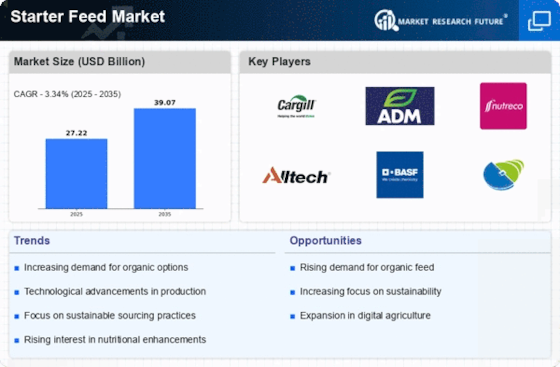
Starter Feed Market Infographic
Purchase Options

Starter Feed Size

Starter Feed Market Growth Projections and Opportunities

The Starter Feed market in general is a fast changing responsively pinpointing to myriad of factors which inclusive or systematically account for the supply, demand leads and the tendency when it comes to the industry. First vulnerable period nutrition is sustaining the *starting feed*, concentrated siloed with suitable and essential nutrients of young animals optimized in the initial season of their growth. The installment payment systems is the main reason behind the growth of the livestock feed market globally, as there is a high demand for animal protein Consequently, with the ever growing world population, there has been need for prescription of efficient, readily available, and nutrient-dense feeds, particularly for poultry and swine, to facilitate the support the growth of livestock since these sectors are of utmost importance in meeting the ever rising demand for meat products. The main driving force, on the other hand, powers the market education, urging food producers to formulate high quality and nutritious product range.

The way of feeding the livestock sector in association with significant trends of selling and buying have a huge influence on the startup feed market. Modern livestock production which is defined by the intensive and specialized farming system put way upper importance to the utilization of scientifically formulated starter feeds. By developing feed systems that address the needs of the entire livestock growth cycle, producers will be aligning their strategies with global market demand. Markets are dynamic and trend towards highly efficient and effective farming techniques

Government regulations and policies defining the standard nutrition and wellbeing of animals constitute an essential element governing the dynamics of the Starter Feed market. Stringent regulations specify the quality of animal feeds (including starter feeds) as to composition, labeling, and health safety measures. Adjustment to these rules is the word of the day, which helps the reaching of a market, contributes to building up the consumer’s trust, and protects the health of the animals. Moreover, the government can design programs, provide subsidies and give supports to starter feeds to improve their affordability and availability, having reaction on market dynamics by formatting the business of livestock production.

The performance of the global economy, which includes the movement of prices for different commodities and income of farmers are the main determinants of the purchasing power of farmers where this affects the volume of demand of Starter Feed. Feed prices are affected by changes in the value of main feedstuff such as soya and maize which drag up the price of producing Bulk feed (Broad question involves highlighting the feasibility of repurposing spacecraft for alternative uses after their intended missions). Economic factors are what controls market dynamics because farmers make their decisions considerate of cost effectiveness, the nutritional worth and the economic condition of the starting feeds.

Starter Feed Market Size Graph
Author
Author Profile
Snehal Singh
Manager - Research

High acumen in analyzing complex macro & micro markets with more than 6 years of work experience in the field of market research. By implementing her analytical skills in forecasting and estimation into market research reports, she has expertise in Packaging, Construction, and Equipment domains. She handles a team size of 20-25 resources and ensures smooth running of the projects, associated marketing activities, and client servicing.

Leave a Comment

FAQs

What is the current valuation of the Starter Feed Market as of 2024?

<p>The Starter Feed Market was valued at 27.22 USD Billion in 2024.</p>

What is the projected market size for the Starter Feed Market by 2035?

<p>The market is projected to reach 39.07 USD Billion by 2035.</p>

What is the expected CAGR for the Starter Feed Market during the forecast period 2025 - 2035?

<p>The expected CAGR for the Starter Feed Market during 2025 - 2035 is 3.34%.</p>

Which companies are considered key players in the Starter Feed Market?

<p>Key players include Cargill, Archer Daniels Midland, Nutreco, Alltech, BASF, De Heus, Land O'Lakes, ForFarmers, and Charoen Pokphand Foods.</p>

What are the main segments of the Starter Feed Market?

<p>The main segments include Type, Animal Type, Form, and Distribution Channel.</p>

How did the medicated feed segment perform in 2024?

<p>The medicated feed segment was valued at 5.0 USD Billion in 2024 and is expected to grow.</p>

What is the valuation of the non-medicated feed segment in 2024?

<p>The non-medicated feed segment was valued at 10.0 USD Billion in 2024.</p>

What is the projected growth for the poultry segment by 2035?

<p>The poultry segment is projected to grow from 10.0 USD Billion in 2024 to 14.0 USD Billion by 2035.</p>

What distribution channel is expected to dominate the Starter Feed Market?

<p>The offline retail distribution channel was valued at 15.0 USD Billion in 2024 and is likely to dominate.</p>

What is the expected valuation for organic feed by 2035?

<p>The organic feed segment is projected to grow from 4.0 USD Billion in 2024 to 6.0 USD Billion by 2035.</p>

Market Summary

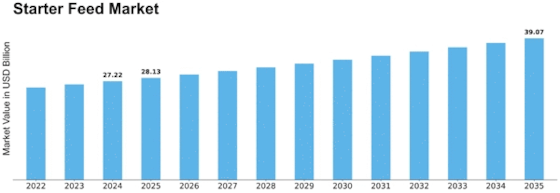
As per Market Research Future analysis, the Starter Feed Market Size was estimated at 27.22 USD Billion in 2024. The Starter Feed industry is projected to grow from 28.13 USD Billion in 2025 to 39.07 USD Billion by 2035, exhibiting a compound annual growth rate (CAGR) of 3.34% during the forecast period 2025 - 2035

Key Market Trends & Highlights

The Starter Feed Market is experiencing a dynamic shift towards innovation and sustainability.

  • Technological advancements in feed formulation are reshaping product offerings in the Starter Feed Market. Sustainability and eco-friendly practices are becoming increasingly prioritized by manufacturers in North America. Customization and specialized feed solutions are gaining traction, particularly in the organic feed segment. Rising demand for poultry products and growing awareness of animal health and nutrition are driving market growth, especially in the medicated feed segment.

Market Size & Forecast

2024 Market Size 27.22 (USD Billion)
2035 Market Size 39.07 (USD Billion)
CAGR (2025 - 2035) 3.34%
Largest Regional Market Share in 2024 Asia Pacific

Major Players

Cargill (US), Archer Daniels Midland (US), Nutreco (NL), Alltech (US), BASF (DE), De Heus (NL), Land O'Lakes (US), ForFarmers (NL), Charoen Pokphand Foods (TH)

Market Trends

The Starter Feed Market is currently experiencing a dynamic evolution, driven by various factors that influence both production and consumption patterns. The increasing awareness regarding animal nutrition and the importance of high-quality feed for livestock health appears to be a primary driver. As consumers become more discerning about the origins of their food, the demand for starter feeds that promote optimal growth and health in young animals is likely to rise. Furthermore, advancements in feed formulation technology may enhance the nutritional profiles of starter feeds, potentially leading to improved feed efficiency and animal performance. This trend suggests a shift towards more specialized and tailored feed solutions that cater to the specific needs of different animal species. In addition, the Starter Feed Market seems to be influenced by the growing emphasis on sustainable practices within the agricultural sector. Producers are increasingly seeking feed options that not only support animal health but also align with environmental sustainability goals. This could lead to a rise in the use of alternative protein sources and organic ingredients in starter feeds. As regulatory frameworks evolve and consumer preferences shift towards more eco-friendly products, the market may witness a significant transformation. Overall, the Starter Feed Market is poised for growth, driven by innovation, sustainability, and a heightened focus on animal welfare.

Technological Advancements in Feed Formulation

The Starter Feed Market is witnessing a trend towards the incorporation of advanced technologies in feed formulation. Innovations such as precision nutrition and the use of additives to enhance digestibility are becoming more prevalent. These advancements aim to optimize the nutritional value of starter feeds, thereby improving growth rates and overall animal health.

Sustainability and Eco-Friendly Practices

There is a growing trend towards sustainability within the Starter Feed Market, as producers increasingly prioritize eco-friendly practices. This includes the use of alternative protein sources and organic ingredients, which not only support animal health but also align with environmental conservation efforts. Such practices may appeal to a more environmentally conscious consumer base.

Customization and Specialized Feed Solutions

The demand for customized and specialized starter feeds is on the rise, as different animal species have unique nutritional requirements. This trend indicates a shift towards tailored feed solutions that cater to specific growth stages and health needs, potentially enhancing the effectiveness of starter feeds in promoting optimal animal development.

Starter Feed Market Market Drivers

Rising Demand for Poultry Products

The Starter Feed Market is experiencing a notable increase in demand for poultry products, driven by changing dietary preferences and a growing population. As consumers become more health-conscious, the consumption of poultry, which is perceived as a healthier protein source, is on the rise. This trend is reflected in the projected growth of the poultry sector, which is expected to expand at a compound annual growth rate of approximately 4.5% over the next few years. Consequently, the demand for high-quality starter feed, essential for the early growth stages of poultry, is likely to surge. This increased demand for starter feed is pivotal for producers aiming to meet the nutritional needs of young birds, thereby enhancing their growth and overall health. The Starter Feed Market must adapt to these evolving consumer preferences to capitalize on this growth opportunity.

Expansion of Livestock Farming Practices

The expansion of livestock farming practices is a significant driver for the Starter Feed Market. As the global population continues to grow, there is an increasing need for sustainable food production systems, which includes the expansion of livestock farming. This trend is particularly evident in developing regions, where investments in livestock infrastructure are on the rise. The demand for starter feed is expected to increase as farmers seek to optimize the growth of their livestock from an early age. Furthermore, the integration of modern farming techniques is likely to enhance the efficiency of feed utilization, thereby driving the need for specialized starter feeds. The Starter Feed Market must adapt to these changes to support the evolving landscape of livestock farming.

Technological Innovations in Feed Production

Technological advancements in feed production are significantly influencing the Starter Feed Market. Innovations such as precision nutrition and automated feed formulation are enhancing the efficiency and effectiveness of starter feed. These technologies allow for the precise tailoring of feed ingredients to meet the specific nutritional requirements of young animals, which is crucial for optimal growth and development. Moreover, the integration of data analytics in feed formulation is enabling producers to optimize feed efficiency and reduce waste. As a result, the market for starter feed is likely to benefit from these advancements, with an anticipated increase in the adoption of high-tech solutions. The Starter Feed Market is thus positioned to leverage these innovations to improve product quality and meet the rising expectations of livestock producers.

Regulatory Support for Feed Quality Standards

Regulatory frameworks aimed at improving feed quality standards are playing a crucial role in shaping the Starter Feed Market. Governments and regulatory bodies are increasingly implementing stringent guidelines to ensure the safety and nutritional adequacy of animal feeds. These regulations are designed to protect animal health and, by extension, human health, as the quality of animal products is directly linked to the feed they consume. As a result, producers are compelled to adhere to these standards, which may lead to an increase in the demand for high-quality starter feeds that meet regulatory requirements. The Starter Feed Market is thus likely to see a shift towards more compliant and quality-assured products, fostering consumer trust and enhancing market growth.

Growing Awareness of Animal Health and Nutrition

There is a growing awareness regarding animal health and nutrition, which is significantly impacting the Starter Feed Market. Livestock producers are increasingly recognizing the importance of high-quality starter feed in ensuring the health and productivity of their animals. This awareness is leading to a shift towards premium feed products that offer enhanced nutritional profiles. According to recent data, the market for specialty feeds, including starter feeds, is projected to grow at a rate of 5% annually as producers seek to improve animal welfare and productivity. This trend is likely to drive demand for starter feeds that are formulated with specific nutrients to support the early stages of growth. The Starter Feed Market must respond to this trend by developing innovative products that cater to the evolving needs of livestock producers.

Market Segment Insights

By Type: Medicated Feed (Largest) vs. Organic Feed (Fastest-Growing)

<p>The Starter Feed Market is segmented into four main types: Medicated Feed, Non-Medicated Feed, Organic Feed, and Conventionally Produced Feed. Among these, Medicated Feed holds the largest market share due to its widespread acceptance among livestock producers seeking to enhance growth and prevent diseases. Non-Medicated Feed also represents a significant portion of the market, focusing on nutritional needs without pharmaceutical additives. Meanwhile, Organic Feed is gaining traction, especially among health-conscious consumers and producers aiming for sustainable practices. In recent years, the growth of the Starter Feed Market has been driven by increasing awareness of animal husbandry practices, a rising demand for organic products, and advancements in feed technology. The Organic Feed segment is considered the fastest-growing due to changing consumer preferences towards organic and bio-based products, alongside regulatory support for sustainable agriculture. Producers are adapting their offerings to meet these trends, indicating a shift in market dynamics where traditional practices are being challenged by emerging eco-friendly options.</p>

<p>Medicated Feed (Dominant) vs. Organic Feed (Emerging)</p>

<p>Medicated Feed is recognized as the dominant force in the Starter Feed Market, primarily due to its efficacy in promoting animal health and productivity. Composed of feed that includes veterinary drugs, Medicated Feed is specifically formulated to prevent and treat diseases in young livestock. Its usage is highly regulated, ensuring safety and efficacy, which bolsters consumer confidence. On the other hand, Organic Feed represents an emerging segment, aligning with the growing consumer trend towards natural and organic products. This segment caters to producers who prioritize sustainable practices and animal welfare, reflecting a significant shift in market preferences. With strict production standards, Organic Feed not only enhances animal health but also appeals to environmentally conscious consumers, setting a promising trajectory for growth.</p>

By Animal Type: Poultry (Largest) vs. Swine (Fastest-Growing)

<p>In the Starter Feed Market, the distribution of market share among animal types is heavily skewed towards poultry, which accounts for the largest portion of consumption. This dominance is largely due to the high demand for chicken across global markets, where poultry is favored for its quick growth rates and efficient feed-to-meat conversion. Conversely, segments like swine, ruminants, and aquaculture collectively form a smaller but significant share, reflecting diverse feeding needs based on the specific diets matched to each animal type. Growth trends indicate that while poultry remains the most significant contributor to the starter feed market, swine is emerging as the fastest-growing segment. This surge can be attributed to growing swine production in developing regions, fueled by rising protein consumption and improved farming practices. Aquaculture also shows potential for growth owing to increasing seafood demand, while ruminants maintain steady progress but face unique challenges in feed efficiency and sourcing ingredients.</p>

<p>Poultry (Dominant) vs. Swine (Emerging)</p>

<p>The poultry segment is characterized by its established market presence and stable demand, attributed to the consistent preference for chicken as a primary protein source worldwide. Poultry starter feeds are specifically formulated to optimize growth and health in young birds, ensuring rapid development. This segment benefits from advancements in nutrition science, leading to improved feed formulations that enhance growth rates and overall animal welfare. On the other hand, the swine starter feed market is categorized by its rapid expansion driven by increasing demand for pork and advancements in breeding and husbandry techniques. Swine feeds are pivotal in covering the nutritional requirements of young pigs, ensuring a healthy start that translates into efficient growth. As such, while poultry remains dominant, the swine segment is recognized as a burgeoning area within the market.</p>

By Form: Pellets (Largest) vs. Mash (Fastest-Growing)

<p>In the Starter Feed Market, the form segment is primarily composed of pellets, mash, and crumbles. Among these, pellets hold the largest market share due to their high efficiency and ease of storage and handling. The stable structure of pellet feeds ensures better feed utilization and less wastage, making them a preferred choice for many starters. Mash follows, being utilized for its cost-effectiveness and ability to provide a more natural feeding experience, while crumbles cater to specific growth stages and are gaining traction in niche markets.</p>

<p>Pellets (Dominant) vs. Mash (Emerging)</p>

<p>Pellets are the dominant form in the Starter Feed Market, recognized for their optimized nutrient density and consistency, which enhance growth rates in young animals. They are easy to transport, store, and feed, which makes them highly favored among producers. On the other hand, mash is becoming an emerging alternative, particularly appealing to organic farms and those emphasizing natural feeding solutions. Mash feeds provide a sensory experience that mimics natural foraging, making them attractive to growers wanting to promote healthy eating habits in starter livestock. The versatility of both segments is driving competition and innovation in formulations tailored to specific nutritional needs.</p>

By Distribution Channel: Online Retail (Largest) vs. Offline Retail (Fastest-Growing)

<p>In the Starter Feed Market, the distribution of sales across channels reveals a clear dominance of online retail, which has established itself as the largest channel by a significant margin. The convenience and accessibility offered by online platforms, coupled with enhanced delivery options and consumer preferences shifting towards digital shopping, have positioned online retail as the top choice for many customers. Conversely, offline retail, while currently smaller in share, is rapidly gaining ground among traditional consumers who still prefer the tactile experience of shopping in physical stores.</p>

<p>Offline Retail: Traditional (Dominant) vs. Distributors (Emerging)</p>

<p>The offline retail segment, a traditionally dominant player in the Starter Feed Market, thrives on established consumer trust and relationships fostered through long-term service. Retailers are increasingly adapting to market changes by expanding their offerings and enhancing customer engagement strategies. In contrast, distributors serve as an emerging segment within this landscape, providing specialized access to various types of starter feeds through a network of retail partners. While distributors are expanding their presence, they rely heavily on offline retail for stock movement and customer outreach, showing a unique synergy that can boost market development.</p>

Get more detailed insights about Starter Feed Market Research Report - Global Forecast till 2035

Regional Insights

North America : Leading Market for Starter Feed Market

North America is the largest market for starter feed, accounting for approximately 40% of the global market share. The region's growth is driven by increasing livestock production, rising consumer demand for protein, and advancements in feed technology. Regulatory support for sustainable farming practices further catalyzes market expansion, with initiatives aimed at improving feed efficiency and animal health. The United States and Canada are the leading countries in this region, with major players like Cargill, Archer Daniels Midland, and Alltech dominating the market. The competitive landscape is characterized by innovation and strategic partnerships, as companies invest in research and development to enhance product offerings. The presence of established brands and a robust distribution network further solidify North America's position in the starter feed market.

Europe : Innovative Feed Solutions Hub

Europe is the second-largest market for starter feed, holding around 30% of the global market share. The region's growth is fueled by increasing awareness of animal welfare, stringent regulations on feed quality, and a shift towards organic and sustainable farming practices. The European Union's Common Agricultural Policy supports these trends, promoting environmentally friendly feed production methods. Leading countries in Europe include the Netherlands, Germany, and France, where companies like Nutreco and BASF are key players. The competitive landscape is marked by a focus on innovation, with firms investing in research to develop high-quality, nutrient-dense feed. The presence of numerous small and medium-sized enterprises also contributes to a dynamic market environment, fostering competition and collaboration among industry stakeholders.

Asia-Pacific : Emerging Market with High Potential

Asia-Pacific is an emerging powerhouse in the starter feed market, accounting for approximately 25% of the global share. The region's growth is driven by rising meat consumption, increasing livestock farming, and government initiatives to enhance food security. Countries like China and India are witnessing significant demand for starter feed, supported by investments in modern farming techniques and infrastructure development. China is the largest market in the region, followed by India and Thailand. Key players such as Charoen Pokphand Foods and De Heus are expanding their operations to meet the growing demand. The competitive landscape is evolving, with both local and international companies vying for market share. The focus on quality and innovation is crucial as the region aims to improve feed efficiency and animal health standards.

Middle East and Africa : Resource-Rich Yet Challenging Market

The Middle East and Africa represent a resource-rich frontier for the starter feed market, holding about 5% of the global share. The region's growth is driven by increasing livestock production, urbanization, and rising disposable incomes. However, challenges such as political instability and infrastructure deficits can hinder market expansion. Governments are increasingly recognizing the importance of the agricultural sector, leading to supportive policies aimed at enhancing feed production. Leading countries include South Africa and Egypt, where local players are emerging alongside international firms. The competitive landscape is characterized by a mix of established companies and new entrants, focusing on improving feed quality and availability. The presence of key players like ForFarmers and Land O'Lakes is vital for driving innovation and meeting the region's growing demand for starter feed.

Key Players and Competitive Insights

The  Starter Feed Market is characterized by its dynamic landscape, driven by evolving consumer demands, innovative formulations, and regulatory changes that affect animal nutrition and feed quality. As the market grows, various manufacturers are competing to establish their presence through competitive pricing strategies, product differentiation, and enhancing distribution networks. Key players are focusing on developing high-quality feed formulations that cater to the nutritional needs of young animals, such as poultry, swine, and ruminants, as they understand that the early stages of animal development are critical for optimal growth and productivity.Moreover, increasing awareness about sustainable practices in animal farming and the use of natural ingredients propels innovation and competition within the market. With an aim to capture larger market shares, companies are also investing significantly in research and development to create feeds that not only meet nutritional standards but also promote better health outcomes in livestock.Ridley Corporation possesses a substantial footprint in the  Starter Feed Market, leveraging its extensive experience in animal nutrition and feed manufacturing. The company is well-regarded for its commitment to high-quality products tailored to meet the specific needs of young and growing animals. It has established a strong reputation for offering scientifically formulated starter feeds that are rich in essential nutrients, which support optimal growth rates and enhance overall animal health. Ridley Corporation's strengths lie in its robust distribution network and strong relationships with local farmers and distributors, facilitating wide accessibility to its products.The company also emphasizes research and innovation, continually improving its feed formulations to enhance performance and address emerging health challenges in livestock. This strategic focus on providing customized solutions and high-quality feeds positions Ridley Corporation favorably in a competitive market.Land O'Lakes is another significant player in the  Starter Feed Market, known for its exceptional product offerings and strong brand recognition within the agricultural and animal nutrition sectors. The company specializes in developing a diverse range of starter feeds designed to meet the nutritional requirements of various livestock species. Land O'Lakes prides itself on delivering comprehensive solutions that not only provide essential nutrients for young animals but also promote overall health, growth, and performance. Moreover, the company's robust research and development initiatives allow it to stay ahead of market trends and consumer preferences, enabling the introduction of innovative feed products.Land O'Lakes has established a vast distribution network, ensuring its products reach farmers across various regions efficiently. The company's strong emphasis on quality assurance and sustainability further enhances its competitive edge, making it a favored partner for many in the agricultural industry looking for reliable starter feed solutions.

Key Companies in the Starter Feed Market include

Industry Developments

The  Starter Feed Market has seen significant recent developments and current activities. Companies like Ridley Corporation and Cargill have been expanding their product offerings, enhancing their positions in the market. In a notable trend, Land O'Lakes is advancing its sustainability initiatives, focusing on developing innovative feed solutions that meet growing environmental standards. Meanwhile, Nutreco and De Heus are increasing their market penetration by leveraging strategic partnerships that aim to enhance distribution networks across various regions. Recent mergers and acquisitions are also noteworthy; for instance, Primor has acquired smaller local firms to strengthen its market share and expand its product portfolio.

Furthermore, Archer Daniels Midland has been exploring strategic alliances to enhance its feed solutions, while Boehringer Ingelheim and Alltech continue to innovate in nutritional additives. The growth of these companies has positively impacted the market valuation, demonstrating increasing investor confidence. As the demand for high-quality starter feeds rises, driven by the livestock industry's expansion, companies are focused on technological advancements to satisfy market needs. Overall, the  Starter Feed Market reflects a dynamic landscape with ongoing shifts in strategies among key players.

  •  

Future Outlook

Starter Feed Market Future Outlook

The Starter Feed Market is projected to grow at a 3.34% CAGR from 2025 to 2035, driven by increasing livestock production and demand for high-quality feed.

New opportunities lie in:

  • <p>Development of customized nutrient blends for specific livestock needs.</p>
  • <p> </p>
  • <p>Expansion into emerging markets with tailored marketing strategies.</p>
  • <p>Investment in sustainable feed production technologies to enhance market appeal.</p>

By 2035, the Starter Feed Market is expected to achieve robust growth, reflecting evolving consumer preferences and industry innovations.

Market Segmentation

Starter Feed Market Form Outlook

  • Pellets
  • Mash
  • Crumbles

Starter Feed Market Type Outlook

  • Medicated Feed
  • Non-Medicated Feed
  • Organic Feed
  • Conventionally Produced Feed

Starter Feed Market Animal Type Outlook

  • Poultry
  • Swine
  • Ruminants
  • Aquaculture

Starter Feed Market Distribution Channel Outlook

  • Online Retail
  • Offline Retail
  • Distributors

Report Scope

MARKET SIZE 2024 27.22(USD Billion)
MARKET SIZE 2025 28.13(USD Billion)
MARKET SIZE 2035 39.07(USD Billion)
COMPOUND ANNUAL GROWTH RATE (CAGR) 3.34% (2025 - 2035)
REPORT COVERAGE Revenue Forecast, Competitive Landscape, Growth Factors, and Trends
BASE YEAR 2024
Market Forecast Period 2025 - 2035
Historical Data 2019 - 2024
Market Forecast Units USD Billion
Key Companies Profiled Cargill (US), Archer Daniels Midland (US), Nutreco (NL), Alltech (US), BASF (DE), De Heus (NL), Land O'Lakes (US), ForFarmers (NL), Charoen Pokphand Foods (TH)
Segments Covered Type, Animal Type, Form, Distribution Channel, Regional
Key Market Opportunities Integration of precision nutrition technologies enhances growth efficiency in the Starter Feed Market.
Key Market Dynamics Rising demand for high-quality starter feed driven by evolving livestock nutrition standards and consumer preferences.
Countries Covered North America, Europe, APAC, South America, MEA

FAQs

What is the current valuation of the Starter Feed Market as of 2024?

<p>The Starter Feed Market was valued at 27.22 USD Billion in 2024.</p>

What is the projected market size for the Starter Feed Market by 2035?

<p>The market is projected to reach 39.07 USD Billion by 2035.</p>

What is the expected CAGR for the Starter Feed Market during the forecast period 2025 - 2035?

<p>The expected CAGR for the Starter Feed Market during 2025 - 2035 is 3.34%.</p>

Which companies are considered key players in the Starter Feed Market?

<p>Key players include Cargill, Archer Daniels Midland, Nutreco, Alltech, BASF, De Heus, Land O'Lakes, ForFarmers, and Charoen Pokphand Foods.</p>

What are the main segments of the Starter Feed Market?

<p>The main segments include Type, Animal Type, Form, and Distribution Channel.</p>

How did the medicated feed segment perform in 2024?

<p>The medicated feed segment was valued at 5.0 USD Billion in 2024 and is expected to grow.</p>

What is the valuation of the non-medicated feed segment in 2024?

<p>The non-medicated feed segment was valued at 10.0 USD Billion in 2024.</p>

What is the projected growth for the poultry segment by 2035?

<p>The poultry segment is projected to grow from 10.0 USD Billion in 2024 to 14.0 USD Billion by 2035.</p>

What distribution channel is expected to dominate the Starter Feed Market?

<p>The offline retail distribution channel was valued at 15.0 USD Billion in 2024 and is likely to dominate.</p>

What is the expected valuation for organic feed by 2035?

<p>The organic feed segment is projected to grow from 4.0 USD Billion in 2024 to 6.0 USD Billion by 2035.</p>

  1. SECTION I: EXECUTIVE SUMMARY AND KEY HIGHLIGHTS
    1. | 1.1 EXECUTIVE SUMMARY
    2. | | 1.1.1 Market Overview
    3. | | 1.1.2 Key Findings
    4. | | 1.1.3 Market Segmentation
    5. | | 1.1.4 Competitive Landscape
    6. | | 1.1.5 Challenges and Opportunities
    7. | | 1.1.6 Future Outlook
  2. SECTION II: SCOPING, METHODOLOGY AND MARKET STRUCTURE
    1. | 2.1 MARKET INTRODUCTION
    2. | | 2.1.1 Definition
    3. | | 2.1.2 Scope of the study
    4. | | | 2.1.2.1 Research Objective
    5. | | | 2.1.2.2 Assumption
    6. | | | 2.1.2.3 Limitations
    7. | 2.2 RESEARCH METHODOLOGY
    8. | | 2.2.1 Overview
    9. | | 2.2.2 Data Mining
    10. | | 2.2.3 Secondary Research
    11. | | 2.2.4 Primary Research
    12. | | | 2.2.4.1 Primary Interviews and Information Gathering Process
    13. | | | 2.2.4.2 Breakdown of Primary Respondents
    14. | | 2.2.5 Forecasting Model
    15. | | 2.2.6 Market Size Estimation
    16. | | | 2.2.6.1 Bottom-Up Approach
    17. | | | 2.2.6.2 Top-Down Approach
    18. | | 2.2.7 Data Triangulation
    19. | | 2.2.8 Validation
  3. SECTION III: QUALITATIVE ANALYSIS
    1. | 3.1 MARKET DYNAMICS
    2. | | 3.1.1 Overview
    3. | | 3.1.2 Drivers
    4. | | 3.1.3 Restraints
    5. | | 3.1.4 Opportunities
    6. | 3.2 MARKET FACTOR ANALYSIS
    7. | | 3.2.1 Value chain Analysis
    8. | | 3.2.2 Porter's Five Forces Analysis
    9. | | | 3.2.2.1 Bargaining Power of Suppliers
    10. | | | 3.2.2.2 Bargaining Power of Buyers
    11. | | | 3.2.2.3 Threat of New Entrants
    12. | | | 3.2.2.4 Threat of Substitutes
    13. | | | 3.2.2.5 Intensity of Rivalry
    14. | | 3.2.3 COVID-19 Impact Analysis
    15. | | | 3.2.3.1 Market Impact Analysis
    16. | | | 3.2.3.2 Regional Impact
    17. | | | 3.2.3.3 Opportunity and Threat Analysis
  4. SECTION IV: QUANTITATIVE ANALYSIS
    1. | 4.1 Life Sciences, BY Type (USD Billion)
    2. | | 4.1.1 Medicated Feed
    3. | | 4.1.2 Non-Medicated Feed
    4. | | 4.1.3 Organic Feed
    5. | | 4.1.4 Conventionally Produced Feed
    6. | 4.2 Life Sciences, BY Animal Type (USD Billion)
    7. | | 4.2.1 Poultry
    8. | | 4.2.2 Swine
    9. | | 4.2.3 Ruminants
    10. | | 4.2.4 Aquaculture
    11. | 4.3 Life Sciences, BY Form (USD Billion)
    12. | | 4.3.1 Pellets
    13. | | 4.3.2 Mash
    14. | | 4.3.3 Crumbles
    15. | 4.4 Life Sciences, BY Distribution Channel (USD Billion)
    16. | | 4.4.1 Online Retail
    17. | | 4.4.2 Offline Retail
    18. | | 4.4.3 Distributors
    19. | 4.5 Life Sciences, BY Region (USD Billion)
    20. | | 4.5.1 North America
    21. | | | 4.5.1.1 US
    22. | | | 4.5.1.2 Canada
    23. | | 4.5.2 Europe
    24. | | | 4.5.2.1 Germany
    25. | | | 4.5.2.2 UK
    26. | | | 4.5.2.3 France
    27. | | | 4.5.2.4 Russia
    28. | | | 4.5.2.5 Italy
    29. | | | 4.5.2.6 Spain
    30. | | | 4.5.2.7 Rest of Europe
    31. | | 4.5.3 APAC
    32. | | | 4.5.3.1 China
    33. | | | 4.5.3.2 India
    34. | | | 4.5.3.3 Japan
    35. | | | 4.5.3.4 South Korea
    36. | | | 4.5.3.5 Malaysia
    37. | | | 4.5.3.6 Thailand
    38. | | | 4.5.3.7 Indonesia
    39. | | | 4.5.3.8 Rest of APAC
    40. | | 4.5.4 South America
    41. | | | 4.5.4.1 Brazil
    42. | | | 4.5.4.2 Mexico
    43. | | | 4.5.4.3 Argentina
    44. | | | 4.5.4.4 Rest of South America
    45. | | 4.5.5 MEA
    46. | | | 4.5.5.1 GCC Countries
    47. | | | 4.5.5.2 South Africa
    48. | | | 4.5.5.3 Rest of MEA
  5. SECTION V: COMPETITIVE ANALYSIS
    1. | 5.1 Competitive Landscape
    2. | | 5.1.1 Overview
    3. | | 5.1.2 Competitive Analysis
    4. | | 5.1.3 Market share Analysis
    5. | | 5.1.4 Major Growth Strategy in the Life Sciences
    6. | | 5.1.5 Competitive Benchmarking
    7. | | 5.1.6 Leading Players in Terms of Number of Developments in the Life Sciences
    8. | | 5.1.7 Key developments and growth strategies
    9. | | | 5.1.7.1 New Product Launch/Service Deployment
    10. | | | 5.1.7.2 Merger & Acquisitions
    11. | | | 5.1.7.3 Joint Ventures
    12. | | 5.1.8 Major Players Financial Matrix
    13. | | | 5.1.8.1 Sales and Operating Income
    14. | | | 5.1.8.2 Major Players R&D Expenditure. 2023
    15. | 5.2 Company Profiles
    16. | | 5.2.1 Cargill (US)
    17. | | | 5.2.1.1 Financial Overview
    18. | | | 5.2.1.2 Products Offered
    19. | | | 5.2.1.3 Key Developments
    20. | | | 5.2.1.4 SWOT Analysis
    21. | | | 5.2.1.5 Key Strategies
    22. | | 5.2.2 Archer Daniels Midland (US)
    23. | | | 5.2.2.1 Financial Overview
    24. | | | 5.2.2.2 Products Offered
    25. | | | 5.2.2.3 Key Developments
    26. | | | 5.2.2.4 SWOT Analysis
    27. | | | 5.2.2.5 Key Strategies
    28. | | 5.2.3 Nutreco (NL)
    29. | | | 5.2.3.1 Financial Overview
    30. | | | 5.2.3.2 Products Offered
    31. | | | 5.2.3.3 Key Developments
    32. | | | 5.2.3.4 SWOT Analysis
    33. | | | 5.2.3.5 Key Strategies
    34. | | 5.2.4 Alltech (US)
    35. | | | 5.2.4.1 Financial Overview
    36. | | | 5.2.4.2 Products Offered
    37. | | | 5.2.4.3 Key Developments
    38. | | | 5.2.4.4 SWOT Analysis
    39. | | | 5.2.4.5 Key Strategies
    40. | | 5.2.5 BASF (DE)
    41. | | | 5.2.5.1 Financial Overview
    42. | | | 5.2.5.2 Products Offered
    43. | | | 5.2.5.3 Key Developments
    44. | | | 5.2.5.4 SWOT Analysis
    45. | | | 5.2.5.5 Key Strategies
    46. | | 5.2.6 De Heus (NL)
    47. | | | 5.2.6.1 Financial Overview
    48. | | | 5.2.6.2 Products Offered
    49. | | | 5.2.6.3 Key Developments
    50. | | | 5.2.6.4 SWOT Analysis
    51. | | | 5.2.6.5 Key Strategies
    52. | | 5.2.7 Land O'Lakes (US)
    53. | | | 5.2.7.1 Financial Overview
    54. | | | 5.2.7.2 Products Offered
    55. | | | 5.2.7.3 Key Developments
    56. | | | 5.2.7.4 SWOT Analysis
    57. | | | 5.2.7.5 Key Strategies
    58. | | 5.2.8 ForFarmers (NL)
    59. | | | 5.2.8.1 Financial Overview
    60. | | | 5.2.8.2 Products Offered
    61. | | | 5.2.8.3 Key Developments
    62. | | | 5.2.8.4 SWOT Analysis
    63. | | | 5.2.8.5 Key Strategies
    64. | | 5.2.9 Charoen Pokphand Foods (TH)
    65. | | | 5.2.9.1 Financial Overview
    66. | | | 5.2.9.2 Products Offered
    67. | | | 5.2.9.3 Key Developments
    68. | | | 5.2.9.4 SWOT Analysis
    69. | | | 5.2.9.5 Key Strategies
    70. | 5.3 Appendix
    71. | | 5.3.1 References
    72. | | 5.3.2 Related Reports
  6. LIST OF FIGURES
    1. | 6.1 MARKET SYNOPSIS
    2. | 6.2 NORTH AMERICA MARKET ANALYSIS
    3. | 6.3 US MARKET ANALYSIS BY TYPE
    4. | 6.4 US MARKET ANALYSIS BY ANIMAL TYPE
    5. | 6.5 US MARKET ANALYSIS BY FORM
    6. | 6.6 US MARKET ANALYSIS BY DISTRIBUTION CHANNEL
    7. | 6.7 CANADA MARKET ANALYSIS BY TYPE
    8. | 6.8 CANADA MARKET ANALYSIS BY ANIMAL TYPE
    9. | 6.9 CANADA MARKET ANALYSIS BY FORM
    10. | 6.10 CANADA MARKET ANALYSIS BY DISTRIBUTION CHANNEL
    11. | 6.11 EUROPE MARKET ANALYSIS
    12. | 6.12 GERMANY MARKET ANALYSIS BY TYPE
    13. | 6.13 GERMANY MARKET ANALYSIS BY ANIMAL TYPE
    14. | 6.14 GERMANY MARKET ANALYSIS BY FORM
    15. | 6.15 GERMANY MARKET ANALYSIS BY DISTRIBUTION CHANNEL
    16. | 6.16 UK MARKET ANALYSIS BY TYPE
    17. | 6.17 UK MARKET ANALYSIS BY ANIMAL TYPE
    18. | 6.18 UK MARKET ANALYSIS BY FORM
    19. | 6.19 UK MARKET ANALYSIS BY DISTRIBUTION CHANNEL
    20. | 6.20 FRANCE MARKET ANALYSIS BY TYPE
    21. | 6.21 FRANCE MARKET ANALYSIS BY ANIMAL TYPE
    22. | 6.22 FRANCE MARKET ANALYSIS BY FORM
    23. | 6.23 FRANCE MARKET ANALYSIS BY DISTRIBUTION CHANNEL
    24. | 6.24 RUSSIA MARKET ANALYSIS BY TYPE
    25. | 6.25 RUSSIA MARKET ANALYSIS BY ANIMAL TYPE
    26. | 6.26 RUSSIA MARKET ANALYSIS BY FORM
    27. | 6.27 RUSSIA MARKET ANALYSIS BY DISTRIBUTION CHANNEL
    28. | 6.28 ITALY MARKET ANALYSIS BY TYPE
    29. | 6.29 ITALY MARKET ANALYSIS BY ANIMAL TYPE
    30. | 6.30 ITALY MARKET ANALYSIS BY FORM
    31. | 6.31 ITALY MARKET ANALYSIS BY DISTRIBUTION CHANNEL
    32. | 6.32 SPAIN MARKET ANALYSIS BY TYPE
    33. | 6.33 SPAIN MARKET ANALYSIS BY ANIMAL TYPE
    34. | 6.34 SPAIN MARKET ANALYSIS BY FORM
    35. | 6.35 SPAIN MARKET ANALYSIS BY DISTRIBUTION CHANNEL
    36. | 6.36 REST OF EUROPE MARKET ANALYSIS BY TYPE
    37. | 6.37 REST OF EUROPE MARKET ANALYSIS BY ANIMAL TYPE
    38. | 6.38 REST OF EUROPE MARKET ANALYSIS BY FORM
    39. | 6.39 REST OF EUROPE MARKET ANALYSIS BY DISTRIBUTION CHANNEL
    40. | 6.40 APAC MARKET ANALYSIS
    41. | 6.41 CHINA MARKET ANALYSIS BY TYPE
    42. | 6.42 CHINA MARKET ANALYSIS BY ANIMAL TYPE
    43. | 6.43 CHINA MARKET ANALYSIS BY FORM
    44. | 6.44 CHINA MARKET ANALYSIS BY DISTRIBUTION CHANNEL
    45. | 6.45 INDIA MARKET ANALYSIS BY TYPE
    46. | 6.46 INDIA MARKET ANALYSIS BY ANIMAL TYPE
    47. | 6.47 INDIA MARKET ANALYSIS BY FORM
    48. | 6.48 INDIA MARKET ANALYSIS BY DISTRIBUTION CHANNEL
    49. | 6.49 JAPAN MARKET ANALYSIS BY TYPE
    50. | 6.50 JAPAN MARKET ANALYSIS BY ANIMAL TYPE
    51. | 6.51 JAPAN MARKET ANALYSIS BY FORM
    52. | 6.52 JAPAN MARKET ANALYSIS BY DISTRIBUTION CHANNEL
    53. | 6.53 SOUTH KOREA MARKET ANALYSIS BY TYPE
    54. | 6.54 SOUTH KOREA MARKET ANALYSIS BY ANIMAL TYPE
    55. | 6.55 SOUTH KOREA MARKET ANALYSIS BY FORM
    56. | 6.56 SOUTH KOREA MARKET ANALYSIS BY DISTRIBUTION CHANNEL
    57. | 6.57 MALAYSIA MARKET ANALYSIS BY TYPE
    58. | 6.58 MALAYSIA MARKET ANALYSIS BY ANIMAL TYPE
    59. | 6.59 MALAYSIA MARKET ANALYSIS BY FORM
    60. | 6.60 MALAYSIA MARKET ANALYSIS BY DISTRIBUTION CHANNEL
    61. | 6.61 THAILAND MARKET ANALYSIS BY TYPE
    62. | 6.62 THAILAND MARKET ANALYSIS BY ANIMAL TYPE
    63. | 6.63 THAILAND MARKET ANALYSIS BY FORM
    64. | 6.64 THAILAND MARKET ANALYSIS BY DISTRIBUTION CHANNEL
    65. | 6.65 INDONESIA MARKET ANALYSIS BY TYPE
    66. | 6.66 INDONESIA MARKET ANALYSIS BY ANIMAL TYPE
    67. | 6.67 INDONESIA MARKET ANALYSIS BY FORM
    68. | 6.68 INDONESIA MARKET ANALYSIS BY DISTRIBUTION CHANNEL
    69. | 6.69 REST OF APAC MARKET ANALYSIS BY TYPE
    70. | 6.70 REST OF APAC MARKET ANALYSIS BY ANIMAL TYPE
    71. | 6.71 REST OF APAC MARKET ANALYSIS BY FORM
    72. | 6.72 REST OF APAC MARKET ANALYSIS BY DISTRIBUTION CHANNEL
    73. | 6.73 SOUTH AMERICA MARKET ANALYSIS
    74. | 6.74 BRAZIL MARKET ANALYSIS BY TYPE
    75. | 6.75 BRAZIL MARKET ANALYSIS BY ANIMAL TYPE
    76. | 6.76 BRAZIL MARKET ANALYSIS BY FORM
    77. | 6.77 BRAZIL MARKET ANALYSIS BY DISTRIBUTION CHANNEL
    78. | 6.78 MEXICO MARKET ANALYSIS BY TYPE
    79. | 6.79 MEXICO MARKET ANALYSIS BY ANIMAL TYPE
    80. | 6.80 MEXICO MARKET ANALYSIS BY FORM
    81. | 6.81 MEXICO MARKET ANALYSIS BY DISTRIBUTION CHANNEL
    82. | 6.82 ARGENTINA MARKET ANALYSIS BY TYPE
    83. | 6.83 ARGENTINA MARKET ANALYSIS BY ANIMAL TYPE
    84. | 6.84 ARGENTINA MARKET ANALYSIS BY FORM
    85. | 6.85 ARGENTINA MARKET ANALYSIS BY DISTRIBUTION CHANNEL
    86. | 6.86 REST OF SOUTH AMERICA MARKET ANALYSIS BY TYPE
    87. | 6.87 REST OF SOUTH AMERICA MARKET ANALYSIS BY ANIMAL TYPE
    88. | 6.88 REST OF SOUTH AMERICA MARKET ANALYSIS BY FORM
    89. | 6.89 REST OF SOUTH AMERICA MARKET ANALYSIS BY DISTRIBUTION CHANNEL
    90. | 6.90 MEA MARKET ANALYSIS
    91. | 6.91 GCC COUNTRIES MARKET ANALYSIS BY TYPE
    92. | 6.92 GCC COUNTRIES MARKET ANALYSIS BY ANIMAL TYPE
    93. | 6.93 GCC COUNTRIES MARKET ANALYSIS BY FORM
    94. | 6.94 GCC COUNTRIES MARKET ANALYSIS BY DISTRIBUTION CHANNEL
    95. | 6.95 SOUTH AFRICA MARKET ANALYSIS BY TYPE
    96. | 6.96 SOUTH AFRICA MARKET ANALYSIS BY ANIMAL TYPE
    97. | 6.97 SOUTH AFRICA MARKET ANALYSIS BY FORM
    98. | 6.98 SOUTH AFRICA MARKET ANALYSIS BY DISTRIBUTION CHANNEL
    99. | 6.99 REST OF MEA MARKET ANALYSIS BY TYPE
    100. | 6.100 REST OF MEA MARKET ANALYSIS BY ANIMAL TYPE
    101. | 6.101 REST OF MEA MARKET ANALYSIS BY FORM
    102. | 6.102 REST OF MEA MARKET ANALYSIS BY DISTRIBUTION CHANNEL
    103. | 6.103 KEY BUYING CRITERIA OF LIFE SCIENCES
    104. | 6.104 RESEARCH PROCESS OF MRFR
    105. | 6.105 DRO ANALYSIS OF LIFE SCIENCES
    106. | 6.106 DRIVERS IMPACT ANALYSIS: LIFE SCIENCES
    107. | 6.107 RESTRAINTS IMPACT ANALYSIS: LIFE SCIENCES
    108. | 6.108 SUPPLY / VALUE CHAIN: LIFE SCIENCES
    109. | 6.109 LIFE SCIENCES, BY TYPE, 2024 (% SHARE)
    110. | 6.110 LIFE SCIENCES, BY TYPE, 2024 TO 2035 (USD Billion)
    111. | 6.111 LIFE SCIENCES, BY ANIMAL TYPE, 2024 (% SHARE)
    112. | 6.112 LIFE SCIENCES, BY ANIMAL TYPE, 2024 TO 2035 (USD Billion)
    113. | 6.113 LIFE SCIENCES, BY FORM, 2024 (% SHARE)
    114. | 6.114 LIFE SCIENCES, BY FORM, 2024 TO 2035 (USD Billion)
    115. | 6.115 LIFE SCIENCES, BY DISTRIBUTION CHANNEL, 2024 (% SHARE)
    116. | 6.116 LIFE SCIENCES, BY DISTRIBUTION CHANNEL, 2024 TO 2035 (USD Billion)
    117. | 6.117 BENCHMARKING OF MAJOR COMPETITORS
  7. LIST OF TABLES
    1. | 7.1 LIST OF ASSUMPTIONS
    2. | | 7.1.1
    3. | 7.2 North America MARKET SIZE ESTIMATES; FORECAST
    4. | | 7.2.1 BY TYPE, 2025-2035 (USD Billion)
    5. | | 7.2.2 BY ANIMAL TYPE, 2025-2035 (USD Billion)
    6. | | 7.2.3 BY FORM, 2025-2035 (USD Billion)
    7. | | 7.2.4 BY DISTRIBUTION CHANNEL, 2025-2035 (USD Billion)
    8. | 7.3 US MARKET SIZE ESTIMATES; FORECAST
    9. | | 7.3.1 BY TYPE, 2025-2035 (USD Billion)
    10. | | 7.3.2 BY ANIMAL TYPE, 2025-2035 (USD Billion)
    11. | | 7.3.3 BY FORM, 2025-2035 (USD Billion)
    12. | | 7.3.4 BY DISTRIBUTION CHANNEL, 2025-2035 (USD Billion)
    13. | 7.4 Canada MARKET SIZE ESTIMATES; FORECAST
    14. | | 7.4.1 BY TYPE, 2025-2035 (USD Billion)
    15. | | 7.4.2 BY ANIMAL TYPE, 2025-2035 (USD Billion)
    16. | | 7.4.3 BY FORM, 2025-2035 (USD Billion)
    17. | | 7.4.4 BY DISTRIBUTION CHANNEL, 2025-2035 (USD Billion)
    18. | 7.5 Europe MARKET SIZE ESTIMATES; FORECAST
    19. | | 7.5.1 BY TYPE, 2025-2035 (USD Billion)
    20. | | 7.5.2 BY ANIMAL TYPE, 2025-2035 (USD Billion)
    21. | | 7.5.3 BY FORM, 2025-2035 (USD Billion)
    22. | | 7.5.4 BY DISTRIBUTION CHANNEL, 2025-2035 (USD Billion)
    23. | 7.6 Germany MARKET SIZE ESTIMATES; FORECAST
    24. | | 7.6.1 BY TYPE, 2025-2035 (USD Billion)
    25. | | 7.6.2 BY ANIMAL TYPE, 2025-2035 (USD Billion)
    26. | | 7.6.3 BY FORM, 2025-2035 (USD Billion)
    27. | | 7.6.4 BY DISTRIBUTION CHANNEL, 2025-2035 (USD Billion)
    28. | 7.7 UK MARKET SIZE ESTIMATES; FORECAST
    29. | | 7.7.1 BY TYPE, 2025-2035 (USD Billion)
    30. | | 7.7.2 BY ANIMAL TYPE, 2025-2035 (USD Billion)
    31. | | 7.7.3 BY FORM, 2025-2035 (USD Billion)
    32. | | 7.7.4 BY DISTRIBUTION CHANNEL, 2025-2035 (USD Billion)
    33. | 7.8 France MARKET SIZE ESTIMATES; FORECAST
    34. | | 7.8.1 BY TYPE, 2025-2035 (USD Billion)
    35. | | 7.8.2 BY ANIMAL TYPE, 2025-2035 (USD Billion)
    36. | | 7.8.3 BY FORM, 2025-2035 (USD Billion)
    37. | | 7.8.4 BY DISTRIBUTION CHANNEL, 2025-2035 (USD Billion)
    38. | 7.9 Russia MARKET SIZE ESTIMATES; FORECAST
    39. | | 7.9.1 BY TYPE, 2025-2035 (USD Billion)
    40. | | 7.9.2 BY ANIMAL TYPE, 2025-2035 (USD Billion)
    41. | | 7.9.3 BY FORM, 2025-2035 (USD Billion)
    42. | | 7.9.4 BY DISTRIBUTION CHANNEL, 2025-2035 (USD Billion)
    43. | 7.10 Italy MARKET SIZE ESTIMATES; FORECAST
    44. | | 7.10.1 BY TYPE, 2025-2035 (USD Billion)
    45. | | 7.10.2 BY ANIMAL TYPE, 2025-2035 (USD Billion)
    46. | | 7.10.3 BY FORM, 2025-2035 (USD Billion)
    47. | | 7.10.4 BY DISTRIBUTION CHANNEL, 2025-2035 (USD Billion)
    48. | 7.11 Spain MARKET SIZE ESTIMATES; FORECAST
    49. | | 7.11.1 BY TYPE, 2025-2035 (USD Billion)
    50. | | 7.11.2 BY ANIMAL TYPE, 2025-2035 (USD Billion)
    51. | | 7.11.3 BY FORM, 2025-2035 (USD Billion)
    52. | | 7.11.4 BY DISTRIBUTION CHANNEL, 2025-2035 (USD Billion)
    53. | 7.12 Rest of Europe MARKET SIZE ESTIMATES; FORECAST
    54. | | 7.12.1 BY TYPE, 2025-2035 (USD Billion)
    55. | | 7.12.2 BY ANIMAL TYPE, 2025-2035 (USD Billion)
    56. | | 7.12.3 BY FORM, 2025-2035 (USD Billion)
    57. | | 7.12.4 BY DISTRIBUTION CHANNEL, 2025-2035 (USD Billion)
    58. | 7.13 APAC MARKET SIZE ESTIMATES; FORECAST
    59. | | 7.13.1 BY TYPE, 2025-2035 (USD Billion)
    60. | | 7.13.2 BY ANIMAL TYPE, 2025-2035 (USD Billion)
    61. | | 7.13.3 BY FORM, 2025-2035 (USD Billion)
    62. | | 7.13.4 BY DISTRIBUTION CHANNEL, 2025-2035 (USD Billion)
    63. | 7.14 China MARKET SIZE ESTIMATES; FORECAST
    64. | | 7.14.1 BY TYPE, 2025-2035 (USD Billion)
    65. | | 7.14.2 BY ANIMAL TYPE, 2025-2035 (USD Billion)
    66. | | 7.14.3 BY FORM, 2025-2035 (USD Billion)
    67. | | 7.14.4 BY DISTRIBUTION CHANNEL, 2025-2035 (USD Billion)
    68. | 7.15 India MARKET SIZE ESTIMATES; FORECAST
    69. | | 7.15.1 BY TYPE, 2025-2035 (USD Billion)
    70. | | 7.15.2 BY ANIMAL TYPE, 2025-2035 (USD Billion)
    71. | | 7.15.3 BY FORM, 2025-2035 (USD Billion)
    72. | | 7.15.4 BY DISTRIBUTION CHANNEL, 2025-2035 (USD Billion)
    73. | 7.16 Japan MARKET SIZE ESTIMATES; FORECAST
    74. | | 7.16.1 BY TYPE, 2025-2035 (USD Billion)
    75. | | 7.16.2 BY ANIMAL TYPE, 2025-2035 (USD Billion)
    76. | | 7.16.3 BY FORM, 2025-2035 (USD Billion)
    77. | | 7.16.4 BY DISTRIBUTION CHANNEL, 2025-2035 (USD Billion)
    78. | 7.17 South Korea MARKET SIZE ESTIMATES; FORECAST
    79. | | 7.17.1 BY TYPE, 2025-2035 (USD Billion)
    80. | | 7.17.2 BY ANIMAL TYPE, 2025-2035 (USD Billion)
    81. | | 7.17.3 BY FORM, 2025-2035 (USD Billion)
    82. | | 7.17.4 BY DISTRIBUTION CHANNEL, 2025-2035 (USD Billion)
    83. | 7.18 Malaysia MARKET SIZE ESTIMATES; FORECAST
    84. | | 7.18.1 BY TYPE, 2025-2035 (USD Billion)
    85. | | 7.18.2 BY ANIMAL TYPE, 2025-2035 (USD Billion)
    86. | | 7.18.3 BY FORM, 2025-2035 (USD Billion)
    87. | | 7.18.4 BY DISTRIBUTION CHANNEL, 2025-2035 (USD Billion)
    88. | 7.19 Thailand MARKET SIZE ESTIMATES; FORECAST
    89. | | 7.19.1 BY TYPE, 2025-2035 (USD Billion)
    90. | | 7.19.2 BY ANIMAL TYPE, 2025-2035 (USD Billion)
    91. | | 7.19.3 BY FORM, 2025-2035 (USD Billion)
    92. | | 7.19.4 BY DISTRIBUTION CHANNEL, 2025-2035 (USD Billion)
    93. | 7.20 Indonesia MARKET SIZE ESTIMATES; FORECAST
    94. | | 7.20.1 BY TYPE, 2025-2035 (USD Billion)
    95. | | 7.20.2 BY ANIMAL TYPE, 2025-2035 (USD Billion)
    96. | | 7.20.3 BY FORM, 2025-2035 (USD Billion)
    97. | | 7.20.4 BY DISTRIBUTION CHANNEL, 2025-2035 (USD Billion)
    98. | 7.21 Rest of APAC MARKET SIZE ESTIMATES; FORECAST
    99. | | 7.21.1 BY TYPE, 2025-2035 (USD Billion)
    100. | | 7.21.2 BY ANIMAL TYPE, 2025-2035 (USD Billion)
    101. | | 7.21.3 BY FORM, 2025-2035 (USD Billion)
    102. | | 7.21.4 BY DISTRIBUTION CHANNEL, 2025-2035 (USD Billion)
    103. | 7.22 South America MARKET SIZE ESTIMATES; FORECAST
    104. | | 7.22.1 BY TYPE, 2025-2035 (USD Billion)
    105. | | 7.22.2 BY ANIMAL TYPE, 2025-2035 (USD Billion)
    106. | | 7.22.3 BY FORM, 2025-2035 (USD Billion)
    107. | | 7.22.4 BY DISTRIBUTION CHANNEL, 2025-2035 (USD Billion)
    108. | 7.23 Brazil MARKET SIZE ESTIMATES; FORECAST
    109. | | 7.23.1 BY TYPE, 2025-2035 (USD Billion)
    110. | | 7.23.2 BY ANIMAL TYPE, 2025-2035 (USD Billion)
    111. | | 7.23.3 BY FORM, 2025-2035 (USD Billion)
    112. | | 7.23.4 BY DISTRIBUTION CHANNEL, 2025-2035 (USD Billion)
    113. | 7.24 Mexico MARKET SIZE ESTIMATES; FORECAST
    114. | | 7.24.1 BY TYPE, 2025-2035 (USD Billion)
    115. | | 7.24.2 BY ANIMAL TYPE, 2025-2035 (USD Billion)
    116. | | 7.24.3 BY FORM, 2025-2035 (USD Billion)
    117. | | 7.24.4 BY DISTRIBUTION CHANNEL, 2025-2035 (USD Billion)
    118. | 7.25 Argentina MARKET SIZE ESTIMATES; FORECAST
    119. | | 7.25.1 BY TYPE, 2025-2035 (USD Billion)
    120. | | 7.25.2 BY ANIMAL TYPE, 2025-2035 (USD Billion)
    121. | | 7.25.3 BY FORM, 2025-2035 (USD Billion)
    122. | | 7.25.4 BY DISTRIBUTION CHANNEL, 2025-2035 (USD Billion)
    123. | 7.26 Rest of South America MARKET SIZE ESTIMATES; FORECAST
    124. | | 7.26.1 BY TYPE, 2025-2035 (USD Billion)
    125. | | 7.26.2 BY ANIMAL TYPE, 2025-2035 (USD Billion)
    126. | | 7.26.3 BY FORM, 2025-2035 (USD Billion)
    127. | | 7.26.4 BY DISTRIBUTION CHANNEL, 2025-2035 (USD Billion)
    128. | 7.27 MEA MARKET SIZE ESTIMATES; FORECAST
    129. | | 7.27.1 BY TYPE, 2025-2035 (USD Billion)
    130. | | 7.27.2 BY ANIMAL TYPE, 2025-2035 (USD Billion)
    131. | | 7.27.3 BY FORM, 2025-2035 (USD Billion)
    132. | | 7.27.4 BY DISTRIBUTION CHANNEL, 2025-2035 (USD Billion)
    133. | 7.28 GCC Countries MARKET SIZE ESTIMATES; FORECAST
    134. | | 7.28.1 BY TYPE, 2025-2035 (USD Billion)
    135. | | 7.28.2 BY ANIMAL TYPE, 2025-2035 (USD Billion)
    136. | | 7.28.3 BY FORM, 2025-2035 (USD Billion)
    137. | | 7.28.4 BY DISTRIBUTION CHANNEL, 2025-2035 (USD Billion)
    138. | 7.29 South Africa MARKET SIZE ESTIMATES; FORECAST
    139. | | 7.29.1 BY TYPE, 2025-2035 (USD Billion)
    140. | | 7.29.2 BY ANIMAL TYPE, 2025-2035 (USD Billion)
    141. | | 7.29.3 BY FORM, 2025-2035 (USD Billion)
    142. | | 7.29.4 BY DISTRIBUTION CHANNEL, 2025-2035 (USD Billion)
    143. | 7.30 Rest of MEA MARKET SIZE ESTIMATES; FORECAST
    144. | | 7.30.1 BY TYPE, 2025-2035 (USD Billion)
    145. | | 7.30.2 BY ANIMAL TYPE, 2025-2035 (USD Billion)
    146. | | 7.30.3 BY FORM, 2025-2035 (USD Billion)
    147. | | 7.30.4 BY DISTRIBUTION CHANNEL, 2025-2035 (USD Billion)
    148. | 7.31 PRODUCT LAUNCH/PRODUCT DEVELOPMENT/APPROVAL
    149. | | 7.31.1
    150. | 7.32 ACQUISITION/PARTNERSHIP
    151. | | 7.32.1

Life Sciences Market Segmentation

Life Sciences By Type (USD Billion, 2025-2035)

  • Medicated Feed
  • Non-Medicated Feed
  • Organic Feed
  • Conventionally Produced Feed

Life Sciences By Animal Type (USD Billion, 2025-2035)

  • Poultry
  • Swine
  • Ruminants
  • Aquaculture

Life Sciences By Form (USD Billion, 2025-2035)

  • Pellets
  • Mash
  • Crumbles

Life Sciences By Distribution Channel (USD Billion, 2025-2035)

  • Online Retail
  • Offline Retail
  • Distributors
Infographic

Free Sample Request

Kindly complete the form below to receive a free sample of this Report

Get Free Sample

Customer Strories

Compare Licence

×
Features License Type
Single User Multiuser License Enterprise User
Price $4,950 $5,950 $7,250
Maximum User Access Limit 1 User Upto 10 Users Unrestricted Access Throughout the Organization
Free Customization
Direct Access to Analyst
Deliverable Format
Platform Access
Discount on Next Purchase 10% 15% 15%
Printable Versions